



Caramel highlights on curly hair can do something most colors can’t: they make the curl pattern look more alive without stealing the show from the curls themselves. On medium-length hair, that matters even more. The shape sits right in the sweet spot where the lighter ribbons can move, separate, and catch the eye, but the ends still have enough weight to keep the whole cut from puffing out like cotton.
The trick is placement. Put caramel in the wrong place on curls and you get stripes, patchiness, or a muddy brown that looks flat in daylight. Put it in the right place and the whole head starts to read differently — the face opens up, the coils look more defined, and the layers stop disappearing into one dark mass. Medium hair gives you room to do that without the color being swallowed by too much length or overwhelmed by too little.
My bias leans toward caramel that looks warm, not brassy; dimensional, not streaky; and grown-in enough that you’re not sprinting back to the salon every month. That’s the lane these styles live in. Some are soft and wearable, some are bolder, and a few have a little attitude, but all of them make sense on curly hair that lands around the collarbone to just below the shoulders.
Why These Cuts Keep Their Shape
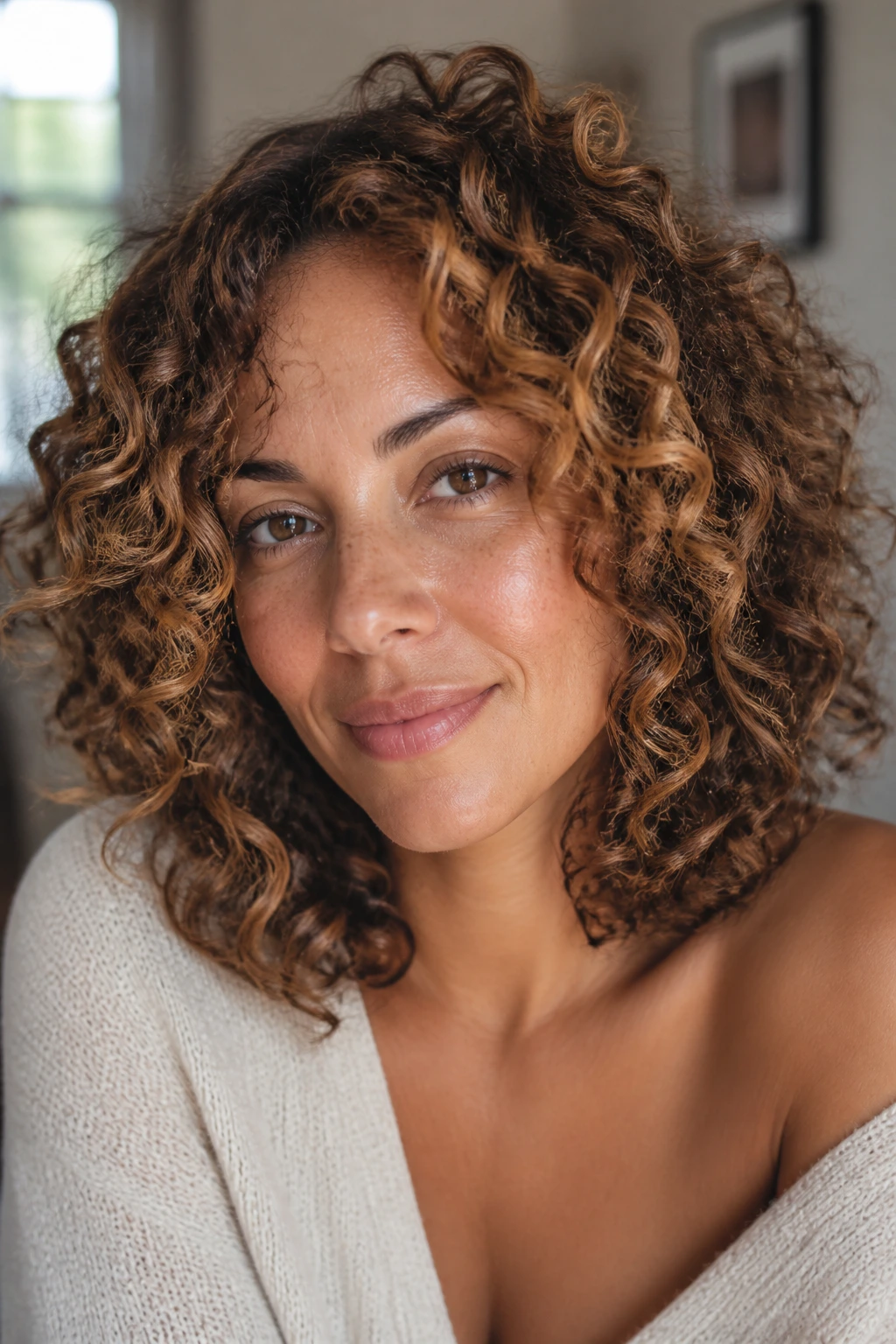
-
Medium length gives curls room to move: Hair that sits around the shoulders shows off the highlight placement on the top layers while still keeping the bottom from turning into a triangle.
-
Caramel reads as dimension, not damage: The warm brown-gold range adds contrast without the harsh jump you get from very light blonde streaks on darker curls.
-
These styles grow out well: Curly hair hides a lot of root line, so a good caramel placement can look polished for weeks without constant touch-ups.
-
The shape works for more than one curl pattern: Whether your texture is loose waves, springy spirals, or tighter coils, medium length can be cut and colored to show the lighter pieces where they matter.
-
You can go subtle or bold: A whisper of caramel around the face changes the whole mood of a cut; chunky ribbons through the crown make it louder. Same color family, different energy.
-
Day-two hair still looks intentional: Once curls loosen a little, caramel highlights keep the shape from collapsing visually. That little bit of light on the surface saves the style.
1. Collarbone Curly Lob with Side-Swept Caramel Ribbons
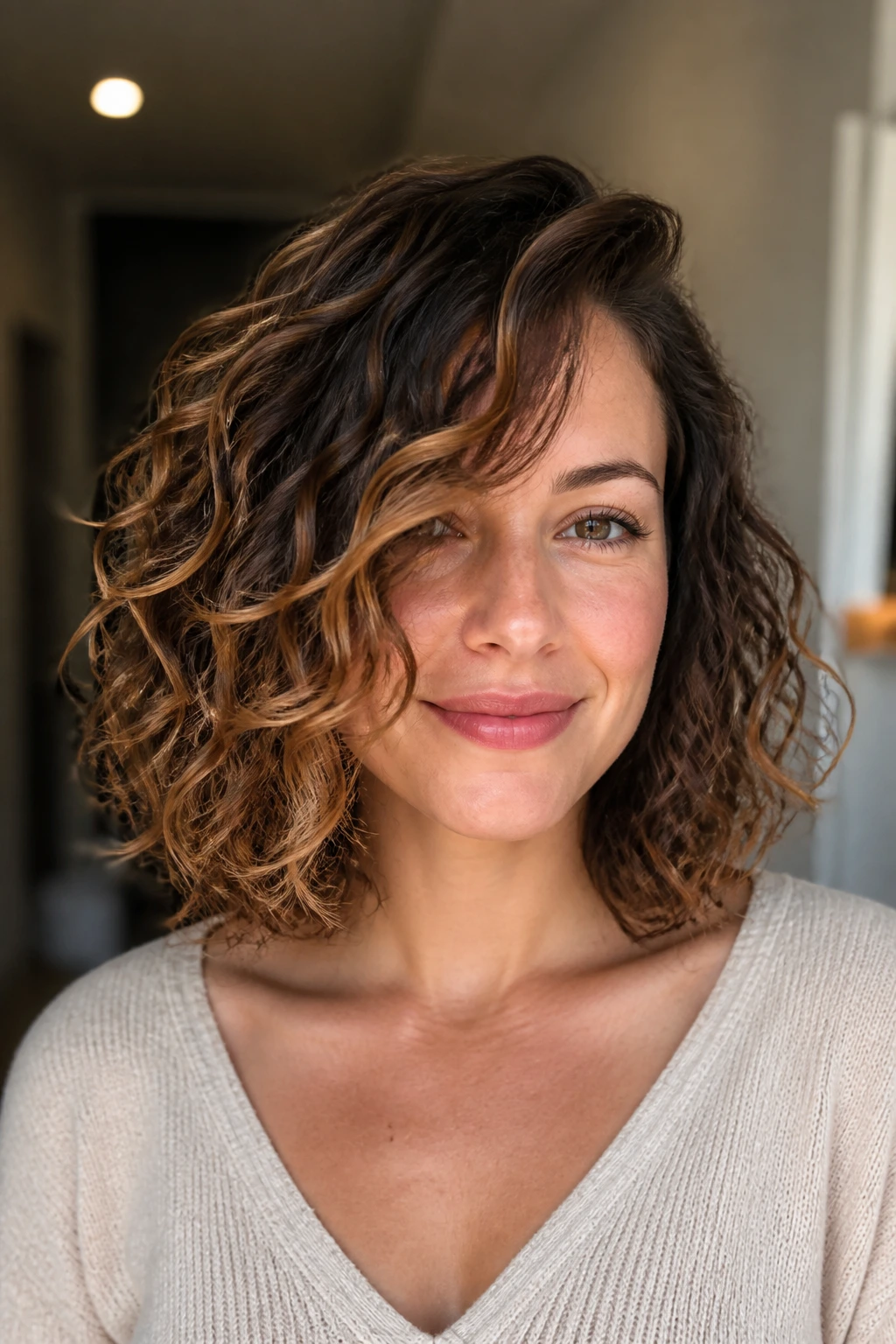
A collarbone-length lob is one of the safest places to start if you want caramel highlights on curly hair without overthinking it. The length gives the curls enough gravity to hang in a clean line, and the side-swept part lets the lighter pieces fall across the face instead of disappearing into the back.
Ask for ribbons that start a few inches below the roots and brighten the outer layer more than the underlayer. That keeps the color looking soft and lived-in, not stripey. If your hair is dense, this cut keeps the outline tidy. If it’s finer, the side part and face-framing pieces create the illusion of more movement.
Best with 3A to 3C curls, though wavy textures can wear it well too. A diffuser on low heat, a light mousse, and a bit of curl cream are enough to keep the shape from going limp.
2. Rounded Curly Shag with Sunlit Ends
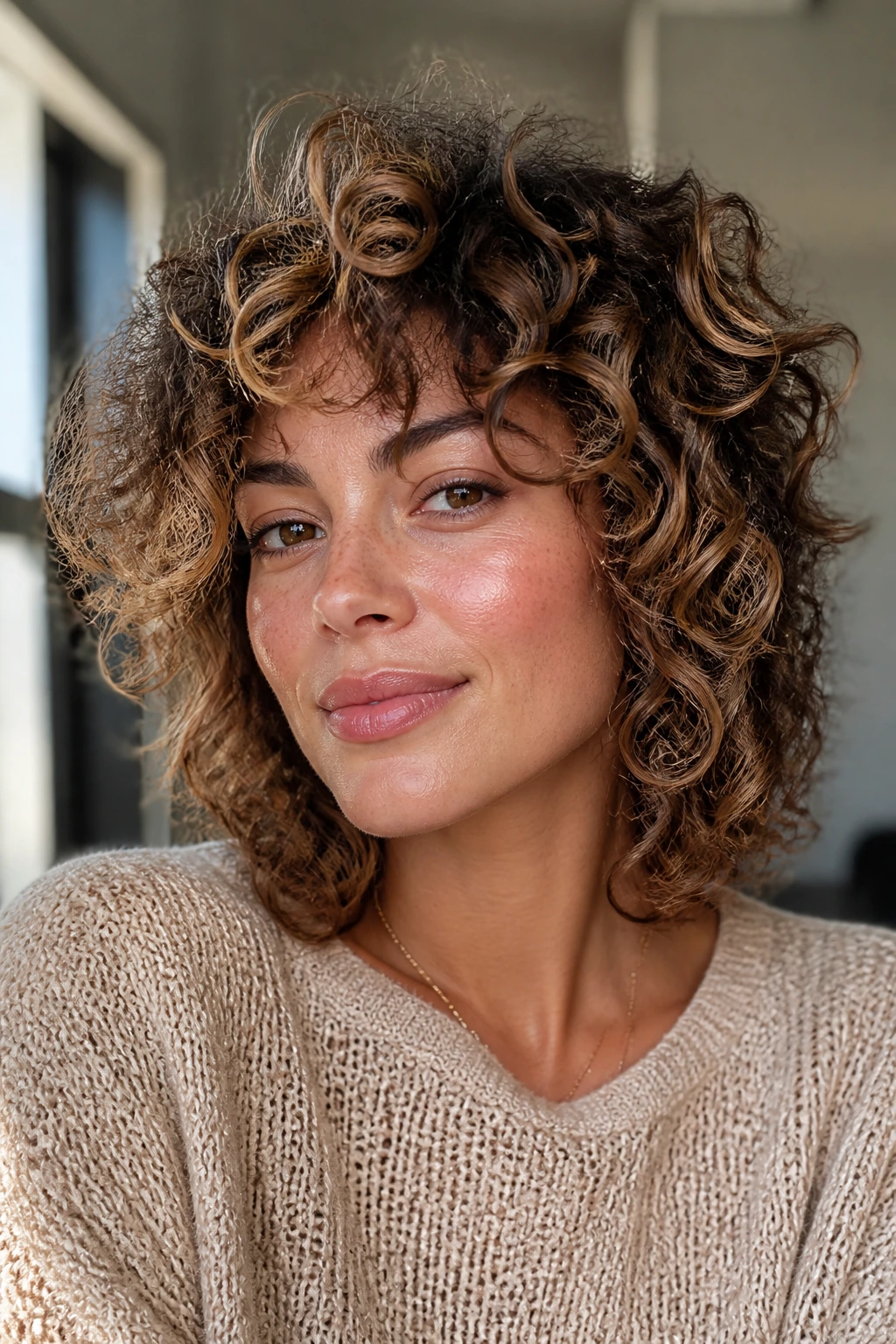
The shag can go wrong fast if the layers are too choppy. Done well, though, it gives medium curls that lifted, airy shape people keep trying to fake with a blowout. Caramel highlights make the layers easier to read, especially when they’re concentrated toward the ends and around the crown.
The rounded version is the one I’d choose for thick hair that likes to expand. It keeps the silhouette soft instead of boxy. Ask your stylist to keep some internal weight so the curl clumps stay together; if the layers are too aggressive, the highlights can start looking scattered.
This cut is especially good if your hair gets wider as it dries. The lighter ends pull the eye downward, and the result feels intentional rather than bulky. A little frizz at the edges doesn’t ruin it. In this style, it adds texture.
3. Deep Side-Part Shoulder Cut with Face-Framing Highlights
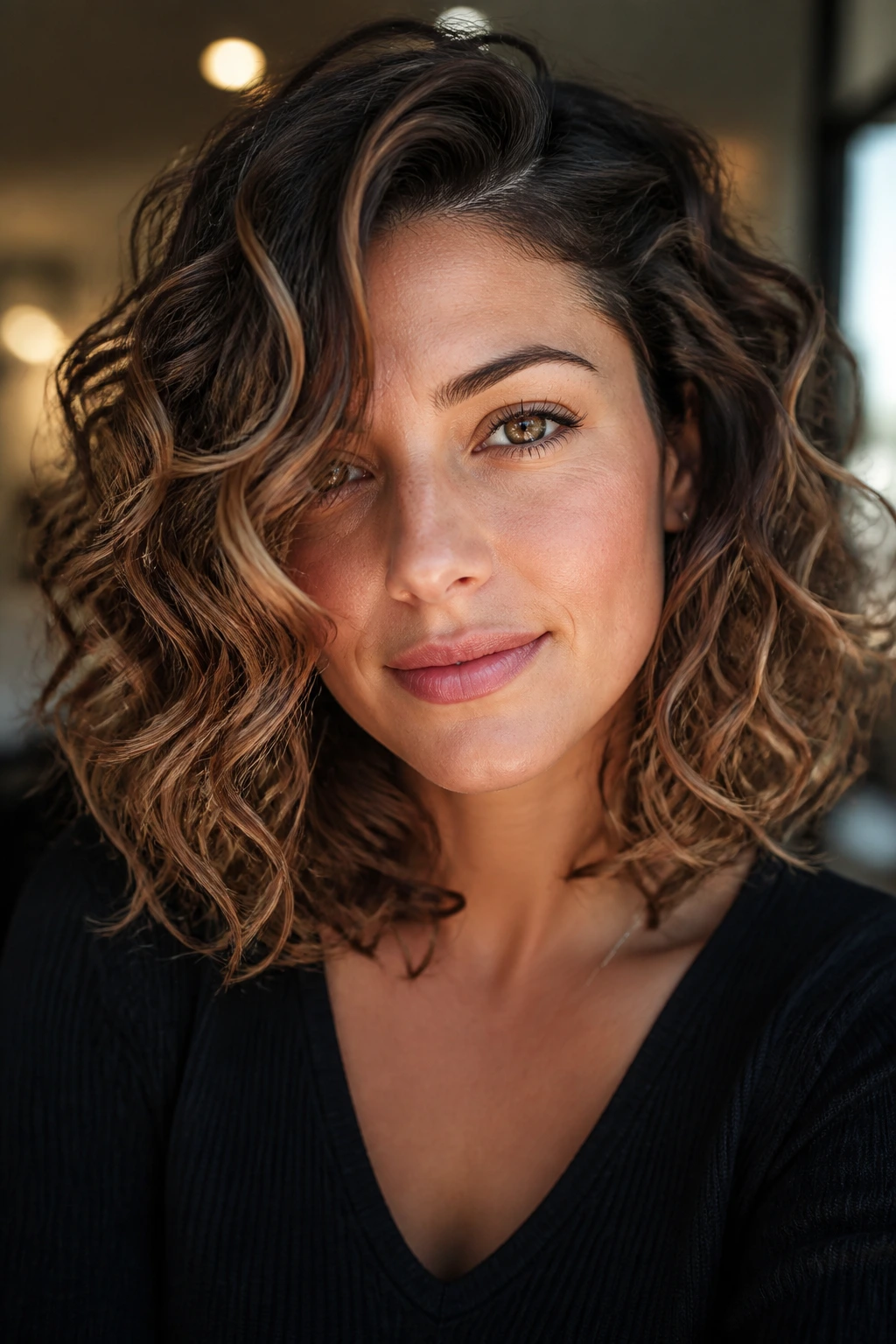
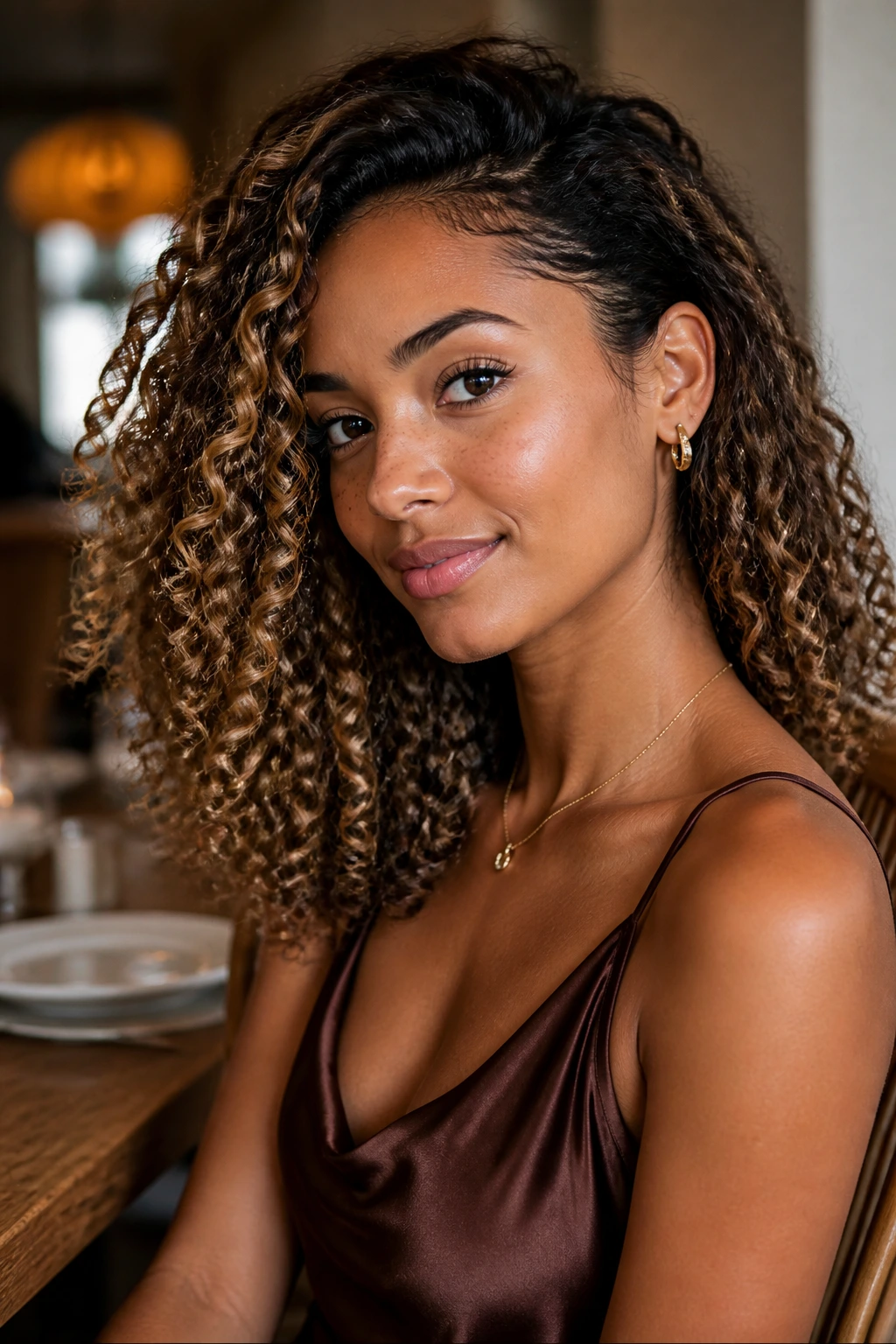
A deep side part is a cheat code for curls. It instantly creates lift at the roots, and with caramel highlights placed along the heavier side of the part, the whole cut looks more sculpted. That first bright section near the temple does a lot of work.
This is one of the easiest styles to wear if you want a polished look without much styling time. The asymmetry gives the eye somewhere to go, so even a basic wash-and-go can look considered. I’d ask for the lightest caramel pieces to sit around the cheekbone and jaw, not high up near the part line where they can look obvious.
If your curls are prone to flattening at the crown, clip the roots while drying. A few minutes with a root lift clip can make a bigger difference than another handful of product. Small move. Big payoff.
4. Soft Curly Lob with Invisible Layers
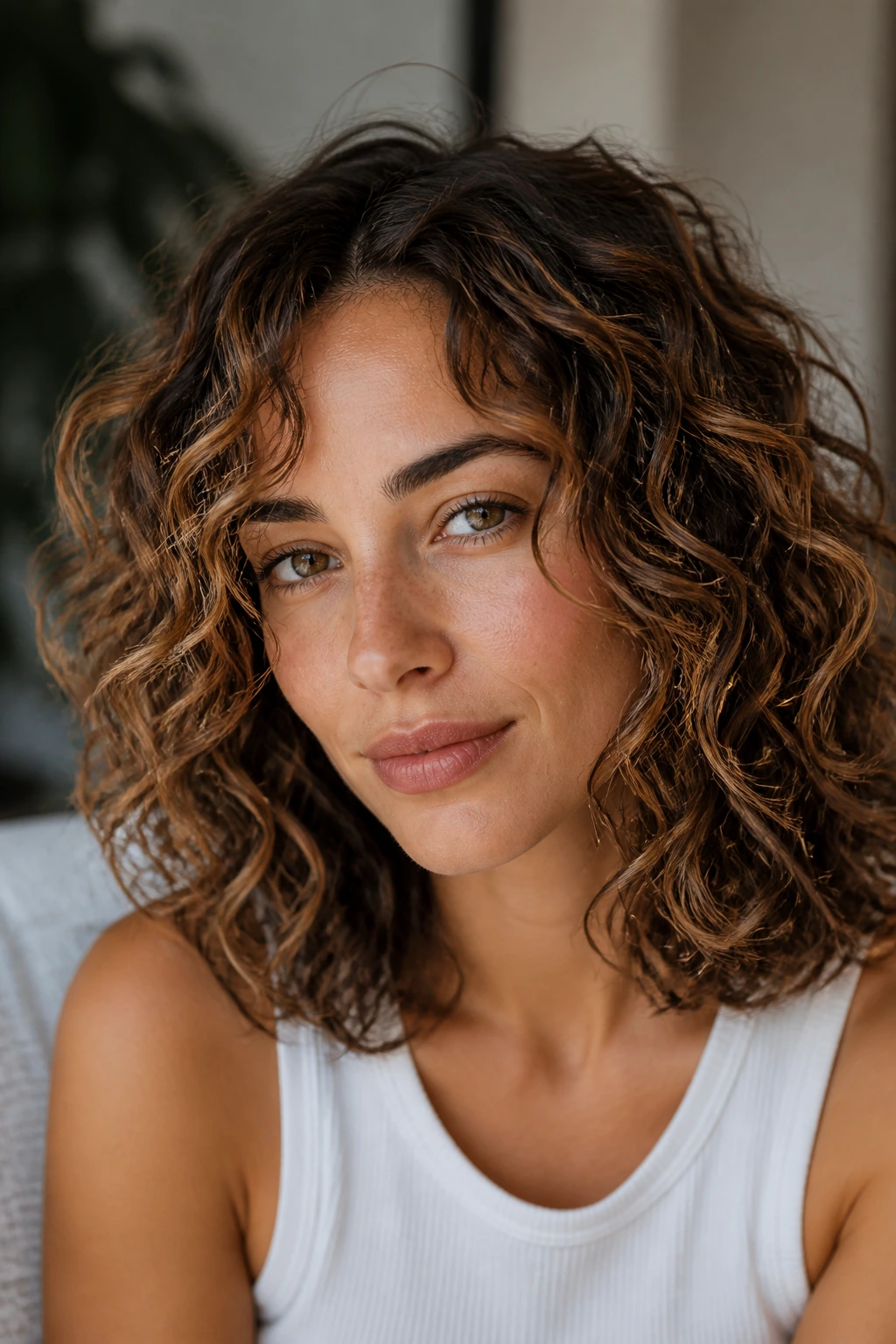
Sometimes the smartest haircut is the one that doesn’t announce itself. A soft curly lob with invisible layers keeps the line full while removing just enough weight for the curls to spring instead of drag. Caramel highlights add the shape that the cut itself doesn’t shout about.
This works especially well if you like your hair to look expensive in a quiet way. The caramel should be painted in thin, broken ribbons — not chunky stripes — so the color shifts as the curls move. On dark brown hair, beige caramel keeps the contrast from going too orange.
The clean outline makes this easy to wear at work, at dinner, or shoved into a clip. It’s one of the few curly styles that looks as good half-finished as it does fully styled. That’s not lazy. That’s useful.
5. Half-Up Twist with Loose Front Spirals
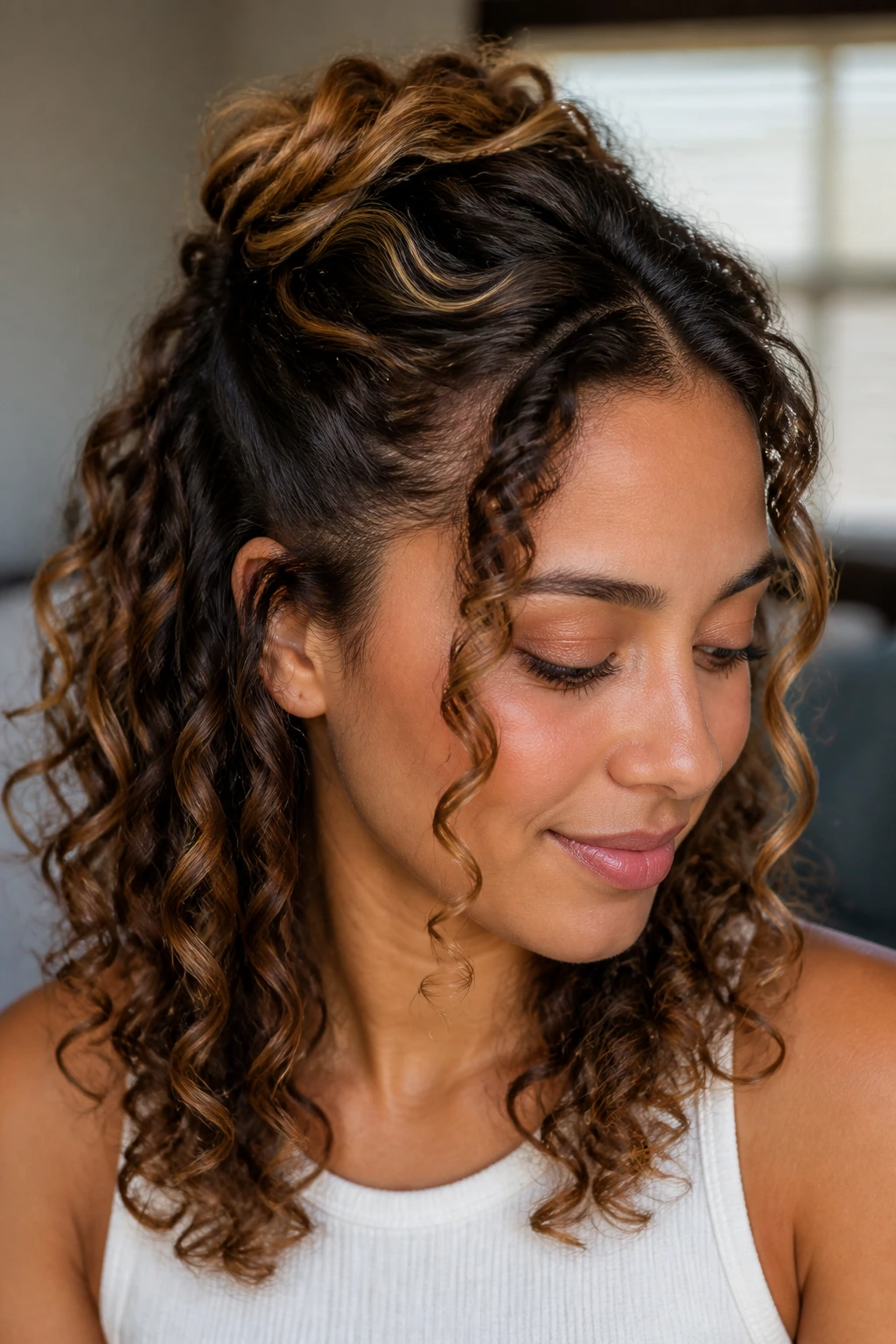
If you want a style that shows off caramel highlights without forcing every curl into the spotlight, the half-up twist is a smart move. Pull the top half back with a twist or two small sections pinned at the crown, then leave the front spirals loose so the lighter pieces frame the face.
This style is especially good when your highlights live around the hairline and top layer. It reveals them instead of hiding them under the bulk of the hair. A few loose tendrils around the temples keep it from looking too formal.
It’s also one of those styles that behaves better on second-day curls. A little curl refresher spray, a touch of mousse on the canopy, and you’re set. Don’t overpin it. The point is shape, not control.
6. Defined Wash-and-Go with Layered Caramel Pieces
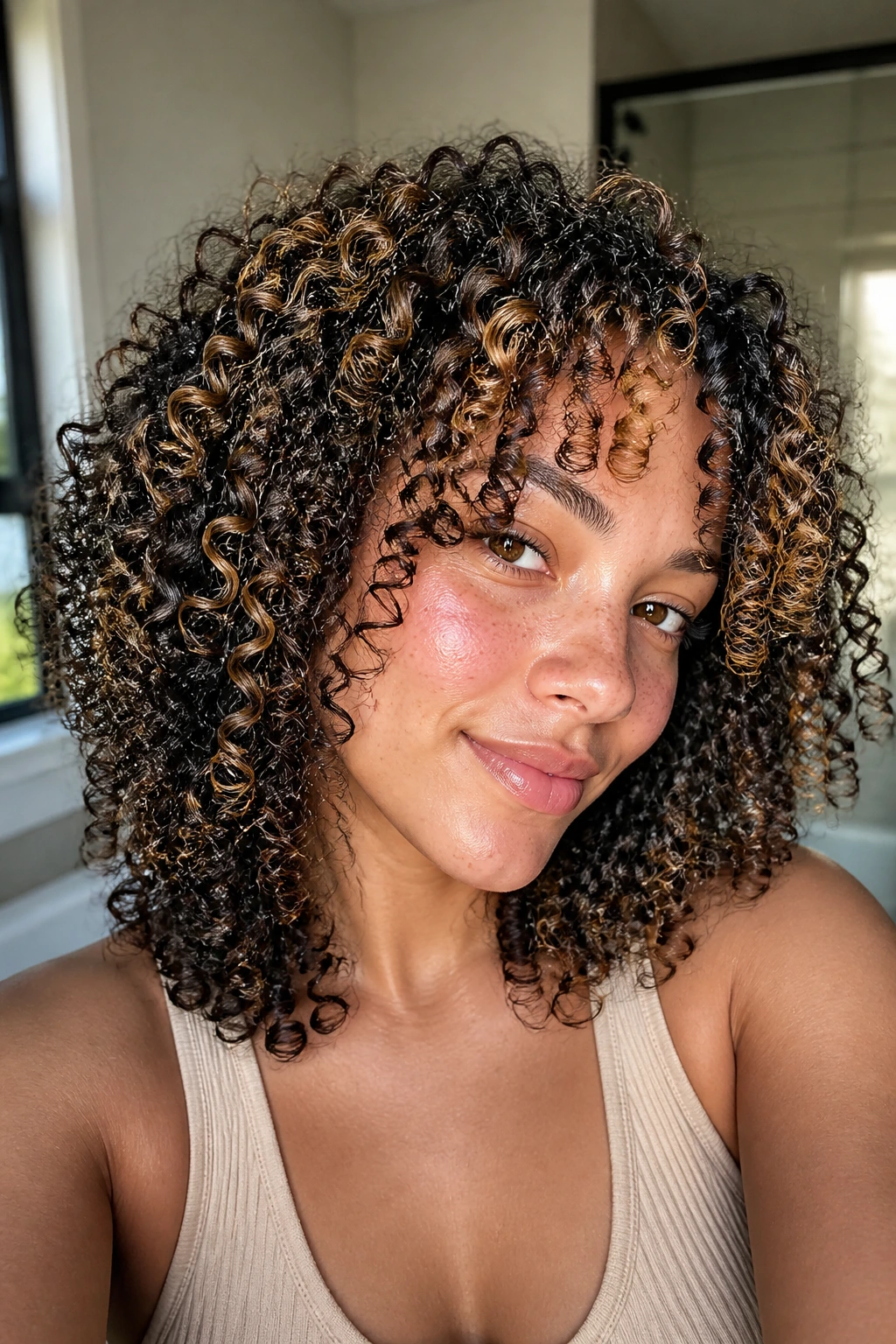
A good wash-and-go on medium curls can look almost too easy, which is exactly why the highlight placement matters. Caramel pieces layered through the top and outer sections give the style depth even when you haven’t touched it much beyond scrunching and diffusing.
This is the style for people who like their hair to look like curls, not a helmet. The layers should encourage clumping, not break it apart. Ask for highlights that follow the natural curl movement rather than crossing it. That means fewer harsh horizontal lines and more soft diagonals.
A wash-and-go also tells on your products. Heavy creams can dim caramel down to a dull brown, so keep the base light and let a little gel cast do the rest. Once the cast scrunches out, the color should still read clearly. If it doesn’t, the placement was too hidden.
7. Curly Wolf Cut with Chunky Highlight Panels
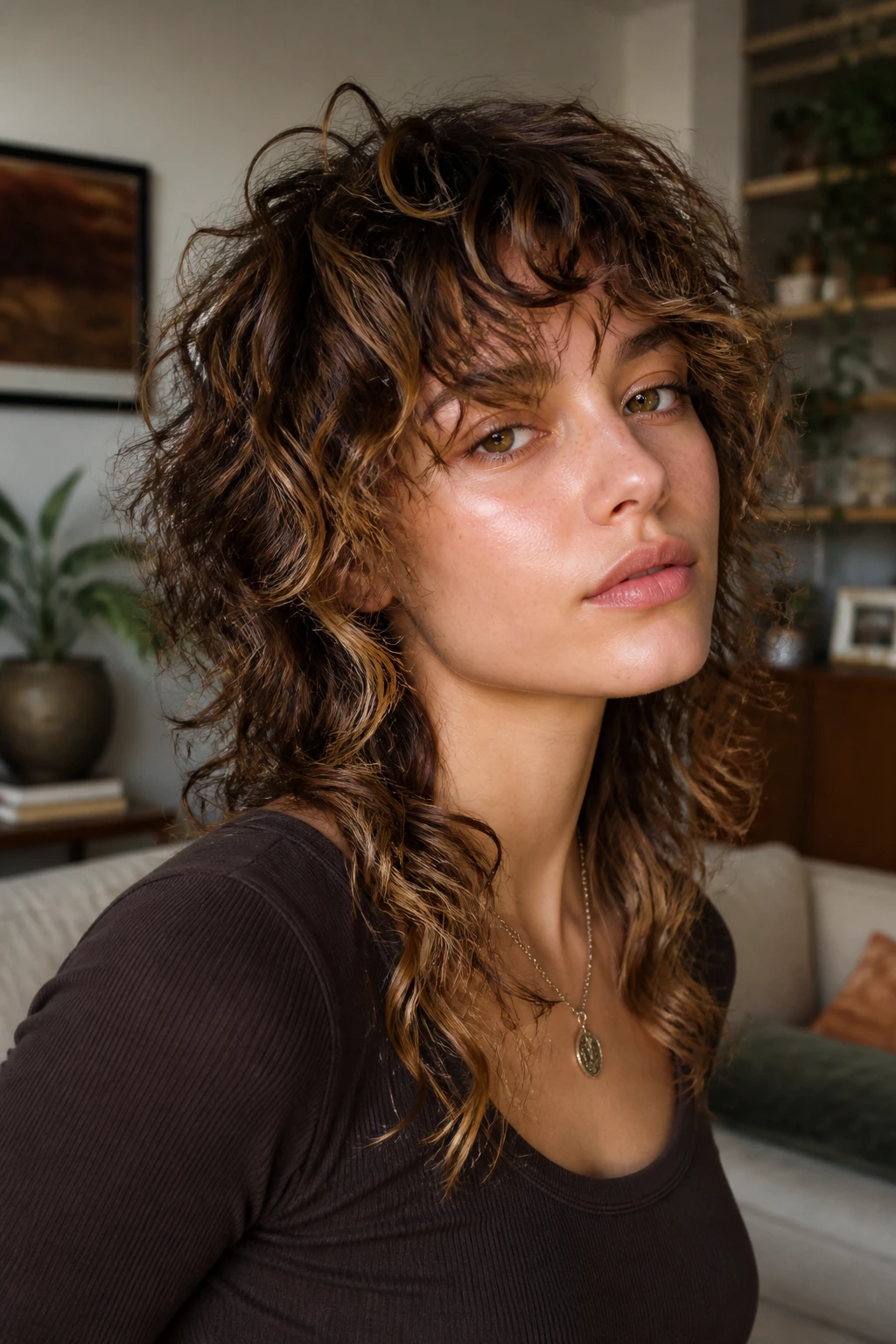
The wolf cut has attitude, and caramel highlights help it avoid looking like a random pile of layers. The shorter crown, longer bottom, and slightly rougher shape become easier to read when the color changes from panel to panel.
Chunkier caramel pieces work here better than tiny micro-highlights. You want the cut to feel a little rebellious, not delicately blended. Think of it as controlled mess. The color should hit the top layers, the sides, and a few of the longer underpieces so the shape looks broken up in a good way.
This is a stronger choice for people who don’t mind a style with edge. If your curls are very fine, keep the panels softer. If your hair is dense, the contrast can handle more drama.
8. Curly Curtain Bangs with Bouncy Layers
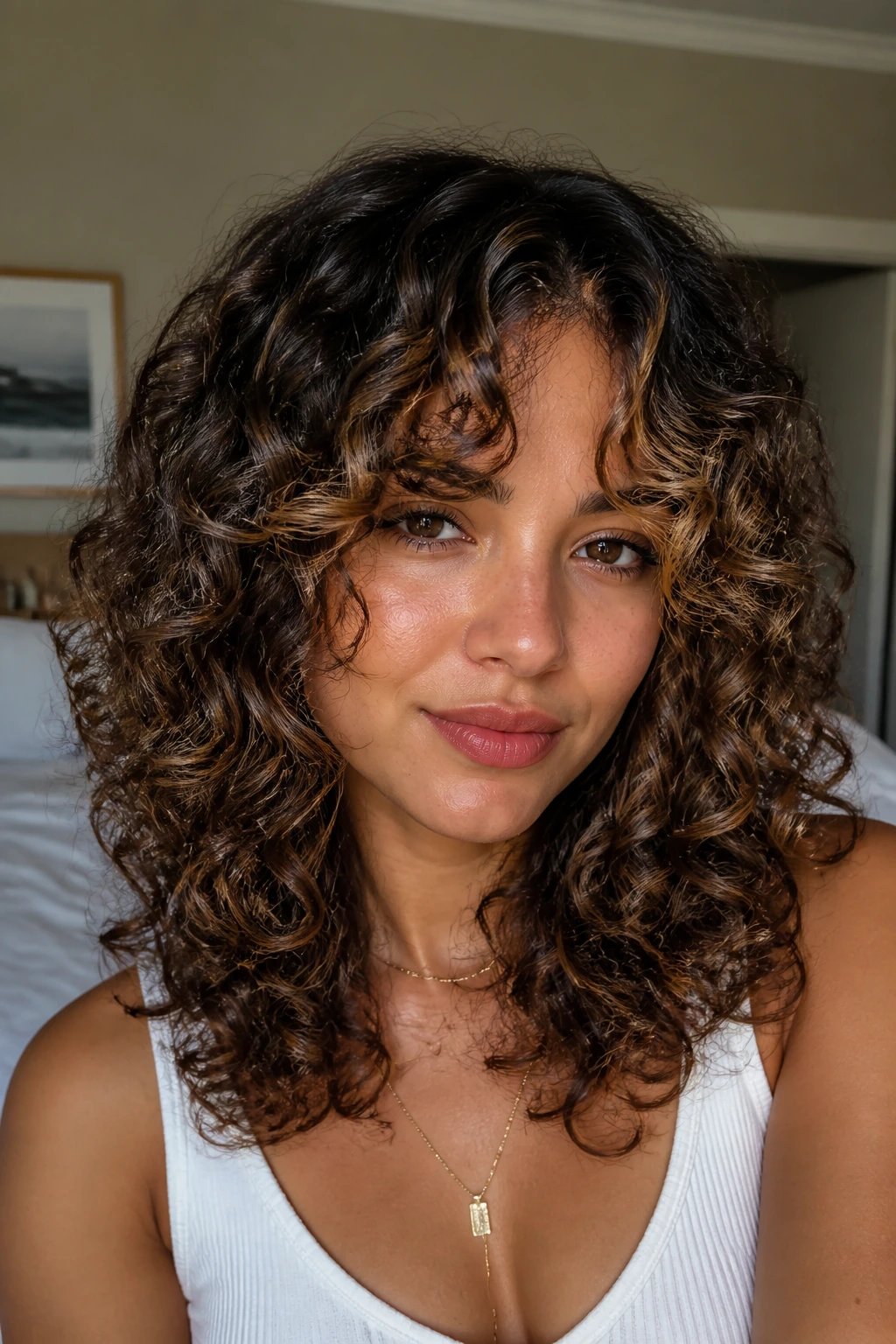
Curtain bangs on curly hair are tricky in exactly the way you’d expect: they can be gorgeous, then suddenly too short, too wide, or too puffy. With medium hair and caramel highlights, the whole thing gets easier because the bangs have lighter pieces to blend into instead of sitting in a dark wall of hair.
The best version keeps the bangs long enough to split at the center and curve away from the eyes. Ask for caramel around the front fringe and upper cheekbones. That keeps the bang area bright without turning it into a stripe.
These bangs do need a little daily attention. A round brush isn’t always necessary — finger-coiling the front pieces while they’re damp can be enough. If the front dries too flat, mist the bangs, scrunch, and let them settle again. Curly bangs have a mood. You work with it.
9. Pineapple Ponytail with Tapered Ends
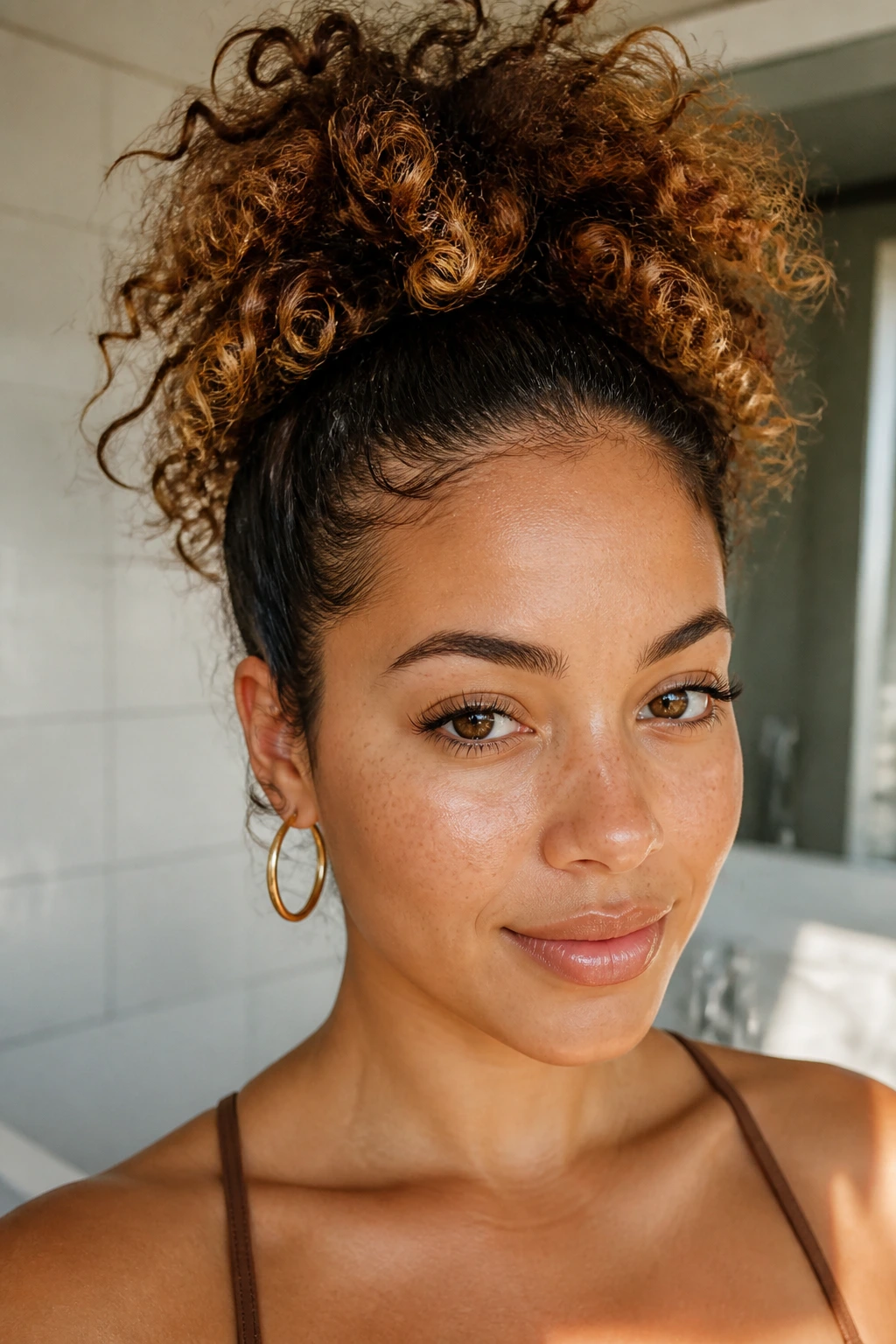
The pineapple ponytail isn’t just for sleeping. On medium curly hair, it can be a real style, especially when caramel highlights are concentrated toward the upper layers and ends. The lifted shape exposes the lighter pieces and gives the whole look some height.
Use a soft scrunchie or coil to secure it high but not tight. You want the base to sit loosely so the curls keep their shape and don’t get smashed at the crown. Leave a few curls around the front hairline if your highlight placement is strongest there.
This one is good when you need your hair off your neck but still want the color to show. It’s casual, but not sloppy. If the ends are highlighted, they’ll swing around enough to look deliberate even when the rest of the style is simple.
10. Twist-Out Lob with Honey-Caramel Dimension
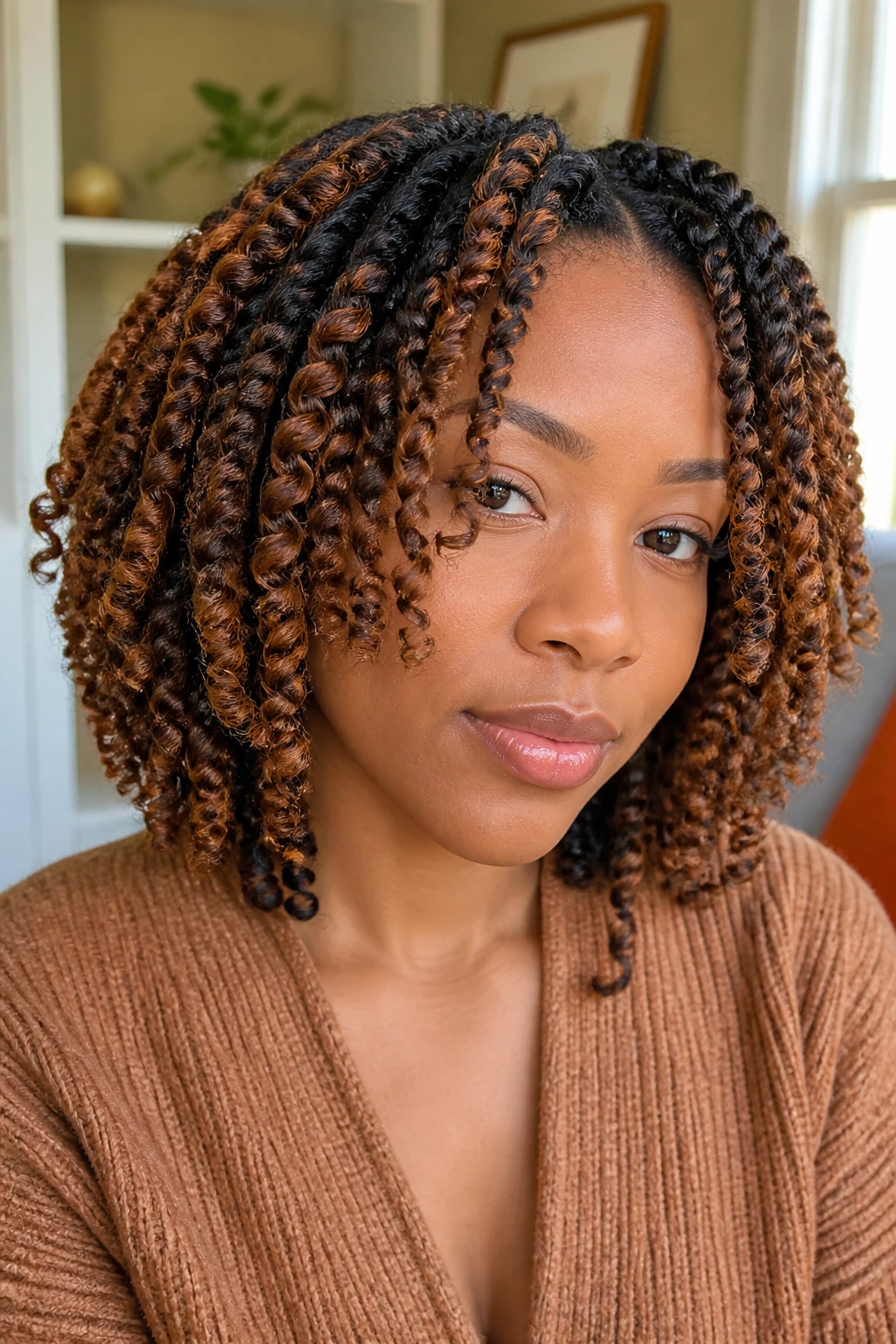
A twist-out on medium-length curls or coils gives the caramel a different kind of shine. The twist pattern creates those broad, glossy curves that pick up light better than tighter, more compact curls, so even subtle highlights can read clearly.
This style shines when the highlights are woven through the sections before twisting, not painted only on the outer edge. That way, the released pattern shows warmth inside the curl instead of just at the surface. Honey-caramel tones work especially well on deeper brown bases because they keep the finished look warm and rich instead of flat.
A twist-out also gives you control over volume. Smaller twists mean tighter definition; larger ones mean a looser, fluffier finish. Pick based on how much shape you want to keep for the next day, because day-two twist-outs have opinions of their own.
11. Side-Tucked Curls with Glossy Ends
Tucking one side behind the ear sounds almost too simple, but on medium curly hair it changes the whole balance of the cut. Suddenly the caramel around the face becomes the focal point, and the exposed side reads as clean and polished.
This works best when the highlights are strongest along the front third of the hair and a little brighter at the ends. The tucked side lets the deeper base color anchor the style, while the loose side carries the shine. Add a touch of gloss serum to the mid-lengths and ends only. Too much near the roots and the curls collapse.
I like this style for dinners, meetings, or any day when you want to look put together without spending twenty minutes negotiating every curl. It’s a small move. It changes the entire frame.
12. Angled Curly Lob with Bright Front Pieces
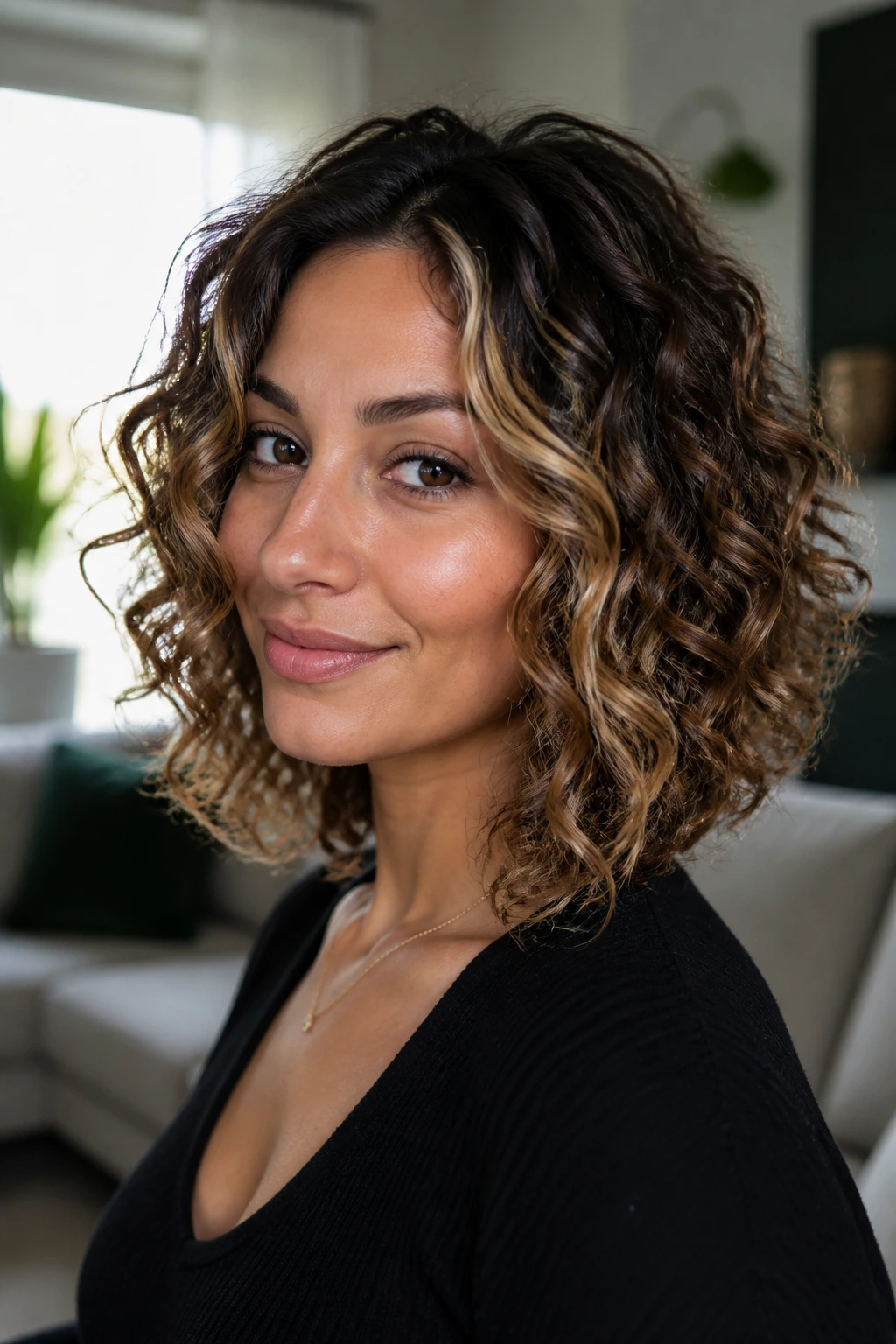
An angled lob is one of the cleanest ways to show off caramel highlights on curly hair. A little shorter in the back and longer in the front, it gives the curls an easy forward sweep that works especially well when the brightest pieces sit near the face.
The angle keeps the cut from feeling heavy at the jaw. That matters if your curls expand outward or your density is high. Ask for the caramel to start near the front layers and taper back toward softer tones in the rear. Otherwise the front can overpower the rest of the head.
This style feels sharper than a rounded lob, but not severe. It has shape without making the curls look rigid. If you like a haircut that still moves when you turn your head, this one does the job.
13. Tapered Medium Afro with Golden Caramel Picks
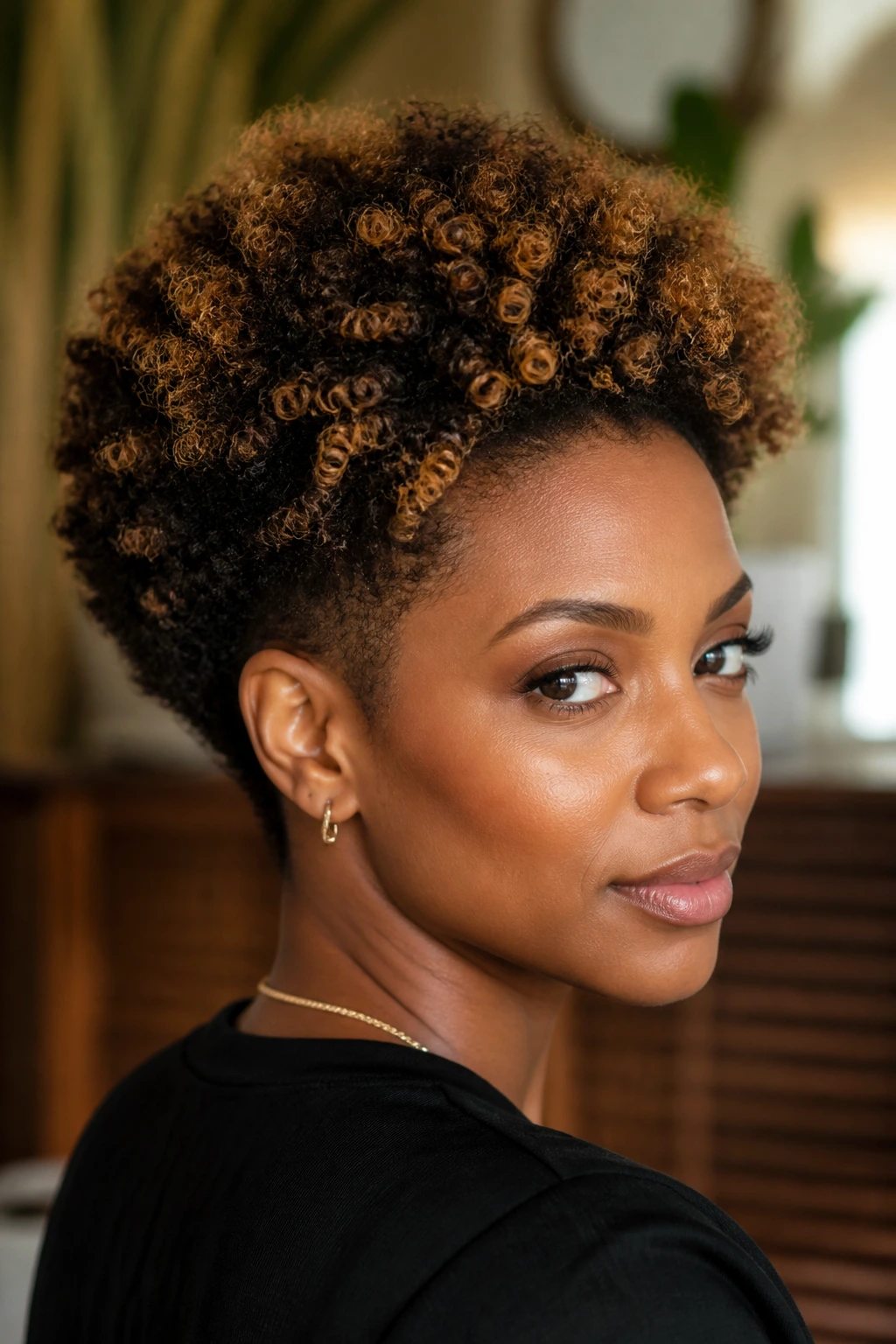
Tighter curls and coils look especially good with selective caramel highlights, not because more color is better, but because the contrast can be stunning when it’s placed with restraint. A tapered medium afro lets the shape stay full at the sides while keeping the profile clean.
Here, I’d skip all-over lightening. Use golden caramel picks on the outer surface, the top, and around the front hairline. That gives you sparkle without flattening the texture. The taper also makes the highlights easier to read because the shape has a clear outline.
This is the style to choose if you want warmth without losing the power of your natural volume. It reads confident. And if the colorist understands coil shrinkage, the result will look far more precise than anything done on stretched hair alone.
14. Low Puff with Defined Crown Curls
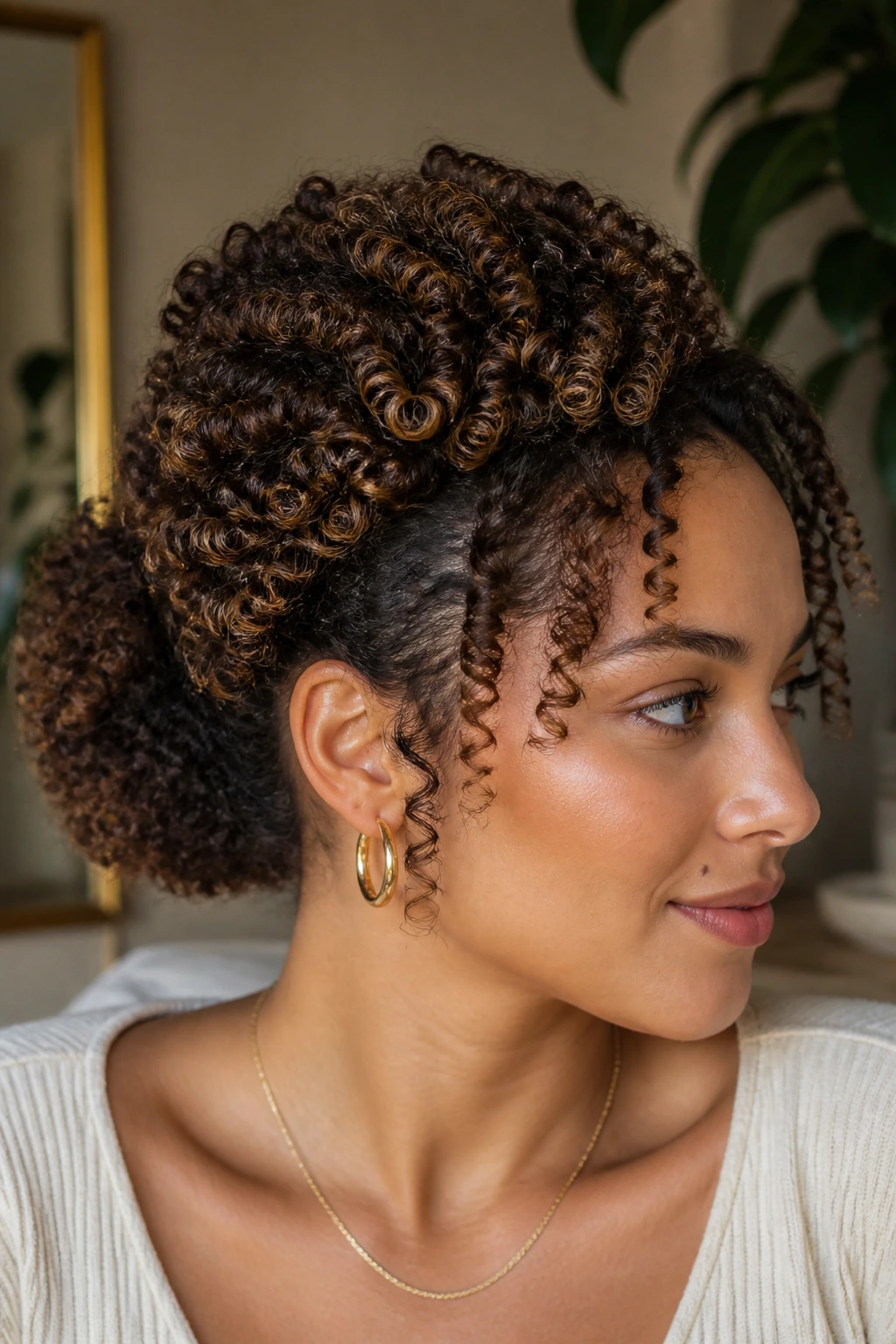
The low puff is easy to underestimate until you see it with caramel highlights at the crown. That little patch of lighter curls changes the whole top of the head, especially if the back and sides are kept neat and smooth.
The key is definition at the crown. Use a curl cream or gel that gives hold without crunch, then gather the hair low and secure it softly. Let a few highlighted curls stay loose around the front if your cut supports it. That breaks up the silhouette and keeps it from feeling too formal.
This style is practical, but it’s not plain. The highlight placement turns the puff into something more dimensional, and on medium-length hair the shape stays balanced instead of stretching too far up or flattening too much at the nape.
15. Invisible-Layer Cut with Soft Highlight Veils
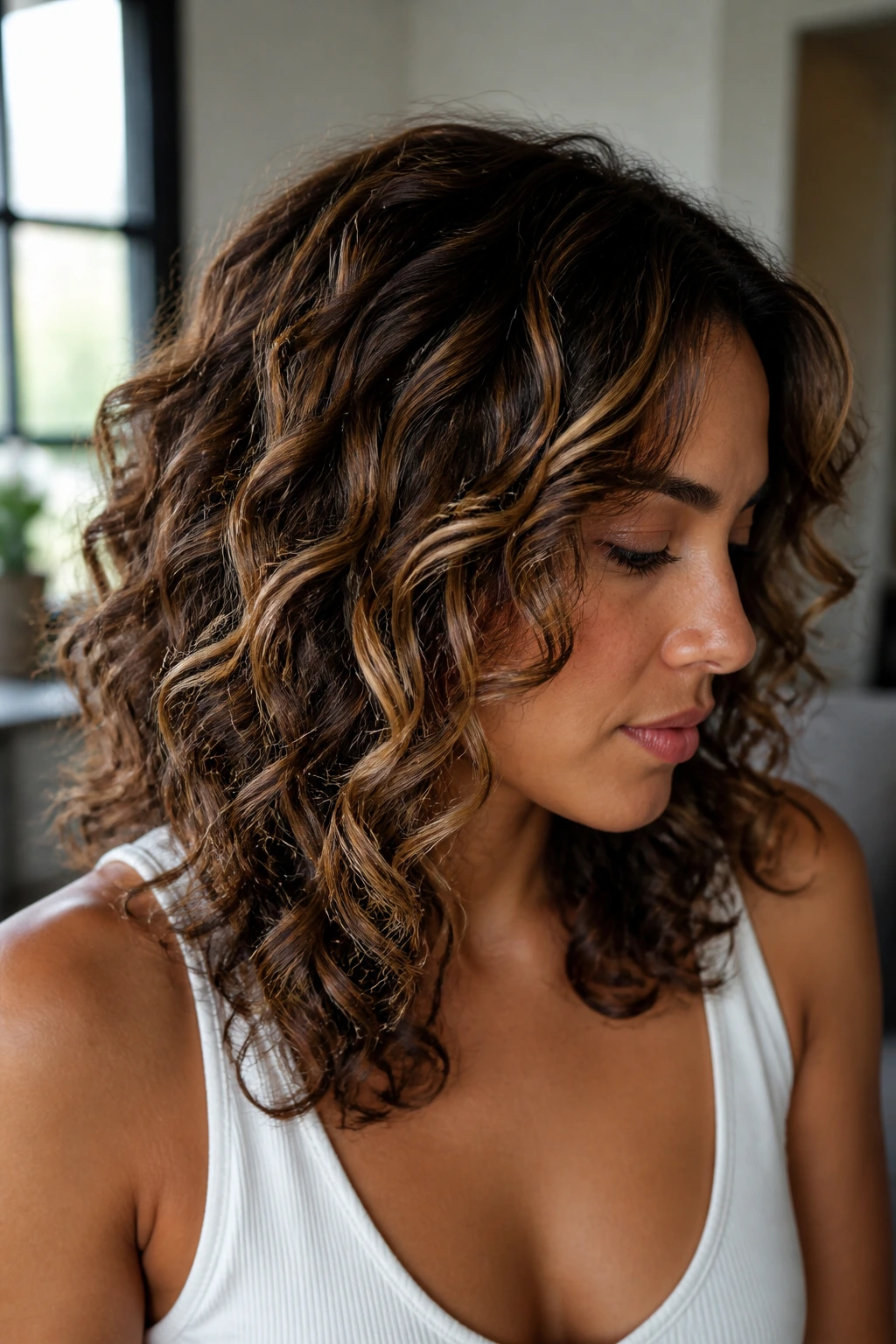
Invisible layers are one of those haircut tricks that most people notice only when the hair behaves well. On medium curls, they remove just enough bulk to improve shape while keeping the perimeter clean. Caramel highlight veils draped through the top and outer layers make that softness visible.
This is an ideal option if you want movement without obvious choppiness. The color should be feathered, not blocked. Think thin veils that appear and disappear as the curls separate. If your base is dark, a soft toffee tone keeps the finish warm and believable.
It’s a particularly good choice for anyone who hates the triangle effect but doesn’t want a heavily layered shag. The cut stays controlled. The highlights do the visual work.
16. Side-Swept Curly Style with a Clean Part
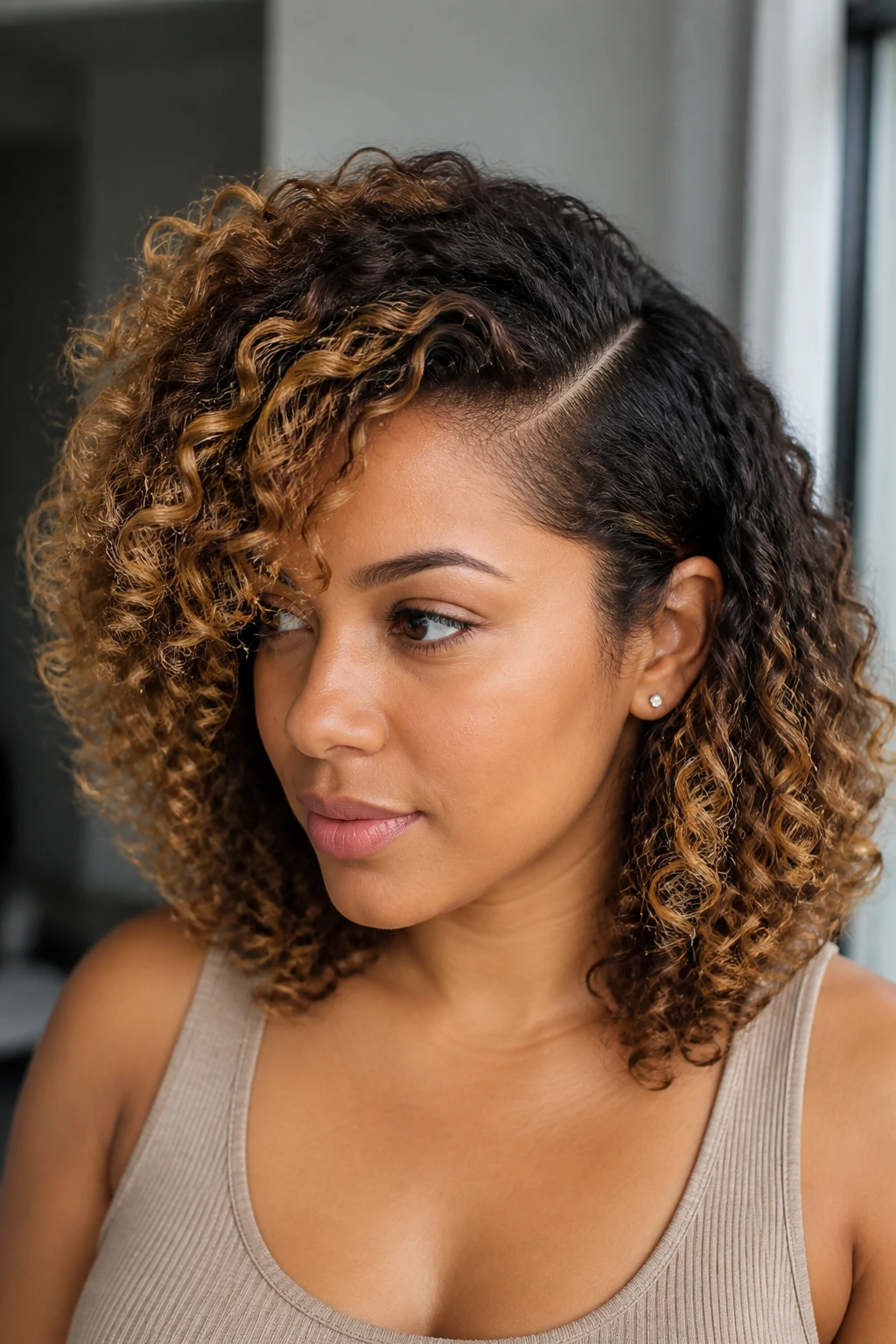
Some curly styles need a fresh part line to come alive. A side-swept shape with a clean part can do more for caramel highlights than a full restyle, because the lighter pieces stack visually instead of scattering across the head.
This works best when the highlight placement is a touch brighter on one side of the front panel. The side sweep lets that brightness glide across the forehead and temple. If you want extra polish, smooth the part with a dab of lightweight gel and finger-comb the top layer into the rest of the curls.
It’s a good evening style, but it also works on a regular day when the curls aren’t quite cooperating. A side part can save a wash day. Or at least save your patience.
17. Bubble Ponytail on Shoulder-Length Curls
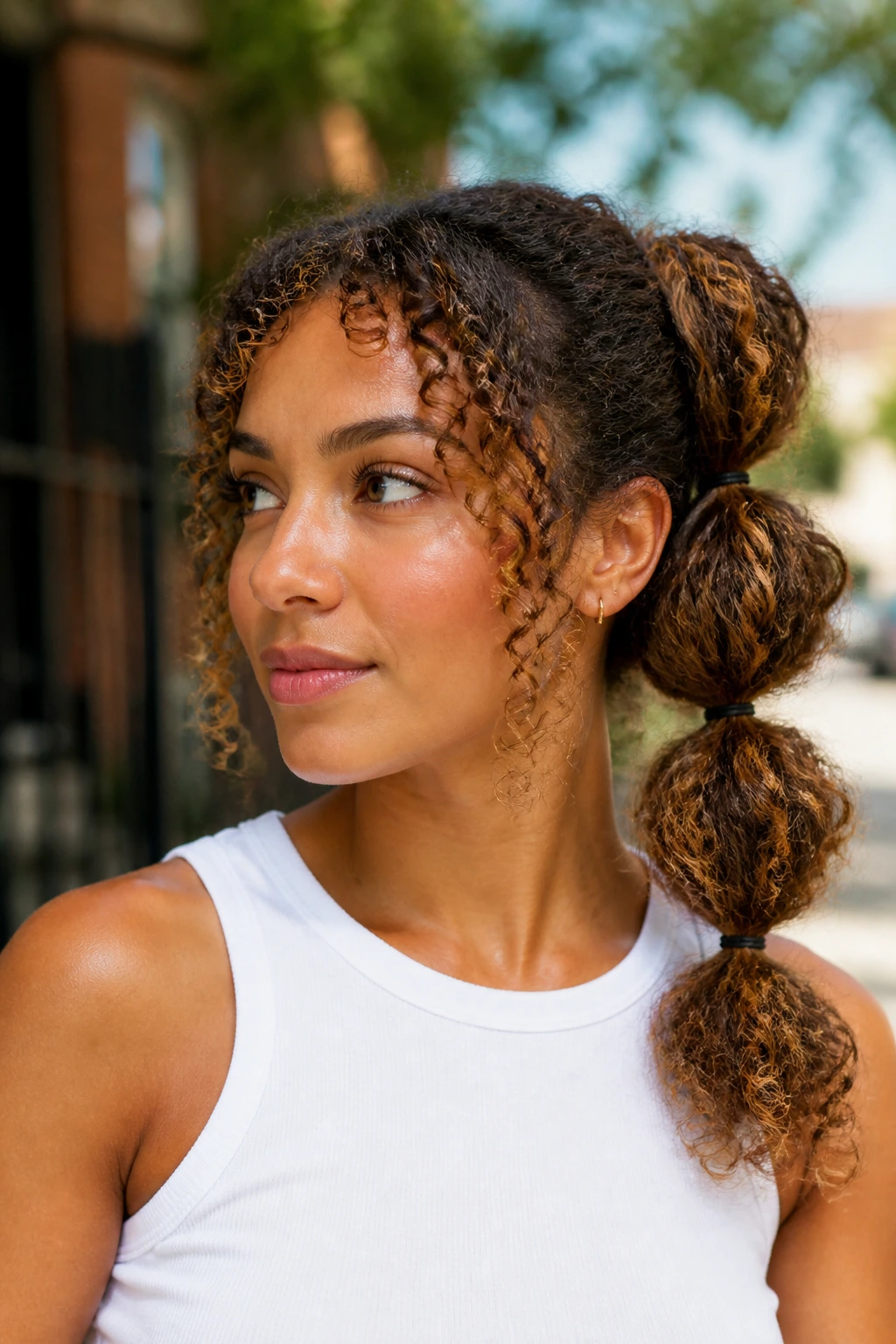
The bubble ponytail gives curly hair a fun shape without asking the curls to act straight. On medium length, the bubbles sit neatly and the caramel highlights show up inside each section, which is half the appeal.
Use small clear elastics or soft bands to create two or three bubbles down the ponytail. Gently pull each section outward so the curls keep some roundness. If the highlights are concentrated toward the ends, the bubbles show them off almost like stacked ribbons.
This one is good when you want movement but need the hair secured. It has a bit of personality. Not fussy, not flat. And because the curls are already adding texture, you don’t need to over-style it.
18. Curly Mullet Lite with Warm Balayage
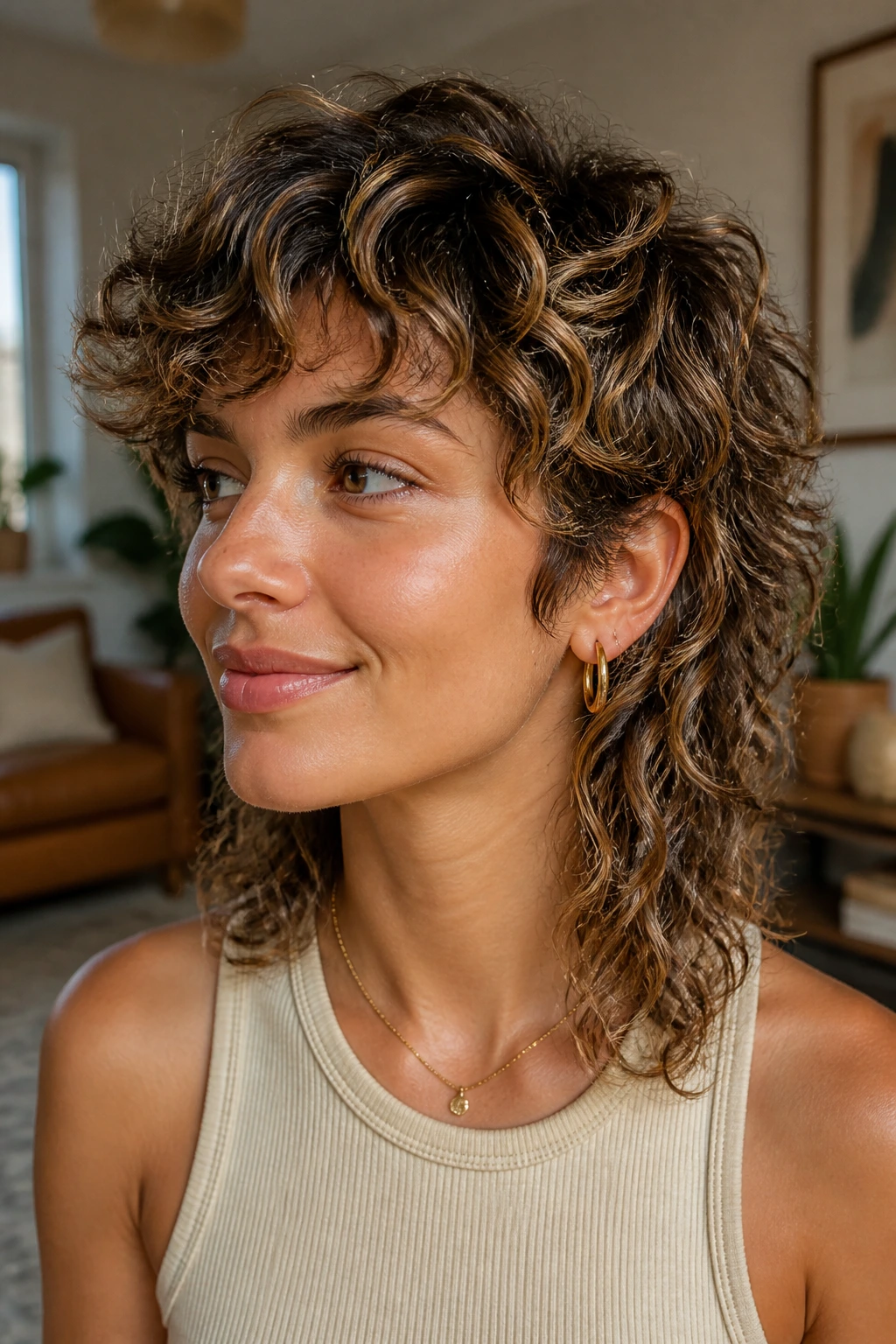
A full mullet on curls is a lot. The lighter version — the one I’d call a mullet lite — keeps the front and crown shorter while letting the back stay medium and layered. Caramel balayage softens the edges so the cut feels edgy rather than costume-y.
The trick is balance. Keep the front pieces long enough to frame the face, and let the back have movement without turning into a tail. Warm caramel tones help the shape feel modern because the color keeps the layers connected visually.
This style suits people who like a little edge and don’t mind a cut that gets comments. If you’re after something safe, skip it. If you want shape, texture, and a little swagger, it’s a strong pick.
19. Middle-Part Spiral Layers with Bronzed Ends
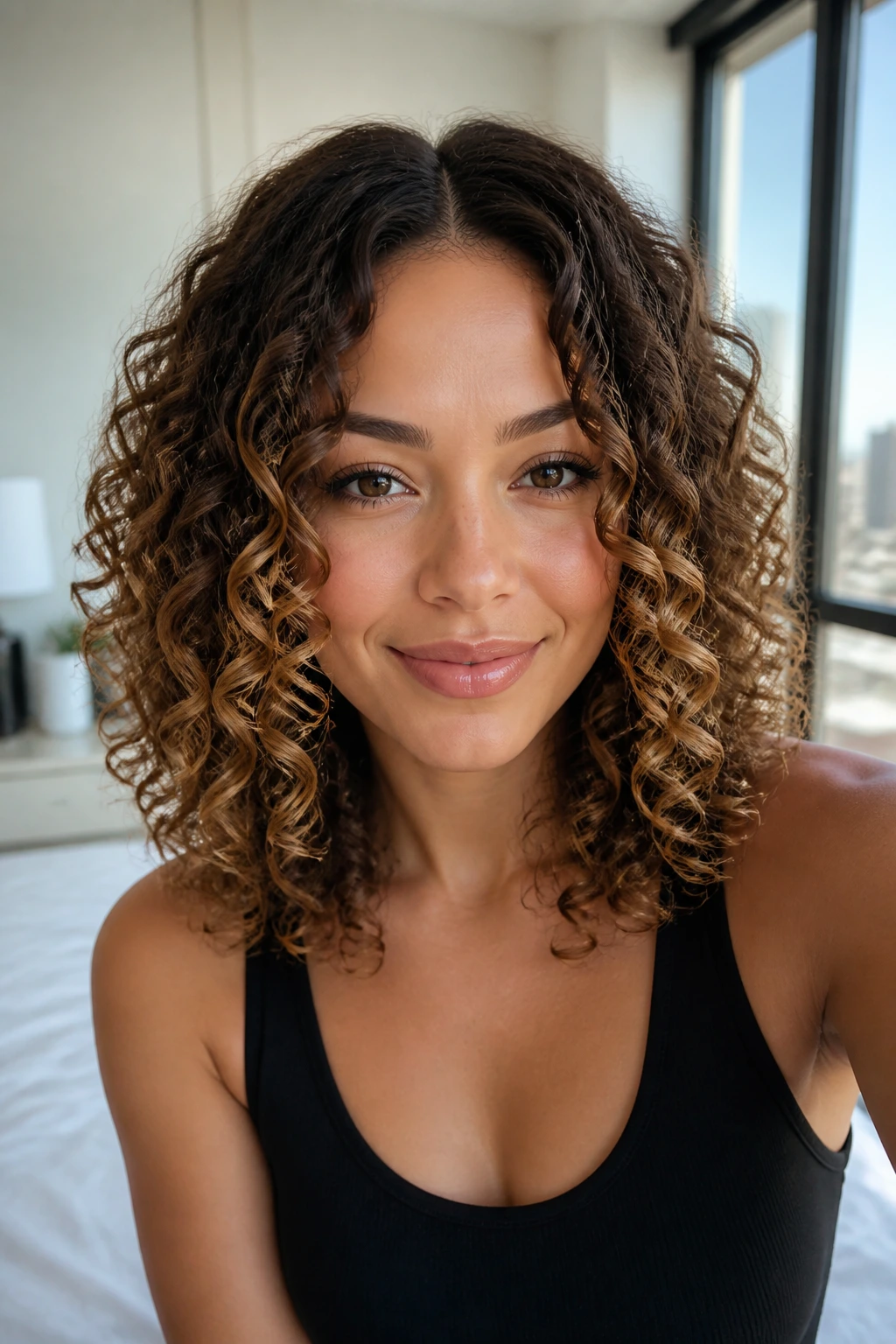
A middle part on curly hair is only boring if the cut underneath is boring. Spiral layers plus caramel-bronzed ends create a clean, centered shape that feels balanced rather than severe. The lighter ends keep the style from reading as one heavy block of color.
This is one of the best options for medium hair that naturally wants symmetry. The curls fall on both sides, the highlight placement stays visible as the hair moves, and the bronzed ends soften the line around the shoulders. Ask for enough layering that the curls stack instead of dragging.
If you wear glasses, this shape can look especially good because the curls and the frames sit in clean, separate zones. No fighting for attention. They can share the space.
20. Loose Curly Updo with Highlighted Tendrils
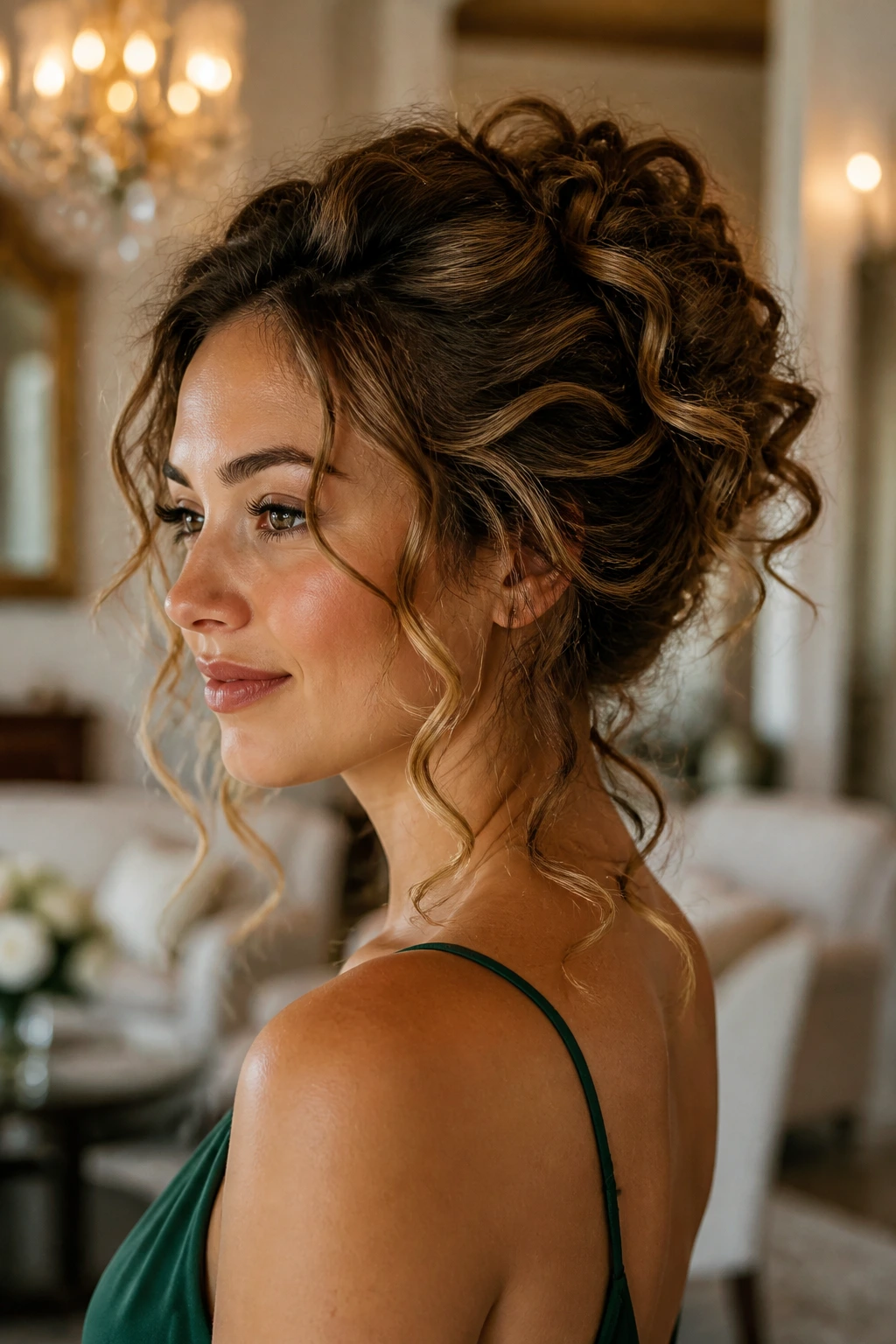
A loose updo on medium curls gives caramel highlights a chance to frame the face instead of hiding in the bulk of the style. The tendrils are the point here — those little highlighted pieces around the temples and neck keep the whole thing from feeling stiff.
Pull the curls up gently, pin them where they naturally want to sit, and let the top keep some volume. The updo should look arranged, not squeezed. If the highlights are concentrated on the outer layer, the pinned shape will still show enough contrast to feel finished.
This is one of my favorites for weddings, dinners, and anything that needs a little more polish. It doesn’t fight the curl pattern. It lets the pattern help the style.
21. Flip-Out Layers with Caramel Around the Face
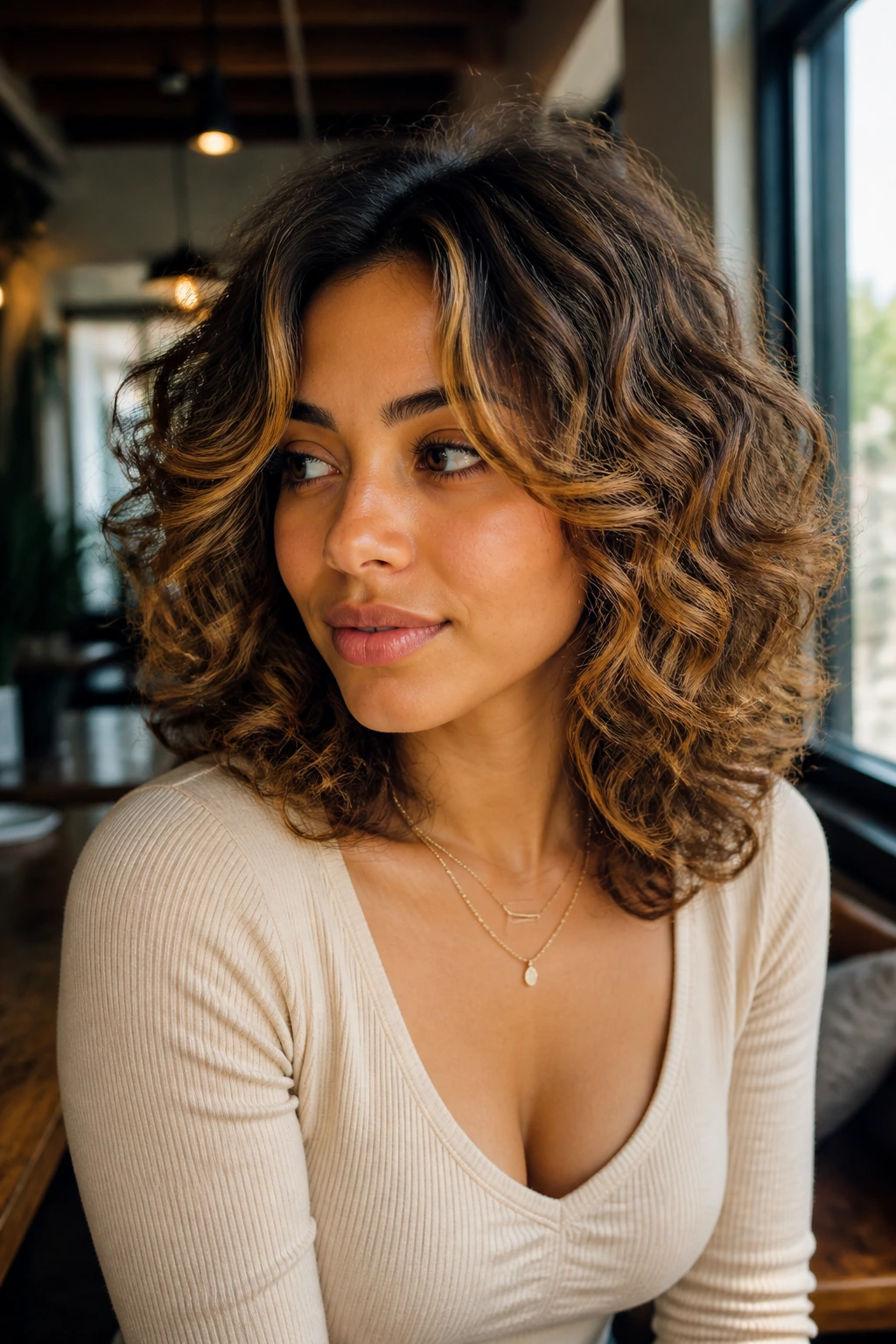
Flip-out layers on curly hair give the ends a playful outward motion that pairs well with warm caramel pieces. The highlight placement around the face keeps the style from feeling too retro or too rigid. It lands somewhere between soft blowout and lived-in curl.
This cut looks especially good when the ends have enough length to bend rather than spring straight up. If your curls are looser, a round-brush diffuse can encourage the flip. If they’re tighter, finger-coiling the front pieces while damp can help guide the shape.
The face-framing color matters here because the flipped ends can sometimes hide the interior of the cut. Brightening the perimeter keeps the shape visible from the front, which is where most people are actually looking.
22. One-Sided Tuck with Clean Volume
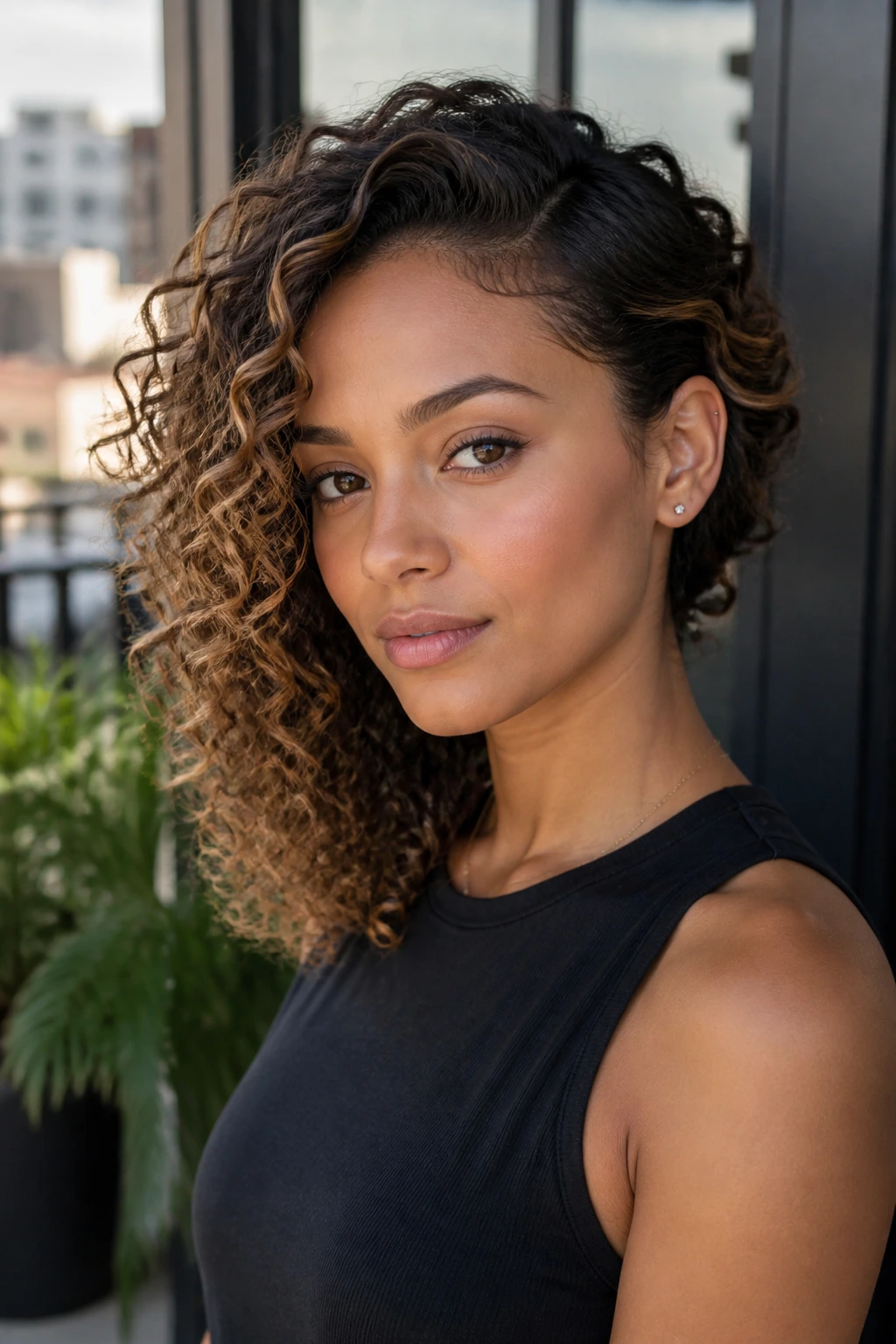
The one-sided tuck is a style for people who want a fast fix that still looks deliberate. Sweep one side back with a pin or a decorative clip, leave the other side loose, and let the caramel highlights do the talking across the open side of the face.
This works best when the cut has enough layering to keep the loose side buoyant. If the hair is too blunt, the tuck can feel heavy. If the hair is too thin, it can fall flat. Medium curls tend to land in the middle, which is why this shape works so well here.
A tiny bit of edge control near the temple can make the tuck cleaner without making the style stiff. That small detail matters more than people think.
23. Dimensional Peekaboo Highlights Under Medium Curls
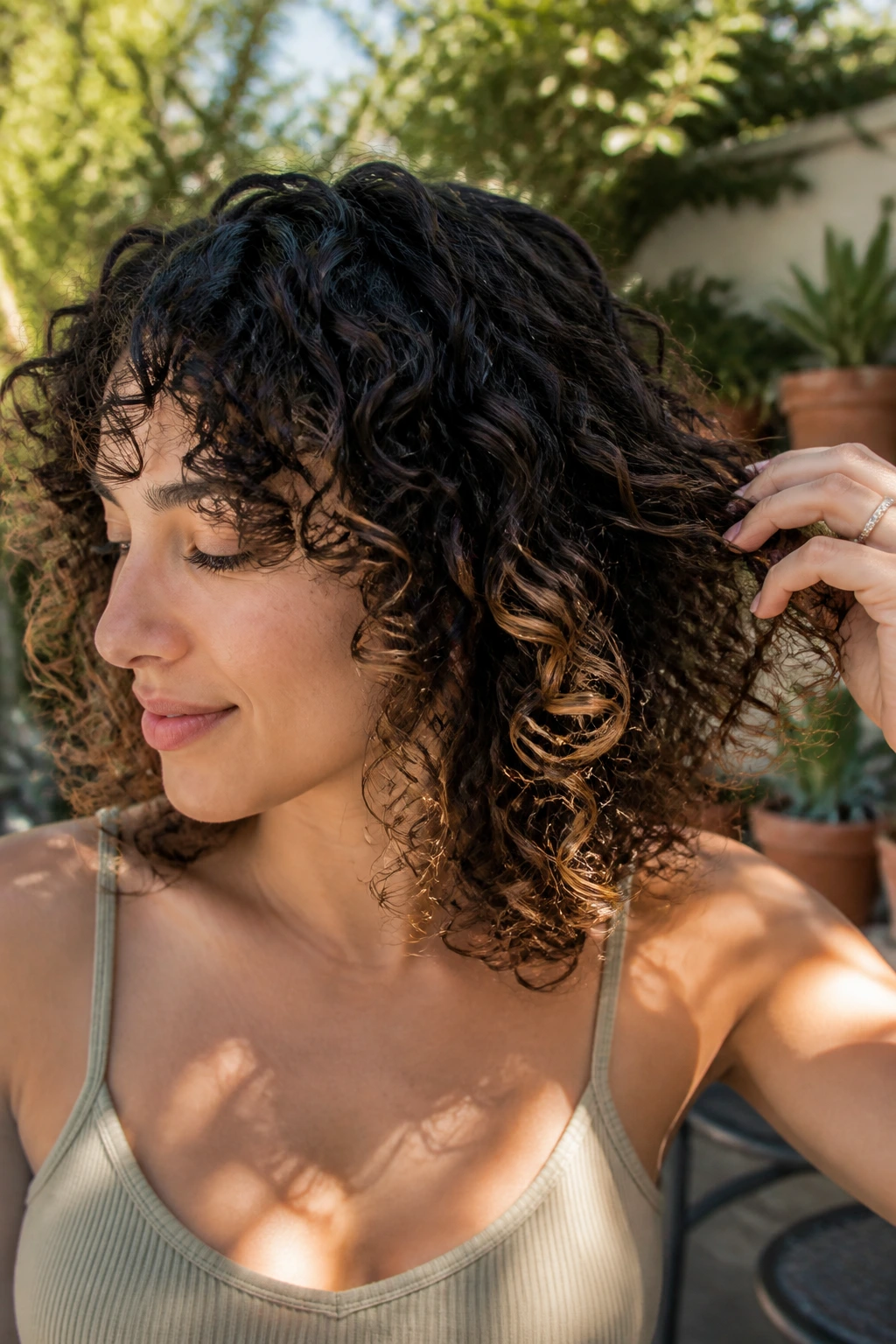
Peekaboo highlights are for the person who wants warmth and dimension without making the color obvious in every curl. On medium hair, caramel placed under the top layer creates movement when the curls shift, and surprise when the hair lifts.
This approach works especially well if you wear your curls loose but want something a little more interesting than surface-only painting. The top stays mostly natural, while the hidden caramel flashes through underneath. Add a few lowlights if your base color needs depth. Otherwise the lighter bits can float too far from the rest of the hair.
It’s one of the best ways to keep curly color looking expensive on grown-out hair. Soft roots, hidden warmth, less maintenance. Good trade.
24. Braided Crown into Free Curls
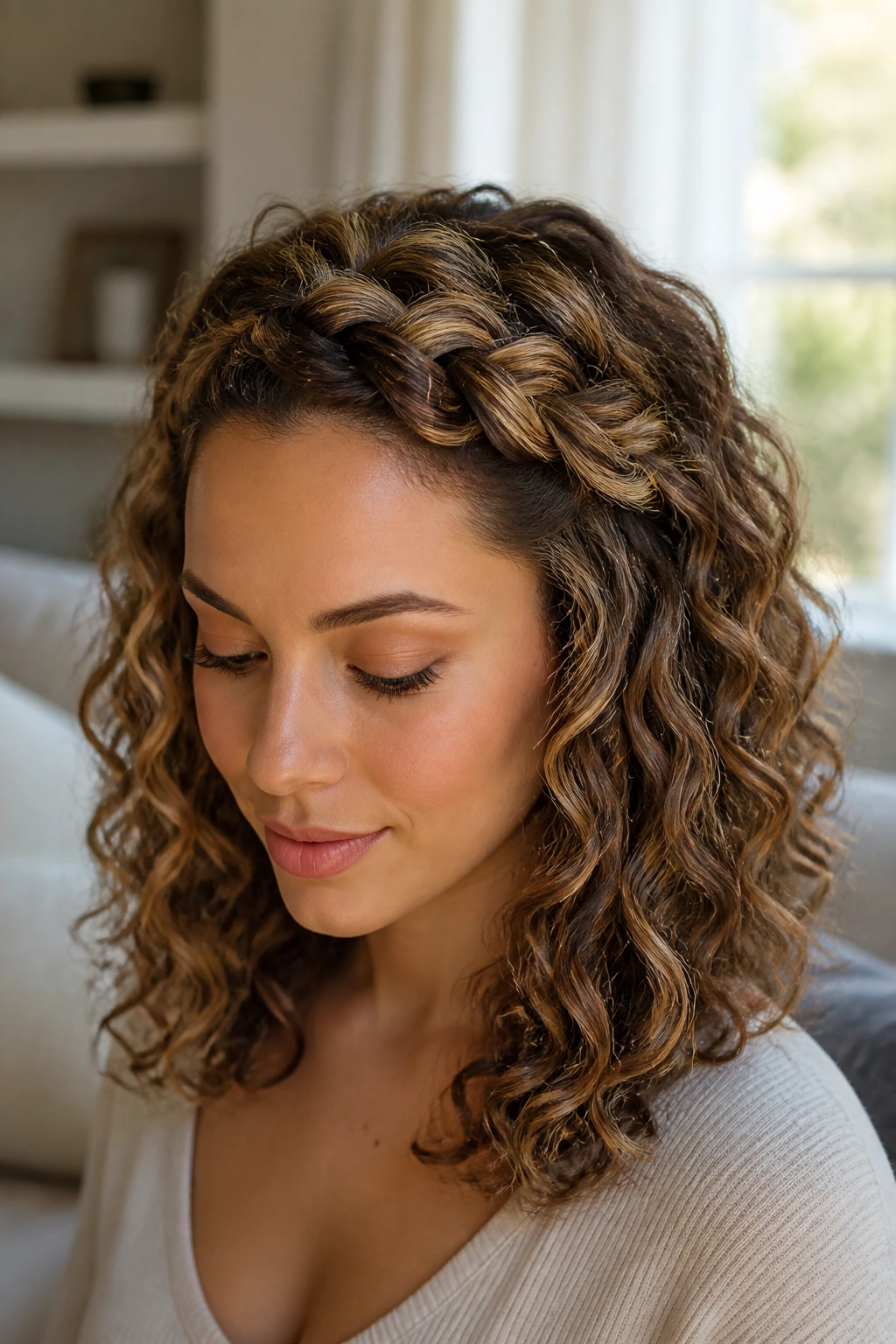
A braided crown on medium curly hair gives structure to the front while leaving the rest of the curls loose and dimensional. Caramel highlights make the braid pattern easier to see, especially if the lighter strands are woven through the front and top sections.
The braid doesn’t need to be tight. In fact, it looks better a little soft and full, with the curls around it still lively. Once the crown is in place, let the rest of the curls fall naturally. The contrast between controlled top and free lengths is what makes the style work.
This is a nice option for humid days, special events, or just when you want the front of your hair off your face without putting the whole head up. It’s practical with a decorative streak.
25. Airy Shoulder-Length Curls with Seamless Balayage
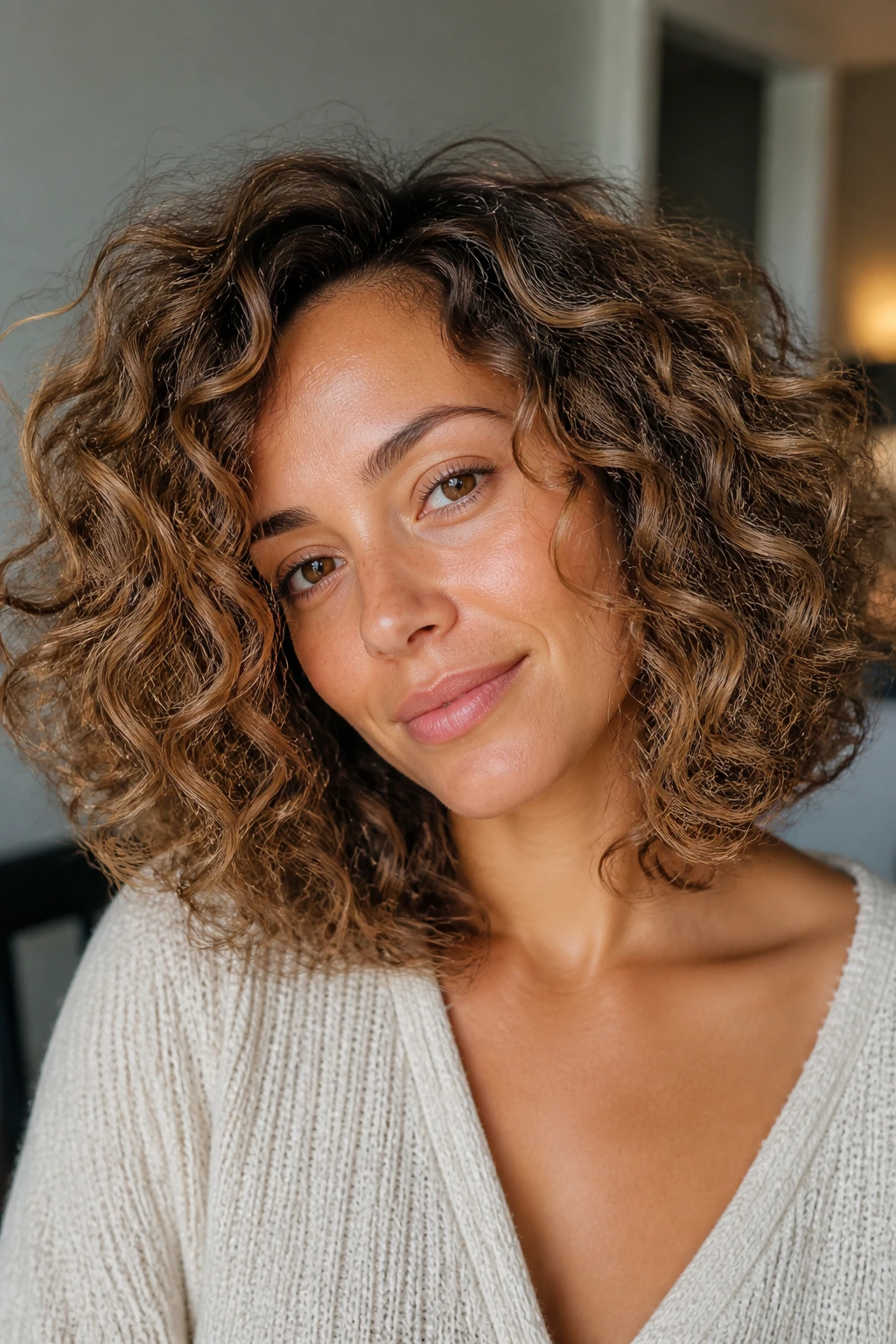
This is the softest look in the set, and maybe the easiest one to live with. Shoulder-length curls with seamless balayage keep the caramel blended so the whole head reads as dimensional rather than highlighted in obvious sections.
The best version has a diffuse transition from base color to caramel, especially around the top layer and outer curve of the curls. That allows the light to move through the hair without sharp lines. If your curls are dense, ask for slightly brighter ribbons near the front so the style doesn’t disappear into itself.
It’s the kind of look that still makes sense a month after the salon visit. That alone earns it a place here.
Why Medium Curls Make Caramel Highlights Behave Better
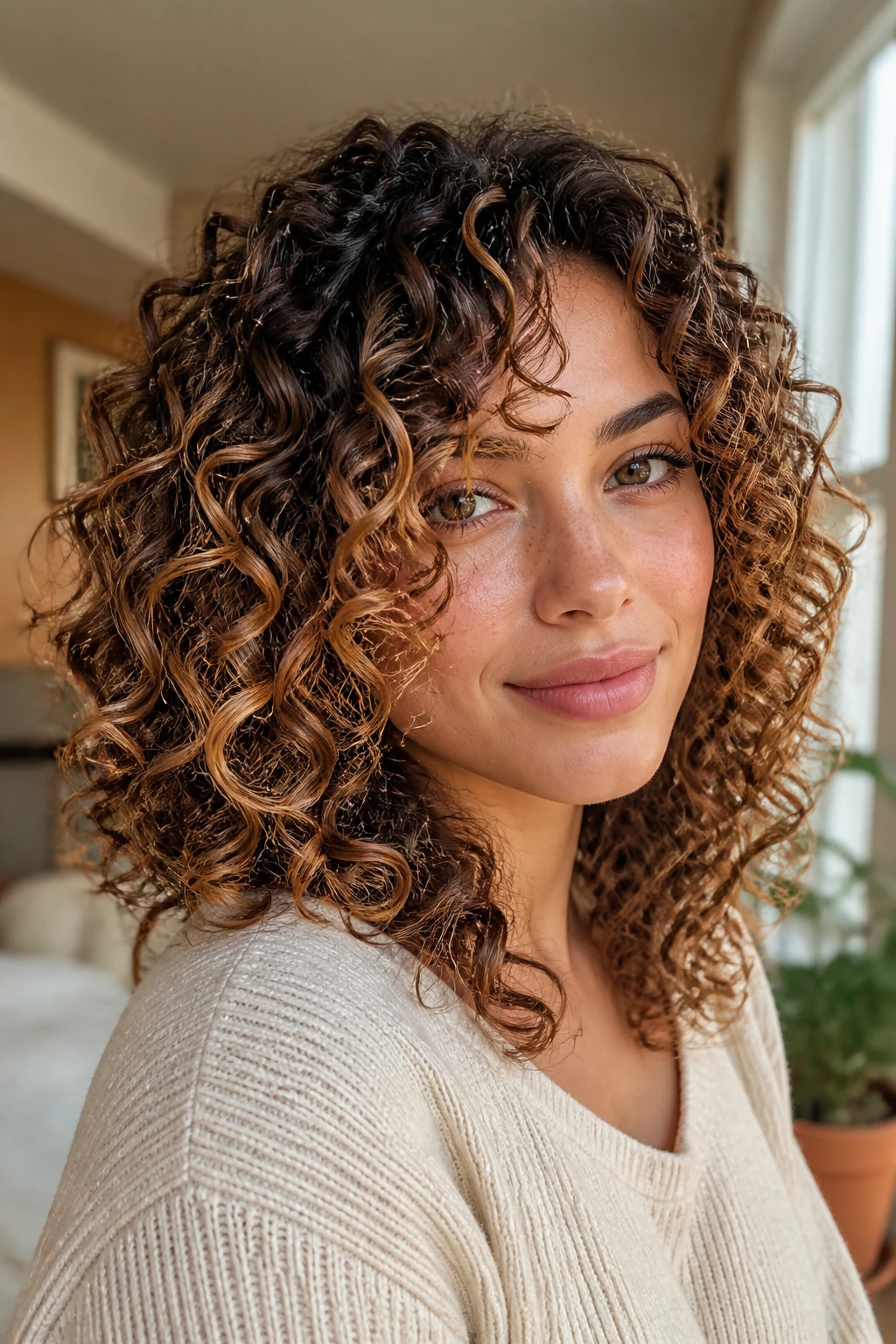
Medium length is the unsung hero of curly color. Short curls can make highlights feel jumpy and disconnected. Long curls can swallow the shape, especially if the hair is dense or heavy at the roots. Medium hair gives caramel a clean stage.
There’s also the practical side. The cut is long enough for a real highlight pattern — face-framing pieces, crown brightness, surface ribbons — but not so long that the lower half of the hair drags everything down. That keeps the curl pattern visible from top to bottom. The color can move with the curls instead of hiding under them.
I also like medium length because it gives you room to adjust. If the curls shrink more than expected, you still have shape. If the highlights are slightly brighter than planned, the length softens them. If the color grows out, the style usually survives the awkward phase far better than a blunt short cut or a very long one.
Choosing the Right Caramel Tone for Your Base Color
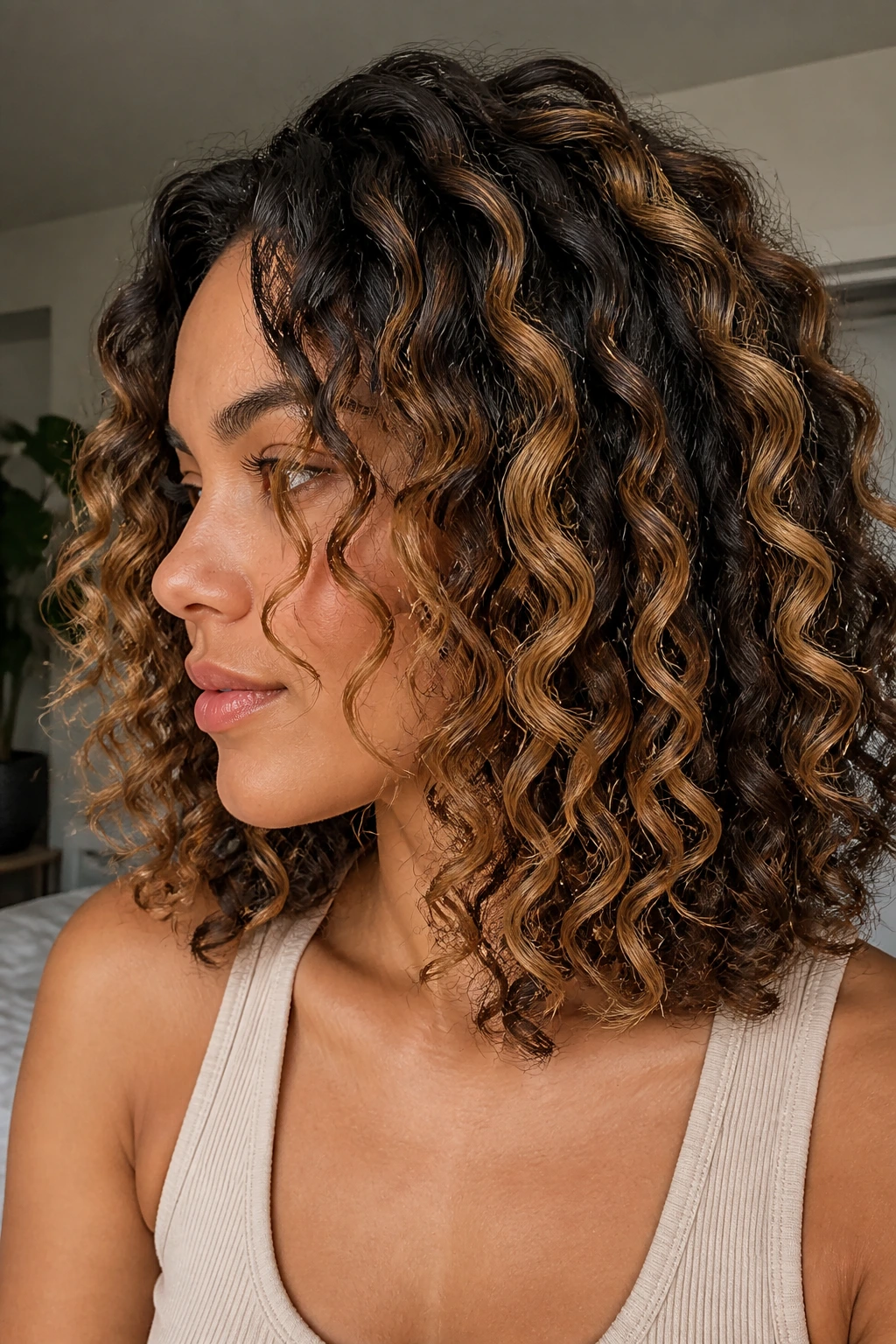
Caramel is not one color. It sits in a whole family of warm browns, golden beiges, toffee tones, and honeyed pieces that can shift warmer or cooler depending on your starting shade. That’s why two heads of curls can both be “caramel highlights” and look nothing alike.
If your base is dark brown, a level 7 or 8 caramel usually gives enough contrast without looking cartoonish. If your hair already has warmth, lean beige or toffee rather than golden-orange. If the base is lighter, a deeper caramel lowlight can add more shape than lightening more would.
The place people get into trouble is tone matching. Too yellow, and the highlights look brassy. Too ash, and the warmth disappears, leaving the curls a little muddy. A good caramel should look edible in daylight. Slightly warm. Never fried.
What to Ask for at the Salon
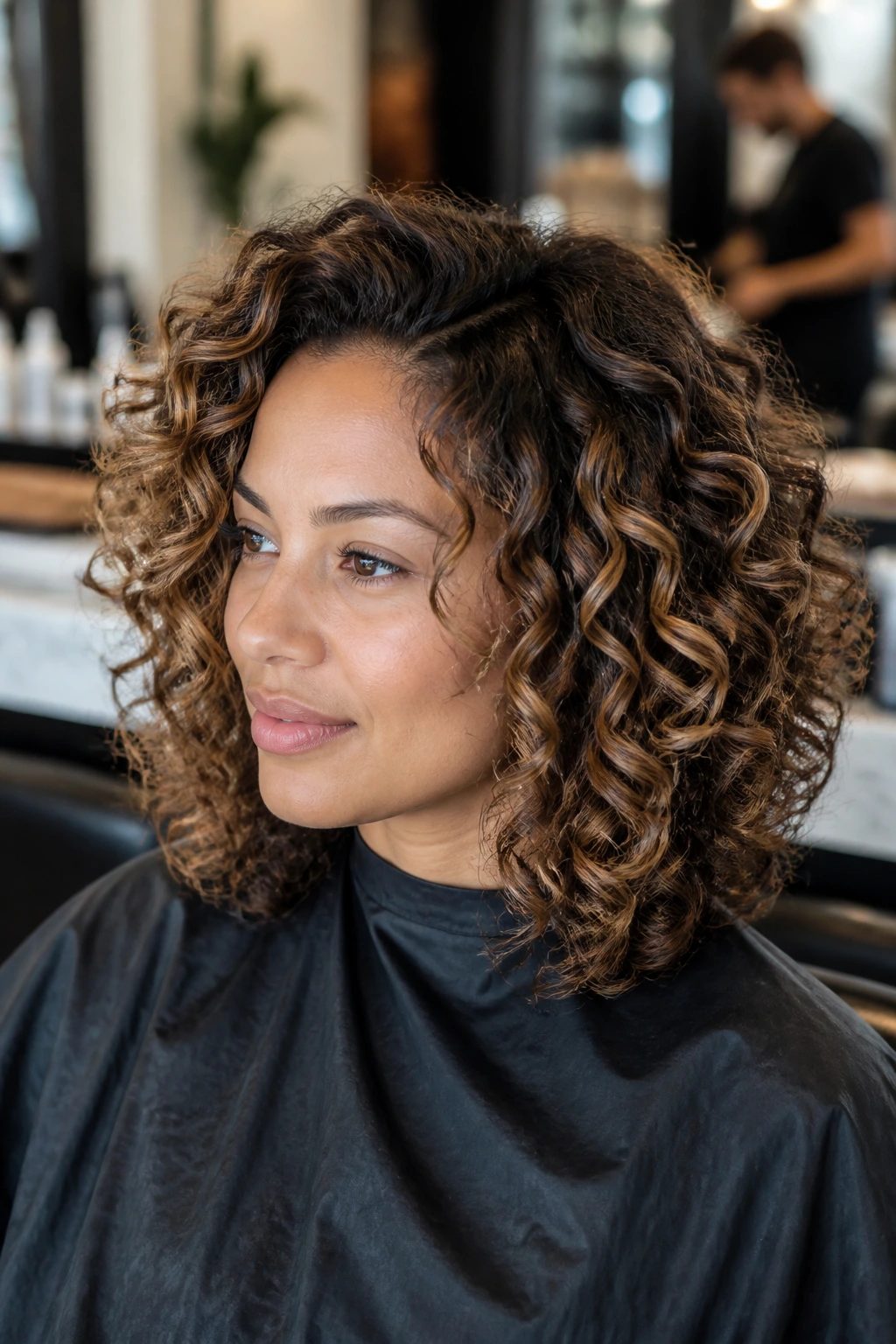
Bring photos, yes, but bring photos of curls that look like yours when dry. That matters more than the outfit or lighting in the picture. A style on stretched waves can lie to you about how a color placement will land on 3B curls or tighter coils.
Ask for the cut on dry hair if your stylist is comfortable doing that. Curly hair changes too much when it’s wet to trust a blunt wet cut alone. For color, ask where the lightest pieces should sit when your curls are in their natural pattern — usually around the face, crown, and outer layer, with softer pieces underneath so the dimension doesn’t vanish.
Say the words face-framing, surface ribbons, soft grow-out, and no harsh stripes. Plain language helps more than salon jargon. If you want lowlights too, mention that before the color bowl gets mixed. The goal is shape first, brightness second, and maintenance third.
Tools and Products That Keep the Shape Crisp
-
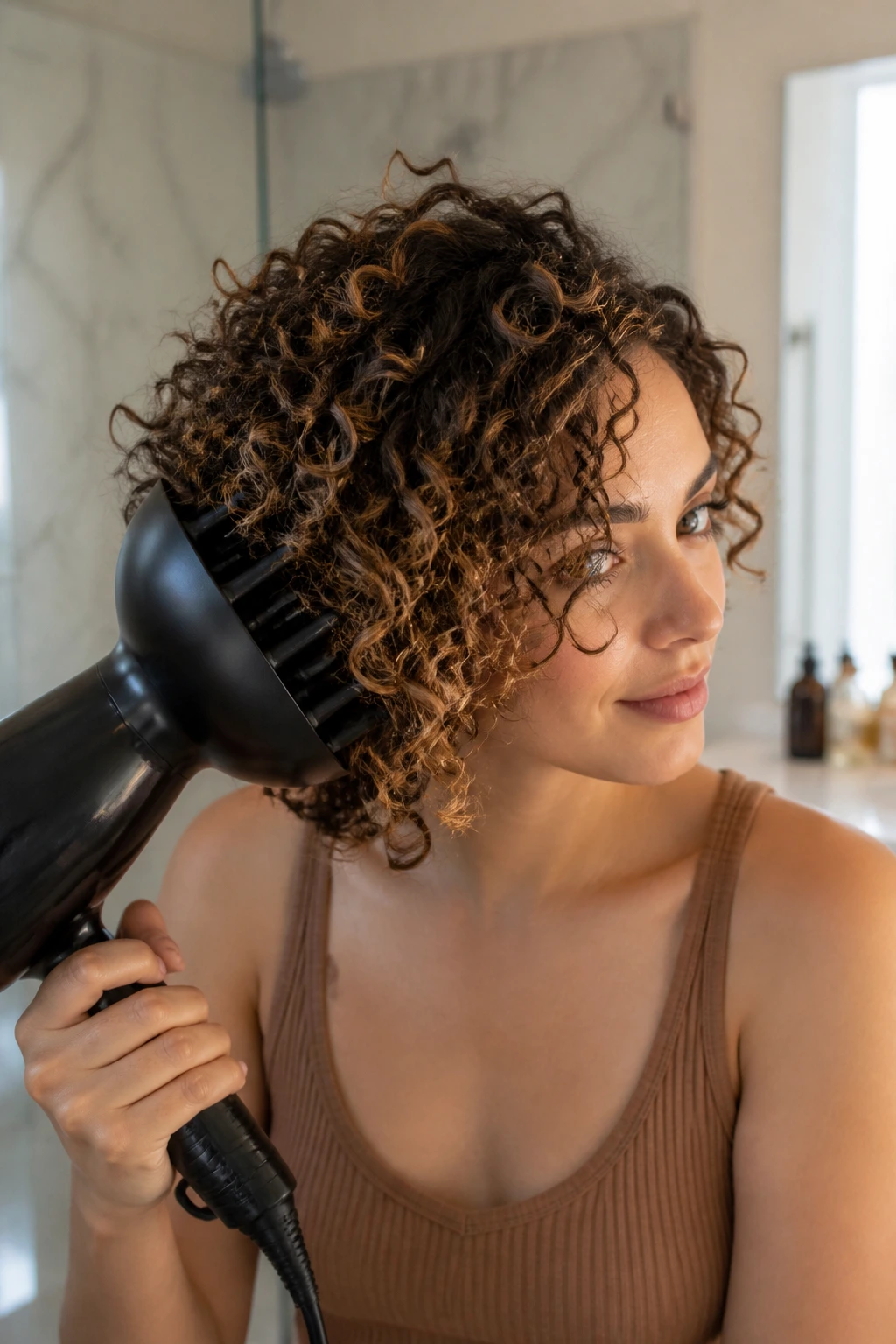
Diffuser attachment: Dries curls without blasting them apart, especially useful for caramel pieces on the top layer.
-
Curl cream: Helps define the pattern so the highlights sit on clean curl clumps instead of frizz.
-
Lightweight mousse: Good for medium hair that needs lift at the roots without greasy ends.
-
Wide-tooth comb: Detangles damp hair without stretching the curls flat before styling.
-
Microfiber towel or T-shirt: Reduces rough frizz, which matters because frizz can hide highlight placement.
-
Heat protectant spray: Necessary if you diffuse often or use a curling wand for touch-up pieces.
-
Color-safe shampoo and conditioner: Keeps caramel from dulling down too fast.
-
Silk or satin pillowcase: Helps the style hold its shape overnight and keeps the ends from getting rough.
-
Root clips: Small but useful when you want crown lift without teasing.
How to Wear These Styles in Real Life
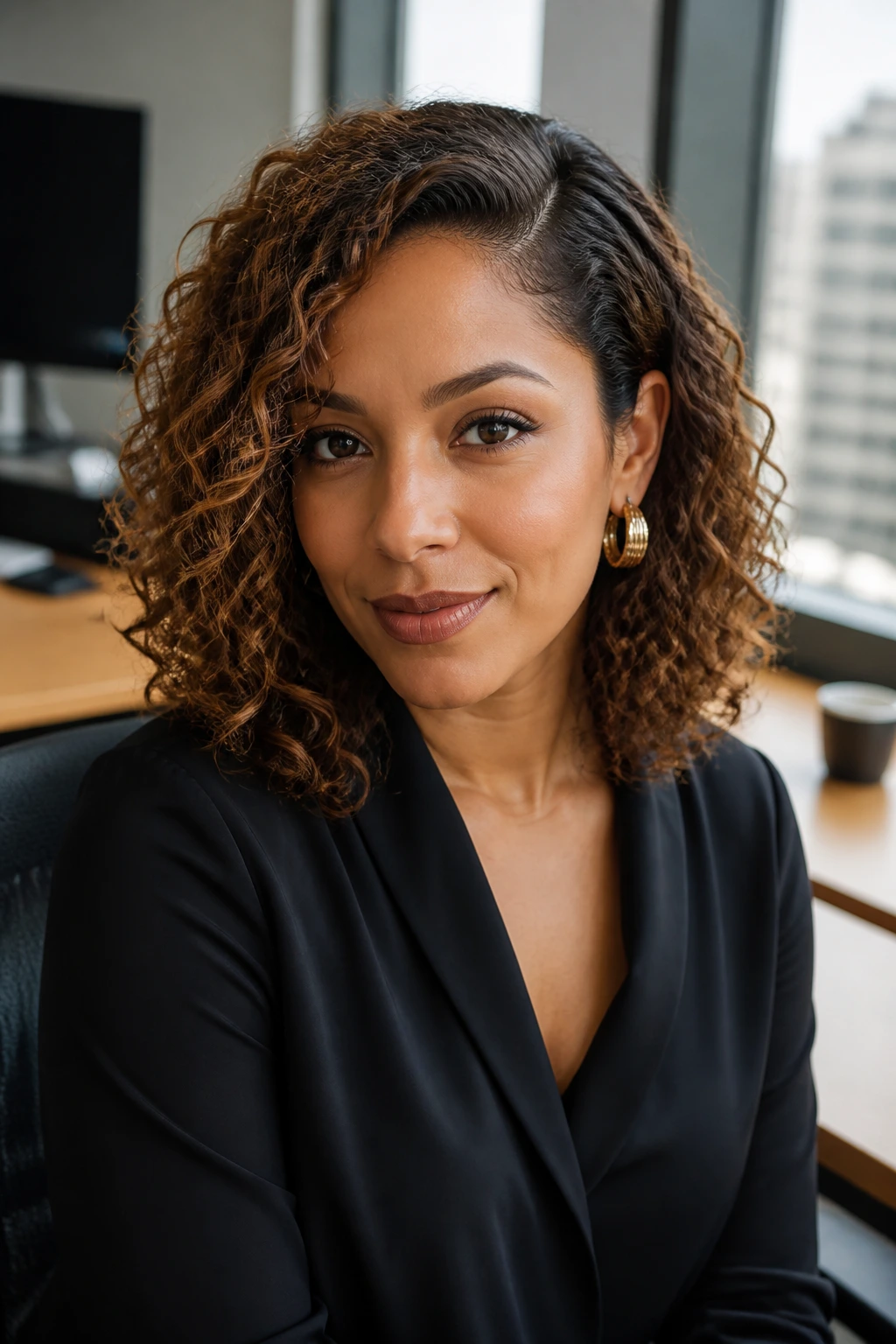
Office days: Go for side parts, tucked styles, low puffs, or soft lob shapes with controlled volume. Those reads as polished without feeling stiff.
Weekend hair: Half-up twists, pineapple ponies, braided crowns, and shaggy cuts with visible caramel are the fun lane. A little more texture is welcome there.
Night-out hair: Deep side parts, angled lobs, and loose updos with highlighted tendrils do the most with the least fuss. The light catches the curls every time you turn your head.
Low-effort days: Wash-and-gos, invisible-layer cuts, and seamless balayage are the easiest to live with. If the color placement is smart, the hair still looks intentional when you barely touch it.
Smart Color and Cut Tips for Better Results
Placement matters more than brightness: A slightly deeper caramel in the right place can look better than a very light piece in the wrong one. Face frame first, crown second, random streaks last.
Ask for some depth: A few lowlights keep the highlight from floating on top of the curls like a sticker. That extra shadow makes the texture look thicker.
Match the cut to the curl pattern: Loose curls can handle smoother lob shapes. Tighter coils often look best with more shape through the crown and sides.
Keep the layers long enough to clump: Tiny short layers can break curl families apart. When that happens, the highlights look scattered too.
Gloss beats over-toning: A clear or lightly tinted gloss often keeps caramel looking shiny without turning it flat or too cool.
Common Mistakes That Flatten the Color or the Curl
The first mistake is asking for highlights on stretched hair and then never checking how the color sits once the curls spring back. Shrinkage can move the whole pattern. What looked like subtle ribbons can turn into stripes. The fix is simple: color the hair in its natural state whenever possible, or at least in a realistic curl pattern.
Another problem is going too light on the first appointment. Very pale blonde against medium curls can look stripy fast, especially if the base is dark. Caramel should soften the contrast, not shout over it. If you want brighter pieces later, build there in stages.
Heavy oils are sneaky, too. They can make caramel look dull and muddy, especially on the top layer where the light should hit. Use a small amount only on the ends. If your curls are coated, the color disappears.
And then there’s the flat-root problem. If the crown lies down, the entire style looks older and heavier. Use clips, mousse, or a root-lifting dryer technique. The top needs air. Without it, even good highlights can look tired.
Variations and Adaptations to Try
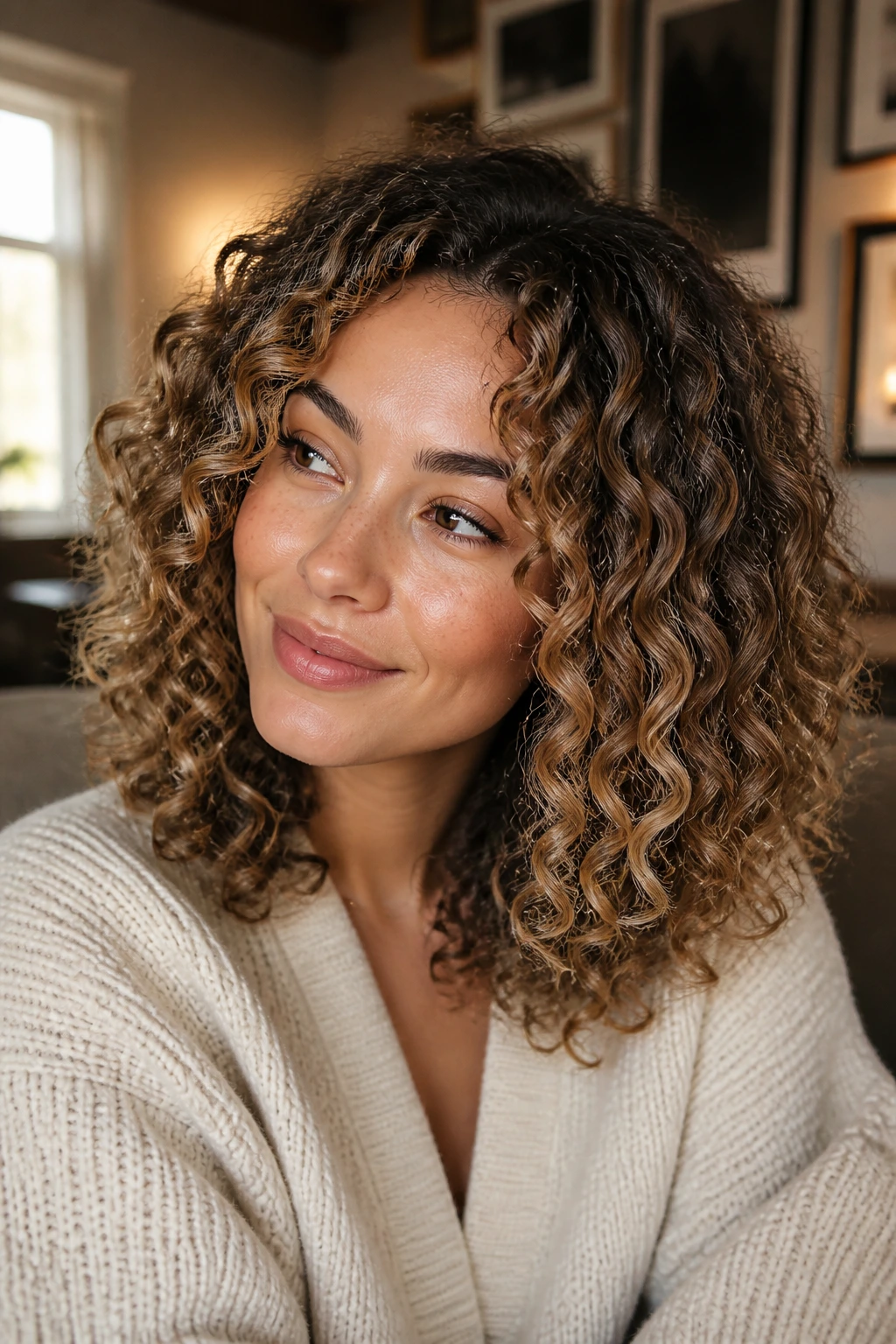
Soft Bronde Melt: This version leans brunette-to-blonde without a harsh break. Ask for beige caramel and a root shadow so the grow-out line stays soft.
Toffee Ribbon Upgrade: A slightly deeper, toastier caramel works well on darker bases and gives the curls a richer, more grounded look. It’s a good choice if you don’t want obvious blonde pieces.
High-Contrast Halo: Brighten only the face frame and top surface while keeping the rest of the hair darker. The shape becomes dramatic without needing full-head lightening.
Coil-Friendly Dimensional Color: For tighter curl patterns, mix caramel highlights with a few lowlights so the pattern doesn’t flatten. This keeps the hair from reading one-note.
Low-Maintenance Grow-Out: Keep the light pieces farther from the root and concentrate them on the mid-lengths and ends. The color stays wearable longer, and the cut still reads as fresh.
Frequently Asked Questions
Will caramel highlights damage curly hair?
They can, because any lightening process changes the hair structure. The damage depends on how far you lift, how often you redo the color, and how well you keep up with moisture. A smart placement plan and a good conditioner routine go a long way.
How often should I touch up caramel highlights on curly hair?
Many curly styles can stretch a touch-up longer than straight hair because the texture disguises grow-out. A gloss or toner every 6 to 10 weeks is often enough for maintenance, while full lightening can wait much longer if the placement is soft.
What if my curls are fine and I’m worried about looking stripey?
Keep the caramel thin and broken up, and ask for more placement around the face and top layer instead of all over. Fine curls usually look better with softer ribbons and a cut that preserves fullness.
Can tighter curls wear caramel highlights too?
Absolutely, but the placement should respect the curl pattern. Selective surface highlights and a few lowlights often look better than broad blonde panels, which can flatten the texture.
Do I need layers for these styles?
Usually, yes. Medium curls with no layers can turn bulky fast, and the highlights lose shape if the cut is too blocky. Long layers, invisible layers, or a rounded shape help the color show up better.
How do I keep the caramel from turning brassy?
Use color-safe cleansing, limit hot water, and don’t overdo purple shampoo unless your hair is actually drifting yellow. A gloss from the salon can bring the tone back without making it chalky.
What’s the best refresh routine for day-two curls?
Mist the hair lightly with water, add a small amount of leave-in to dry ends, then scrunch a bit of mousse or gel into the surface layer. Focus on the crown and face frame first. That’s where the style lives.
Can I mix caramel highlights with lowlights?
Yes, and on curly hair, that can be the smartest move. The lowlights keep the highlight from floating too much, especially if the medium cut has a lot of movement or the base color is already warm.
The Medium-Curl Sweet Spot
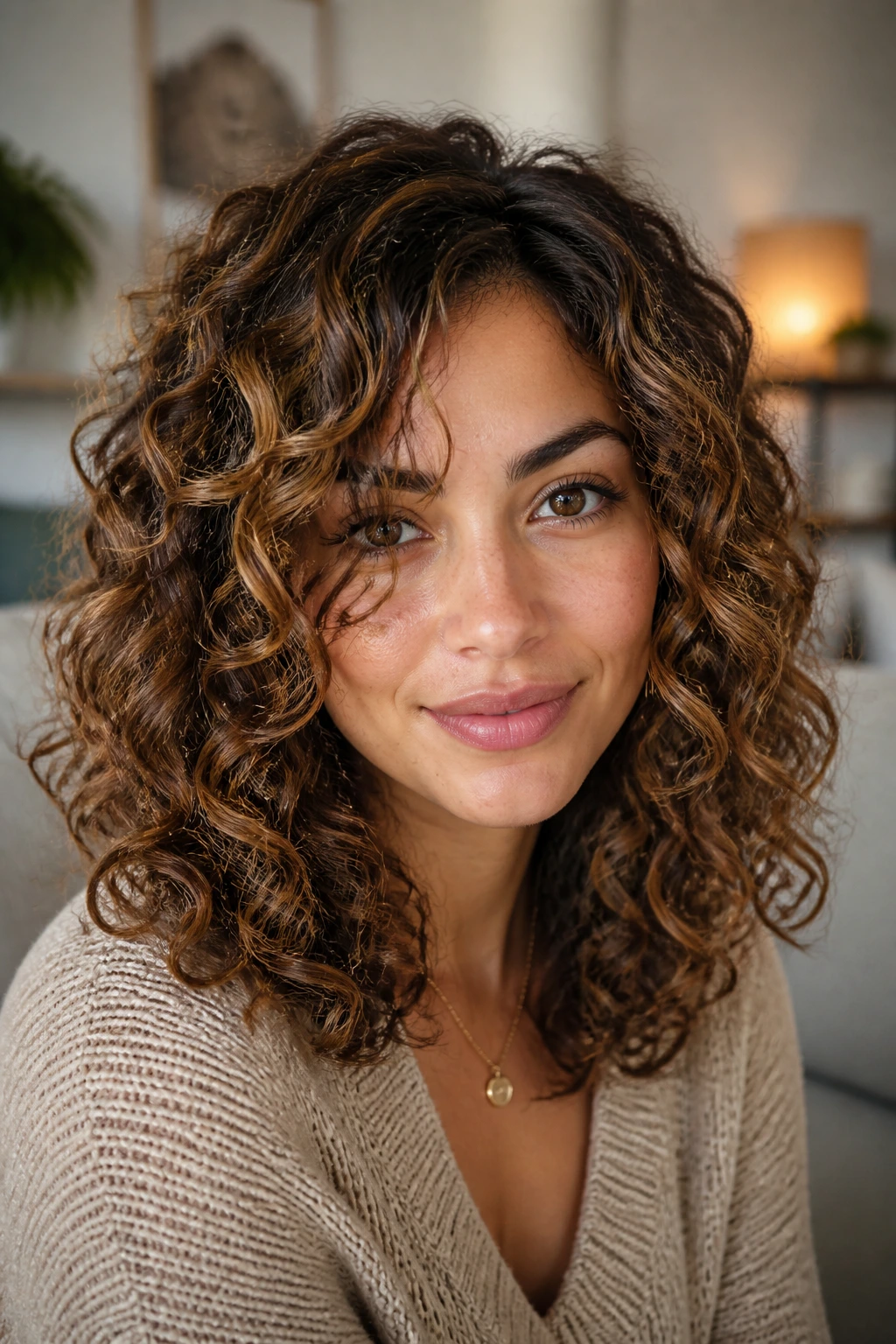
Medium curly hair gives caramel highlights enough room to breathe. That’s the real trick. The color shows, the curl pattern stays visible, and the cut doesn’t have to fight its own weight or its own shrinkage.
If your hair has been stuck in a zone where every highlight looks too loud or too faint, this length is where the balance tends to click. You can go bright around the face, soft through the crown, or dimensional all over, and the curls still do most of the talking. Which is exactly how it should be.
The best versions of these looks are the ones that feel like your hair, only better lit. That’s the lane worth staying in.