



Long bangs for thick hair and heart-shaped faces can solve a weird little beauty problem that gets underestimated all the time: the hair has enough weight to drag forward, but the face already carries its width through the forehead and temples. Cut the fringe too short and it sits like a shelf. Leave it too blunt and it can make the top half of the face look even broader. Get the length and shape right, though, and the whole haircut starts breathing again.
The best versions do something very specific. They break up width at the forehead, add movement around the eyes, and let thick hair keep its body instead of fighting against it. That matters. Thick hair does not need more bulk at the front; it needs direction. And a heart-shaped face usually looks best when the bang line softens the upper face and nudges attention downward toward the cheekbones, mouth, and jaw.
A lot of fringe advice sounds generic because it is. “Face-framing” gets tossed around like it means the same thing on every person. It doesn’t. On thick hair, the cut needs internal weight removal, not just thinning for the sake of thinning. On a heart-shaped face, the shortest point usually looks better around the outer brow, cheekbone, or even the top of the lip than right across the middle of the forehead. That small shift changes everything.
Why These Long Bangs Earn Their Keep
-
They keep thick hair from swallowing your face: The length gives the fringe enough room to move, so it falls forward softly instead of sticking out like a heavy shelf.
-
They balance a wider forehead without hiding it completely: Heart-shaped faces usually look best when the bangs create width lower down, around the cheekbones and eyes, not at the very top of the face.
-
They grow out gracefully: A long bang can sit at brow level, then cheekbone level, then cheekbone-plus-layers without going through that awkward “what did I do?” phase every three weeks.
-
They work with side parts, middle parts, and lazy-day clips: That flexibility matters when you do not want to style the same way every morning.
-
They let thick hair look intentional, not puffy: The trick is not removing every ounce of weight. It’s carving a shape that still has enough density to lie flat and stay put.
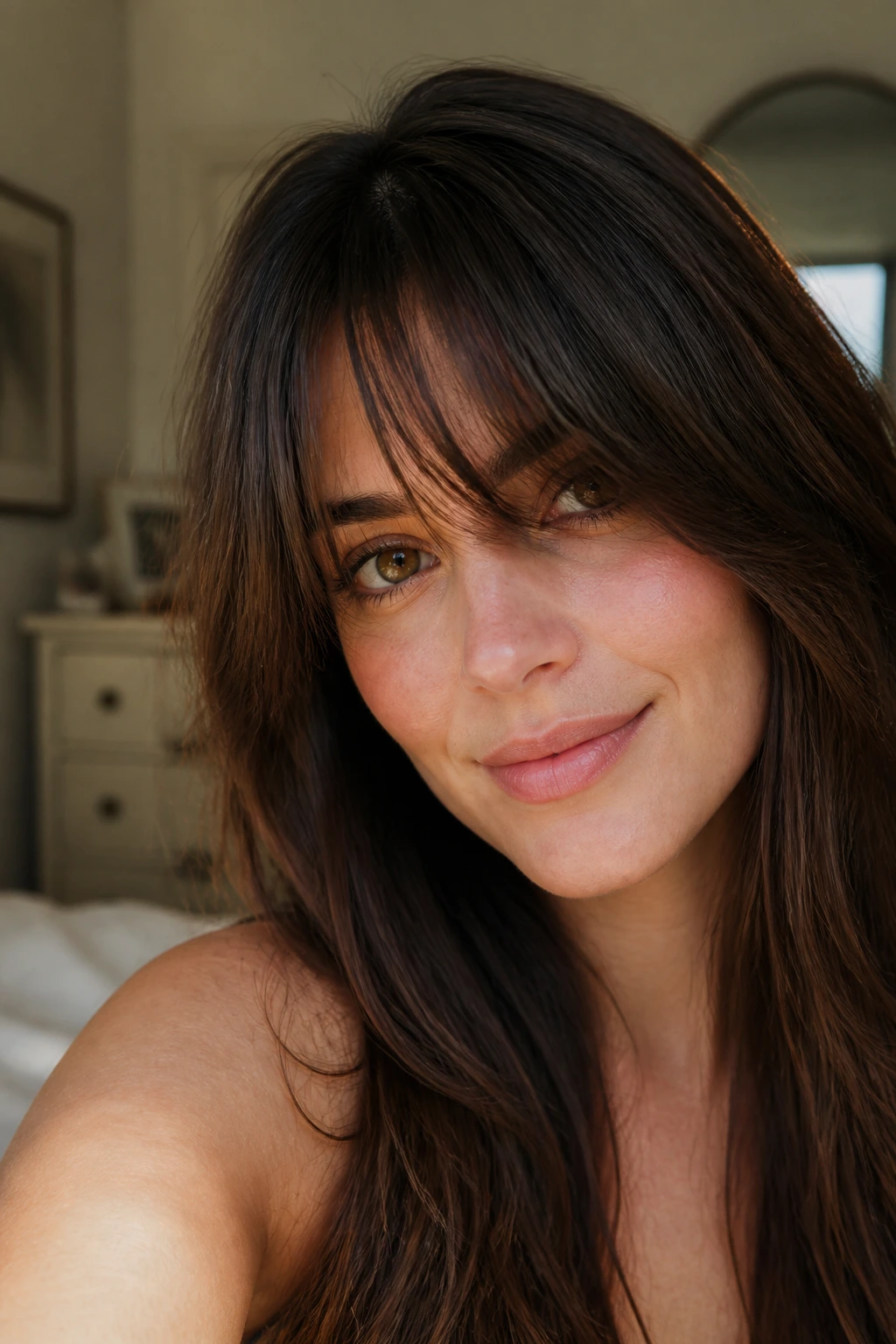
1. Curtain Bangs That Open at the Cheekbones
Curtain bangs are still the safest place to start, and on thick hair they can look especially good because the weight helps them fall in a clean drape. The key is where the shortest pieces land. For a heart-shaped face, I like them beginning around the outer brow and slipping down toward the cheekbones rather than getting chopped too high in the center.
Why they work
The middle split creates vertical space at the forehead, which helps a wider upper face feel less dominant. Then the longer edges sweep outward and give the cheekbones something to do. That’s the whole trick, really.
Ask for the front to be cut with a soft center opening and for the ends to blend into the first layer of the haircut. If the stylist leaves the ends too blunt, thick hair can turn the fringe into two stiff curtains. You want movement, not a drape that looks glued in place.
2. Bottleneck Bangs With a Wider Sweep at the Edges
Bottleneck bangs are a little tighter through the center and wider at the sides, and that shape suits a heart-shaped face in a way that feels almost custom. The narrow center keeps the forehead from feeling boxed in. The wider edges broaden the face where the chin starts to narrow.
On thick hair, this shape is useful because it gives structure without needing the entire front section to be heavily thinned. The middle can stay slightly denser, which helps it sit down neatly after blow-drying. Then the sides taper out into the cheek area with a soft bend.
If your hair has a stubborn cowlick at the front, this style usually handles it better than a blunt line. The opening helps the hair land where it wants to land instead of fighting for a perfect straight-across fall.
3. Side-Swept Feathered Fringe
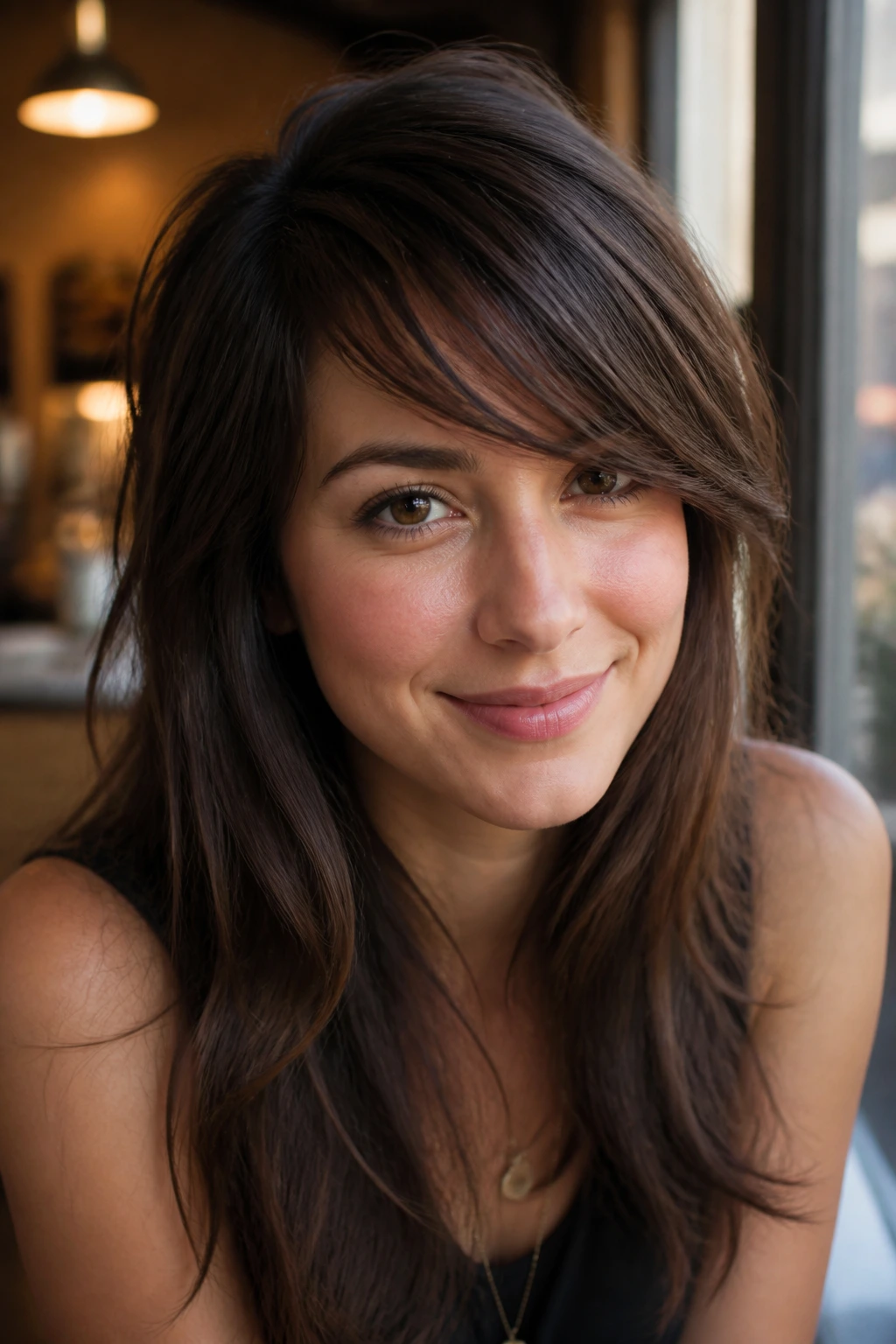
A side-swept fringe can look very old-school in the wrong hands. Feathered well, it looks sleek, grown-up, and a little bit expensive in the ordinary sense of the word — polished without trying too hard. On thick hair, the side sweep also keeps the front from sitting too heavily over the forehead.
What to ask for
Tell your stylist you want the shortest point to land near the outer brow or top of the cheekbone, then taper down into the side layers. That keeps the line long enough to style and short enough to feel like bangs, not just face-framing layers.
This shape is especially kind to heart-shaped faces because it creates a diagonal line across the forehead. Diagonals soften width. Straight lines announce it.
4. Long Arched Bangs That Follow the Brow Line
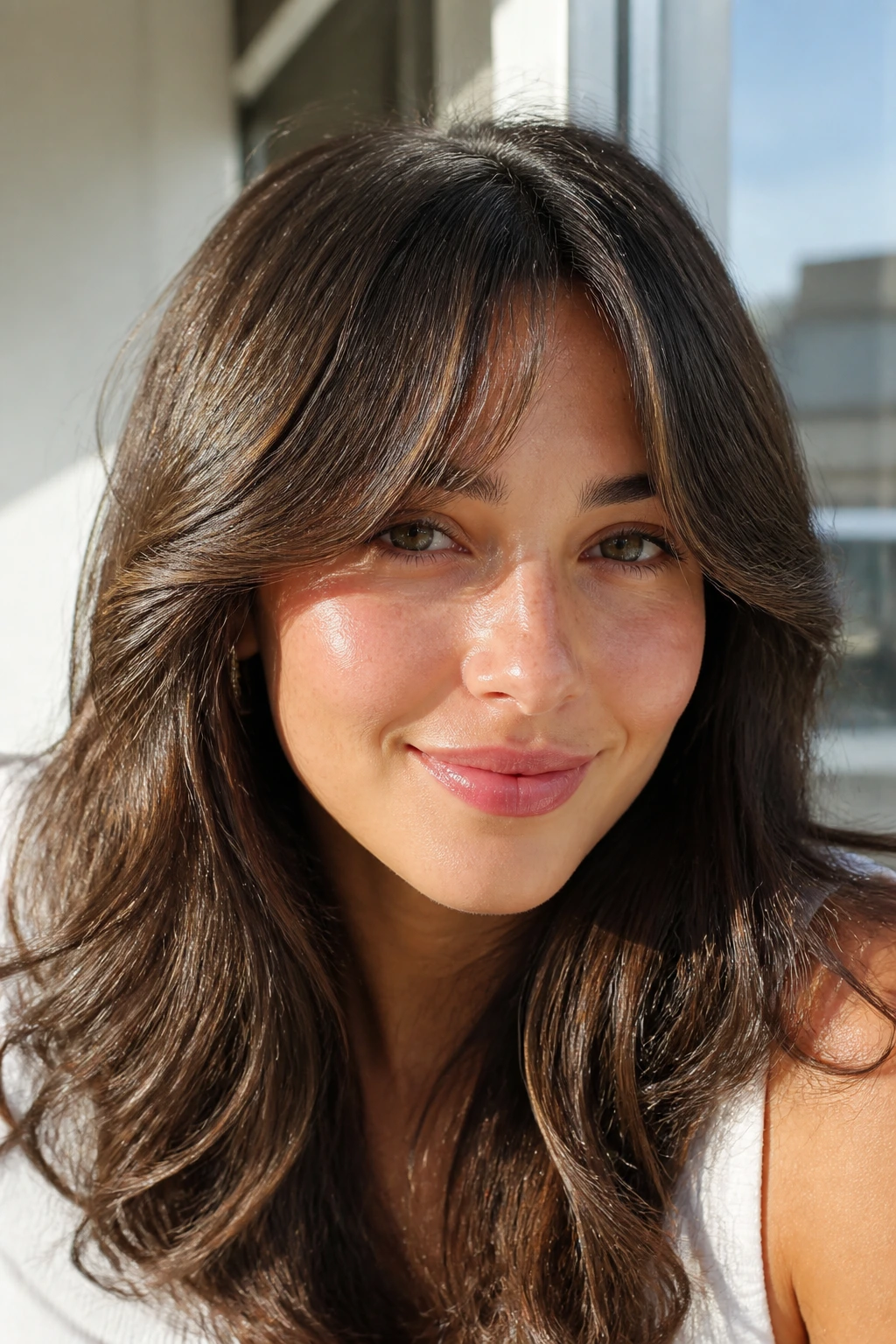
Long arched bangs have a little more shape in the center than curtain bangs, and that gentle curve can be lovely on thick hair because it echoes the natural roundness of the face without crowding it. The center sits a touch higher, then the sides fall lower in a rounded arc.
This style works best when the bangs are cut dry, or at least refined dry, because thick hair often looks shorter once it shrinks and bends. If the arch is cut too bold when wet, it can bounce up into something much shorter than intended.
I like this option for someone who wants softness but still wants the forehead partially covered. It gives you that “there’s a fringe here” feeling without turning the whole front into a wall of hair.
5. Center-Part Face-Framing Fringe
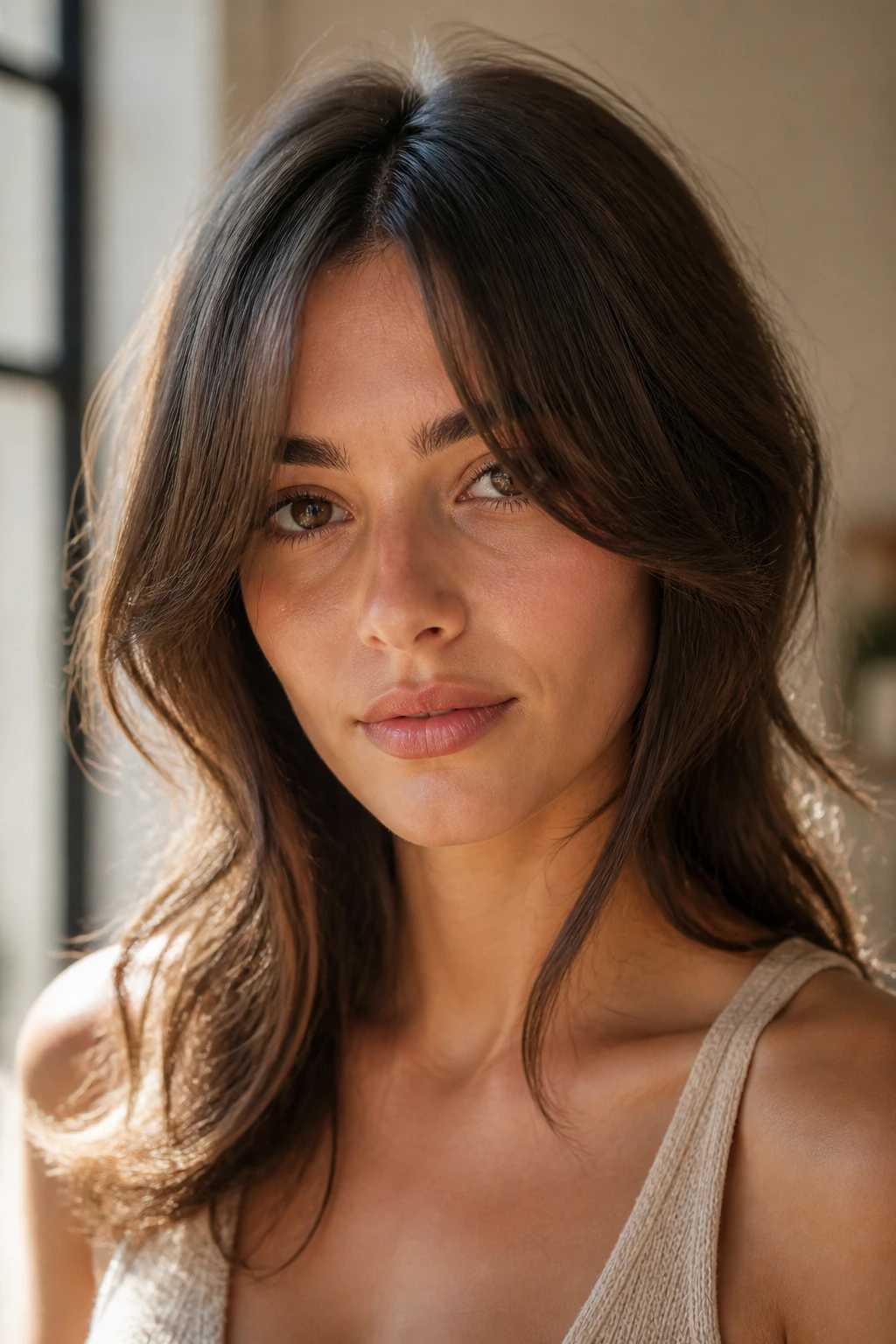
Not every bang has to look like a bang right away. A center-part fringe that begins around the temples and angles down toward the jaw can act like bangs and layers at the same time. On a heart-shaped face, that means the eye moves down and out, which helps balance a broader top half.
This one is especially good if you wear your hair up often. You can let the front pieces live loose around the face, then tuck them back when you need them out of the way. Thick hair gives you enough substance here that the pieces still look deliberate rather than stringy.
The danger is making them too short in the center. Keep the shortest lengths around brow to cheekbone territory, or the face starts to feel top-heavy again.
6. Shaggy Long Fringe With Built-In Movement
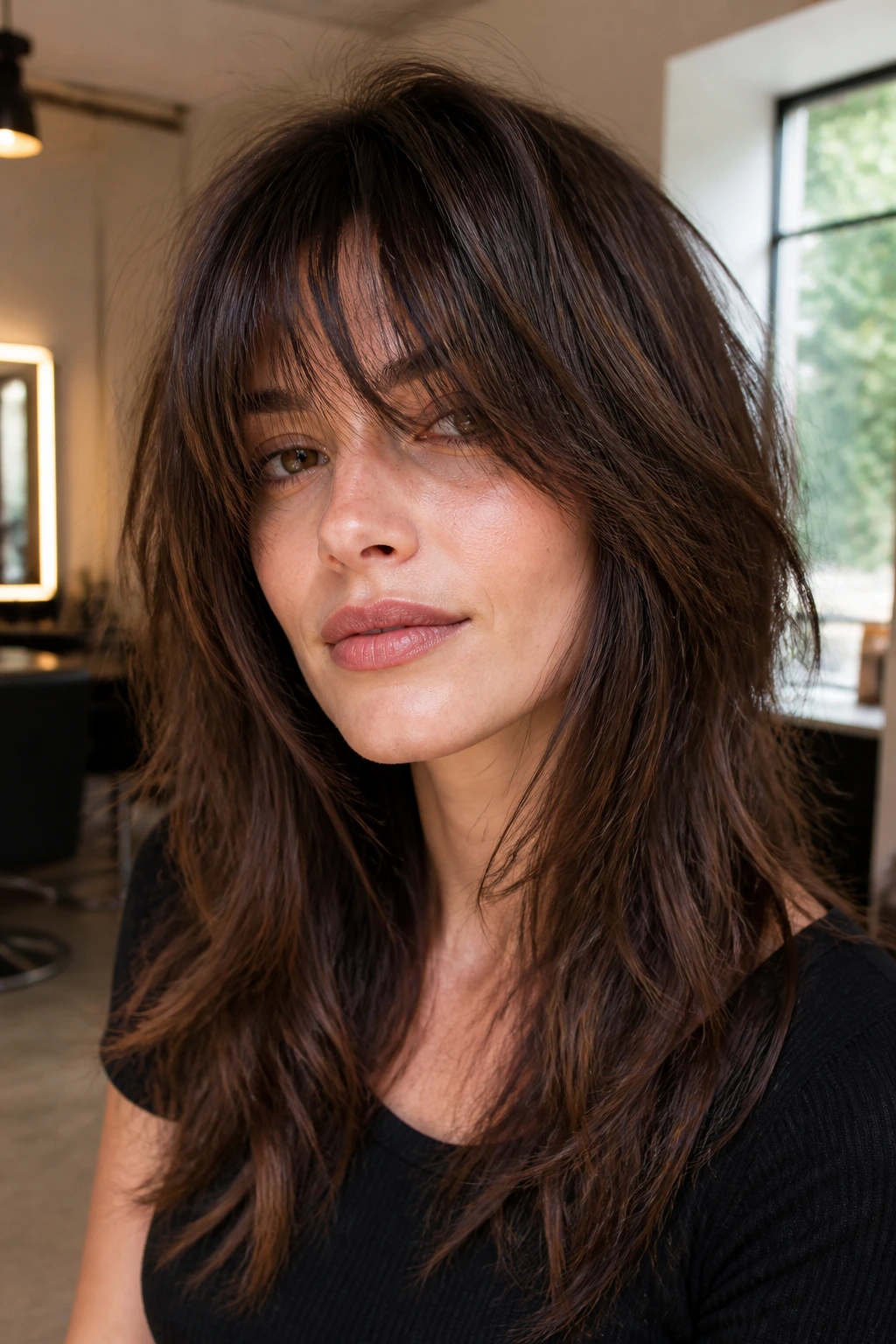
A shaggy long fringe is for people who like a little less polish and a little more swing. It’s choppier, looser, and usually cut to blend into a layered shag or wolfy haircut. On thick hair, that shape can be a relief because it removes some of the heavy front weight without taking away the body.
Why it flatters a heart-shaped face
The broken-up ends keep the bang line from drawing one hard horizontal across the forehead. That matters on a heart shape, where you want the top of the face softened, not emphasized.
Style it with a diffuser or a rough blow-dry if your hair is wavy. If it’s straighter, use a round brush just on the front few inches and let the ends stay piecey. Too much smoothing kills the point of the cut.
7. Wispy Long Bangs With Internal Weight Removal
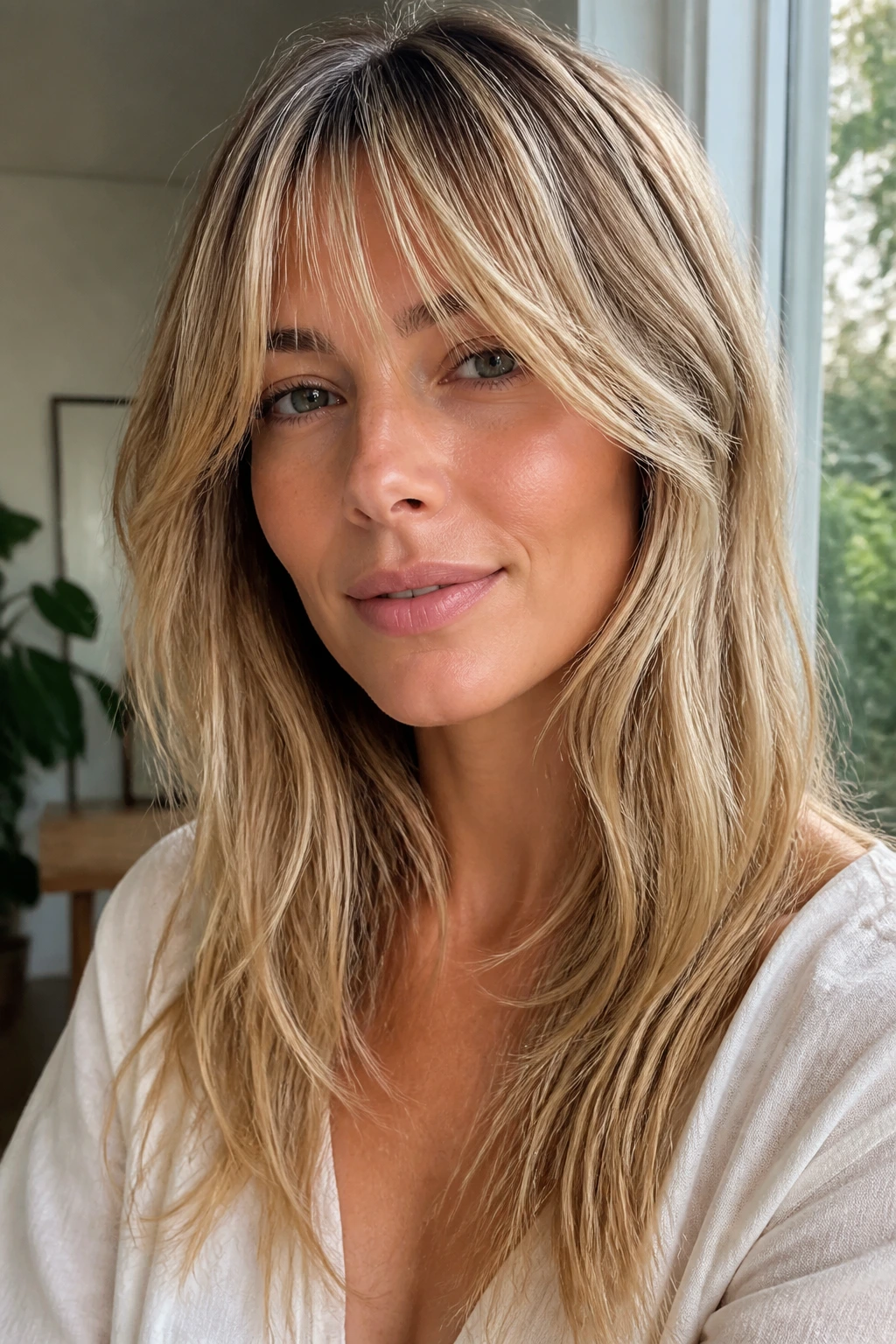
Wispy does not have to mean thin. That’s the part people get wrong. On thick hair, wispy long bangs work when the stylist removes weight from inside the fringe while keeping enough surface density to cover the forehead in a soft veil.
The finish should feel light at the edges and fuller near the roots. That creates a fringe that moves when you blink, not one that separates into see-through strands by noon.
This style suits a heart-shaped face because it softens without widening. You still get coverage across the forehead, but the see-through ends stop the face from feeling boxed in. Ask for point cutting or soft internal texturizing, not aggressive thinning. Aggressive thinning on thick hair often turns into frizz, which is a miserable trade.
8. Razored Piecey Fringe
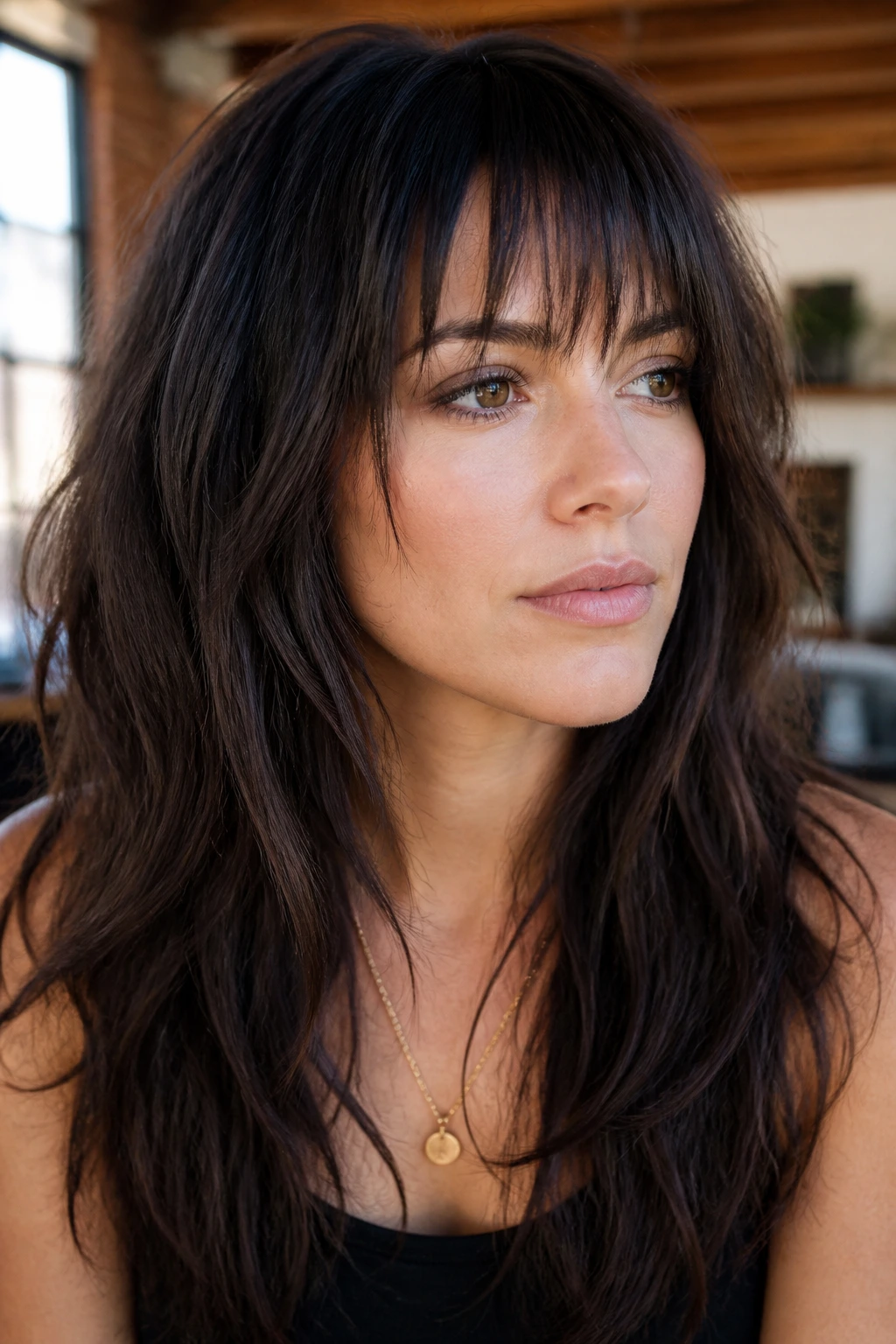
A razor-cut fringe can be gorgeous on thick hair when the strands are smooth enough to handle the cut. It gives the ends a tapered, airy look that scissors sometimes can’t create as cleanly. The result is piecey and a little cool, especially if your hair has some natural bend.
But here’s the catch: razor cutting is not a free-for-all. On coarse or dry hair, too much razor work can rough up the ends and make the fringe puff. The haircut should keep a strong shape at the root and only soften the perimeter.
Best for
- Hair that is thick but not overly frizzy
- People who wear a loose blowout or soft wave
- Heart-shaped faces that need forehead softness without a flat line
9. A Deep Side-Part Sweep That Feels Almost Dramatic
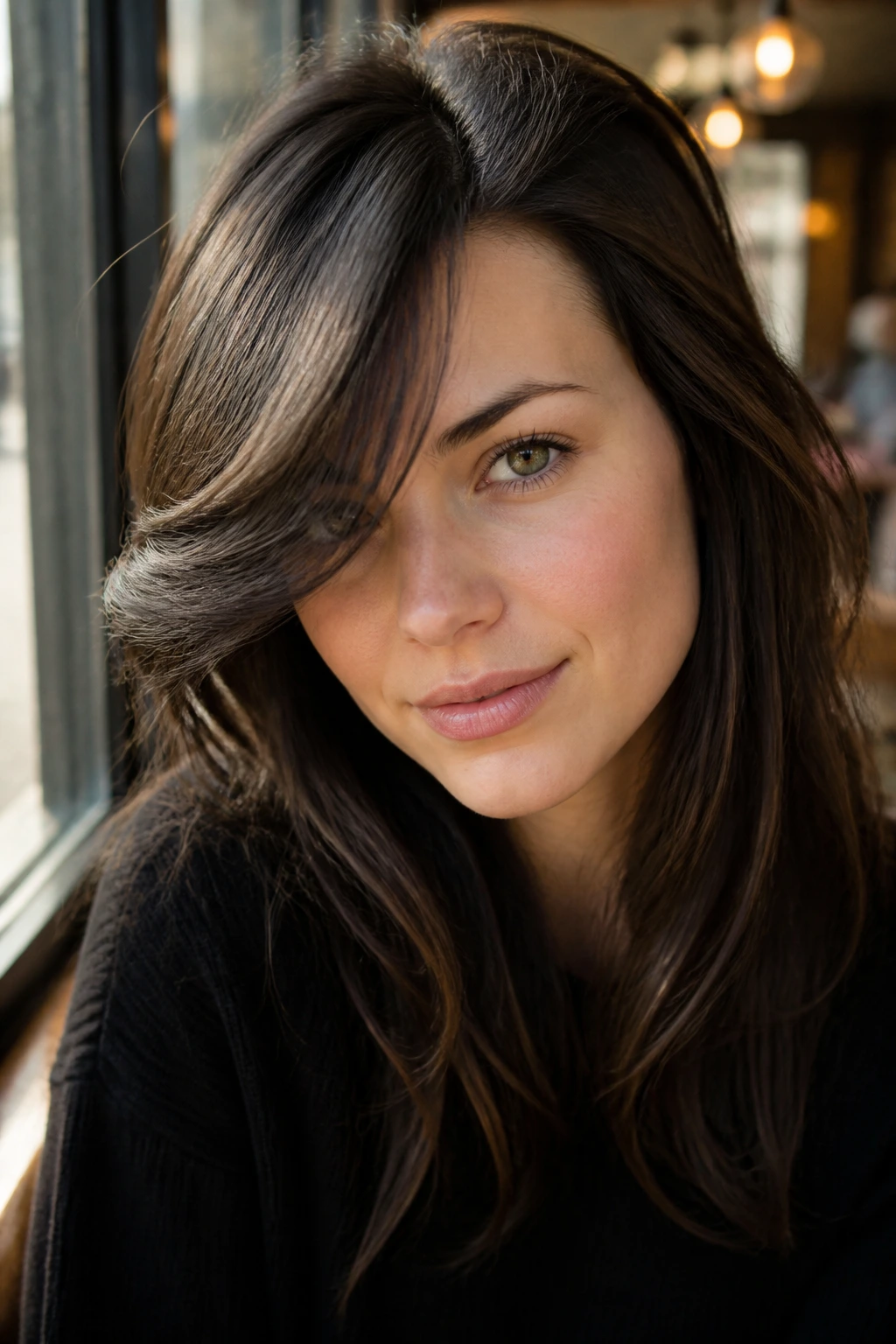
A deep side-part bang is a clean escape hatch if you want fringe but do not want to deal with a full curtain every day. The sweep creates a long diagonal across the forehead and pushes more of the bang weight to one side, which is nice on a heart-shaped face because it pulls the eye away from forehead width.
The part matters as much as the cut. If you keep the part shallow, the bang never really commits. Make the part deep enough that the fringe has room to lie down and curve across the front.
Thick hair helps here because it keeps the sweep from collapsing. A fine-haired version can go limp. A dense version holds its shape better and can even look better on day two.
10. Blowout Bangs With Rounded Ends
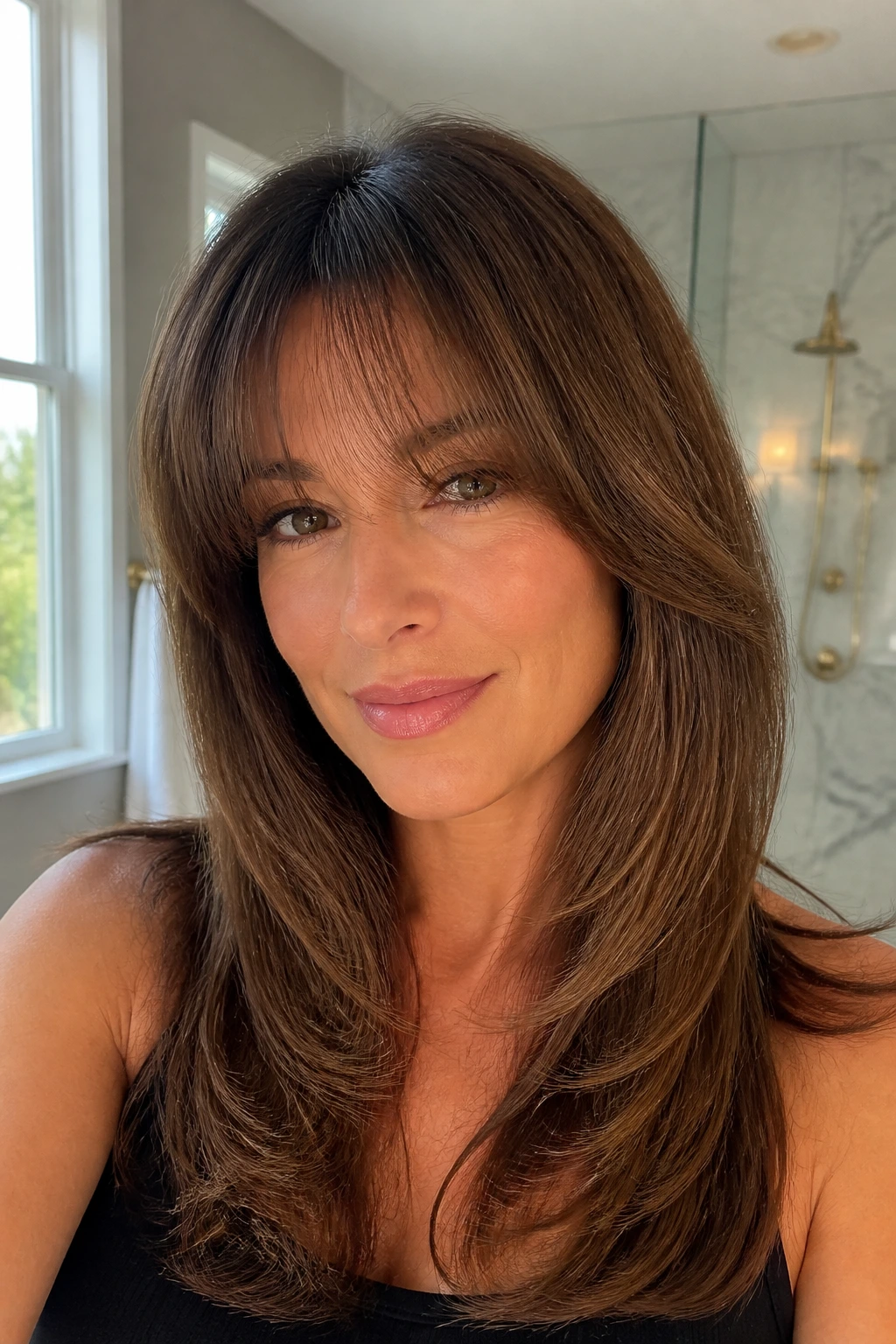
If you like that salon finish where the fringe curves in a soft arc and the rest of the hair has a little movement, this is the one. Blowout bangs are not a cut so much as a shape the cut wants to become. Thick hair is ideal because it holds the bend after brushing.
The shortest pieces should graze the brow or upper lash line when dry, then the sides should turn under gently toward the cheekbones. That curve helps a heart-shaped face because it softens the forehead and points the eye down toward the center of the face.
Use a medium round brush, not a giant one. Giant brushes flatten the front and make the bang line too broad. A 1.25- to 1.5-inch brush usually gives enough bend without over-splaying the hair.
11. Extended Curtain Bangs That Melt Into the Layers
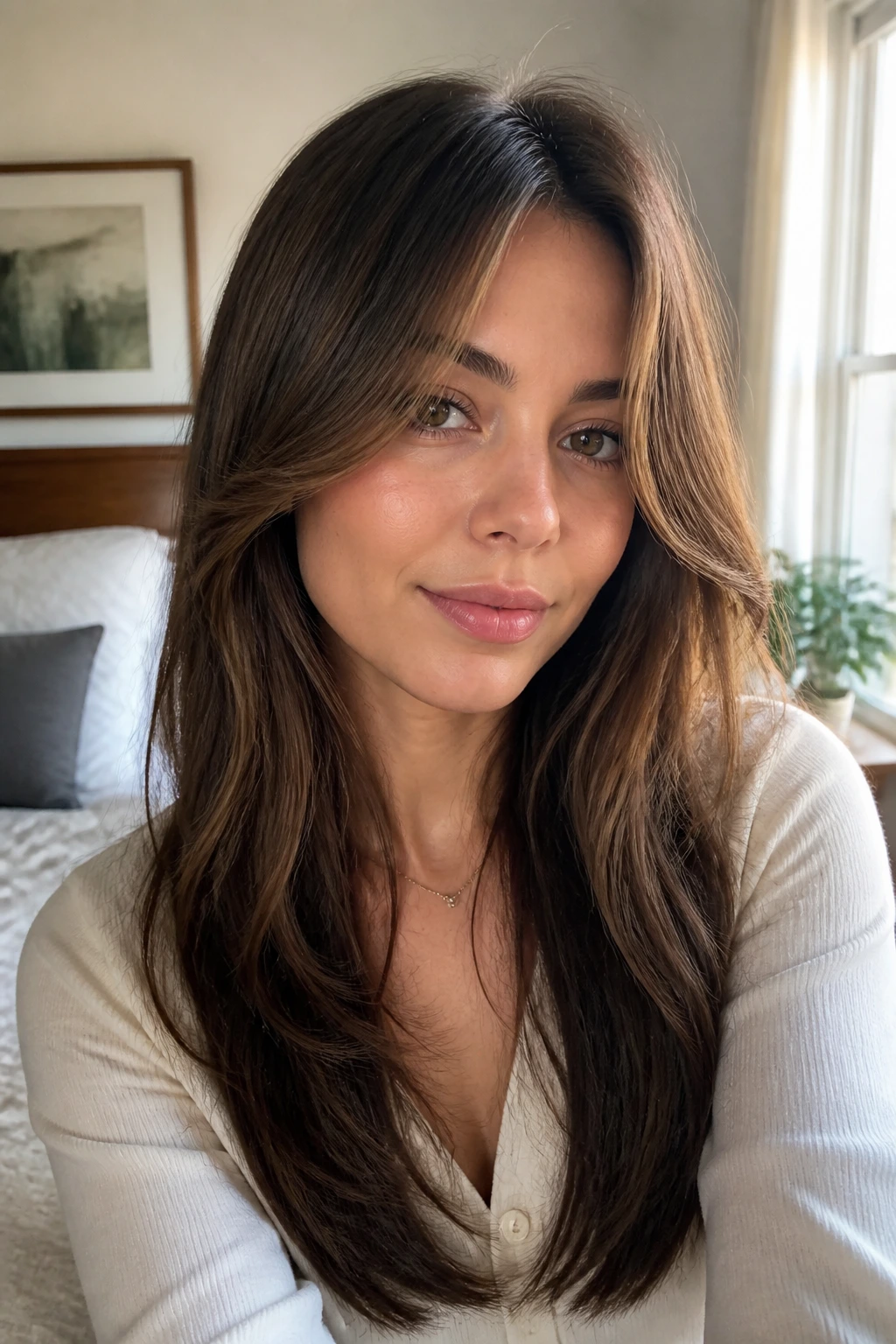
Extended curtain bangs are what happens when a curtain fringe grows up and gets a little more elegant. The shortest pieces still split at the center, but the ends run longer, often reaching the cheekbones or even the top of the lip. That extra length is useful on thick hair because it gives the front section a place to sit without puffing out.
This version is especially good if you’re trying to move from shorter bangs to something softer. The shape keeps its purpose even when it’s not freshly cut. It can be tucked, curled, or left loose, and it rarely looks accidental.
For a heart-shaped face, the long edges are the whole point. They fill in the lower part of the face visually, which keeps the forehead from taking over the whole show.
12. French-Girl Fringe With a Softer, Grown-Out Edge
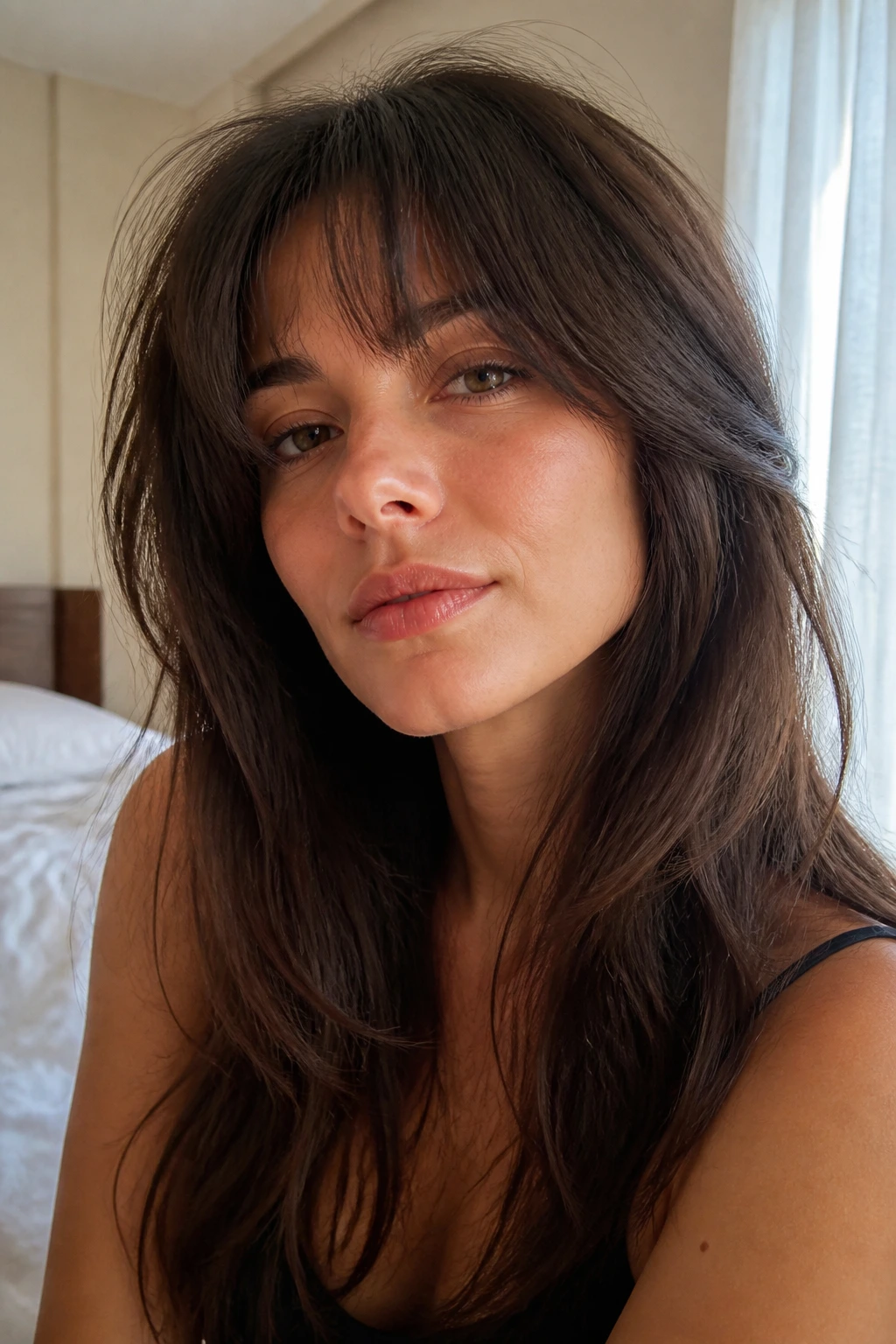
The French-girl version of long bangs is less tidy and a little more casual, which is exactly why it works. It’s usually cut with a soft line and minimal fuss through the ends. On thick hair, that relaxed edge keeps the fringe from reading too severe.
This is not a blunt, heavy bang pretending to be carefree. It needs shape at the root and a light, slightly uneven finish through the ends. That unevenness is what keeps it from feeling stiff.
If your hair naturally splits a bit in the center or falls with a bend, this style can look easier than classic curtain bangs. It suits heart-shaped faces because the soft line breaks up the forehead without creating a hard frame around it.
13. C-Curve Fringe That Hugs the Cheekbones
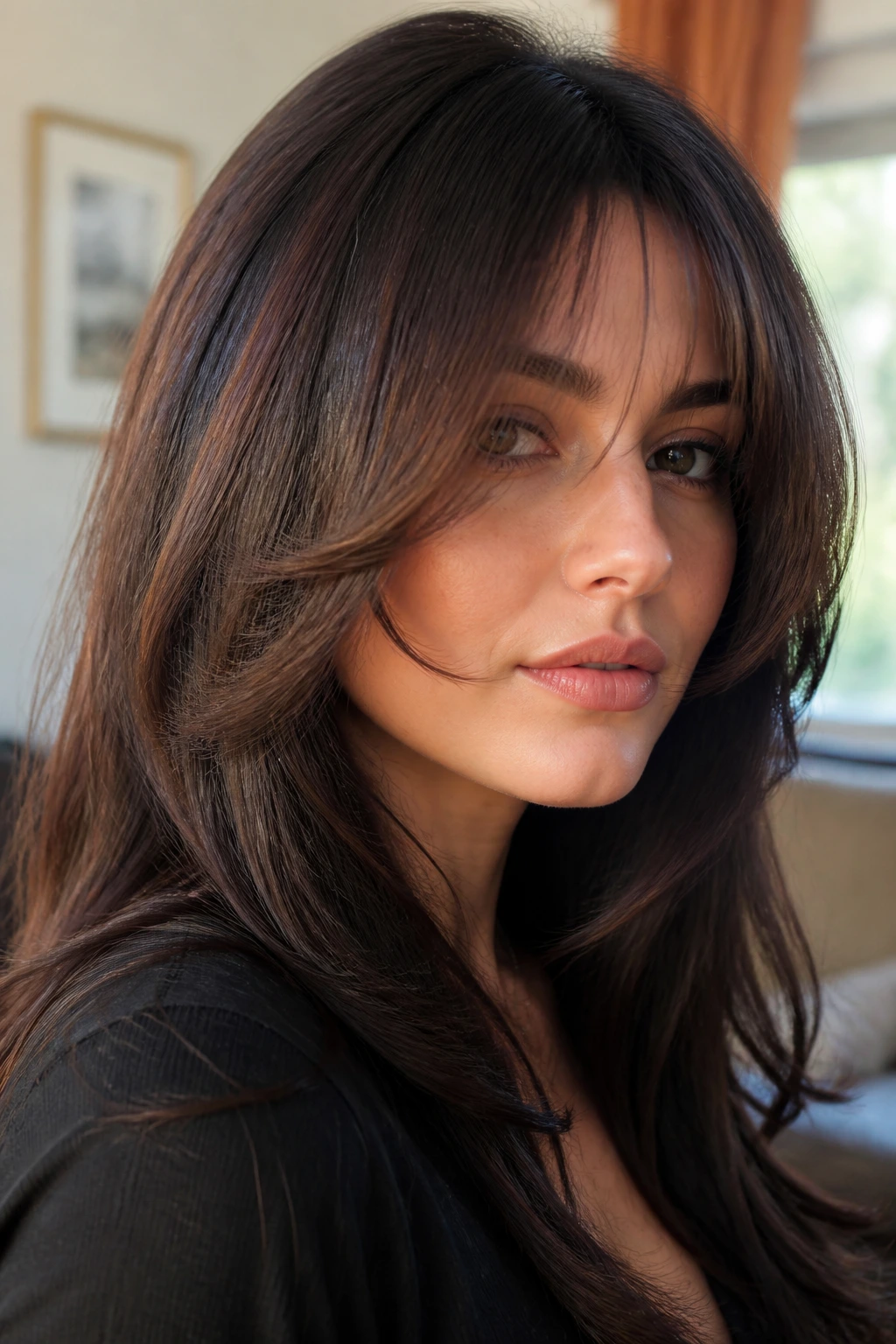
A C-curve fringe starts near the middle and arcs toward the cheekbones in a soft rounded line, almost like the shape is hugging the face. That curve is flattering on a heart-shaped face because it gives width lower down without making the top look larger. Thick hair gives the curve enough body to stay visible.
What makes it different
Unlike a curtain bang, which usually parts cleanly and opens in the center, a C-curve leans more into a single flowing shape. It can be a little more polished and a little less casual. Good if you like structure.
Ask for the shortest point to land around the center of the brow, then lengthen quickly toward the sides. If the layers are cut too far down, you lose the curve and end up with two disconnected front pieces. That ruins the line.
14. Peekaboo Bangs That Hide and Reveal Themselves
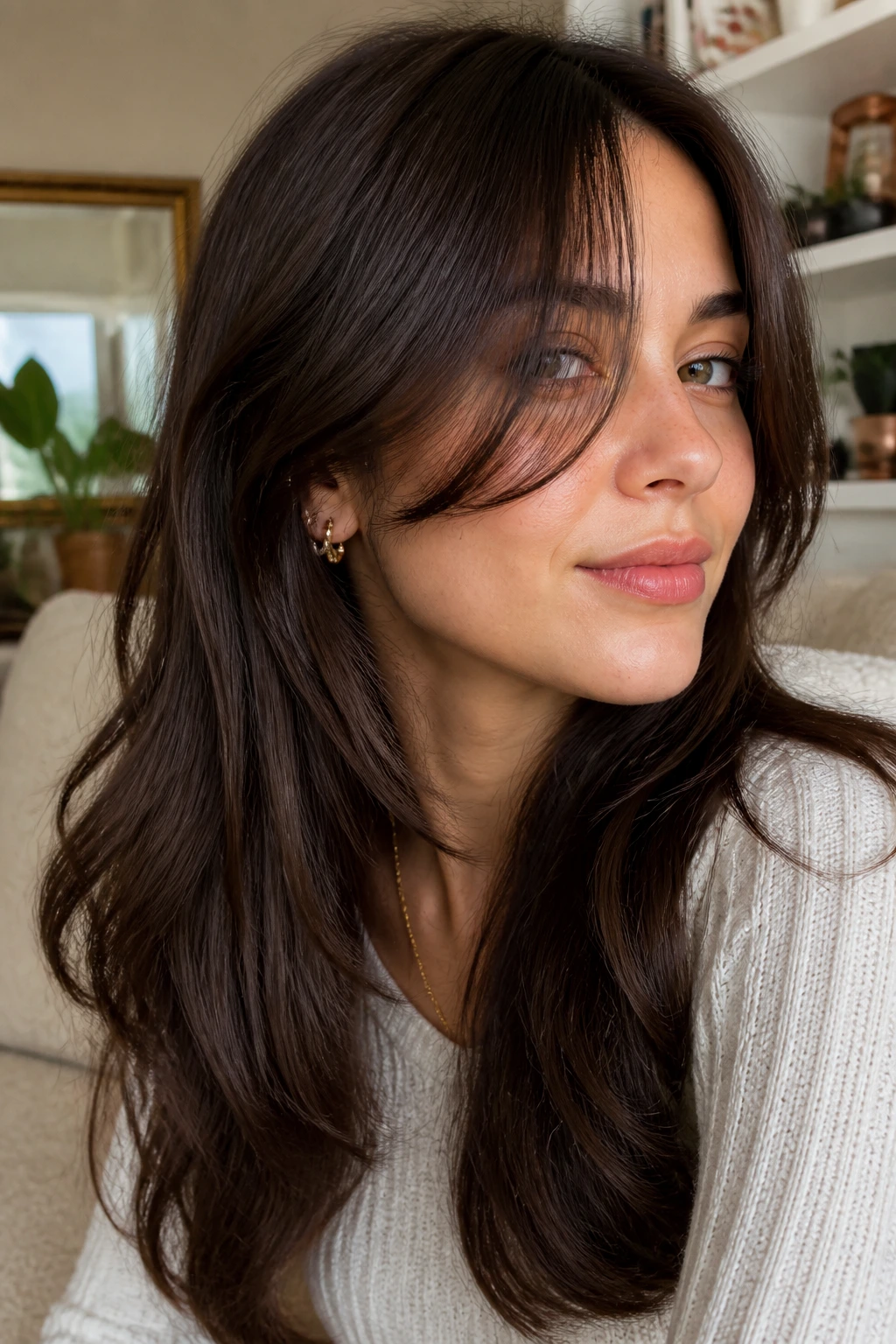
Peekaboo bangs are for people who like a little movement around the forehead but do not want the bang to dominate the face. The front pieces sit under the top layer enough to feel secretive, then pop out when you move or tuck your hair back. Thick hair makes this possible because it gives the front enough substance to stay visible.
On a heart-shaped face, the benefit is subtle. The fringe softens the upper face without taking over the whole front view. It’s a quieter choice, and I think that’s part of its charm.
This style plays well with thick hair that you wear half up, clipped back, or loosely pinned on busy days. You get the feeling of bangs without the daily commitment of a harder fringe line.
15. Long Temple-Framing Fringe
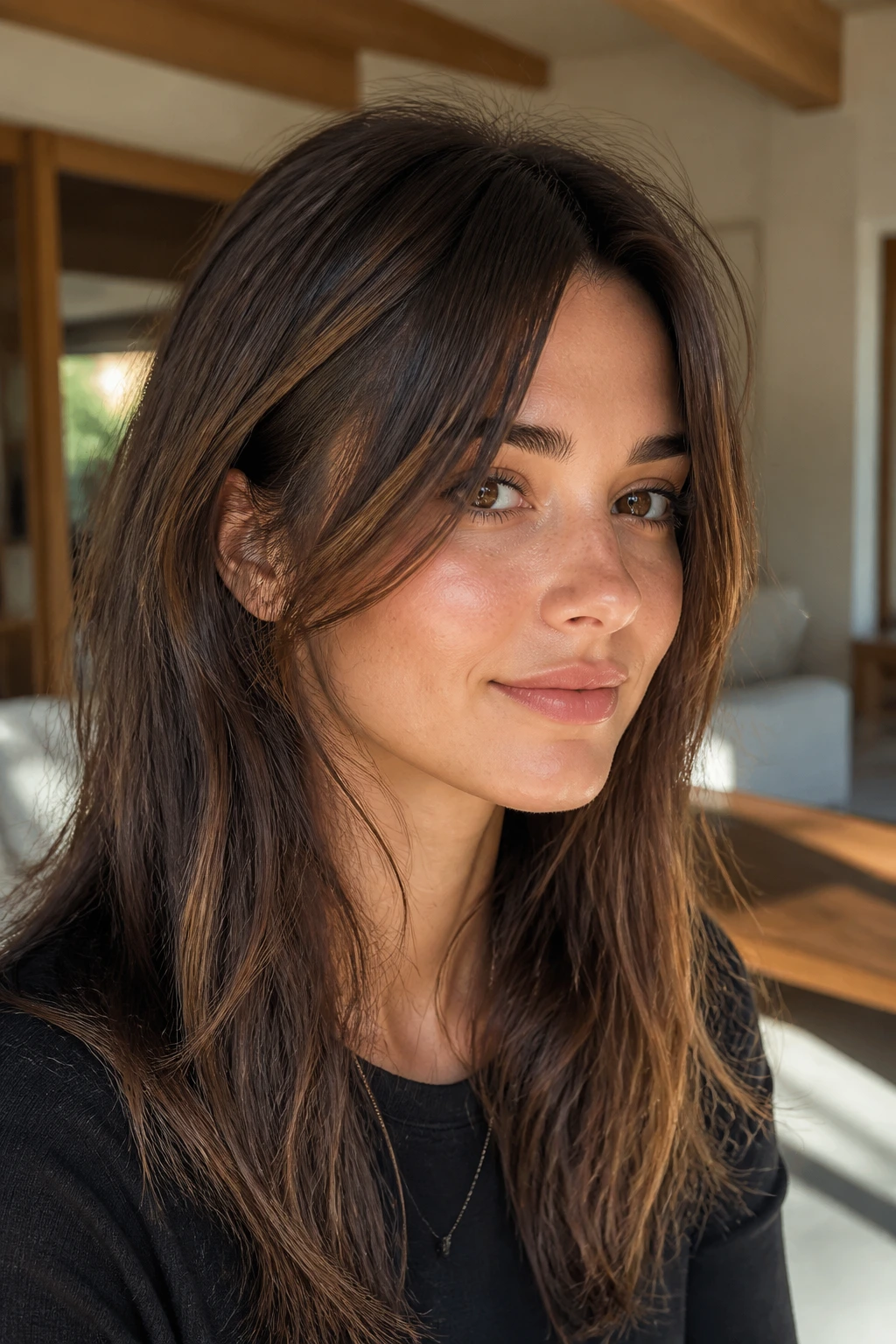
This is one of the smartest shapes for a heart-shaped face, and it does not get enough credit. The shortest pieces live near the temples, not dead center, which means the forehead stays open while the outer face gets more softness. The result feels balanced instead of crowded.
On thick hair, temple-framing fringe keeps the weight where it belongs. You’re not thinning the whole front to death. You’re carving out a shape that can sit beside the face and blend into the haircut.
I like this style if your forehead is broad and your chin is narrow. It adds visual width where the face starts to taper. That’s the game, really.
16. A Soft Split Fringe With Less Gap Than a Curtain
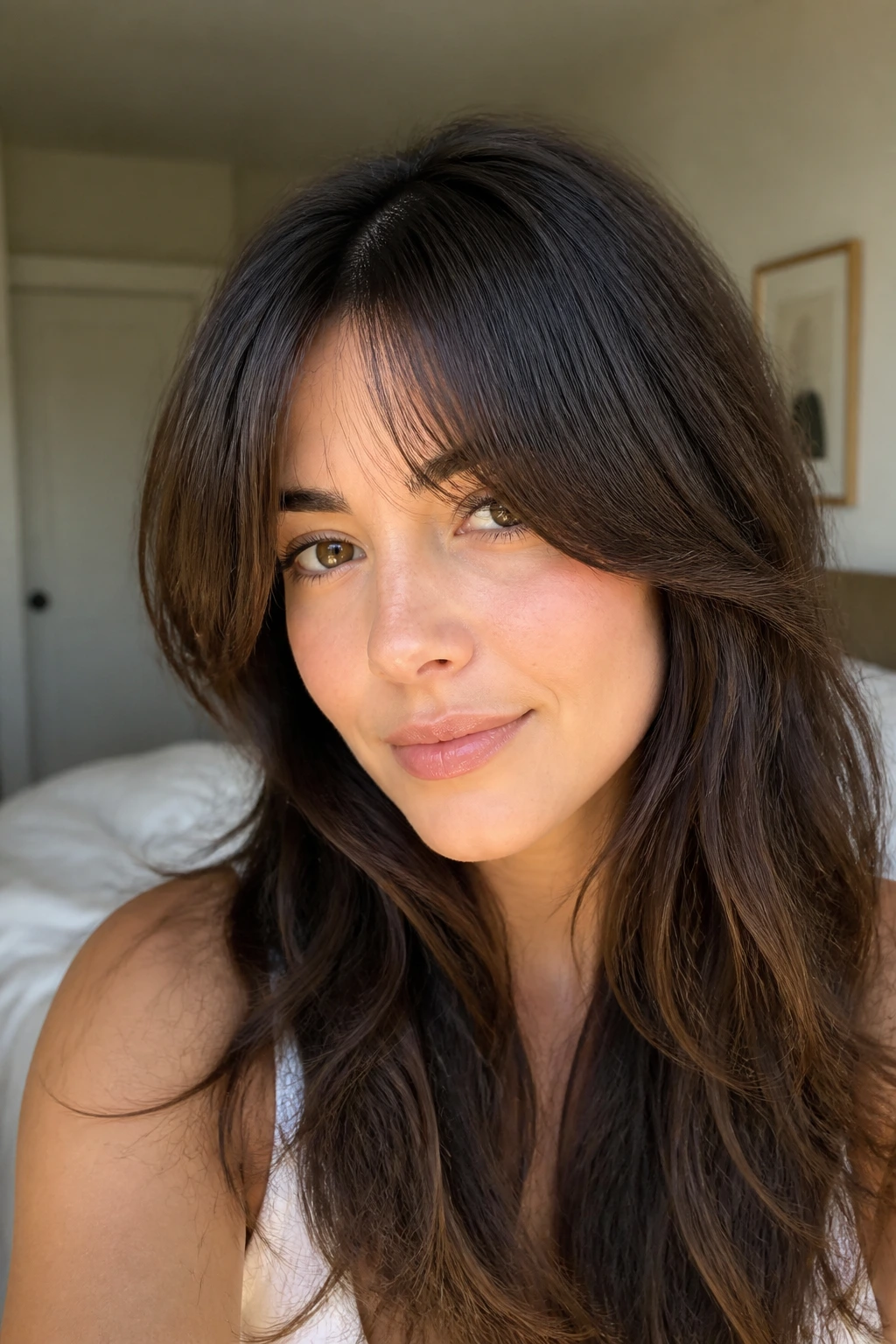
A soft split fringe sits somewhere between curtain bangs and a more blended face frame. The parting is there, but it isn’t a dramatic gap. The front pieces fall close enough together that the fringe still reads as one soft unit.
That middle ground matters for thick hair. Some curtain bangs split too cleanly and can feel a bit open. A soft split keeps more coverage through the forehead, which suits a heart-shaped face if you want a little extra balance up top.
It’s also easier to live with on day two. You can mist the roots lightly, turn the fringe forward with your fingers, and it usually drops back into place. That kind of low-drama behavior is worth a lot.
17. Tapered Heavy Fringe With a Soft Edge

Heavy bangs get a bad reputation because people picture a hard, blunt line. Tapered heavy fringe is the opposite. The body is there — thick, plush, solid — but the ends are softened so the bang doesn’t feel like a wall.
This is a good fit if your hair is coarse, dense, and tends to puff when over-thinned. The taper lets the front section keep enough weight to lie flat. That is useful on a heart-shaped face because the fringe can create a grounding effect without widening the forehead.
Styling note
Blow-dry from side to side first, then brush the fringe down and slightly forward. If you only dry straight down from the start, thick hair can set in a bend that’s hard to fix later.
18. Flip-Under Long Bangs
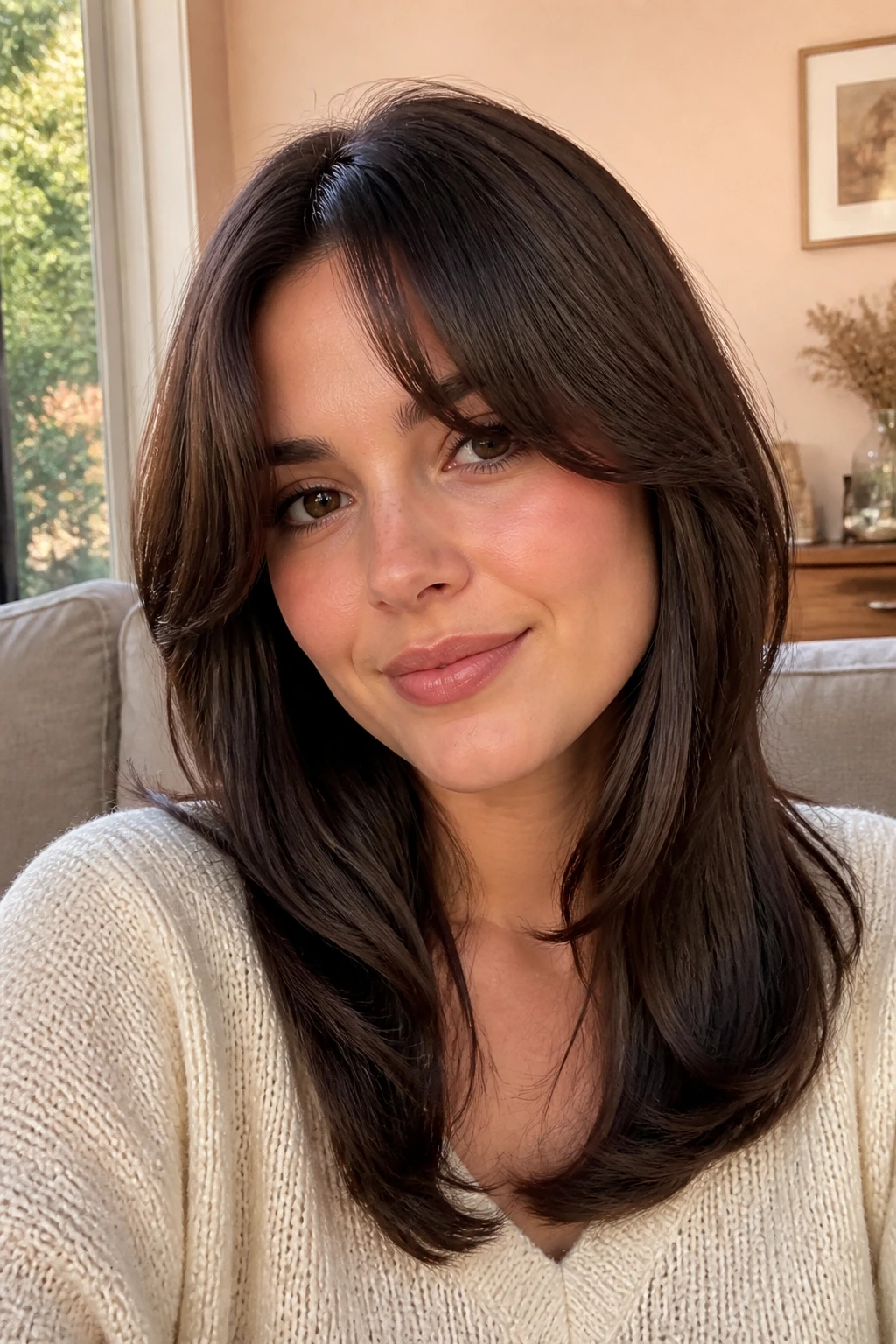
Flip-under bangs have a little inward curl at the ends, almost like the front got a tiny salon blowout of its own. On thick hair, the curve feels polished because the weight of the hair helps the bend stay put. The look is soft, neat, and a touch retro.
This works especially well if you want your bangs to merge into the rest of the haircut instead of standing apart from it. The undercurve makes the fringe sit closer to the face, which helps a heart-shaped face by softening the upper width and guiding the eye downward.
If your hair is straight and stubborn, a round brush and a quick cool-shot at the end make a real difference. Do not skip the cool air. That’s what helps the bend stay.
19. Invisible Bangs That Melt Into the Cut
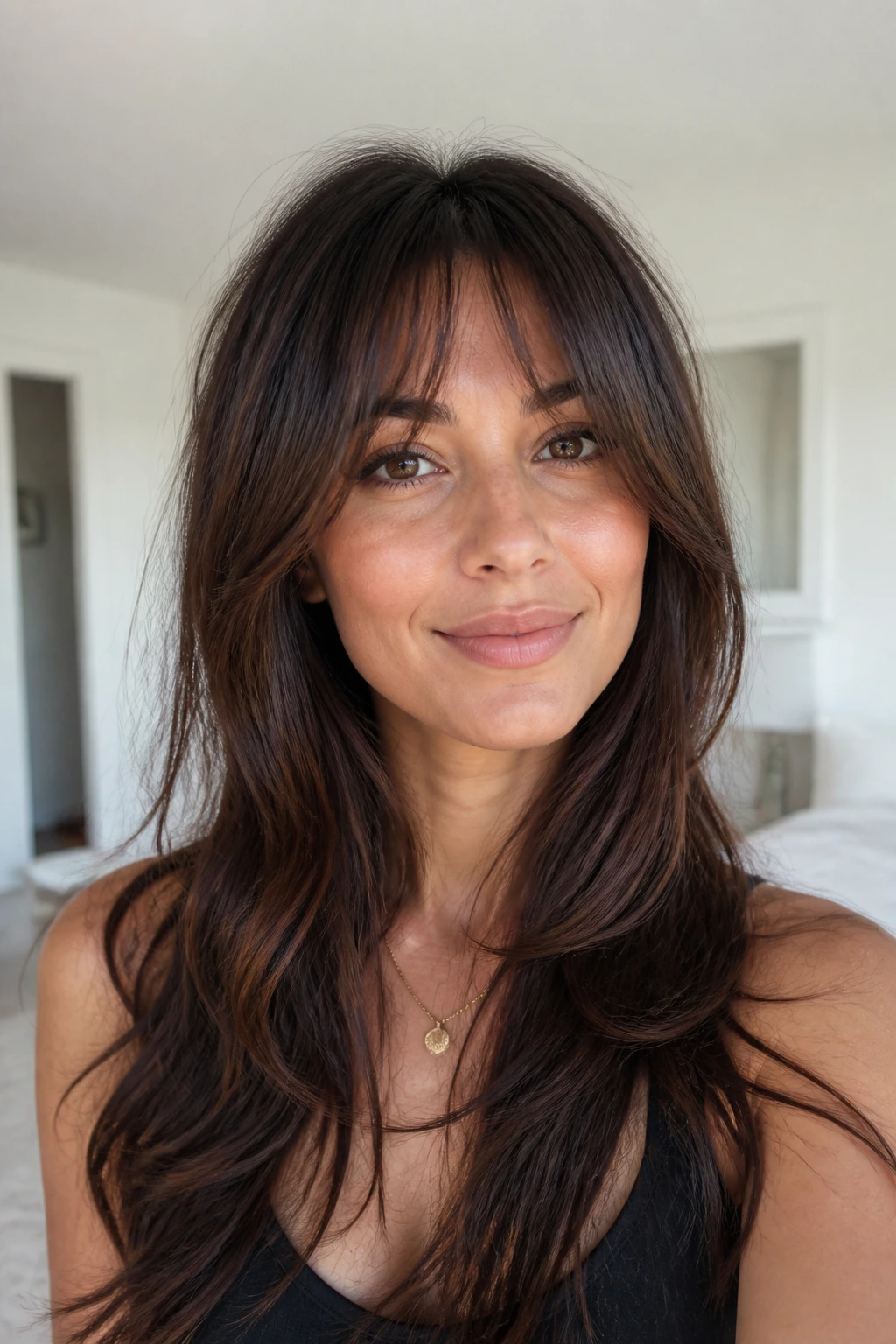
Invisible bangs are the fringe version of a good whisper. They are there, but they don’t announce themselves with a hard edge. Thick hair is useful here because the front pieces can be weighty enough to blend into the layers while still reading as intentional.
This shape is nice if you’re nervous about bangs in general. You get movement around the face without a dramatic break in the haircut. For a heart-shaped face, that means a softer forehead without over-framing the top half.
What to watch for
- The shortest pieces should still be long enough to tuck behind the ear.
- The line should melt into the first layer, not stop abruptly.
- The fringe should survive a casual air-dry, not only a 20-minute salon blowout.
20. Rounded Side Bangs With Body
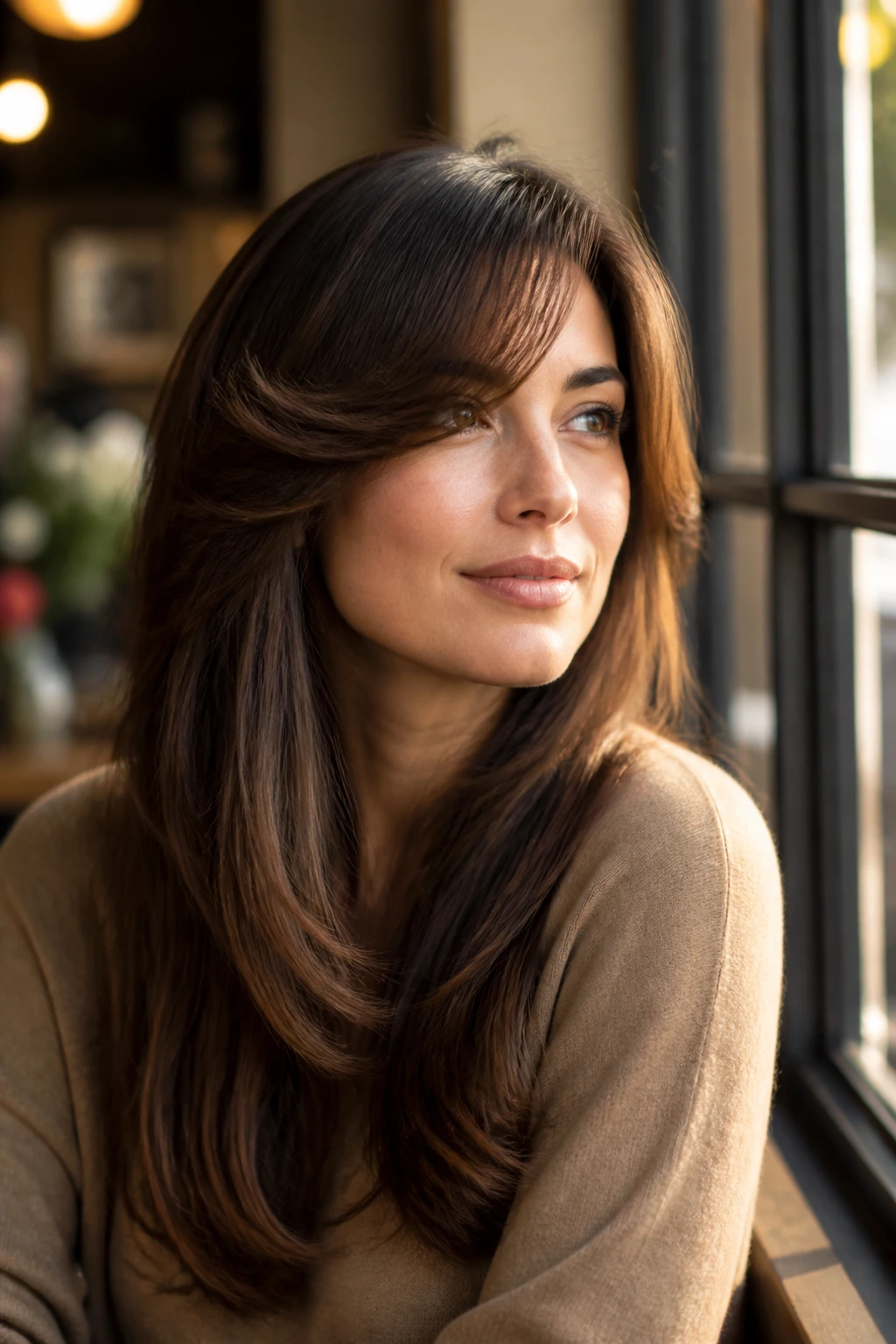
Rounded side bangs are a little fuller than a basic side sweep, and that fullness helps thick hair look lush instead of overworked. The shape curves gently across the forehead and then broadens toward the side, which is lovely on a heart-shaped face because it softens the top while filling in the narrower lower half.
This is a more dressed-up version of side bangs. It has shape. It has presence. But it still moves.
If your hair is very dense at the front, ask the stylist to build a curve through the middle rather than leaving one flat diagonal. That rounded shape keeps the fringe from feeling like it was pasted on with a comb and a prayer.
21. Long Wispy Fringe With a Real Face Frame
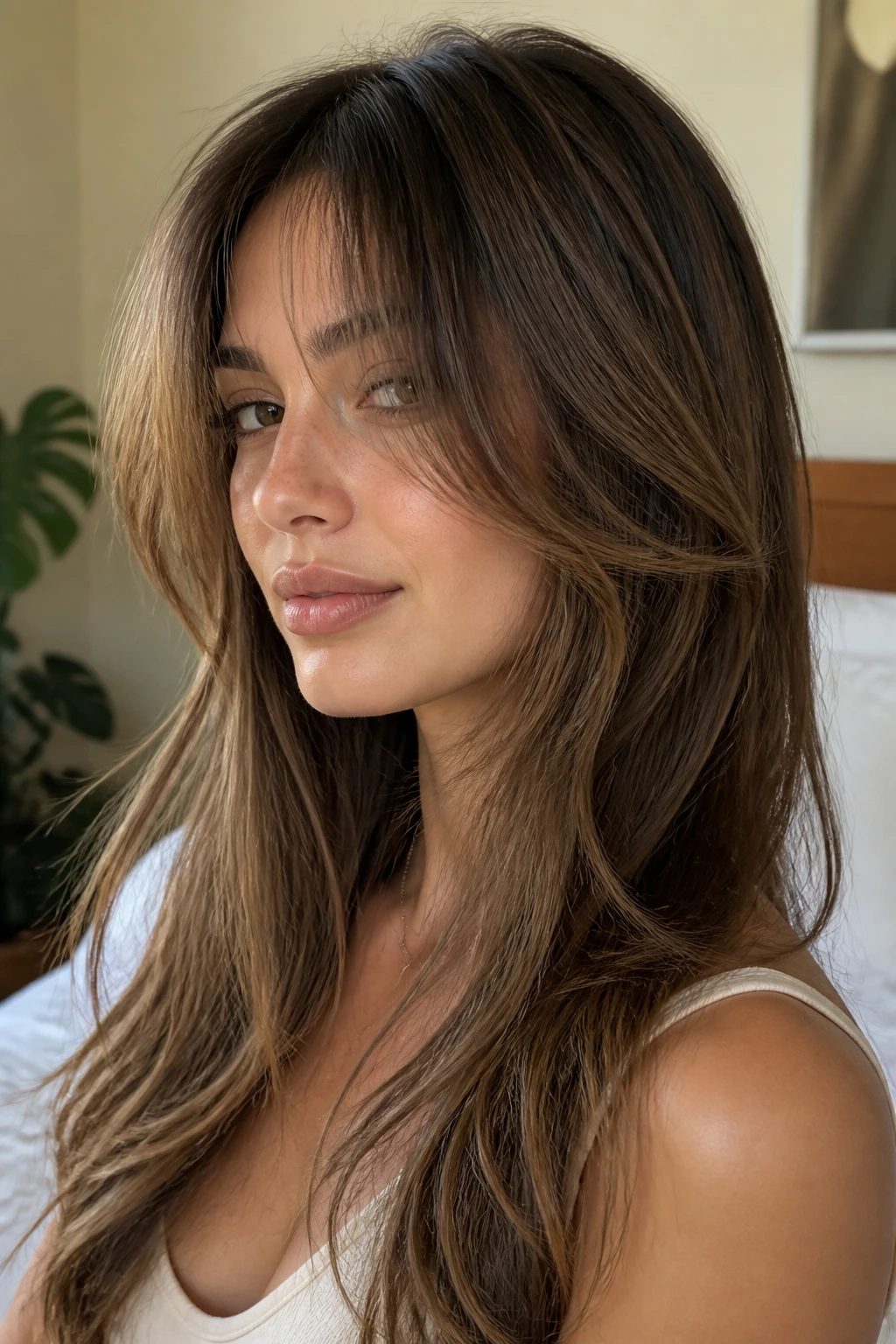
There’s a difference between wispy and sparse, and this style lives in the first camp only. The fringe is light around the edges, but the overall line still has enough body to shape the face. On thick hair, that means the ends are softened while the root area keeps structure.
It’s a smart choice for a heart-shaped face because the longer side pieces can pull attention to the cheekbones and jawline. The front doesn’t need to be heavy to do that job. It just needs to be placed well.
I like this option when the rest of the haircut has layers already. The bangs can borrow shape from those layers and blend in instead of fighting them.
22. Chin-Skimming Side Fringe
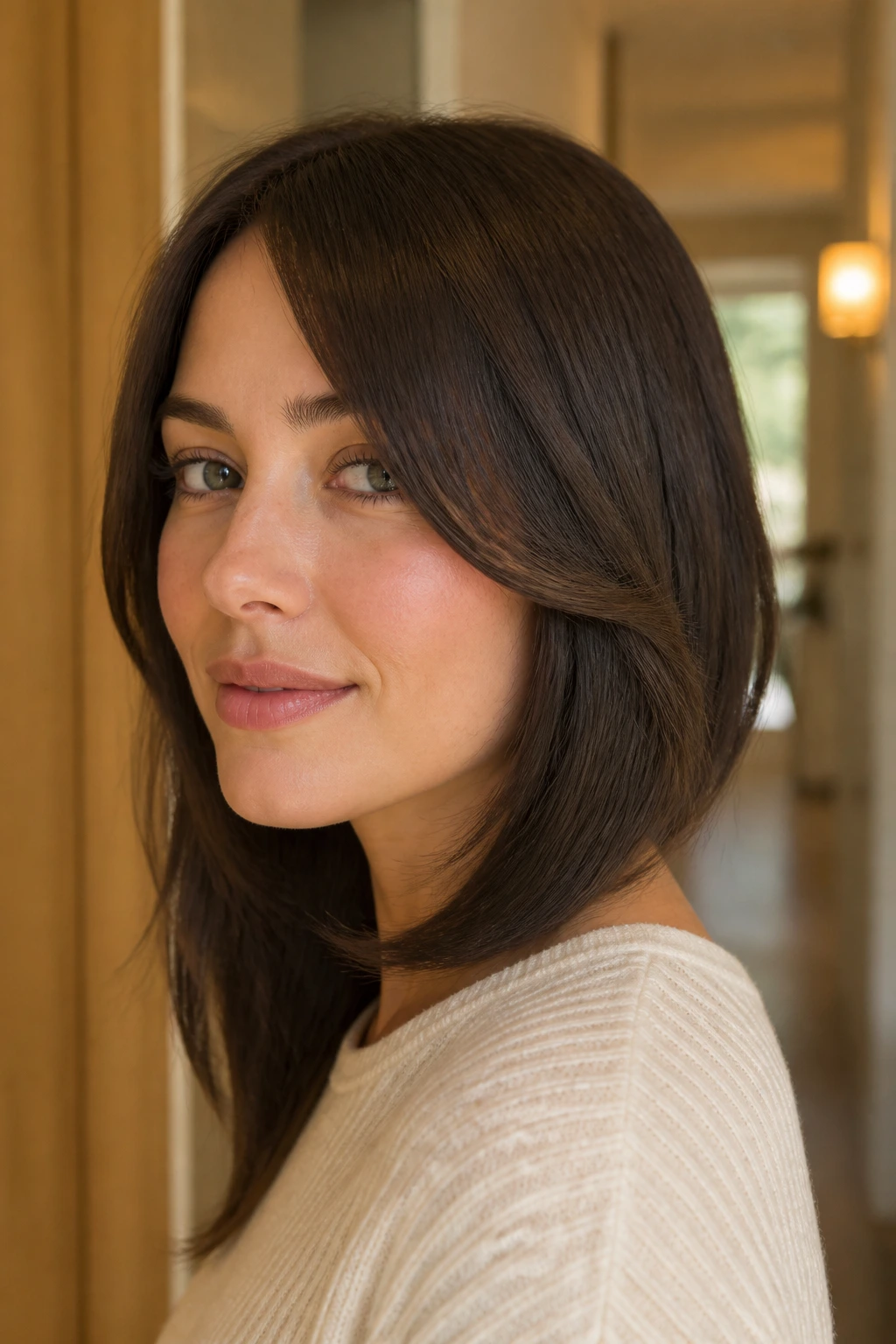
A chin-skimming side fringe is almost not a bang at all, which is exactly why some people love it. It starts around the temple or outer brow and slides down toward the jaw, sometimes brushing the chin on the shorter side. Thick hair gives this shape enough density to feel intentional rather than stringy.
For a heart-shaped face, it’s useful because it visually widens the lower third. That little bit of extra fullness near the chin helps balance a broader forehead.
This is a good one if you want face-framing with a bit of drama but no maintenance nightmare. It can be tucked, curved, or left to fall naturally, and it looks fine in all three states.
23. Lob-Blend Fringe That Disappears Into the Haircut
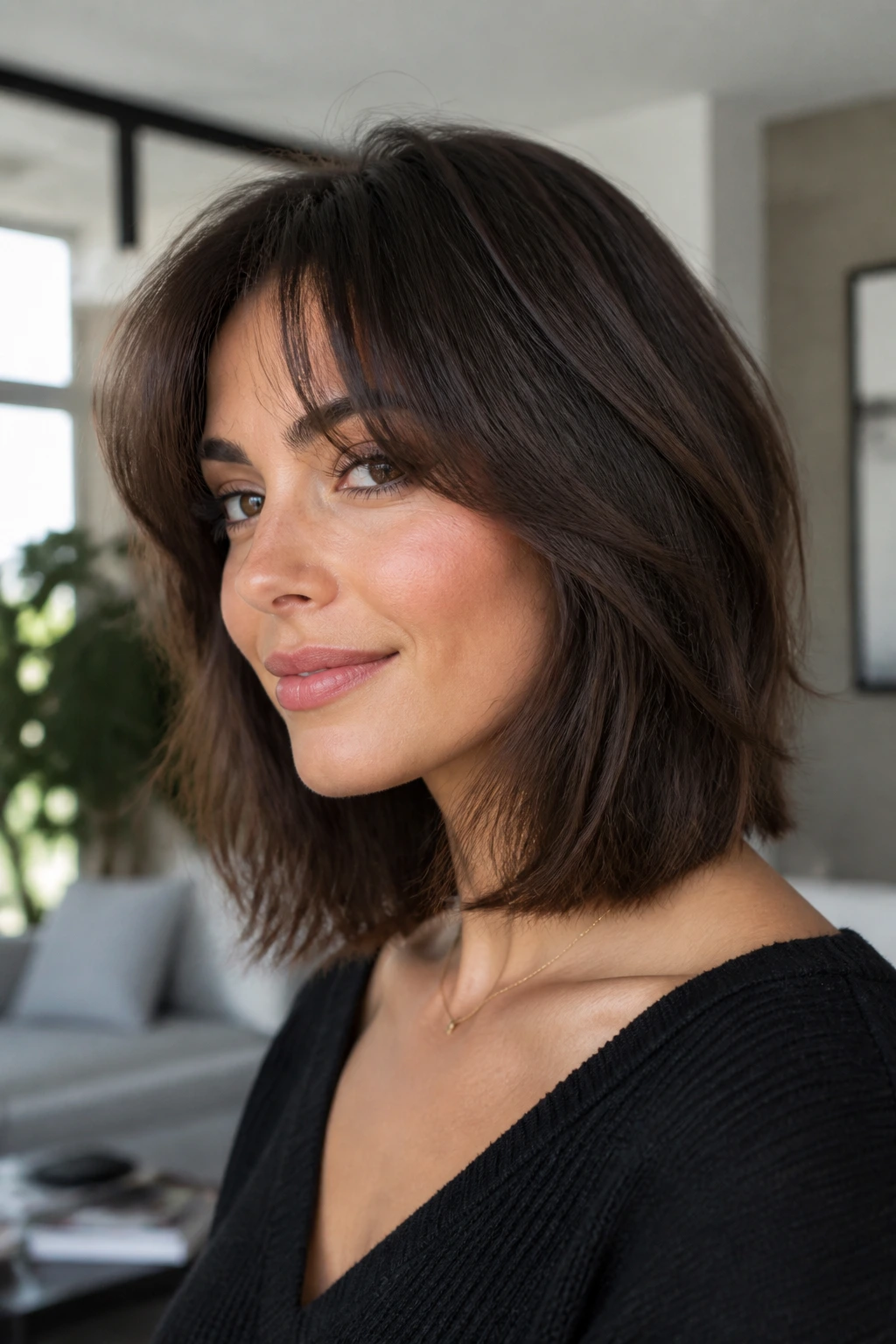
If you wear a lob or any shoulder-length cut, this fringe shape feels especially easy. The bang pieces start long and melt into the front sections of the haircut so cleanly that you can barely tell where the fringe ends and the layers begin. Thick hair makes that blend possible without the shape collapsing.
A heart-shaped face benefits because the front pieces create softness around the cheeks and jaw while keeping the forehead open enough to avoid heaviness. It’s one of the least fussy options in the whole group.
Best for people who want:
- A fringe that grows out gracefully
- A cut that works with ponytails and clips
- Less daily styling than a crisp curtain bang
24. Long Bangs With Micro Layers for Extra-Dense Hair
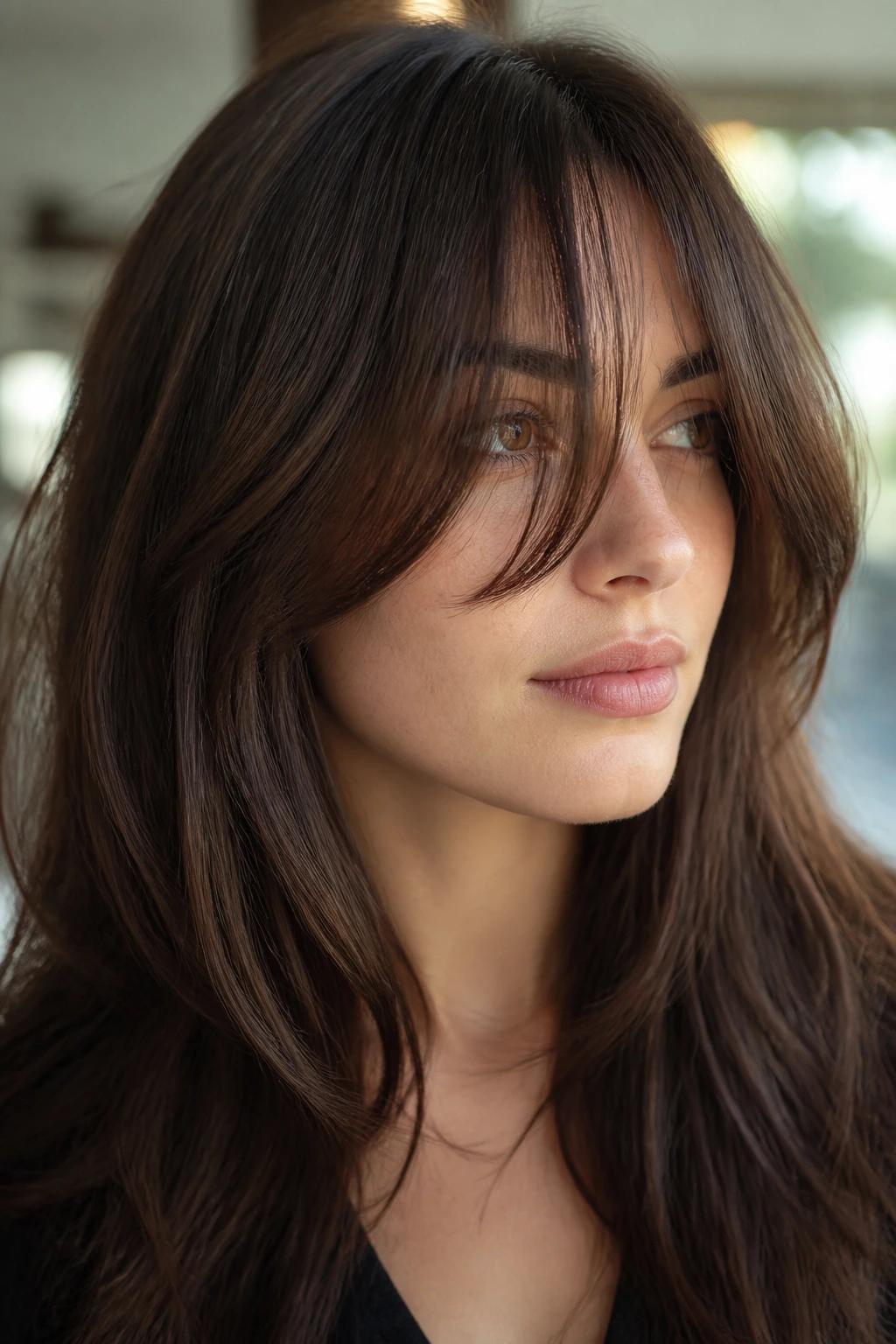
Micro layers are the hidden workhorse of this whole topic. You do not see them right away, but you feel them the second you try to blow-dry a super-dense fringe and it actually lies down instead of ballooning up. The shape keeps the edge smooth while removing just enough interior bulk.
This is the move for hair that feels almost too thick in the front. Not all thick hair is coarse, but when it is, a little internal structure helps a lot. The bang stays long, but it stops behaving like a thick flap of fabric.
For a heart-shaped face, the benefit is simple: the fringe can sit lower and softer without swallowing the eyes. That balance is worth chasing.
25. Growth-Friendly Fringe That Still Looks Planned
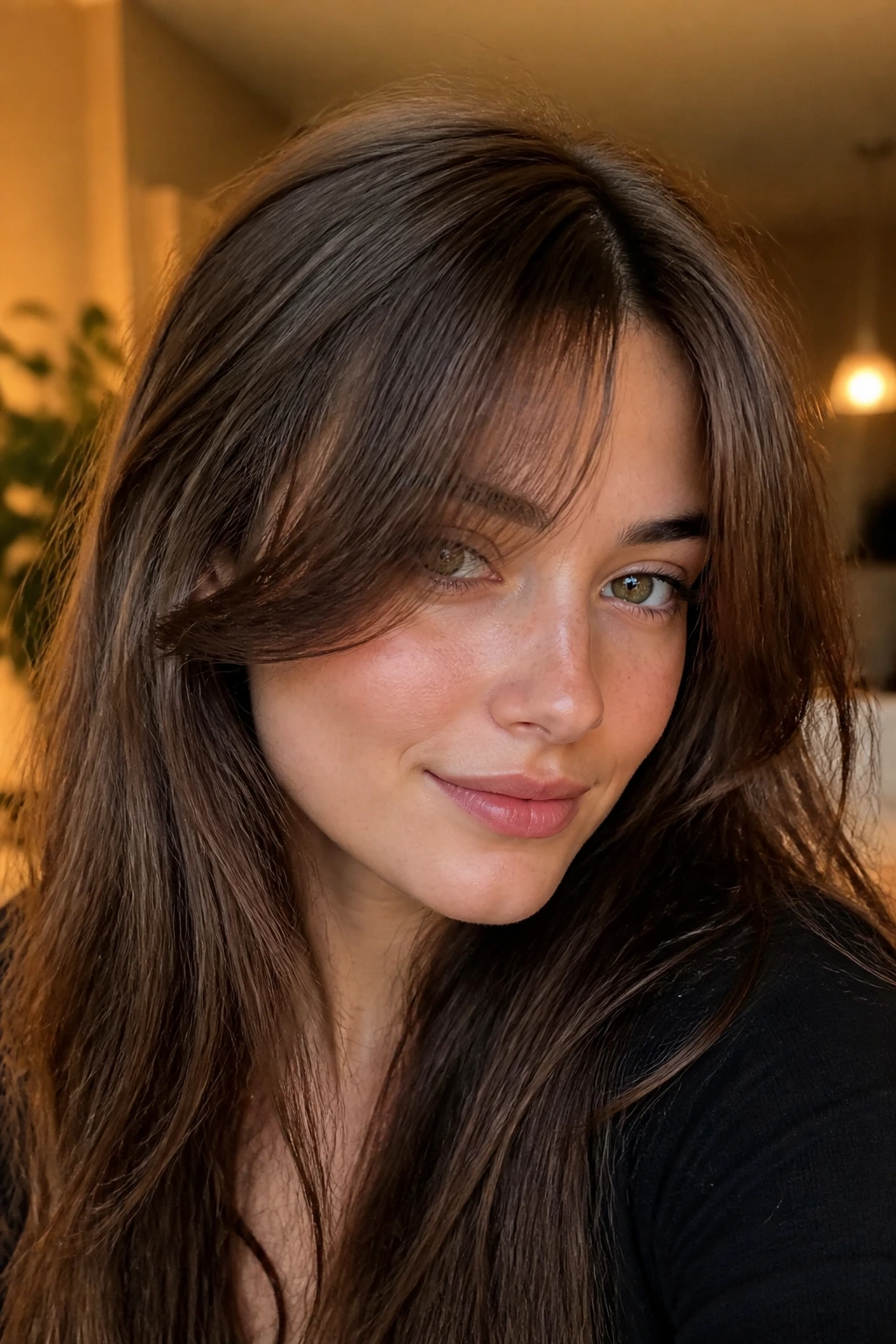
Some bangs look great on day one and then become a project. Growth-friendly fringe does not have that problem. It’s cut long enough to shift into curtain pieces, temple pieces, or side-swept layers as it grows, which makes it a smart pick if you know you will want options later.
The shortest point usually lands just below the brow or at the outer brow area, with longer edges that already point toward the cheekbones. That means the shape can move through several stages without looking like you forgot to get a trim.
For thick hair and a heart-shaped face, this is the practical winner. It gives you the face-softening effect now and leaves room for changes later. That’s a rare thing in fringe land.
How Long Bangs Sit Best on Thick Hair and Heart-Shaped Faces
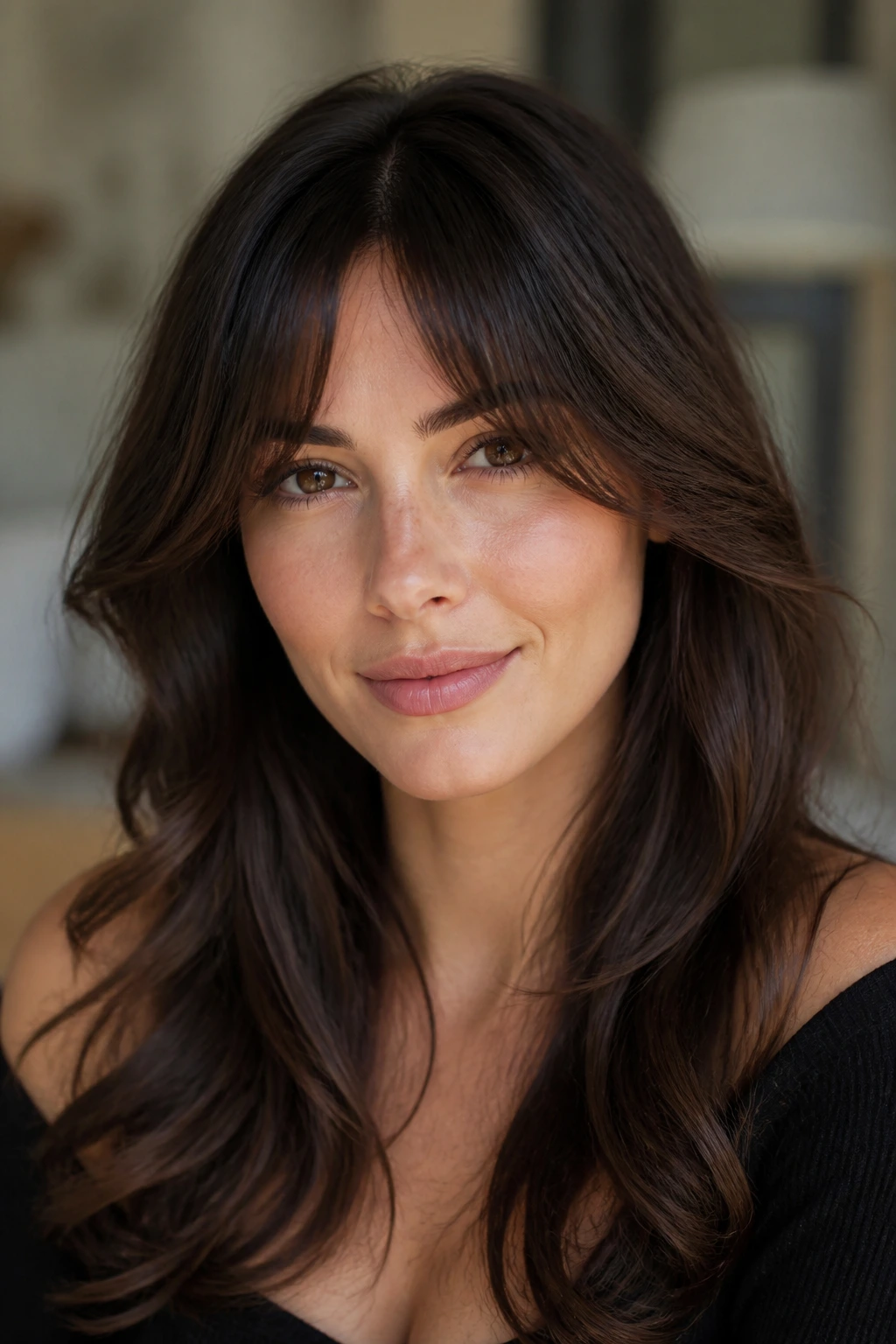
These bangs work because they respect two facts at once. Thick hair carries weight, and a heart-shaped face usually asks for softness at the forehead and fullness lower down. If a fringe ignores either one, it tends to look fussy for all the wrong reasons.
The best starting point is usually not the exact center of the forehead. That spot tends to emphasize width. Better options land around the outer brow, cheekbone, or top of the lip, where the bang can break up the top half of the face and pull the eye downward. That does not mean every fringe should be long and shapeless. It means the shortest area needs to be chosen on purpose.
The cutting details that matter most
- Length placement: Ask where the shortest point will sit when the hair is dry, not just when it’s wet.
- Internal weight removal: Thick hair usually needs inside work, not just surface thinning.
- Parting direction: A center part, off-center part, or deep side part changes the whole balance of a heart-shaped face.
- Blend point: The bangs should disappear into the first layer, not stop like a separate section.
Essential Equipment for These Styles
-
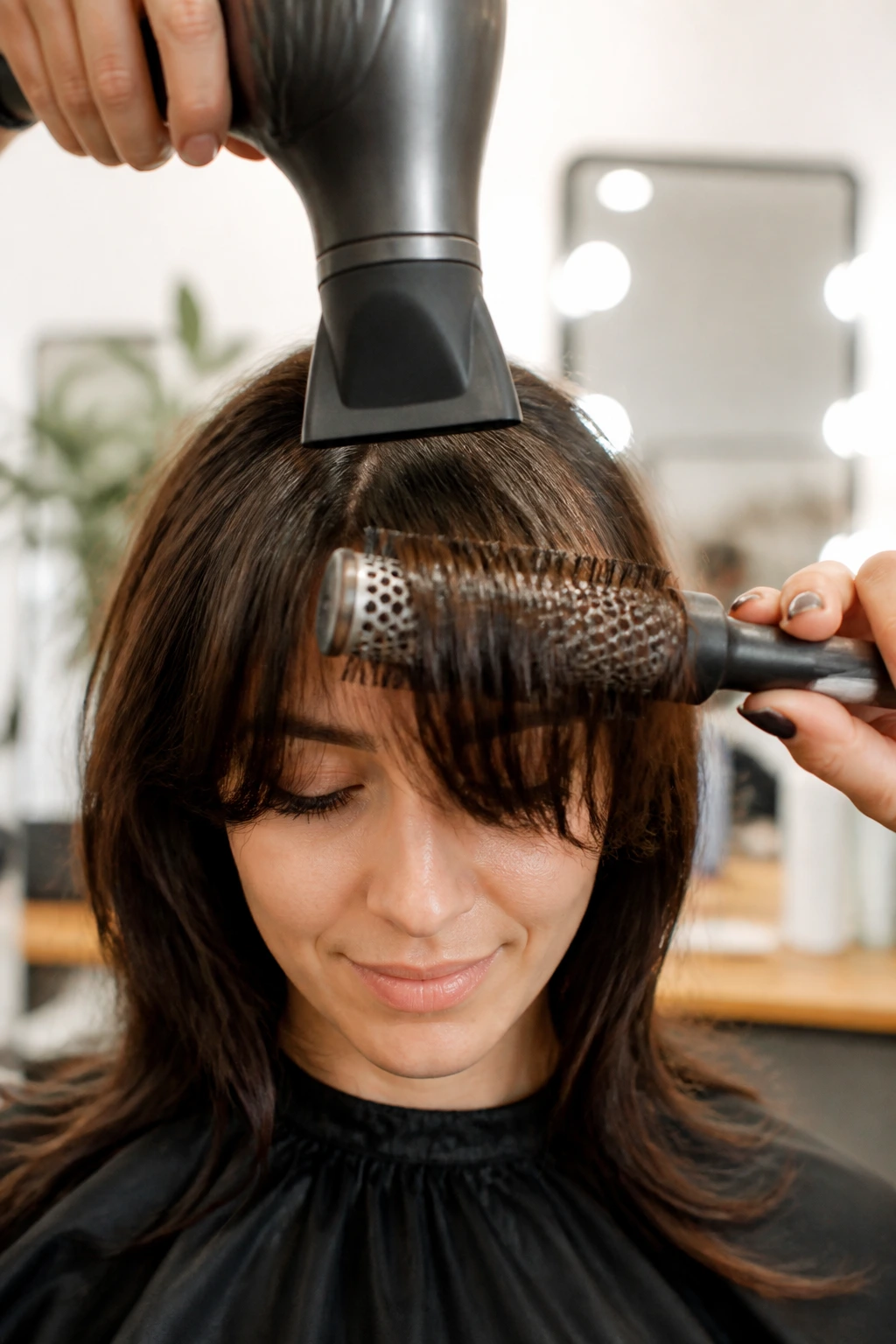
Blow dryer with a narrow nozzle — Directs airflow so the fringe lies the way you want instead of puffing in every direction.
-
1.25- to 1.5-inch round brush — Big enough to bend thick hair, small enough to shape the front without flattening it.
-
Fine-tooth comb — Useful for clean parting and for steering damp bangs before they set.
-
Duckbill clips — Handy for pinning the rest of the hair away while you dry only the fringe.
-
Lightweight smoothing cream — Keeps thick bangs from frizzing without making them greasy.
-
Root-lift spray or mousse — Helps the fringe stay lifted at the roots if your hair is heavy or prone to collapsing.
-
Flat iron or hot brush — Optional, but useful for polishing the ends of curtain, side-swept, or arched bangs.
-
Dry shampoo — A smart backup when the front gets a little oily faster than the rest of the head.
How to Brief Your Stylist So the Bangs Land in the Right Place
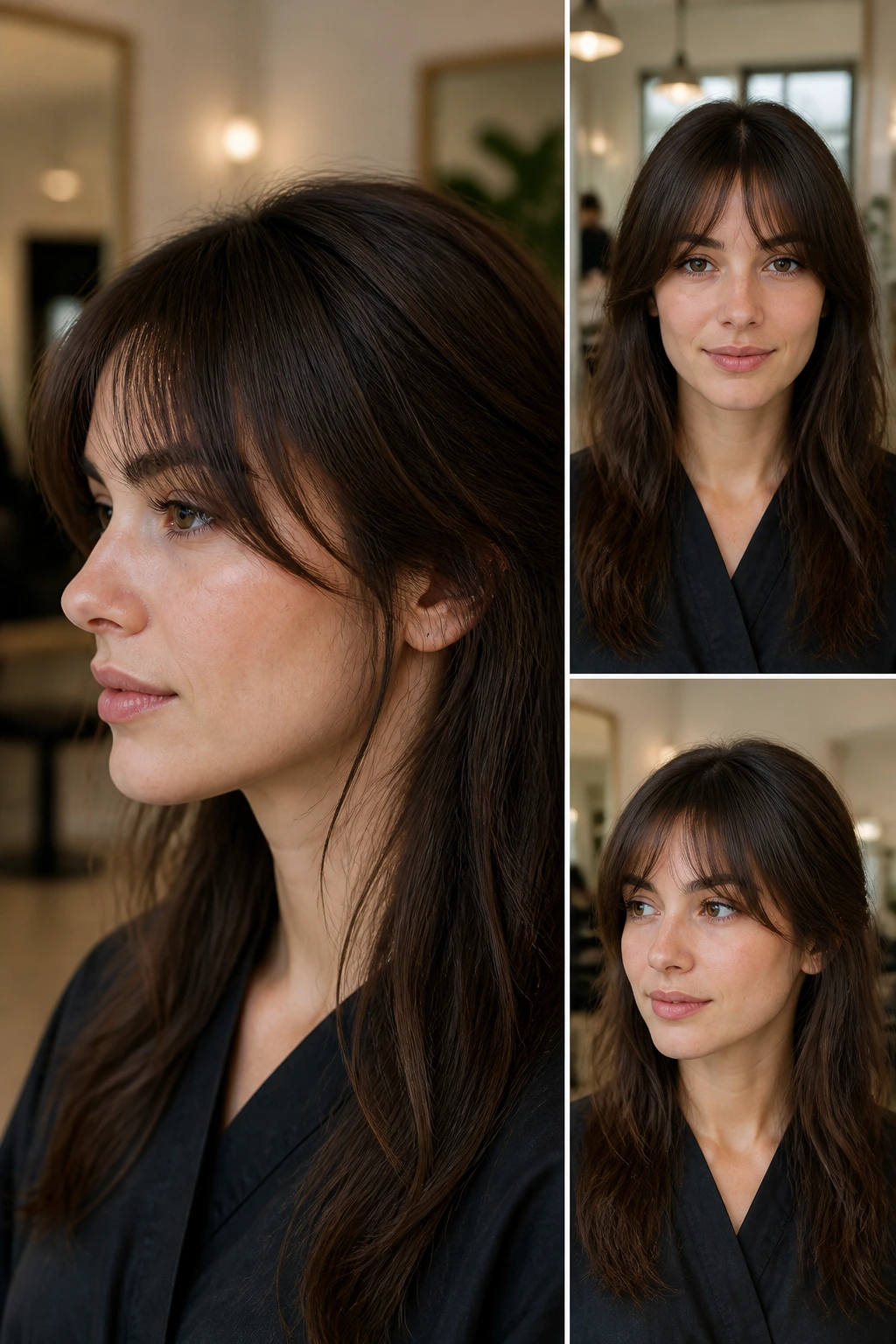
Bring more than one photo. Bring one picture of the front, one with the hair tucked back, and one that shows the bangs from a side angle. The side view is the one people forget, and it matters most with long bangs because the length and angle change everything.
Say where you usually part your hair, how often you wear it up, and whether the front tends to split at the root. Those little details affect the cut more than people think. A stylist can cut the prettiest fringe in the room and still miss the mark if your cowlick pushes the hair left and you actually live in a deep right part.
Use plain language. Tell them you want the fringe to soften the forehead, not cover it completely. Mention that your hair is thick and you want shape removal, not a baggy, overly thinned front section. If you have a strong brow line or a narrower chin, say that too. A good stylist can work with that information without translating it into salon poetry.
One more thing: ask where the fringe will sit dry. Thick hair shrinks, bends, and settles differently than fine hair. Wet length is a liar. Dry length is the truth.
How to Style Long Bangs on Thick Hair
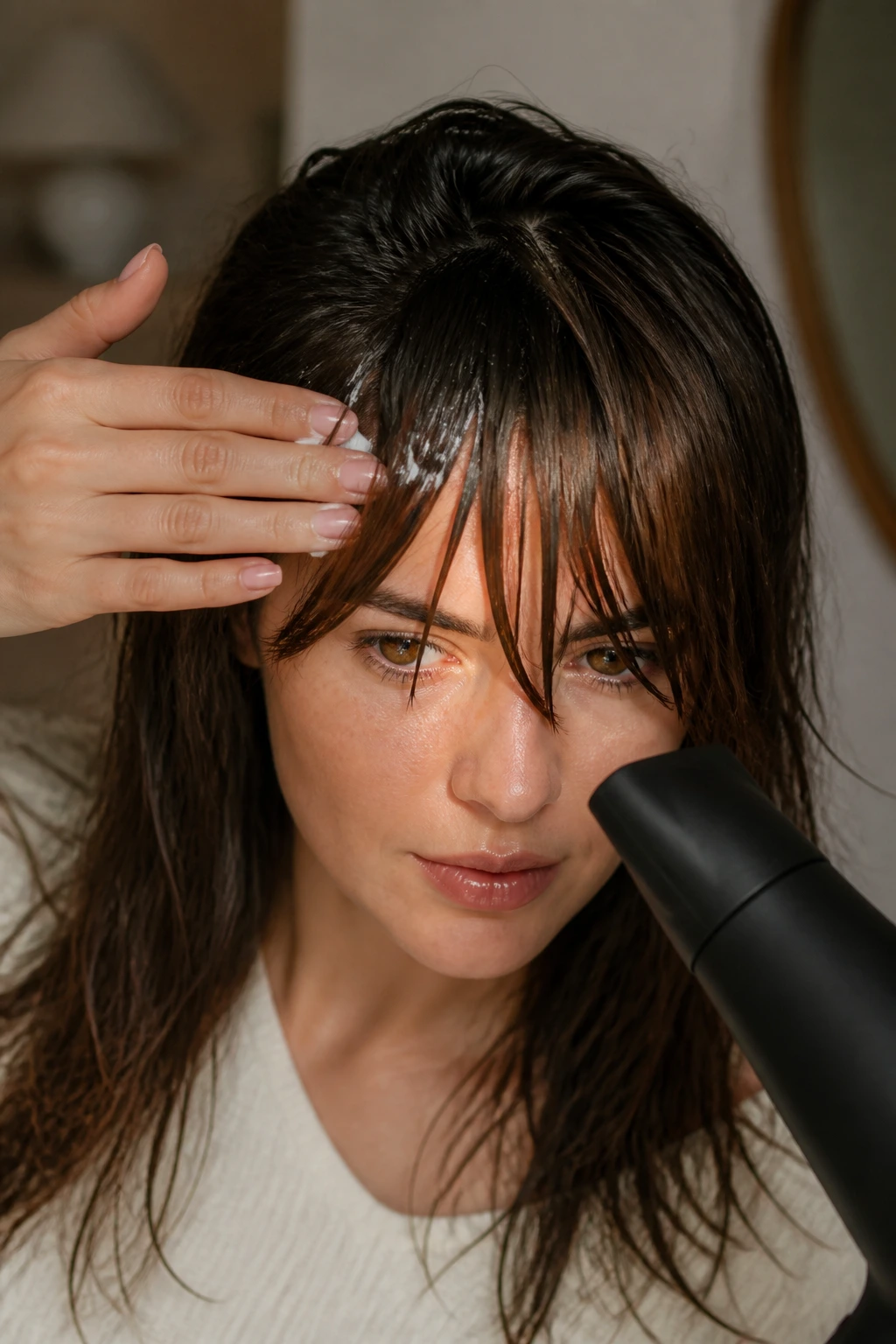
The front of thick hair usually needs to be styled first, not last. If you dry the rest of the hair and leave the bangs for the end, the front has already started setting in the wrong direction. That’s how you get the weird swoop, the split piece, or the puffed-up middle that refuses to cooperate.
Start damp, not dripping. Work a tiny bit of smoothing cream or mousse through the fringe, then direct it where you want it to go while using the dryer on medium heat. Keep the nozzle pointed downward if you want polish, or use a round brush if you want bend. For curtain bangs and side sweeps, I like to dry each side away from the face first, then roll it back in. That gives the front a softer curve and keeps it from sticking flat to the forehead.
A cool shot at the end matters. A lot. Thick hair holds heat, and if you skip the cooling step, the bang line can fall apart ten minutes later.
Additional Tips and Styling Moves That Pay Off
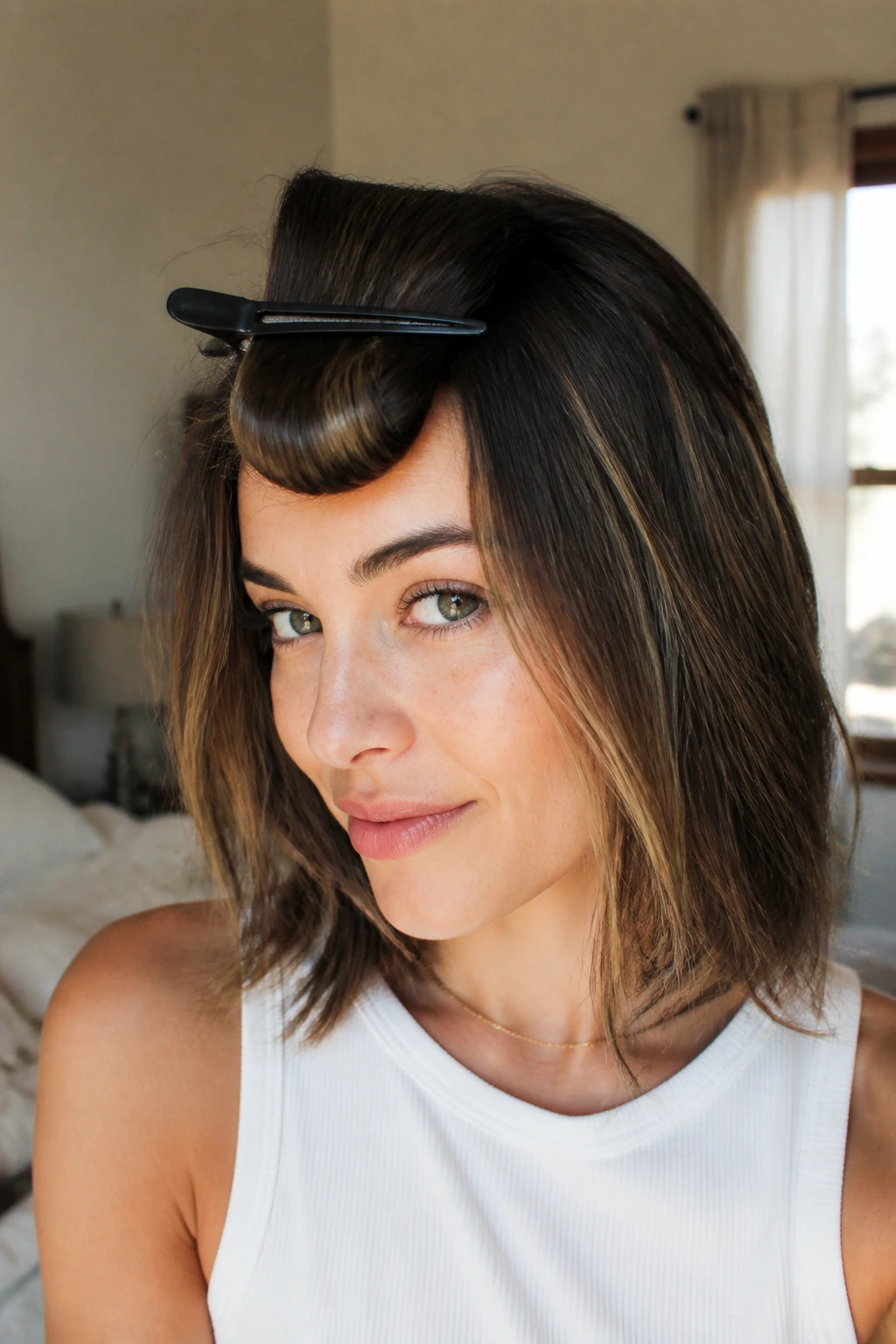
Shape control: If your bangs puff at the roots, clip them forward with a duckbill clip while they cool. That little bit of pressure helps the front settle flatter and keeps the part from splitting too wide.
Texture balance: On thick wavy hair, don’t chase poker-straight bangs unless you truly want that look. A slight bend usually looks better and takes less work. Straightening every strand often makes the fringe separate at the ends.
Time-saver: Dry the bangs first, then clip them aside while you finish the rest of your hair. Come back to the front for a 30-second polish at the end. Less heat. Less fuss. Better shape.
Finish choice: If the bangs feel too airy, add the tiniest touch of lightweight cream to the very ends only. Skip the roots. Roots need lift, not slip.
Common Mistakes to Avoid With Long Bangs
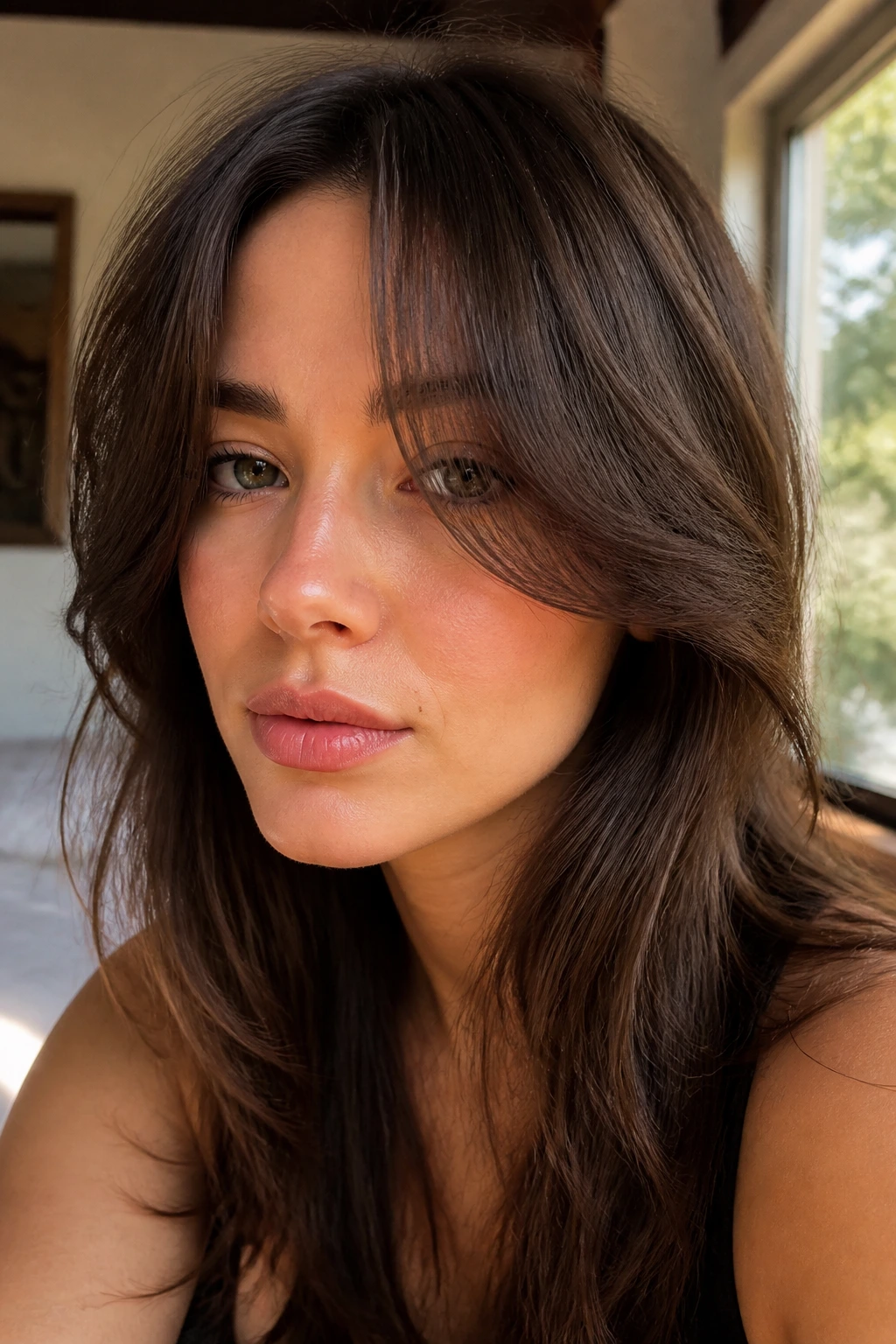
The first mistake is cutting the fringe too short at the widest part of the forehead. On a heart-shaped face, that usually makes the top half look broader and the face more top-heavy. The fix is simple: keep the shortest point a bit lower, then let the sides do the balancing.
The second mistake is over-thinning thick hair. Thin the wrong way and the bangs turn fuzzy, see-through, and weirdly puffy around the edges. If your hair is dense, ask for internal weight removal or point cutting instead of heavy thinning shears through the whole front.
The third mistake is ignoring the natural part or cowlick. If the front wants to split left and you keep forcing a center part, the bangs will fight you every morning. Work with the growth pattern. That is not surrender. That is good hairstyling.
The fourth mistake is styling only the middle and forgetting the edges. Long bangs need the outer pieces to bend too, or the whole shape falls apart and starts to look disconnected from the haircut.
Variations and Adaptations to Try
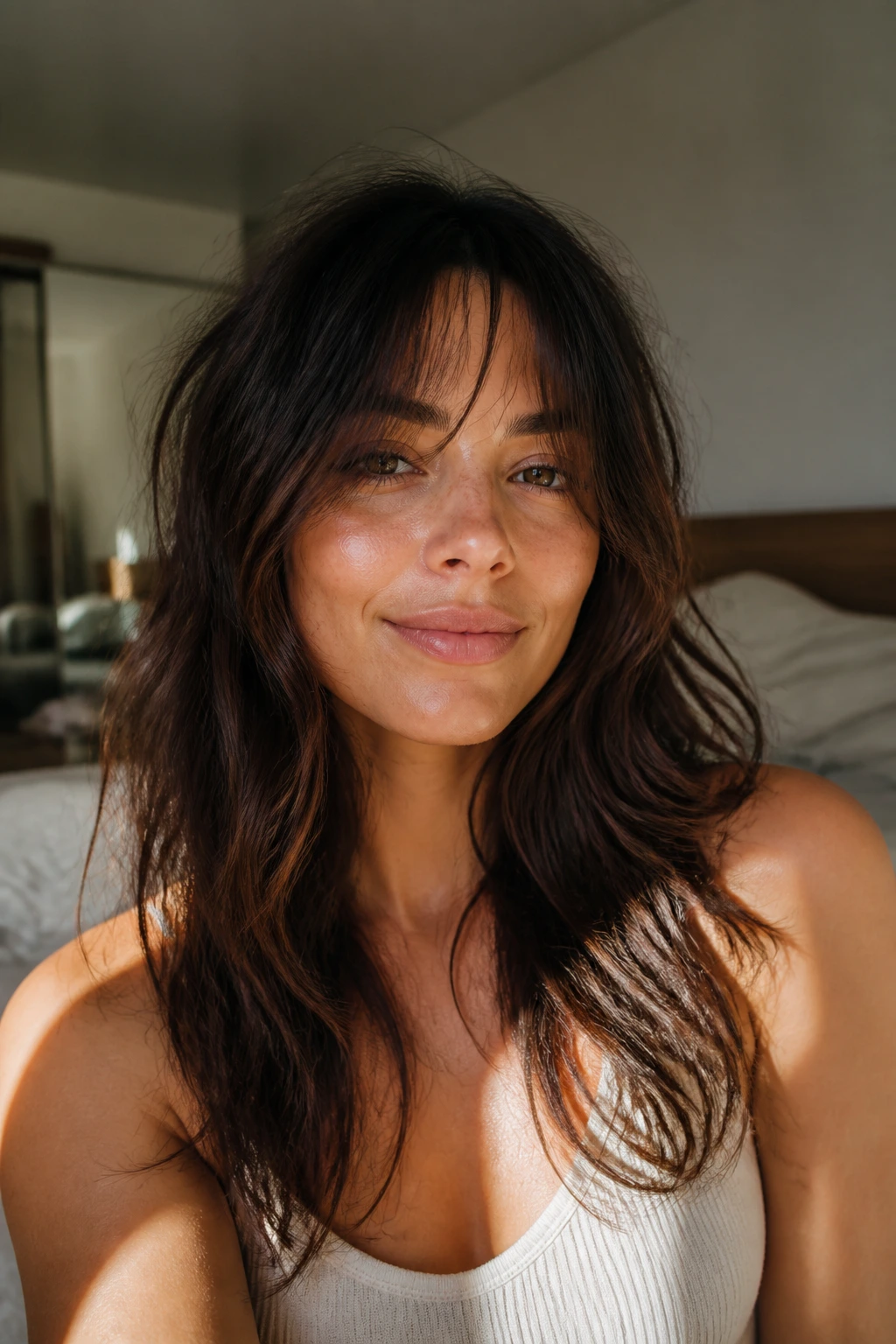
Soft Air-Dry Fringe: Best if your thick hair has a natural bend. The cut should be long, layered, and a little loose so it falls into place after scrunching and air-drying.
Polished Blowout Fringe: This version leans on a round brush and a smooth finish. It works when you want the bang to curve under and read a bit more refined than lived-in.
Wavy Face-Frame Fringe: Keep the bang longer and let it blend into wavy layers. Good if you want forehead softness without losing texture.
Deep Side-Part Version: A stronger side part gives more drama and helps direct attention away from forehead width. It’s a clean fix for days when the center part feels too exposed.
Grow-Out-Friendly Version: Start with the shortest point just above or at the brow and keep the sides long enough to tuck. It buys you time between trims and keeps the shape useful as it changes.
Frequently Asked Questions
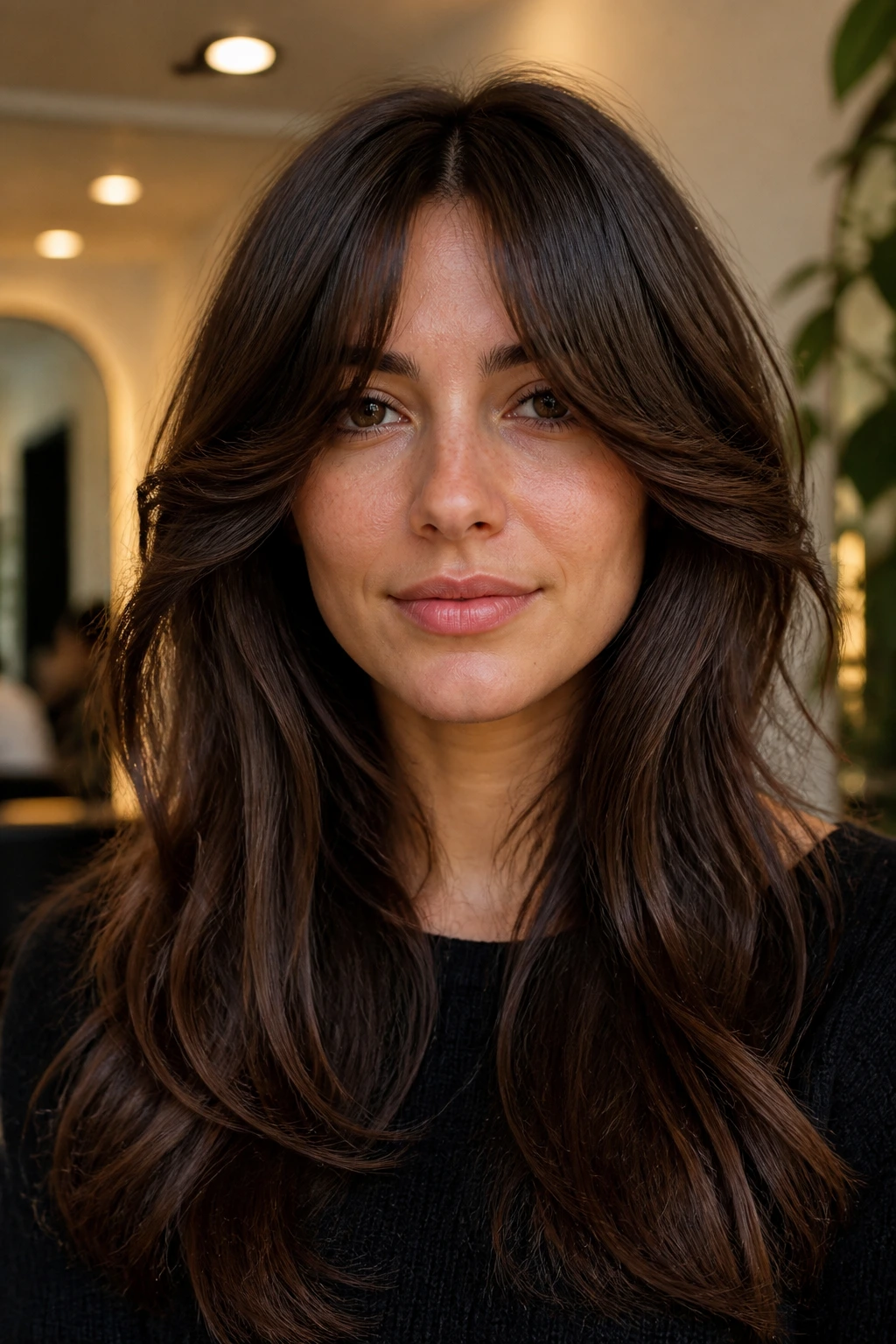
How long should long bangs be on a heart-shaped face?
Usually somewhere between the outer brow and the top of the cheekbone works best, with the side pieces stretching lower. That keeps the forehead soft without making the front too heavy.
Are curtain bangs or side-swept bangs better for thick hair?
Curtain bangs usually win if you want the most flexibility. Side-swept bangs are easier if you already wear a deep side part and want the fringe to stay out of your eyes more often.
Can thick hair handle wispy bangs without looking frizzy?
Yes, if the thinning is controlled. The trick is keeping enough density at the roots and softening the ends, not shredding the whole front section into a see-through mess.
Should long bangs be cut wet or dry?
A lot of stylists use both. Wet cutting sets the shape, but thick hair often needs a dry refinement so the final length lands where it should once the hair settles.
How often do long bangs need a trim?
Every 4 to 8 weeks is common, depending on how crisp you want the shape. If you like a softer grow-out, you can stretch longer, but the front will stop sitting as cleanly.
What if my bangs puff up in humidity?
Use less product than you think you need and keep the roots light. A tiny bit of smoothing cream through the mid-lengths, plus a quick pass with a round brush, usually helps more than heavy styling balms.
Can I wear these bangs if I have a strong cowlick?
Yes, but the cut has to respect the cowlick instead of bulldozing it. A deeper part, a longer center, or a split fringe usually behaves better than a blunt front.
Do these styles work with curly or wavy thick hair?
They can, but the length has to be measured in the hair’s natural shape, not when it’s stretched straight. Ask for the fringe to be cut with the curl pattern in mind, and keep the shortest pieces longer than you would on straight hair.
Maintenance, Trim Timing, and Grow-Out Sanity

Long bangs are kinder than short bangs, but they still need a little upkeep. If you want the shape to stay crisp, plan on a light trim every 4 to 6 weeks. If you like a softer, more blended fringe, 6 to 8 weeks usually works. Thick hair can carry a grow-out better than fine hair, but once the fringe starts hitting the cheeks and eyes, it either needs shaping or a clear move into layers.
Dry shampoo helps the front more than people admit. Bangs pick up forehead oil faster than the rest of the head, so a small blast at the root can buy you a day without a full wash. Use it sparingly. Too much and the fringe gets chalky and rough.
If you are growing the bangs out, do not fight the awkward stage every single morning. Push the fringe to one side, split it at the center, or pin the shorter pieces back and let the long edges frame the face. That stage is not failure. It is just a different haircut in transit.
The Bangs That Keep Their Shape
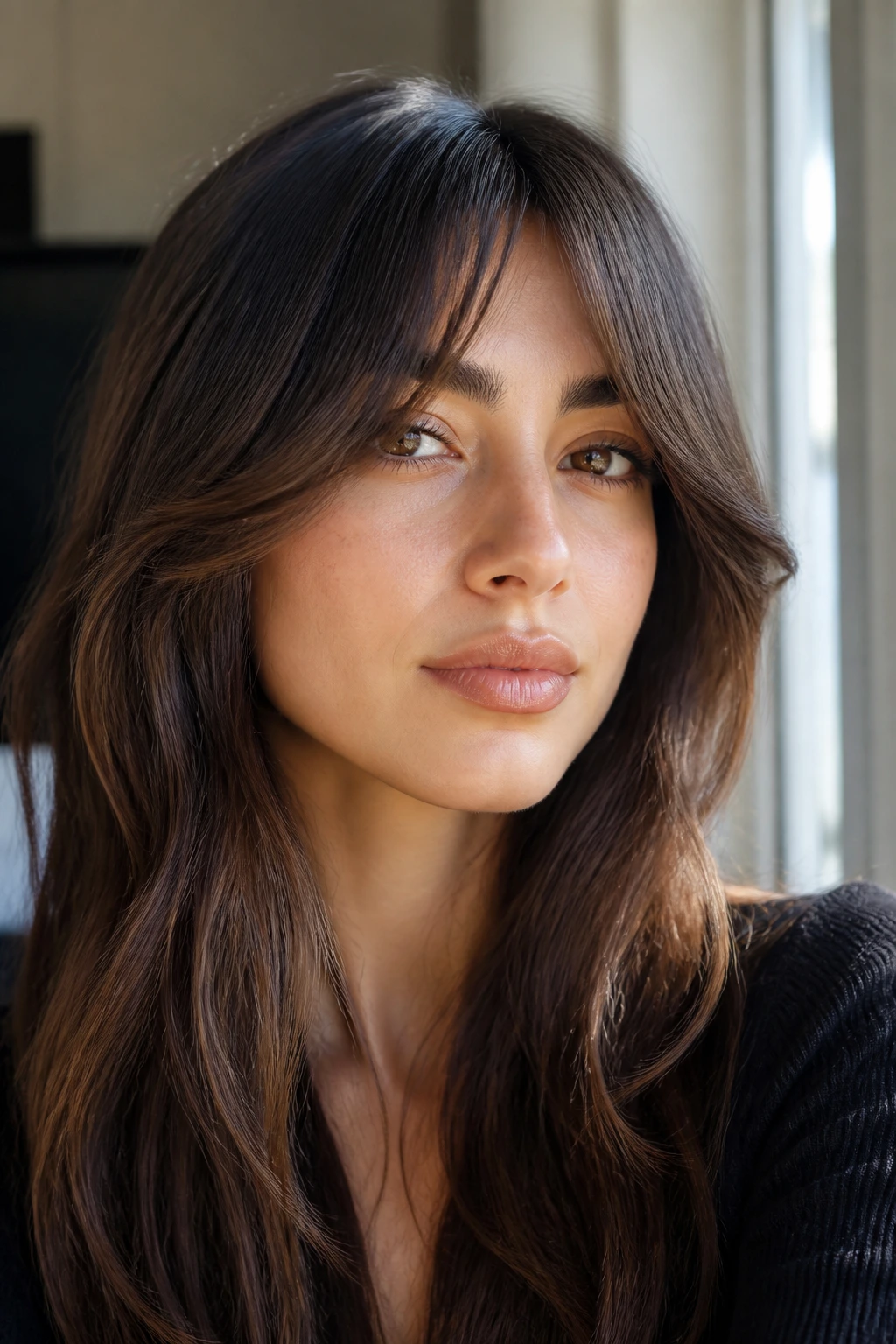
Long bangs on thick hair can be a little fussy if the cut is lazy, and surprisingly easy if the shape is right. That’s the part people miss. The fringe is not supposed to sit there and behave on its own. It’s supposed to work with the weight of the hair and the shape of the face, especially when the face is heart-shaped and the forehead is doing the most visual work.
If you choose one of these styles, choose it for a reason. Curtain bangs because you want movement. Bottleneck bangs because you want balance. A side sweep because you want flexibility. A growth-friendly shape because you know your patience has limits. Those choices are the difference between a bang that feels like a mistake and one that feels built for your head.
And once the cut is right, the styling becomes much easier. That’s the real win. Not perfection. Just a fringe that falls into place without demanding a whole morning.