



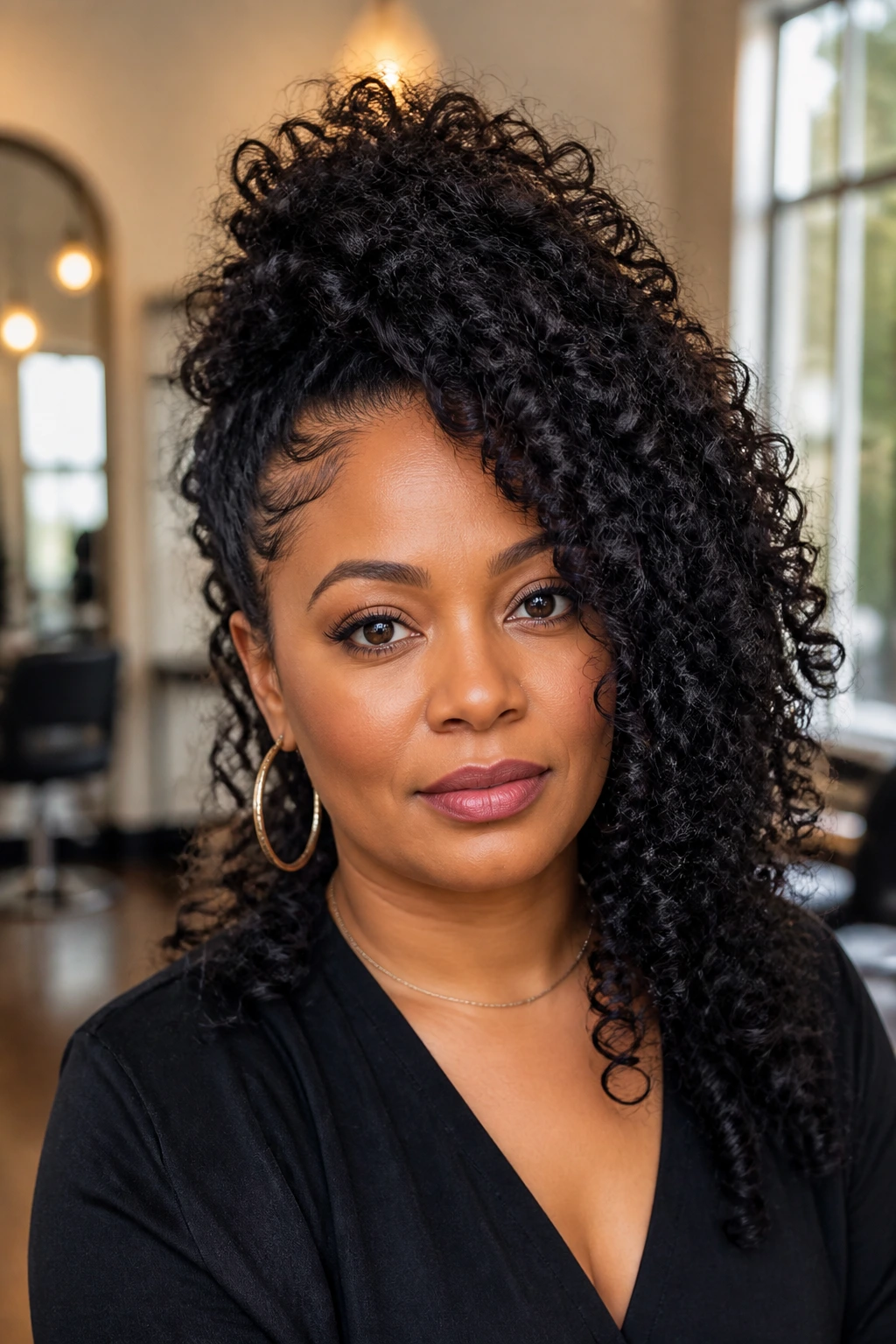
A round face does not need to be hidden. It needs a better line.
That line can come from height at the crown, a side sweep that breaks the circle, or a long piece of hair that drops below the jaw and keeps the eye moving. Black hair gives you more options than people admit out loud. Coils can rise. Braids can pull diagonally. Locs can sweep. A silk press can carve a clean part that changes the whole face in five seconds flat.
Width at the cheeks is the trap. If the silhouette blooms right where the face is already fullest, the style starts working against you. If it climbs upward, falls lower, or cuts across on a slant, the same face suddenly reads longer, sharper, and more balanced — without losing any of the softness that makes Black hair so good on a real head instead of a mood board.
Why These Hairstyles Are Worth Bookmarking
-
Crown Lift: Styles that stack volume higher on the head create a longer line from forehead to top, which helps a round face read less wide.
-
Diagonal Movement: Side parts, side sweeps, and angled braids break up the circle better than a flat, even shape.
-
Texture Respect: These looks work with coils, curls, braids, locs, twists, and presses instead of trying to flatten Black hair into one narrow idea.
-
Face-Framing Control: A few pieces around the cheeks can soften the face, but they need to start below the widest point or they’ll add bulk where you don’t want it.
-
Short-Hair Options Included: You do not need shoulder length to get this right. A TWA, pixie, or tapered cut can do the same job with less fuss.
-
Protective and Open Styles: Some days you want something low-manipulation. Some days you want the face to stay open. The styles below cover both moods.
What a Round Face Needs From Black Hair
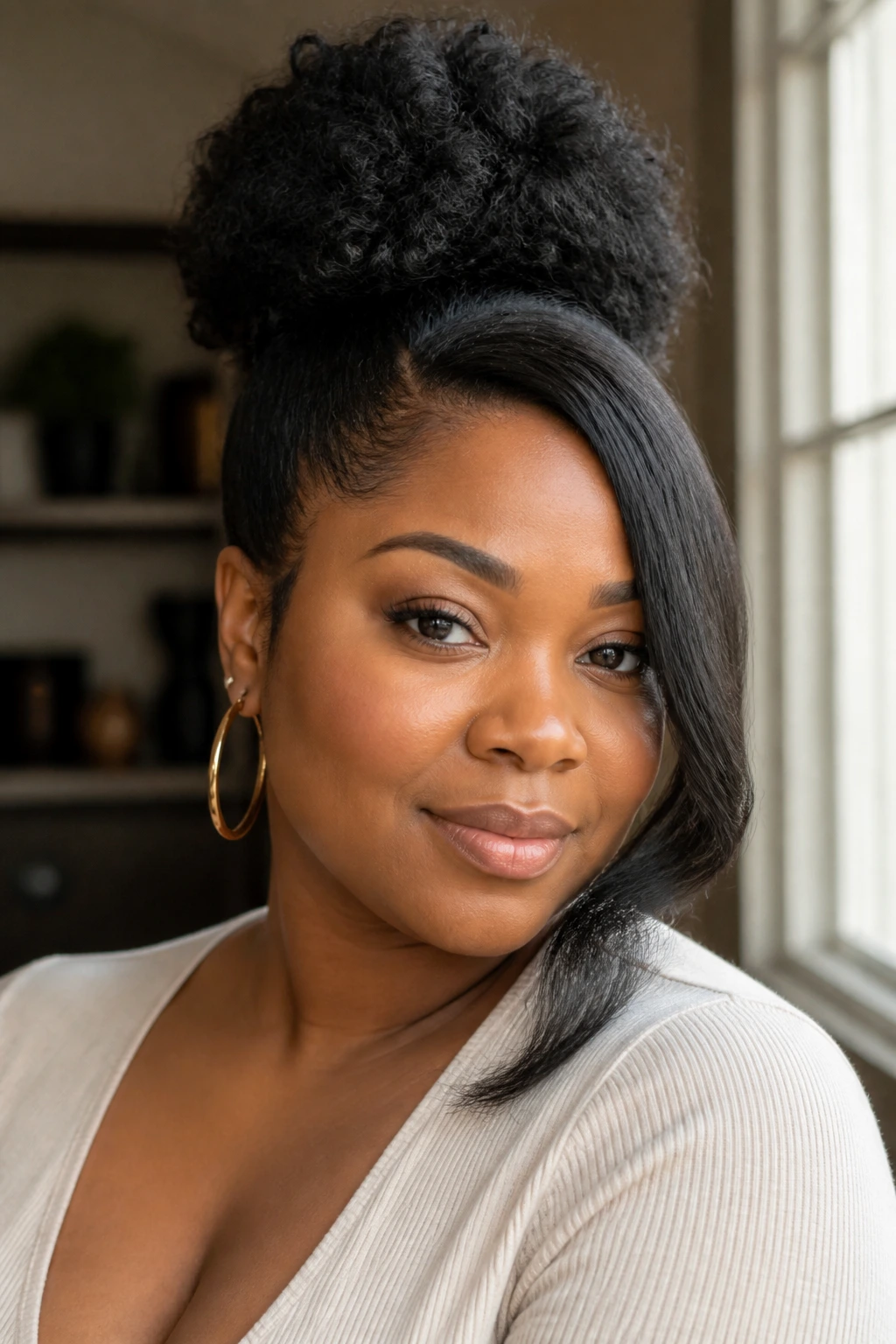
A round face is all about proportion. The goal is not to make it look narrow at every angle. That usually looks stiff anyway. The real trick is to give the eye somewhere to go — upward, downward, or off to one side — so the face doesn’t sit in the exact center of a circular frame.
Crown Height
Height at the crown is the fastest fix when a style feels too soft or too even. A high puff, a lifted twist-out, a ponytail that starts above the midpoint of the head — all of those pull the silhouette upward. The face still looks like a round face. It just reads longer.
Side Movement
A deep side part, a swept braid pattern, or a loc style that falls over one shoulder cuts across the width of the face. That diagonal line matters. It keeps the eye from getting stuck on the widest part of the cheeks and jaw.
Where the Ends Land
Length can help, but only if it lands in the right place. Ends that stop right at the jawline can make a round face feel broader. Ends that sit below the chin, skim the collarbone, or stay high and tight on top usually work better.
A Fast Way to Choose
If you want the safest bet, pick a style that gives you height, side movement, or length below the jaw — ideally two of those, not one. If your hair is short, go for shape. If it’s long, go for direction. If it’s braided or locked, keep the front lighter than the back and let the tail carry the weight.
That rule explains most of what follows.
How to Pick One Without Regretting It on Day Three
-
If you hate morning styling: Go for braids, twists, locs, or a clean tapered cut. You want the shape to hold without a 20-minute reset.
-
If humidity ruins everything: Choose a protective style or a stretched set. A silky press looks sharp for about five minutes if the air is wet and your hair is thirsty.
-
If your edges are tender: Skip tight ponytails and heavy temple tension. Knotless braids, loose twists, and updos with soft side pieces are kinder.
-
If you wear glasses: Keep bulk away from the temples. A wide puff or heavy side curl can fight the frame and make your face look busier.
-
If you want the most face-lengthening effect: Pick a style that rises at the crown or sweeps to one side. Straight width around the cheeks is the thing to avoid.
-
If you like switching looks often: Choose styles that can be dressed up or down with a part change, a pin, or a few face-framing pieces. That buys you more mileage.
1. High Puff Lifted Above the Crown
A high puff is one of those styles that does a lot with very little. It gathers the hair up and away from the cheeks, which gives a round face a cleaner vertical line almost instantly. The best version sits high enough that you can see the shape from the front, not tucked low at the back like a last-minute afterthought.
Why it works: The puff keeps the width near the top of the head instead of the sides of the face. That shift matters. If the front is smoothed neatly and the puff starts above the crown, the face reads longer without looking overdone.
Best details to copy:
- Stretch the roots first with banding, twists, or a quick blow-dry on low heat.
- Keep the puff band above the widest part of the head.
- Use a little gel or styling cream on the front so the puff reads clean, not fuzzy.
A high puff is forgiving, but it still has a bad version. If the puff sits too low, it lands right in the middle of the face and loses the lift that makes it work. If your curls are short, use a puff cuff or a stretched base — not a tight band that leaves your scalp sore by lunch.
2. Tapered Afro With a Soft Top Shelf
A tapered afro is one of my favorite answers for a round face because it changes the silhouette without pretending the hair is something else. The sides stay close. The top gets the room. That alone can make a face look noticeably longer, even when the hair itself is short.
The best tapered afro has a shape to it. Not a sphere. A shape. The crown should feel fuller than the sides, and the hairline should be cleaned up enough that the outline looks intentional. If the cut balloons evenly all around the head, it starts to echo the roundness you’re trying to soften.
A tiny edge-up, a good pick-out at the top, and a trim every 6 to 8 weeks keep the shape honest. I’d take a tapered afro over a perfectly round cut every time. The first one has movement. The second one can feel like a helmet.
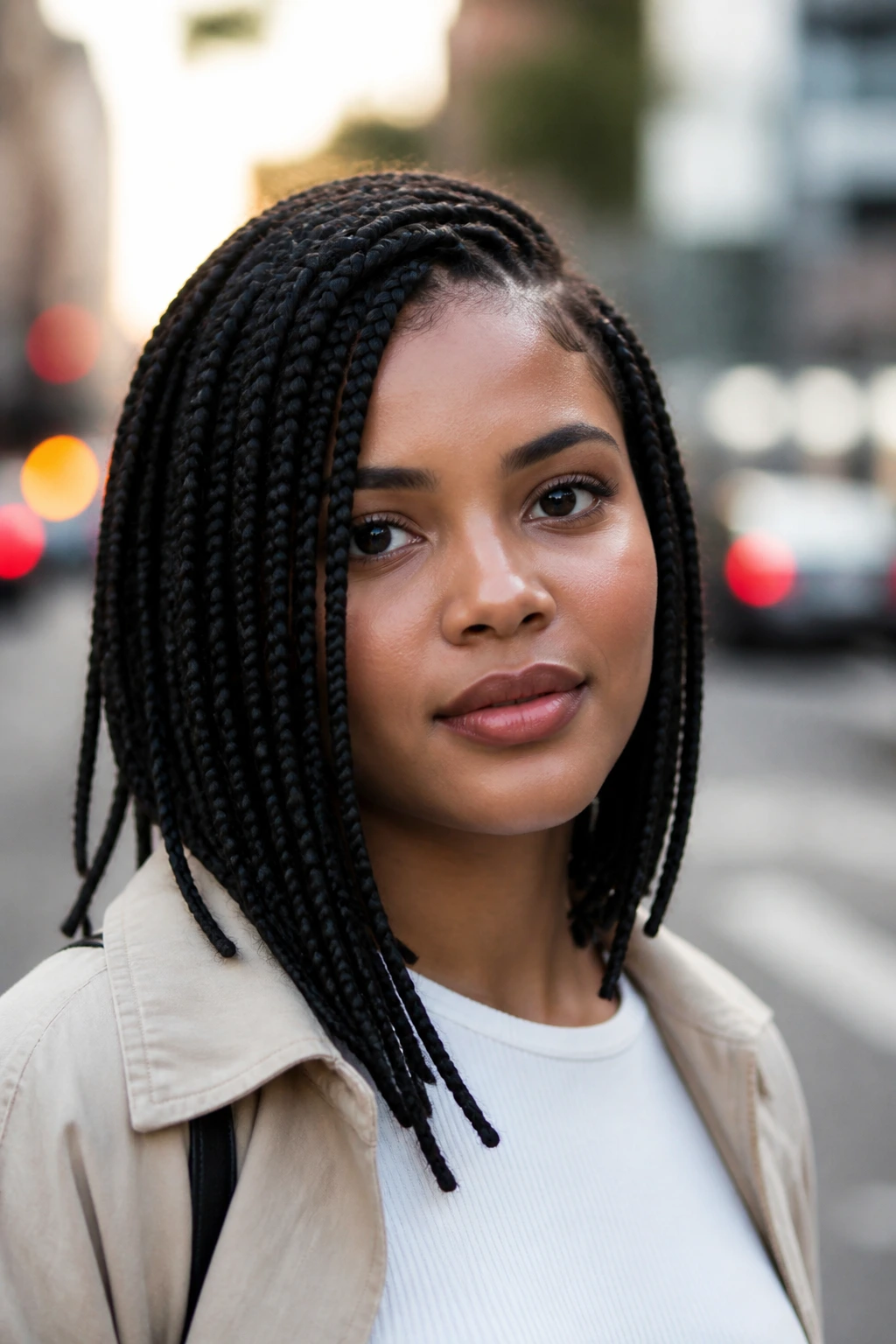
3. Side-Part Box Braids Falling Past the Jaw
If you want braids and you have a round face, the parting pattern is not a small detail. It’s the whole game. A side-part box braid style shifts the eye off-center, and that diagonal break is exactly what a fuller face needs.
The length matters too. Braids that stop at the jaw can widen the face in a way that’s hard to ignore. Braids that fall past the collarbone let the face breathe. The extra length gives a cleaner vertical drop, which is much friendlier.
What to ask for at the chair
- A side part that starts off-center, not dead in the middle.
- Medium-sized braids if you want the style to feel balanced.
- Length that reaches the collarbone or below.
- A neat front so the style doesn’t puff at the temples.
I like this style because it can go polished or casual without changing the braid pattern. The only catch is weight. If the braids are too chunky at the front, the face loses the benefit. Keep the roots neat and let the length do the talking.
4. Knotless Braids With Face-Framing Pieces
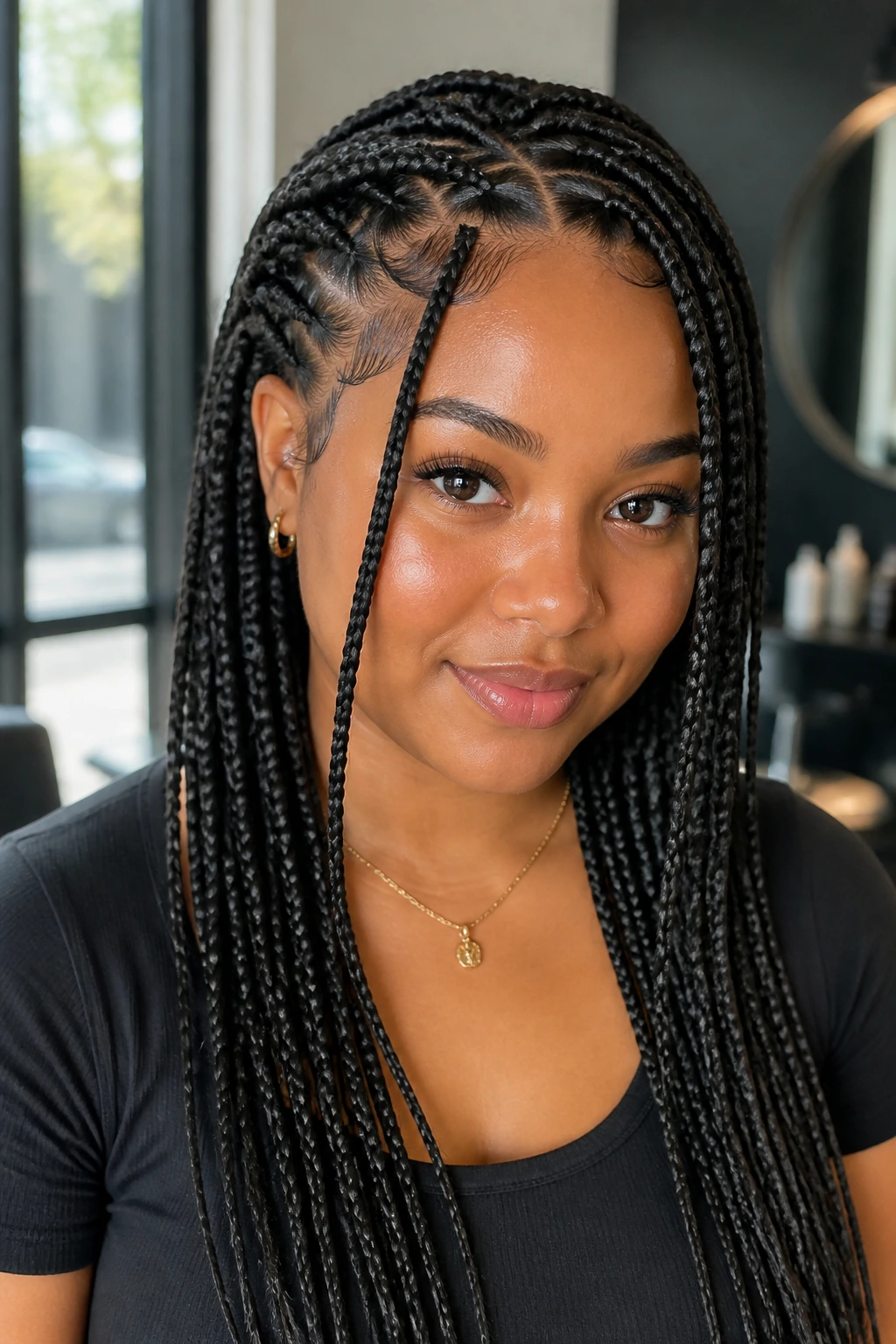
Why do knotless braids sit so well on a round face? Because the root is lighter, the parting looks softer, and the front can be shaped without that hard blocky edge some braids have. The face-framing pieces matter here. A lot.
Why it works: Knotless braids reduce bulk at the scalp, which keeps the top of the style from looking heavy. A few slimmer pieces in front can skim the cheeks without sitting on them. That gives softness without width.
Keep these details in mind
- Ask for face-framing pieces that start below the cheekbone.
- Keep the braid size medium if you want the style to stay light.
- Don’t overload the front with beads or cuffs; they add visual weight.
- If you want more lift, ask for the first rows to angle back slightly.
This is one of those styles that looks expensive when it’s done right. The difference is usually not the hair itself. It’s the front. If the stylist leaves too much density by the cheeks, the whole look gets heavier than it needs to be.
5. Fulani Braids With a Long Center Tail
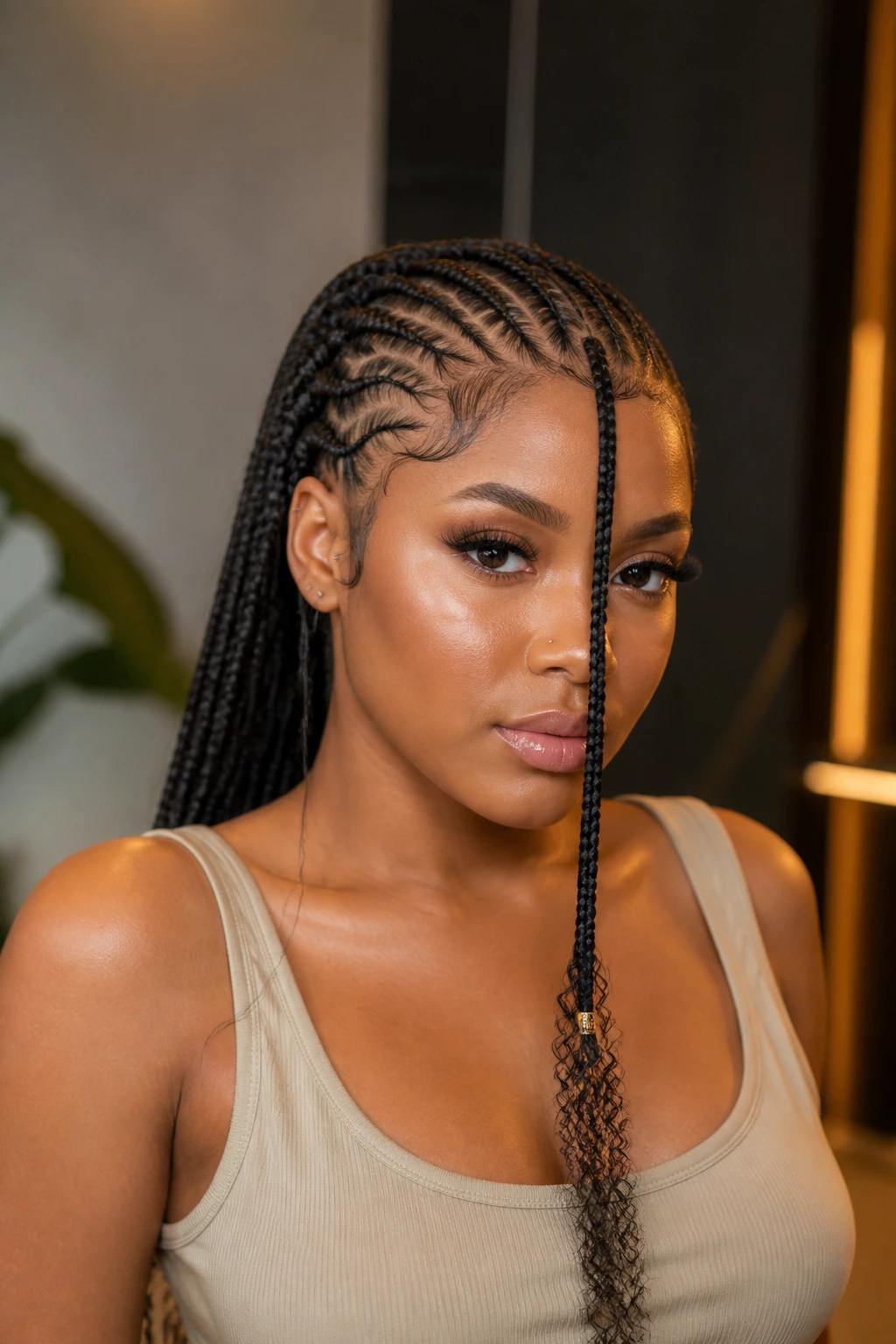
Fulani braids earn their place because they combine structure and movement in a way that flatters a round face without trying too hard. The front braids draw lines across the forehead, while the long tail in the back creates that vertical drop that keeps the face from reading too wide.
There’s a nice tension in this style. The front is detailed, the back is long, and the face sits right between them. That balance keeps the eye moving. Beads can look beautiful here, but I’d keep them moderate near the temples. Too much weight at the sides starts to fight the shape.
If you want the style to feel lighter, ask for the long tail to begin at the mid-back of the head, not down near the nape. That gives the silhouette a bit more height. Small choice. Big difference.
6. Faux Locs Swept Across One Shoulder
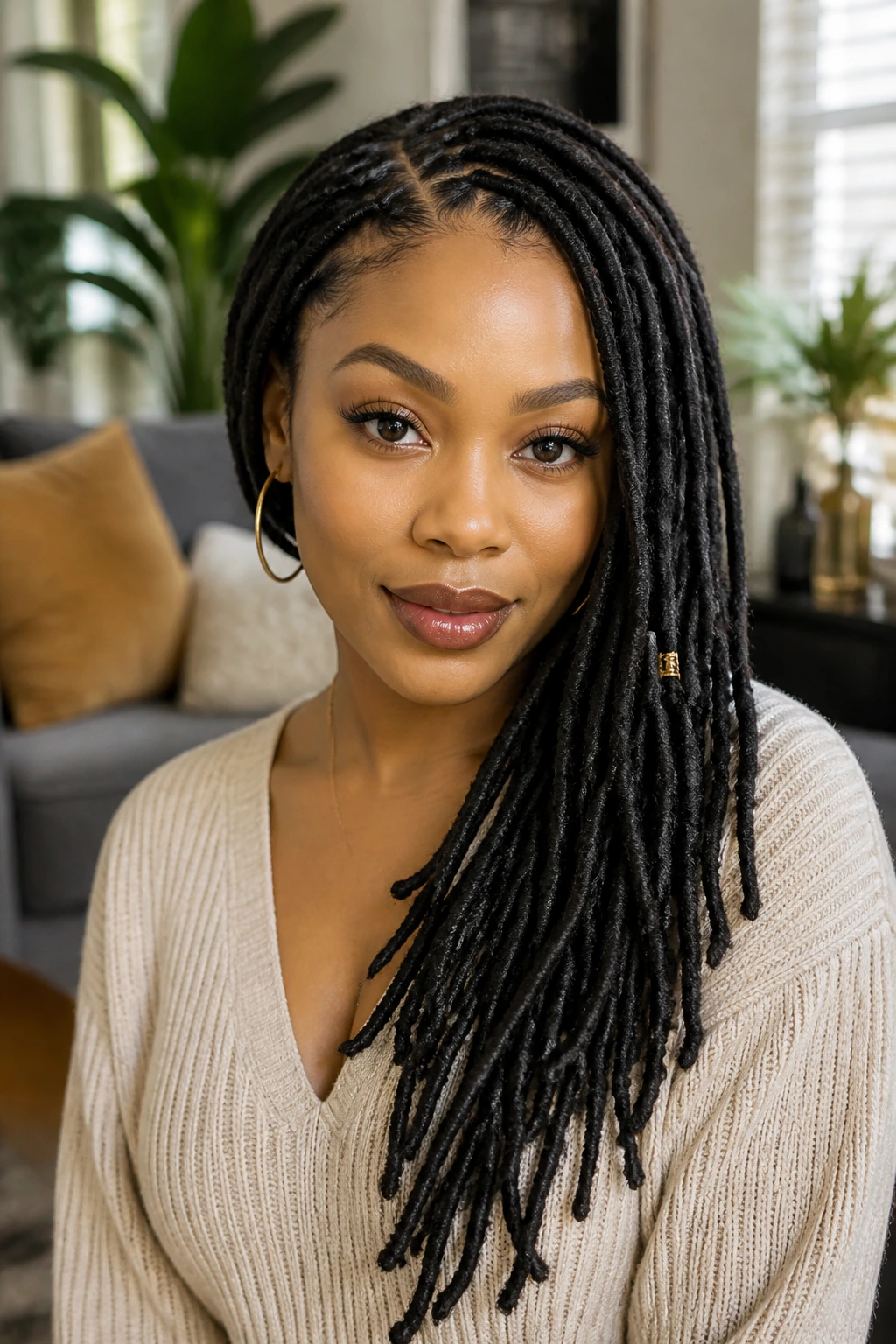
A center-part faux loc set can feel boxy on a round face. Sweep the locs to one shoulder and the whole thing changes. The face gets a diagonal line, the neck opens up, and the length stops behaving like a curtain.
The nice part of faux locs is that they already have texture and movement built in. You do not need to force them into perfection. A deep side part and a loose sweep are enough. If the locs are too heavy around the cheeks, though, they can still add width, so the front should stay a touch lighter than the back.
I like this style for people who want coverage without stiffness. It reads relaxed, not lazy. And when the locs land below the shoulder, they pull the eye down in the best possible way.
7. High Braided Ponytail With a Clean Base
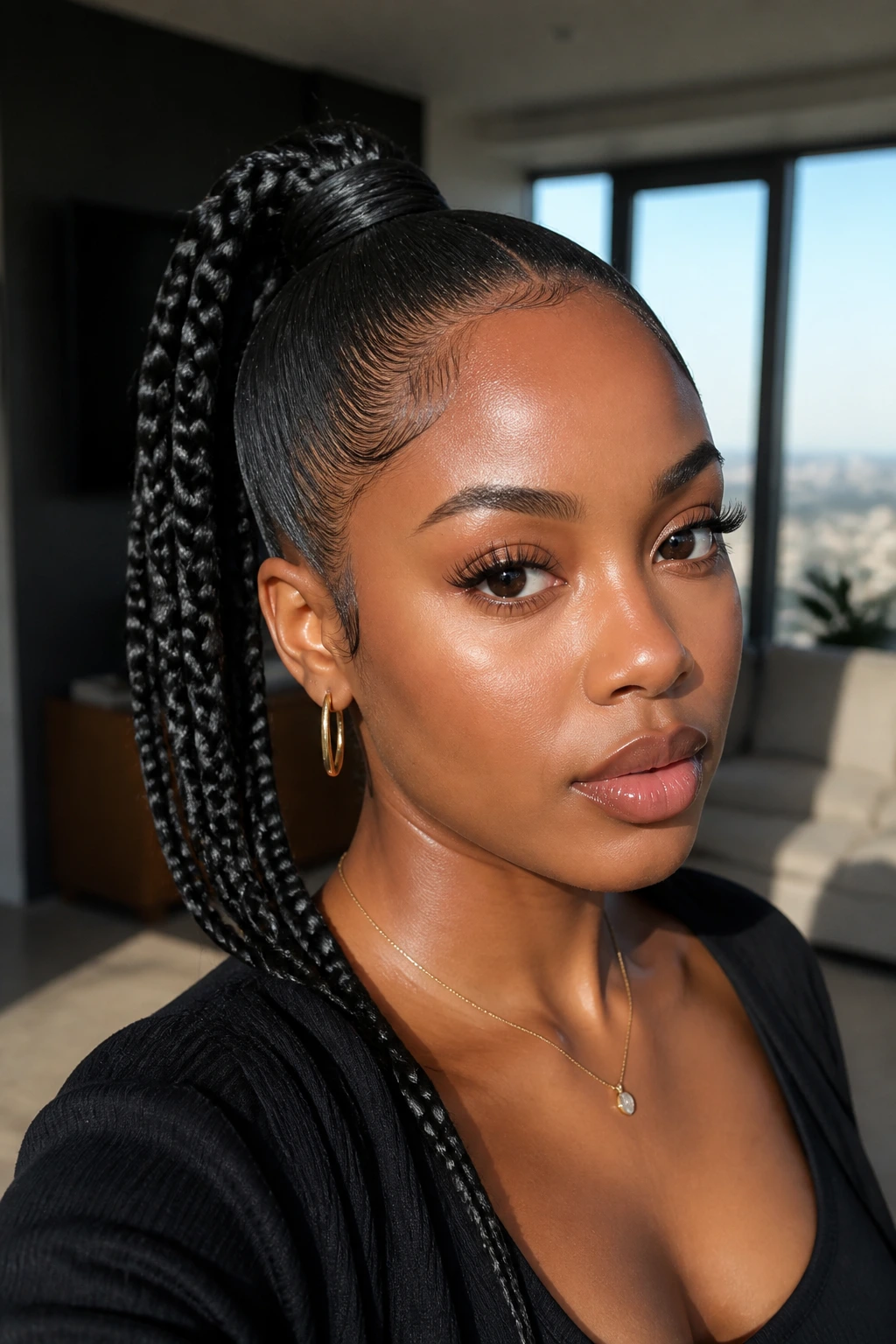
This style does one thing very well: it points the whole head upward. A high braided ponytail sits above the crown, so the face gets a longer line without losing the drama of length. It’s sleek at the base, strong at the top, and blunt in the best possible way.
The ponytail should not start in the middle of the head. That’s the mistake. If it’s too low, the effect disappears and the style can flatten the face. Put it high enough that the line from forehead to ponytail feels intentional.
A wrapped base, a smooth front, and a braid that drops past the shoulder make the shape work. If your edges are fragile, keep the front brushed back with enough hold to stay neat but not so much tension that your temples feel pulled by noon.
8. Half-Up, Half-Down Curls With Crown Volume
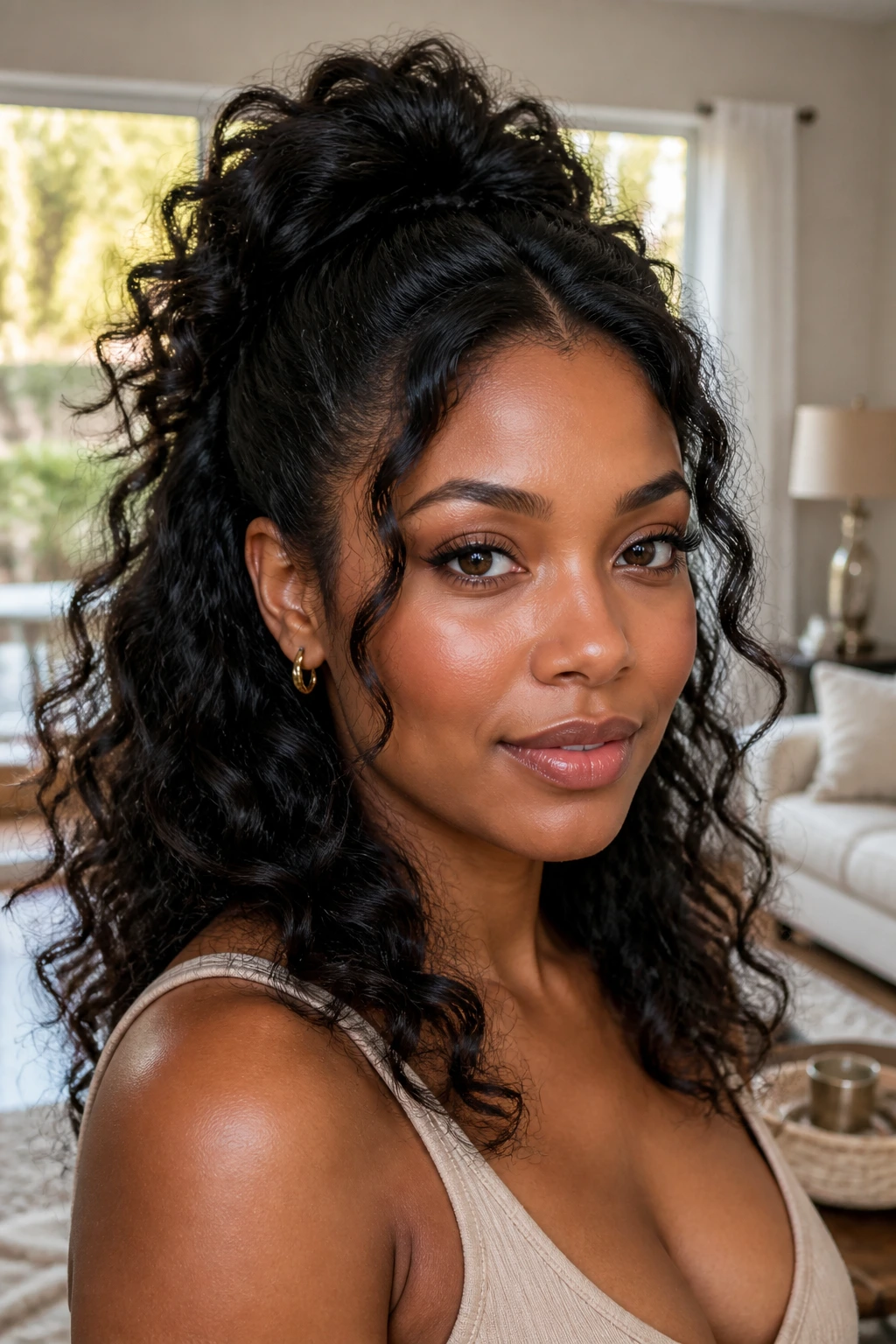
Half-up, half-down styles are so good on round faces because they give you height and length in one frame. The top section lifts the eye. The bottom section falls past the face. That combination is hard to beat when the goal is balance.
The trick is where the half-up section sits. Too low, and it creates width at the temples. Too high, and it can look severe. I like it just above the ears with enough volume at the crown to give the style shape. A few loose curls around the face help, but they should start below the cheekbone.
This works especially well on stretched curls, wand sets, or a soft blowout with bend at the ends. The bottom half should look full, not puffy at the cheeks. That’s the detail most people miss.
9. Shoulder-Length Twist-Out With Stretched Roots
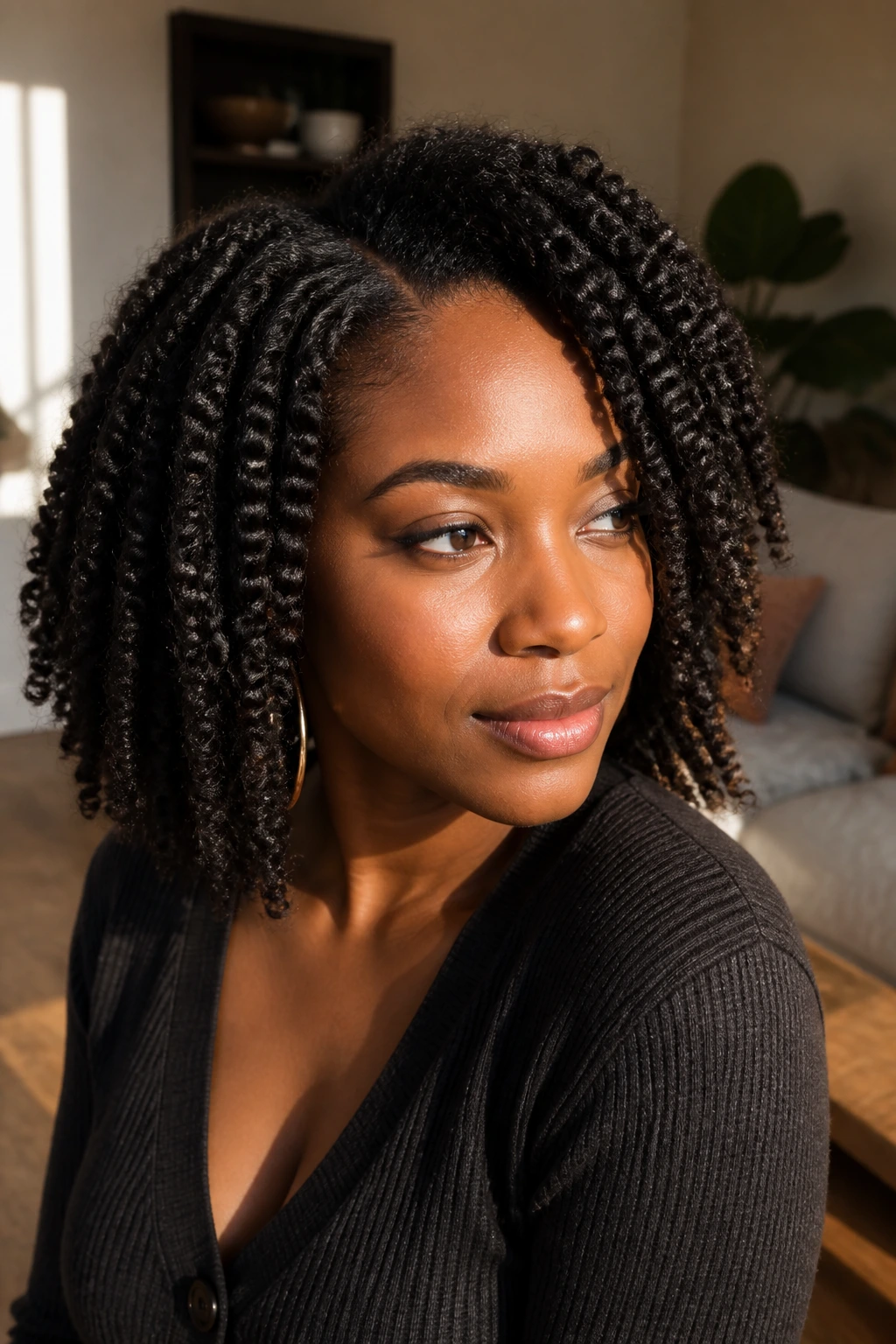
A twist-out can be one of the kindest styles for a round face when the roots are stretched and the shape is controlled. The texture stays visible. The hair still looks like itself. But the silhouette doesn’t bloom straight out from the cheeks.
A shoulder-length cut helps here because the ends can sit below the widest part of the face. If the twist-out is too short, it can puff outward at the jaw. If it’s stretched well and parted to one side, the face gets a longer line and the hair gets room to move.
I like using banding, a low-tension blow-dry, or a stretched twist set the night before. That keeps the roots from shrinking too much. A little shrinkage is fine. A full halo around the cheeks is not.
10. Bantu Knot-Out With Vertical Curl Pattern
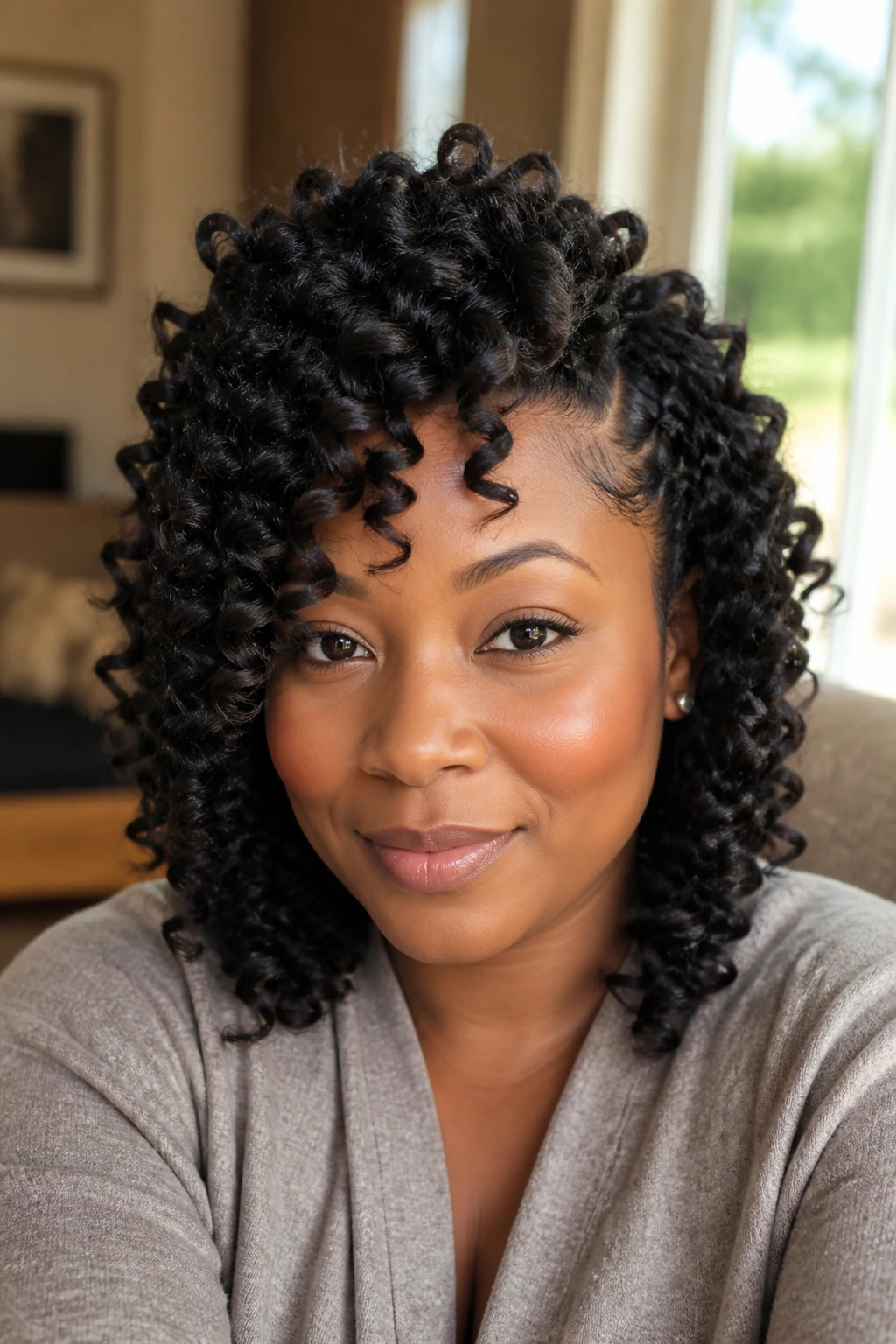
What makes a Bantu knot-out flattering on a round face is the way the curls fall after the knots come down. They don’t just balloon outward. They separate in a pattern that can feel almost sculpted, especially if the knots were placed in a way that lifts the crown.
The size of the knots changes the end result. Smaller knots give you tighter curls and more control. Larger knots create looser, rounder curls that can add width if they sit too close to the cheeks. I’d be careful with the front rows. Keep them slightly higher and a bit narrower than the middle rows.
A good way to think about it
- More knots = more definition, less width.
- Fewer knots = bigger curls, more softness.
- Stretched roots = cleaner shape.
- A side part makes the whole set feel longer.
This is a style that rewards patience. Rush the take-down and the curls get fuzzy. Let it set fully and the shape is much cleaner.
11. TWA With a Crisp Shape-Up
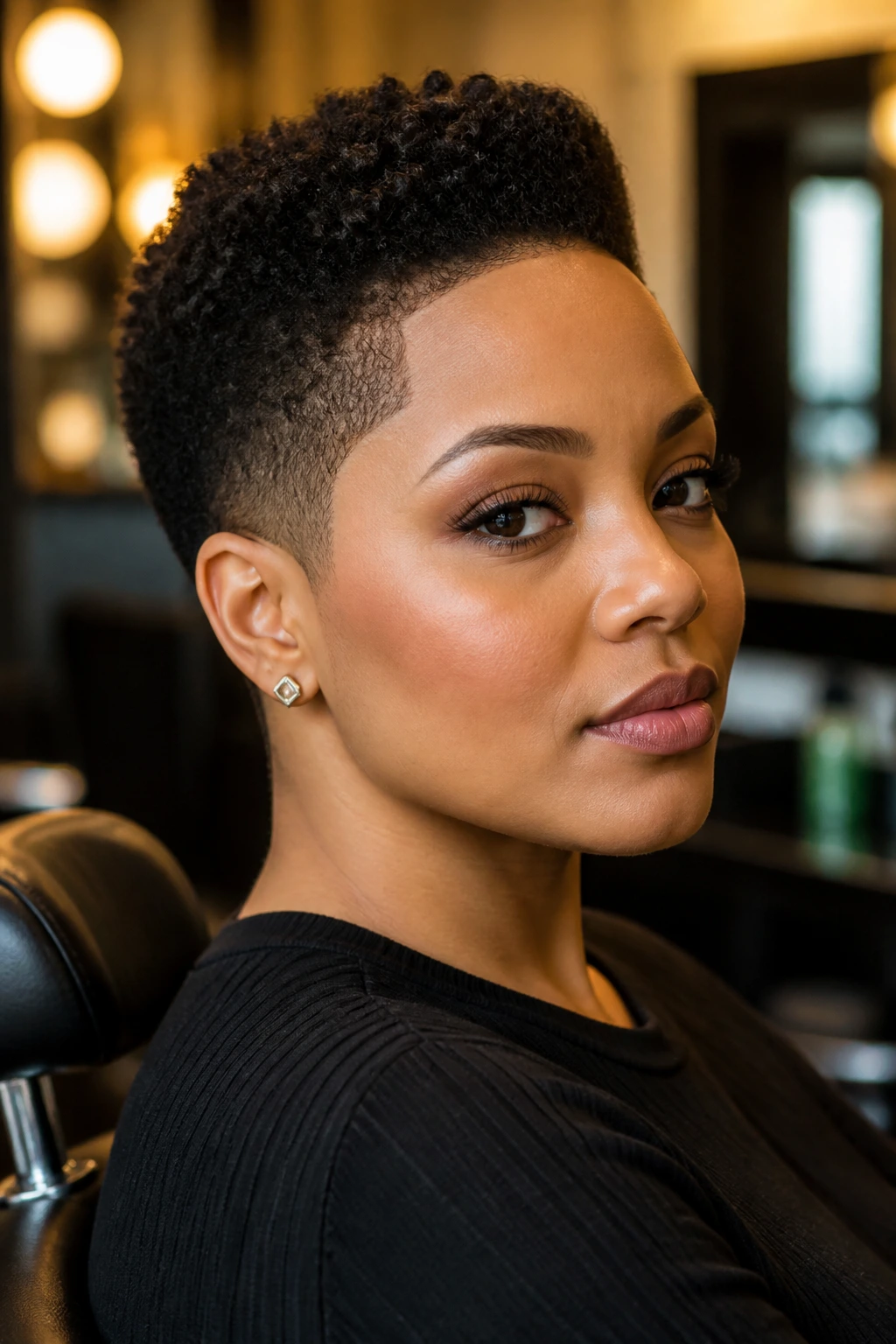
Short hair can be the smartest move on a round face, and the TWA proves it. A tightly shaped TWA gives the head a clean outline without adding bulk at the cheeks. If the top is left slightly fuller than the sides, the whole face reads longer.
I prefer a TWA with a little lift near the front and a tidy shape-up around the temples and nape. A perfectly even cut can look a little flat. A cut with a bit of top height has more personality. You can use a sponge, finger coils, or a light styling cream to bring out texture without turning the style puffy.
If you want the face to look a touch longer, avoid shaping the cut into a perfect circle. That shape is doing the opposite of what you want.
12. Asymmetrical Bob That Drops Lower on One Side
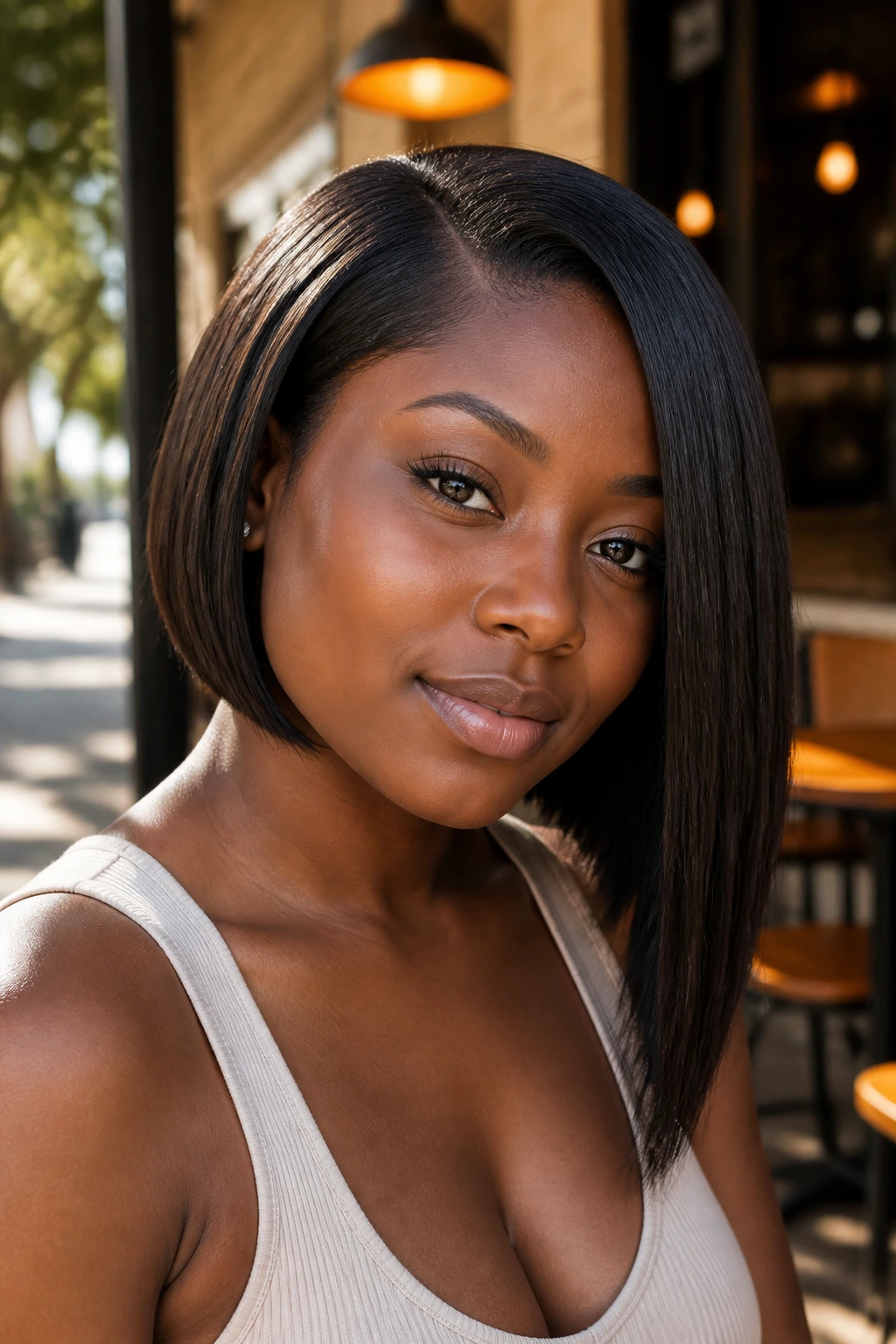
A blunt bob that ends right at the jaw is risky on a round face. An asymmetrical bob fixes that by letting one side fall lower, which changes the geometry completely. The face stops sitting inside a box and starts sitting inside a line.
The longer side should usually skim the collarbone or at least sit a bit below the chin. That extra drop matters. It gives the eye a place to travel and stops the widest point of the face from feeling boxed in by hair.
I love this cut on pressed hair, relaxed textures, and even wavy sets. The key is the angle. If both sides end at the same point, you lose the effect. If one side is clearly longer, the face gets an immediate stretch.
13. Silk Press With a Deep Side Part
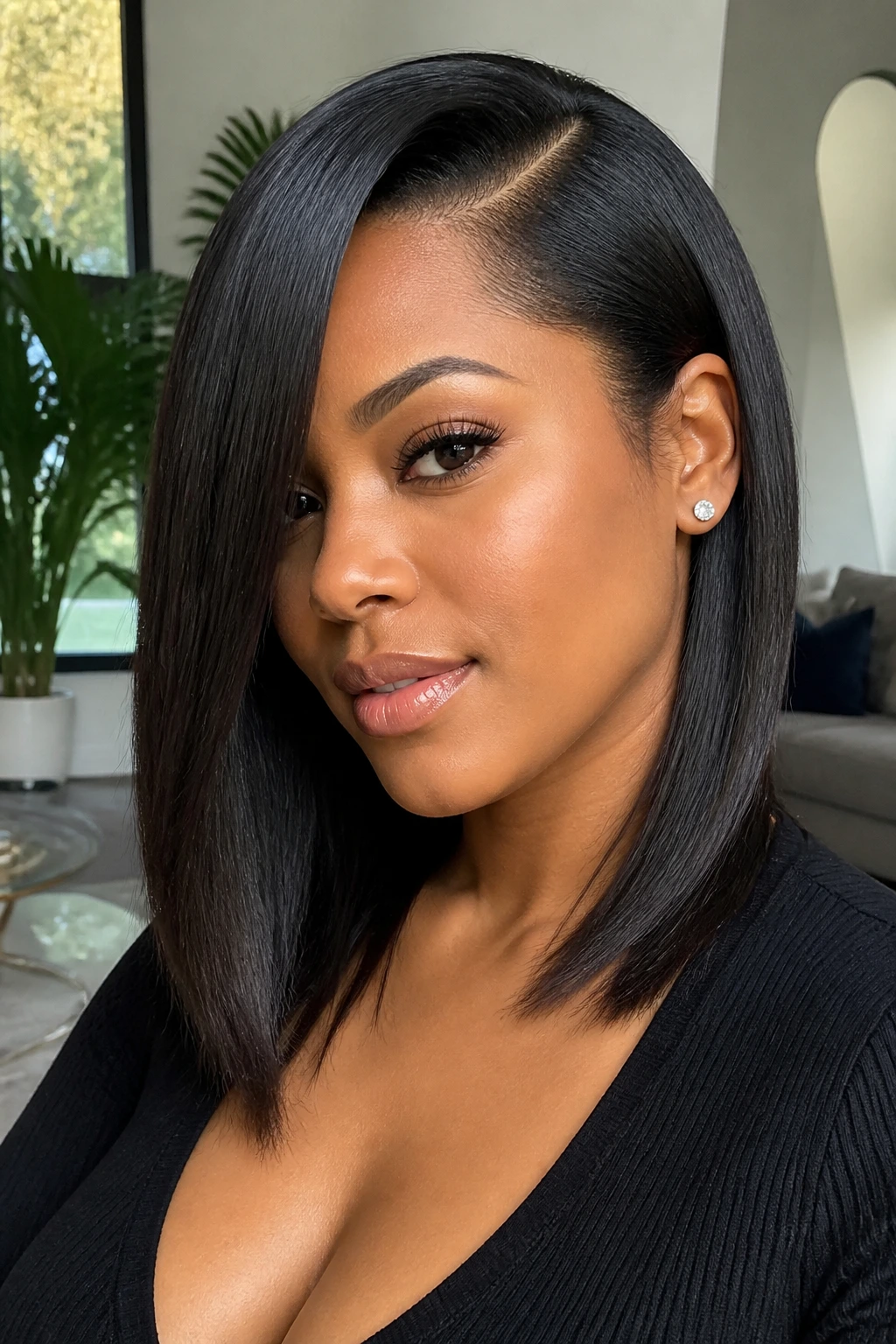
A silk press with a deep side part is one of the cleanest ways to flatter a round face. The press gives you length. The side part gives you angle. Put those together and the face gets a sharper frame without looking severe.
The part should go deep enough that one side has visible lift at the root. Not a tiny shift. A real side part. That single move changes the face more than people expect. The pressed hair can fall straight, curved under, or with a slight bend at the ends, but it should not stop at the jaw unless the rest of the cut is already long.
Heat protectant is not optional here. Neither is wrapping the hair at night. A silk press is beautiful in the first few days because the line is so clean. Keep that line intact and the round face looks longer all week.
14. Curly Shag With Layers Below the Cheekbone
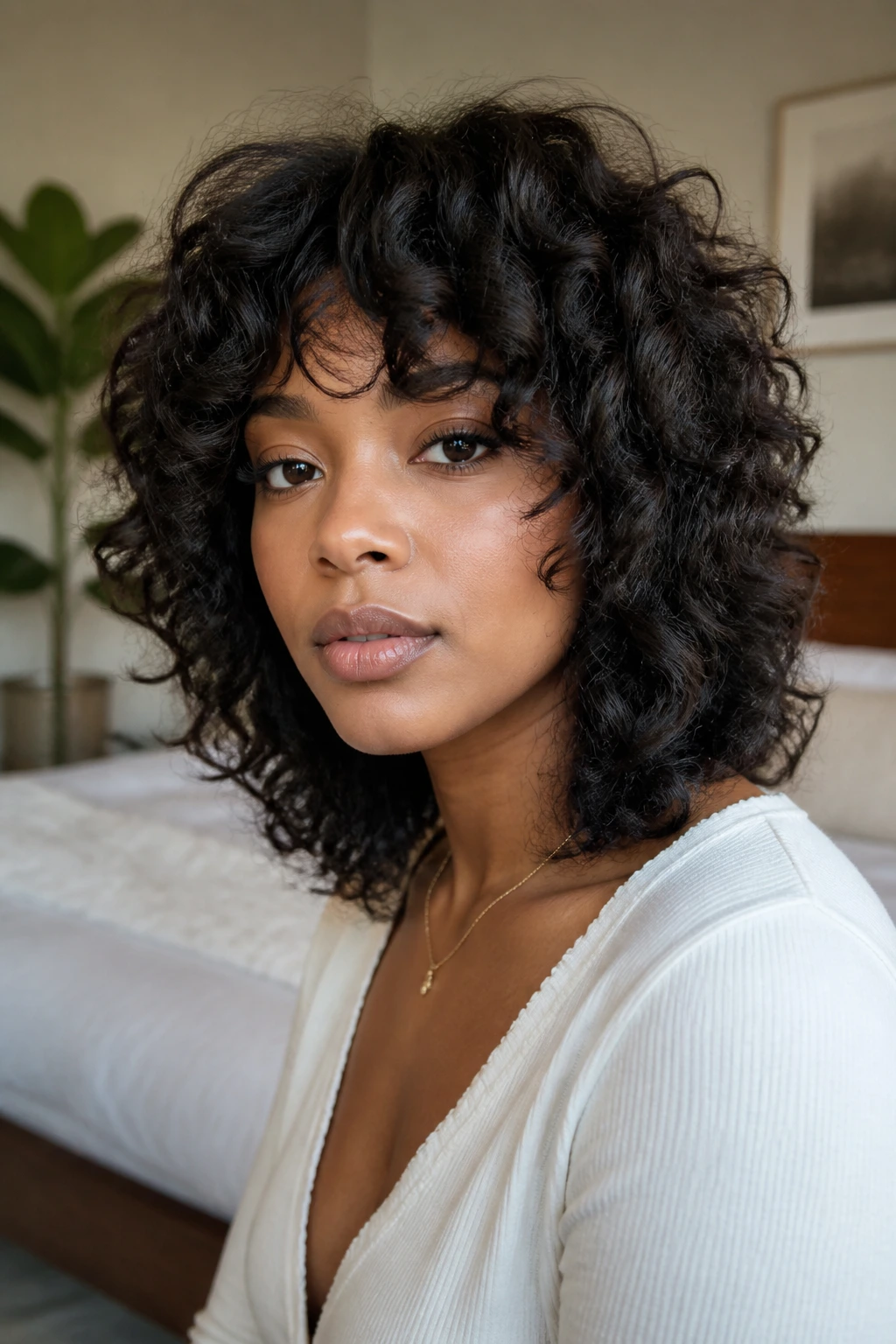
A curly shag works because the layers break up the width before it can settle into one big shape. The best version starts layering below the cheekbone, not right at the cheeks. That keeps the top full and the sides softer.
This is one of the few cuts where a little mess is part of the charm. The curls do not need to behave perfectly. They need to fall in pieces. If the layers are cut too high, the face can get lost in volume. If they’re cut too low and too heavy, the style loses the lift that makes a shag worth wearing.
I’d ask for a dry shaping if possible, especially on curlier textures. Wet cuts can look great, but a curl-by-curl shape usually gives more control around the face. A deep side part can make the shag feel longer too.
15. Frohawk Built From Flat Twists
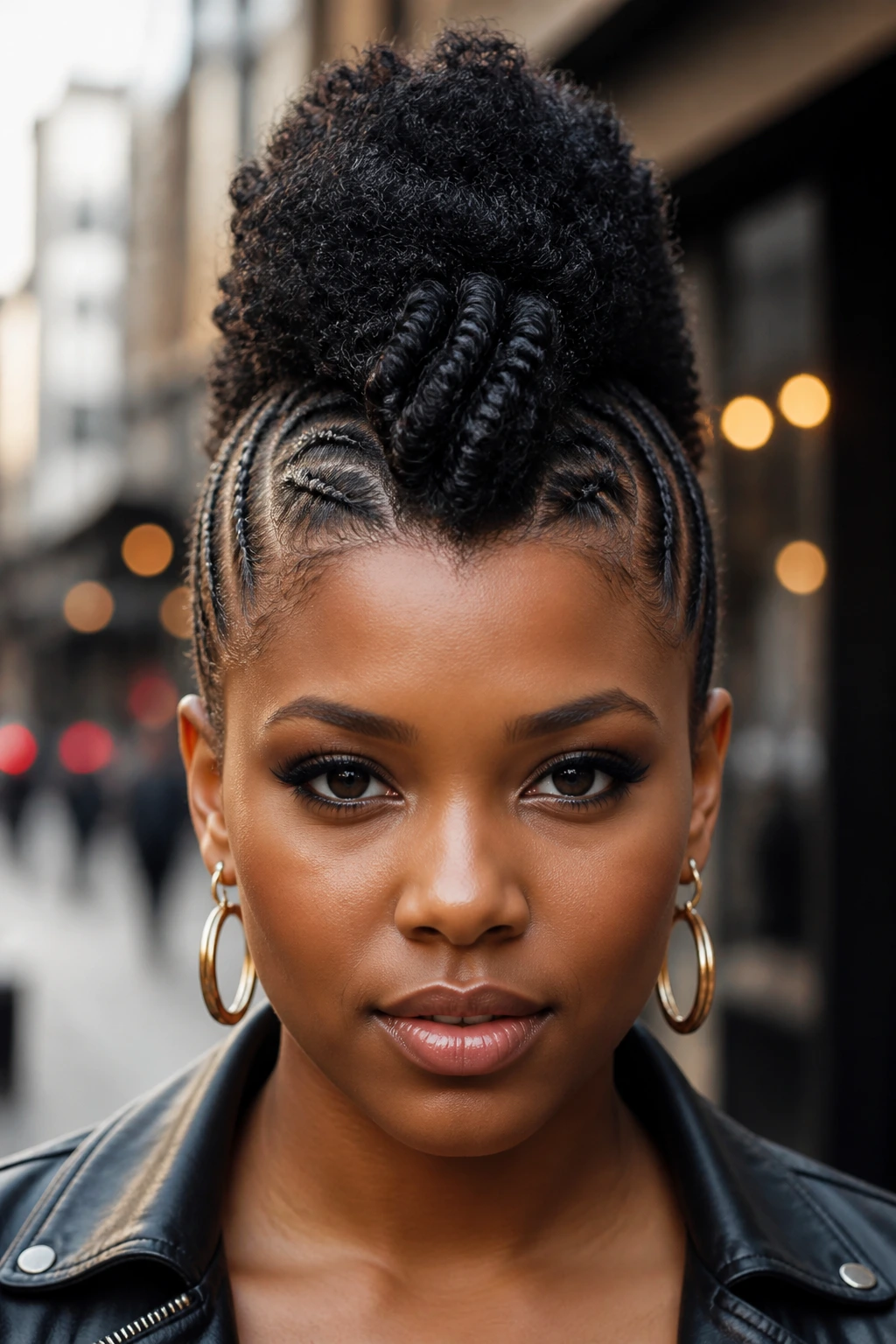
The frohawk is one of the boldest styles on this list, and it works because it keeps the bulk in one narrow strip down the center of the head. The sides are braided, twisted, or pinned flat. The crown gets the height. A round face gets a clean vertical lane right up the middle.
This is a style with attitude, but the face-shape logic is simple. No extra width at the cheeks. No puffy side mass. Just a strong center ridge that pulls the eye upward. You can wear it with curls, twists, or a braided center section depending on how formal or casual you want it to feel.
If you want it softer, leave a few pieces around the hairline. If you want it sharper, keep the sides snug and the center lifted. Either way, the shape does the work.
16. Goddess Locs With a Side Sweep
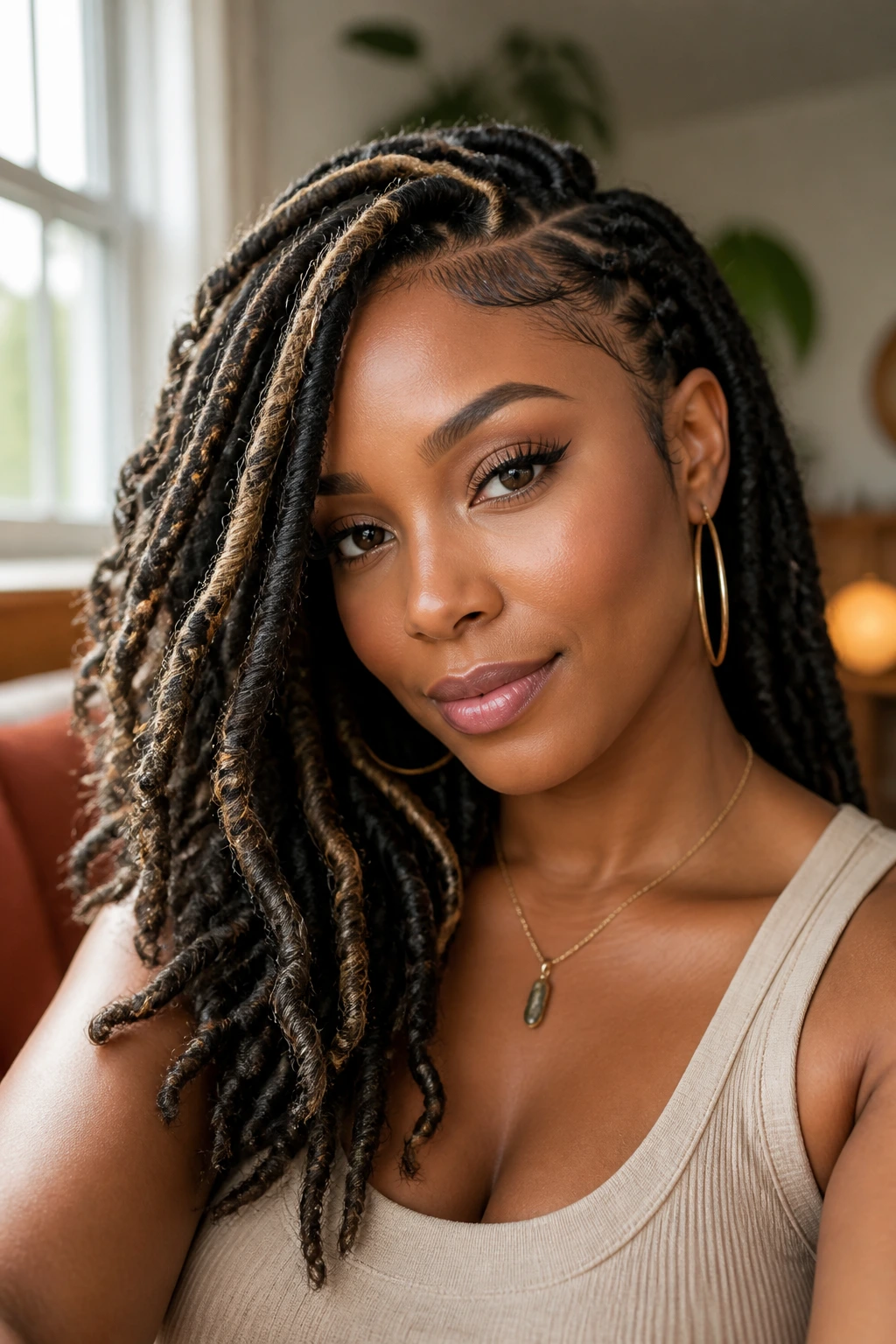
How do goddess locs stay soft without turning the face into a circle? The answer is the side sweep. When the locs fall over one shoulder and a few lighter strands move around the face, the style keeps its texture but loses the heavy, even width that can be unflattering.
What to ask for
- A deep side part or a clear sweeping direction.
- Locs that fall below the collarbone.
- A few front pieces left loose, but not a thick curtain.
- Lightweight wrapping so the style doesn’t feel bulky near the face.
I like goddess locs when the front is calm and the length is doing the talking. Too much frizz around the temples can make the style feel wider than it is. Keep the sweep clean and the shape will do its job.
17. Senegalese Twists Gathered Into a Low Side Bun
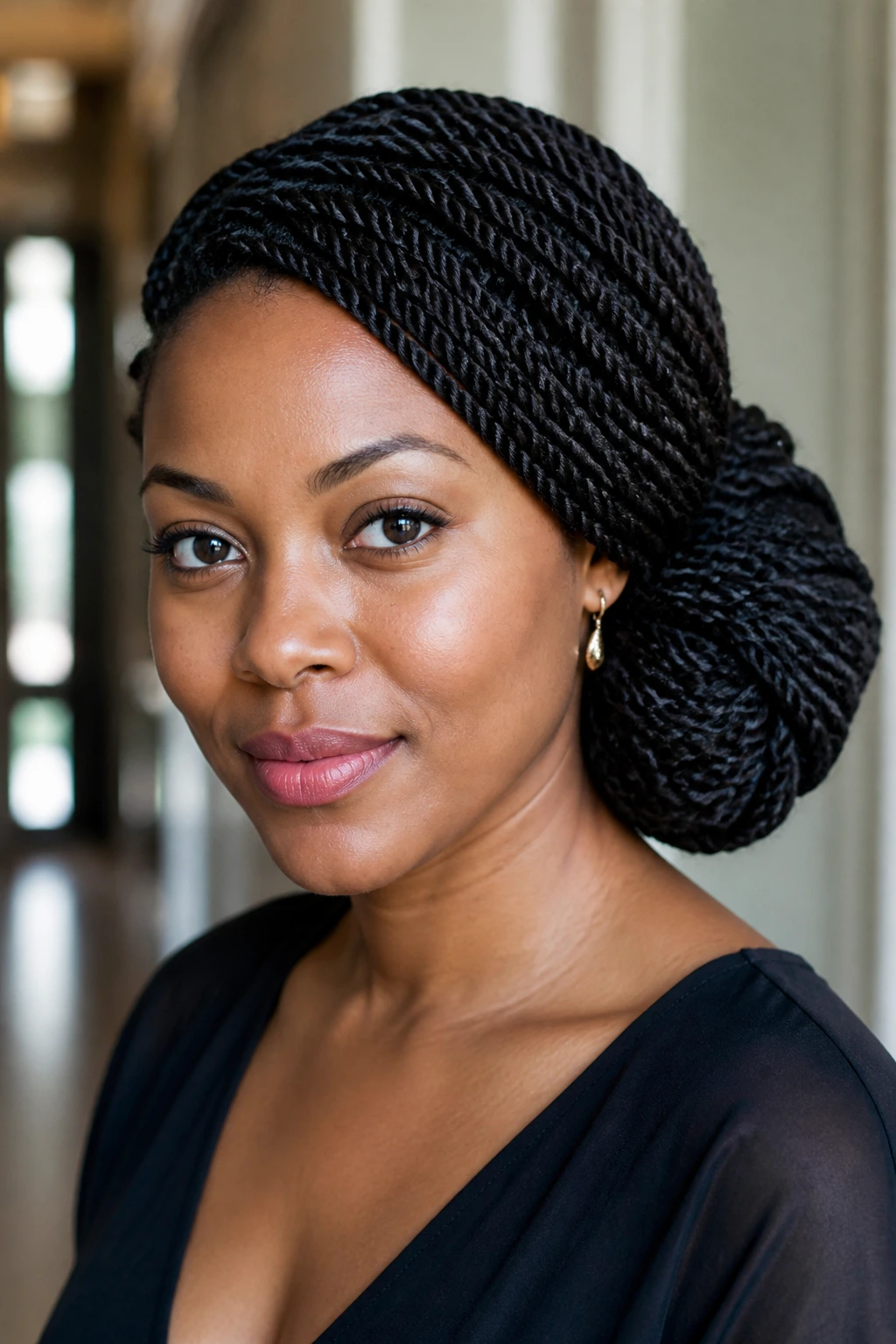
Senegalese twists have a smooth, rope-like look that suits a round face well when they’re gathered into a low side bun. The twist line is tidy. The bun sits off-center. The face gets a diagonal shape that feels more interesting than a flat knot right in the middle of the head.
A low side bun is also kinder when you want something polished without dragging the eyes outward. The bun should sit behind or just below one ear, not at the widest point of the jaw. That placement keeps the face open and the neck visible.
This is one of those styles that can work for a long week or a dressier event. It doesn’t scream for attention, but it doesn’t disappear either. It just holds shape.
18. Crochet Curls With a Soft Side Fringe
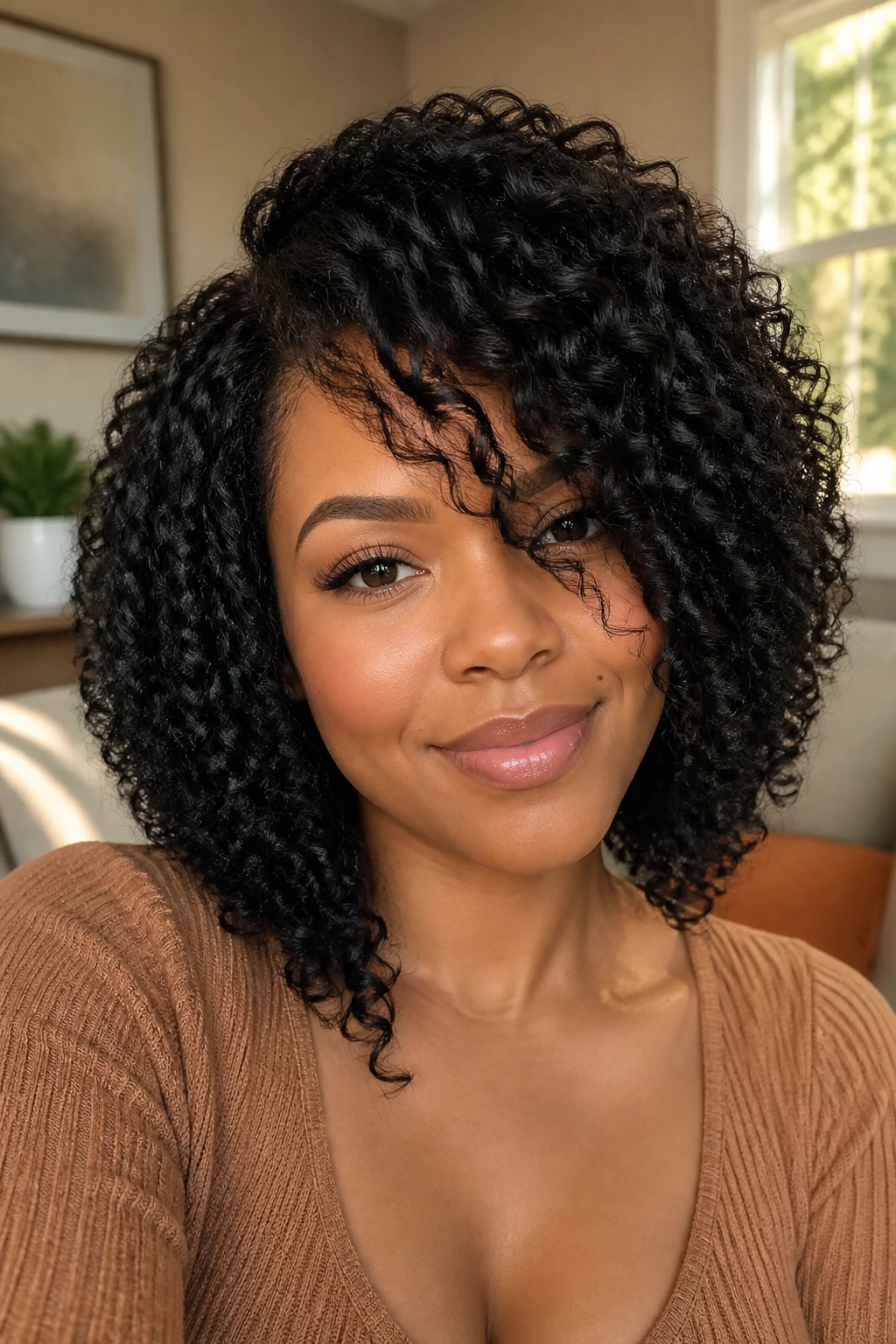
Crochet curls can go bulky fast if every curl falls the same way. That is why a soft side fringe changes the whole look. It gives the front direction, keeps the face open, and stops the curls from building a heavy wall at the cheeks.
The curl pattern matters too. A looser, more layered curl reads softer around a round face than a dense, uniform spiral. The front should be a little longer than the cheekbone if you want the face to feel less broad. Shorter pieces can work, but they need to be wispy, not thick.
Crochet styles are easy to overload. Less density around the face is usually better. You want movement, not a padded border.
19. Lemonade Braids Sweeping Across the Forehead
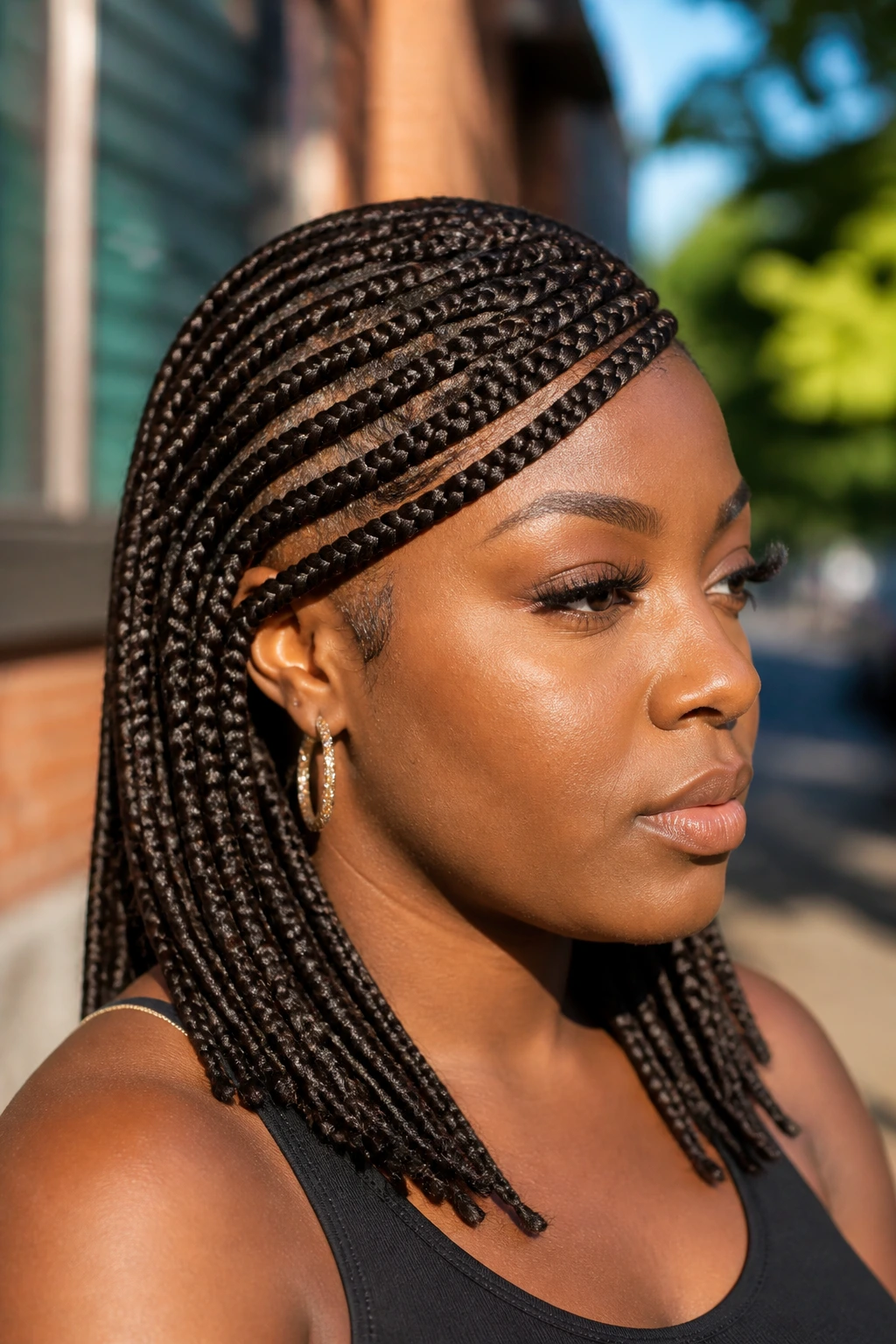
Lemonade braids were made for strong side movement, which is exactly why they fit a round face so well. The braids sweep across the forehead in a line that feels longer than it is wide. That diagonal is the whole point.
A medium size usually flatters better than jumbo braids here. Too thick, and the braid line can overwhelm the face. Too tiny, and you lose the boldness that makes the style fun. I like braids that fall to the collarbone or lower, because that extra drop gives the face a cleaner vertical end point.
Watch the front carefully
- Keep the braids close and neat at the hairline.
- Avoid too much puff at the temples.
- Let the lengths fall forward and downward, not straight out to the sides.
- Add accessories sparingly so the face doesn’t get crowded.
This style has a very clear attitude. The trick is making sure the attitude doesn’t become width.
20. Braided Crown Wrapped Into a Low Bun
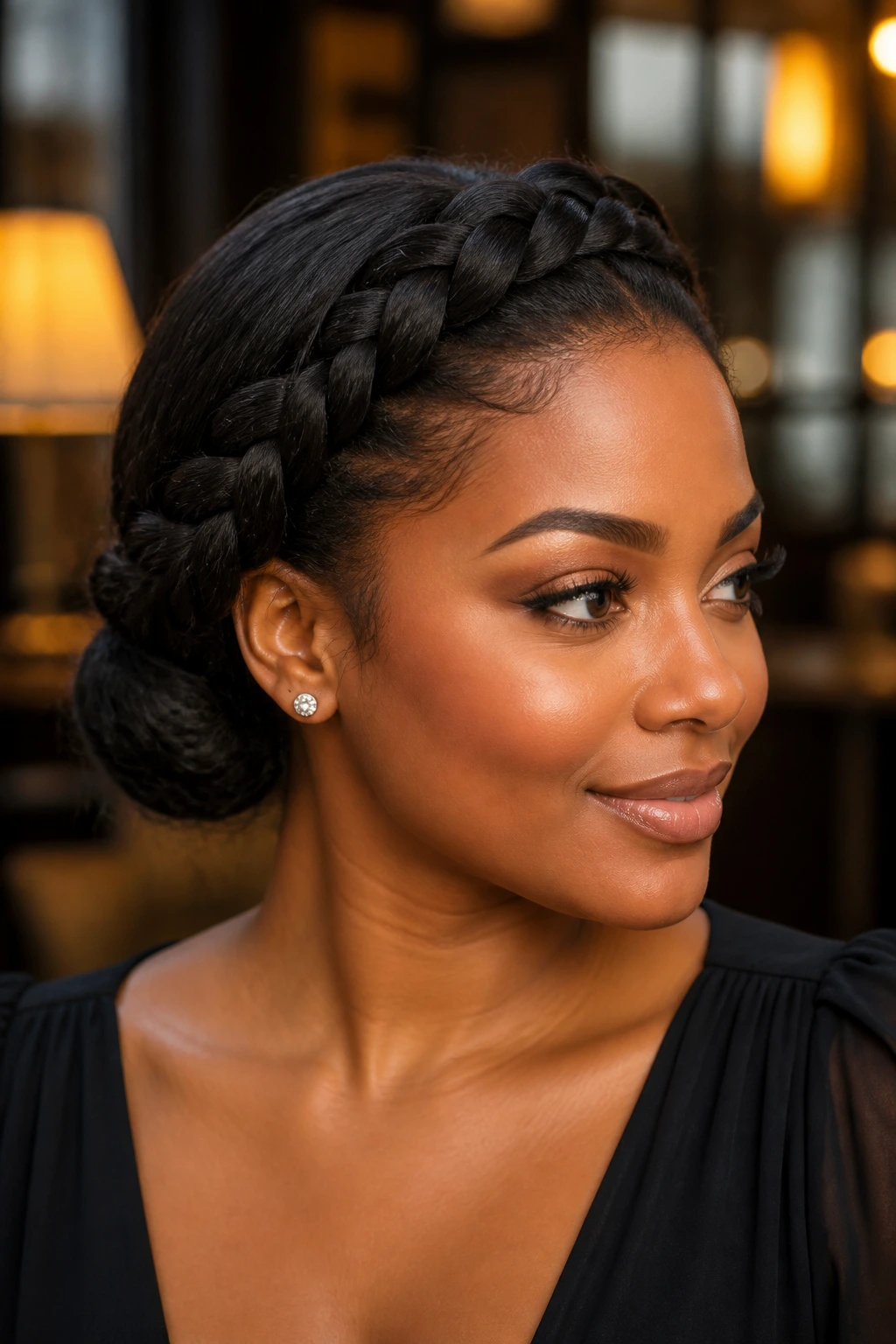
A braided crown wrapped into a low bun can look formal, but it also does a lovely thing for a round face: it builds a line around the top of the head and then tucks the bulk low and centered at the back. That keeps the face open while still giving the style structure.
The crown braid should trace slightly above the hairline, not sit low and tight around the cheeks. A low bun at the nape keeps the silhouette calm. If you want a softer feel, leave a few tiny face pieces loose. If you want a sharper look, keep the front clean and let the braid pattern do the talking.
This is one of the better event styles if you want your face to look a little longer without wearing hair down. It’s neat. It’s controlled. It holds shape.
21. Cornrow Ponytail With Feed-In Length
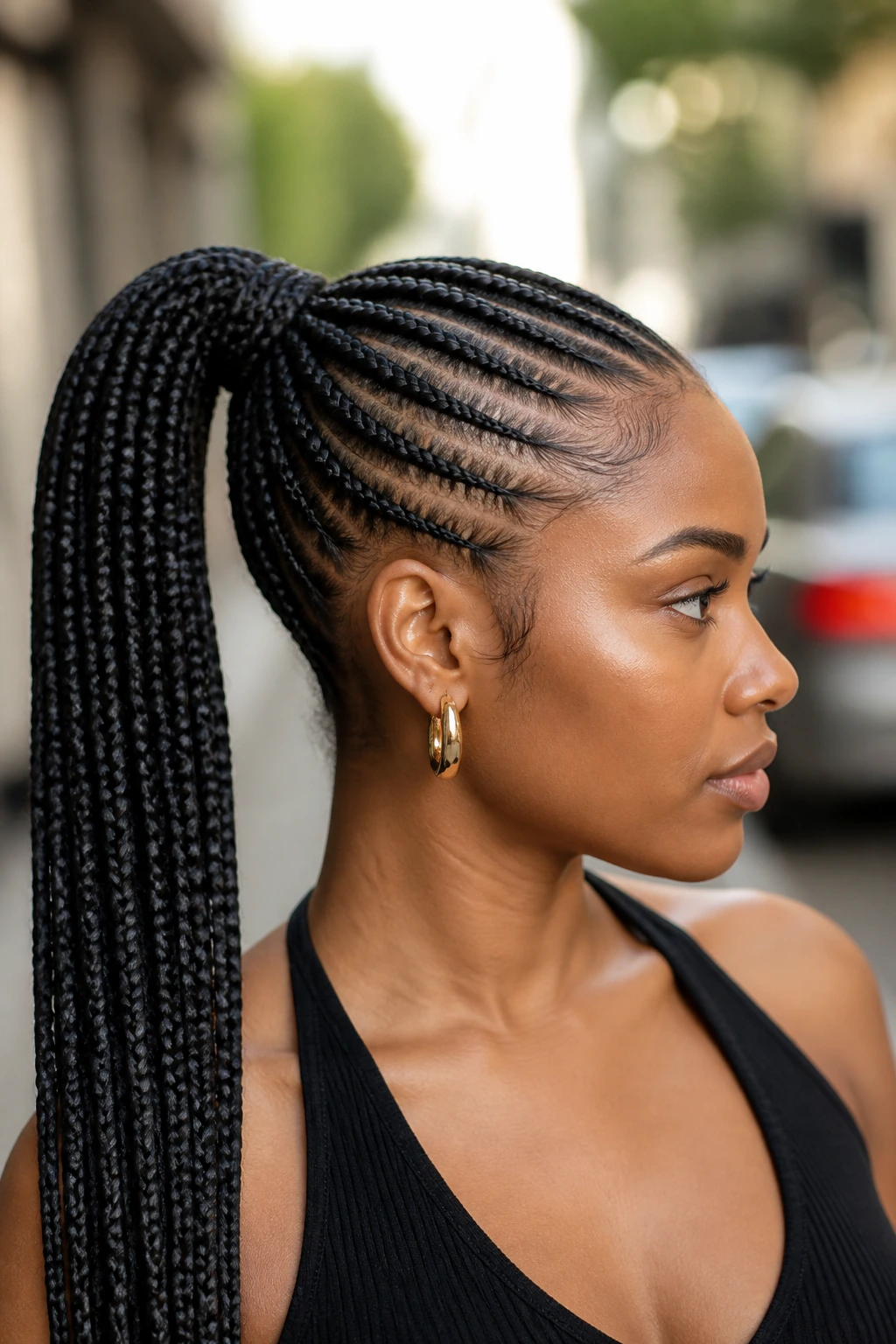
A cornrow ponytail is a strong choice when you want your hair pulled back but still want shape. The feed-in braids guide the eye toward the ponytail instead of out to the sides, which helps a round face look more lifted. The style feels sleek without going flat.
The parting pattern matters here. Narrow rows near the front keep the forehead open, while the ponytail adds height or length depending on where it sits. I prefer a ponytail that starts higher than the midpoint of the head so the style doesn’t drag the eye down.
If the rows are too wide at the temples, the face can look broader. If they’re tidy and slim near the front, the whole style reads cleaner. That’s the real difference.
22. Flat-Twist Updo That Keeps the Sides Close
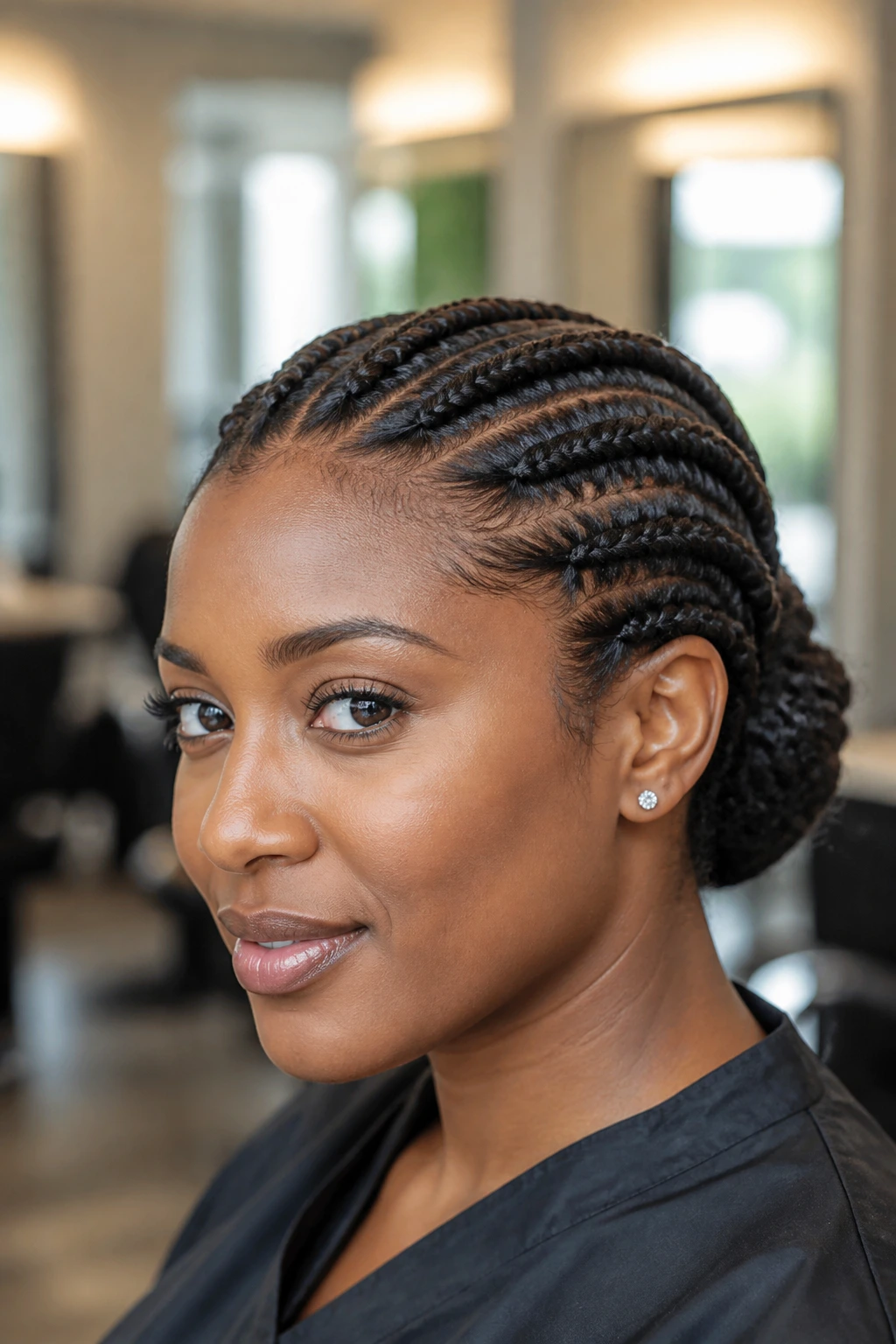
What if you want your hair off your neck but do not want a style that sits like a dome on the head? Flat twists solve that. They lie close to the scalp, give you clean lines, and keep the sides from puffing out at the exact spot a round face is most sensitive.
The updo part can be tucked low, pinned into a twist, or gathered into a small knot. I like it when the twists angle back rather than going straight out from the face. That little shift creates a longer shape.
This style is underrated because it looks calm. No extra width. No loose ends crowding the cheeks. Just a neat frame and some breathing room.
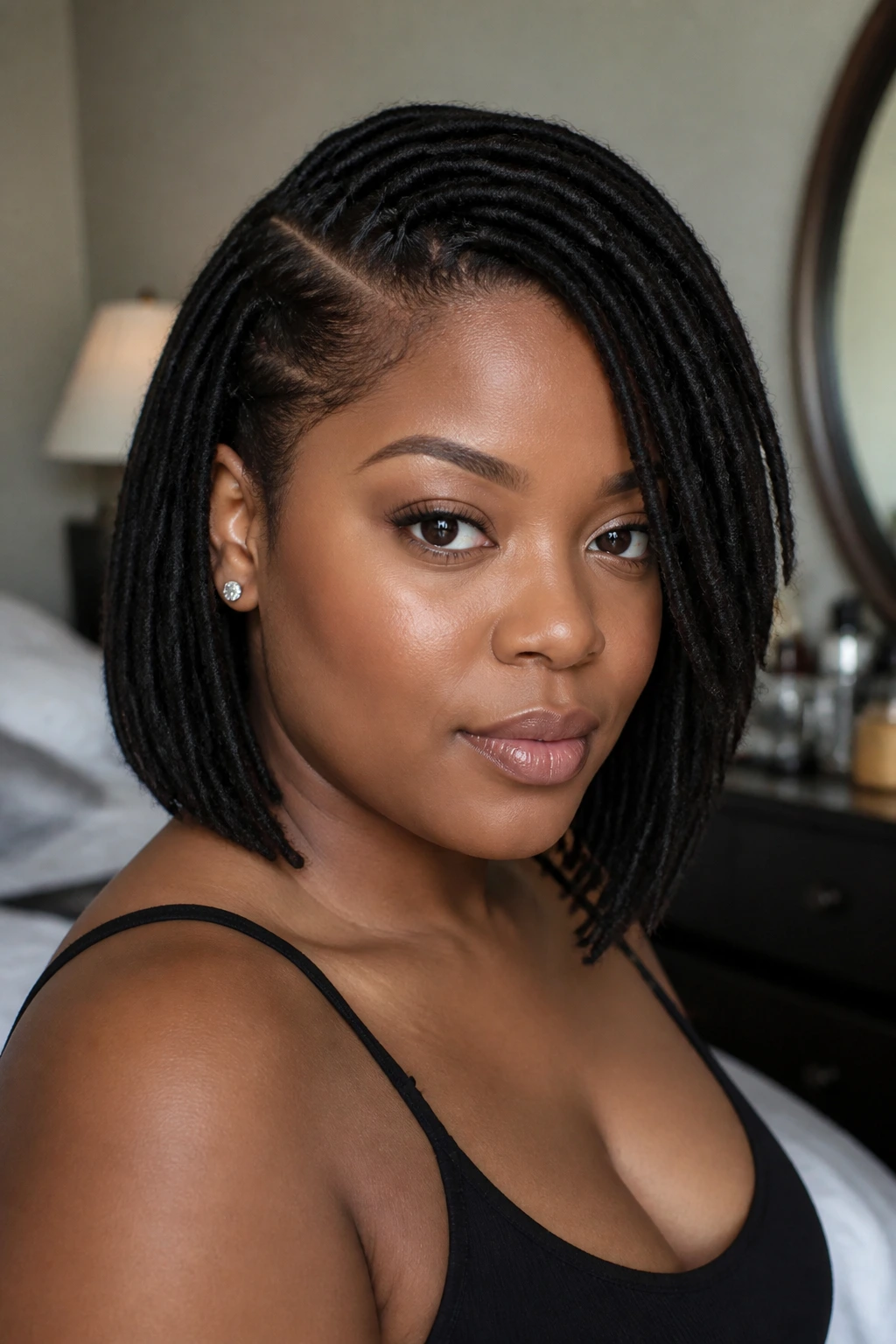
23. Loc Bob With Lift at the Roots
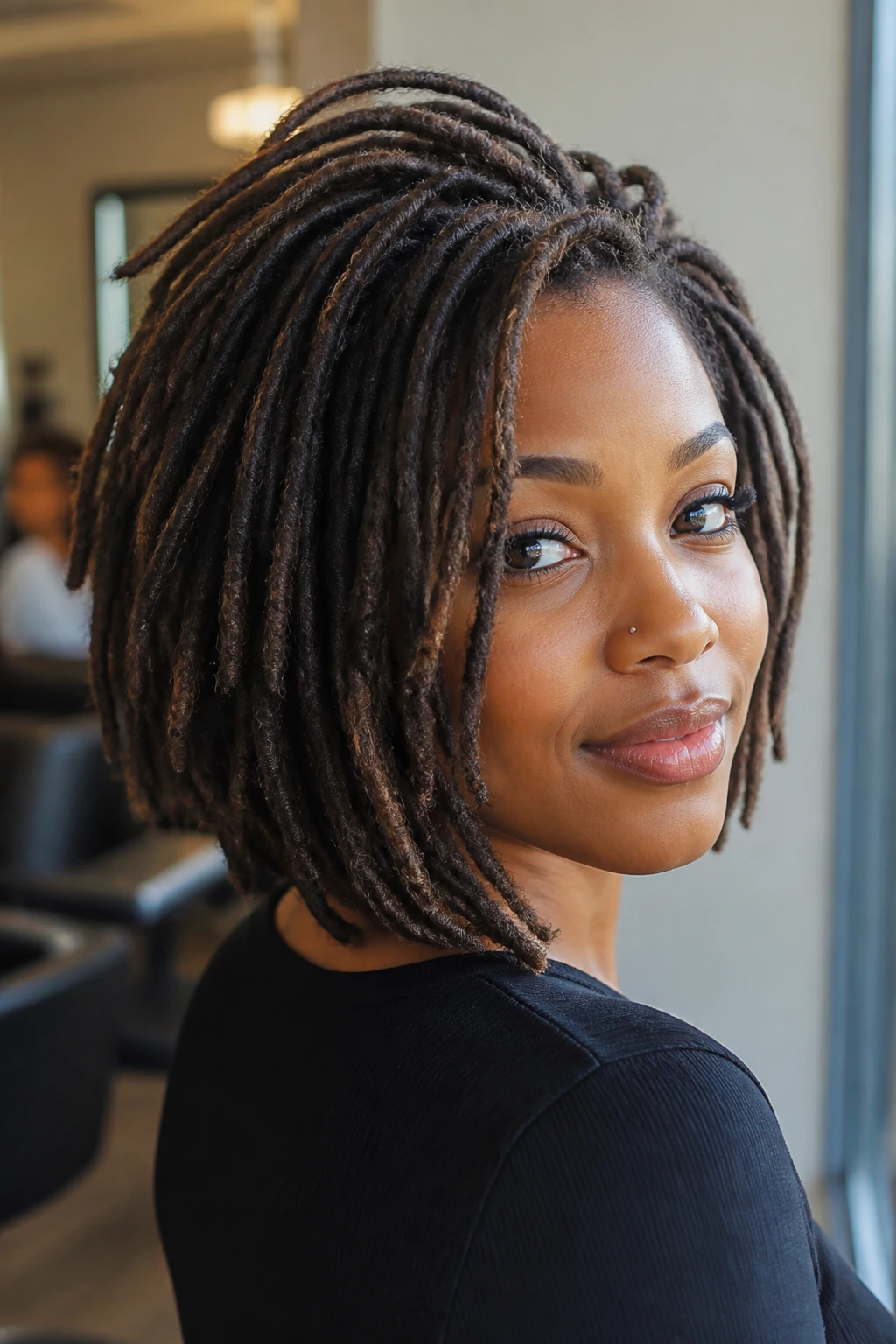
Locs at bob length can be gorgeous on a round face, but only if the shape is controlled. A straight all-one-length bob can feel boxy. A loc bob with a little lift at the roots and a slightly stacked back reads better because the crown gets more height.
The cut should be checked from the front and side. If the ends hit exactly at the jaw, the face may look wider. If they sit a little lower, or the bob has soft layers, the line feels more flattering. Some people like a small side part here too. It helps more than you’d think.
I’d also keep the locs from getting too thick at the sides. The shape is doing the heavy lifting, and heavy sides can undo it.
24. Pixie Cut With a Longer Top and Narrow Sides
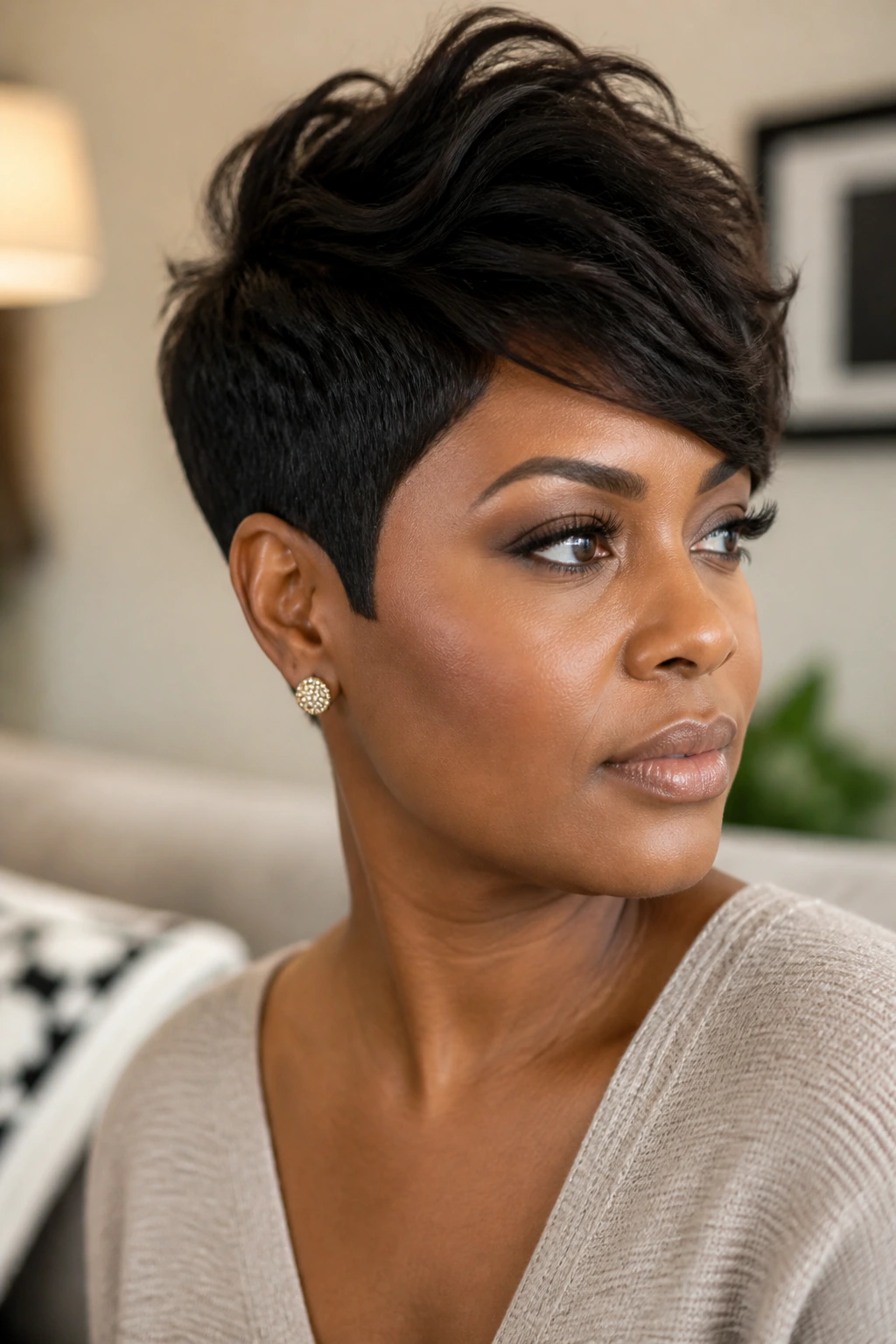
A pixie on a round face works when the top has movement and the sides stay snug. If the sides puff out, the face gets wider. If the top has a little height and the front can sweep upward or off to one side, the cut feels sharp and clean.
This is a cut for someone who likes structure. You’ll need regular shape-ups to keep the sides narrow and the outline crisp. On natural texture, finger coils, a curl sponge, or a light foam can give the top some lift without flattening it.
I prefer this over a blunt cropped cut on most round faces. The longer top does the face a favor. The narrow sides keep the shape honest.
25. Wash-and-Go With Stretched Roots and Face-Framing Clumps
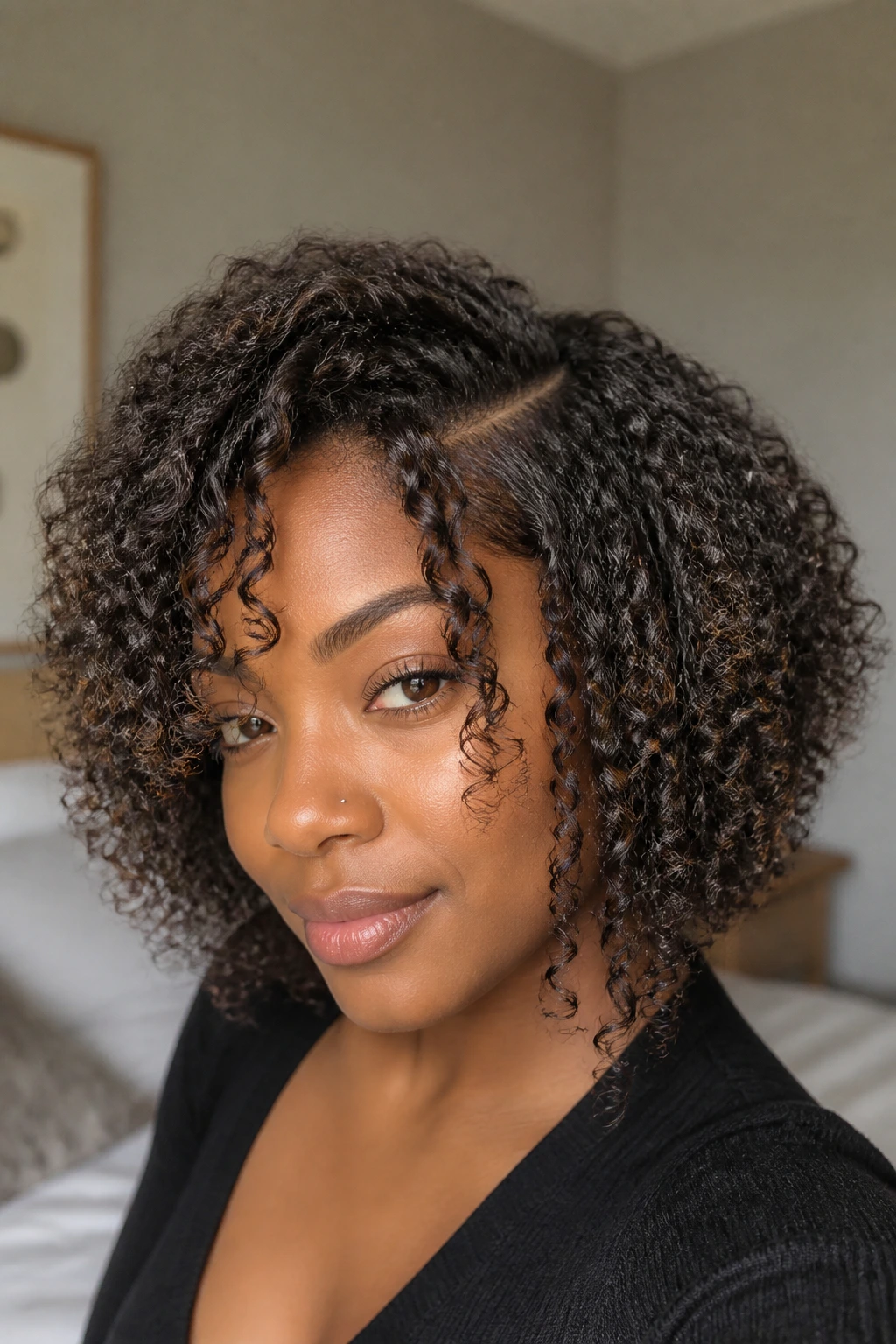
A wash-and-go can absolutely work on a round face, but the roots need a little discipline. Stretched roots keep the curl cloud from expanding straight out at the cheeks. Face-framing clumps add movement without making the whole head puff into one circle.
The part helps, too. A side part or an off-center part gives the style more direction than a dead center split. Diffusing on low heat, pineappleing at night, and refreshing with a water-based mist all keep the curls from collapsing or getting too fuzzy around the face.
This style works best when the curl pattern is defined and the crown has some lift. If the curls are dense right at the cheekbones, the face can disappear into them. Keep the front thoughtful and the shape stays clean.
Tools, Products, and Salon Notes
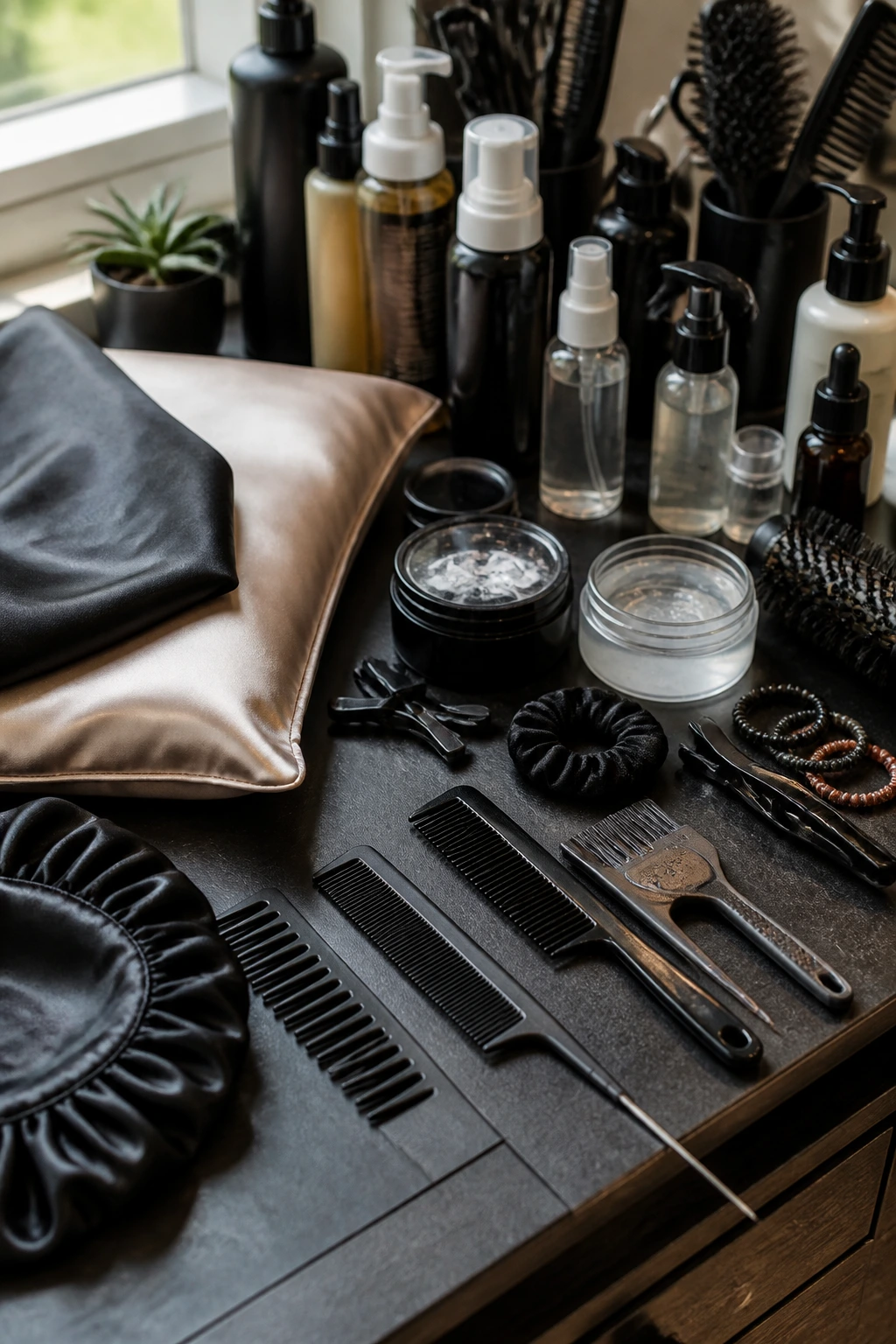
-
Rat-tail comb: Clean parts and sharp side parts live or die by this tool.
-
Wide-tooth comb or detangling brush: Best for stretching curls, detangling before braid or twist styles, and keeping breakage down.
-
Edge brush: Useful for smoothing the front without wrecking the rest of the style.
-
Styling gel or mousse: Gel helps with sleek styles and parts; mousse works better for braids, twists, and set curls.
-
Heat protectant: Necessary for silk presses, blowouts, or any style that starts with heat.
-
Satin scarf or bonnet: Keeps edges, parts, and curls from frizzing overnight.
-
Silk or satin pillowcase: Handy backup when the bonnet goes missing halfway through the week.
-
Braiding hair or crochet hair: Choose soft, pre-stretched hair that doesn’t scratch the neck or weigh down the front.
-
Leave-in conditioner: Good slip makes prep easier, especially for natural hair before twists, puffs, and wash-and-gos.
-
Scalp spray or light oil: Use sparingly. A heavy hand collapses volume and leaves roots greasy.
-
Hair clips and sectioning clips: Essential for half-up styles, silk presses, and anything with a clean part.
-
Hand mirror: Not glamorous, but useful. A round face can look different from the side, and the side view tells the truth.
How to Keep These Styles Fresh Between Wash Days
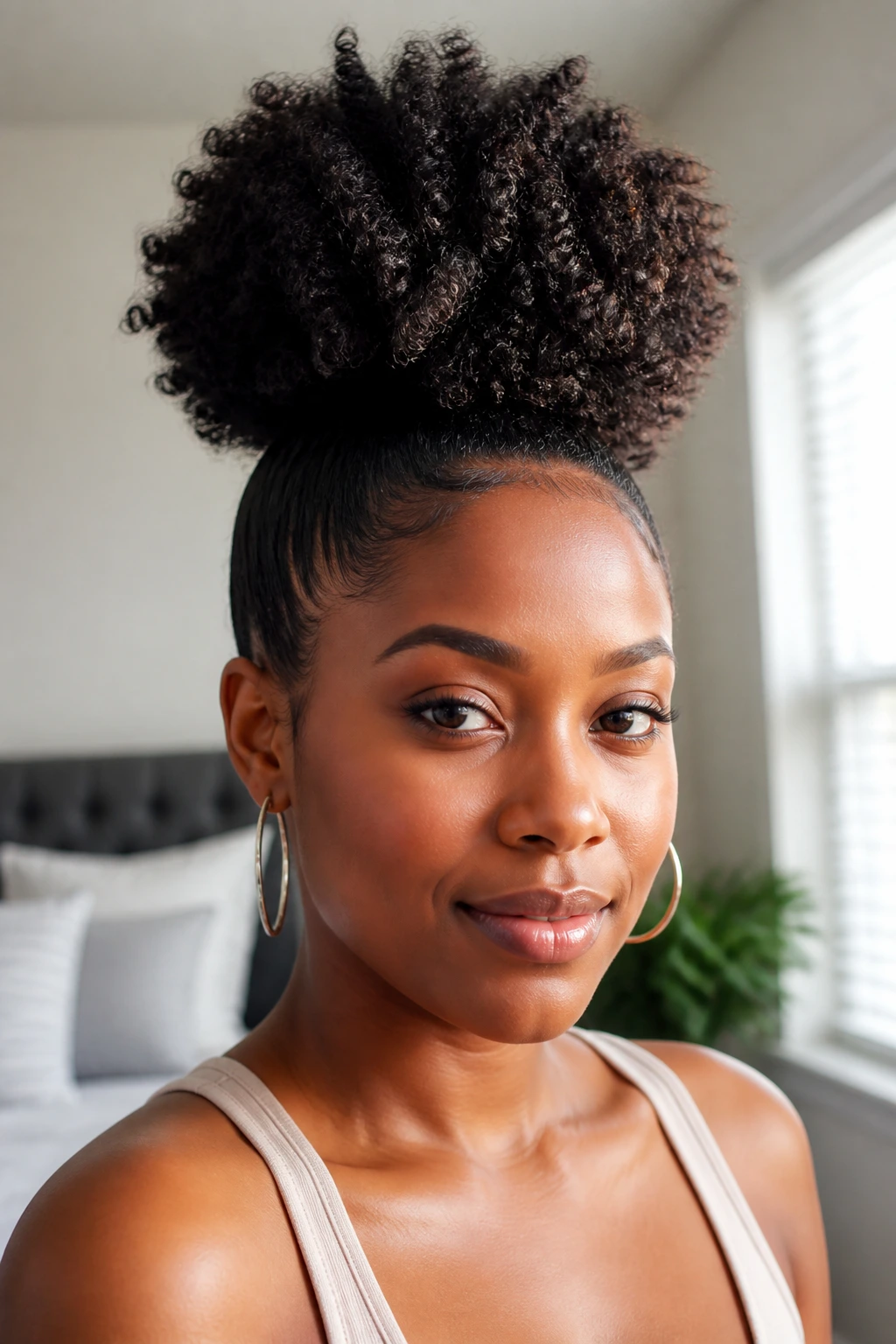
A style that flatters a round face on day one can drift into a wider shape by day four if you let it go unchecked. That is usually where people get frustrated. The cut or braid was fine. The upkeep wasn’t.
For curls, twist-outs, and wash-and-gos, sleep with a satin bonnet and keep a loose pineapple or banding set if the curls need lift. In the morning, mist the outer layer with water and a little leave-in, then fluff the crown with your fingers. Do not rake through the cheeks if you want the shape to stay long.
Braids, twists, and loc styles like a weekly refresh. A light mousse along the frizzy sections, a clean scalp, and a quick re-wrap at night keep them neat. Most protective styles hold for 4 to 8 weeks, but if the front starts pulling or the shape swells too much, take that as your cue. A style that looks tired at the temples is usually done.
Silk presses are a different creature. They usually stay clean for 1 to 2 weeks if you wrap them well and avoid humidity as much as possible. A small bump of heat on the roots can reset them, but if the ends are already swollen, don’t fight it. Wear the softer texture or wash it out.
Four Ways to Change the Look Without Losing the Shape
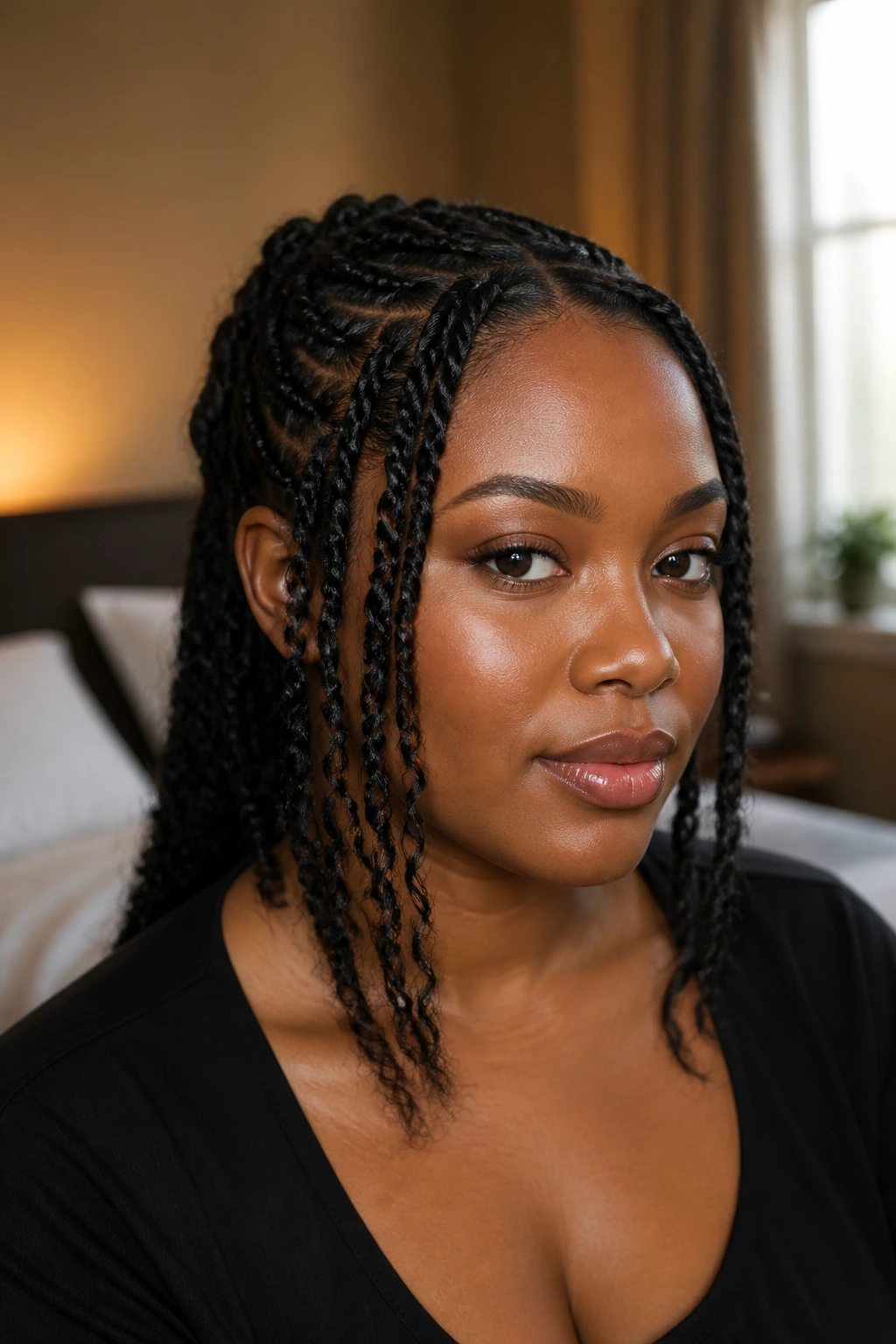
The Low-Tension Edit:
Choose knotless braids, looser twists, or a flat-twist updo when your scalp wants a break. The silhouette stays neat, but the roots feel less stressed. This is the version I’d pick if edges are already sensitive.
The Heat-Free Stretch Route:
Use banding, twists, or a blow-dry on low heat to stretch curls before styling. That keeps wash-and-gos, puff styles, and twist-outs from blooming too wide around the cheeks. The hair still looks natural; it just behaves better.
The Dress-It-Up Version:
Add a deep side part, a wrapped base, a polished edge, or a few deliberate accessories. A braided crown, high ponytail, or silk press can go from daytime to formal without changing the cut at all. The shape does the work.
The Short-Hair Route:
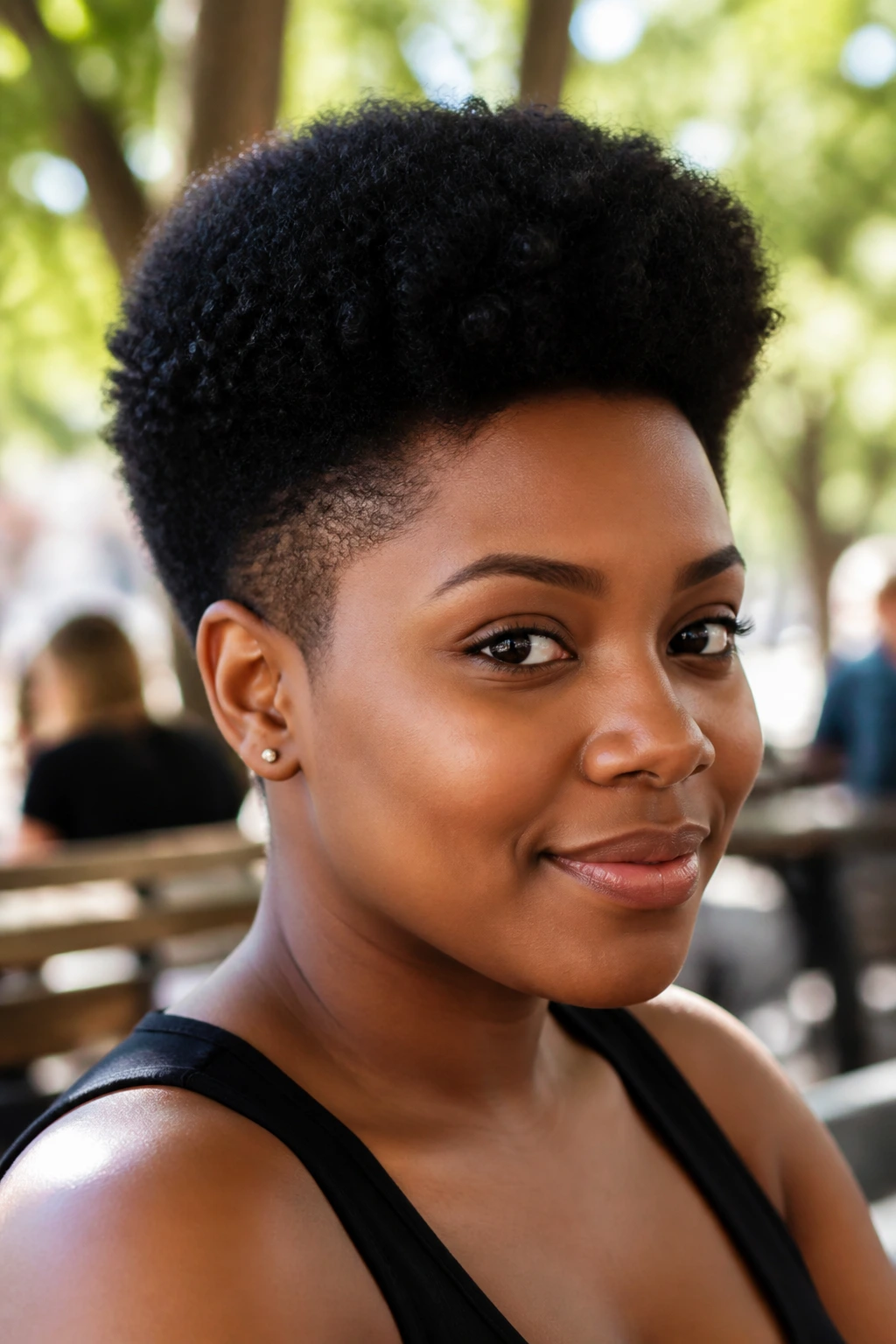
Lean into a tapered afro, TWA, or pixie with a longer top. Short hair on a round face can look sharper than longer hair if the outline is controlled. It’s less about length and more about line.
The Protective-Style Rotation:
Move between braids, locs, twists, and crochet styles so the same pressure points are not taking a beating every time. Your hairline will thank you. So will the shape.
The Mistakes That Make a Round Face Look Wider
-
Putting too much width at the cheeks: If the hair balloons right where the face is already fullest, the silhouette gets wider instead of longer. The fix is simple: raise the style, sweep it to one side, or let the length fall below the jaw.
-
Choosing blunt ends that stop at the jawline: A blunt bob, a cut twist set, or a braid ending right at the jaw can make the face look boxier. Move the length lower or go shorter and tighter on the sides.
-
Pulling braids and ponytails too tight at the temples: Tight fronts can leave bumps, headaches, and a very severe look. Loosen the front rows and let the style sit with a little breathing room.
-
Ignoring crown height: A flat top can make the face look short and wide. Add lift with a puff, a lifted twist-out, a top knot, or a shape-up with height.
-
Overloading the style with heavy product: Too much gel, cream, or oil flattens the roots and leaves the hair looking greasy. Use less than you think, then add only if the style actually needs it.
-
Letting a protective style grow out too far: Once braids or locs swell at the front and the parts blur, the whole shape can go fuzzy and broad. Take them down while the outline still looks clean.
Frequently Asked Questions About Hairstyles for Black Hair and Round Faces
Are bangs bad for round faces?
Not always. Soft, side-swept bangs or curly fringe can work because they add a diagonal line. Straight blunt bangs that stop across the forehead can shorten the face, so those need more care.
Can a center part work on a round face?
Yes, but it needs help. A center part looks better when the style has height at the crown, length below the chin, or long face-framing pieces that keep the face from feeling boxed in.
What short hairstyle works best if my hair is very coily?
A tapered afro, TWA, or pixie with a longer top is usually the safest move. Those shapes keep the sides narrow and give the face a cleaner line than a puffed-out round cut.
Do braids or twists flatter a round face more?
Both can work. Braids tend to look sleeker and more structured, while twists feel softer. The real difference is where they end and whether the front is kept light.
How do I know if a style is too wide for my face?
Stand in front of a mirror and check the cheekbone area. If the hair pushes outward exactly there, the face can read wider. If the shape moves up, down, or diagonally, you’re in better territory.
Can I wear a bob with a round face?
Yes, but an angled or asymmetrical bob usually works better than a blunt one. If the ends fall at the jaw, the cut can feel boxy. If one side drops lower or the back is slightly stacked, the shape improves fast.
What’s the gentlest protective style for edges?
Loose knotless braids, medium twists, or flat twists are usually kinder than tight feed-in rows or heavy ponytails. The scalp should feel secure, not strained. If it hurts, it’s not worth keeping.
How long should a style last before I take it down?
That depends on the style. Silk presses often look best for 1 to 2 weeks, twist-outs for a few days, and braids or loc styles for several weeks. If the shape stops flattering your face, take that as a real signal, not a failure.
A Better Line at the Mirror
The strongest styles for Black hair and round faces do the same quiet thing: they steer the eye. Up, down, or to the side. That is the whole trick, and once you start noticing it, you can spot the difference between a style that sits on the face and one that frames it.
A round face does not need a hard correction. It needs shape with intention. The high puff, the tapered afro, the side-swept locs, the angled bob, the lifted twist-out — they all work because they give the face a line to follow instead of a wide block to sit inside.
The next time you sit in the chair or stand in front of the mirror, start with the line first. The rest gets easier after that.