



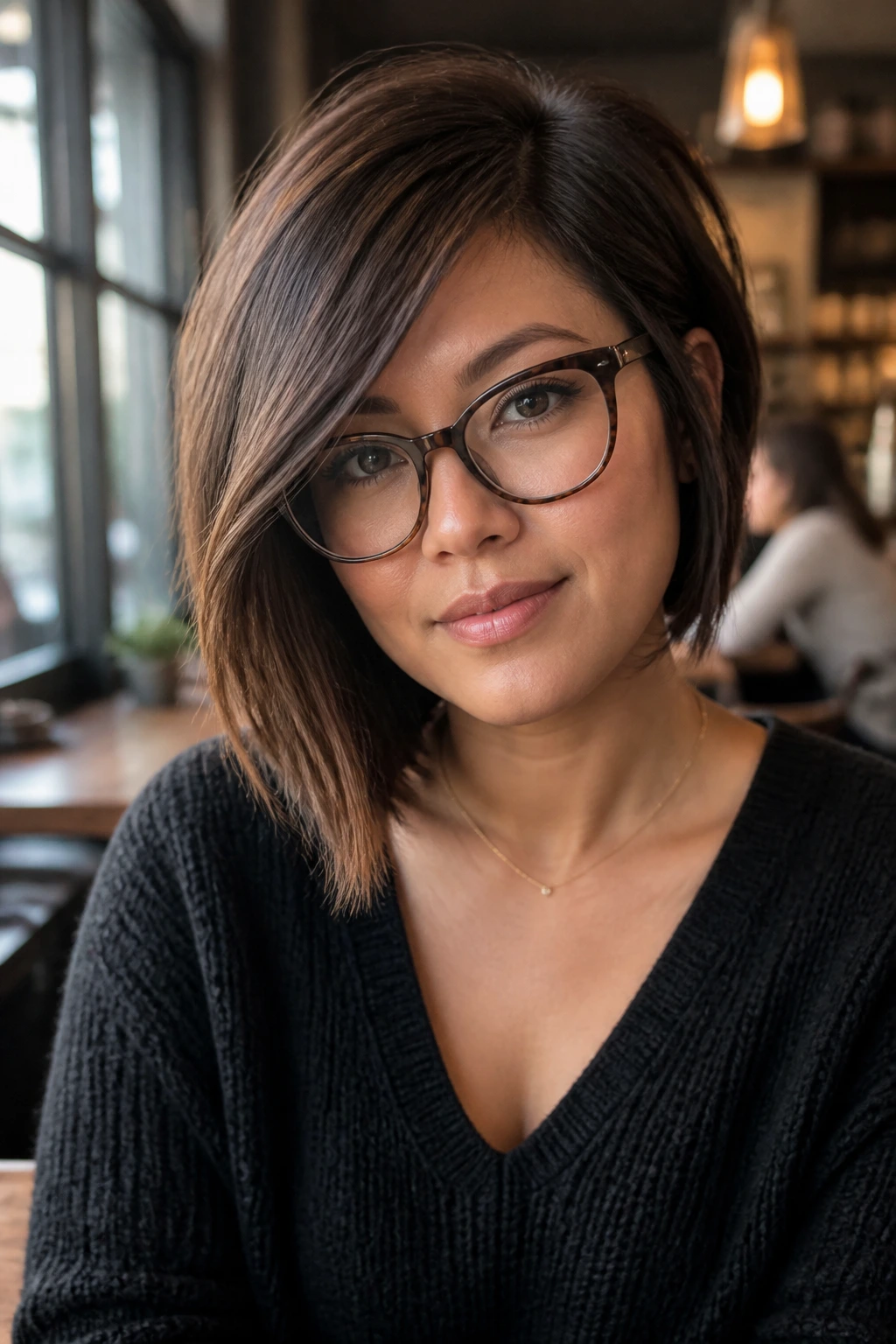
If you’re looking for glasses hairstyles for round faces with side-swept bangs, the whole game is angle, not volume. A round face already has soft width through the cheeks, and glasses add another strong shape right where the eye wants to rest. The right haircut doesn’t fight that. It slips in a diagonal line, leaves a little space around the temples, and gives the lenses room to look deliberate instead of crowded.
Side-swept bangs do a specific kind of work that blunt fringe just can’t. They break up the horizontal line of the frame, keep one brow visible, and guide the eye down and out instead of straight across. When the cut is right, the hair almost behaves like a frame for the frame. Funny how that works.
The styles below aren’t random pretty pictures pulled from a mood board. They’re the cuts and styling shapes that actually behave around glasses: some soften bold frames, some sharpen a softer face, and some make fine hair look like it has a little more backbone than it really does. If your fringe keeps colliding with your lenses, or your current cut makes your face look wider than it is, the fix is usually sitting in the front few inches of hair.
Why These Styles Feel Better With Glasses
-
Diagonal movement does the heavy lifting: A side-swept bang cuts across the forehead and breaks the roundness that can show up in both the face and the frame line.
-
The eyes stay visible: A good sweep leaves one brow or one eye slightly open, which keeps glasses from swallowing the whole expression.
-
Temple space matters more than length: Hair that’s too full at the sides bumps into the arms of the frames and makes everything feel wider than it needs to.
-
Soft edges beat hard blocks: A little feathering around the bang and cheekbone area keeps the haircut from looking boxy beside a round face.
-
Each texture can play this game: Straight hair, curls, coils, and waves all work here, but the front needs to be cut with the shrinkage, bend, or slip in mind.
-
The style can grow out nicely: A well-cut side sweep usually turns into face-framing layers instead of an awkward helmet line.
What to Tell Your Stylist Before the First Snip
The fastest way to get a flattering result is to stop talking about “just some bangs” and start talking about where the hair sits against your glasses. Bring the frames you wear most often, or at least a photo of them on your face. The top edge of the frame changes everything. A low-sitting frame wants a different bang length than a thin, high frame that barely touches the brow.
A round face usually needs a little vertical lift or a little diagonal pull, and side-swept bangs can give either one. Ask for the longest point of the bang to land somewhere between the brow arch and the outer corner of the eye, not right on the lashes. That leaves enough room for your lenses and keeps the fringe from splitting awkwardly on the bridge of the frame.
A few things worth saying out loud in the chair
-
Tell them how your hair behaves when dry. Cowlicks, cowlicks, cowlicks. They change the direction of the sweep more than people think.
-
Mention how often you style your hair. A fringe that needs a round brush every morning should be cut differently from one that needs to air-dry and behave.
-
Say whether your frames are heavy or light. Thick acetate can handle a softer, airier bang. Wire frames usually need more shape at the front.
-
Ask for movement around the temples. That one detail stops the haircut from ballooning out at the widest part of the face.
A good stylist will cut the front with your frames in mind, not as an afterthought. That’s the difference between “nice haircut” and “why does this suddenly look expensive?” No mystery there.
1. The Collarbone Lob That Skims the Cheekbone
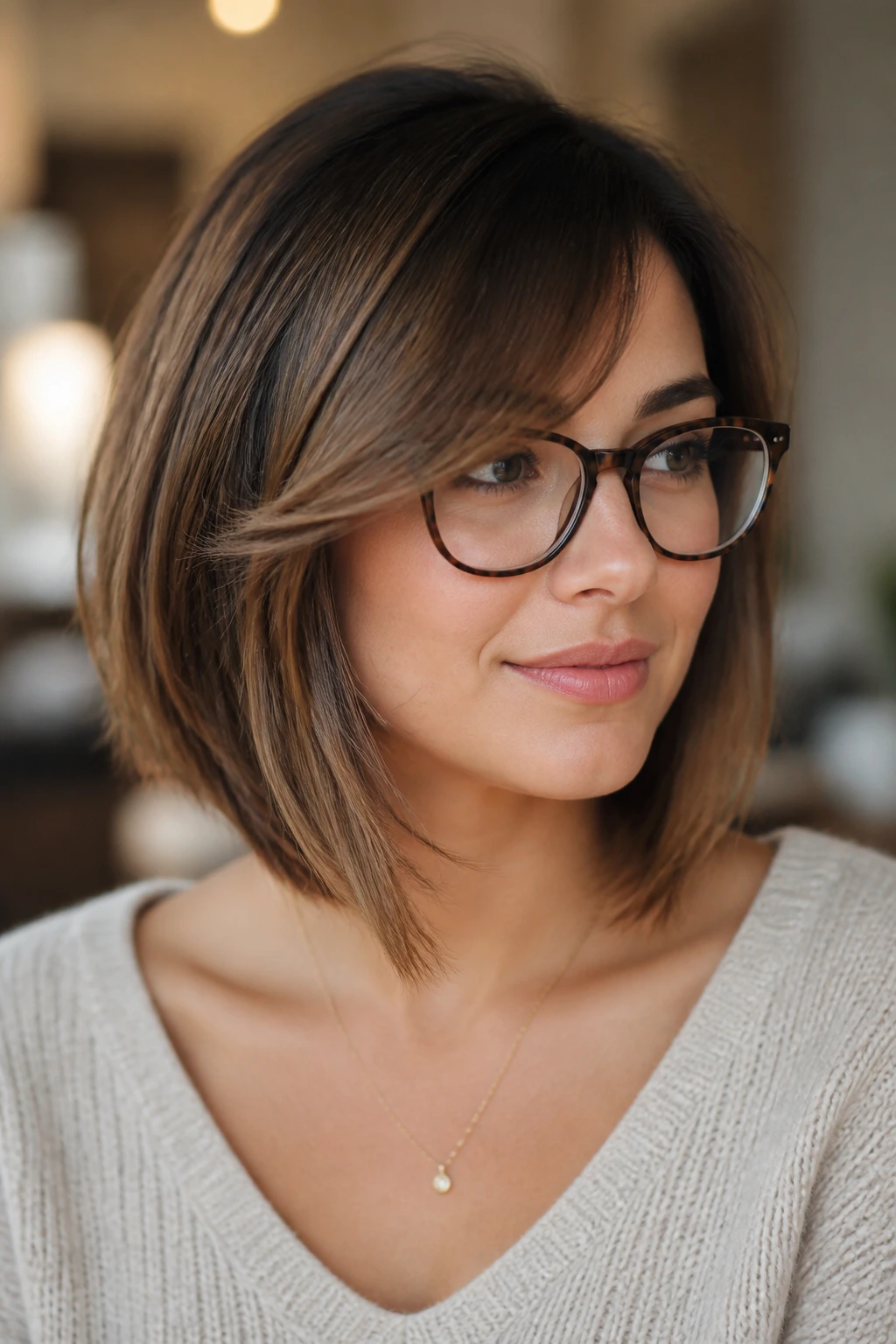
This is the safest place to start if you want shape without giving up length. The lob lands below the jaw, so it doesn’t stop the eye at the widest part of a round face, and the side-swept bangs soften the top half without covering the glasses bridge. The whole look feels tidy, but not stiff.
A collarbone lob works especially well when the front pieces are cut to graze the cheekbone before dropping to the shoulders. That tiny drop changes the line of the face. The fringe should start a little off-center and sweep toward the stronger side of your part, not sit straight across like a curtain that forgot what it was doing.
Best for: medium frames, soft waves, and hair that likes a little bend.
Styling note: bend the ends under with a 1-inch round brush, then flip the bang across the forehead with your fingers while it cools. Don’t over-smooth it. A little air keeps the style from feeling helmet-like.
2. The Soft French Bob That Leaves Room for Glasses

A chin-length bob sounds risky on a round face, but the French version works because it isn’t blunt in the wrong places. The ends are soft, the interior has movement, and the side-swept bang keeps the eye line from getting boxed in by the frame. It’s short, yes. Cramped, no.
Why it works
The trick is the line of the cut. Instead of sitting as one flat shelf at the jaw, the French bob usually bends in or out just enough to create a little shadow and depth. That matters beside glasses, because the frame already gives you a strong geometric line. You do not need the haircut to copy it exactly.
Ask for a fringe that starts long enough to tuck behind the frame arm if needed. If the bang ends at the top of the lens, the look can feel chopped. If it falls just past the outer corner of the eye, it looks intentional.
Quick reality check: this shape needs regular shaping, not lazy grow-out. Short hair tells the truth fast.
3. The Bixie With a High Crown
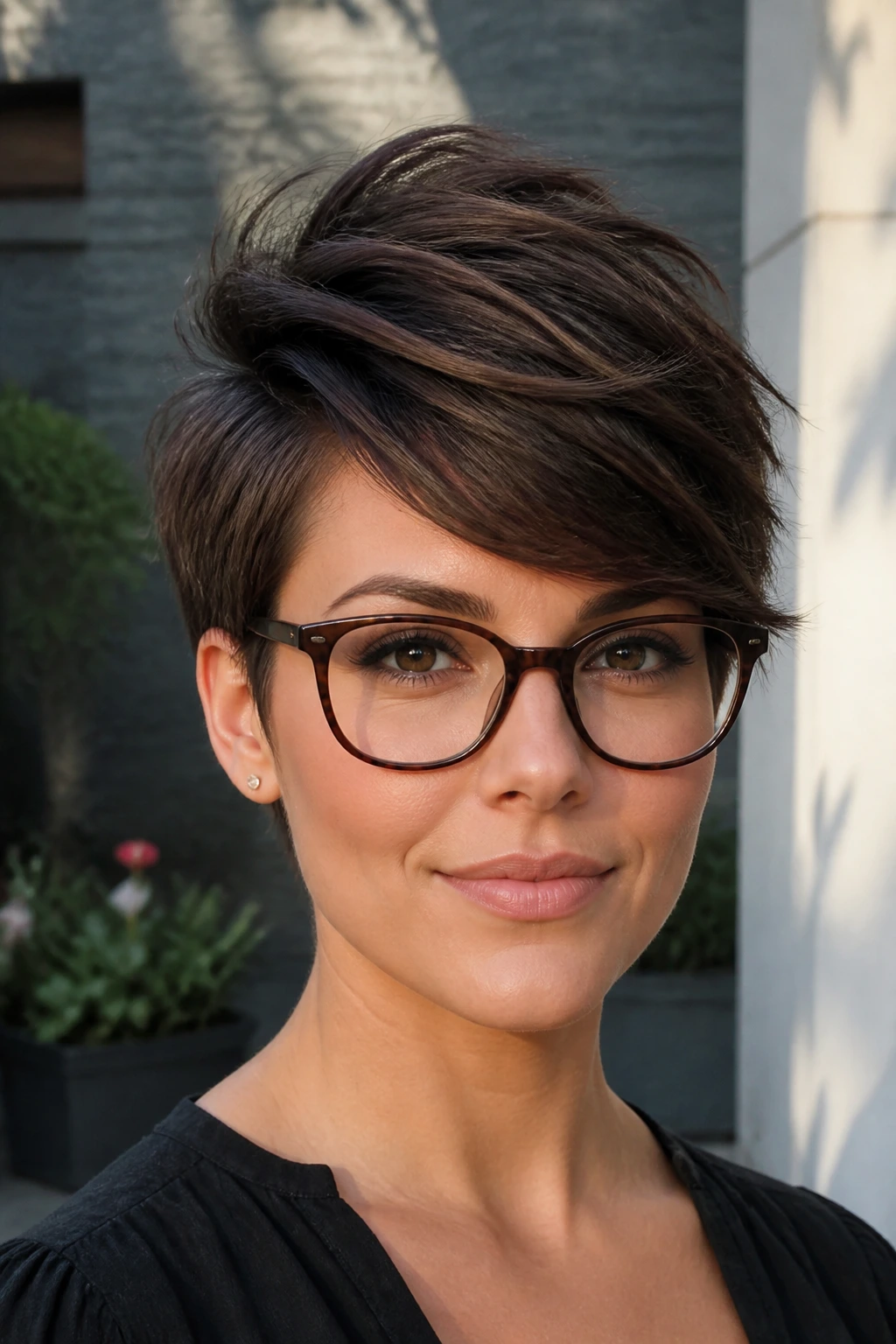
Short hair with glasses can look fantastic when the volume sits up high instead of out wide. That’s where the bixie comes in. It gives you the lift of a pixie and a little more softness through the side, while the side-swept front keeps the face from looking too open or too severe.
The crown should stay airy and light. Not puffed. Airy. That means the top has enough height to lengthen the face, but the sides stay close enough to avoid adding width at the temples. The bang can be longer than you think, sweeping across one brow and landing just above the cheekbone.
What to ask for
- Shorter back and sides with visible texture at the crown.
- Longer front pieces that angle across the forehead.
- Light feathering near the temples so the frame arms don’t fight the hair.
Best move: rough-dry first, then direct the front section sideways with a small round brush. If you comb it flat, the whole style loses its lift.
4. The Shag That Breaks Up the Roundness

A shag can be a gift to a round face, but only if the layers are cut with some restraint. Too much puff at the sides and you’re back where you started. The version that works here keeps the volume slightly higher and the front fringe soft, swept, and piecey enough to move around the glasses.
The reason this cut earns its keep is simple: the broken-up texture creates vertical and diagonal lines all over the head. Those lines keep the eye moving. A smooth, one-length shape can make a round face feel even rounder. A shag interrupts that, which is the whole point.
A side-swept bang in a shag should blend into the rest of the layers instead of looking pasted on. If the front is cut too short or too thick, it can crowd the frame and turn fuzzy by lunchtime. Ask for softness around the face, not a heavy block of fringe.
5. The Long Layers With a Deep Side Part
Want to keep the length? Fine. Long hair can absolutely work on a round face with glasses, but it needs enough structure near the front to keep the whole style from hanging there like a curtain. A deep side part does a lot of the work, and the side-swept bang finishes it off.
This is one of those cuts that looks simple until you see it on. The long layers drop past the cheeks, which helps stretch the face visually, while the bang sweeps across one side and softens the frame. The layers shouldn’t all begin at the same height. That’s how you get the flat, triangular shape that makes a face look wider.
Tip that saves the look: keep the shortest face-framing piece no higher than the brow arch. Anything shorter can start to compete with the frame rather than complement it.
6. The Tucked Lob for Clean Frame Lines
Some days you want your glasses to be the star and your hair to behave itself. This is that haircut. The tucked lob stays at the shoulders or just above, with enough bend to tuck one side neatly behind the ear while the side-swept bang stays soft on the other side.
What makes this style work is the little pocket of space it creates near the temples. That space matters. Frames need breathing room. A lot of round faces get visually wider because the hair lands right beside the frame arms and sits there like a second pair of parentheses. Tucking one side breaks that shape instantly.
Use a soft cream or light spray on the bang, not a heavy wax. The fringe should move when you blink, not stick to the forehead like it was painted on.
7. The Inverted Bob With a Longer Front Edge
Here’s the cleanest way to get structure without harshness: a bob that sits shorter in the back and gradually lengthens toward the front. The forward angle pulls the eye down and away from the cheeks, which is exactly what you want on a round face. Add side-swept bangs and the face gets a slimmer-looking frame almost by accident.
The front edge should not be blunt and sharp like a ruler. A little softness keeps it from feeling severe beside glasses. The bang can echo the same forward slope, starting near the crown and sweeping down toward the outer brow.
If your hair is thick, ask for internal removal of bulk rather than heavy thinning at the ends. Thinned ends can frizz around the frame and look wispy in a bad way. You want a clean line, not a shredded one.
8. The Curly Shoulder Cut That Lets the Fringe Bend
Curly hair and side-swept bangs can be beautiful together, but the cut has to respect shrinkage. A curly shoulder-length cut keeps enough weight to stop the curls from exploding outward at the cheeks, while the fringe can be left long and bent to one side instead of forced into a straight line.
A few details that matter
- Cut the fringe longer than you think. Curls spring up.
- Shape the front while dry, or at least mostly dry, so the final length makes sense.
- Keep the longest front pieces near the cheekbone, not the lip line.
- Use a diffuser only until the fringe is about 80 percent dry, then let it finish on its own.
The sweep should look soft, not ironed flat. Curly side bangs with glasses look best when they look like they belong to the same head of hair, not a separate little project sitting on the forehead.
9. The Pixie That Stays Light at the Temples
A pixie can be a very smart choice for round faces with glasses because it clears the sides and lets the frames breathe. The catch is the temple area. If the sides are too full, the head can look wider right where you don’t want it. The version that works keeps the sides close, the top slightly lifted, and the front longer enough to sweep.
That side sweep is doing real work here. It keeps the cut from feeling too open and gives the eyes a bit of soft cover. Without it, a pixie can feel stark next to strong frames. With it, the whole look feels deliberate and sharp in a good way.
Best for: strong cheekbones, heavier acetate frames, and hair that holds direction after a quick blow-dry.
10. The Asymmetrical Bob That Pulls the Eye Diagonal
Some cuts change a face by being a little unfair, and that’s exactly why they work. An asymmetrical bob—one side a touch longer than the other—creates a diagonal line that interrupts roundness immediately. Add a side-swept bang and you’ve got movement from forehead to jaw in one clean sweep.
The difference does not have to be dramatic. A half-inch to an inch is enough. Too much asymmetry can start to feel costume-y, and that’s not the goal. You want the eye to travel, not get lost in a gimmick.
This style is especially good if your glasses have a strong brow line. The diagonal cut keeps the hair from echoing the frame too closely. That little mismatch is what makes it interesting.
11. The Butterfly Layers With a Feathered Sweep
Butterfly layers are basically a lesson in strategic volume. The shorter layers live higher up, the longer ones fall below the cheekbone, and the result is movement without bulk at the exact widest part of a round face. A feathered side sweep at the front keeps the bang light enough to work with glasses.
The magic of this cut is that it creates lift where you want it and drop where you need it. The cheek area stays open. The ends move. The face doesn’t get swallowed by hair that sits in the middle and refuses to go anywhere.
A round face can look especially good in butterfly layers if the front pieces are blown away from the face, not tucked inward. Inward bends can close the shape too much. Outward movement makes the whole thing breathe.
12. The Sleek Shoulder Cut for Crisp Frames
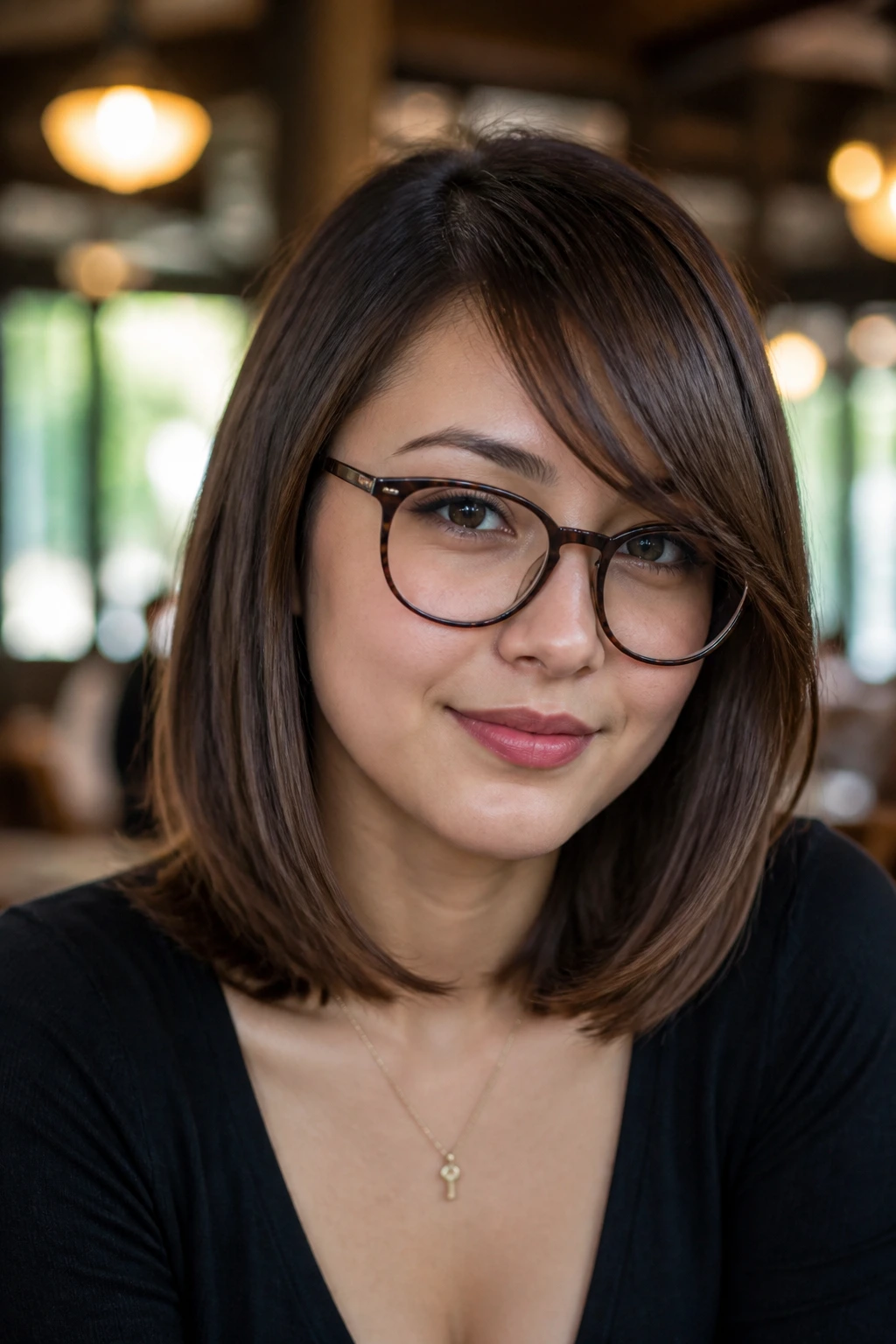
If your frames are already crisp and geometric, the haircut can either echo that or soften it. I usually prefer the second option. A sleek shoulder-length cut with a side-swept bang gives the face one smooth line and one diagonal interruption, which is enough to keep the look clean without becoming rigid.
What makes it different
The smoothness matters here. Not flatness. Smoothness. A little bend at the ends keeps the hair from looking too heavy beside glasses, and the side-swept front prevents the whole look from becoming one blunt shape from temple to shoulder.
This is a strong choice for straight hair that falls naturally without much work. Run a flat iron through the last inch of the ends if needed, but keep the bang soft. A pin-straight fringe beside thick frames can feel a little severe, and usually not in a cool way.
13. The Wolf Cut With a Softer Front

A wolf cut can go wrong on a round face if the texture gets wild at the sides. Too much puff around the cheeks, and the face gets wider. The version that behaves keeps the front soft and the layers more controlled, with the side-swept bang blending into the cheek area rather than springing out like a separate layer.
What makes this cut good with glasses is the contrast. The frames give you a sharp shape. The hair gives you broken-up texture. That mix keeps the look from feeling flat. Just keep the shortest pieces near the eye long enough that they don’t crowd the frame arm.
My opinion: this cut looks best when it’s a little imperfect. If every piece is too polished, the shag falls apart anyway. Let some pieces bend where they want.
14. The Rounded Afro With a Tilted Fringe
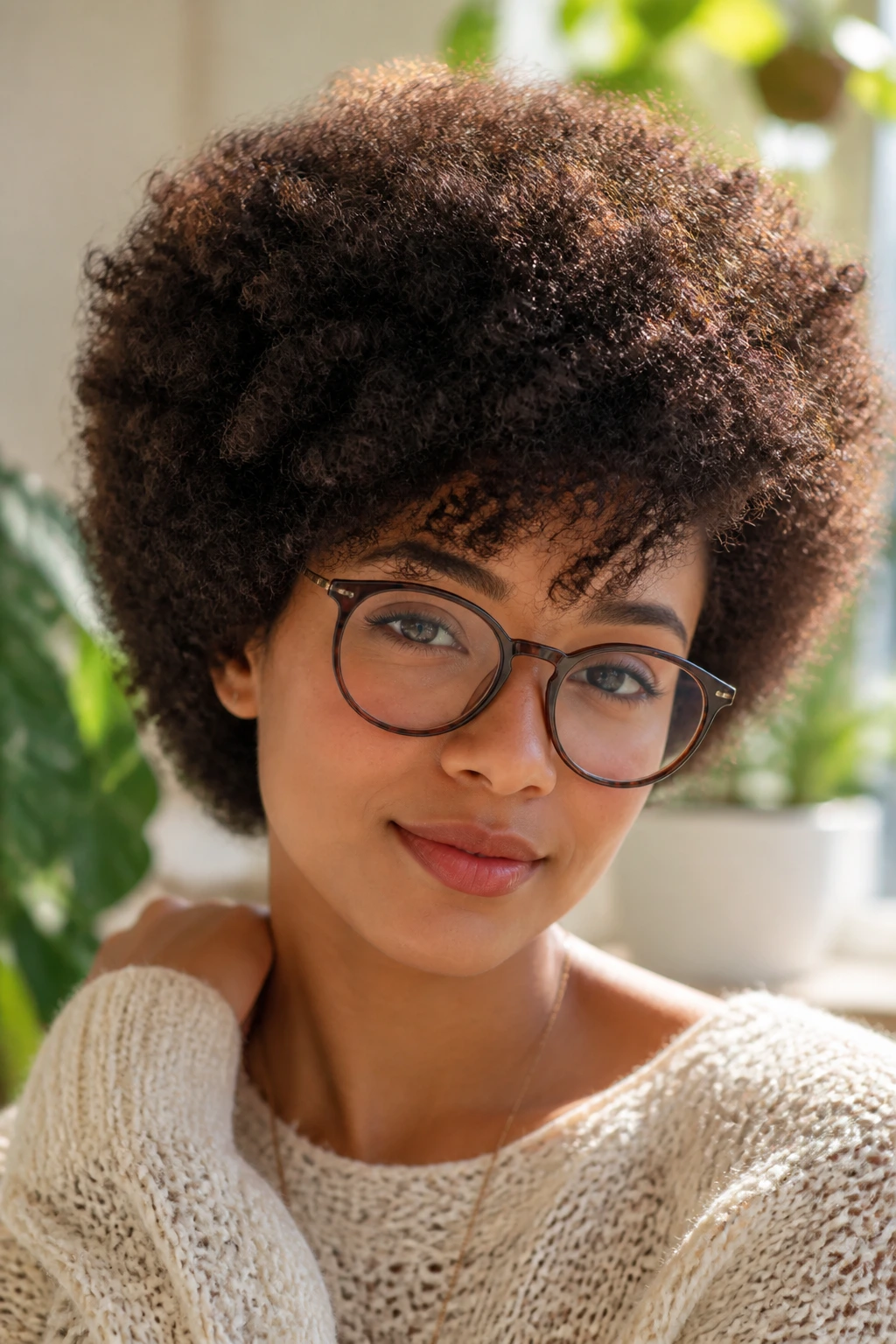
Natural texture changes the rules, and that’s fine. A rounded afro can absolutely flatter a round face when the shape is controlled near the sides and a tilted fringe adds a diagonal line across the forehead. The point is not to flatten the hair. The point is to shape it so it feels airy near the glasses.
Why this works
The rounded silhouette should be wider higher up or longer below the cheek, not widest right beside the eyes. A side-swept front section can be stretched, twisted, or picked into a soft angle that lands across one brow and away from the frame. That keeps the face from looking boxy.
Dry cutting matters here. So does shrinkage. Leave enough length in the front that the fringe still touches the intended spot once it dries. If the cut is too ambitious while wet, the bang will pop up and sit right on the lenses. That’s a headache nobody needs.
15. The Blunt Lob With Airy Bangs

A blunt lob sounds like a bad idea for a round face until you see the trick: keep the perimeter clean, then make the bangs airy and side-swept so the front doesn’t feel heavy. The result is sharp but soft enough to play with glasses.
The blunt line creates stability. The airy fringe creates movement. Those two things balance each other. If both the cut and the bang are heavy, the face gets buried. If both are too light, the style loses definition. This version sits in the middle, which is where most good haircuts live anyway.
The bang should be cut with some internal texture so it moves instead of hanging in one solid sheet. A piecey finish is better than a dense curtain, especially if your frames are thick or dark.
16. The Wavy Midi With an Off-Center Part

A mid-length cut with soft waves and an off-center part is one of the easiest shapes to wear with glasses because it never looks overworked. The part shifts the bulk away from the center of the face, and the side-swept front shape follows the same line. Nothing feels stuck in place.
This is a good choice if your hair naturally bends in a wave and you don’t want to fight it every morning. The side bang can merge into the waves on one side and stay a little shorter on the other. That gives the face a gentle diagonal, which is all it needs.
A wavy midi also looks good when the lenses are a bit larger because the hair doesn’t compete with them. The frames can stay visible. The bangs can stay soft. It all feels calm, which is underrated.
17. The Grow-Out Cut That Still Looks Intentional

Growing out bangs with glasses can be annoying if the cut is sloppy. The smarter move is to ask for a shape that already lives between fringe and layer, so the grow-out phase looks like part of the plan. That means longer side pieces, soft layering at the cheekbone, and enough length at the front to sweep instead of split.
A lot of people cut bangs too straight and then spend months trying to rescue them. This is the rescue plan from the start. The face-framing pieces can be tucked behind the frame arm, pulled forward on windy days, or swept aside when the lenses need a clean line.
Best for: anyone who hates regular bang trims but still wants front interest.
Not ideal for: a rigid, sharply blunt style. That grows out like a drama.
18. The Half-Up Wave Shape That Keeps Hair Off the Lenses
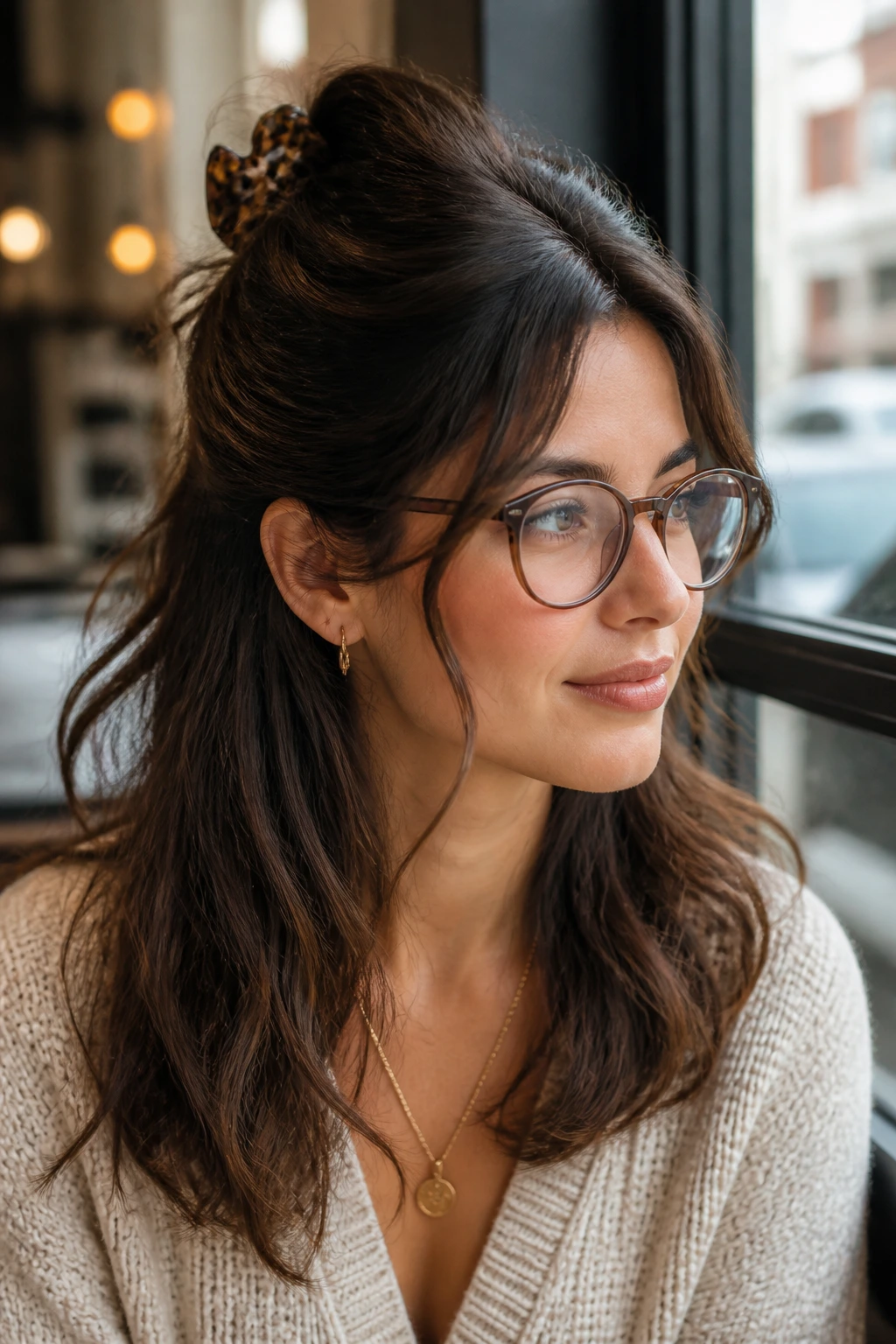
Some hairstyles are more about how you wear the cut than the cut itself, and this is one of them. Half-up waves pull the sides off the face, which is a relief if your glasses slide a little or if your hair tends to sit on the frame arms by noon. Leave the side-swept bangs and a few front pieces loose, and the shape stays soft.
The best version keeps the lifted section a little loose at the crown, not slicked tight. Tight half-up styles can make a round face look more circular because they expose every line at once. A gentle lift creates height, which is the point.
Use a claw clip, not a tiny elastic that bends the hair into a weird dent. The shape should feel easy. If it looks like a sport hairstyle from the back and a formal one from the front, something has gone off the rails.
19. The Low Bun With Face-Framing Side Pieces
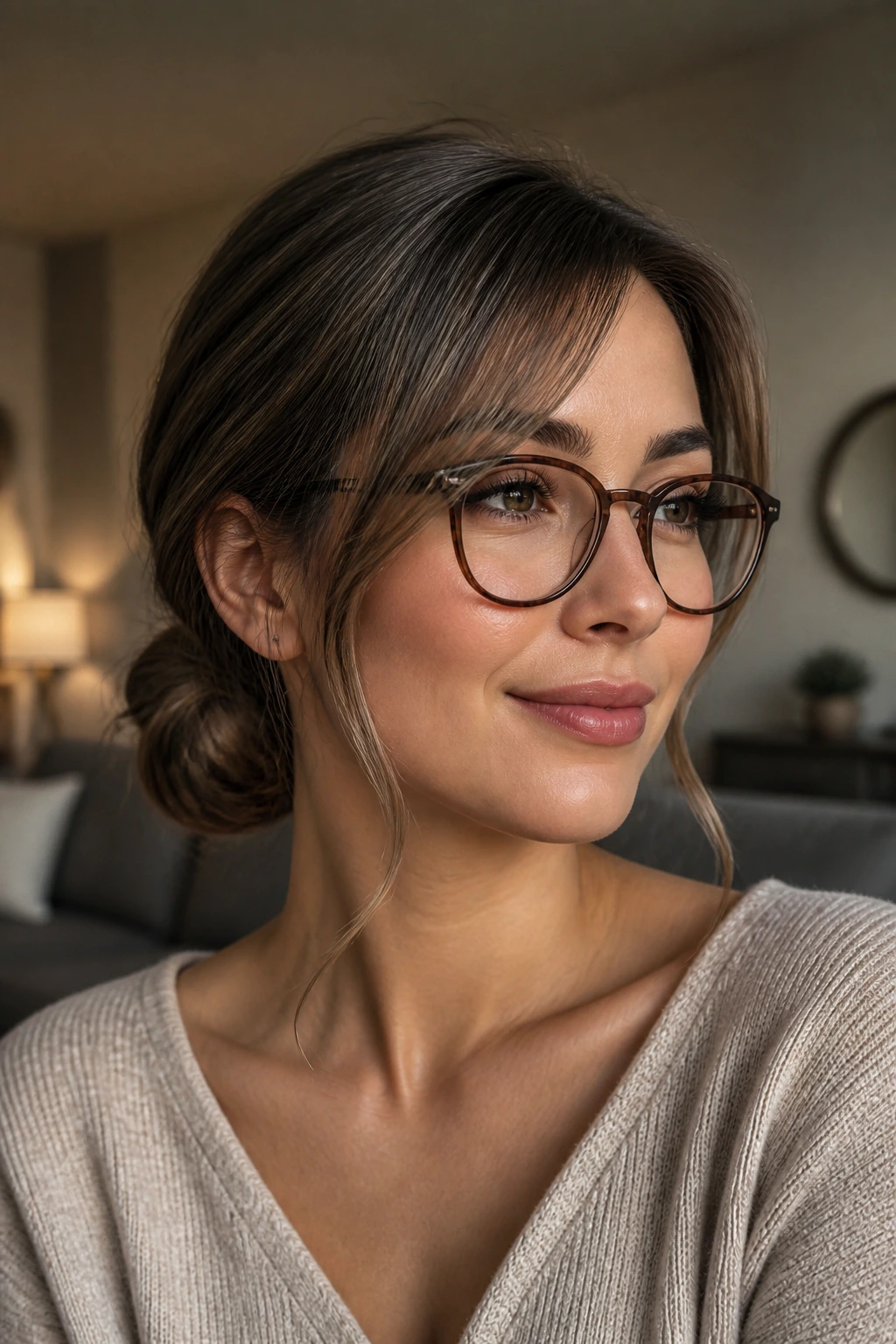
A low bun sounds too plain until you add the front. A side-swept bang and two soft face-framing pieces can turn it into a polished shape that still flatters a round face. The bun clears the neck and jaw, while the front pieces keep the glasses from sitting in a completely bare frame.
This is a nice option for people who wear bold frames because the hair does not compete. It supports. Keep the bun low and a little loose at the base, not tight and tiny. A tiny bun can make the head look top-heavy, which is not the mood.
A few loose pieces near the cheekbone are enough. Don’t overdo it. When too many strands escape, the style stops looking intentional and starts looking like it lost a fight with humidity.
20. The Braided Crown for a Neat Frame Line
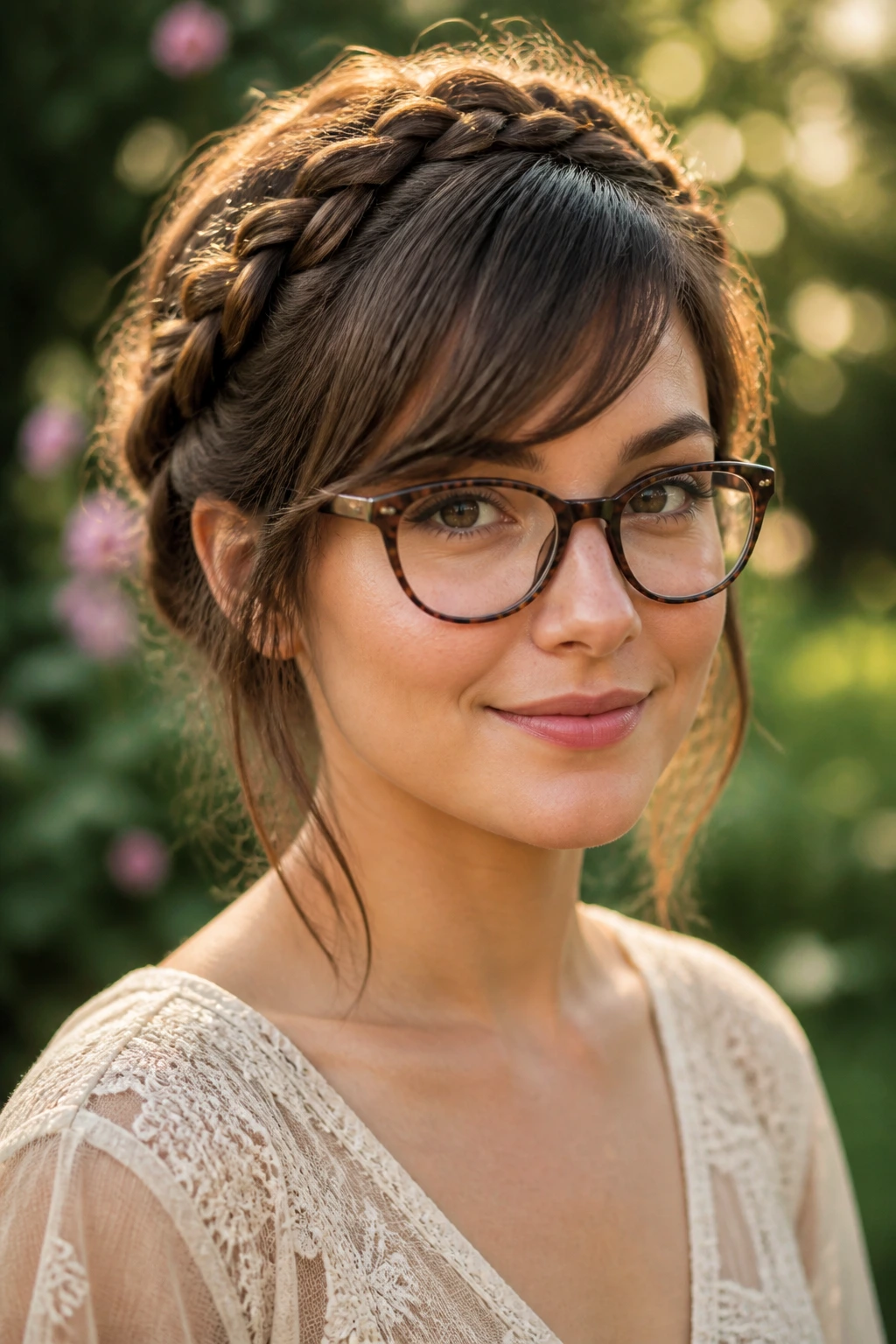
A braided crown gives you a clean perimeter and a lot of control around the face. On a round face with glasses, that’s useful because it clears the sides and lets the side-swept bang act as the soft counterbalance. The braid itself adds a little height and structure without making the hair feel bulky.
How to get the shape right
Keep the braid a touch higher than the temples so it doesn’t sit on the widest part of the face. The front sweep should stay soft and directional, not pinned back too tightly. If the bangs disappear completely, the style can start to feel severe beside glasses.
This is a strong choice for events or long workdays when you want hair out of your lenses. It’s also one of the few styles that looks better when the front isn’t too perfect. A few soft pieces around the forehead make it feel less rigid.
21. The Retro Flip That Lifts the Ends

A flipped end can do more for a round face than a perfectly smooth blowout. The slight outward kick at the bottom creates motion below the cheekbone, which keeps the haircut from sitting straight and heavy beside the glasses. Pair that with a side-swept bang and the whole shape gets a little lift.
The flip should start low, not at the ear. If the turn happens too high, the sides puff out beside the frame and the face widens. Keep the movement around the collarbone or just below the jaw, where it opens the outline instead of crowding it.
This look has a bit of personality. It reads polished, but not rigid. A round face usually benefits from that little bit of play.
22. The Long Straight Cut With Piecey Front Arc
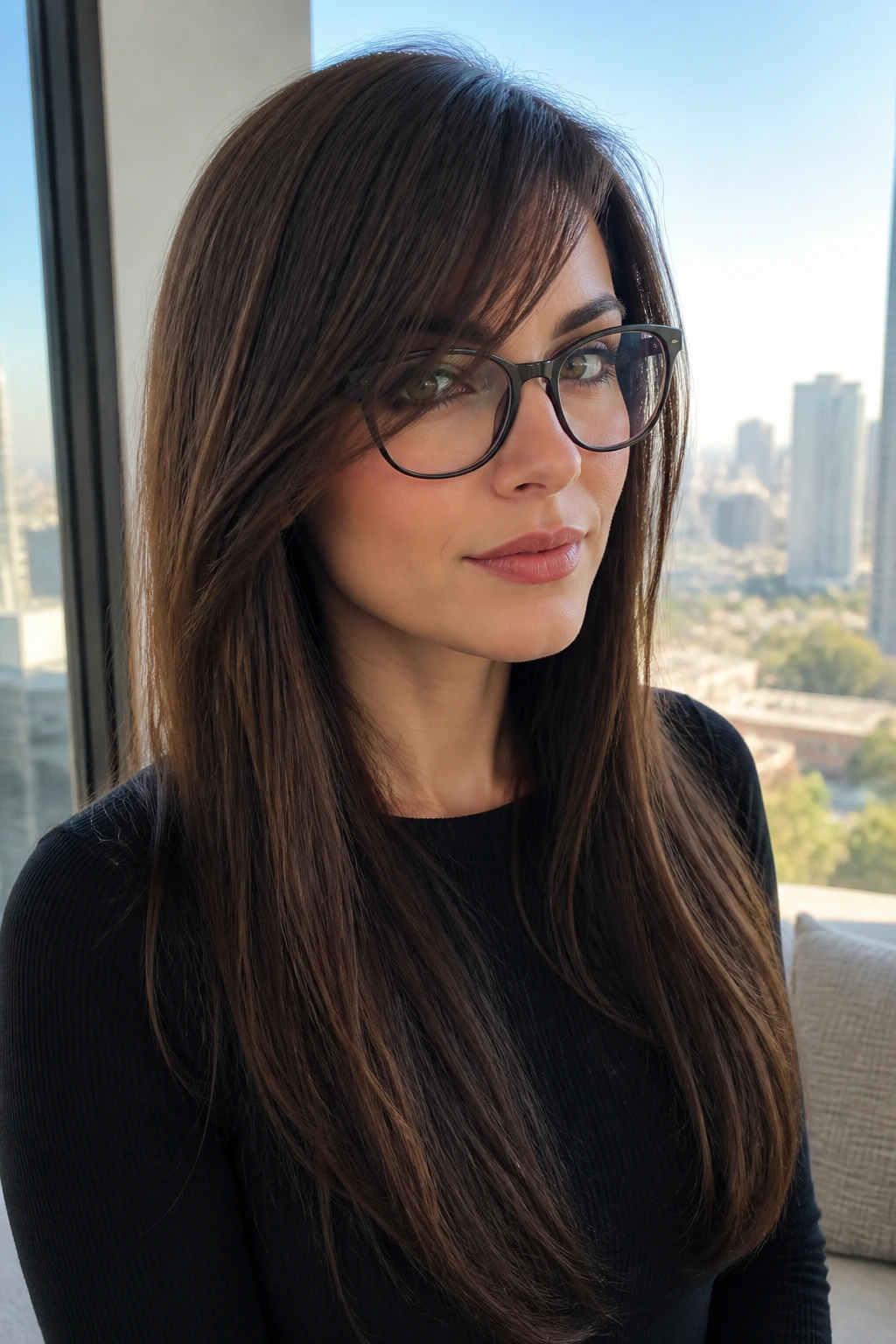
Straight hair does not need a ton of layers to flatter a round face. Sometimes it just needs the right front. A long, sleek cut with a piecey side-swept arc can stretch the face cleanly, especially when the ends stay below the shoulders and the front moves diagonally instead of falling straight down.
The risk with long straight hair is that it can create one solid wall. Piecey front sections solve that. They break the wall apart near the forehead, which is exactly where glasses already make a strong statement.
What to watch for
- Don’t let the front pieces stop at cheek height if your hair is very dense.
- Ask for soft separation through the bang, not a heavy curtain.
- Keep the length glossy and controlled so the style doesn’t puff at the sides.
My take: this is one of the best choices if you love simplicity and hate fuss.
23. The Choppy Lob With Separated Ribbons

A choppy lob is basically a lob with attitude. The ends are broken up enough to move, and the front can be swept into separated ribbons instead of one smooth bang. That texture keeps the shape from looking round and heavy beside glasses.
The reason it works is the space between the pieces. A solid line can feel boxy. Separated ribbons let the face peek through, which softens the whole silhouette. If your hair is fine, this gives the illusion of more body without needing giant round-brush volume.
Use a little texturizing spray near the ends, not at the roots. Roots need lift. Ends need separation. Mixing those up is how people end up with greasy bangs and crunchy shoulders.
24. The Curved Pixie Bob With a Soft Sweep

This is the cut for someone who wants short hair but not a hard short-hair line. The pixie bob keeps the nape short and the front longer, so it still gives that neat, close shape without ending in a blunt shelf around the cheeks. The side-swept front adds softness right where glasses need it.
The curve in the bob matters. It helps the haircut follow the shape of the head rather than jutting out at the sides. That keeps a round face from feeling wider. The bang should be light enough to move, but long enough to land over one brow and into the front edge of the frame.
It’s a good in-between cut. Not as severe as a pixie. Not as sleepy as a grown-out bob. Just right if you like your hair to look deliberate without much morning drama.
25. The Air-Dried Layered Cut That Falls Naturally
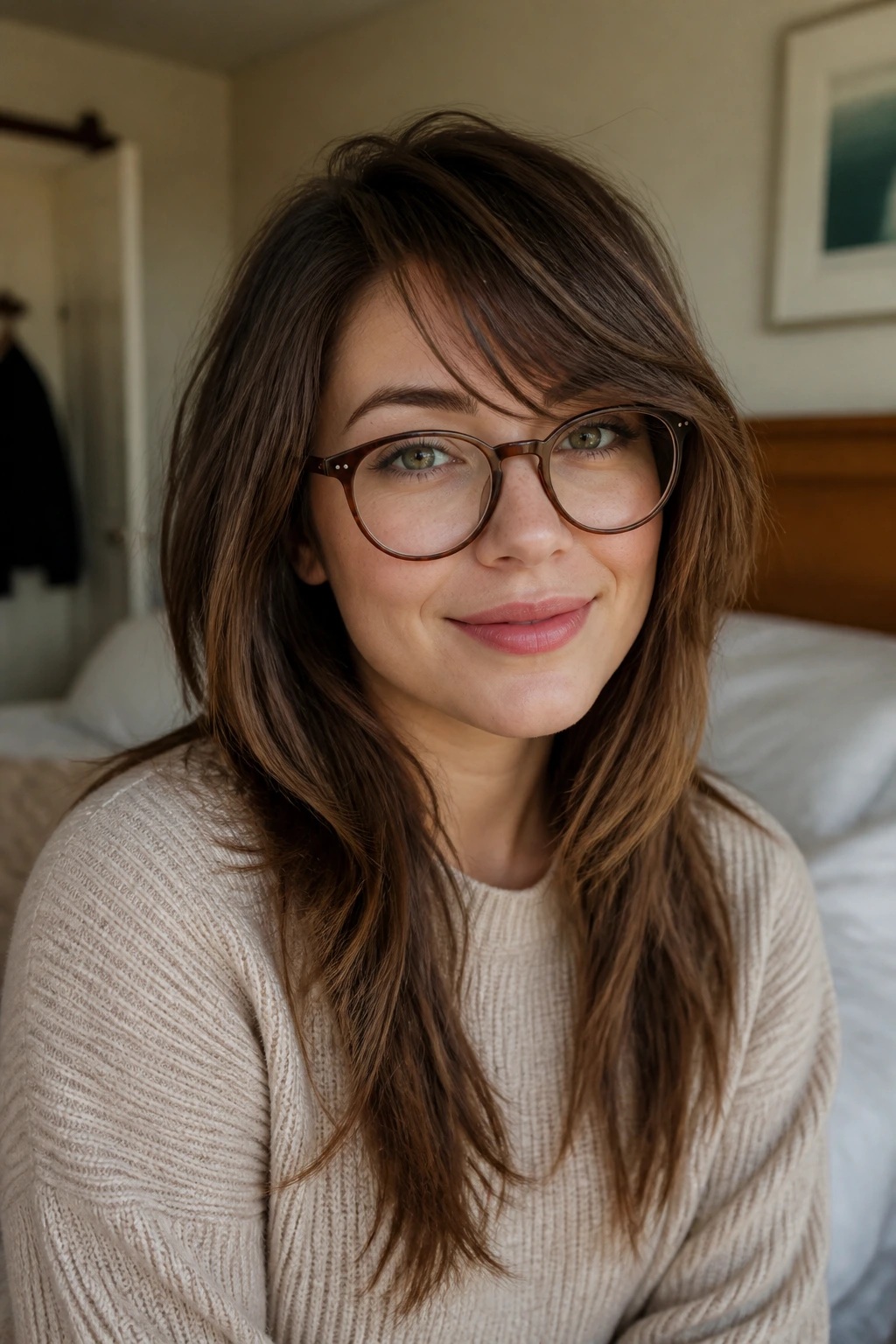
Not everybody wants a round brush in one hand and a blow dryer in the other before breakfast. Fair. An air-dried layered cut can still flatter a round face with glasses if the front is shaped to fall in a side sweep on its own. The layers should be soft enough to bend, but not so short that they puff out around the temples.
This style depends on smart cutting more than styling tricks. If the front is angled properly, the hair settles into a diagonal as it dries. A little leave-in cream or mousse can help the bang keep direction, but the cut has to do the real work.
A good air-dried shape looks better on day two than a fussy one. That’s the kind of haircut people keep returning to, because it doesn’t demand a performance every morning.
Styling Moves That Keep the Bangs Swept
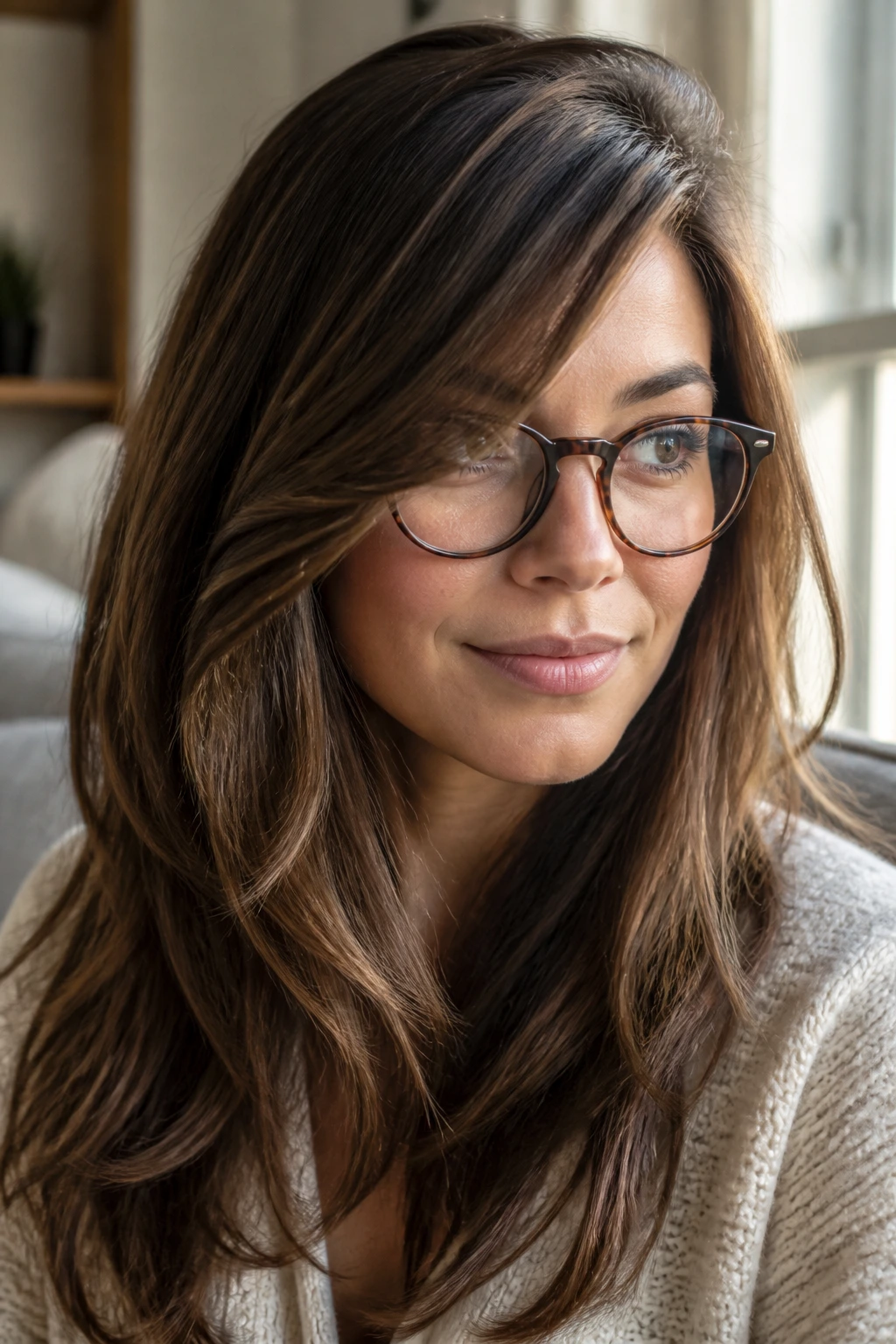
A side-swept bang lives or dies by how it’s dried. Brush it the wrong way, and it splits across the glasses frame. Dry it with a little direction, and it falls into place with less drama. The trick is not heroic blow-drying. It’s small, repeatable habits.
Root Lift: Start by drying the front section in the opposite direction for a few seconds, then sweep it across. That tiny flip gives the roots enough memory to stay off the forehead instead of clinging to the skin.
Temple Control: Keep the sides lighter than the top. If the hair around the temples is too puffy, the glasses arms disappear into it and the face looks wider. A pea-sized amount of cream is usually enough.
Frame Clearance: Leave a little space between the top of the frame and the shortest bang point. If the bang grazes the lens edge every time you blink, it will separate and get oily faster.
Fast Reset: On days when the fringe starts to split, mist it lightly, twist it once with your fingers, and hit it with warm air for 10 to 15 seconds. No full restyle needed. Just enough to wake it up.
Tools, Brushes, and Products That Help

- Blow dryer with a nozzle attachment — directs airflow at the bang instead of blowing it everywhere.
- 1-inch round brush — small enough to shape side-swept bangs without overbuilding volume.
- Vent brush — useful for quick root lift on straight or fine hair.
- Wide-tooth comb — better than a fine comb for curls and waves that need gentle direction.
- Duckbill clips or metal clips — hold the bang section while the rest of the hair dries.
- Lightweight mousse — gives the front a bit of memory without turning it stiff.
- Heat protectant spray — worth using if you blow-dry bangs every day; the front gets the most heat.
- Texturizing spray — good for lobs, shags, and choppy cuts that need separation.
- Dry shampoo — a practical fix for bangs that pick up oil from the forehead.
- Silk or satin pillowcase — helps the front stay smoother overnight, especially if you sleep on one side.
How to Keep the Shape Between Salon Visits
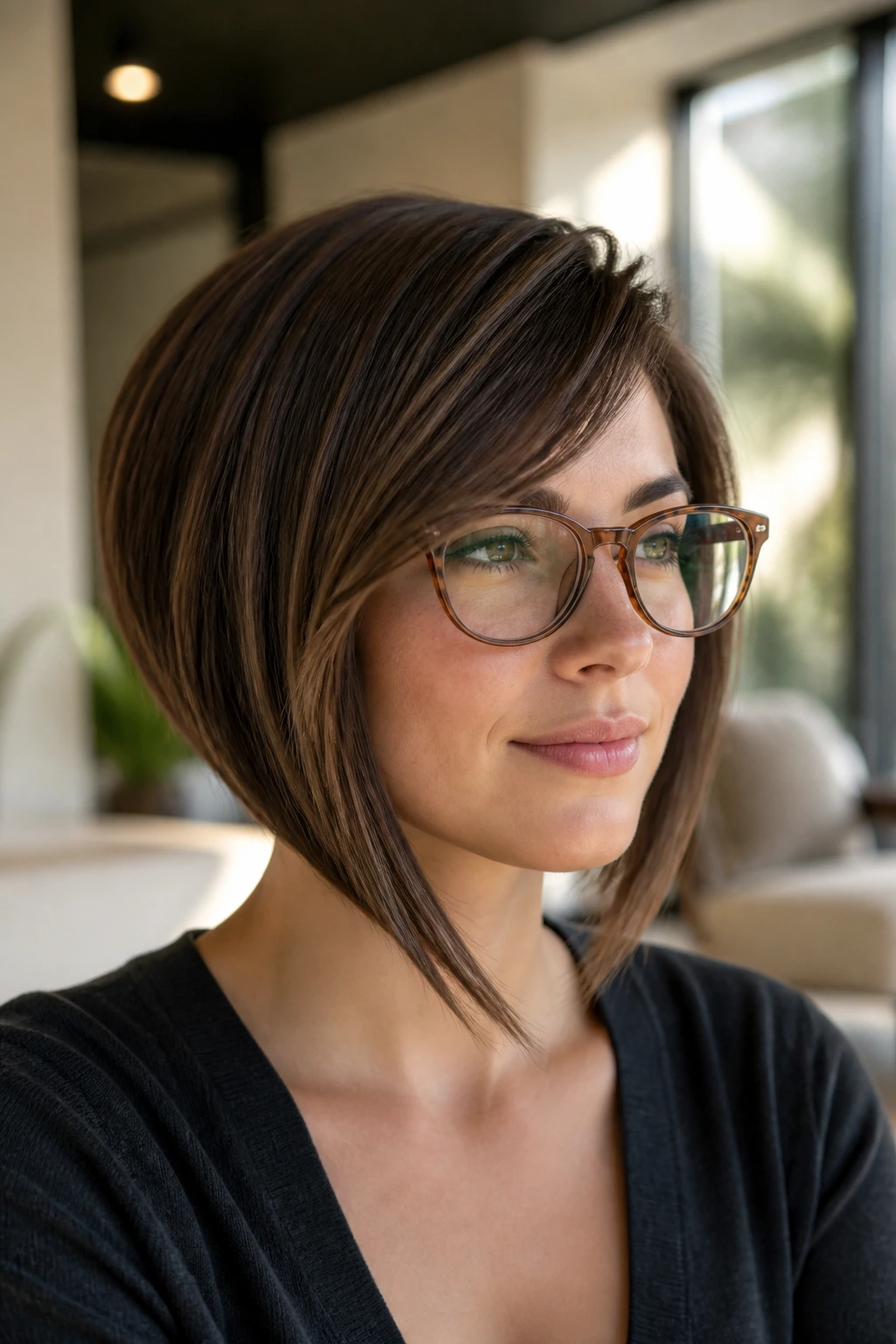
Side-swept bangs need more frequent attention than the rest of the cut. That’s not a flaw. It’s just how front hair behaves. A bang trim every 3 to 5 weeks keeps the sweep from sliding into the glasses and stops the shape from losing its diagonal line. If your hair grows fast or your frames sit high, lean closer to 3 weeks.
The rest of the haircut can usually stretch farther. A lob, shag, or layered cut often holds its shape for 8 to 10 weeks, while shorter pixie-based shapes usually need a clean-up sooner. If the sides start to puff at the temples, you’ll feel it before you see it. The glasses begin to look trapped.
Front hair also needs a different wash rhythm than the rest of the head. Bangs often need a quick wash or a rinse at the sink every other day, sometimes daily if your skin gets oily or you wear makeup under the frame line. That tiny reset keeps the fringe from clumping and stops the lenses from getting foggy from product.
Sleep matters too. Try not to go to bed with damp fringe. It bends in weird directions and wakes up with a grudge. If the front section gets weird overnight, pin it loosely to the side before bed or smooth it with a little water and a quick blast of warm air in the morning. Short hair and fringe are easiest when you treat the front like its own little project.
Common Mistakes That Make the Face Look Wider

Cutting the bang too short: When the fringe ends right at the top of the glasses, the face can look chopped in half. Ask for a longer starting point and let the bang hit the brow arch or just below it.
Loading the sides with too much volume: Big width at the temples is the fastest way to make a round face look rounder. Keep the bulk higher up or lower down, not right beside the frame arms.
Ignoring the part line: A dead-center part can make the whole face read wider and flatter. An off-center or deep side part usually gives the bang more useful direction.
Using too much product on the fringe: Heavy cream or wax makes the bang stringy, and stringy bangs cling to glasses. Start with a tiny amount and add only if needed.
Letting the frame and haircut repeat the same shape: Round glasses with a very round bob and a blunt fringe can feel like too much of one note. A diagonal sweep or a bit of asymmetry breaks that echo.
Forcing the hair against its growth pattern: Cowlicks at the front will win. Every time. Work with the natural direction, or the bang will split and sit on the frame in the oddest way.
Variations and Alternatives to Try
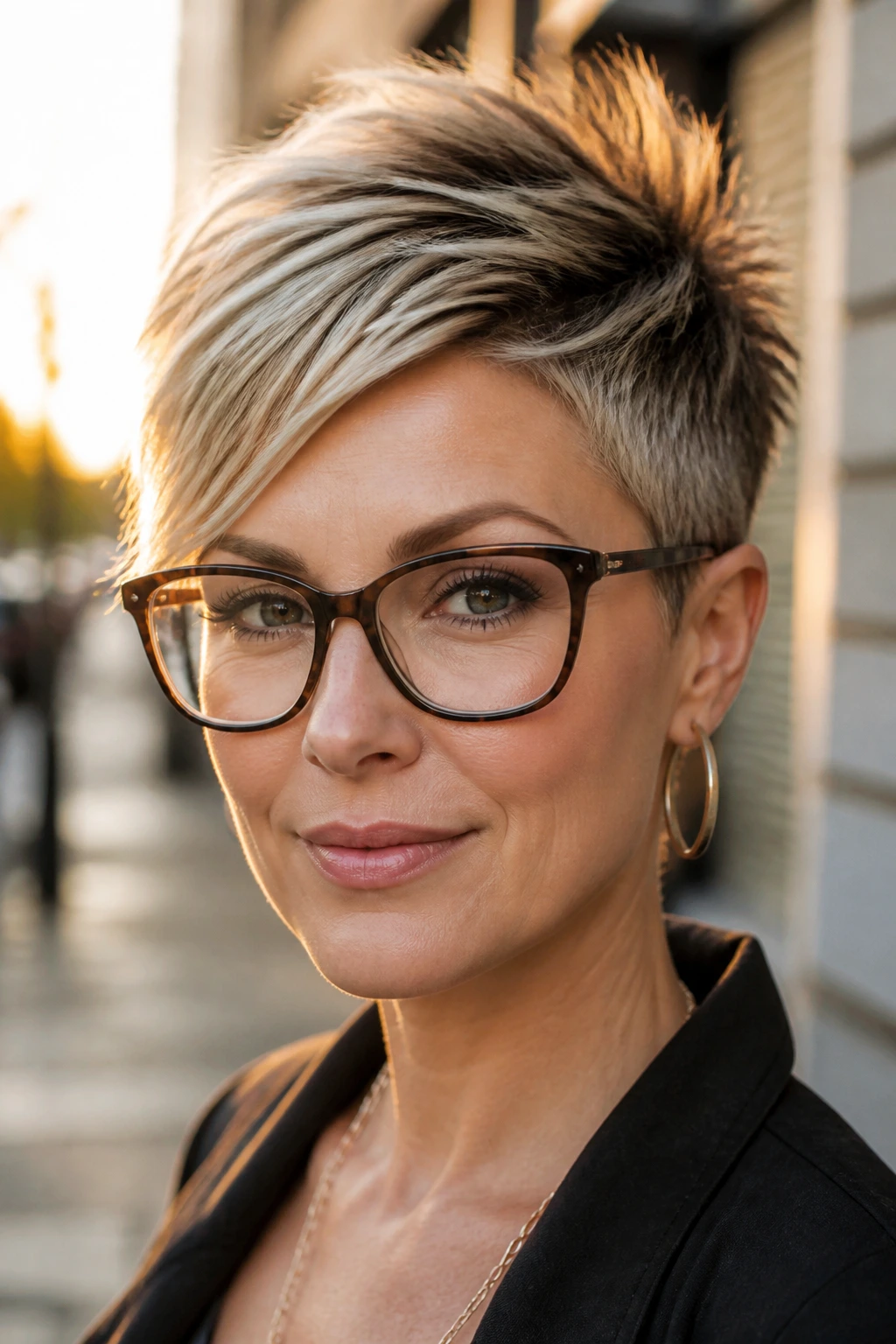
Thicker Frames, Softer Fringe: If your frames are bold or dark, keep the side-swept bang airy and longer. Heavy fringe plus heavy frames can feel crowded fast, so let the front breathe.
Fine Hair, Fewer Layers: Fine hair often looks better with a cleaner outline and lighter face-framing pieces. Too many layers can make the front collapse against the lenses by noon.
Curly and Coily Texture, Longer Front: Leave more length in the bang so the shrinkage has somewhere to go. A dry-cut front section usually gives a better result than guessing wet length.
Low-Maintenance Grow-Out: Ask for face-framing pieces that can grow into layers rather than a strict bang line. That gives you a softer transition and fewer awkward weeks.
More Lift at the Crown: If the face needs more vertical shape, shift the volume upward with a round brush, roller set, or root-drying technique. Height at the top can change the whole read of the face.
Frequently Asked Questions
Are side-swept bangs better than curtain bangs for round faces with glasses?
Usually, side-swept bangs are easier if your frames sit close to the brow line, because they leave more of one eye area open. Curtain bangs can work too, but they need more length and a lighter center so they do not crowd the lenses.
What bang length is safest if my glasses sit high on my nose?
Aim for the longest point of the bang to land around the brow arch or just below it. That keeps the fringe away from the top of the frame and gives you room to style it without constant touching.
Can I wear a pixie cut with a round face and glasses?
Absolutely, if the pixie keeps a little height on top and softness in the front. The danger is too much width at the temples, so the sides should stay close and the fringe should sweep rather than stand straight up.
How do I stop bangs from splitting on my glasses?
Dry the front in the opposite direction first, then sweep it over with a brush or fingers while it cools. A small amount of styling cream or mousse at the roots can also help the bang hold its line instead of falling into the lens.
What if my hair is curly and the bang keeps shrinking too much?
Leave the fringe longer than the length you want to see in the mirror. Curly hair often shrinks more than expected once it dries, so a dry cut or a carefully planned longer front usually works better than cutting it short and hoping.
Do round glasses make these cuts harder to wear?
They can, but only if the hair copies the same curve too closely. A side-swept angle, some lift at the crown, or a little asymmetry keeps the haircut from echoing the frame in a way that makes the face feel wider.
How often should I trim side-swept bangs?
Every 3 to 5 weeks is the sweet spot for most people. If the bangs are long and blended into layers, you might stretch it a little more, but once the sweep starts landing on the glasses, it’s time.
What if I want to grow out my bangs without an awkward phase?
Ask for the front to blend into cheekbone layers instead of ending in a blunt line. That way the growing bang becomes part of the haircut instead of looking like a mistake you are waiting to fix.
The Shape That Keeps Working
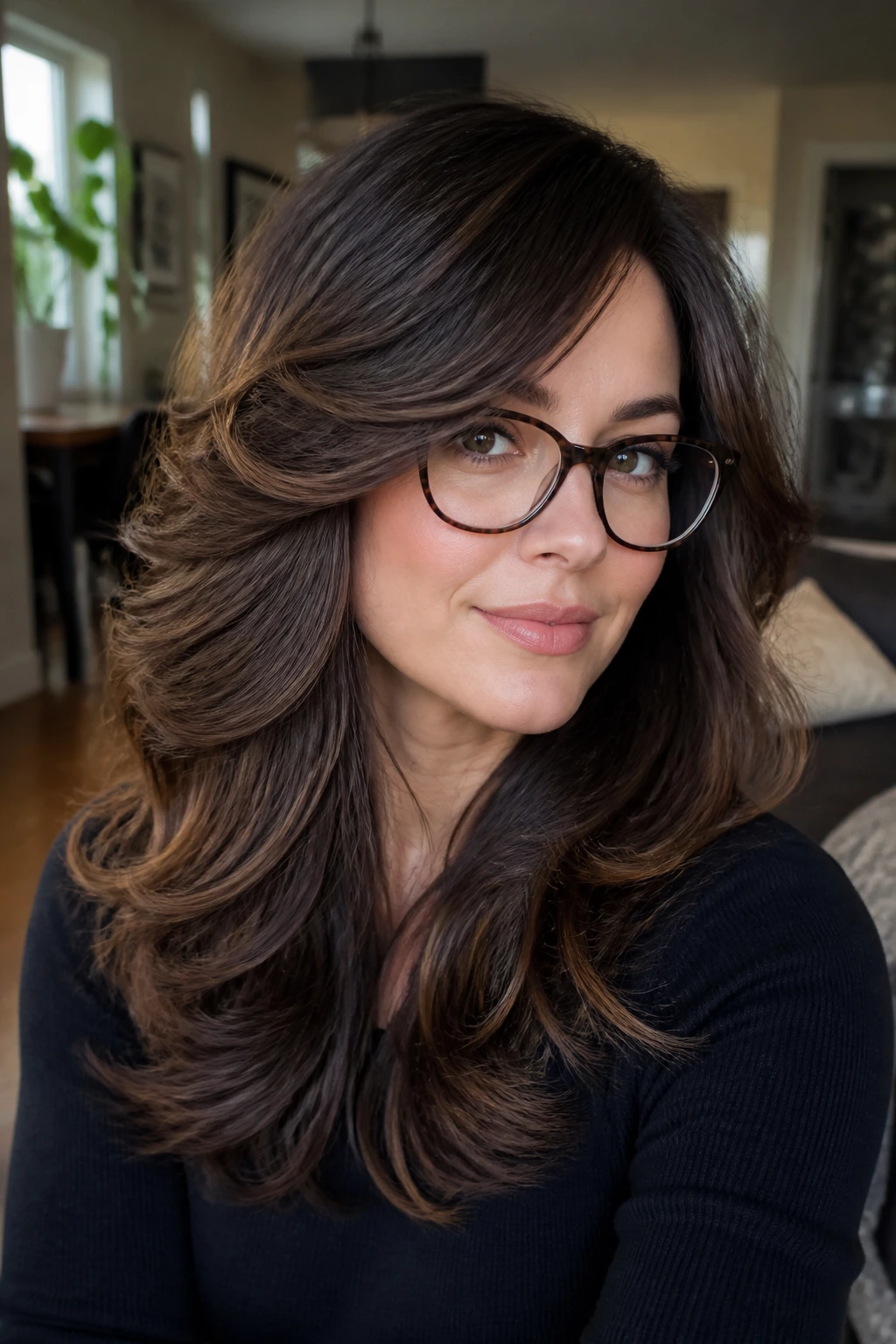
Good hair around glasses does not try to steal the whole show. It gives the face structure where it needs structure, softness where it needs relief, and a little diagonal movement where the eye would otherwise stop. That is why side-swept bangs keep showing up in so many flattering cuts for round faces: they make the front of the hair do some honest work.
The best choice is the one that fits how you live, not just how it looks in a mirror for thirty seconds. Some people need a lob that can be tucked behind the ear. Some need a pixie that stays off the lenses. Some need curls that keep their spring and a fringe that understands shrinkage. Pick the shape that makes your frames look deliberate, then keep the front section trimmed often enough that it does not wander into your eyes.