



Thick curls can be glorious right up until they land in the wrong place and turn the front of your haircut into a box. A square face does not need more hard lines, and a dense curl pattern does not need to be bullied into submission. The sweet spot is a fringe that bends, softens, and moves with the rest of the hair — which is why curly bangs for thick hair and square faces deserve a much more careful approach than a blunt snip across the forehead.
The problem is rarely the bang itself. It’s the shape. Cut too straight, and the front can sit like a shelf. Cut too short, and shrinkage can yank the line up before you’ve even left the salon. Cut too thin, and thick curls fray into separate wisps that fight each other all morning. The trick is learning which fringe shapes break up the width of a square jawline, which ones keep the density looking rich instead of bulky, and which ones give you a grow-out path that doesn’t feel like punishment.
What works best is usually a little softer than people expect. Curves beat angles. Diagonals beat hard horizontal lines. Face-framing pieces that start at the temples or cheekbones do more for a square face than a tiny, over-thinned fringe ever will. And with thick curls, the right cut can make the front of your hair feel lighter without making it look sparse — a small miracle when the curl pattern wants to expand the minute humidity enters the room.
Why This Fringe Collection Earns Its Keep
-
It softens the jawline: Bangs that curve, split, or sweep diagonally interrupt the square shape at the temples and keep the face from looking boxed in.
-
It uses thickness as structure: Dense curls give the fringe enough weight to sit with intention, which is why the right cut can look polished without being stiff.
-
It respects shrinkage: A good curly bang is planned dry or at least cut with shrinkage in mind, so the finished shape lands where you expect it to.
-
It offers real grow-out options: Many of these styles can be worn center-parted, swept aside, or blended into face-framing layers when you want a break.
-
It works with volume instead of against it: You do not need a flat front to flatter a square face. You need controlled movement in the right places.
-
It gives thick hair a job to do: Instead of fighting density, these styles redirect it into shape, bounce, and a front edge that feels deliberate.
1. Soft Curly Curtain Bangs
Soft curtain bangs are the safest place to start if you’re nervous about committing. They split at the center, bend toward the cheekbones, and let the curls fall in a way that keeps the forehead open without exposing every angle of a square face. On thick hair, that center part matters. It breaks up the front so the fringe doesn’t become one solid wall.
The best version lands a little below the brow when dry and a little longer than that when wet. That extra room saves you from a nasty surprise after shrinkage kicks in. I like this shape because it gives the curls room to breathe while still doing the job of softening the temples. It looks relaxed, not accidental.
Why It Works
Curtain bangs help square faces because the eye travels downward and outward instead of straight across. That small shift makes the jaw look less dominant. If your curl pattern is loose to medium, this shape can sit with a bit of bend and look effortless without needing much product.
Ask for longer side pieces that connect into the front layers. That connection keeps thick hair from feeling chopped up. Dry cutting is the move here. Wet curls lie.
2. Brow-Grazing Ringlet Bangs
This is the flirtier cousin of the curtain bang. The ringlets sit right around the brow line, but they’re not blunt or stiff. Each curl gets to spring on its own, which is exactly why this shape can look so good on thick hair. You get fullness without that heavy block sitting above the eyes.
On a square face, the brow-grazing line helps frame the upper third of the face and takes attention away from the width of the jaw. The trick is to keep the center a touch longer than the outer corners. That subtle taper avoids a hard line and gives the curls room to land in a soft arc.
What to Watch For
If your curls are tighter, the front may rise more than you expect. That’s fine, as long as the stylist leaves a little extra length. You want the fringe to skim, not perch. A little mousse at the root and a finger-coiled finish can keep each ringlet from scattering in different directions.
3. Side-Swept Spiral Bangs
A diagonal line is one of the easiest ways to soften a square face, and side-swept spiral bangs do that without making the haircut feel overly precious. The front bends across the forehead in a slanted line, which breaks up the width of the face and gives thick curls a place to land.
This style works especially well if you hate the feeling of a full-on center fringe. It’s less committal. It also handles volume better than a blunt front because the curls are distributed across the forehead instead of packed into one straight band.
Best Length
Keep the shortest point somewhere near the top of the cheekbone, then let the rest of the fringe sweep down toward the opposite brow. That shape does a lot of quiet work. It trims the look of width at the temples and gives you a front section that can be pushed aside, pinned back, or worn loose depending on the day.
4. Rounded Full Fringe
A rounded fringe sounds bold, and it is, but it does not have to read as severe. The best versions on thick curly hair have a curved outline that follows the shape of the brows and temples instead of cutting straight across. That roundness is what keeps a square face from looking harsher.
I like this one when the curls are dense enough to hold a shape all day. Thin curls can go stringy here. Thick curls can actually make the fringe look rich and lush, which is a very different thing. Ask for internal weight removal, not aggressive thinning. You want the front to have air, not gaps.
The result is a bang with a little drama. Not costume drama. Just enough presence to look intentional.
5. Bottleneck Bangs That Narrow in the Middle
Bottleneck bangs are one of the smartest shapes for square faces because they start narrow at the center and widen gently as they move outward. That small shift makes a big difference. The eye goes to the soft taper instead of the width of the forehead.
What to Ask Your Stylist For
- Leave the center slightly shorter, around eyebrow level when dry.
- Let the outer pieces fall toward the cheekbones.
- Keep the corners soft, not blunt.
- Remove bulk from underneath so the fringe doesn’t puff.
Thick hair handles this style beautifully because the density supports the shape. The center can feel light, while the outer edges frame the face like a soft bracket. It’s one of the easiest curly bang styles to grow out, too, because the side pieces simply melt into the rest of the cut.
6. Airy Piecey Bangs

Piecey bangs are not the same thing as sparse bangs. That distinction matters. On thick curly hair, you’re not trying to create the illusion of less hair; you’re trying to separate the front into visible curl groups so the fringe moves instead of sitting as one solid mass.
This style suits square faces because the separated pieces let bits of forehead show through, which breaks up the width. The result feels lighter around the eyes and temples. It also gives you more styling control. A touch of gel, a quick finger twist, and the front can shift from casual to polished in minutes.
The mistake here is overdoing product and making the pieces stick together like wet rope. Keep the definition soft. A little separation goes a long way.
7. Curly Shag Fringe
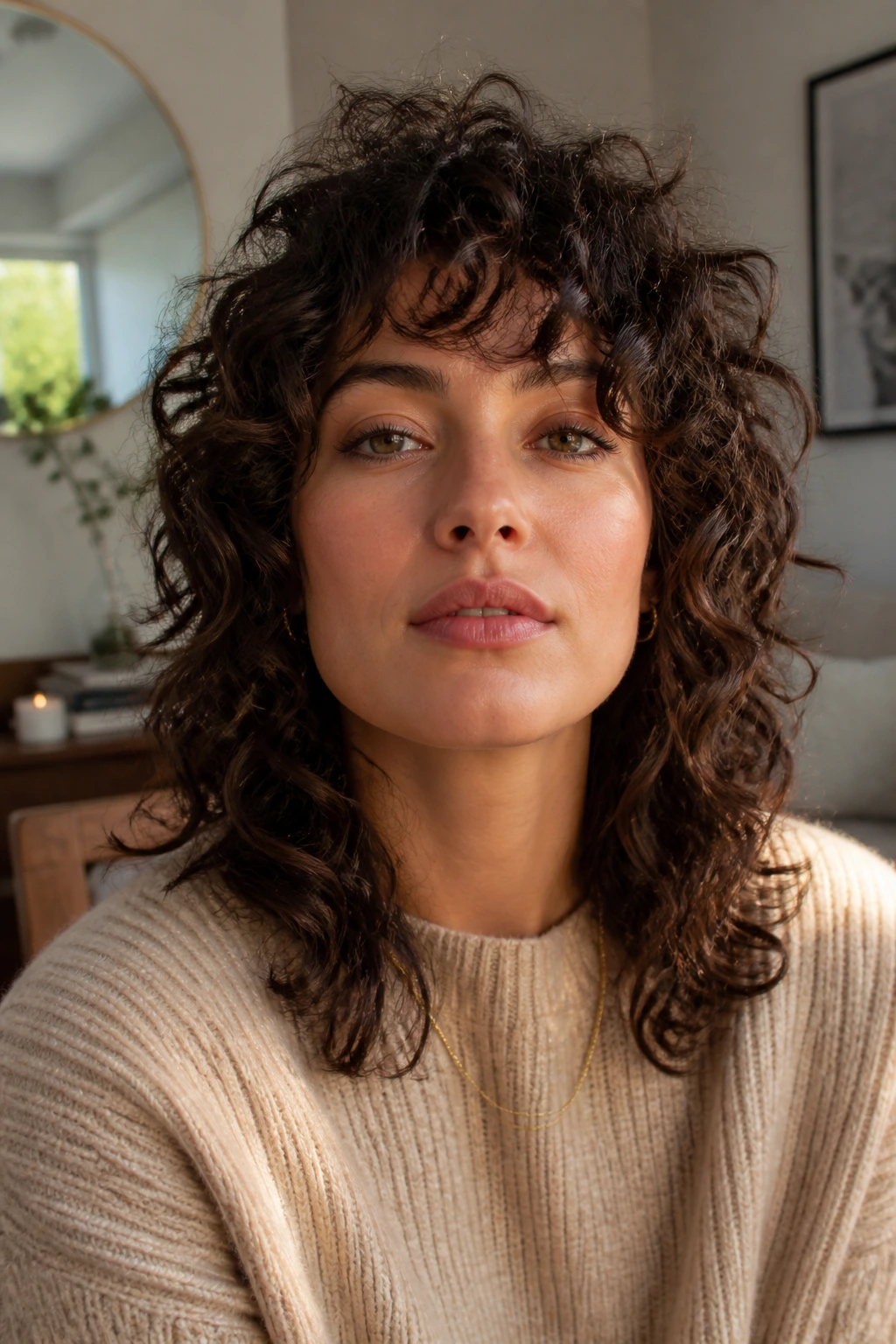
If your thick curls have a wild side, the shag is probably already whispering your name. A curly shag fringe blends into the rest of the haircut, so the bangs don’t look like a separate piece dropped onto the forehead. That connection helps square faces because the eye moves through the layers instead of stopping at one hard line.
The shag also solves a thick-hair problem. It redistributes bulk. Instead of piling everything into the front, the haircut sends some of that density into the crown, the sides, and the ends. The fringe ends up lighter and more mobile.
You do have to like texture. This is not the neatest option in the lineup. But if you want a cut that can air-dry and still feel alive, this one earns its keep fast.
8. Wolf Cut Bangs with Soft Edges

Wolf cut bangs are a little messier, a little choppier, and far more forgiving than they look in photos. The front tends to be shorter and more textured, which gives thick curls room to break apart naturally. On a square face, the uneven edges help soften the jaw by keeping the whole cut from reading as symmetrical.
Why It Works for Thick Hair
The wolf cut removes weight from the right places. That matters. If your curls are dense, a full fringe can turn into a heavy curtain that sits too low on the forehead. Choppy layers stop that from happening, and the texture keeps the front from collapsing into a block.
It’s a style for people who don’t mind a little edge. If you want smooth and polished, skip it. If you want movement with a bit of attitude, this one is fun in the best sense.
9. Long Face-Framing Bangs

Sometimes the smartest bang is barely a bang at all. Long face-framing pieces that start near the brow and fall toward the cheekbones can do the same softening job as a shorter fringe, only with less maintenance and less risk. On square faces, they blur the line of the jaw without announcing themselves.
These are a strong choice if you want to keep your options open. Wear them down. Push them back. Split them in the center. Let them blend into layers when you’re tired of looking at them. Thick hair gives them enough body to stay visible, even when they’re long.
The key is to have enough curve near the front so the pieces don’t just hang straight. Straight front pieces can look heavy on a square jaw. A little bend fixes that fast.
10. Tapered Fringe Bob
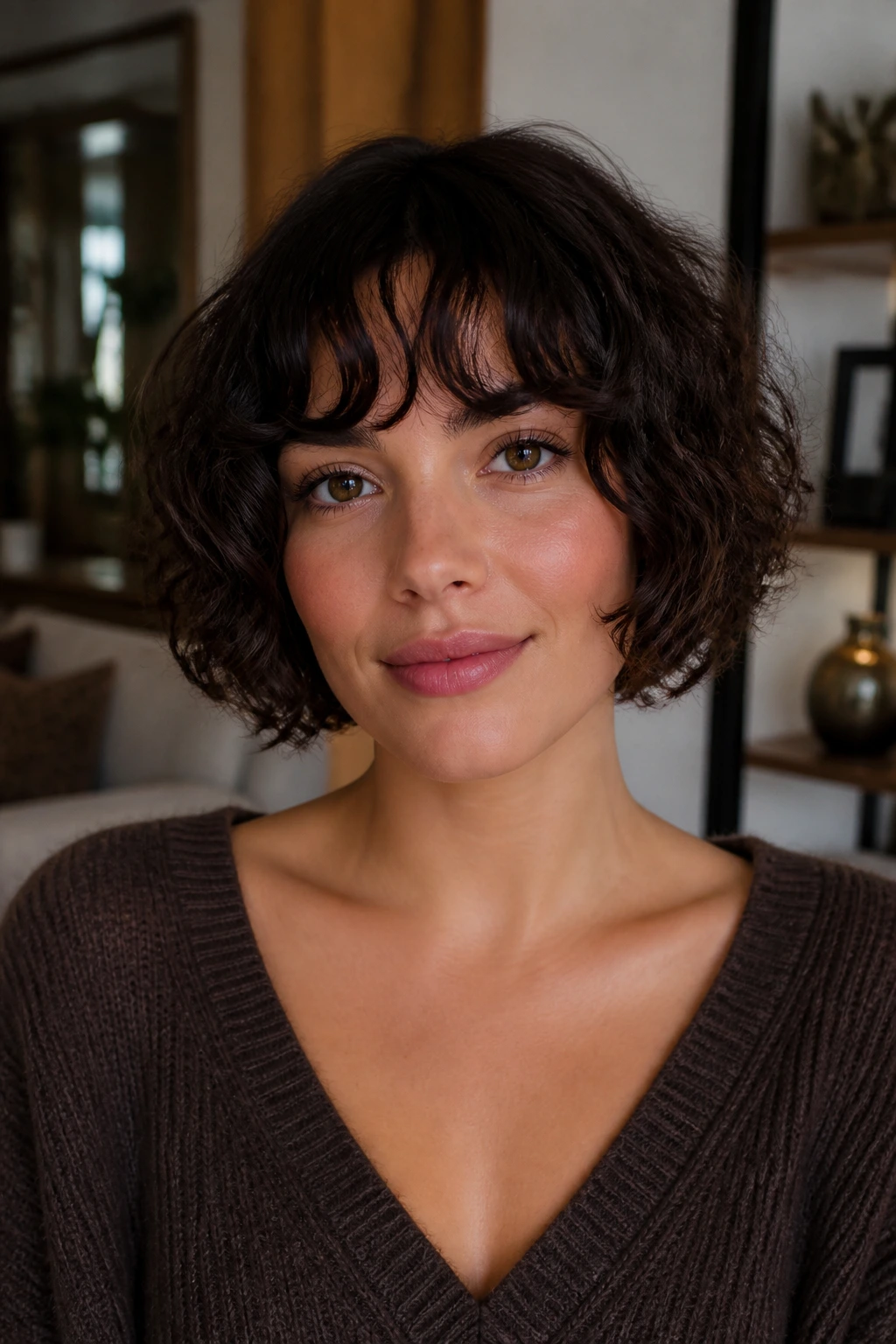
A bob with a tapered fringe gives thick curls a clean shape without starving them of volume. The bob removes bulk at the ends, and the fringe brings attention upward. That balance is useful on a square face because it prevents the lower half of the face from feeling too strong.
The taper matters. A fringe that’s slightly longer at the corners will round out the forehead and keep the cut from looking too boxy. Keep the bob itself at the chin or just below it, where the ends can skim past the jaw instead of landing right on it.
A Small Stylist Note
Ask for the bangs to be cut in the curl pattern you actually wear, not the pattern you have on a flat iron day. That one detail changes everything. Curly bangs should live in your real life, not in a salon mirror.
11. Halo Bangs with Crown Volume
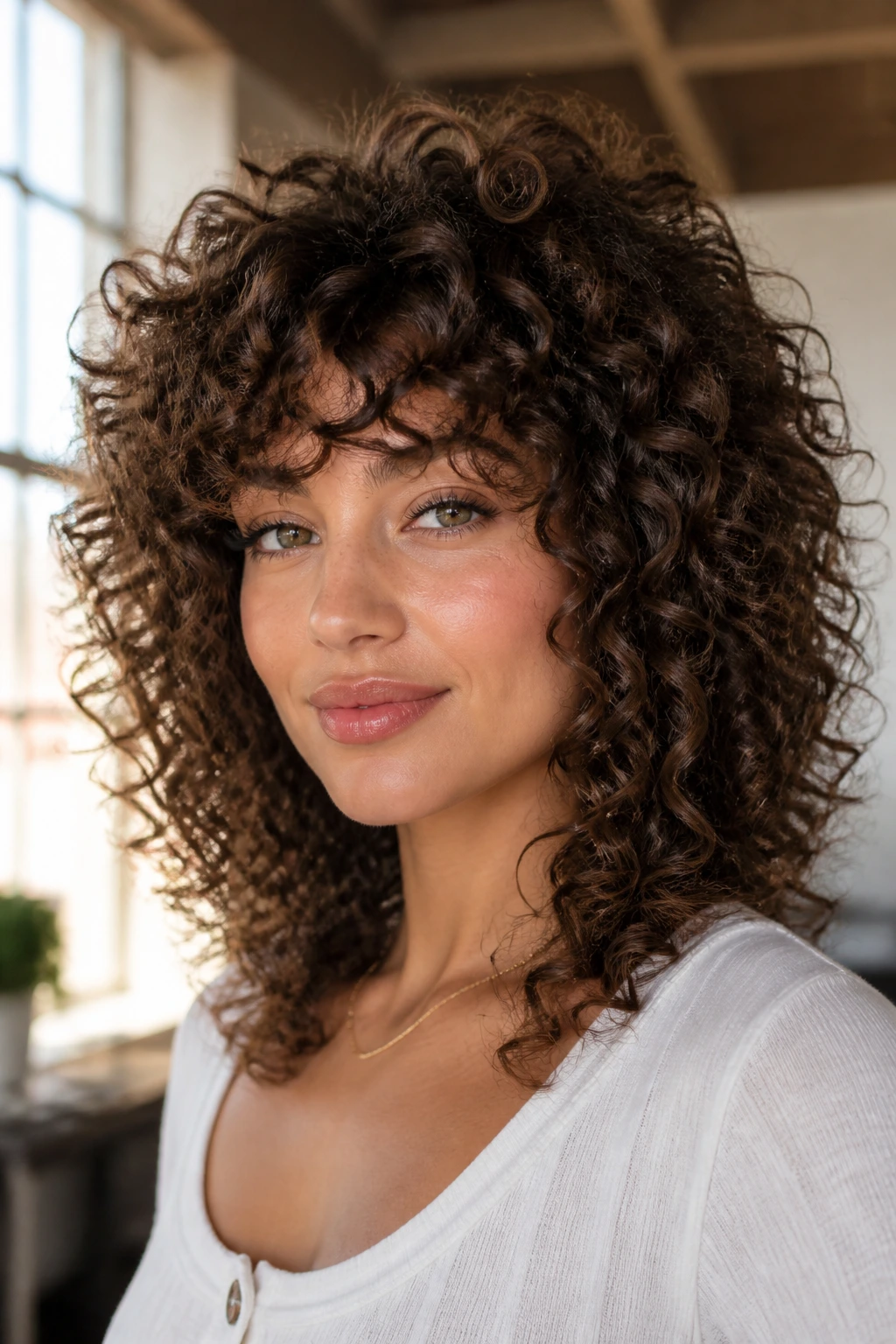
Halo bangs are for people who like volume and have stopped apologizing for it. The fringe doesn’t sit in a straight sheet. It blends into a rounded crown of curls so the whole front has lift and movement. On a square face, that lifted shape draws the eye upward and softens the strong corners around the jaw.
This style is lovely on thick hair because the density keeps the halo from collapsing. If the curls are springy, the fringe can feel airy rather than heavy, even when there’s a lot of hair up front. It’s a good option for tighter curl patterns that like to expand.
The catch is maintenance. The crown needs direction. A diffuser helps, and so does a bit of root clip work while the hair dries. Skip those steps and the halo can turn into a triangle.
12. Feathered Bangs with Layers

Feathered bangs are all about taking weight out without making the fringe look sparse. The edges are softened, the layers are blended, and the front moves instead of sitting as one uninterrupted shape. Thick hair loves this, because the cut lets the hair stay full while still losing some of the bulk.
On a square face, feathering is useful because it avoids hard edges around the forehead. The fringe becomes a soft veil rather than a line. That change is subtle, but it changes the whole mood of the haircut.
If your curl pattern tends to puff at the root, feathered layers are your friend. Ask for the ends to be point-cut rather than chopped straight. The difference shows up after the hair dries.
13. Chin-Skimming Curly Bangs
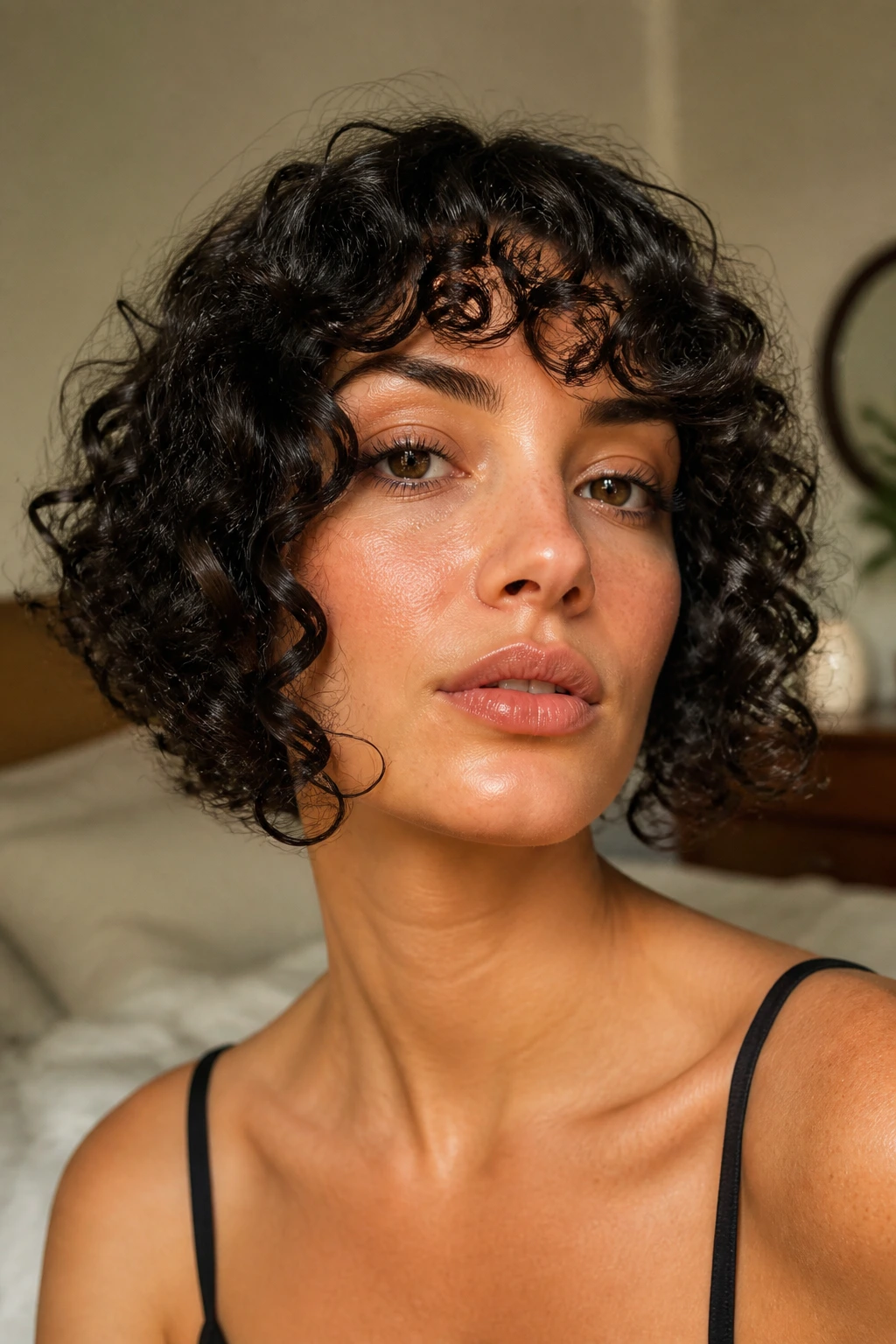
Chin-skimming bangs are longer than most people think of as bangs, and that’s exactly why they work. When the front curls land near the chin or a touch above it, they steer attention downward and away from the square edges of the jaw. That’s a smart move on a square face.
Thick hair makes this shape easier to live with because the fringe has enough body to sit against the cheeks instead of flying apart. You can wear it with a middle part, a soft off-center part, or even tucked behind one ear. It’s one of the most flexible options in the group.
This is also a good choice if you want to test bangs without losing too much length. Long fringe is forgiving. Short fringe is not.
14. Retro Heavy Curly Fringe

There’s something gloriously direct about a heavy curly fringe. It has presence. It has weight. It does not pretend to be invisible, and on thick hair that can be a good thing. The curve of the curls keeps it from feeling blunt, while the density gives it a rich, vintage shape.
When It Makes Sense
- You like a bold front.
- Your curls hold a shape after drying.
- You don’t mind trimming every 6 to 8 weeks.
- You want the fringe to read as part of the haircut, not an afterthought.
Square faces can wear this well if the corners of the fringe are softened. Keep the line rounded and let the side pieces drop toward the cheekbones. That keeps the shape from becoming too square itself, which is a surprisingly easy thing to do.
15. French-Girl Curly Bangs
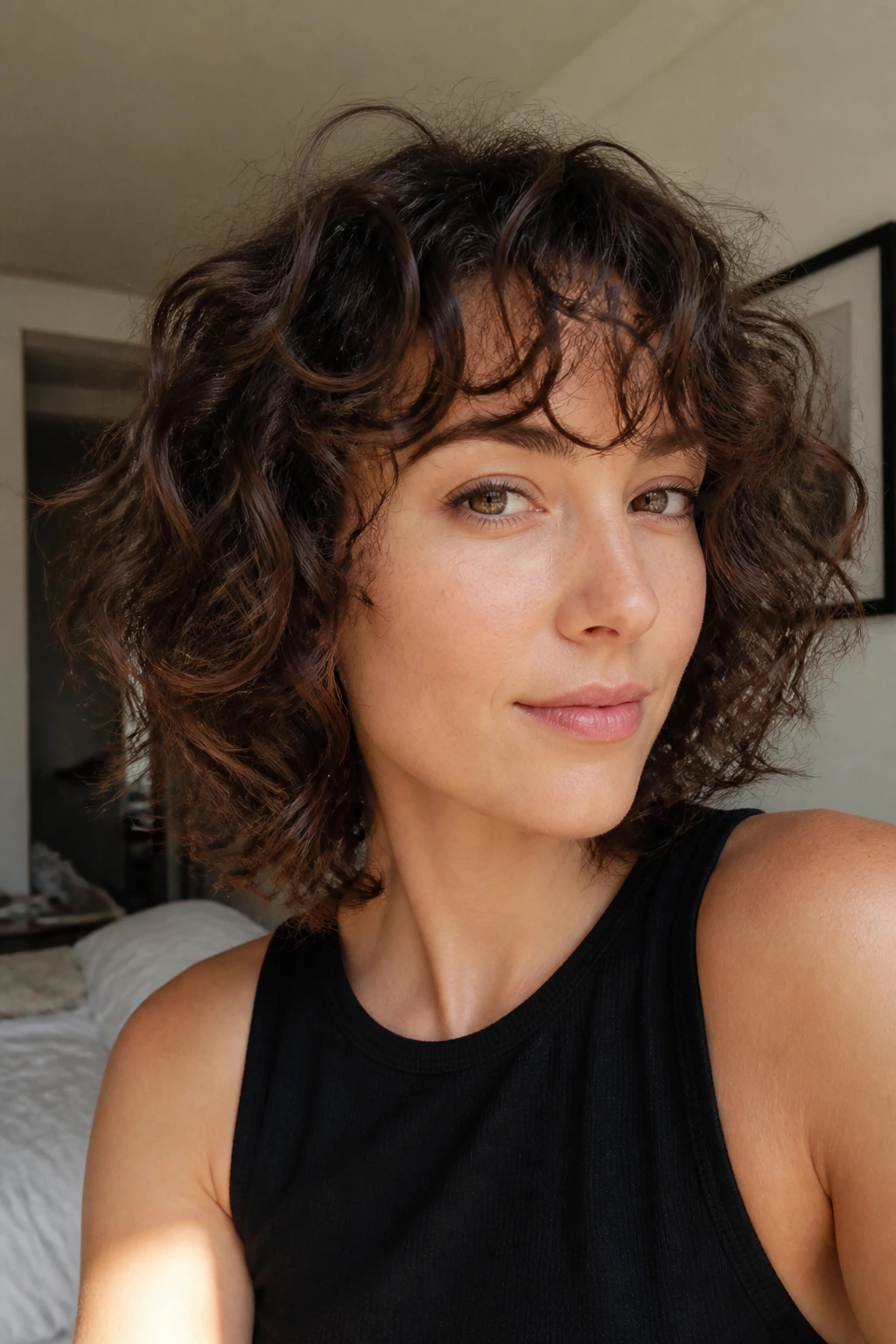
French-girl bangs get thrown around as a label a lot, but the good version is easy to spot. The fringe sits a little imperfectly, with small differences in length that keep it from looking overplanned. On thick curls, that looseness is useful. It keeps the front moving instead of locking it into a helmet shape.
For a square face, the irregular line is the point. It softens the hard symmetry and gives the features a little room. You want the bangs to graze the brows, not carve the forehead into neat geometry.
This style likes a light hand. Too much gel and it loses the airy feel that makes it work. A cream-plus-mousse combo often gives enough control without making the curls stiff.
16. Short Curly Pixie Fringe
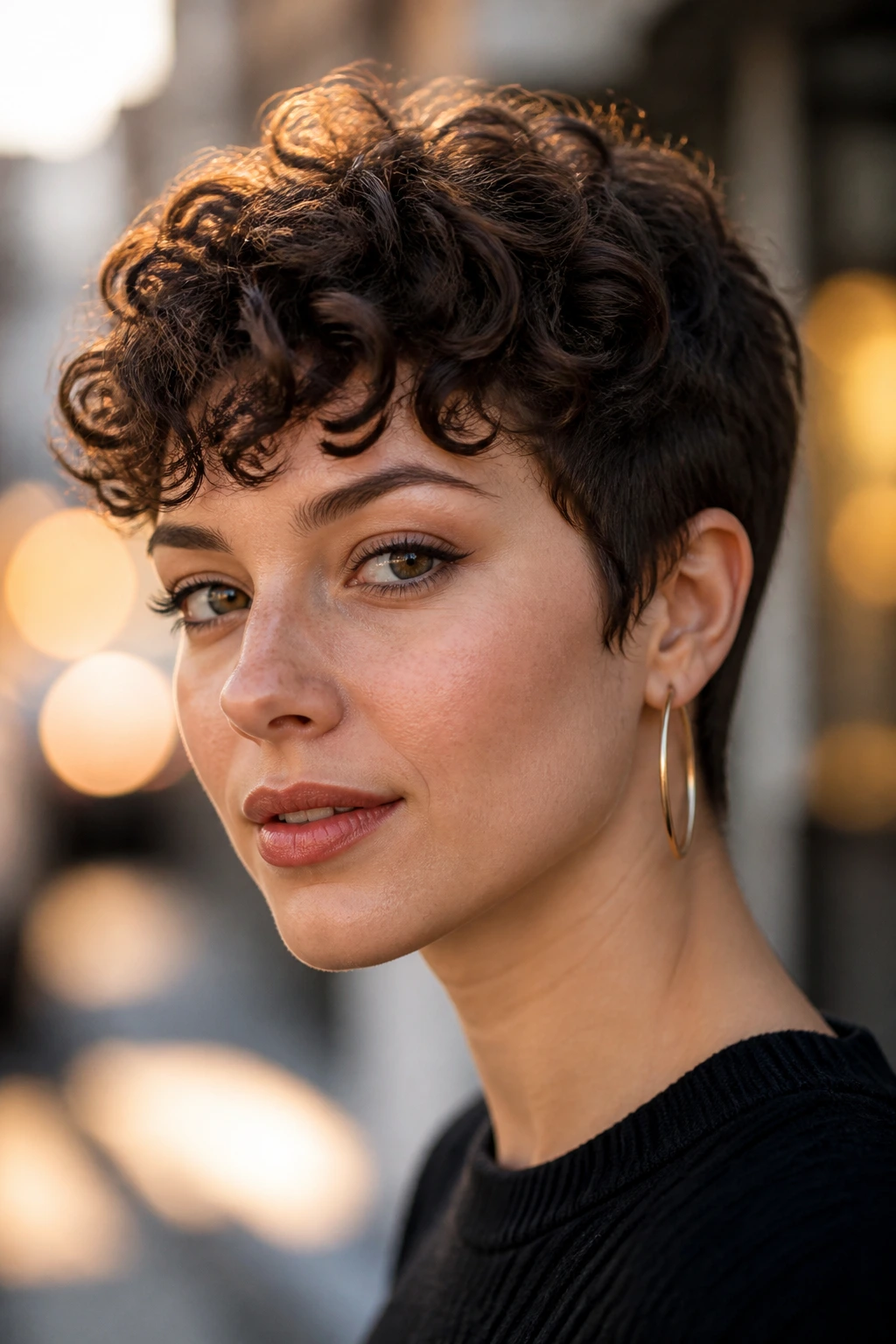
Short curly fringe on a pixie cut is not for the faint of heart. It’s crisp, playful, and much more demanding than longer bangs. But on thick curls, it can be fantastic because the density gives the front enough substance to stand up on its own. A square face benefits when the fringe is paired with softer sides and a little length at the temples.
The important part is balance. If the bangs are too short and the sides are too tight, the face can look more angular. Keep some softness around the ears and sideburn area. That gives the whole cut a curve to lean on.
It’s also a high-maintenance style. A few weeks can change the whole shape. If you like appointments and strong haircuts, it’s worth it.
17. The DevaCut Fringe for Tight Curls
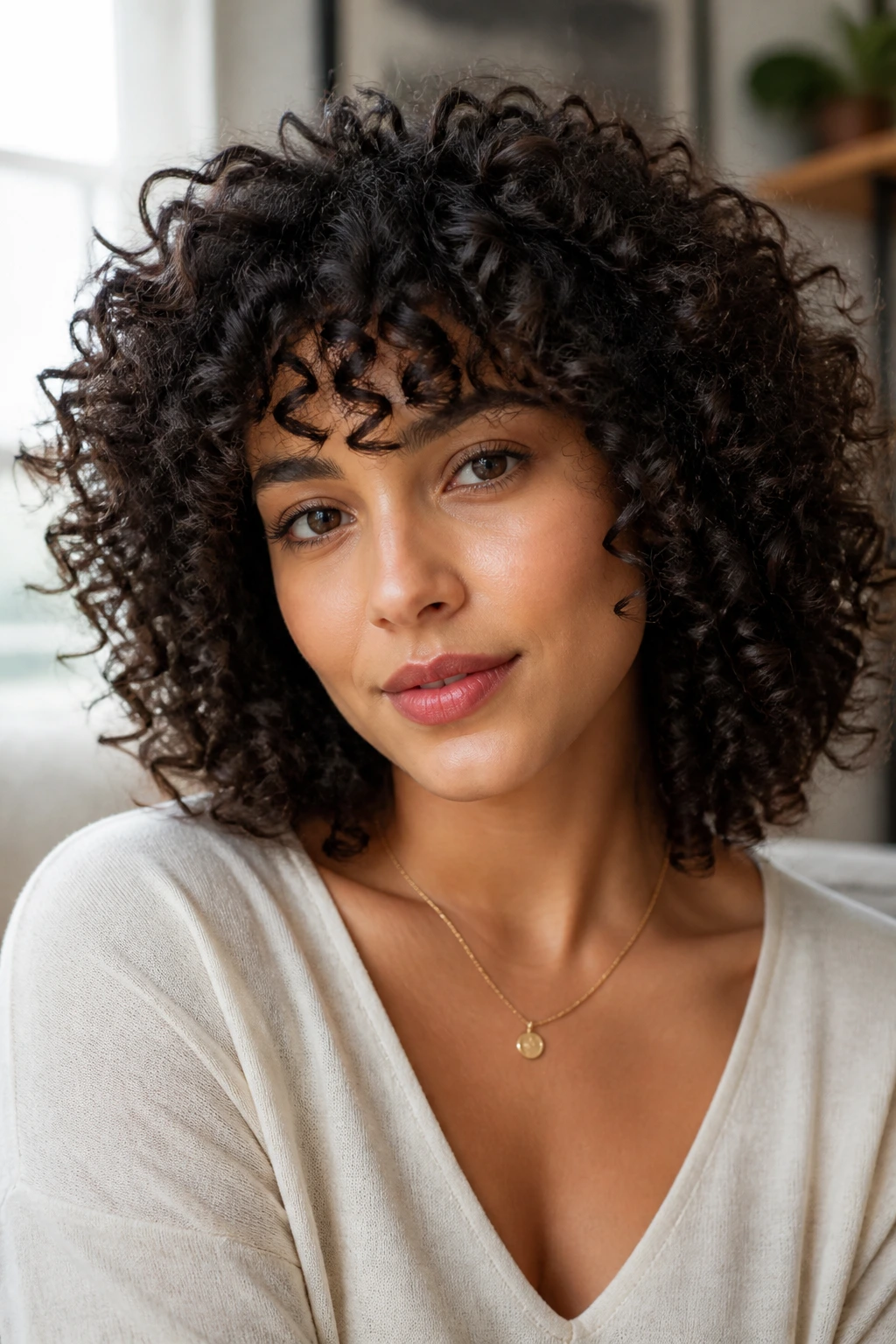
A DevaCut isn’t a bang shape so much as a method, and it earns a spot here because thick curly fringe lives or dies by how it’s cut. The idea is simple: the hair is cut dry, curl by curl, in the shape it actually wears. For square faces, that matters because the front can be shaped to soften the jaw and temples instead of guessing through wet shrinkage.
Why the Method Matters
Tight curls rarely fall the same way wet and dry. If the fringe is cut wet, the result can spring up too high or kick unevenly on one side. Dry cutting lets the stylist adjust each curl to where it belongs. That sounds fussy, and it is. It also saves a lot of regret.
If your curls are 3B, 3C, or tighter, this approach can be the difference between a shapely fringe and a mushroom. Ask for the front to be balanced against the natural part, not forced into a straight line.
18. Curly Lob with Split Bangs
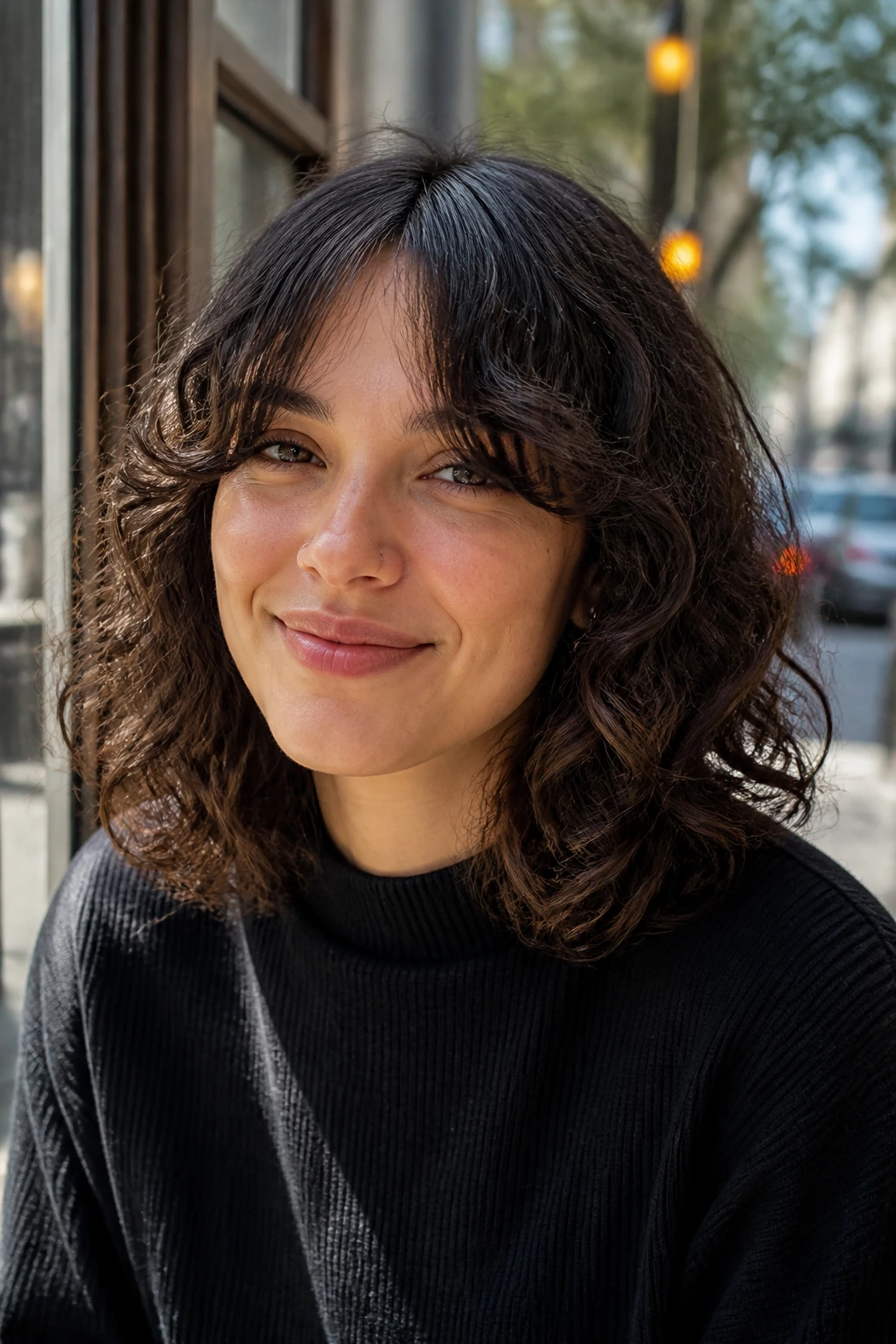
A lob gives thick curls room to hang without piling up at the shoulders, and split bangs make the front feel lighter. That center opening is useful on square faces because it draws the eye down the middle and softens the width of the forehead.
This is one of the easiest styles to live with day to day. The fringe can be worn forward, pushed aside, or tucked back. The lob length keeps the overall shape calm, which matters when the front has a lot of movement.
If you like hair that looks good on day one and still makes sense on day three, this is a strong candidate. It’s low-drama in a good way.
19. Arched Curly Bangs

Arched bangs follow the brow line in a soft curve, which gives the front of the haircut a gentle shape without a hard horizontal edge. On a square face, that curve matters. It mirrors the brows and softens the straight lines that tend to make the jaw look broader.
Thick curls help here because the arch needs body. Too little hair and the line gets thin. Too much and it can look heavy unless there’s internal layering. Ask for the middle to sit a touch shorter than the corners, but keep the transition smooth.
This shape feels a little more polished than the shag or wolf cut options. If your style leans clean but not severe, it lands in a nice middle ground.
20. Ringlet Curtain Fringe
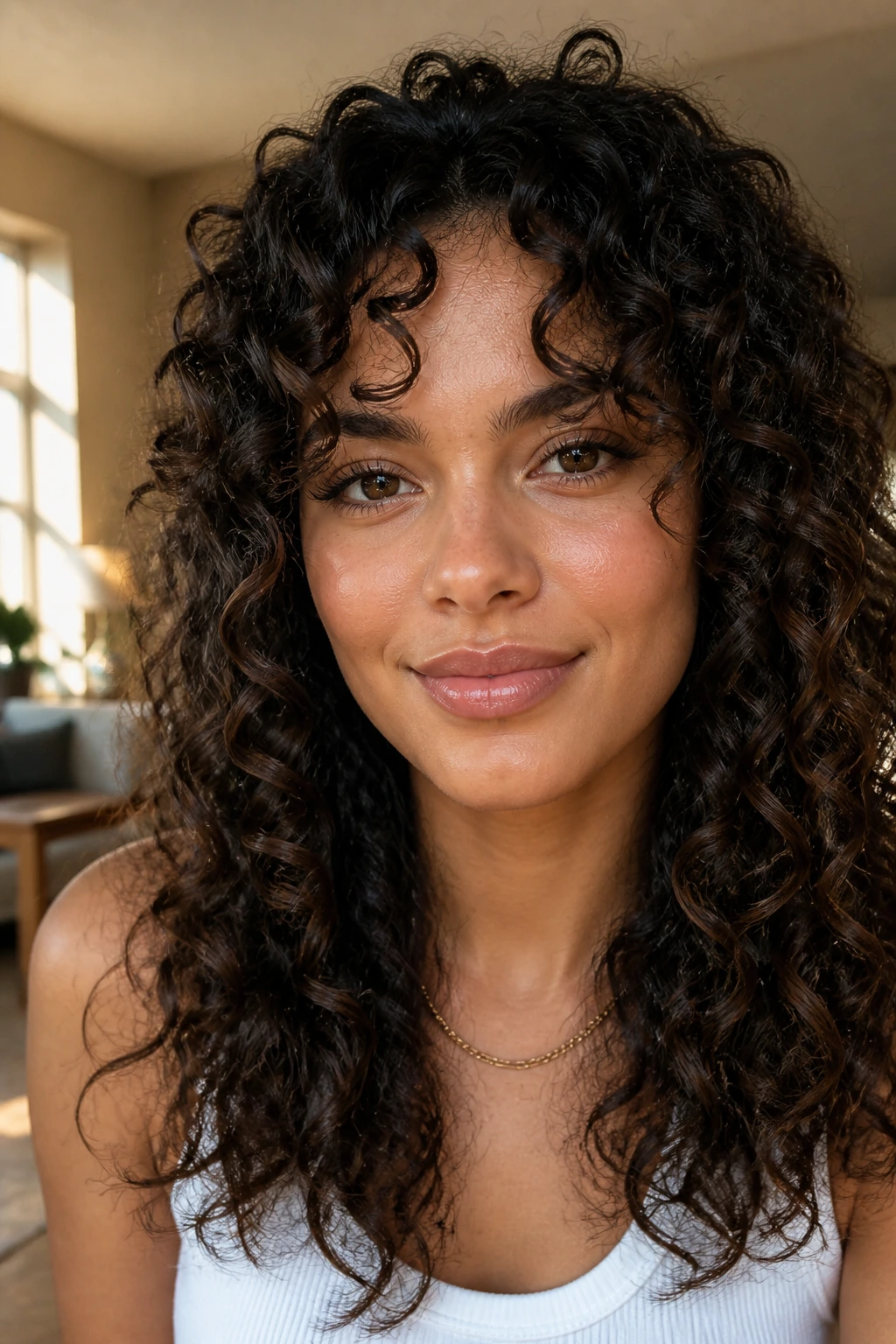
Ringlet curtain bangs are all about letting each curl act like its own small curtain panel. The middle opens slightly, the sides sweep out, and the front keeps a lot of texture. It’s a good fit for square faces because the movement at the center and temples keeps the face from reading too rigidly.
The style is charming when the curl pattern is consistent. If one side curls tighter than the other, you may need to encourage the bend with finger-coiling. That’s not a flaw. It’s just curly hair doing what curly hair does.
I like this version with medium to thick density because the ringlets have enough body to frame the eyes without vanishing. It has a soft, bouncy feel that a lot of blunt shapes simply can’t match.
21. Deep Side-Part Fringe
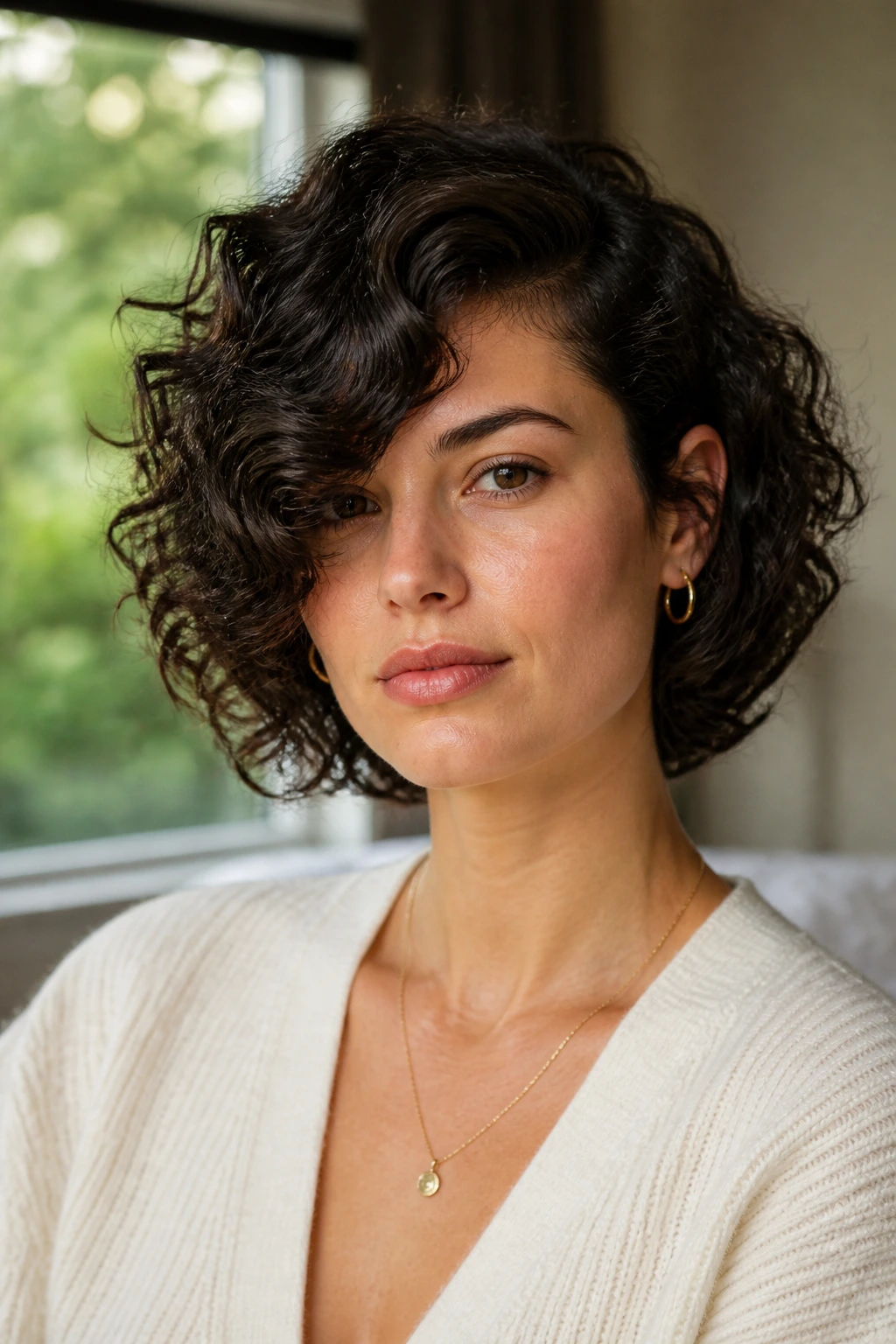
A deep side part changes the whole front of the haircut. Instead of dividing the face evenly, it shifts the weight to one side and creates a long diagonal line across the forehead. That diagonal is gold on a square face because it softens the width and makes the front look more fluid.
Thick hair supports this shape well. The fringe can carry enough body to stay in place without needing to be sprayed into submission. Let the shorter side skim the brow and the longer side sweep toward the cheekbone. That asymmetry is doing the heavy lifting.
Styling Notes
Use a small clip at the roots while drying if the part keeps collapsing. Once the shape sets, you can remove the clip and finger-shake the curls loose. A side part like this looks especially good when the rest of the hair has some layered movement, not just one solid length.
22. Micro Curly Fringe
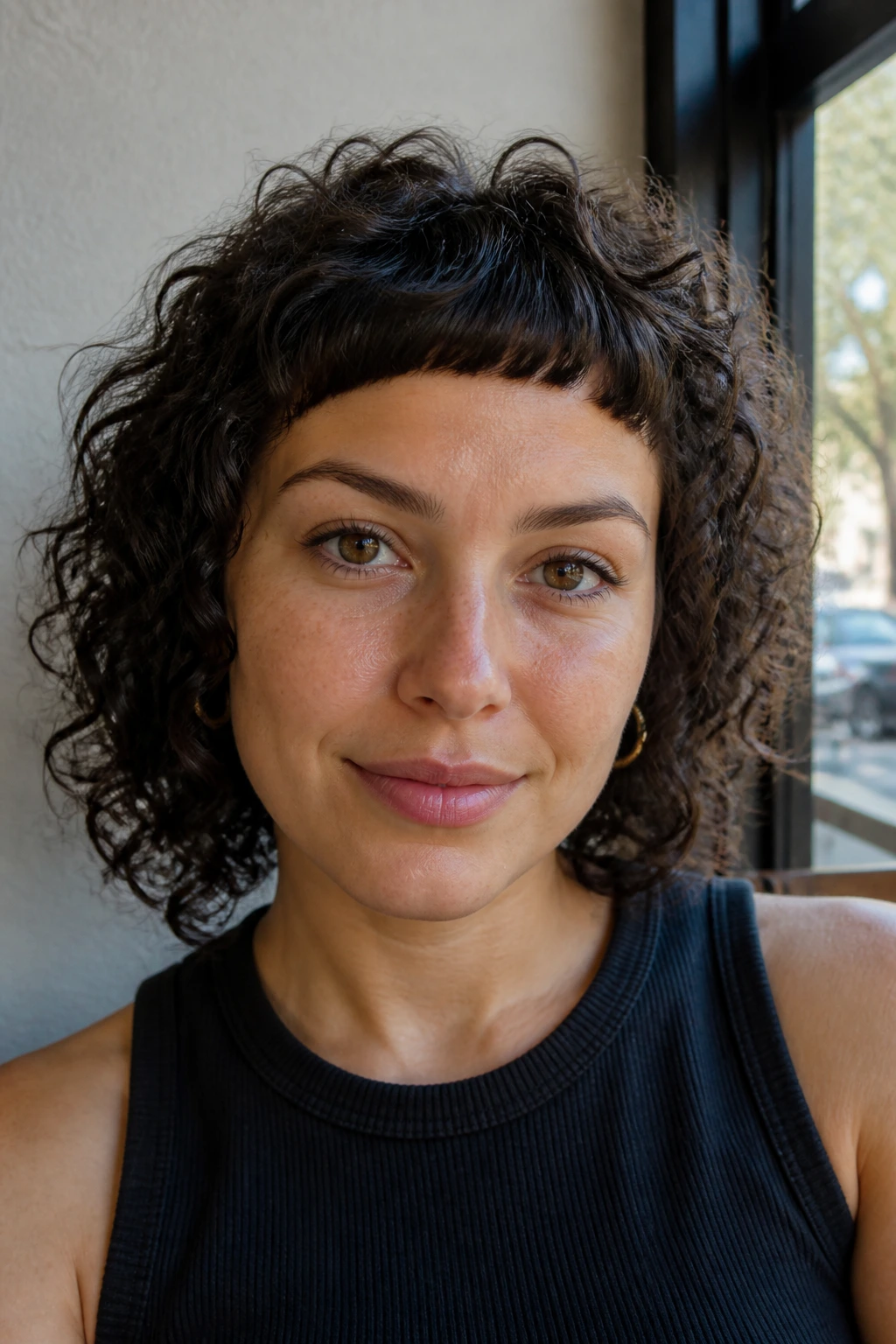
Micro bangs on curls are a bold move. On thick hair, they can look sculptural instead of fussy, but they need a square face to be softened by the rest of the cut. That means longer sides, curved temples, or a tapered neckline nearby. Without that balance, the front can feel too abrupt.
This is not the lowest-maintenance choice, and I would not call it universal. Still, if you like a strong shape and you want the forehead mostly visible, it can be sharp in a good way. Tight curl patterns often make the effect feel more playful than severe.
The biggest rule is not to over-thin them. A micro fringe that has been stripped of density can look wispy and broken. Keep the structure.
23. Curly Mullet Fringe
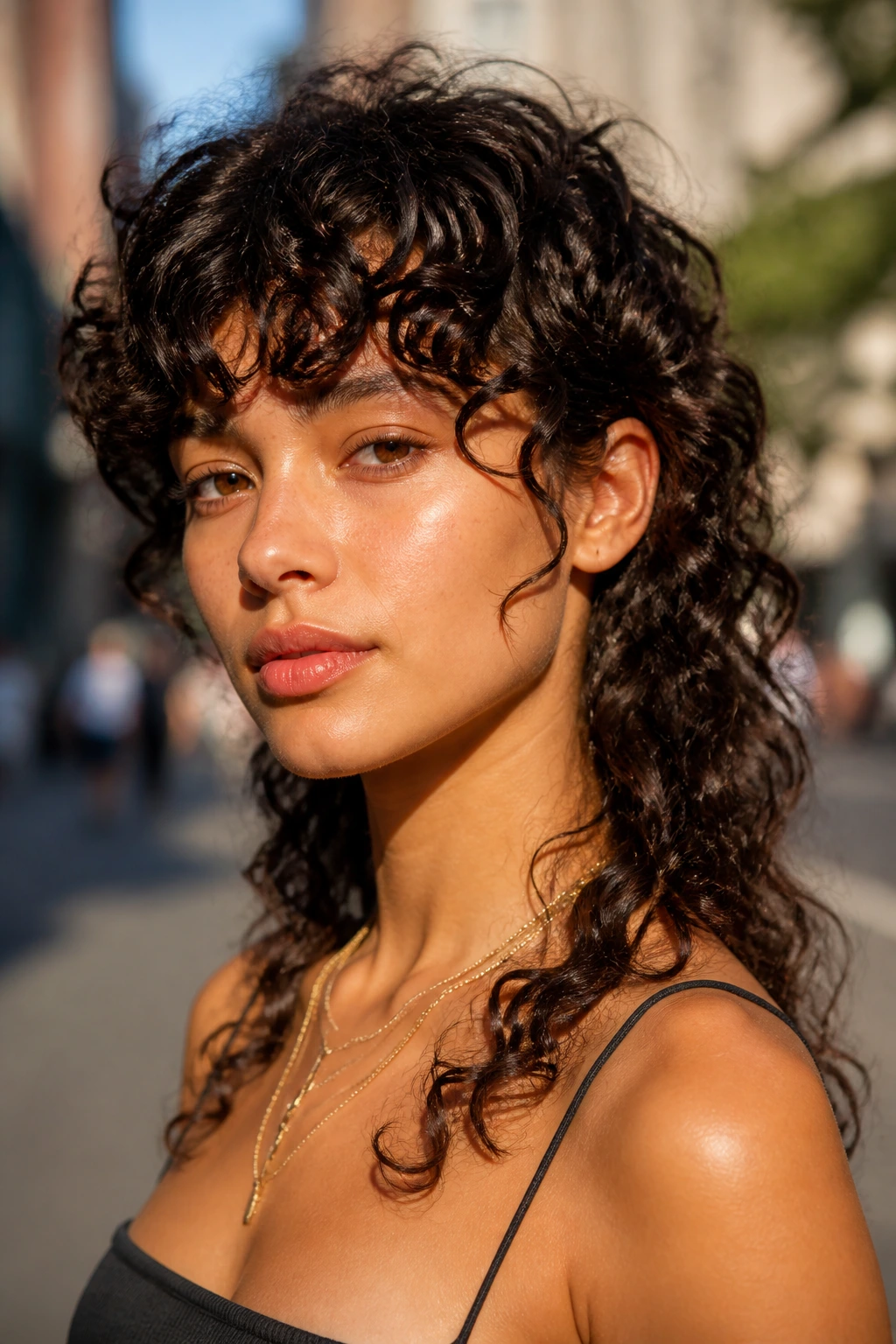
The curly mullet has more personality than most people are willing to admit. Shorter bangs in front, longer length in the back, and a lot of texture through the sides create a shape that feels relaxed but intentional. On a square face, the contrast helps: the front is softened by curls, while the back keeps the cut from looking blocky.
Thick hair is practically built for this. The density adds drama, and the layers stop the whole style from feeling bottom-heavy. The fringe should stay soft and a little broken up, not sealed into one front wall.
This is a good style if you want edge without losing curl movement. It’s not neat. That’s the point.
24. Shoulder-Length Rounded Bangs

This is the grown-up version of a big curly fringe. The bangs stay longer and rounder, blending into shoulder-length layers so the front and sides feel like one shape. On a square face, that curved transition is useful because it keeps the jaw from standing out too hard against the rest of the cut.
Thick hair benefits from the length because it keeps the fringe from puffing up too high. The extra weight makes the curls settle. If you’ve been burned by short bangs that spring straight up after drying, this longer rounded shape is a calmer bet.
The best version has soft edges near the cheekbones and a little movement at the ends. Nothing stiff. Nothing carved.
25. Wash-and-Go Fringe with Internal Layers
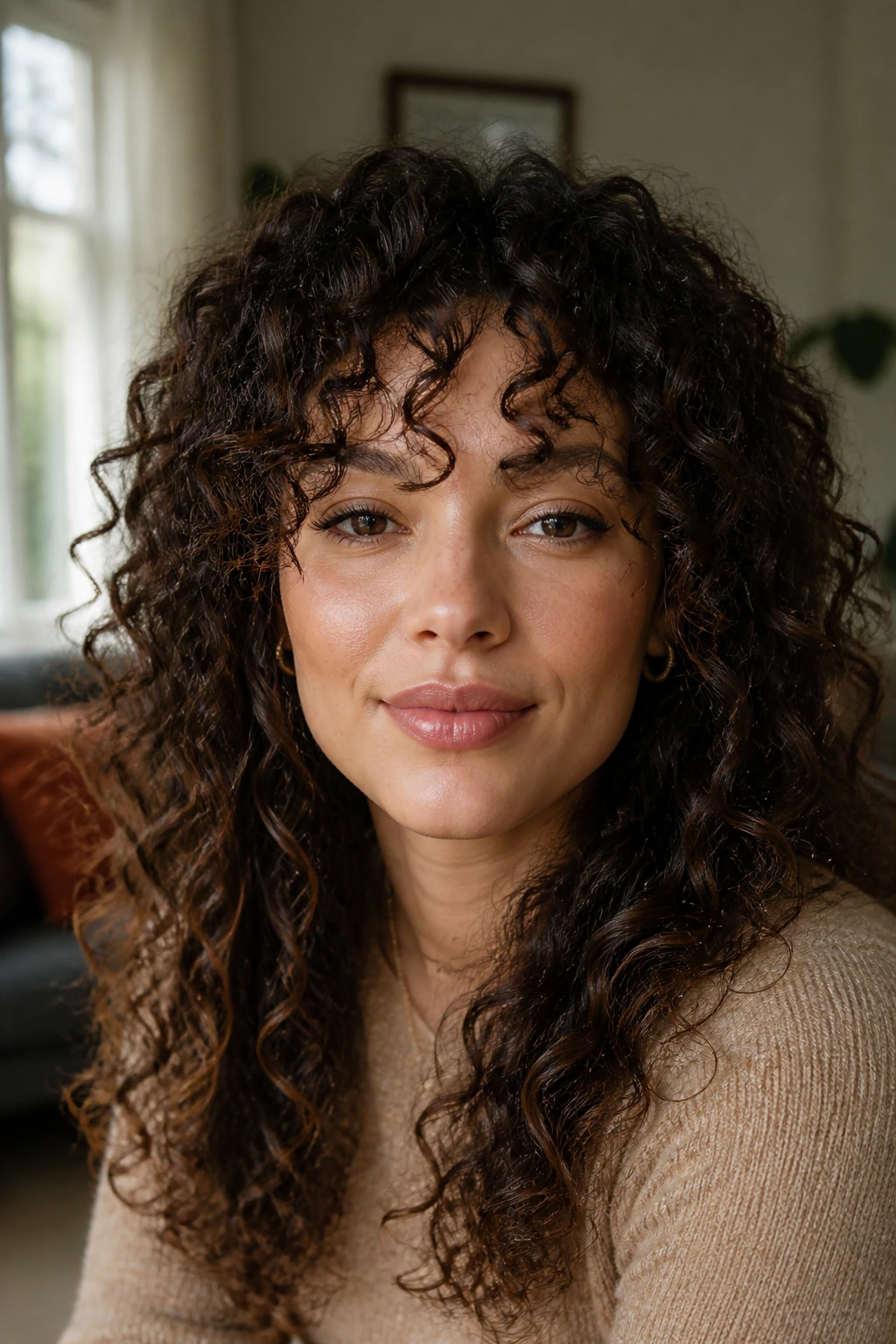
If you want curly bangs that can survive real life, this is the one to study. A wash-and-go fringe with internal layers keeps the front light enough to move, but not so thin that it frays apart. That hidden structure helps thick hair sit forward without turning into a block of curls.
For square faces, the trick is to let the shortest pieces curve away from the temples while the longer pieces melt into the side layers. That softens the upper face and avoids a hard horizontal edge. It’s a smart cut for people who prefer air-drying and don’t want to rebuild their fringe every morning.
This style rewards a good cut more than a clever product. The styling can be simple. The shape has to be right first.
What Makes Curly Bangs Behave on Thick Hair
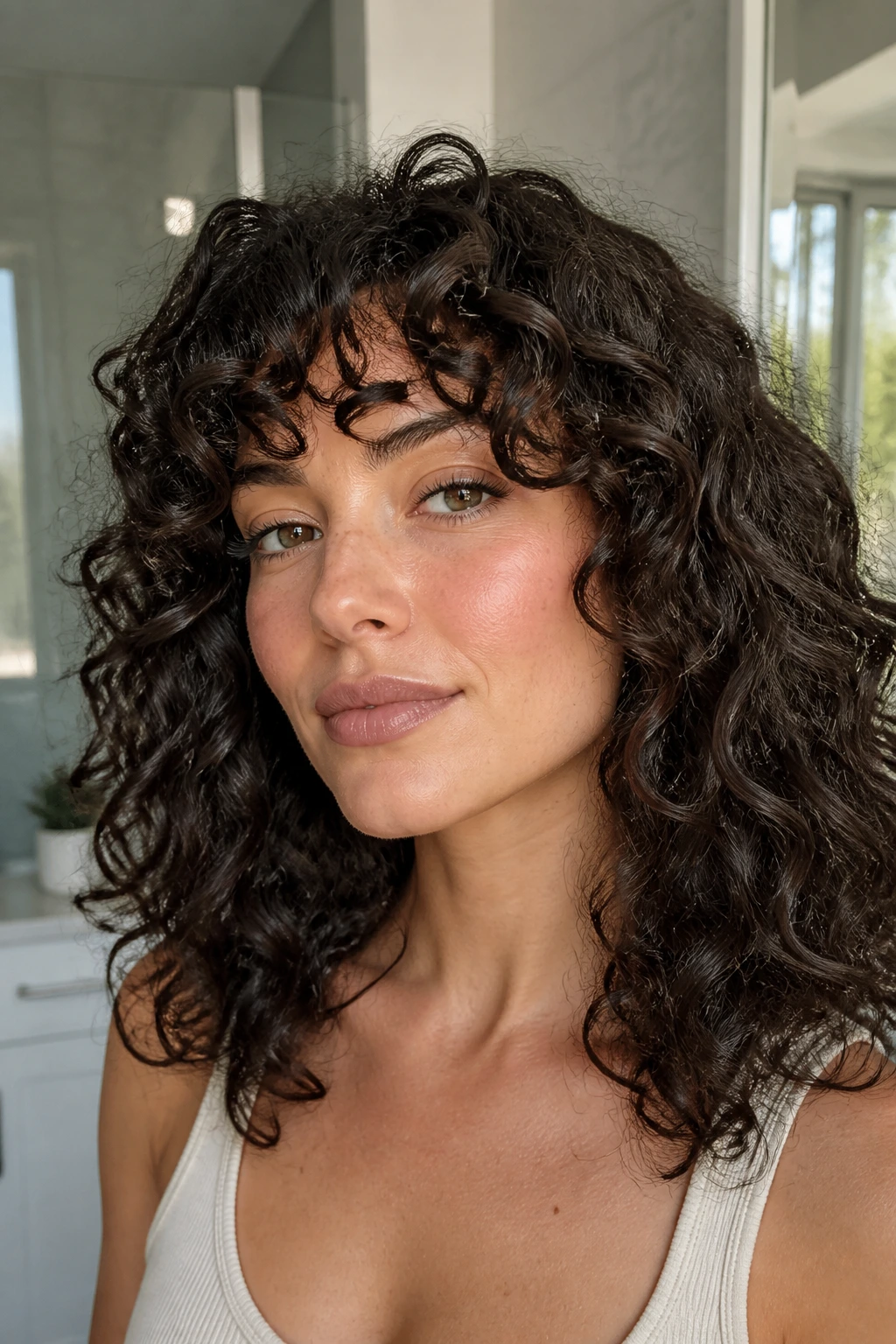
Thick curly hair does not need to be wrestled into obedience. It needs boundaries. That’s the whole job of the cut. When the fringe is shaped with shrinkage in mind and the bulk is removed in the right places, the front stops ballooning into a wall and starts moving like part of the haircut.
The best curly bangs for square faces do two things at once. They soften the temples and they redirect volume away from a harsh horizontal line. A square jawline can handle strength. What it does not need is more straightness at the forehead. Curves, diagonals, and soft side pieces change the read of the whole face faster than almost any other haircut move.
Dry cutting is still my preference here. You can talk about curl pattern all day, but if the cut is guessed while wet, the bang can land a full inch shorter once it dries. That’s not a minor detail. It’s the difference between flattering and frustrating.
What to Tell the Stylist Before the First Snip
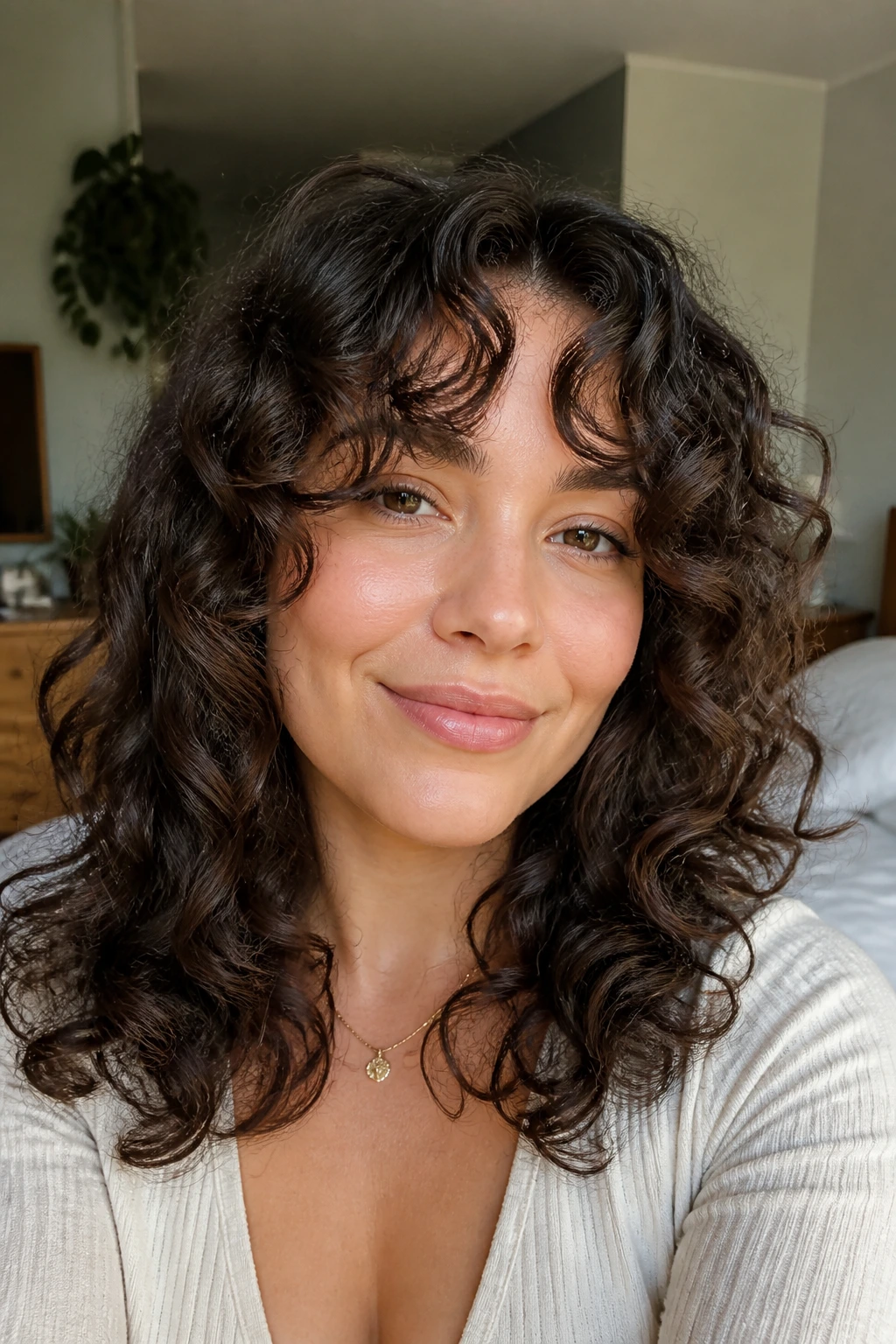
Bring photos, yes, but bring the right kind. The best reference is not a model with loose waves if your hair coils tightly, and not a tight curl photo if your strands are more springy and open. Show a stylist the texture, density, and front shape you want to live with, not just the vibe.
Ask for the fringe to be cut with your curls in their natural state. That one sentence is worth saying out loud. Tell them you want the front to soften a square face, not carve out a blunt line. If your hair is very dense, ask where they plan to remove weight. The answer should be somewhere in the interior, not just across the surface.
The Most Useful Consultation Notes
- Mention how far your curls shrink when dry.
- Say whether you usually wear a middle part or side part.
- Ask how the bang will look on day two, not only on fresh wash day.
- Point out any cowlicks or stubborn front swirls before the cut starts.
- Ask for temple pieces that connect to the front layers, especially if your jawline is strong.
If a stylist wants to cut your curly fringe dead straight and wet, pause. Not because wet cutting is always wrong, but because thick curls with a square face usually need more control than that. The front line needs to be judged in its real shape.
Tools and Products That Keep Curly Bangs Honest
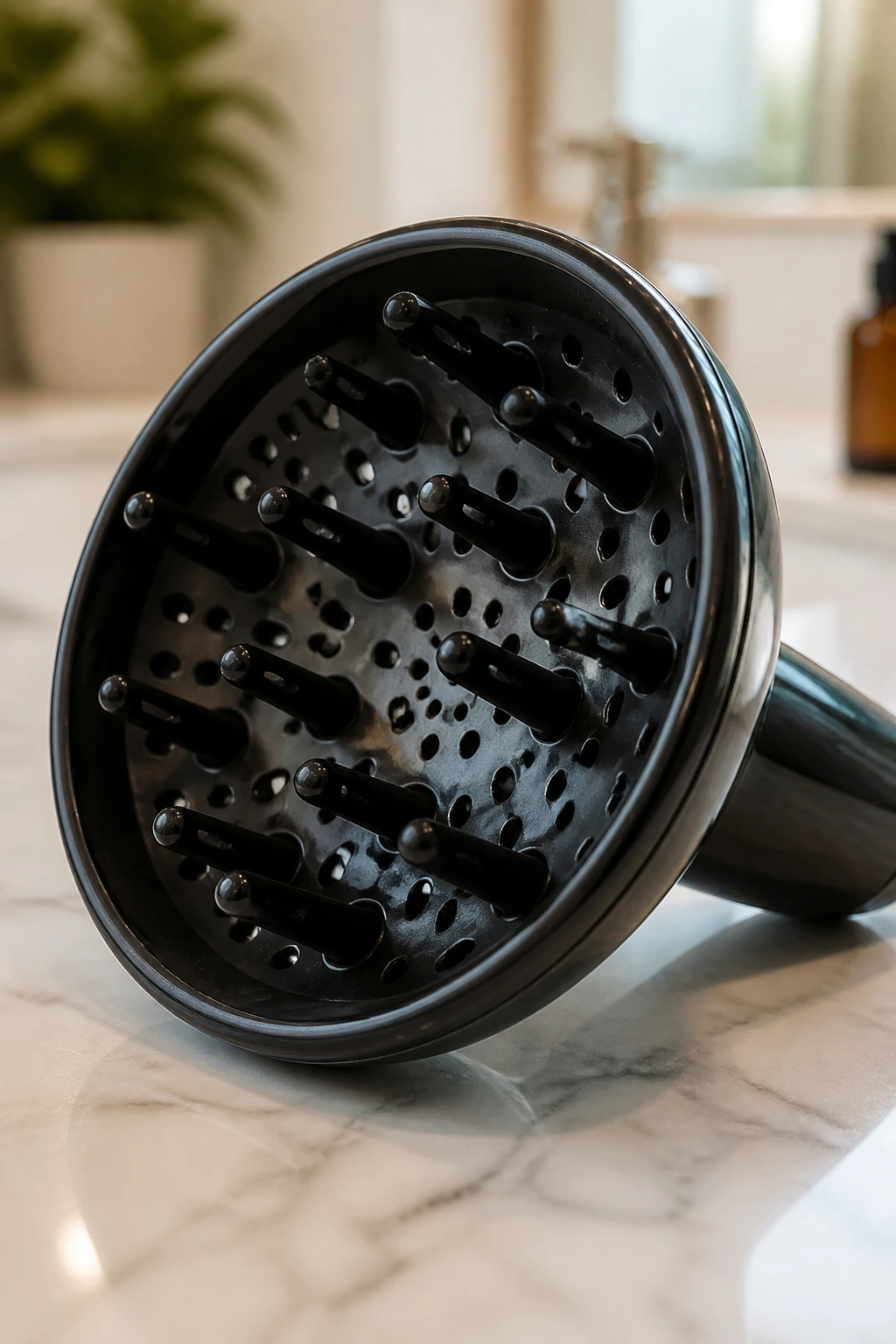
A good set of tools will not fix a bad cut, but it can save a good one from collapsing at noon. Thick curls with bangs behave best when the front is dried with direction and the product load stays light enough to avoid buildup.
- Wide-tooth comb: Detangles without ripping the curl pattern apart.
- Spray bottle: Re-wets only the fringe when you need to reset the front.
- Microfiber towel or cotton T-shirt: Cuts down on frizz while you blot excess water.
- Curl cream: Adds slip and softness; use a small amount so the bangs do not droop.
- Mousse or lightweight gel: Gives the front shape and helps curls hold a separated pattern.
- Diffuser attachment: Dries the fringe with less blast and more control.
- Duckbill clips: Hold roots up while the bangs dry, which helps keep the front from flattening.
- Small claw clip or bobby pins: Useful for pinning the fringe out of your face on grow-out days.
If you only buy one extra thing, make it a diffuser. Thick curly bangs look different when they’re blasted with hot air versus dried with a diffuser held low and close. The latter usually wins.
How to Wear Curly Bangs on Wash Day and Day Two
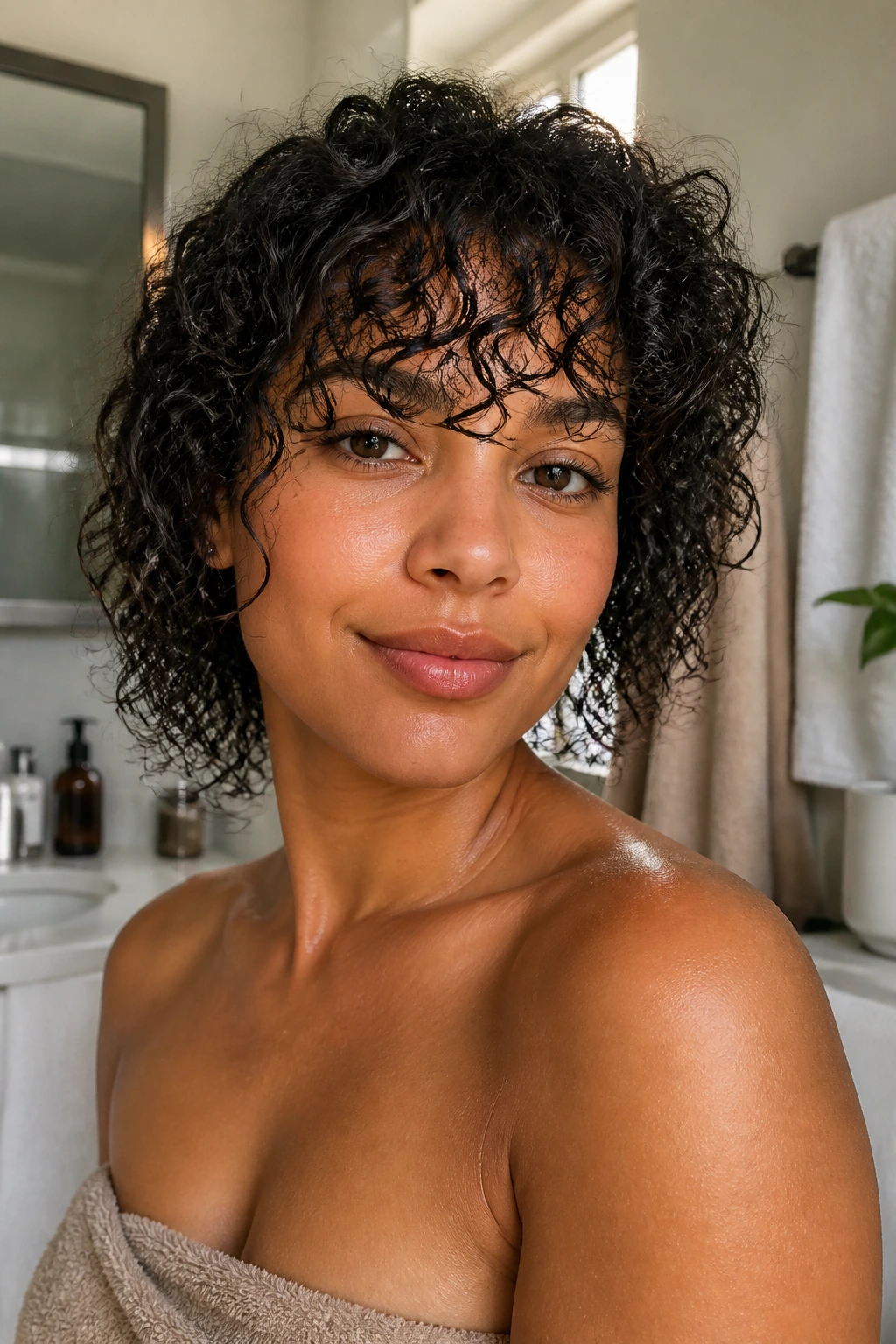
The first day is about shape. The second day is about rescue. Those are different jobs, and it helps to treat them that way instead of pretending the same routine will cover both.
Wash Day: Start with damp bangs, add a small amount of curl cream or mousse, and rake it through with your fingers. Then either finger-coil the front pieces or scrunch them upward with a diffuser on low. Stop drying when the bangs are around 80% dry and let the rest air-finish. That keeps the shape from getting too puffy.
Day Two: Mist the fringe lightly with water, then twist the largest pieces back into shape with damp fingers. If the roots have collapsed, clip them up for 10 to 15 minutes while they dry again. Do not soak the whole front unless you want to restart the entire style.
Tie-Up Days: If the bangs are having a fight with your forehead, push them into a loose twist and pin them at the crown. It looks intentional, and it buys you a day without overhandling the curls.
Best Pairings: Curly bangs love layered lobs, shags, soft bobs, and longer cuts with temple framing. They need a haircut that gives the front somewhere to land. A one-length cut with dense bangs can feel too square.
Additional Styling Moves That Keep the Shape Balanced
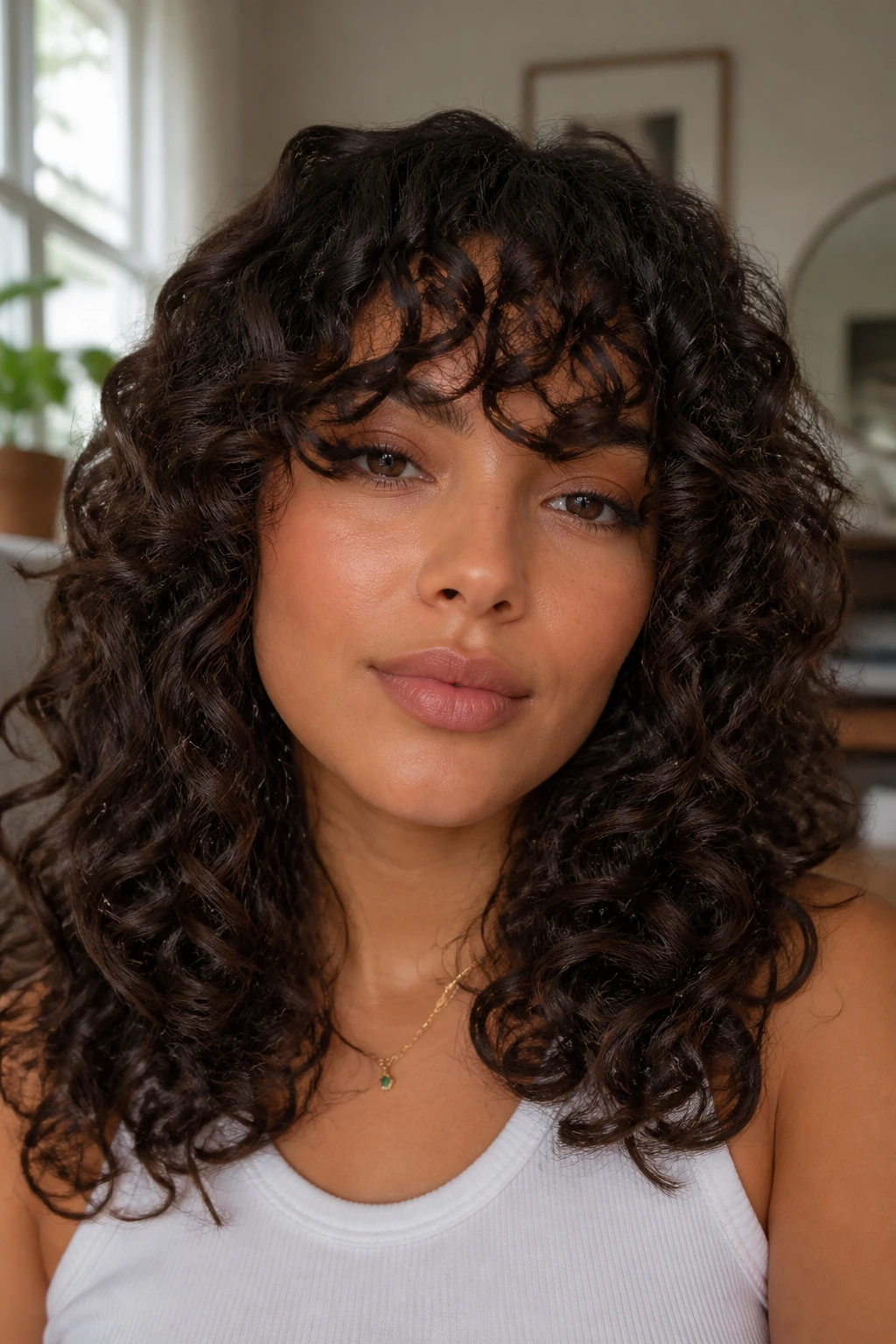
A small amount of root lift goes a long way. Clip the bangs at the base while they dry, then remove the clips once the shape is set. That keeps the fringe from sticking to the forehead, which is one of the fastest ways to flatten the front of thick curls.
If the curls separate too much, don’t pile on product. Use your fingertips to gather only the loose pieces and encourage them back together. The front should look shaped, not lacquered. That’s the difference between control and helmet hair.
Curl Direction: Twist the front curls slightly away from the center if your square face feels too wide at the temples.
Frizz Control: Smooth a pea-size amount of gel over the outermost layer, not the whole bang.
Softness: Break one or two curls apart near the sides so the fringe doesn’t read as a solid block.
The temptation is always to fix everything. Resist that. Curly bangs look best when they have a little life.
Common Mistakes That Turn Curly Bangs Boxy
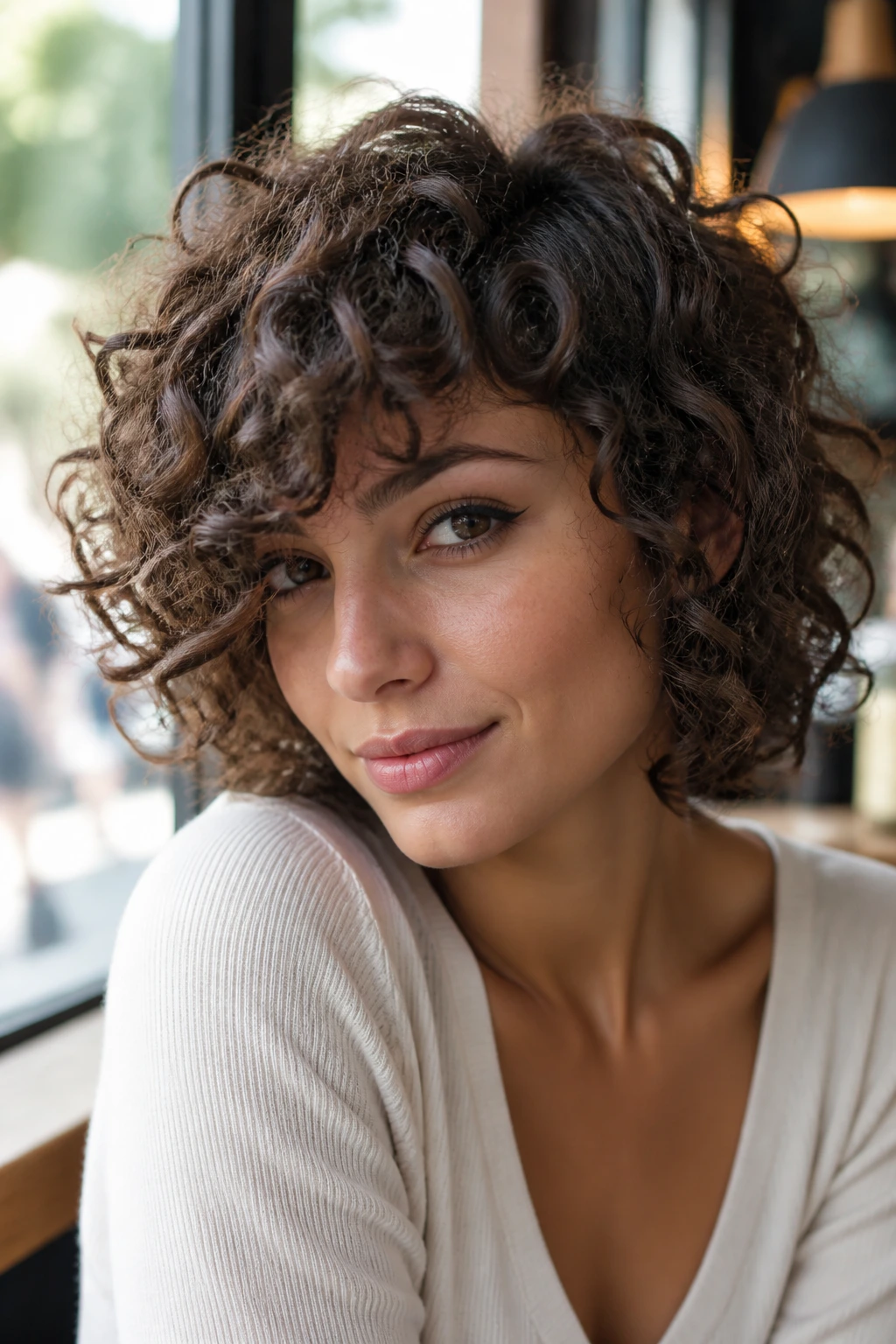
The most common mistake is cutting them too short while wet. Curly bangs shrink, and thick hair can shrink with enthusiasm. If the front is already above the brows when wet, it may end up far shorter than intended once dry. The fix is simple: cut conservatively, then check the shape dry before removing more length.
Another easy error is over-thinning the fringe. Thick curls do not need to be stripped into submission. When a stylist removes too much bulk, the front can split into see-through strands that frizz at the edges. Ask for internal weight removal instead of a razor-happy surface pass.
A third issue is ignoring the temple area. Square faces need softness at the sides of the forehead, not a clean stop right above the brows. If the fringe ends too abruptly, the face can look wider. Let the side pieces blend into layers.
And then there’s product overload. Too much cream or oil drags the bangs down and makes them separate into greasy clumps. Start with less than you think you need. Add more only if the curl pattern truly needs it.
Shape-Shifting Ideas for Different Curl Patterns

The Softer Grow-Out: If you want less upkeep, let the center pieces lengthen first and keep the sides blending into layers. It turns the fringe into a face-framing sweep without needing a full cut reset.
The Polished Blow-Dry Version: Stretch the bangs with a diffuser or round brush just enough to smooth the front line, then let the ends keep their curl. This works well for tighter curl patterns that need a little direction.
The Tight-Curl Reset: For 3C and tighter curls, keep the fringe shorter in the center and longer at the corners. That shape helps the shrinkage land in a curve instead of a little puffy rectangle.
The Side-Part Escape Hatch: If you are tired of center bangs, move the front into a deep side part and sweep the fringe across. Same cut. Different mood. Handy.
The Glam Version: Pair a rounded curly fringe with a defined shape elsewhere — a clean bob, long layers, or a soft lob. It gives the front more stage presence without making the overall style messy.
Keeping the Fringe Fresh Between Trims
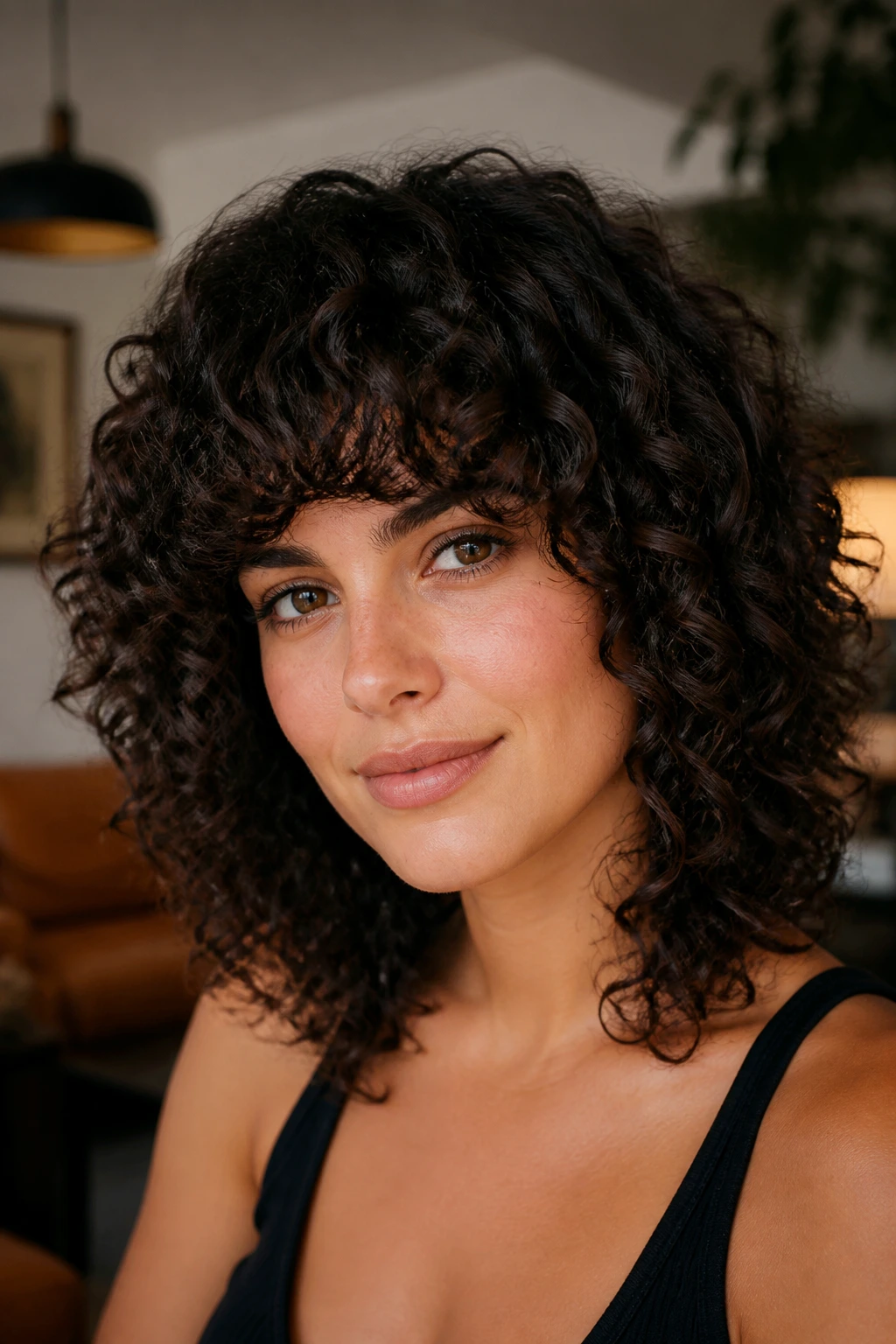
Curly bangs need a trim faster than the rest of the haircut. That’s not a flaw. It’s how front pieces work. Plan on checking the shape every 6 to 8 weeks if the fringe is short, or every 8 to 10 weeks if it’s longer and blends into layers.
At night, protect the front. A silk pillowcase helps, but the real trick is keeping the bangs from getting crushed flat. If your fringe tends to bend oddly, clip it loosely up and away from the forehead before sleep. In the morning, mist the front, shake the curls loose, and reset with your fingers.
If the bangs go limp at midday, do not start over with a full wash. Wet only the front section, scrunch once or twice, and diffuse for a few minutes. Thick curly bangs usually bounce back fast when they get a little water and a little direction.
Curly Bangs Questions People Ask a Lot
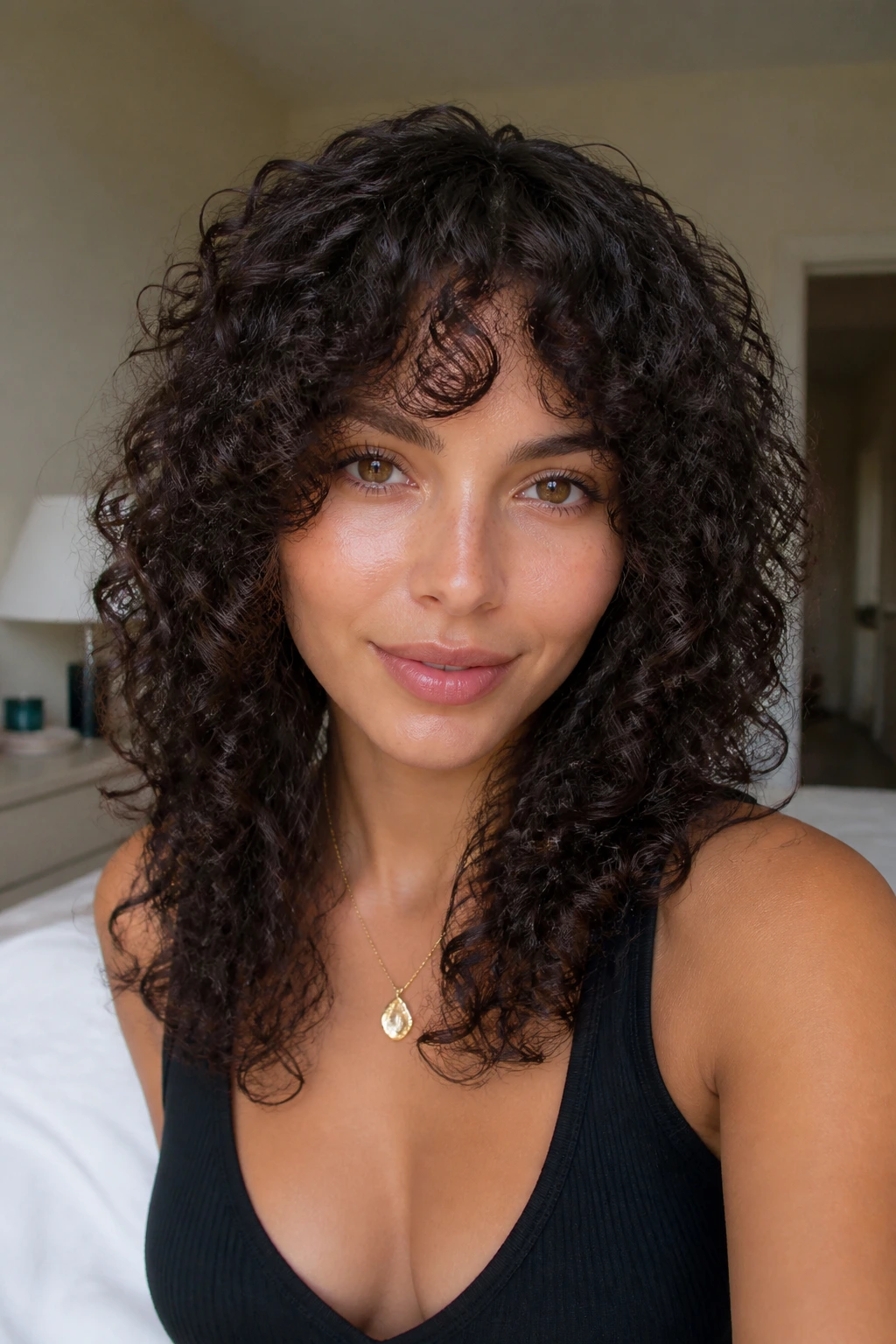
Can curly bangs work on a square face?
Yes, if the shape is soft at the temples and not cut into a hard horizontal line. Curtain, bottleneck, side-swept, and rounded shapes tend to work best because they interrupt the width of the face.
Should curly bangs be cut wet or dry?
Dry is safer for most thick curls because it shows the true length and shrinkage. Wet cutting can work in skilled hands, but it takes a stylist who knows how your pattern behaves once it springs up.
How short should curly bangs be?
Longer than you think. For most curl patterns, the ideal starting point is around brow level or a touch longer when dry, then adjusted from there. The tighter the curl, the more room you need.
Do thick curls need thinning in the bangs?
Sometimes, but not aggressively. A little internal weight removal helps the fringe sit better, yet too much thinning can make the bangs frizzy and see-through. Aim for shape, not starvation.
What if my bangs puff up during the day?
That usually means they need more root control or less product. Clip the roots while drying, use a diffuser on low, and keep heavy creams off the front layer unless the curls are genuinely dry.
Can I straighten curly bangs sometimes?
Yes, but keep the cut shaped for curls first. A curly-friendly fringe can be smoothed with a brush and heat if needed, while a straight-only fringe often looks awkward when it air-dries.
How often should I trim them?
Short fringe: every 6 to 8 weeks. Longer curtain or face-framing fringe: every 8 to 12 weeks. If you wait much longer, the shape usually loses the softness that made it work in the first place.
What if one side curls tighter than the other?
That is normal. Encourage the looser side with a little finger-coiling and let the tighter side keep its own shape. Do not force them into identical loops; curly bangs look better when they keep a bit of personality.
The Fringe That Softens the Jaw

A good curly fringe does not fight a square face. It redirects it. That’s the part people miss when they try to make bangs behave like straight-hair bangs. Thick curls want shape, not punishment, and the best cuts use that volume to blur hard edges around the temples and jaw.
The styles above all do the same basic job in different ways. Some split the forehead. Some sweep it. Some keep the front full but rounded. The right one depends on how much maintenance you want, how tight your curl pattern is, and how much forehead you’re willing to show.
Bring a photo, a realistic sense of your shrinkage, and a stylist who understands dry cutting. The rest is mostly shape, patience, and not stealing too much length on the first pass. If you get that part right, curly bangs can be the sharpest softening move in the whole haircut.