



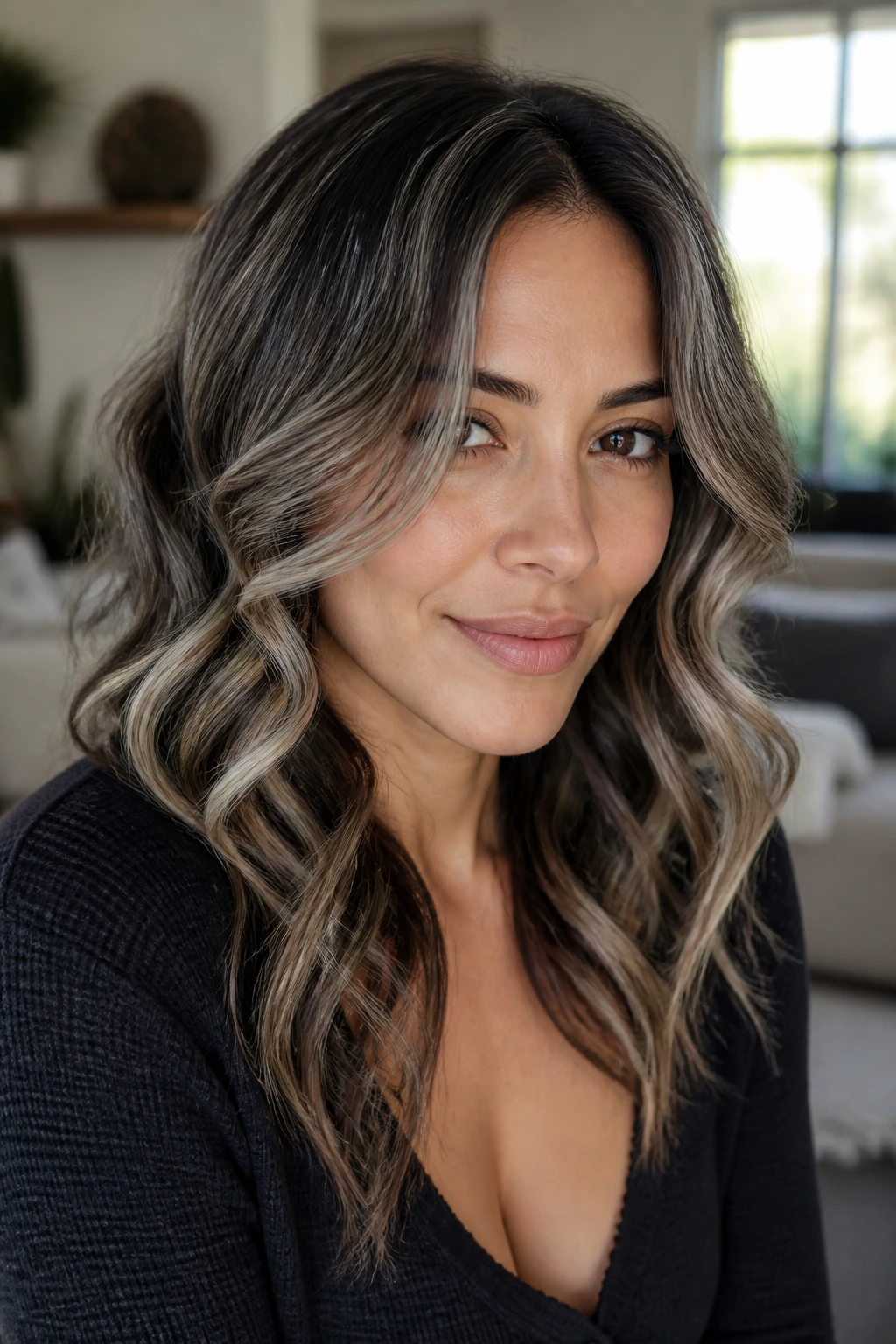
Roots grey hairstyles for olive skin with loose curls can look sharp in the right shade and strangely flat in the wrong one. That’s the whole game. Grey near the roots gives structure, but on olive skin it needs a little warmth, a little smoke, or a little beige in the mix so the face doesn’t turn sallow under indoor light.
Loose curls fix what flat color sometimes ruins. They break up the grey into moving ribbons instead of one solid silver block, and that movement matters more than people think. Olive skin has a way of changing a color’s temperature the second you walk from daylight into a bathroom mirror, so the styles that work best are the ones with depth at the crown and softness through the ends.
I’m a fan of grey when it’s treated like a dimension, not a statement. That means shadow roots, mushroom tones, pearl gloss, graphite lows, and curls that are bent just enough to show off the tonal shift. Some of these looks lean polished. Some are a little undone. A few sit right on that line where the hair looks expensive without looking stiff, which is usually where the interesting stuff happens.
Why Grey Roots and Loose Curls Look So Good on Olive Skin
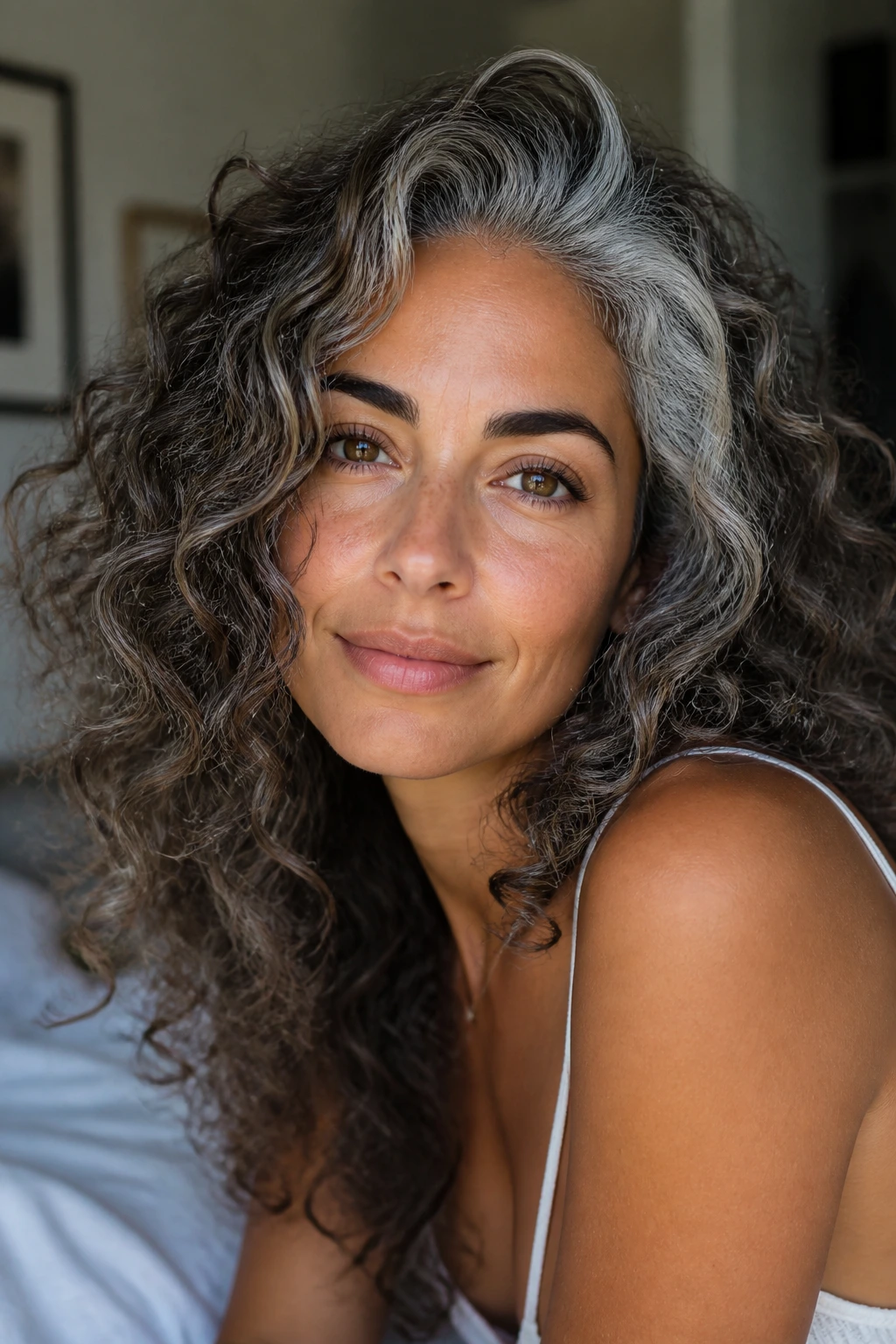
- Depth at the root keeps the face grounded: A deeper root shadow stops grey from floating over olive skin like chalk; it gives the eye something to hold onto first.
- Loose curls soften cooler tones: A 1-inch or 1¼-inch bend breaks up silver and ash so the color reads as dimensional, not metallic in a blunt way.
- Mushroom, taupe, and pearl grey are kinder than icy white: Those shades carry enough beige or smoke to sit beside green-gold undertones without making the skin look tired.
- Grow-out is easier to live with: When the roots are already darker, a regrowth line turns into part of the style instead of an emergency.
- Movement matters more than shine alone: A glossy grey can still look flat if the cut is too straight; loose curls keep light shifting across the hair all day.
- The color changes personality with the angle: Face-framing pieces read brighter, while the deeper underside keeps the whole look from feeling washed out.
1. Smoky Root Melt with Pearl Ribbons
A smoky root melt with pearl ribbons has that nice “I didn’t overthink this” feel, even though it’s doing a lot of work. The crown stays espresso or deep mushroom, then thin pearl-grey ribbons weave through the midlengths so the loose curls flash cooler as they move. On olive skin, that dark base keeps the complexion steady; the pearl pieces bring light without tipping the whole look into icy territory.
Why It Works
The root melt gives the style its backbone. Without it, grey can sit too high and start to fight warm undertones near the face. With it, the transition feels soft, and grow-out is easier to manage because the color has somewhere to land. Ask for ribbons that are fine enough to disappear in a curl and reappear when the hair swings.
- Best on: Medium to long hair with loose, layered curls
- Ask for: A shadow root 1–2 shades deeper than your mids
- Curl plan: Wrap 1-inch sections away from the face, then alternate direction halfway down the head
One smart move: Keep the front ribbons a half-shade brighter than the back; that tiny shift makes the face look clearer without turning the whole head silver.
2. Mushroom Grey Lob with Bouncy Ends
Mushroom grey on a lob is one of those cuts that looks calmer than it has any right to. The color sits in taupe-grey territory, the length hits around the collarbone, and the ends bend outward just enough to keep the shape from collapsing. On olive skin, that brown-grey balance matters. Pure silver can look a little harsh. Mushroom grey feels cushioned.
The lob is doing half the styling work here. It gives the grey a clean frame, which means the color doesn’t need to shout to get noticed. I like this best when the layers are subtle and the finish is brushed out, not tight. You want a soft bend, not a prom curl. A flat iron can also make those bends look modern if your hair resists curling irons.
This is the style I’d point to for someone who wants grey to look intentional in office light, car light, and that awful fluorescent grocery-store glow. It stays neat at the roots, but the movement at the ends keeps it from looking like a helmet. That’s the whole trick.
3. Ash Balayage with Face-Framing Curls
What happens when the grey starts around the face instead of hiding in the back? You get a brighter, more lifted version of the same idea. Ash balayage with face-framing curls puts the cool pieces where olive skin needs them most: along the cheekbones, jawline, and first few inches near the part. The rest can stay a little deeper, which keeps the look from going flat.
How to Wear It
The first curls around the face should be the most deliberate. Clip them while they cool so they don’t drop too fast, then finger-comb only the very ends. If you brush the whole curl out, you’ll lose the clean grey framing and end up with a blur. That might be fine on a messy day, but it’s not the point here.
If your skin leans greener or more neutral, ash balayage can be almost magic. The cool ribbon near the face doesn’t fight your undertone; it sharpens it. Ask for balayage panels that start lower in the lengths and a slightly lighter veil around the front. That split is what gives the curls shape when they’re loose.
4. Silver Shadow Root and Caramel Underlights
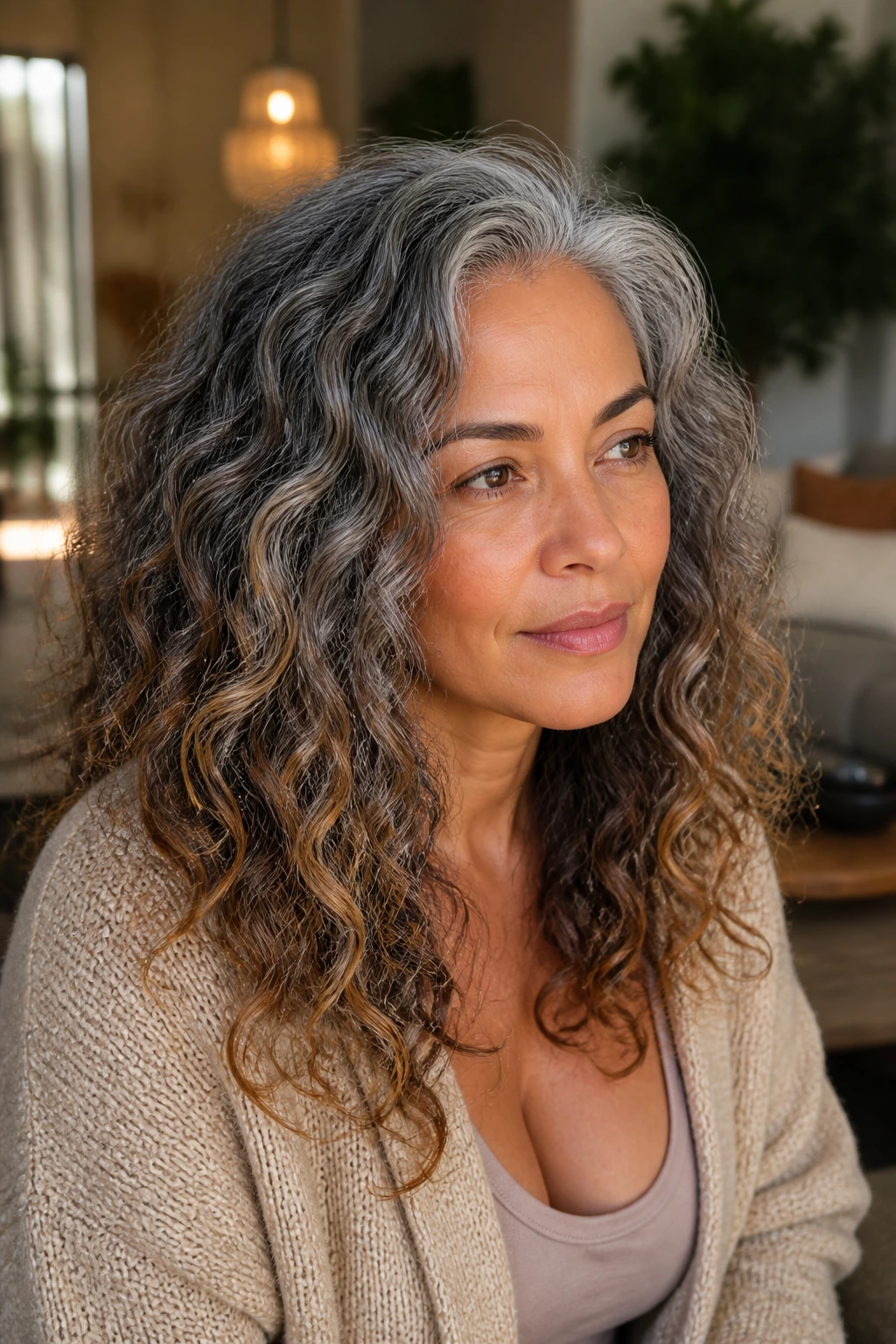
Picture walking out of the salon with silver on top and caramel peeking through the curls underneath. That’s this look. It sounds contradictory, and that’s exactly why it works so well on olive skin. The shadow root gives you depth, the silver lifts the top layer, and the caramel underlights stop the whole thing from reading cold or washed out.
The magic is in the hidden dimension. When loose curls move, you catch flashes of warmth beneath the silver, and olive skin tends to love that tension. It’s not a loud contrast. It’s a controlled one. The style looks polished when pinned behind one ear, and a little softer when the curls fall forward and the underlights stay mostly tucked away.
- Best for: Medium-density hair that can hold a bend without puffing up
- Ask for: Caramel lowlights placed under the top veil, not all over
- Style note: A side part gives the silver more visible sweep across the forehead
The practical upside is that this grows out like a dream. The shadow root buys you time, the underlights keep the hair from looking monochrome, and the curls hide the transition so nobody is staring at the regrowth line.
5. Greige Money Pieces around Loose Curls
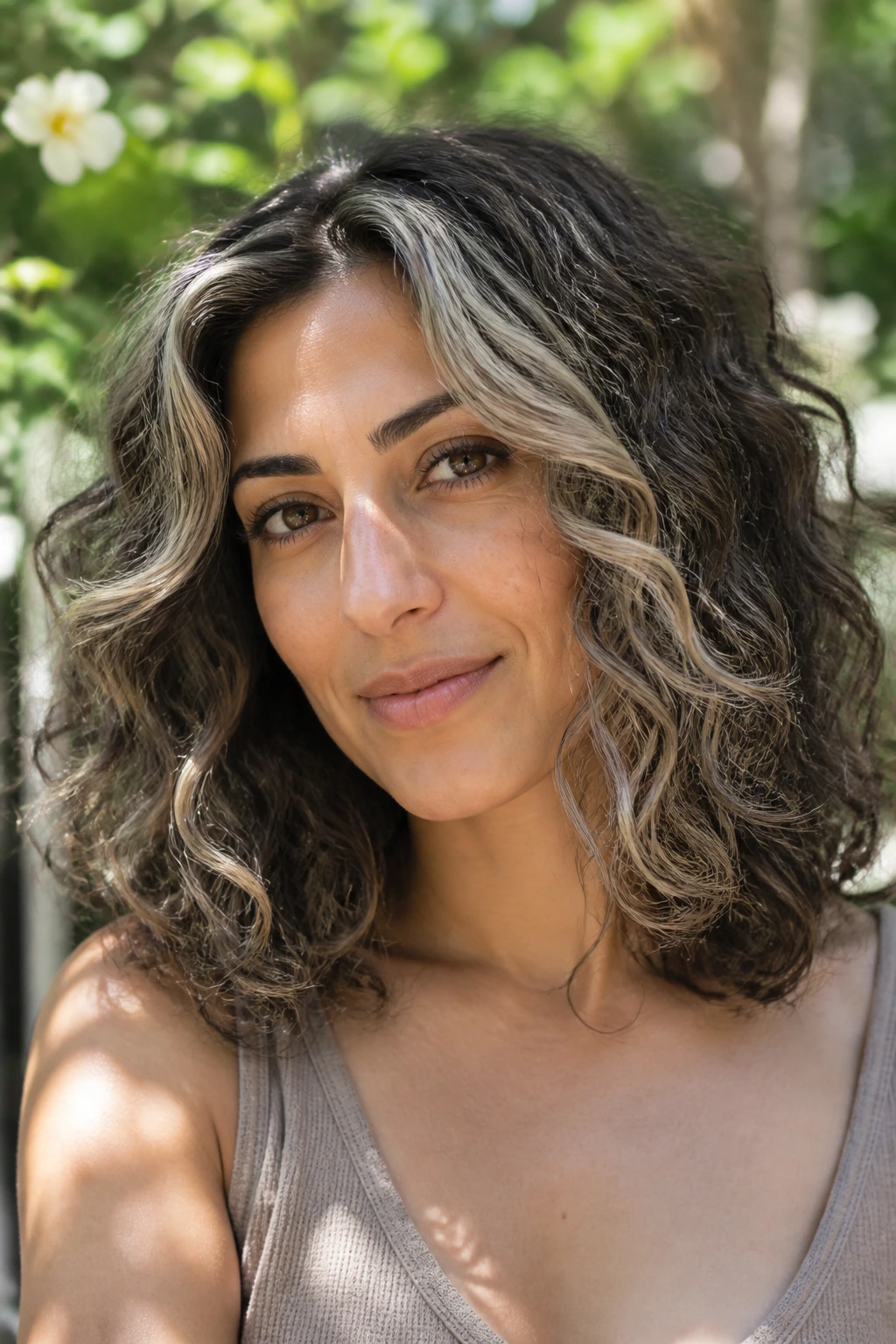
Greige money pieces are the easy way to make grey feel less severe. The front sections sit in that sweet middle zone between grey and beige, so they brighten the face without turning frosty. Around olive skin, that matters. A harsh white stripe can steal warmth from the cheeks. Greige has enough softness to keep the face alive.
I like this look on shoulder-length curls because the face-framing pieces move more than the rest of the hair. They catch light when you turn your head, and that flicker makes the color look expensive in a quiet way. Keep the crown a shade deeper so the money pieces don’t turn the whole style into a stripey situation.
If you’ve ever liked grey but worried it would age you, this is the version to try first. It keeps the impact near the eyes and lets the rest of the hair stay softer and darker. That balance is useful. It’s also more forgiving when your curl pattern loosens over the day.
6. Platinum-Dusted Ends on Espresso Roots
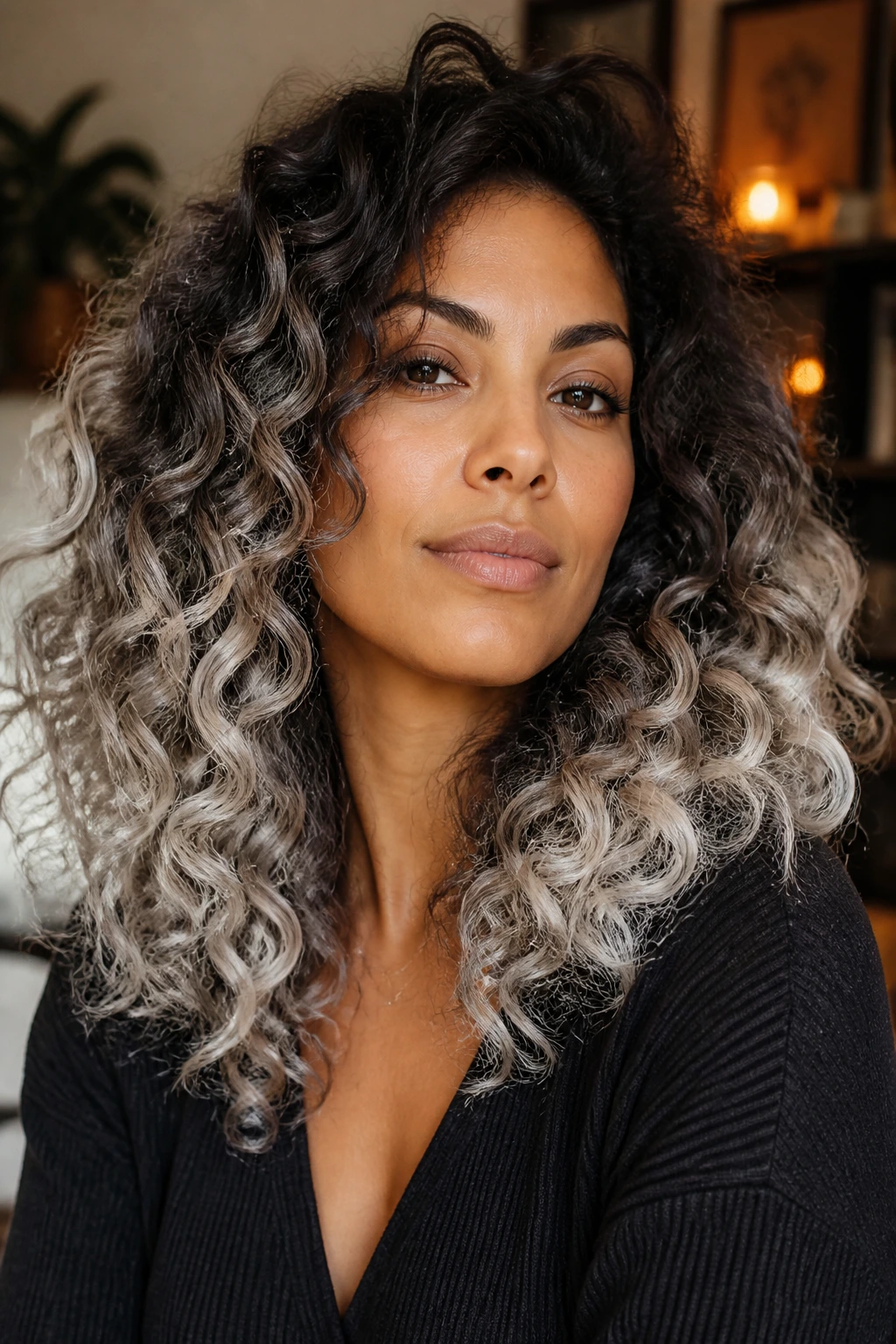
This is the dramatic one in the group. Espresso roots give the base real weight, then the ends lift into a platinum-dusted grey that feels almost frosted. Unlike a full platinum grow-out, this style keeps the brightness at the tips, which means olive skin gets contrast without losing definition around the face.
The reason it works is simple: the eye starts at the roots and travels down. That darker crown prevents the light ends from floating away, and loose curls make the transition between dark and light look softer than it would on straight hair. If you wear your hair long, the effect is even stronger because the ends have room to show the gradient.
This is best for someone who likes a bolder color story and doesn’t mind a little toner upkeep. The lighter ends need regular care, especially if your water runs hard. I’d use a color-safe mask once a week and keep heat as low as you can get away with. Platinum at the tips is unforgiving when it gets dry. Not impossible. Just unforgiving.
7. Grey Halo Curls with Soft Layers
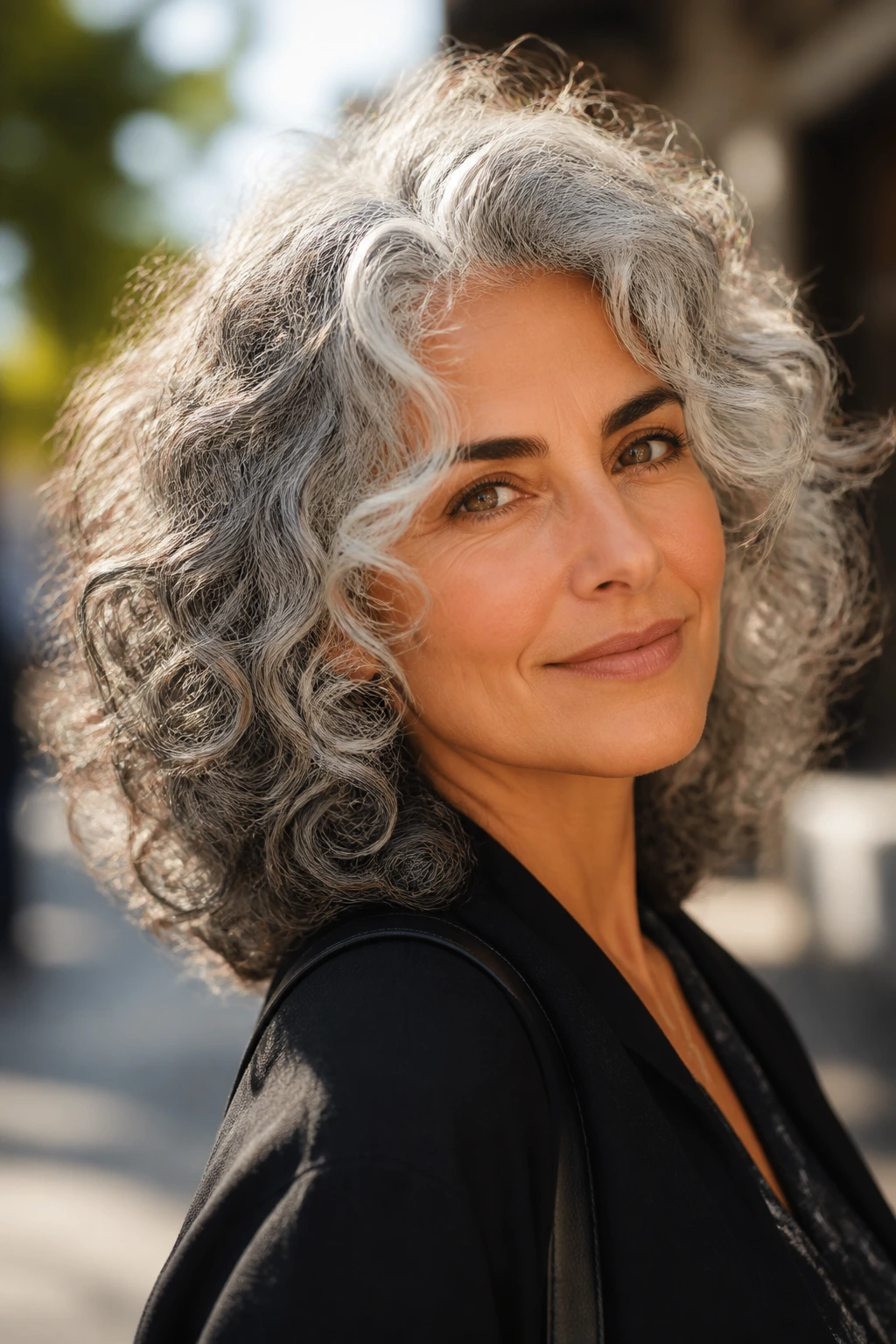
A grey halo is less about full coverage and more about where the brightness lives. The top and outer layers carry the silver-grey tone, while the underneath stays deeper and quieter. On olive skin, that halo effect can be flattering because it brightens the face without surrounding it in one solid pale block.
Why It Flatters
Soft layers matter here. Without them, the grey halo can sit like a cap, and nobody wants that. With them, the curls separate into little bands of tone, and the silver lands on the outer curves instead of swallowing the shape. The result feels airy, especially when the curls are brushed out just enough to loosen the ringlets.
- Keep the top layers slightly lighter than the underside
- Ask for a root shadow that’s mushroom or graphite, not jet black
- Use a curl cream with a light finish so the halo doesn’t go limp
My favorite part: the halo catches daylight at the crown first, which is where olive skin often benefits from a bit of lift. It’s subtle, but it changes the whole mood.
8. Steel Ribbon Highlights in Dark Waves
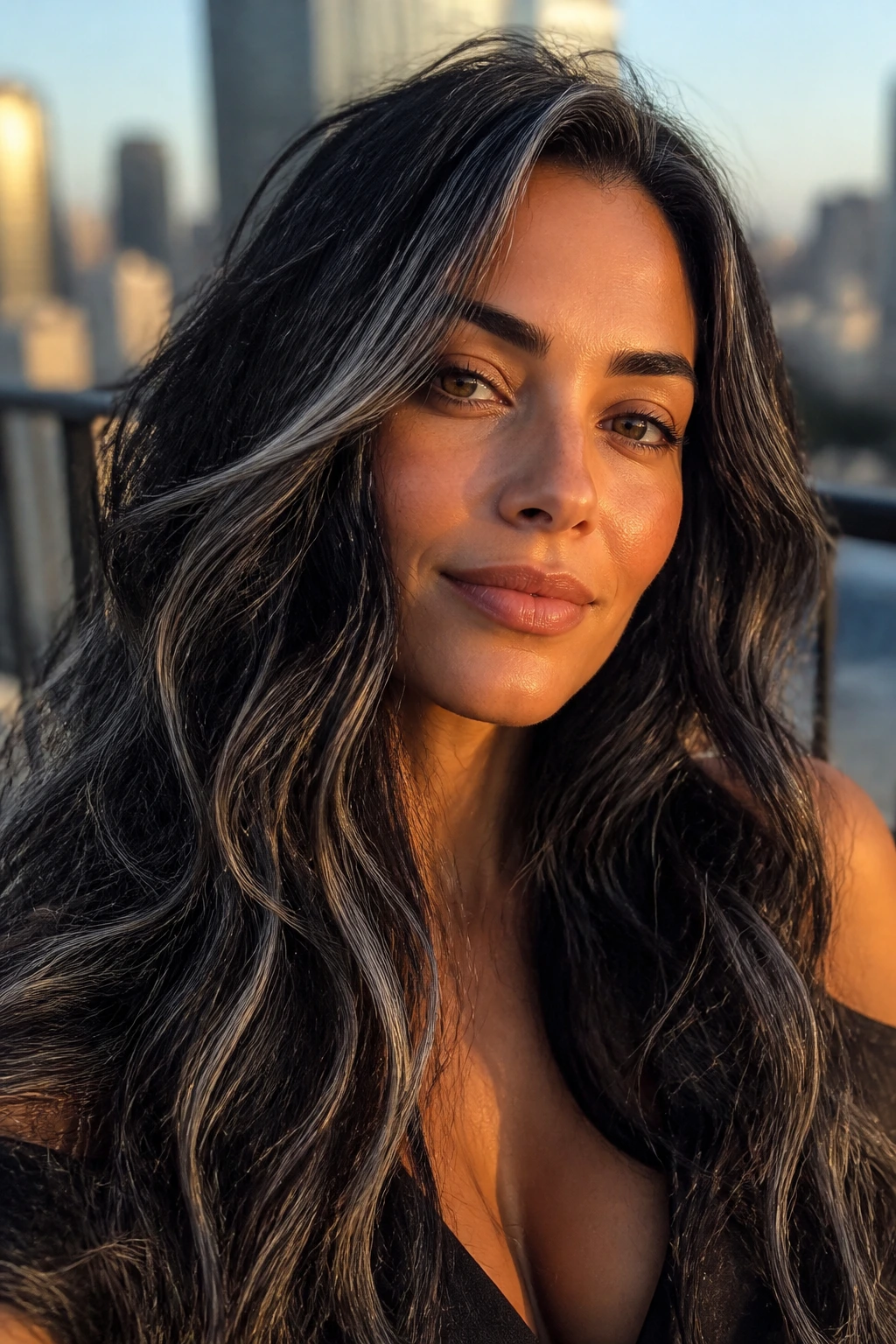
Steel ribbon highlights are for the person who wants grey to look deliberate, not dusty. Thin ribbons of steel-grey run through dark waves, and because they’re narrow, they pick up light in sharp little flashes. On olive skin, the contrast is clean. The darker base keeps the face from going pale, and the steel pieces add edge.
I prefer this on long waves rather than tight curls. The ribbons need room to stretch and show off, and loose waves give them that. If the hair is too tightly curled, the steel can blur into the background. A loose S-wave, though, keeps each streak readable without looking stripey.
This is one of those styles that looks expensive when the finish is a little messy. Not frizzy. Messy. The difference matters. Finger-separate only a few sections, leave some ends piecey, and don’t polish every wave into submission. The whole point is movement.
9. Charcoal-to-Silver Ombré with Long Lengths
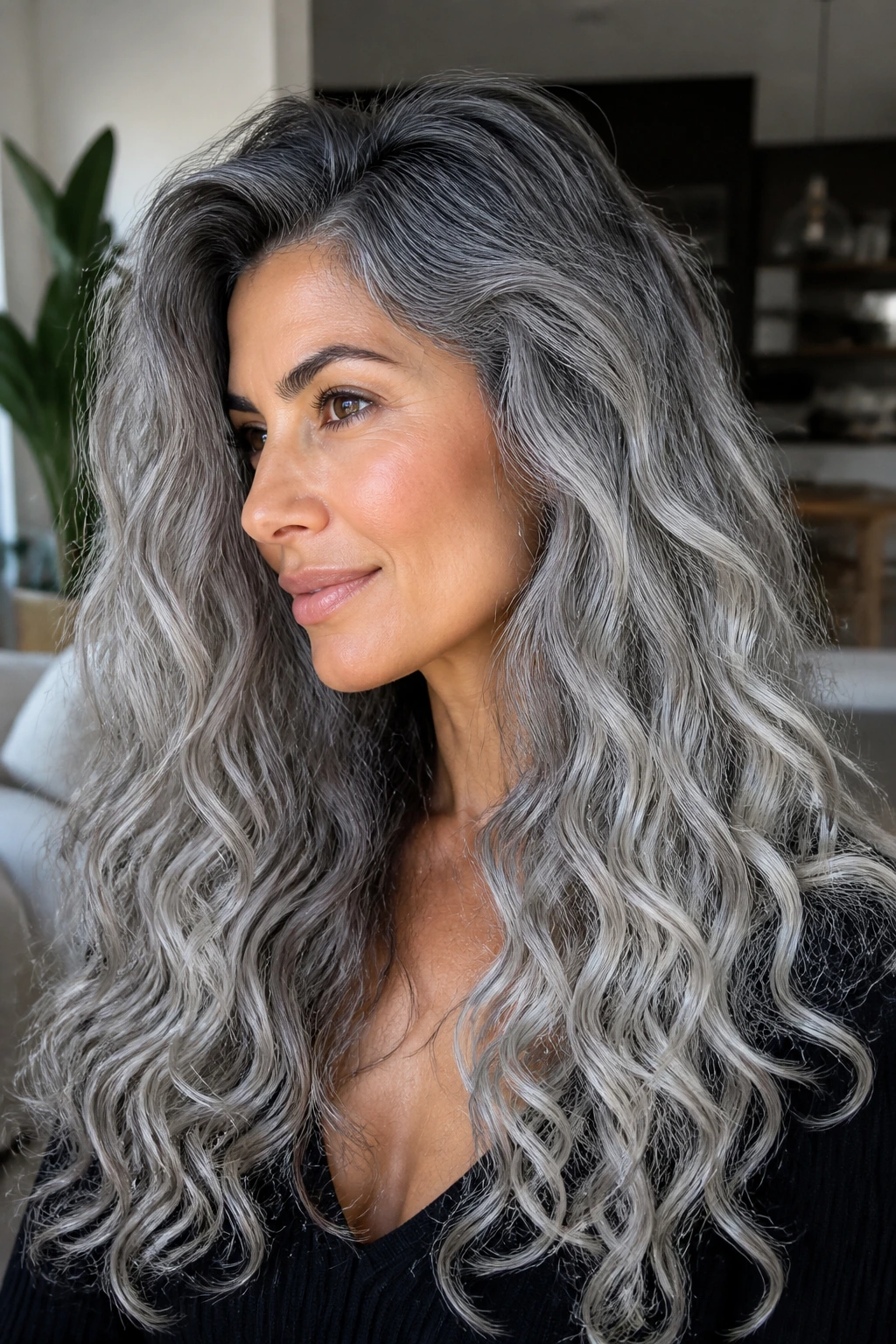
Why does ombré work so well with grey? Because the fade does the same job a good makeup contour does: it shapes the face while the color shifts. Charcoal at the roots and crown melts into silver near the ends, and long loose curls make the transition feel slower, smoother, and more natural than a straight line would.
How to Get the Most From It
The long length is not optional here. You need room for the fade to breathe. If the hair is too short, the charcoal-to-silver blend can look abrupt, almost like two different color jobs stacked together. Ask your colorist to keep the transition soft through the midlengths so the silver only really takes over near the bottom third.
A deep side part makes the charcoal more flattering on olive skin because it puts the darker tone closer to the forehead and temples. Then the silver ends move like a second layer. If you want to wear this up, let a few silver pieces fall around the face. Otherwise the contrast can disappear too quickly.
10. Salt-and-Pepper Layered Mid-Length Cut
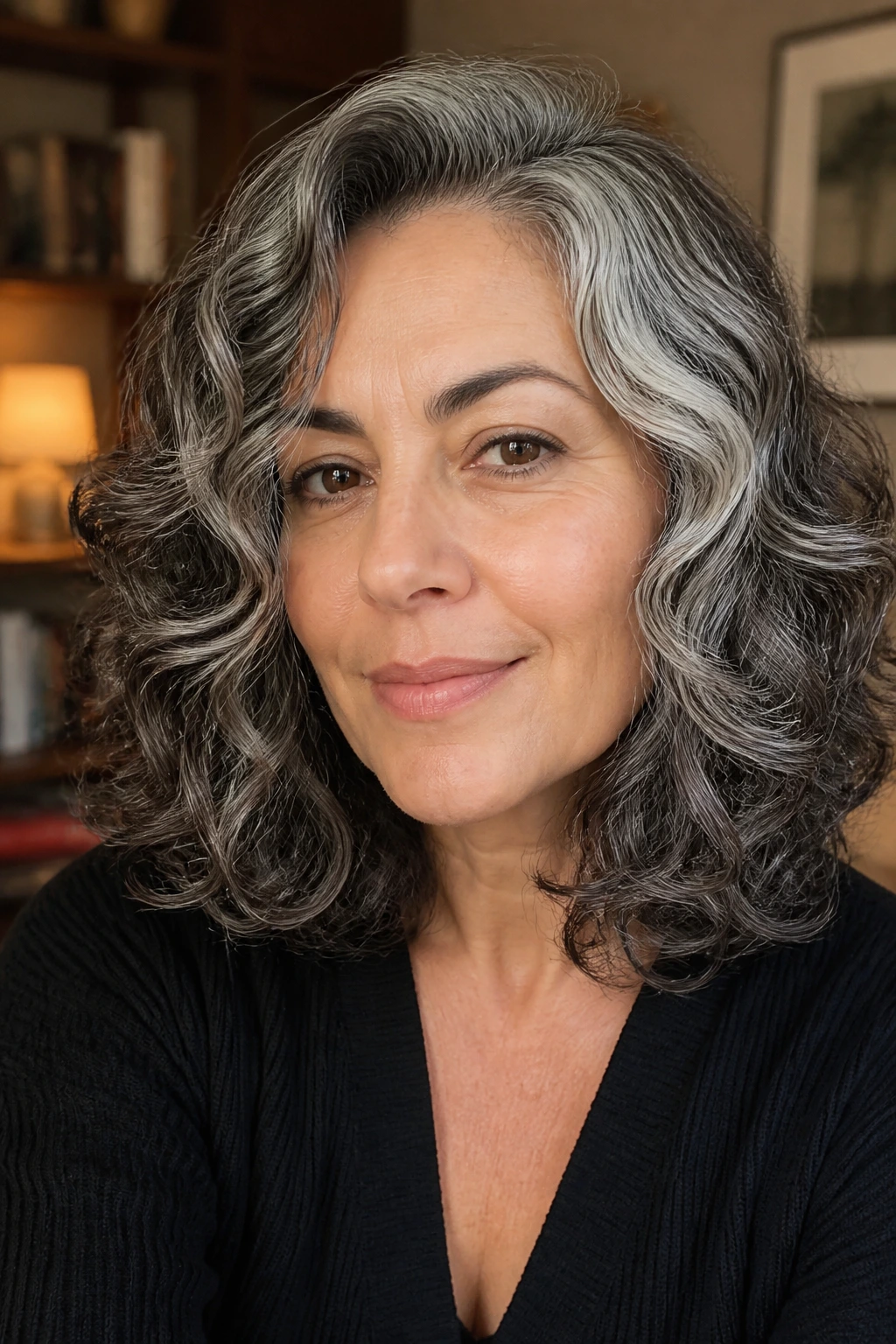
Salt-and-pepper hair doesn’t need to look accidental. In a layered mid-length cut, it can look crisp, modern, and a little bit lived-in in the best possible way. The trick is keeping the salt pieces bright enough to notice and the pepper pieces deep enough to anchor the curl pattern. Olive skin tends to do well with that balance.
I’ve always liked this look on hair that has some natural grey already showing. It doesn’t fight the pigment you have left; it works with it. The loose curls keep the lighter strands from reading patchy, and the mid-length cut prevents the style from feeling heavy around the jaw.
A few internal layers make a huge difference. They let the curls stack without building a triangle shape, which is where salt-and-pepper styles often go wrong. If the ends start to puff outward too much, the color reads busier than it should. Keep the layers soft, then let the curl pattern do the rest.
11. Graphite Root Smudge with Beige Lift
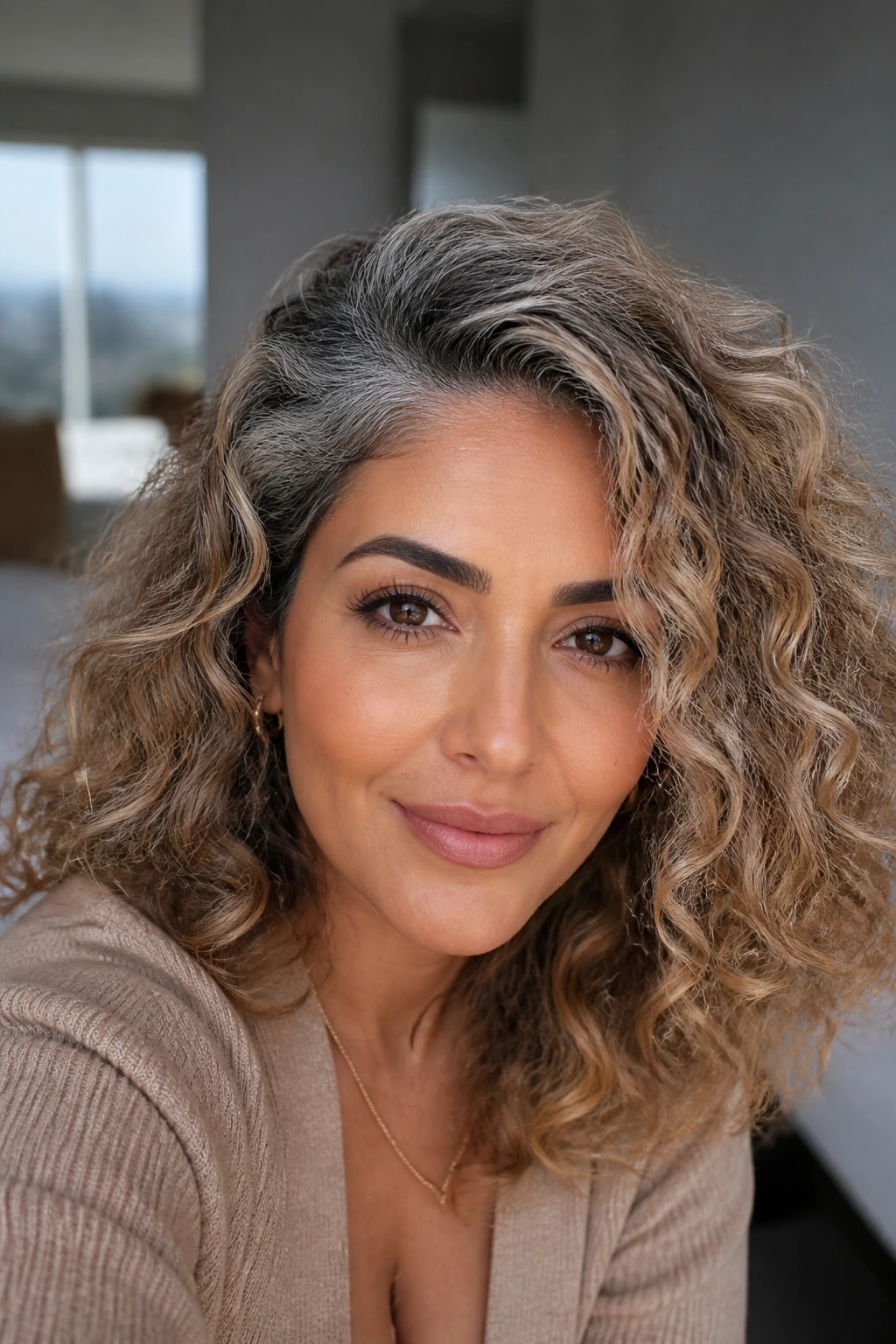
Graphite root smudge is one of my favorite options for olive skin because it has enough coolness to feel current but not so much brightness that it steals warmth from the face. Add beige lift through the midlengths and you get a softer, more wearable grey story. The beige keeps the silver from going sterile.
This is a quiet style. It does not need a big contrast moment. Instead, it moves in layers: dark graphite near the scalp, muted beige-grey through the body of the hair, and a little extra brightness where the curls bend at the ends. On loose curls, that combination reads plush rather than flat.
The practical benefit is grow-out. A graphite smudge hides the root line better than a pale ash base, so you can go longer between toners or touch-ups. If your olive skin leans golden, this one is especially nice because the beige lift prevents the whole look from turning cold. It’s probably the most forgiving option in the group.
12. Antique Silver Bob with Airy Bend
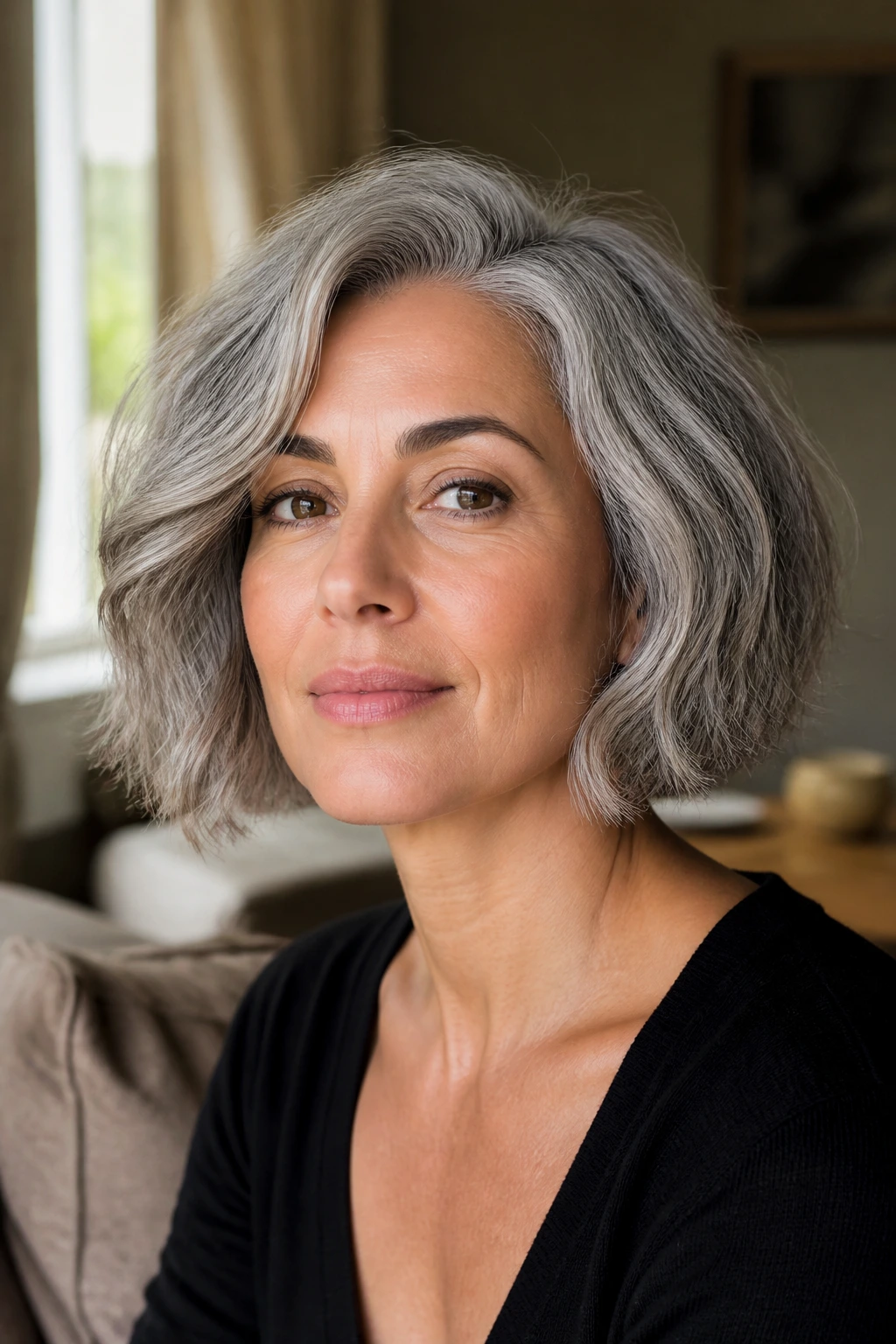
An antique silver bob is not the same thing as an icy silver bob. Antique silver has a softer, slightly muted finish—more pewter than chrome—and that difference shows up fast on olive skin. The airy bend keeps the bob from looking blunt, while the color gives it enough shine to feel fresh.
What Makes It Different
A bob lives or dies by the ends. If they’re too sharp, the grey can look severe. If they’re too soft, the shape disappears. Antique silver works because it holds some shadow inside the tone, so the hair still has texture when it moves. A loose bend at the jawline keeps the whole cut from boxing in the face.
This one suits people who want grey with a little restraint. It’s polished enough for a straight blouse or blazer, but it still loosens up nicely with a sweater or bare shoulders. If your olive skin has cool undertones, the antique finish can look especially clean. If you lean warmer, ask for a touch more beige so it doesn’t feel too metallic.
13. Ash Brown Curls with Frosted Underlayer
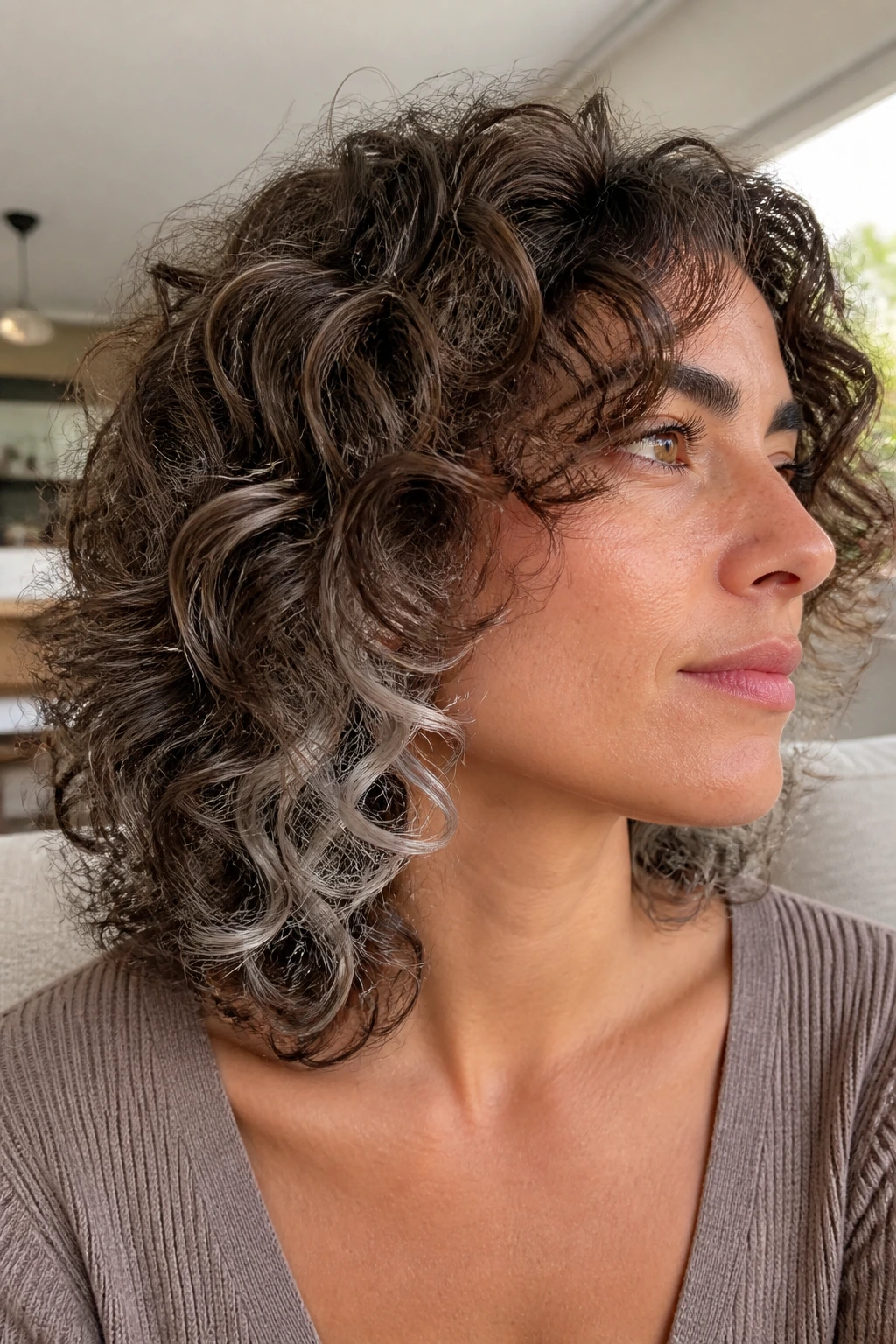
Ash brown curls with a frosted underlayer are made for anyone who wants grey without going full silver. The top stays ash brown, which helps olive skin keep its natural warmth, and the frosted underlayer only appears when the curls move or when you tuck the hair behind one ear. That hidden flash is the whole reason the style feels interesting.
Why It Works
The underlayer adds surprise. You do not see it all at once, which keeps the look from reading flat in direct light. On loose curls, the frost peeks through in little windows between the bends. That makes the hair look thicker too, because the color shift creates depth.
I’d choose this if you’re testing grey but not ready to commit to a full silver direction. The ash brown base is forgiving, and the frosted bits can be placed lightly near the ends or more heavily near the back, depending on how much contrast you want. It’s a smart way to keep the maintenance manageable while still getting that cool-skin, cool-hair effect.
14. Lived-In Grey Balayage for Dense Curls
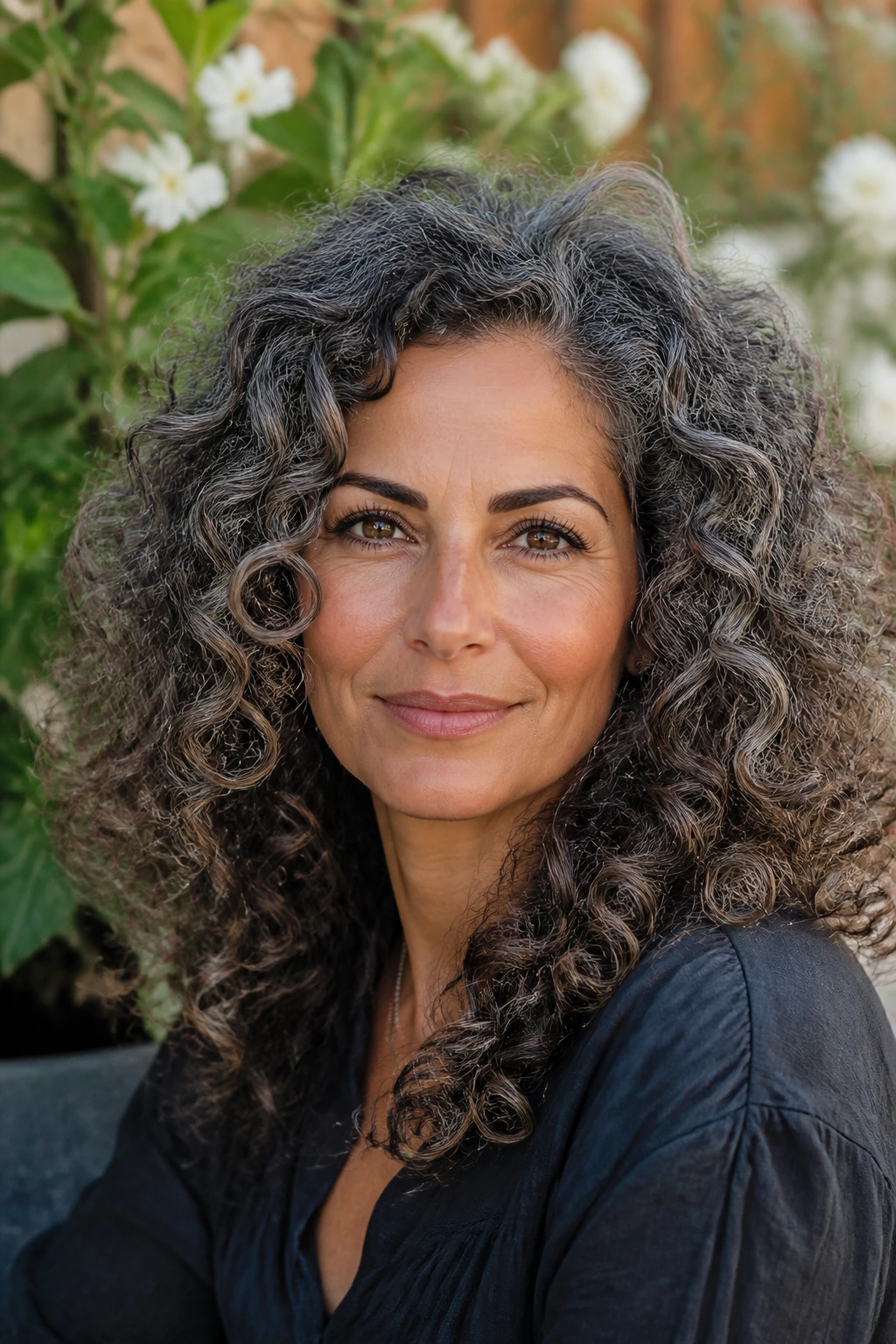
Dense curls need a different hand. Too much grey packed into the surface layer and the hair can feel heavy fast. A lived-in balayage solves that by scattering the grey through selective panels, leaving pockets of depth underneath so the curls can breathe. Olive skin likes the softness. The face gets brightness without the whole head turning into a silver block.
The color should look painted, not striped. That means wider placement around the crown, thinner pieces near the temples, and a few brighter streaks through the midlengths where the curl pattern opens up. On dense hair, that placement keeps the tone from disappearing into the mass of hair.
I’m a big believer in this look for thick textures because it respects the curl. It doesn’t try to flatten the shape or force every strand to behave the same way. Let the density stay. Just break it up with grey in the right places, and suddenly the whole style feels lighter without actually removing much hair.
15. Pearl Blonde Streaks over Shadow Roots
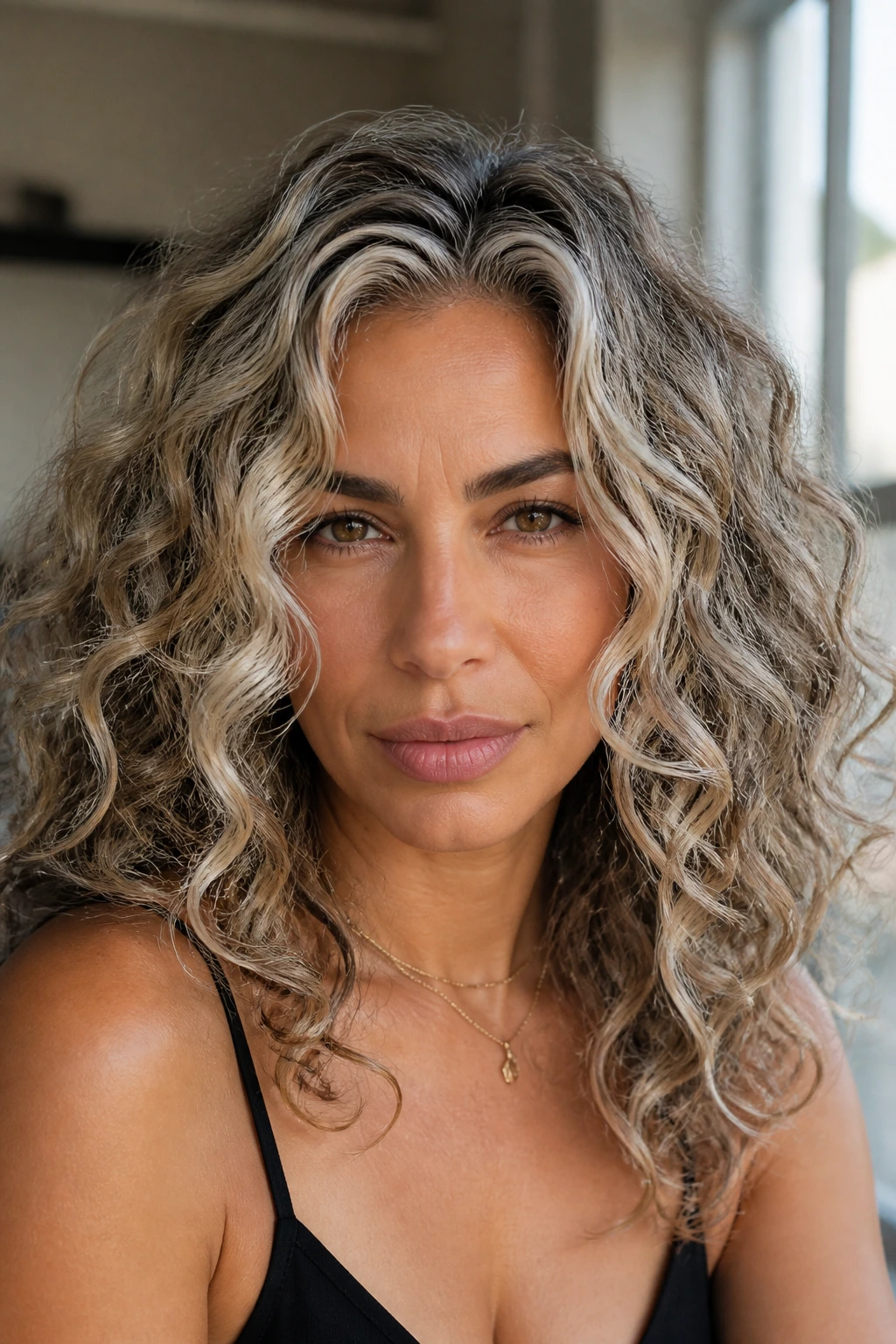
Can grey and blonde sit together without fighting? Absolutely, if the blonde is pearl and the root is shadowed. Pearl blonde streaks over a darker root give olive skin a bright edge, but the shadow root keeps the look from turning washed out. The loose curls are what make the streaks feel soft instead of streaky.
How to Wear It
Ask for pearl pieces that are thin enough to weave through the curls, not broad ribbons that sit on top of them. The effect should be airy. If the blonde pieces are too thick, the contrast can overpower olive undertones and make the complexion look less even. A shadow root one or two levels deeper solves a lot of that.
This is the version I’d choose if you like brightness near the front of the face. It’s livelier than a smoky mushroom blend and a little less moody than charcoal. Think of it as the daylight version of grey roots: lighter, fresher, and a touch more playful.
16. Smoke-Glass Waves with Dimensional Lowlights
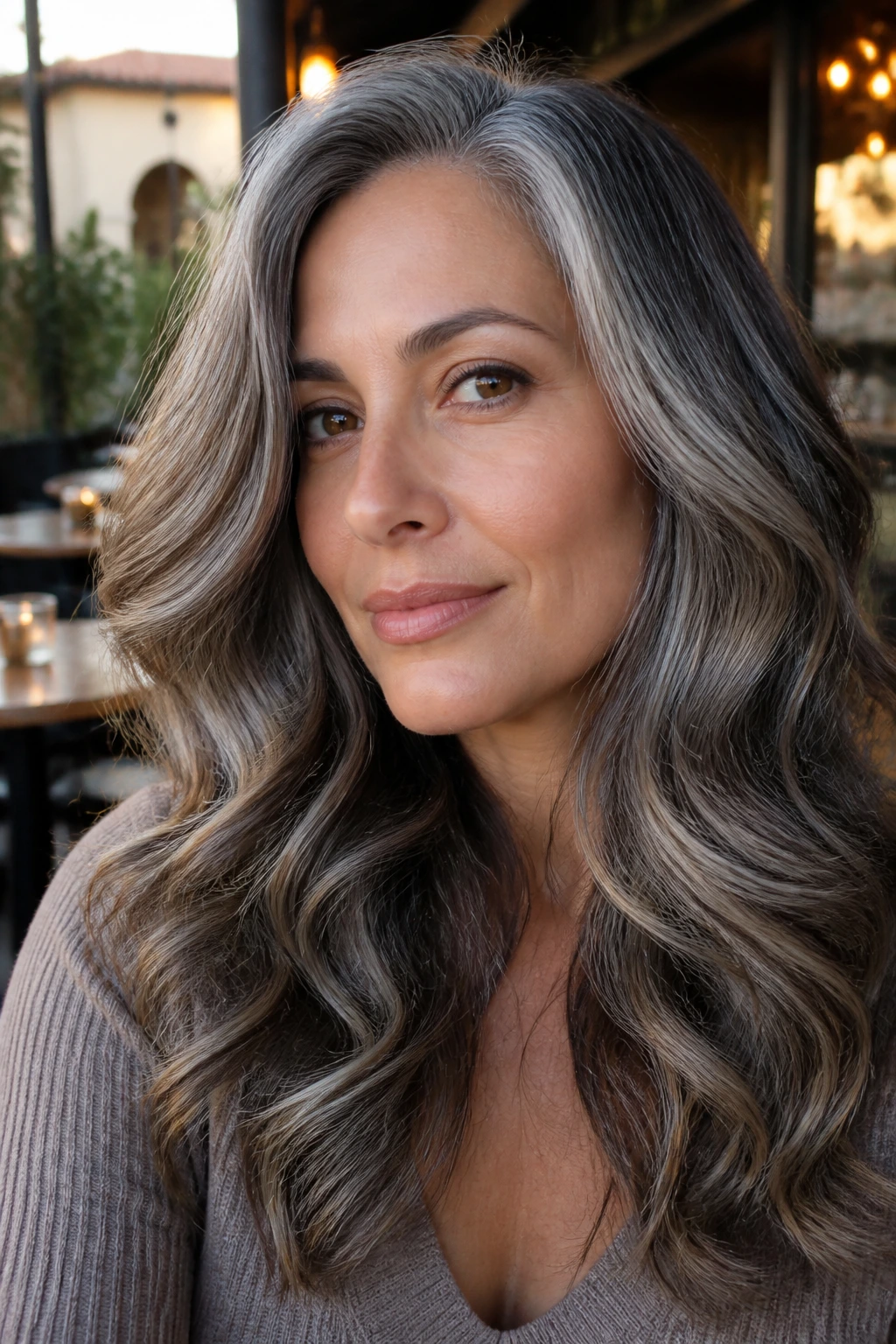
Smoke-glass waves sound dramatic, but the look itself is more subtle than the name suggests. The color sits between grey, smoke, and sheer silver, while dimensional lowlights keep the waves from turning chalky. On olive skin, those lowlights are the part that matters most. They preserve warmth in the face and stop the grey from reading one-note.
The waves should be wide and loose, not curled into a tight pattern. A flat iron bend or a large-barrel iron works well because it leaves a smooth surface that the smoke-glass tone can sit on. If the texture is too tight, the lowlights get lost. If it’s too straight, the color loses movement. That middle ground is the sweet spot.
This style is especially good if you like hair that looks polished in a ponytail too. The lowlights still show through, which means the color doesn’t disappear when the hair is tied back. I like that practicality. It keeps the style from feeling precious.
17. Cool Taupe Grey Cascade with Curtain Bangs
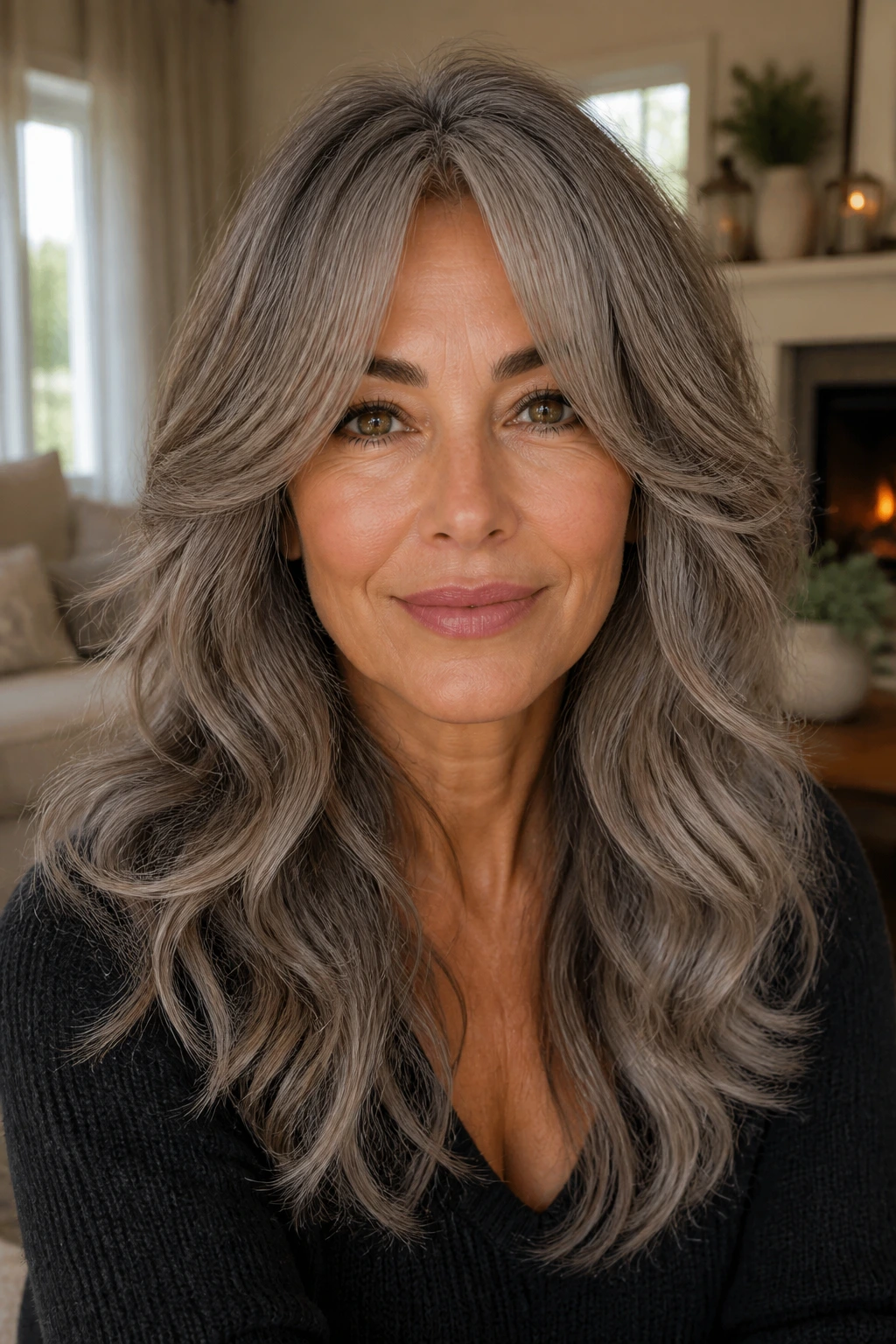
Cool taupe grey and curtain bangs are a very good pair when the face wants softness near the eyes. The bangs break up the forehead, the taupe-grey cascade moves through the lengths, and loose curls keep the whole thing from becoming too deliberate. On olive skin, taupe acts like a buffer. It’s grey’s kinder cousin.
The cascade needs a few long layers so the hair can swing. Without them, the grey can sit in one heavy sheet, and curtain bangs can start to look disconnected from the rest of the cut. Ask for the bangs to blend into the side pieces rather than ending in a sharp shelf. That tiny detail makes the style easier to wear.
What I like here is the balance. The bangs add shape, the taupe softens the coolness, and the curls keep the movement casual. It’s the sort of style that can look dressed up with a lip color or completely relaxed with a plain turtleneck.
18. Salted Espresso Curls with Silver Threads
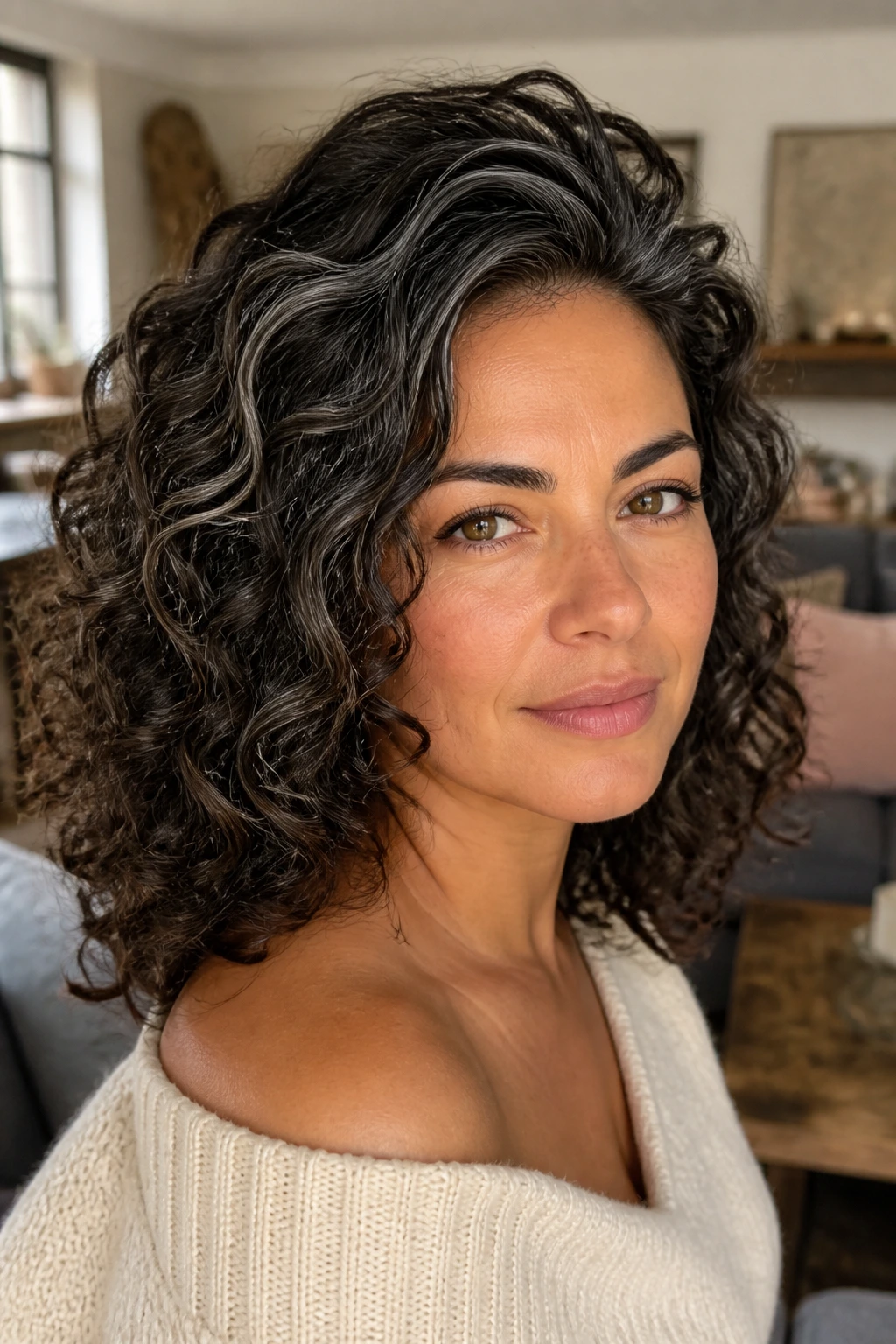
Salted espresso curls are for people who want a dark base that still shows grey without turning fully silver. The espresso keeps olive skin looking alive, and the silver threads threaded through the curls act like little sparks. They’re narrow, scattered, and much easier to wear than a broad silver band.
This look sits somewhere between natural and enhanced. That’s what makes it so wearable. The curls do the work of separating the threads, so each bright piece has room to breathe. On straight hair, the same placement can look more obvious. On loose curls, it reads softer and more dimensional.
Who It’s Best For
If you like grey but don’t want to lose your darker root identity, start here. It works on medium to long lengths, and it’s friendly to people who don’t want to be in the salon every month. The silver threads can be refreshed selectively, which makes upkeep less of a headache than a full-head grey transition.
19. Metallic Ash Lob with Side Sweep
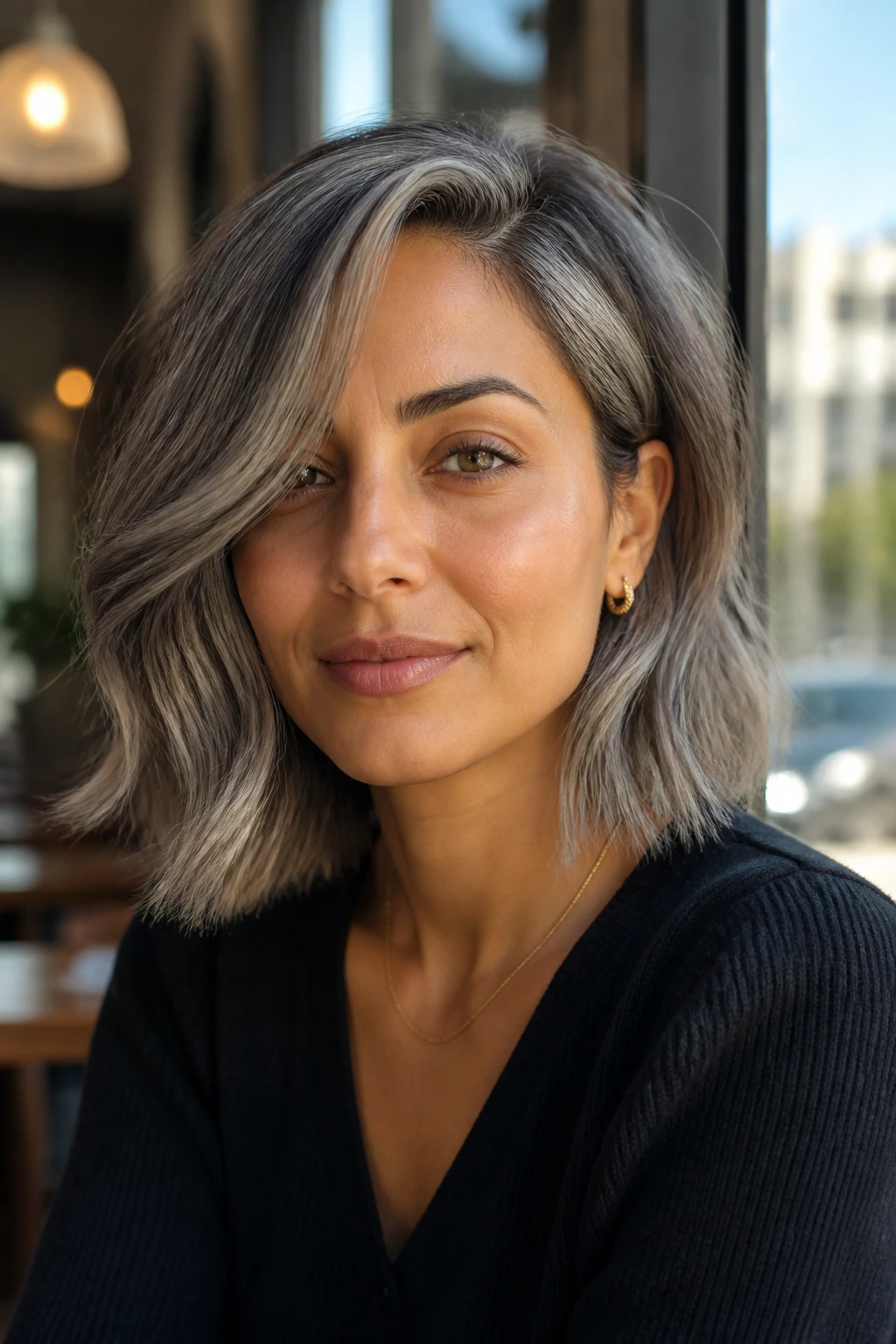
A metallic ash lob with a side sweep is sleek without being stiff. The ash tone gives the hair that cool, slightly reflective finish, and the side sweep keeps the lob from looking symmetrical in a boring way. Olive skin benefits from the offset part because it lets the darker side balance the face while the lighter side brings in brightness.
Why It Stands Out
Unlike a center-parted ash lob, the side sweep creates movement before the curls even start. That matters. The color gets a built-in shape, and the hair doesn’t need as much curling to look styled. If you want grey that feels modern without tipping into high-contrast drama, this is a smart pick.
I’d keep the sweep loose, not pinned hard against the head. Let it fall softly over one temple, then let the rest of the lob bend under at the ends. The result is neat, slightly moody, and very wearable with minimal fuss.
20. Frosted Fringe and Loose Curls
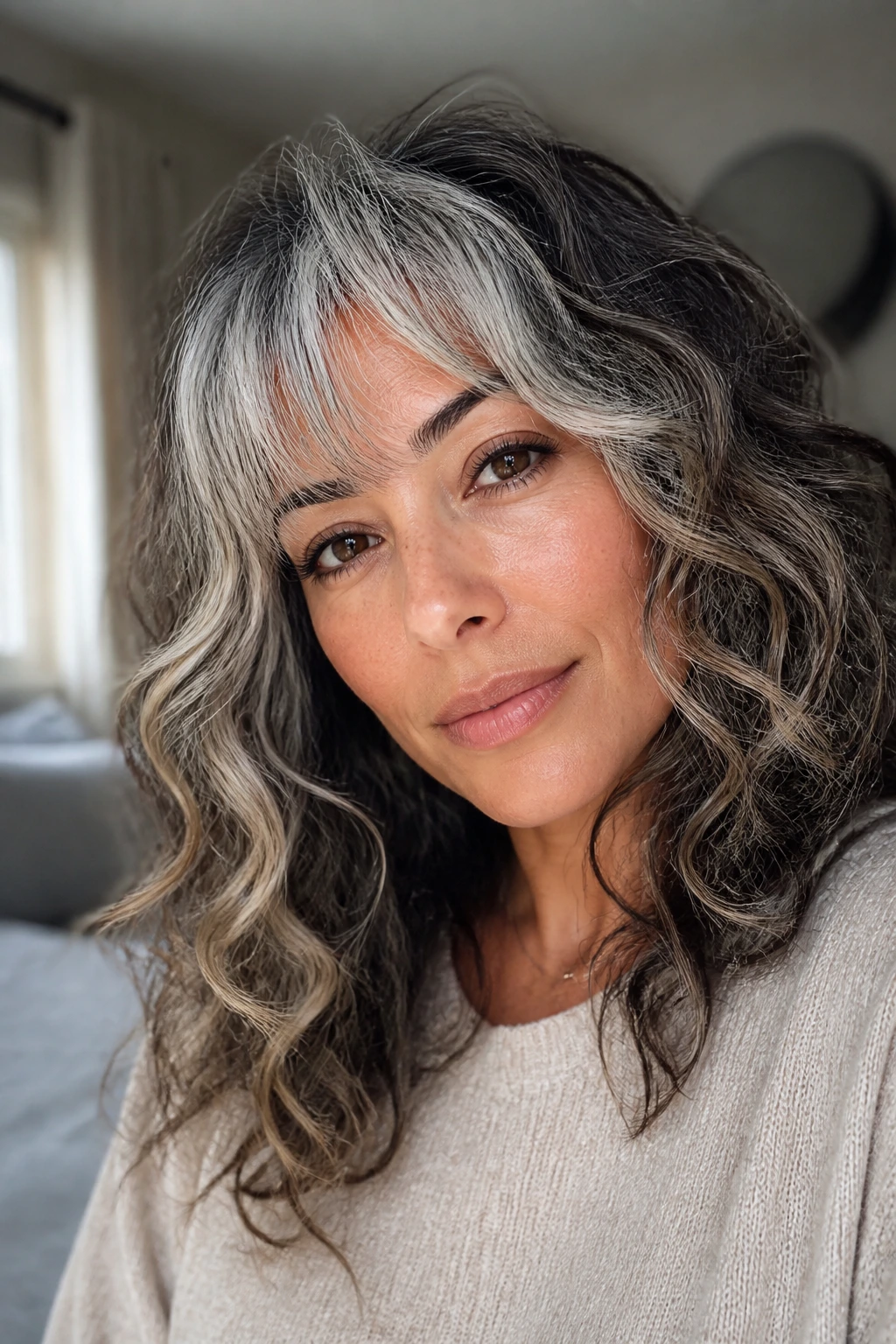
A frosted fringe changes the whole face. The front gets that pale grey or silver touch, while the rest of the hair stays deeper and softer in the curls. On olive skin, the fringe needs some beige or pearl in the formula so it doesn’t turn harsh. Done right, it brightens the eyes and keeps the color story local instead of overwhelming the whole head.
The fringe also lets you test how much grey you actually want near the face. Some people love a lot of light around the forehead. Others want just a whisper of it. A frosted fringe gives you a very clear answer without requiring a full transformation.
I like this look most when the curls are loose and a little brushed out. That keeps the fringe from sitting on top of the rest of the hair like a separate piece. Blend matters here. You want the front to announce itself, then melt back into the lengths.
21. Slate Grey Half-Up Waves
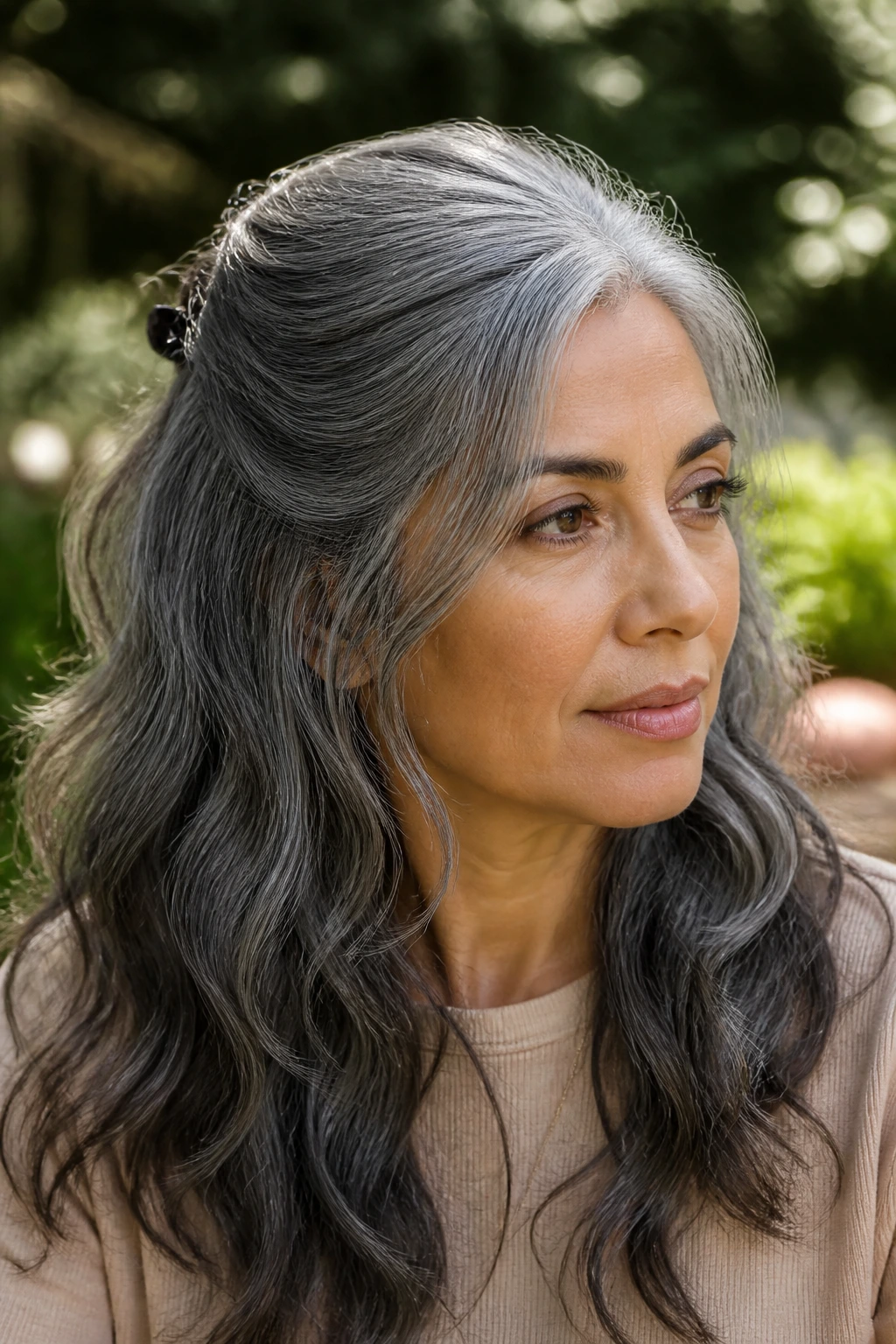
Why does a half-up style help slate grey so much? Because it shows off the crown and keeps the waves open through the lower half of the head. Slate grey has enough depth to flatter olive skin, and the half-up shape adds lift without hiding the color. It’s also one of the best ways to make loose curls look fuller around the shoulders.
The top section should be pulled back softly, not tight. A loose twist or small clip works better than a stretched ponytail because it lets the front pieces keep their curve. When the lower waves fall, the slate tone shows up in a cleaner band, and the face gets a little halo of shadow and shine.
This is a practical style too. It stays put through a long day better than fully loose curls, and it gives the ends a chance to show off the color without tangling at the nape. If your hair tends to flatten by lunch, half-up waves are the easiest fix.
22. Cascading Smoke Grey Layers
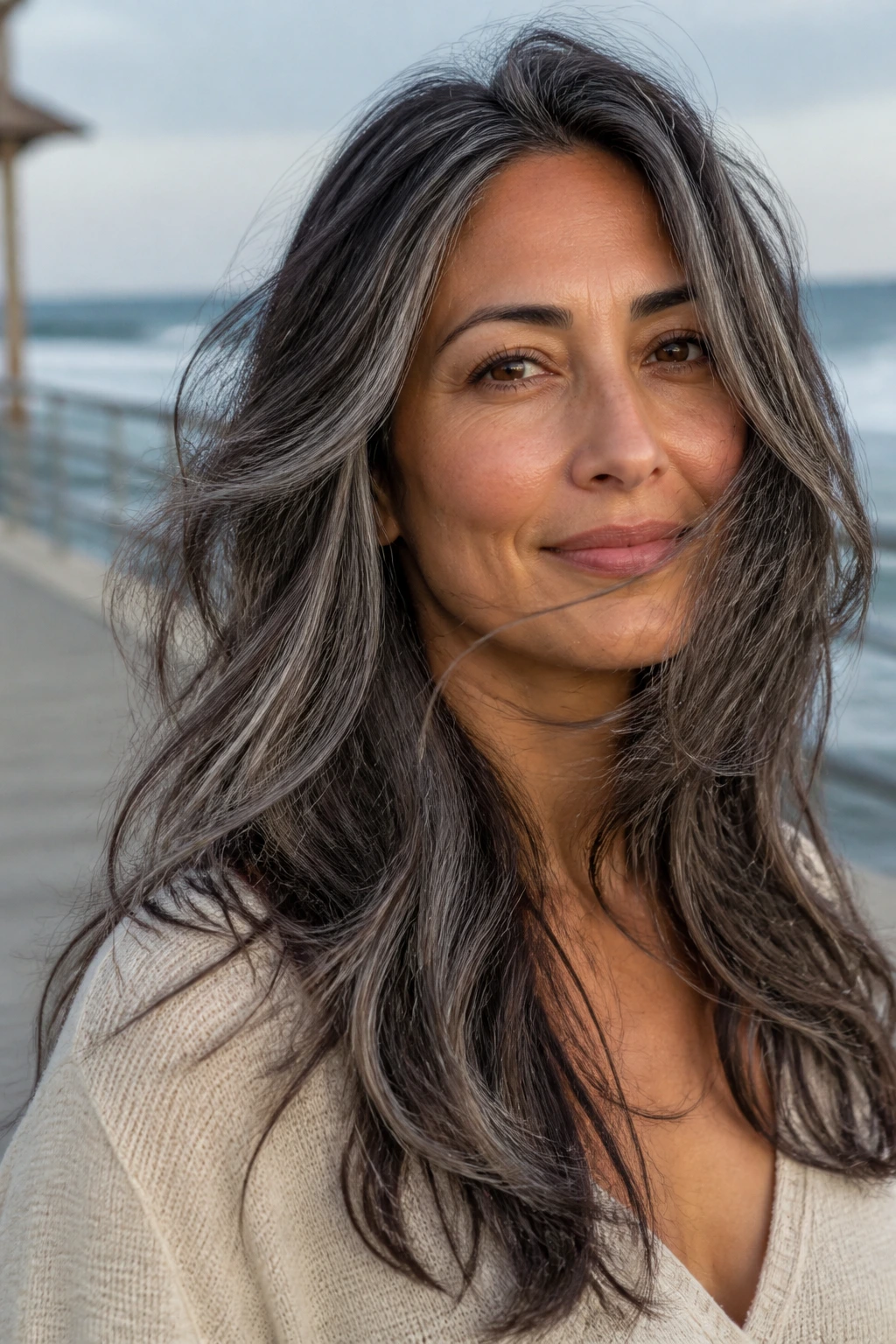
Cascading smoke grey layers have the most movement of the bunch, and that’s why they land so well on olive skin. The layers let the grey fall in sheets of different depth—some smoky, some almost silver, some shadowed enough to keep the face from losing warmth. Loose curls make the cascade visible from every angle.
This is the kind of style that looks best when it isn’t over-styled. You want the layers to fall naturally, with a bit of bend in the midlengths and a softer finish at the ends. If the curls are too uniform, the cascade turns into a stack. If they’re too loose, the layers disappear. There’s a narrow middle, and that’s where the good version lives.
I’d choose this for long hair that needs shape as much as color. The layers prevent the style from dragging, the smoke grey keeps it cool, and the curls stop the whole thing from feeling static. It’s a strong finish to the collection because it shows how grey can move, not just sit there.
Why Grey Roots Need Dimension, Not a Flat Block of Color
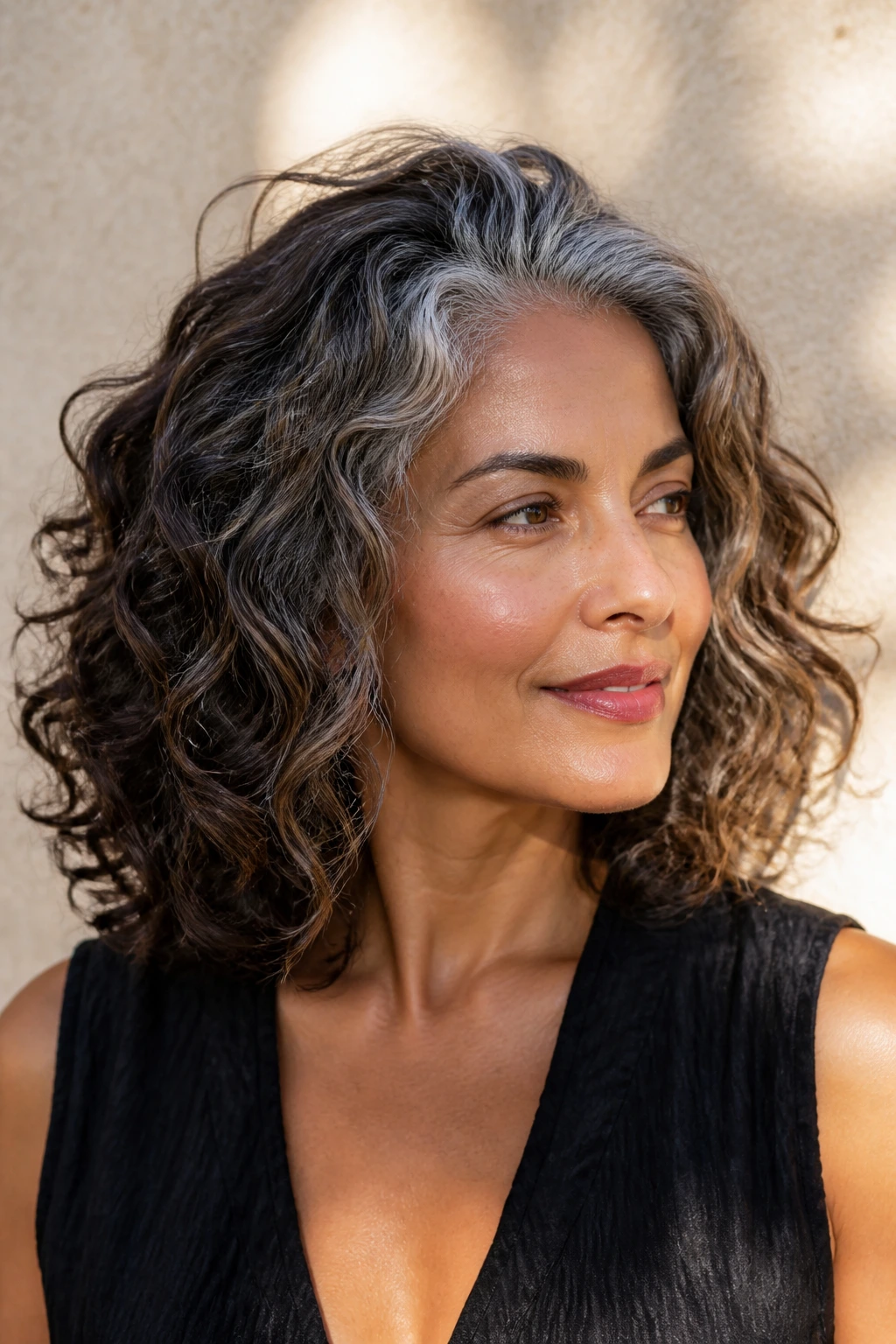
Grey roots on olive skin look best when they have somewhere to travel. A flat silver block at the crown can make the face look harder, especially if your skin leans green or golden. Add a root shadow, a lowlight, or a beige-grey transition, and the whole thing changes. The color starts to behave like fabric with folds instead of paint on a wall.
Loose curls help because they keep light from landing in one place. The curve of each curl catches the ash or pearl tone on one side and leaves a little depth on the other. That shadow is your friend. It keeps grey from looking chalky and gives olive skin the contrast it usually needs.
I’ve noticed that the most flattering grey styles are the ones with at least two tones, sometimes three. A graphite base, a pearl ribbon, and a soft beige or taupe middle can look richer than a single bright silver ever will. It’s less about chasing one perfect grey and more about building a small range that behaves well in real light.
Essential Tools for Grey Roots and Loose Curls
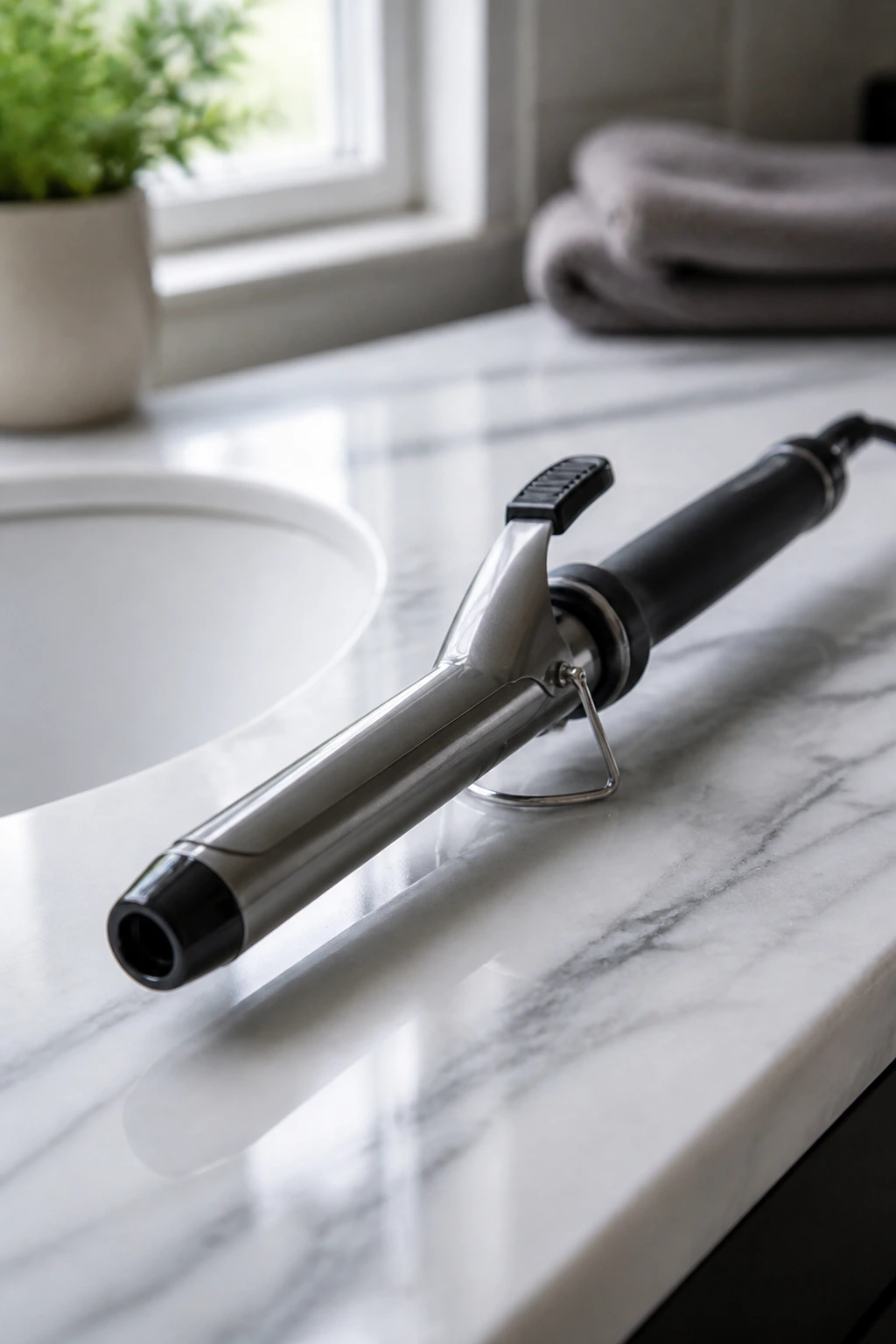
- 1-inch curling iron or wand: Best for shoulder-length cuts and tighter loose curls that hold their shape.
- 1¼-inch curling iron: Softer bend for longer hair; this is my pick when you want movement, not ringlets.
- Heat protectant spray: Grey and silver tones show dryness fast, so this is non-negotiable before hot tools.
- Color-safe, sulfate-free shampoo: Keeps the grey from dulling too quickly and helps preserve toner.
- Purple shampoo or blue shampoo: Purple is useful for pale silver and blonde-grey; blue works better when the base skews deeper or yellow-orange.
- Toning mask or gloss: A quick way to refresh smoke, pearl, or mushroom tones between salon visits.
- Wide-tooth comb: Detangles without pulling curls apart.
- Sectioning clips: Make it easier to keep the grey ribbons and curls cleanly separated while styling.
- Tail comb: Handy for parting the hair and lifting the crown for root volume.
- Silk pillowcase or bonnet: Keeps loose curls from getting crushed overnight.
Smart Product Shopping and Color Notes
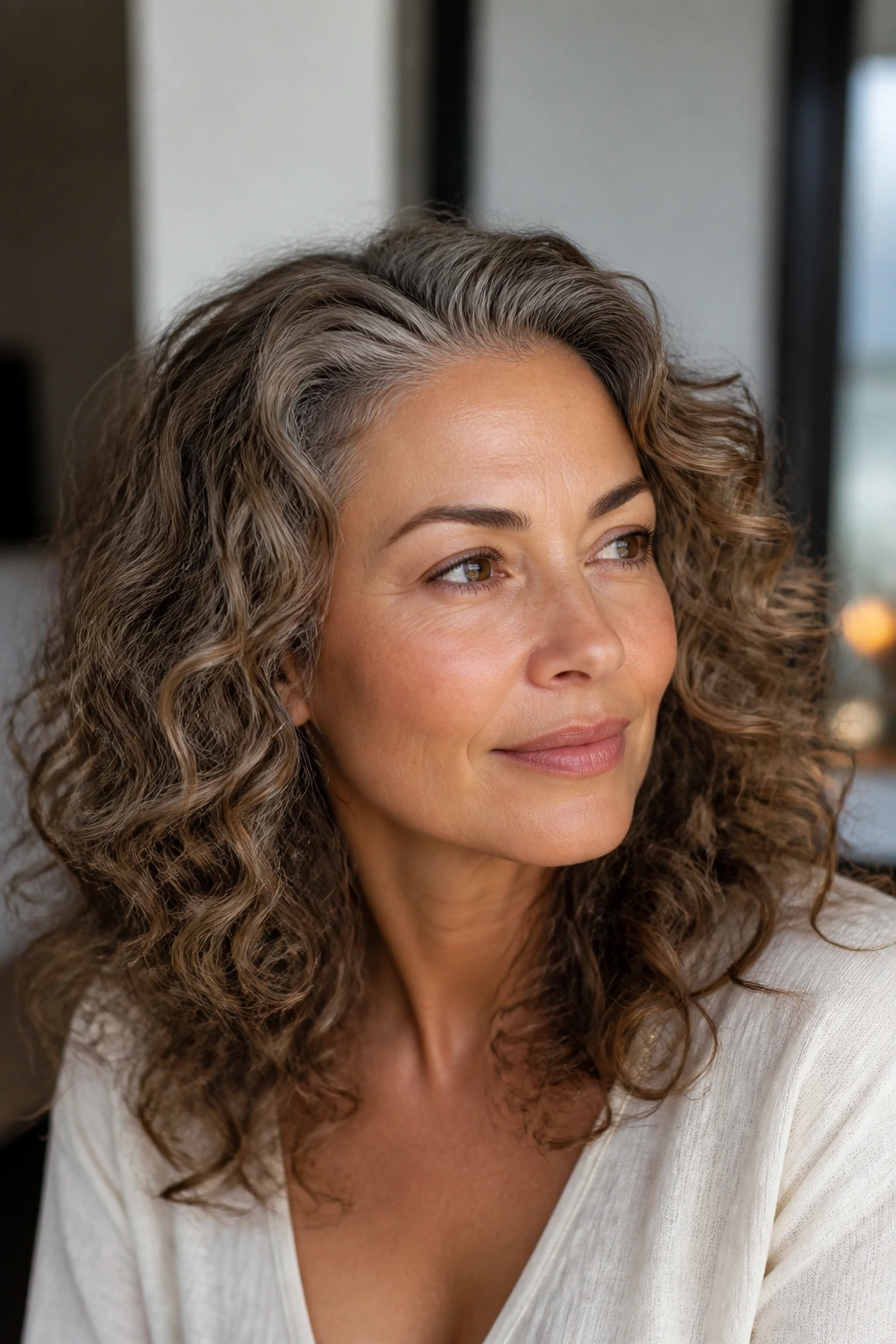
Grey on olive skin lives or dies by tone choice. If the hair looks too white, too blue, or too silver-chrome, it can fight the skin instead of flattering it. Mushroom, taupe, pearl, graphite, and smoke are the shades I’d watch for first. They hold enough softness to sit beside olive undertones without flattening the face.
If you’re buying home-care products, match them to the actual shade you’re wearing, not the shade you wish you had. Pale silver needs a gentle purple shampoo every few washes, not every wash. Deeper ash or mushroom often does better with a blue-violet mask because it keeps brass from sneaking in around the root line. Over-toning is a real problem. Hair that gets too purple or too blue starts looking tired fast.
For salon work, ask for a shadow root one to two levels deeper than the mids and a gloss that lands in the pearl, taupe, or cool beige family. If you’re going grey gradually, a demi-permanent formula is easier to live with than a hard, permanent one. It fades softer. That’s useful when loose curls are part of the plan, because curls already add movement; the color should support that, not trap it.
How to Wear These Looks
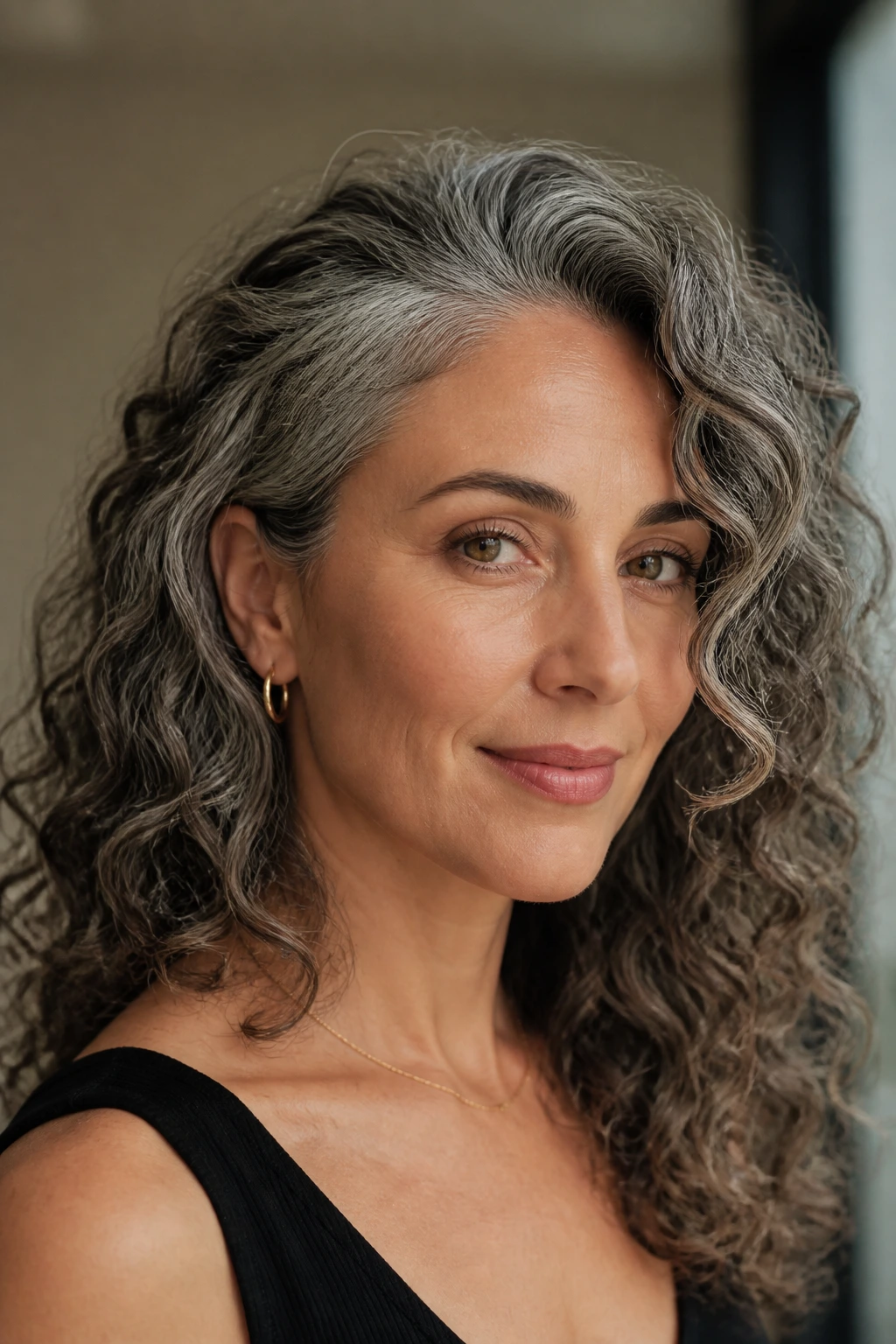
Presentation: Part the hair slightly off-center and let the front curl skim the cheekbone. That little shift gives the grey something to do near the face, and it keeps the style from sitting too evenly on both sides.
Accompaniments: Gold hoops, a clean neckline, and soft brow definition usually beat busy jewelry or heavy eye makeup. Olive skin plus grey hair can get crowded fast, so give the color room.
Portions: If your hair is fine, keep the layers long and curl only the midlengths so the style doesn’t puff out. If your hair is thick, ask for internal shaping so the curls sit in softer stacks instead of ballooning at the sides.
Beverage Pairing: Black coffee, iced tea, or sparkling water fits the cool, clean mood of grey roots. For an evening event, a dry white wine or a gin-based drink keeps the palette crisp without muddying it.
Extra Styling Tips and Tone Boosters
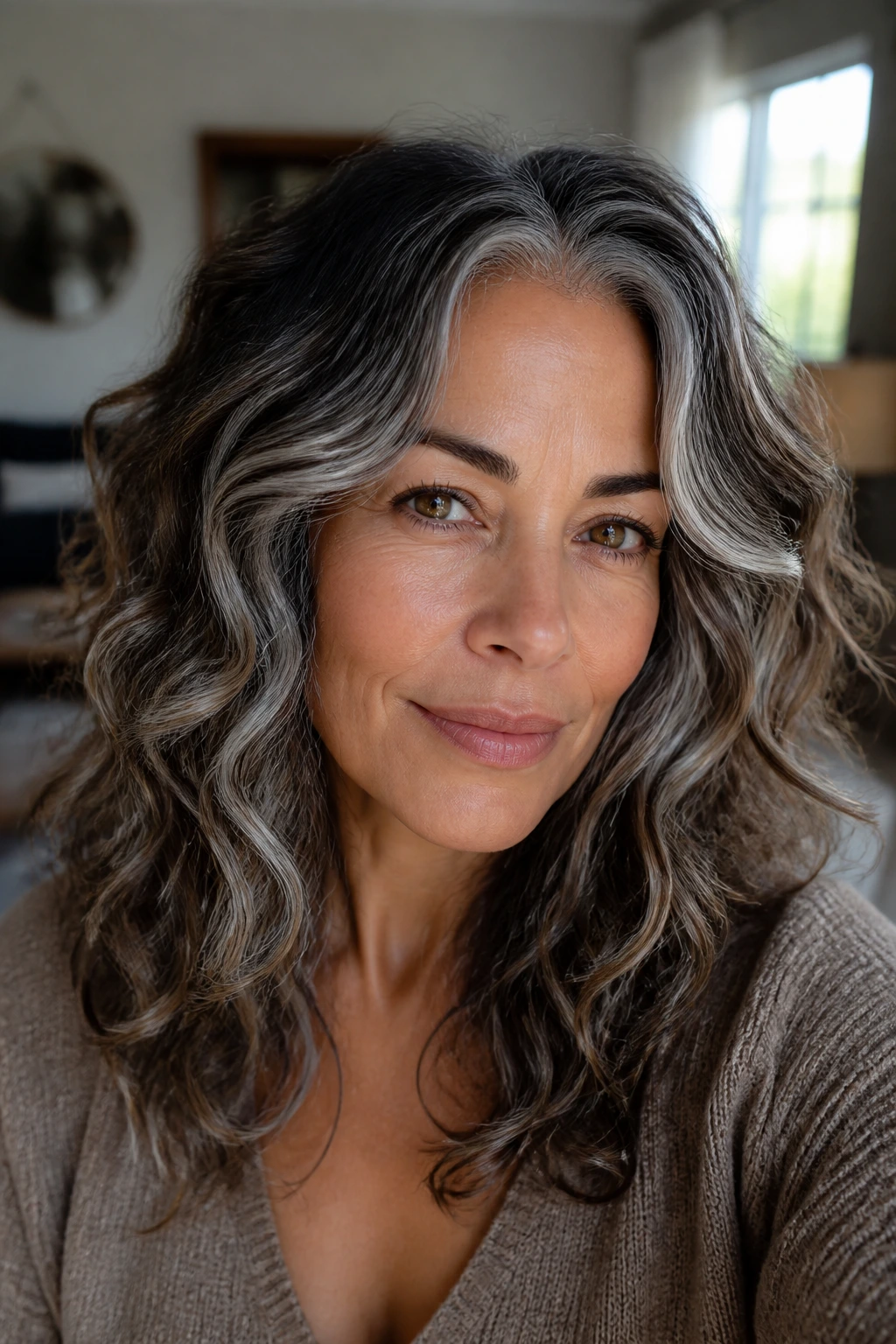
Tone Enhancement: A sheer pearl or smoke gloss every 6 to 8 weeks keeps the grey from going flat. If the color starts to look dusty before the next salon visit, a five-minute toning mask can bring it back without a full appointment.
Customization: Warm-leaning olive skin usually likes more taupe, mushroom, or greige in the blend. Cooler olive skin can take graphite, steel, and pearl with less beige in the mix. That one adjustment changes the whole mood.
Curl Definition: Alternate curl direction as you work through the hair, then let the pieces cool before touching them. It keeps the style from turning into one big spiral pattern, which can feel too formal for grey.
Make-It-Yours: If you want softer grey, brush the curls out after they cool. If you want more edge, leave the ends piecey and add a tiny drop of serum only to the last inch. Same color. Different attitude.
Keeping Grey Roots and Loose Curls Fresh Between Washes
Grey and silver tones tend to show every little thing, so the maintenance rhythm matters. For most of these looks, the root shadow can stay attractive for 6 to 10 weeks, while the toner or gloss may need a refresh every 4 to 8 weeks depending on water quality and heat styling. If the hair starts looking yellowish at the ends, do not reach for purple shampoo every day. That usually makes things worse, not better.
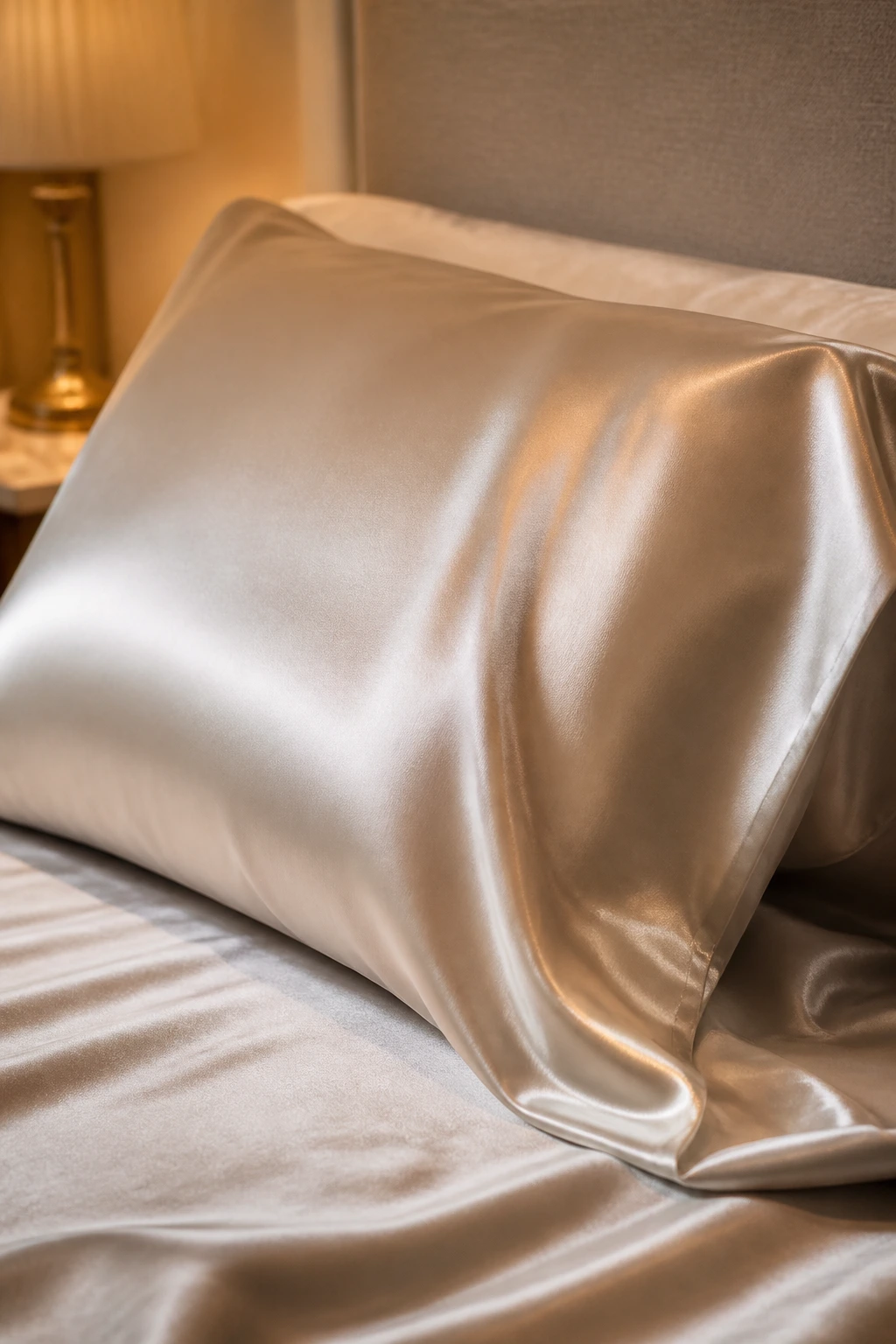
At night, a silk pillowcase or loose bonnet does more than people expect. It keeps the curl shape from getting crushed and stops the lighter pieces from roughing up. In the morning, mist the midlengths with water or a leave-in spray, scrunch lightly, and re-bend only the front pieces with a hot tool if needed. That’s often enough to revive the whole style.
If your grey is color-treated, use a sulfate-free shampoo and keep heavy oils away from the root line. Oils are fine on the ends. They’re trouble near the crown because they can flatten the lift that makes grey and loose curls look good in the first place. A root-lift spray or a dry shampoo at the scalp is usually a better choice than piling on more product.
Common Mistakes That Make Grey Read Flat
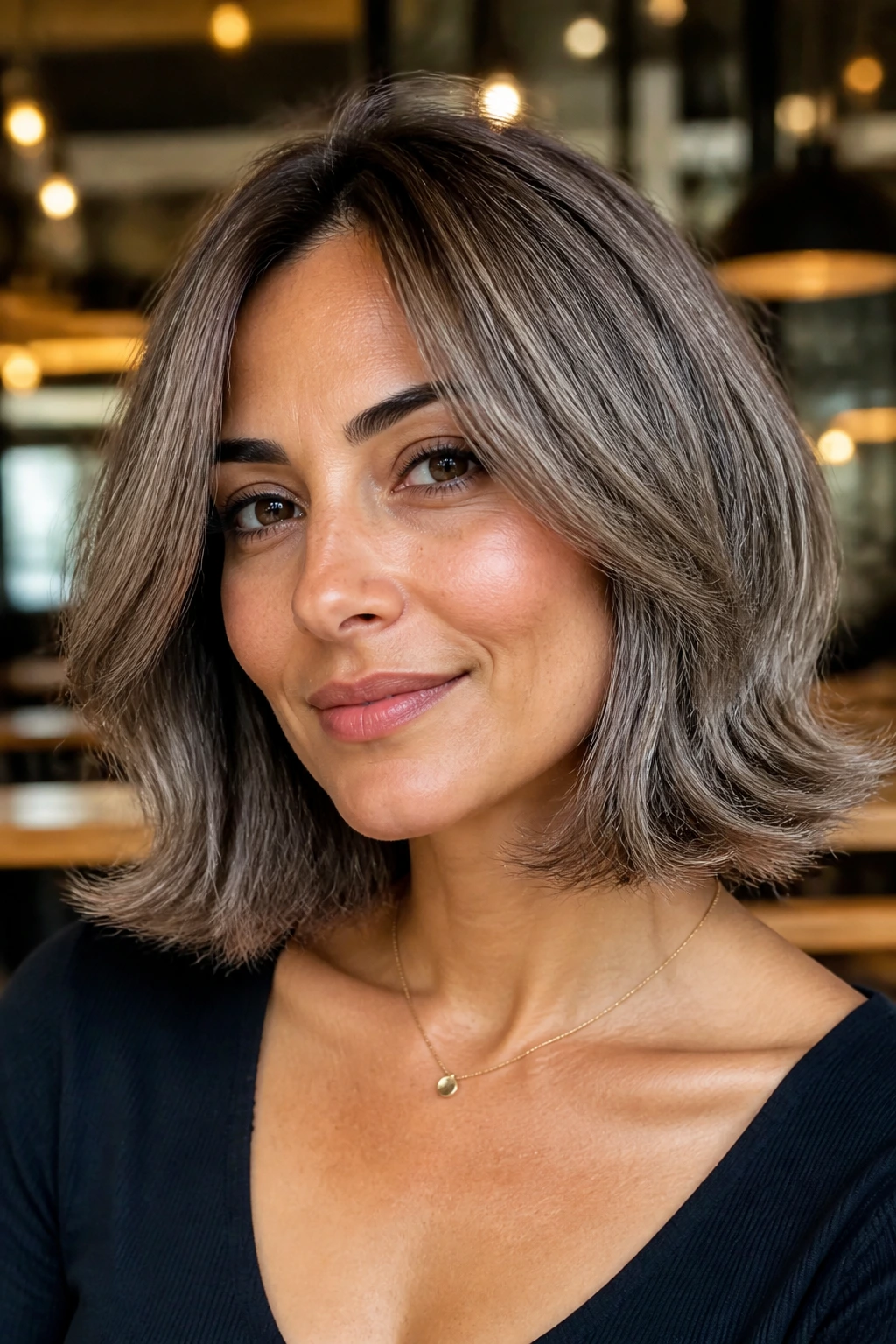
- Choosing a grey that’s too icy for olive skin: The symptom is a washed-out face or darker under-eyes. The fix is to ask for mushroom, pearl, taupe, or graphite instead of stark silver-white.
- Curling every section the same way: That gives the style a stiff, pageant-like look. Alternate directions and break up the pattern with your fingers once the hair cools.
- Skipping root depth: A pale root on olive skin can float above the complexion and look unfinished. A deeper shadow root makes the grey look grounded and easier to wear.
- Over-toning the lengths: Hair that goes lavender, smoky purple, or dull blue has been toned too hard. Back off, wash with a gentler shampoo, and use a lighter gloss next time.
- Ignoring the cut: Grey color on one length with no layers can look heavy fast. Loose curls need shape underneath or the whole style sits in a block.
- Using too much oil before styling: The curls drop, the grey loses movement, and the ends clump. A tiny amount on the last inch is enough.
Five Ways to Shift the Mood
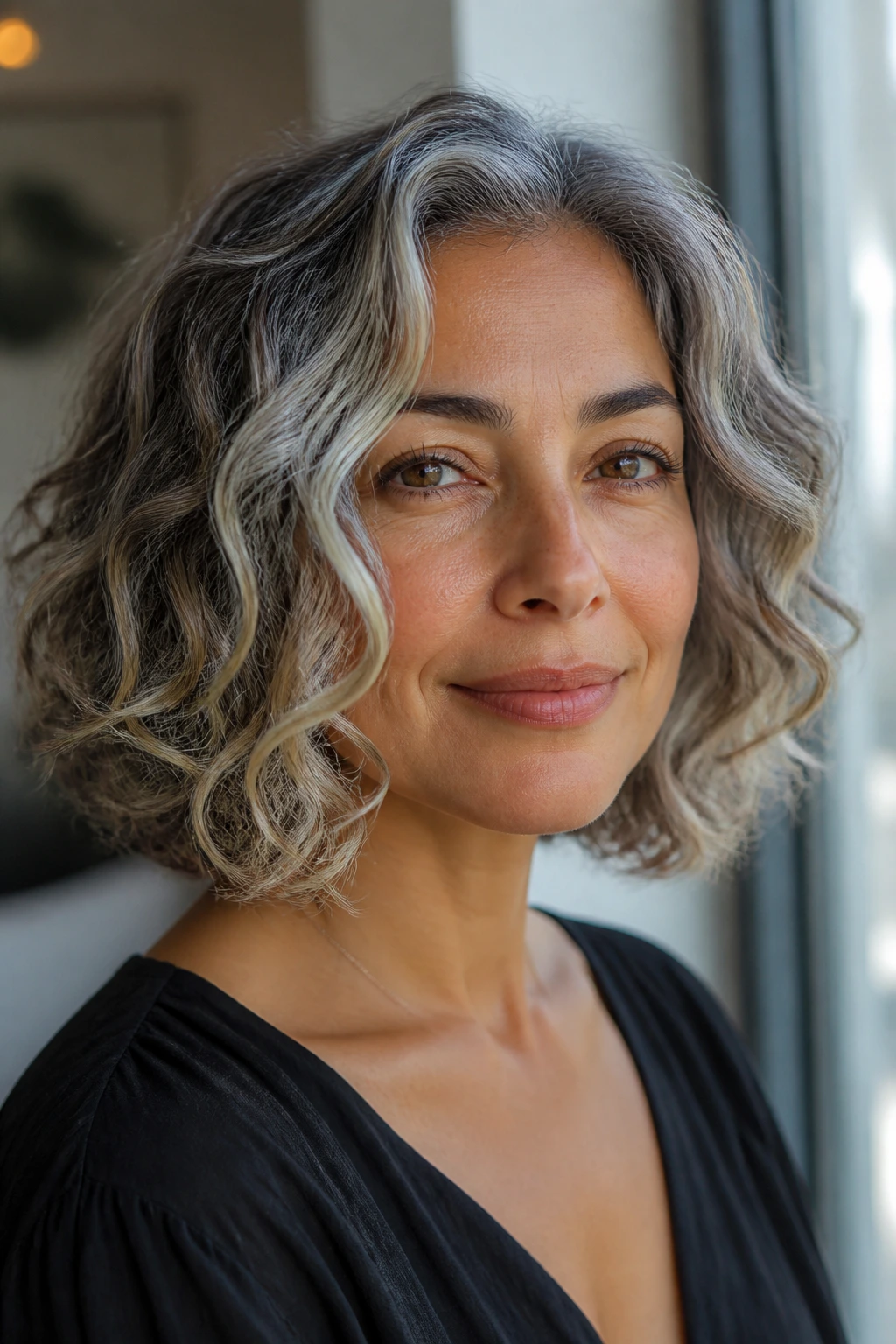
Warmer Greige Edit: Add beige lowlights and a mushroom gloss if your olive skin leans golden. It softens the grey and keeps the face from looking too cool.
High-Contrast Silver Frame: Brighten only the front ribbons and leave the crown much darker. This gives a sharper, more modern look without committing to full silver all over.
Short-Cut Remix: Take the same color family and put it on a bob or lob. The shorter length makes the grey read cleaner and cuts down on styling time.
Low-Maintenance Root Grow-Out: Ask for a deeper shadow root with sparse silver ribbons through the mids. It’s the easiest version to live with if you don’t want frequent salon visits.
Cool Smoke Finish: Push the formula toward graphite and pearl if your olive skin is more neutral or cool. It looks sleek in daylight and especially good with loose, brushed-out waves.
Frequently Asked Questions
Will grey roots wash out olive skin?
They can, if the grey is too white or too blue. A shadow root with mushroom, taupe, or pearl tones usually solves the problem by keeping some depth near the face.
What grey shade works best if my olive skin leans warm?
Mushroom grey, greige, and soft taupe are the easiest starting points. They carry a little beige in the tone, which keeps the hair from looking icy against warm olive undertones.
Do loose curls make grey hair look frizzy?
Only if the ends are dry or the curl is brushed too aggressively. Use a light serum on the last inch, let curls cool before touching them, and keep the finish soft rather than fluffy.
Can I wear these looks on naturally curly hair?
Yes, and the texture can make the color look richer. You’ll probably want more internal layers and a curl cream with a lighter finish so the grey ribbons stay visible.
How often do grey roots need toner or gloss?
A gloss every 4 to 8 weeks is a good range for most people. If the hair lives in hard water or gets a lot of heat, you may notice brass or dullness sooner.
Is purple shampoo enough to maintain silver-grey hair?
Not by itself. Purple shampoo helps with brass, but it does not replace glossing, moisture, or good cut shape. Too much of it can leave pale grey hair looking violet or dry.
Can these styles work on short hair too?
Yes, especially the lob and bob versions. Shorter cuts just need a softer bend and a careful root shadow so the grey still feels dimensional.
What if my grey starts looking green or muddy?
That usually means the tone has gone too ash-heavy or your water has left mineral buildup behind. A clarifying wash plus a warmer pearl or beige gloss can clean it up fast.
Smoke, Shine, and Soft Movement
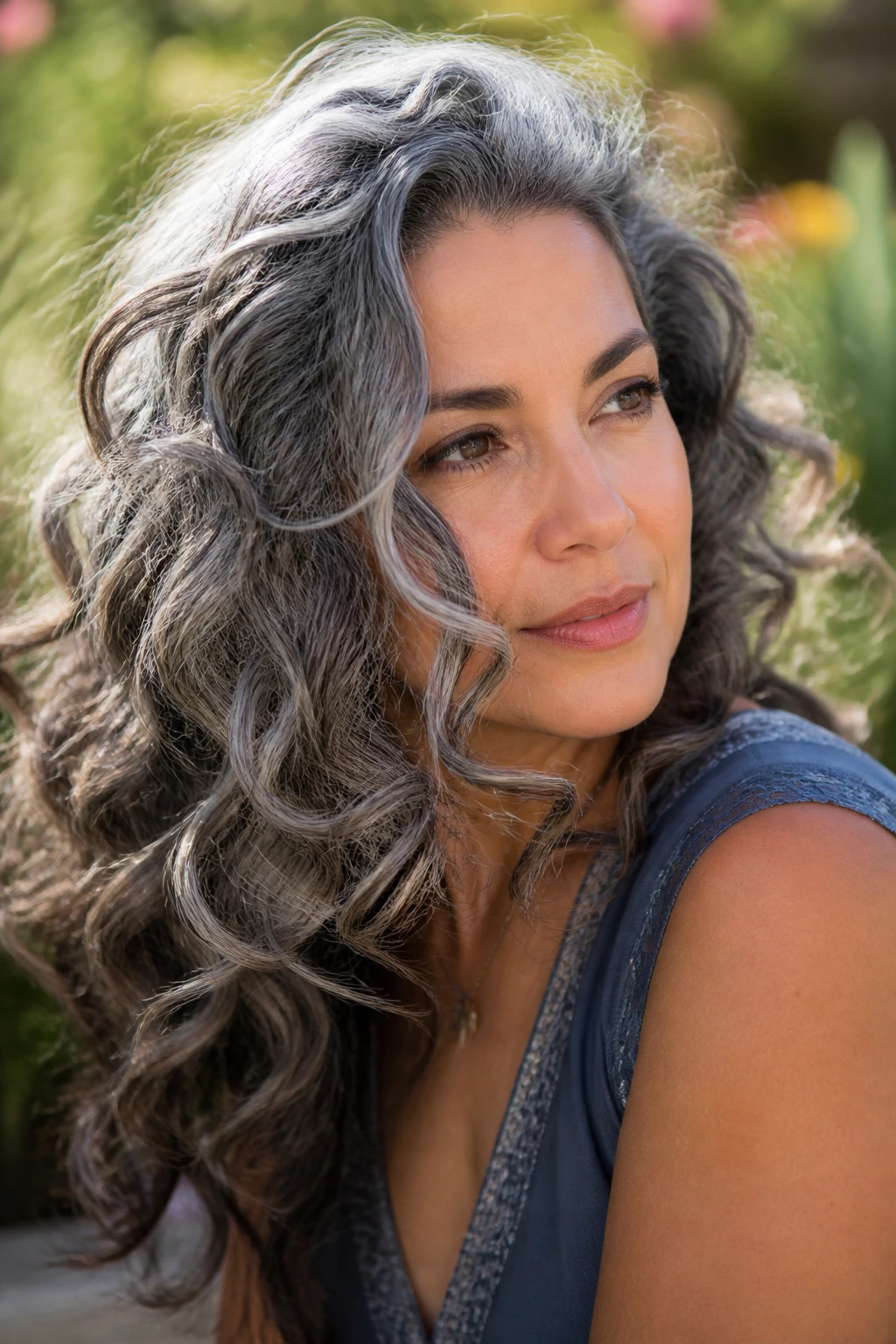
Grey on olive skin is at its best when it doesn’t try to be a single, perfect shade. A little root depth, a little pearl, a little graphite, and a loose curl that breaks the whole thing into moving pieces—that’s the mix that keeps the color alive. Flat silver can be pretty for about ten minutes. Dimension lasts longer.
The best part is how flexible these looks are. You can go smoky, metallic, taupe, soft, dramatic, or almost natural depending on where you place the brightness. That means you’re not stuck chasing one version of grey. You get to tune it to your skin, your haircut, and how much time you actually want to spend in front of a mirror.