



Gray on dark curls does not hide politely. A silver temple coil catches the light, the part line looks wider than it did yesterday, and suddenly the whole front of your hair feels louder than the rest of it. That’s the game with cover gray hairstyles for dark hair with curly hair: you’re not trying to erase texture, you’re using shape, lift, and movement to break up contrast.
And that contrast is the whole problem. Dark hair makes gray strands look brighter, while curls make them show up in little pockets — at the temples, along the part, around the crown, sometimes in a streak that seems to appear overnight. Straight hair can smudge gray into the background a little easier. Curly hair asks for a smarter trick.
The good ones don’t fight the curl pattern. They work with it. A side part shifts the bright line off center. A puff lifts the gray away from the face. Braids, twists, bangs, and layered cuts give the eye somewhere else to go. That’s why the most useful styles here are not just pretty; they’re good at doing a job.
Why These Curly Styles Earn Their Keep
-
Temple Coverage Without Helmet Hair: The strongest styles here move attention away from the hairline, which is where gray on dark hair tends to shout the loudest.
-
Curl Pattern Friendly: These looks keep the bend, spring, and volume that curly hair needs, so you don’t have to iron your texture flat just to quiet the silver.
-
Useful on Real Hair Days: Some of these styles work on day-one curls, some on day-three curls, and some are better when your roots need a reset but your ends still look fine.
-
Easy to Adjust: A tiny part change, a little more height at the crown, or one extra braid can change how much gray you see in the mirror.
-
Good for Different Lengths: Short coils, shoulder-length curls, and long spirals all get something here. You’re not locked into one cut to make gray blend in.
-
Low-Drama Styling: A lot of these looks use what you already have — curls, coils, a comb, a few pins, a little hold product — instead of asking for a full salon project.
1. Deep Side-Part Wash-and-Go
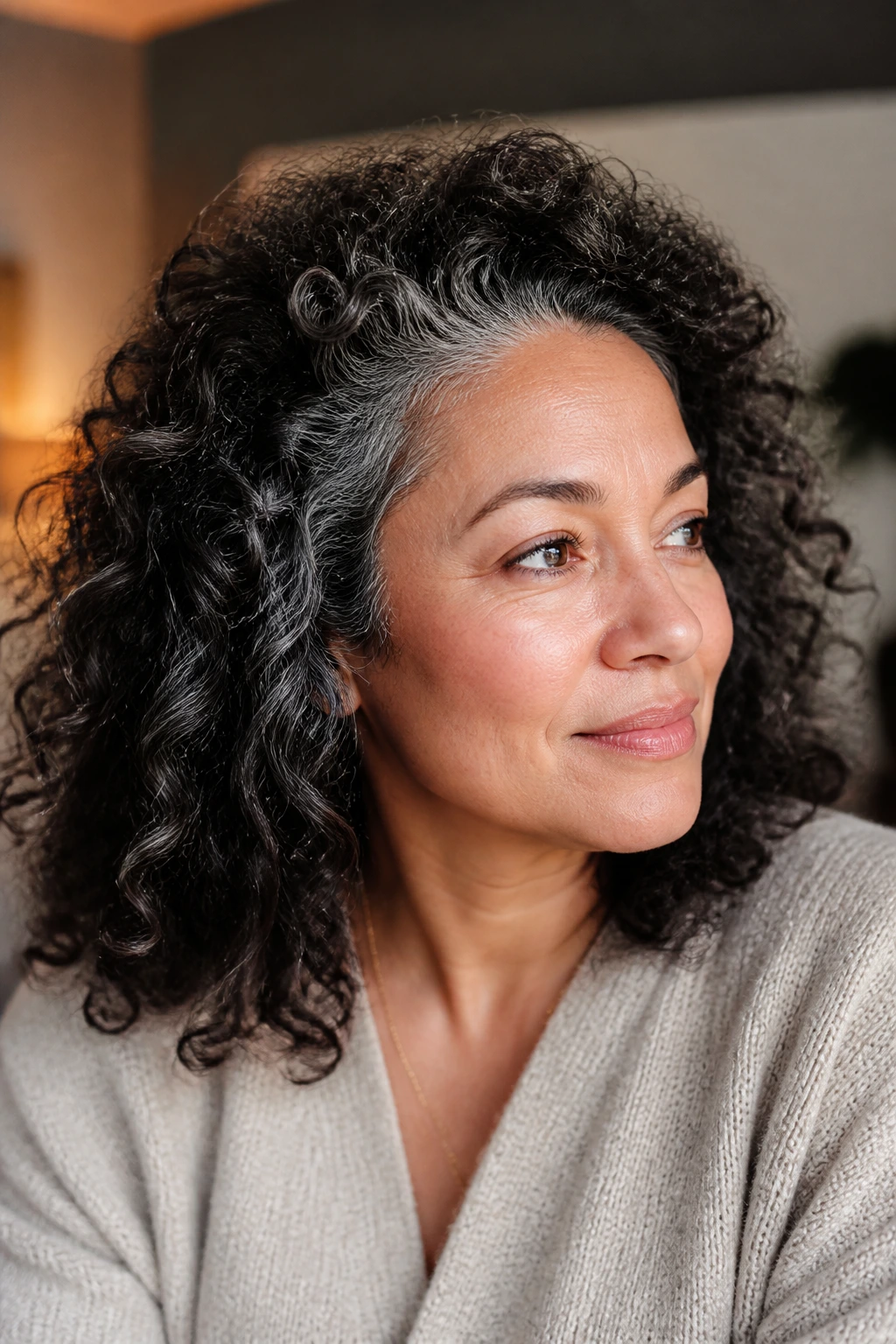
A deep side-part wash-and-go is one of the easiest ways to soften gray on dark curls without making the hair look overworked. The diagonal part breaks up any bright line at the crown, and the curl volume falling forward does half the camouflage for you. I like this best when the gray lives at one temple or along a narrow strip near the front.
The trick is simple: shift the part about an inch or two from where you normally wear it, then let the front curls fall toward the cheekbone instead of straight back. That little angle changes the whole read of the style. On 3A to 3C curls, the curls near the face can do a lot of the hiding by themselves. On tighter curls, the part still helps because it keeps the scalp from showing as one hard line.
Best for: temple grays, loose-to-medium curls, and anyone who wants to wear hair down without a lot of pinning.
Styling note: use a light leave-in, then a mousse or soft gel at the roots so the part stays in place but the curls still move.
2. Curly Pixie with Tapered Sides
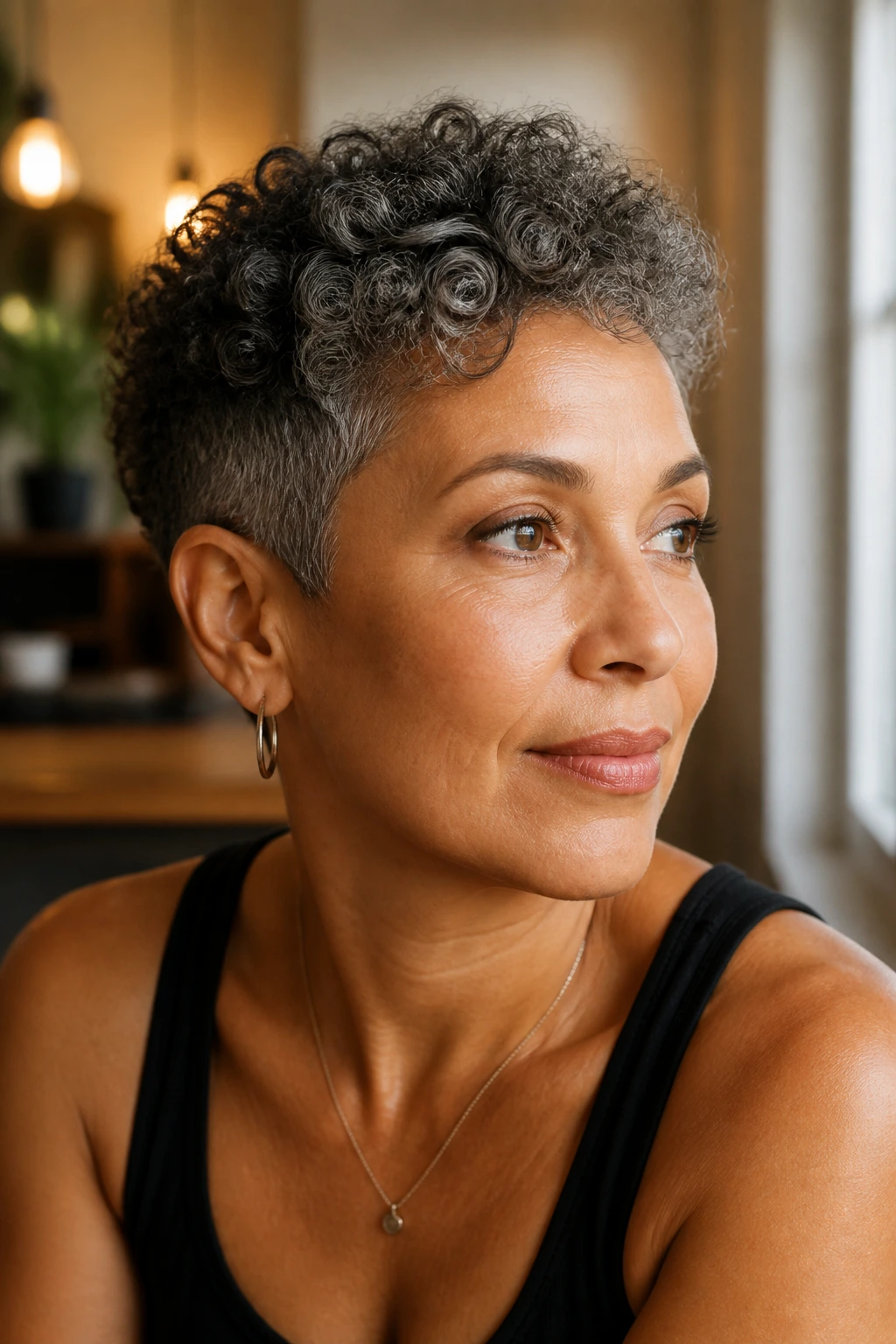
A curly pixie with tapered sides does something very useful: it pushes the eye upward. That means the silver near the temples stops being the star of the show, because the crown and top carry the shape. On dark hair, short curls like this can look crisp and full instead of patchy, which is a nice bonus when the gray is clustered around the hairline.
This cut works especially well if your curls are thick enough to hold a bit of height. The tapered sides clean up the perimeter, and the longer top keeps enough texture to blur scattered gray strands. If the gray is in streaks, not one solid block, this shape makes those strands look like part of the texture rather than a separate stripe.
Who it suits: busy mornings, smaller faces, and coarse curls that stand up well with a little product.
What to ask for: keep the sides neat but not shaved too close; a hard fade can make the grow-out more obvious against dark roots.
3. Shoulder-Grazing Curly Lob with Face-Framing Pieces
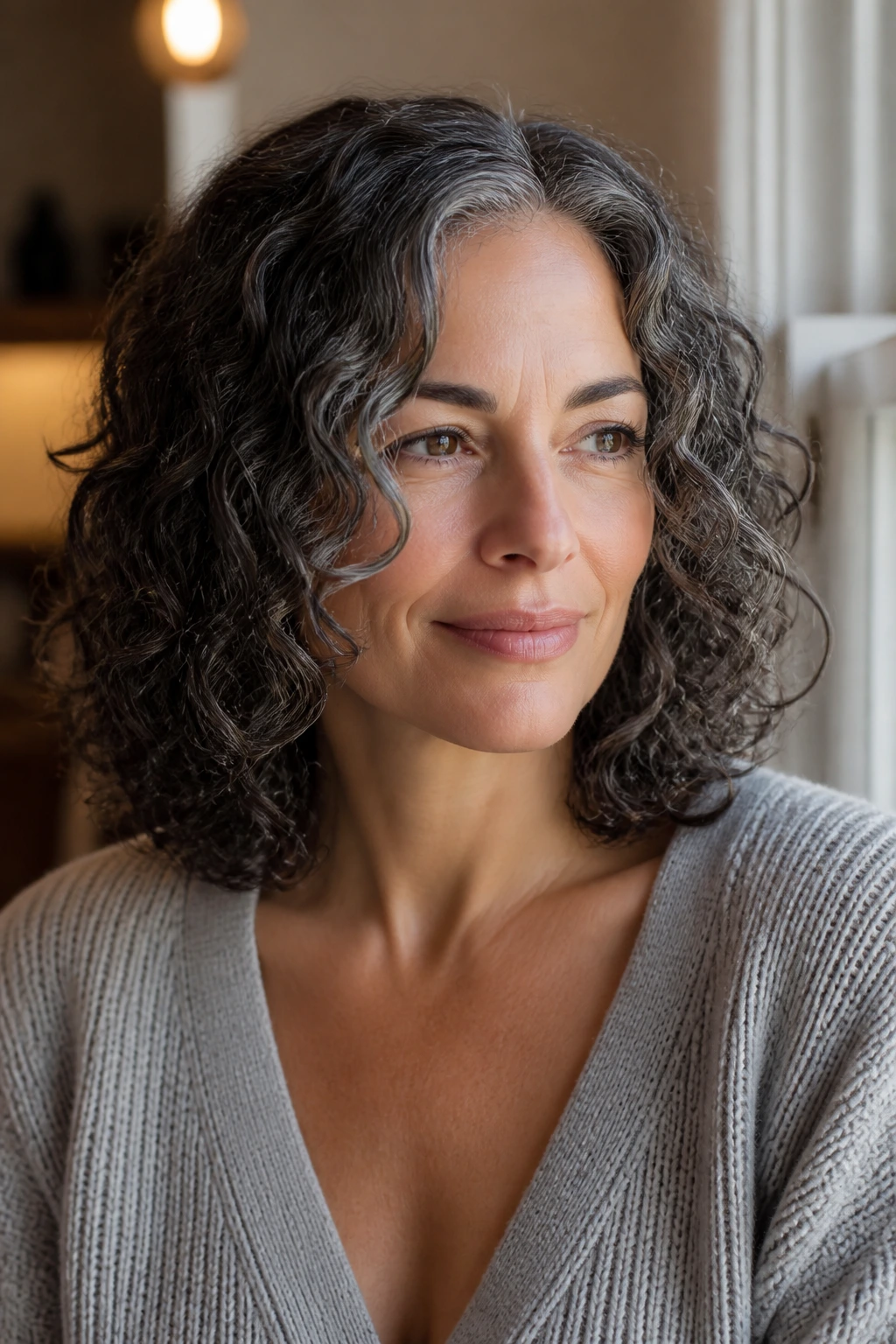
A shoulder-grazing lob gives you just enough length to drape over gray at the temples without dragging the whole style down. Face-framing pieces help too. They drop soft curls right where the eye wants to land, which is a much better move than leaving a bright streak exposed on both sides.
Why It Works
The lob is a sweet spot. It has enough weight to look polished, but not so much that it turns into one flat curtain. That balance matters when the gray is scattered around the front and crown, because the curl layers keep the light from hitting one smooth surface all at once.
The face-framing pieces also give you shape even on a rough hair day. If the curls around your forehead are a little frizzy, fine. They still work in your favor. Dark curly hair looks best here when the front isn’t too uniform.
How to Style It
Use a curl cream on damp hair, then scrunch in a foam or mousse to hold the bend. A quick diffusing session at the roots adds lift, and that lift helps gray blend into the body of the style instead of sitting on top of it.
4. Curly Shag with Soft Layers
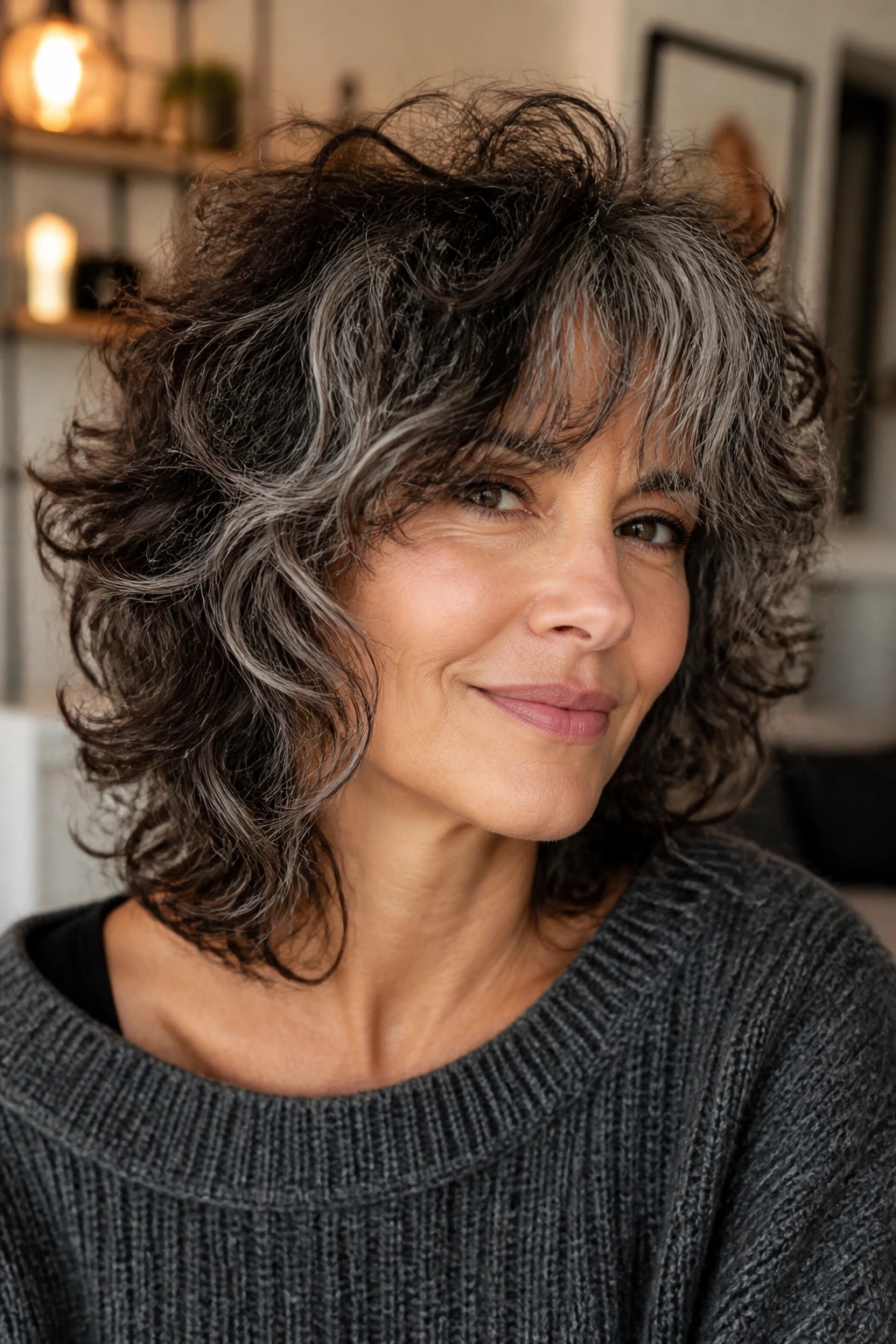
A curly shag is one of my favorite gray-blending cuts because it refuses to sit still. The layers break up the outline, the curls fall at different lengths, and gray strands get mixed into a moving cloud instead of one neat surface. That’s useful on dark hair, where a clean, smooth shape can make every silver thread look louder.
This cut is especially good if your gray is scattered rather than concentrated in one spot. The shag gives the eye too many places to land. One curl falls over another, a piece flips forward, another lands at the cheek, and suddenly the gray looks intentional — or at least invisible enough that nobody is counting strands.
It also has a nice side effect. It makes curls feel lighter. Heavy, one-length curls can expose gray because they stretch and separate at the root. Layers solve that by building a little chaos into the shape.
5. Half-Up Top Knot with Loose Crown Curls
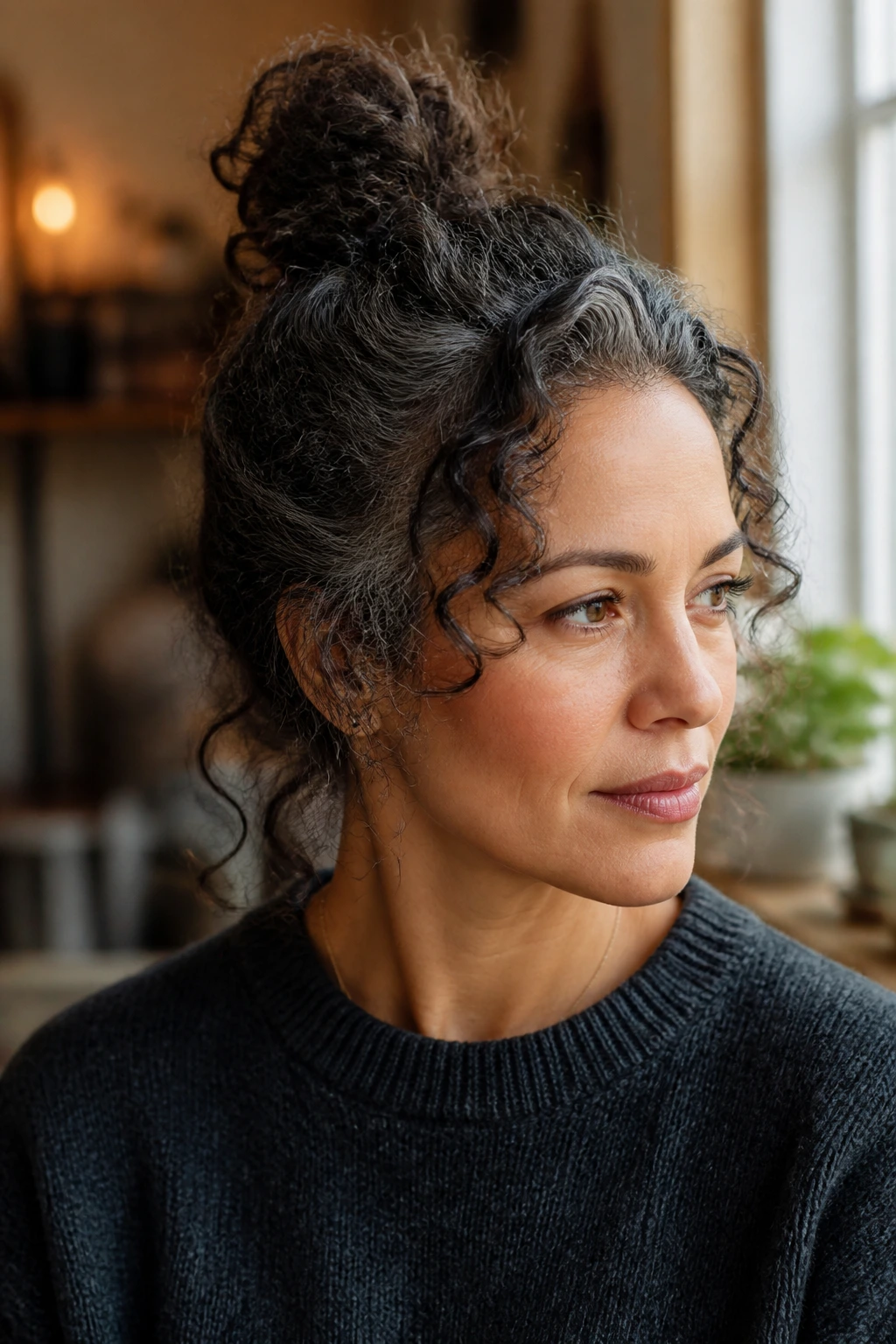
The half-up top knot is a smart compromise when you want your curls off your face but you still need the front to do some hiding. Pull the top section up, leave the lower curls loose, and let the crown create a bit of lift. Gray that sits around the front hairline gets tucked out of direct view, while the loose curls below keep the style from looking severe.
I like this on second- or third-day hair. A little texture actually helps. Too-sleek curls make gray more obvious; a slightly lived-in crown gives the eye movement instead of a spotlight. Keep the knot soft, not tight, or the contrast between the slicked top and the loose sides can make gray roots stand out more.
A small face-framing curl on each side helps a lot here. One curl. Maybe two. That’s usually enough to soften the line.
6. Pineapple Puff with Wrapped Base
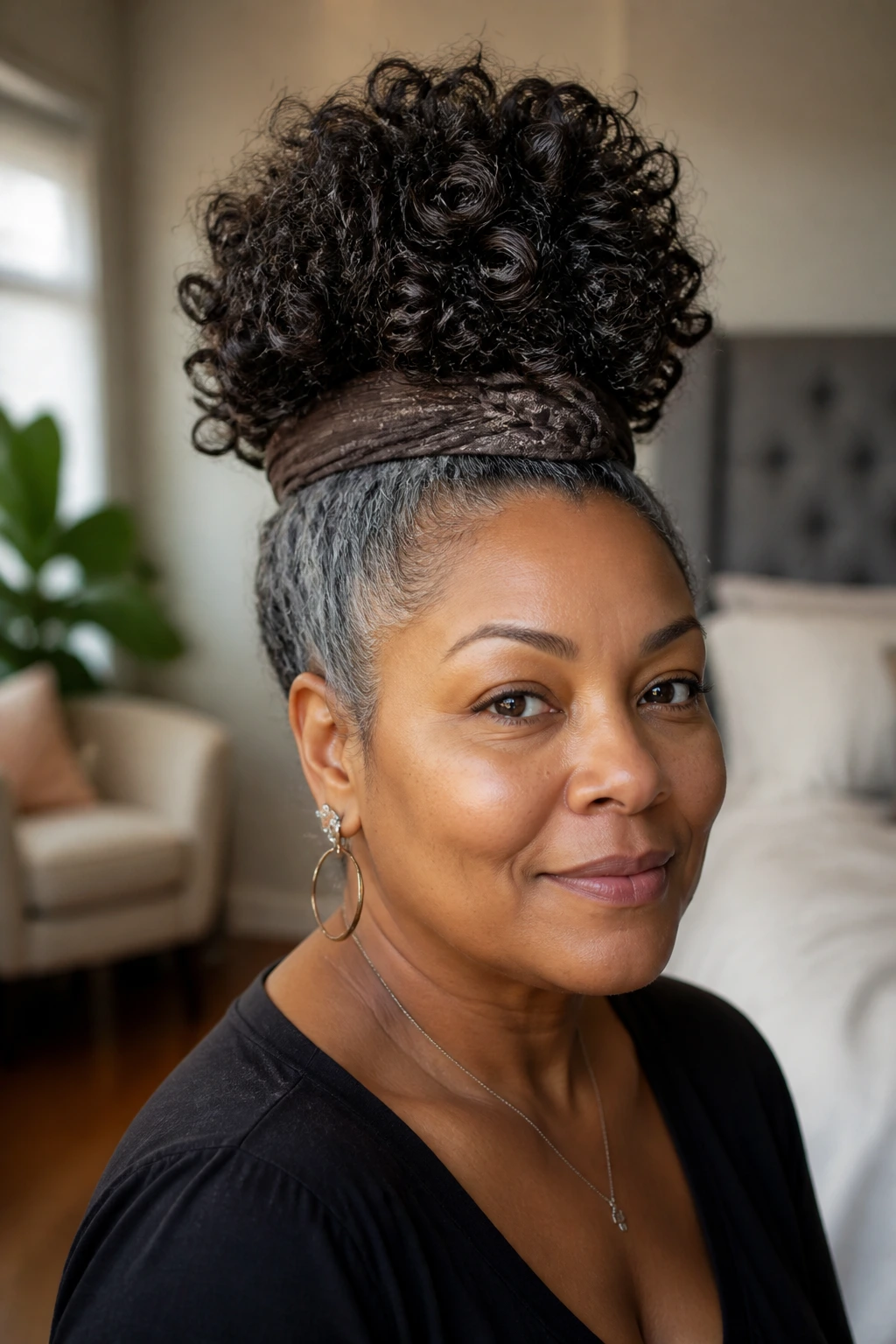
A pineapple puff is one of the fastest ways to hide gray that gathers around the sides and back of dark curly hair. You pull the curls up high, wrap the base with a scarf or a coil of hair, and leave the volume sitting on top like a rounded cloud. The result is bright, full, and very good at swallowing silver that would be obvious in a flatter style.
This works best when the gray is less concentrated at the crown and more scattered through the perimeter. The puff lifts the whole mass away from the face, which means the gray strands are not sitting in one clean line. They’re moving with the curls, and that buys you camouflage.
Use a soft bristle brush only at the edges if you need them neat. Don’t flatten the puff itself. The height is the whole point.
7. Low Curly Puff with Side Sweep
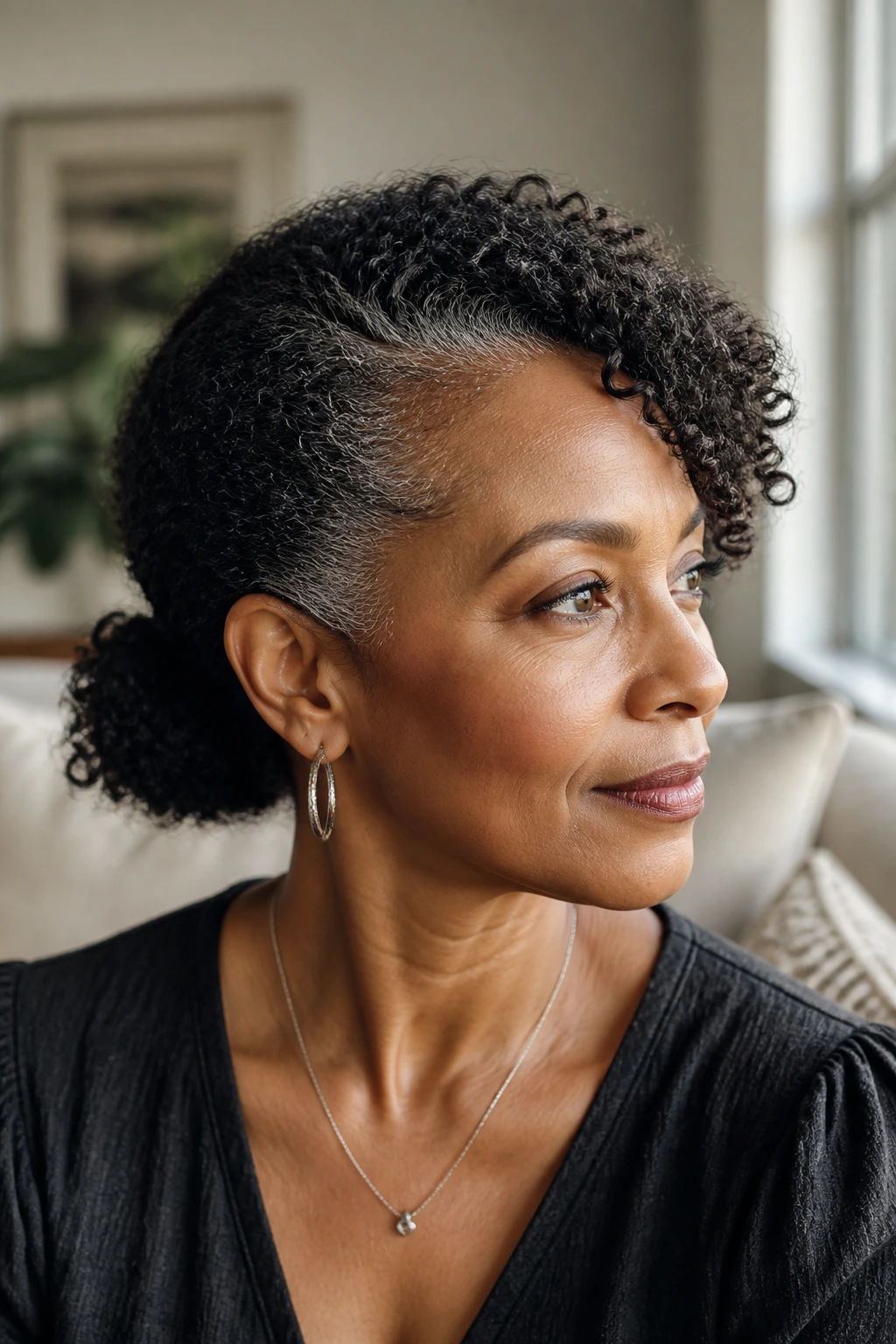
A low puff with a side sweep is less playful than a pineapple and more useful when you want coverage around the temples. Sweep one front section across the forehead or just above it, and the gray near the front disappears behind the arc of curls. The low placement keeps the style grounded, which is handy when your hair is thick and you don’t want a lot of bulk at the top.
This style works especially well for coily textures because the puff can hold volume without needing much product. A soft side sweep gives you a curtain effect, and that curtain is what helps hide the bright pieces near the hairline. If your gray lives mostly at one temple, sweep that side first.
A few bobby pins hidden under the curls can keep the sweep in place. Nothing fancy. Just enough so the hair behaves.
8. Twist-Out with Curly Ends
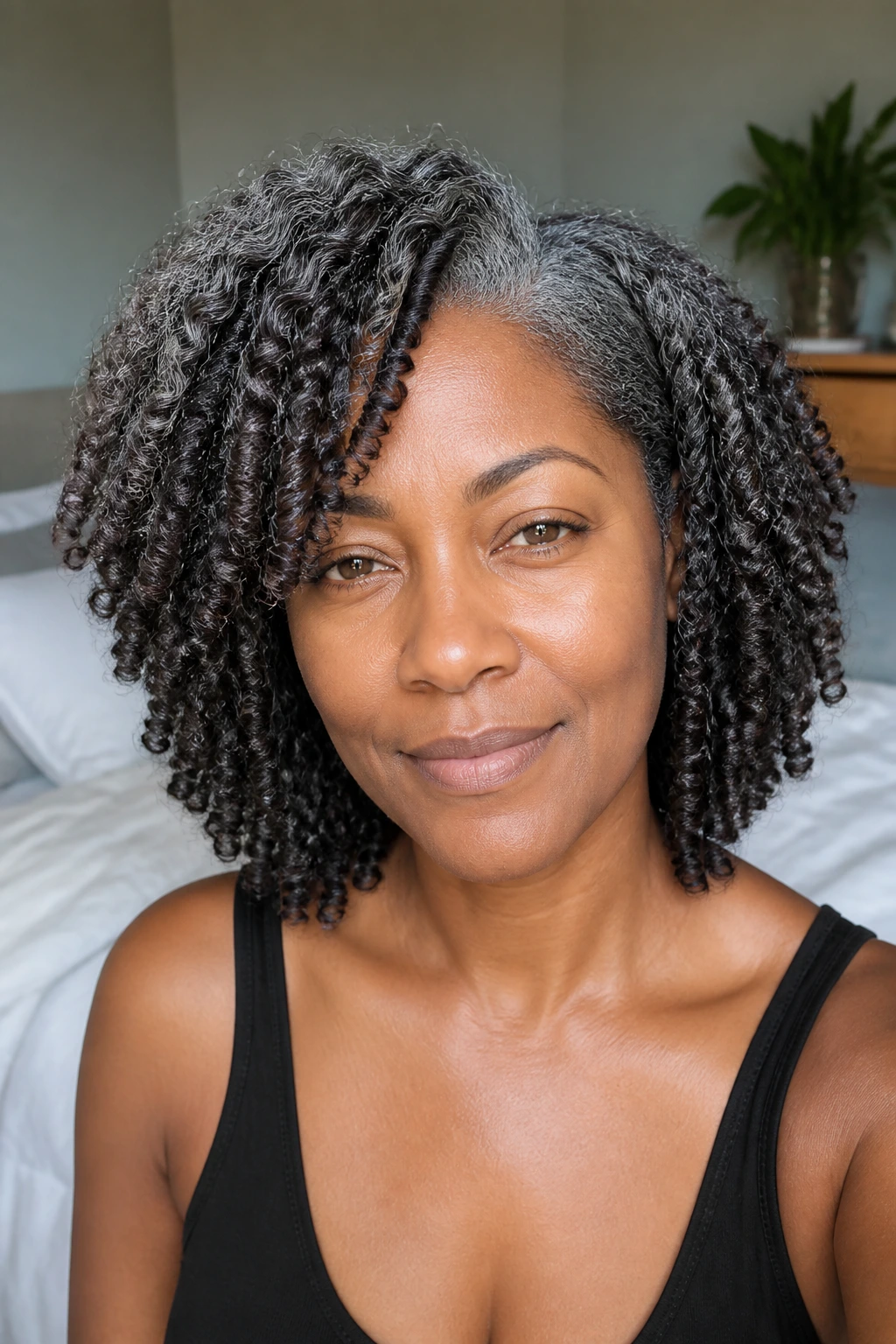
A twist-out is one of the cleanest ways to blur gray on dark curls because the twists set the hair in sections first, and that sectioning already disguises scattered silver. When you take the twists down, the resulting curls and coils don’t lie flat enough to show every root. They move. They overlap. They steal the spotlight from the gray.
What Makes It Different
Compared with a wash-and-go, a twist-out gives you more control over where the hair opens up. That matters if the gray is heavier at the front or crown. You can place the twists to work around those spots, then unravel them into a style that looks fuller than a plain set of curls.
A Good Way to Wear It
Set the twists on damp hair with a cream and a little gel at the ends. Let them dry completely — no shortcuts here — or the unravel will turn fuzzy fast. Once out, separate only once or twice. If you pull them apart too much, you lose the soft clumping that helps the gray blend.
9. Flat-Twist Crown
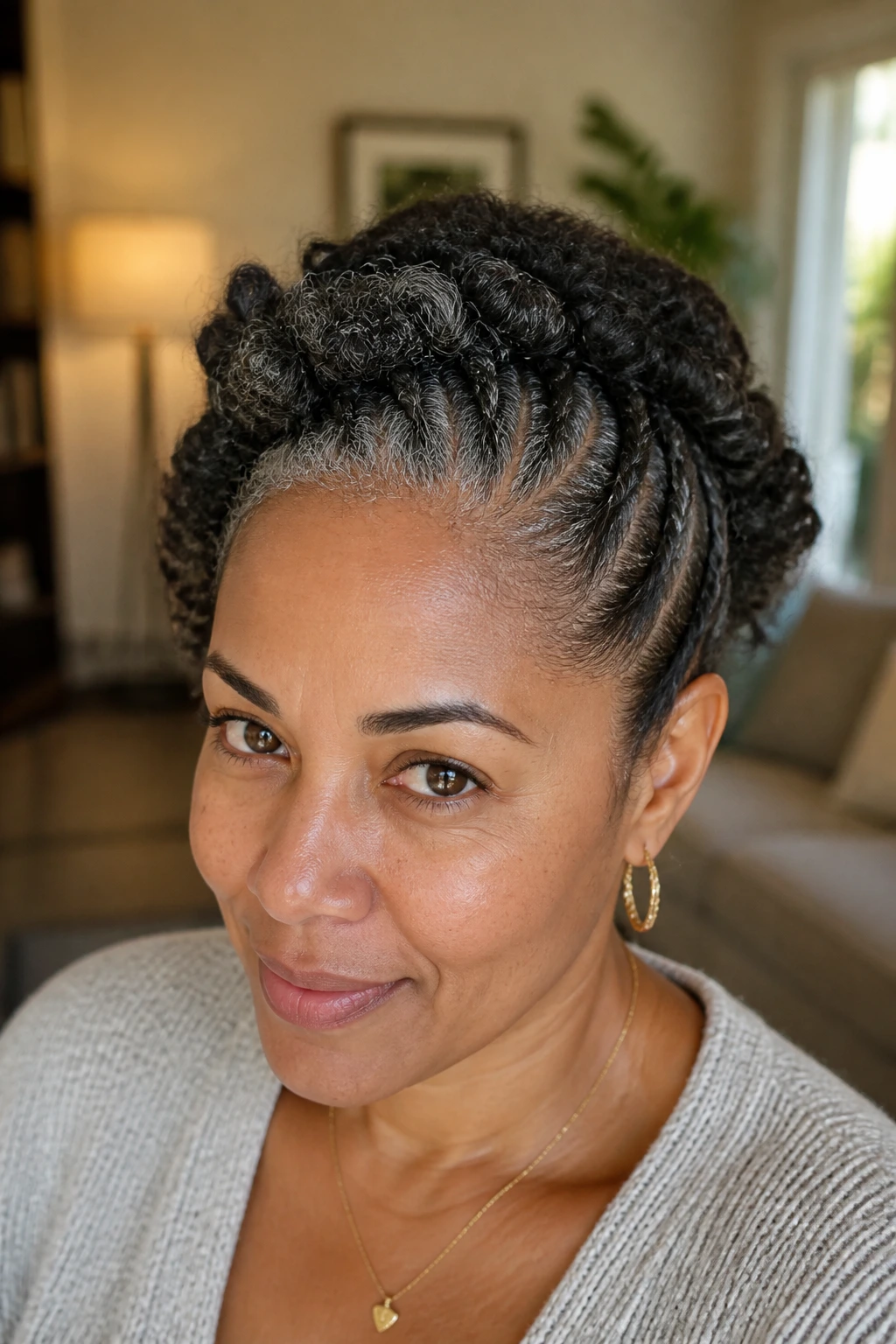
Flat twists along the crown are almost unfairly good at covering gray. They lay right over the most visible part of the head, where dark hair and silver strands usually create the strongest contrast. Instead of fighting that line, the twist pattern breaks it into smaller sections.
This style is a strong choice if your gray is concentrated in a band across the top or if the hairline is where you notice it first. You can keep the ends tucked into a bun, leave them loose, or pin them into a low shape. The crown twist does the cover work; the rest is just finish.
Use a small rat-tail comb and a little edge control only where needed. Too much product can make the twists look stiff, and stiffness on dark hair tends to make gray strands gleam more than they should.
10. Halo Braid with Loose Length
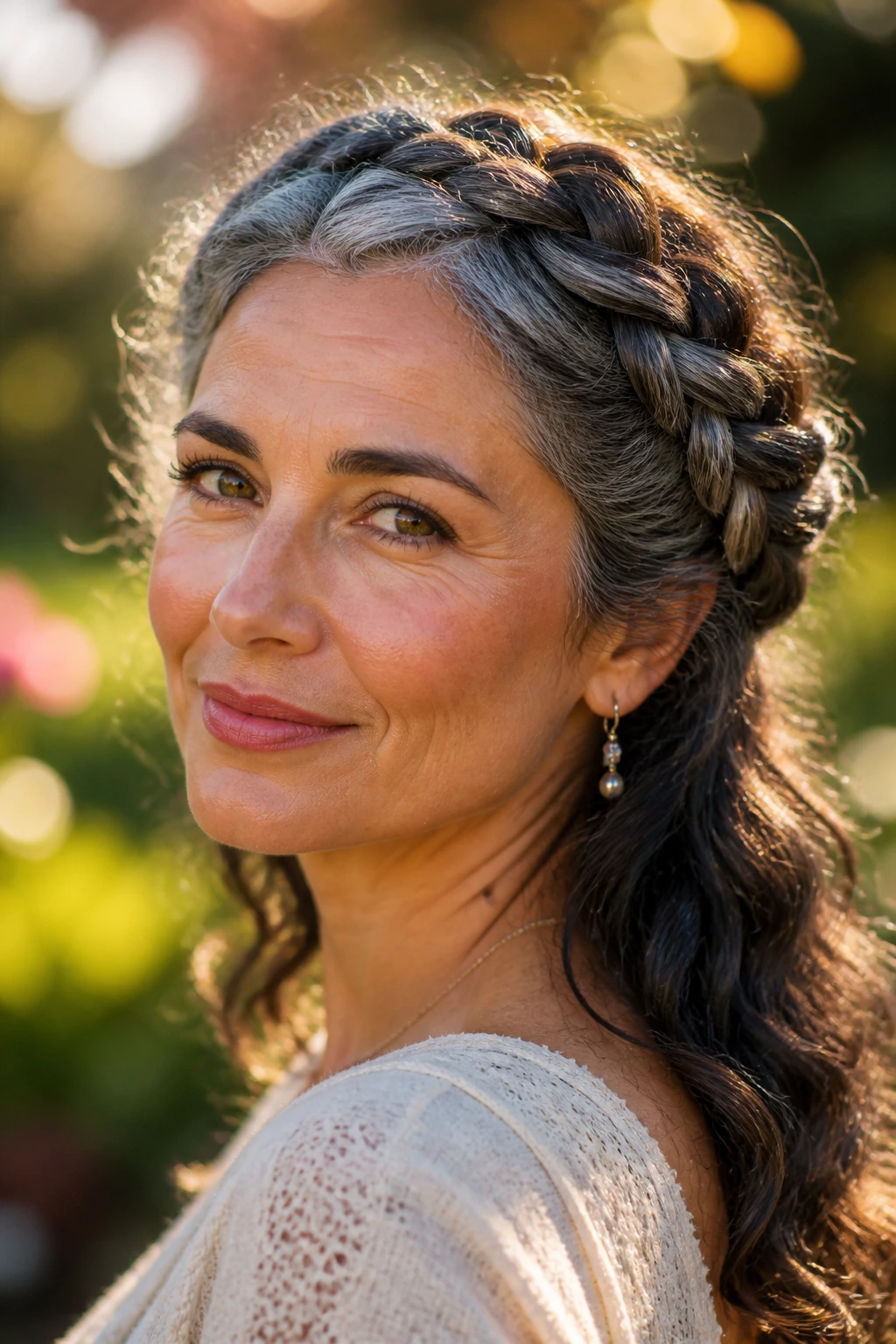
A halo braid is a nice trick when you want the perimeter to disappear into the style. The braid circles the head, so the gray near the front and sides gets woven into the structure instead of hanging out in plain view. Then the loose length in back keeps the look soft, not church-hat formal.
This is one of the few styles that can handle a lot of gray at the hairline and still feel graceful. The braid track acts like a frame. Dark hair inside that frame looks richer, and the silver at the edges stops reading as a problem.
If your curls are long enough, leave the back loose and defined. If not, tuck the braid ends under. Either way, the style works because it makes the most visible gray sit inside a pattern.
11. Curly Bob with Curved Side Part
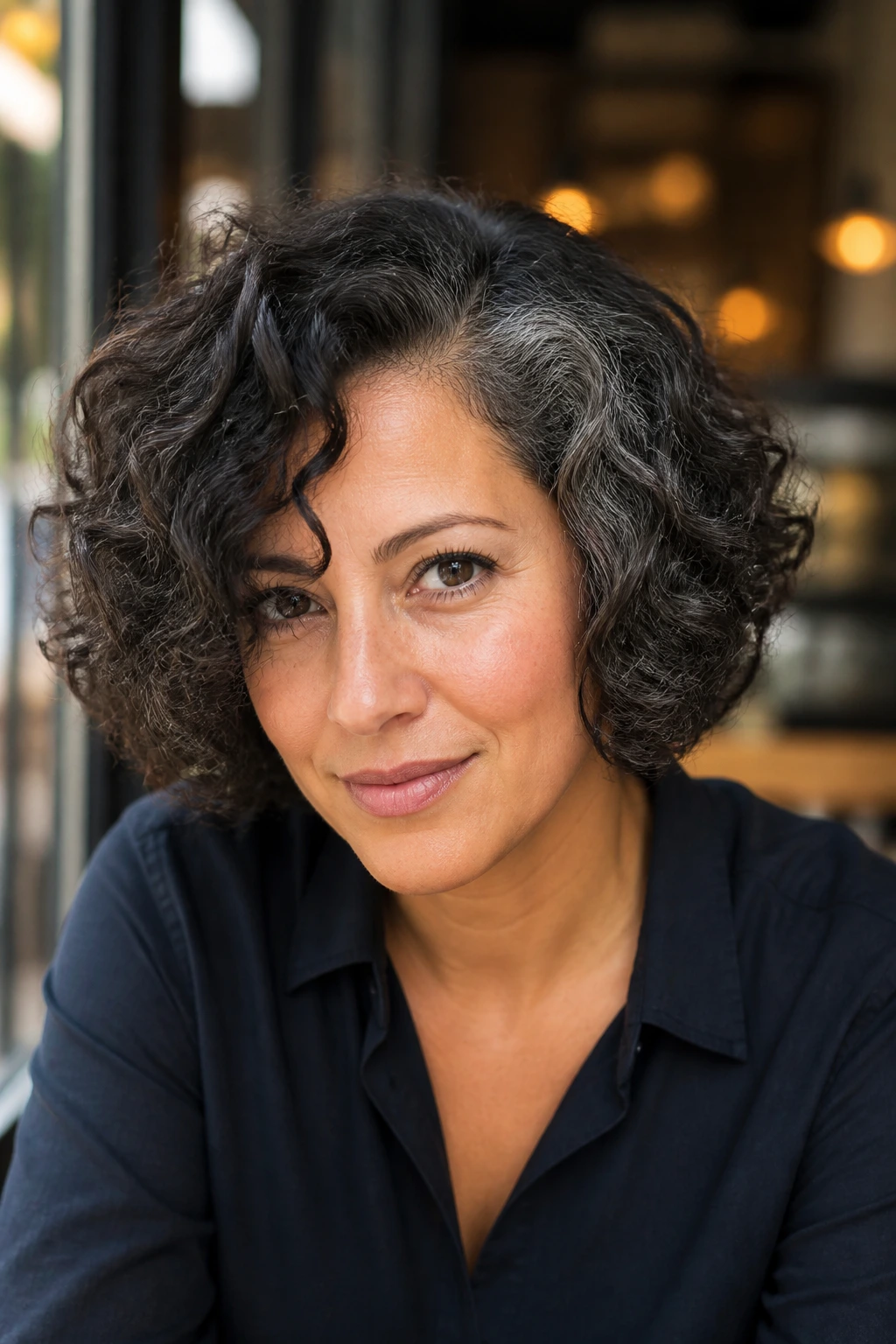
A curly bob with a curved side part is a quiet little cheat code. The curved part keeps the scalp line from running straight across the top of the head, and the bob length lets curls swing just enough to blur the temples. On dark hair, that curve matters. Straight parts can turn gray into a bright road map.
The cut itself should land somewhere around the chin or just below it, with enough layering that the curls don’t puff into a block. If the shape is too boxy, the gray strands catch on the edges of the silhouette. A curved side part softens that immediately.
This is a good choice if you like a polished look without a lot of styling time. The haircut does the heavy lifting. Your job is mostly to keep the curls moist enough to clump.
12. Space Buns with Curly Ends
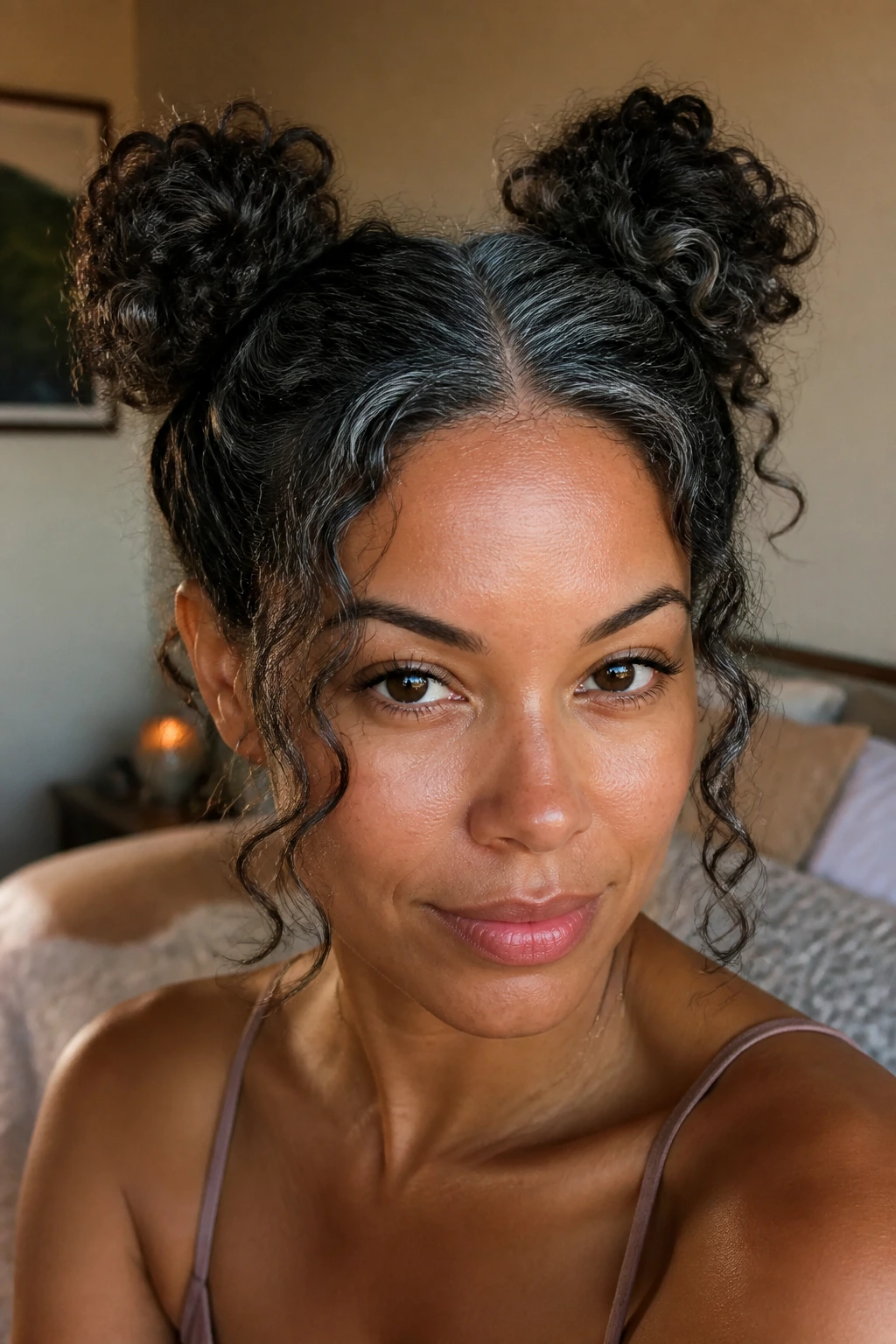
Space buns can be playful, but they’re also practical for gray coverage because they split the eye into two separate shapes. Instead of one big area where silver can show, you get two rounded buns and some curly ends. That division helps. A lot.
Best for
Medium-length curls, younger styling energy, and days when you want the hair off your neck but don’t want a plain bun. The open curls at the ends keep the style from looking too severe.
Why It Hides Gray
The sections usually start with a clean part, then move upward into the buns. That means the gray along the center line is tucked into the structure early. If you leave a few curls out around the face, the hairline looks softer and the silver near the temples becomes part of the overall movement.
A little mousse at the part helps keep the base neat. After that, don’t overthink it. Space buns look best when they’re slightly relaxed, not perfect.
13. Chunky Two-Strand Twists
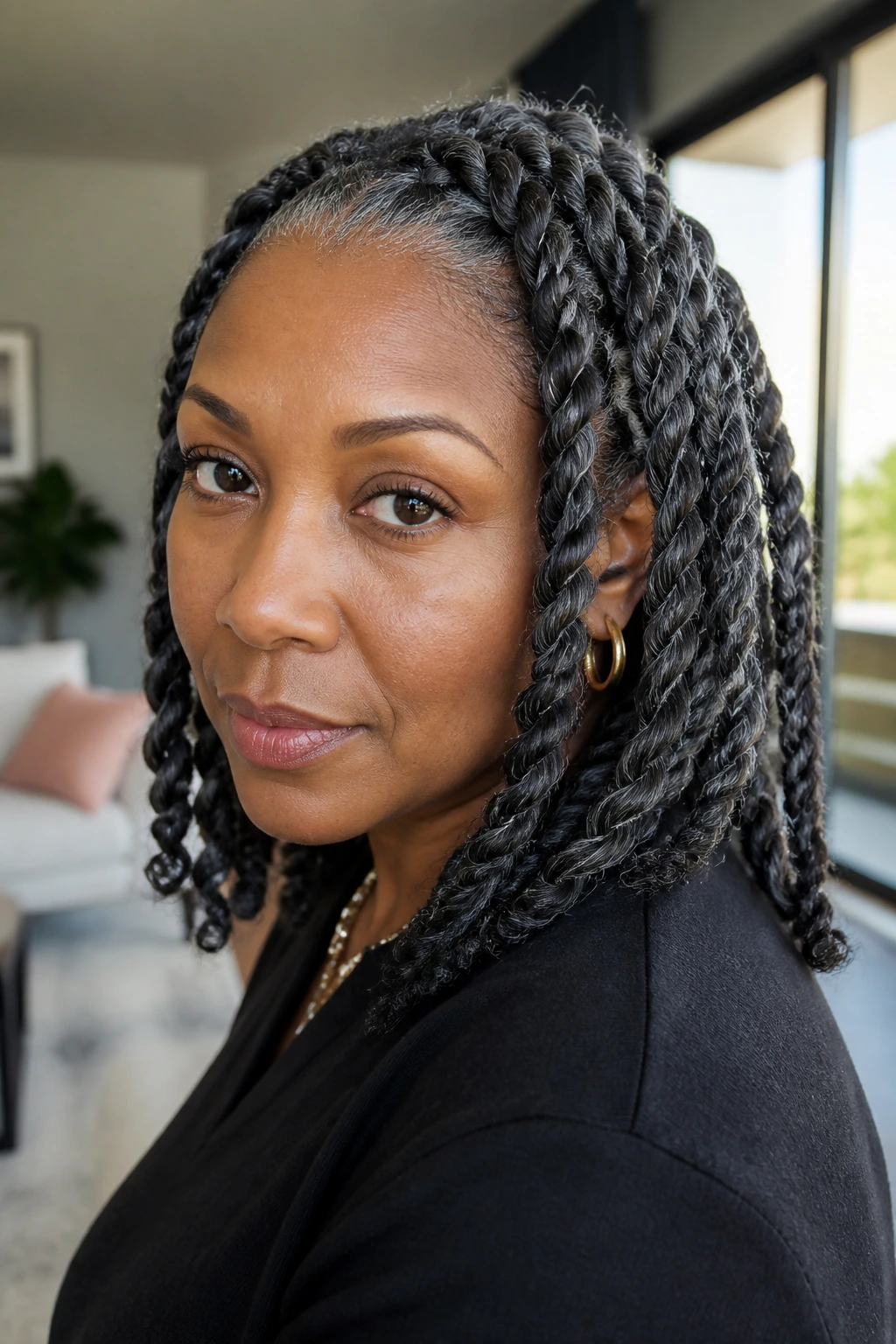
Chunky two-strand twists are one of the most dependable ways to hide gray on dark curly hair because they wrap the strands together in thick ropes. A single gray strand doesn’t stand alone there. It gets folded into the twist and disappears into the pattern.
They’re also good for people who want a style that lasts more than one day. Twists can be worn down, pinned up, or gathered into a puff, and each version handles gray a little differently. If the gray is concentrated at the temples, twist the front pieces a little tighter into the pattern so the roots are less exposed.
Use enough product to keep the twist smooth, but not so much that the hair goes dull and clumpy. Dullness on dark hair can make gray stand out even more, which is the opposite of what you want.
14. Bantu Knot-Out
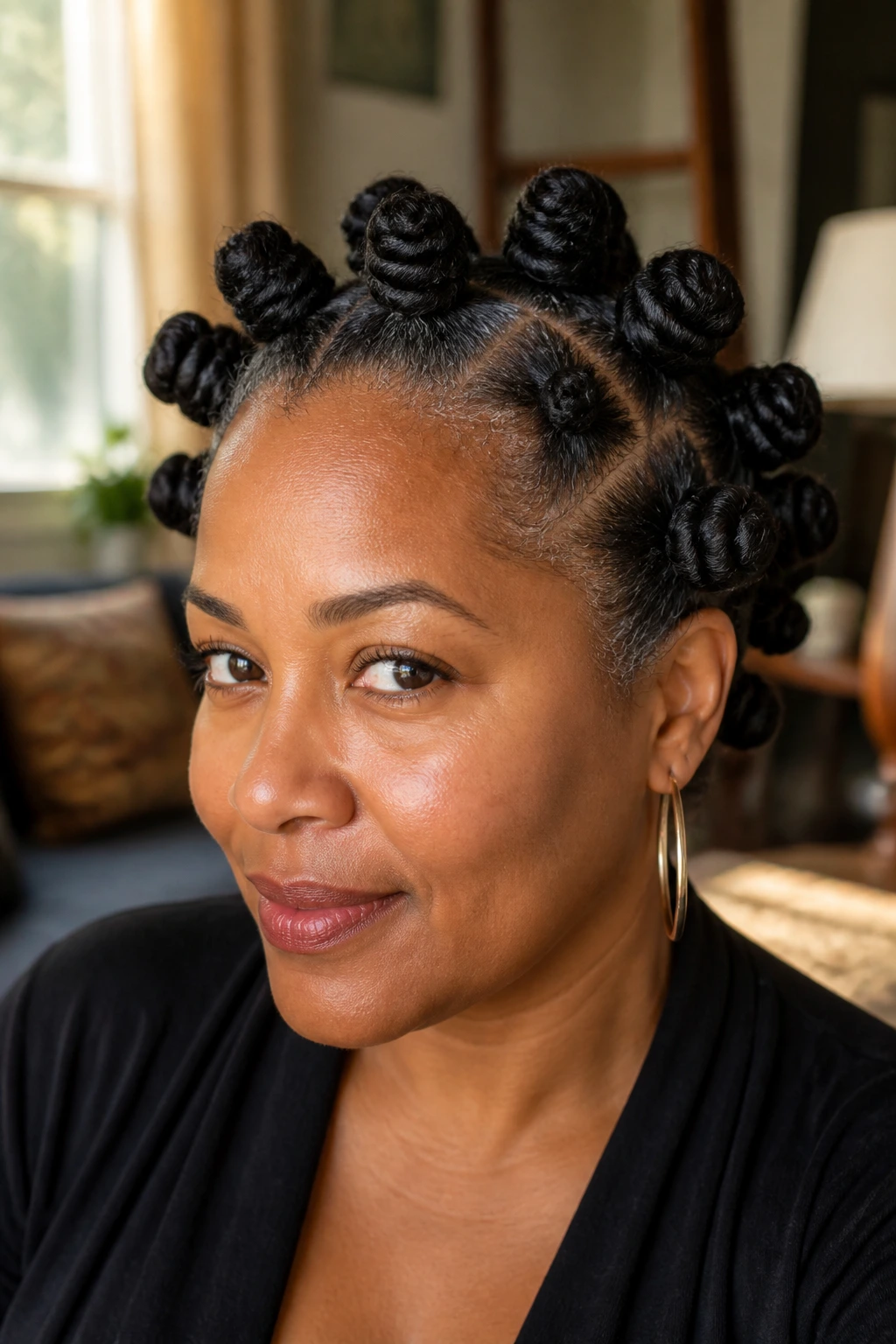
A Bantu knot-out has two jobs. First, the knots themselves hide the gray while the hair sets. Then, when you take them down, the resulting curls scatter light in all directions and break up any obvious silver line. On dark hair, that scattering is useful. Very useful.
The Science Behind the Look
The curl pattern from a knot-out tends to be rounded and dense, which means it creates more visual texture than a stretched style. Texture is your friend when gray strands are bright. The eye sees shape first and color second, which is exactly the direction you want.
Best When
You want a style that feels set and structured, not loose and airy. Bantu knot-outs also work well if your gray is in patches rather than a single band, because the pattern can be placed to cover those spots during the setting phase.
Give the knots enough time to dry fully. Half-dry knots can frizz into a halo that looks busy rather than polished.
15. Side-Swept Curly Frohawk
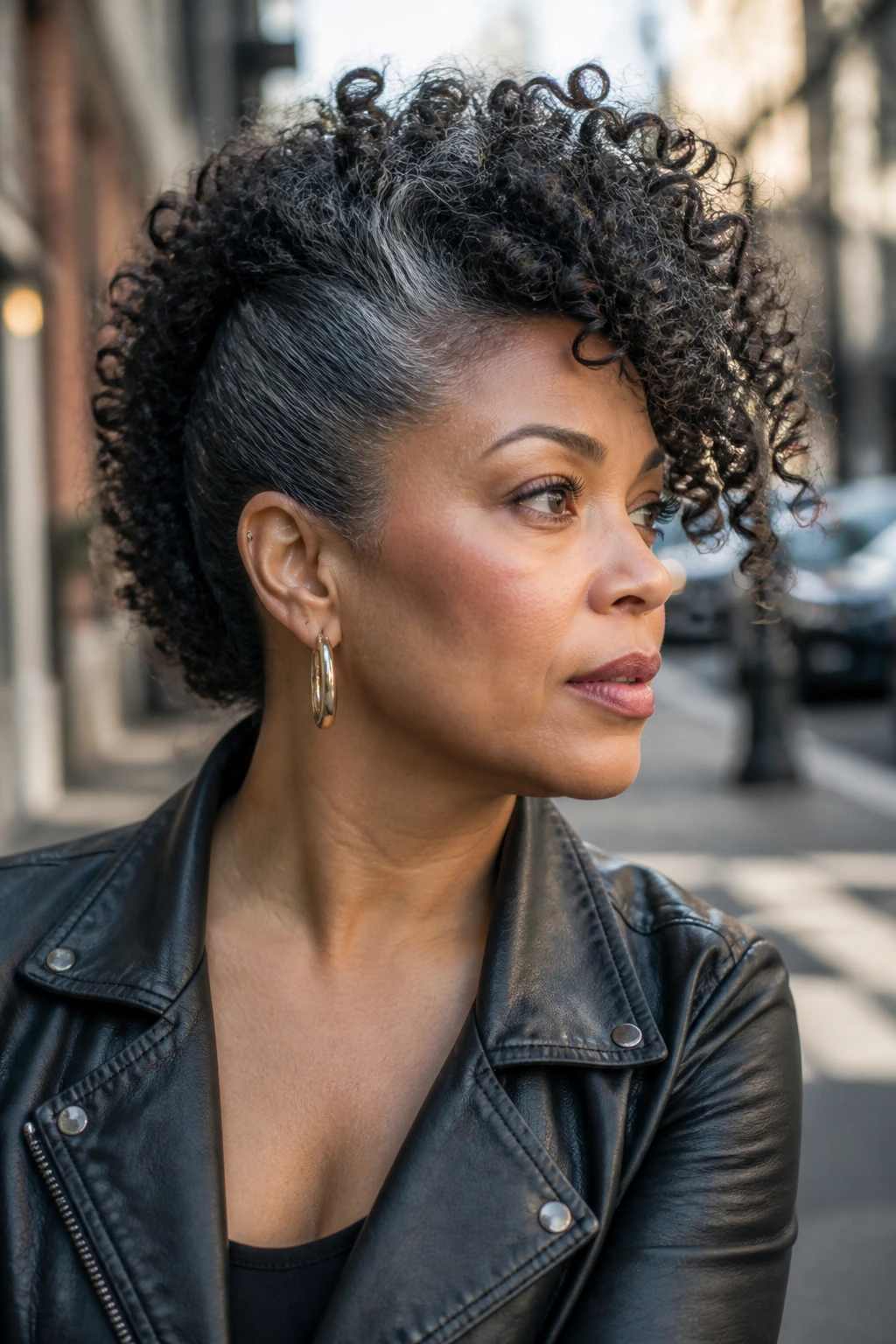
A side-swept curly frohawk is bold, and it knows it. The sides are pinned or smoothed down while the center stays tall and textured, which shifts attention away from gray around the temples and toward the shape of the silhouette. That shape is the whole trick.
This style works best when you want contrast to do the hiding. Dark hair with gray at the sides can look very obvious in a straight-down style. Pull the sides back, push the volume up the middle, and the silver stops being framed so directly.
Keep the side sections soft rather than shellacked. A frohawk looks better when it still has some curl around the edges. Too much gel at the sides can make the style look severe, and severe styles tend to make bright strands stand out more.
16. High Puff with Soft Bangs
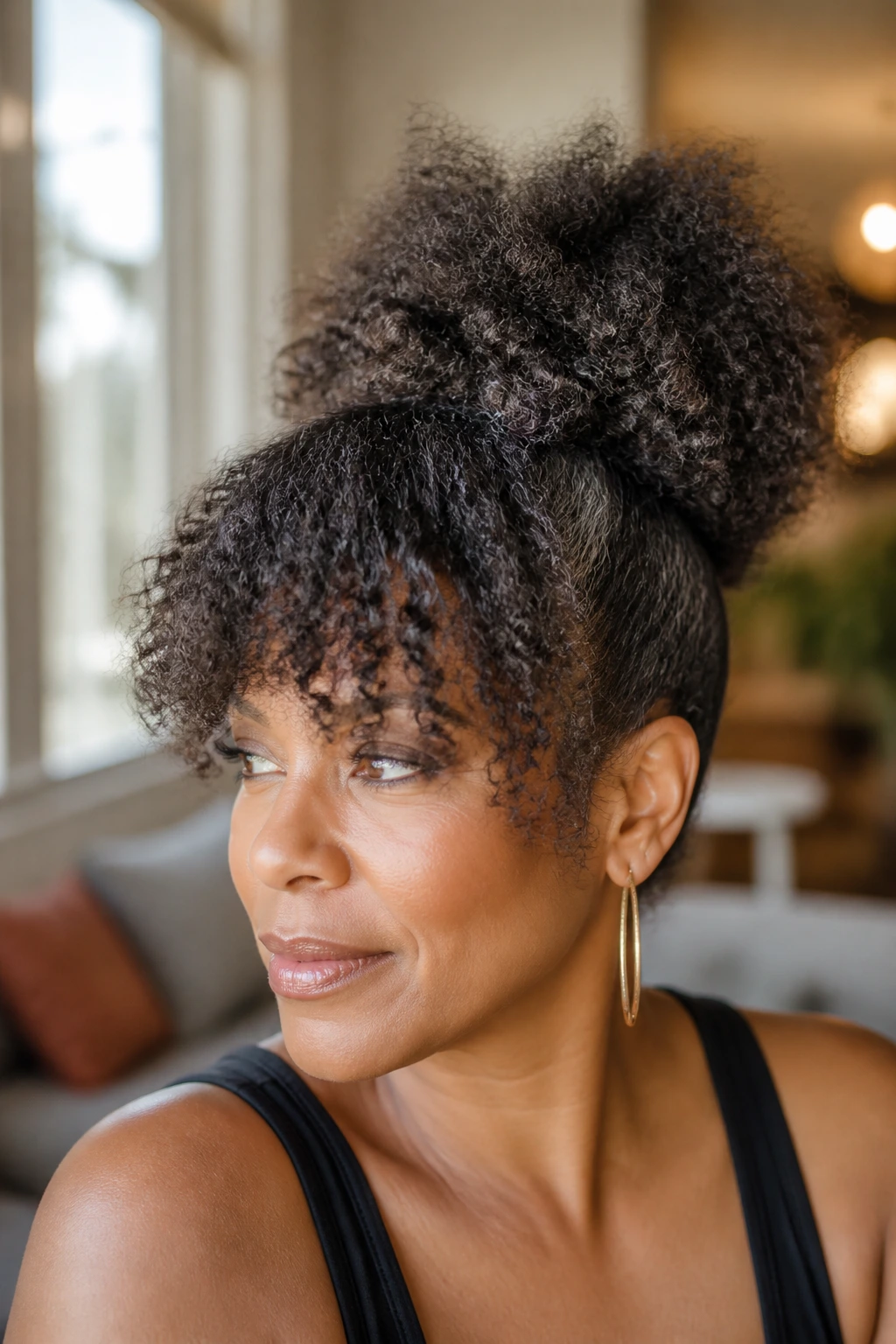
A high puff with soft bangs gets gray out of the center of the face fast. The puff lifts everything upward, and the bangs — or just a few loose front curls — fall across the forehead where gray often shows first. That little curtain is enough to change the whole vibe.
I like this style because it does not pretend to be fancy. It’s quick, it holds shape, and it makes dark curly hair look full even when the roots are in an awkward in-between stage. If your gray is scattered through the front hairline, this is one of the easiest ways to keep it from taking over the look.
Keep the puff base neat with a scarf or a stretch band, then let the bangs stay soft. Too much smoothing around the front makes the gray line more visible, not less.
17. Curly French Roll Tuck
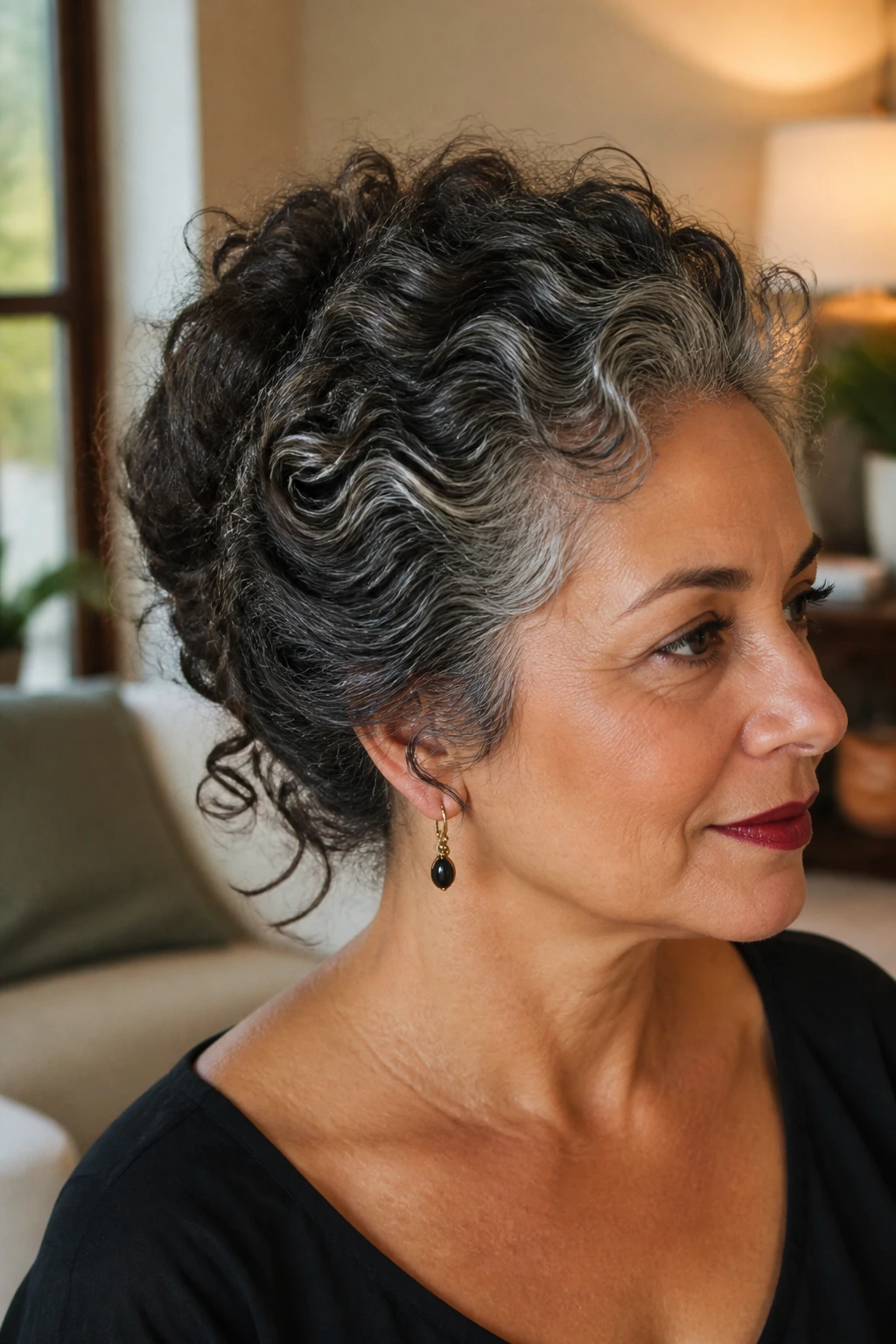
The curly French roll tuck is one of those styles that looks more complicated than it is. Hair is rolled back and pinned into a vertical or diagonal tuck, which hides the front gray under the fold. If your silver is mostly around the part or temple area, the tuck does a nice job of making it disappear into the shape.
This works well on medium to long curls because there’s enough length to roll without cramping the curl pattern. Leave a few ends peeking out if you want it softer. Tightly tucking everything can make the style look too rigid on curly hair.
A few hidden pins do the job. You don’t need a box of them. You need the roll to hold, not to feel like armor.
18. Layered Lob with Curtain Bangs
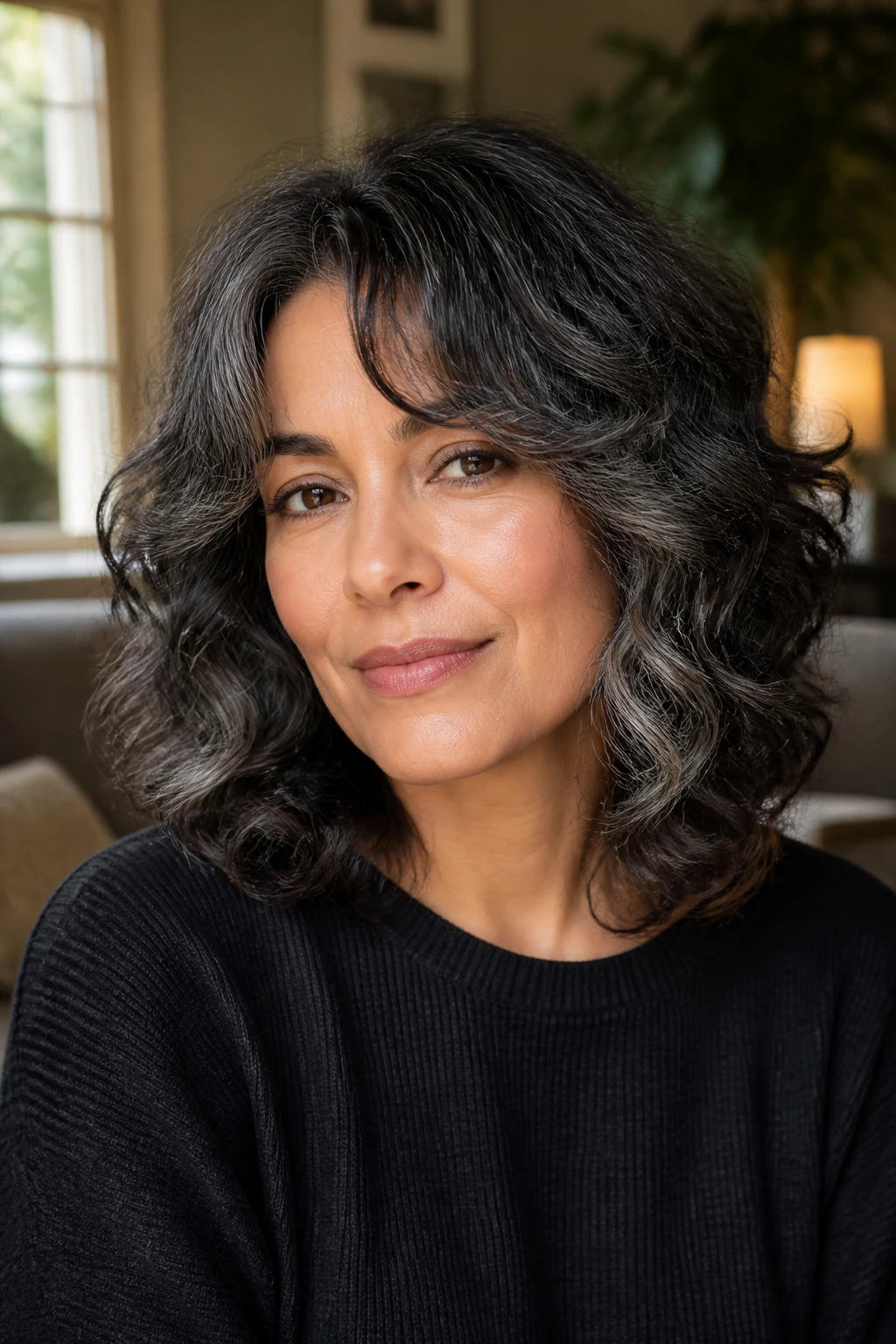
A layered lob with curtain bangs is a steady, low-maintenance way to cover gray while keeping hair down. The curtain bangs split the front frame, which softens the temples, and the layers keep the curls from forming one flat sheet. That movement is what makes the gray less visible.
This is a strong choice if you’re tired of constantly styling updos. The lob gives enough length for shape, but the bangs take pressure off the front hairline. Gray that would look obvious in a blunt cut becomes just part of the texture when the bangs fall loosely around the face.
Ask for bangs that can be tucked or flipped back if needed. Curly bangs need flexibility. Hard, exact lines are the enemy here.
19. Braided Hairline with Open Curls
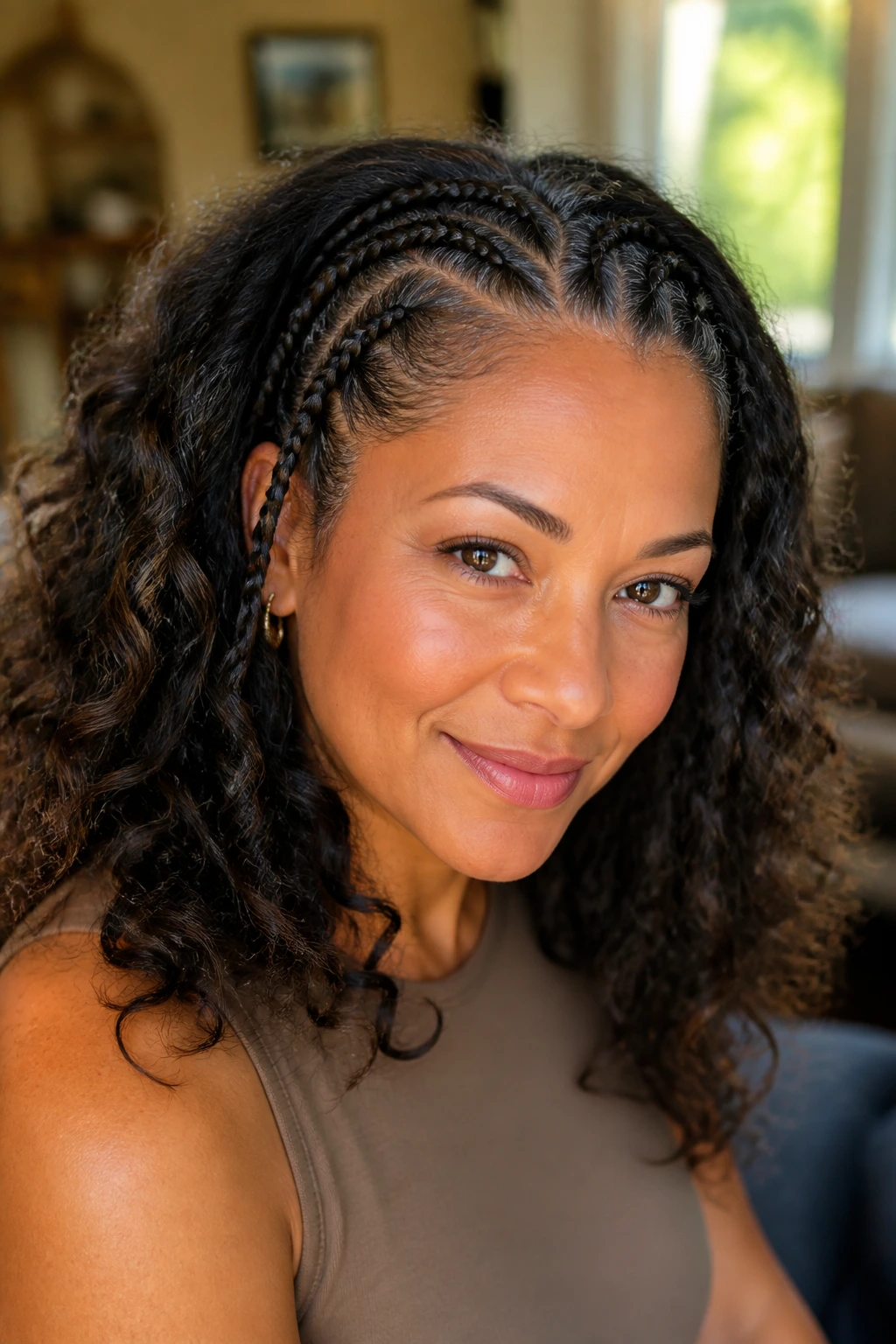
A braided hairline with open curls gives you a little bit of both worlds. The braids around the front and temple area hide the most visible gray, while the rest of the hair stays loose and curly. That makes the style feel softer than a full braid look and more controlled than a simple wash-and-go.
What to Watch For
Keep the braids small enough to blend, but not so tiny that they pull at the edges. Tension around the hairline can thin the perimeter over time, and that makes gray roots more noticeable the next time you wear the style.
How to Make It Work
This is especially good when the gray is concentrated in a narrow frame around the face. Braid that frame, leave the back open, and let the curls take over. If you want more polish, add a little shine product to the open ends, not the braids themselves.
It’s a hybrid style, which is exactly why it works. One part camouflage, one part movement.
20. Voluminous Afro with Gray-Blending Gloss
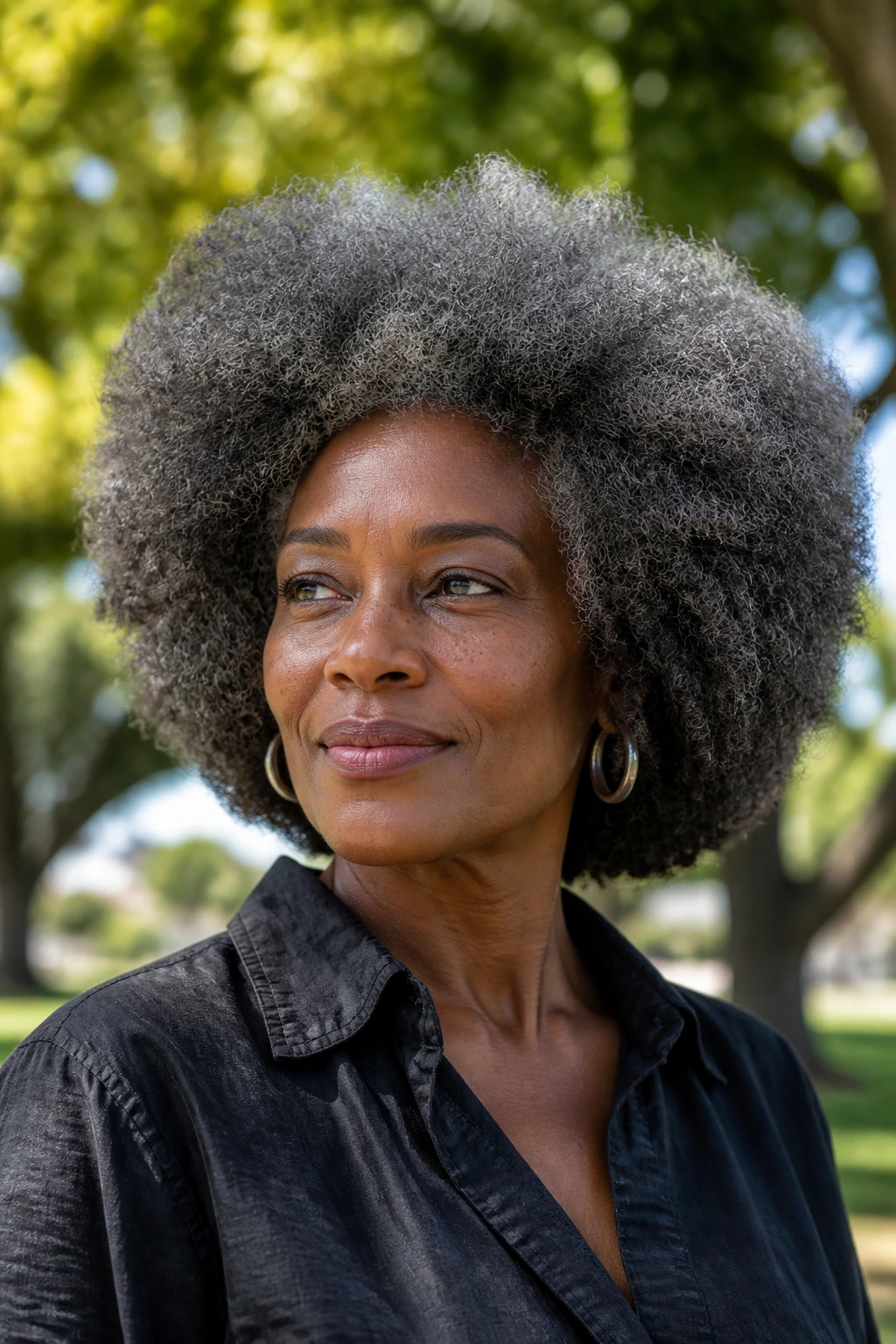
A voluminous afro is a strong answer when you’d rather blend gray than chase it. The shape distributes the silver across the whole head, so no single streak gets all the attention. On dark hair, that makes gray look like part of the texture instead of a root problem.
A light gloss or shine spray can help unify the tone, especially if your gray strands are wiry and want to sit on the surface. Don’t drench the hair. A little shine on the midlengths and ends is enough. Too much product near the roots can make the grays flash harder under light.
This style works best when the cut has enough shape to stand on its own. A good afro is not random. It’s sculpted, even if it looks effortless from across the room.
21. Sleek Side Twist Low Bun
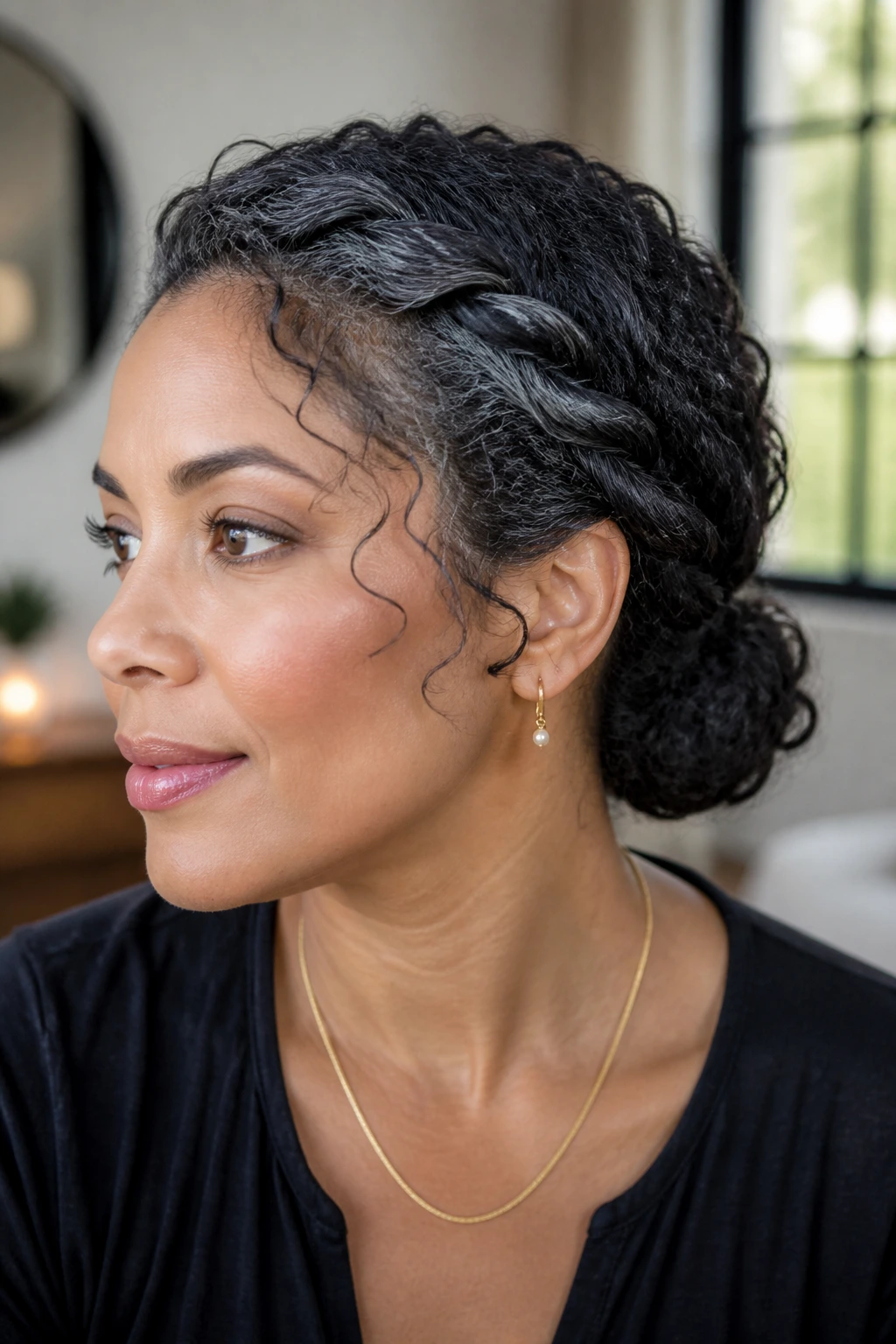
A sleek side twist low bun is one of the best polished looks for gray coverage because the side twist interrupts the part line and the bun keeps the ends tucked away. That matters on dark curly hair, where loose flyaways can make silver pieces pop against the background.
The bun sits low and close to the neck, which keeps attention away from the crown. The side twist gives you a soft frame, so the style does not feel severe. If your gray is mostly at the part or top, this is a clever way to keep it from sitting in plain sight.
Use smoothing gel sparingly. You want the front neat, not stiff. A little movement near the twist keeps the style from looking drawn on.
22. Defined Coil Set with Zigzag Part
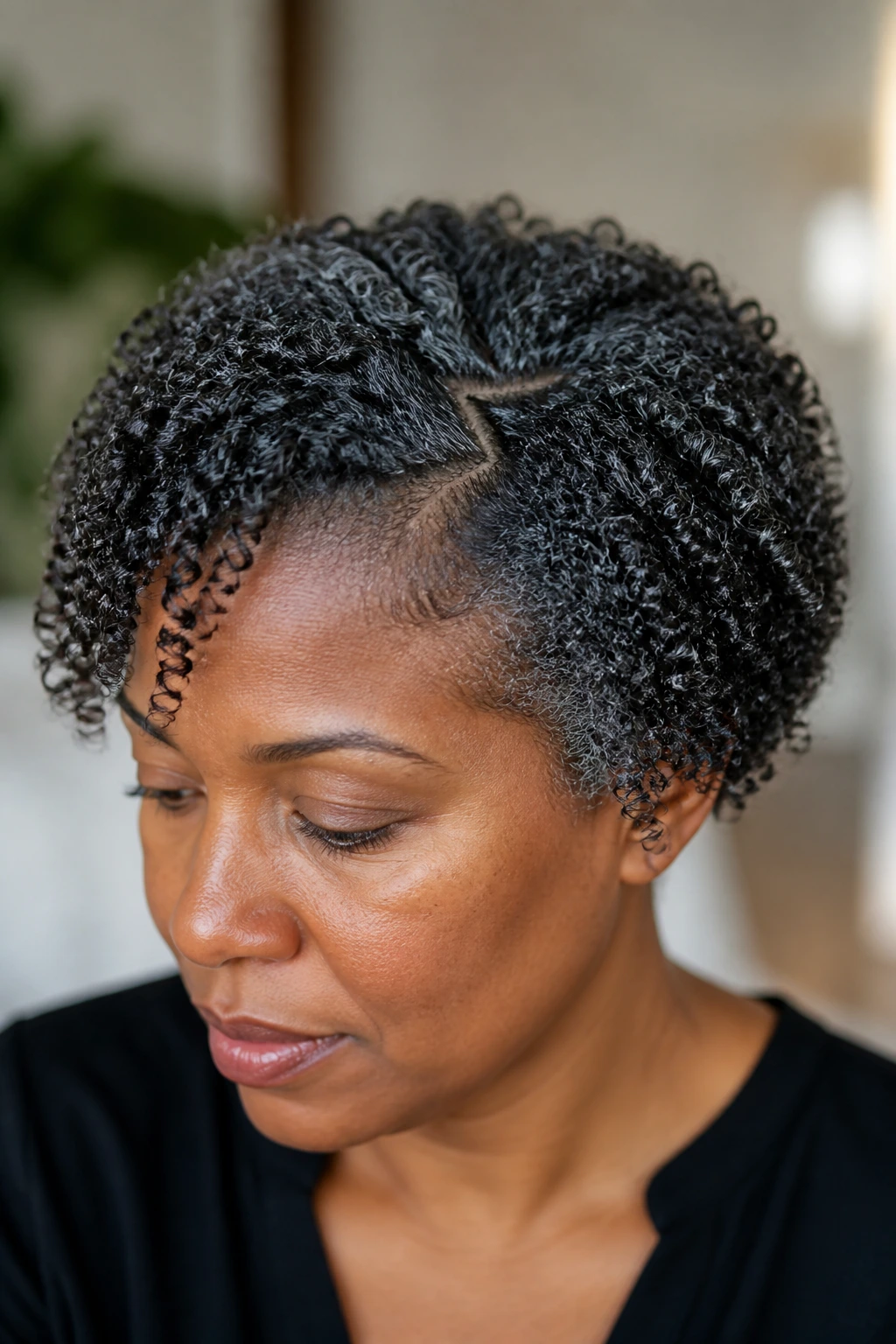
A defined coil set with a zigzag part is one of the most literal ways to break up gray on dark hair. The part line stops being a straight runway, so the eye cannot track the silver as easily. Each coil stands on its own, which turns gray strands into part of the overall pattern instead of a separate stripe.
This is especially good for shorter to medium-length coils and tighter textures that hold definition well. The more exact the coils, the more the silver gets folded into the shape. If you want extra camouflage, change the zigzag direction every few inches so the scalp never shows one clean road.
Take your time with this one. Small sections make a cleaner result, and cleaner coils usually mean less visible gray at the root.
Why Dark Curly Hair Needs a Different Gray Strategy
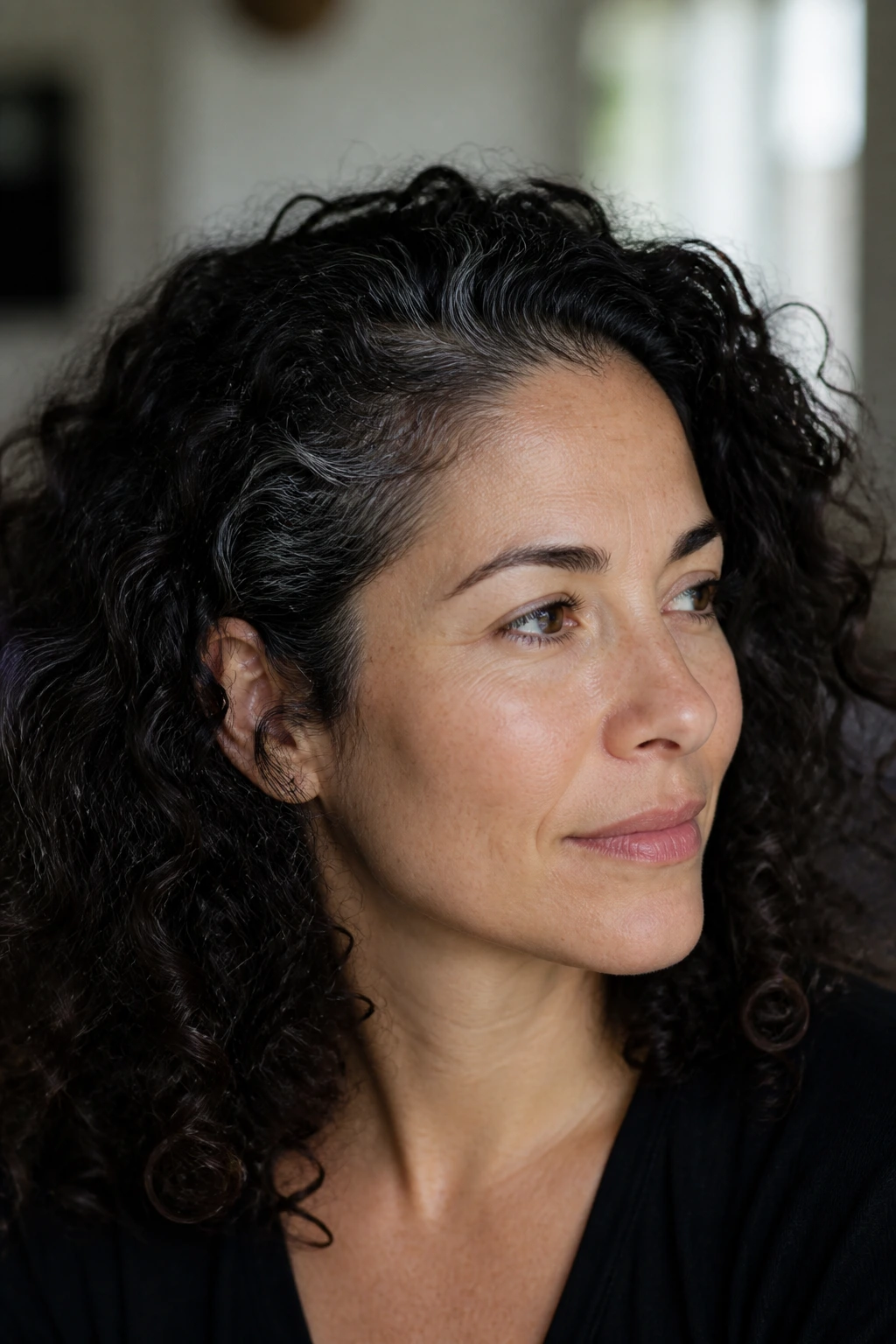
Dark curly hair does not show gray the same way straight hair does. The curl pattern catches light from several angles, so silver strands can flash in little bright pockets instead of one even sweep. That can be useful, but it can also make a few grays look louder than the actual amount of gray you have.
The other thing working against you is contrast. Dark roots plus bright silver plus a visible part line can create a sharp little map on the scalp. If the hair is dry or fluffy at the crown, the contrast gets even stronger. That’s why shape matters so much here. You are not just styling curls; you’re managing where the eye lands first.
What Gray Usually Does on Curls
It tends to show up at the temples, along the part, and in any place where the curl clumps separate. That means styles that create movement — side parts, layers, puffs, twists, braids — are doing real camouflage work, not just decoration.
What Usually Makes It Stand Out
Flat roots, overly shiny products, and hard center parts are the usual culprits. They make the gray travel in a clean line. Clean lines are the enemy of good gray blending on curly dark hair.
Essential Tools for Gray-Covering Curly Styling
-
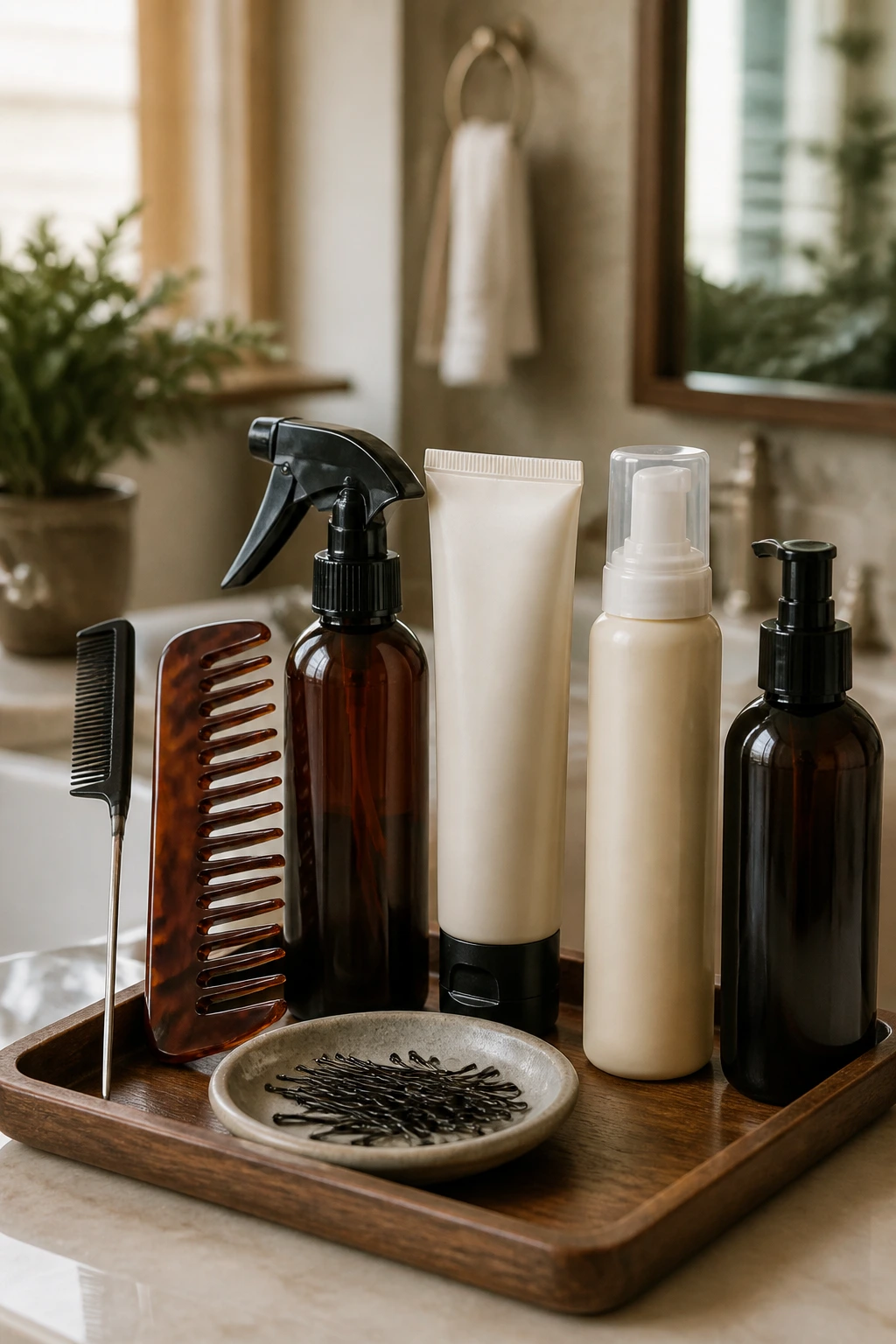
Rat-tail comb: Best for moving the part line just enough to hide a strong gray stripe without disturbing the whole curl pattern.
-
Wide-tooth comb: Good for detangling damp curls before styling. It keeps breakage down, which matters when gray strands feel coarser than the rest.
-
Spray bottle with water: Handy for reactivating curl cream or mousse on second-day hair without soaking the roots.
-
Curl cream or leave-in conditioner: Keeps curls soft enough to clump, which helps gray blend instead of separating into bright wisps.
-
Mousse or light-hold foam: Great for side parts, puffs, and wash-and-go shapes that need lift without heavy residue.
-
Strong-hold gel: Useful for slicked sides, braids, and twists where the perimeter needs to stay neat.
-
Bobby pins and duckbill clips: These hold side sweeps, rolls, and tucked styles while the curls settle.
-
Satin scarf or bonnet: Keeps the front from frizzing up overnight, which is where gray often becomes most obvious first.
-
Diffuser attachment: Optional, but worth it if your curls need root volume and you don’t want the gray line to sit flat against the scalp.
-
Root touch-up powder or mascara wand: Optional, not mandatory. Helpful if you want to bridge the gap between washes or salon visits.
Picking the Right Style for Your Curl Pattern and Gray Pattern
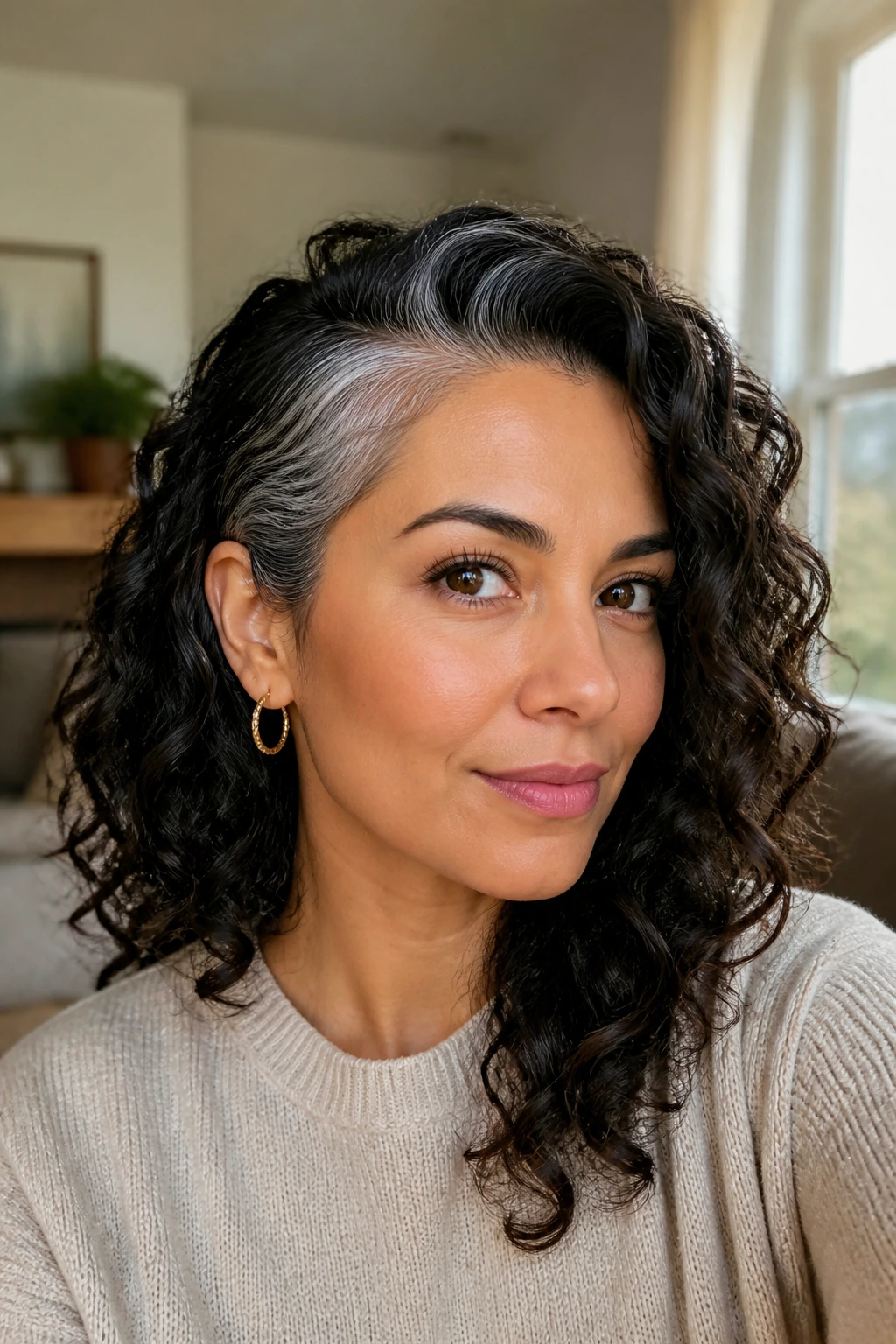
Gray coverage on curly hair is not one-size-fits-all. The style that hides a temple streak on loose 3A curls might do almost nothing for a tight 4B crown that goes silver in patches. That’s not a flaw in the style. It’s just hair being honest about what it needs.
If the gray sits mostly at the temples
Use side parts, face-framing layers, braids at the hairline, or swept-up styles like the frohawk and half-up top knot. Those looks pull attention away from the exact spot where the silver is loudest.
If the gray spreads through the crown
Go for styles that break up the top visually: twist-outs, flat twists, zigzag parts, layered shags, and voluminous afros. The goal is to make the crown look textured, not stripped clean.
If your curls are loose, medium, or tight
Loose curls can usually carry lobs, side parts, and curtain bangs with ease. Tighter curls often do better with twists, puffs, knots, and braids because those styles keep the gray woven into the shape instead of sitting in exposed streaks. If your hair shrinks a lot, plan for that shrinkage. A style that looks covered when stretched can reveal more gray once it dries into its final shape.
How to Get the Most Gray Coverage Without Fighting Your Curls
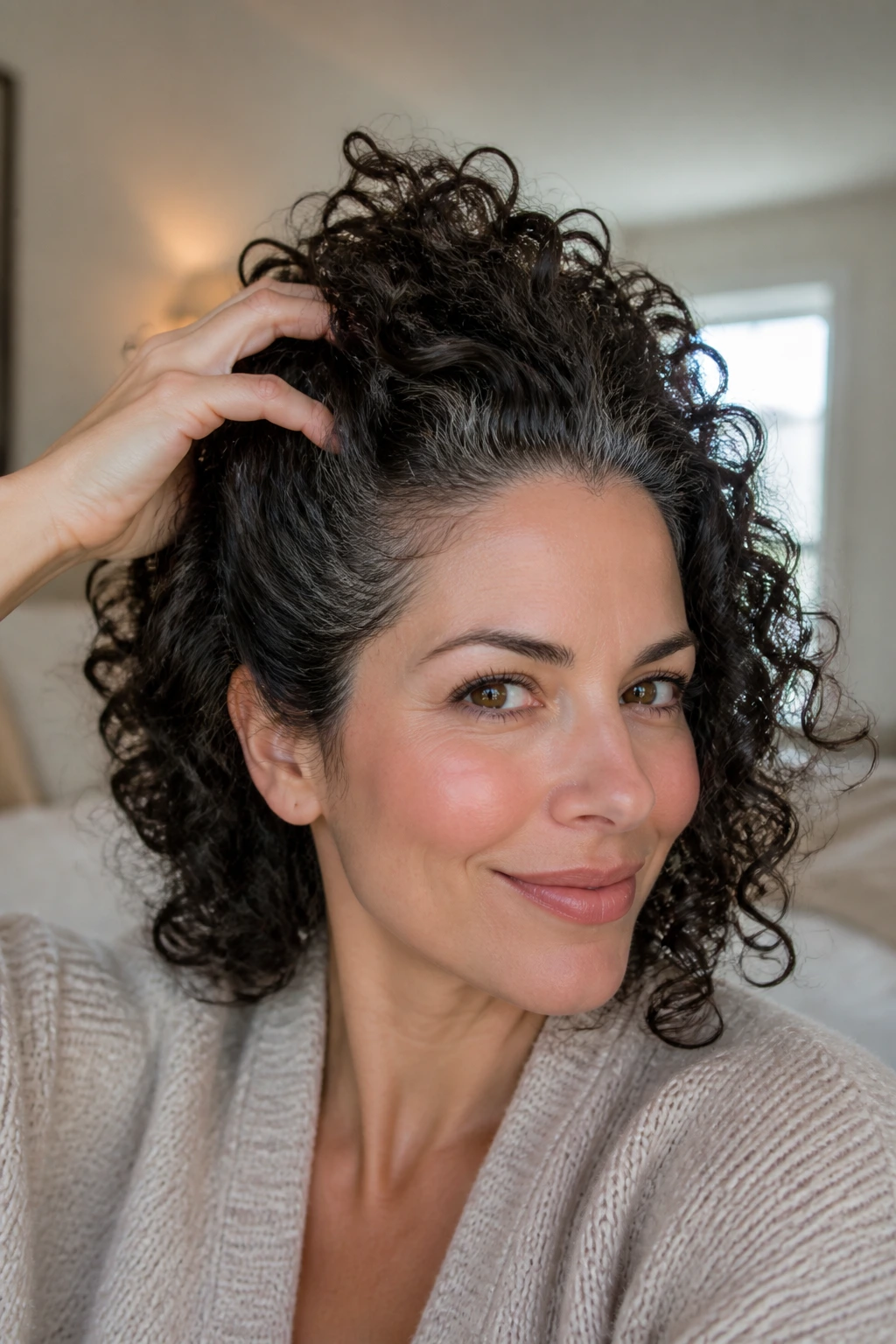
Part Placement: Move the part line at least half an inch off your usual spot. Even that small shift can move a bright gray seam out of direct view, especially if the grays cluster on one side.
Lift at the Roots: Gray on dark hair looks louder when the roots lie flat. Diffuse the crown, fluff the roots with your fingers, or use a pick at the base after the hair is dry. Height creates shadow, and shadow is useful.
Use Shine Where It Helps: A tiny bit of gloss on the mids and ends can make curls look healthy, but heavy shine at the roots tends to highlight silver strands. Keep the gloss away from the scalp line unless you want every gray thread to sparkle.
Respect the Curl Clump: Don’t separate curls to death. Big, fluffy separation can be nice, but too much of it exposes more of the gray strand itself. Leave some clumping intact so the silver sits inside the curl instead of on top of it.
Change the Direction: If you keep wearing the same part or the same puff placement, the same gray spots stay visible. Switching direction every few wears helps a lot more than people think.
Common Mistakes That Make Gray Pop
-
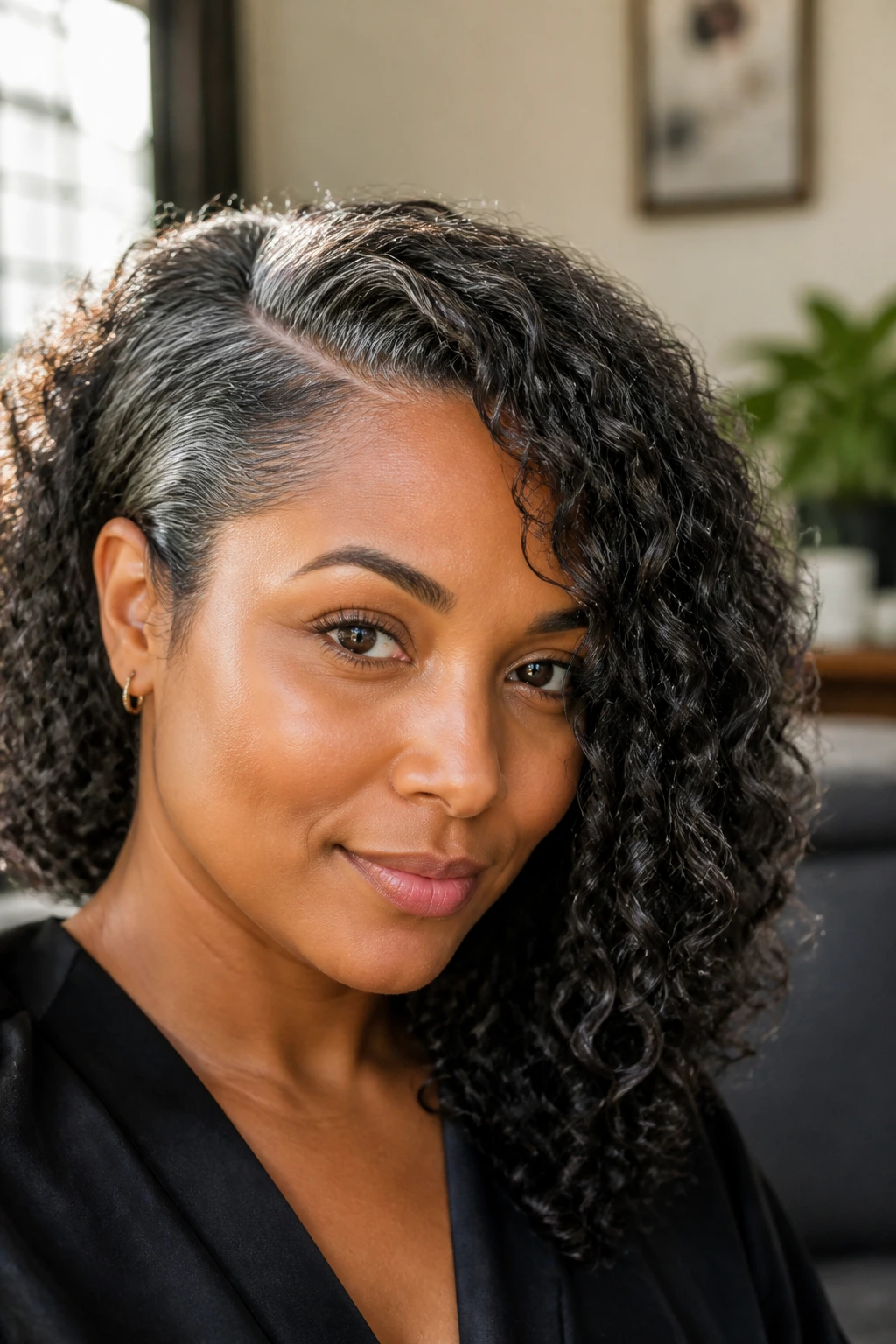
Wearing the same hard center part every day: If your gray lives along that line, you’re basically framing it on purpose. Shift the part or make it zigzagged so the scalp line breaks up.
-
Slicking the crown too flat: Flat roots remove the shadow that dark curls need. The result is a shiny top with silver lines sitting right on the surface. Keep some lift.
-
Using too much oil near the scalp: Grease reflects light. On dark hair, that can make gray strands look brighter and thinner than they really are. Put shine on the ends first, not the roots.
-
Pulling braids or twists too tight: Tightness around the hairline exposes gray more sharply and can thin the perimeter over time. Slightly looser sectioning gives better camouflage and a calmer scalp.
-
Choosing a style that collapses in two hours: A style that looks great in the mirror but falls flat after lunch is a bad bargain. If your curls droop fast, pick a shape with built-in structure: twists, puffs, frohawks, or layered cuts.
-
Ignoring shrinkage: A stretched style may look covered while wet, then shrink and reveal the gray again when dry. Style with the final shape in mind, not the wet one.
Variations and Adaptations to Try
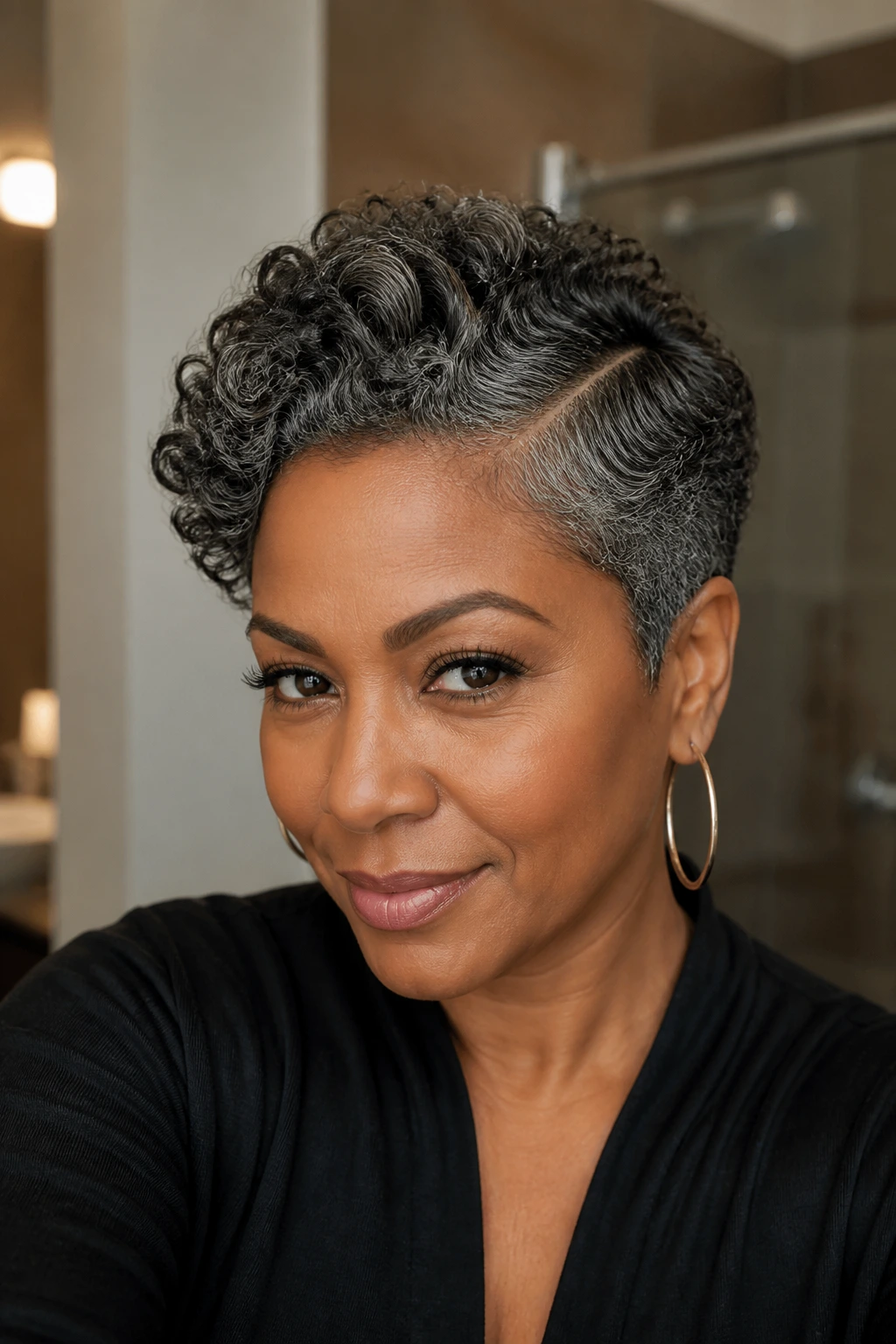
Short-Crop Edit: If your curls are short, lean into pixies, tapered cuts, mini frohawks, and textured side parts. Short hair usually hides gray best when it has a little lift and a clear shape, not when it’s smoothed down.
Office-Polished Edit: Swap playful styles for low buns, side twists, and curved side-part bobs. These reads cleaner without turning hard or severe, and they’re good when you need the gray tucked away but still want a finished look.
Weekend Volume Edit: Go bigger with afros, high puffs, and loose twist-outs. Extra volume breaks up gray by spreading it across more surface area, which keeps any one bright strand from dominating.
Protective-Style Edit: Use flat twists, halo braids, chunky two-strand twists, or braided hairlines when the goal is longer wear and less daily manipulation. These styles are useful when the gray is mixed through the front and you want the scalp line to stay quiet for days.
Heat-Free Definition Edit: Use Bantu knot-outs, twist-outs, and carefully set wash-and-gos when you want curl definition without blow-drying or flat ironing. The definition gives the hair enough pattern that the silver blends into the texture instead of sitting on top of it.
How to Keep These Styles Looking Fresh Between Wash Days
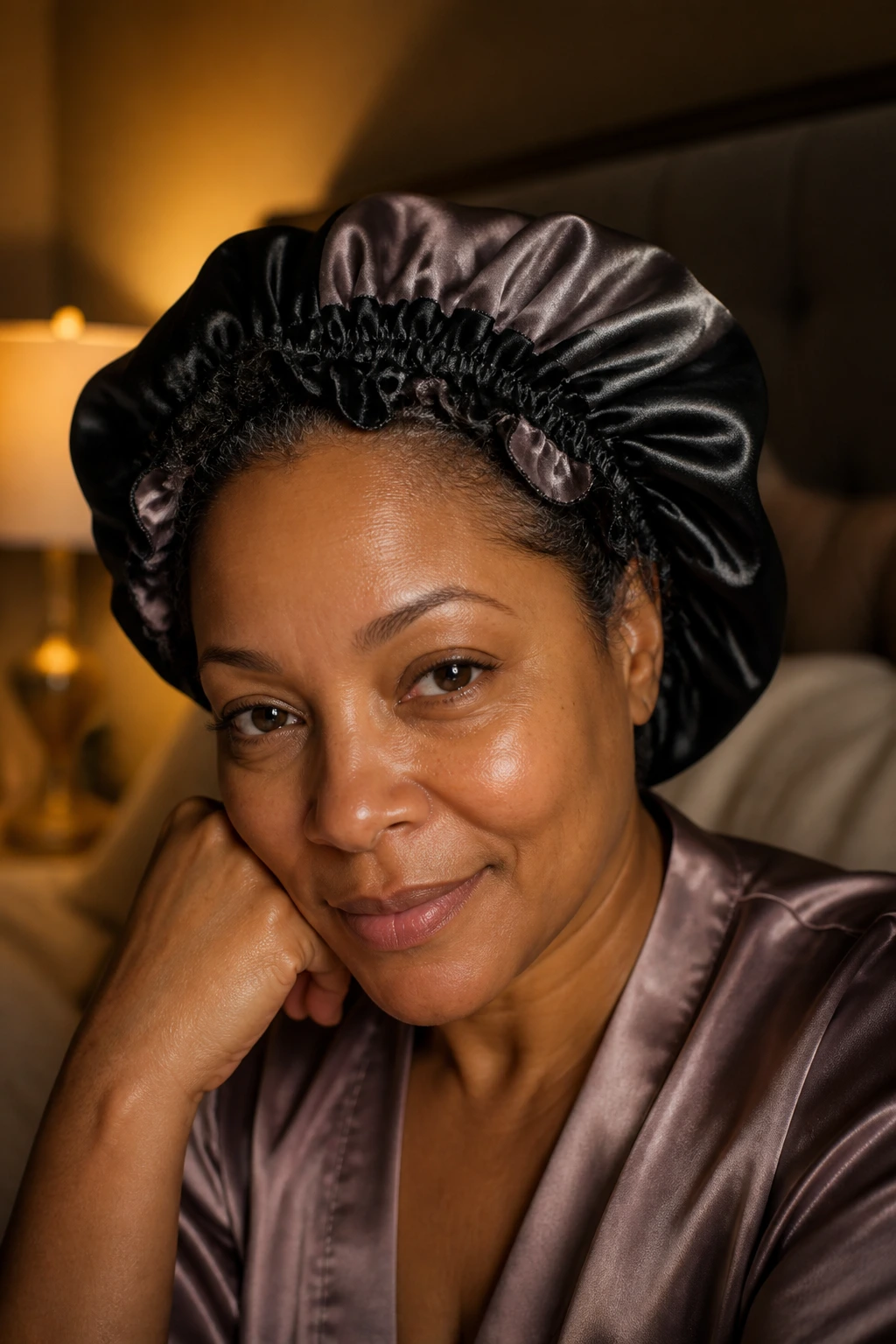
A lot of gray-hiding styles fail not because they start badly, but because they get tired too quickly. Curly hair gets frizzier at the front first, and that’s exactly where gray likes to show up. A satin bonnet or scarf at night makes a real difference. So does putting the curls in a loose pineapple or keeping twists wrapped up.
For wash-and-go styles, plan on a light refresh by day two or three: mist the hair lightly, add a little leave-in to the ends, then scrunch the crown so the roots don’t collapse. Twist-outs and braid-outs usually hold for four to six days if you preserve the pattern at night. Puffs and buns are faster, but they often need a redo after a day or two because the perimeter loosens first.
Protective styles like twists, flat twists, and halo braids can last one to two weeks if the scalp stays comfortable and the edges are not being pulled. If the hairline starts to feel sore, take that as your cue. Gray coverage is not worth stress along the perimeter. Not even close.
Frequently Asked Questions About Cover Gray Hairstyles
Which styles hide gray at the temples best?
Side parts, braided hairlines, half-up top knots, side-swept frohawks, and curved bob shapes usually work best. They move the eye away from the exact place where temple silver tends to flash first.
Do center parts make gray more obvious?
They can, especially if the gray sits along the crown or part line. A center part creates one strong vertical line, and dark curly hair will show silver more sharply when that line is flat and straight.
Can I cover gray without coloring my hair?
Yes. You can hide or soften a lot of gray just by changing the part, adding lift, using braids or twists, and wearing styles that create texture. If you want a little extra help, a root powder or temporary concealer can fill in the gap.
What if my curls frizz up and the gray starts showing by lunchtime?
Use a stronger hold at the root, preserve the style overnight with satin, and keep your hands out of the front. Frizz breaks the curl clump apart, which exposes silver more quickly than a neat, clumped curl would.
Are protective styles a good choice for gray coverage?
They are, especially when the gray is scattered through the hairline or crown. Flat twists, halo braids, and chunky twists keep the silver woven into the style instead of sitting in exposed sections.
What works best for very coarse, tight curls?
Twists, puffs, knot-outs, and frohawks usually do the best job. Those styles hold shape without needing the hair to lie flat, which is where gray tends to shout the loudest on tight textures.
Should I use shiny products to make gray blend?
A little shine is fine on the midlengths and ends, but too much at the roots can make silver more visible. Dark curly hair usually looks better with soft, healthy-looking sheen than with a glossy scalp line.
How often should I change my part or styling direction?
Every few wears is smart if the gray is concentrated in one area. Rotating the part keeps the same bright strand from being exposed day after day, and it also helps the hair fall more naturally over time.
A Softer Way to Wear the Gray
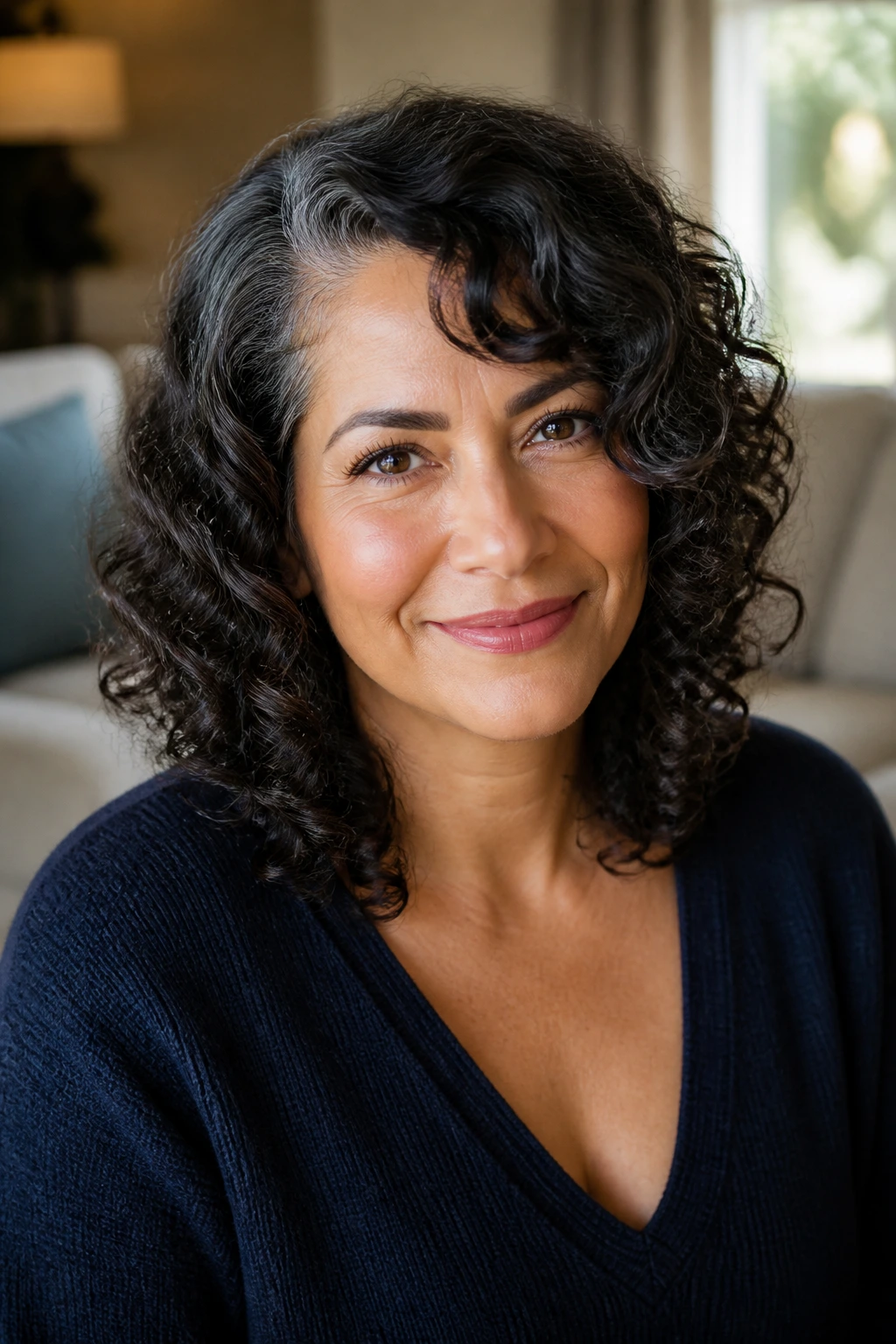
Gray on dark curls does not have to look like a problem waiting for a color appointment. Sometimes the better answer is shape, not dye. A side part, a puff, a braid, or a layered cut can quiet a bright streak faster than a bottle of anything.
The nicest part is that these styles still let the curls look like curls. They keep the bend, the lift, the little bits of movement that make dark curly hair feel alive. Pick the shape that gives your gray somewhere to disappear, and the rest gets easier from there.