



Fine hair can turn bangs into a little liar. They look full in the mirror for ten minutes, then the roots flatten, the fringe splits, and the whole forehead line starts acting heavier than it looked in the salon chair. On a round face, that’s even trickier. Put too much density across the front and you widen the face; cut the fringe too short and you lose the soft length that makes loose curls look relaxed instead of puffy.
The fix is not “more bangs.” It’s the right kind of fringe. You want lightness at the center, movement at the sides, and enough bend that the bangs feel stitched into the loose curls instead of sitting on top of them like a separate piece of hair. A good wavy bang on fine hair should brush the brows, skim the cheekbones, and fall with a little air between the strands. Heavy, blunt, thick? No thank you.
What actually works here is shape. A diagonal line, a soft split, a feathered edge, a longer side piece that falls past the widest part of the cheek — those small changes do the real work. The styles below lean into that idea in different ways, because some people want almost invisible fringe and some want a stronger cut with a little personality. Either way, the goal is the same: loose curls, more lift, and a face shape that feels longer without looking stiff.
Why These Bang Shapes Earn Their Keep

-
Fine Hair Needs Breathing Room: A lighter fringe keeps the front from collapsing into a flat strip the minute humidity or sweat shows up.
-
Round Faces Need Direction, Not Bulk: Diagonal bangs, center splits, and cheekbone-length pieces pull the eye downward and break up width around the middle of the face.
-
Loose Curls Do Better With Soft Edges: A soft bend at the ends blends the fringe into the rest of the style, so the bangs don’t look pasted on.
-
The Grow-Out Is Easier Than You Think: Many of these cuts still look intentional after a few weeks because the sides lengthen into face-framing pieces instead of turning into awkward shelf bangs.
-
You Can Style Them Three Ways: Air-dried, brushed out, or set with a curling iron, these fringe shapes can shift with your mood without needing a fresh cut every time.
-
They Play Nice With Low Effort Mornings: A little mousse, a round brush, and a quick cool-down clip can turn sleepy hair into something that looks planned.
1. Feathered Curtain Bangs
Feathered curtain bangs are the style I’d hand to someone with fine hair and a round face before I’d hand over anything blunt. The center stays light, the sides fall longer, and the whole fringe opens like a soft frame instead of a wall. With loose curls, this matters. The wave in the lengths gives the bangs somewhere to go, so they can melt into the style instead of fighting it.
Where the Shape Does the Work
Ask for the shortest point to land around the bridge of the nose or just below the pupils, then let the outer edges drift toward the cheekbones. That long side length is the part that keeps a round face from feeling boxed in. Fine hair likes the feathered edge too, because point-cut ends move more easily than a hard line.
A round brush and a quick bend away from the face are enough. Don’t over-roll it. If you twist the fringe into a tiny barrel curl, it starts looking cute for a minute and then a little too neat. You want the bangs to look broken up, not shellacked.
Best detail to ask for: a soft center split with the sides left long enough to tuck into loose curls.
2. Bottleneck Bangs with Airy Ends
Bottleneck bangs are the smartest middle ground when you want some coverage but not a heavy curtain across the forehead. The center is narrower, the sides widen gently, and that little flare around the cheekbones is what helps a round face look longer. On fine hair, the airy ends are the whole trick. Without them, the shape goes flat and the style loses its lift.
They work because the cut does not ask the front section to do too much. The bang is short enough to feel like a real fringe, but the outer pieces are long enough to blend into loose curls. That means less contrast between “bangs” and “rest of hair,” which is exactly what you want when the hair itself is fine and needs every bit of movement it can get.
I like this style best when the fringe is blow-dried in two directions: the center forward, then the sides curved out and back. Let it cool in place for a minute or two. That tiny pause matters. Fine hair forgets shape fast unless you give it a chance to set.
3. Side-Swept Fringe and Loose Curls
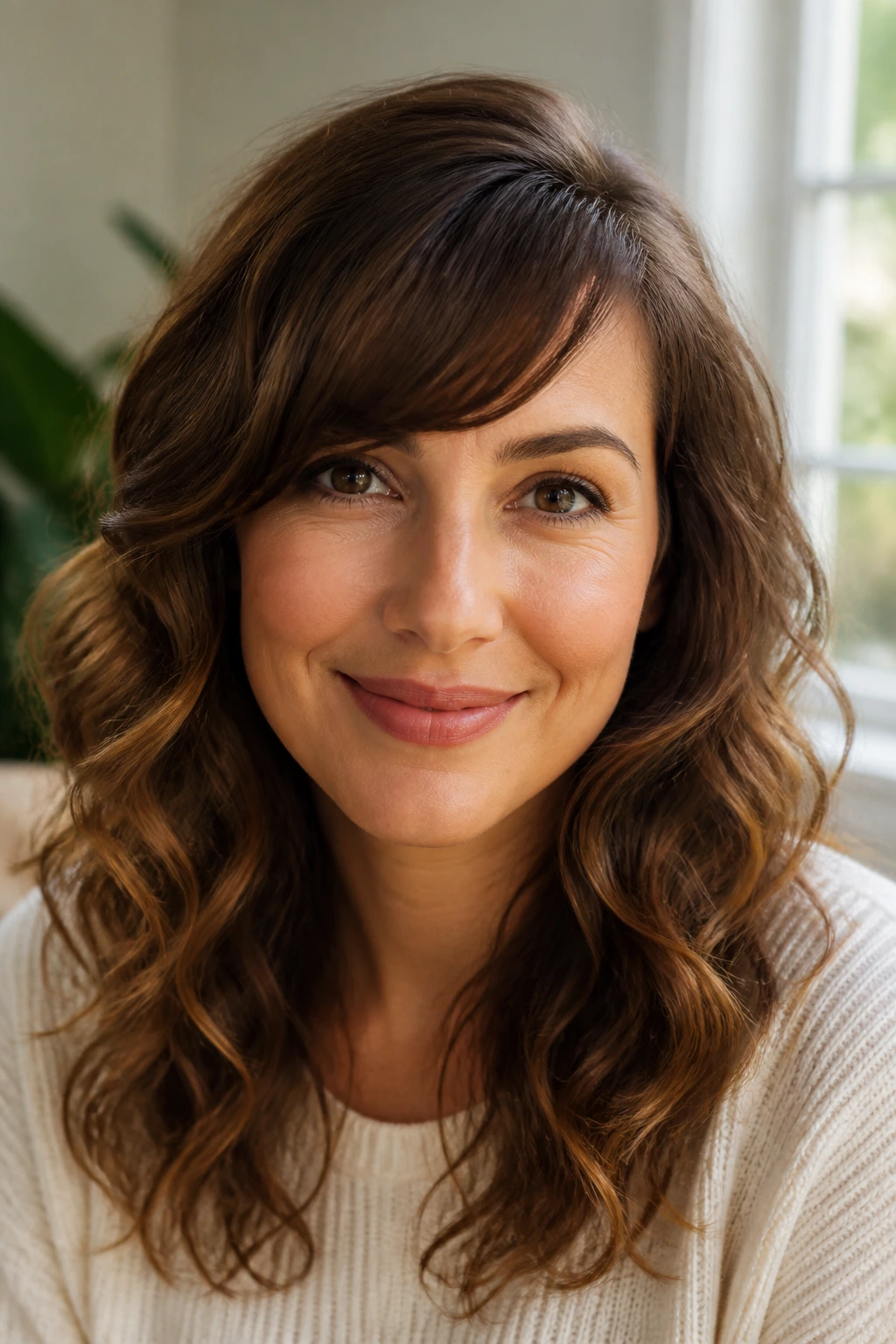
Why does side-swept fringe keep working on round faces? Because it cheats the eye, and I mean that in the nicest way. A deep side part creates one strong diagonal line across the forehead, which immediately breaks the symmetry that can make a round face read wider. Add loose curls underneath, and the whole head looks longer without looking fussy.
This is also one of the easiest fringe shapes to live with if your fine hair has a stubborn cowlick near the front. You’re not forcing the hair to fall straight down. You’re sending it where it already wants to go. That usually means less fighting, less frizz, and fewer mornings spent reshaping the same strand three times.
How to Wear It
Part the hair well off-center, then brush the fringe across the forehead and slightly upward at the root before letting it fall. Keep the ends light and piecey. If the side fringe gets too thick, it starts acting like a curtain; if it’s too thin, it vanishes. The sweet spot is a soft sweep that rests just above one brow and melts into the curl pattern near the temple.
4. Wispy Brow-Grazing Bangs
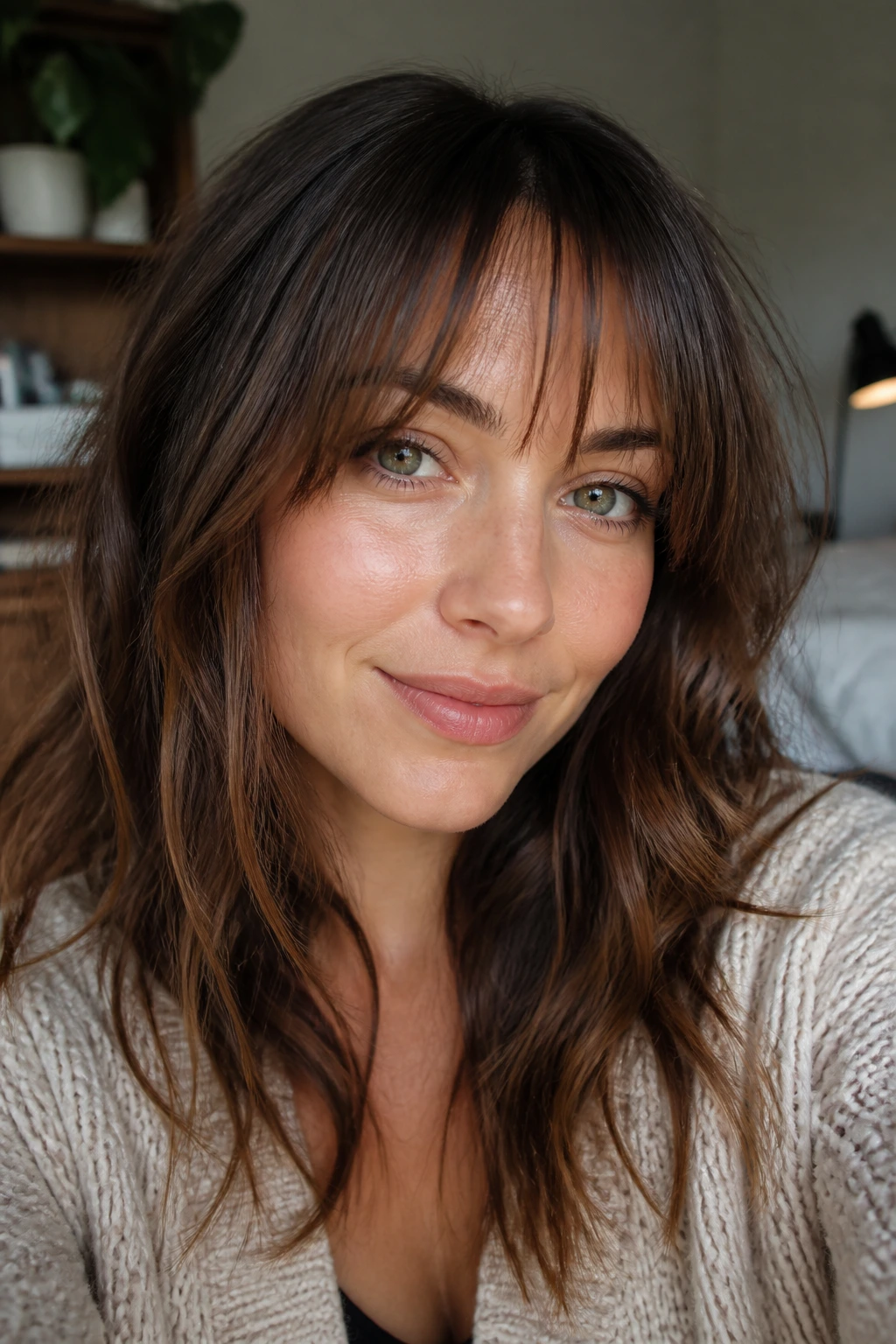
If you hate hair brushing your eyelashes but still want the softness of bangs, wispy brow-grazing fringe is the compromise that actually makes sense. The line sits right at the brow or just above it, but the density stays light enough that you can see a little forehead through the pieces. That transparency matters on fine hair. It keeps the fringe from looking like a slab.
On a round face, the wispy finish stops the front from taking over the whole upper half of the face. You still get that little frame at the eyes, but not the blunt width that can make cheeks look fuller. The key is to keep the ends textured, never blunt. A tiny point-cut finish is better than a hard straight edge.
- Ask for the bangs to be cut dry or dried almost fully first.
- Keep the center lighter than the sides.
- Style with a small round brush and a puff of flexible-hold spray, not a sticky wax.
- Let the fringe cool before touching it.
One more thing: this style looks best when it’s slightly imperfect. If every strand sits in the same place, it stops being wispy and starts being helmet-like. That’s the line you want to avoid.
5. Cheekbone Curtain Fringe
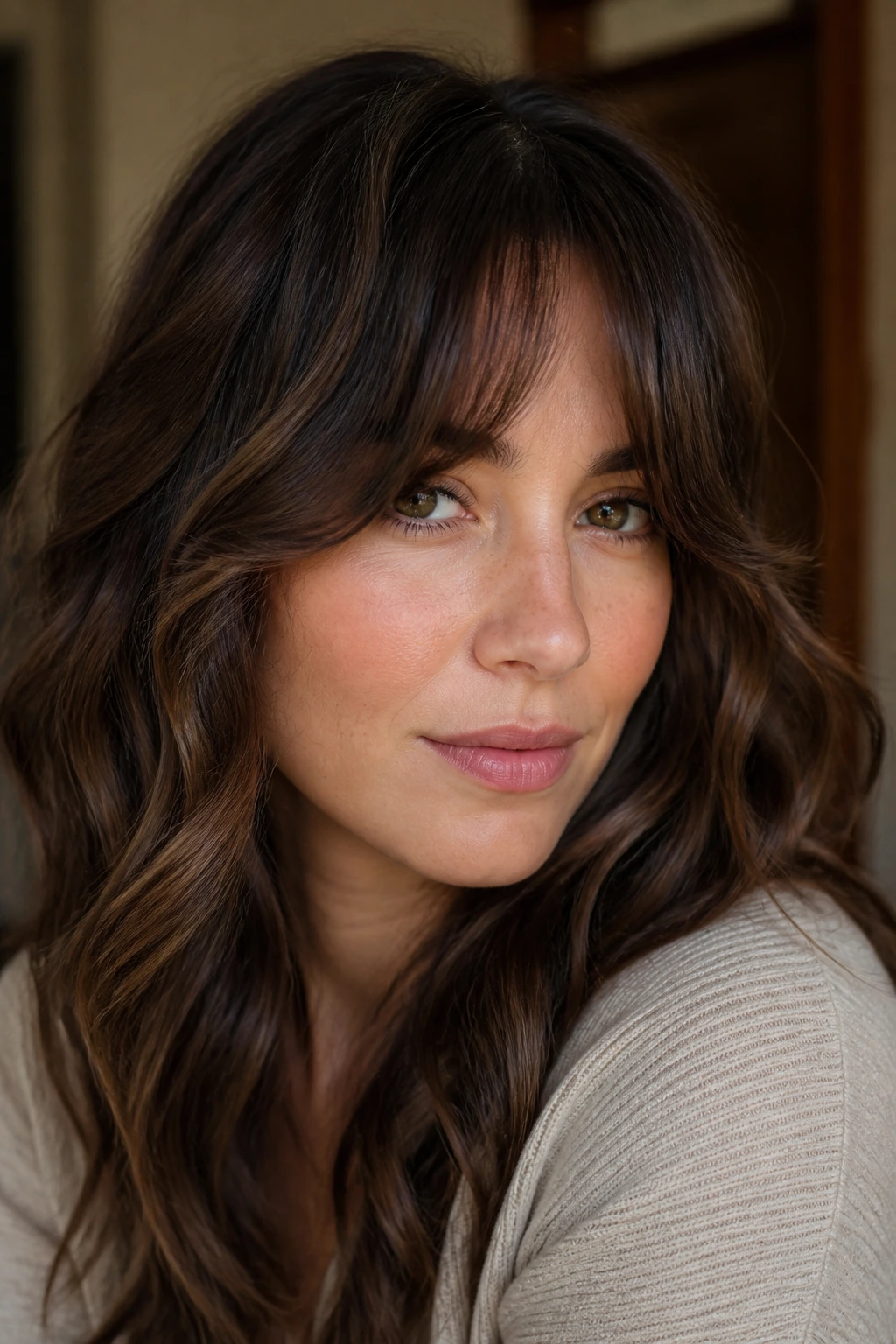
Cheekbone curtain fringe is all about placement. The shortest pieces land close to the outer eye area, then the sides drop to the top of the cheekbone and blend into the lengths. That extra drop at the cheek makes a round face look a little longer, and it gives fine hair a strong shape without asking for a thick bang line.
This is the one I’d choose for loose curls that start mid-length or lower. The curls supply the body, and the fringe supplies the frame. If the curls are loose enough — think soft bends, not tight spirals — the front and the rest of the cut read as one piece. That cohesion is what keeps the style from getting puffy around the cheeks.
The styling move is simple, but it has to be precise. Blow-dry the fringe forward first, then redirect the outer ends away from the face with your brush. Don’t aim the brush at the jaw. Aim it just above it. That tiny shift keeps the cheek area open instead of crowded.
6. Shaggy Bangs with Soft Layers
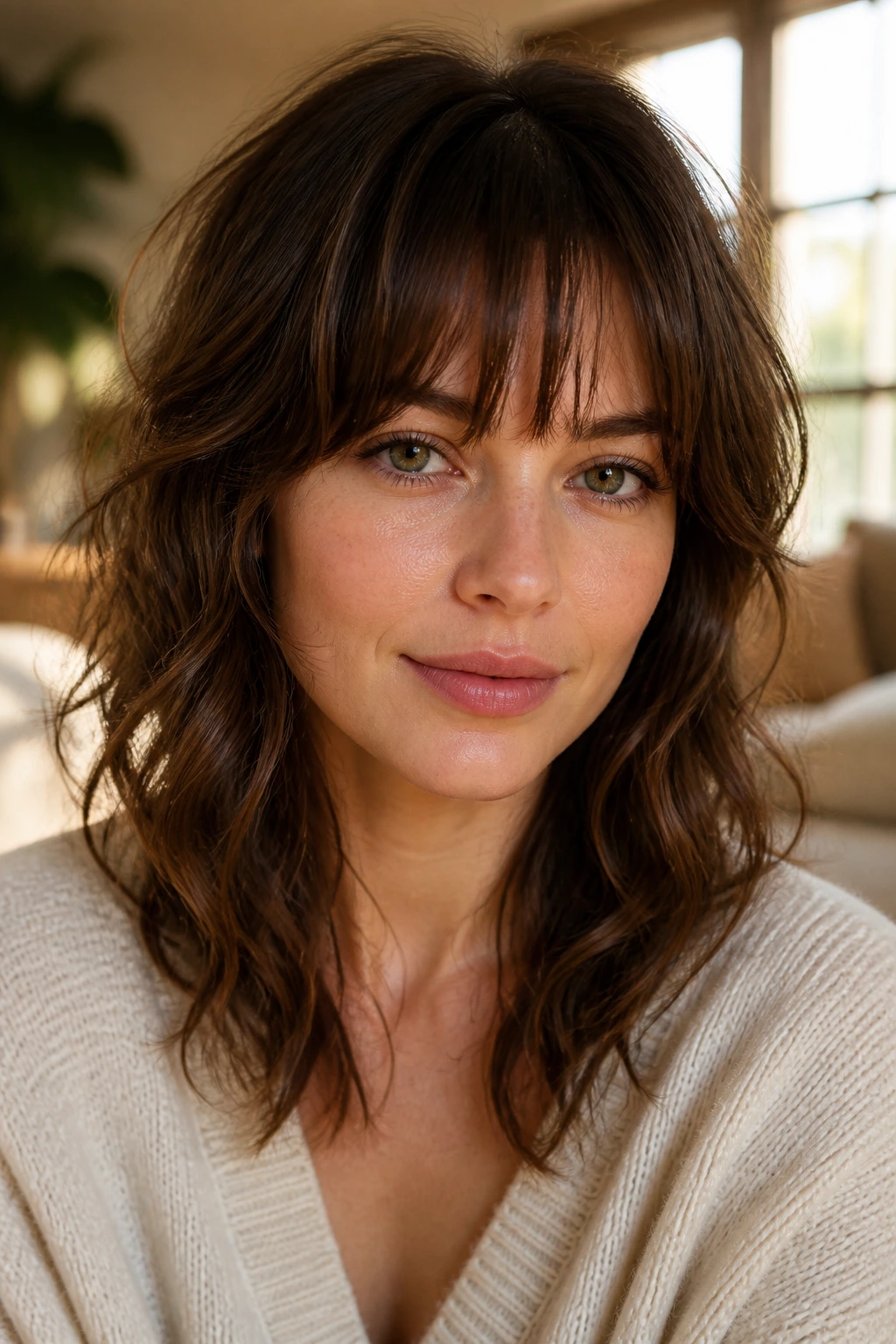
Shaggy bangs can be brilliant on fine hair, but only if they’re soft. Hard shag layers can strip away too much density and leave the fringe looking scrappy in the worst way. Soft layers, though, create a little swing. They let the bangs sit on top of loose curls without forming a heavy block at the forehead.
What makes this cut different from a cleaner curtain fringe is the texture. The bangs are more broken up, and the surrounding layers are slightly disconnected so the whole haircut has movement built in. For a round face, that broken texture is useful. It pulls attention away from the widest part of the cheeks and keeps the eye moving.
If you go this route, ask your stylist to keep the crown layers controlled. Too much removal up top can make fine hair look sparse, especially once you add loose curls and a bit of lift at the roots. The fringe should feel airy, not thinned to the point where it disappears under bright light.
7. Soft Micro Curtain Bangs

Micro curtain bangs sound dramatic, but the soft version is more wearable than people think. The center sits higher on the forehead — not baby-bang short, not even close — and the sides stay long enough to brush the temple area. The result feels modern without turning the face into a box. That’s the part that matters for round faces.
The trick is keeping the fringe translucent. Fine hair can pull this off when the density stays light and the ends are broken up. A solid micro bang line is a bad idea here. It grabs all the attention at the top of the face and makes the cheeks look wider by comparison. A soft version does the opposite: it lifts the eye line and leaves plenty of openness at the sides.
I’d style this one with a tiny round brush or even a flat brush plus a quick bend. Then I’d stop. Seriously. Overworking short fringe on fine hair usually just makes it separated and weirdly dry at the ends.
8. Long Face-Framing Bangs
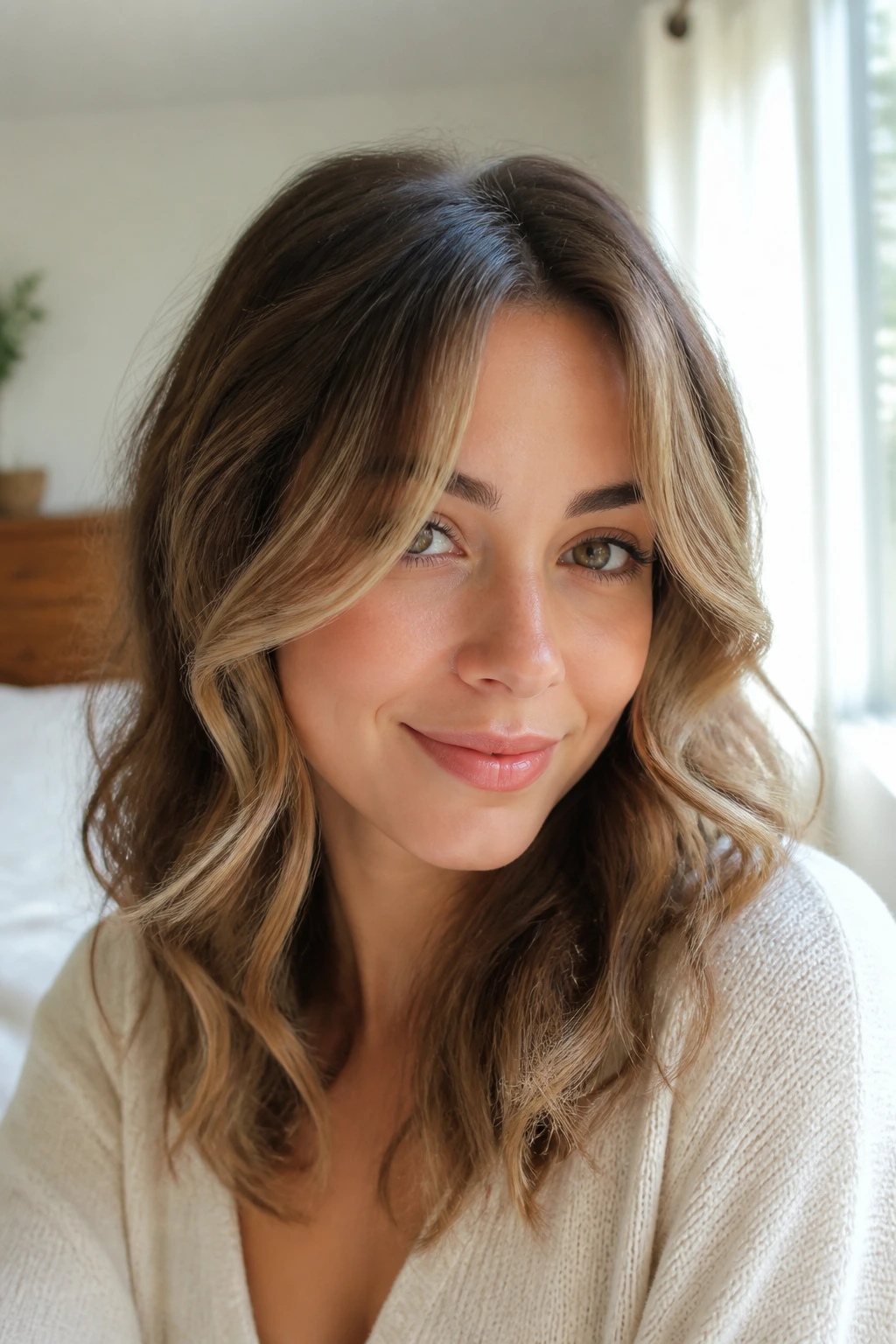
Long face-framing bangs are the safe bet for anyone who wants to flirt with fringe without surrendering to a full cut. They start around the cheekbone or slightly higher, then fall into the loose curls so the front section feels like part of the haircut, not a separate decision you have to live with every morning. For a round face, that downward line is gold.
The nice part is how forgiving this style is on fine hair. Longer bangs have a little more weight, so they hold a bend better than shorter ones. They also give you room to tuck, sweep, pin, or split them depending on how the rest of your hair behaves. If your curls are loose and soft, the bangs can curve around the face without crowding it.
What to Ask For
Tell your stylist you want the shortest front pieces to fall near the cheekbone, then taper into the jawline or collarbone. Keep the ends feathered. A blunt long bang can work on thick hair, but on fine hair it often reads as heavy and flat. This version should feel like it’s moving, even when you’re standing still.
9. Arched Bardot Bangs
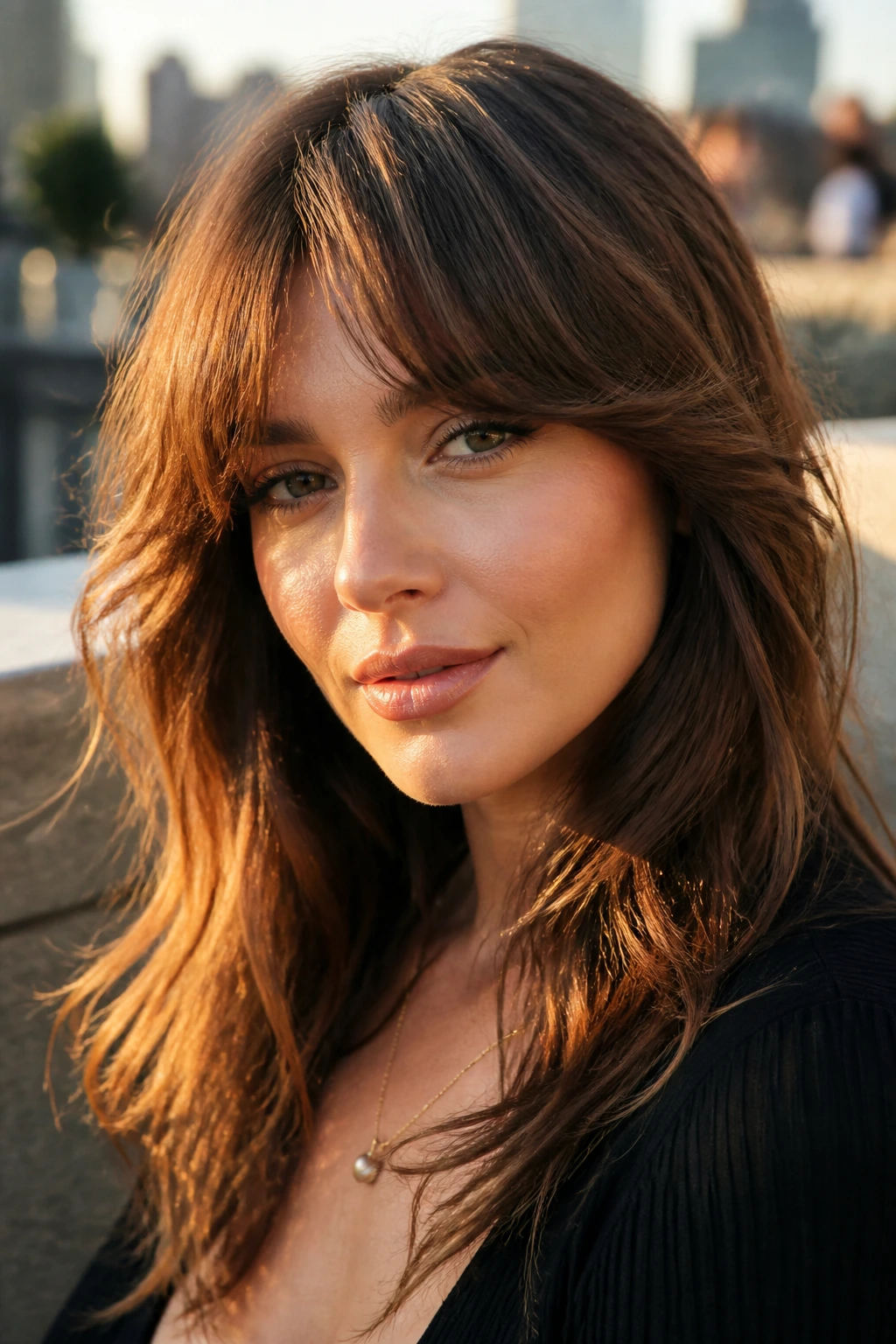
Arched Bardot bangs have a little more presence than curtain bangs, but they still need air. The middle portion is fuller, the arc opens toward the sides, and that curve across the forehead gives the face a lifted shape. On a round face, that lift helps because it draws attention upward instead of letting everything sit at the widest part of the cheeks.
Fine hair can wear this cut beautifully if the density stays controlled. I mean controlled. Not sparse, not see-through to the point of disappearing, but not thick enough to make a heavy line. The arch should feel soft, almost brushed on. You want a gentle curve, not a hard retro bang that demands perfect styling every morning.
A medium round brush helps here, but the real trick is the cool-down. Roll the fringe under or away from the face, clip it for a minute, then release. That pause gives the arch a memory. Without it, the bang tends to sag and lose the shape that makes the style special.
10. Deep Side Part with Swept Fringe
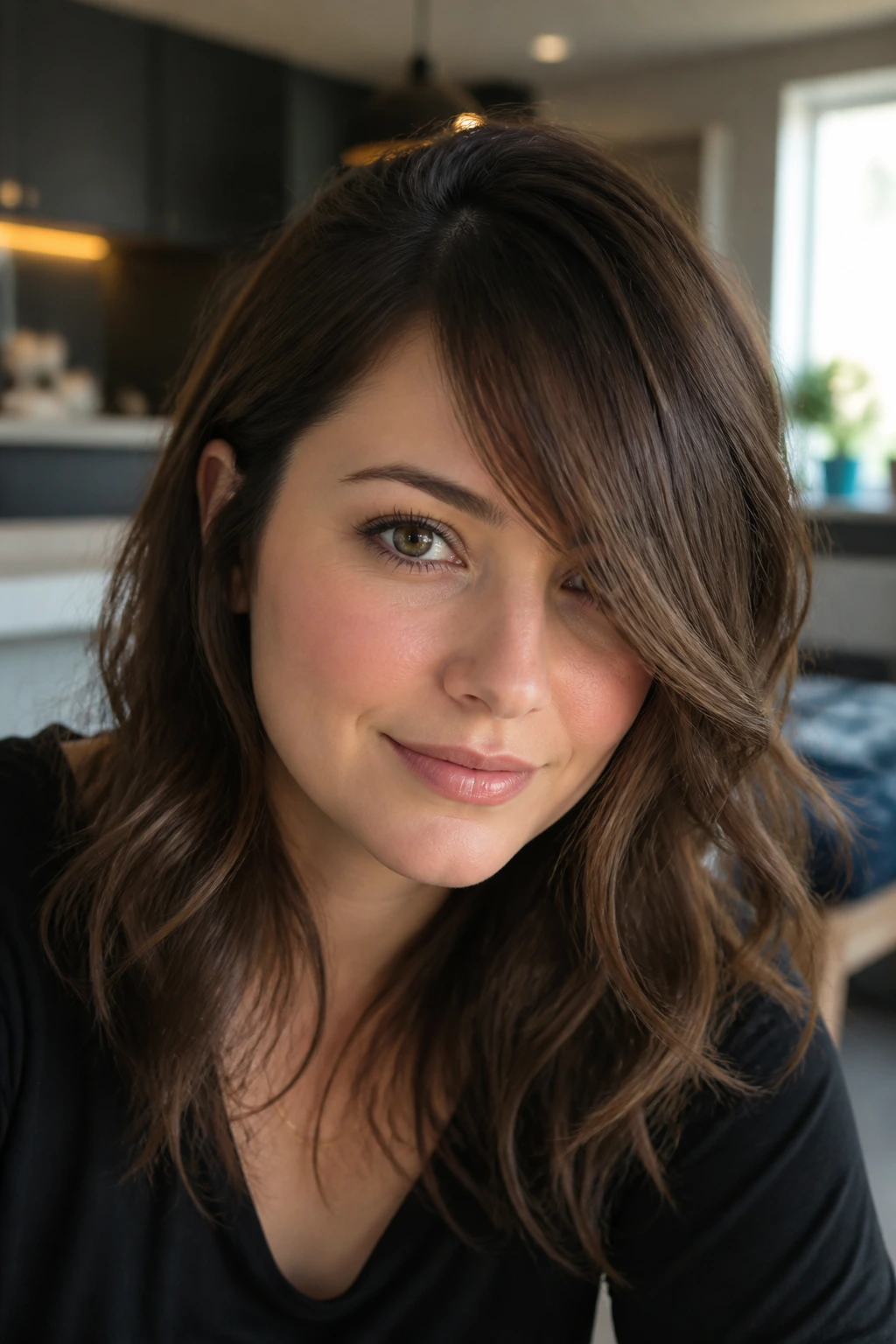
You do not need a center part to flatter a round face. A deep side part with swept fringe can be even better, especially when the hair is fine and the curls are loose. The off-center line adds instant length, and the front sweep gives the eye a strong diagonal to follow. That diagonal is the reason this style works.
This look has a little more attitude than curtain bangs, which is why I like it when the rest of the hair is softly waved rather than curled into a tight pattern. The front section should look like it was placed there on purpose, not like it fell out of a ponytail. Fine hair often needs that kind of decisive direction; otherwise it slumps into the face.
If you want more lift, clip the side fringe at the root while the hair cools. Even a tiny metal clip can keep the curve from collapsing. And if the front piece insists on splitting, don’t fight it with heavy product. A drop of styling cream at the ends, not the roots, is enough.
11. Piecey Split Bangs

What if you want bangs, but you cannot stand the idea of a solid fringe line? Piecey split bangs solve that problem. The front is separated into small sections that fall around the forehead with little gaps between them, which keeps the style light and lets fine hair look airy instead of overloaded. On a round face, those gaps help too — they stop the front from creating a single wide band.
This style needs a careful hand. Too much separation, and it looks unfinished. Too little, and it becomes a regular fringe with a bad attitude. The sweet spot is a few defined pieces that bend differently from one another, especially when they fall into loose curls that already have their own pattern.
- Keep the bang sections narrow, not chunky.
- Use a pea-sized amount of lightweight styling paste on the ends only.
- Push a few pieces left and a few right while drying.
- Let the hair cool before you decide whether it needs more separation.
I like this cut for people who move a lot during the day. It changes shape in a way that feels natural, not sloppy. That’s a rare thing.
12. Soft Blunt Bangs with Texture
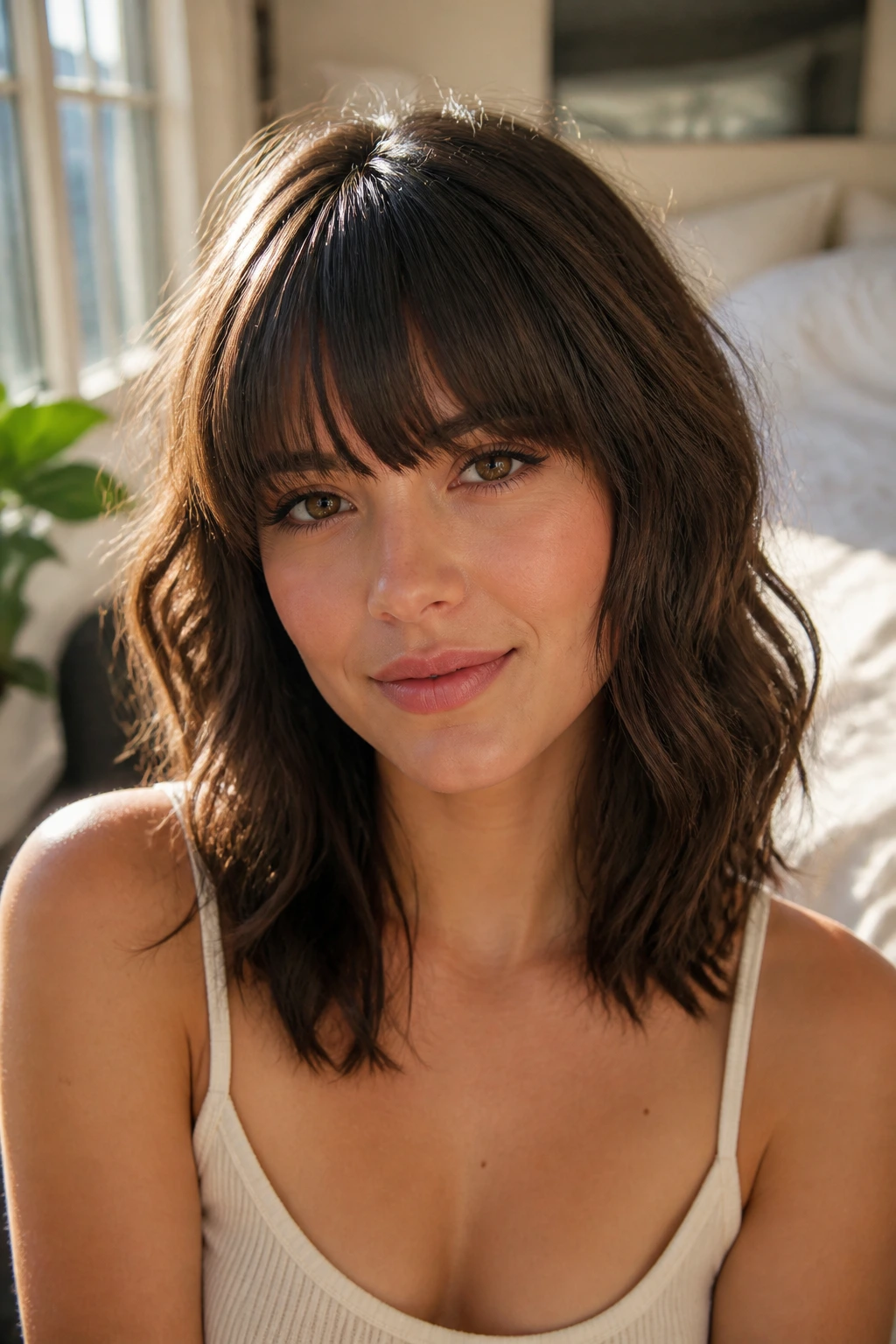
You can wear blunt bangs on fine hair, but they need texture or they’ll sit like a paper strip across the forehead. The edges should be clean enough to feel intentional, yet soft enough that the line doesn’t hard-stop the face. That balance is what keeps a round face from looking wider. A little texture in the middle breaks the line up and lets the curls do some of the visual work.
This is the boldest option on the list, and I wouldn’t recommend it if you hate maintenance. The style looks best when it’s freshly shaped and lightly styled, not when it’s been slept on for two nights and started dividing into odd little clumps. Still, when it works, it gives the face a sharper front edge that can be useful if your loose curls are very soft and need a bit of contrast.
A Small Styling Rule
Keep the roots lifted and the ends broken. That means mousse at the root, a round brush through the front, and a very small amount of heat protectant. Heavy oil or serum near the bangs is a mistake here. It flattens the whole line and turns “textured” into “greasy” in about thirty minutes.
13. Crescent Bangs

Crescent bangs follow the brow in a soft arc, shorter in the middle and longer toward the sides. That curve does something subtle but important on a round face: it frames the upper face in a way that feels lifted rather than boxed. The arc also echoes the shape of loose curls, so the whole haircut looks more connected.
Fine hair loves this kind of curve because it doesn’t need much density to read well. The line itself does the job. Even a modest amount of hair across the forehead can look substantial if the cut is placed right and the curve is clean. The trick is not to let the center get too straight. A straight center with curved sides looks unfinished. A true crescent feels deliberate.
I’d style this with a small round brush and a side-to-side motion at the end. You’re not trying to force a curl. You’re teaching the fringe to bend. That’s a different thing, and the result is softer.
14. Jawline-Grazing Bangs
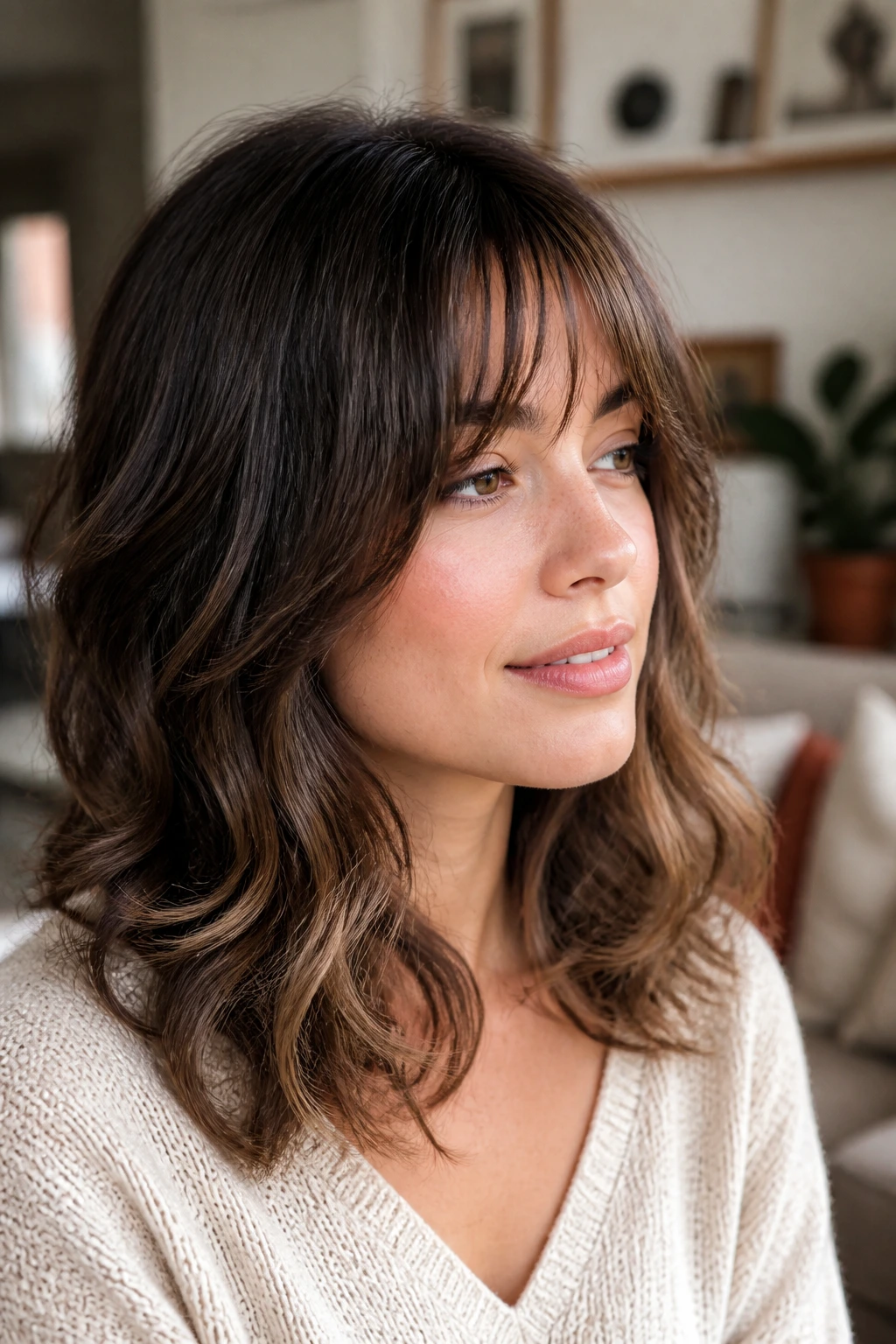
Jawline-grazing bangs are for people who want fringe, but only on their own terms. The front pieces are long enough to skim the jaw or slide into the front layers, which makes the face look longer and gives fine hair enough weight to hold a shape. Round faces benefit from that lower line because it pulls the visual focus below the cheeks.
This style is especially good with loose curls that start around the collarbone. The bangs don’t end abruptly. They melt into the front of the haircut. That means less risk of the dreaded “bang shelf,” where the fringe sits on its own little ledge and refuses to connect to the rest of the style.
If you’re deciding between this and shorter curtain bangs, choose jawline-grazing pieces if you like tucking your hair behind your ears. The shape still shows when the hair is partially pulled back. Shorter fringe often disappears the second you move it off the face. These pieces keep their job even when you’re not looking at them straight on.
15. Air-Dried Bend Bangs

Air-dried bend bangs are less of a cut and more of a styling attitude, which is exactly why they work so well for fine hair. The front section gets encouraged into a soft bend while it dries, usually with clips, fingers, or a bit of directional brushing. Once it’s set, you’re left with a fringe that looks like it has movement without looking overstyled.
This method is useful if your loose curls are air-dried too. The whole front of the head reads as one texture family instead of a blow-dried bang sitting on top of naturally waved lengths. Round faces benefit because the front stays soft and vertical, not puffy at the sides. And because fine hair gets weighed down fast, skipping some heat can be a relief.
Here’s the move I like: mist the fringe with water or leave-in, brush it in the desired direction, clip the root for a few minutes, then leave it alone until it’s dry. Touching it too early is where people mess this up. Wet hair lies. Dry hair tells the truth.
16. Feathered French Fringe
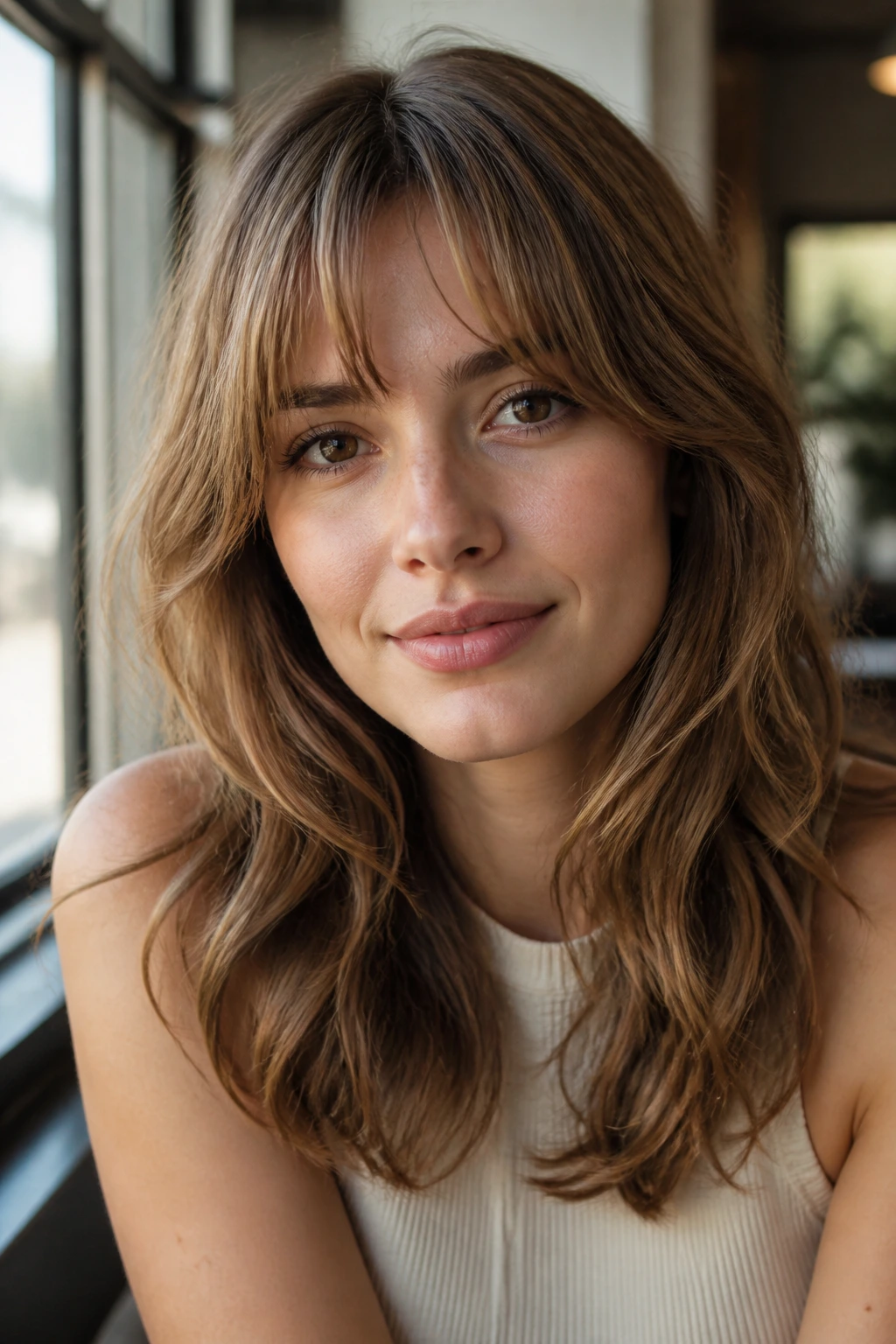
A feathered French fringe sounds romantic, but the practical version is what matters. It’s soft through the center, longer at the sides, and lightly broken up at the ends so the line never looks harsh. On fine hair, that feathering keeps the front from becoming a flat, solid block. On a round face, the longer sides stretch the face visually and keep the widest area from feeling crowded.
I prefer this over heavier French-bob-style bangs when the hair is loose and wavy. The softer version doesn’t need the same density to look full. It relies on placement and texture. A bit of root lift, a gentle bend, and a side sweep at the temple are enough.
The finish should feel brushed, not stiff. If the bangs look too neat, they lose the easy shape that makes this style attractive in the first place. A little lived-in movement is the point. Not mess. Movement.
17. Long Layered Bangs with Loose Spiral Ends
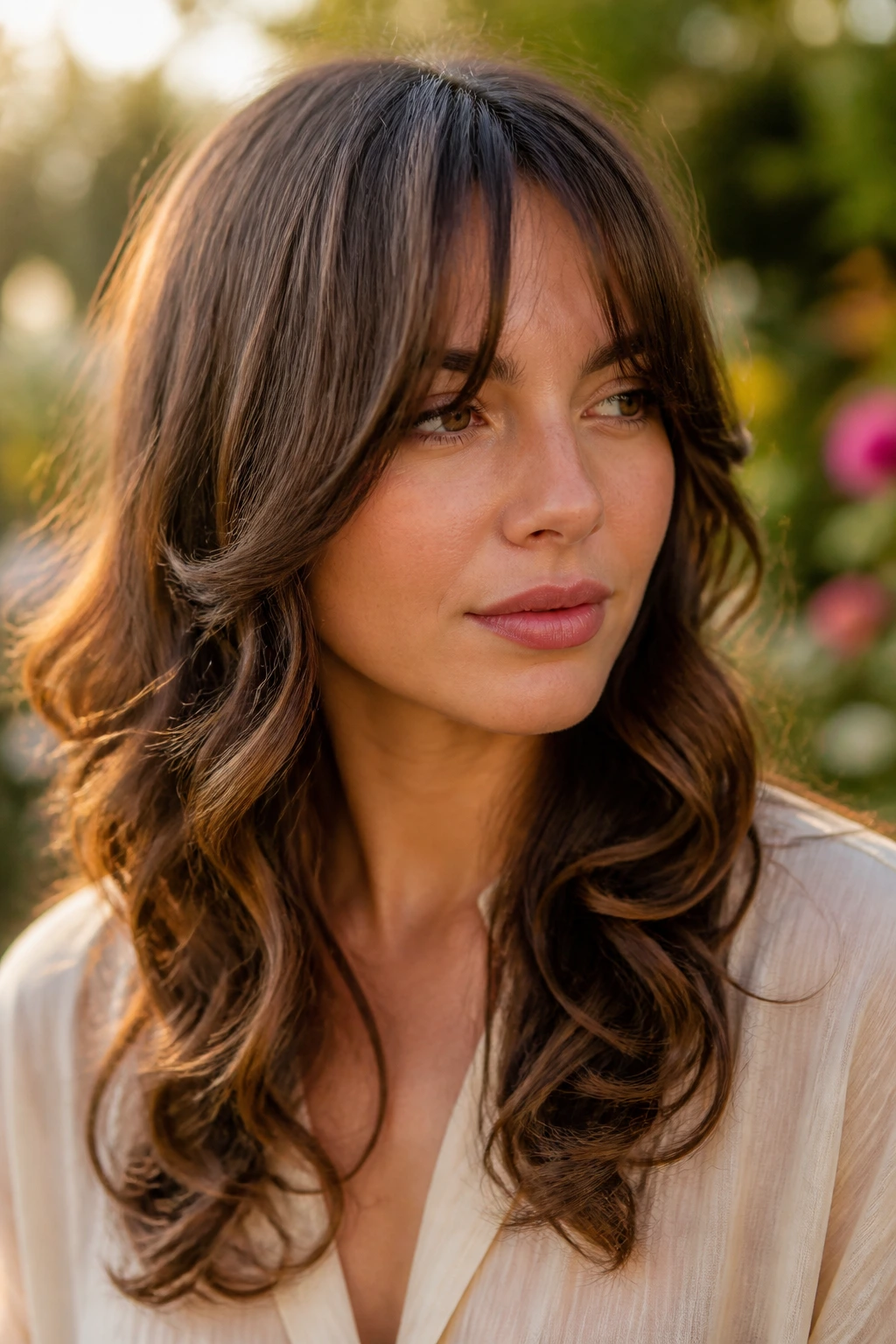
Long layered bangs are the quiet overachiever of this whole group. They give you fringe, face framing, and flexibility, all without forcing a heavy bang line onto fine hair. Because the pieces are longer, they hold a soft spiral or bend at the ends better than short bangs do, which makes them pair nicely with loose curls.
Round faces often do well with this kind of length because it creates a vertical path along the cheek and jaw. The bangs don’t stop at the forehead. They keep going. That sense of continuation is what prevents the face from looking wider than it is. The side pieces matter as much as the front.
If you want the style to read clearly, ask for the front layer to start near the cheekbone and taper into the collarbone length. Too short and you lose the elongating effect. Too long and the bangs disappear into the rest of the hair. The sweet spot is visible but soft, like the hair decided to frame the face instead of announcing itself.
18. Cloud Bangs
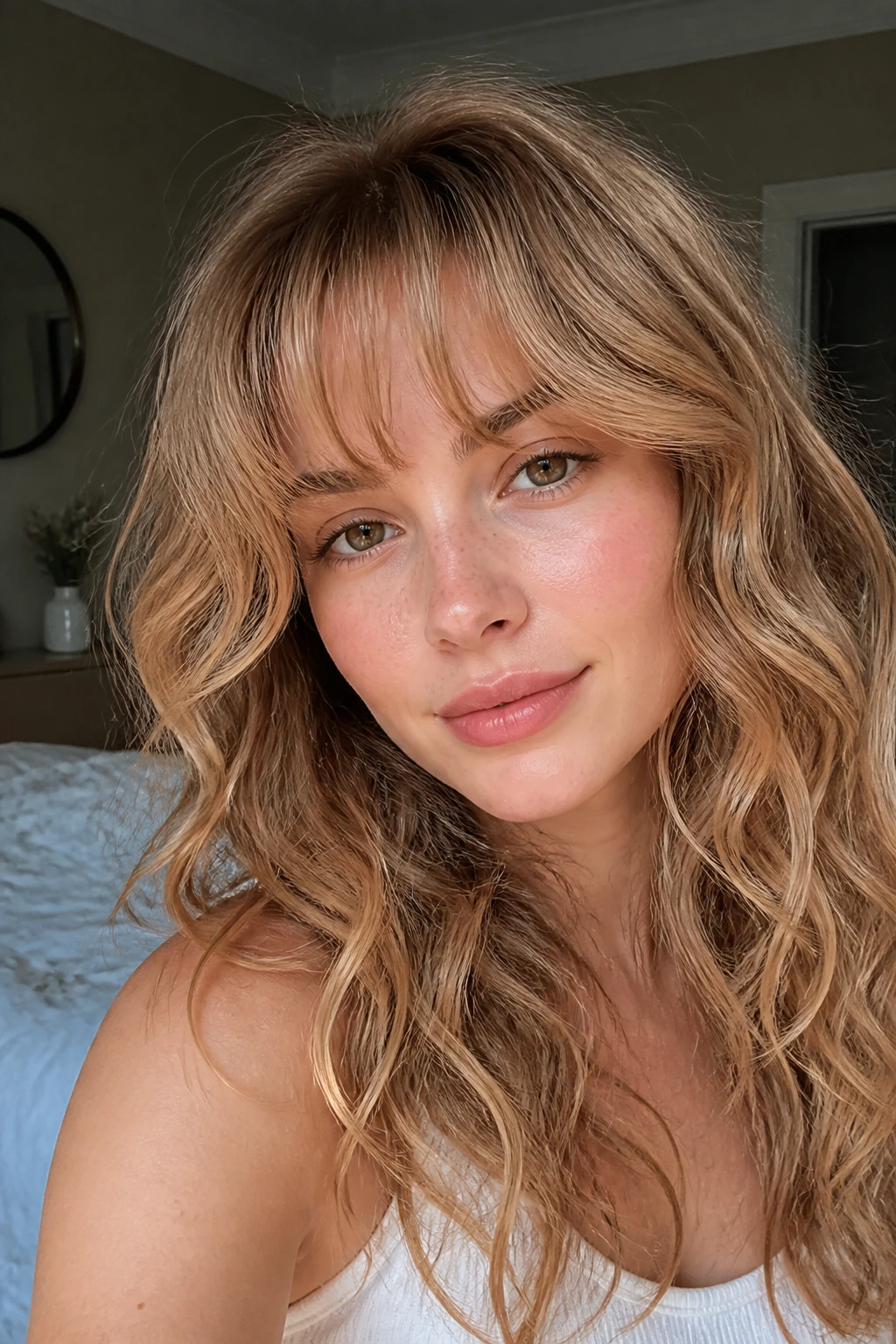
Cloud bangs are all softness and no hard edge, which sounds vague until you see them on fine hair. They sit lightly across the forehead, with enough texture that light passes through the fringe. That translucence is a gift for round faces because the front doesn’t become a wide block. It just hovers there, lifting the eyes and softening the shape.
This style depends on controlled fluffiness. Not frizz. Not puff. Fluff. There’s a difference. The strands should separate a little, move a little, and keep a soft outline instead of one strict line. Loose curls below the bangs help a lot here because they echo the airiness of the fringe.
I like cloud bangs when someone wants the feeling of bangs without the commitment of a heavy fringe. They’re forgiving on growth, easy to brush over to one side, and surprisingly good at making fine hair look fuller at the front without making the face look crowded. If you like hair that feels soft when you run your fingers through it, this is the one to watch.
Why This Shape Works on Fine Hair and Round Faces
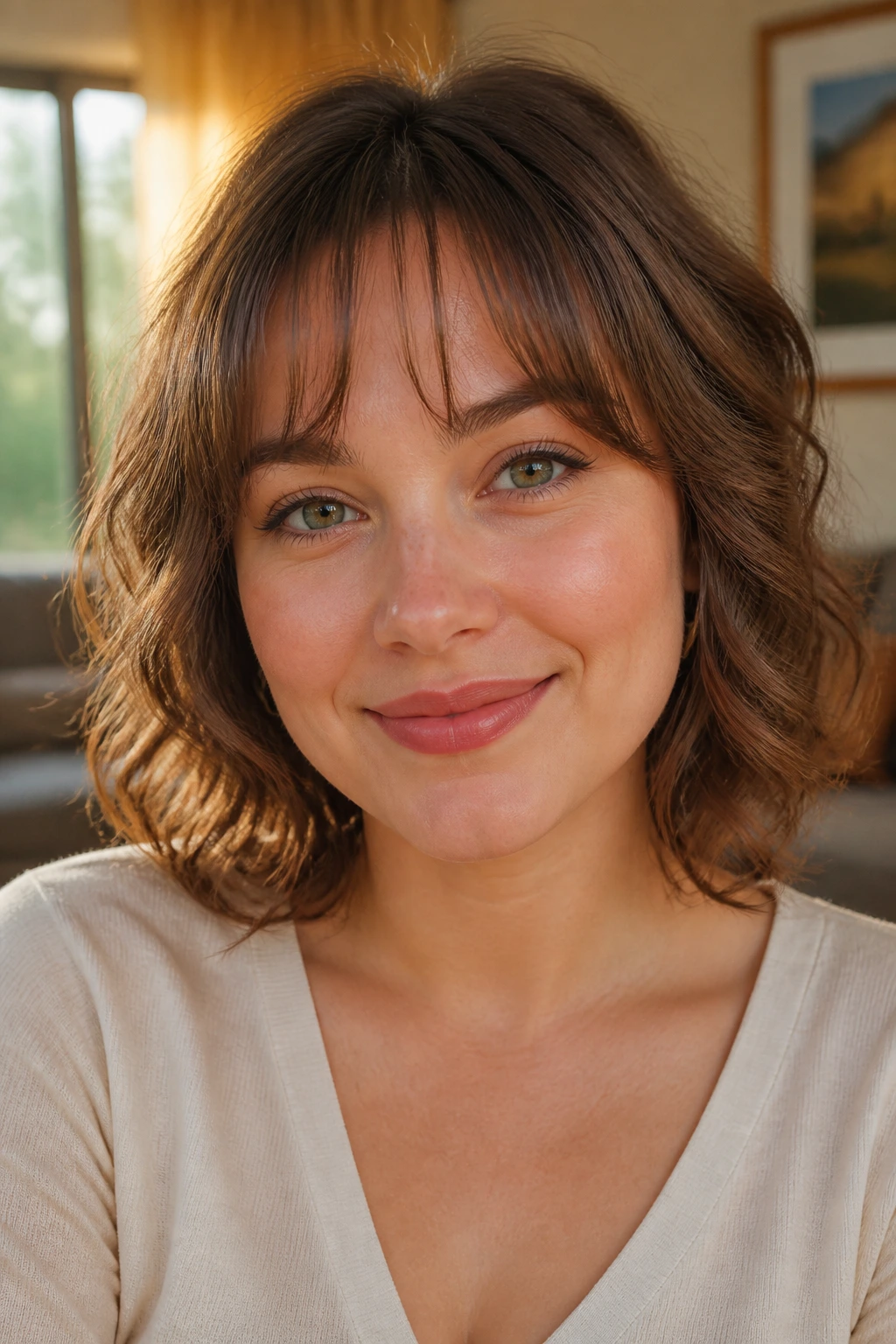
The short version? Fine hair needs structure that does not look heavy, and round faces need framing that does not widen the cheeks. Those are separate problems, but bangs and loose curls can solve both if the cut is thoughtful. The trick is to keep density light at the forehead and let the longest pieces fall where the face needs length: near the temples, cheekbones, or jaw.
Loose curls are part of the equation too. Tight curls can add width in the wrong place, but soft bends create movement without building a helmet shape. That gives the fringe room to breathe. It also means the bangs can blend into the style instead of sitting like a little haircut on top of a bigger haircut.
Placement matters more than thickness. A bang that starts too low on the forehead and ends too bluntly will make the whole style feel shorter. A bang that opens at the center and falls longer at the sides creates vertical movement, which is what round faces tend to need most. That doesn’t mean you need hair hanging in your eyes. It means the line should travel, not stop.
There’s one more thing people miss. Fine hair often looks better when the fringe is a little imperfect. A tiny split, a piece that lifts, a softer end on one side — those things make the style feel alive. Too much precision can actually make the hair look thinner, because every strand is forced into the same line. A little looseness helps.
The Tools That Keep This Fringe from Falling Flat
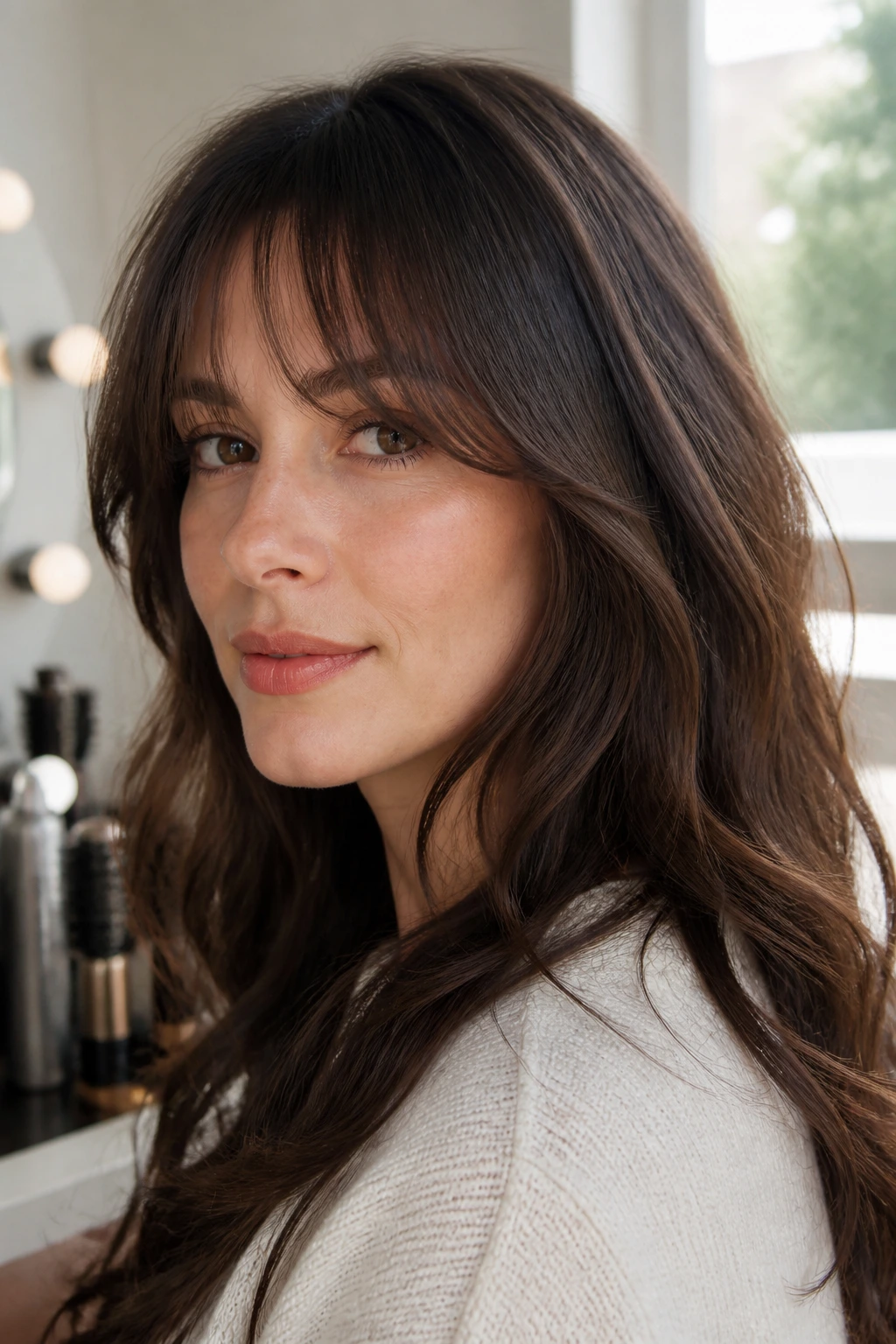
You do not need a suitcase of gadgets, but a few good tools make a huge difference when you’re styling wavy bangs on fine hair. A lightweight blow dryer with a concentrator nozzle is the big one. The nozzle helps you direct the fringe without blasting it sideways, which is how a lot of people accidentally create unwanted puff.
A small round brush, around 1 to 1.25 inches, is my favorite for most of these looks. Bigger brushes can be too blunt on short fringe, and tiny brushes can turn the bangs into springs. A vent brush works too if you want less curl and more bend.
- Light mousse: Gives the roots some grip without the crunch.
- Heat protectant spray: Keeps fine ends from getting dry and fuzzy.
- Duckbill clips or sectioning clips: Useful for setting the fringe while it cools.
- Dry shampoo: Keeps the front from turning greasy first.
- Flexible-hold hairspray: Holds shape without freezing the bangs in place.
- Small round brush: Best for curve and lift.
- Flat iron with a slim plate: Good for quick bends, especially on longer fringe.
- Tail comb: Helps part the hair cleanly and control the center split.
A lot of people buy heavy styling cream and regret it. Fine hair does not want weight near the forehead. It wants support, then air.
Styling Moves That Keep the Fringe Light
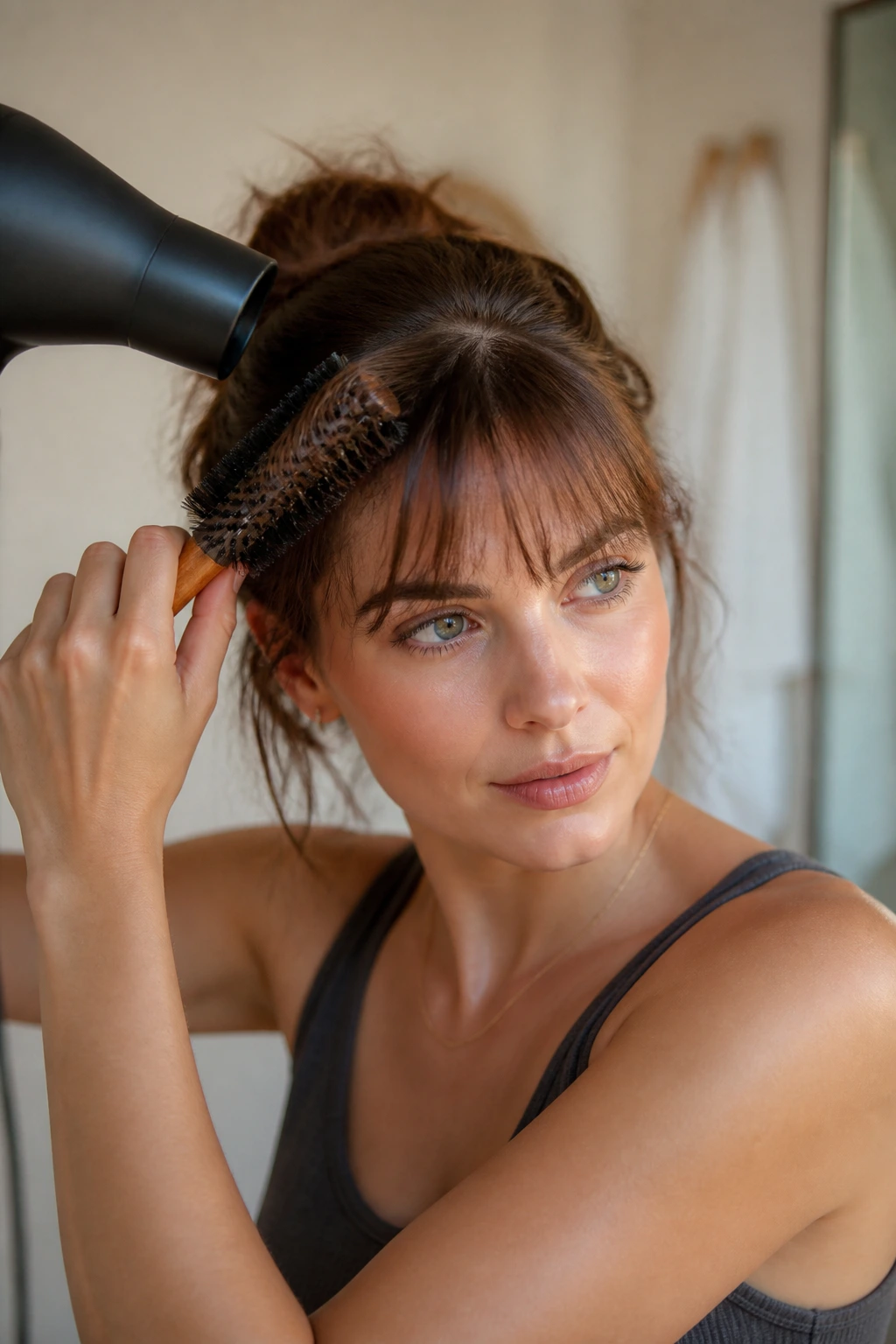
The best styling habit you can build is to dry the bangs first. Not after the rest of the hair. First. Fine fringe loses shape fast, so if you spend twenty minutes on the lengths and leave the front damp and sad, the bangs never really recover. Start there, set the bend, then move on.
At the Salon
Ask for soft point cutting at the ends rather than a straight blunt edge. If your hair is very fine, a heavy razor pass can make the fringe look wispy in a bad way. Point cutting gives movement without stripping away too much body. Also ask where the shortest point should land. On most round faces, that sits somewhere between the brows and the bridge of the nose.
At Home
Use a small amount of mousse at the roots, then direct the fringe with a brush while it dries. Hold the brush taut for a few seconds at the ends so the bang takes the shape. Don’t flood the fringe with product. A dime-sized amount spread between your fingers is enough in most cases.
The Cool-Down Trick
Heat shapes hair. Cool air seals the shape in. That’s the part people skip. Once the bangs are set, clip them in place or roll them for a minute, then let them cool before touching them. If you finger-comb too soon, the hair collapses back to its old pattern and you’re starting over.
Mistakes That Flatten the Shape
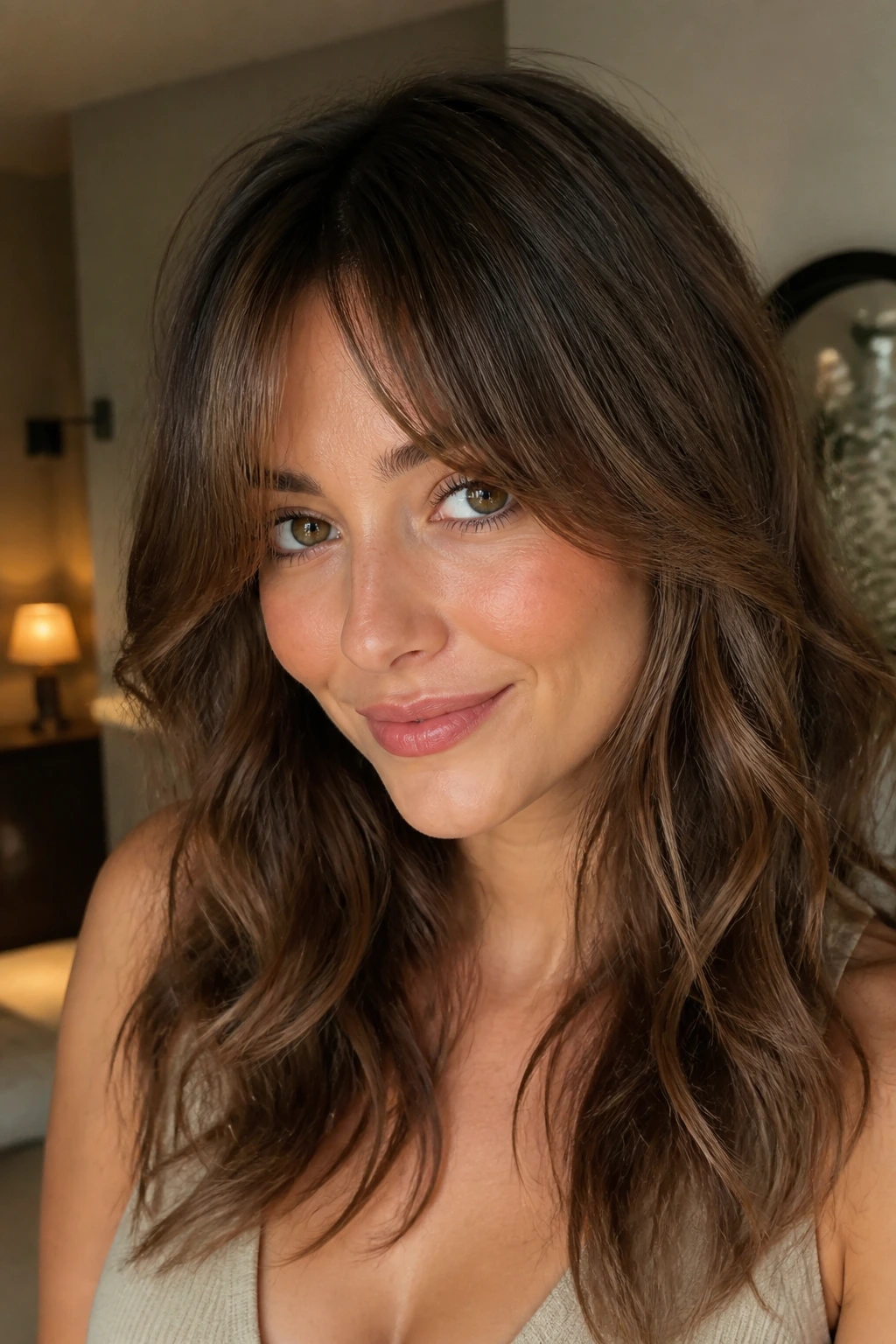
The biggest mistake is too much density at the front. Heavy bangs on fine hair can look good in the salon mirror, then flatten by lunch and drag the whole face downward. The fix is a lighter cut with longer side pieces, not more product.
Another problem is starting the curl too high. If the loose curls begin at the cheeks, the face can read wider. Keep the bend lower, around the mouth, jaw, or collarbone, and let the bangs stay soft at the top. That shift in where the curve starts makes a bigger difference than people expect.
Heavy creams and oils are a trap. They make fine hair clump, and clumping reads as thinness. Use a mousse or light spray instead, and keep richer products away from the fringe. A tiny amount at the ends of the curls is fine. Near the bangs? Usually a mistake.
Cutting the fringe too short is another classic error. Fine hair shrinks once it dries and lifts, so what looked like a sleek brow skim in the chair can turn into a tiny strip above the forehead later. If you’re unsure, leave it longer. You can always trim up. You cannot glue hair back on.
Cowlicks deserve attention too. If the hair wants to split at the center, don’t force a straight fall and hope for the best. Work with the part, or choose a side-swept option that respects the natural growth pattern. Fighting the cowlick every morning gets old fast.
Variations and Other Ways to Wear the Look
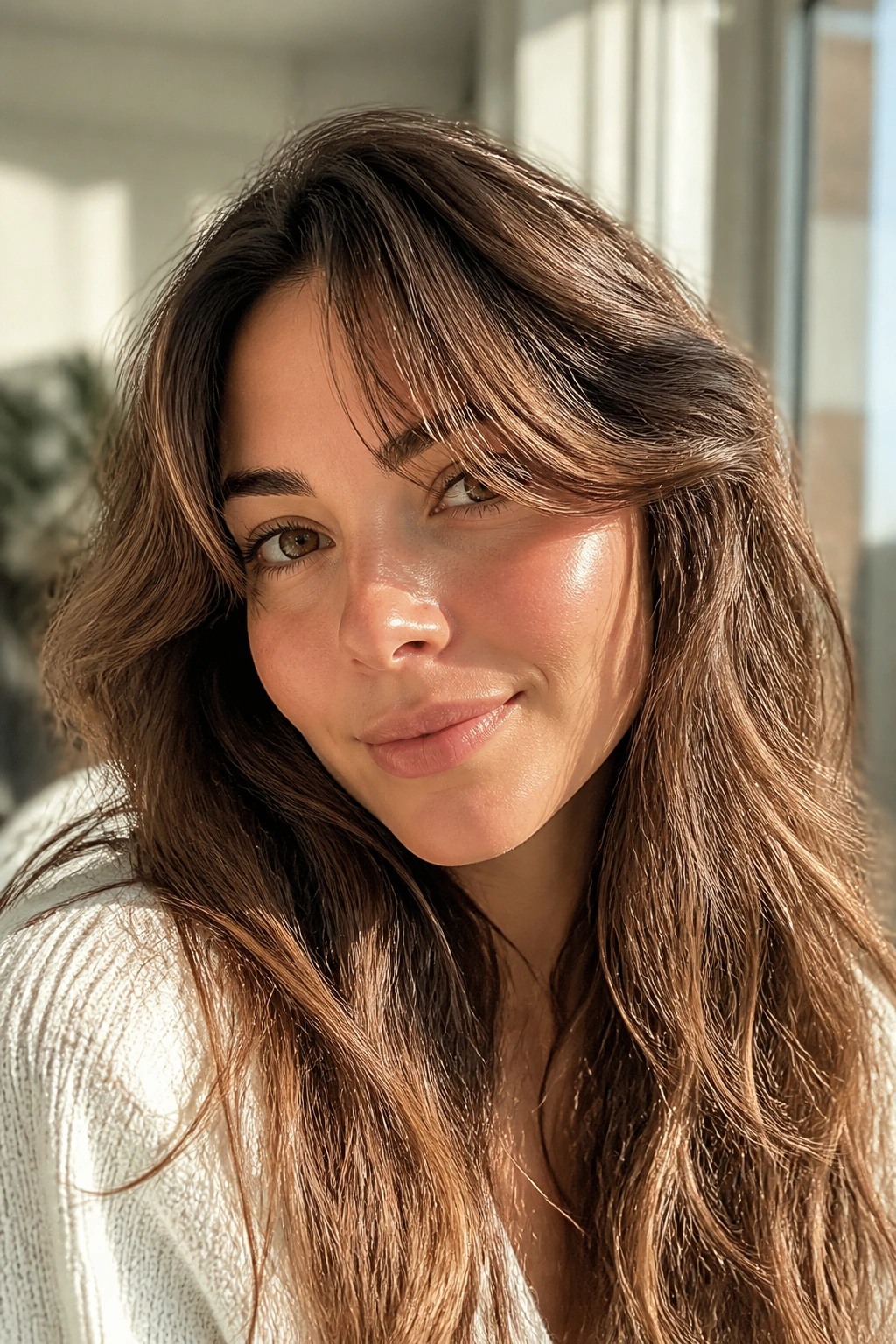
The No-Heat Air-Dry Version:
Choose curtain, cloud, or piecey split bangs, then let them dry with a clip at the root and a little mousse. This keeps the front soft and saves time, which is handy if your loose curls are already air-dried.
The Blowout-Finish Version:
Use a round brush and a cool-down clip to give the fringe a polished bend. This works especially well on bottleneck bangs and feathered French fringe when you want a more dressed-up finish.
The Grow-Out Version:
Let the fringe stretch into jawline-grazing pieces and long face-framing layers. It still reads as bangs, but the maintenance gets easier because the shape blends into the rest of the cut.
The Extra-Airy Version for Very Fine Hair:
Ask for more separation and less density through the center. This is a good match for wispy brow-grazing bangs or cloud bangs, especially if your hair tends to go limp by midday.
The Stronger-Part Version:
If your hair refuses to cooperate at the center, use a deep side part and a swept fringe instead. That one diagonal line can do more for a round face than a perfectly centered fringe that keeps splitting.
The Curl-First Version:
If your waves are the star, shape the bangs around them rather than against them. Long layered bangs and cheekbone curtain fringe usually win here, because they blend into the curl pattern instead of sitting on top of it.
Keeping the Shape Between Washes
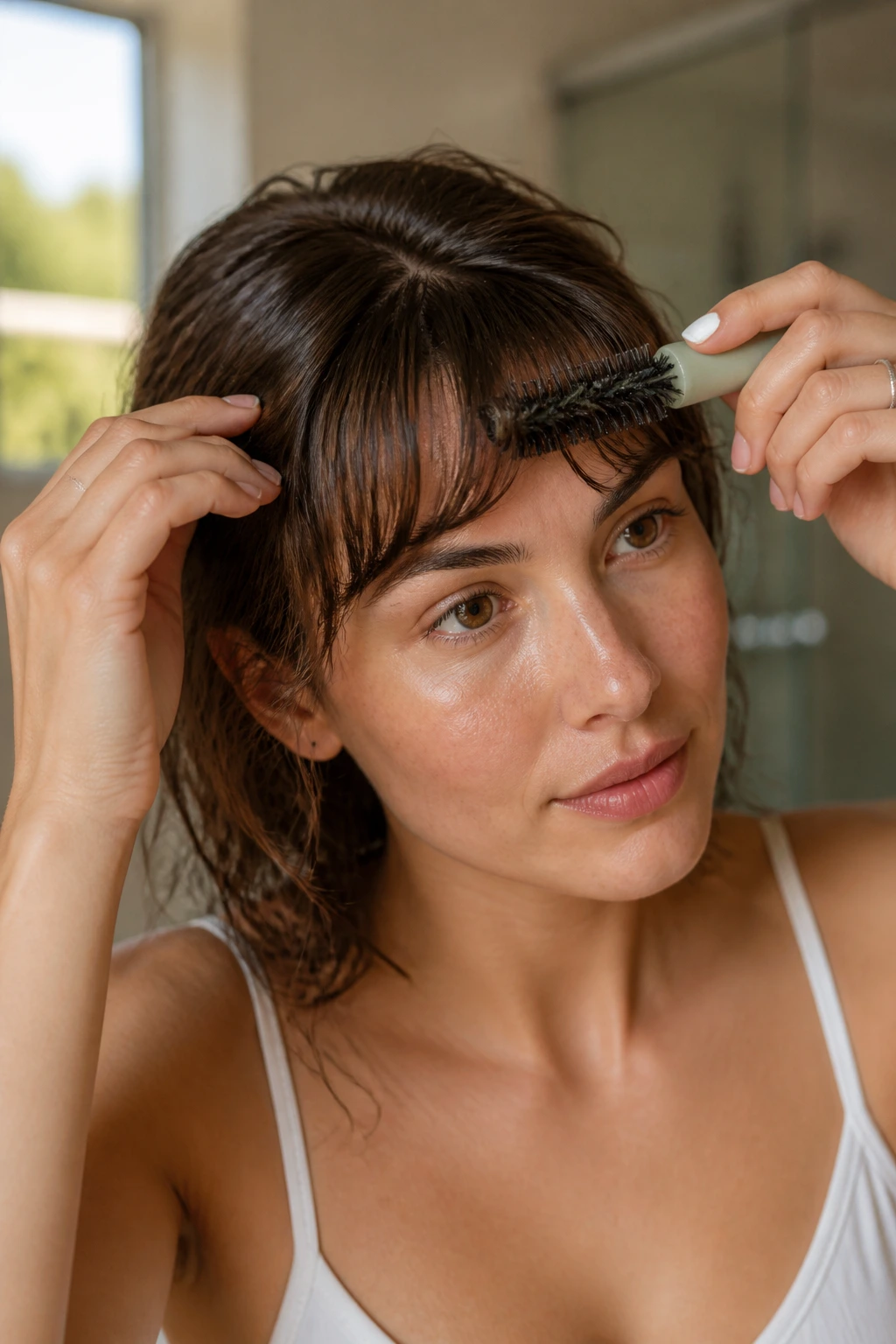
Fine hair tends to show wear fast around the fringe, so maintenance matters. The bangs usually need a quick refresh before the rest of the style does. A little dry shampoo at the roots can buy you a day or two, especially if the front starts clinging to the forehead. Use it lightly. Piles of powder just make the fringe look dusty.
A quick blast from the dryer in the morning often fixes more than a full restyle. Wet the bang line very slightly — fingers dipped in water are enough — then brush it forward or across the face with a round brush or flat brush. Two minutes later, it looks like you meant to do it. That’s the whole game.
If you sleep hot or toss a lot, clip the fringe loosely to the side before bed. Not tightly. You’re not trying to train it overnight into a rigid shape. You’re just keeping it from folding in a weird direction. A silk pillowcase helps too because fine hair hates friction. It frays at the edges first.
Trims matter more with fringe than with the rest of the cut. Plan on a trim every 4 to 6 weeks if you want the shape to stay clear. Let it go longer, and the side pieces can start swallowing the front line, which turns a designed bang into a vague front layer. Sometimes that’s fine. Sometimes it just looks like you gave up halfway.
Questions People Ask Before Cutting Fringe

Will bangs make a round face look wider?
Not if the cut is placed well. The problem is usually a heavy straight fringe that stops at the widest part of the cheeks. A lighter center with longer sides, side-swept movement, or cheekbone-length fringe usually adds length instead of width.
Can fine hair handle curtain bangs?
Yes, but the density has to stay light. Heavy curtain bangs on fine hair collapse fast, while feathered or bottleneck versions hold up better because they use shape rather than thickness to look full.
What length should the shortest part of the bangs be?
For most round faces, somewhere between the brows and the bridge of the nose is safest. Shorter can work, but only if the fringe stays airy and the sides are longer enough to balance it.
Do I need heat styling every day?
No. A lot of these styles can be air-dried with a clip or quick brush-through. Heat helps set a sharper bend, but if you’re busy or avoid hot tools, softer pieces like cloud bangs or long face-framing fringe can work without them.
What if my bangs split in the middle all the time?
Then a center-parted style may be fighting your cowlick. Move to a side sweep, a bottleneck shape, or a piecey split bang that treats the separation as part of the design instead of a mistake.
Can I wear these bangs with glasses?
Yes, but longer fringe usually plays nicer with frames. Brow-grazing bangs and cheekbone curtain fringe tend to sit better than very short pieces, which can bounce right into the top of the glasses.
What if my hair is fine but dense?
You can still wear these looks. Dense fine hair often needs extra internal removal so the fringe doesn’t sit too bulky. Ask for softness in the center and movement at the sides, not just thinning everywhere.
How do I keep the bangs from getting greasy first?
Use dry shampoo before they look oily, not after. Fine fringe absorbs forehead oil fast, so a light mist at the roots can help on day two or day three. Also keep heavy serums off the front section.
Soft Fringe, Better Shape
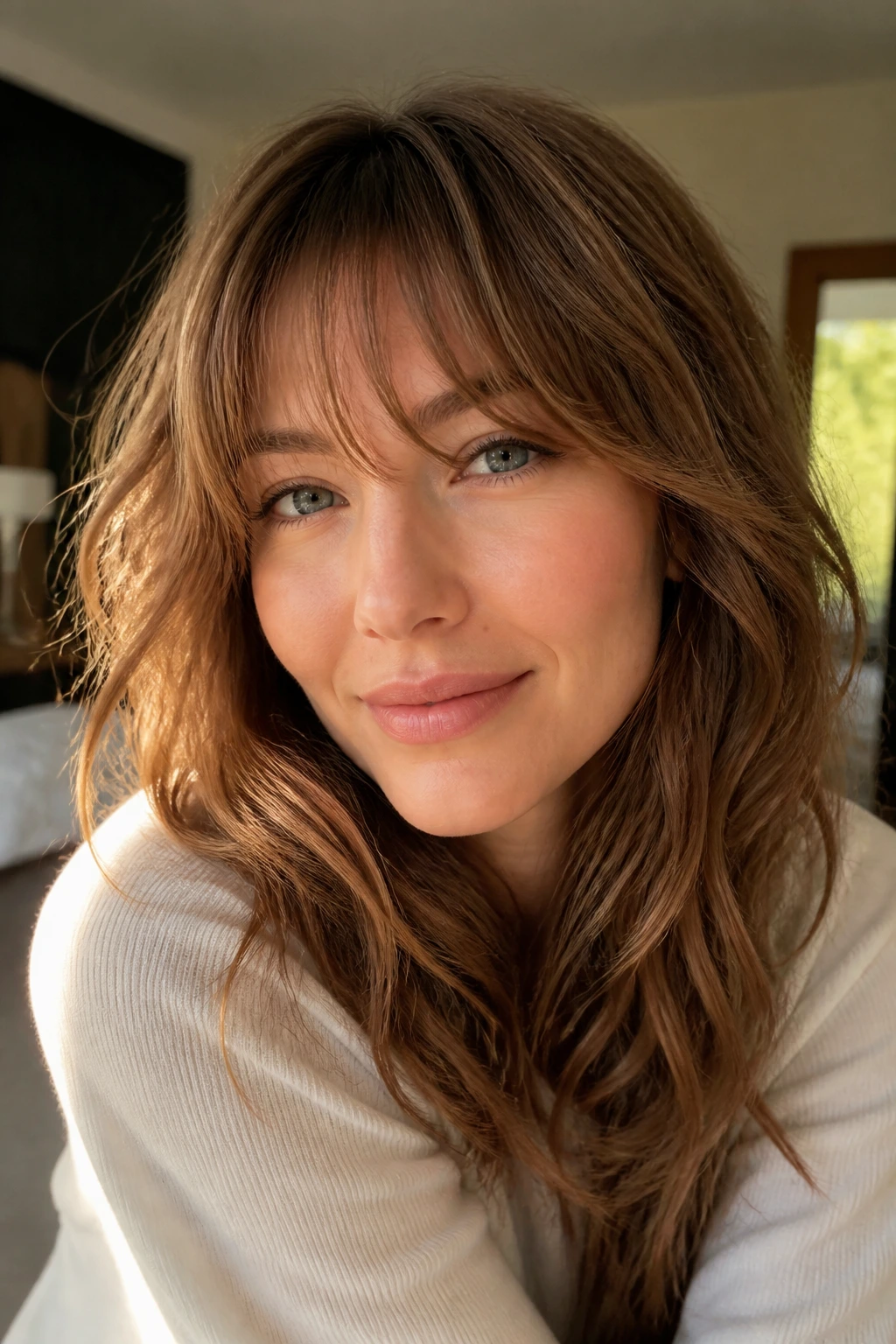
The best wavy bangs for fine hair and round faces do one thing very well: they make the face look longer without stealing all the attention. That’s the sweet spot. You want softness at the forehead, movement near the cheeks, and loose curls that carry the style instead of swallowing it.
I’m biased toward the lighter shapes — feathered curtain bangs, bottleneck fringe, cheekbone-grazing layers, and side-swept pieces — because they age better between trims and don’t turn into a flat line by noon. But even the bolder options work when the cut respects fine hair’s limits. Heavy is the enemy. Air is the friend.
If you’re taking one idea to the salon, make it this: keep the center light, keep the sides longer, and let the curls do part of the framing. That one decision changes everything, and it gives you bangs that look like they belong there from the first wash all the way through the grow-out.