



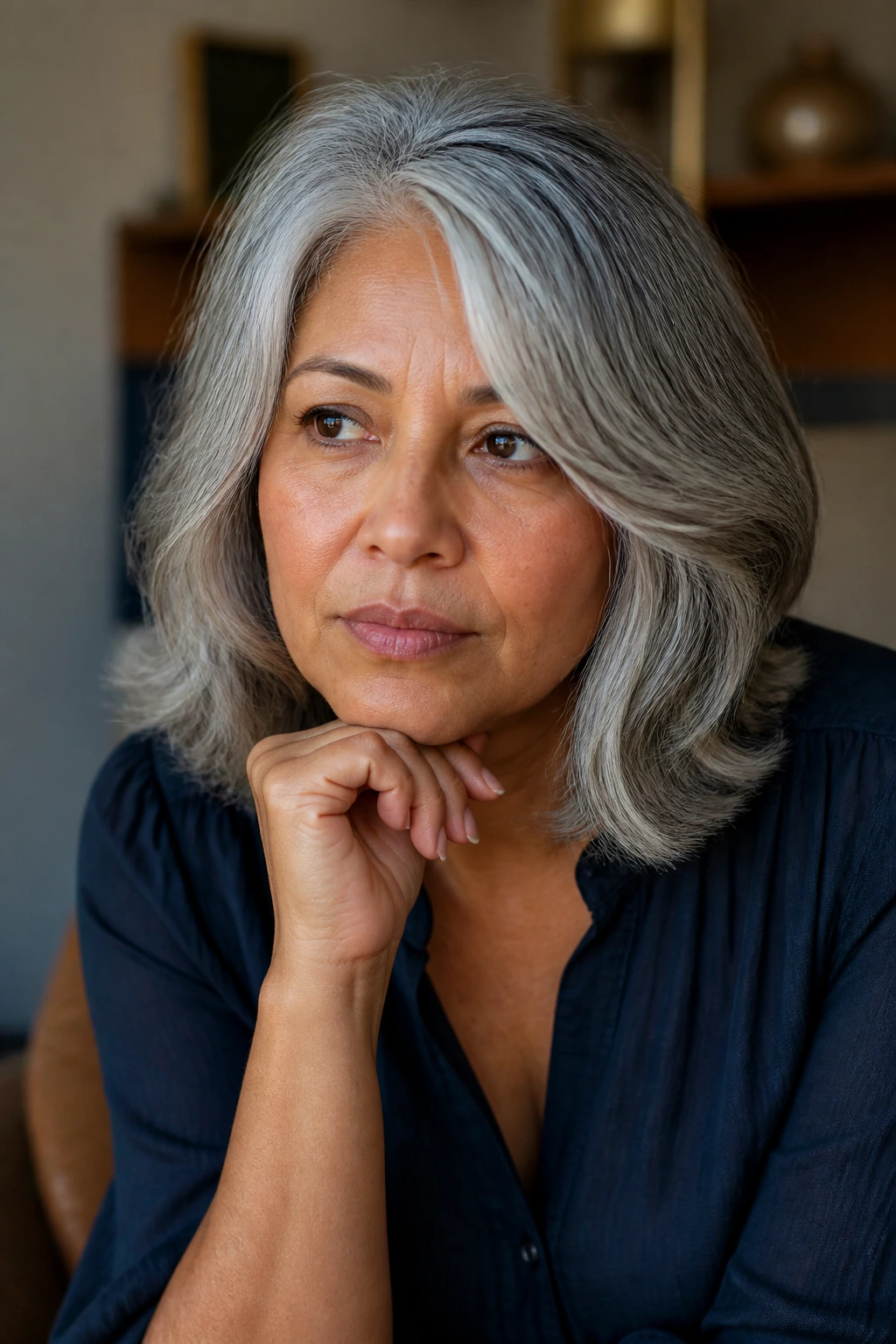
Dry gray hair can look flat in a hurry, and medium skin tones are where that problem shows up fastest. Not because gray is wrong for you. Because the cut, the shape, and the finish have to do more work once the pigment is gone and the texture starts feeling a little dry, a little wiry, a little unwilling to cooperate unless you ask nicely.
That’s why the best dry gray hairstyles for medium skin tones aren’t just “gray hair ideas.” They’re shapes with purpose. A blunt lob that stops at the collarbone. A shag that breaks up puffiness. A low knot that keeps coarse ends tucked away. A soft wave that catches light without turning your whole head into a halo of frizz. The sweet spot is usually somewhere between polished and lived-in, never too stiff, never too vague.
Medium skin has range. Golden, olive, neutral, peachy, deeper bronze — all of it can hold gray, but the trick is choosing a cut that doesn’t drain the face or exaggerate dryness at the ends. A little structure helps. So does a clean line near the jaw, or a fringe that lands just right, or a side part that gives the color a better angle. Gray hair is honest hair. If the style is lazy, it shows.
Why These Gray Styles Work So Well on Medium Skin
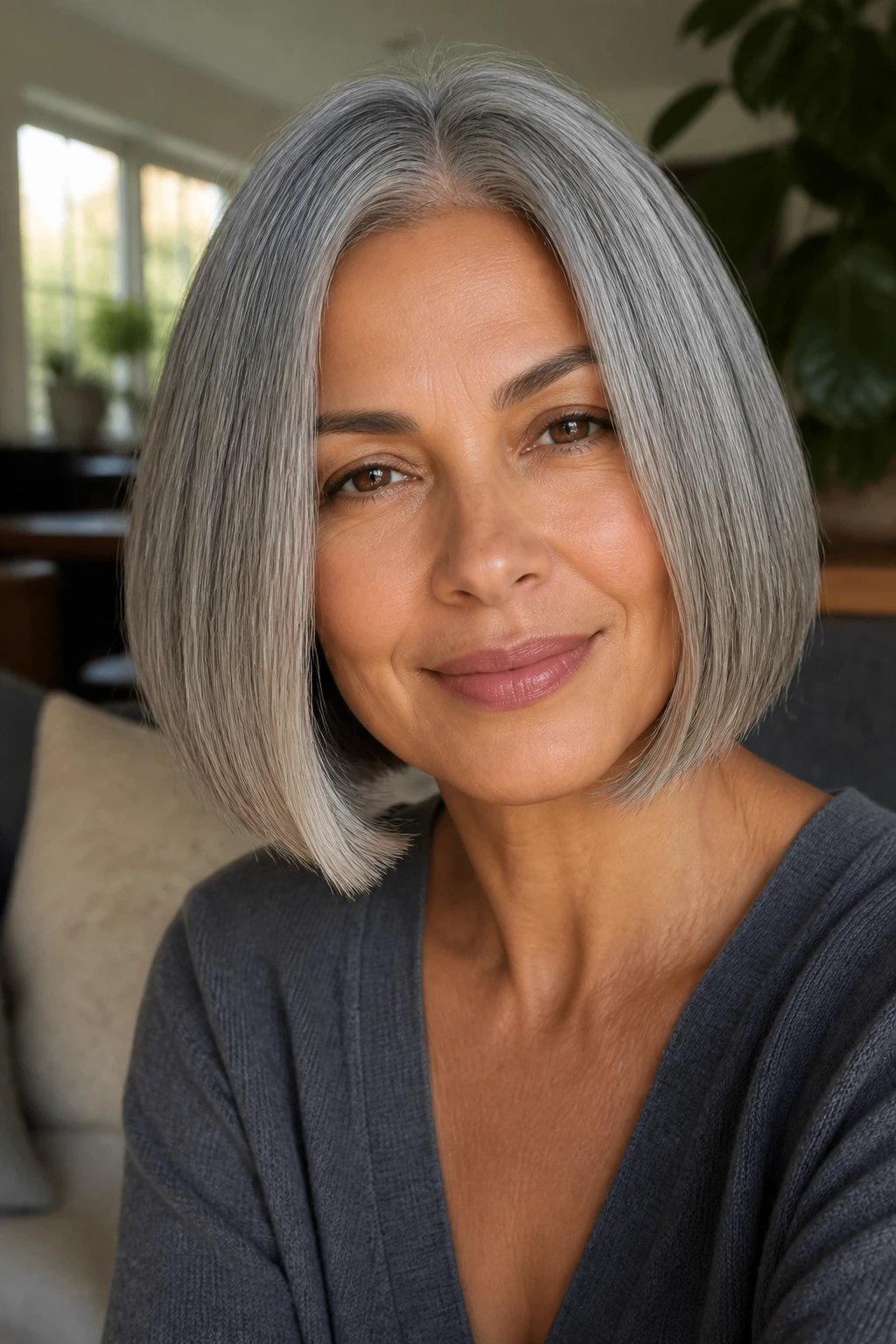
-
Contrast does the heavy lifting: Gray against medium skin creates a clean edge, and a blunt bob or sharp part makes that contrast look deliberate instead of washed out.
-
Dry texture needs shape, not punishment: Heavy heat and endless brushing make gray strands puffier and rougher, while cuts with real structure keep the hair from sprawling.
-
Medium skin loves depth around the face: Silver, charcoal, pewter, and salt-and-pepper tones sit better when the cut frames the cheeks, jaw, or collarbone instead of floating far away.
-
Soft movement beats stiff shine: Gray hair often reflects light in a matte, powdery way, so styles with bends, waves, or tucked pieces look more alive than pin-straight rigidity.
-
Accessories matter more than people think: Gold hoops, tortoiseshell frames, warm makeup, and a clean part can make gray hair look intentional in a way that a pile of styling cream never will.
-
Low-maintenance shapes save dry ends: The less you have to re-iron, re-curl, or re-smooth the ends, the better the hair behaves by day three.
1. Blunt Silver Lob With a Center Part
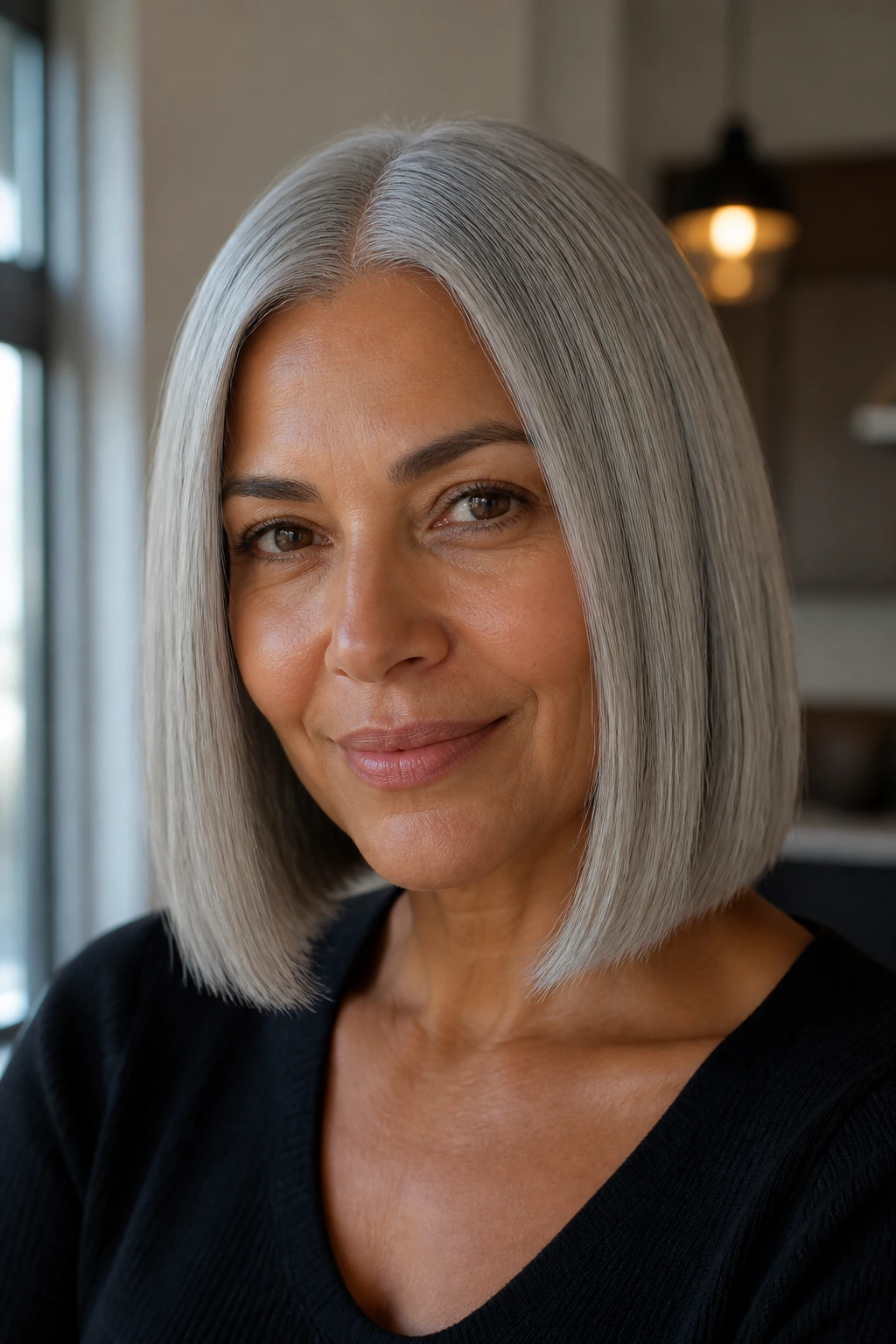
The blunt lob is the first cut I’d hand to someone whose gray hair feels dry at the ends and a little too fluffy near the crown. The straight line at the collarbone gives the color something solid to sit on, and on medium skin tones it creates a clean frame that doesn’t disappear into the face. It has edge without feeling severe.
Why it works
Gray hair often loses some of the natural slip that makes longer layers behave. A blunt lob cheats that problem. The shape does the styling for you, and the center part keeps the look calm instead of fussy.
I like this cut best when the silver reads as cool-pearl or smoky chrome rather than icy white. That little bit of depth keeps medium skin from looking dull, especially if your undertones lean olive or golden. If the ends are dry, a tiny amount of cream on the bottom inch is enough. More than that and the cut starts to lose its sharpness.
Quick styling note
A 1.25-inch flat iron or large straightener pass is enough. Don’t chase poker-straight perfection. A slight bend at the ends keeps the blunt line from looking hard in a bad way.
2. Soft Side-Part Pixie With Piecey Crown
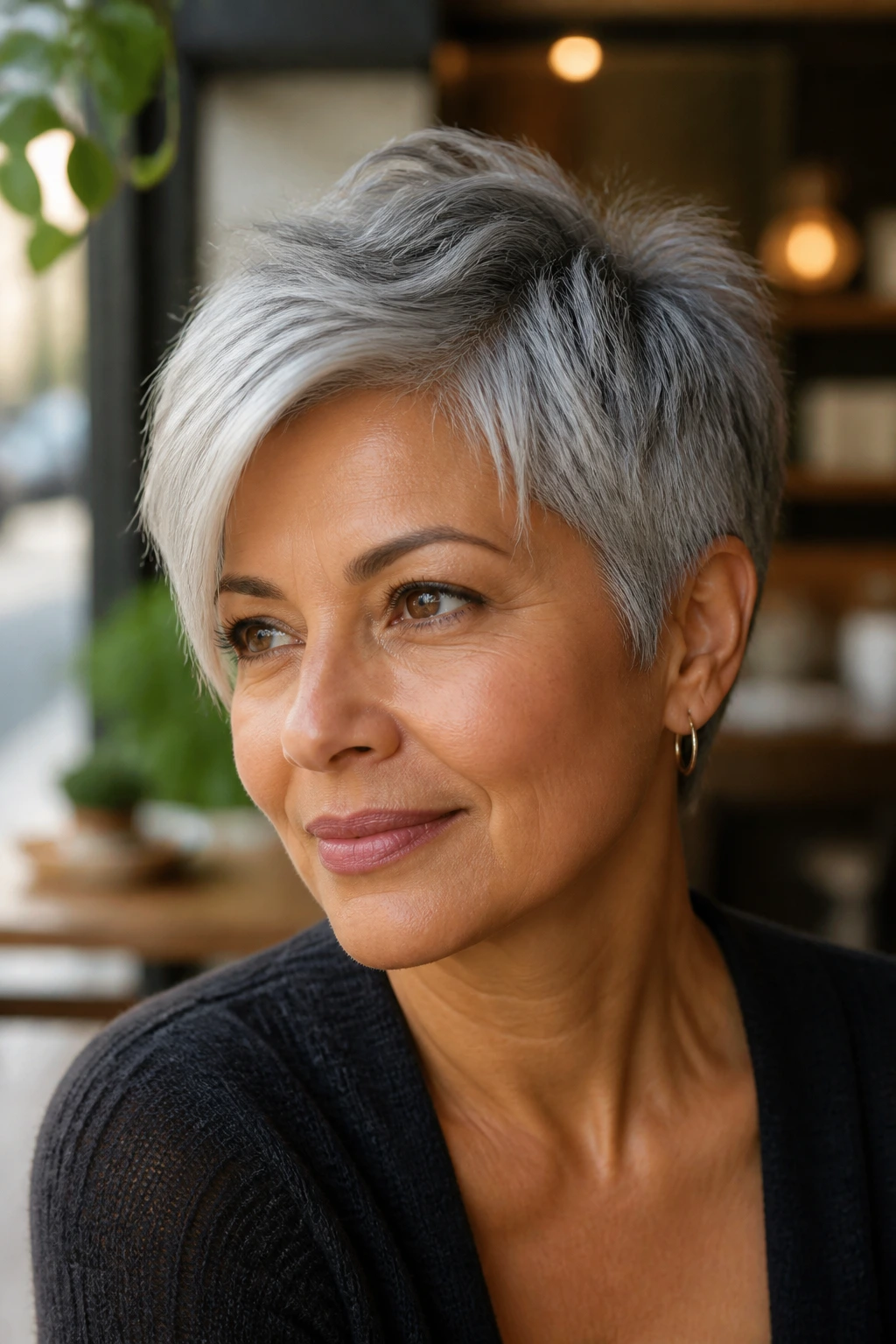
This is the cut for someone who wants gray hair that feels modern without trying too hard. The side part gives the face lift, the shorter sides keep dry texture under control, and the crown stays piecey instead of shellacked. On medium skin, that little bit of asymmetry keeps the color from flattening the features.
You can go neat or rough with it. That’s the charm.
A pixie like this works especially well when gray hair has a coarse feel at the back but a finer texture near the temples. The shorter length means you’re not fighting split ends every morning. Use a pea-sized amount of matte paste, rub it between your fingers until it disappears, and then pinch the top in small sections. If you smear product through the whole head, the style loses its lightness fast.
This is also one of the best choices if your brows are strong and your cheekbones already do a lot of the visual work. The cut lets your features carry the look.
3. Layered Gray Shag With Curtain Bangs
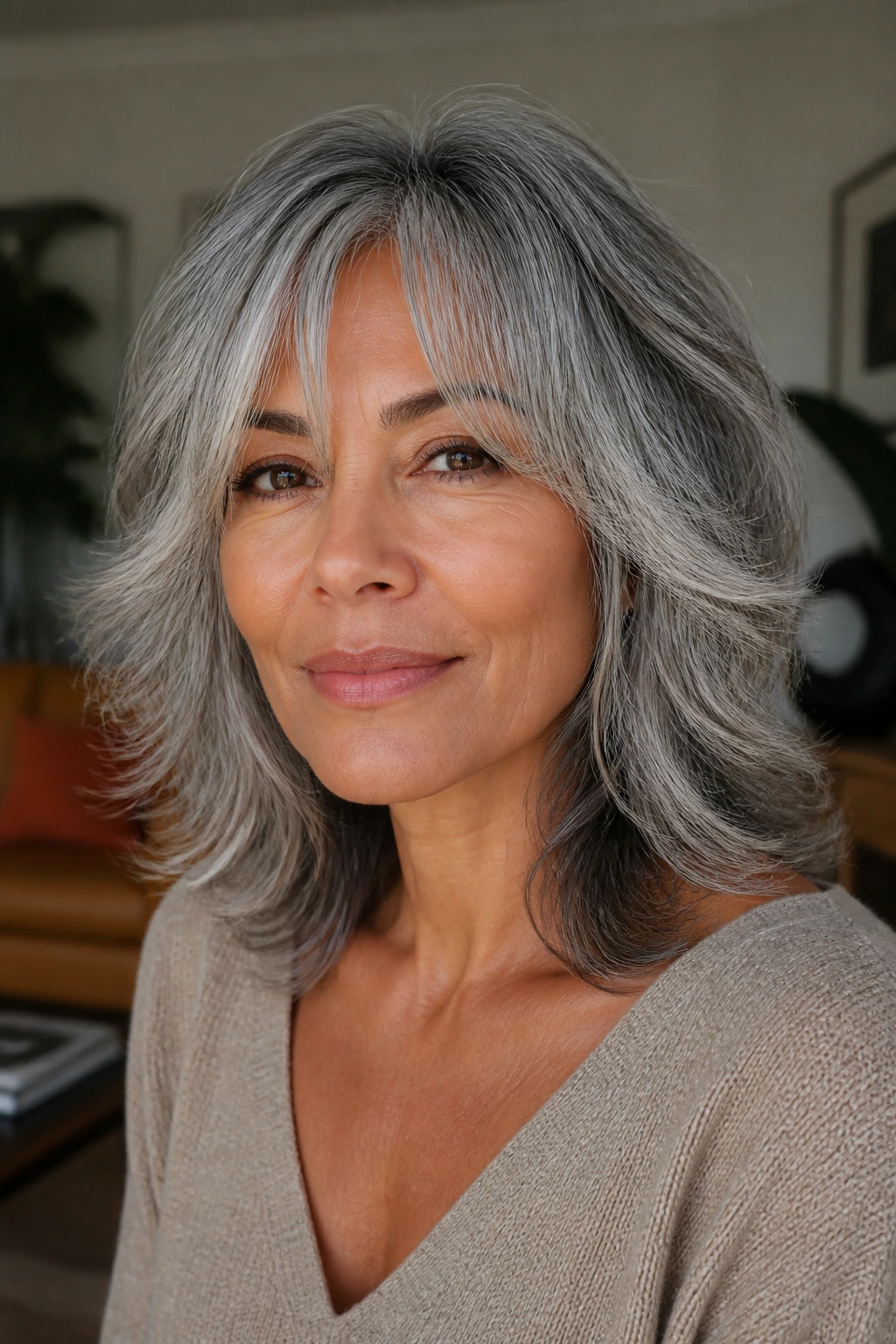
Why does the shag keep showing up in every smart gray-hair conversation? Because it solves dryness without making the head look too tidy. The layers break up bulk, the curtain bangs soften the forehead, and the whole cut lets natural movement do most of the talking. On medium skin tones, that face-framing softness keeps the silver from feeling stern.
What makes it flattering
The best gray shag is never chopped to bits. It has shape. I’d keep the shortest layers around the cheekbone or just below it, then let the length skim the shoulders so the hair has enough weight to settle. That matters with dry hair, because over-layering can turn the ends fuzzy by lunchtime.
Curtain bangs are the good part here. They let you keep some skin exposed near the center of the face while still hiding the rougher areas around the temples. If your gray has a smoky or pewter cast, this cut looks especially good with a warm-toned lip and a clean brow.
Styling cue
Blow-dry with a medium round brush and stop while the hair still has a little give. If you overwork the bend, the shag gets puffy instead of airy.
4. Sleek Low Chignon With a Soft Side Sweep
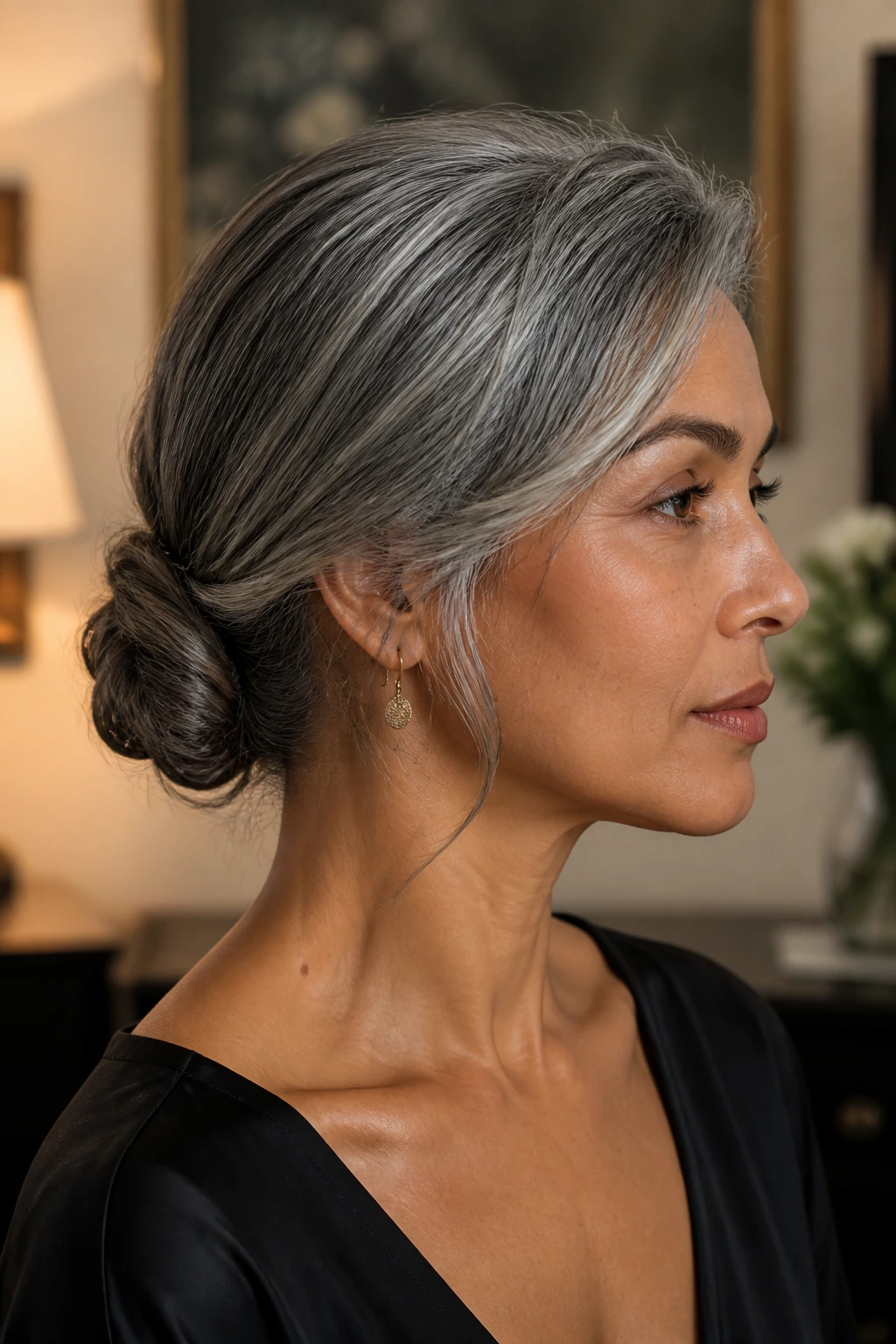
A low chignon is what I reach for when dry gray hair needs to look intentional in ten minutes or less. It pulls the ends away from the elements, keeps frizz under control, and gives medium skin a nice open frame at the jaw and neck. The side sweep keeps it from feeling too formal.
It’s also a very forgiving style on day-three hair. In fact, that slight dryness helps the bun hold shape.
I prefer this look when the gray shade has a little mix — silver with white ribbons, or charcoal near the roots and lighter lengths. A tight, shiny bun can look harsh if the color is too flat. Leave a few soft pieces near the temples, smooth them with a drop of cream, and pin the bun low and slightly off-center. The tiny shift makes the whole style feel less stiff.
Use a bristle brush if you want a polished finish, but don’t flatten the entire head. Some lift at the crown keeps the chignon from looking pinned to the skull.
5. Collarbone Cut With Face-Framing Layers
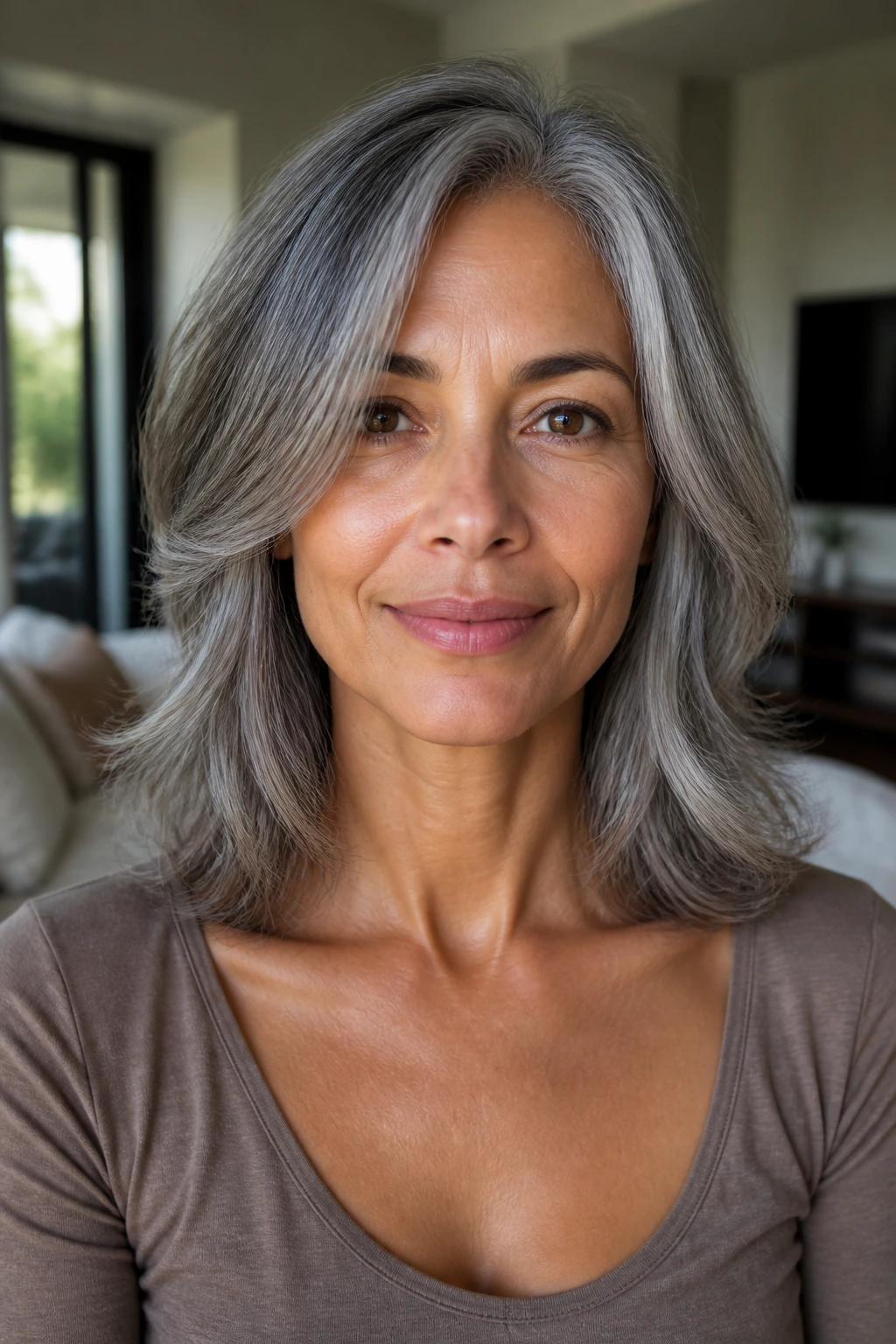
This is the quiet workhorse of the gray-hair world. Not flashy. Not boring. Just useful. A collarbone cut sits in that sweet spot where it can be worn straight, waved, tucked, or clipped back, and the face-framing layers give medium skin a little softness without dragging the whole style into feathered territory.
Gray hair that feels dry usually likes this length because there’s still enough weight to keep the ends from floating. The layers should start low — around the chin or cheekbone, not up by the ear. Too many short pieces and the hair starts to fluff in all the wrong places.
I’d use this cut for someone who wants options. Wear it with a center part on workdays. Add a deep side part for dinner. Curl just the front pieces with a 1.5-inch wand if the rest of the hair is behaving. It’s flexible, and that’s a rare thing with dry gray hair that resists constant restyling.
6. Textured French Bob With a Light Fringe
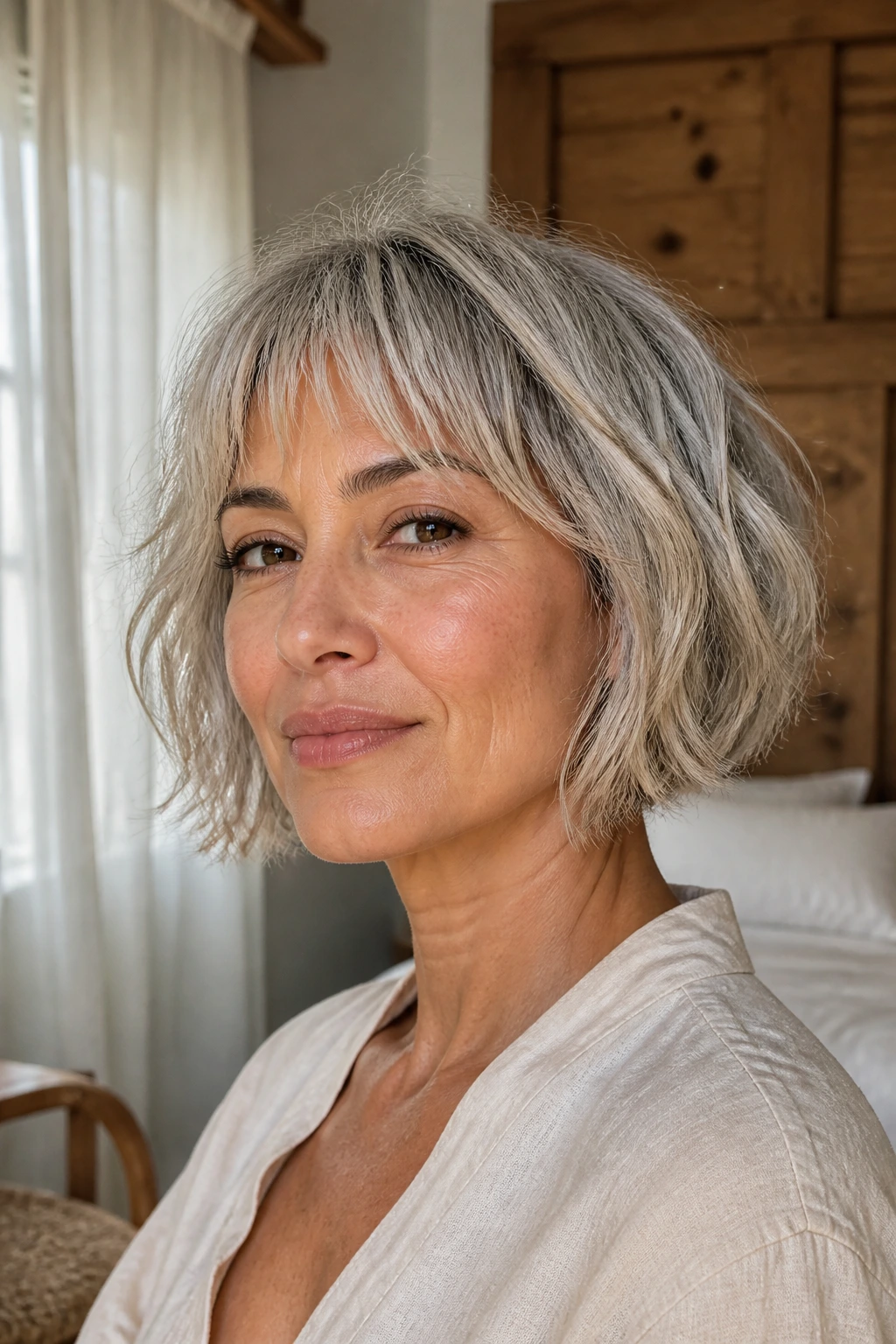
The French bob gets better on gray hair than people expect. The shorter length sits neatly at the jaw, and the texture keeps it from feeling too severe. On medium skin tones, the jaw-skimming shape draws attention to the lower face in a way that looks crisp and a little romantic.
A light fringe helps a lot here. Heavy bangs can make dry gray hair look blunt in the wrong way, but a softer fringe opens the forehead and makes the cut feel less helmet-like. I’d keep the ends slightly rough, not razor-thin. Dry gray hair already has enough texture; it doesn’t need help looking wispy.
This cut is strong with silver-beige or smoky ash gray because those shades keep the face warm enough. If your hair is naturally wavy, even better. Just bend it under with a round brush and let the ends move a little.
7. Long Gray Waves With a Deep Side Part
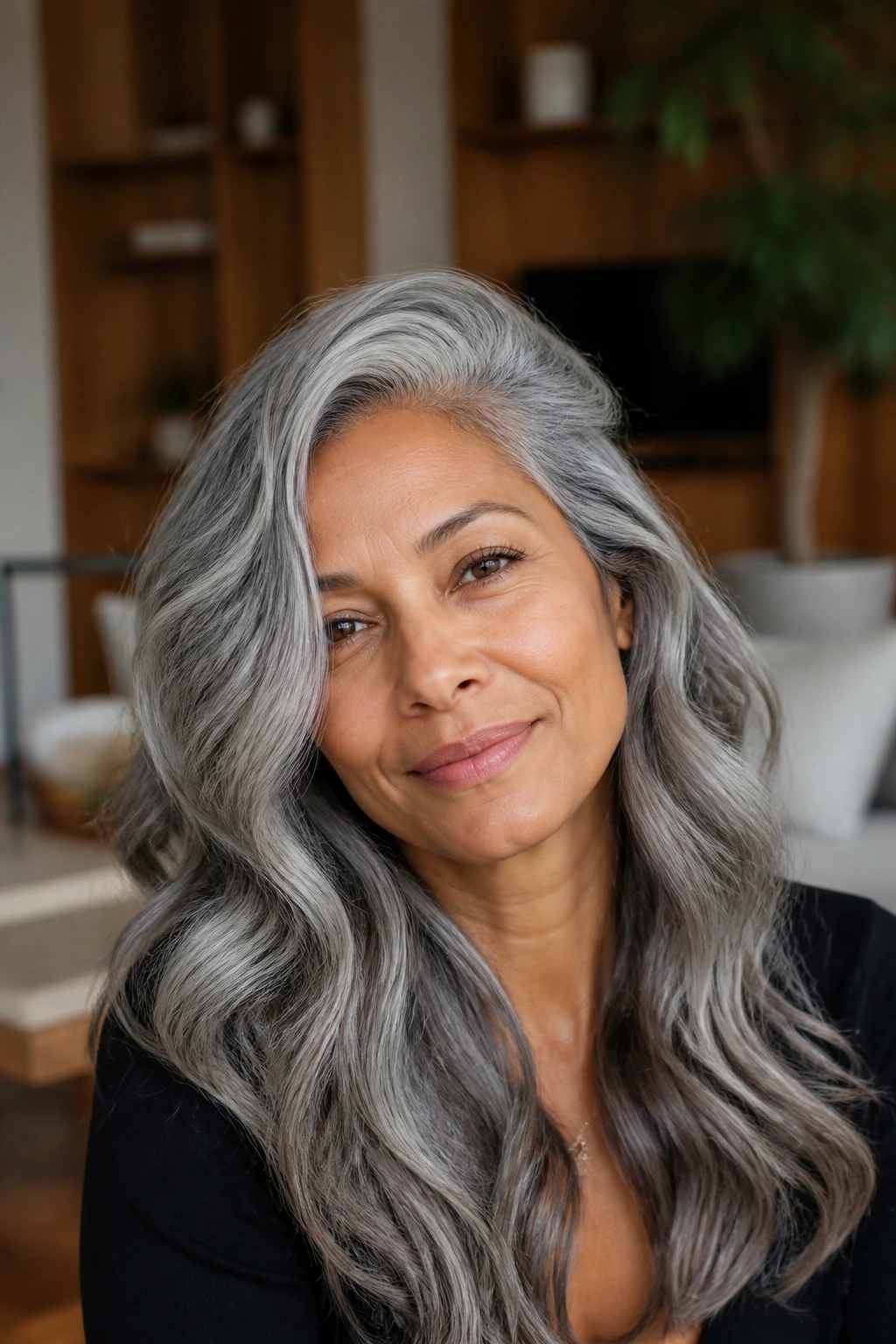
Long gray hair can be gorgeous on medium skin, but it needs a plan. A deep side part gives the color contrast and stops the length from hanging flat on both sides of the face. The waves keep the dry texture from looking too stringy.
The trick here is restraint. Long dry gray hair looks best when the waves are broad and loose, not tight and uniform. Think one or two passes with a large barrel iron, then brush it out with your fingers. A few bends near the face are enough. The rest can stay soft.
If your gray has darker lowlights or natural salt-and-pepper depth, this style shines because the shifts in tone show up in the waves. Medium skin tones also benefit from the asymmetry of the deep part. It creates a shadow line that keeps the face from looking too open or pale.
This one does ask for more upkeep than the shorter cuts. Split ends show fast on long gray hair. A trim every 8 weeks keeps the wave pattern from fraying.
8. Tucked-Behind-the-Ear Lob
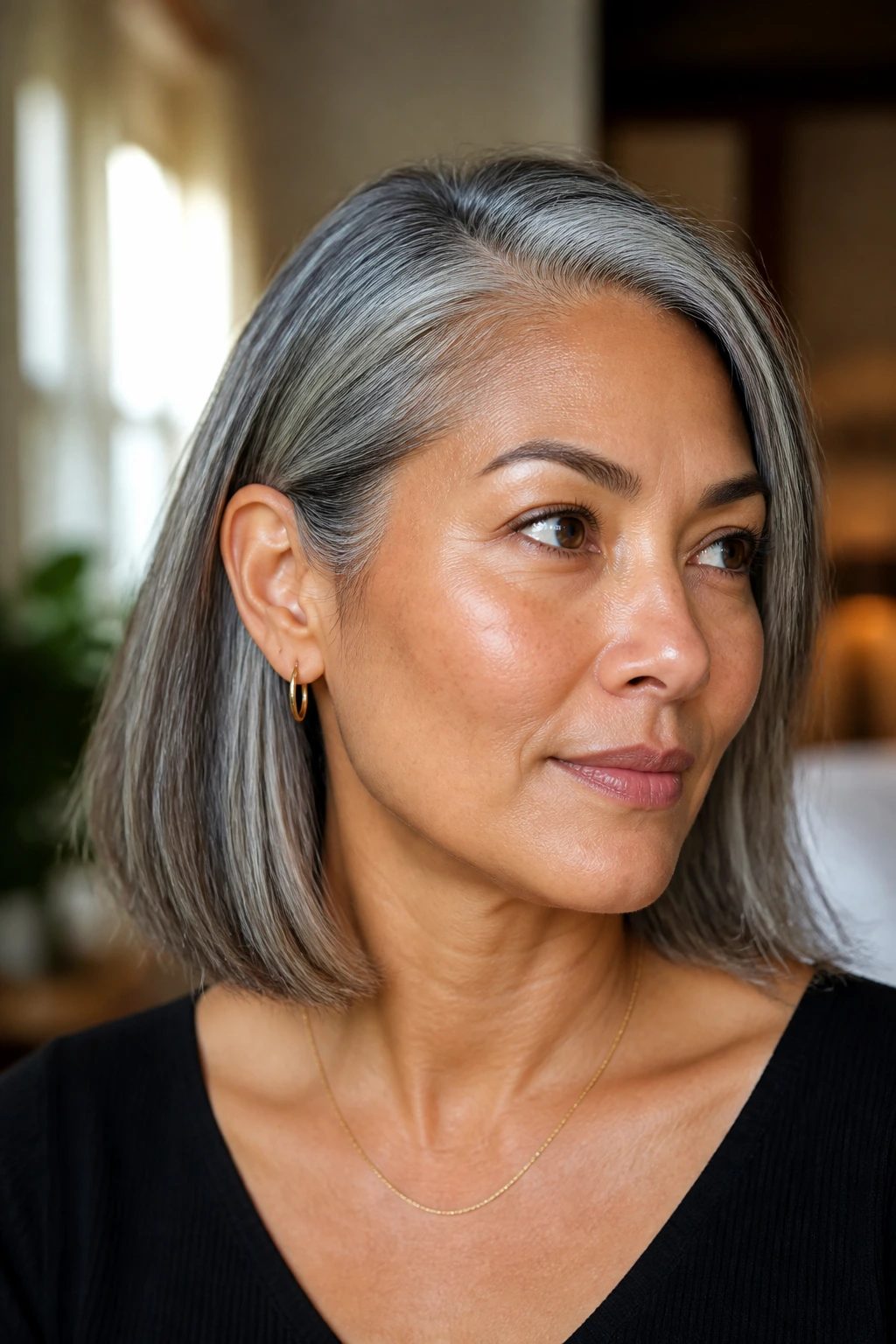
Sometimes the best hairstyle is one simple move. Tuck one side behind the ear, leave the other side loose, and suddenly the whole cut has shape. On a medium skin tone, that exposed cheek and jaw line make gray hair look sharper without needing a lot of product.
This works especially well on a lob that hits just below the chin or near the collarbone. The tucked side gives you a clean line for earrings, glasses, or a high neckline, while the loose side keeps the style from feeling severe. If the hair is dry, keep the product light. A silicone-free cream or a tiny bit of serum on the ends is enough.
I like this look with a side part better than a center part, mostly because the tucked side gets a little more lift at the root. That lift matters. It keeps the style from collapsing into the head.
9. Braided Crown for Second-Day Gray Hair
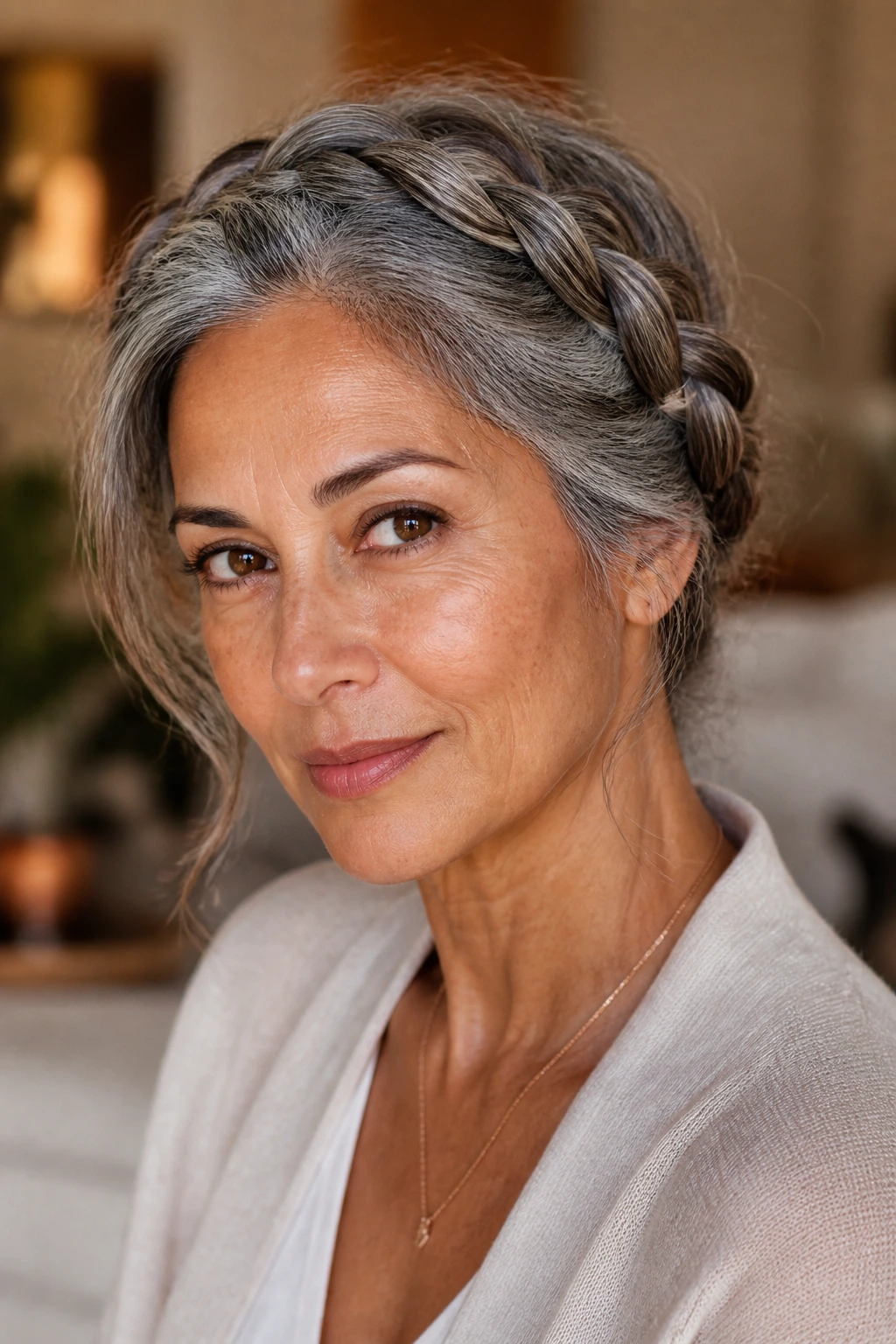
A braided crown is one of the smartest ways to use dry gray hair instead of fighting it. The texture helps the braid hold, and the lifted shape keeps the face open. On medium skin tones, the braid also adds a nice warm contrast when you pull a few soft pieces loose around the temples.
Best when you need control
Second-day hair is ideal here. Freshly washed gray hair can be too slippery, and the braid slips apart fast. A little dry shampoo at the roots or a mist of texture spray gives you grip without making the hair crunchy.
I’d keep the braid low enough that it hugs the head instead of floating above it. That keeps the crown from looking too fairy-tale or too precious. A few hidden pins are enough. And if your gray has some darker streaks, even better — braids show off color variation in a way loose styles often miss.
A small opinion
Use a light hand with shine spray. Gray hair does not need to look lacquered to look healthy.
10. Curly Tapered Crop With Defined Top
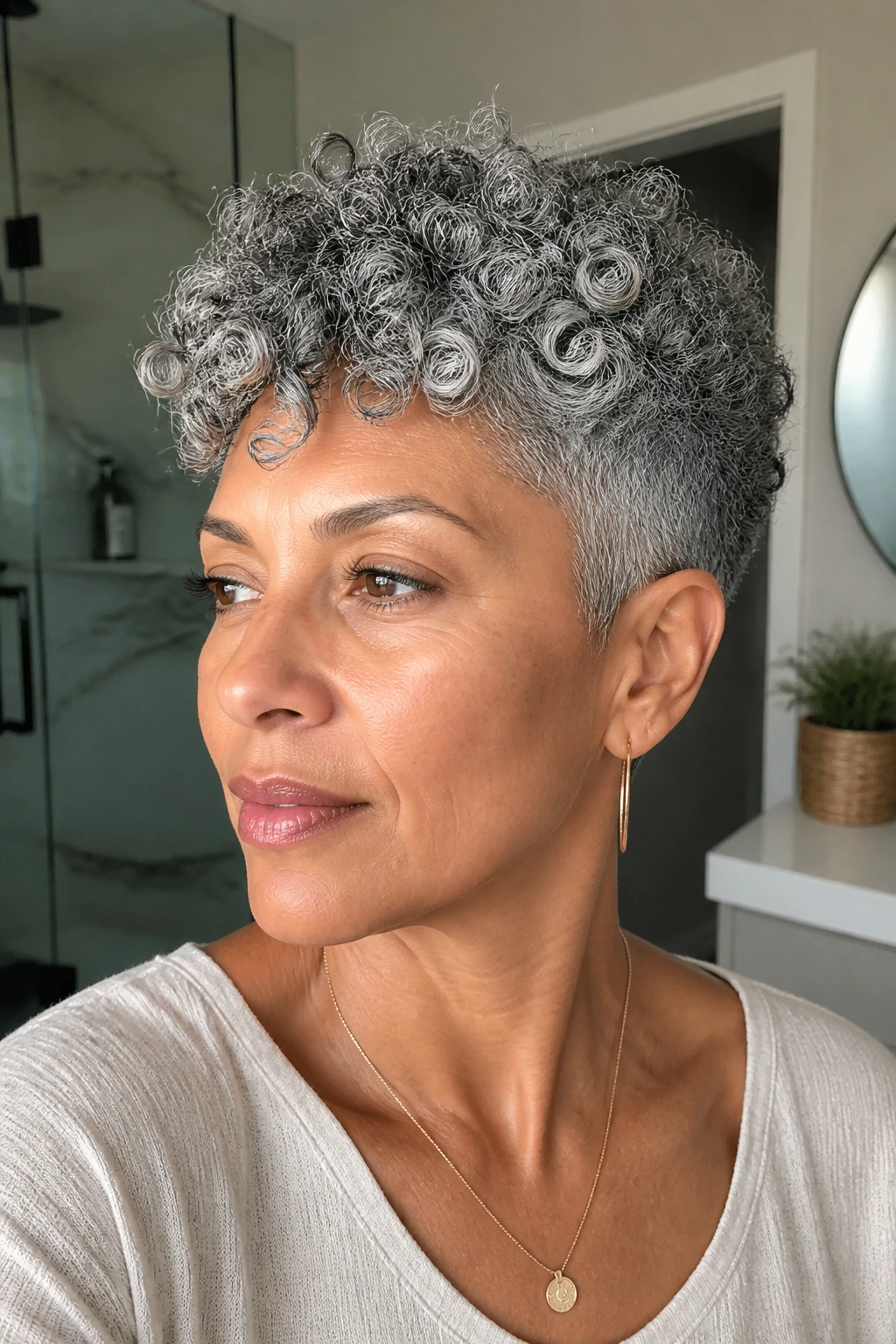
If you have naturally curly gray hair, the tapered crop is one of the few cuts that can make dry texture look planned instead of random. The sides stay neat, the top keeps its shape, and medium skin tones get a clean frame around the eyes and mouth.
The biggest mistake with curly gray hair is taking too much weight off the top. That leaves the curls looking puffy and uncertain. Keep enough length on top for the curls to spring, then taper the sides closely so the whole silhouette stays balanced.
A curl cream plus a gel cast works well here. Scrunch it in while the hair is soaking wet, diffuse on low heat, and don’t touch the curls until they’re dry. The finish should feel soft but supported. If the curls are dry enough to frizz by lunchtime, use a little leave-in conditioner before the gel.
This cut has attitude. Not loud attitude. Just enough.
11. Half-Up Knot With Loose Face Pieces
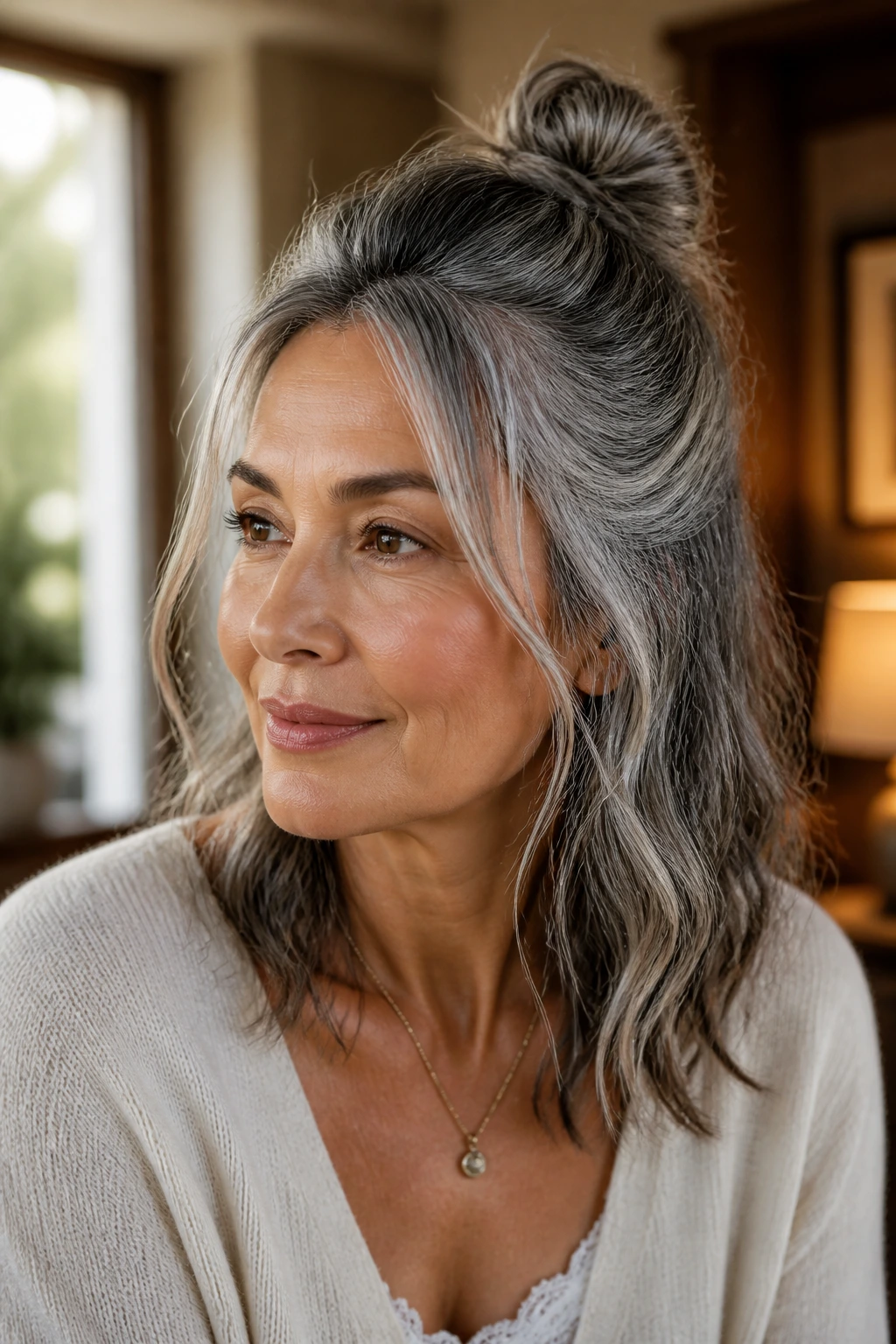
The half-up knot is for the days when gray hair won’t behave enough to be fully loose but you still want movement. Pull the top section into a soft knot, keep the lower half down, and leave two loose pieces near the temples. On medium skin, those face-framing pieces warm the look up immediately.
It’s a good option when the ends are dry but the crown still has decent smoothness. The knot hides the rougher top layers, and the loose hair lets the color show. I like this more on shoulder-length gray hair than on very long hair, because the proportions stay cleaner.
Use a satin scrunchie or a covered elastic so the knot doesn’t feel harsh. If the front pieces are too blunt, twist them once before letting them fall. That tiny twist keeps them from looking like they were left out by accident.
12. Angled Gray Bob With a Longer Front Edge
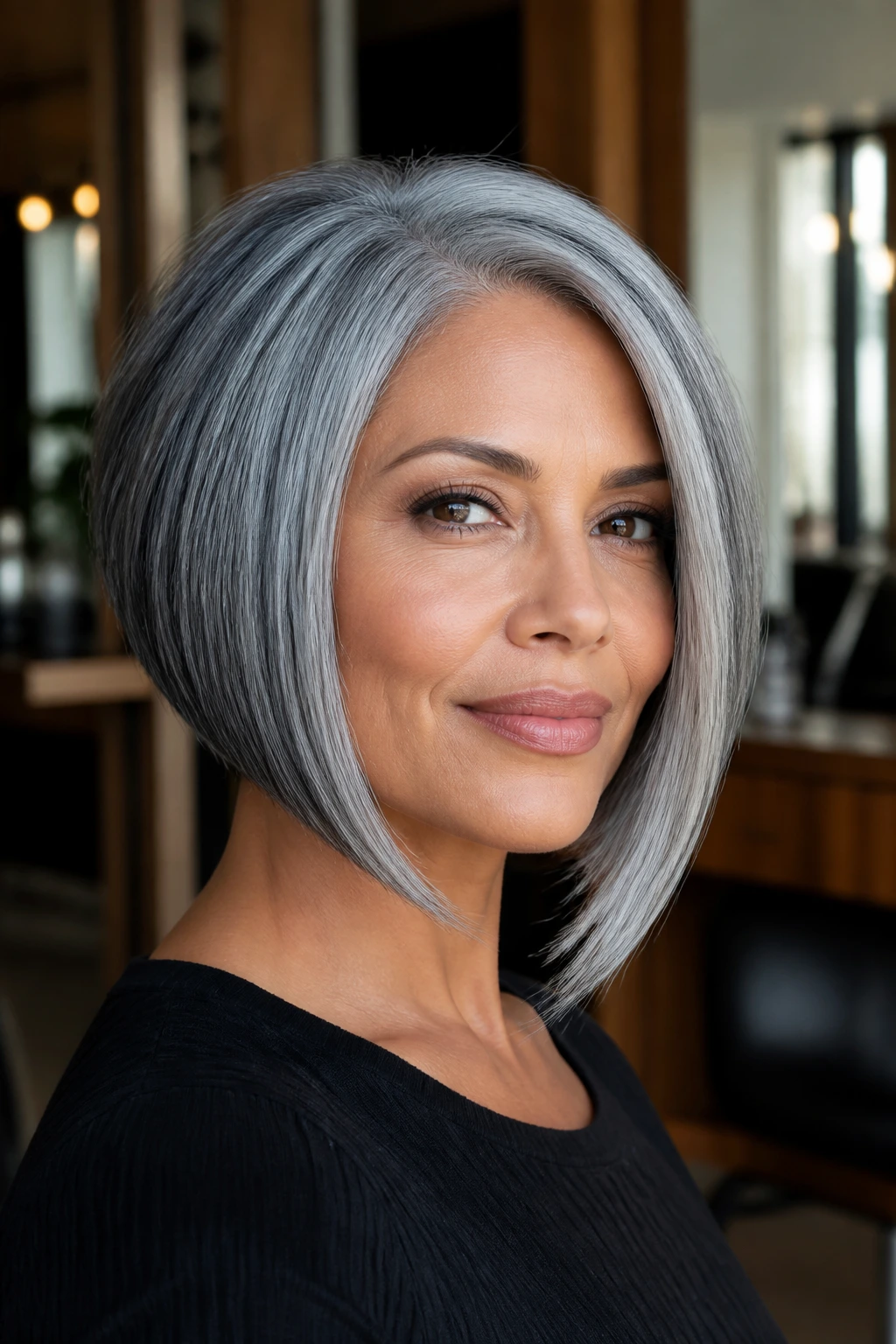
An angled bob gives gray hair a little architecture, and architecture is useful when the texture is dry. The shorter back lifts the nape, while the longer front pieces graze the jaw and help medium skin look more defined.
I like this cut when the hair has some body but not too much. Too much volume and the angle starts shouting. Too little and the whole shape collapses. The sweet spot is a clean back line with sides that curve toward the chin.
This bob also works well if your gray is a mix of silver and steel. The angled front catches the light, while the shorter back keeps things from looking bulky. If you wear glasses, this is one of the easiest cuts to live with. It sits neatly around frames instead of fighting them.
13. Shoulder-Length Roller-Set Curls
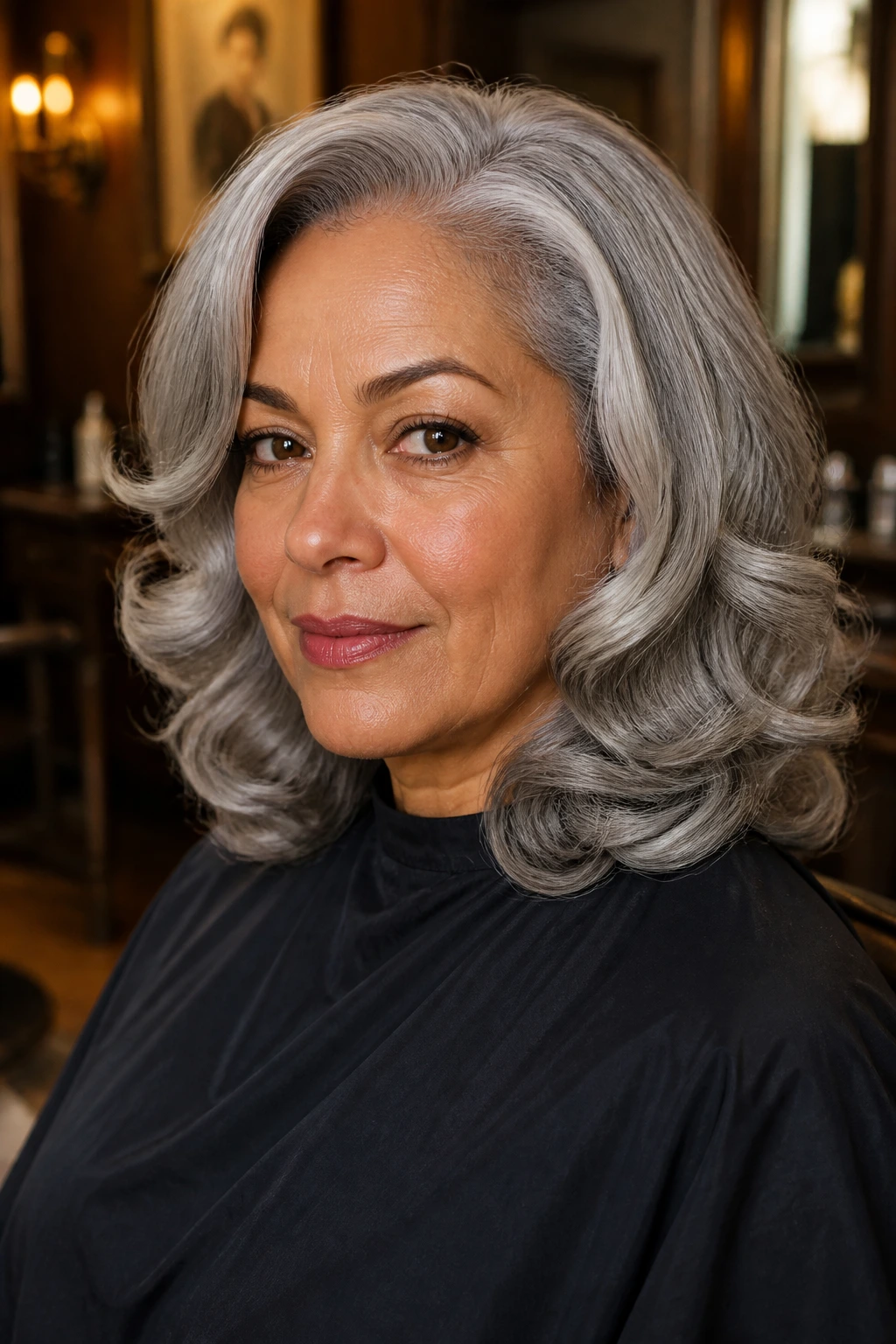
Roller sets are old-school for a reason. They smooth dry gray hair, set a bend without frying it, and give medium skin a polished frame that looks especially good in profile. Big rollers create soft curls, not tight ringlets, and that matters if the hair is already a little coarse.
Why I keep coming back to this look
Because it lasts. A good roller set holds shape longer than a rushed blowout on dry gray hair, especially if you let the hair cool fully before removing the rollers. Use medium or large rollers, set the hair in sections about 1 to 1.5 inches wide, and pin the front away from the face so the crown keeps some lift.
The result should feel soft, not perfect. That’s the point. Gray hair with a little bend at the ends looks more awake than gray hair dragged straight down. A brush-out with fingers or a wide-tooth comb keeps the wave loose.
If your medium skin has warm undertones, this style plays nicely with gold jewelry and a peach blush. It likes warmth around it.
14. Messy Top Knot With Soft Temples
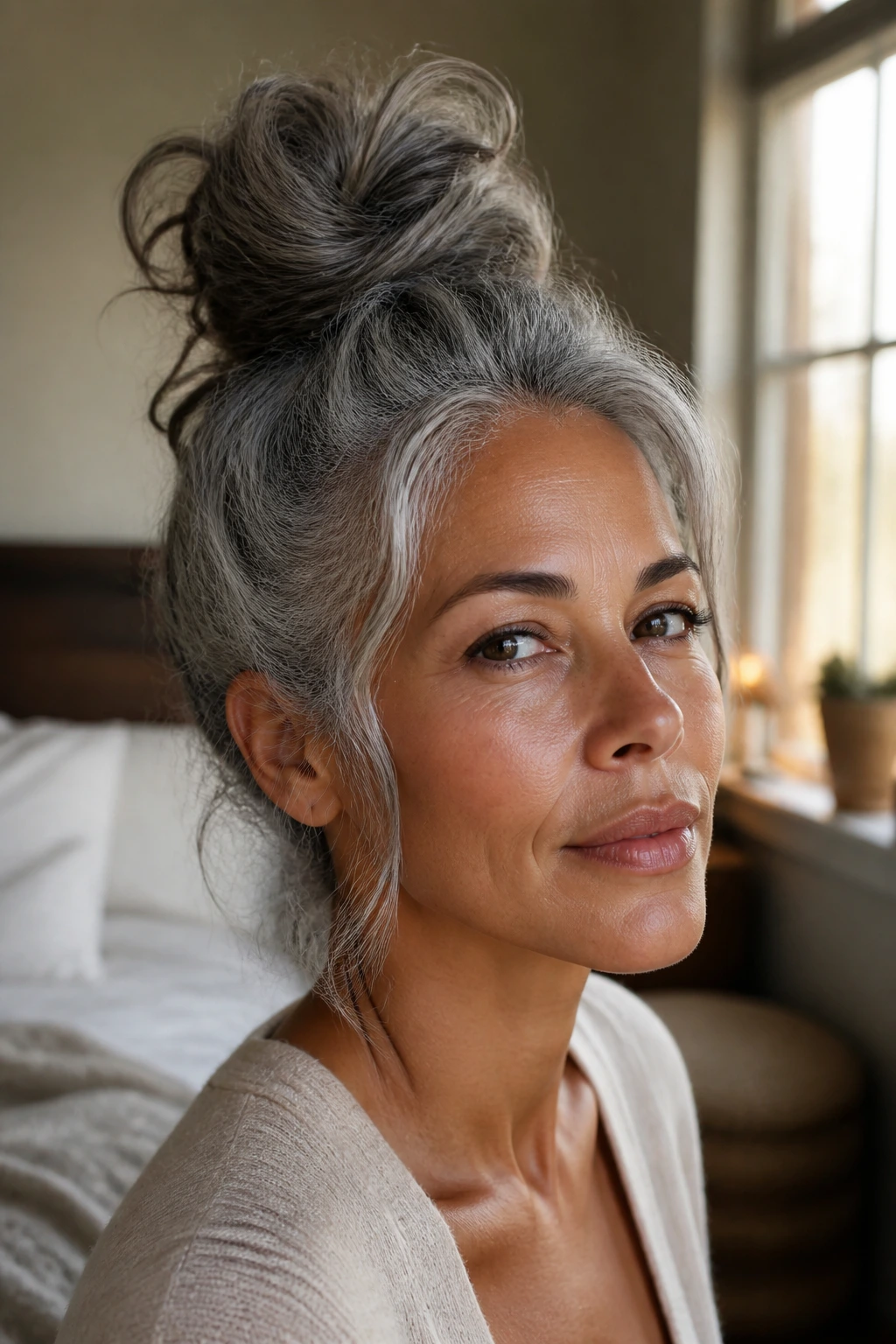
A messy top knot can go wrong fast. Done well, it looks relaxed and sharp at the same time. Done badly, it looks like you gave up. The difference is in the shape at the temples and the tension at the crown.
For dry gray hair, this style works because it tucks the most fragile ends away and lets you use volume where you have it. Keep the knot high but not pulled tight, and leave the temple pieces soft. If the hair is short in layers, let a few pieces escape near the nape. That’s fine. Better than fine, actually. It keeps the style from looking too engineered.
Medium skin tones get a nice open frame from the lifted shape. Add small hoops or a clean brow, and the whole thing looks considered.
15. Glassy Straight Lob With a Soft Edge
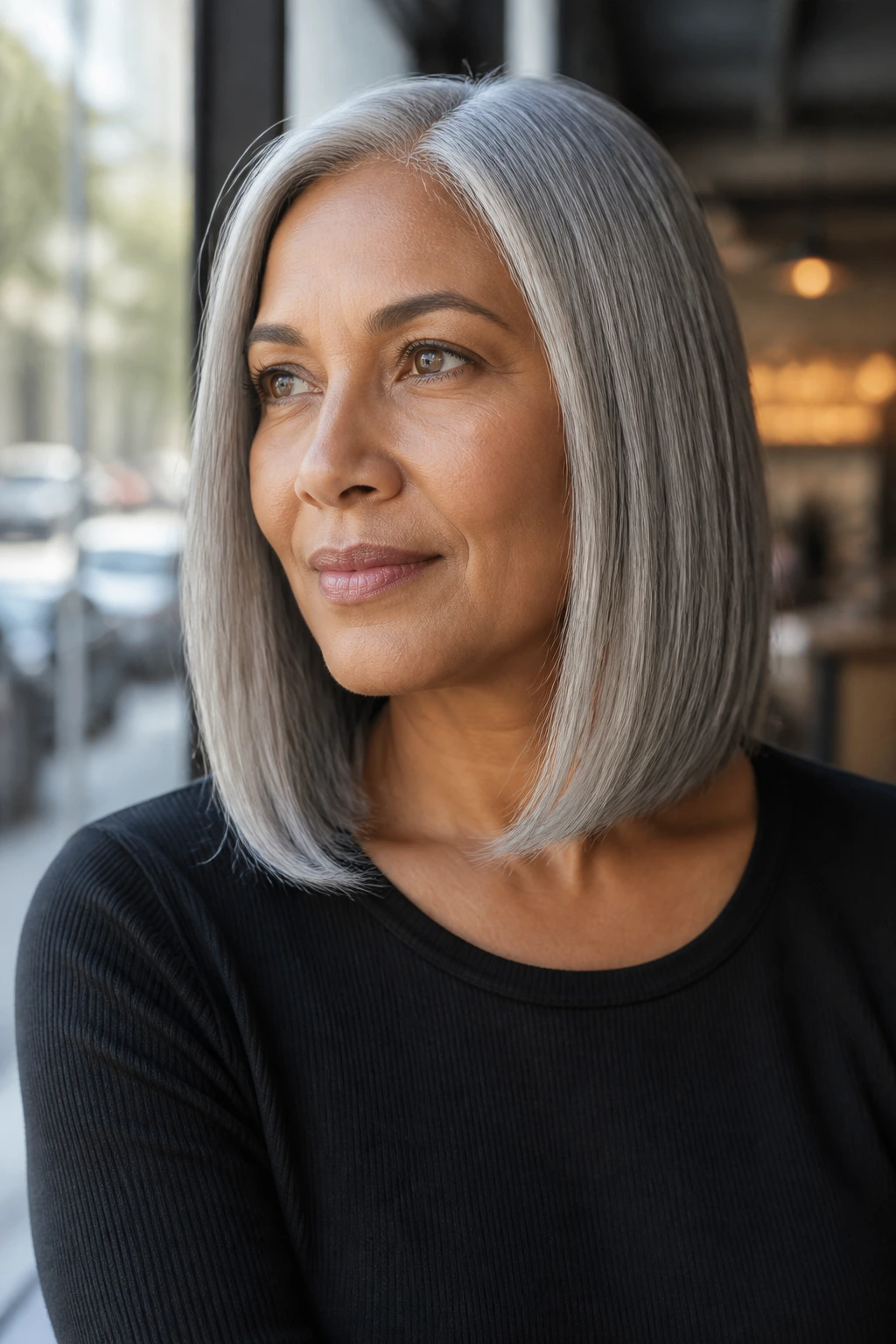
A glassy lob sounds fancier than it is. It’s a straight lob with a smooth finish and just enough bend at the ends to stop it from looking severe. On medium skin, the shine draws attention to the face, and the blunt line gives gray hair a strong shape.
The catch is dryness. If the hair is brittle, chasing a super-flat finish with hot tools can make the ends look shredded. Keep the iron around 300°F to 325°F, use a heat protectant, and do one slow pass instead of four hurried ones. Then stop. A tiny bevel at the ends keeps the cut from turning into a helmet.
I would choose this style when the gray is clean silver or soft pewter and the hair cuticle is in decent shape. If the hair feels rough, this look can still work, but you’ll need a smoother serum and a careful blow-dry first.
16. Soft Perm Bob With Round Shape
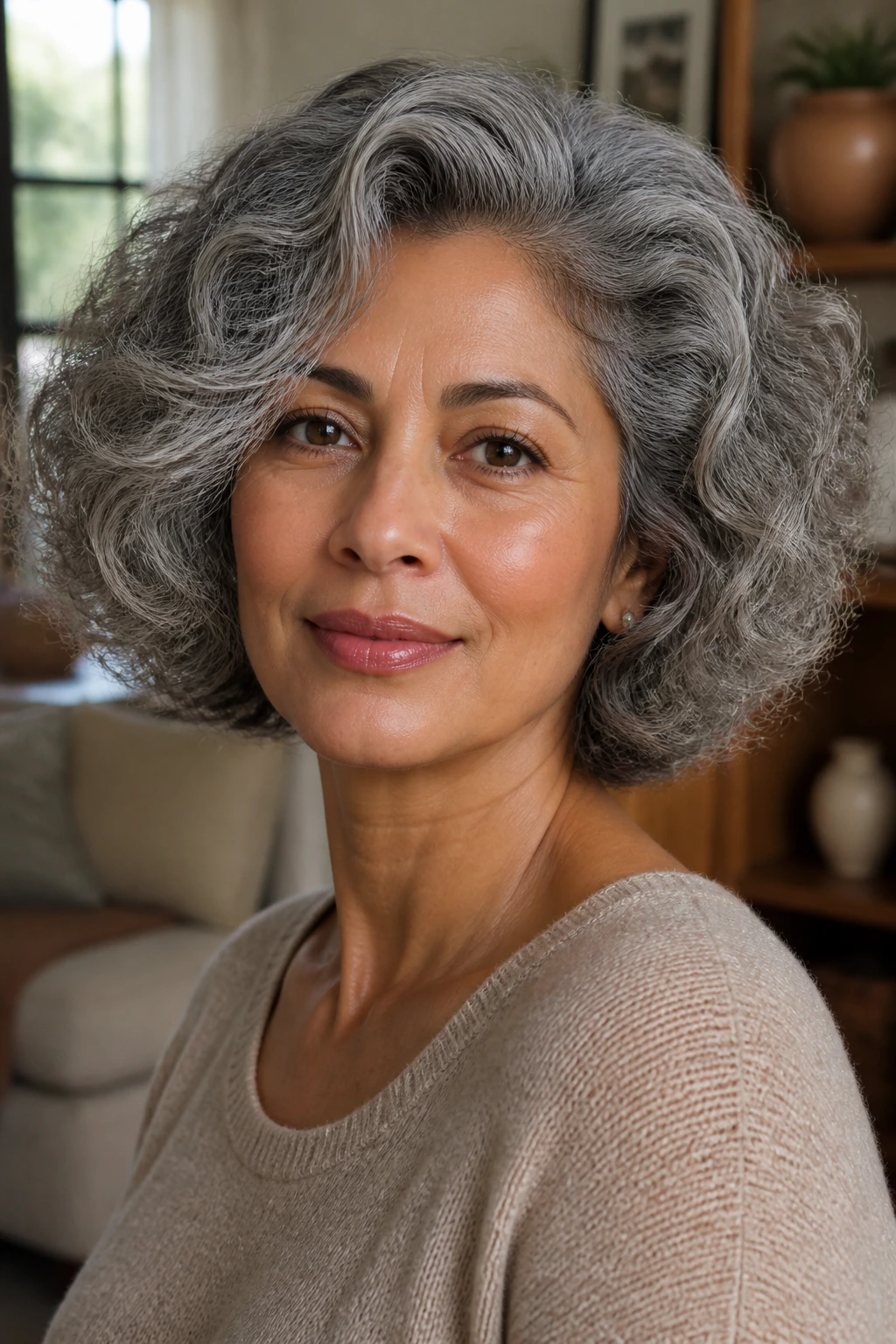
A modern perm sounds scary until you see the right version of it. On gray hair, a soft perm bob can create roundness where the hair has gone flat and dry. The result is not 1980s curl explosion. It’s a controlled, cushioned shape that sits nicely around the face.
This is especially useful for medium skin tones when the hair is fine and tends to disappear against the face. The curl pattern gives the gray more body, and the bob keeps it from sprawling. Ask for large rods or a gentle wave perm, not a tight curl pattern. The goal is shape, not volume for volume’s sake.
A perm like this does require care. Moisture masks, low-heat diffusing, and a wide-tooth comb are your friends. But if your hair has gone limp and dry, the right perm can make styling easier, not harder.
17. Low Bubble Ponytail With Wrapped Sections
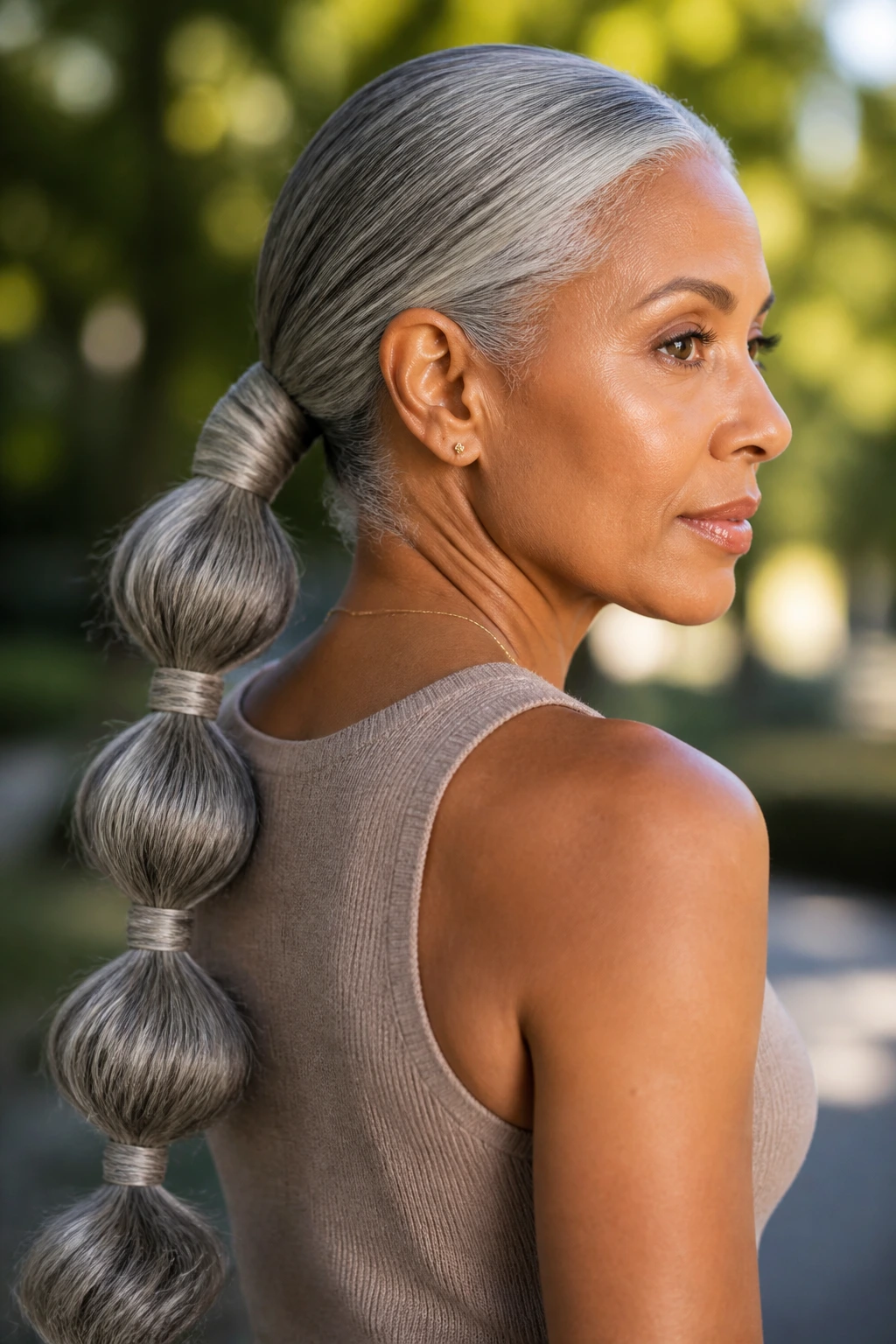
The bubble ponytail is a nice trick when you want something playful without exposing every dry end. The sections between elastics create shape, and the low placement keeps the look grounded enough for medium skin tones.
Start with a low ponytail at the nape. Add small clear elastics every 2 to 3 inches, then gently tug each section into a rounded bubble. If the hair is fine and dry, a little texture spray at the roots helps the bubbles hold. If the hair is thick, use bigger elastics so the ponytail doesn’t pinch.
I like this style more on gray hair than on many darker shades because the sectioning shows off the silver tones. The light catches each bubble differently. A wrapped strand around the base hides the elastic and makes the style look finished.
18. Braided Ponytail With a Satin Ribbon
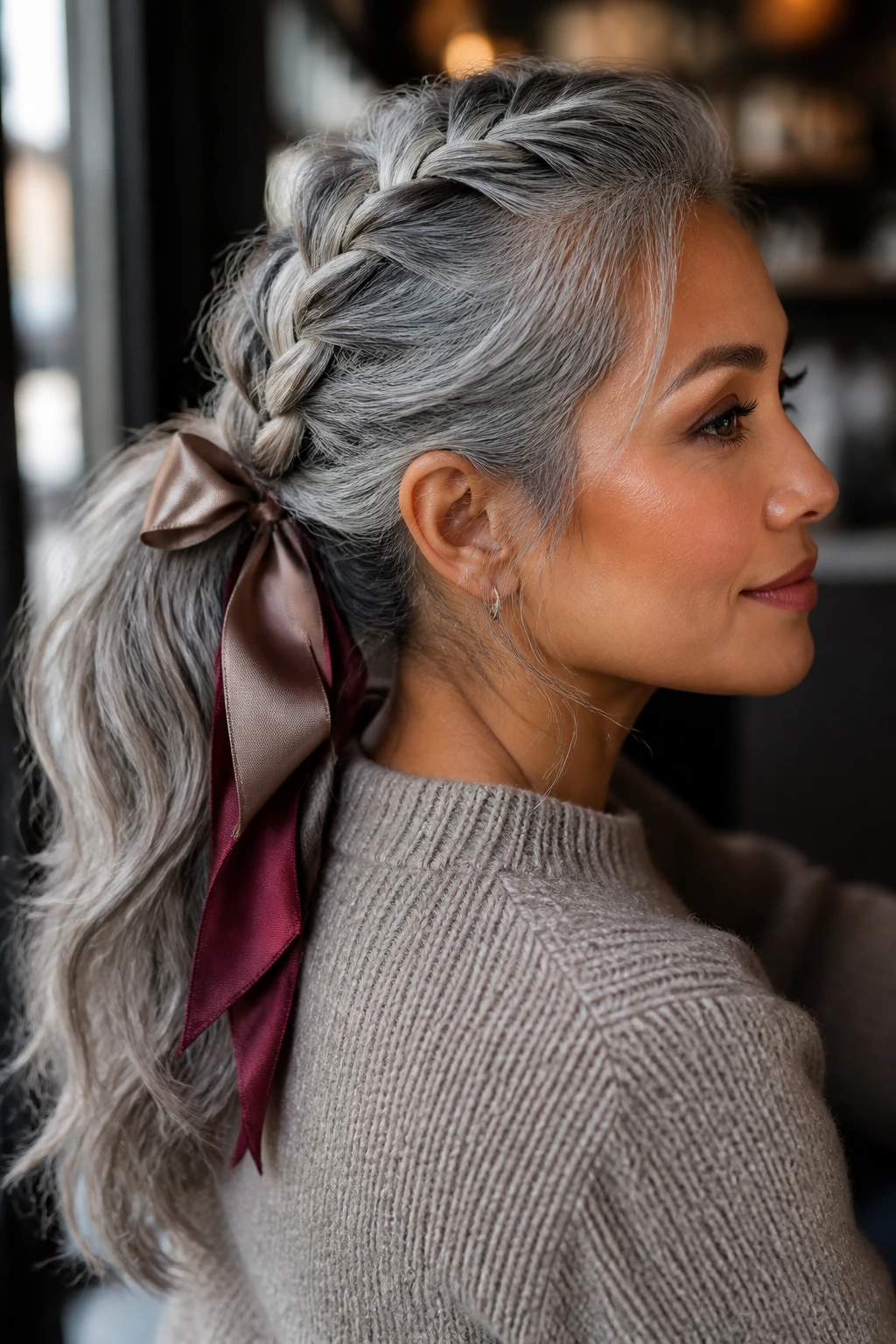
This one gives gray hair a little drama without requiring a full updo. A sleek braided ponytail pulls the face back, and the satin ribbon softens the finish. On medium skin, the ribbon can bring warmth back into the picture, especially if you choose taupe, rust, deep olive, or warm burgundy.
The braid itself should stay neat at the crown and looser through the tail. That contrast matters. Gray hair with dry ends can look too stiff if every strand is tightly controlled. Leave the tail a little airy. The braid does the work.
This is one of my favorite event styles because it hides the bits that need help — dry ends, uneven layers, old grow-out — while still letting the gray shine. A little pomade at the hairline and a mist of flexible spray are enough.
19. Side-Swept Wave With a Temple Pin
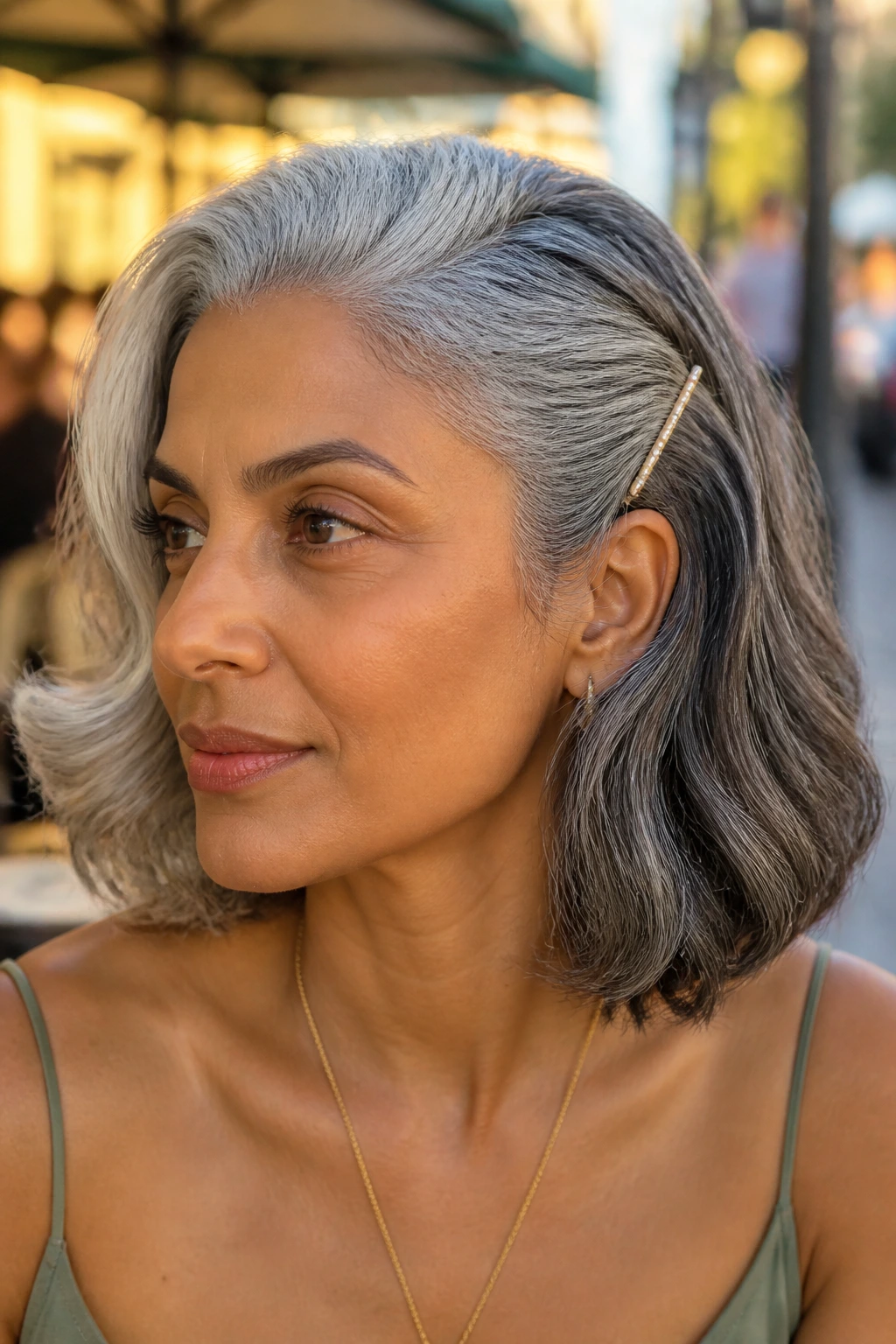
A side-swept wave gives gray hair a quiet kind of glamour. The weight sits on one side, the other side gets pinned back near the temple, and the whole style feels deliberate without being rigid. Medium skin tones benefit from that diagonal line because it brings the eye upward and outward.
The wave should be broad and soft, not barrel-tight. Use a large wand or hot rollers, then brush the curl out once it cools. Pin the tucked side with something simple — gold, pearl, or a matte metal finish. Bright, tiny pins sometimes disappear in gray hair. A pin with a little body shows up better.
This is a good choice for shoulder-length hair that needs polish but not a full updo. It also works if your gray has darker lowlights, because the wave reveals the color shifts as it moves.
20. Chin-Length Chop With Micro Layers
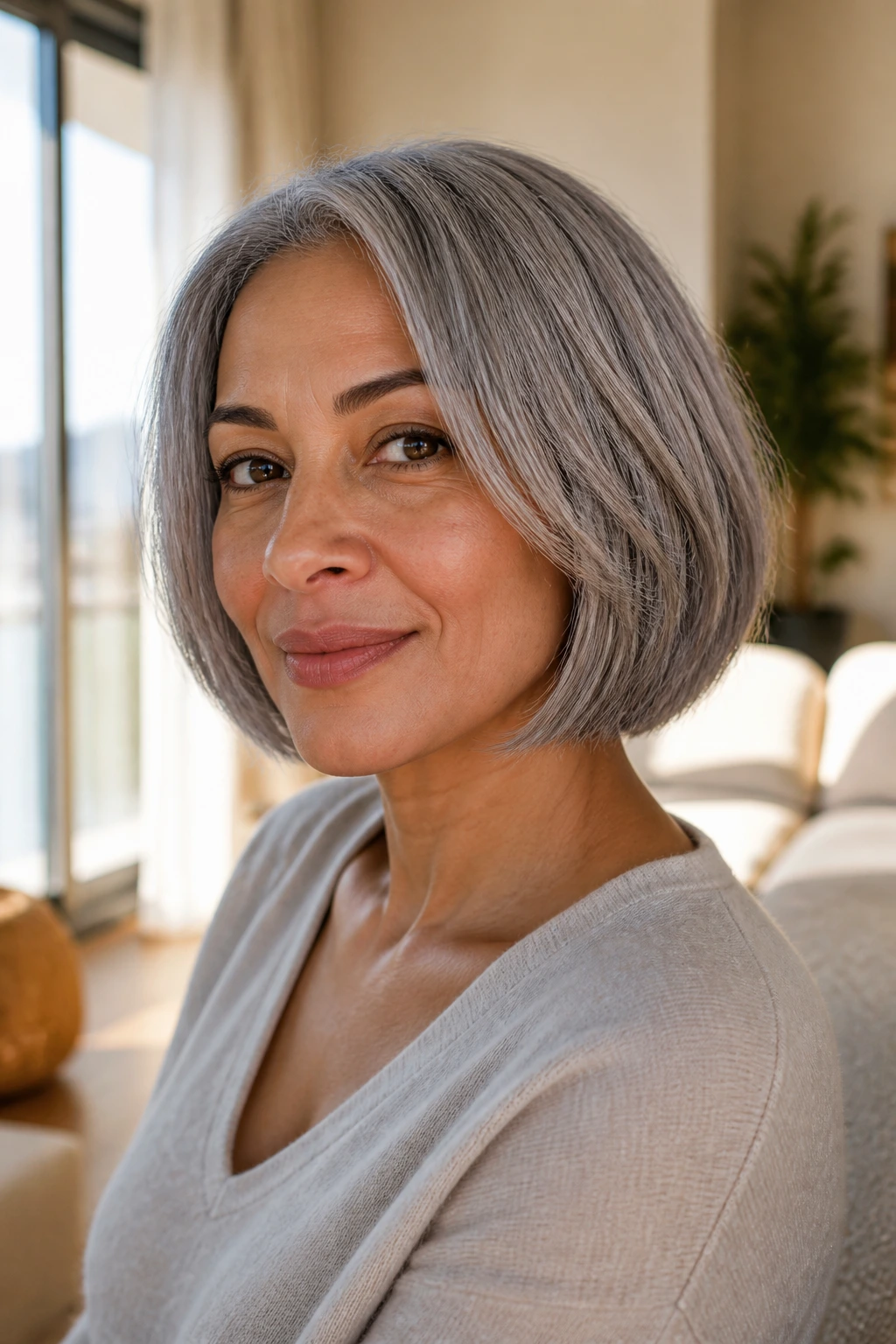
A chin-length chop is a sharp move, and micro layers make it easier to live with on dry gray hair. Instead of obvious stacked layers, you get tiny internal ones that stop the hair from bulking up at the ends. On medium skin, the result is neat and a little modern.
The cut sits close to the face, so the shape matters. I’d keep the line clean at the jaw and avoid over-thinning the bottom. Gray hair already has enough airy texture. The goal is control, not transparency.
This works especially well if your hair bends at random and refuses to lie flat. The micro layers help it settle. A round brush, a smoothing cream, and a quick blast of cool air at the end are usually enough to set it.
21. Asymmetrical Bob With a Tapered Nape
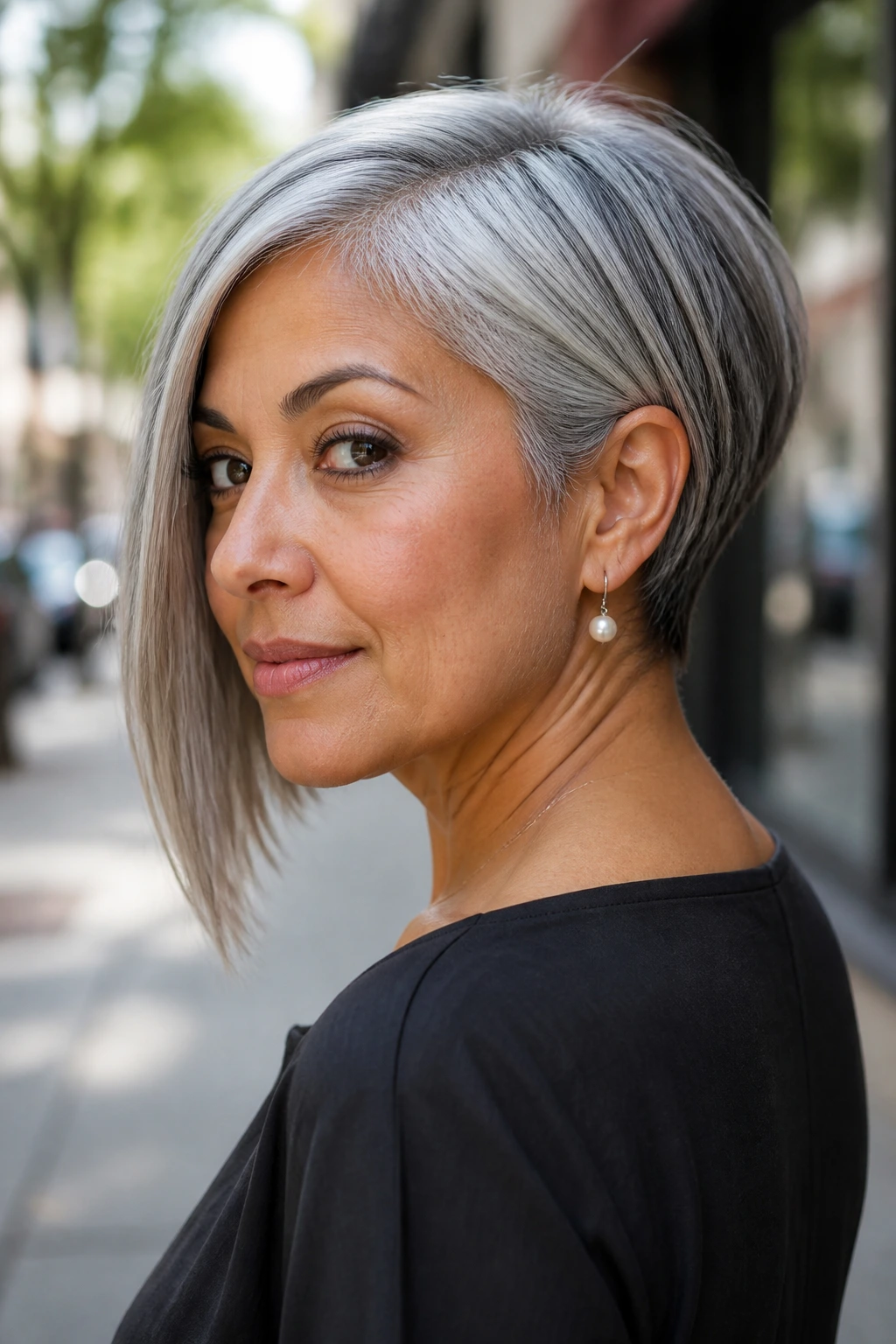
If you like your gray hair with a little attitude, the asymmetrical bob is worth the trouble. One side sits longer. The other side is tighter. The nape is tapered so the cut feels light at the back and sharper near the face. Medium skin tones wear this shape well because the diagonal line adds structure without needing a lot of volume.
This cut is strongest on straight or slightly wavy hair. Too much curl and the asymmetry can get lost unless the stylist shapes it carefully. Ask for the longer side to land near the chin or slightly below it. That length helps balance dry hair, which can puff when it’s cut too short.
Use a smoothing balm at the ends and keep the part clean. If the cut is sloppy, the angle won’t read. If it’s precise, the whole style looks expensive without saying a word.
22. Twist-Out Shoulder Cut With Defined Ends
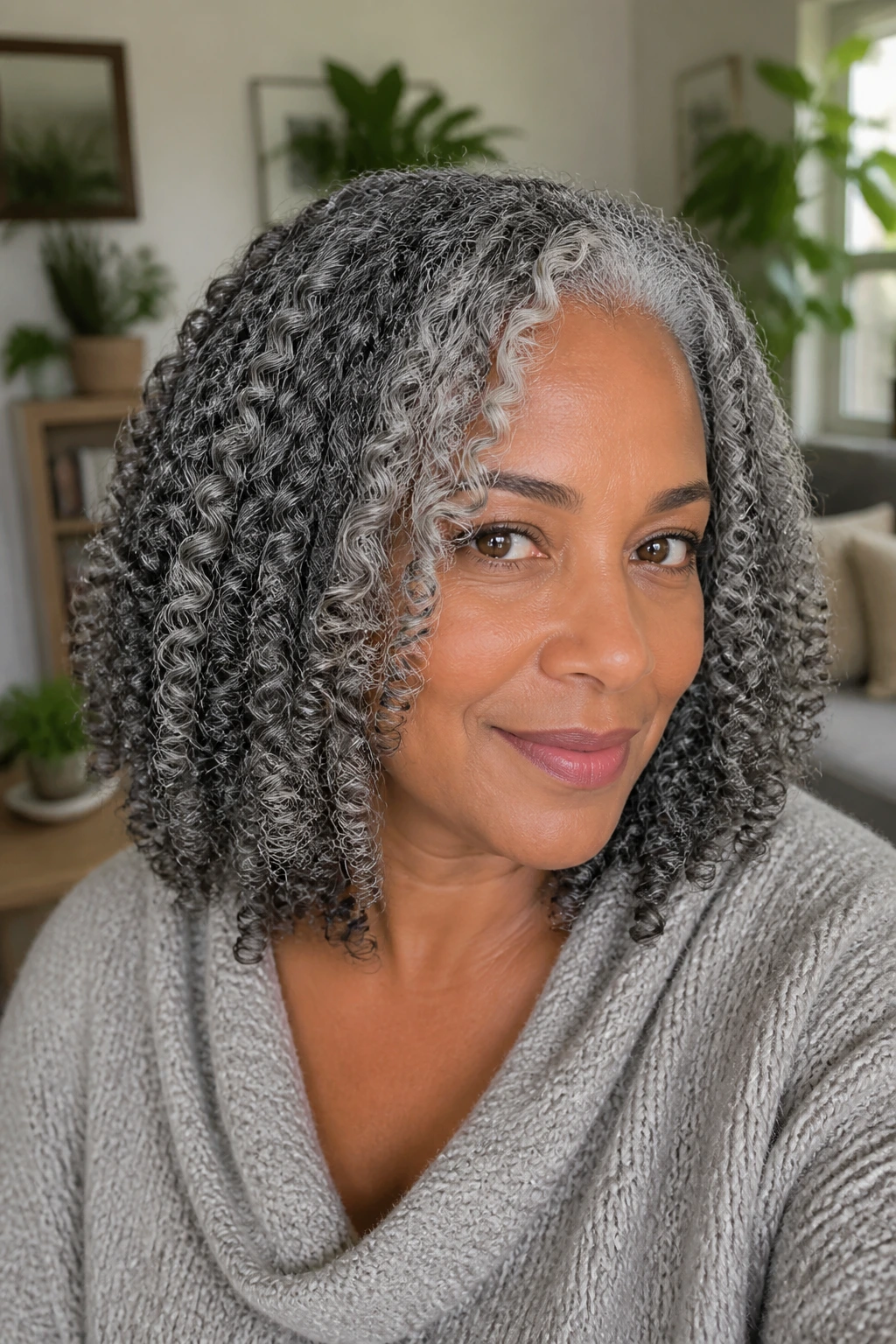
A twist-out on gray hair has a softer mood than tight curls and more control than loose waves. It works beautifully on coily or textured hair that tends to dry out. The shoulder length keeps the twists from hanging too heavily, and medium skin tones get a warm frame from all that texture.
Moisture matters here. Use a leave-in conditioner, then a cream or gel that gives hold without making the hair stiff. Twist in sections that match the curl size you want, let the hair dry fully, and separate gently with oiled fingers. If you pull too hard, the definition disappears and the hair frizzes.
I like this style because it shows off gray in a way that feels alive. The pattern catches light at the twists, not just the surface. It’s not fussy, but it does ask for patience.
23. Scarf-Wrapped Bun With Clean Edges
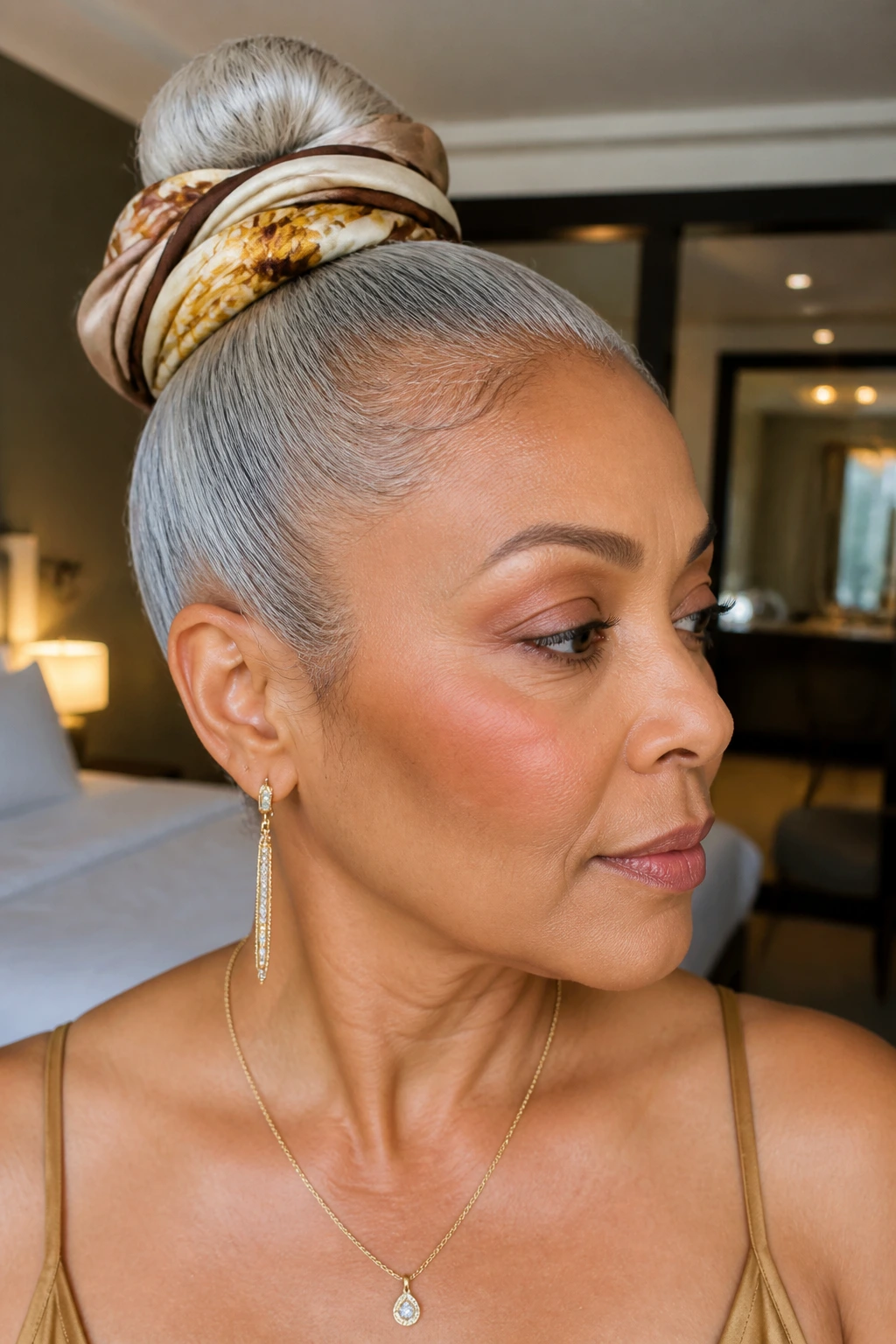
A scarf-wrapped bun is what I’d call a “save the hair, still look dressed” style. The bun protects dry gray ends, the scarf adds color, and medium skin tones get a lot of freedom from the fabric choice. Warm prints, deep jewel tones, and earthy neutrals all work.
The bun can sit low or mid-height. Keep it smooth at the base and wrap a silk scarf around it once or twice so the knot looks intentional. A cotton scarf can grip too hard and leave dents, so silk or satin is better. If the hairline is frizzy, use a toothbrush-sized edge brush with a bit of cream and stop there. Too much smoothing product can make gray hair look greasy instead of neat.
This style is especially useful on days when the hair needs a break from heat. Sometimes that’s the whole point.
24. Soft Finger Waves With a Side Sweep
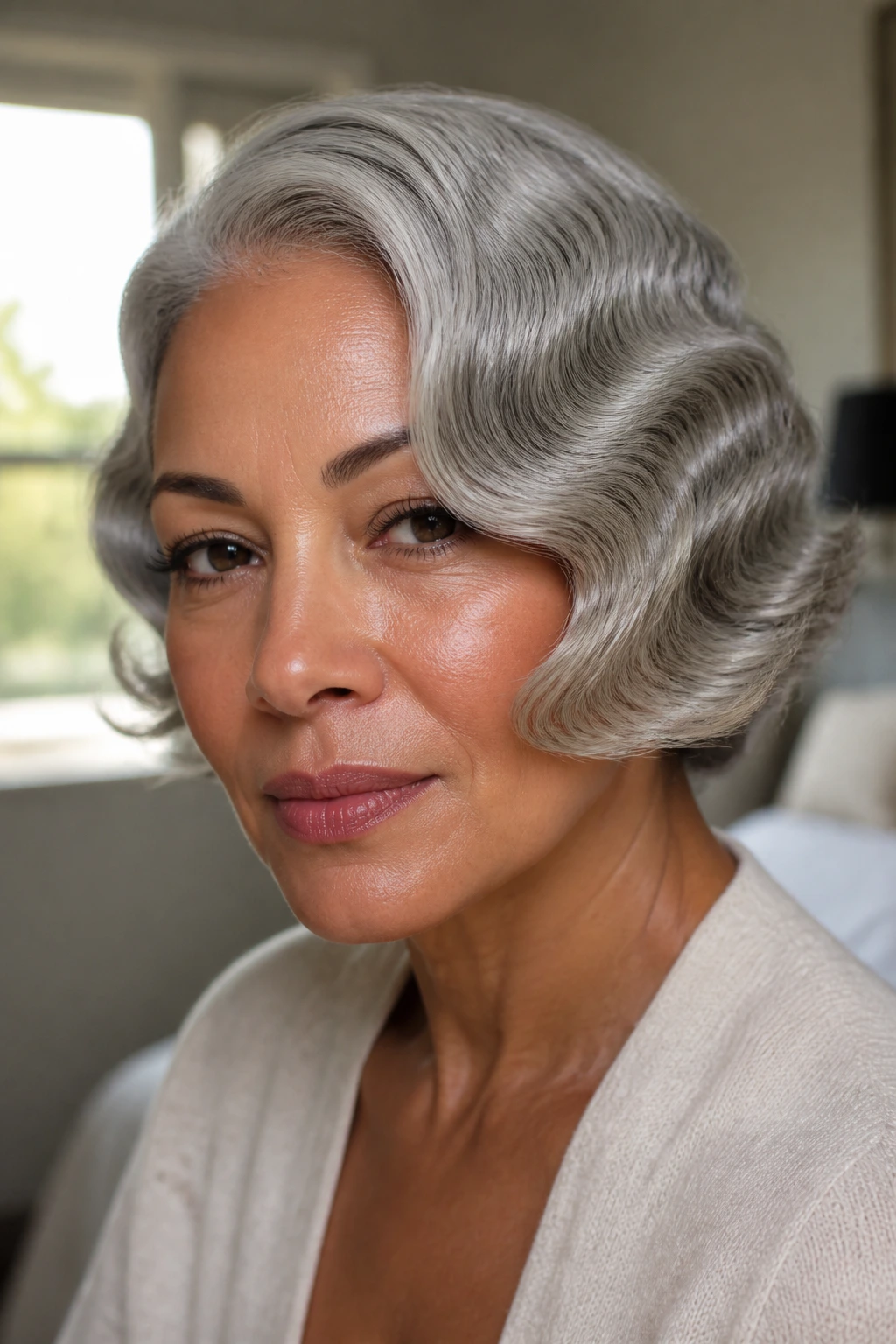
Finger waves ask for patience, but they give back a shape that gray hair often loves: sleek at the scalp, sculpted through the middle, and soft at the edges. On medium skin tones, the curve of the wave frames the face in a very flattering way, especially when the hair is short to medium in length.
This style works best when the hair has some length to hold the wave pattern, but not so much that it collapses under its own weight. Use gel, a fine comb, and wave clips, then let each ridge dry fully before you touch it. If you try to rush it, the whole pattern turns messy fast.
Finger waves are one of the few looks that can make coarse gray hair look deliberate even when the texture is rough. That’s why I keep them in the toolbox.
25. Crown-Volume Blowout With Soft Ends
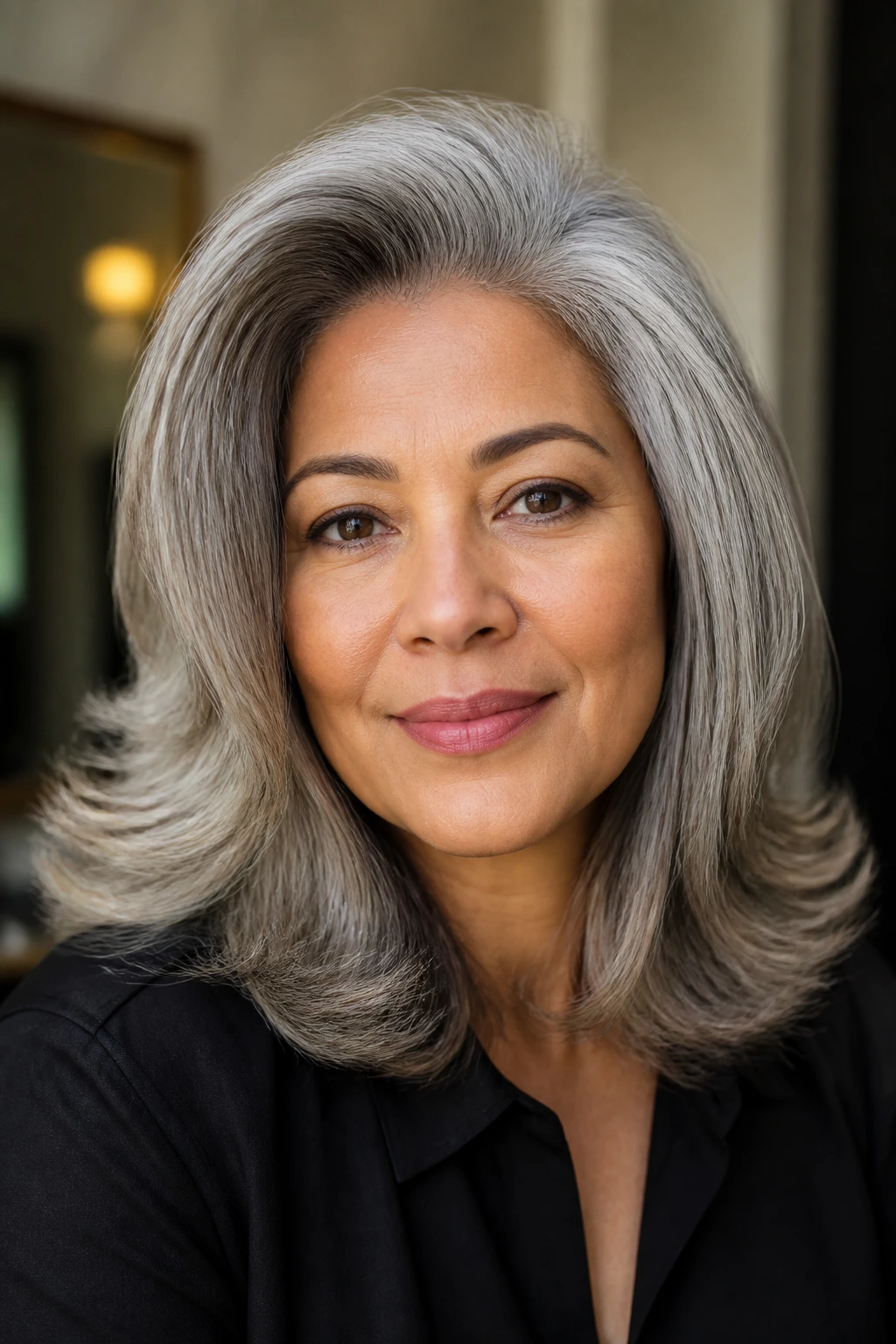
This is the style for someone who wants movement, not curls. A crown-volume blowout lifts the roots, keeps the lengths smooth, and lets the ends move in a soft bend. Medium skin tones get a nice lift from the volume near the top, especially if the gray shade leans smoky or silver-beige.
The key is root direction. Blow-dry the crown up and back with a round brush, then finish the ends with a gentle undercurve. Don’t overdo the round brush at the bottom or the hair starts to look too blown out, which dry gray hair rarely needs. A cool shot at the end helps the shape settle.
This style is a good middle ground between sleek and textured. It looks polished, but it doesn’t punish the hair. And that matters more than people admit.
Why Gray Hair Wants Shape More Than Shine
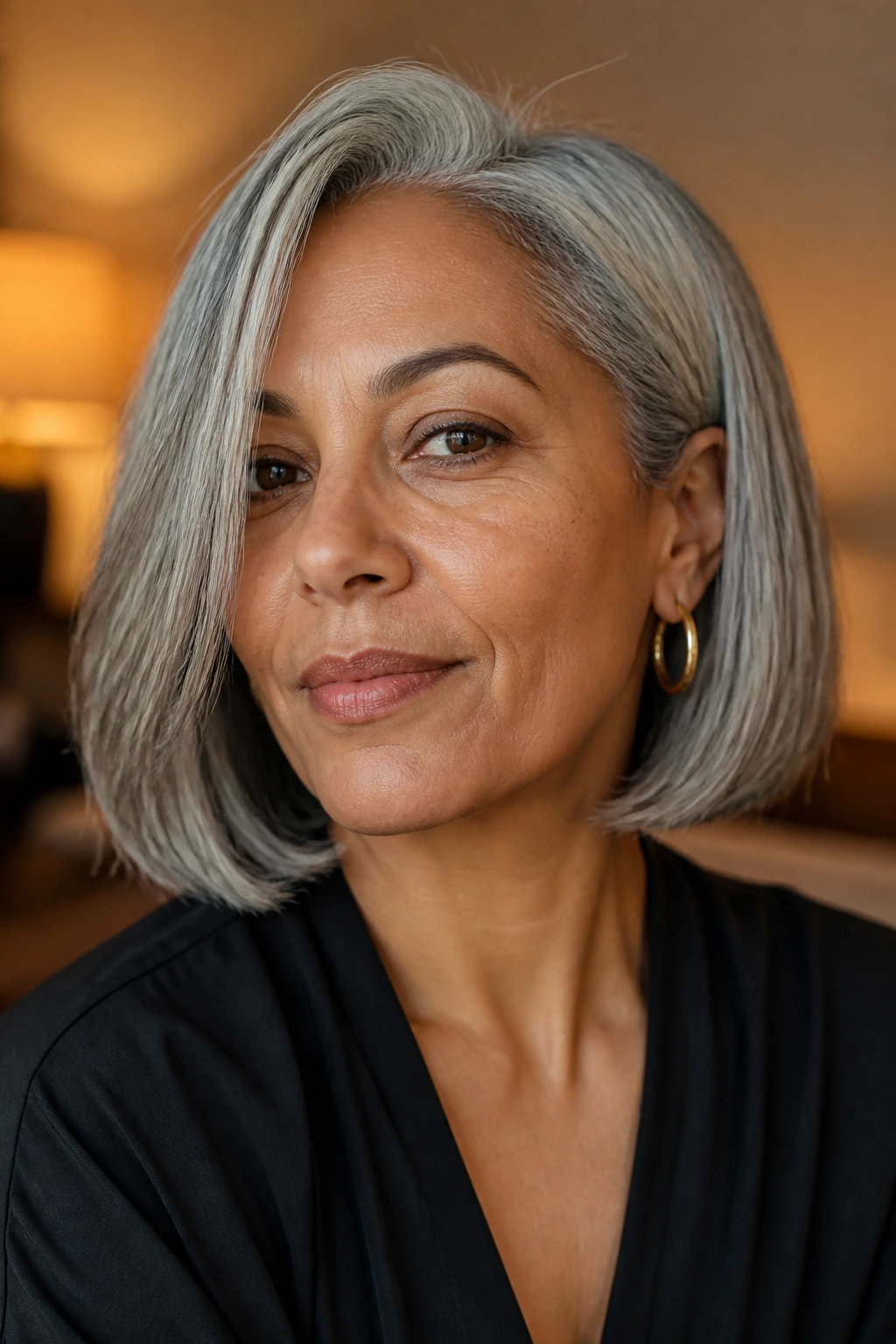
Dry gray hair changes the rules a little. The strand is often rougher, the surface reflects light differently, and the old habit of piling on shine serum can make the style look oily instead of healthy. Shape matters because it gives the eye somewhere to land. Without shape, gray hair can drift into “unfinished” territory fast.
Medium skin tones add another layer. A cut with a clean line, a soft bend, or a smart part keeps the gray from flattening the face. That’s why blunt lobs, textured bobs, and sculpted updos keep showing up in good gray-hair work. They aren’t just trendy shapes. They solve a real problem.
I also think gray hair benefits from a little restraint. Not no styling. Restraint. A good haircut plus one or two smart finish products usually beats a bathroom counter full of sprays, pastes, glosses, and miracles in bottles that promise more than they can deliver.
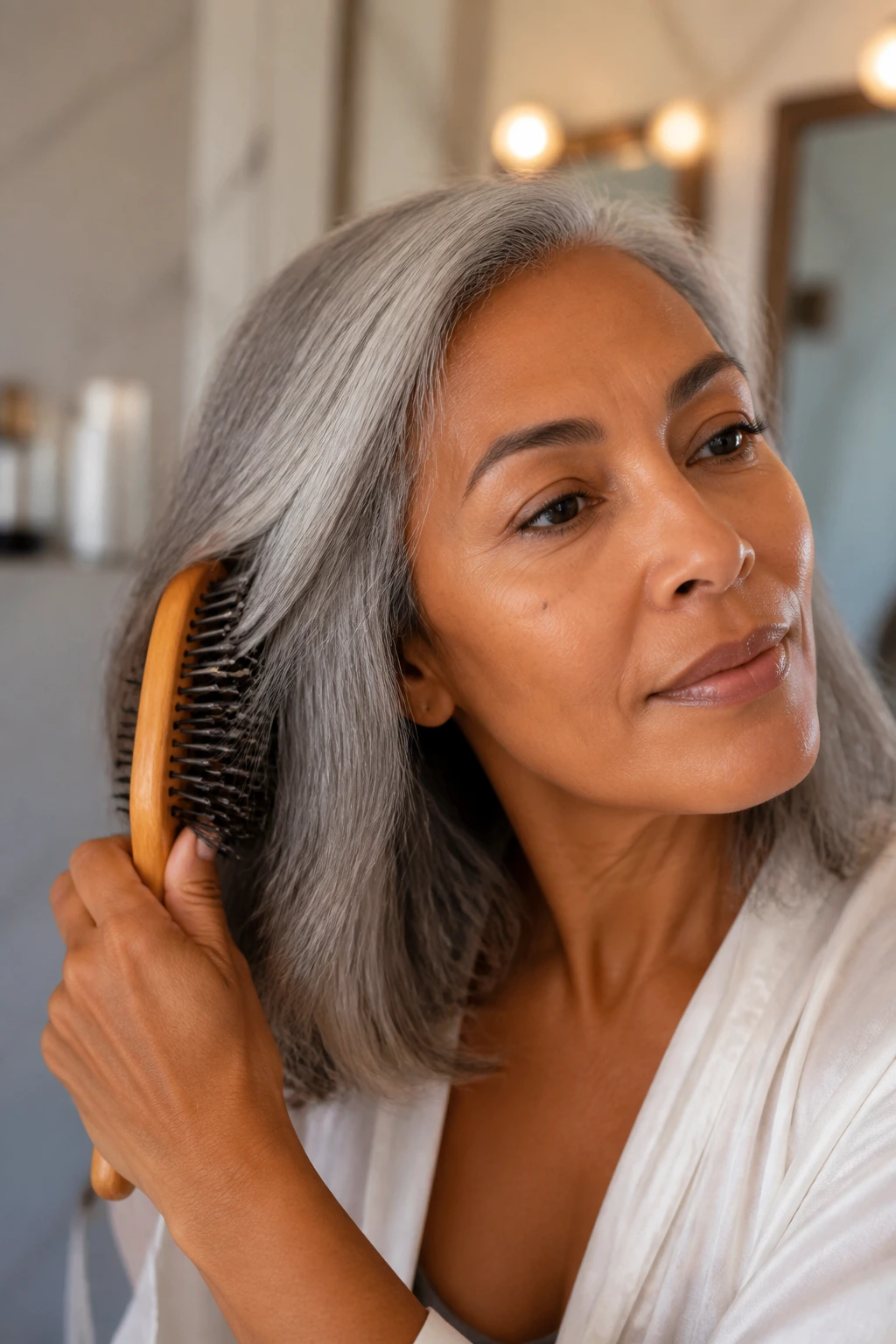
Tools That Make Dry Gray Hair Easier to Style
-
Wide-tooth comb: Good for detangling wet gray hair without scraping the cuticle and creating extra frizz.
-
Boar-bristle or mixed-bristle brush: Helps smooth the surface on blowouts and low buns, especially around the hairline.
-
1 to 1.5-inch curling wand or flat iron: Enough for bends, waves, and soft ends without making the hair look overworked.
-
Round brush, medium size: Useful for lobs, bobs, and crown-volume blowouts; keep the tension light so dry ends don’t snag.
-
Diffuse attachment: A must for curly and wavy gray hair, since direct heat can rough up already thirsty strands.
-
Satin scrunchies and coated elastics: They hold updos and ponytails without carving a line into dry hair.
-
U-pins and long bobby pins: Better than tiny pins for heavier buns, crowns, or sculpted styles that need real support.
-
Lightweight leave-in conditioner and heat protectant: Not glamorous, but non-negotiable if the gray hair sees heat more than once a week.
Choosing Cuts, Shades, and Products That Flatter Medium Skin
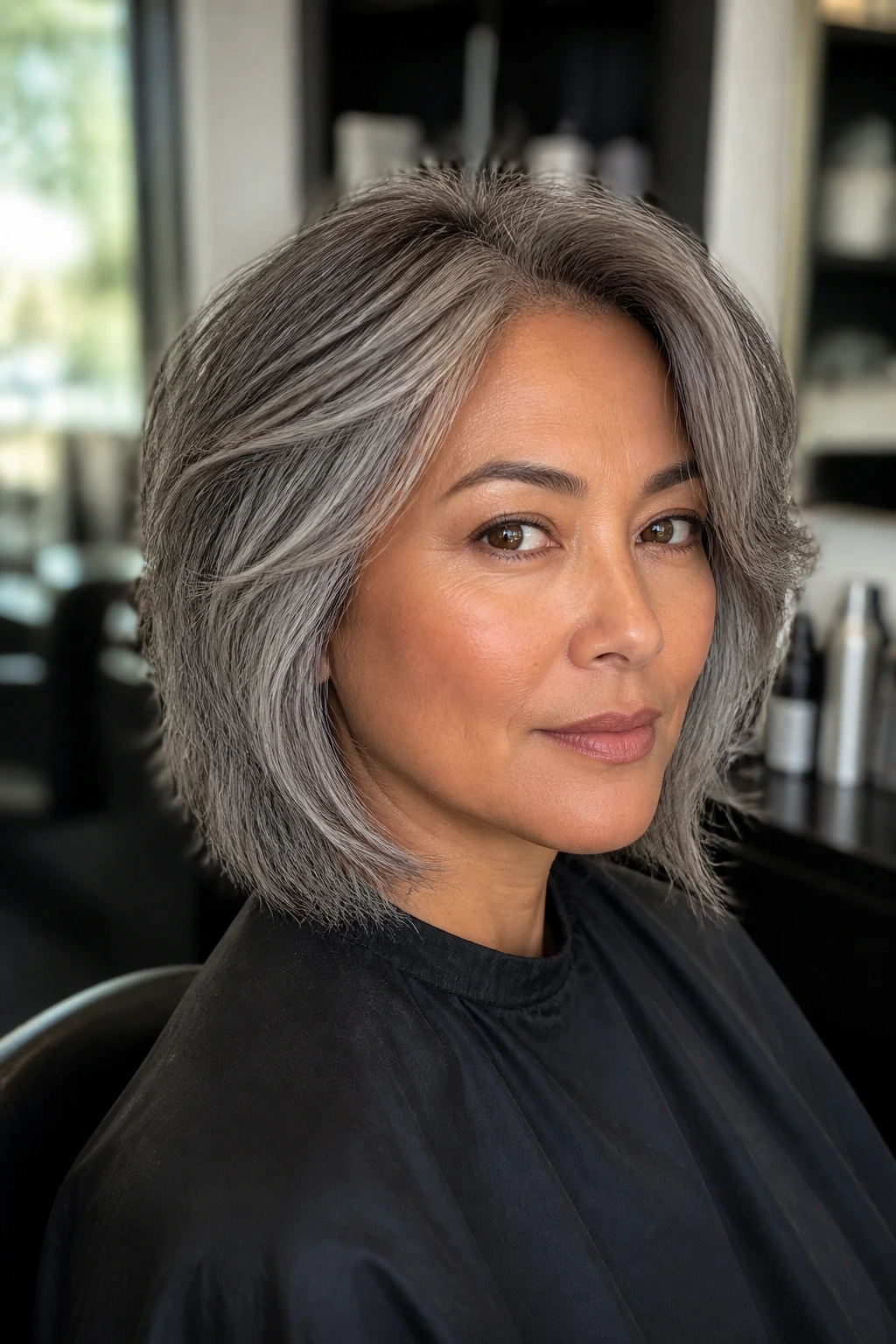
The best gray-hair shopping starts before you buy a single product. It starts in the chair. Bring photos that show the silhouette you want — blunt, layered, tucked, waved — not just the color. A lot of people fixate on silver tone and forget the cut is what makes the gray look expensive instead of accidental.
For medium skin, I usually like gray shades with some depth in them. Pure flat silver can work, but it’s easier to wear when there’s a shadow root, charcoal lowlight, or smoky beige cast somewhere in the mix. Those little shifts keep the face from going pale. If your undertone is warm or olive, a gray with too much blue can feel icy in the wrong way.
Product-wise, dry gray hair does better with lightweight moisture than with heavy butter. A leave-in cream, a flexible mousse, and a heat protectant often beat thick oils. If the hair is yellowing, a violet shampoo every 10 to 14 days is enough for most heads. More than that and the tone can go flat or chalky. Use a gloss spray only on the surface, not through the whole length, unless you enjoy seeing every strand separate.
How to Wear These Looks With Clothes and Accessories
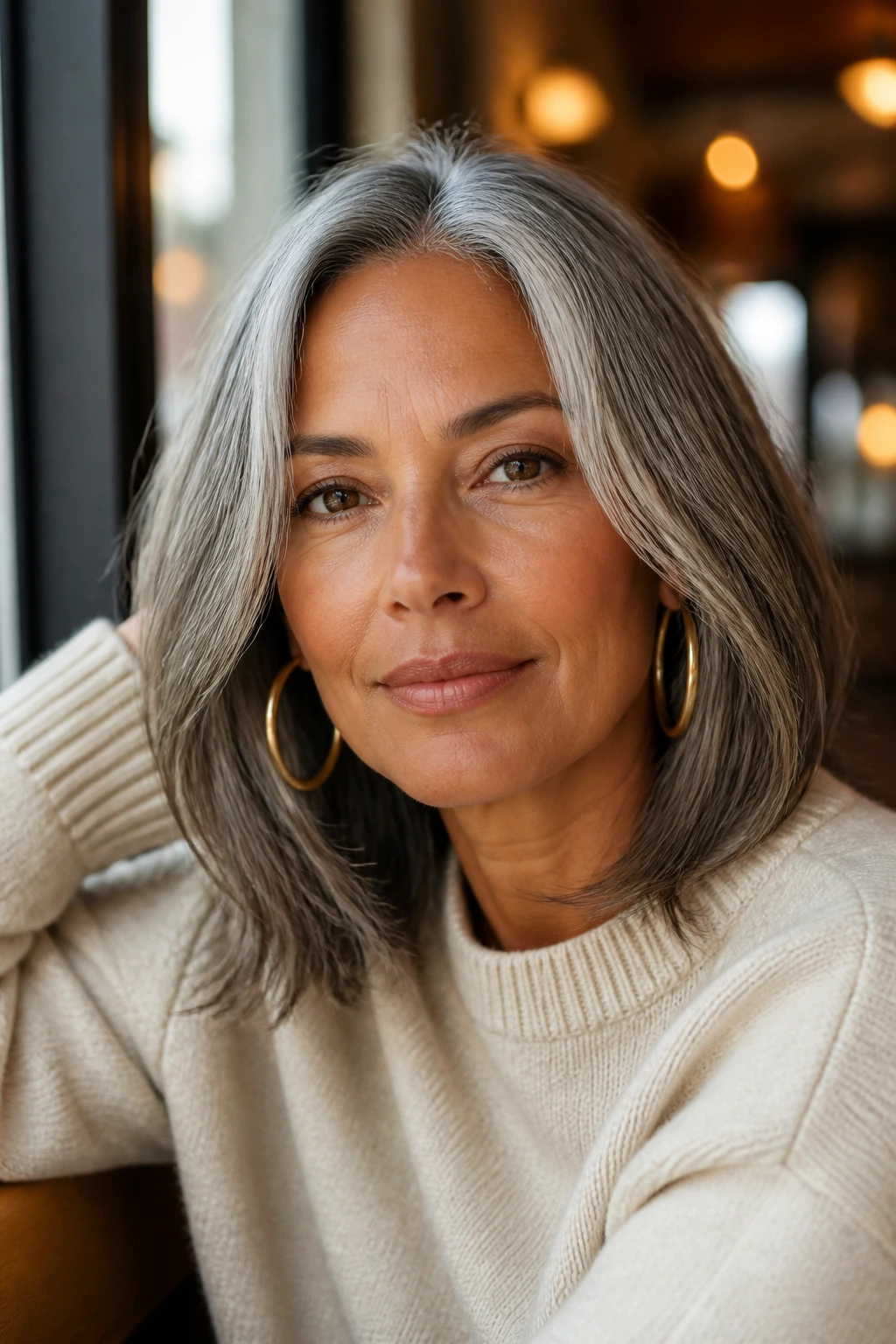
Presentation: Keep the line of the hairstyle visible. A center part, tucked ear, or lifted crown lets the gray read as a feature instead of an afterthought. If the cut is sharp, let it stay sharp; if it’s soft, don’t over-style it into stiffness.
Accompaniments: Medium skin tones usually come alive next to gold hoops, warm blush, tortoiseshell glasses, cream sweaters, deep green tops, and rich brow shades. Gray hair can handle cool clothing, but the face often looks better when something warm sits close to it.
Portions: Shorter styles need less product and less sectioning; long styles need more control at the ends. If the hair is dense, use larger clips and wider sections. If it’s fine, keep the shape compact so the style doesn’t swallow the face.
Beverage Pairing: A clear glass of water, iced tea, or coffee is the only “pairing” that matters while you’re setting clips and smoothing the front. Keep the drink away from freshly styled hair, because a stray splash on a good gray blowout is a small disaster.
Small Styling Tweaks That Change the Whole Look
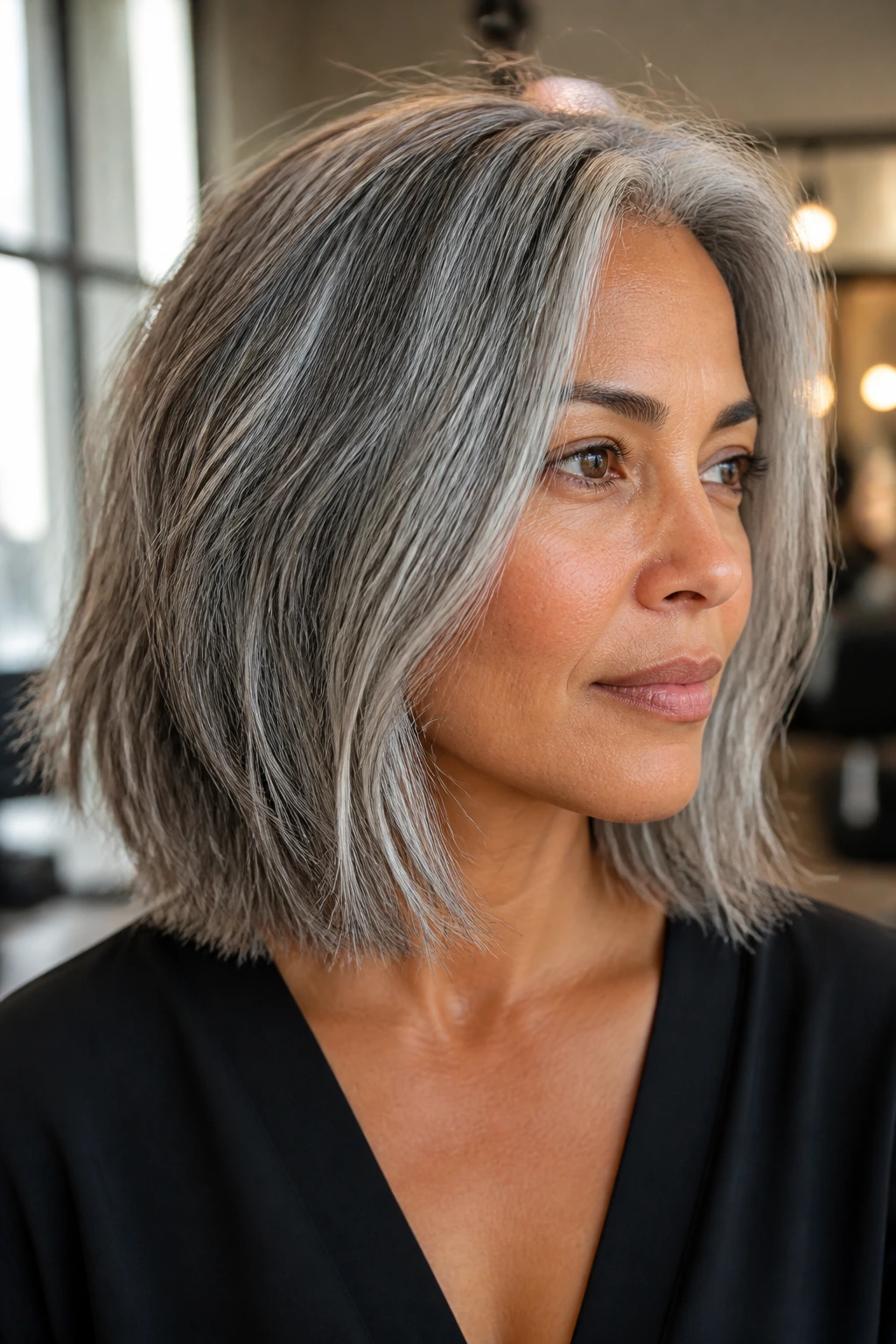
Finish Boost: A pea-sized drop of lightweight serum just on the bottom inch of the hair can calm dry gray ends without making the whole head limp. Use it sparingly. Gray hair shows too much product fast.
Customization: Swap a center part for a side part when you want more lift, or tuck one side behind the ear when the face needs a cleaner line. Tiny changes matter more on gray hair than on darker shades.
Serving Suggestions: If that word has to live here, let it mean accessories. Add a matte pin, a silk scarf, a gold hoop, or a clip with some weight. Gray hair likes objects that look deliberate, not fussy.
Make-It-Yours: Fine hair usually does better with blunt shapes and a little root lift. Thick hair tends to need longer layers, internal removal, and more moisture. Curly hair likes shape at the perimeter and room in the center. Straight hair can take a sharper line, but the ends still need softness.
Keeping Gray Styles Fresh Between Washes
Gray hair is not the sort of hair that enjoys being ignored for a week and then shocked back to life with dry shampoo. It usually looks best when you give it a light refresh every morning: a mist of water, a dab of leave-in on the ends, and a quick restyle of the front sections. The front matters most. If the front looks tidy, the whole head reads as intentional.
At night, a satin pillowcase or bonnet makes a real difference. Cotton steals moisture and roughs up the cuticle, which gray hair does not need. For blowouts, a loose wrap or a few large clips at the crown can keep the shape from collapsing while you sleep. For curls or waves, pineappling the hair too tightly can leave dents, so keep the hold soft.
If a style relies on heat, give the hair a break after two or three days and switch to a bun, braid, or tucked lob. Dry gray hair tends to look better with rotation than with constant re-iron treatment. And if the ends start looking crispy, that is usually a trim problem, not a product problem.
Common Mistakes That Make Gray Hair Look Older Than It Is
The biggest mistake is over-flattening the hair. Gray strands can handle a clean line, but they rarely look good when pressed to the scalp with too much heat or too much oil. The symptom is hair that looks limp at the roots and fuzzy at the ends. The fix is simple: use less product, leave a little root lift, and stop styling once the shape is set.
Another one is choosing a cut that’s too layered for dry hair. Tiny layers on gray hair can create a halo of frizz, especially around the crown and face. If that’s happening, ask for longer layers or a blunt perimeter with only a little internal movement.
Yellowing is a third problem. Some gray shades drift warm in the sun or from hard water, and medium skin tones can start looking tired if the gray turns brassy. A violet shampoo every 10 to 14 days usually handles it. More often than that, and the tone can go dull.
The last mistake I see all the time is forgetting the brows and makeup. Gray hair changes the whole face. If the brows disappear and the lips vanish, the style loses half its effect. You don’t need a full makeup routine. You do need a bit of contrast.
Easy Variations and Adaptations to Try
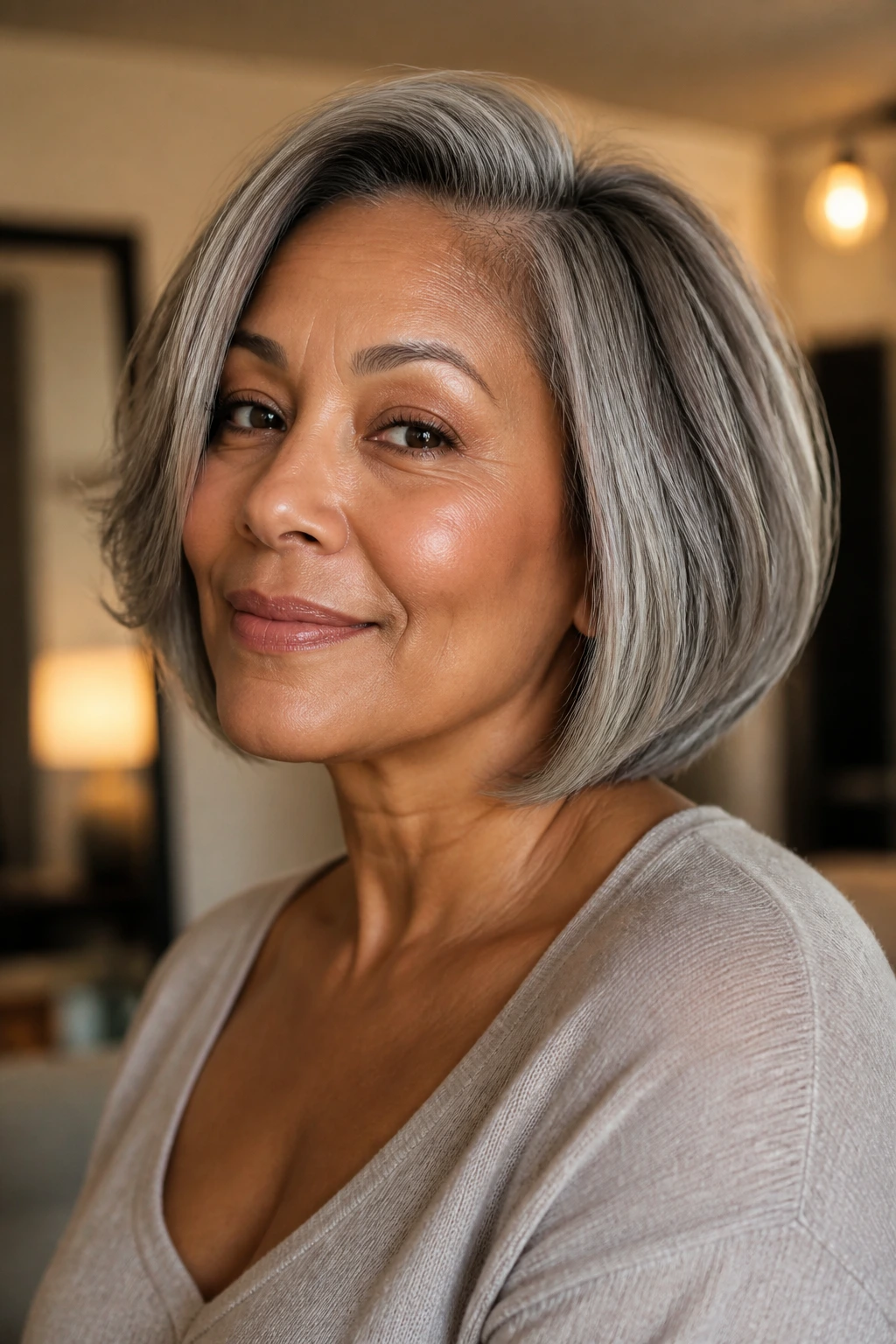
Warm Pewter Bob: If a cool silver bob feels too stark, ask for a pewter or silver-beige tone with a soft root shadow. It keeps the gray flattering on medium skin with golden undertones and looks less like a costume shade.
Curly Gray Halo: Keep the same overall cut, but let natural curls form a round halo instead of forcing them into a crisp shape. This works when the hair is dry but dense, because moisture cream and gel give the pattern a cleaner edge.
Sleek Event Twist: Take a lob or shoulder-length cut and twist one side back with a polished pin. It’s a small shift, but it makes the style feel dressed up without demanding a full updo.
Salt-and-Pepper Crop: If the gray is still mixed with darker pieces, go shorter and let the contrast show. The mixed tone gives the cut more depth, which medium skin usually wears well.
Soft Wave Lob: Same blunt shape, less straightness. Add loose waves only from the cheekbone down, then brush them out. The style keeps the edge of the lob but gives dry ends a softer landing.
Questions People Ask Before Cutting or Styling Gray Hair
Does gray hair on medium skin look better short or long?
Neither length wins by default. Shorter cuts make gray hair easier to control when it’s dry, but longer styles can look richer if the ends stay healthy and the shape has some movement.
What gray shade flatters medium skin most?
Silver with depth usually beats flat icy gray. Pewter, smoky silver, charcoal, and salt-and-pepper blends tend to sit nicely on medium skin because they keep the face from looking washed out.
Can I wear gray hair if my skin runs warm or olive?
Yes, but the cut matters. Warm or olive medium skin usually looks better with gray styles that have structure, root shadow, or a little beige in the tone instead of a very blue-white finish.
How often should dry gray hair be trimmed?
Every 6 to 8 weeks is a good rhythm if the ends split easily. For shorter styles like bobs or pixies, that timing keeps the shape crisp. For longer hair, a 10-week trim can work if the ends stay tidy.
What styles hide frizz best?
Braids, low buns, chignons, tucked lobs, and layered shags all hide frizz in different ways. The best one depends on whether your hair is frizzy at the roots, the middle, or just the ends.
Can I heat-style gray hair often?
You can, but you’ll pay for it if you push the temperature too high. Keep heat moderate, use protectant, and give the hair a few no-heat days each week so the texture doesn’t turn brittle.
Do bangs work on gray hair?
Yes, as long as they’re not cut too heavy. Curtain bangs, soft fringe, and side-swept pieces tend to age better on dry gray hair than thick, blunt bangs that can puff up and separate.
What if my gray hair feels wiry no matter what I do?
Then the answer is usually less heat and more shape. A blunt lob, a pixie, or a controlled bob often solves the problem better than piling on extra products.
The Gray Shape That Holds Its Own
Gray hair on medium skin doesn’t need apologizing for, and it doesn’t need drowning in gloss spray either. It needs shape, a little restraint, and a cut that understands dry texture instead of fighting it. That’s where the strongest styles win: they frame the face, keep the ends from going feral, and let the gray read as a choice.
Pick the silhouette that matches your life, not just the one that looks good in a photo. A blunt lob if you want order. A shag if you want movement. A low bun if the week is already full of problems. Gray hair can carry all of it, and on medium skin tones, the right shape makes the color look grounded instead of pale.
The best part is how little you have to overthink once the cut is right. The hair starts doing more of the work on its own, and that’s a relief I never get tired of recommending.