



Some short length haircuts for round faces with curly hair fail in the same boring way: they stop at the cheekbones, puff out at the sides, and turn every curl into extra width right where you do not want it. The wrong cut makes a round face read wider, especially when the curls are springy enough to shrink an inch or three after they dry. The right cut changes the whole conversation. It lifts the eye, breaks up the circle, and lets the curl pattern do its own thing without turning the head into a perfect sphere.
That’s the part people miss. A flattering curly cut is not about hiding the face shape. It’s about steering it. A little height at the crown, a side part that lands off-center, a perimeter that doesn’t sit in one blunt line, and enough internal layering to stop the curls from stacking out at the cheeks — that combination does more than any trendy fringe ever could. Short hair can be sharp, soft, polished, shaggy, cropped, or airy. It just needs the right geometry.
These 25 cuts lean into that idea from different directions. Some are neat and close. Some are choppy and wild. A few are bold enough to feel almost rebellious. All of them work with curly texture instead of fighting it, and all of them give a round face a little more length, a little more edge, and a lot less width.
Why These Cuts Stand Up Better on a Round Face
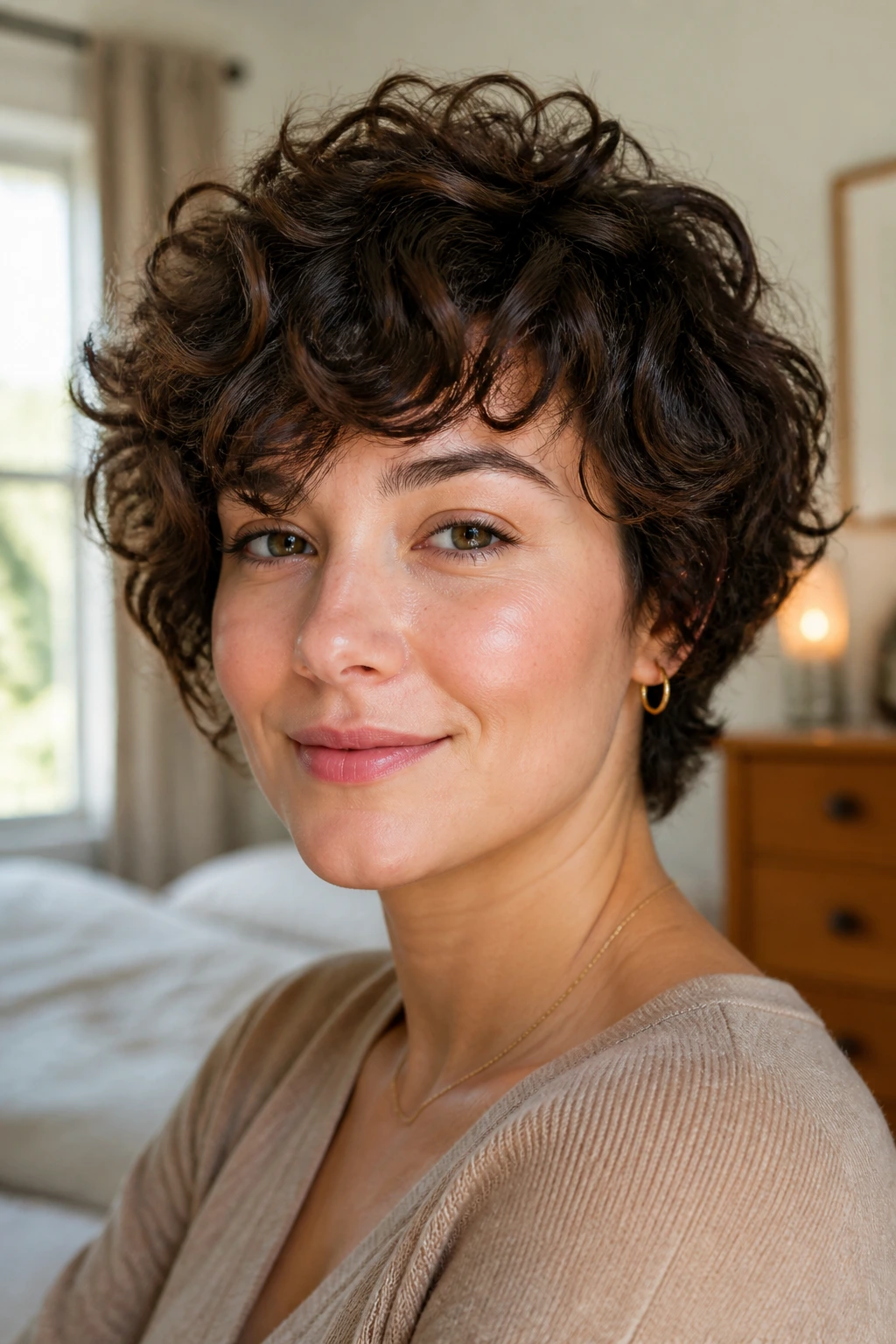
-
Vertical balance: The best curly short cuts create lift at the crown or movement below the jawline, which helps the eye read the face as longer than it is wide.
-
Broken edges: A blunt line that lands right on the cheeks adds fullness fast. Soft layers, choppy ends, and curved framing stop that shelf effect before it starts.
-
Diagonal movement: Off-center parts, asymmetry, and swept fringe pull the eye across the face at an angle instead of straight out from the cheeks.
-
Shrinkage awareness: Curly hair can spring up a lot after it dries. These cuts leave enough shape room so the final result lands where you intended, not two inches shorter and wider than expected.
-
Bulk control: Tapered napes, undercuts, and careful debulking keep thick curls from ballooning outward behind the ears and at the neck.
-
Shape with attitude: Short curly cuts look best when they seem deliberate. A little structure matters. Without it, the haircut can drift into “grew out by accident” territory.
1. Chin-Length Curly Bob with an Off-Center Part
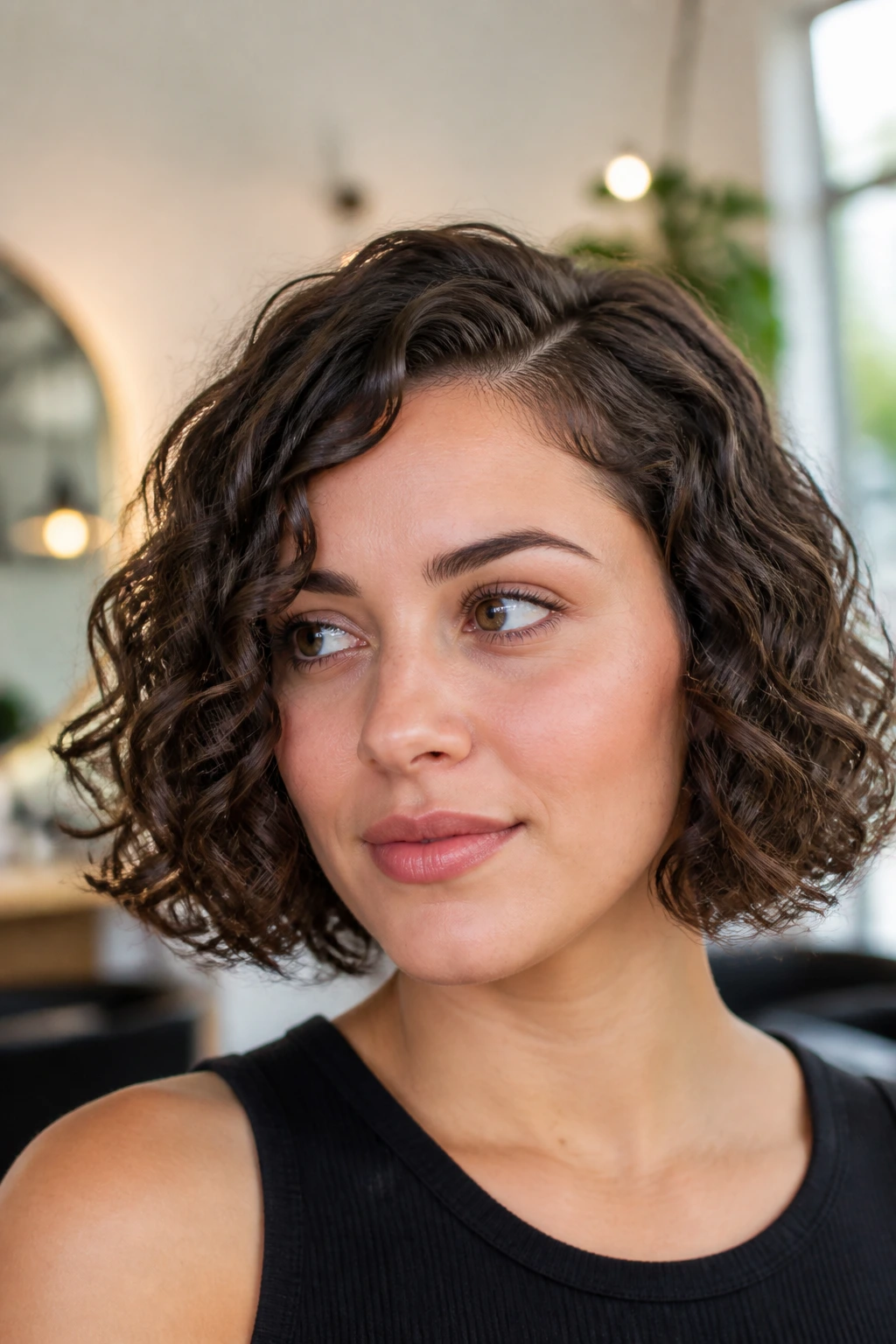
This is the safe bet that never looks boring when it’s cut well. The chin-length curly bob gives you a clean line, but the off-center part keeps it from sitting like a perfect circle around the face. On a round face, that tiny shift matters. It makes the front read slightly longer on one side, which breaks up the width at the cheeks.
Ask for the perimeter to sit just below the chin when dry, not wet. Curly hair lies to you when it’s wet, and a bob that seems jaw-length in the chair can land far higher once it springs up. If your curl pattern is loose, this cut looks neat and airy. If it’s tighter, the shape gets fuller and more sculpted.
A blunt chin-length bob with curls can go helmet-y if the weight line is too even. The off-center part and a few soft internal layers keep it from turning into one solid bubble.
2. Curly Pixie with a Long Top
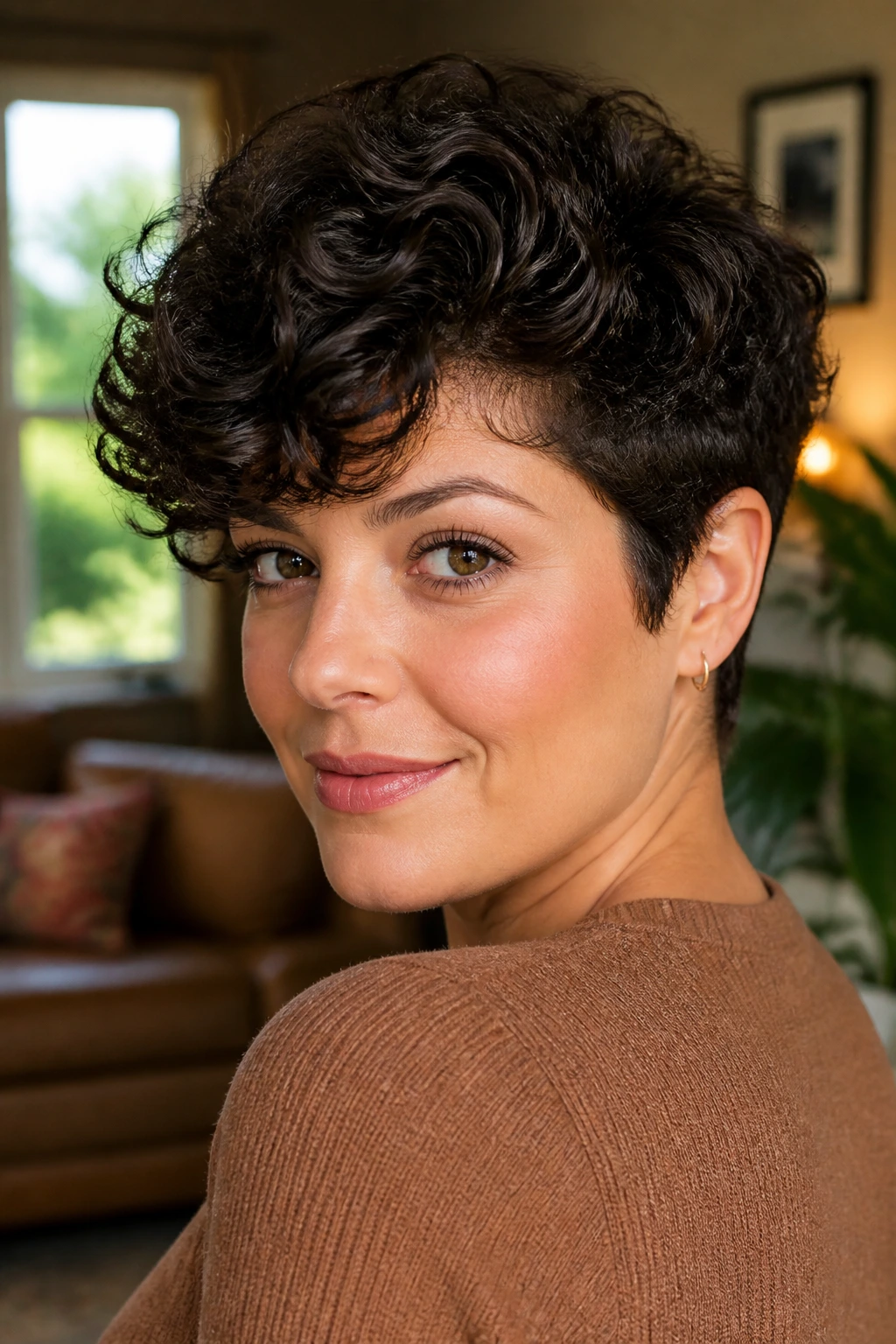
A short pixie can be a very smart move on a round face, but only if the top stays long enough to create height. Think 2.5 to 4 inches on top, with the sides and nape kept close. That vertical lift gives the face a little more length, and the close sides stop the haircut from ballooning at the cheeks.
This one lives or dies by the crown. If the top is cut too short, the shape goes flat and wide. If it’s too long without enough layering, it collapses forward. The sweet spot is a top that can be scrunched, lifted, or finger-shaped into a piecey ridge.
It’s also one of the easiest cuts to style on days when you do not want a full routine. A dab of curl cream and a diffuser are enough. A little dry texture at the top can make the face look leaner than polished, slick curls ever will.
3. Layered Curly Shag That Skims the Jaw

The curly shag earns its keep because it refuses to sit in a single heavy line. Instead, it breaks the shape into layers that move around the cheeks and jaw, which is exactly what a round face needs. The best version starts the shortest face-framing pieces around the cheekbone or just above the jaw, then lets the rest fall in uneven, springy sections.
This cut shines when the curl pattern has bounce. The layers keep the curls from stacking out sideways. You get texture, not width. That’s the difference between a shag that looks cool and one that looks like a triangle with a mood problem.
If you like hair that looks better a little messy, this is one of the strongest options in the whole list. The shag does not want to behave like a sharp bob. It wants movement. A soft gel cast and a scrunch-out once the hair is dry usually give it the right amount of separation.
4. Asymmetrical Curly Bob with a One-Side Swing
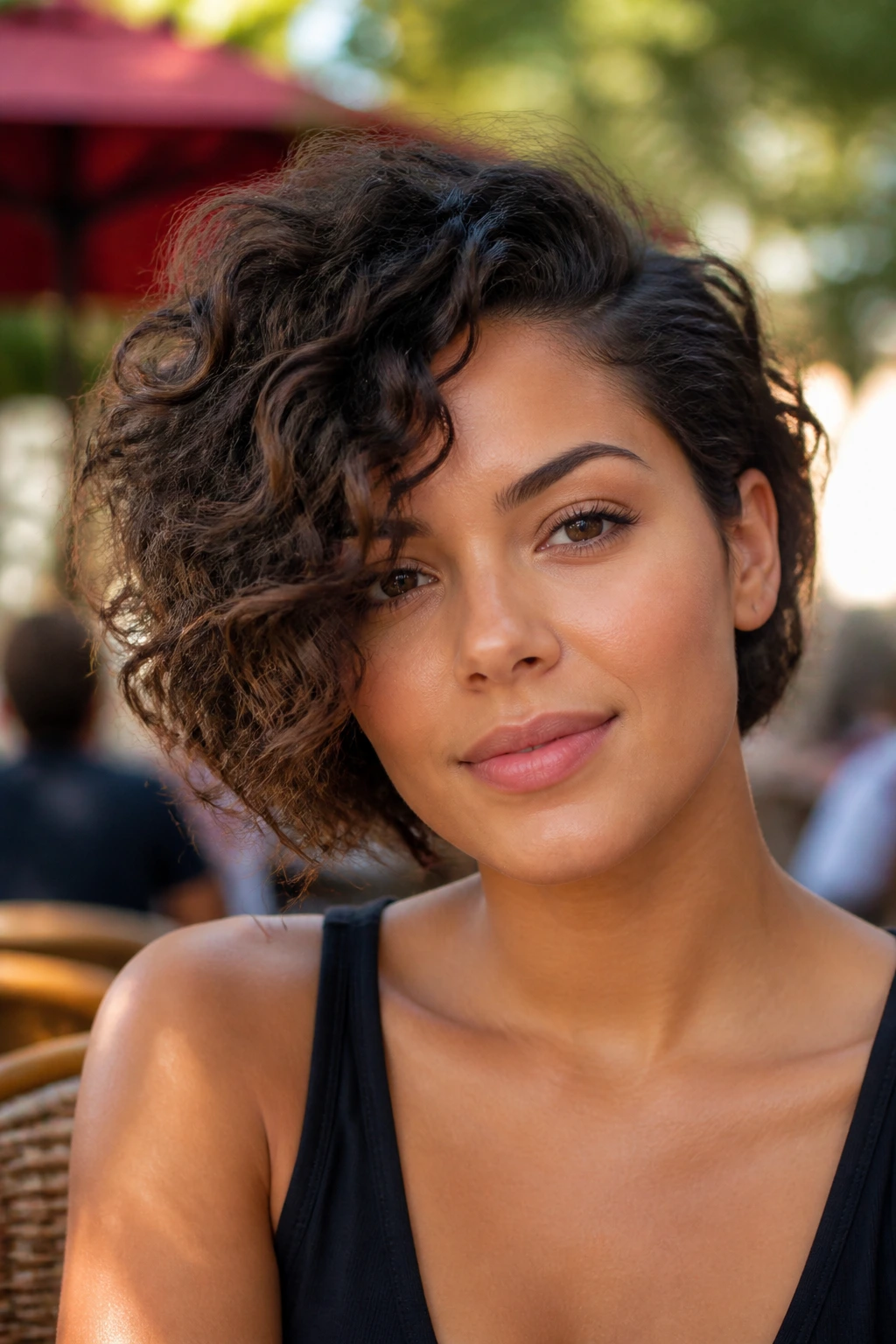
An asymmetrical bob is one of the easiest ways to interrupt a round face shape without going extreme. One side sits a little longer — sometimes an inch, sometimes closer to two — and that difference creates a diagonal line across the face. Diagonals are your friend here. They pull attention away from width and toward length.
The best asymmetrical curly bobs are subtle enough to look intentional in every setting. You do not need a dramatic side that swings to the collarbone while the other side hugs the ear. A gentler difference keeps the cut wearable while still doing the job.
This shape especially helps if your curls naturally part more comfortably on one side. Fighting that habit usually ends in flat roots and poofy sides. Let the asymmetry work with the pattern, and the whole cut settles faster.
5. French Bob with a Wispy Curly Fringe

The French bob gets a lot of credit for looking chic, but on curly hair its real strength is the broken line around the face. With the right fringe, it can make a round face look more oval without feeling severe. The trick is keeping the bangs wispy and a little longer than you think you need. Curly fringe shrinks. Fast.
A good curly French bob usually lands around the jaw or just above it, with soft pieces that touch the cheek rather than sit flat across it. The fringe should bend, not barricade. If the bangs are too dense, they can widen the middle of the face. If they’re airy, they soften the forehead and narrow the overall silhouette.
This haircut loves loose to medium curls. If your pattern is tight, the bangs need even more length at the start. A stylist who cuts curl by curl can save you from the old “wet fringe surprise” that ends with a bang trim every two weeks.
6. Curly Bixie with Soft Sideburns
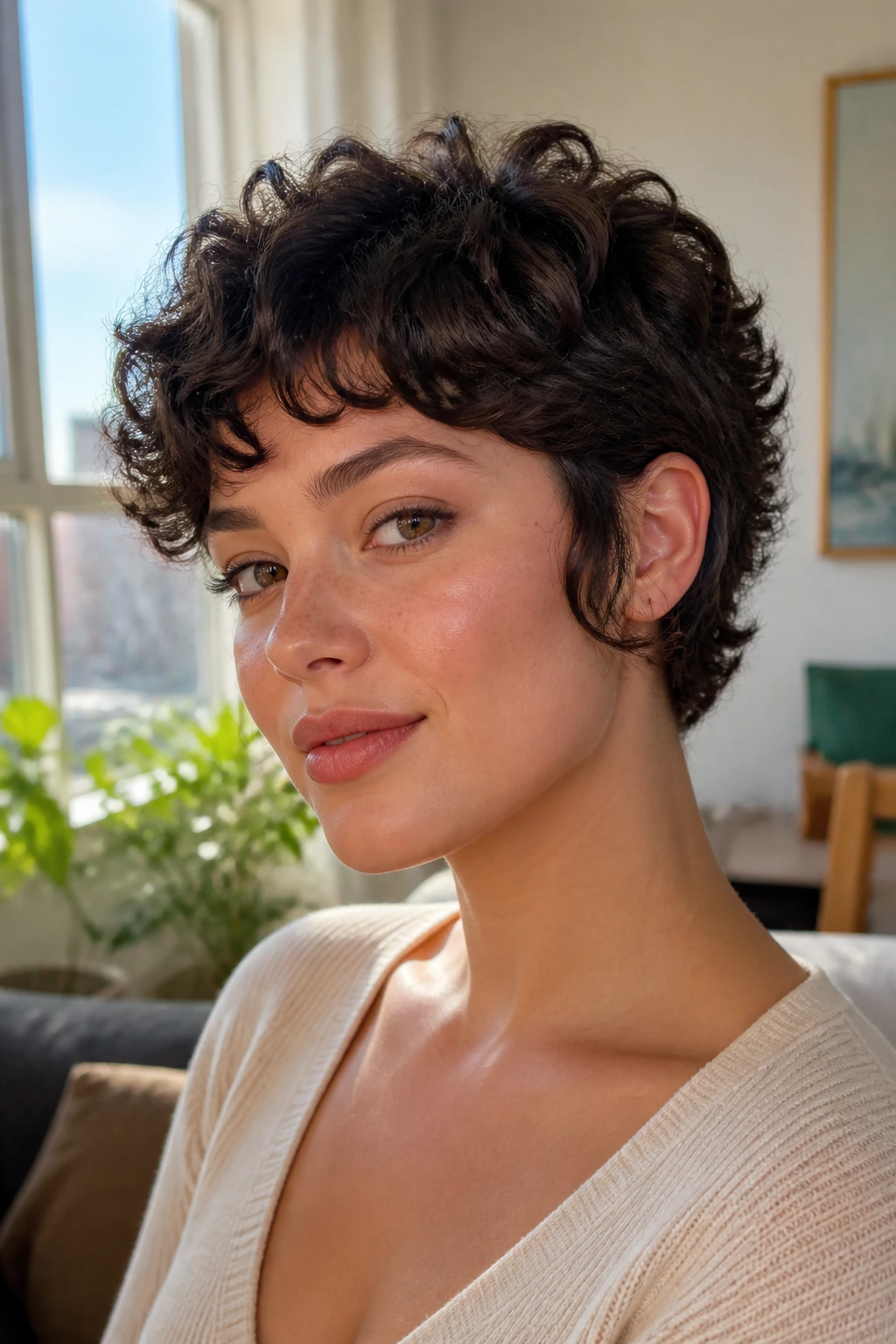
The bixie sits in that nice middle ground between a bob and a pixie, which makes it especially useful for a round face. It keeps enough length around the ears and front to avoid a hard cropped edge, but it stays short enough to keep the silhouette light. Soft sideburns help even more. They draw the eye downward and keep the cut from feeling boxy.
This is one of the easiest short curly cuts to grow out. That matters. A lot. Too many short haircuts look sharp for three weeks and awkward for the next eight. The bixie tends to age better because its shape can slide toward a longer crop without losing the basic idea.
If your curls are dense, this cut can remove a surprising amount of bulk. If they’re fine, the bixie creates the illusion of more structure than the hair really has. Either way, it gives round faces some welcome air around the cheeks.
7. Stacked Curly Bob with a Tapered Back
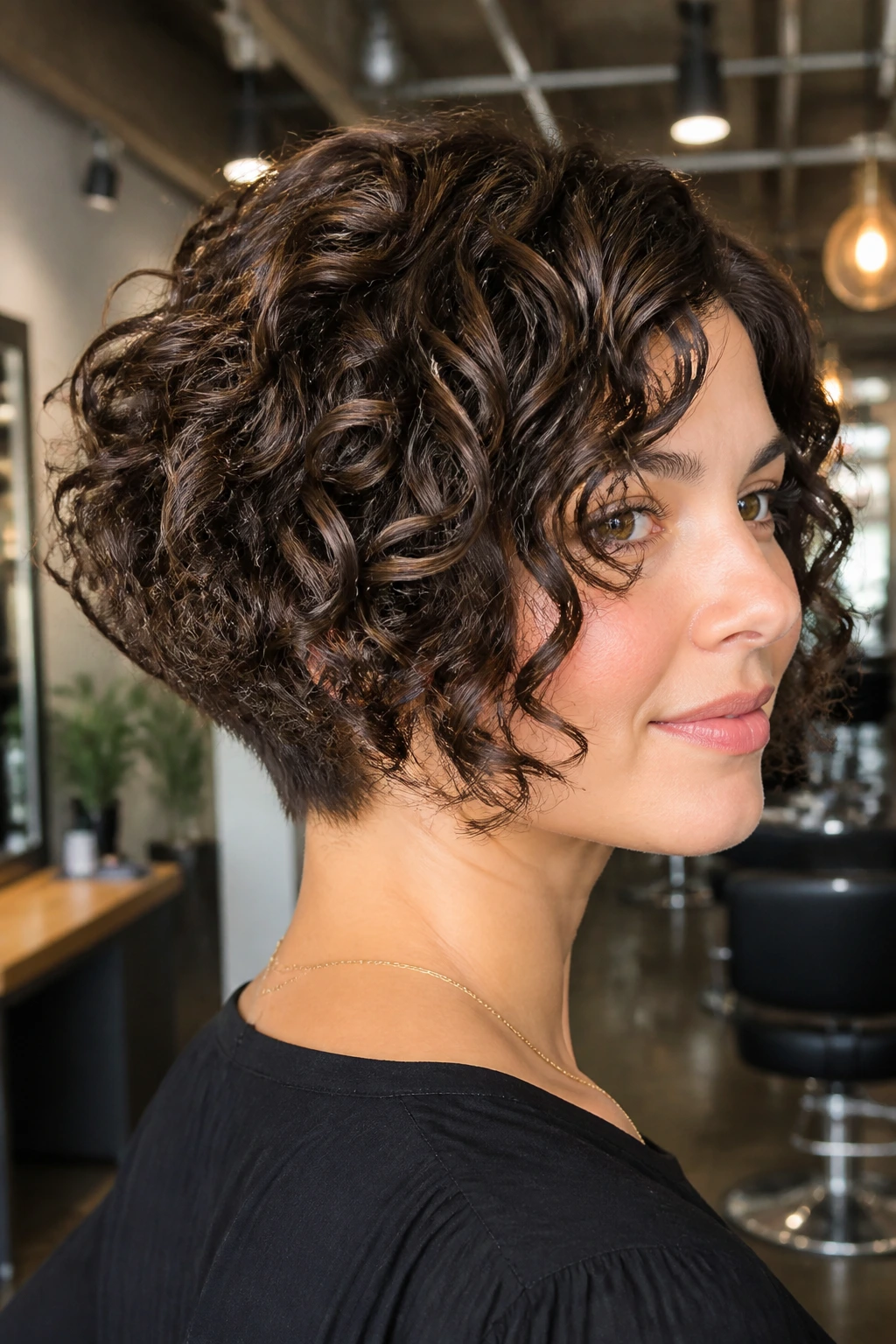
A stacked bob puts weight and lift where they help most: the back of the head. On curly hair, that stacked shape can open up the neckline and create a more vertical line from crown to nape. That is useful on a round face, as long as the stack does not get too high or too round. Too much volume at the back turns into a little mushroom cap. No one needs that.
The front should stay a touch longer than the back. Just enough to keep the face from looking boxed in. A side part usually helps, though a deep side part can make the whole cut feel more dramatic. If your hair is thick, the stack keeps the back from sitting heavy on the neck. If it’s finer, the lift gives the illusion of density.
This cut likes regular shaping. Let it grow too long and the stacking disappears under the curls, which is when the back starts to look flat and the sides look wide.
8. Curly Wolf Cut Cropped Short

The short curly wolf cut is for anyone who wants texture with a little edge. It keeps shorter layers around the crown and a slightly longer perimeter, so the hair has that shag-mullet energy without feeling too extreme. On a round face, the best part is the broken outline. The eye never gets stuck on one wide line.
The wolf cut works because it refuses to overfit the face. The upper layers create lift, the lower layers move, and the ends stay loose enough to avoid a clean circle. That matters more on curls than on straight hair, because curls already have their own volume. You want shape, not a helmet.
This version looks especially good when dried with a diffuser and left a little airy. If you smooth it too much, you lose the whole point. Messy is part of the design here. Controlled mess, but still mess.
9. Ear-Length Crop with Tapered Sides
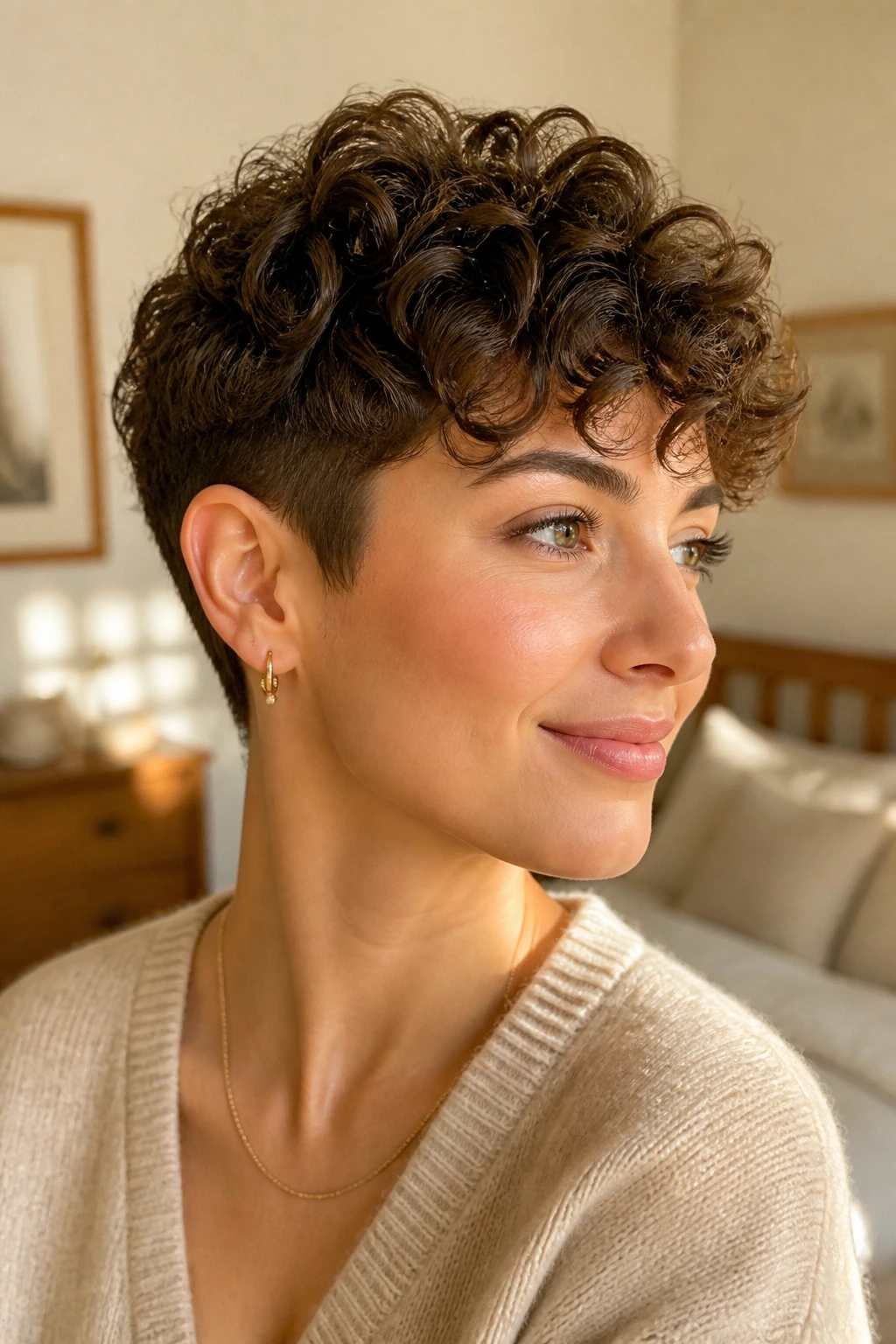
Shorter than most people expect, the ear-length crop can be excellent on a round face when the sides are tapered instead of blunt. The exposed ear area opens the face, and the taper keeps the silhouette from pushing outward right where the cheeks are widest. It’s clean. It’s sharp. It does not ask permission.
This cut works best when the top has enough curl length to create some lift or bend. A flat ear-length cut can look severe; a textured one looks deliberate. That’s the difference between “I wanted this” and “I got tired of dealing with my hair.” They are not the same thing.
If you like earrings, this one is especially satisfying. The haircut frames the jaw and leaves the neck visible, which gives the face a longer read without adding fake volume at the sides.
10. Jaw-Skimming Bob with Face-Framing Pieces
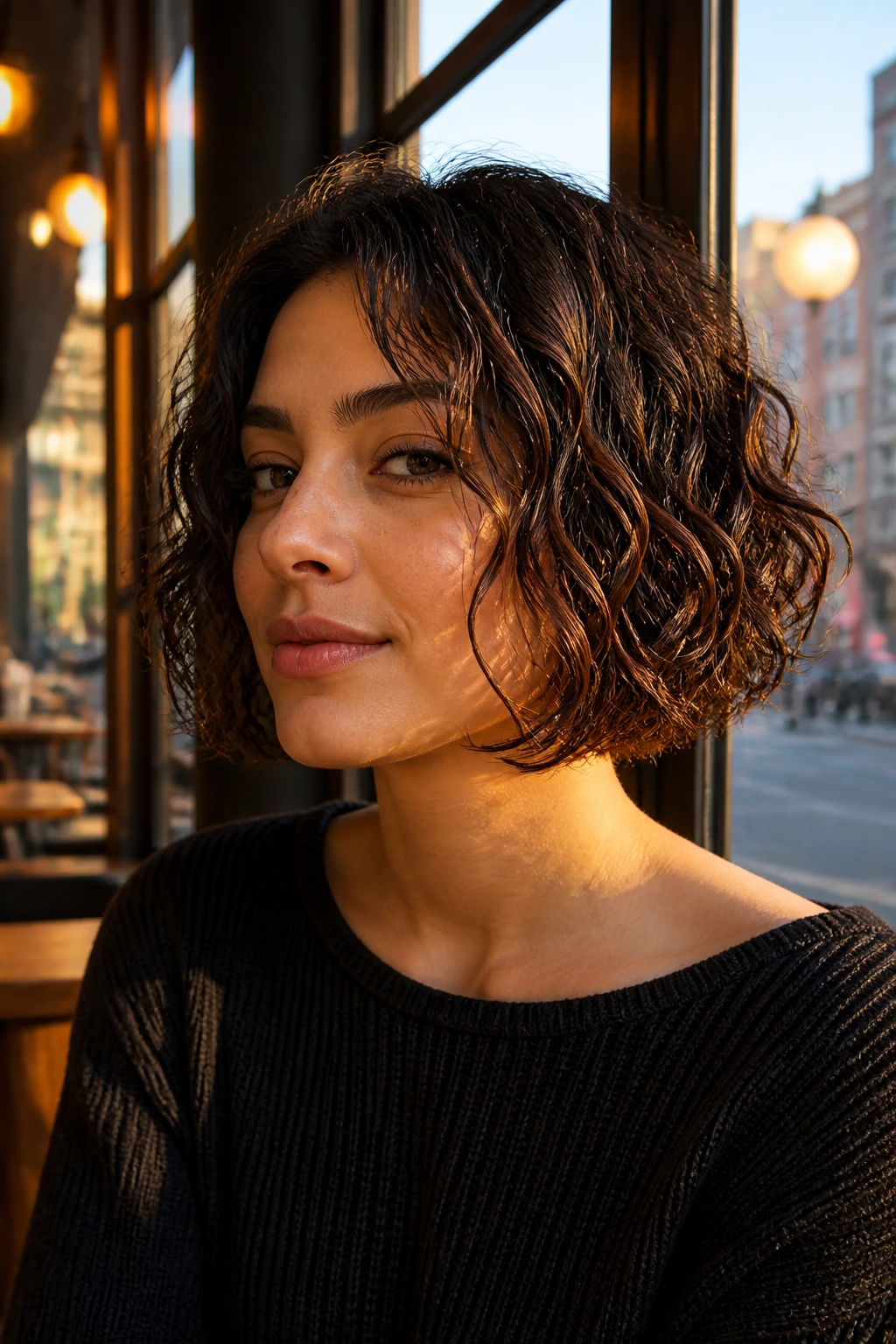
A bob that skims the jaw can be a smart choice when the front pieces are deliberately longer than the rest. The face-framing sections should start below the cheekbone and bend toward the jaw, not sit right at the cheek like a shelf. That placement keeps the curls from widening the face at its fullest point.
This cut is all about line control. The perimeter can stay relatively neat, but the front needs softness. A little curl-by-curl adjustment around the temples can change the whole effect. If your curls are very springy, ask the stylist to leave extra length in the front and dry-check the shape before finishing.
It’s a good option if you want structure without looking overlayered. The haircut feels composed, not fussy. And on a round face, that composed feeling goes a long way.
11. Short Curly Mullet with a Soft Nape
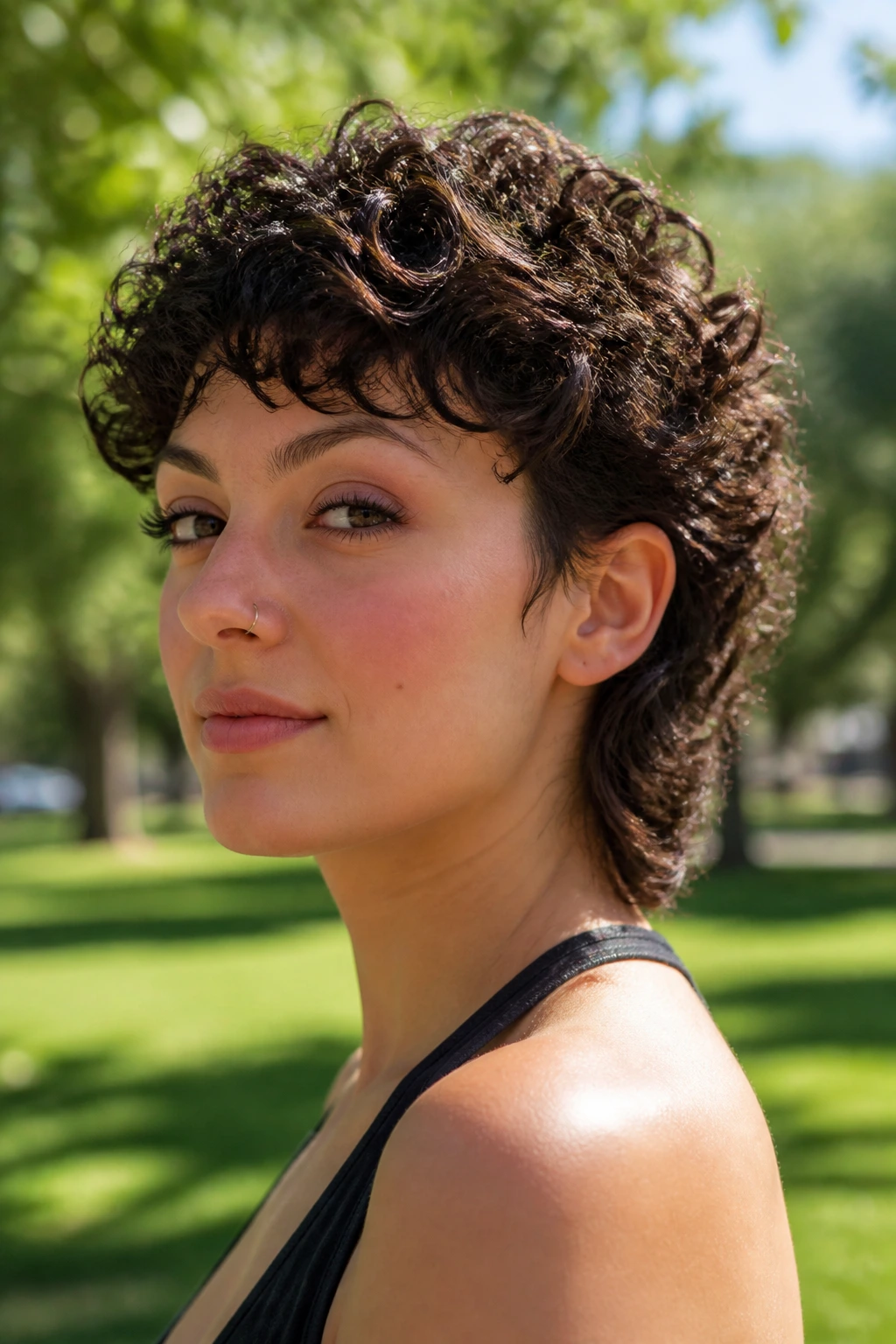
The curly mullet is not for everyone. Good. It doesn’t need to be. On a round face, though, the extra length at the nape can work like a visual line that draws the eye downward. The front stays lighter and shorter, the sides stay controlled, and the back gets to do its own thing.
Softness matters here. You do not want a hard line or a punky little tail unless that is the look you’re after. The modern version is looser, with textured layers and a nape that sits close enough to keep the cut tidy. It’s a haircut that says, yes, I know exactly what this is.
The best curly mullets have enough crown lift to avoid collapsing into a wide silhouette. If your curls are dense, ask for weight removal at the sides. If they’re fine, keep the layers longer so the shape doesn’t disappear.
12. Deva Cut Crop with Crown Lift
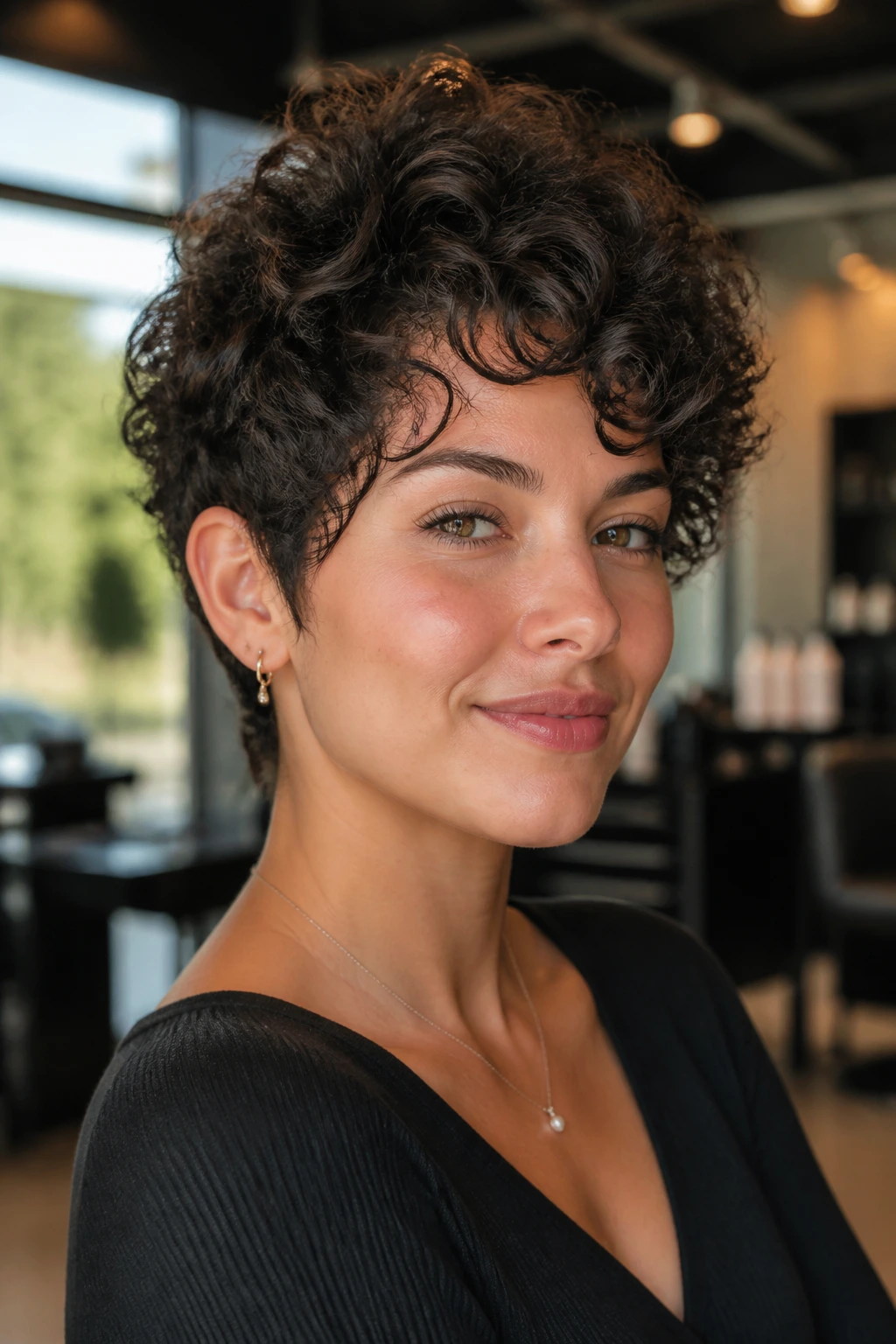
A Deva-style crop is less about a specific silhouette and more about how the haircut is made. Cut dry, curl by curl, it respects the way each strand actually lives on your head instead of how it looks stretched out when wet. For round faces, that matters because the stylist can see where the curls naturally add width and where they need to be encouraged upward.
Crown lift is the point. A little extra height at the top stretches the face visually, and careful shaping around the cheeks keeps the cut from puffing out sideways. If you’ve had a curly cut that looked fine in the salon and wrong at home, this is often the fix. Dry cutting exposes the real shape before the scissors are done.
It’s one of the best choices if your curl pattern varies across your head. Some curls are looser near the front, tighter in the back, and a wet cut can miss that. A curl-by-curl crop catches it.
13. Curly Undercut Pixie
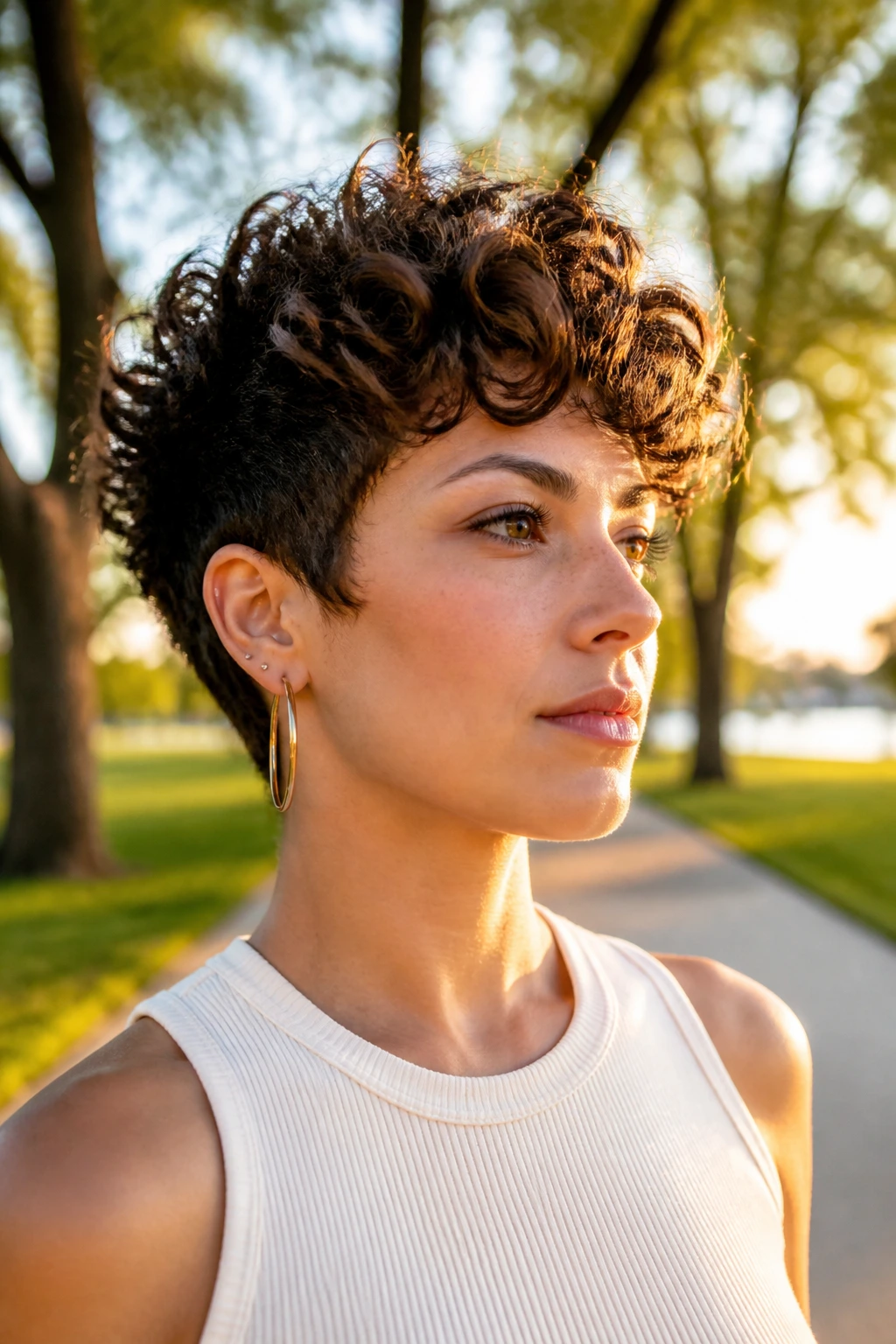
An undercut pixie takes bulk away where round faces least need it: around the sides and lower back of the head. The top stays long enough to hold curl and volume, while the undercut quietly removes puff. That contrast makes the face look more open and the neck a little longer.
This cut is practical if your curls are thick or dense and tend to grow out sideways. The undercut keeps the shape from becoming a wide triangle. It also makes morning styling faster, because there’s less hair to wrestle into place around the ears and nape.
The thing to watch is the transition. If the top is left too short, you lose the drama. If the undercut is too aggressive, the grow-out can look patchy. A soft fade or a hidden undercut usually keeps the whole thing cleaner.
14. Textured Wedge Cut with Lifted Back
A modern wedge is not the hard, helmet-shaped cut people picture from old photos. The new version keeps the back lifted and the sides textured, which can work beautifully on a round face with curls. The stack in the back gives height, and the softened sides stop the face from looking wider.
This cut is good when you want a neat shape that still moves. It can look polished with curl cream and a diffuser, or more relaxed if you scrunch it and let the ends separate a little. The key is avoiding a blunt shelf at the bottom. That’s what turns a wedge into a box.
If your curls sit flatter at the crown, the wedge can create structure without the fuss of a pixie. It’s one of those cuts that looks more technical than it feels. Nice bonus.
15. Micro Shag with Wispy Bangs
The micro shag is a tiny, choppy version of the bigger shag, and it works because it keeps the hair from expanding into one round mass. On a round face, the wispy bangs help break up the forehead while the layered crown lifts the eye upward. The haircut looks casual, but it’s not accidental.
Bang length matters here. Curly fringe should usually be left longer than straight bangs because shrinkage can send them flying higher than expected. The wispy part is what keeps the front from becoming a heavy curtain. You want softness around the forehead, not a wall.
This cut suits loose curls and waves more than tight coils, but it can be adapted. The shorter the curl, the more important the layering becomes. Without it, the micro shag loses shape quickly.
16. Tapered Coily Crop
For tighter coils, a tapered crop is one of the cleanest ways to flatter a round face. The sides and nape are cut closer, while the top is left fuller so the shape rises upward instead of blooming outward. That vertical emphasis is gold on a round face.
This is not a cut that needs to be overcomplicated. The silhouette does the work. What matters is moisture, definition, and a shape that stays balanced as the coils shrink. If you like a pickable, shaped top with controlled sides, this cut has a nice, tidy confidence to it.
A tapered crop also keeps the neckline light, which changes how the whole face reads. The eye sees height, then neck, then face — not just width. That’s a small thing on paper and a big thing in the mirror.
17. Rounded Pixie Bob with Long Crown Layers
The pixie bob is a useful in-between cut when you want something shorter than a bob but softer than a pixie. On a round face, long crown layers are the point. They let the top lift while the sides stay close enough to keep the silhouette in check.
This cut gives you more styling flexibility than a standard pixie. You can push the front forward, sweep it to the side, or let the curls fall piecey and loose. That extra crown length also helps the haircut hold up better between trims, because it does not lose its shape the moment it grows half an inch.
A rounded pixie bob looks especially good when the curls are dense but not huge. The shape feels neat, but not severe. That balance is harder to fake than people think.
18. Soft Mohawk Crop with Curled Center Ridge
A soft mohawk crop takes the widest part of the haircut and places it in the center, not at the cheeks. That’s why it works on a round face. The sides stay tucked close, the top rises into a curled ridge, and the eye goes straight up the head.
It sounds bold because it is bold. But the soft version is wearable. You do not need shaved sides unless you want them. Tapered sides and a textured center strip can give you the same vertical lift with less drama. It’s the kind of haircut that looks best when the curls are defined enough to separate into ridges, not one solid puff.
If your hair grows outward at the temples, this cut can be a relief. It trims away the width and lets the height take over. Clean, punchy, and a little cheeky. Good combination.
19. Curly Crop with Curtain Fringe
Curtain fringe on curls has to be handled with care, but when it’s done well it’s one of the nicest ways to soften a round face. The fringe splits in the middle and falls away from the cheeks, which avoids that blunt horizontal line that makes faces read wider. The short crop beneath it keeps the shape fresh.
The fringe should be cut to bend, not sit heavy. If it lands too short, it can spring above the brows and lose the curtain effect. If it’s too dense, it can close off the face. The ideal version has enough air that you can see a little skin through the curls.
This cut is especially useful if you want a short style that still feels feminine and soft. It frames the face without crowding it. That’s harder to pull off than it sounds.
20. Hidden Undercut Bob
A hidden undercut is one of those practical tricks that saves a curly bob from turning bulky. The outer layer still reads like a bob, but the underlayer at the nape or behind the ears is clipped shorter, removing weight where curls often puff out. For a round face, that keeps the sides cleaner and the jawline more visible.
This is a smart cut for thick, dense hair. It gives you the bob shape you want without the side bulk you don’t. From the outside, it can look completely normal — which is helpful if you want something polished for work but easier to live with than a full-volume halo.
The grow-out is usually manageable, too. You are not trapped in a high-maintenance shape every six weeks. The undercut quietly does its job under the surface.
21. Deep Side-Part Crop
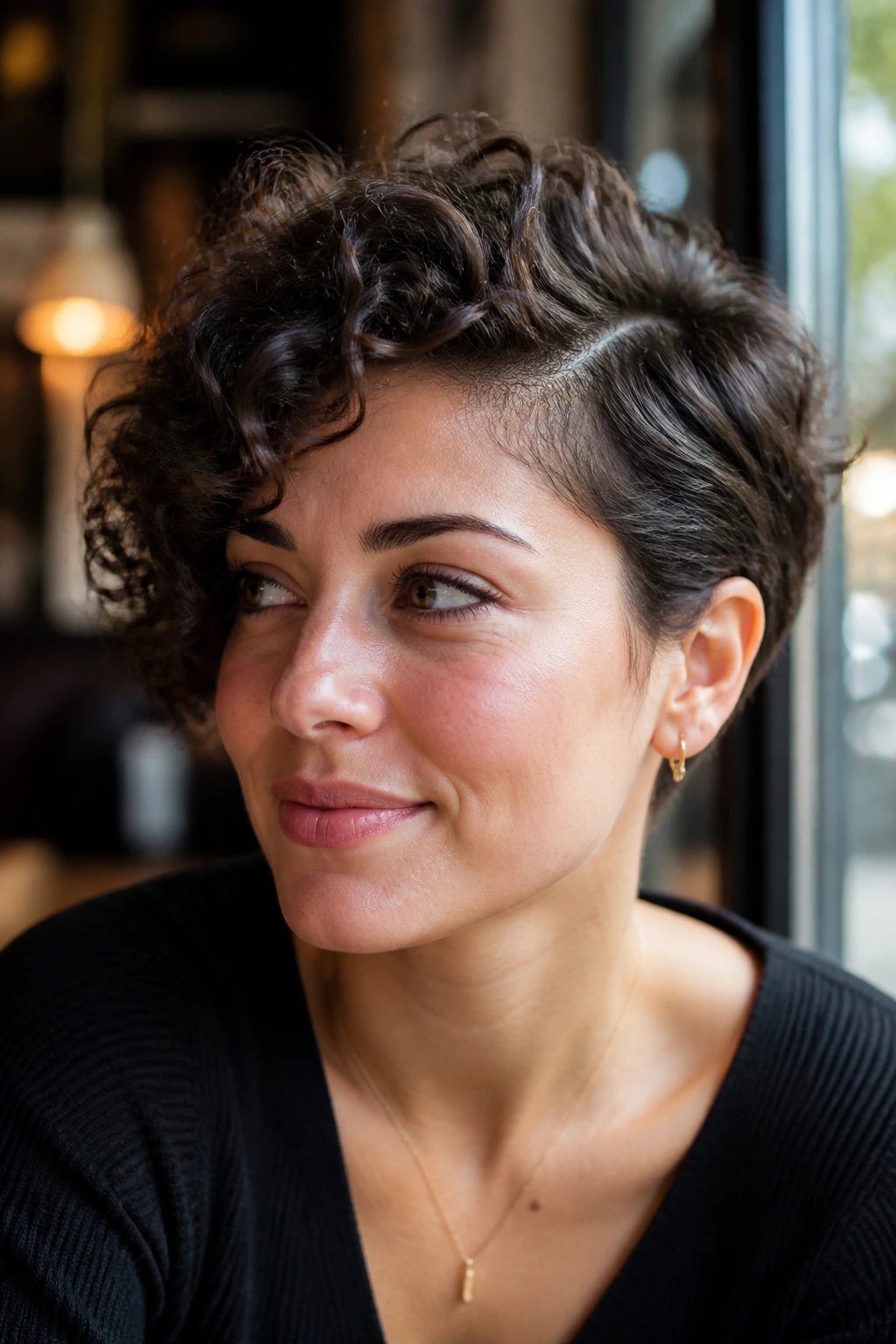
Sometimes the haircut itself matters less than the part. A deep side part can make almost any short curly shape flatter a round face because it creates a strong diagonal and adds lift where the hair lifts away from the scalp. That lift is the whole point. The eye reads height first, width second.
This works especially well on bobs, bixies, and short shags. The hair falls differently, the front gets a little swing, and the cheeks stop being the center of attention. If your curls naturally fight a middle part, this is usually a better choice anyway.
A deep side part also gives you room to play with volume. You can keep it polished, or you can push the roots a little higher for a more lifted, sculpted look. Very small change. Very different face shape effect.
22. Elongated Front Curly Cut

An elongated front means the front pieces are left longer than the back and sides, usually enough to create a clear downward line along the face. On a round face, that line is your friend. It draws the eye from cheek toward jaw and neck instead of letting the width sit front and center.
This shape works across a few short cuts — a bob, a crop, even a curly shag. The important bit is the front length and where it ends. If it stops right at the fullest part of the cheek, it can widen the face. If it drops below that, it helps stretch everything out.
It’s a strong option for people who want a short haircut that still feels soft around the face. The front pieces do a lot of the visual work, so you do not need much else.
23. Mini Shag Bob with Choppy Ends

A mini shag bob takes the bluntness out of a standard bob and replaces it with movement. The layers are subtle but not invisible, and the ends are choppy enough that the hair does not sit as one wide block. On a round face, that broken edge matters a lot.
This cut is nice for curls that need shape but not too much reduction in length. It keeps the bob idea intact while making it look looser and more current. If your hair tends to poof at the bottom, the choppy ends keep the silhouette from becoming too dense near the cheeks and jaw.
The mini shag bob also behaves well on day two. The slightly uneven perimeter hides the natural changes that happen as curls settle. That is one of the underrated perks of short curly hair: a cut with texture can look better after a little life happens to it.
24. Tapered Curly Afro with Height
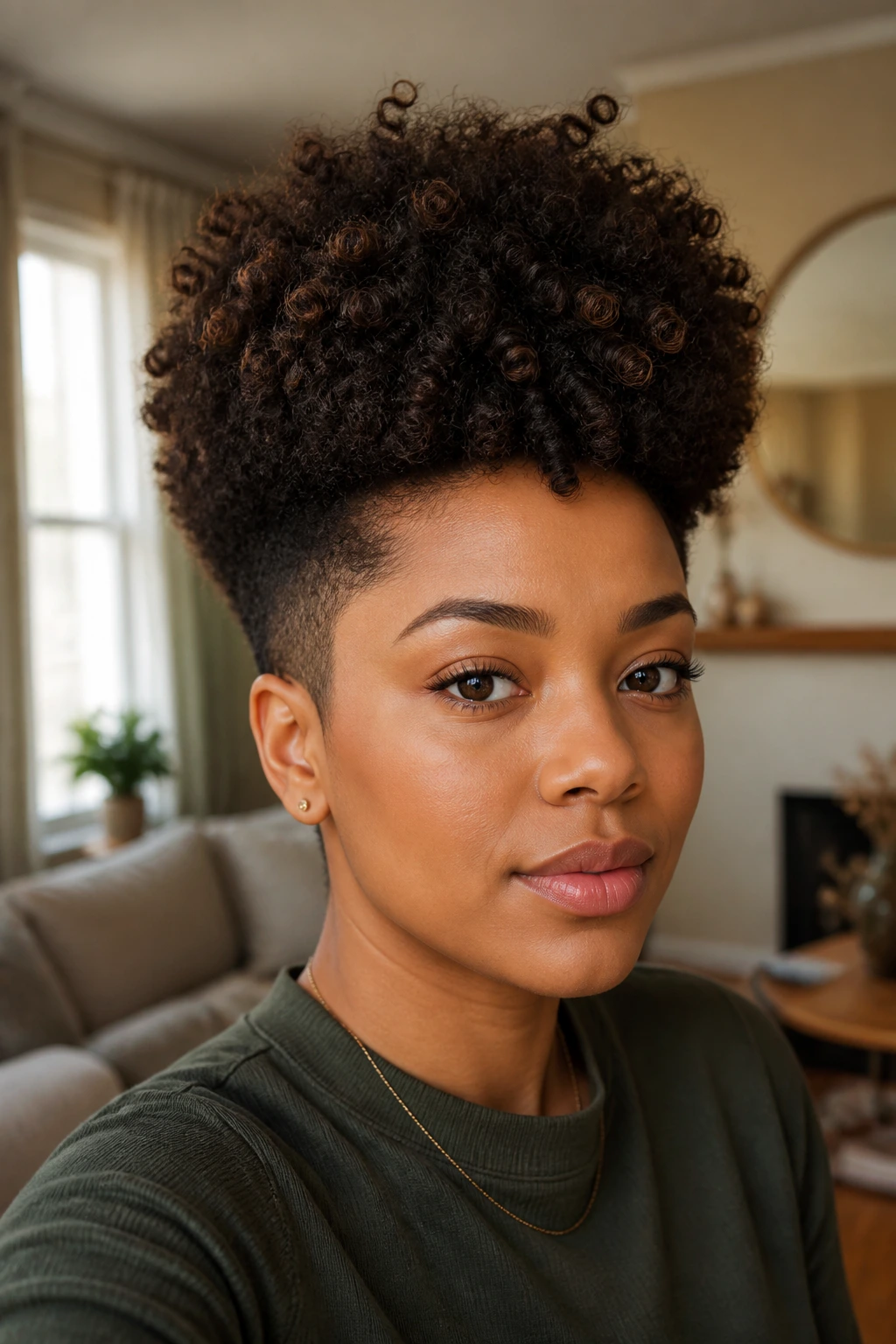
For tighter curls and coils, a tapered curly afro can be one of the most flattering short shapes for a round face. The height sits on top, the sides are shaped inward, and the silhouette stays rounded upward instead of outward. That distinction is everything. Upward is length. Outward is width.
The taper keeps the face from disappearing into the hair. A clean shape at the ears and nape opens the jawline, while the crown gets to be the star. If you like your hair to look full but controlled, this cut has a lot of presence without feeling heavy.
It also plays nicely with defined curls, twist-outs, and finger coils. The shape stays strong even when the texture changes a little from wash day to refresh day. That flexibility is useful. Very useful.
25. Halo Crop with an Open Nape
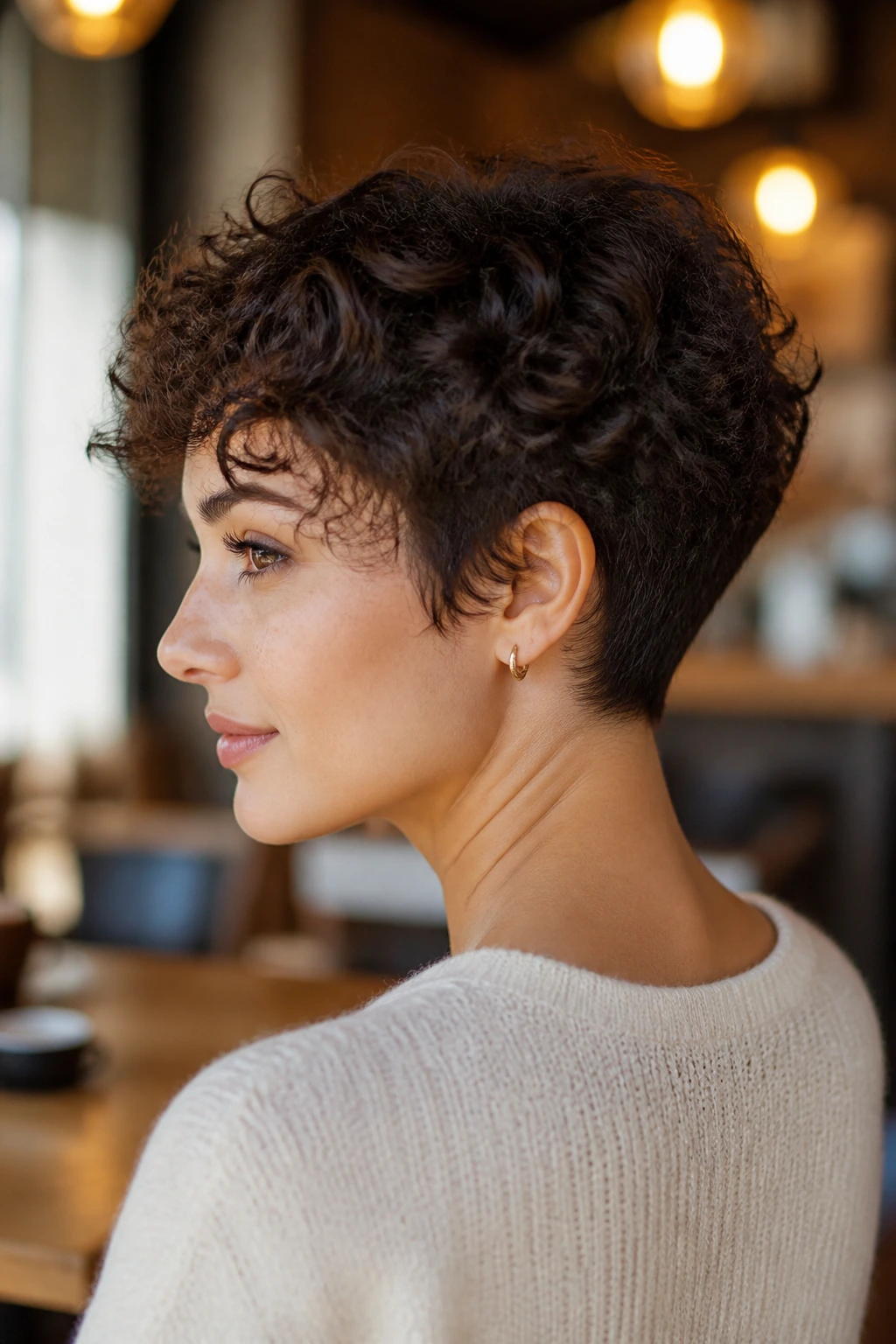
A halo crop wraps the curls around the top and sides in a soft frame, but the open nape keeps the whole thing from becoming too round. On a face that already has softness, that open neckline creates the needed contrast. You get curl volume where it helps and clean space where it counts.
This cut works best when the curls are shaped to float rather than sit in one lump. Think lifted crown, tidy side shape, exposed neck. It can look almost sculptural when it’s done well. Not stiff. Sculpted.
I like this one for anyone who wants short hair that still feels feminine without depending on long pieces. It has a little polish, a little edge, and enough structure to stay interesting as it grows.
How These Cuts Keep the Shape Moving in the Right Direction
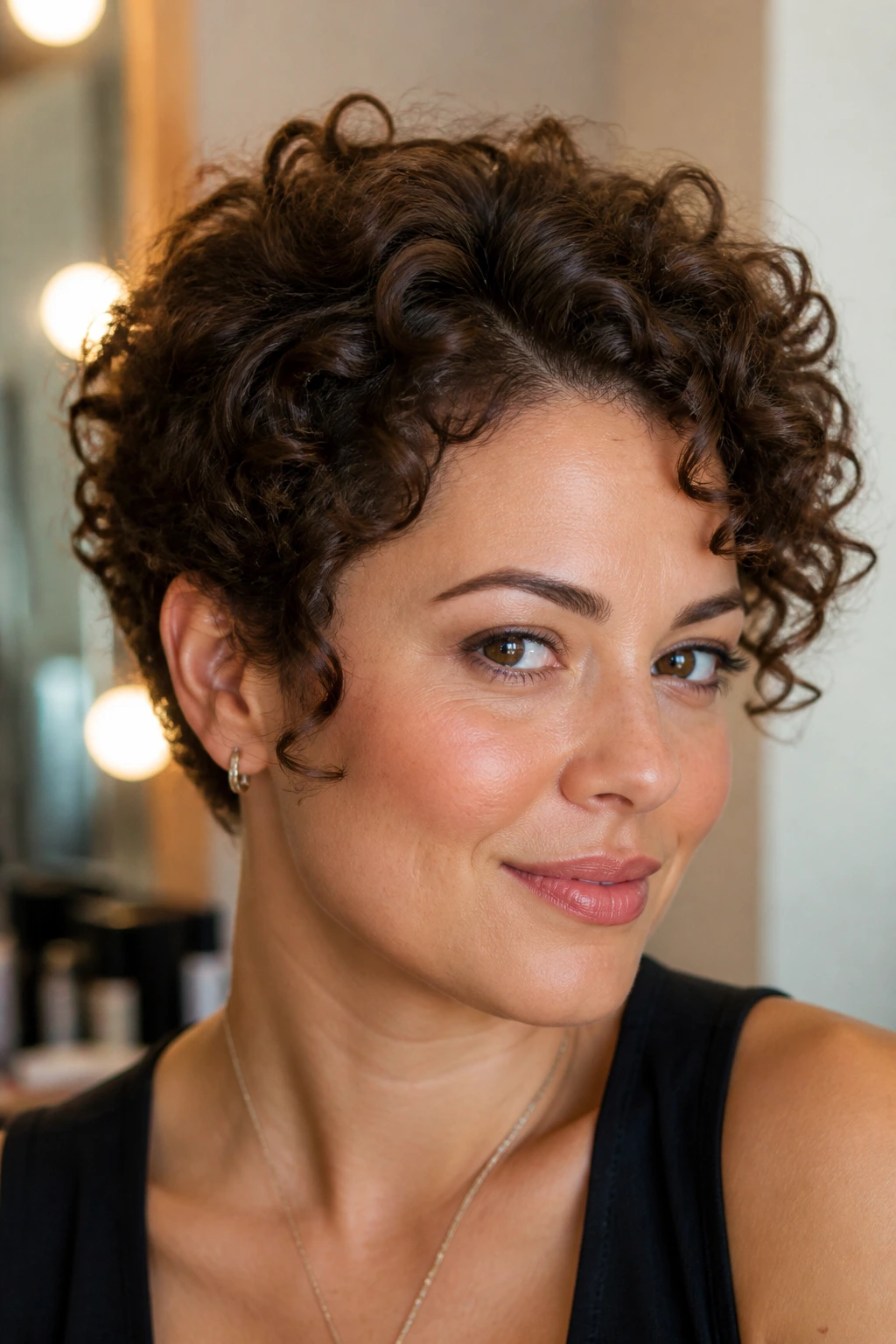
The whole point of a flattering short curly cut is not to erase roundness. That would be a strange goal anyway. The point is to keep the width from sitting at the same level as the cheeks and to give the curl pattern someplace to travel — up, down, or diagonally — instead of just out.
That usually means three things are happening at once. The crown has a little lift. The sides are not too heavy. And the perimeter breaks up instead of forming one blunt circle. Sometimes it takes all three. Sometimes one strong detail is enough, like a deep side part or an undercut at the nape. Curls are forgiving that way, but they’re also honest. If the structure is wrong, you see it immediately.
How to Brief a Stylist Without Ending Up With a Puffy Triangle
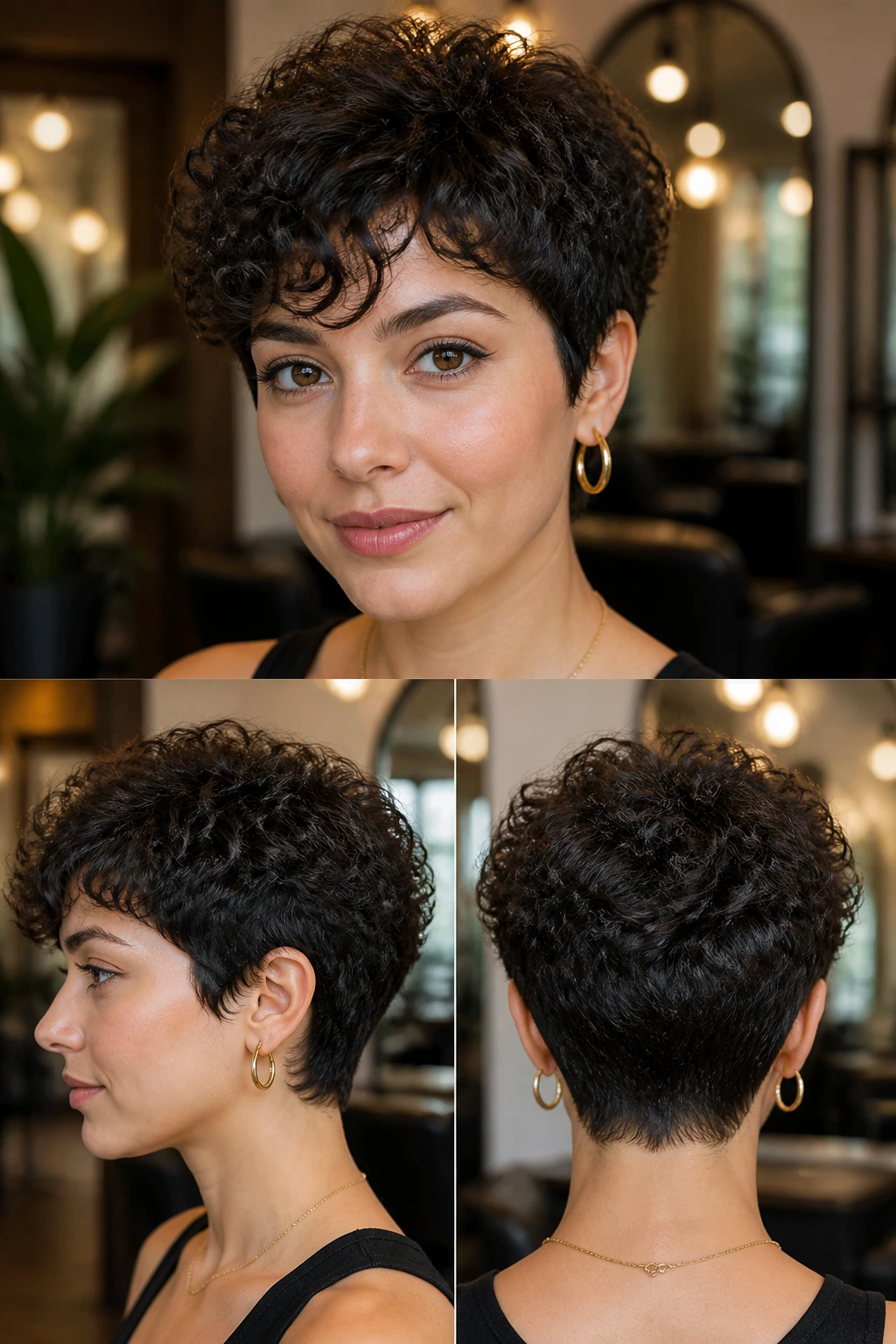
Bring photos, yes, but bring the right kind. A front view alone is not enough with curly hair. You need a front, a side, and a back if possible, because the silhouette matters more than the inspiration shot. A curly bob that looks sleek from the front can have a huge shelf in the back. That’s how people end up surprised in the car mirror.
Say the words that matter: dry cut, curl-by-curl, keep the weight off the cheeks, leave room for shrinkage, open the nape, taper the sides. Those phrases are not magic, but they are specific. Specific helps. Vague usually gets you a haircut that is “pretty” until the first wash.
If your curls shrink a lot, tell the stylist how much. If you know the front curls spring up more than the back, say that too. A good stylist can work with it. A rushed one will cut everything to the same length and hope for the best. That is how round faces end up wider.
Tools That Make Curly Short Hair Behave
-
Wide-tooth comb: Good for detangling in the shower without ripping through curl clumps.
-
Duckbill clips: Useful for sectioning while the hair is wet or for pinning the top while diffusing.
-
Microfiber towel or cotton T-shirt: Cuts down on frizz better than a regular bath towel, which roughs up the curl surface.
-
Spray bottle: Handy for reactivating curls on day two and reshaping the fringe without soaking the whole head.
-
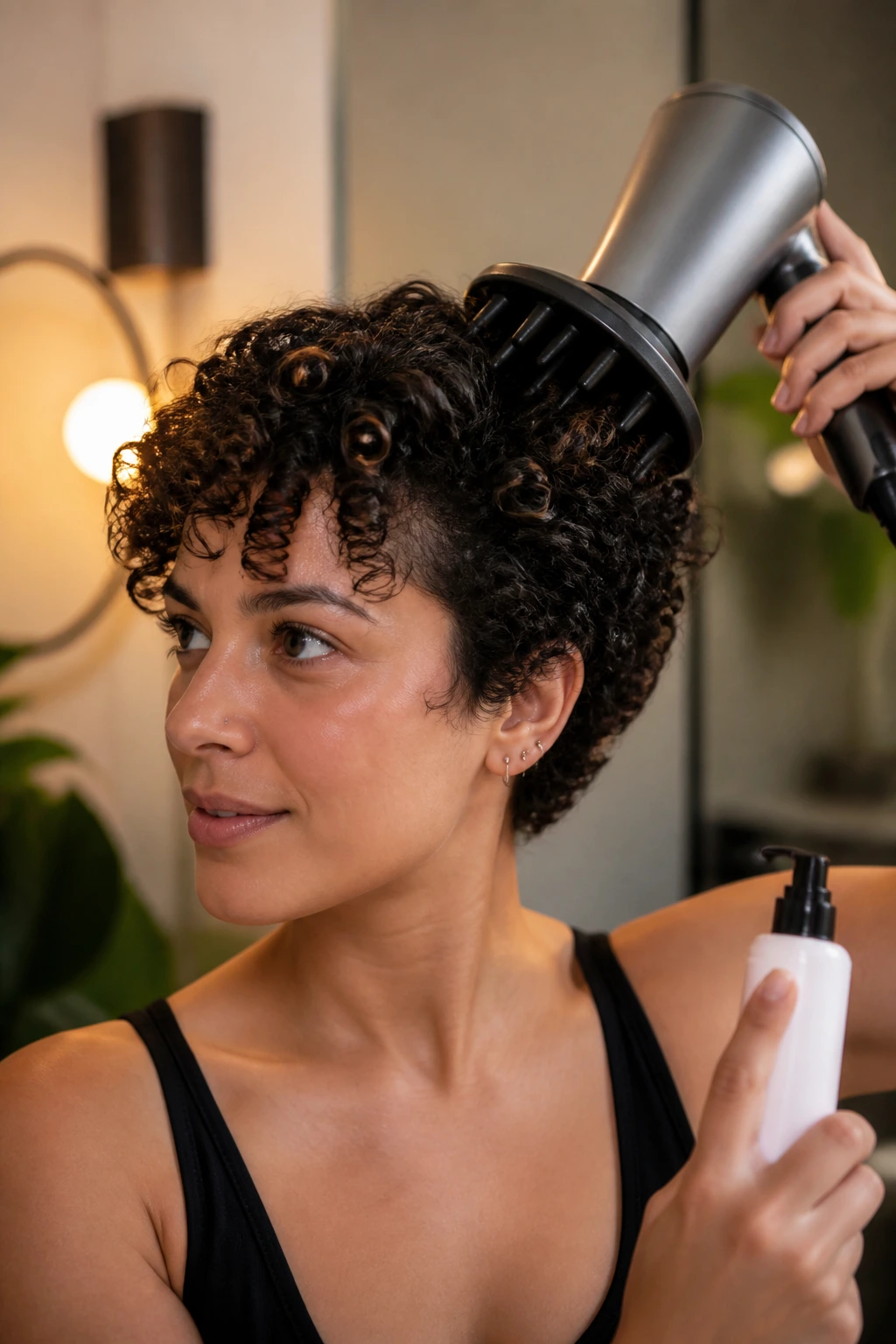
Diffuser attachment: The easiest way to keep the top lifted and the sides defined without blasting the curl pattern flat.
-
Curl cream or leave-in: Adds slip and helps the cut sit with a cleaner, softer shape.
-
Medium-hold gel or mousse: Gives a bit of control so the curls don’t fan outward at the cheeks as they dry.
-
Small round mirror: Worth having if you trim a neckline or bang edge between appointments.
-
Hair pick: Better for lifting the roots at the crown than for digging through the whole head. Use it lightly.
-
Clips for root lift: A few root clips at the crown can help a short curly cut dry with more height and less side spread.
Styling Moves That Keep the Width Under Control
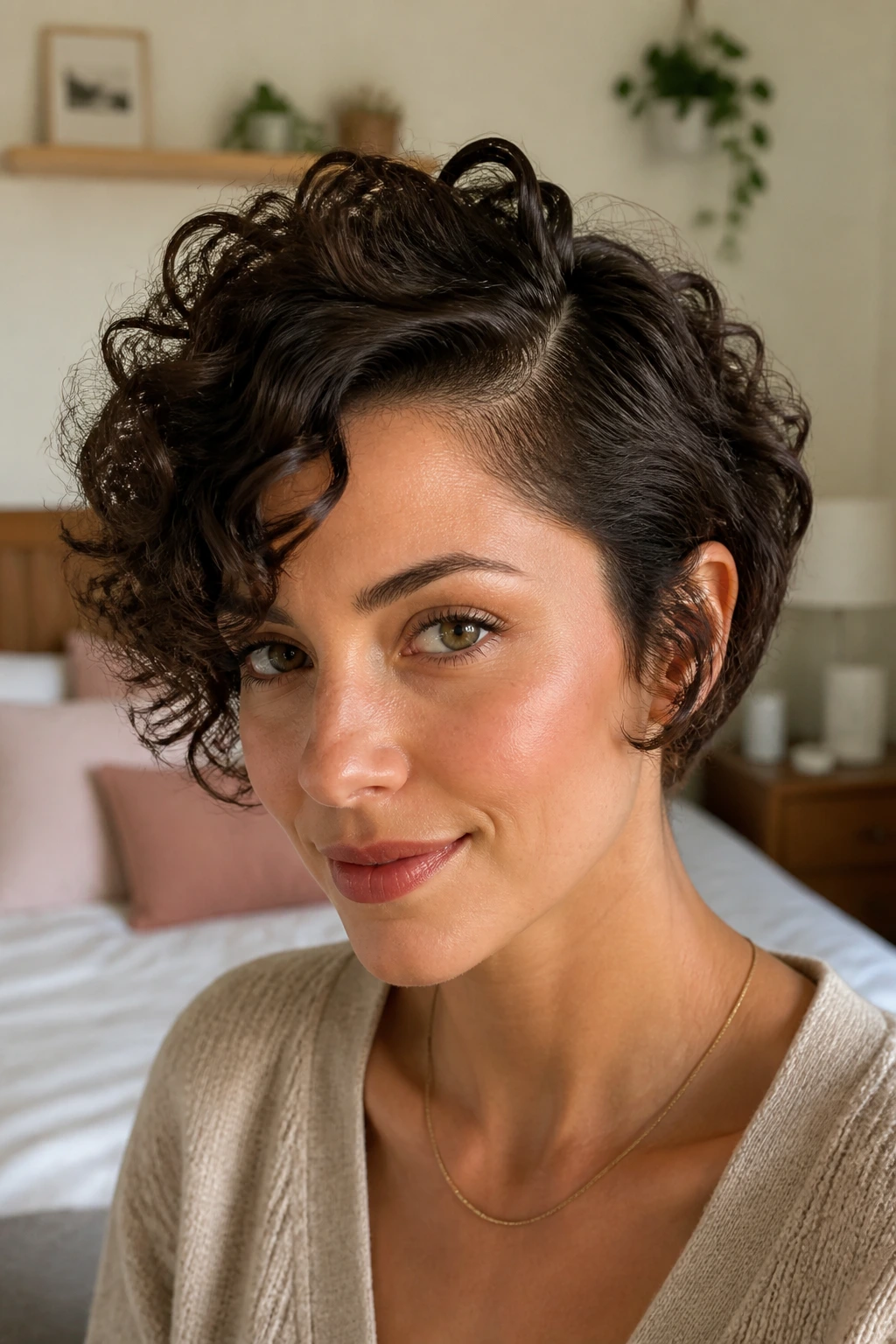
Short curly hair on a round face usually looks best when you start styling with the idea that the top matters more than the sides. Apply product through the mid-lengths and roots, then lift the curls upward as they dry. If you scrunch everything sideways, the cut spreads out. If you encourage height, the face reads longer.
A diffuser helps, but only if you use it with some restraint. High heat and too much movement can puff the curls into a halo that sits at cheek level. Keep the airflow moderate, cup the curls upward, and stop drying before the hair is bone dry if frizz is your enemy. Letting the last bit air-dry often keeps the shape cleaner.
Parting also matters more than people think. A center part can work on some round faces, but an off-center or deep side part usually gives more length. If your curls resist staying parted, set the part while the hair is wet and clip it for a few minutes. It sounds fussy. It is fussy. It also works.
Common Mistakes That Make a Round Face Look Wider
The easiest mistake is cutting the curls too short at the cheekbone. It feels tidy in the salon, then the hair dries and the perimeter sits right on the widest part of the face. The fix is simple but not negotiable: leave the face-framing pieces longer than you think you need, especially if your curl pattern has strong shrinkage.
Another problem is too much bulk at the sides. Curls love to puff out behind the ears, especially if the haircut has no taper or internal shaping. The symptom is a rounded silhouette that feels heavy at eye level. Ask for weight removal where the hair spreads, not just at the ends.
The third one is a blunt fringe that lands straight across the forehead. It can make the face look shorter and broader in one shot. A wispy fringe, a curtain fringe, or no fringe at all is usually safer. If you want bangs, let them bend. Straight-across bangs on curls are a gamble.
Finally, there’s the wet-cut trap. Curly hair lies. A lot. If a stylist cuts only on wet hair and never checks the dry shape, the result can land much shorter and wider than planned. Dry checking saves people from that mistake every day.
Variations for Loose Curls, Coils, and Thick Density
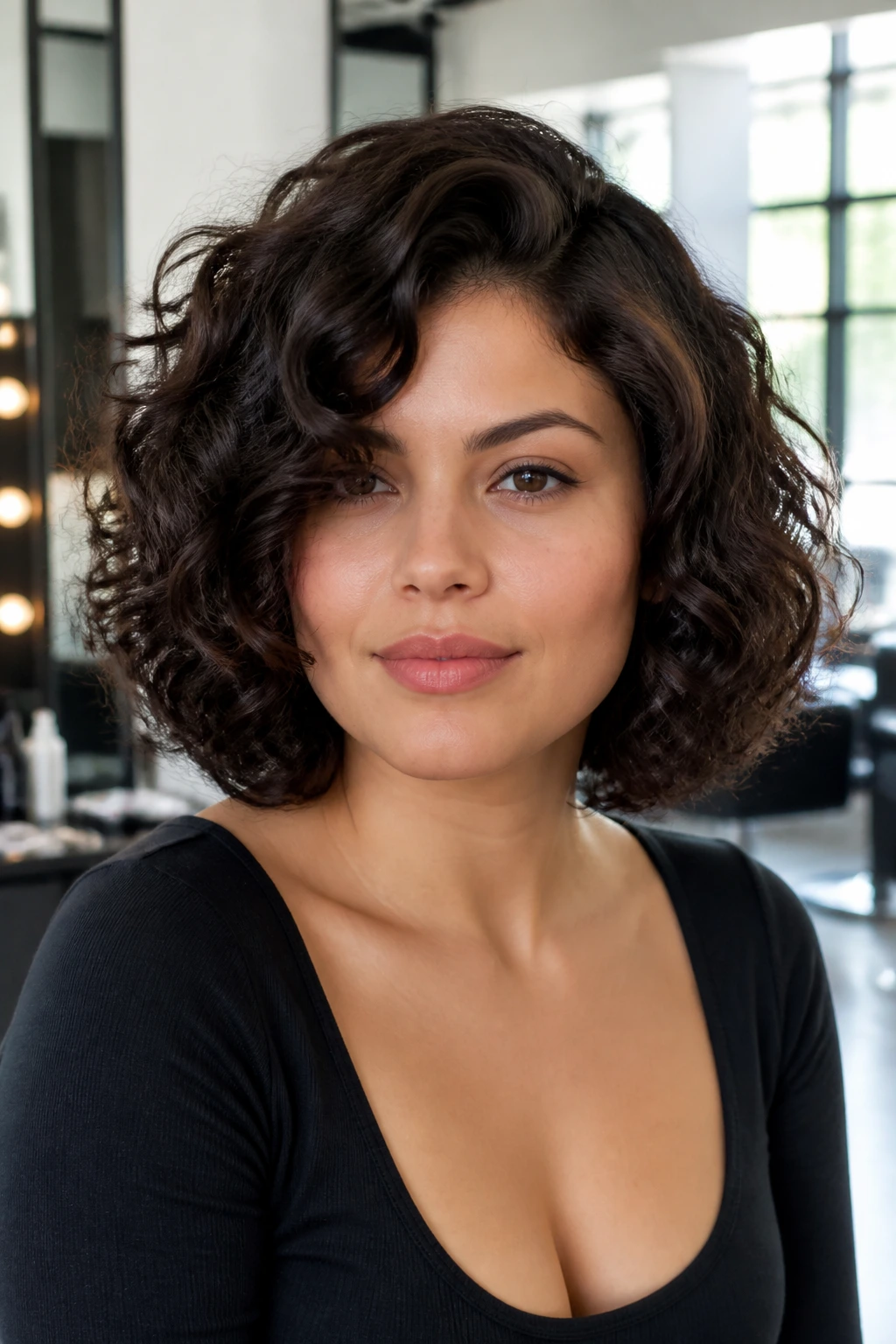
Loose-Curl Version: If your curls are more 2A to 2C, keep the layers longer and the texture softer. Too many short pieces can make the hair flick outward instead of falling in a clean shape. A bob, bixie, or French bob tends to work well here.
Dense-Curl Version: Thick curls need room to breathe. Ask for internal debulking, a tapered nape, or a hidden undercut so the cut does not expand outward around the cheeks. Stacked bobs and shags usually behave better than blunt crops on dense hair.
Coily Version: Tighter coils look excellent in tapered crops, halo cuts, and rounded pixies with height on top. The shape should move upward, not outward, and the perimeter should stay controlled around the ears and neckline. Moisture is part of the haircut here. Not optional.
Low-Maintenance Version: If you want less salon upkeep, choose a bixie, a mini shag bob, or a jaw-skimming curly bob with soft layers. These shapes grow out with a little grace instead of turning into a box the minute they lose an inch.
Bold Version: If you like a sharper look, the asymmetrical bob, soft mohawk, or curly undercut pixie give you more edge and more vertical line. They read intentional from across the room. That helps a round face more than over-polished symmetry does.
Keeping the Shape Sharp Between Salon Visits
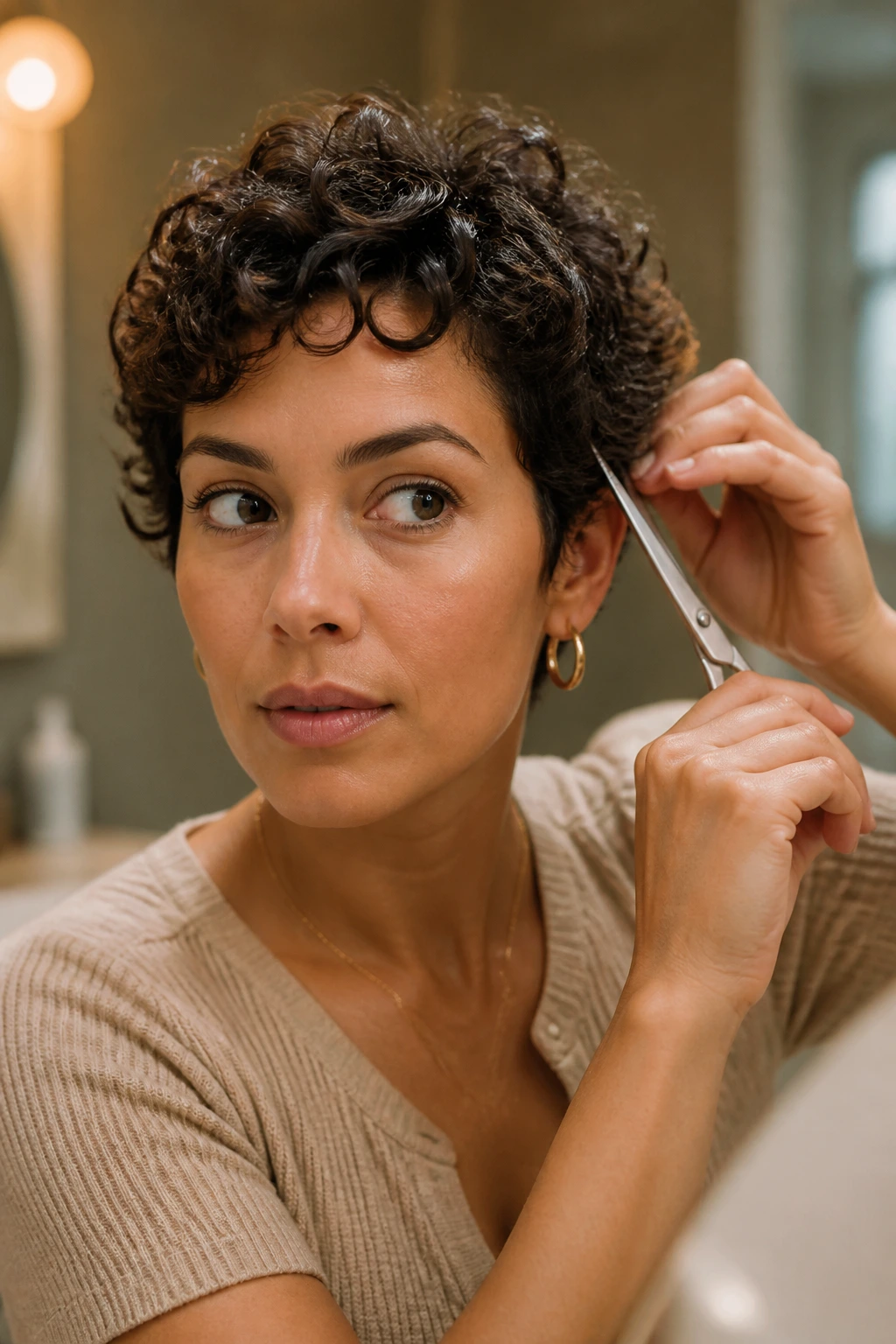
Short curly cuts need trims more often than shoulder-length hair, but the exact rhythm depends on the shape. Pixies and undercuts usually need attention every 4 to 8 weeks if you want the shape to stay crisp. Bobs and shags can stretch longer, often 8 to 12 weeks, before the silhouette starts to lose the lift that made it work in the first place.
Bang trims are a separate thing. If you have curly fringe, it may need a small clean-up sooner than the rest of the cut. Do not wait until the bangs are hanging in your eyes and then blame the haircut. Curly fringe grows in little jumps. One month it looks fine. Then a single wash day changes the whole mood.
At home, sleep on satin or silk if your curls frizz easily, and refresh the shape with water and a little leave-in instead of drowning the whole head. Short curly cuts look best when the crown stays lifted and the sides stay calm. You can nudge that shape back into place with your hands. No need to start from zero every morning.
Frequently Asked Questions
Which short haircut is most flattering for a round face with curly hair?
A chin-length curly bob with an off-center part is one of the safest bets because it adds a diagonal line without going too extreme. If you want more edge, a curly pixie with a long top or an asymmetrical bob can give even more lift.
Should curly hair be cut wet or dry for a round face?
Dry cutting usually gives better results because you can see how the curls fall, spring, and stack in real shape. Wet cuts can work, but only if the stylist checks the dry outline before finishing, especially around the cheeks and fringe.
Will bangs make my face look wider?
They can, if they’re heavy and cut straight across. Wispy bangs or curtain fringe are safer because they break up the forehead without forming one hard horizontal line. On curls, leave extra length for shrinkage.
Can I wear a middle part with a round face and curly short hair?
Yes, but it depends on the cut. A center part works better on styles with crown height, face-framing layers, or longer front pieces. If the hair is short and wide at the sides, a deep side part usually gives a better shape.
What works best for thick, dense curls?
Stacked bobs, hidden undercuts, tapered crops, and layered shags handle density better than blunt cuts. The goal is to remove bulk where the hair expands, not just thin the ends and hope the shape settles itself.
What if my curls shrink a lot after cutting?
Tell the stylist how much shrinkage you usually see and ask to keep the front and fringe longer than your instinct says. A cut that looks a little long in the chair can land exactly right once it dries. The opposite is much harder to fix.
How short can I go without making my face look wider?
Very short can work, but the cut needs height or asymmetry to balance the face. A pixie with a long top, a tapered crop, or a bixie usually gives more room for that balance than a very even short bob.
How often should I trim a short curly cut?
Most short curly cuts need shaping every 6 to 10 weeks, though pixies and undercuts may need it sooner. If the nape starts puffing out or the fringe stops behaving, the cut is telling you it’s time.
The Shape That Lets the Curl Lead
The nicest thing about a good short curly cut is that it stops fighting your face and your texture at the same time. The curls get to move. The face gets a little extra length. And the whole shape looks deliberate instead of accidental, which is a much better feeling when you’re dealing with short hair and a round face.
Pick the version that matches your curl pattern, your density, and your patience for upkeep. A neat bob, a shag with attitude, a pixie with real lift, a tapered crop — they all work for different reasons. The common thread is simple: keep the volume from sitting in one wide circle, and let the eye travel somewhere more interesting.