



Coily hair already brings the architecture. A round face just decides how dramatic the silhouette feels. When the balance is right, the whole look gets cleaner: the eyes go up, the cheeks read softer, and the hair stops fighting the face for attention.
That balance usually comes down to three things — height, asymmetry, and where the fullness lands. A style that sits low and wide at the temples can make a fuller face look even rounder. Shift the volume upward, sweep it to one side, or let it drop below the jaw, and the whole outline changes without you having to flatten your texture into submission. That’s the part people miss.
The good news is that coily hair is unusually good at this kind of shape work. Shrinkage gives you lift. Density gives you presence. Twists, puffs, braids, shags, and careful cuts all create different ways to place that volume on purpose instead of letting it sprawl wherever it wants. Start with the shapes that pull the eye up or break the circle, and the rest gets much easier.
Why These Styles Deserve a Spot on Your Rotation
-
Height Beats Width: Styles that lift the crown or top of the head help lengthen a round face without making the rest of the hair look stiff.
-
Coily Texture Holds Shape Well: Tight curls and coils keep puffs, twists, and shaped cuts from falling flat the way straighter textures often do.
-
Asymmetry Does a Lot of Heavy Lifting: Side parts, swept bangs, and off-center buns break the circular outline that can make cheeks read wider.
-
Protective Options Are Built In: Several of these looks keep the ends tucked away, which matters if you want low-manipulation days between wash sessions.
-
Short, Medium, and Long Hair Are All Covered: You do not need one exact length to make this work, because shrinkage means “short” and “long” are often two different things on the same head.
-
You Can Adjust the Drama: The same shape can look polished or playful just by changing where the part sits, how tight the base is, or how much curl you leave in front.
1. High Pineapple Puff for Coily Hair and Round Faces
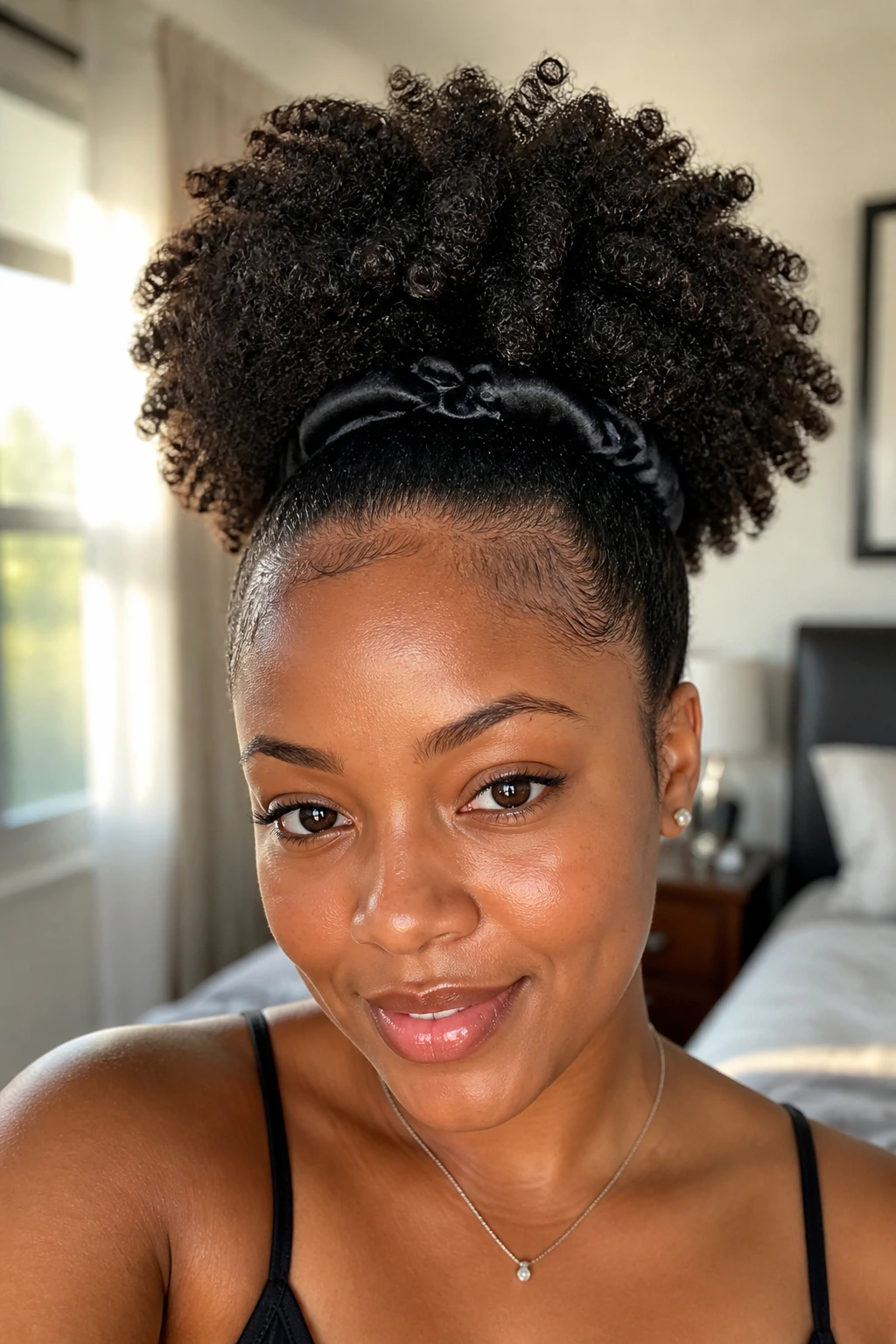
A high pineapple puff is one of those styles that looks simple until you watch what it does to the face. The puff sits above the crown, so the eye travels upward before it ever reaches the cheeks. That vertical line matters. A lot.
What I like about this style is that it works with second- or third-day hair, when the coils have enough body to hold shape but not so much softness that the puff collapses by lunch. Smooth the front and sides with a soft brush, gather the hair high at the crown, and leave the ends loose and full. A satin scrunchie is better than a thin elastic here because it grips without carving a hard crease into the hair.
Why it flatters
- The puff sits above the widest part of the face, which makes the outline read longer.
- The sides stay neat, but not plastered down.
- The coils in the puff keep texture visible, so the style still feels like coily hair and not a generic updo.
If your hair is long and dense, stretch it lightly first with banding or a loose braid-out. If it is shorter, make the puff smaller and higher. That little change keeps the shape from drifting toward your cheeks. One warning: do not place the puff at the back of the head. That’s where the style starts to widen instead of lift.
2. Tapered TWA with Defined Coil Lineup
A tapered teeny-weeny afro is not a “safe” cut. It’s a sharp one. And that’s exactly why it works so well on a round face. The cropped sides clear out visual bulk near the cheeks, while the top keeps enough length to add height and personality.
The best version has clean shaping around the nape and sideburns, then a little extra length through the top for coils to spring upward. A curl sponge can give texture, but finger coils or a twist-and-define method usually looks cleaner on the first day. I prefer a lineup that follows your natural hairline instead of carving it into a hard block. Hard edges can look a little severe if the face is already full.
Shape notes
- Keep the top about 1.5 to 3 inches longer than the sides.
- Use a light curl cream or foam, not a heavy butter that leaves the top droopy.
- Refresh with a small spray bottle and a fingertip twist, not a full rewash.
This cut is especially good if you like seeing your earrings, brows, and forehead shape. Everything around the face gets clearer. The whole style feels intentional because it has structure built into it, not just product.
3. Side-Parted Twist-Out
Why does a side part matter so much? Because it breaks the face in a good way. A center part can turn a round face into a neat little circle if the hair is wide enough at cheek level. A side-parted twist-out moves the weight off center and gives the curls somewhere to fall besides straight down the middle.
The trick is to set the twist-out properly. The twists need to dry fully — fully, not “mostly” — before you separate them. Otherwise the style puffs out too soon and you lose the definition that gives it shape. When you unravel, coat your fingers with a tiny bit of oil or serum and separate only once or twice per twist. Too much separation makes the hair bloom sideways.
How to keep it from getting bulky
A twist-out on a round face works best when the roots are lightly lifted and the ends fall below the chin. That drop below the jaw gives the eye a place to go. If the style ends right at cheekbone level, it can look wide fast.
I also like a soft pick at the crown after the twists are separated. Not a huge pick-out. Just enough to raise the top by half an inch or so. That small lift changes the whole reading of the style.
4. Faux Hawk with Two Side Cornrows
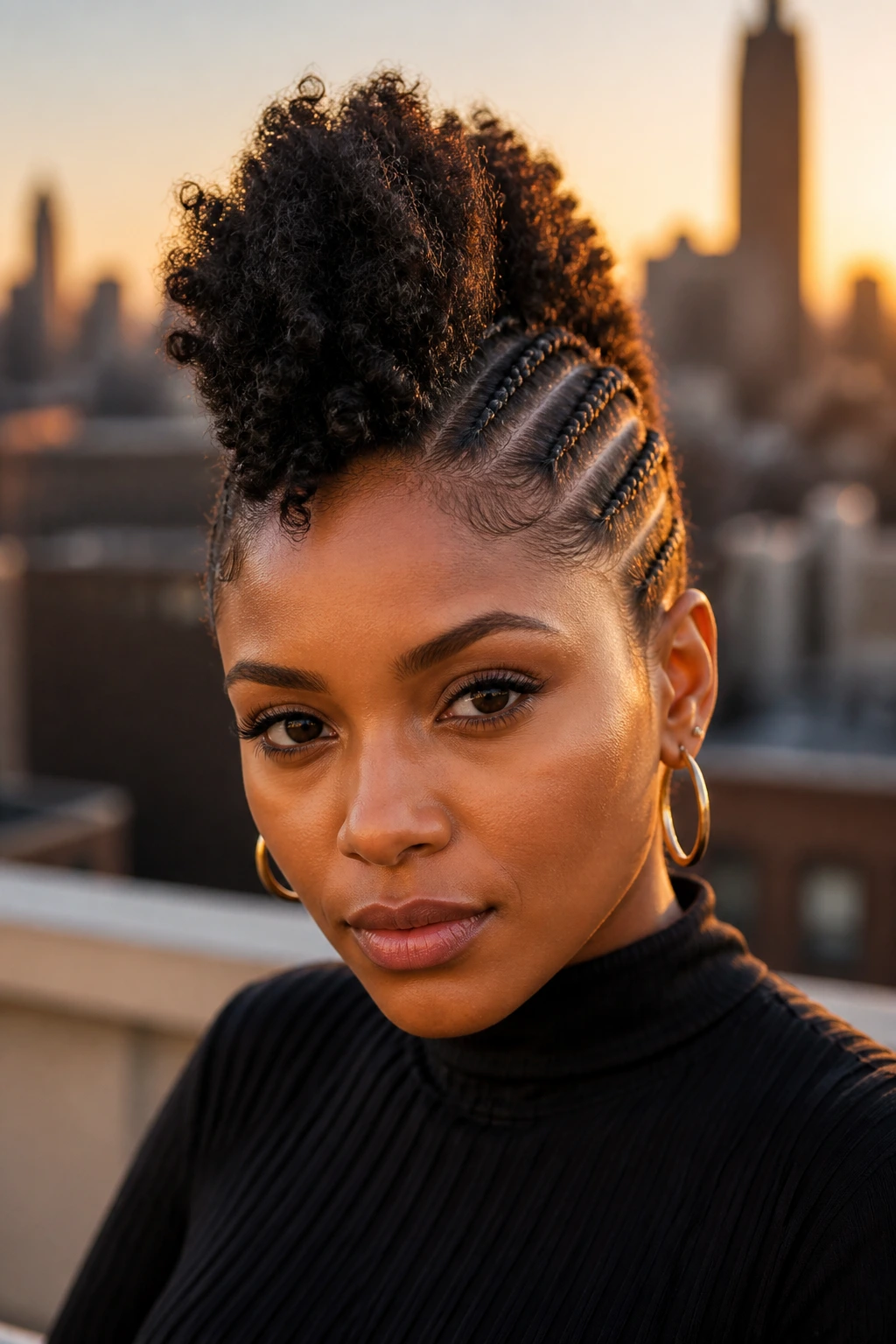
If you want a little edge without losing the shape benefits, this is the one. Two side cornrows keep the sides tight and low, while the center section rises into a textured strip that makes the face look longer. It’s a clean line. No fuss. A lot of attitude.
The faux hawk works because it creates a strong vertical path through the middle of the head. That line cuts through the roundness of the cheeks and jaw in a way that a full, equally wide style can’t. The hair on top can be twisted, puffed, coiled, or left curly. I like it best when the middle section has some visible texture instead of being slicked into a hard ridge.
Use gel sparingly on the braided sides. You want them neat, not crunchy. If the braids are too tight near the hairline, the whole look can pull harshly at the face. And no, tighter is not better here. Tighter just means more tension and less movement.
5. Shoulder-Length Layered Wash-and-Go
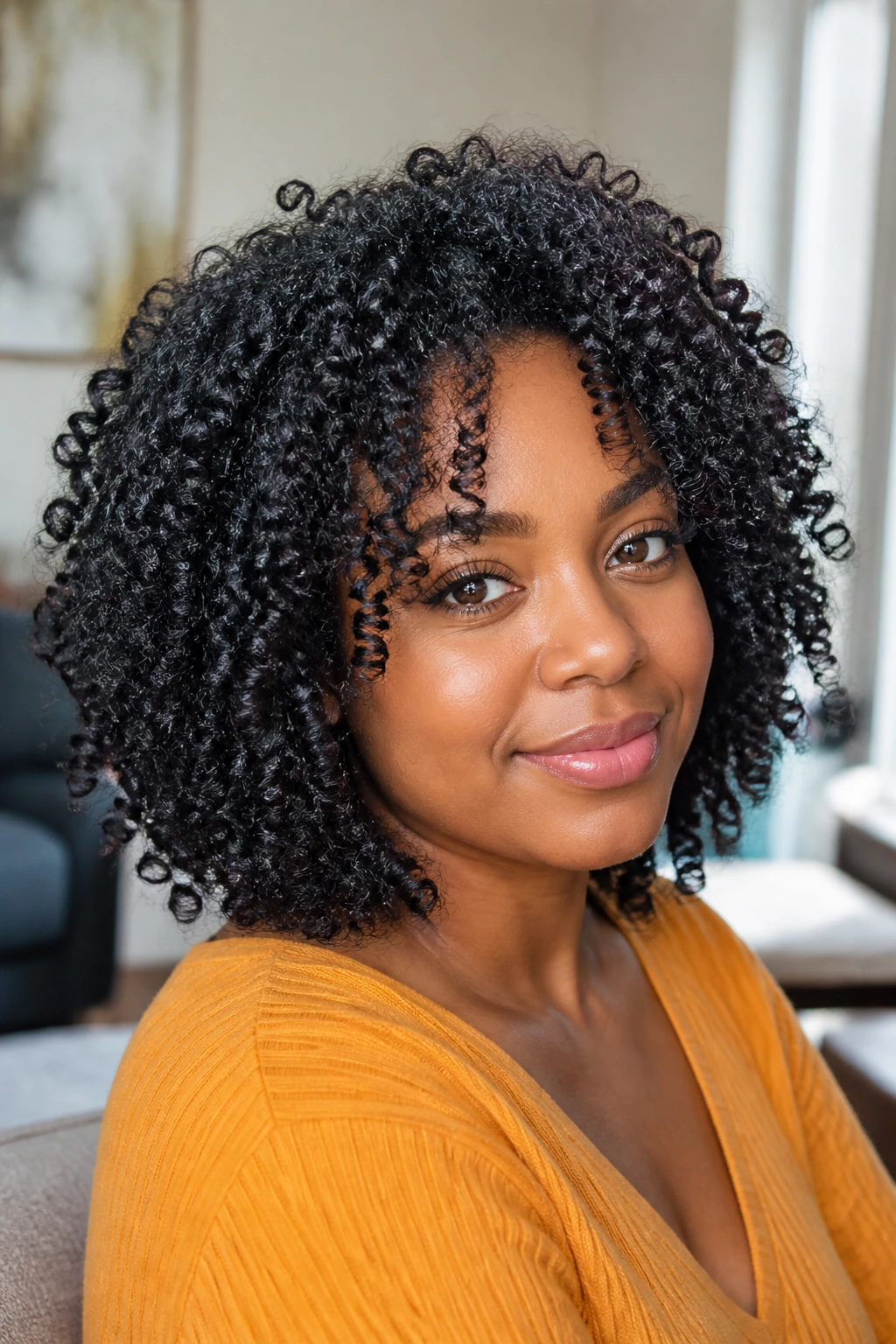
A shoulder-length wash-and-go can be a gift on a round face, but only if the shape is cut or styled with some control. One-length coily hair at shoulder length tends to flare outward around the cheeks. Layers solve that. They let some curls sit higher at the crown while others drop below the jaw, which breaks up the circle.
The finish matters almost as much as the cut. Apply your leave-in and styler in sections, then use a diffuser on low heat or let the hair dry fully in the open air if you have the time. When the curls are still damp, clip the roots at the crown for a bit of lift. That tiny trick keeps the top from lying flat and dragging the whole silhouette downward.
A good wash-and-go on coily hair has a little cast at first. Good. That cast keeps the curls grouped. Once the hair is fully dry, scrunch the crunch out gently. If the hair is still wet when you touch it, stop. Leave it alone. Wet handling is where a polished wash-and-go turns into a puffed-out triangle.
6. Crown Braid with Free Curls
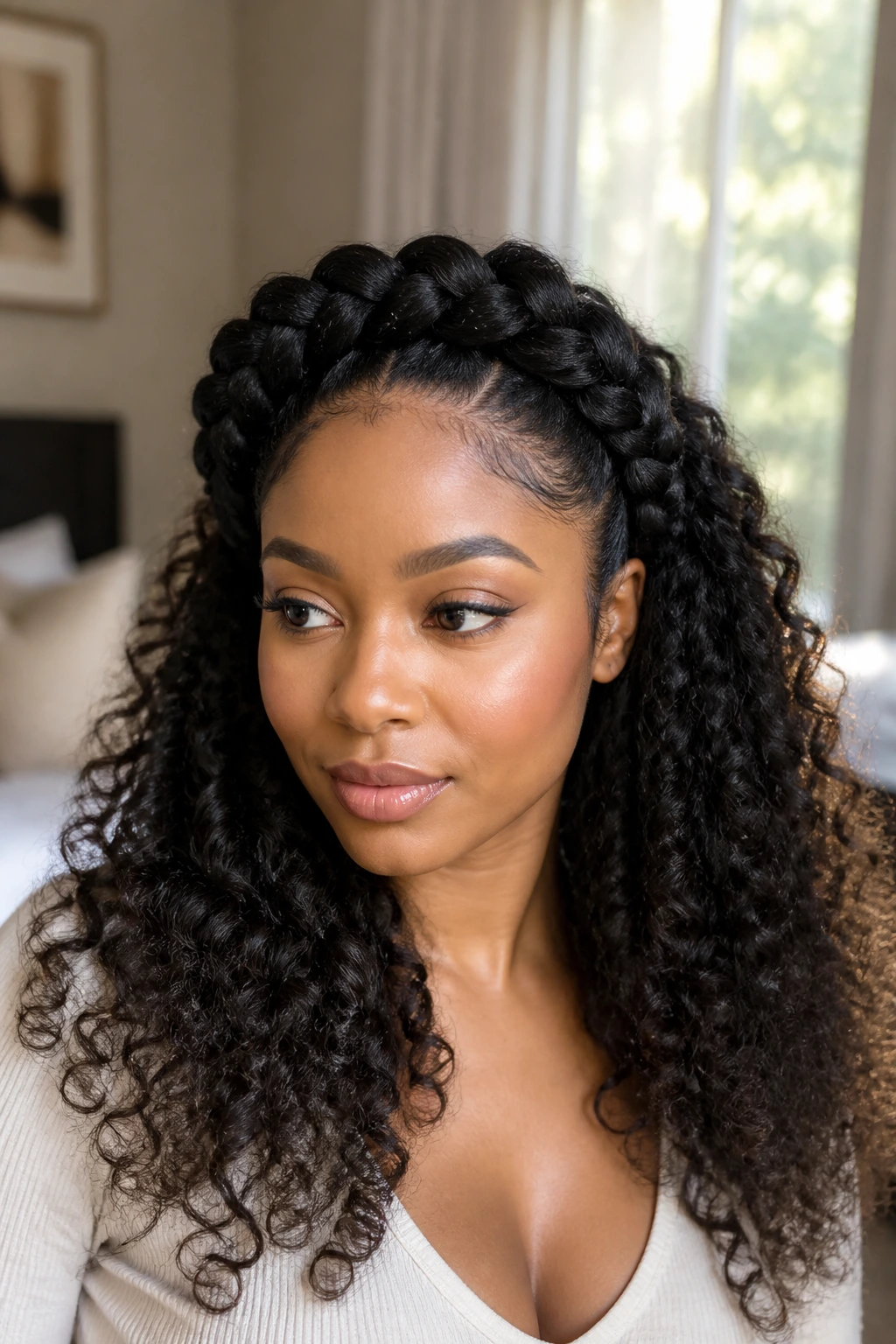
A braid across the crown does something slick styles rarely do: it gives the head a clear line without starving the hair of texture. The braid acts like a frame, and the free curls below keep the whole look from feeling severe. On a round face, that split is useful. The eye sees structure at the top and softness around the shoulders.
Keep the braid high enough that it sits near the upper hairline, not draped low across the forehead. Low placement can shorten the face. High placement opens it up. The curls that hang below should be defined but not over-separated; a little clumping helps them fall in stronger sections instead of ballooning out near the cheeks.
I like this style for days when you want your hair off your face but don’t want a full updo. It has a cleaner shape than leaving everything loose, and it still lets the coils do what they do best. If you add a few small pins or a thin metallic cuff, keep them near the braid rather than the widest part of the hair. Tiny placement details like that matter more than people think.
7. High Bun with Sculpted Edges
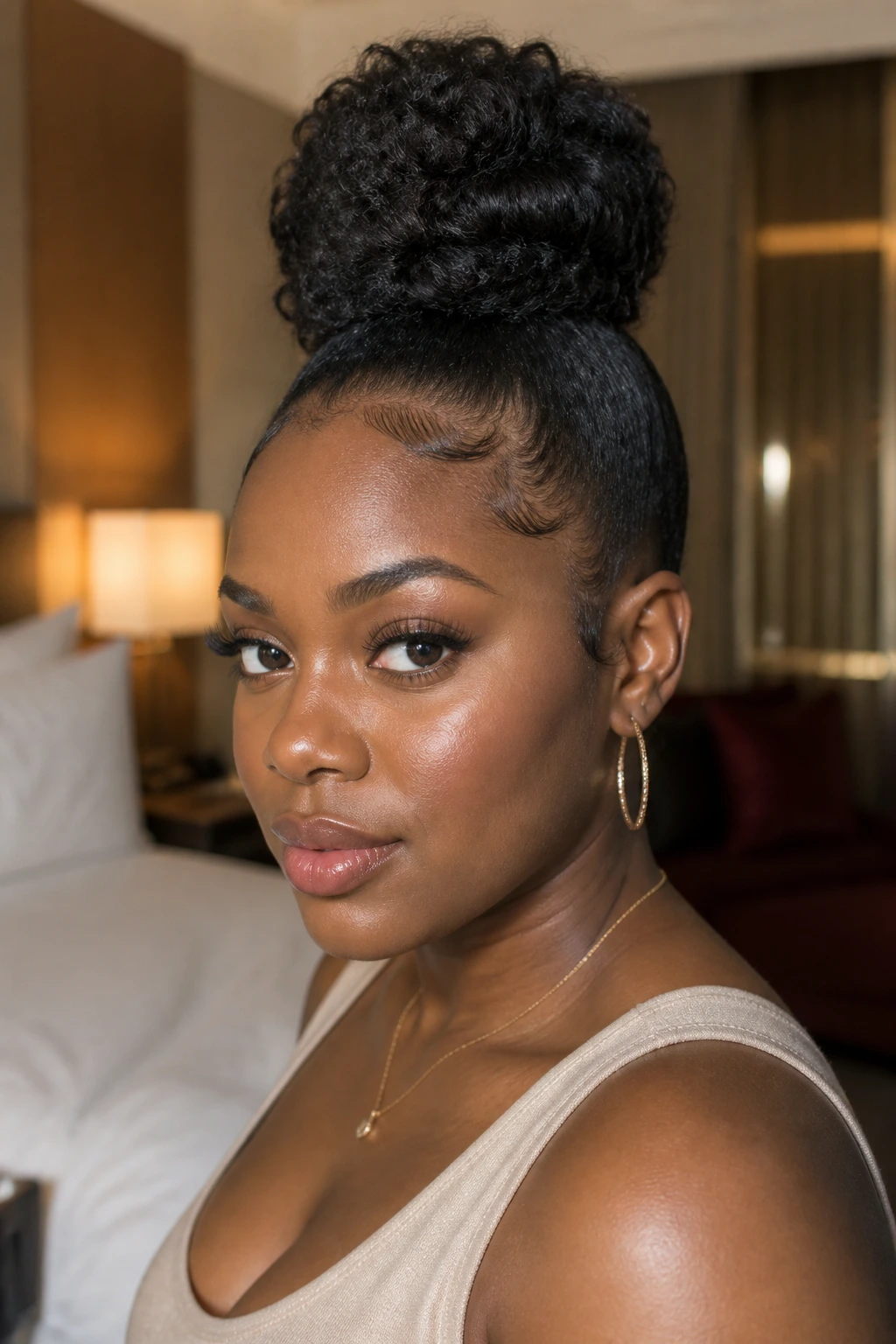
The high bun can look severe on a round face if it sits too low or too wide. Put it high — above the crown line — and it turns into a strong vertical shape instead of a heavy lump at the back of the head. That’s the difference between “pulled back” and “pulled together.”
I prefer a bun that keeps a little texture on top rather than a perfectly slick, glossy dome. Coily hair looks richer when you can still see the bend in the strands. Smooth the perimeter with a soft brush, gather the hair upward, and twist the lengths around the base instead of wrapping them flat and wide. If your hair is thick, a smaller bun usually flatters more than an oversized one.
Where the bun should sit
- High enough to show the nape.
- Narrow enough that it doesn’t spread across the back of the head.
- Firm, but not so tight that the scalp looks pulled.
The edges are the last thing to think about, not the first. A thin ribbon of laid baby hairs can soften the hairline. A full helmet of edge control usually does the opposite. Keep it light, and let the bun do the shaping.
8. Flat-Twist Halo Updo
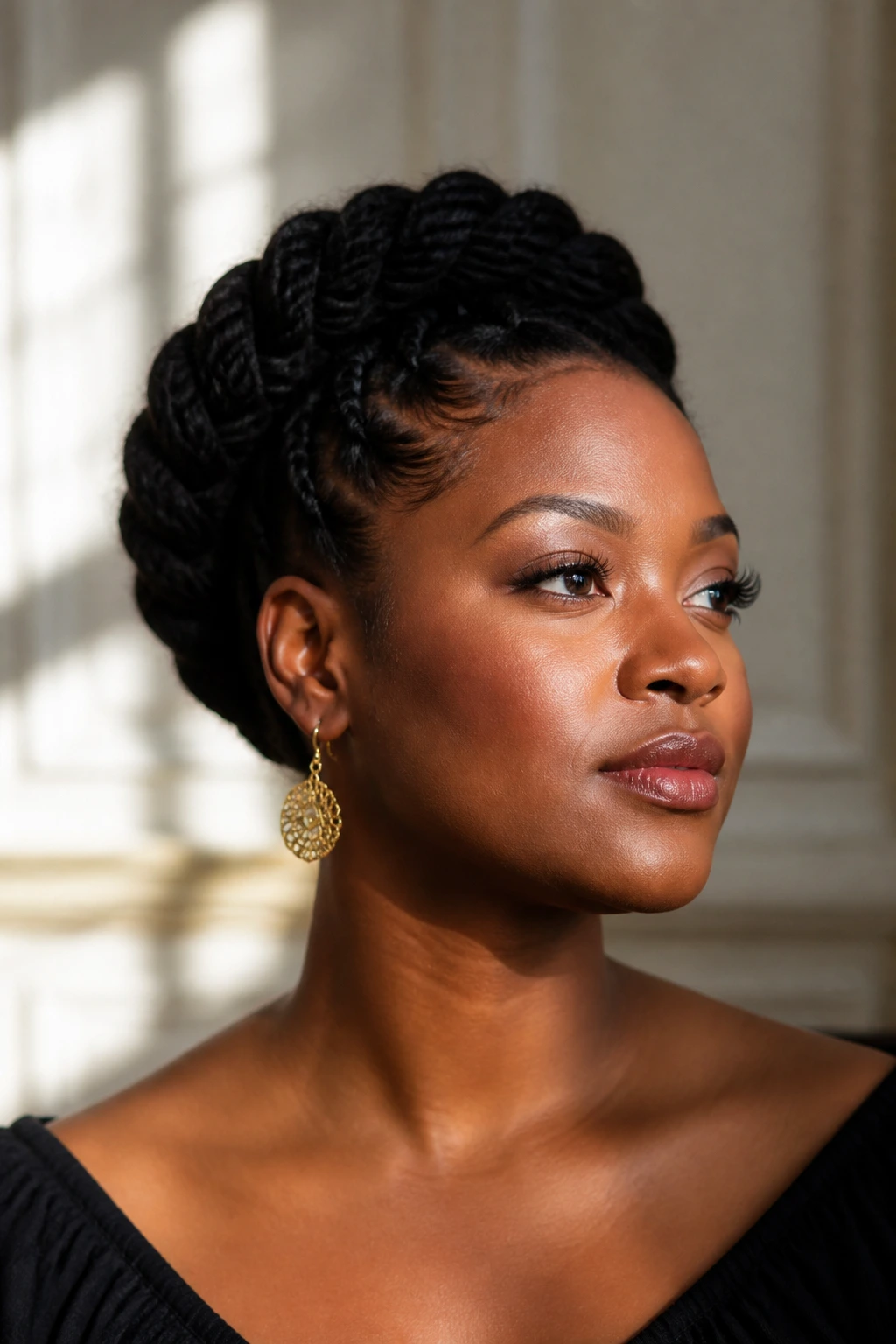
The flat-twist halo is a protective style that still feels polished. The twists travel around the head like a crown, which gives you a nice clean frame without leaving the face swallowed by volume. On a round face, I like this look best when the halo sits slightly higher on the head rather than hugging the temples.
That small change keeps the shape from reading too circular. The crown gets a little lift, the sides stay tidy, and the neck looks longer because the hair is pulled away from the widest point of the face. The result is calm, neat, and a little regal without being fussy.
It also has a nice practical side. You can wear it for several days with a silk scarf at night, and the twists usually hold their pattern well if the hair was stretched first. If your roots are slippery, section with a touch of styling foam before you begin. The twists will grip better and lie closer to the scalp.
9. Space Buns with Coily Bangs
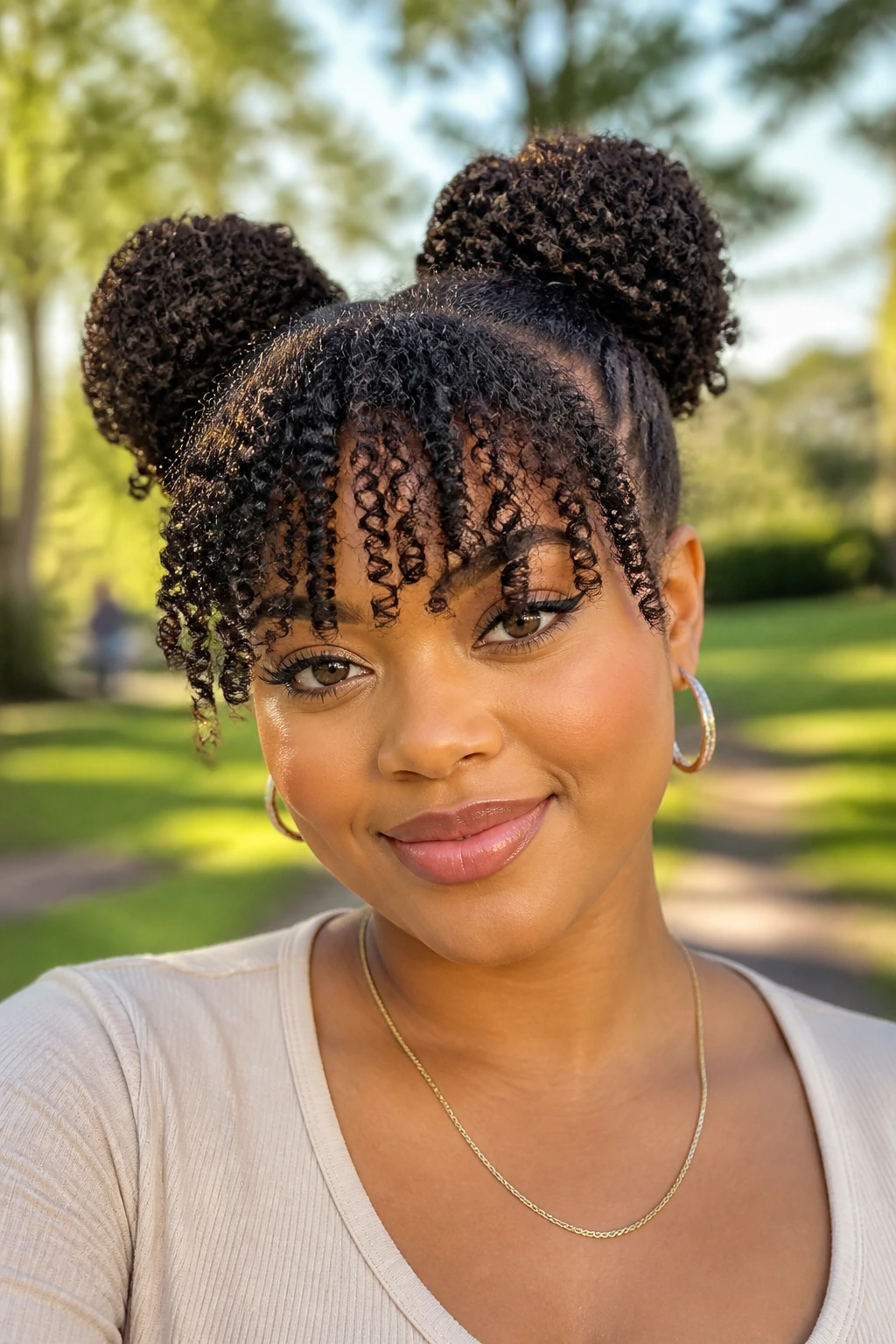
Space buns can go juvenile fast if they’re placed too low or too far apart. On a round face, the fix is simple: keep them high, keep them compact, and let the bangs do some of the softening. Coily bangs or a short curly fringe take the pressure off the forehead and give the face a break from perfect symmetry.
The bangs should be loose enough to move. If they’re too stiff, they look pasted on. If they’re too short, they can disappear into the hairline. I like them to skim the brow or sit just above it, with a little twist or curl left visible on the sides. That creates a broken line, which is much more flattering than a blunt block.
Space buns work especially well when you want something playful but not sloppy. Use a small amount of gel at the base, then twist the buns upward instead of out. The up-and-in direction matters. Outward buns widen the silhouette. Upward buns lift it.
10. Long Knotless Braids with Face-Framing Tendrils
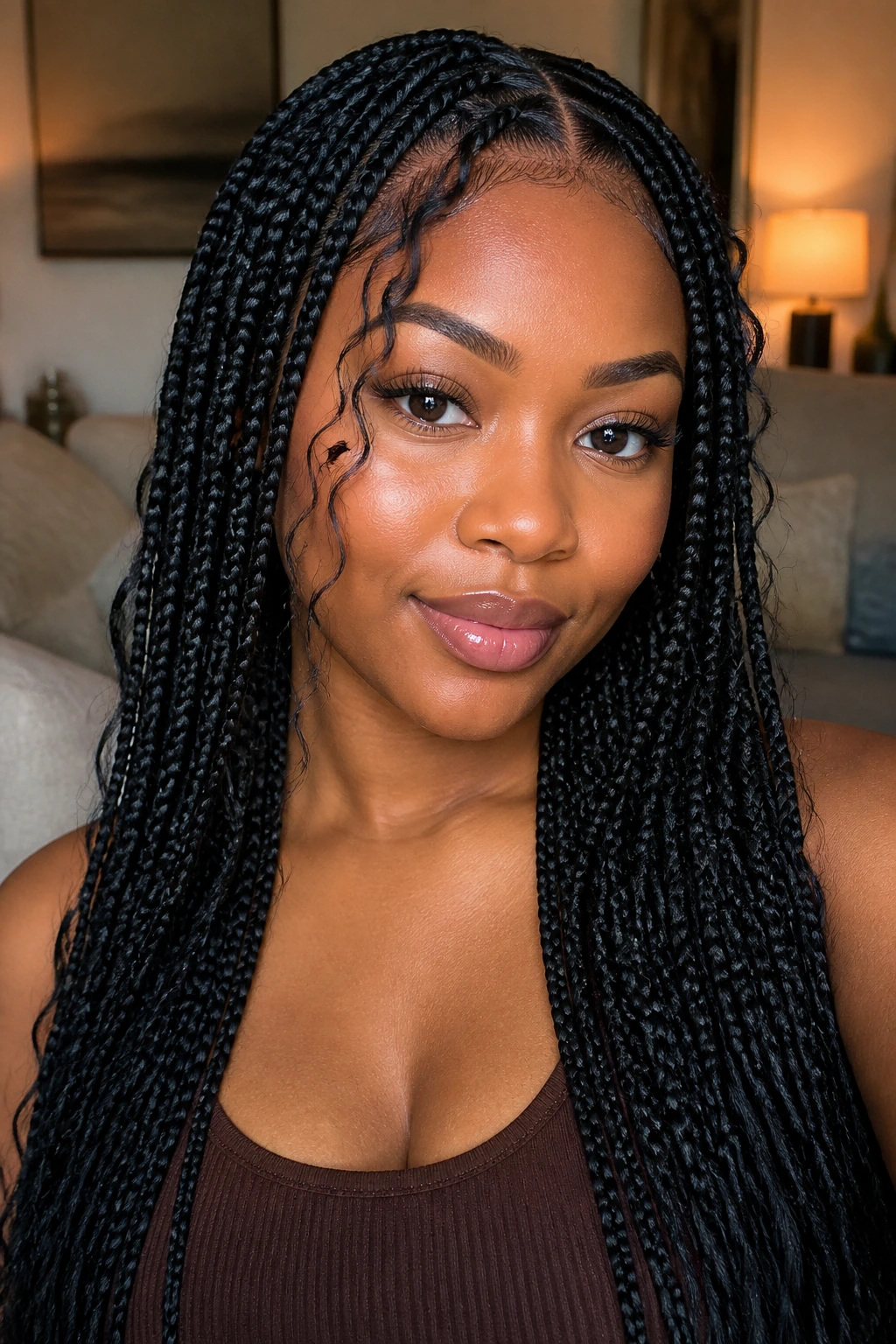
Braids can make a round face look longer, but only if the front is handled with a little restraint. That’s where knotless braids shine. They lie flatter at the scalp, move naturally, and don’t build a bulky knot at the base. Add a few face-framing tendrils, and the whole style stops looking boxed in.
I like braid lengths that land below the collarbone or closer to the bust. Anything too short can sit right at jaw level and make the face read wider. The tendrils do a lot of work here. A few loose pieces near the temples soften the outline and keep the front from looking too squared off.
If you’re choosing thickness, medium is the sweet spot. Tiny braids can sometimes disappear into the scalp if the hair density is high. Very thick braids can overwhelm smaller features. Medium gives you movement, which is really the point of this style.
A little mousse along the braid lengths helps keep flyaways down. Not too much. Just enough to keep the braids from looking fuzzy on the first day. After that, wrap them at night and leave the ends alone.
11. Bob-Length Flexi Rod Set
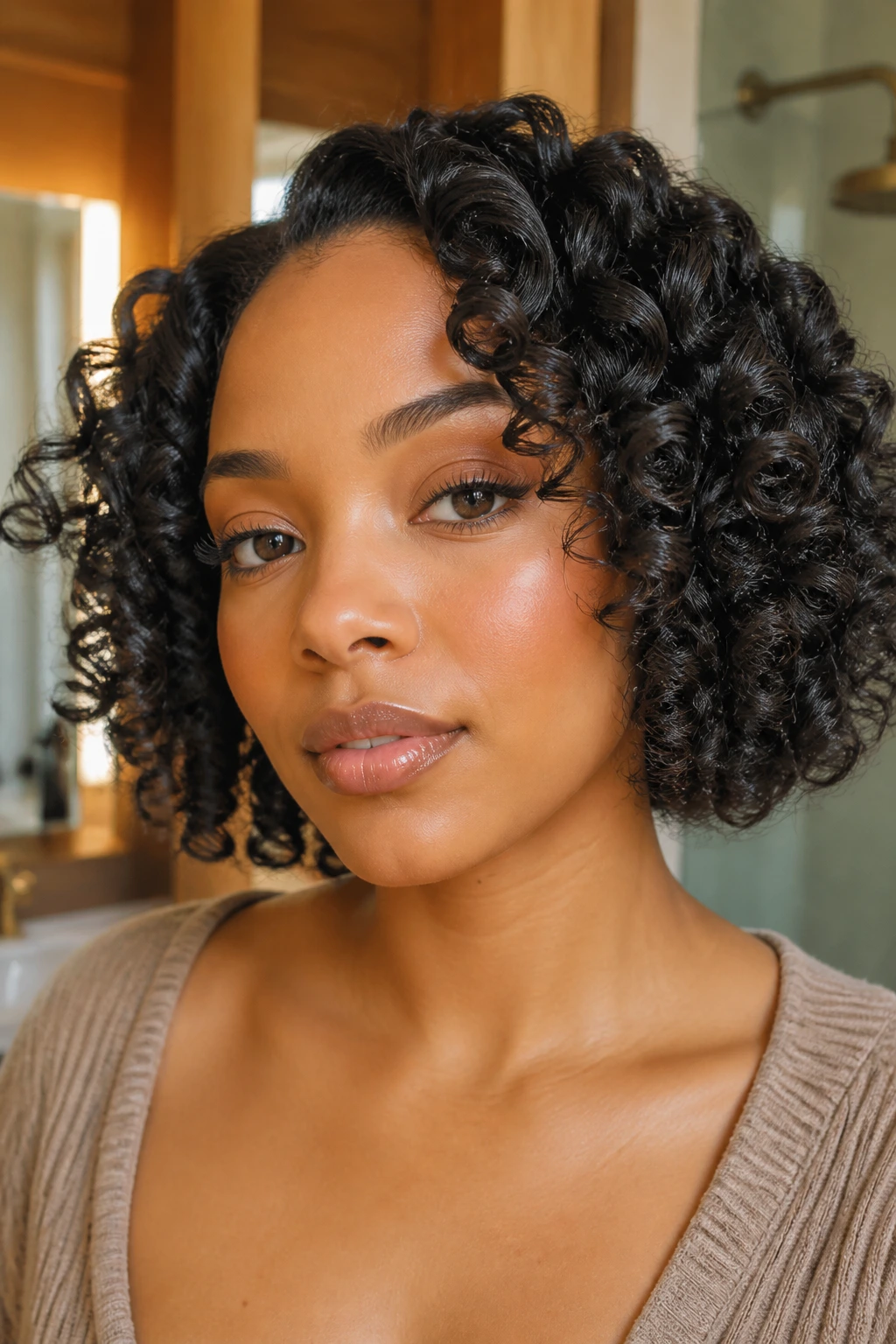
Can a bob and a round face work together? Absolutely, if the curls are shaped with some lift and the length falls below the chin rather than stopping right at it. A flexi rod set gives you those neat spiral curls that look polished without crushing the natural texture.
The bob length is the part that needs attention. If it ends at the widest point of the cheeks, the silhouette can feel boxy. If it skims the jaw or lands just below it, the line gets cleaner. A side part helps even more because it shifts the curl mass away from the center of the face. That small shift buys you more shape than people expect.
Drying is the part nobody wants to hear about, but it matters. Flexi rods need to be dry through the center before they come out. If the hair is damp in the middle, the curl will collapse and puff. That’s how you end up with a bob that looks rounder than you wanted. Give it the time.
12. Afro with Shaped Sides and Height on Top
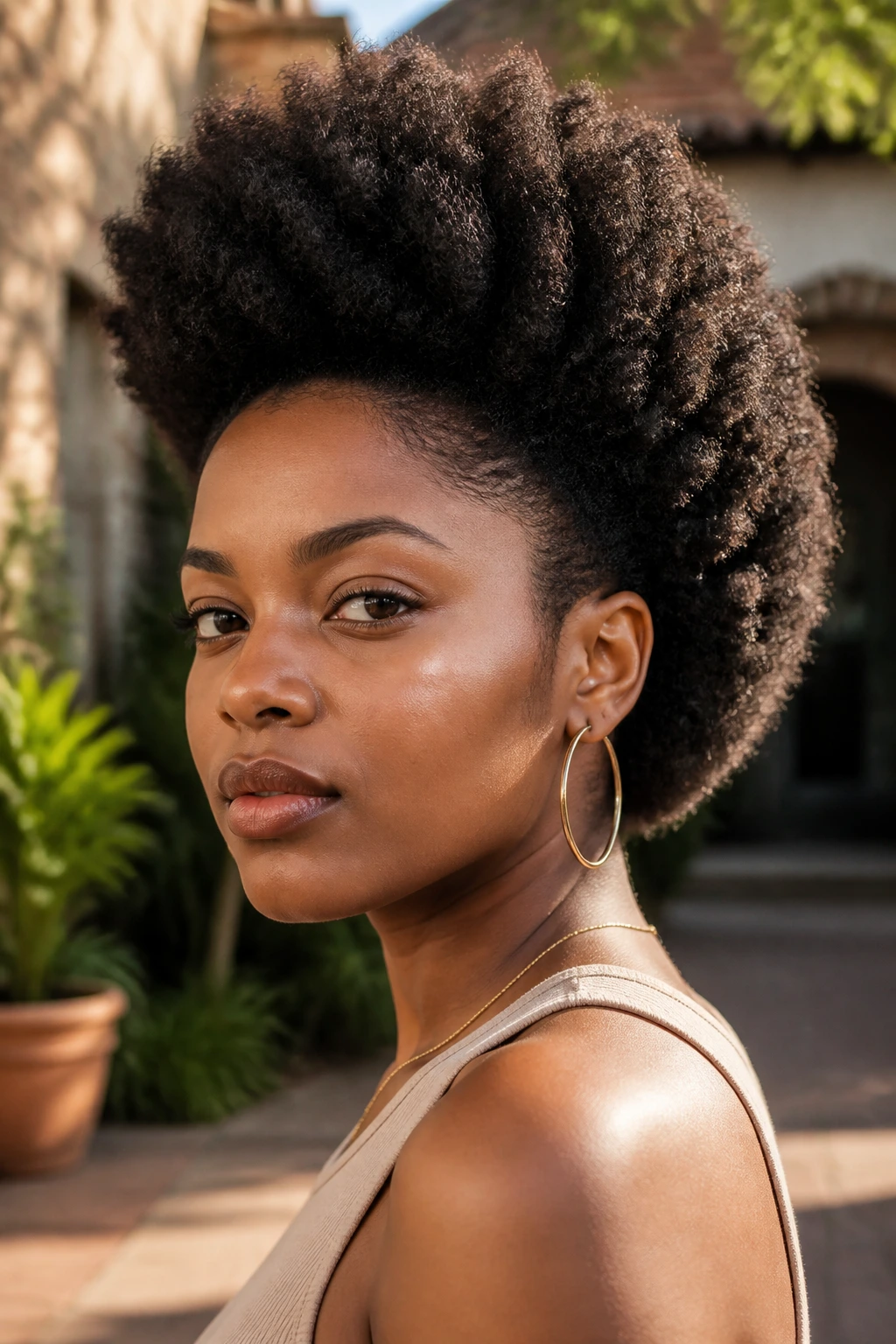
A shaped afro does not need to be small to flatter a round face. It just needs intention. The sides can stay close to the head at cheek level while the top carries the fullness upward. That creates a kind of sculpted oval instead of a perfect circle, and the difference is huge.
I’m picky about the outline here. A puffed-out shape that widens at the jaw can make the face look broader than it is. A shape that narrows slightly at the sides and rises at the crown gives the hair a cleaner silhouette. If you trim your afro, ask for a shape that follows your face, not a generic rounded ball. Coily hair has enough natural presence already. It does not need a second circle.
Use a pick at the roots only. Don’t rake through the middle of the strands unless you want frizz. A little oil on the pick can help it slide without snagging. And if the top feels flat, lift only the uppermost layer. That keeps the body where you want it.
13. Chunky Flat Twist Out
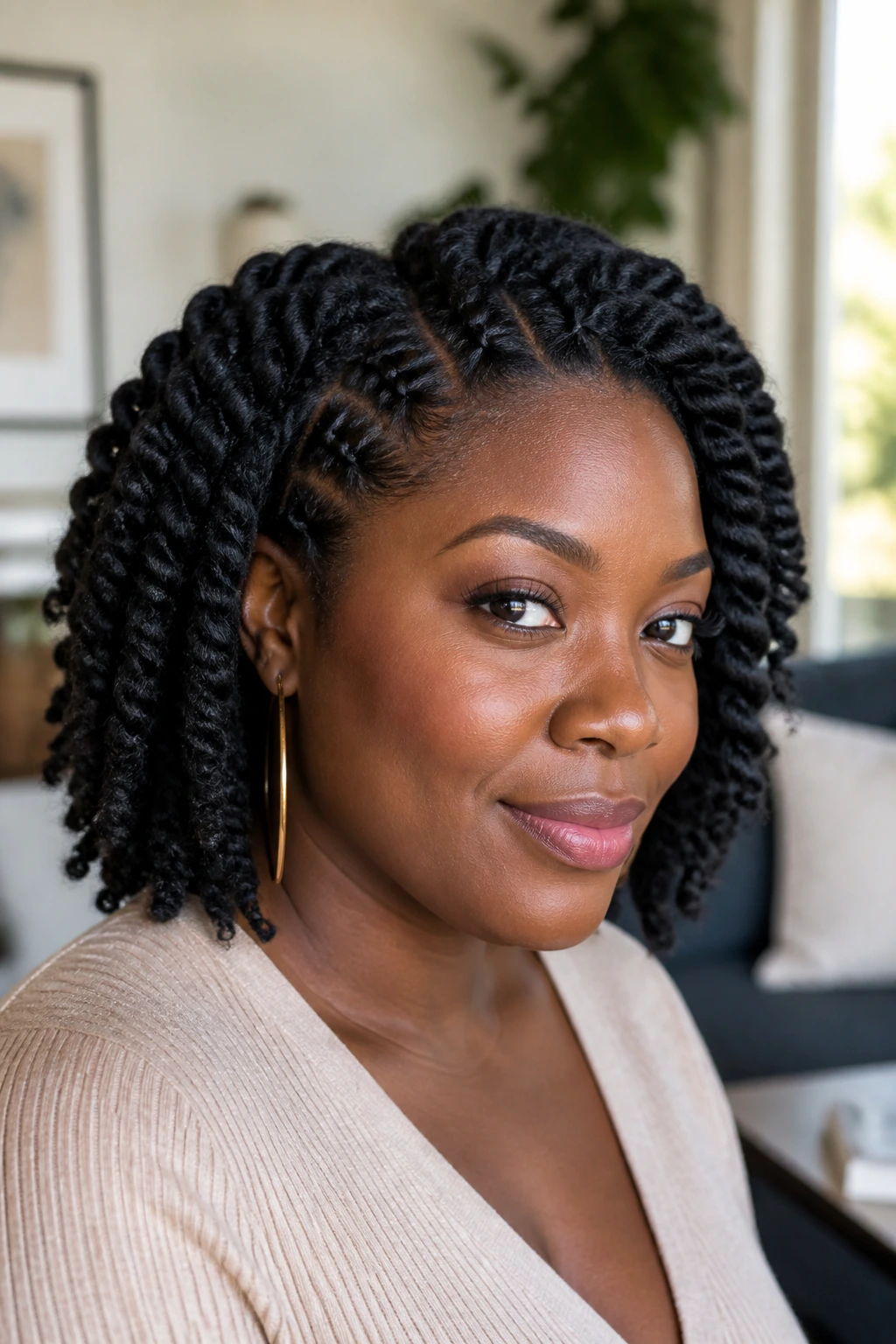
A chunky flat twist-out is one of my favorites when I want definition with a bit of stretch. The twists lie flatter at the roots, which helps control width near the cheeks, and the unraveling creates a rope-like texture that feels more directional than a standard twist-out.
The chunkier sections matter. Too many tiny twists can make the hair explode into too much volume around the face once you separate them. Larger flat twists give you a more deliberate pattern and a longer stretch. That stretch helps on a round face because the silhouette drops downward instead of flaring sideways.
What makes it different
- Flat twists anchor the roots closer to the scalp.
- Chunky sections create visible movement without a halo of frizz.
- The finished shape can be worn fuller at the ends and neater near the face.
I like to set this style on stretched hair, then sleep in a bonnet until it’s fully cool and dry. Unraveling too soon ruins the pattern. If you want more lift, separate just the front twists a little less than the back. That keeps the face frame cleaner and the rest of the style fuller.
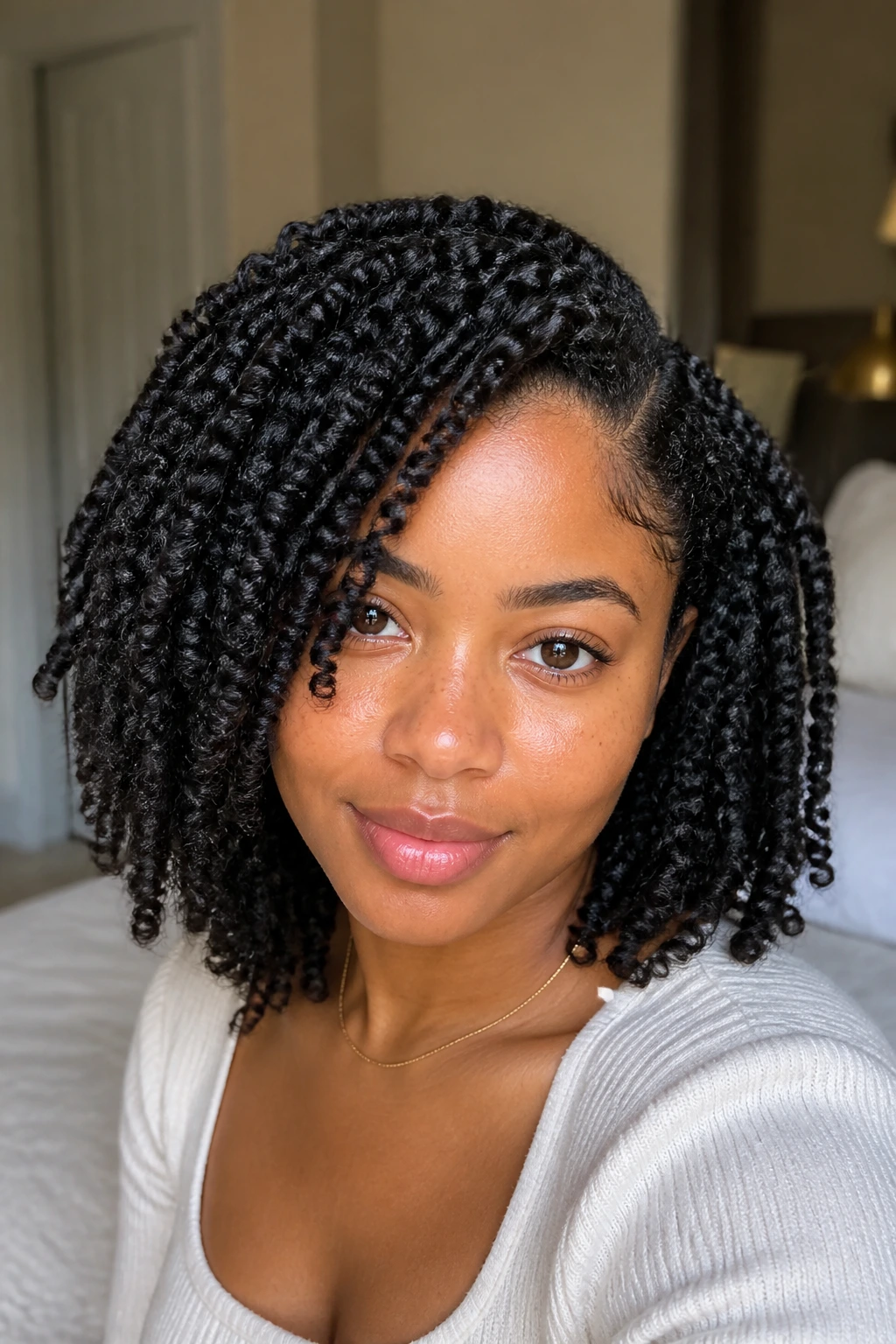
14. Mini Twists with a Deep Side Part
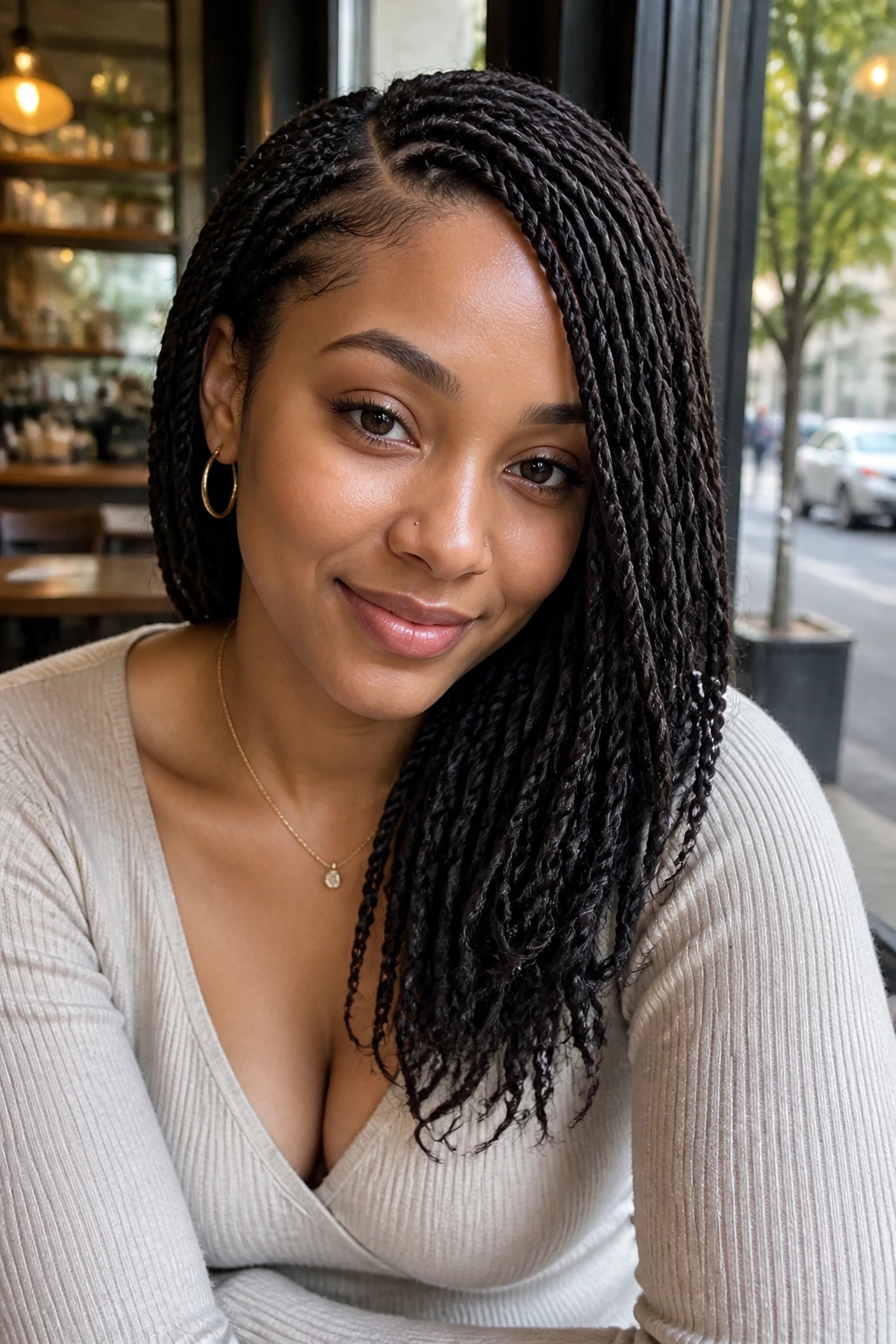
Mini twists are the kind of style that looks modest until you realize how much shape control it gives you. The deep side part breaks up the symmetry, which is half the battle on a round face. The tiny twists add enough texture to keep the style from lying flat, but they don’t balloon the way loose curls can.
This is a low-manipulation style I like for busy stretches, travel, or any week when your hair needs to be left alone. The part is where the personality comes from. Move it a few inches off center and the whole face changes. The left or right side can carry more twist mass, while the other side stays cleaner and closer to the cheek.
Keep the twists light at the root. Heavy product near the scalp makes them droop faster and can leave residue in the part. A small drop of oil at the fingertips when you separate the sections helps the twists stay neat without feeling greasy. The whole style should move when you do, not hang like rope.
15. Half-Up Half-Down Puff
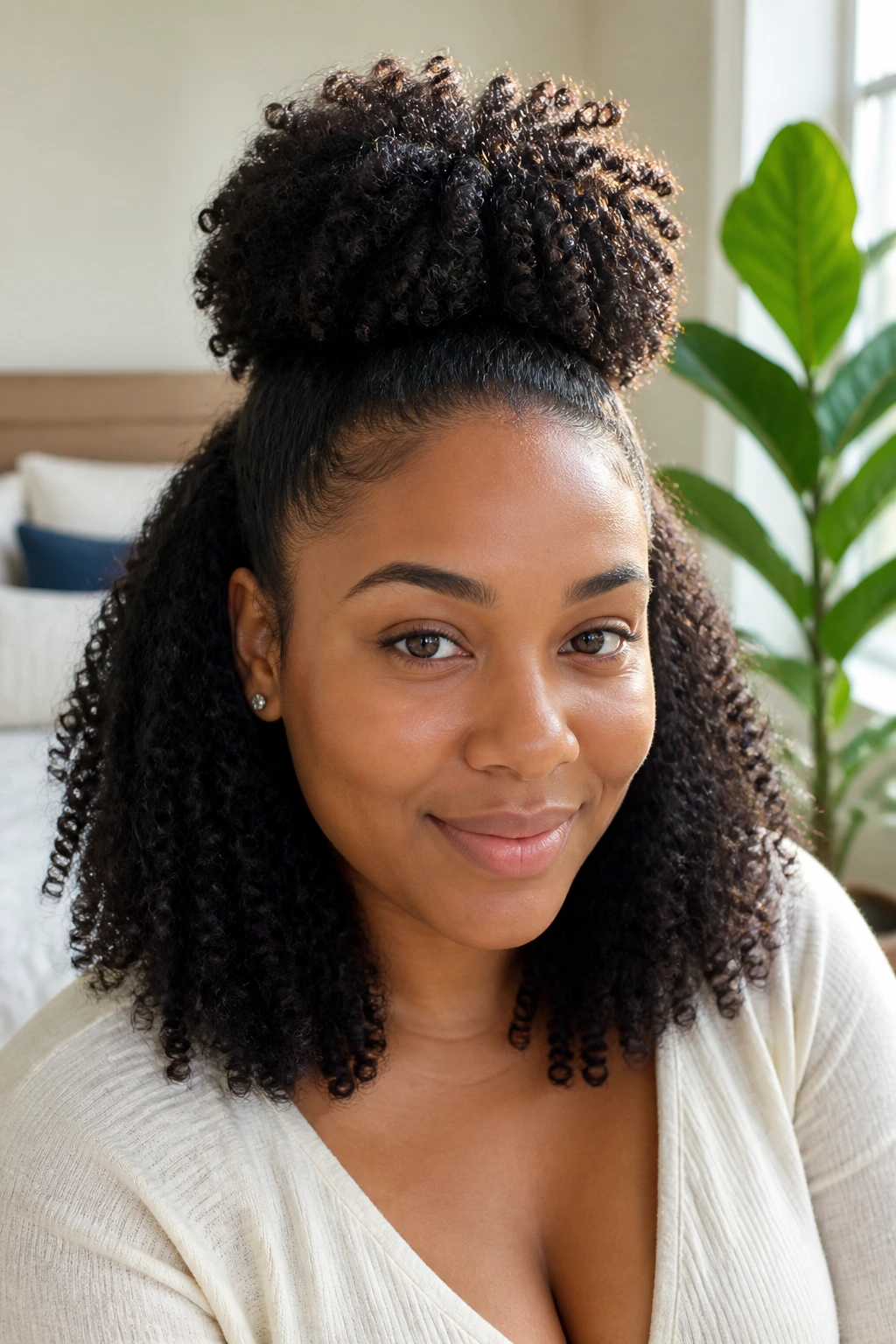
A half-up half-down puff gives you two shapes at once: lift on top and length below. That combo is gold on a round face, because it lets the crown do the vertical work while the back keeps the style soft and full. It’s a nice middle ground if you don’t want your hair fully up or fully loose.
The half-up section should sit above the temples, not right at the widest point of the face. That placement changes everything. Too low, and the style can feel heavy around the cheeks. Higher up, the face opens and the eye goes upward before it drops to the length below.
I like to leave a few coils loose around the front hairline if the puff is high and smooth. Those little pieces stop the look from becoming too formal. If the back is especially dense, stretch it lightly with a braid-out or a loose twist-out first. The half-down portion falls better when it has some shape of its own.
16. Sisterlocks with a Side Sweep
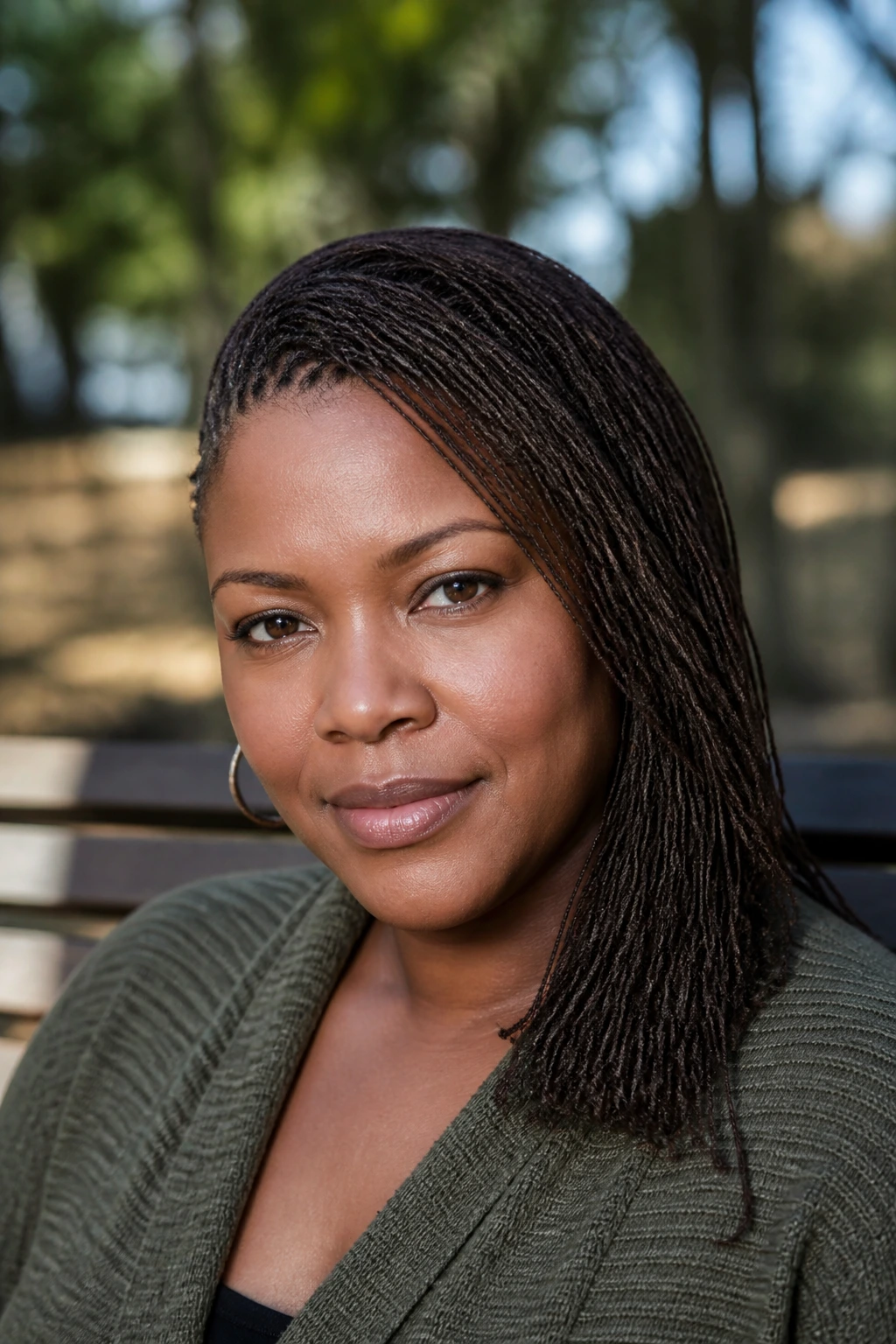
If you already wear locks, a side sweep is one of the simplest ways to stop the silhouette from reading too round. Sisterlocks fall in a finer pattern than thicker locs, which gives you more movement and more control over where the hair lands. Sweep them to one side, and the face picks up a diagonal line instead of a full circle.
The side sweep works especially well when the locs are medium to long. Shorter locks can still do it, but the visual effect is softer. Use a discreet pin or a small clip behind one ear if the front wants to drift back into the middle. The goal is not to freeze the hair in place. It’s to hold the angle long enough for the shape to read.
I’d avoid heavy butter or thick cream here. Fine locs can collect buildup fast, and buildup makes the style feel heavier around the face. A light mist and a clean part go further than product stacking. Clean roots. Clear line. That’s the charm.
17. Curly Mohawk Updo
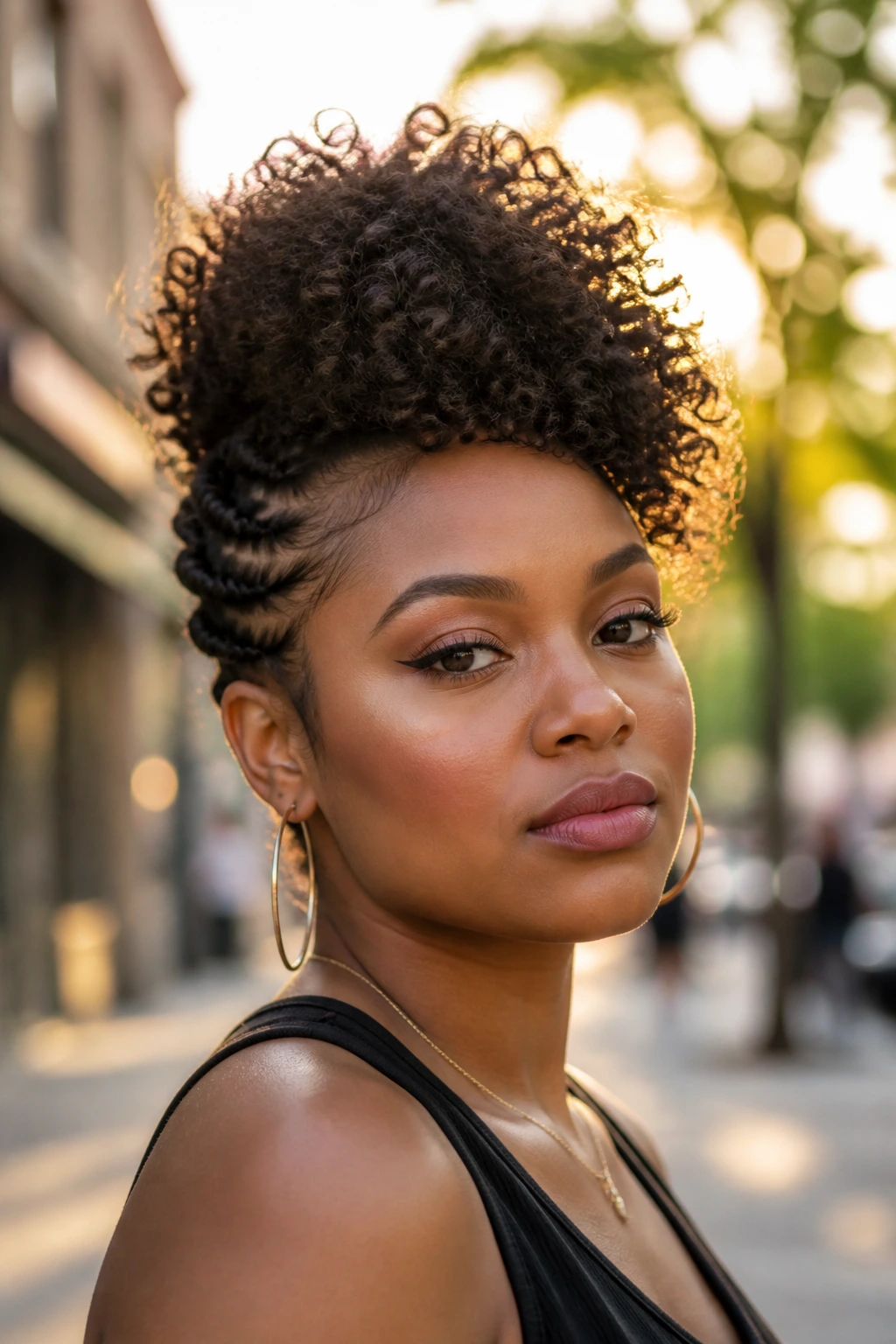
This is the style for anyone who wants shape with a little bite. The sides stay tucked, braided, or pinned close, and the center strip rises into curls, coils, or twists that give the head a strong vertical line. On a round face, that line is doing real work. It narrows the visual field without stripping away texture.
The center section should have enough height to be obvious from the front. If it lies too flat, the mohawk loses its edge and starts reading like a regular updo. I prefer a little asymmetry in the curl placement too. A slight lean to one side keeps the style from feeling too exact, and exact is not always flattering on a fuller face.
You can keep this neat with bobby pins hidden under the curls and a light hold spray at the finish. Just don’t load the hair with too much product. Once the curls stop moving, the style loses some of its energy. This one is best when it still has a little spring in it.
18. Side-Swept Afro Puff
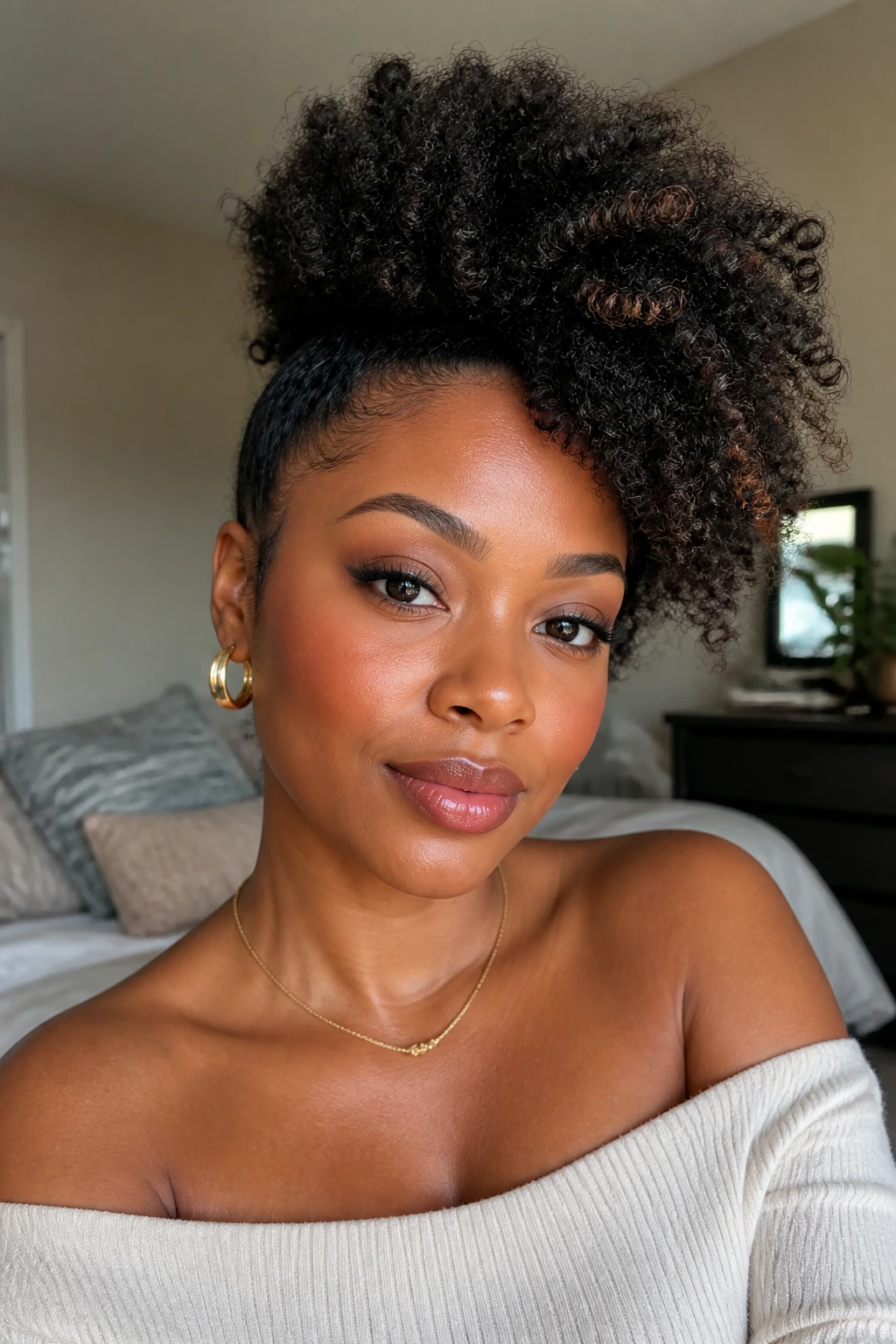
A side-swept afro puff is one of those easy shapes that can look surprisingly elegant if the placement is right. Instead of sitting dead center, the puff rests off to one side above the ear or slightly behind it. That diagonal line pulls the eye across the face rather than straight out from it.
The face-framing effect is what makes it work. A centered puff can feel symmetrical in a way that emphasizes roundness. The side-swept version breaks that symmetry and gives the cheek area more breathing room. I especially like this on dense hair with a little stretch, because the puff has enough body to hold the off-center shape without collapsing.
Brush the front lightly, gather the hair low enough to avoid tension and high enough to keep the face open, then angle the puff to one side. A silk scarf overnight helps it stay where you put it. If the puff is slipping downward, the elastic is too loose or the hair is too soft with product. Tighten the base a touch and use less cream next time.
19. Bantu Knot-Out with Crown Volume
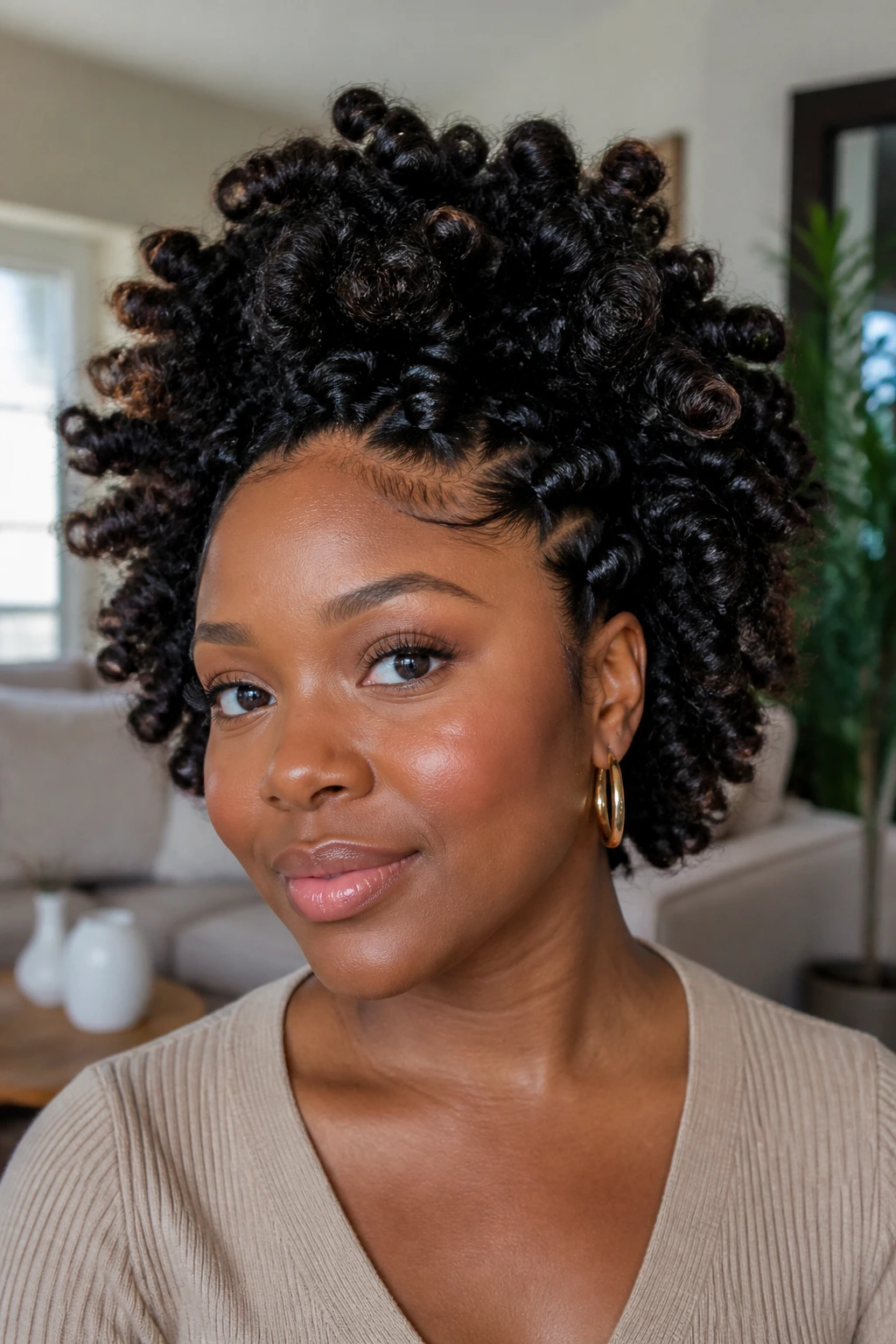
Why does a knot-out sometimes look better on day two? Because the hair has settled into itself. The curls separate a little, the roots lift, and the crown gets a touch more volume without the set losing its shape. On a round face, that crown volume is the point.
The size of the knots changes everything. Larger sections at the crown give you broader curl definition and less width around the cheeks. Smaller knots around the hairline keep the front neat and prevent the style from puffing too far outward. If you want a more sculpted finish, keep the sections around the face slightly larger than you think. Tiny knots near the temples can make the sides look too busy.
Drying matters here, too. A knot-out that isn’t fully dry at the base will frizz fast. If you sleep on it, let it dry under a bonnet or sit under a hooded dryer until the roots are no longer cool to the touch. The finished look should feel springy, not damp or sticky.
20. Cornrow Ponytail with Coily Length
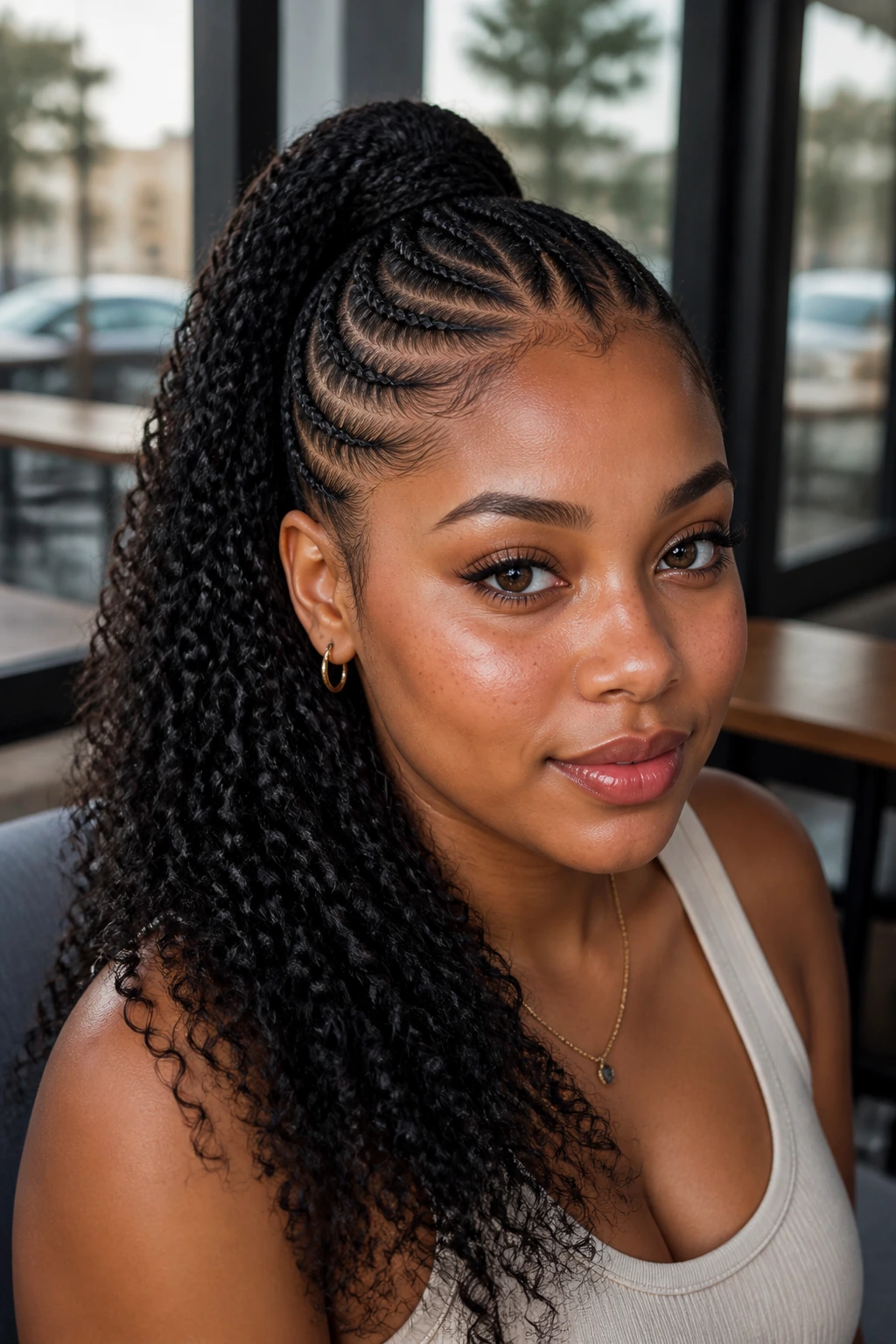
A cornrow ponytail gives you a clean scalp line and a long fall of texture, which is a nice combination for a round face. The cornrows keep the front sleek and narrow, while the ponytail creates a vertical drop that stretches the silhouette. It is one of the easiest ways to make hair feel tidy without making the face look boxed in.
The ponytail should sit high or mid-high. Low ponytails tend to draw the eye straight across the jaw, which is not the move here. A ponytail above the cheek line gives the face more length and lets the length of the hair do the flattering work. If you’re adding coily extensions or leaving your natural hair out, keep the tail smooth at the base and textured through the ends.
I also like a small side part or a curved braid pattern at the front. Straight-back rows can look strong, but a slight curve softens the outline. That little bend matters more than a lot of people think. It keeps the style from feeling hard.
21. Layered Coily Shag with Curved Fringe
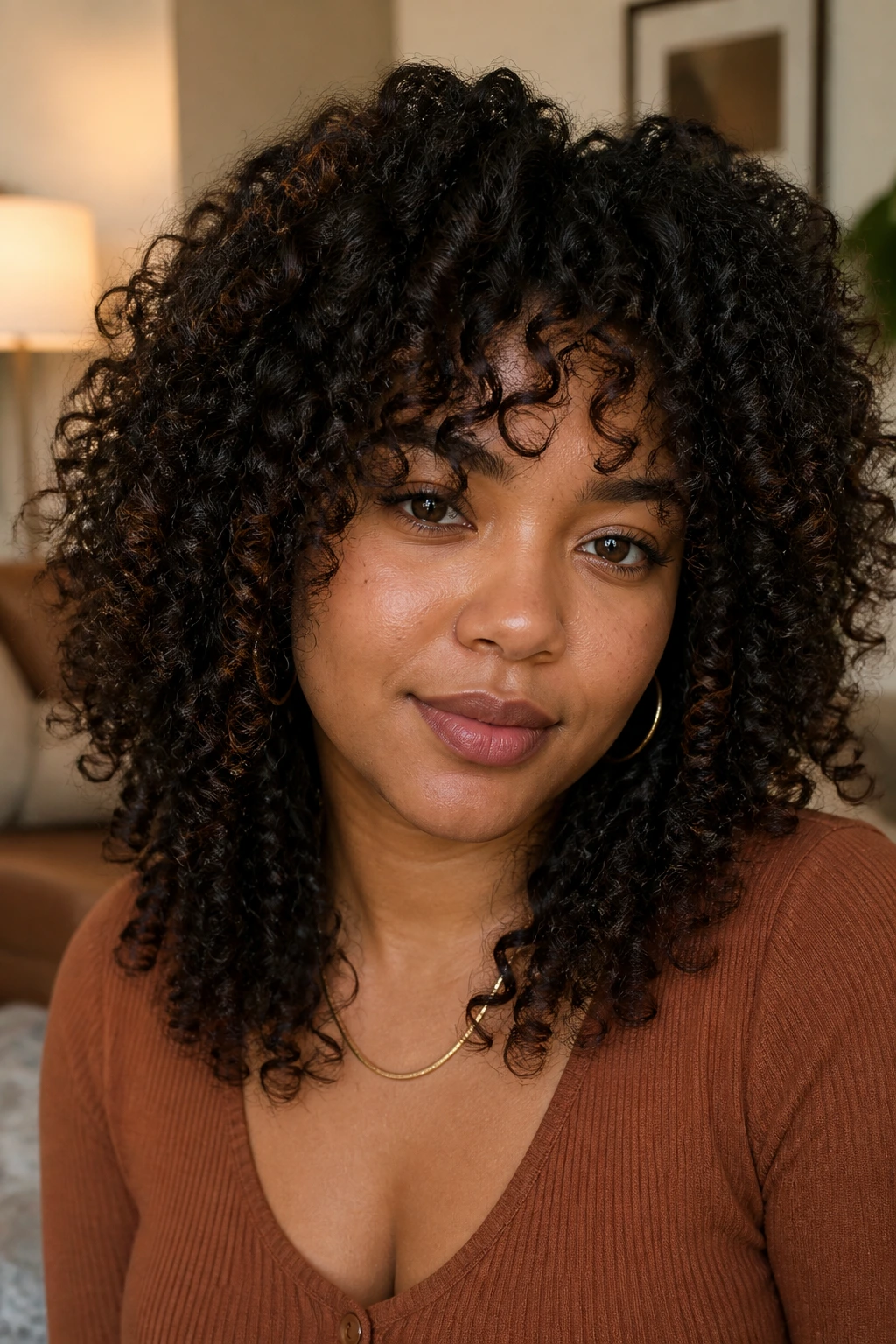
What if the haircut itself did the balancing? That’s the appeal of a coily shag. The layers build movement where the hair naturally wants to sit, and the curved fringe gives the front a soft break without swallowing the forehead. On a round face, that matters because the face already brings softness. The cut needs to add structure.
This style works best when it’s cut on dry or stretched hair. Coily hair springs up, and if the layers are cut too conservatively while wet, the shape can land in a place you didn’t ask for. I’m a big fan of curl-by-curl shaping for this kind of cut. It lets the stylist see where each coil really falls, not where it pretends to fall when wet.
The fringe should be curved, not blunt. A blunt line across the forehead can shorten the face. Curved pieces that land a little shorter in the center and longer toward the sides soften the outline and keep the eyes moving. If you like wearing your hair loose most days, this is one of the most useful cuts on the list.
22. Low Rolled Chignon with Twisted Sides
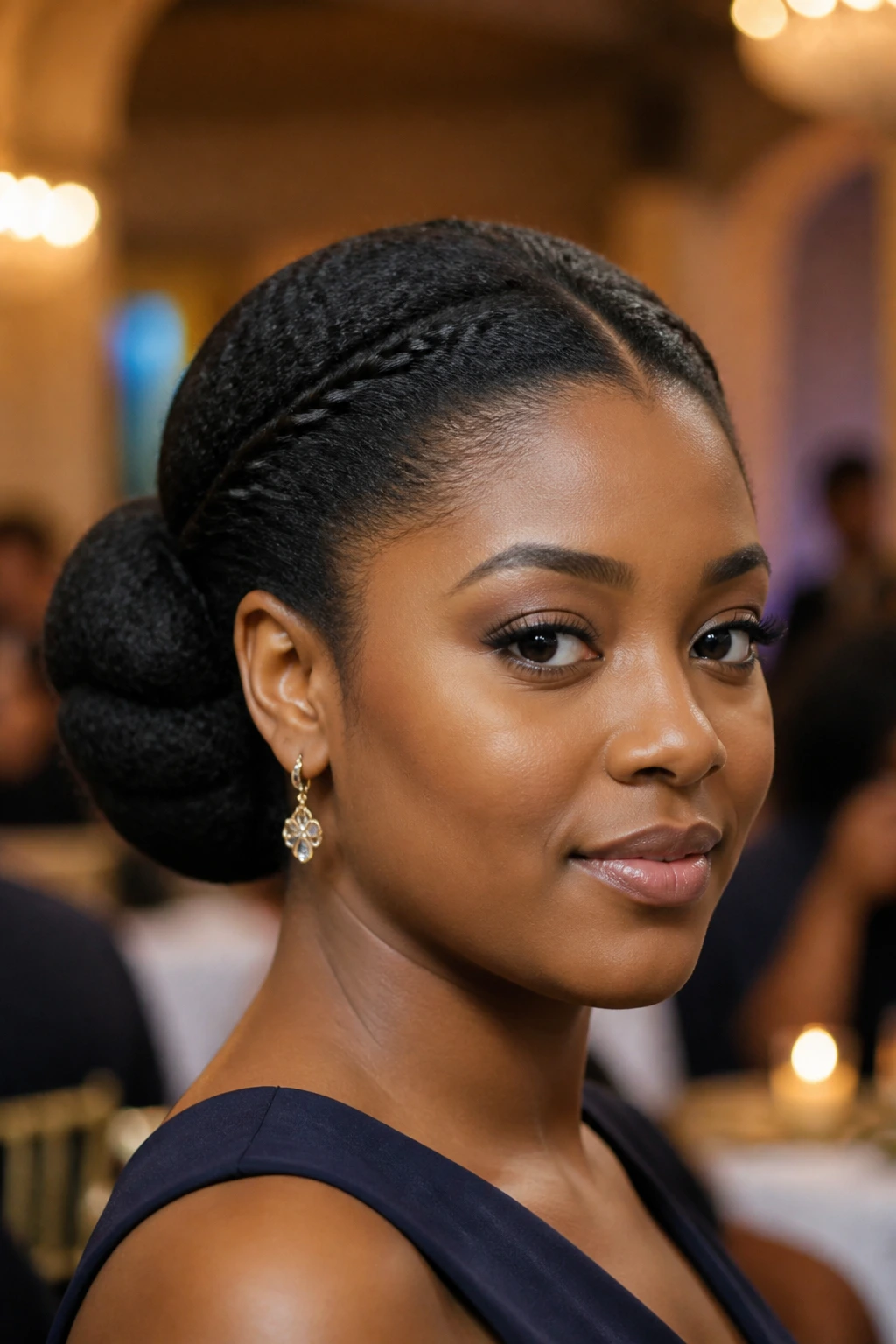
Low buns usually get ignored in round-face advice, and that’s a mistake. The problem is not the low bun itself. The problem is when it’s wide, flat, and parked right at the back of the head like an afterthought. A low rolled chignon with twisted sides keeps the shape narrow and neat, while the twists add vertical texture near the temples.
The roll should sit close to the nape, not spread across the whole back of the head. That keeps the silhouette long and controlled. Twisting the sides before pinning them into the bun adds just enough detail to stop the style from looking plain. It also helps coily hair stay put, since twisted sections grip better than loose ones.
I like this look for formal days, interviews, or any time you want the face to stay open without a high bun’s energy. Add one clean accessory — a pin, a comb, or a narrow barrette — and leave the rest alone. Too many extras compete with the shape. The shape is already doing the work.
What Makes Coily Hair and Round Faces Such a Strong Styling Match
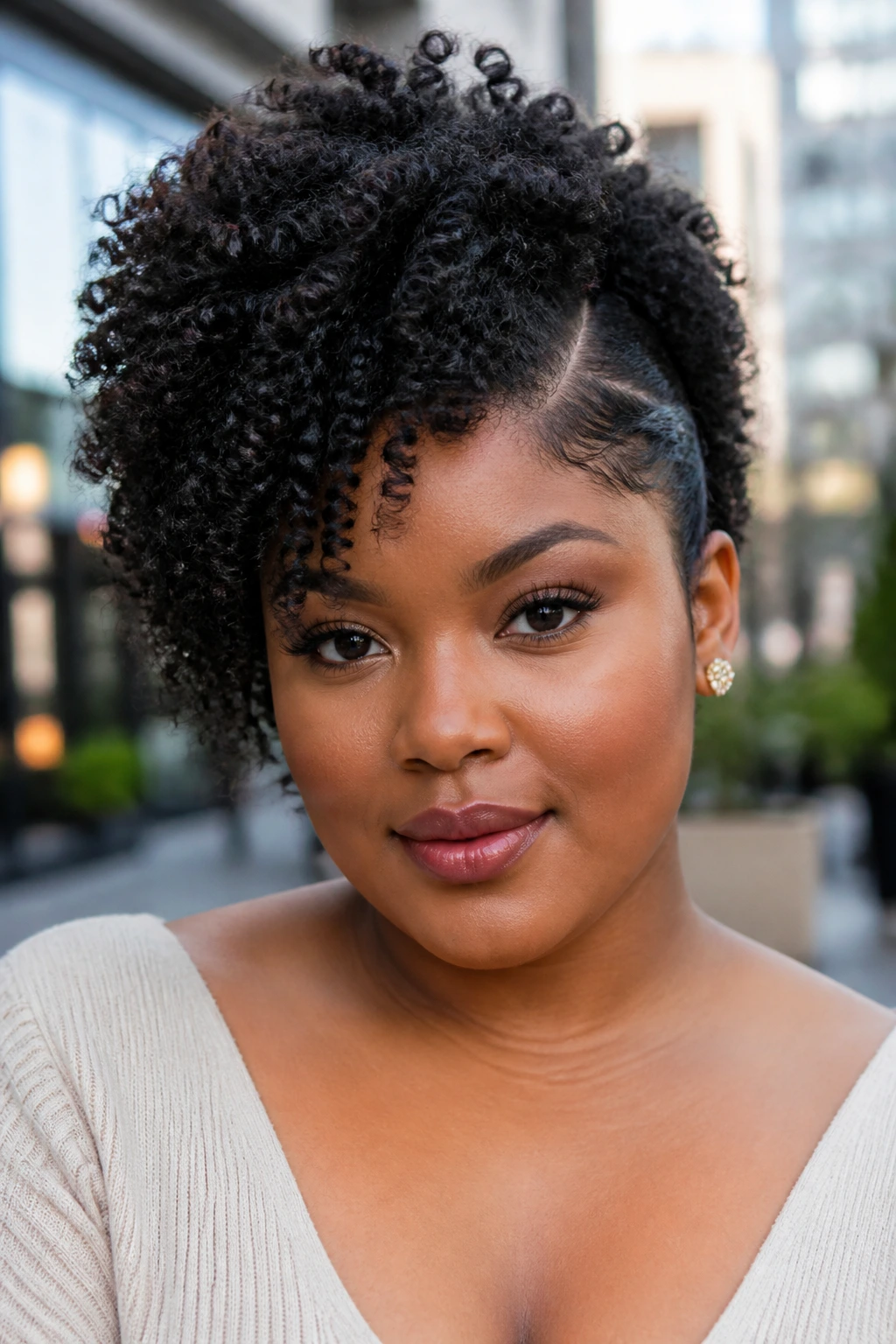
Coily hair and round faces are not a problem to solve. They’re a shape puzzle to play with, and the pieces are already there. Coily texture gives you volume that can be directed upward, outward, or diagonally. A round face benefits from any style that interrupts the circle a little — height at the crown, a side part, a swept bang, a braid track, a tighter side, a longer drop past the jaw.
Shrinkage is part of the story here, too. People sometimes treat it like an enemy because it hides length, but shrinkage also gives you lift, body, and a built-in way to make a style hold its own shape. A puff looks puffier. A twist-out gets more texture. A cut looks fuller without having to be huge. The trick is learning where the hair settles on your head instead of forcing it to behave like someone else’s texture.
The other thing worth saying is that you do not need to “hide” a round face. That’s bad advice. The goal is cleaner proportion, not disguise. A style that opens the forehead, narrows the sides a bit, or sends the eye on a diagonal usually reads better than one that smothers everything under the same level of width. Once you see that, the whole category stops feeling restrictive.
Essential Tools and Products for These Looks
-
Spray Bottle: A fine mist helps re-wet sections without soaking the hair, which is especially useful for twist-outs, coil sets, and refresh days.
-
Leave-In Conditioner: Pick a light one for puffs and wash-and-gos, or a creamier one for twist-outs that need a little more slip.
-
Curl Cream or Foam: Foam gives lighter hold and less buildup; cream gives more softness and better control for thicker coils.
-
Styling Gel: Use it on edges, braids, and slicked-back bases, but keep the layer thin so the hair does not flake or feel stiff.
-
Wide-Tooth Comb: Best for detangling wet hair in sections before styling. Don’t rake through dry coils unless you’re chasing volume on purpose.
-
Rat-Tail Comb: Useful for clean side parts, deep parts, and sectioning twists or braids with a neat line.
-
Denman Brush or Soft Detangling Brush: Good for defining curls and smoothing the base of updos without pulling too hard.
-
Bobby Pins and U-Pins: Essential for buns, halos, mohawks, and side sweeps. Use more than you think you’ll need, then hide the extras under the style.
-
Satin Scrunchies: Better than thin elastics for puffs and half-up styles because they don’t cut into the hair shaft as hard.
-
Satin Scarf or Bonnet: This is non-negotiable if you want the style to last past one evening.
-
Diffuser: Helpful for wash-and-gos, flexi rod sets, and anything that needs root lift without blasting the pattern apart.
-
Flexi Rods or Perm Rods: Optional, but useful if you want a bob set, a tighter curl pattern, or a more defined finish for special occasions.
Smart Prep for Coily Hair Before You Style
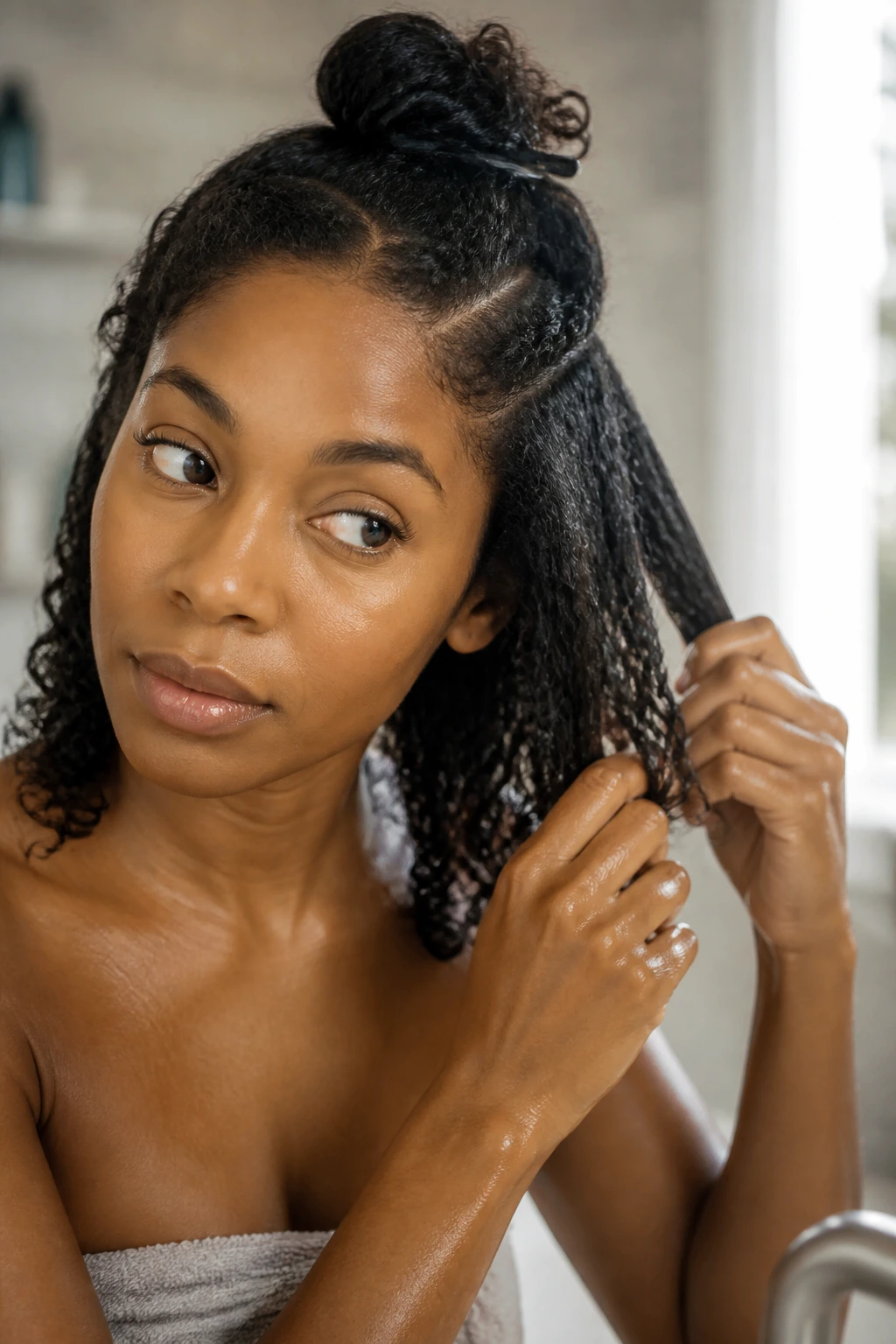
The best style starts before the parting comb comes out. Coily hair needs moisture, but not so much product that the whole head turns soft and sleepy. I like to start with clean, well-conditioned hair that has been detangled in sections, then leave it damp enough to accept product but not dripping down the neck. That one detail saves time and helps the product sit on the hair instead of sliding off it.
Think in layers. Leave-in first. Then the styler that matches the shape you want. For puffs and updos, a lighter moisturizer keeps the hair from slipping. For twist-outs and rod sets, you usually want a cream or foam with enough hold to keep the set from bloating. If your hair is dense, don’t overload the roots. Heavy product near the scalp weighs the style down and makes it hard to build lift.
Trimming matters more than people admit, especially on round faces. A good shape does not come from a miracle product. It comes from a cut or style that respects shrinkage. If you’re wearing a shag, bob, or shaped afro, ask for the hair to be cut in its natural state or at least stretched in a way that shows the true fall. Wet cutting on coily hair can be a gamble because the curl pattern changes so much as it dries.
How to Wear These Styles So the Shape Reads Cleanly
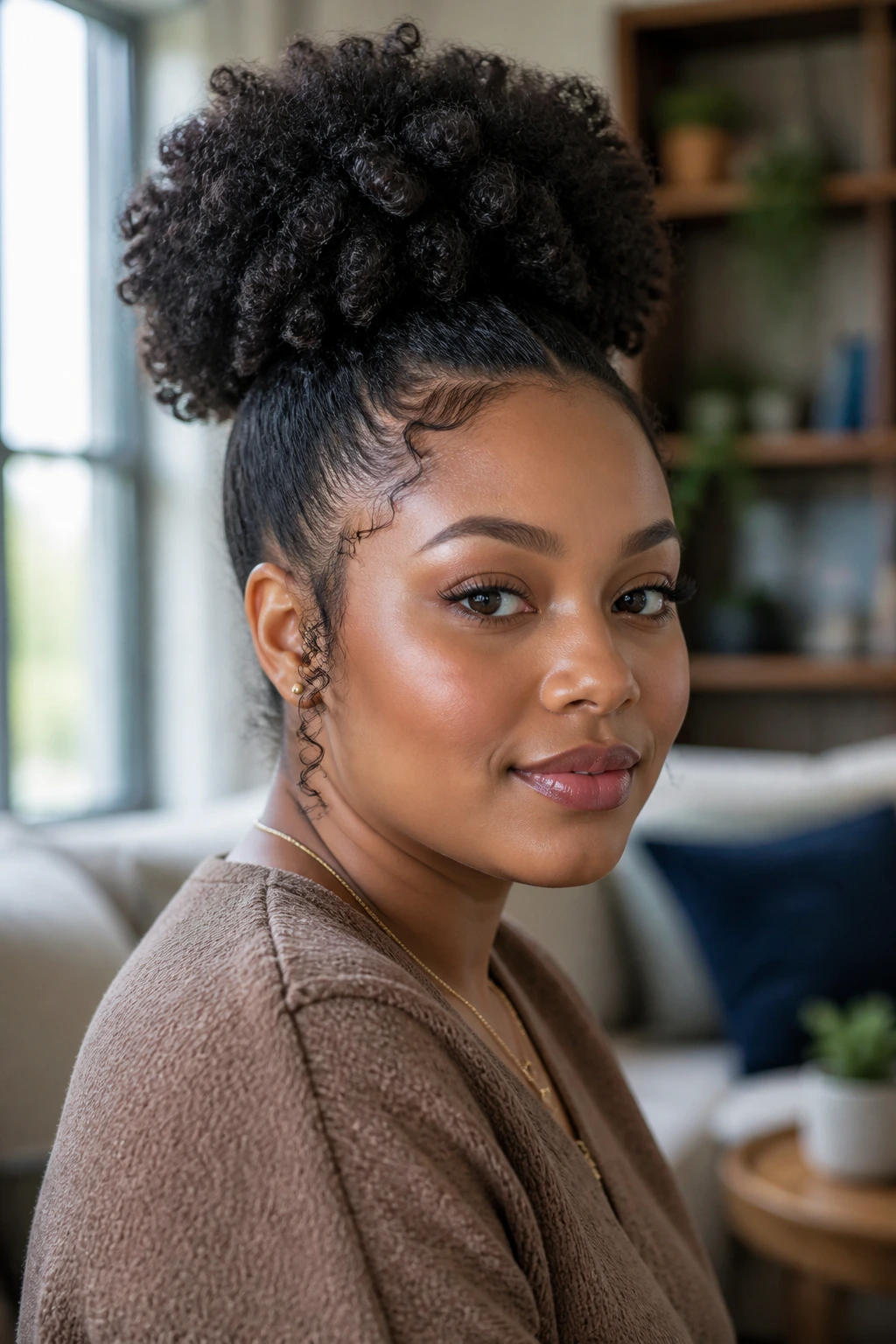
Height: Keep your tallest point above the crown or just behind it. That’s where puffs, buns, mohawks, and top-heavy cuts do the most work for a round face.
Width Control: Watch what happens at the cheeks and temples. If a style balloons there, pin it, stretch it, or move it higher so the widest part lands somewhere less noticeable.
Parting: A deep side part usually softens the outline better than a strict center part, though a center part can work if the top has enough lift or the length drops well below the jaw.
Edges: Use edge control as a finishing touch, not a mask. Too much slickness makes the scalp look hard and draws attention to the widest points of the face.
Accessories: Place clips, cuffs, combs, and pins above the cheek line when you can. Accessories at the widest point of the face tend to widen the whole look. Accessories higher up help the shape instead.
Texture Balance: If one part of the style is sleek, let another part stay fluffy or defined. That contrast keeps the look from feeling flat and gives coily hair the dimension it naturally wants.
Common Mistakes That Make the Face Read Wider
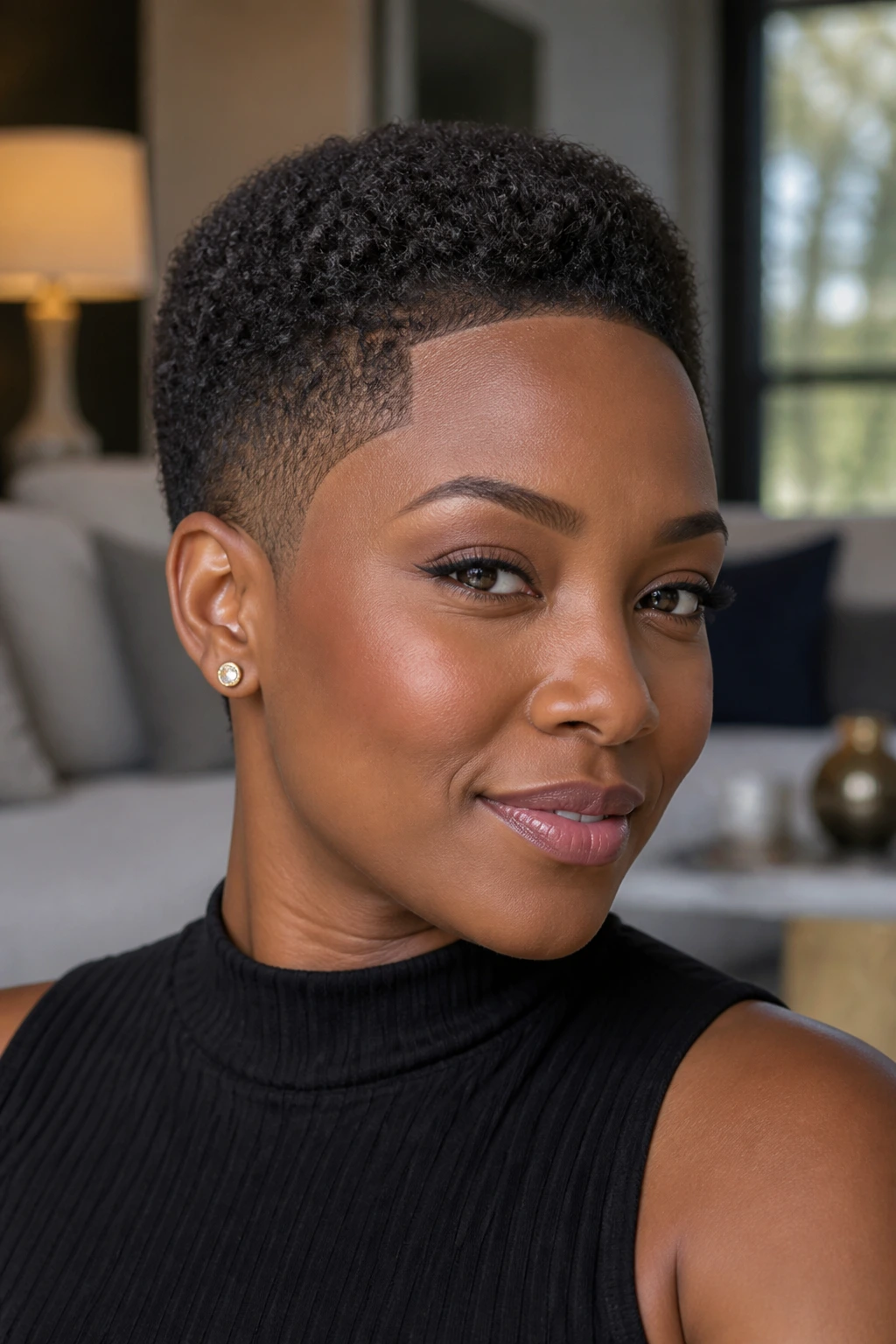
The most common mistake is parking all the volume at cheek level. A puff sitting low on the head, a bun that spreads wide at the back, or a twist-out that flares at the temples can make the face look broader than it is. The fix is annoyingly simple: move the shape up, narrow the sides, or let the length fall below the jaw.
Another easy misstep is over-slicking the front. A tight, shiny perimeter can look neat in photos, but on a round face it often sharpens the outline in a way that feels harsh. You don’t need a helmet. You need a clean hairline and a little softness around it.
Then there’s the half-dry style. Twist-outs, rod sets, and knot-outs that are taken down before the centers are fully dry puff up too fast and spread sideways. That’s when the shape starts drifting back toward a circle. If the roots still feel cool or damp, walk away for another hour.
A fourth problem is choosing symmetry when asymmetry would do more work. A center part on dense coily hair can be gorgeous, but if the hair sits wide on both sides of the face, it can shorten the look. A side part, a side sweep, or even a slightly uneven puff often solves the issue before it starts.
Finally, many people skip the cut. That hurts. Coily hair shaped badly will keep reading bulky no matter how good the product is. If your hair is long enough for layers or short enough for a taper, use the cut to help the style. Don’t make the style do all the work alone.
Ways to Change the Look Without Starting Over
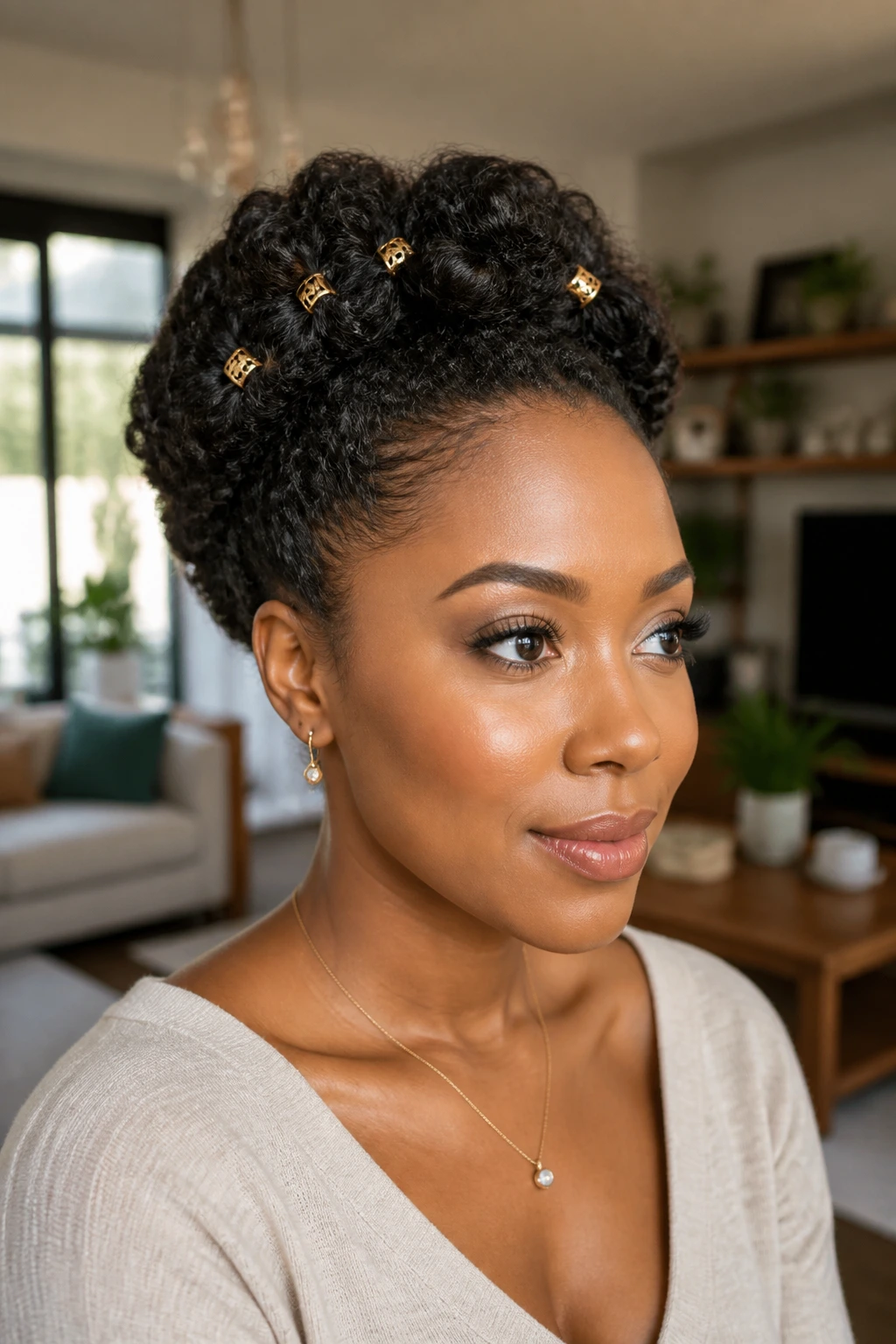
The Short-Hair Remix: If your hair is cropped, turn any of these looks into a smaller version — mini puffs, tighter twist-outs, a tapered frohawk, or a shaped TWA. The goal is the same: keep the crown active and the sides controlled.
The Protective-Style Reset: Braids, mini twists, Sisterlocks, and halo updos let you rest the hair while still keeping the outline flattering. Add tendrils or a side part when you want a softer face frame.
The Event Polish: If you need the look to read more formal, swap a scrunchie for pins, smooth the base with foam, and use one strong accessory instead of three small ones. Clean lines do a lot of the work.
The Low-Manipulation Week: Mini twists, a stretched afro, or a wash-and-go with a defined part are the best bets when you want less daily handling. Keep the ends moisturized and leave the roots alone.
The Heat-Free Stretch: Banding, plait-outs, twist-outs, and rod sets stretch coily hair without straightening it. That stretch helps the face look longer because the hair falls downward instead of ballooning outward.
Overnight Care and How Long the Styles Last
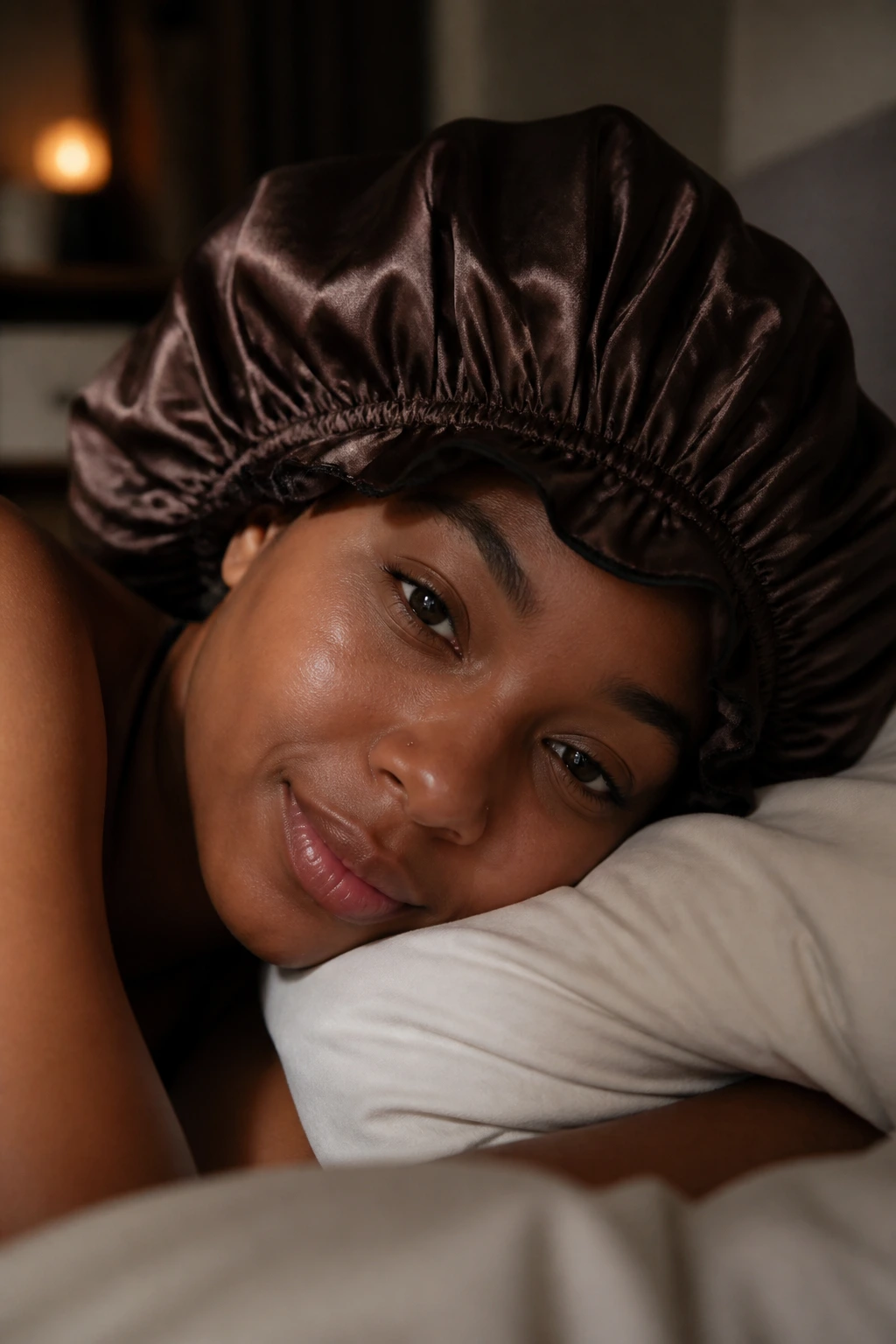
Puffs and buns are usually one-day styles, maybe two if you’re careful. Wrap the front with a satin scarf and cover the puff or bun with a bonnet if the shape needs to stay intact overnight. In the morning, a little mist at the hairline and a quick re-puff is usually enough.
Twist-outs, flexi rod sets, and Bantu knot-outs can last three to five days if the hair was fully dry when you took them down. Some people stretch them to a week, but only if they sleep with the curls protected and avoid heavy hands during the day. Once the roots flatten, a light pick at the crown and a touch of oil on the ends can revive the style.
Braids, flat twists, Sisterlocks, and mini twists have the longest runway. Depending on scalp health, tension, and how much the roots are moving, these can last from two to six weeks. I would rather see a style refreshed early than pushed too long. If the scalp starts itching, the roots start fuzzing in one thick halo, or the braid line shifts too much, it’s time to redo or clean up the style.
Wash-and-gos are the most temperamental. Many hold their best shape for two to four days, sometimes longer with a strong gel cast and a good sleep routine. Pineapple the top loosely, refresh the ends with a water-and-leave-in mist if needed, and avoid brushing the curls apart every morning. That’s how the shape disappears.
Frequently Asked Questions
Which hairstyle here is best if I want my face to look longer?
High styles usually do the most: high puffs, high buns, faux hawks, and crown-volume cuts. Anything that lifts the hair above the cheek line and keeps width off the temples helps create length.
Do side parts always flatter round faces more than center parts?
Not always, but they usually create a cleaner break in the shape. A center part can still work if the crown has lift, the sides are narrow, or the hair drops well below the jaw.
Can short coily hair still wear these looks?
Yes. The TWA taper, mini twists, shaped afros, tiny puffs, and short faux hawks all work well on shorter lengths. Short hair often benefits from a sharper cut because the outline matters more than the length.
What if my hair shrinks so much that every style looks shorter?
Use stretched styling methods like banding, twist-outs, flat twists, or rod sets, and ask for cuts with shrinkage in mind. Shrinkage is not a mistake; you just need to plan for it so the final shape lands where you want.
How do I stop a puff or bun from looking too wide?
Place it higher, not lower, and keep the base tighter while leaving the ends fuller. If the style still spreads sideways, reduce the amount of product at the roots and stretch the hair a little before gathering it.
Are braids and twists good for round faces, or do they make the face look fuller?
They can be excellent when the parting is clean and the front is handled with some asymmetry. Side parts, tendrils, and medium-sized sections usually flatter more than a straight, center-heavy layout.
Can I wear bangs if my face is round?
Yes, but soft, curved, or coily bangs usually work better than a blunt, straight-across line. The fringe should break the forehead line without chopping the face in half.
What should I do if a style puffs up by midday?
That usually means the set was not fully dry or the base was too loose. For twist-outs and rod sets, dry longer next time; for puffs and buns, tighten the base slightly and use less moisturizer near the scalp.
The Shapes That Actually Work
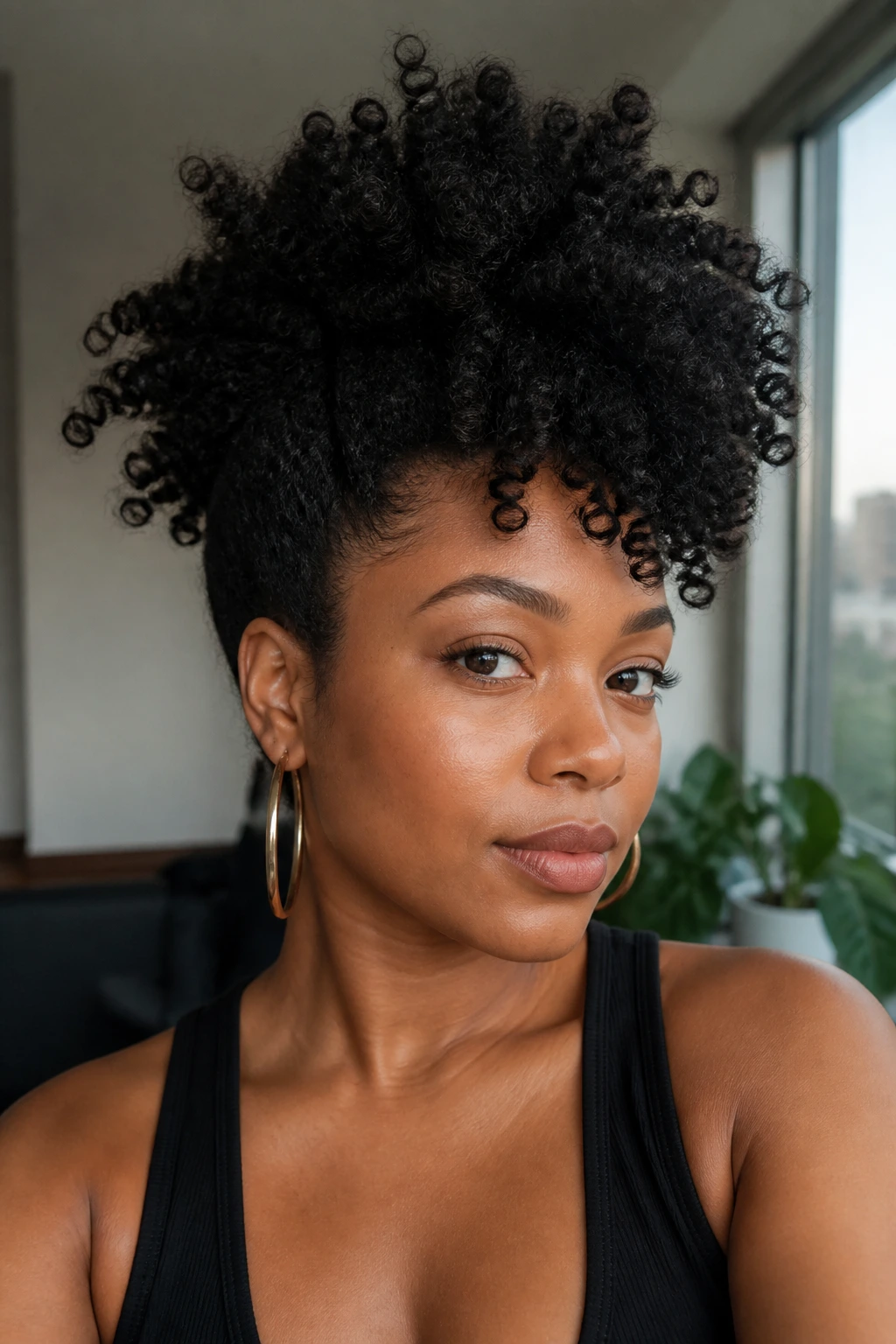
The best hairstyles for coily hair and round faces do one simple thing well: they decide where the eye goes first. Upward, sideways, diagonally, or down past the jaw — any of those can work if you place the volume with intention. That’s the real trick. Not hiding the face. Directing the hair.
What I like most about this group is how flexible it is. You can go cropped, piled high, stretched out, braided down, or cut into layers that do the balancing for you. Coily hair gives you enough texture to build shape without asking for much else. Once you stop fighting the natural bend of the hair and start using it, the whole process gets cleaner.
Pick the style that matches your length, your density, and how much maintenance you actually want to do. The right one will make the face read the way you want without turning your routine into a battle every morning.