



Square faces do not need hiding. They need a haircut that stops drawing a hard line right across the jaw.
That’s where a long bob with a fringe earns its keep. The length gives the face room to breathe, the fringe breaks up the forehead, and the whole shape can be tuned with a side part, a curtain split, or a few cheekbone-grazing pieces that move when you turn your head. The wrong version of this cut looks boxy fast. The right one looks deliberate in that low-key, “my hair just does this” way that takes real planning.
The trick is not vague softness. It’s geometry. If the bob ends at the chin, the eye lands exactly where a square face is strongest. Push the hemline down to the collarbone or just above it, then keep the fringe light enough to split or sweep, and the face suddenly reads longer, not wider. A blunt edge can still work, by the way—but only when the rest of the cut does some quiet work around the cheekbones and temples.
Why These 25 Cuts Work on Square Faces
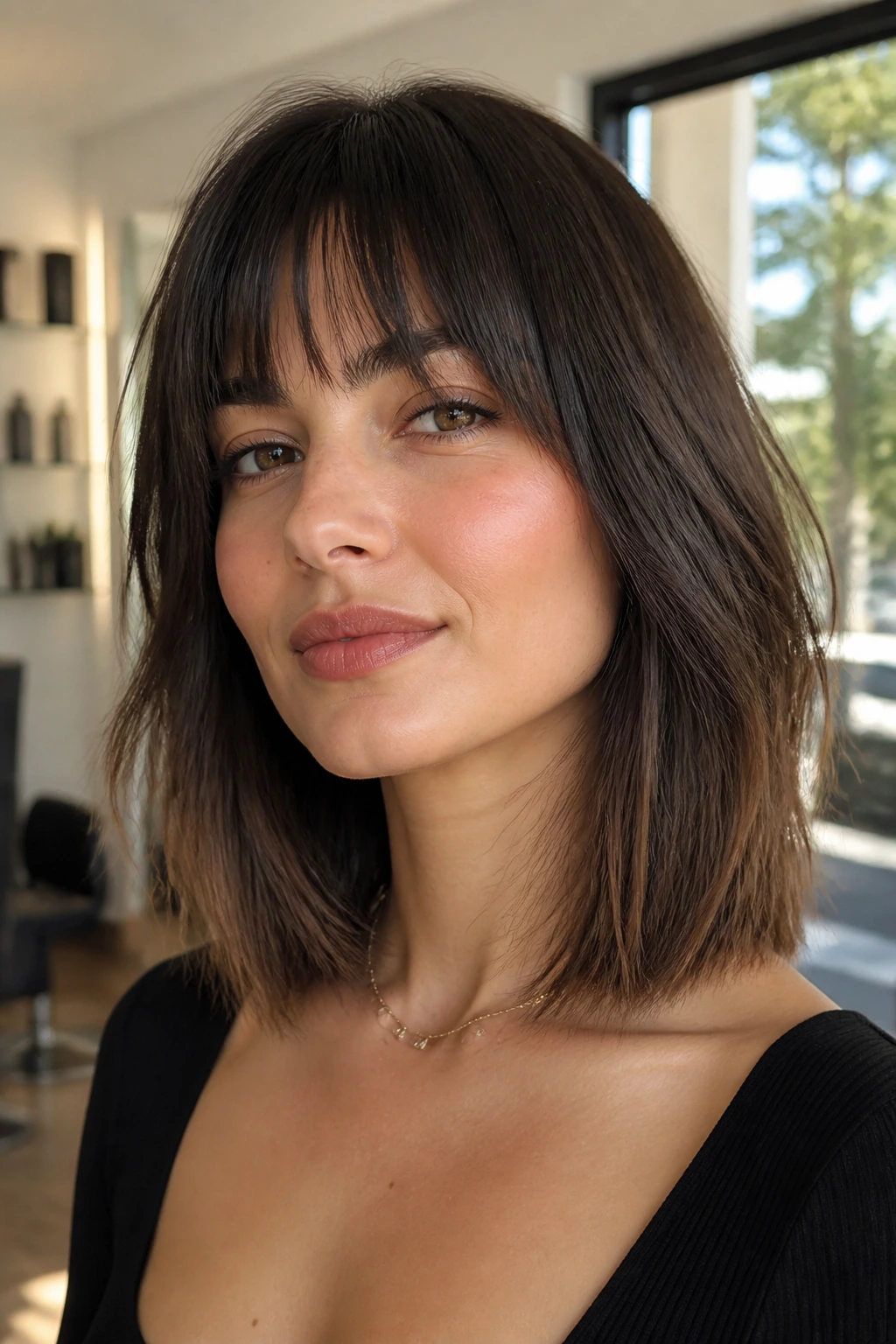
- Jawline Relief: A lob that lands below the jaw keeps the haircut from boxing in the widest part of a square face, which is the main mistake with shorter bobs.
- Fringe Softening: Curtain bangs, bottleneck bangs, and side-swept fringe all interrupt the straight horizontal line that can make the forehead look broad.
- Cheekbone Direction: The best pieces skim the outer cheekbone or angle past it, which pulls the eye upward instead of letting it stop at the jaw.
- Low-Fuss Grow-Out: A long bob can stretch a few weeks past a trim and still look intentional, especially if the fringe is split or feathered.
- Real Styling Range: The same cut can go sleek, bendy, tucked, or air-dried without losing its shape, which matters when you do not want a haircut that only works on day one.
1. Soft Curtain Fringe Lob for Square Faces
A soft curtain fringe lob is the easy answer when you want the face to look less square without making the haircut feel fussy. Keep the length grazing the collarbone, then split the fringe so the shortest pieces open around the center of the forehead and the longer sides melt into the cheekbones. That softens the upper half of the face fast.
Why It Works
The center split breaks the straight line across the forehead, and the longer fringe wings guide the eye down and out, not straight across. That matters on a square face, where width can show up in the forehead and jaw at the same time.
- Keep the front pieces 1 to 2 inches below the jaw so the ends do not sit right on the strongest part of the face.
- Ask for the fringe to be slightly longer in the center than at the temples.
- Style it with a 1.5-inch round brush and a loose bend, not a stiff curl.
The cut looks best when the fringe is a little imperfect. Too polished and it can feel heavy. A touch of bend makes the whole shape breathe.
2. Blunt Collarbone Lob with Wispy Brow-Graze Bangs
A blunt lob can work on a square face, but only if the bangs behave. Keep the perimeter clean at the collarbone, then thin the fringe so it sits at the brows with a little air between the strands. The line stays modern, but the forehead does not get boxed in.
The move here is contrast. The bob edge is sharp on purpose; the fringe is not. That contrast keeps the haircut from reading like one solid block of hair, which is the problem with a blunt cut that hits the jaw too hard. Ask your stylist to soften the ends with tiny point cuts, especially if your hair is dense. A heavy, solid bang with this shape can feel like a helmet by lunchtime.
This version suits straight or slightly wavy hair best. If your hair bends hard on its own, the fringe can split on its own and look more lived-in than neat. That is fine. Better a little movement than a stiff curtain of hair sitting exactly where you do not want it.
3. Side-Swept Lob with a Long Diagonal Fringe
Want the face to look longer without giving up the bob? Sweep the fringe across on a deep side part and let it fall in one long diagonal line. That angle does a lot of heavy lifting on a square face because it interrupts the symmetry that can make the jaw feel even stronger.
The lob itself should be just past the shoulders or skimming the collarbone. If the front is a touch longer than the back, even better. The diagonal fringe becomes the first thing the eye sees, then the rest of the cut follows that line down. It feels clean, not fussy.
This is one of the best choices if you wear your hair with a little bend rather than pin-straight. The sweep has somewhere to land, and the shape looks intentional instead of overworked. If you have a cowlick near the part, move the part about half an inch until the fringe settles instead of fighting it all morning.
4. Choppy Wave Lob with a Birkin Fringe
There’s a reason this cut looks good even when it is not perfectly styled. The chopped texture stops the bob from becoming one solid shape, and the Birkin-style fringe sits softly around the brows instead of carving a hard line across the face. On a square face, that softness matters.
The fringe should not be thick enough to sit like a wall. Think broken-up ends, not a dense strip. A 1-inch curling iron or a couple of quick passes with a flat iron are enough to create the loose wave through the lengths; you are not building curls, just a bend and some separation.
This cut suits hair that already has a little body. Fine hair can wear it too, but it needs a root lift spray at the crown or the texture can fall flat by midday. The face shape benefit comes from the irregularity. No straight edge, no rigid frame, no hard stop at the jaw.
5. Angled Lob with Broken-Up Fringe Ends
An angled lob gives you structure without the harshness of a chin-length bob. The front pieces land lower than the back, so the haircut naturally draws the eye downward. Add a fringe with slightly broken ends, and the whole shape gets softer without losing line.
This is one of those cuts that quietly fixes a strong jaw. The length in front acts like a vertical line, and the fringe keeps the forehead from feeling wide. Do not let the angle become too steep. When the front drops far below the collarbone and the back is too short, the haircut starts to look dated fast. Keep the difference subtle.
What to Ask For
- A front length that brushes the collarbone or sits just below it
- Internal point cutting through the fringe
- Soft texture at the ends, not feathering that shreds the perimeter
- A side or off-center part if your forehead feels broad
6. Rounded French Lob with Feathered Fringe

A rounded lob feels softer than a blunt one because the perimeter curves in instead of sitting straight and severe. Add a feathered fringe, and the haircut starts doing that nice face-softening thing around the temples and cheeks. It is one of the better choices if your jaw is square but your hair is thick enough to hold shape.
The roundness should be visible in the blowout, not carved in with a razor. Think brushed under at the ends, with the fringe dusted lighter at the edges. If the bangs are too precise, the cut loses that easy French-bob feel and starts acting like a strict geometric shape. That’s the opposite of what you want.
This one looks best with a little swing. A brush-blown bend, a side part, or even a tucked-behind-the-ear moment helps keep it from sitting stiffly against the face.
7. Shaggy Long Bob with Curtain Bangs for Square Faces

A shaggy lob with curtain bangs is one of the friendliest cuts for a square face because it gives movement everywhere the face needs it. The layers around the cheekbones and the split fringe both break up strong straight lines. Nothing feels boxed in.
The cut works especially well if your hair has natural wave, because the shag layers can live in that texture instead of fighting it. Let the curtain bangs fall from the brows into the cheekbones, then keep the ends slightly ragged, not shredded. Too much razor work can thin the silhouette until it looks airy in a bad way.
Wear it a little undone. A diffuser, a salt spray mist, or just air-drying with a leave-in cream can do the job. The point is movement, not perfection.
8. Glassy Lob with a Center-Split Fringe
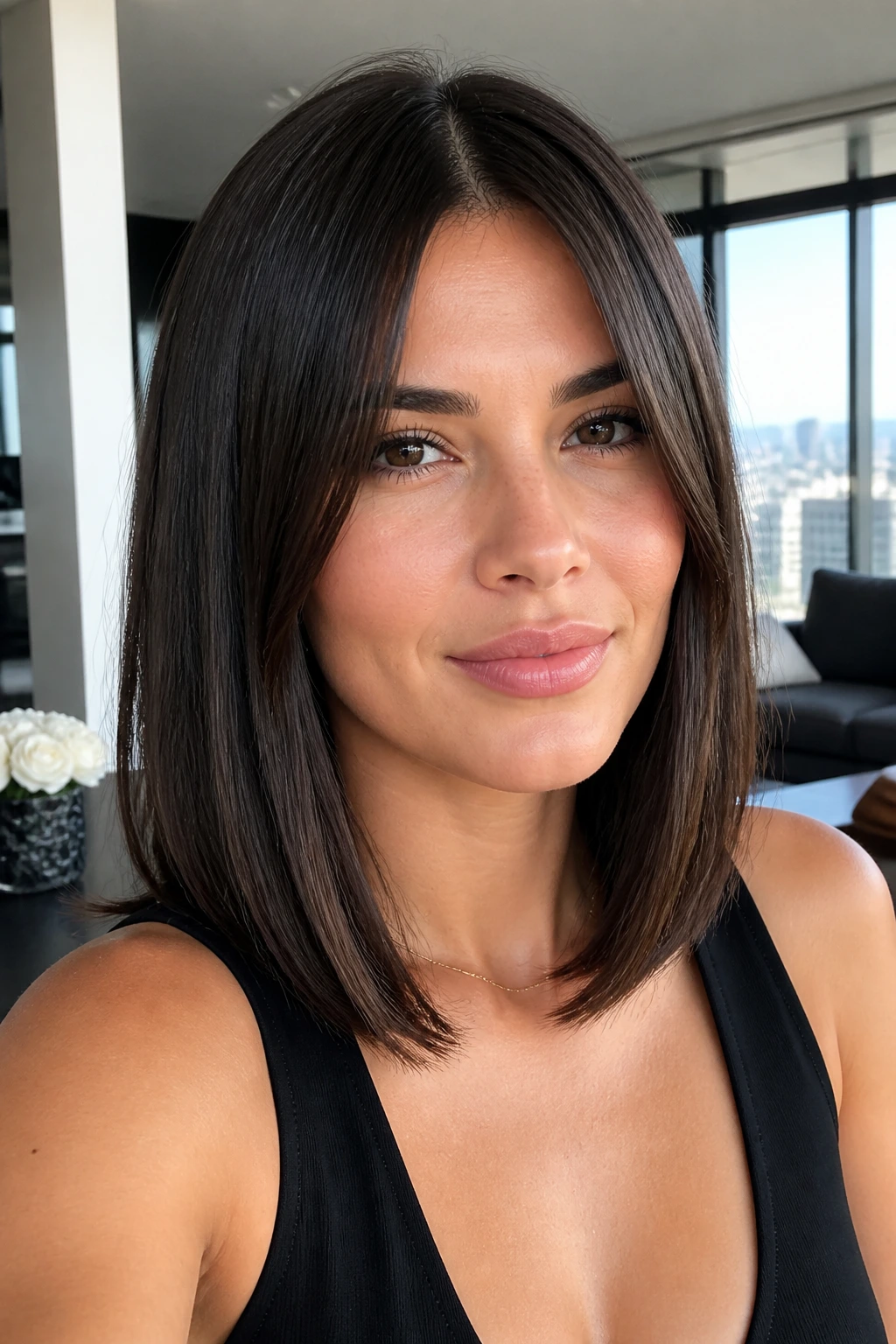
Straight hair can look severe on a square face if the line is too blunt and the fringe is too dense. A glassy lob fixes that by staying sleek while the center-split fringe opens the forehead. You get shine, but not a hard frame.
The key is length. Keep the lob at the collarbone or slightly longer so the ends sit below the jaw. If the cut ends at the widest point of the face, the polish works against you. With this shape, the fringe should fall in two neat panels, each side long enough to brush the outer brow and cheekbone.
This is the cut for someone who likes a clean finish and does not want layers everywhere. It looks best when the blowout is smooth and the ends are tucked under just a little. Not flipped, not curled into oblivion. Just enough curve to keep the line from feeling rigid.
9. Bottleneck Fringe Lob with Bend at the Cheekbones
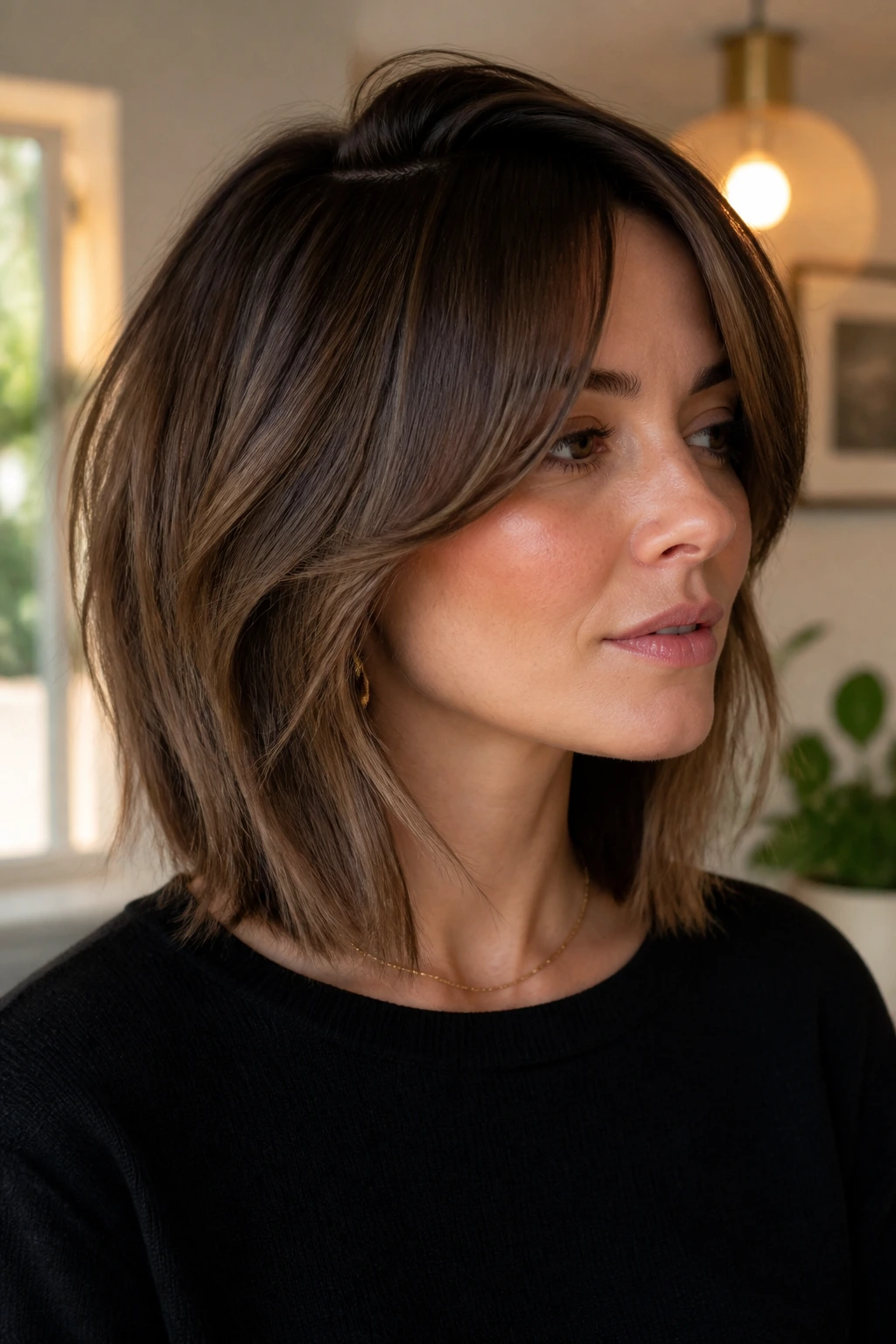
Bottleneck bangs are sneaky good on square faces because they start narrower at the center and open outward near the cheekbones. That shape breaks up the forehead without overwhelming it. Pair it with a lob that lands below the jaw, and the result feels balanced rather than over-styled.
The bend matters. If the fringe hangs too flat, the middle can close in the face. A slight lift at the roots and a soft outward flick at the sides make it work. Keep the bob perimeter clean, not choppy, so the fringe remains the star. This is one of those cuts that needs a stylist who understands where the face is wide and where it needs vertical movement.
Best case: medium-density hair, a blow-dryer, and a round brush. If you air-dry it, clip the fringe up at the center for a few minutes while it dries so the split settles in place.
10. Air-Dried Lob with Face-Framing Fringe
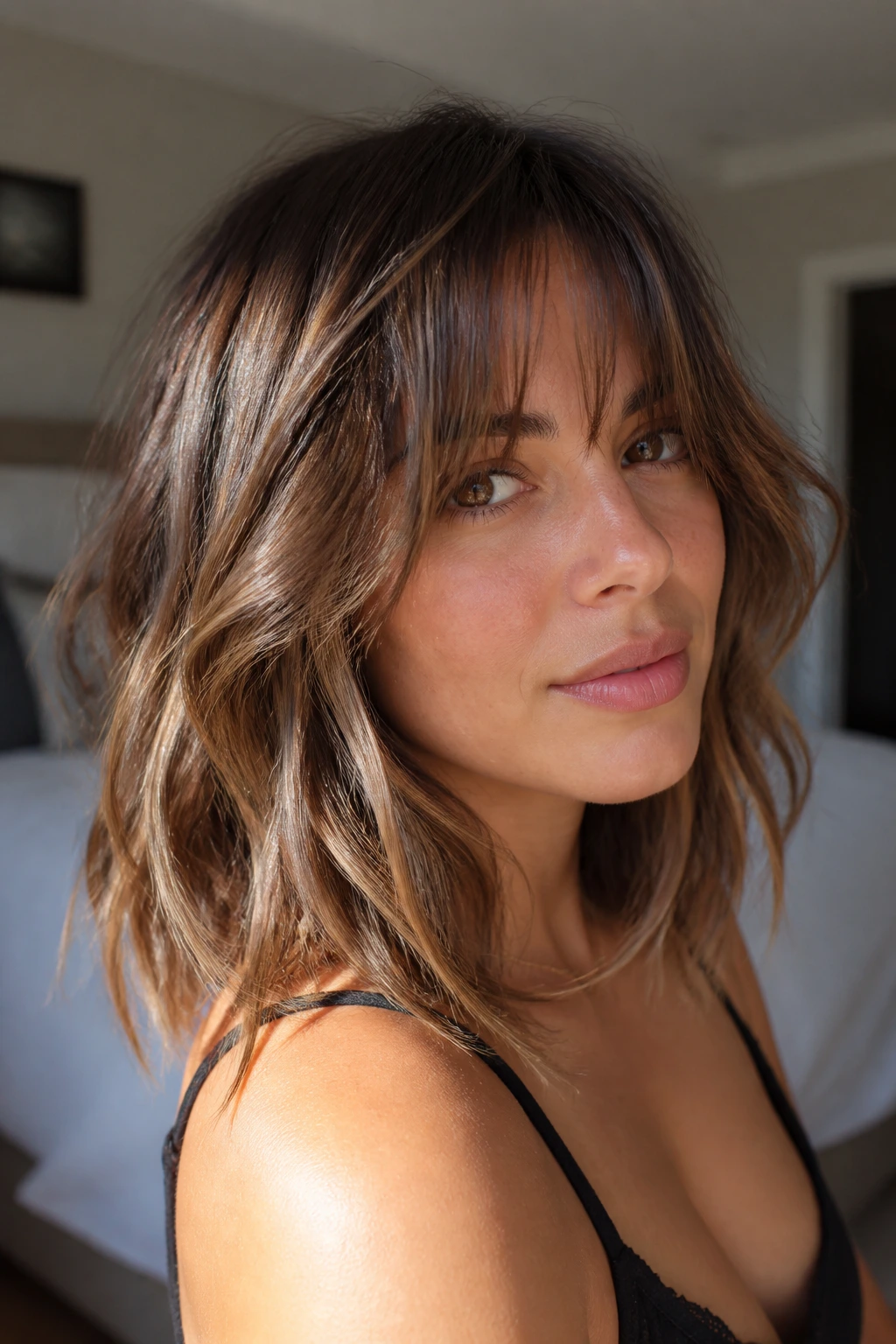
Some cuts fall apart without a blowout. This one improves when you leave it alone. The lob should be long enough to clear the jaw, and the fringe should be cut with enough length to bend around the cheekbones instead of sitting on the brow like a blunt shelf.
This shape is especially useful if your hair has a wave or a loose curl pattern. A little leave-in cream, a quick rake through the ends, and a rough dry with your fingers can give the haircut its shape. The face-framing pieces around the front keep the silhouette from looking square, which is the part that matters most here.
Don’t overthink it. If the fringe dries a touch uneven, that can actually help. Square faces need breaking points, not matching edges.
11. Curly Lob with a Curly Fringe

Curly hair does not need to hide behind a fringe, but it does need the fringe cut in a way that respects shrinkage. On a square face, a curly lob works when the width sits higher on the head and the ends fall below the jaw. The fringe should spring softly, not sit as one heavy line.
Cut this one dry or nearly dry. That matters. A wet curl lies. It stretches, then springs up later and lands in a place you did not mean. Ask for a fringe that starts a little longer than you think you need, with the outer pieces allowed to curl toward the cheekbones. That softens the face and keeps the shape from feeling too boxy.
Use a diffuser and stop touching it once it starts to set. Curly fringes get frizzier the more you fuss with them. Let the curl pattern do its job.
12. Feathered Lob with a Deep Side Part
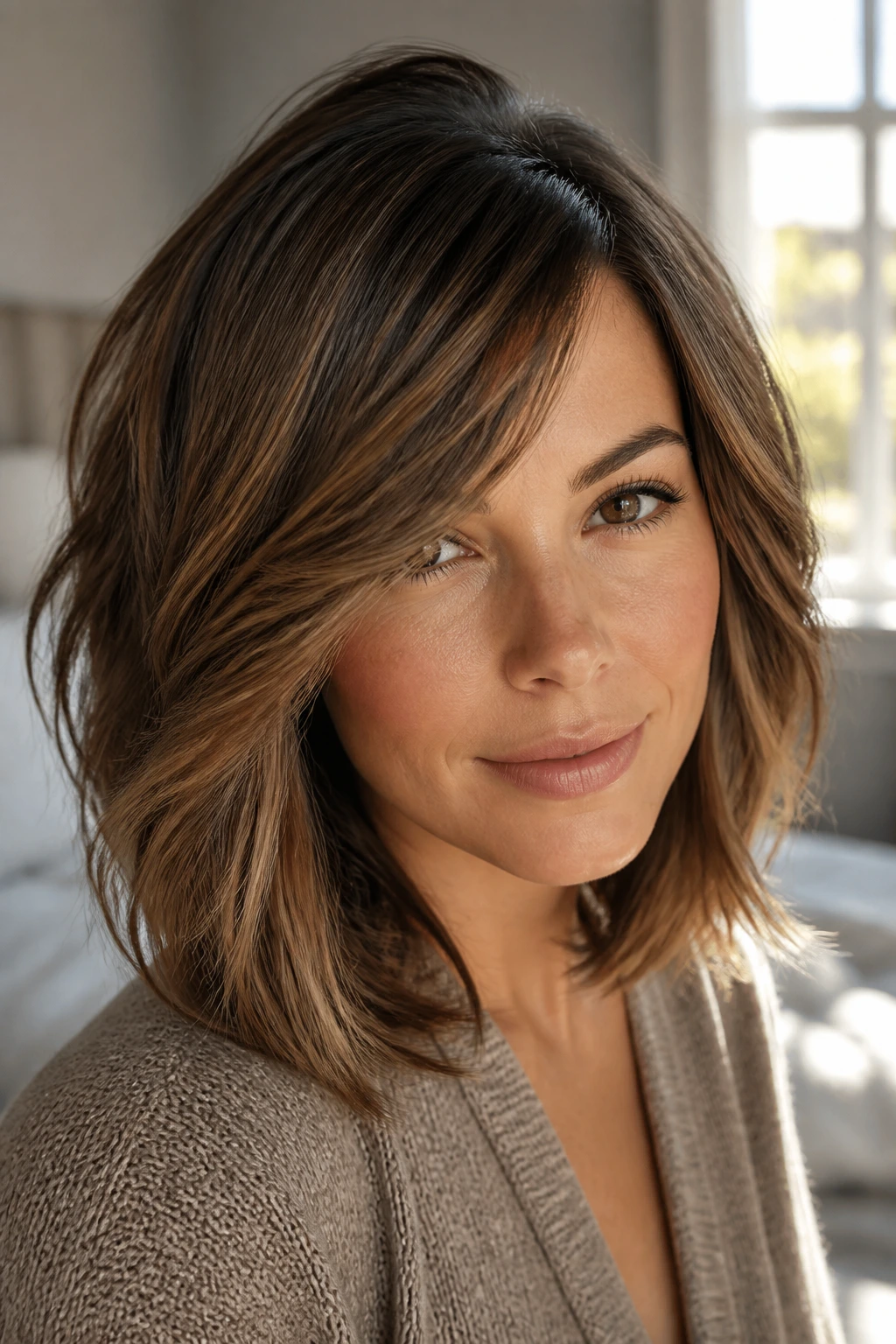
A deep side part can change the whole haircut in one move. On a square face, it shifts the weight away from the center and creates a long diagonal across the forehead. Add feathered ends through the lob, and the look gets lighter without losing shape.
This is a strong choice for fine to medium hair because the feathering adds movement where blunt cuts can feel heavy. The fringe should not be pushed straight down; it needs to sweep across one side and blend into the longer front pieces. The result feels softer and less symmetrical, which is exactly the point.
If you like a haircut that looks good after a quick finger comb and a bit of root lift, this one earns its place. It does not need elaborate styling. It needs a good part and a little bend at the ends.
13. Razored Lob with a Shattered Fringe

Razor work can go wrong fast, but on thick hair it can be a lifesaver. A razored lob removes bulk and keeps the edge from sitting like one heavy block. Pair that with a shattered fringe, and the face gets more movement around the brow and temple area.
The trick is restraint. Too much razor work near the ends can make the haircut fray and lose its shape after a few washes. Ask for internal lightness, not a full shred. The fringe should still have enough weight to split and move, but not so much that it feels like a curtain.
This cut likes texture spray and a rough blow-dry. If your hair is dense and tends to puff out at the sides, this shape can feel much lighter without turning into a wispy mess.
14. Collarbone Lob with Long Layered Fringe

A long layered fringe is one of the easiest ways to soften a square face because it keeps changing shape as it moves. The fringe can sit at the brows, split at the center, or tuck behind one ear. That flexibility matters when the jaw is strong.
The lob itself should stay at the collarbone with subtle layers through the front only. Too many internal layers and the shape gets broken up in a way that looks thin instead of airy. The goal is movement in front, not a shag everywhere.
Styling Note
- Blow the fringe forward first, then sweep it open with your fingers.
- Keep the ends soft with a drop of serum.
- If the part feels too centered, shift it half an inch off-center and watch the whole cut relax.
15. Sleek Lob with a Swept-Over Fringe
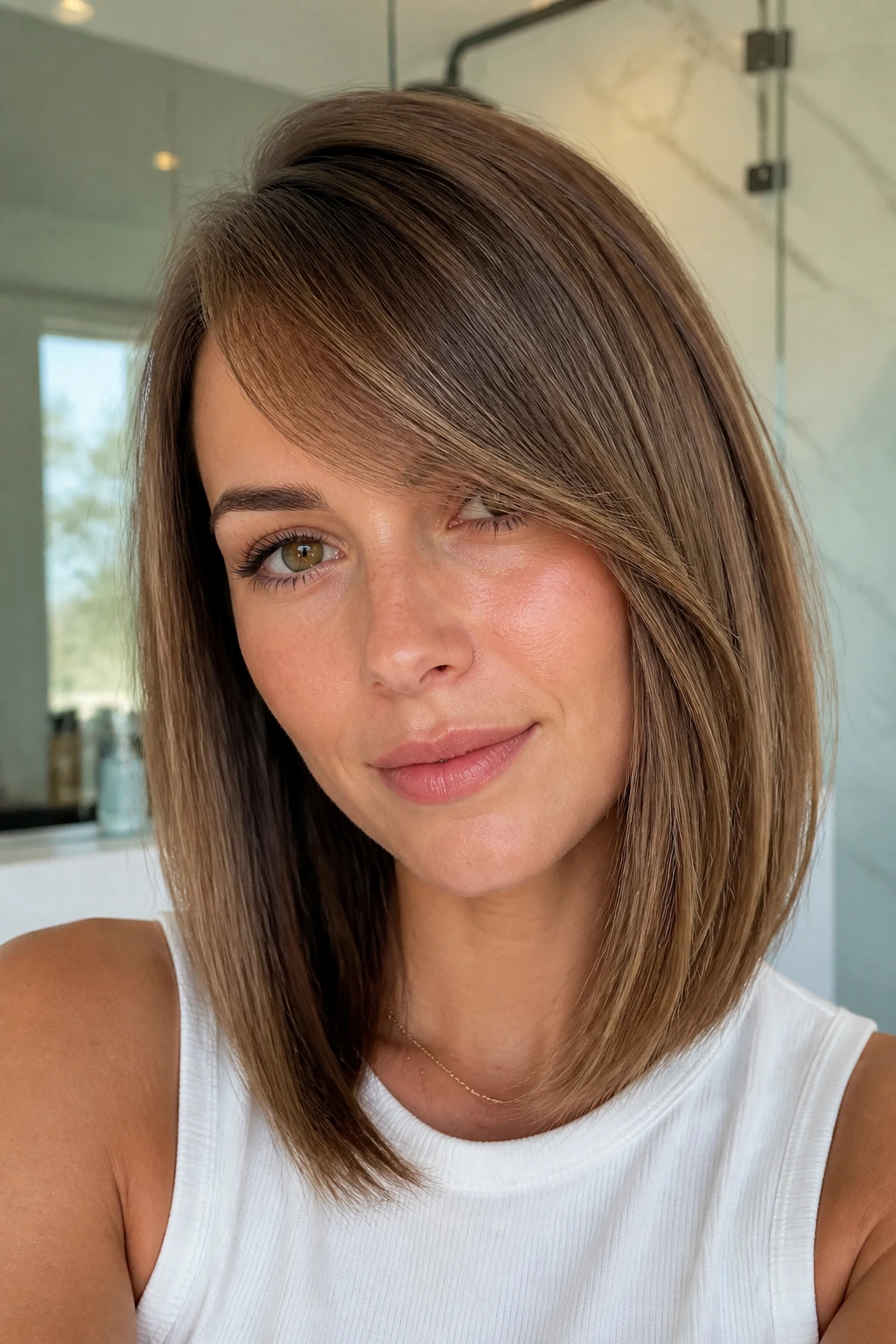
A swept-over fringe is almost unfair on square faces because it creates an immediate diagonal. It does not stop at the forehead; it drifts across it. That little change takes the edge off a strong jaw and makes the face look longer.
Keep the lob polished but not stiff. A flat iron can smooth the lengths, but you still want a touch of bend at the front so the fringe sits with motion rather than clinging flat to the face. If your hairline has a cowlick, blow-dry the fringe in the opposite direction first, then sweep it back over. That usually helps it settle where you want.
This is a good cut when you want hair that looks intentional with minimal ornament. No layers shouting for attention. Just a clean side sweep and a collarbone length that lands in the right place.
16. Tucked Lob with a Grown-Out Fringe for Square Faces

A grown-out fringe is not a sign you missed your trim. On a square face, it can be the whole point. When the fringe is long enough to split and tuck, the haircut softens around the temples and cheekbones instead of creating a hard brow line.
The lob here should feel wearable from day one all the way through the grow-out phase. That means a length that clears the jaw and front pieces long enough to slide behind the ear without puffing out. It is a forgiving cut, which is handy if you do not want to visit the salon every few weeks.
I like this shape on hair that needs a little movement but not too much fuss. A small bend at the end, a soft side tuck, and a fringe that can fall either open or closed—that’s enough. The cut should handle real life.
17. A-Line Lob with a Soft Split Fringe

The A-line lob pushes the front pieces forward, and that forward movement can lengthen a square face in a way a blunt cut never will. Keep the difference subtle, not dramatic. A small drop in the front is enough.
The soft split fringe keeps the top of the face open, which stops the cut from feeling heavy. If the split is too perfect, the look can get a little rigid. A slightly irregular center part, with one side a touch fuller than the other, often looks more natural and less staged.
This is one of the smarter cuts for someone who likes shape but not chaos. It has architecture. It also has softness. That balance is rare.
18. Beachy Lob with a Long Piecey Fringe
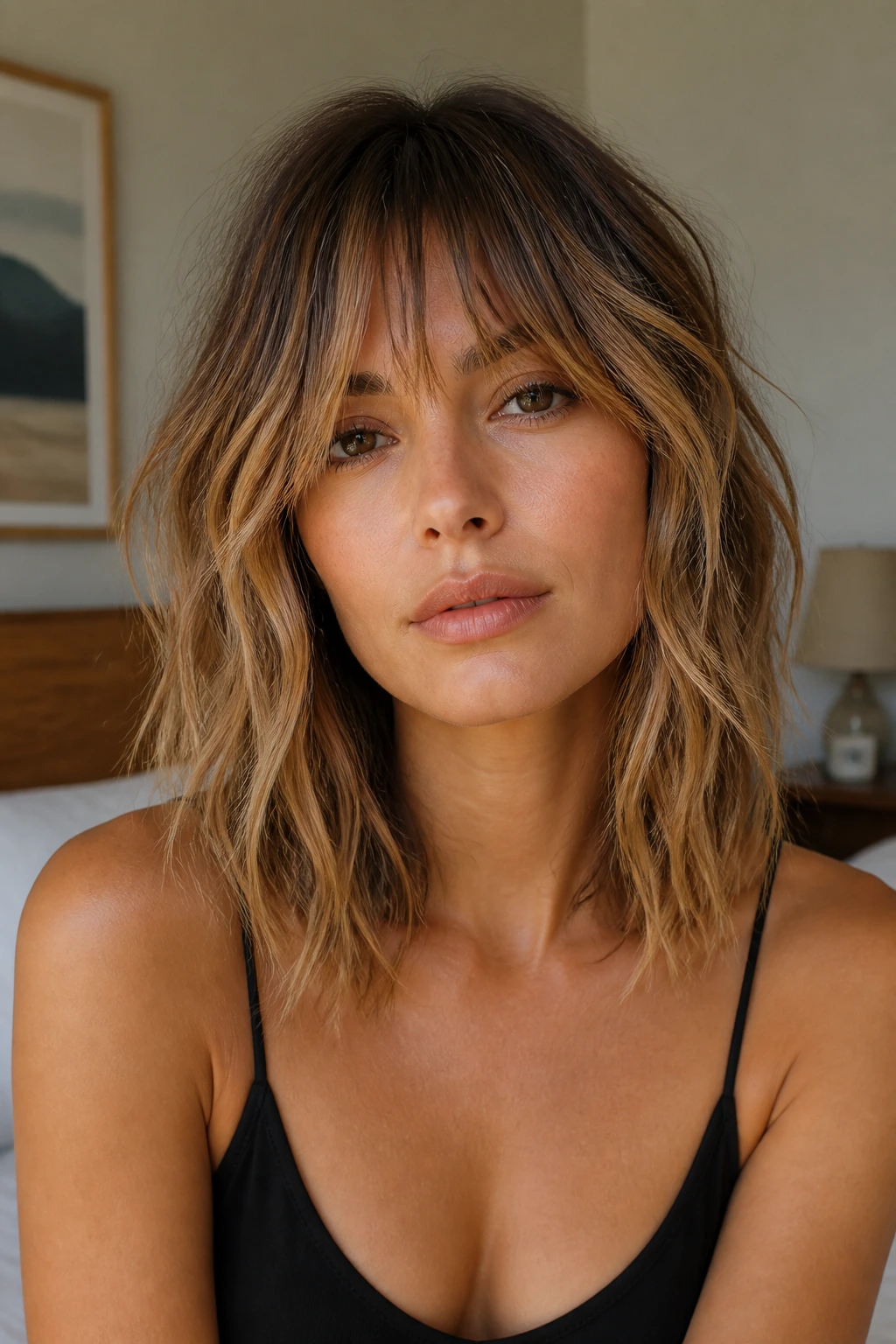
Beachy texture can be a gift on a square face because it breaks the hard outline that strong bone structure sometimes creates. The lob should stay long enough to touch the collarbone, and the fringe should be piecey rather than solid. A few separated strands around the forehead change the whole mood.
Use a 1.25-inch iron and do not curl every section the same direction. That’s the mistake people make. Uniform waves create a shell. Mixed directions create movement. If the fringe feels too thick, split it with your fingers after it cools. A little asymmetry helps here.
This cut is best when it looks a bit windblown. Not messy. Windblown. There’s a difference, and the difference is usually in how much product you leave out of the front pieces.
19. Polished Blowout Lob with a Rounded Fringe
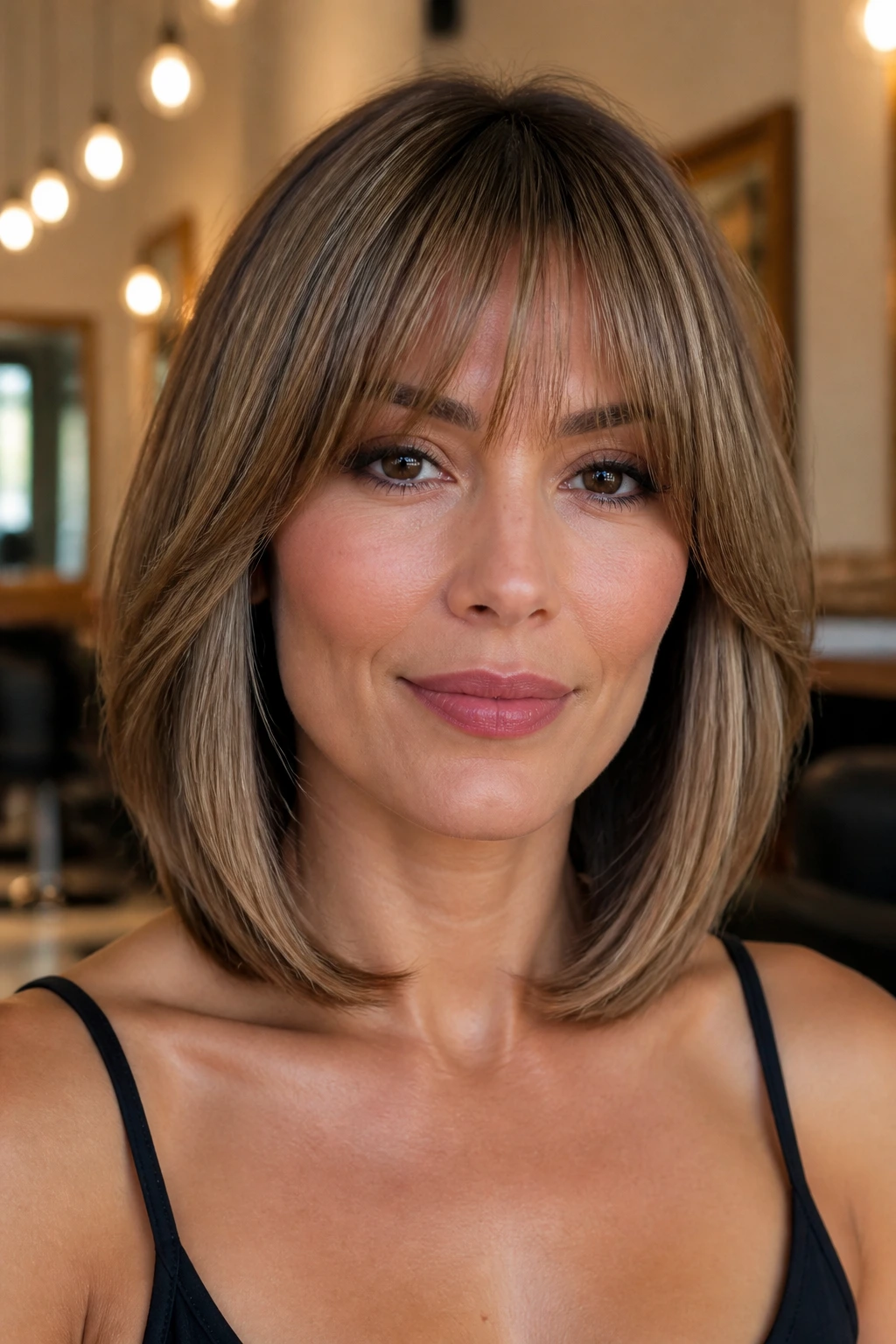
A polished blowout can soften a square face if the shape curves instead of sticking straight out. The rounded fringe helps by following the natural arc of the forehead and then easing into the sides of the face. It feels controlled, but not hard.
The ends should turn under just enough to keep the perimeter tidy. Too much curl and the haircut starts to shrink upward, which shortens the face. That is the opposite of what you want. Use a round brush, clip the fringe at the root for a minute if needed, and let the front pieces fall with a smooth curve.
This one works well when you want a haircut that looks dressed up without much extra styling. It is neat. It has shape. It does not need layers of product to make its point.
20. Uneven Lob with an Asymmetric Fringe

Asymmetry can be a smart move on a square face because the face already has strong structure. A slightly uneven fringe and an off-balance lob stop the haircut from mirroring that structure too closely. The result looks more relaxed and less boxed in.
Keep the unevenness subtle. You do not want a dramatic fashion cut unless that is truly your lane. One side can sit a touch longer, or the fringe can sweep more heavily across one brow than the other. Those small differences matter. They break the rigid line without making the cut look accidental.
This is a good option if your face has one side that photographs differently from the other or if your natural part never sits perfectly centered. Work with that, not against it.
21. Thick-Hair Lob with Thinned-Out Fringe
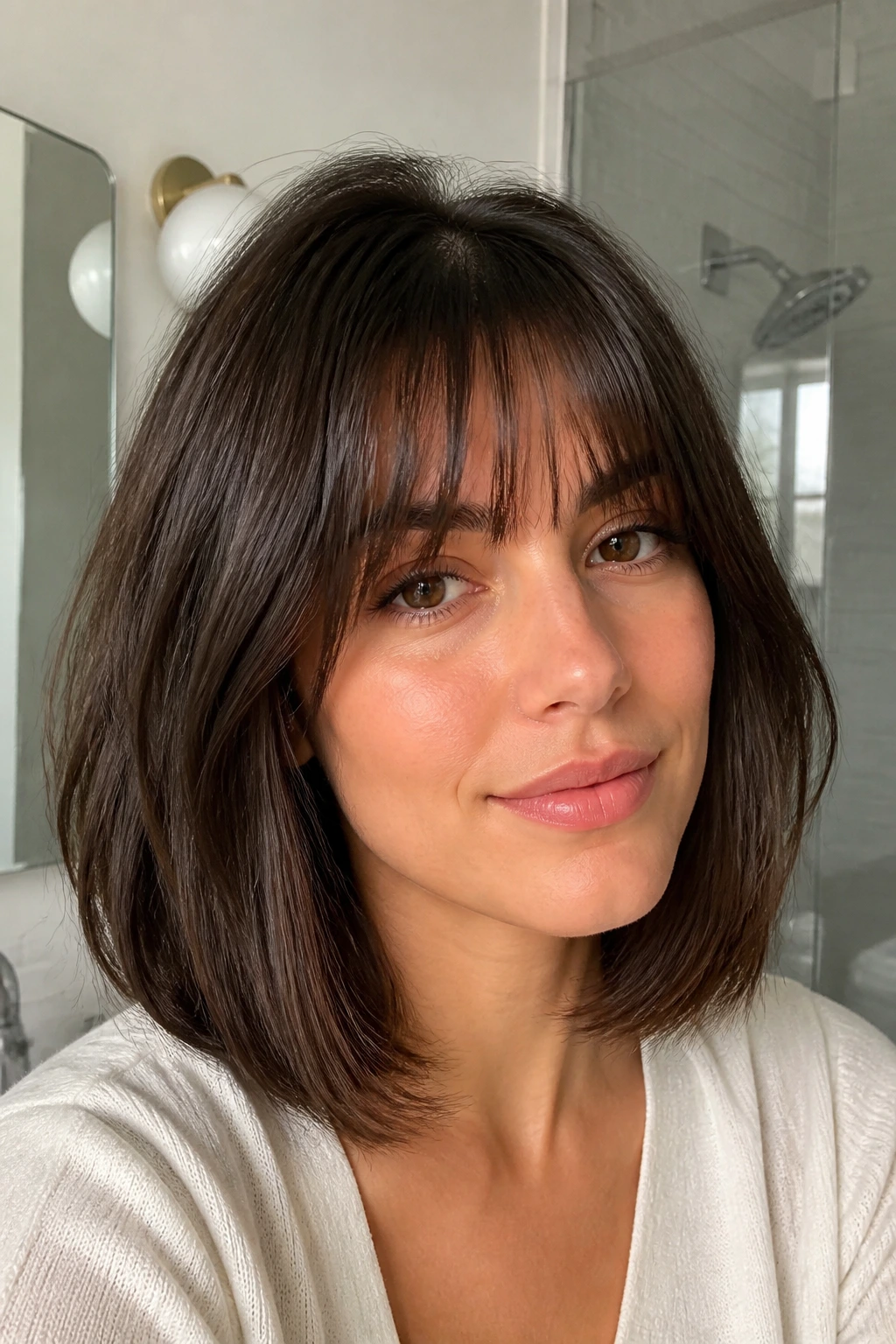
Thick hair needs control before it needs layers. A thick-hair lob with a thinned-out fringe lets the shape move without sitting like a heavy wall around the forehead. On a square face, that lighter fringe softens the top half so the jaw does not feel matched by a dense brow line.
Ask for internal removal, not aggressive thinning at the ends. The perimeter still needs weight so the bob holds its shape. If the fringe gets too sparse, it can separate in a way that looks frizzy instead of airy. A good stylist will remove bulk where the hair stacks, not where it should frame the face.
This cut usually behaves well with a smoothing cream and a blow-dry directed downward through the fringe. Thick hair likes direction. Give it some.
22. Fine-Hair Lob with a Light See-Through Fringe

Fine hair does not need a heavy bang to make an impression. In fact, a lighter, see-through fringe often works better because it keeps the forehead open and avoids dragging the whole front of the haircut down. The lob should stay blunt enough to hold the shape, but the fringe needs air.
That airy quality matters on a square face. The fringe softens the brow without building another hard horizontal line. Keep the ends clean and the layers minimal so the hair does not look stringy. A touch of root lift at the crown can make the whole thing feel fuller without adding bulk at the sides.
Dry shampoo is your friend here, but use it at the roots, not just the fringe. Fine hair collapses fastest at the crown, and a flat top can make the jaw feel stronger than it is.
23. Mid-Length Lob with a Loose Arc Fringe

A loose arc fringe is a quiet fix for a square face. It sits a little longer in the center, then curves softly toward the temples. That shape opens the forehead while keeping the sides light enough to avoid a hard frame.
The mid-length lob should hover somewhere between the collarbone and upper chest, with enough length to tuck one side back if needed. This is not a severe shape. It is a shape with options. The arc fringe works because it avoids a dead-straight line, but it does not need to shout.
If your hair naturally bends or flips at the ends, this cut can look especially good on second-day hair. A little looseness suits it. That is part of the charm.
24. Low-Maintenance Lob with Long Curtain Fringe
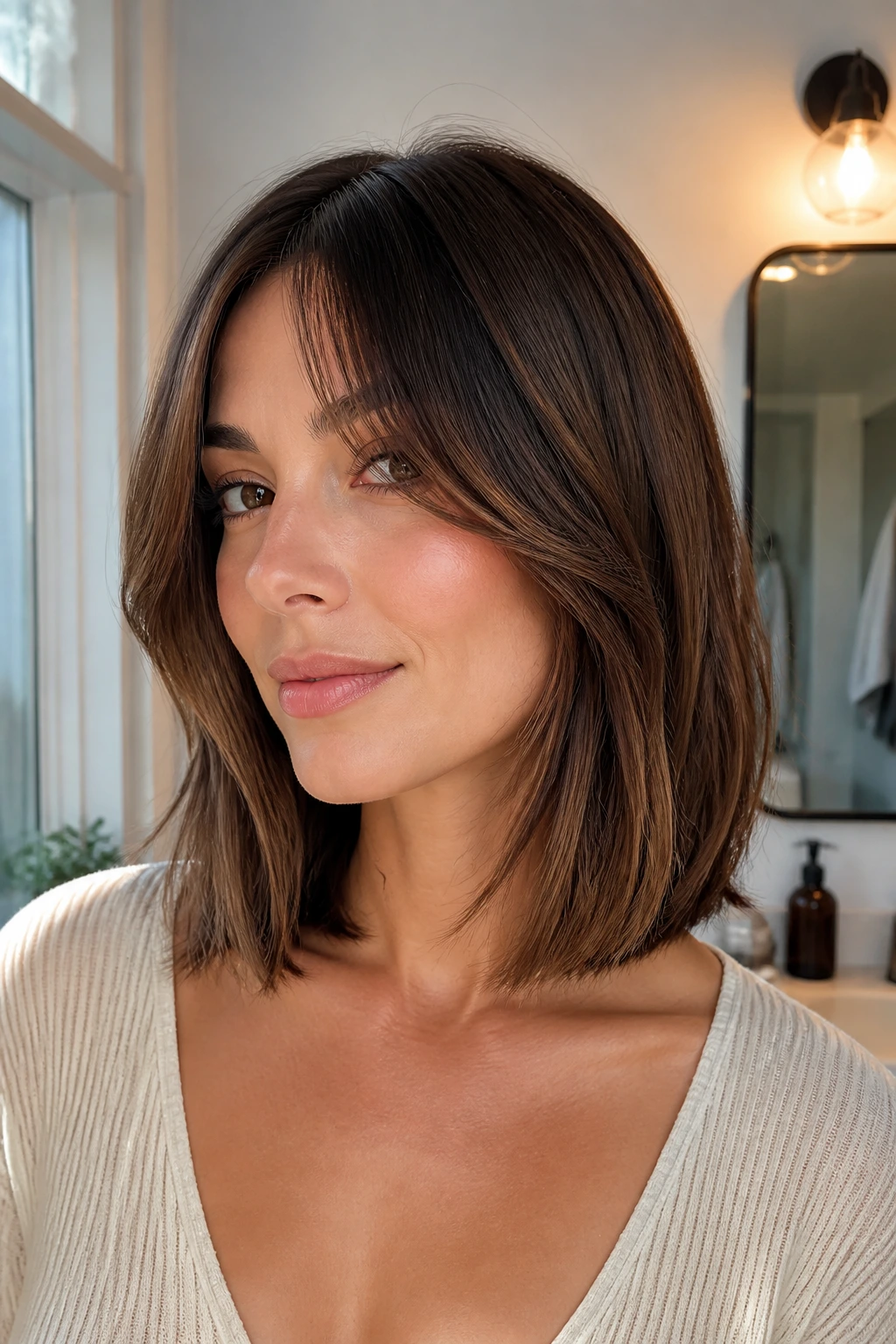
Low-maintenance does not mean shapeless. It means the cut keeps working after the first blowout disappears. A long curtain fringe is a smart choice for a square face because it can part on its own, tuck away, or fall forward without creating a heavy block.
Keep the lob long enough to clear the jaw and ask for the front pieces to angle softly into the fringe. That keeps the whole shape connected. If the fringe is too short, it will sit like a little fence across the forehead. Too long and it disappears into the rest of the hair. The sweet spot is usually right around the brows with the sides a touch longer.
This one is practical in a real way. If you want hair that can go from polished to second-day without looking like it gave up, this is one of the strongest bets.
25. The Lasting Shape Lob with a Soft, Worn-In Fringe

If you want one long bob that still looks shaped after the blowout settles, this is the one to ask about. The perimeter stays below the jaw, the fringe stays soft enough to split, and the whole cut is built to look better once it loses a little perfection. Square faces often benefit from that worn-in movement.
The best version is not sloppy. It is softened. The fringe should graze the brow, then separate a little as it dries. The ends should move, not stick out. Small shifts in the part and a little bend around the cheekbones keep the haircut from turning boxy as it grows.
This is the style I’d hand to someone who wants shape without constant babysitting. It survives real life. That counts for a lot.
Why the Collarbone Length Does More Than the Fringe

The fringe gets all the attention, but the hemline is doing plenty of work too. A square face usually looks best when the haircut stops below the jaw, because that keeps the strongest part of the face from becoming the haircut’s endpoint. Collarbone length is useful for exactly that reason. It gives the eye a place to keep moving.
A chin-length bob can look sharp and chic on some faces, but on a square face it often behaves like a frame around the widest area. The fringe helps, sure. But the longer line is what keeps the whole thing from feeling boxed in. Even a blunt lob can feel softer than a layered one if the ends sit low enough and the front pieces curve gently toward the neck.
One more thing. The neck is part of the shape. Hair that skims the collarbone shifts attention away from the jaw and toward the vertical line of the neck and shoulders, which is exactly where a square face benefits from a little visual length.
The Tools That Keep a Fringe From Going Flat

You do not need a drawer full of gadgets. You do need the right few.
- Blow dryer with a nozzle: The nozzle helps direct airflow down the hair shaft so the fringe lies smoother and the ends do not puff.
- 1.25-inch or 1.5-inch round brush: This size gives a soft bend through the fringe and front layers without making them curl too tight.
- Tail comb: Useful for parting, lifting the fringe at the roots, and resetting a center split after a wash.
- Lightweight heat protectant: A mist that does not leave a sticky film keeps the fringe from looking greasy after styling.
- Dry shampoo: Helpful for fringe oil, especially if your forehead gets shiny fast or you wear makeup.
- Texturizing spray: Good for lob styles that need a piecey finish without heavy wax.
- Flat iron, optional: Useful for polishing the front pieces or adding a slight bend where the round brush did not cooperate.
- Clips: Simple duckbill or sectioning clips make blow-drying the fringe less annoying. That sounds small, but it saves time.
What to Tell Your Stylist Before the First Snip
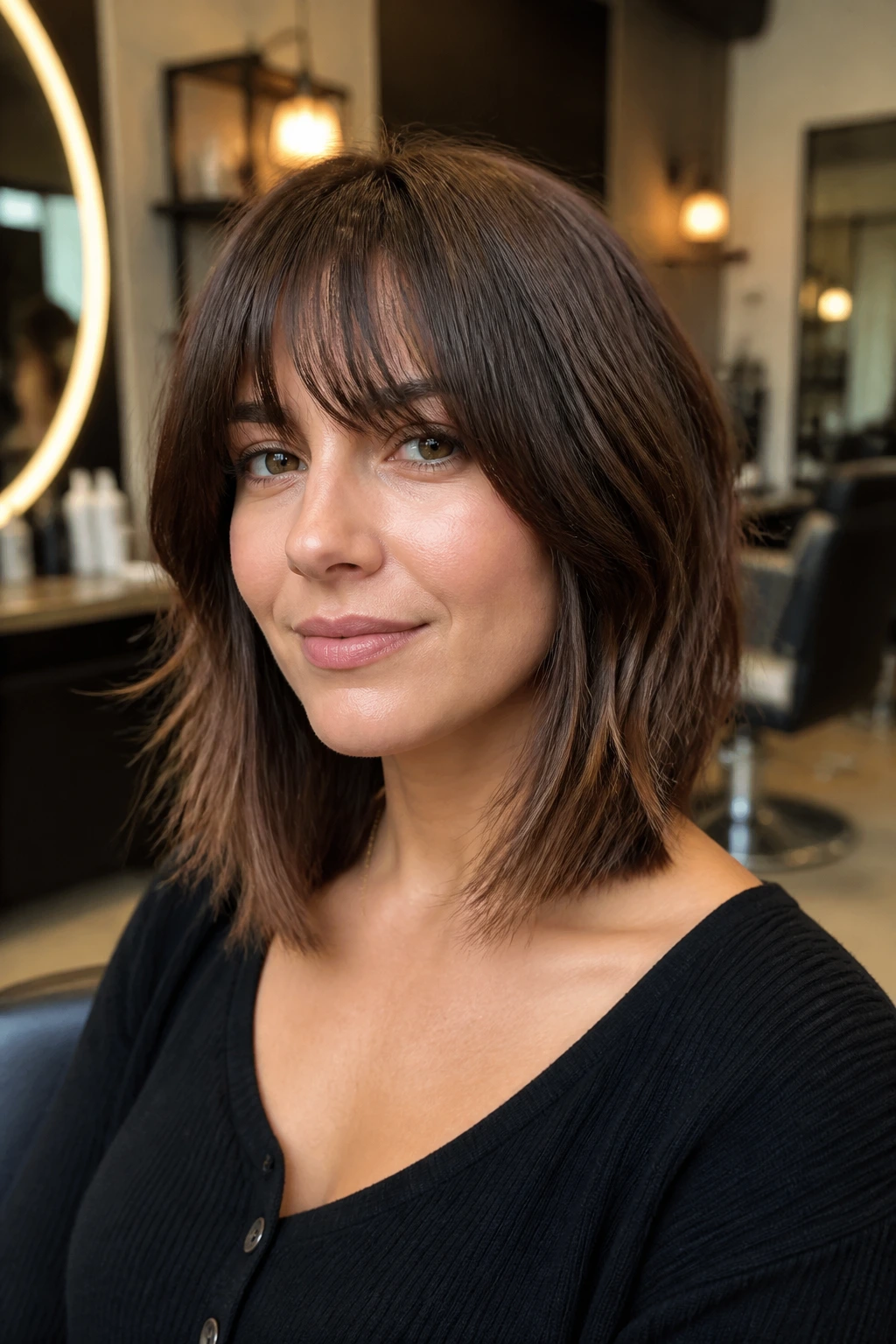
Bring photos, but bring the right photos. You want pictures that show the front, the part, and the length when the hair is at rest, not windblown in a perfect pose. Ask for the longest pieces to clear the jaw and land somewhere between the collarbone and upper chest, depending on how much length you want to keep.
Say what your hair does, not what you wish it did. If your fringe splits on its own, say that. If one side grows faster or the front flips out, say that too. A good cut on a square face is partly about controlling where the hair stops, and partly about letting your natural growth pattern do some of the work.
A few useful phrases in the chair:
- “Keep the fringe light enough to split.”
- “I want the front to hit below the jaw.”
- “Soften the cheekbone area, but keep the perimeter clean.”
- “My hair is dense/fine/wavy, so I need the fringe to sit without puffing.”
That last part matters more than people think. Density changes everything.
How to Wear the Cut Straight, Wavy, or Curly
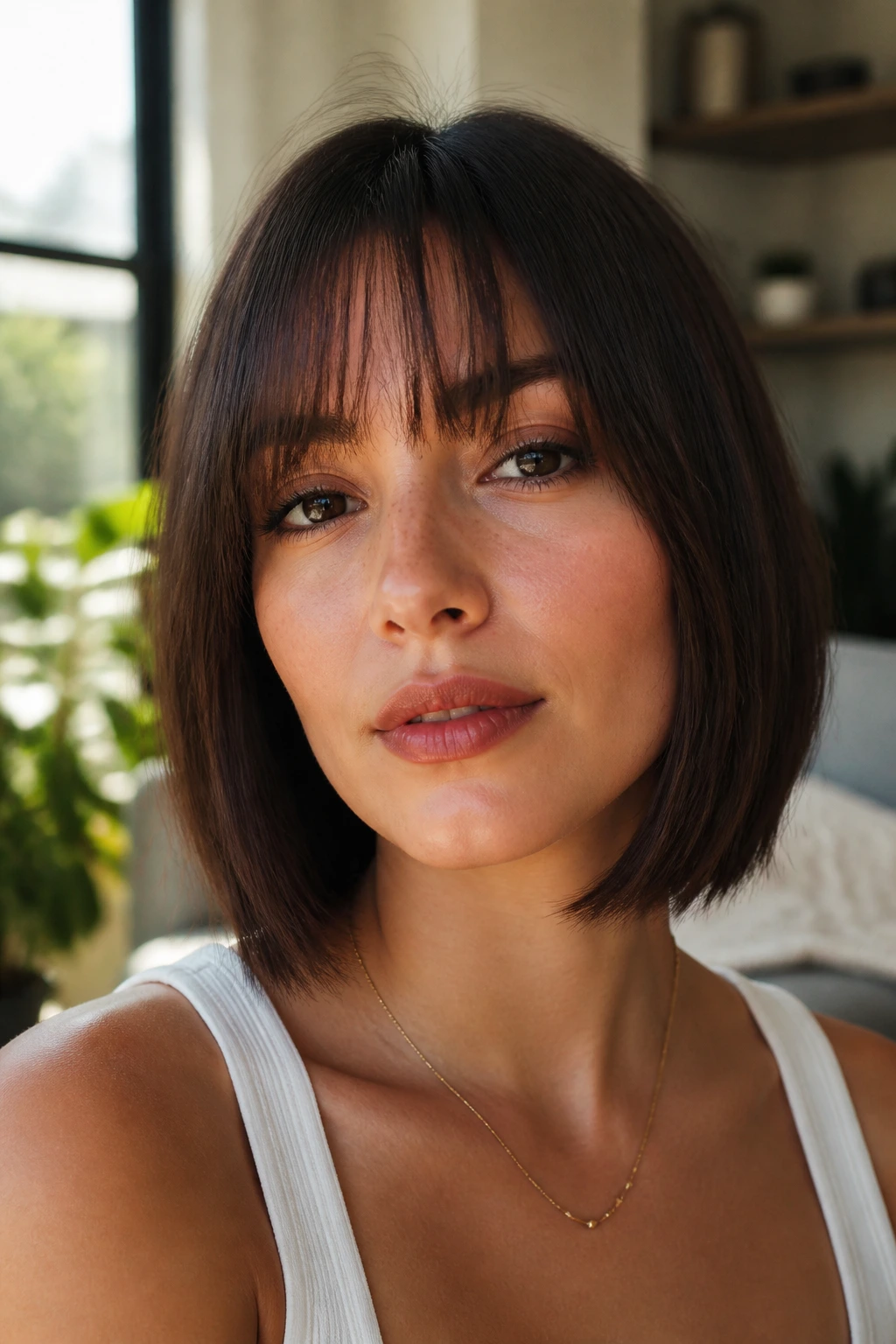
Straight and sleek: Keep the part slightly off-center if your face feels very symmetrical. A dead-center part can be gorgeous, but on a square face it sometimes looks too exact unless the fringe is soft and the ends are below the jaw.
Loose wave: This is the easiest lane for most of these cuts. Bend the front pieces away from the face, then let the fringe sit in a soft split or sweep. The wave should move, not curl into uniform spirals. A little mismatch looks better than perfect sameness.
Curly and coily: Ask for the fringe to be cut with shrinkage in mind and style it with enough moisture to keep the outline soft. The top of the cut needs lift, while the widest curl should not sit right at the jaw. That placement is everything.
Second-day hair: A square face usually benefits from a bit of undone texture on day two. The hair settles. The fringe loosens. The shape feels less stiff, which often makes the face look softer too.
Small Tweaks That Change the Whole Silhouette
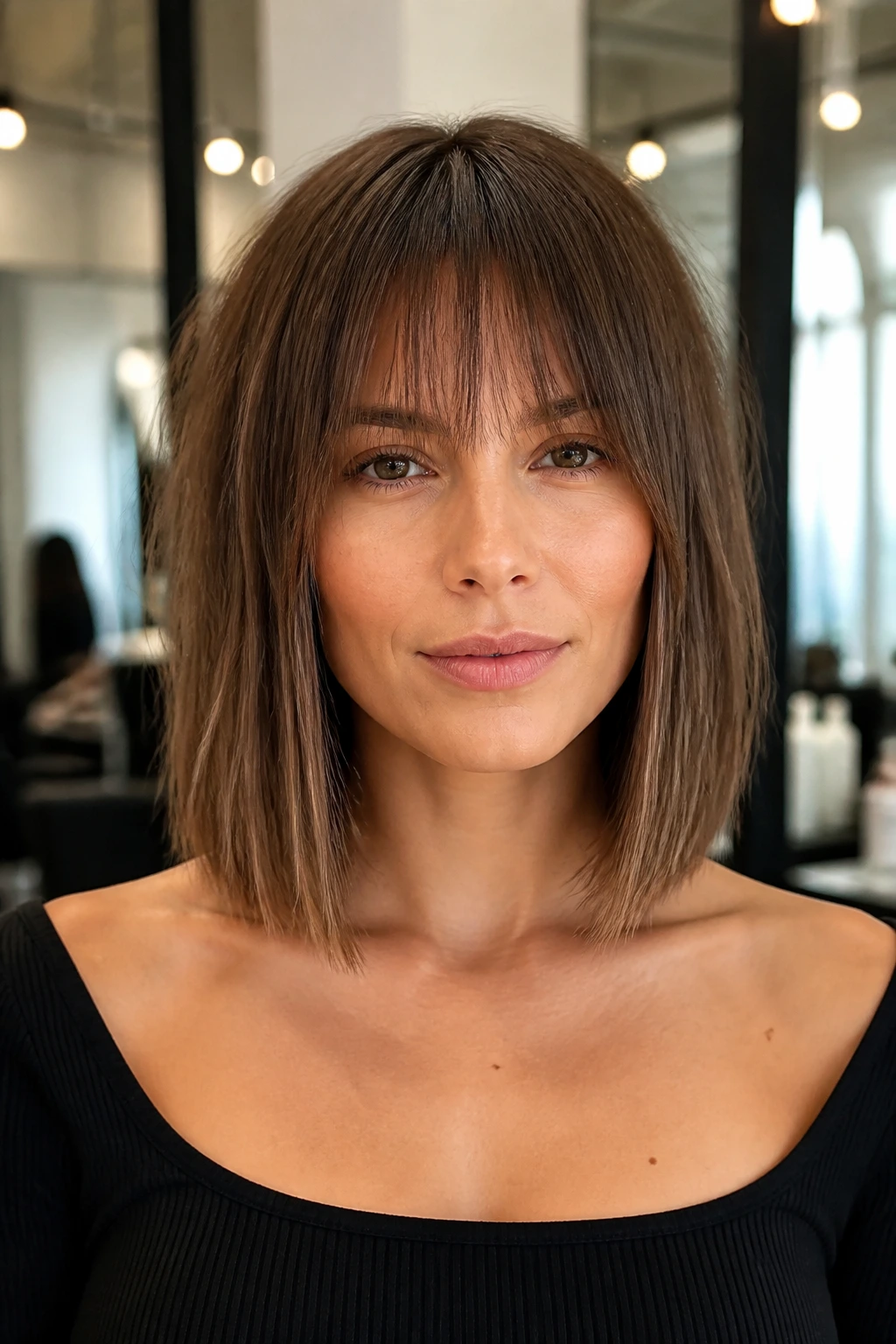
Move the part: Sliding the part one inch off center can change how the fringe falls across the forehead. It sounds small. It isn’t.
Open the cheekbones: Ask for the front pieces to start their shortest point around the outer corner of the eye, then blend lower. That keeps the width up high, not at the jaw.
Keep the ends blunt or softly beveled, not fuzzy: A clean perimeter helps the lob hold its shape. Too much shredding at the bottom can make the cut puff.
Use the crown, not the sides, for volume: If your hair is flat, lift at the top of the head. Side volume can make a square face look wider than it needs to.
Choose fringe weight on purpose: Heavy fringe makes a statement, but it also shortens the face visually. Light fringe opens things up. Pick the one that matches your hair and your patience.
The Boxy-Shape Mistakes to Avoid
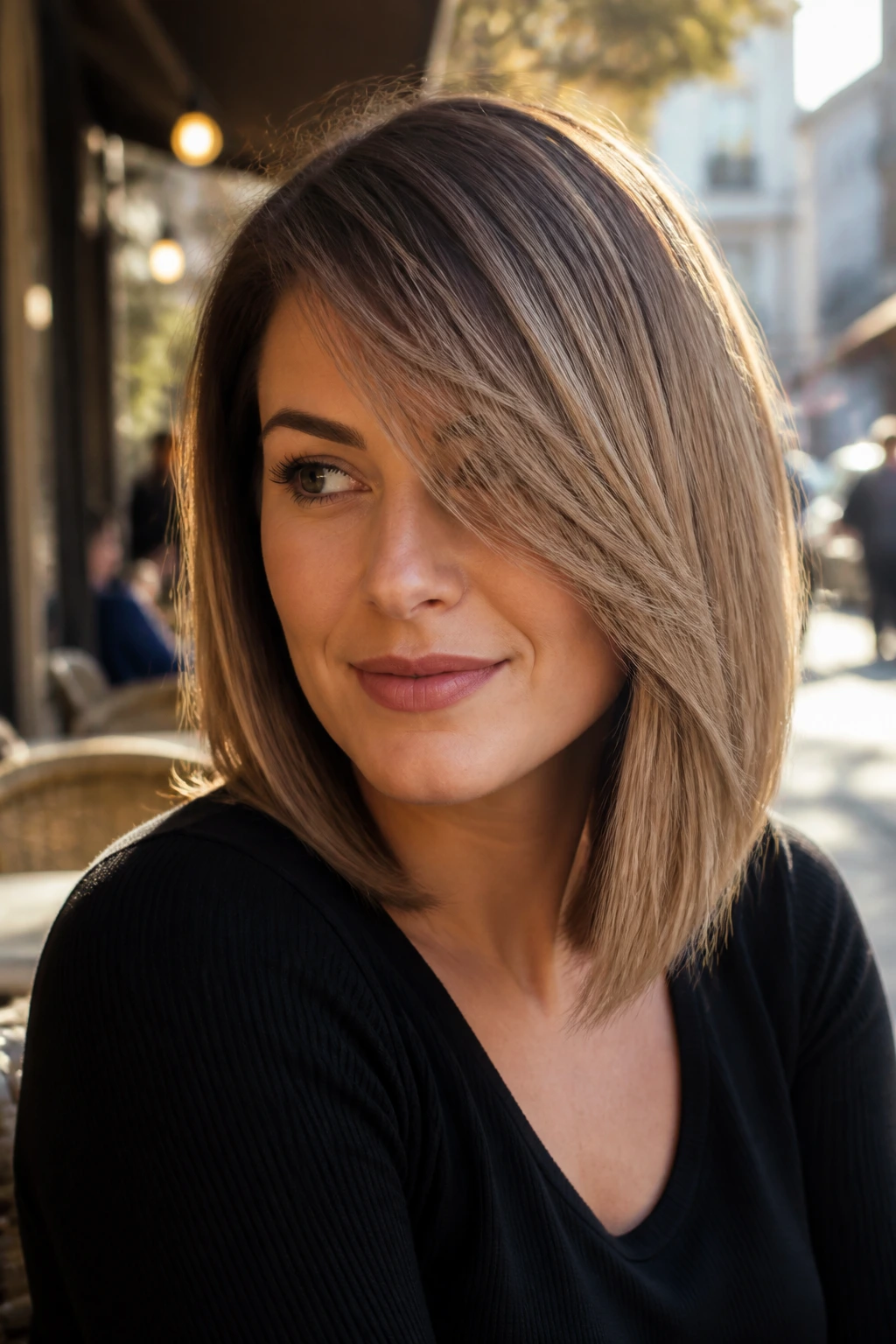
- Ending the cut right at the jaw: That’s the fastest way to make a square face look wider. Move the length down at least an inch or two.
- Cutting a thick, straight fringe with no movement: A heavy bang plus a blunt bob creates one big rectangle. Soften the fringe or soften the perimeter.
- Over-layering the front on fine hair: Too many layers can make the cut look thin and stringy at the sides. Keep the line cleaner.
- Letting the part stay too rigid: A hard center part on every face is lazy styling, not good styling. Shift it if the cut needs relief.
- Forcing curls to sit at the jaw: Curl pattern should lift and bend, not pile right where the face is widest.
Variations and Adaptations Worth Trying
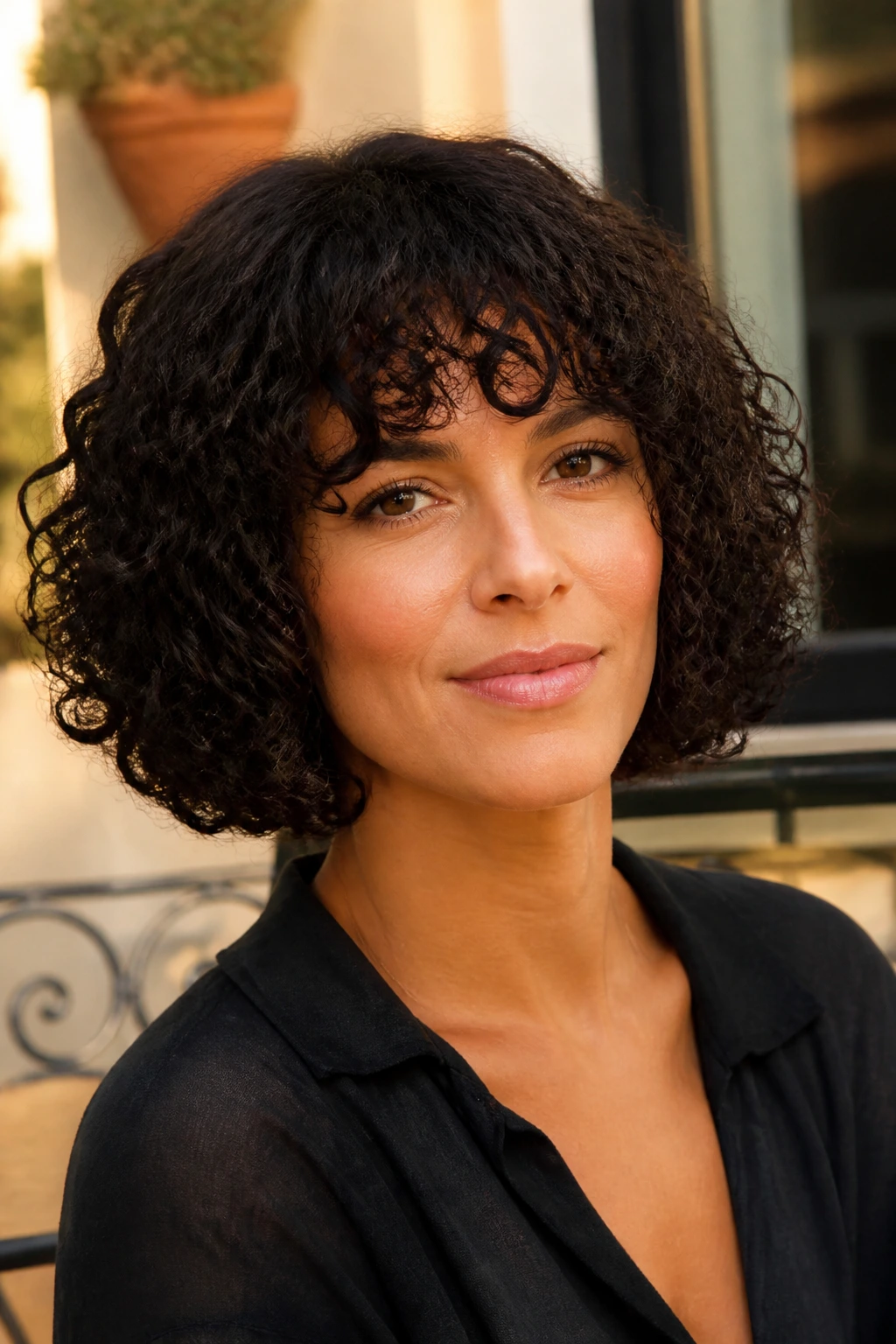
The Soft Grow-Out: If you hate salon upkeep, keep the fringe long enough to split and the lob long enough to survive a missed trim. It grows out without losing the face-softening shape.
The Dense-Hair Version: Ask for internal weight removal and a fringe that stays light at the center. This keeps thick hair from swelling at the sides.
The Fine-Hair Version: Keep the perimeter blunt and the fringe airy. Too much layering can make the cut disappear on the ends.
The Curly Version: Cut the fringe dry and keep the length below the jaw so shrinkage does not pull the bob into chin territory.
The Sleek Version: Use a side part and a smooth round-brush finish. The diagonal line gives square faces some needed movement without adding too much texture.
The Worn-In Version: Let the fringe split a little on its own and keep the ends soft. This one looks best after it loosens up.
Keeping the Fringe Fresh Between Trims

A fringe changes faster than the rest of the cut. Hair grows roughly half an inch a month, and you feel that in the bangs before you notice it anywhere else. Most people do well with fringe trims every 3 to 5 weeks and a lob reshape every 8 to 10 weeks, depending on density and how precise the perimeter is.
Wash the fringe more often than the rest of the hair if your forehead gets oily. That alone can save a bad hair day. A quick sink rinse, a blast with the dryer, and a dab of dry shampoo at the root usually beats piling on more product. At night, push the fringe out of the way or clip it very lightly so it doesn’t dry bent in the wrong direction against your pillow.
If the fringe starts splitting awkwardly, dampen it and reset it with a round brush or a flat brush. Do not keep piling heat on a fringe that just needs water and a few seconds of direction.
Questions People Ask Before Cutting Their Hair

Will a long bob make my square face look wider?
Not if the length sits below the jaw and the fringe is soft or split. The widening effect usually comes from chin-length ends and a heavy, straight bang.
Is curtain fringe better than blunt bangs for square faces?
Usually, yes. Curtain fringe opens the forehead and adds diagonal movement, which helps counter the square shape. A blunt bang can still work if it is light and the bob length stays low.
Can I pull this off with fine hair?
Yes, but keep the layers controlled. Fine hair usually looks best with a cleaner perimeter and a lighter fringe so the front does not go stringy.
What if my hair is curly?
Curly hair can wear a lob and fringe beautifully when the fringe is cut with shrinkage in mind. The key is not forcing the curls into a straight line at the jaw.
How often will I need to trim the fringe?
Most fringes need a touch-up every 3 to 5 weeks. If you wear a very precise brow-graze bang, you may want it even sooner.
Should I choose a middle part or a side part?
Both can work. A middle part with curtain fringe softens a square face well; a side part creates a stronger diagonal and can feel more flattering if your features are very symmetrical.
What if the cut looks boxy after the first wash?
Add movement at the front before you blame the whole cut. A little bend through the face-framing pieces, a softer part, or a lighter fringe shape usually fixes the problem faster than another chop.
Can I grow out a fringe without looking awkward?
Yes, if the fringe starts long enough to split and tuck. The awkward stage is smaller when the fringe was never cut too short in the first place.
The Shape That Stays Soft

A square face does not need more hardness. It needs a haircut that understands where the strongest lines are and refuses to repeat them. That is the whole job of a good long bob with a fringe: lower the line, break the forehead, and let the cheekbones do the talking without handing the jawline a spotlight.
The best versions here are rarely the most dramatic ones. They are the ones with a collarbone hemline, a fringe that can move, and enough softness around the front to keep the whole cut from becoming a rectangle. Pick the one that fits your texture, then let the shape do the work.