



Olive skin can make gray hair look sharp in one light and strangely flat in another, and thin hair only makes the decision more unforgiving. That’s the real trick with grays dark hairstyles for olive skin with thin hair: the shade has to cool the complexion without draining the face, and the cut has to keep enough weight at the perimeter that the ends don’t vanish under a bathroom bulb.
Bright silver is not the only move here. Pewter, graphite, mushroom, slate, ash-black, and smoky charcoal sit in a better place for this combination because they keep depth near the root and a little softness around the face. Thin hair tends to look better when the color has dimension and the shape has a blunt edge — or at least a controlled one — because shredded layers and over-lightened mids can make the whole style go airy in a bad way.
That’s why the smartest gray looks here are rarely the loudest ones. A chin bob, a collarbone lob, a cropped bixie, or a dark root melt can do more for olive undertones than an all-over icy silver ever will. The right cut and tone work together, and once you see the difference in daylight, it’s hard to go back.
Why These Gray Looks Earn Their Spot
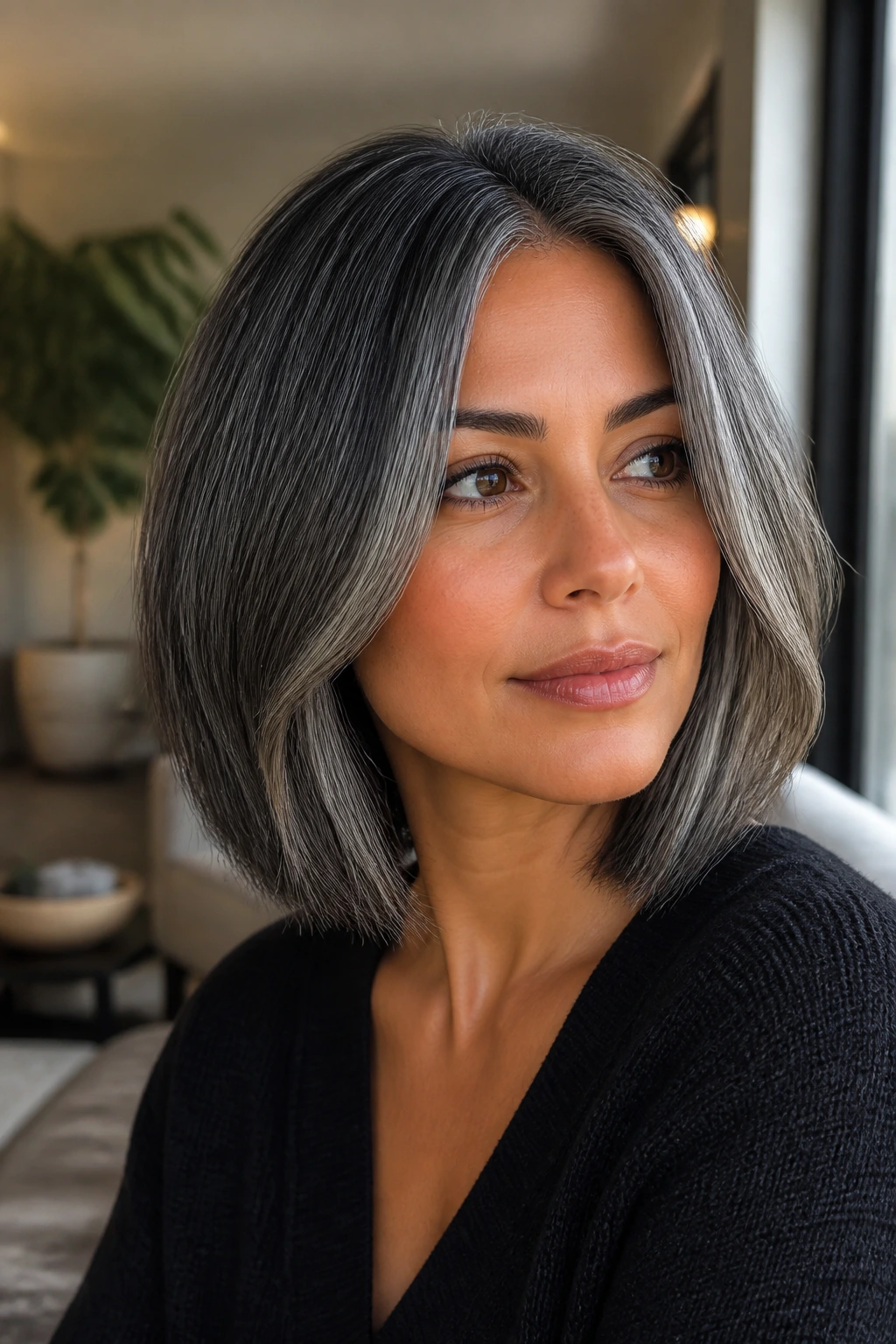
Cool gray beats blue-white silver: Smoky tones like pewter and graphite steady olive skin instead of making it look yellow or washed out.
Thin hair needs a real outline: A blunt bob, a beveled lob, or a short crop gives the eye a clear edge to read as fullness.
Dark roots make grow-out easier: Keeping the base deeper buys you time between appointments and keeps fine hair from looking sparse at the part.
Face-framing pieces do more than brighten: A few silver ribbons near the cheekbones pull light upward without turning the whole head pale.
Texture has to be controlled: Soft bends and loose waves add body; too much razoring steals density fast.
These styles work with olive undertones, not against them: The grays sit in a smoky lane, so the skin stays warm enough to look alive.
1. Smoky Blunt Bob with a Dark Root Line
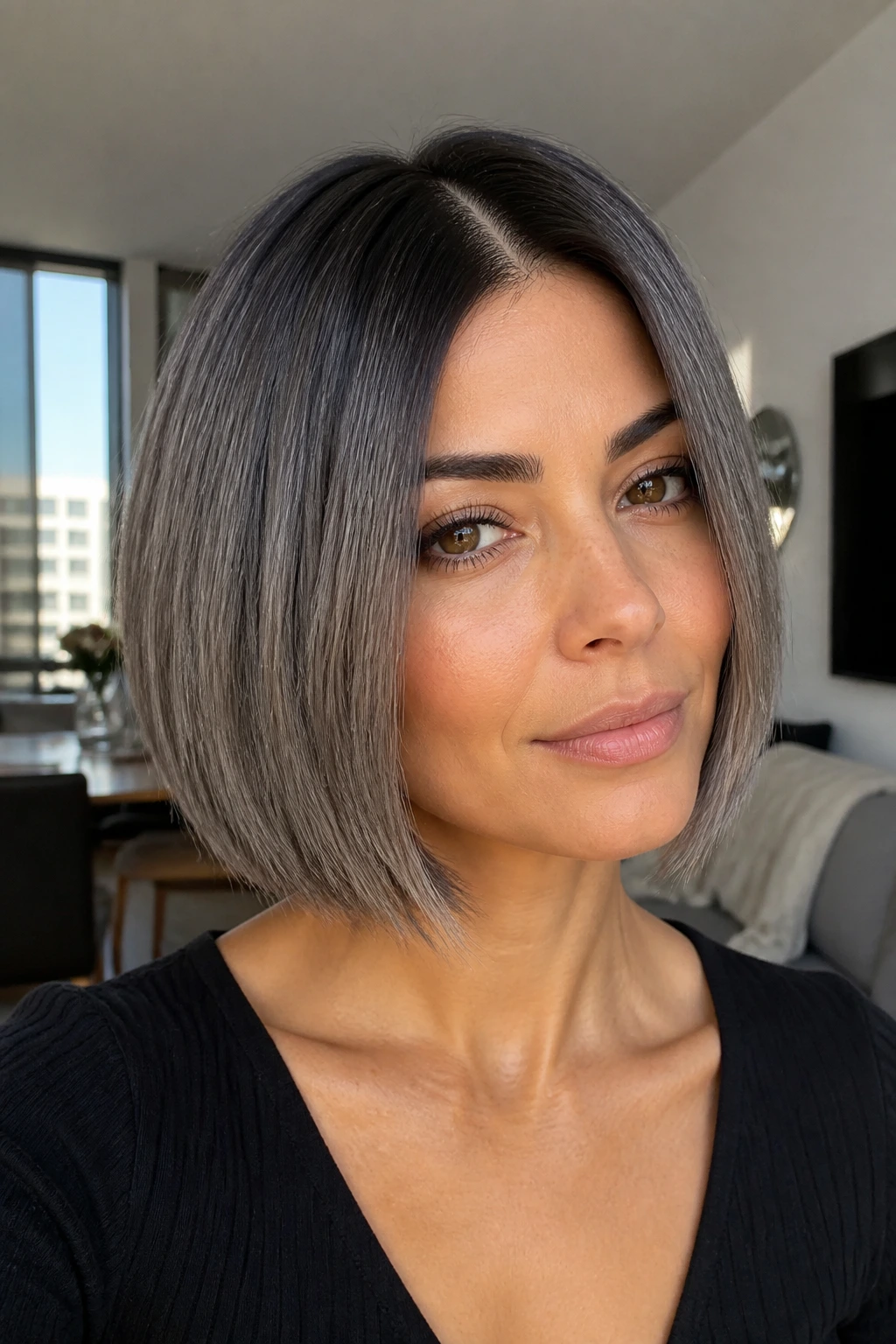
A chin-length blunt bob does one thing thin hair loves: it gives the ends a hard finish. There’s no wispy breakup at the bottom, no feathered tail that disappears when the humidity rises. Add a dark root line and a smoky gray gloss, and the shape reads denser before you even touch a styling tool.
Why it works
On olive skin, that deeper root keeps the face from looking drained. The smoky gray through the mids and ends cools things down, but it stops short of the chalky look that can make green-gold undertones look tired.
Ask for a blunt line at the chin or just below it, with the root kept one to two levels deeper than the gray through the rest of the cut. A one-inch bend at the ends is enough. You do not want a tight curl here. It turns the bob fluffy instead of full.
Best for: straight or slightly wavy fine hair that tends to fall flat at the crown.
Style with: a round brush, light mousse, and a flat iron bend at the last inch.
Skip if: your ends are badly damaged and need a trim before the gray will sit cleanly.
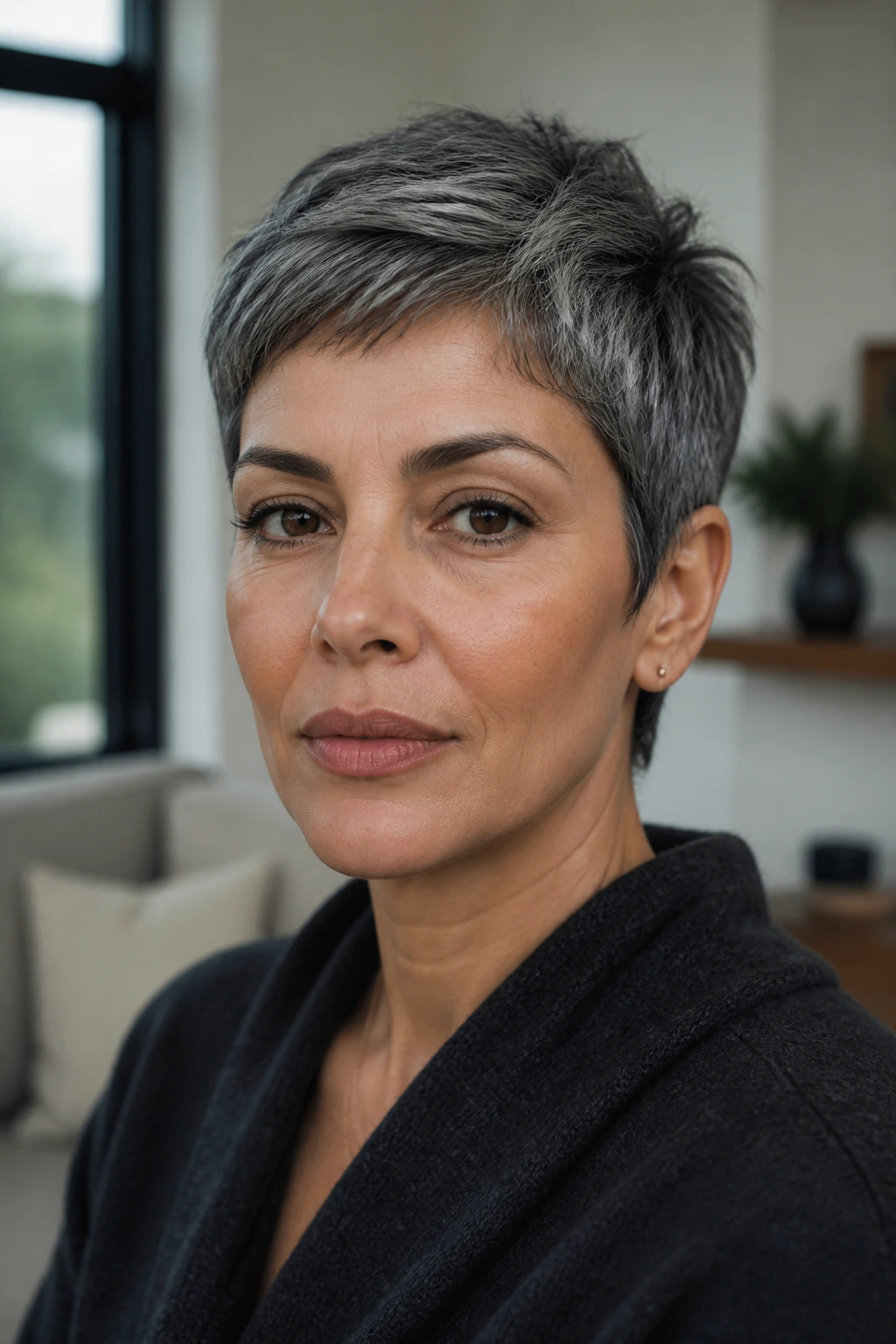
2. Graphite Pixie with Side-Swept Fringe
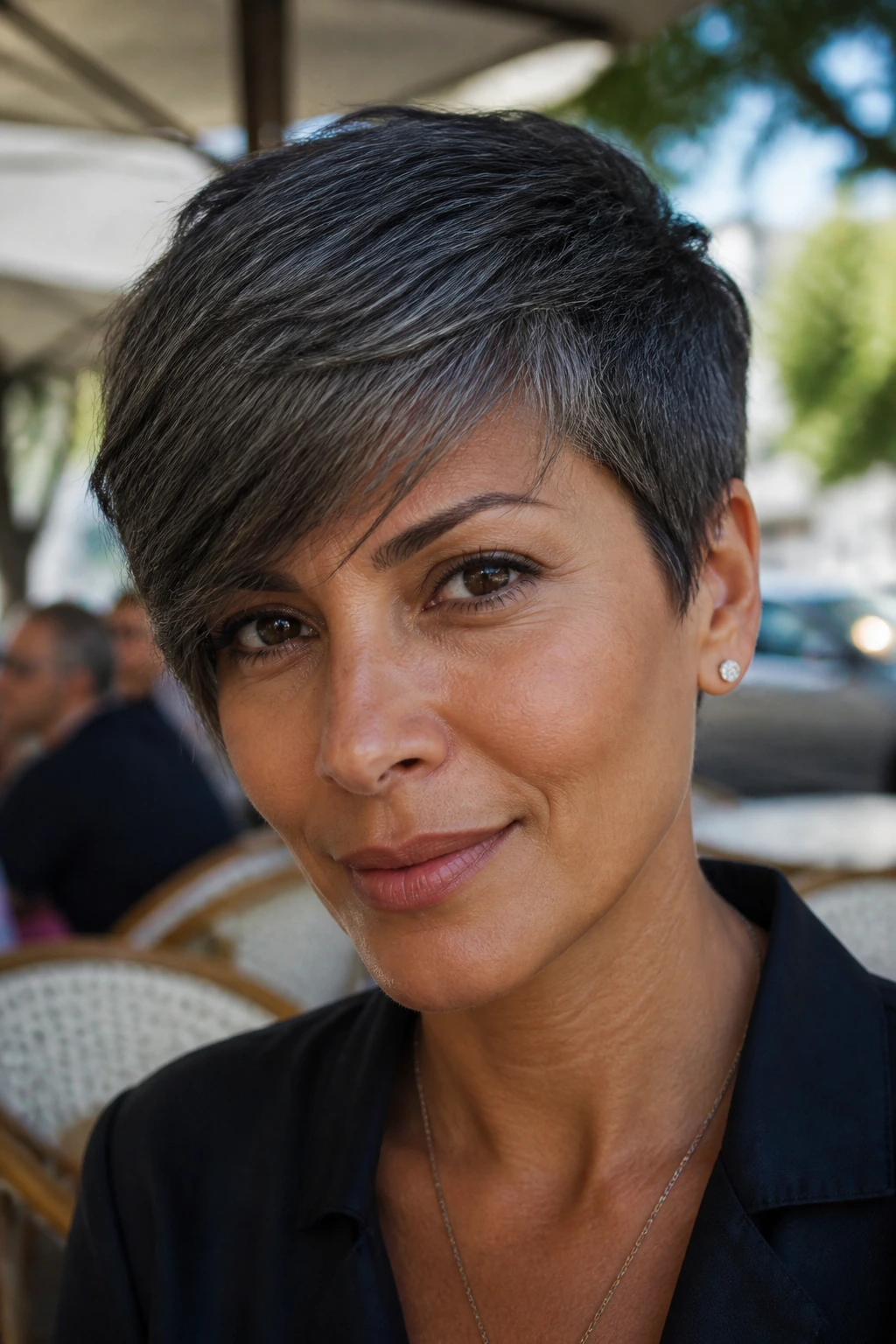
A pixie can be a cheat code for thin hair, and this version leans into that. Graphite makes the short length feel dense, while a side-swept fringe softens the forehead and keeps olive skin from looking severe.
Why the fringe matters
A straight, chopped fringe can get harsh fast. A side sweep lets the light hit the face in a more forgiving way, which matters when the gray is deep and cool. It also gives you a little lift at the front without asking the crown to do too much work.
Keep the top long enough to brush forward and across, not straight up like a spiky cut from a bad salon memory. A tiny amount of paste at the roots is enough.
- Ask for: tapered sides, a longer top, and a fringe that skims the brow.
- Color note: graphite reads richer than bright silver on olive skin.
- Styling note: blow-dry the fringe first, then set the top with fingers.
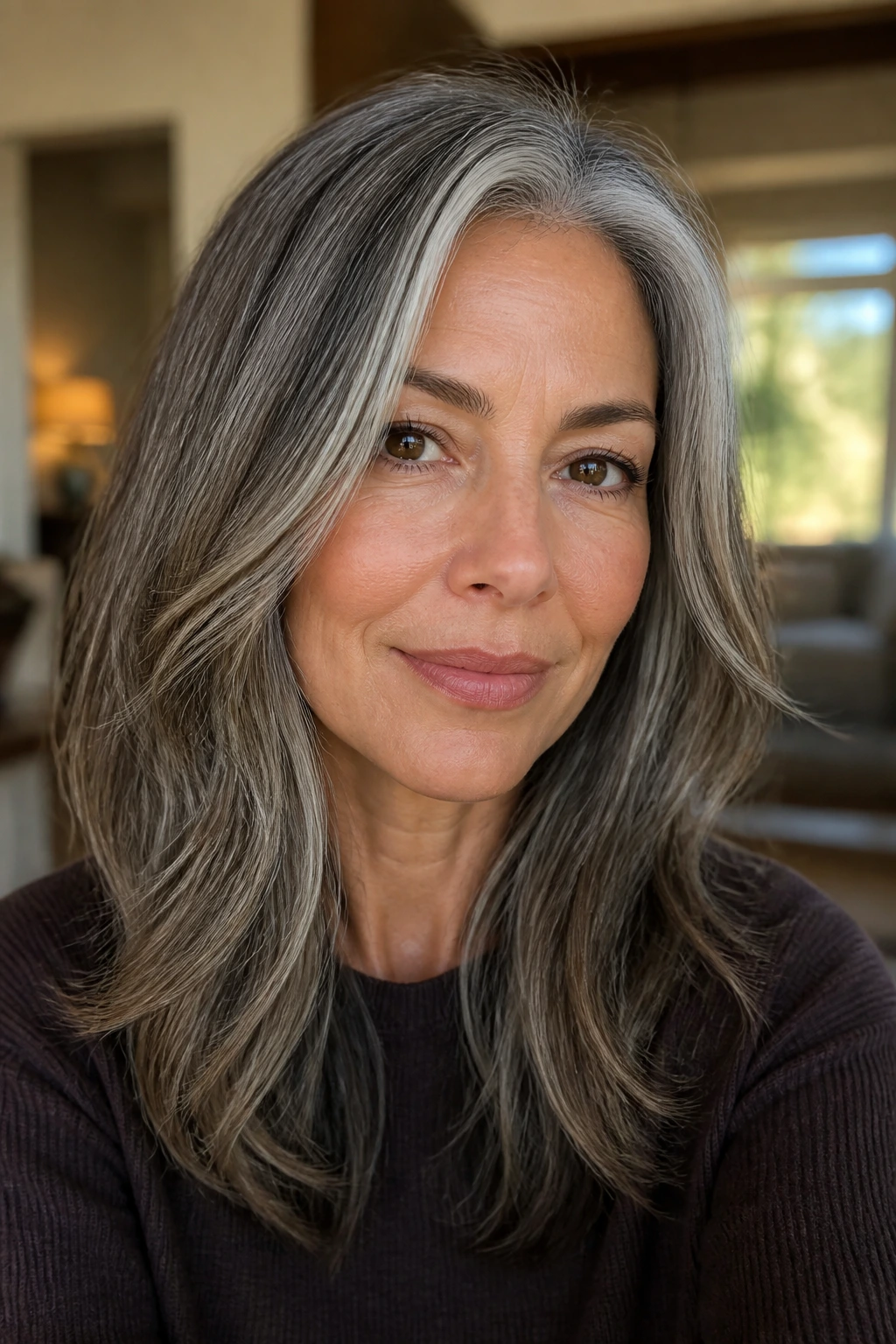
3. Mushroom Gray Lob with Soft Bends
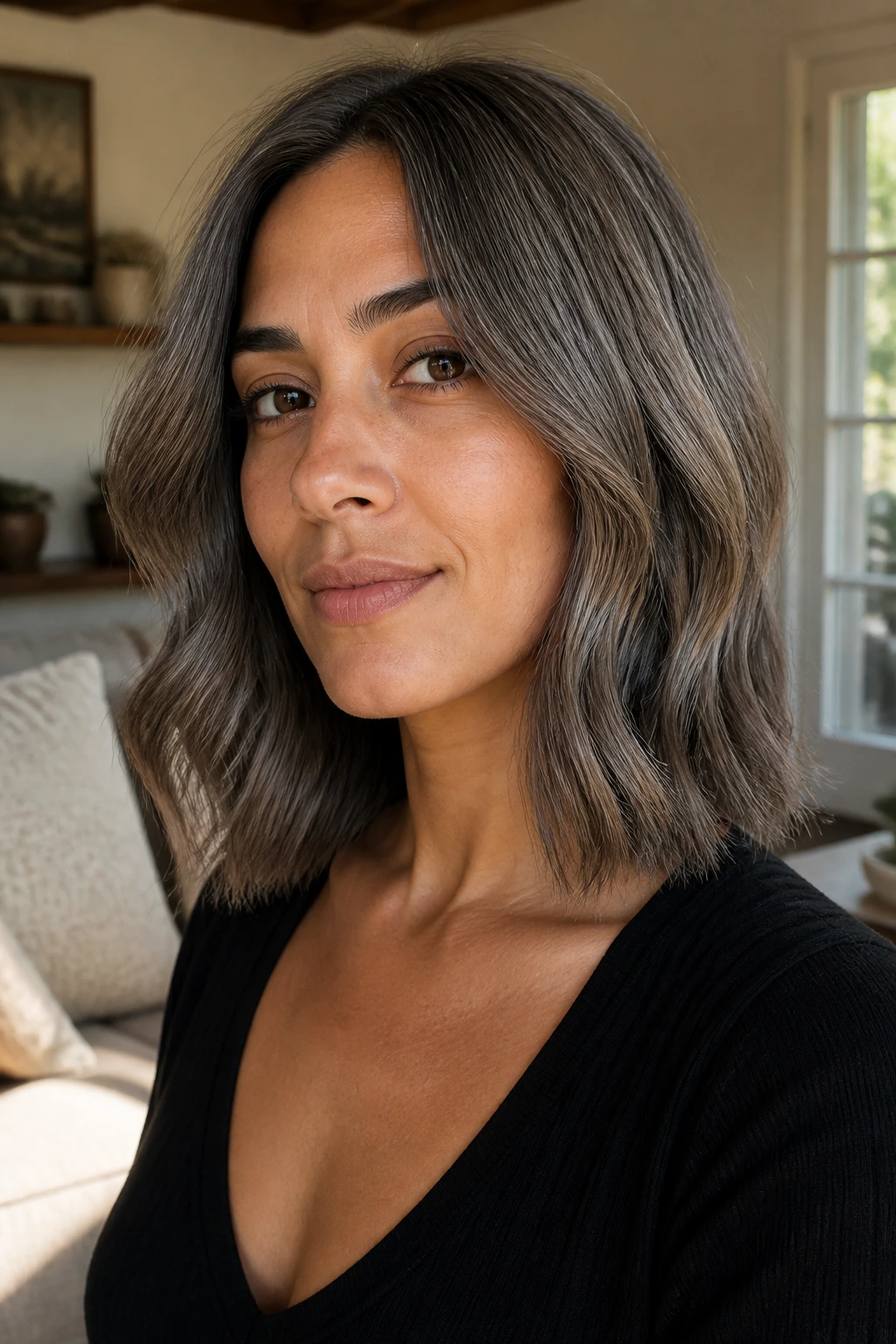
This is the sort of cut that looks quiet in the chair and expensive in daylight. A collarbone lob keeps enough length to preserve density, and mushroom gray sits in that sweet zone between cool and earthy. Thin hair gets movement without getting stripped down.
The bends should start below the cheekbones. That keeps the volume from puffing out around the face, which is the fastest way to make a fine-haired lob look triangle-shaped. A flat root and a soft S-wave through the ends give you body without fluff.
If your olive skin leans warmer, mushroom gray is one of the safest bets. It has enough softness to keep the complexion from going flat, and enough smoke to avoid a brassy cast. This is a good one if you want gray that still looks like hair, not a costume.
4. Steel-Silver Curtain Bob
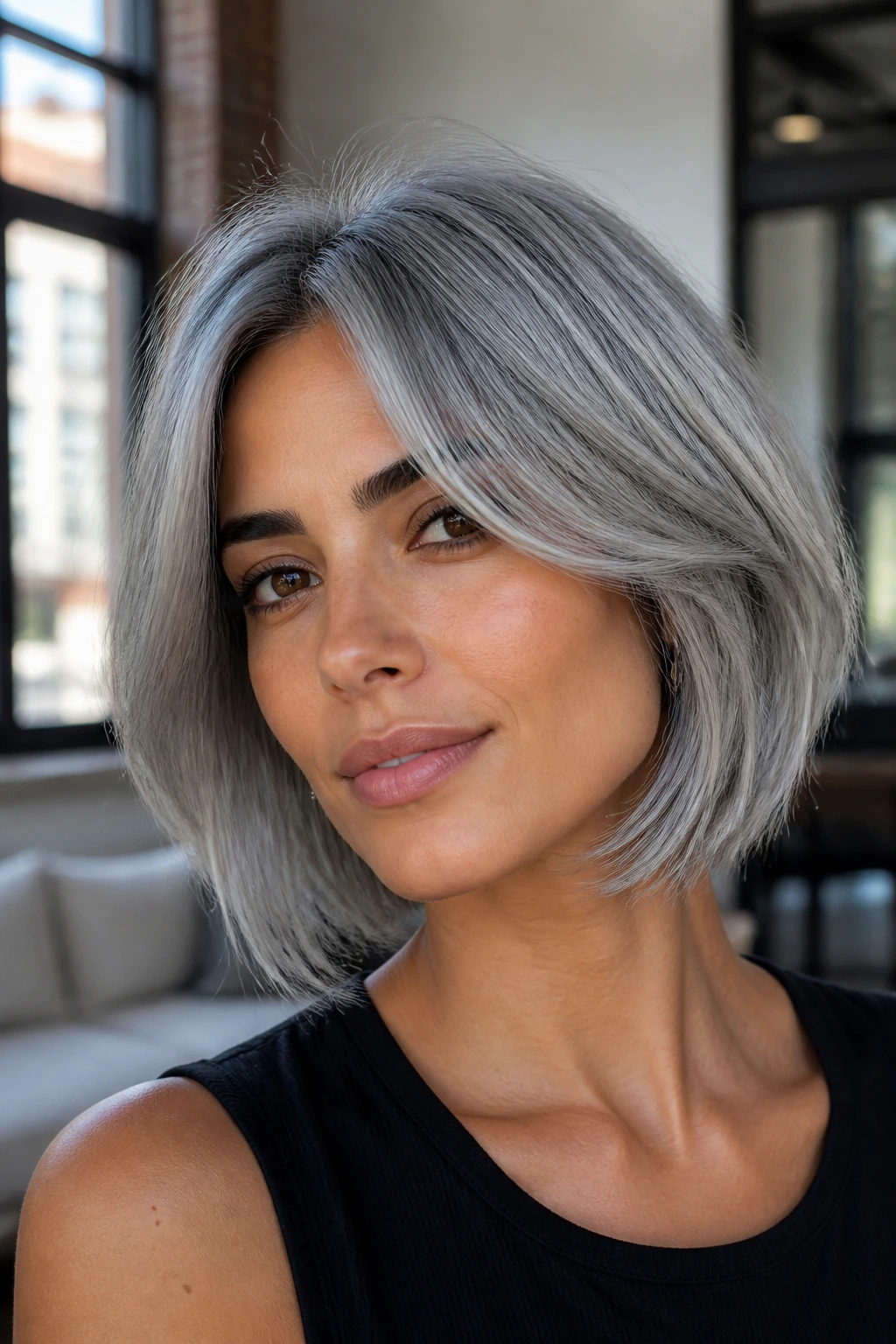
Want a brightening effect without turning the whole head icy? Curtain bangs and a chin-skimming bob do the heavy lifting. The steel-silver tone gives the cut a crisp edge, while the bangs open the face and pull attention to the eyes.
Curtain bangs are useful on thin hair because they don’t sit like a heavy block across the forehead. They split, move, and leave a little negative space, which keeps the front from looking packed down. That space is doing more than you think.
What to ask for
A bob that lands right at the jaw, with bangs that part from the center and blend into the sides. Keep the silver slightly deeper at the root and brighter only where the bangs fold away from the face. That placement matters.
If your hair is fine and pin-straight, wrap the bangs around a round brush for 20 seconds after blow-drying. That small curve changes the whole cut.
5. Charcoal Shag with Airy Ends
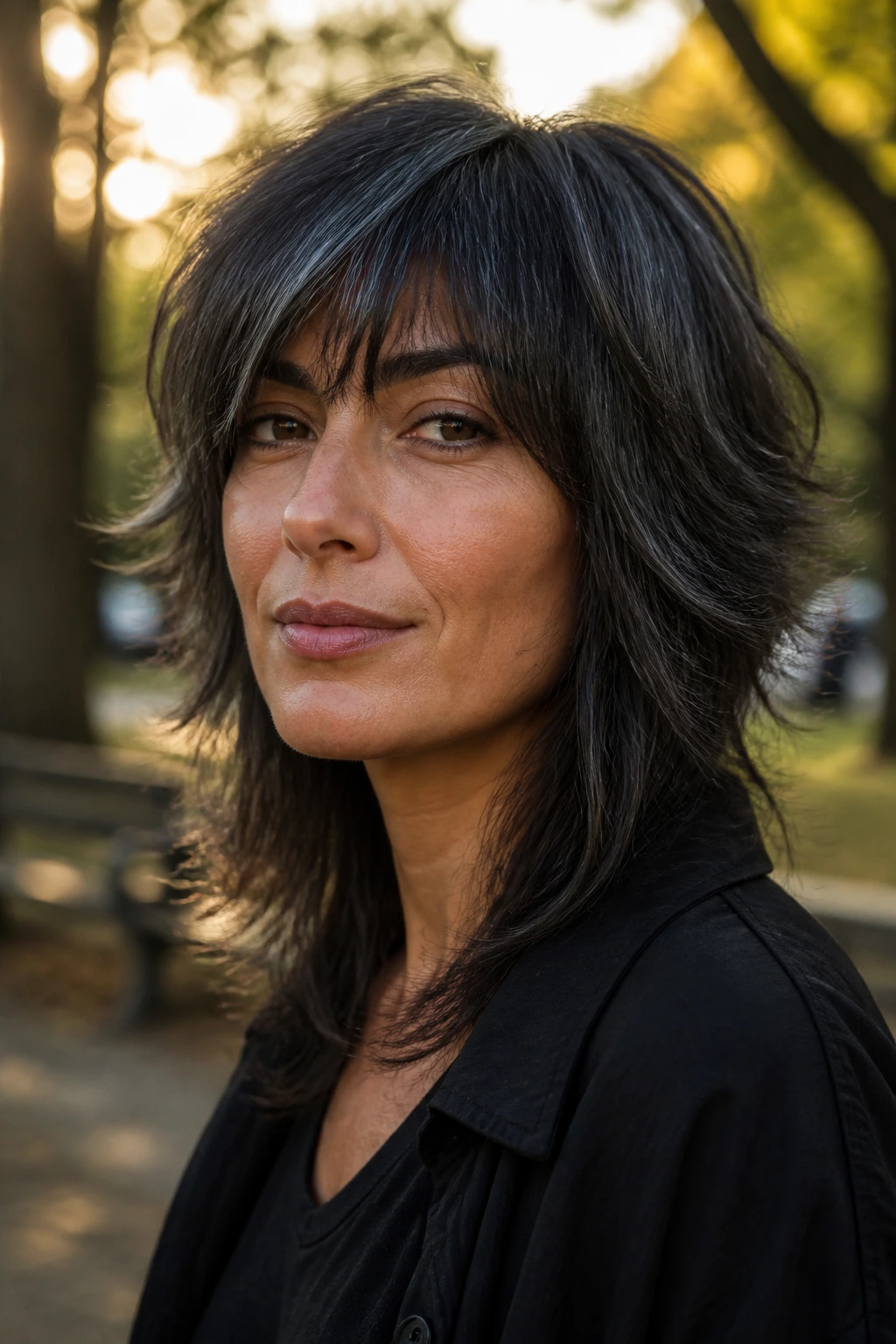
A shag sounds risky for thin hair, and sometimes it is. A badly cut shag can chew up the ends so much that the style goes translucent by week two. But when the layers stay long and soft, charcoal gray gives the shape real depth.
The point here is not to pile on choppy pieces. It’s to create movement around the crown and sides while keeping enough length in the ends to hold weight. Think swing, not scraps.
Charcoal gray works especially well on olive skin because it sits darker than silver but lighter than black. That middle ground keeps the face from looking hollow. If you like a little edge and don’t want a polished bob every day, this one has some attitude. Good attitude. Not costume attitude.
6. Pearl Gray Bixie Cut
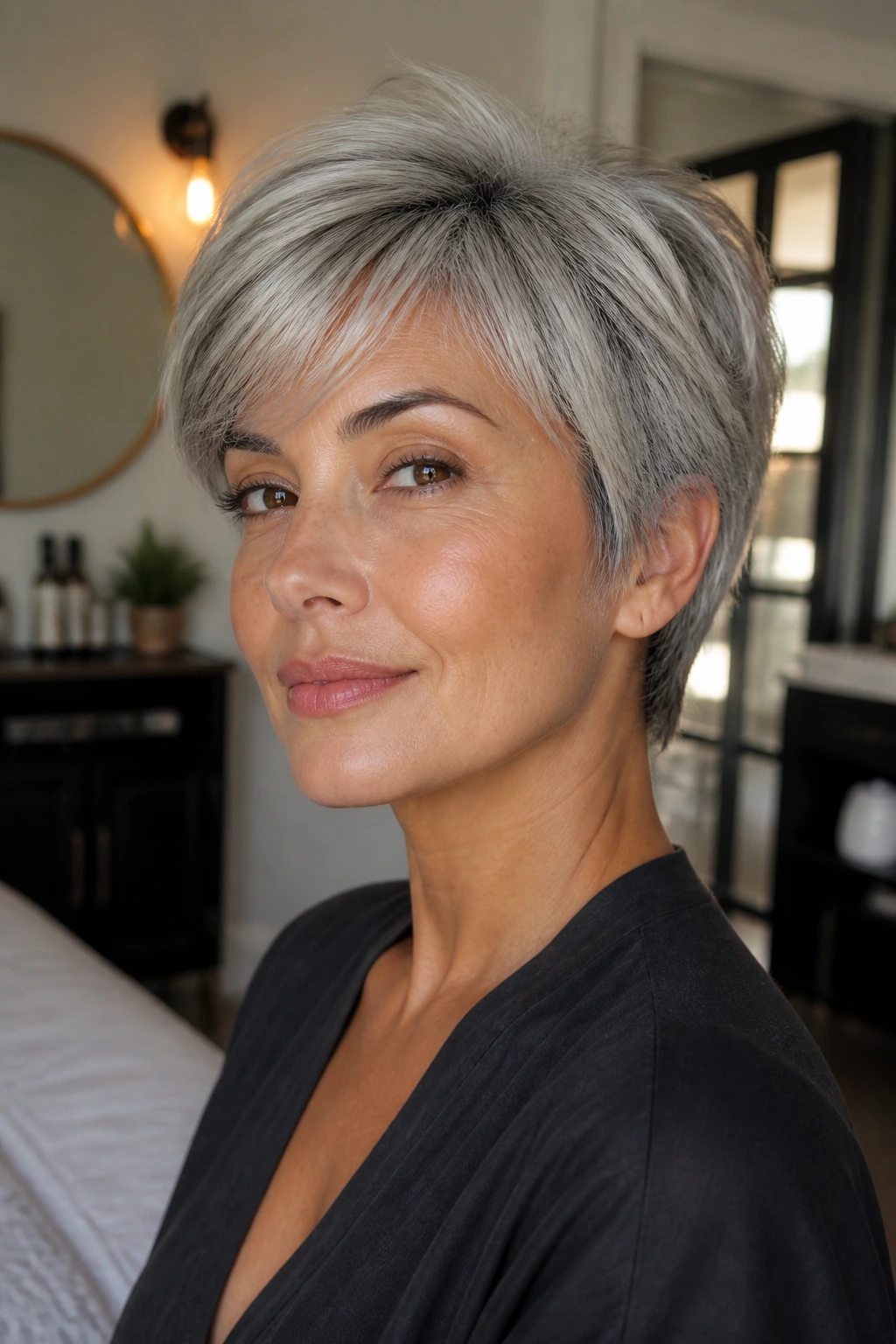
The bixie sits between a bob and a pixie, and that in-between length is a gift for fine hair. Short enough to lift, long enough to move. Pearl gray gives it a soft sheen that keeps olive skin looking fresh instead of chalky.
Best for
- Hair that loses volume at the crown by lunchtime.
- Faces that need a little lift around the cheekbones.
- People who want a short cut without the full commitment of a pixie.
Ask your stylist for
A bixie with a full enough top to blow-dry upward, but not so much texturizing that the ends get see-through. Pearl gray can be done as a gloss over lighter pieces or as a soft toner on pre-lightened hair.
Keep the finish loose. A dab of lightweight wax on the ends and a finger-tousle at the crown is enough. The charm here is in the shape, not in making it too styled.
7. Slate Angled Bob
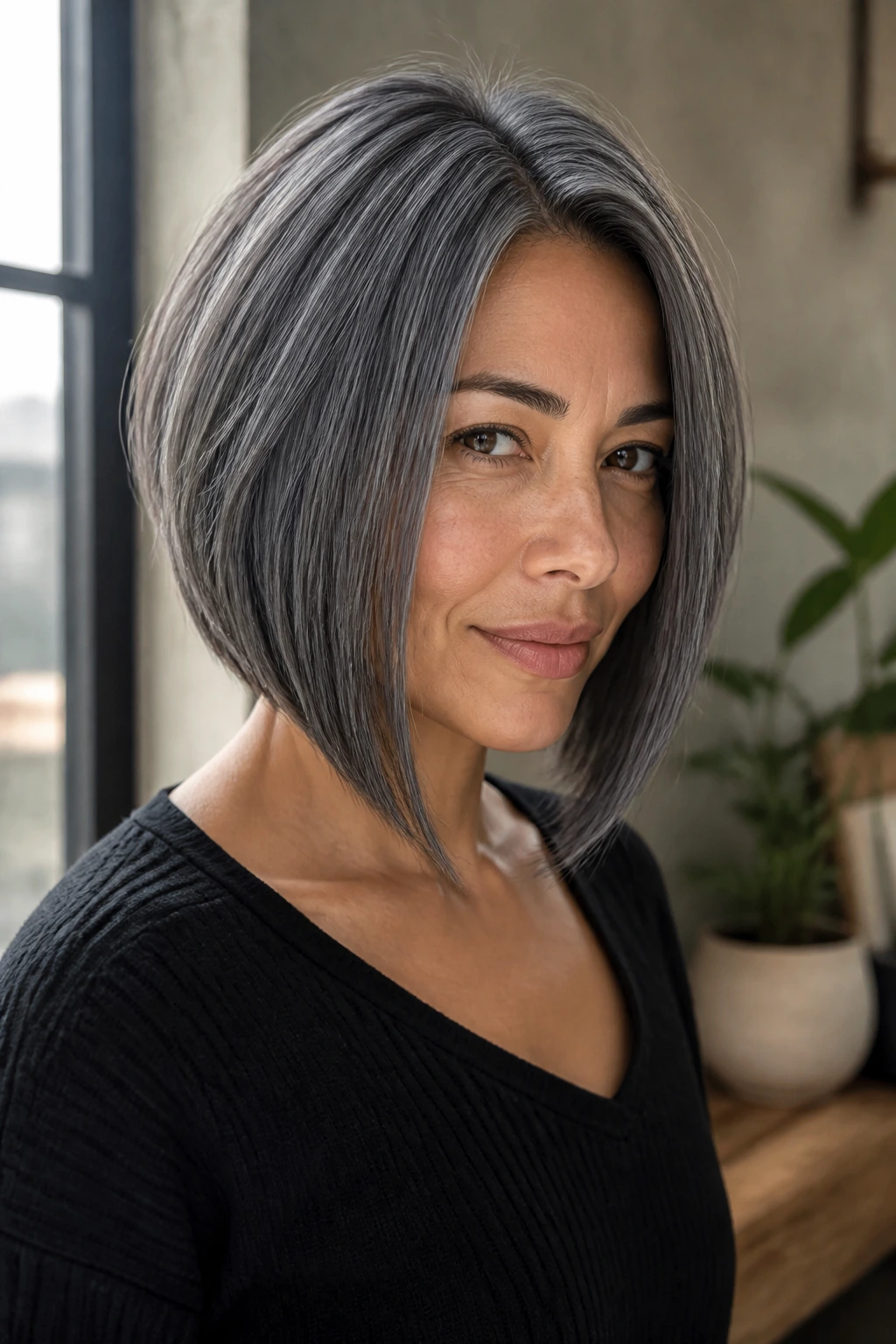
An angled bob is one of the few cuts that flatters thin hair because it creates a visual slope. Shorter in back, longer in front — simple math, big effect. Slate gray adds a cool, stone-like finish that sits well against olive undertones.
The front pieces should land somewhere between the chin and collarbone, depending on how much length you can spare. That extra inch or two in front gives the eye something to read as density. You do not want the angle so steep it looks like a wedge; that can feel dated fast.
This cut is at its best when the surface is smooth and the ends are lightly beveled. A flat brush blowout with a touch of shine spray does more for it than curls. If your hair is fine but fairly straight, this is one of the easiest gray styles to wear every day.
8. Silver Money Pieces on a Dark Base
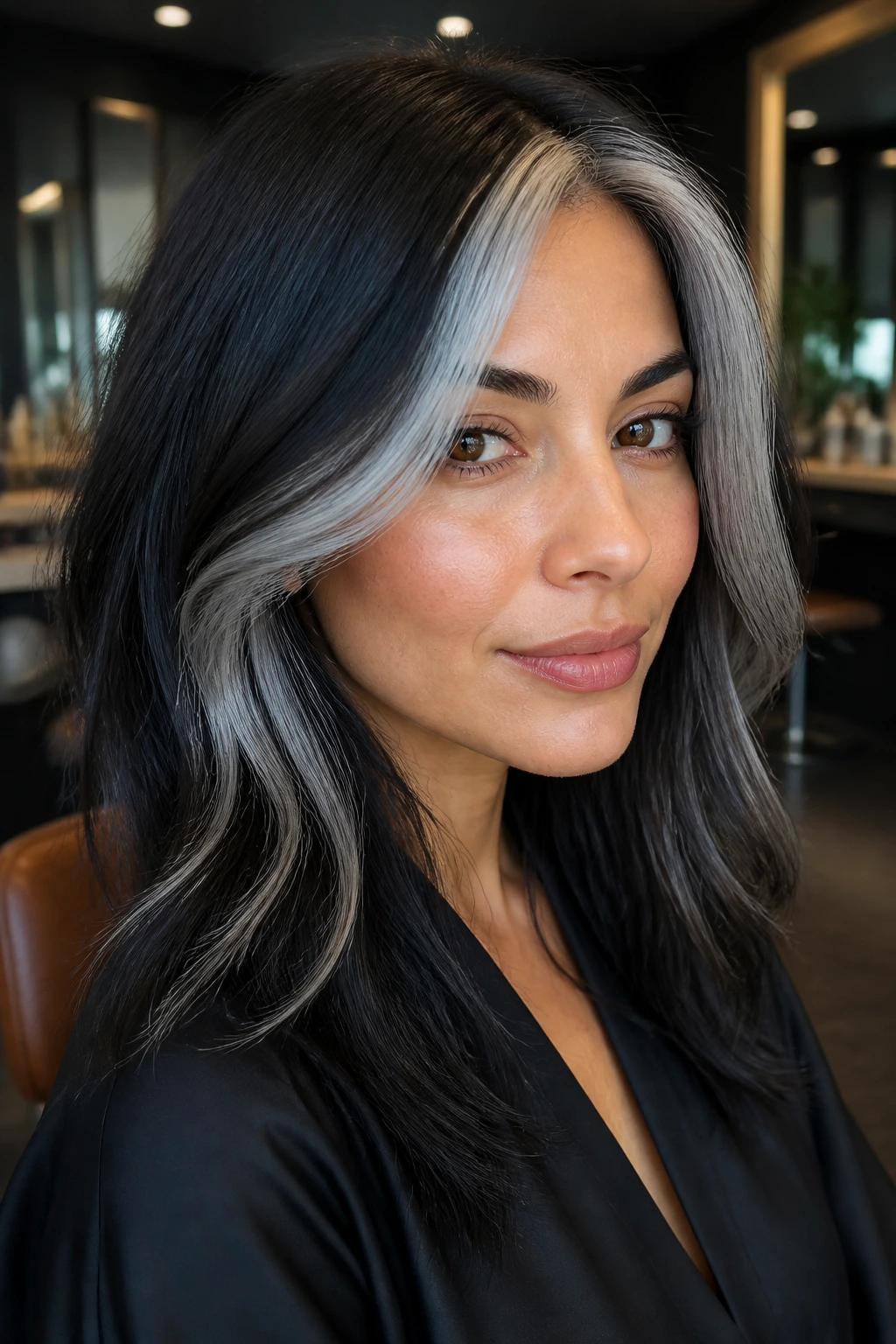
Not every gray look needs to go all over. In fact, for thin hair, a darker base with silver money pieces around the face can be smarter than flooding the whole head with light. The dark base keeps the body of the hair looking thicker, while the silver pieces give the face a clean lift.
Why this placement matters
Money pieces work best when they start near the brow and skim the cheekbones, not when they sit as thick stripes. On olive skin, that front-brightening effect can wake up the face in a way full silver often can’t. The contrast is the point.
This is also a good choice if you want to dip into gray without committing to a full transition. Ask for just enough lightening around the front to make the silver visible when the hair moves. Keep the rest smoky and deep.
A side part makes this even better. The silver catches the part line and the front curve of the hair, and the rest stays fuller-looking.
9. Pewter Collarbone Cut with Face-Framing Layers
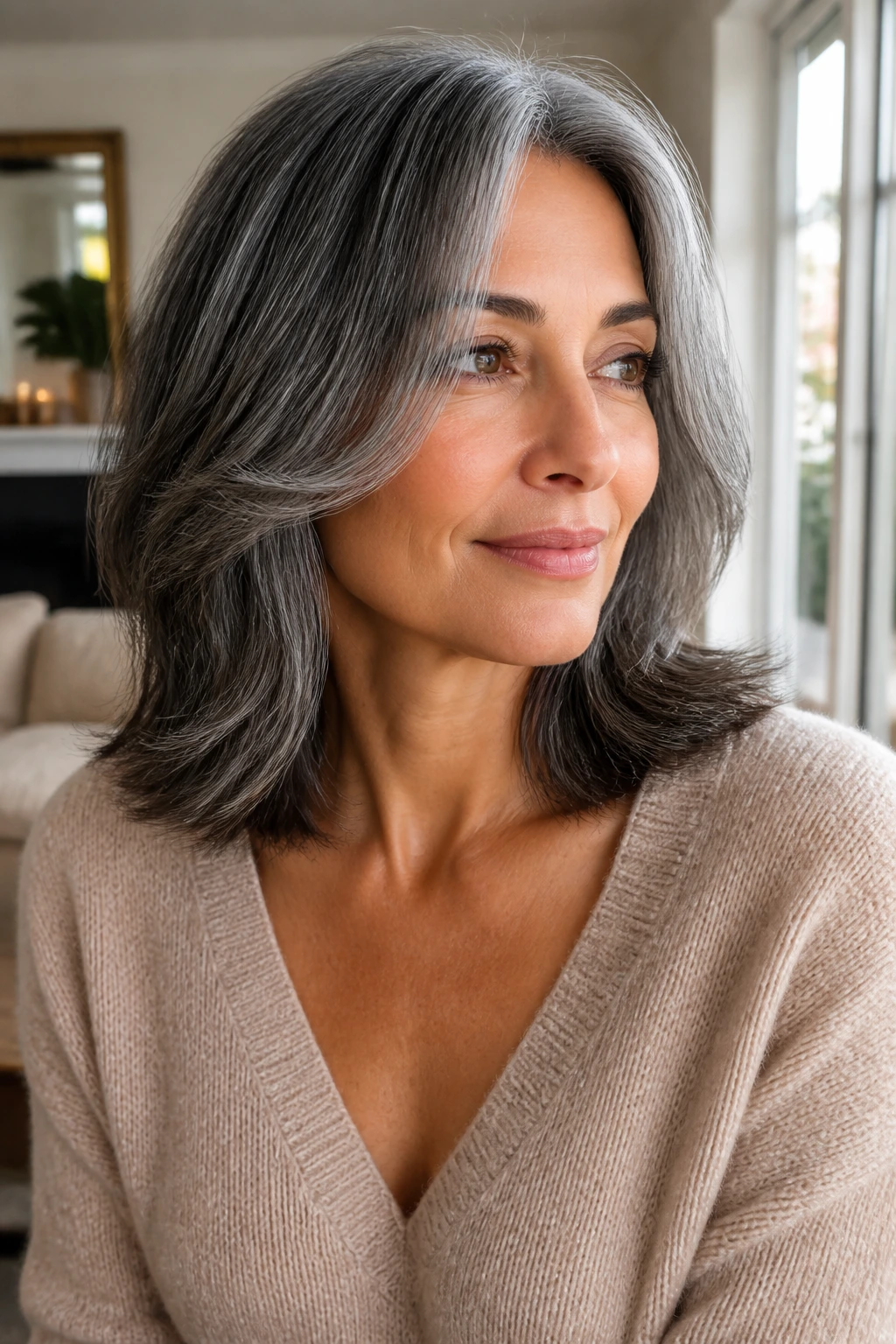
Pewter might be the most forgiving gray in the bunch. It has enough softness to flatter olive skin and enough depth to keep thin hair from looking like it’s been bleached to the bone. On a collarbone cut, it feels calm and expensive in the best way.
The face-framing layers should start low, around the mouth or jaw, not high on the cheekbones. High layers can eat through density. Low ones shape the face without leaving the sides sparse.
This cut is good for hair that has a slight wave or a bend already built in. Air-dry it with a small amount of cream, or use a large round brush and flip the front sections away from the face. The result is gentle, not fussy. And that matters.
10. Smoky Wolf Cut for Thin Hair
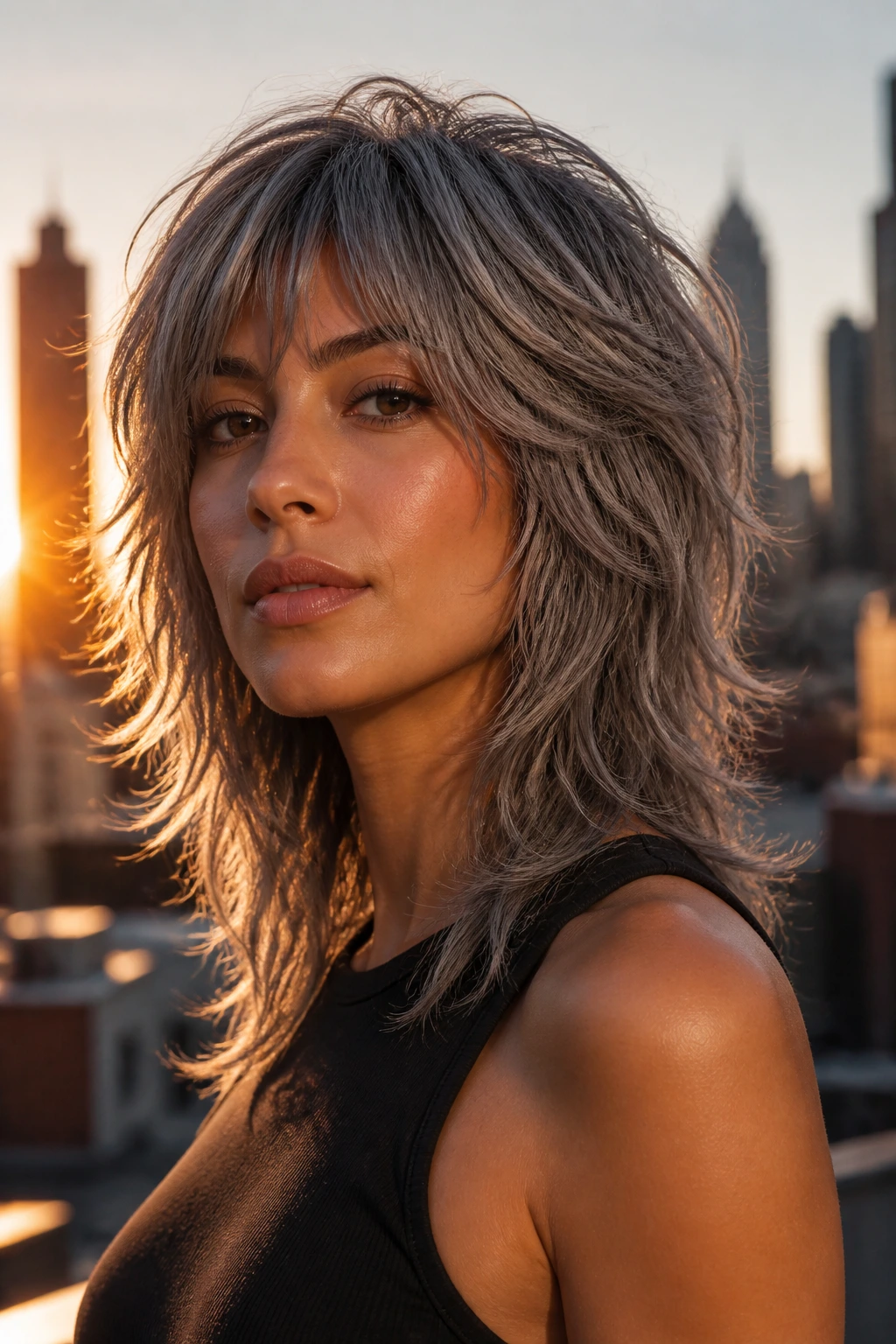
A wolf cut is a risky request if your hair is truly fine, but a softened version can work. The trick is keeping the layers long enough to preserve weight while using the crown for lift. Smoky gray gives the shape a gritty, lived-in texture that suits the cut better than a shiny silver ever would.
The best version for thin hair is not the shredded one from a social feed. It’s a controlled wolf cut with a loose fringe, longer wings around the face, and a back that still has enough length to hold shape. If it looks too airy in the salon, it will look even airier after a wash or two.
Use this one if you want movement and you don’t mind a bit of edge. It loves texture spray. It hates heavy cream.
11. Ash-Black Midi with Invisible Layers
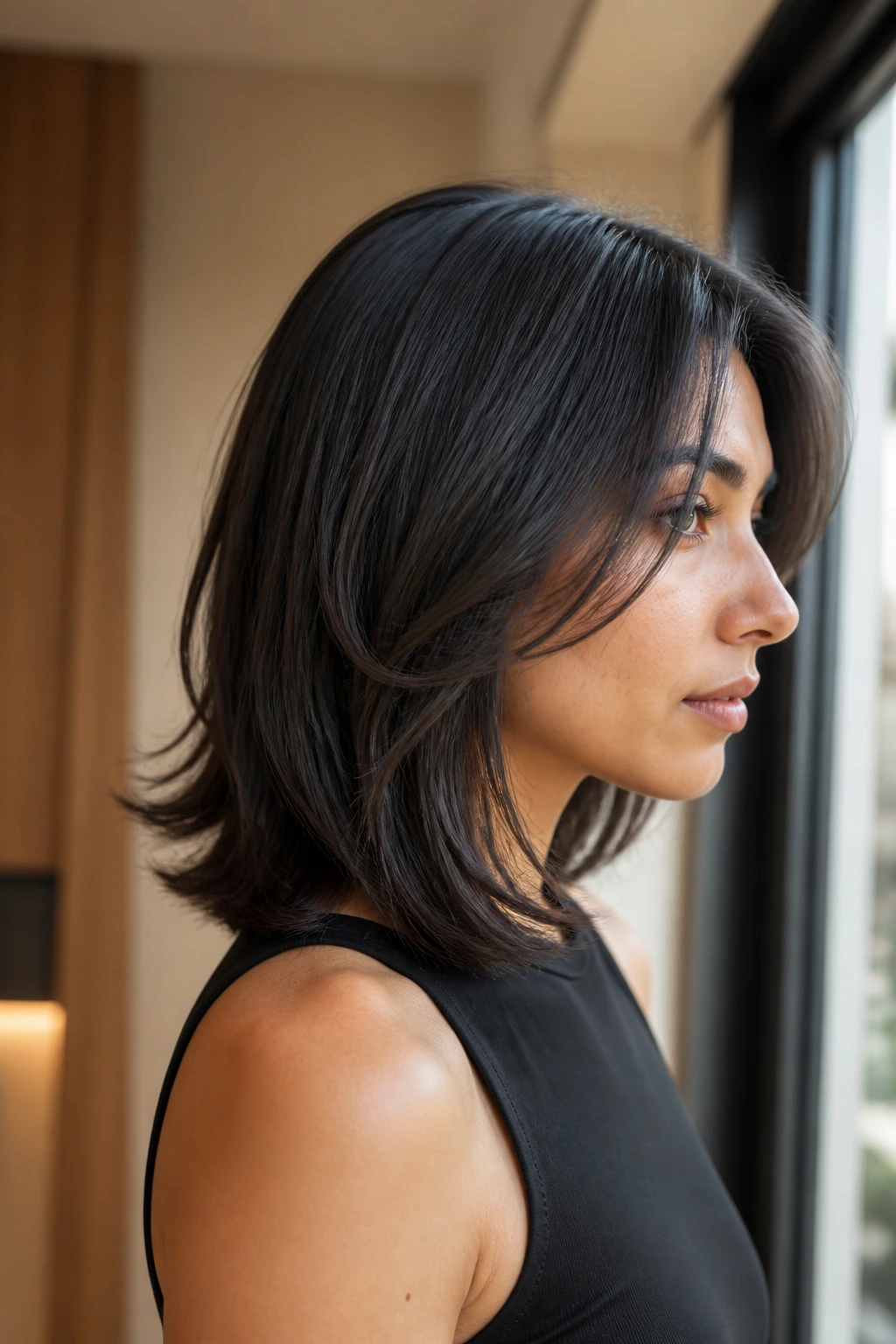
Ash-black is the darkest shade on this list, and that’s why it works. The near-black base keeps thin hair looking full, while the ash note stops it from turning soft brown or muddy. Invisible layers do the rest by adding movement without breaking up the silhouette.
Invisible layers, explained
They’re cut into the inside of the hair, not the outline. That means the perimeter still looks solid, which is exactly what thin hair needs. The movement happens underneath, where it can’t steal the thickness from the ends.
This is a strong choice for olive skin that leans more neutral or slightly golden. The ash tone keeps the darkness from looking red. If you want your gray look to feel grounded and polished rather than bright and icy, this is one of the most useful cuts in the group.
A center part can work here, but a soft off-center part often gives the crown more lift. Tiny change. Big payoff.
12. Gunmetal Side-Part Bob
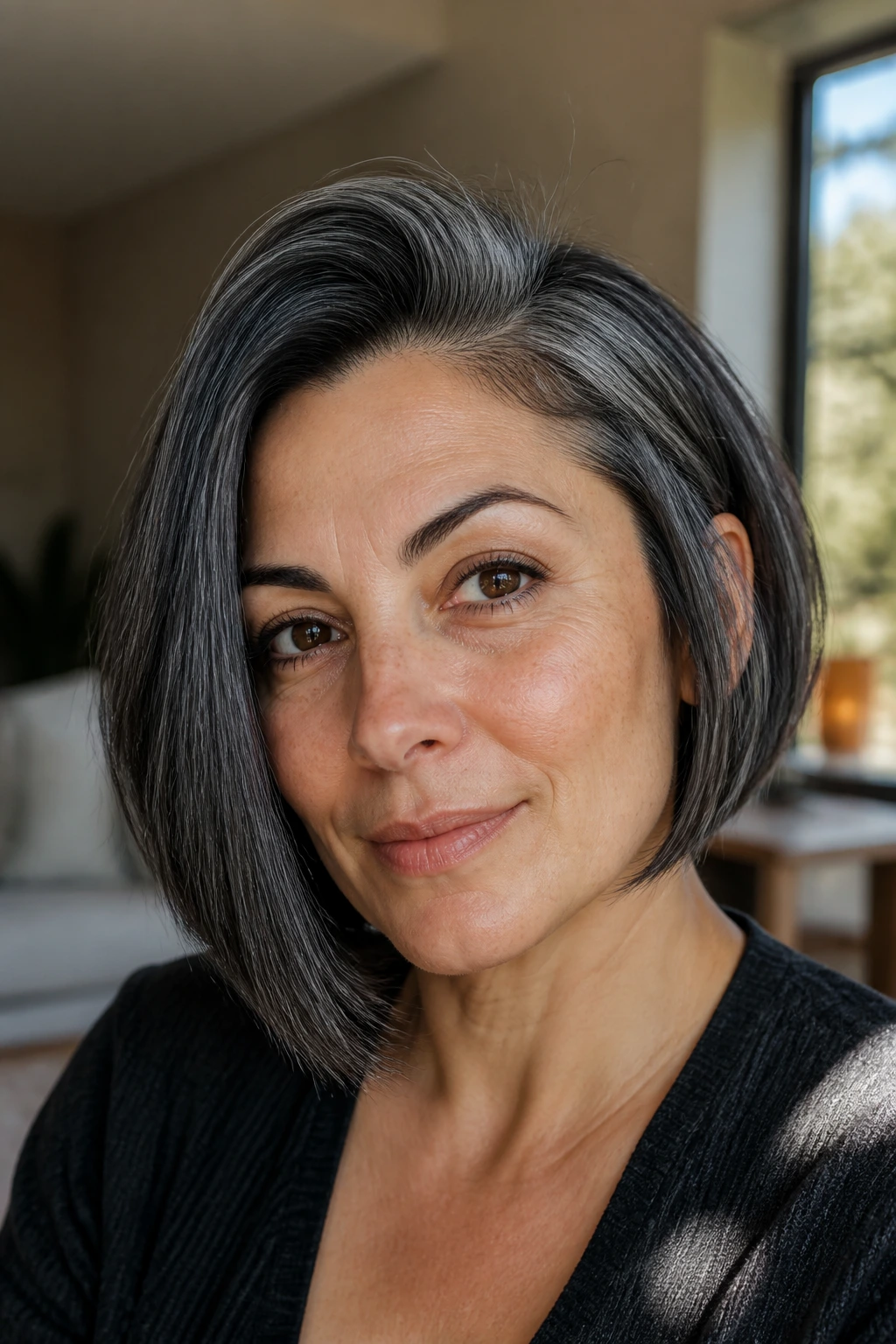
Why does a side part make such a difference on thin hair? Because it forces one side to rise at the root. That small lift changes the whole shape, and gunmetal gray gives the bob a sleek, steel-edged finish that holds its own on olive skin.
The cut itself should stay chin to jaw length, with a slight bevel under the ends. Keep the front just a touch longer if your jawline needs softening. Gunmetal is darker than silver but not as hard as black, which makes it easier to wear if you want a gray look without a pale finish.
Use a tail comb to make the part clean, then blow-dry the top against the natural fall for a few seconds before letting it settle. That little bit of resistance is what gives the root height. Easy to miss. Easy to fix.
13. Cool Taupe Gray Lob
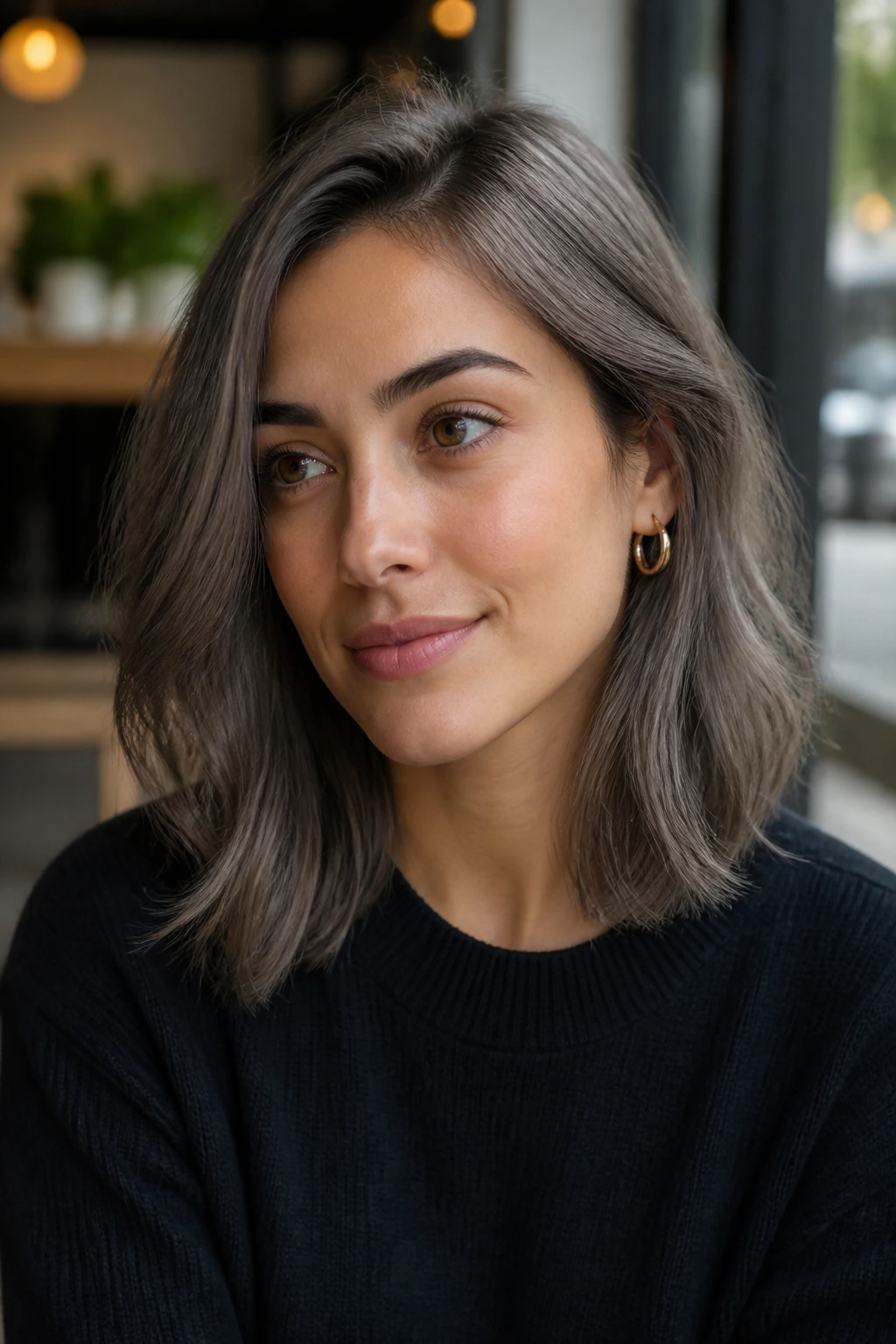
Taupe gray sits in the warmer corner of the gray family, and that is exactly why it deserves a spot here. Olive skin that leans golden can look a little severe against icy shades. Taupe gray softens that problem and still reads gray in daylight.
The lob should hit around the collarbone and avoid over-layering. Thin hair needs a clean outline more than a lot of internal slicing. If you want movement, use a wide barrel or a flat iron to create a loose bend just through the mid-lengths.
This is one of those cuts that makes sense for someone who wants gray hair but doesn’t want the maintenance of very pale silver. It grows out with less drama, and it plays well with natural root color. Quiet choice. Smart choice.
14. Frosted French Bob
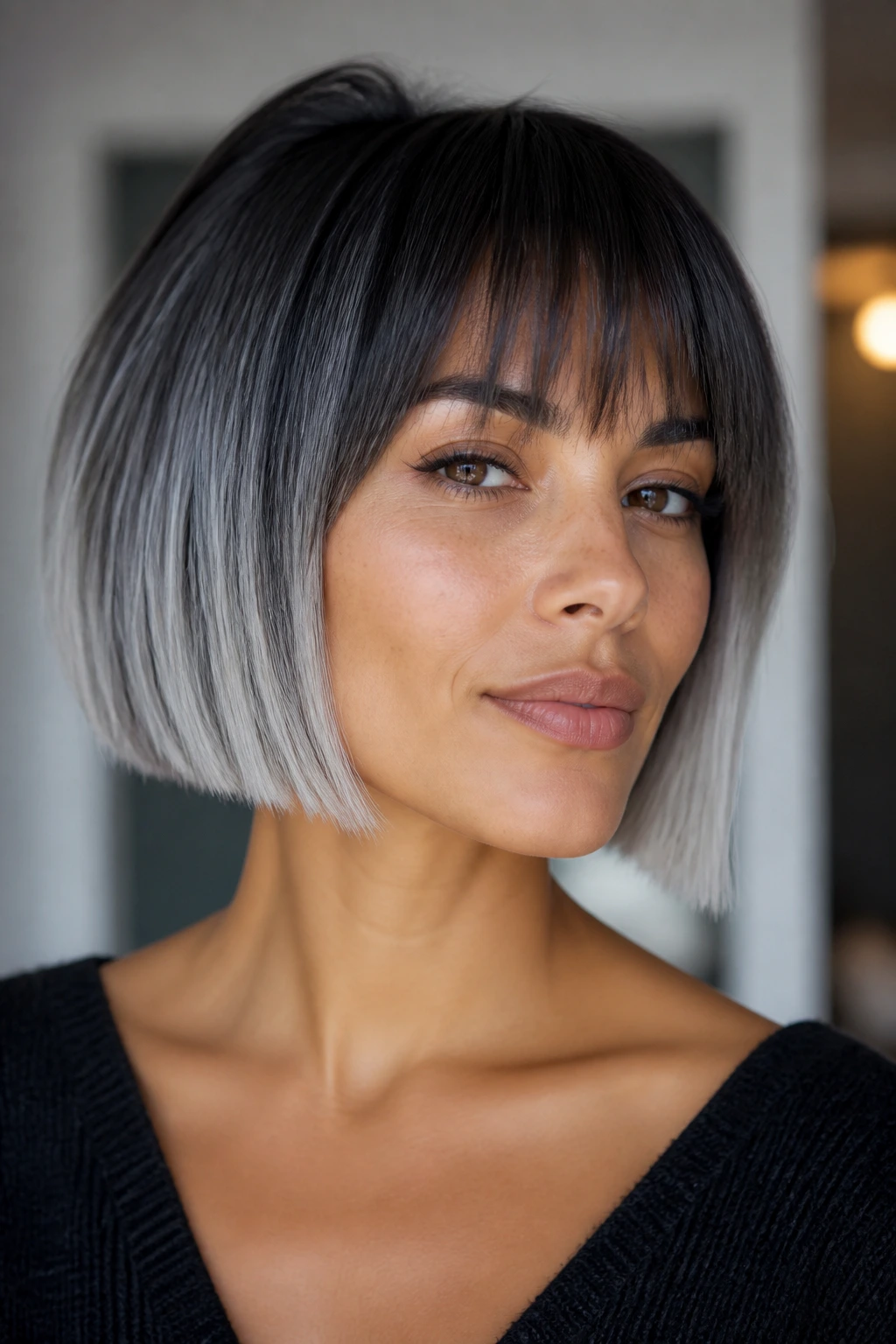
The French bob gets its charm from being a little shorter and a little more precise than a standard bob. Frosted gray tips and a barely there fringe make it feel airy without sacrificing shape. For thin hair, that precision is gold.
The length should sit around the jawline, with the fringe skimming the brow or sitting just above it. Keep the ends blunt. A fringe that’s too wispy can make the whole cut look underfed, especially if the hair is fine.
On olive skin, the frosted finish works best when the roots stay deeper. That contrast keeps the face from disappearing into the color. If you’ve ever tried a very pale gray and felt like it wore you instead of the other way around, this cut is the correction.
15. Raven Root Melt with Gray Ribbons
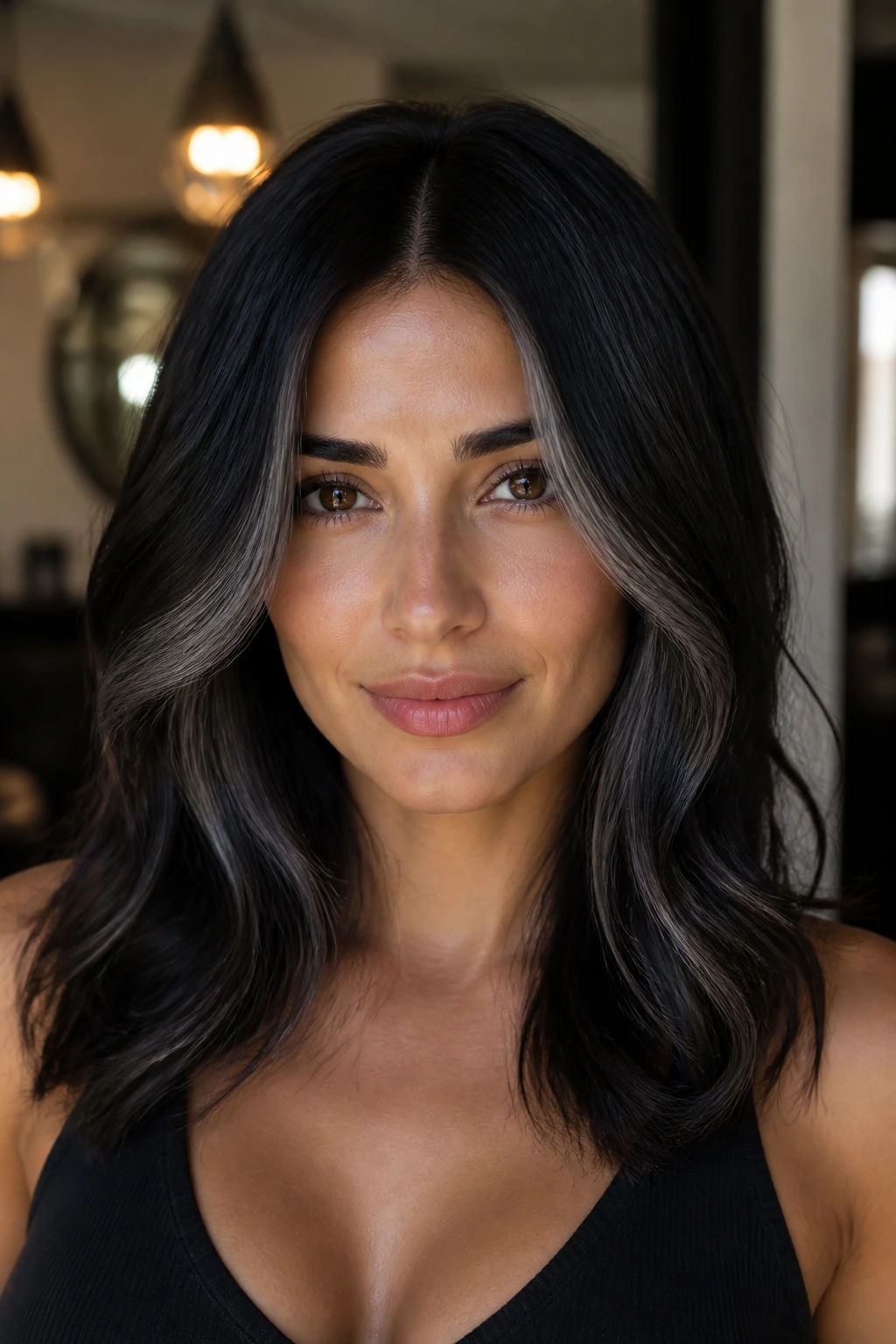
This one is for the person who wants dark hair first and gray second. The raven base keeps thin hair looking full, and the gray ribbons add movement without exposing too much scalp or too much texture loss. It’s one of the easiest ways to wear gray and still keep a dark overall impression.
The melt should be soft. No hard line between root and ribbon. Let the gray live mainly in the outer layers and around the face, where it can catch light without taking over the whole head.
Olive skin handles this beautifully because the dark base sharpens the features while the gray pieces keep the finish from looking flat. If you like your hair to read polished, not trendy-for-five-minutes, this is a strong pick.
16. Textured Crop with Silver Choppy Fringe
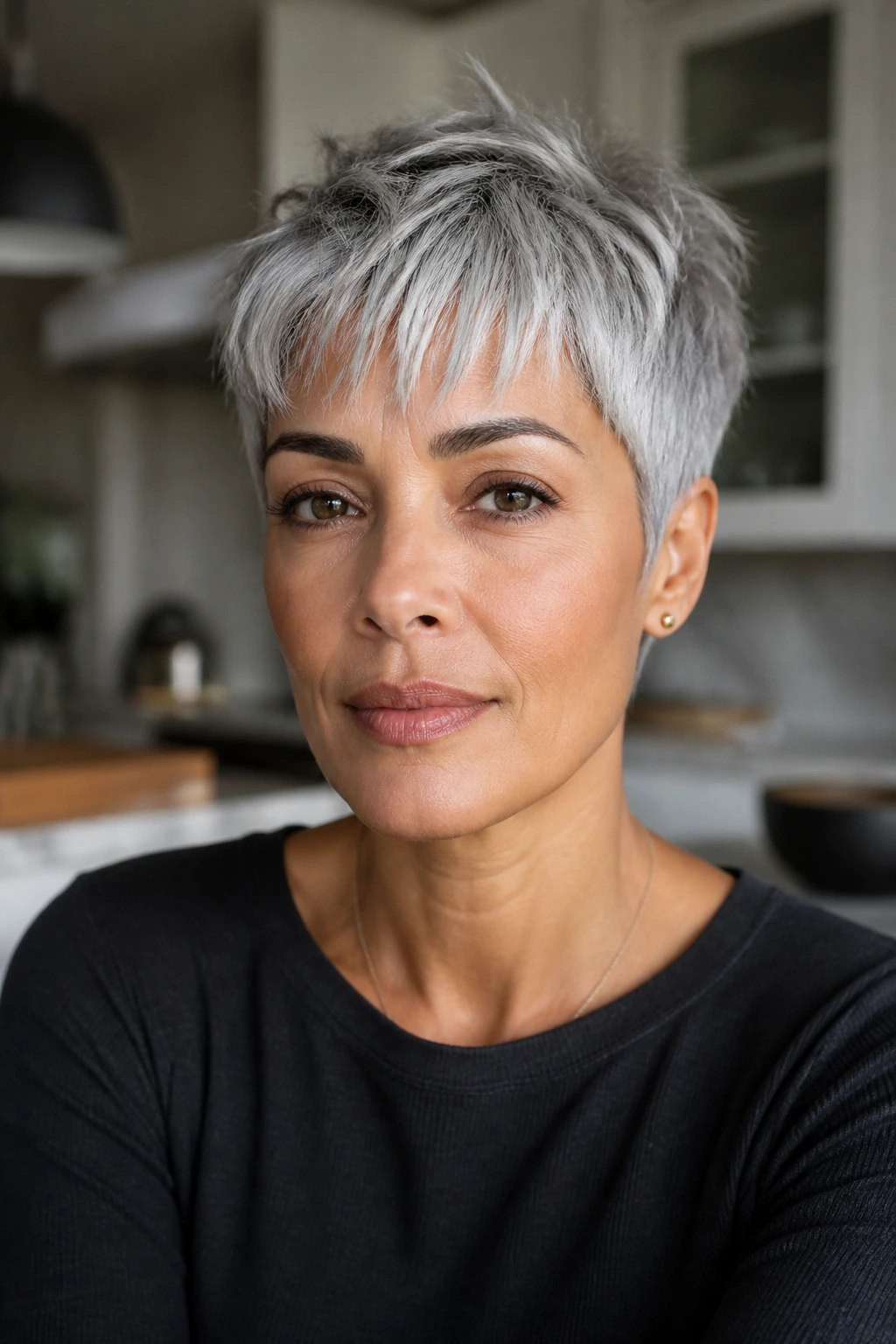
A crop can be fierce, but it needs discipline on thin hair. Keep the sides close, leave enough on top for lift, and let the fringe carry the silver. The result is a compact shape that looks deliberate rather than overworked.
The fringe is the whole story here. Choppy pieces at the front break up the forehead, pull attention upward, and keep the cut from feeling severe. Silver works as an accent more than an all-over shade, which helps when the hair density is limited.
A tiny amount of matte paste at the roots is enough. If you start loading this cut with heavy product, it loses the airy lift that makes it work. Short, sharp, and a little smoky. That’s the lane.
17. Soft Gray Feather Cut
Feathering can be dangerous on thin hair. Go too far and the ends turn stringy fast. Keep the feathering soft and mostly around the face, and the cut can bring a lot of swing without giving up density.
Gray works well here because the feathered edges catch the light in a gentle way. On olive skin, the soft gray tones keep the look cool, but not stark. The shape should have enough length to tuck behind the ears or sweep forward with a brush.
This is a good choice if you want movement more than drama. It’s also one of the easier styles to grow out, since the layers blend naturally. If your hair is fine but not fragile, and you want something that moves when you turn your head, this one earns its keep.
18. Metallic Silver Underlayer Bob
Here’s the fun one. A metallic silver underlayer lets you keep the top darker while hiding a brighter panel underneath. The hair looks fuller on top, then flashes silver when it moves. Thin hair likes that because the eye reads depth first, brightness second.
The bob itself should stay clean and compact. If the outline gets too broken up, the underlayer loses its impact. Keep the top a shade or two deeper than the silver beneath it, and ask for the lighter pieces to sit under the surface rather than all through the crown.
On olive skin, this gives you contrast without washing out the face. It’s a little more unexpected than the rest of the list, but not in a loud way. The best part is how it changes depending on how you wear it: tucked, pinned, or loose.
19. Graphite Curtain Bangs and Long Bob
A long bob plus curtain bangs is one of the easiest combinations to wear when hair is thin. The lob keeps the ends thick enough to matter, and the curtain bangs create that soft opening around the face that olive skin usually likes. Graphite tones keep the whole thing grounded.
The bangs should split cleanly and blend into the front lengths. If they’re cut too short or too dense, they can crowd a fine-haired face and make the crown seem flatter. Keep them airy, not heavy.
This cut is useful if you like a part you can change on bad hair days. It works in the middle, off to the side, or tucked behind one ear. A flexible cut is a relief when your hair density is not doing you any favors.
20. Smoky Asymmetrical Cut
An asymmetrical cut sounds dramatic, and it can be. The good version uses one side slightly longer to create line and movement, not a sharp angle for the sake of it. On thin hair, that diagonal shape gives the eye something to chase.
Smoky gray softens the edge. It keeps the cut from feeling too hard against olive skin, which can happen when the shape is severe and the color is too cold. The longer side should still feel connected to the rest of the hair, not like it was chopped on a dare.
A small styling note
Use a side part that supports the longer side rather than fighting it. That lets the top gain lift and keeps the shorter side from hugging the head too tightly.
21. Dark Mushroom Waves with a Gloss Finish
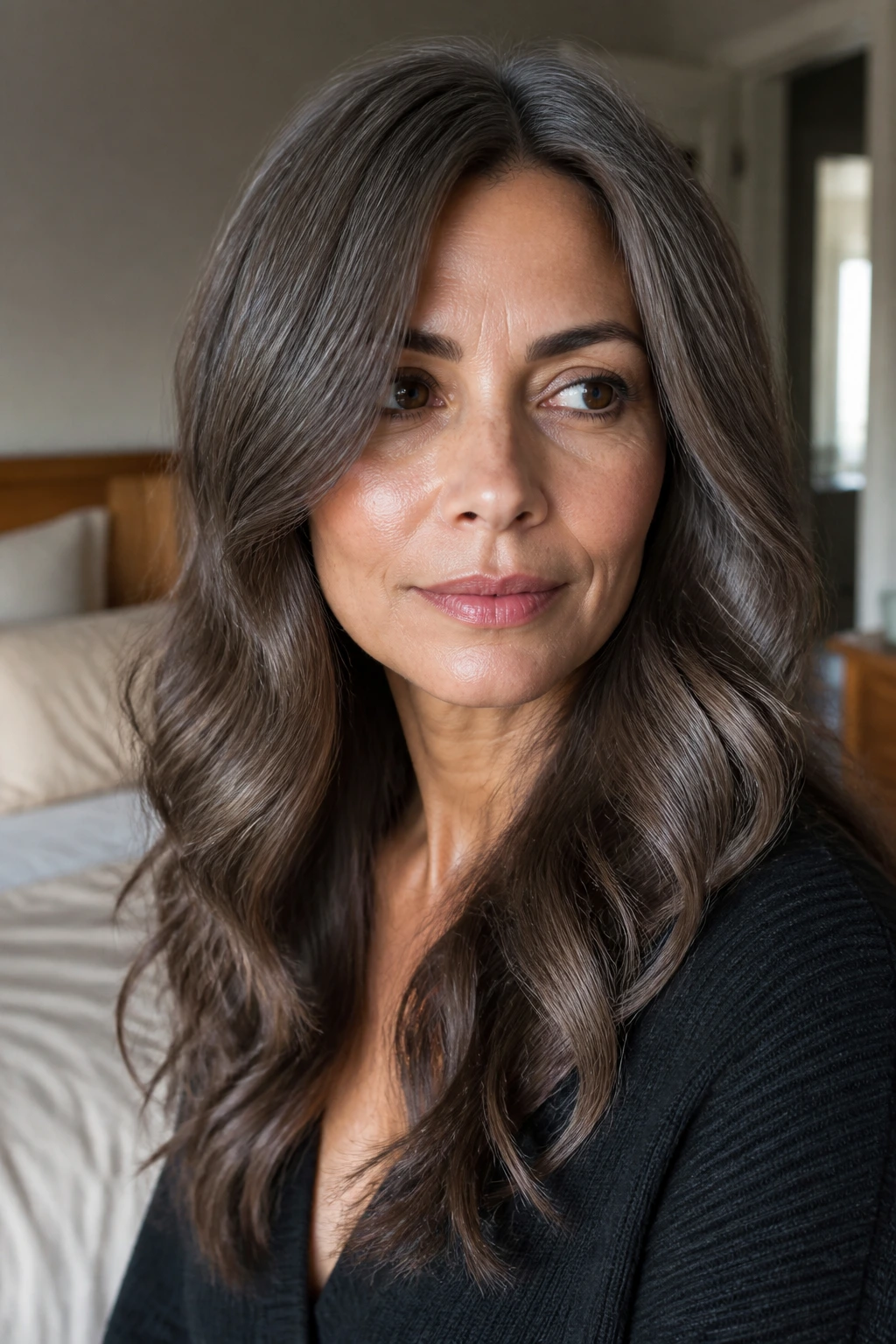
If you want gray that still feels soft and wearable, this is one of the nicest options. Dark mushroom reads earthy-cool, and a gloss finish keeps the surface smooth enough that thin hair doesn’t look frayed. Loose waves give the cut a bit of air without turning it fluffy.
The waves should be broad and relaxed. Think a bend made with a large iron, not a curl you’d wear to a party. Too much curl exposes the ends and can make fine hair look shorter than it is.
On olive skin, the mushroom note is the quiet hero. It keeps the tone from going too blue and gives the complexion a little warmth back. This is the one I’d point to for anyone who says they want gray, but not gray-gray. Fair request.
22. Pearl-Gray Pixie Bob
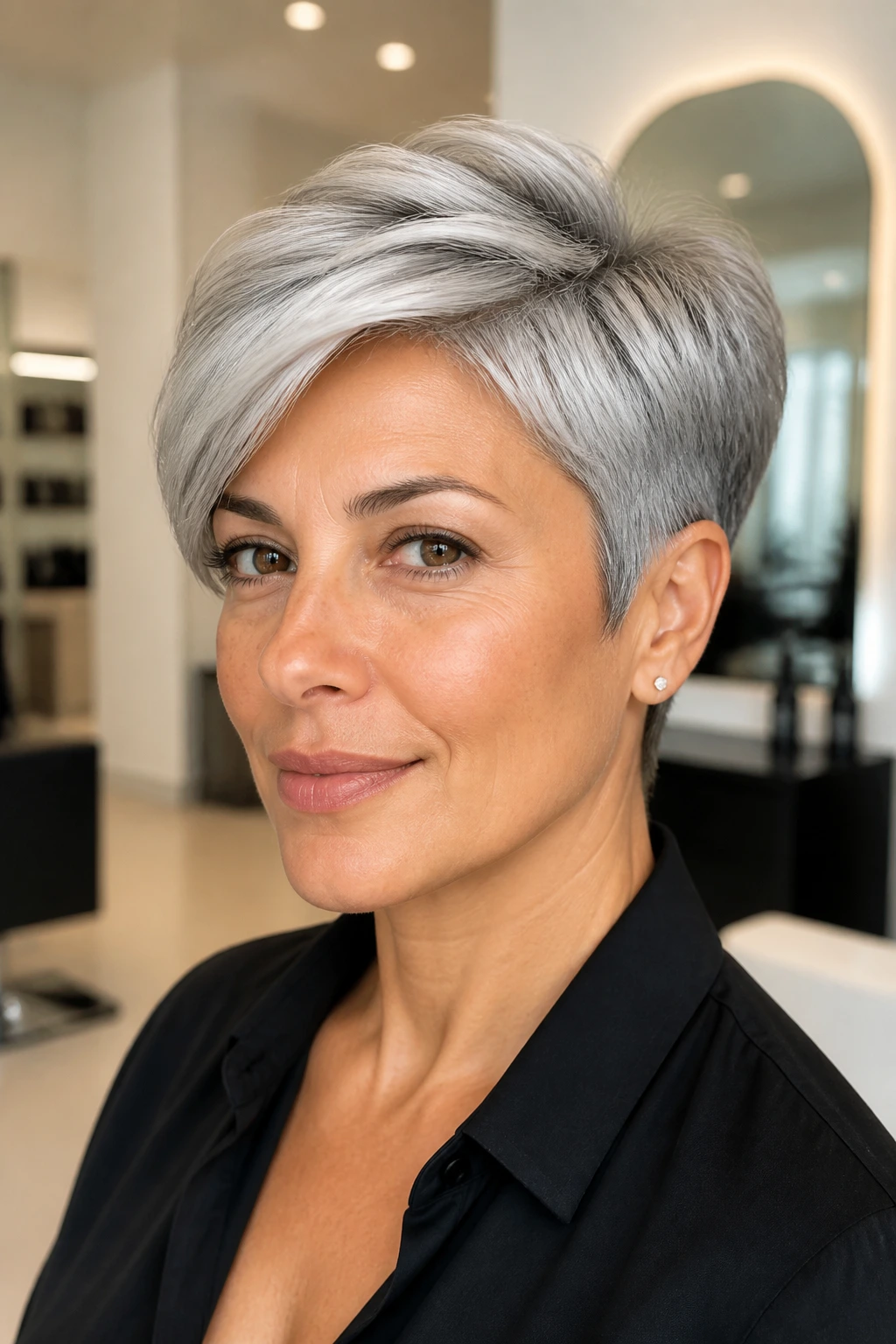
The pixie bob is a smart middle ground if you want the lift of a short cut but not the clean crop of a pixie. Pearl gray gives it a polished sheen, and the slightly longer top keeps thin hair from collapsing at the crown.
This cut works best when the sides stay close and the top has enough length to sweep or fluff with fingers. Pearl gray is softer than metallic silver, which makes it easier on olive skin that leans muted. The finish feels luminous without looking frosted.
If you have a narrow face, keep a little length near the temples. If your face is fuller, more volume on top and a tighter side can sharpen the shape. Small cut decisions matter here. They matter a lot.
23. Steel Ribbon Highlights on a Sleek Lob
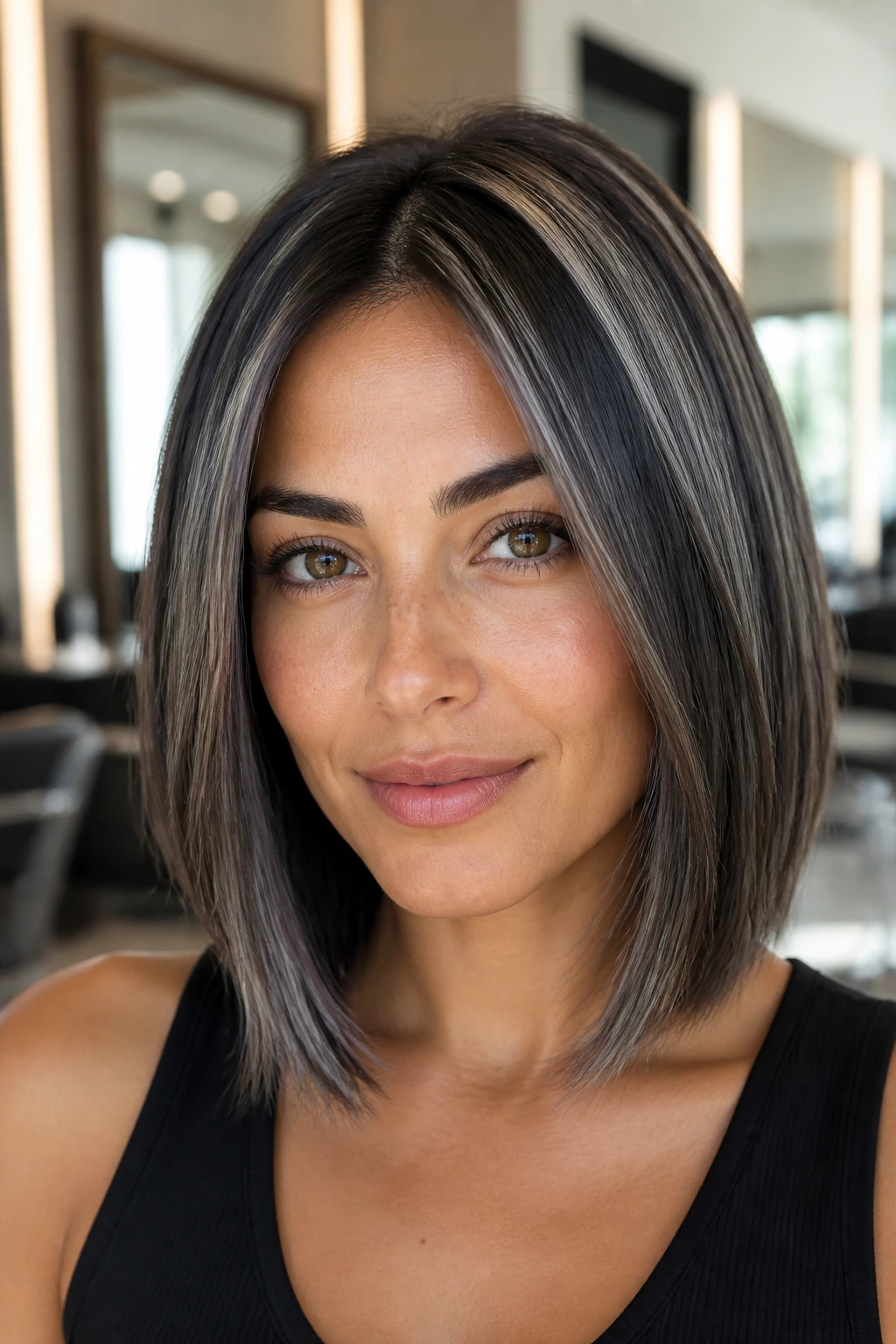
This is for people who want gray in the hair, not necessarily as the whole story. Steel ribbon highlights woven through a sleek lob give depth without stripping away the darker base that helps thin hair look denser. The effect is subtle in the chair and obvious in motion.
The ribbons should be fine and placed with intention, especially around the top layers and near the face. Chunky streaks can look disconnected on thin hair. Fine ribbons melt better and make the cut look richer.
A sleek finish suits this style more than a tousled one. The contrast between the polished base and the steel pieces is what makes it work. If you like your hair to look neat even when it’s not freshly styled, this one holds up well.
24. Slate Curls with Root Shadow
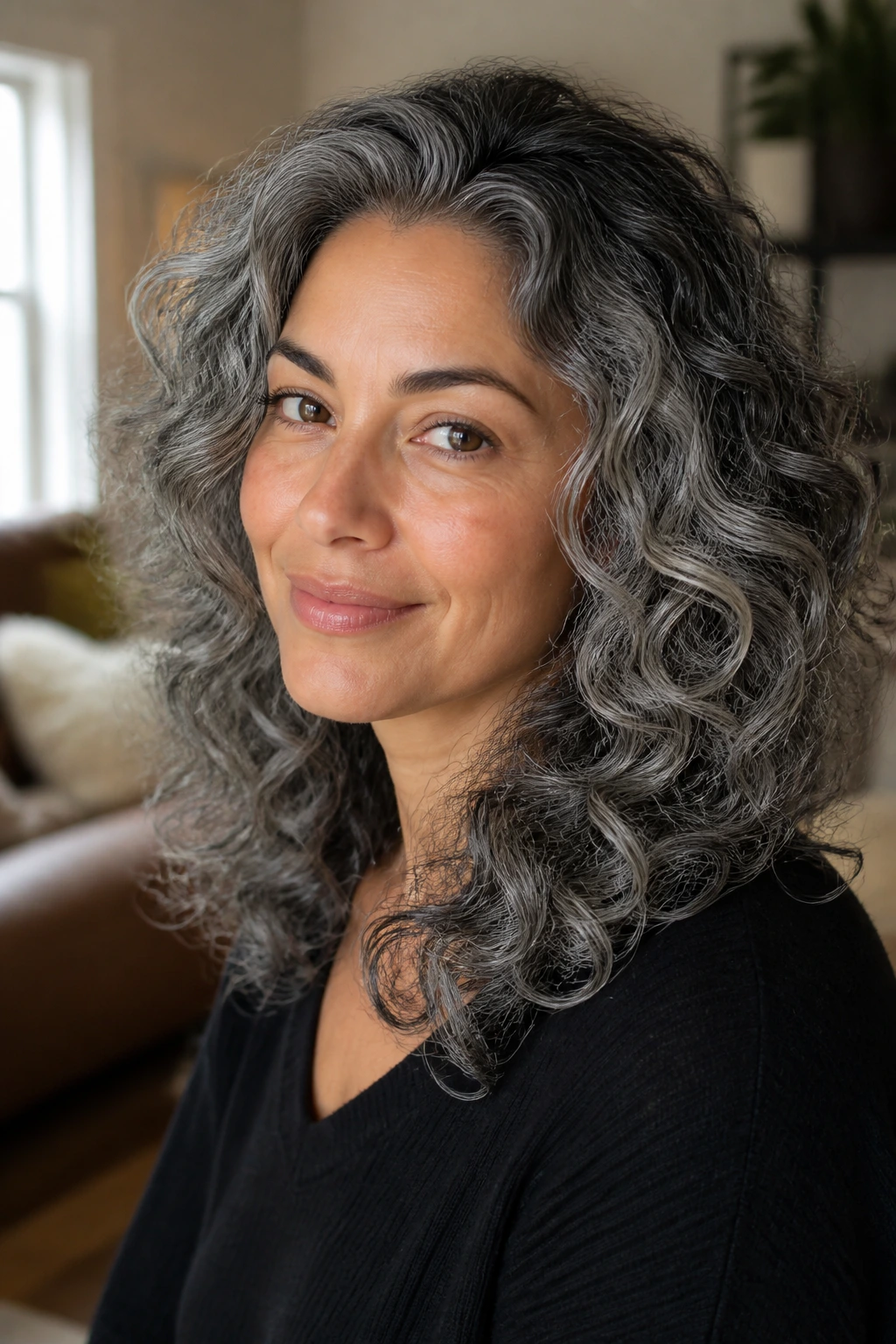
Thin hair can wear curls, but they have to be the right curls. Soft slate-colored curls with a root shadow give the hair body and keep the base from looking see-through. The darker root makes the whole shape look fuller, and the slate tone keeps the color cool without going pale.
The key is not tight ringlets. Use a medium barrel or a diffuser to create soft bends and loose spirals, then separate them a bit with fingers. That gives you volume without turning the ends into a puff.
Olive skin usually likes the darker root because it frames the face and keeps the color from floating too high on the skin. If your hair is fine but naturally wavy, this may be one of the easiest gray looks on the whole list.
25. Charcoal Polished Shag with Length in Front
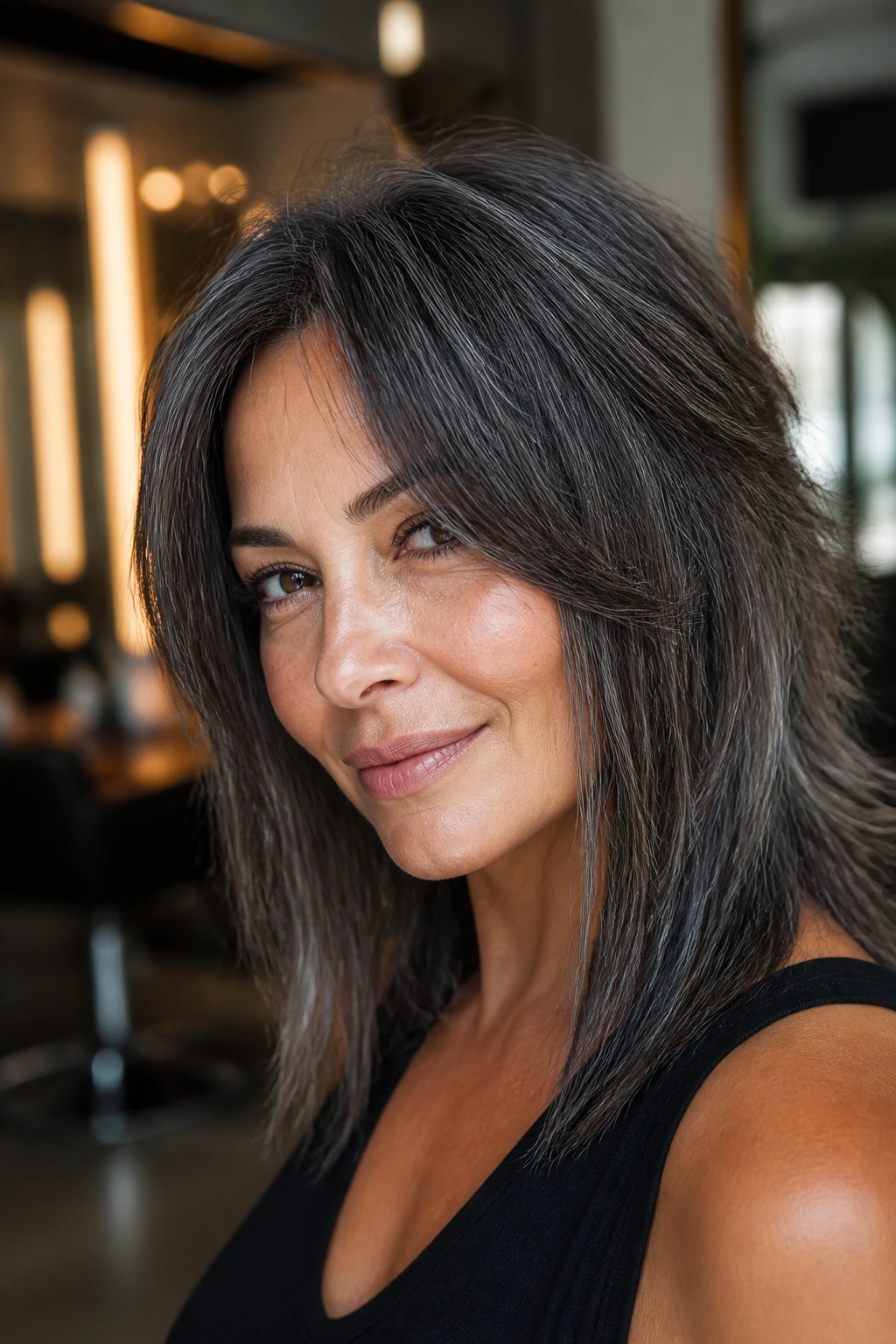
A shag with length in front can solve a common problem: fine hair that looks too short and too puffy at the same time. Keeping the front pieces longer anchors the shape, while the shag layers at the crown add lift where you want it. Charcoal gray keeps the whole cut grounded.
The trick is restraint. You want texture, not shredding. The layers should move, but the ends still need enough bulk to hold their line. That’s what keeps the style from going limp by noon.
On olive skin, charcoal has enough depth to feel rich without turning black and flat. It’s the right final note if you want one style that sits between edgy and wearable. Add a little root lift, a soft bend through the front, and stop before it gets overstyled. The cut does the work.
Why Smoky Gray Beats Flat Silver on Olive Skin
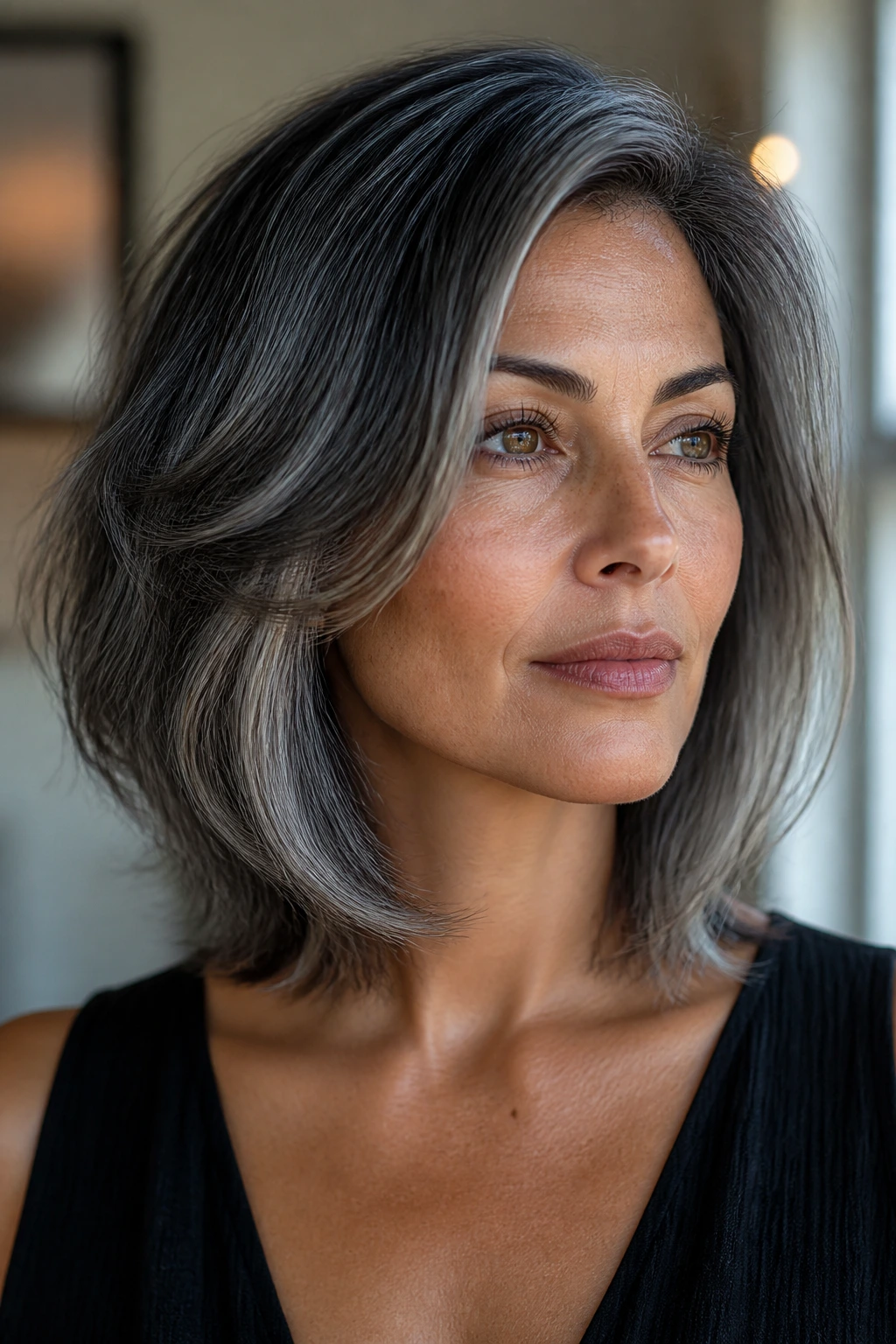
Olive skin has its own lighting problem. Some grays make it look clean and cool; others make it look tired, sallow, or a little green around the edges. The difference usually comes down to depth. A smoky gray keeps enough shadow in the hair that the face still has somewhere to land.
Flat silver can be gorgeous, but it asks a lot from the cut and the makeup. Thin hair often doesn’t have the density to support a bright, monochrome finish without showing every gap at the scalp and every soft end at the perimeter. Smoky gray, graphite, and mushroom work with that reality instead of fighting it.
The smartest version of gray hair for this combination usually has three pieces working together: a deeper root, a controlled gray through the mids, and a cut that holds its outline. Break any one of those, and the whole style starts looking thinner than it is. Keep them in sync, and you get shape, shine, and a cleaner face frame.
Essential Tools for Styling and Color Care
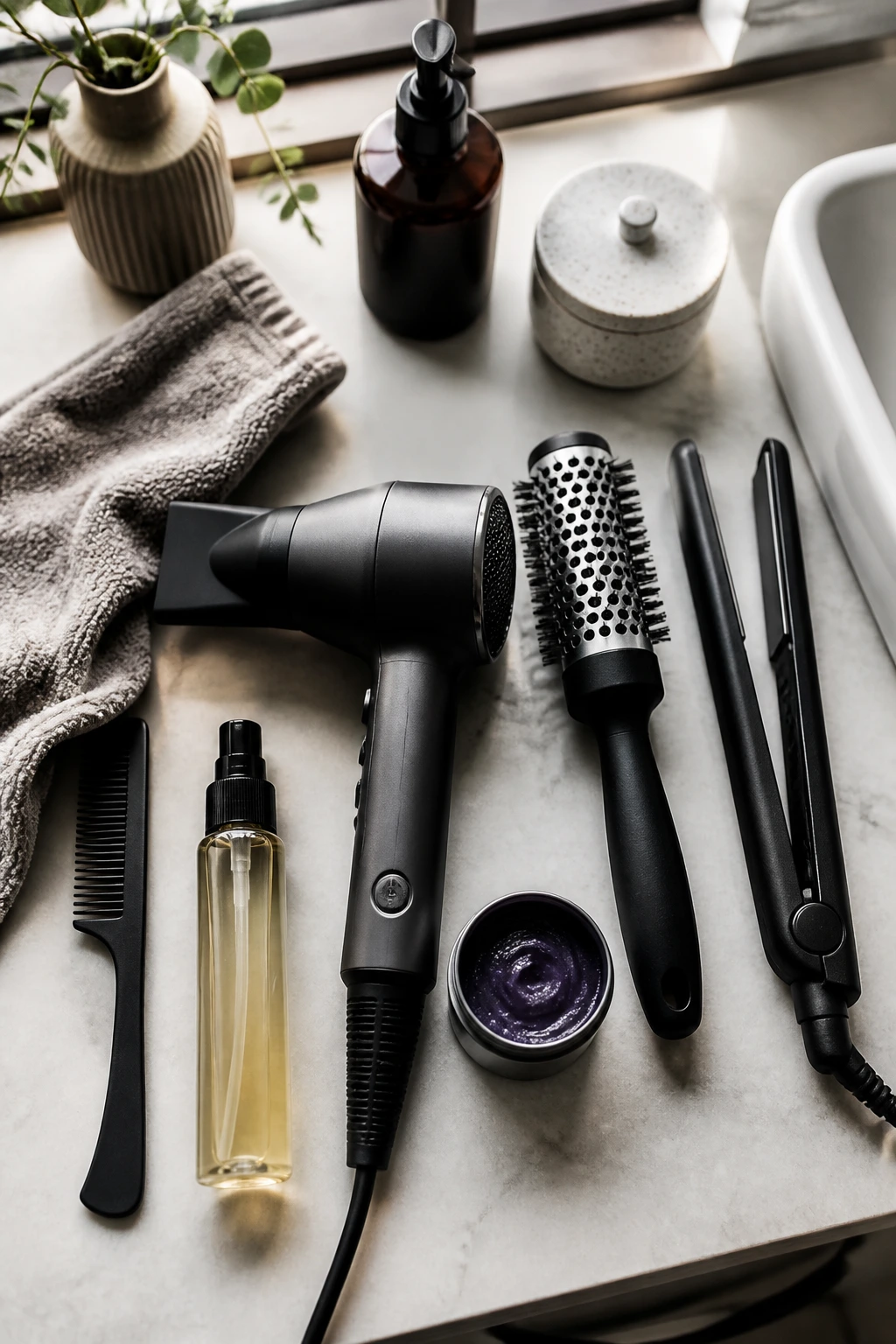
- Color-safe shampoo: A sulfate-free wash keeps gray tones from fading too fast and stops thin hair from feeling stripped.
- Purple or blue-violet mask: Use it lightly on silver or smoky gray lengths when brass starts creeping in; once a week is usually enough.
- Root-lift mousse: Fine hair needs lift at the scalp more than heavy cream through the ends.
- Round brush with mixed bristles: This gives the bob, lob, or bixie a smoother bend without flattening the crown.
- 1-inch curling iron or flat iron: Better for controlled waves and bends than a large barrel that can swallow fine hair.
- Texturizing spray: A light mist adds grip to gray hair, which often feels too silky to hold shape.
- Tail comb: Handy for clean parts and precise money-piece placement.
- Microfiber towel or T-shirt: Less friction, less frizz, fewer broken flyaways.
Smart Shade and Product Choices for Olive Skin and Thin Hair
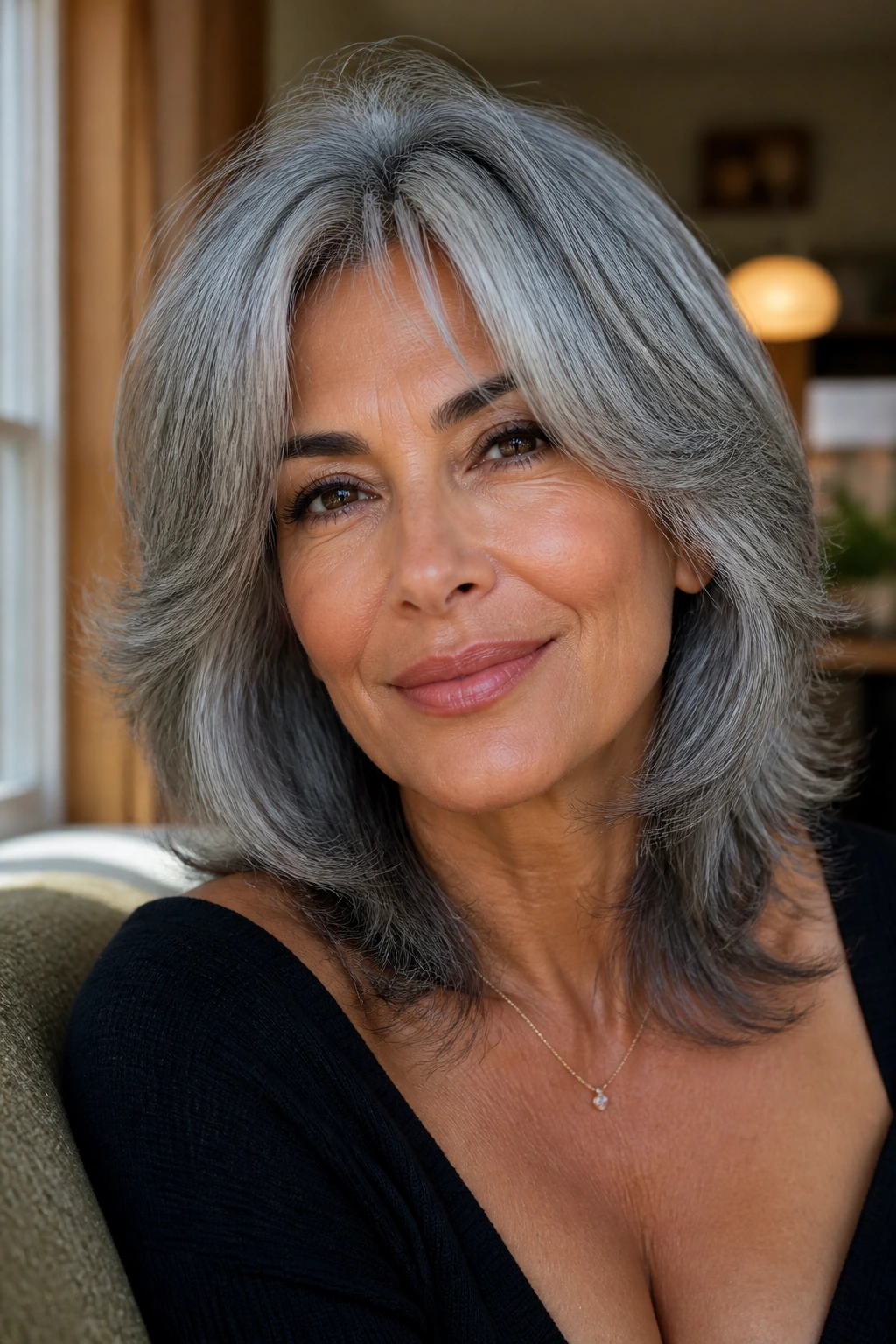
The most useful gray shades here sit in the smoky middle. Think pewter, graphite, slate, mushroom, gunmetal, and ash-black. These tones cool olive skin without making it look flat, and they keep fine hair from going all one pale note. Bright silver has its place, but it usually works better as an accent than as the whole head.
If your natural base is dark brown, a root shadow or melt is worth asking for. It softens grow-out and protects the illusion of fullness at the scalp. If your hair is lighter, a demi-permanent gloss can often get you closer to the gray finish without a full lightening session. That matters because thin hair often gets tired faster when it’s pushed through too much bleach.
Product choice matters too. Heavy oils and thick butters can drag fine hair down by lunchtime, especially when it’s already been lightened. Stick with lightweight leave-ins, root sprays, and gloss-friendly shampoos. If a product claims to “repair” everything and feels slippery in the hands, it may not be your friend here.
How to Style These Gray Cuts So They Keep Their Shape
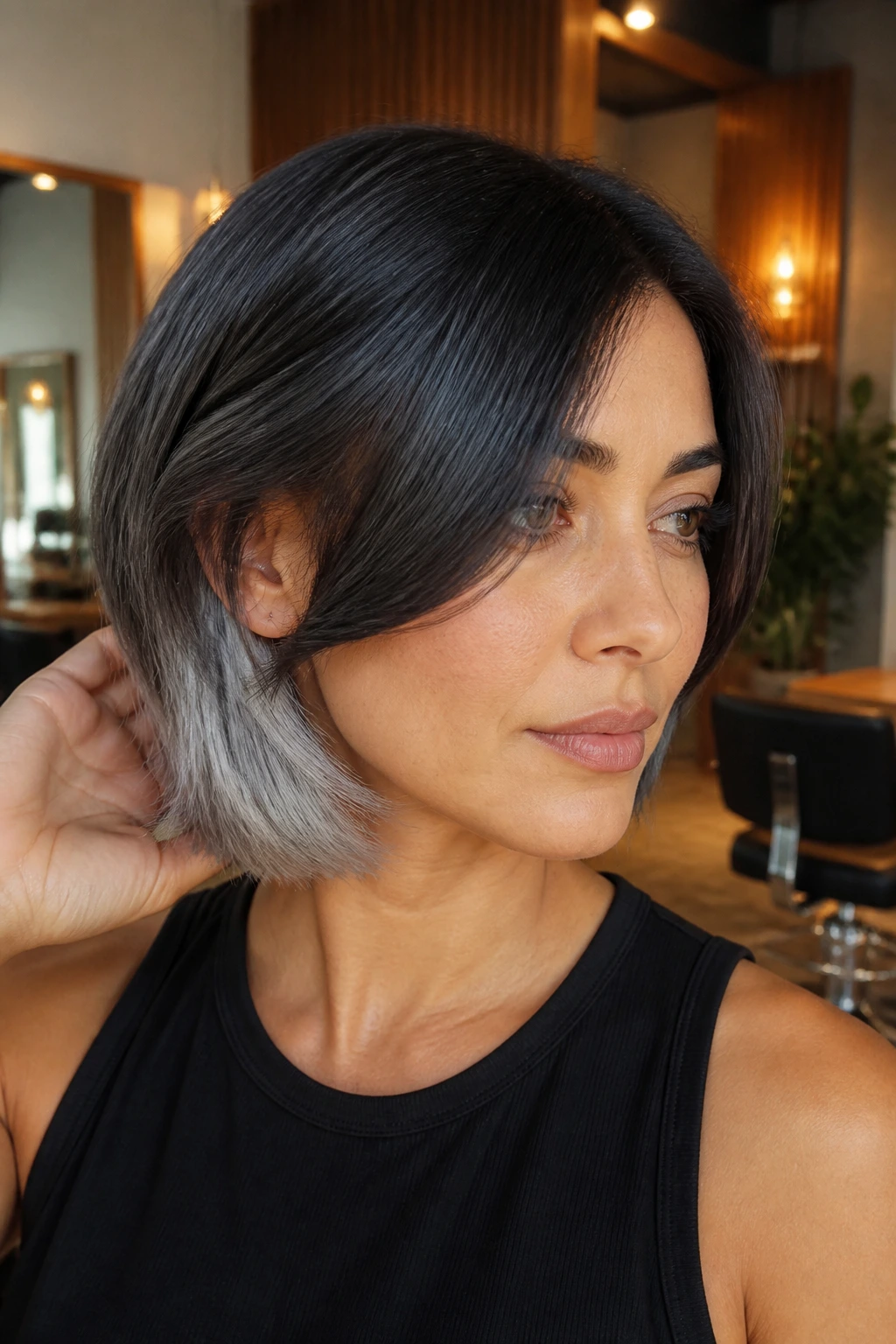
Shape: Keep the perimeter blunt or softly beveled whenever density is a concern. A clean edge at the bob or lob makes thin hair look thicker because the eye sees one strong line instead of wisps.
Texture: Choose controlled movement over big, airy waves. A one-inch bend, a loose wave, or a soft blowout gives life to gray hair without exposing the ends. Tight curls and aggressive crimping can make fine hair look shorter and lighter than it is.
Parting: Side parts are useful when the crown is flat. Middle parts work when the cut has enough body and the face frame is doing some of the work. If your roots collapse by midday, a slightly off-center part is often the better compromise.
Finish: Use mousse at the roots, a heat protectant through the mids, and a tiny drop of serum only on the ends. That last part matters. Too much shine product on fine gray hair can make it look stringy instead of sleek.
Balance: Olive skin usually looks best when the brows and makeup stay a little softer than the hair. Taupe shadow, muted rose, bronze, and soft berry tend to sit well next to smoky gray. Heavy black liner plus icy silver can be a hard combination.
Additional Tips and Color Boosters
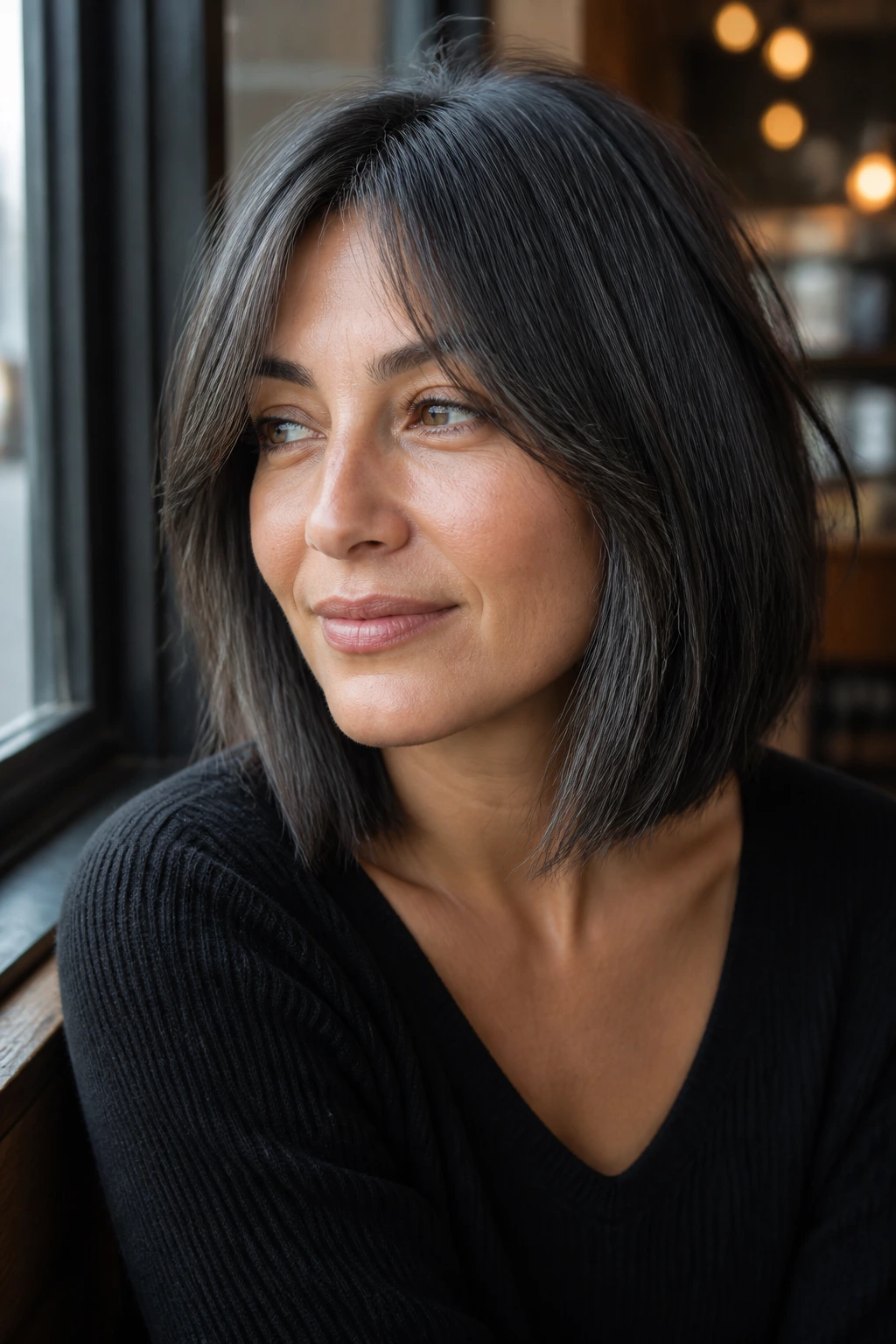
Tone Boost: If your gray starts leaning yellow or khaki, use a purple mask once every 7 to 10 days, but only on the lighter sections. Leave it on too long and the hair can go dull or lavender-tinted at the tips.
Customization: Want a softer look? Keep the root deeper and let the gray sit only in ribbons or through the top layers. Want more edge? Push the shade toward graphite or ash-black and sharpen the part with a tail comb.
Serving Suggestions: A tuck behind one ear, a slim barrette, or a pair of small hoops can change the whole read of a gray bob. For lobs and shags, a little lift at the crown plus a bend at the front pieces keeps the style from lying too close to the head.
Make-It-Yours: If your hair is very fine, ask for invisible layers instead of heavy texturizing. If it’s wavy, keep the surface smooth and let the wave do the volume work. If it’s straight, a beveled edge and a root-lift spray will carry more weight than extra cutting ever will.
Common Mistakes to Avoid
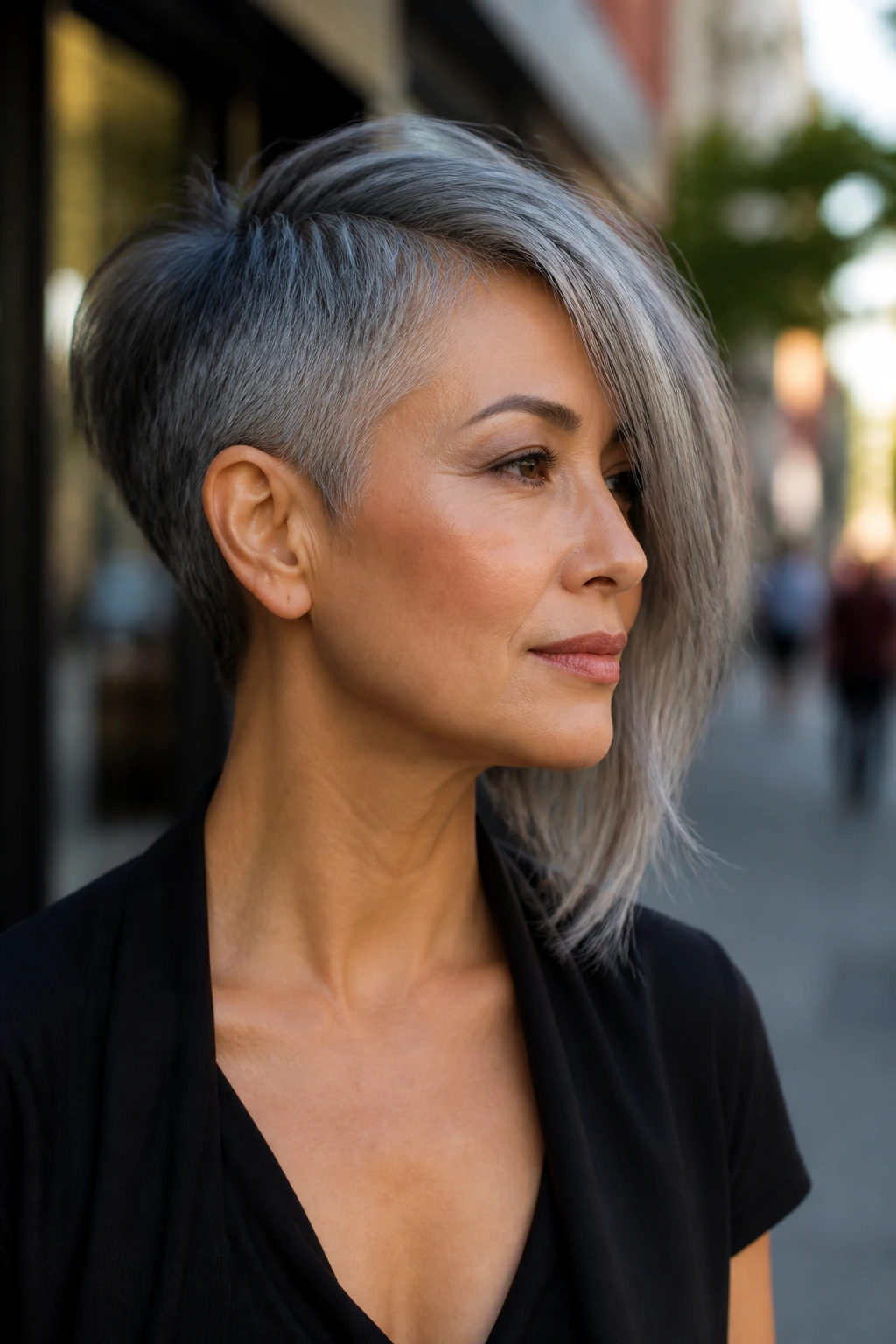
Going too icy too fast: Full-on silver can look flat on olive skin if the cut is also thin and airy. The fix is a smoky root, a gloss with depth, or a few darker ribbons to hold the face in place.
Over-layering fine hair: Too many short layers remove the outline that makes hair look dense. If the ends feel wispy after the cut, the shape was taken too far. Ask for long, controlled layers or a blunt perimeter.
Using heavy conditioner everywhere: Fine hair does not need a thick mask from root to tip every wash. That usually makes the crown limp and the ends stringy. Keep rich conditioner on the lower half only, then rinse well.
Skipping the root shadow: A bright, all-over gray on thin hair can expose scalp and make the part line look wider than it is. A darker root buys depth and time between salon visits.
Choosing the wrong part: A center part on a flat crown can make the top look bare. If the hair loses height fast, shift the part a quarter inch off center and blow-dry against the fall at the roots.
Leaving trims too long: Gray cuts lose their shape faster than people expect, especially bobs and pixies. Once the edges start to fray, the whole style looks thinner. Shorter maintenance intervals are annoying. They also work.
Variations and Adaptations to Try
Soft Mushroom Melt: Keep the base a soft brown-gray and let the silver appear only through the mids and face frame. This is the easiest version for anyone nervous about going too cool.
High-Contrast Graphite: Push the root darker and the gray lighter, especially near the bangs or front pieces. The contrast sharpens features and makes fine hair look more structured.
Salt-and-Pepper Grow-Out: If you’re blending natural grays with dyed lengths, ask for a mixed finish instead of one solid tone. It hides the transition line and reads intentional instead of patchy.
Curly-Gray Volume Cut: For wavy or curly fine hair, keep the cut longer than you think and let the gray live in the outer layers. Curls need room to spring, and over-cutting them removes the illusion of fullness.
Office-Ready Pewter Bob: Same idea as a classic bob, but with the gray kept softer and the finish smoother. It’s a good compromise if you want gray hair that still feels restrained.
Maintenance, Refreshing, and Grow-Out Care
Gray tones usually look sharpest in the first few weeks after a gloss or toner. After that, brass creeps in, especially if the hair sees hard water or a lot of heat. For most smoky gray looks, a refresh every 4 to 6 weeks keeps the tone clean. Short cuts like pixies may need a trim on the same schedule because the shape shows every millimeter of growth.
Wash fine gray hair with lukewarm water, not hot. Hot water opens the cuticle fast and can fade toner faster than people expect. If your hair is lightened, use a hydrating conditioner on the mids and ends every wash, but keep the scalp product light so the roots don’t collapse.
For styling, dry shampoo can buy you an extra day of lift at the crown, and a quick pass with a flat iron can reset a bob or lob without a full wash. Sleep on a silk pillowcase if the cut relies on bends or a smooth surface. It helps more than most people think. A lot more, honestly.
Frequently Asked Questions
Which gray shade looks best on olive skin?
Smoky shades like pewter, graphite, mushroom, and slate usually flatter olive skin better than icy white silver. They cool the complexion without flattening it.
Can thin hair pull off dark gray styles?
Yes, if the cut keeps a strong outline. A blunt bob, a polished lob, or a short crop with a deeper root usually looks fuller than a long, over-layered style.
Should I choose silver highlights or an all-over gray color?
If your hair is fine, highlights or ribbons are often the safer move. They add dimension and keep the base from looking sparse, which matters when density is limited.
Will a side part help flat hair?
Usually, yes. A side part lifts one side at the root and breaks up the flatness that a center part can exaggerate on thin hair.
How do I keep gray from turning yellow?
Use a purple or blue-violet mask lightly, not every wash, and avoid very hot water. Hard water can also dull gray, so a clarifying or chelating wash once in a while helps.
Can I get this look without bleaching everything?
Sometimes. A root melt, gray ribbons, or a toner on pre-lightened pieces can create the effect without an all-over bleach job. Darker bases are easier to maintain and usually kinder to fine hair.
Do curtain bangs work on thin hair?
They do if they’re kept light and blended. Heavy curtain bangs can crowd the face, but soft ones open olive skin nicely and add movement at the front.
How often should I trim a gray bob or pixie?
Bobs usually need a trim every 6 to 8 weeks. Pixies often need cleanup every 4 to 6 weeks because the shape changes fast.
The Gray That Keeps Its Shape
The best gray looks for olive skin and thin hair don’t chase brightness for its own sake. They keep a little shadow at the root, a little softness around the face, and enough structure at the ends that the hair still looks like it has weight. That combination matters more than trends, and it holds up better in real life than the pale, over-lightened versions people often try first.
If you want gray hair that feels modern without flattening your features, start with depth, not bleach drama. A smoky bob, a graphite pixie, or a pewter lob can do a lot of quiet work for you. Pick the shape that keeps its line, then let the color do the rest.