



Choppy bangs for thick hair and heart-shaped faces solve a problem blunt fringe keeps creating: too much hair at the forehead and not enough softness where the face needs it. Cut the front section with a little breakup, and the whole shape starts behaving differently. The bangs stop reading like a slab and start reading like a frame.
That matters more than people think. A heart-shaped face usually carries more visual width through the forehead and a narrower finish through the chin, so the wrong fringe can exaggerate that contrast in a hurry. Thick hair can help or hurt here. Left alone, it piles up. Cut with intent, it gives you body, movement, and a front section that doesn’t collapse by lunch.
Heavy doesn’t have to mean heavy-looking.
The best versions of this cut don’t hide the face. They guide it. A few shorter pieces near the brows, longer scraps near the temples, and just enough internal removal to keep the fringe from puffing out—that’s the sweet spot. If you’ve ever watched a stylist turn a dense front section into something airy without making it thin, you already know the appeal: the hair still looks full, but it moves.
Why These Fringe Shapes Work on Thick Hair and Heart-Shaped Faces
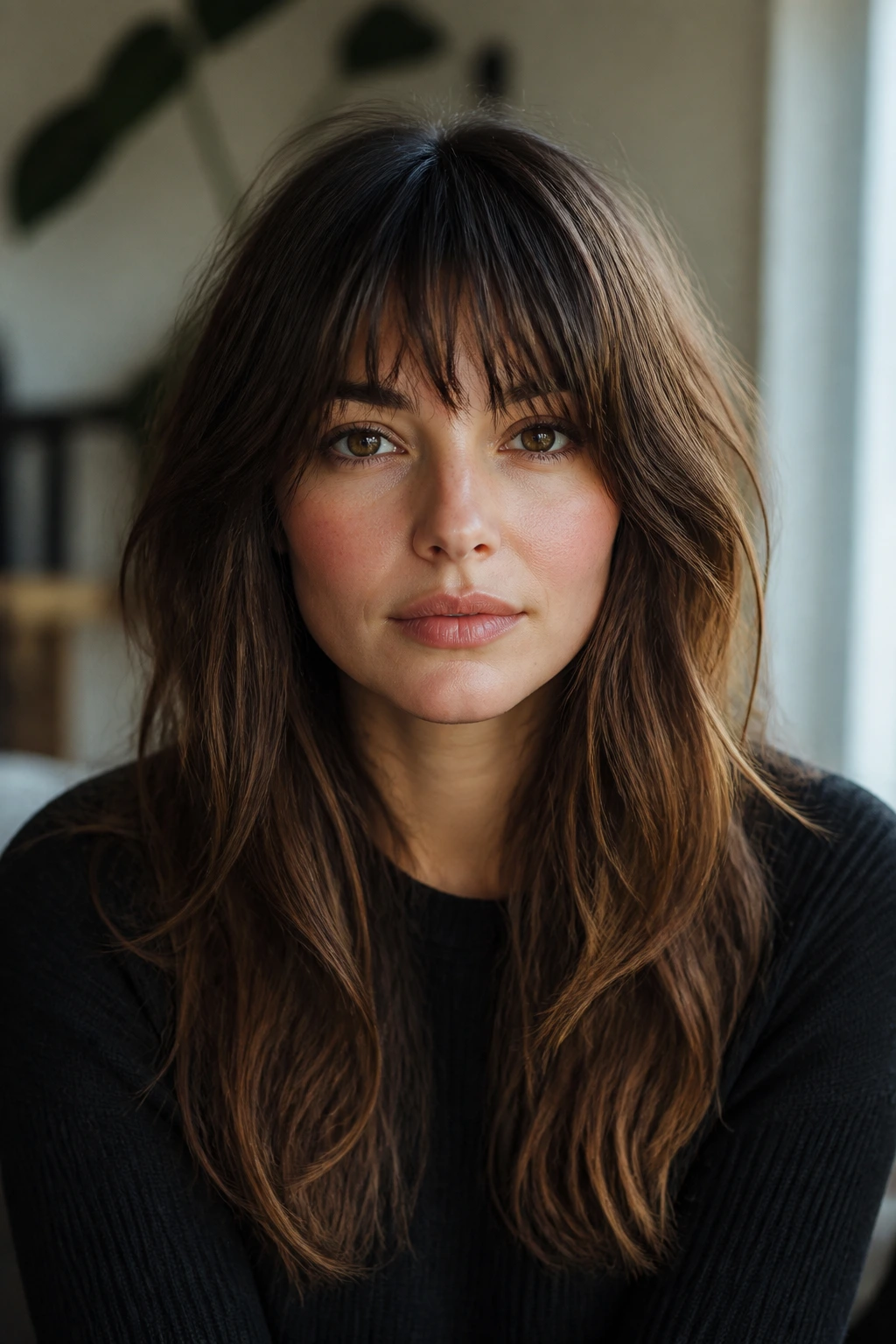
- Bulk gets edited, not erased: Thick hair gives the stylist room to remove weight without leaving the fringe see-through, which is why choppy ends look better here than they do on fine hair.
- The forehead gets softer fast: Heart-shaped faces usually benefit from bangs that break up the upper third of the face, especially when the center is slightly lighter than the corners.
- Temple length does a lot of quiet work: Pieces that extend toward the temples keep the forehead from looking too wide and help the cut blend into face-framing layers.
- The grow-out is less annoying: A choppy fringe can move from bang to face frame more gracefully than a crisp blunt line, which matters once the first trim window passes.
- Texture helps the style last: A little bend, wave, or piecey separation keeps thick bangs from sitting like a solid curtain by the end of the day.
1. Brow-Skimming Razor Fringe With Chopped Ends
A brow-skimming razor fringe is the style I reach for when thick hair wants to look soft instead of square. The front line sits right at the eyebrows, but the ends are broken up enough that you can still see a little skin between the pieces. That tiny bit of air changes everything.
Why it flatters a heart-shaped face
The center section shortens the visual height of the forehead just enough, while the torn-up ends keep the cut from looking severe. If your face opens out across the temples, this shape gives you a little coverage without closing the whole front down. It also works with the natural bend thick hair tends to have, which is why it rarely looks limp.
- Ask for point-cutting or a light razor finish so the edges don’t form a hard shelf.
- Keep the center just at brow level and let the sides drop a touch lower.
- Style with a small round brush or fingertips, not a heavy cream that glues the pieces together.
- If you have a cowlick, have the stylist leave the very middle slightly longer. It saves you from a daily fight.
Best detail: this is one of the few fringe shapes that can look polished even when it’s not perfectly smooth.
2. Soft Curtain Bangs That Split at the Pupils
Curtain bangs stop looking predictable the moment you let the ends get ragged. On thick hair, that little breakup keeps the center from feeling too tidy, and the split at the pupils opens the forehead in a way heart-shaped faces usually wear well. The result feels lighter than a full fringe, but it still gives you the front-of-face change many people want.
The trick is to keep the shortest point only slightly below the brows, then let the longest pieces fall toward the cheekbones. That diagonal line is doing the real work. It steers the eye down and outward, which softens the width at the top of the face and gives the jawline more room to show up.
I like this cut for people who need a fringe that can be worn both styled and messy. Blow it out with a round brush if you want the swoop to hold. Or just twist the front pieces away from the face and let them dry with a bend. Either way, the choppy ends stop the whole thing from feeling too precious.
3. Piecey Micro Bangs for a Sharp Forehead Frame
Can micro bangs work on thick hair? Yes, if the cut is handled with restraint. Thick density gives tiny bangs enough body to sit up and stay visible, and the choppiness prevents that stiff little rectangle effect you get when they’re cut too blunt.
How to wear them without looking severe
The center can sit high on the forehead—short enough to show brows, not so short that the line feels abrupt. The corners should be broken and a little uneven, especially if your face narrows toward the chin. That softens the transition into the temples, which is where heart-shaped faces usually need the most balancing.
Micro bangs are not for anyone who wants invisible maintenance. They’re a statement, and they ask for regular trims. But if you like a sharper look and your thick hair tends to obey once it’s cut, this fringe has real bite. Use a dab of matte paste on dry bangs and separate the ends with your fingers. A comb makes them too neat.
4. Cheekbone-Grazing Choppy Fringe
If your bangs keep ballooning at the sides by noon, cheekbone-grazing fringe is the repair. The length lands lower than a classic eyebrow bang, which gives the cut a little more weight and a lot more movement. On thick hair, that extra length keeps the fringe from springing too high after styling.
The real advantage for heart-shaped faces is the placement. Cheekbone level is where this face shape often needs help most. The fringe points the eye right to that area, which brings balance to a forehead that might otherwise dominate the profile. It’s a smart cut, not a flashy one.
- Best with slight internal layering so the ends don’t clump together.
- Works well if you want to tuck one side behind the ear and keep the other side forward.
- Needs only a quick bend from a flat iron or brush to look finished.
This one is quietly versatile. It can lean soft and romantic, or it can read more modern and tousled depending on how much separation you build into the ends.
5. Side-Swept Slice Bangs With Airy Ends
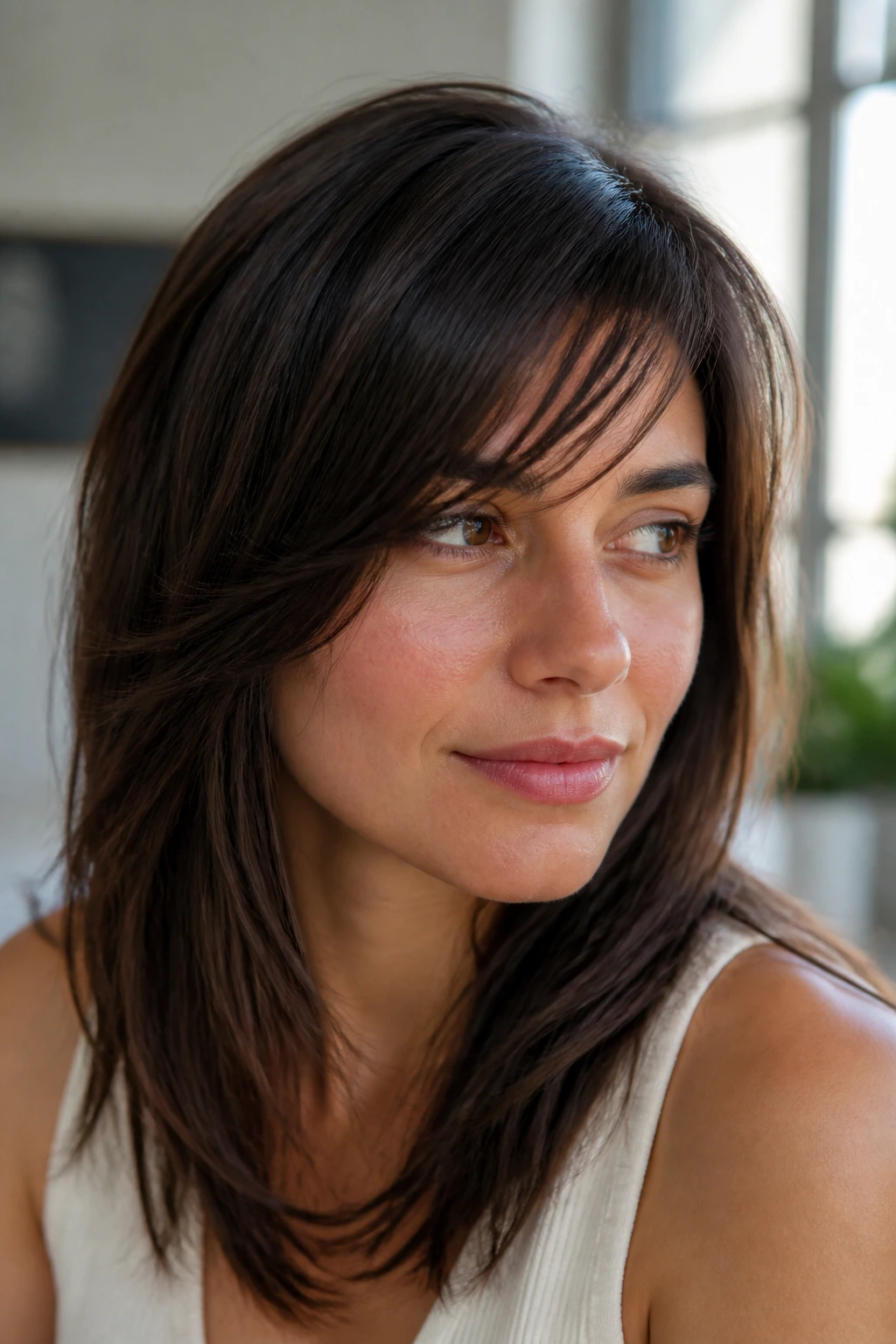
Side-swept slice bangs do a nice trick on thick hair: they look like they took effort, when in practice they often just need a good part and a clean blow-dry. Because the line moves diagonally across the forehead, it gives heart-shaped faces a little asymmetry, which helps counter a wider top half.
The best version is not one solid swoop. It’s a series of thin, slightly uneven slices that overlap just enough to suggest movement. If the ends are blunt, the whole thing gets heavy fast. If they’re choppy, the fringe feels lighter and grows out better too.
I’d wear this cut if you want fringe but don’t want a full commitment to daily bang styling. It can fall forward on one side, tuck behind the opposite ear, and still look like part of the haircut. That flexibility matters when thick hair has a mind of its own.
6. Long Bottleneck Bangs That Narrow at the Center
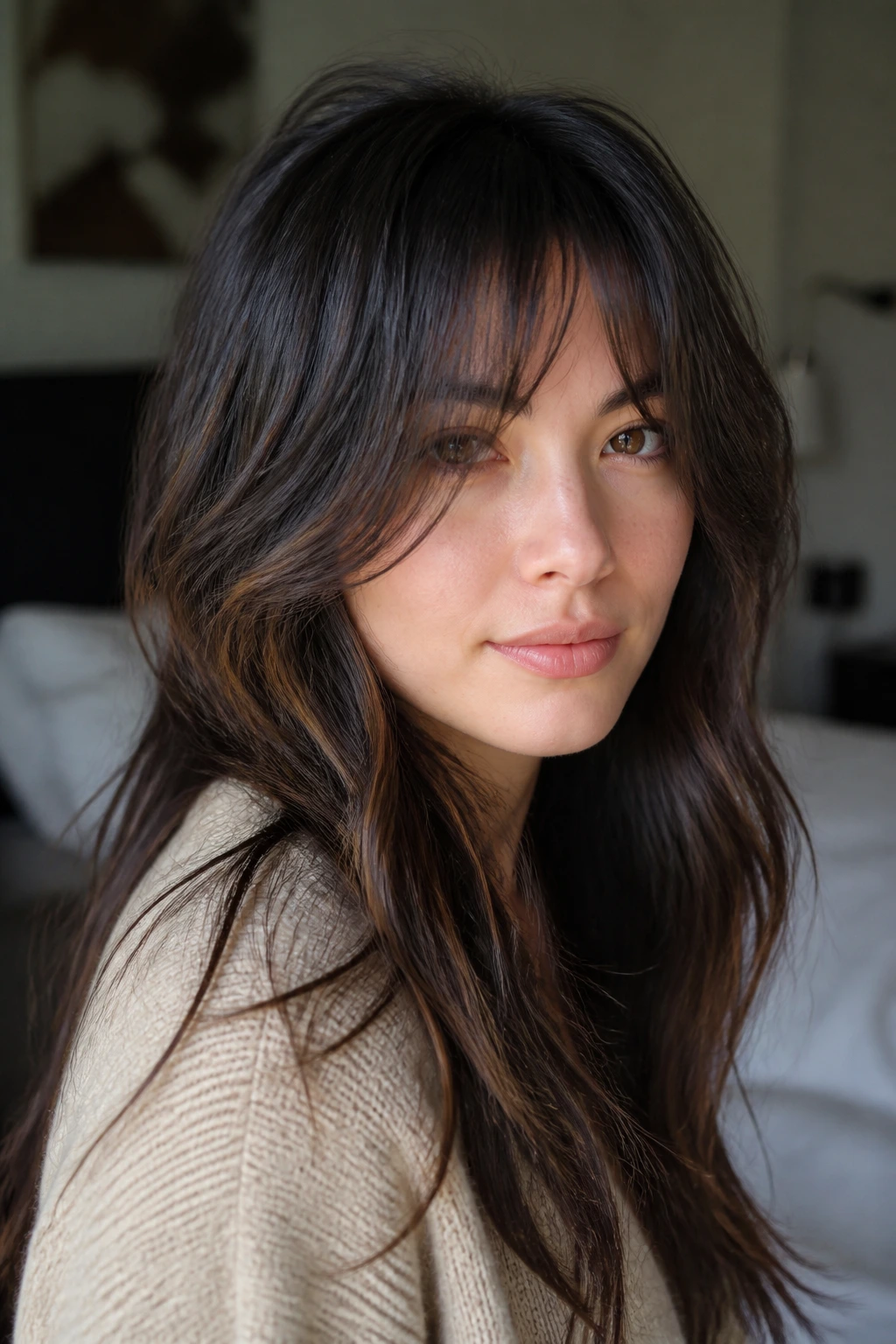
Long bottleneck bangs narrow through the middle and widen as they reach the temples, which is why they work so well on heart-shaped faces. The center can sit at or just below the brows, while the sides sweep down toward the cheekbones. Choppy ends keep the shape from feeling too polished or too dense.
This cut is especially good if your thick hair has a little wave. The shape almost wants to bend on its own. The shorter center keeps the forehead from looking fully covered, and the longer sides leave room for your jaw and cheekbones to stay visible. That’s the whole point, really.
Unlike a classic curtain bang, bottleneck bangs have a more deliberate taper. They tighten in the middle and relax outward. If you like a tailored shape but don’t want your fringe to look rigid, this sits in a very useful middle ground.
7. Shaggy Fringe With Feathered Temples

Shaggy fringe is where thick hair gets to show off. The front pieces are cut with feathered edges, then blended into temple length that looks almost accidental, in the best way. Nothing about it feels stiff. It moves, especially when you turn your head.
That looseness helps a heart-shaped face because it softens the shift from forehead to cheekbones. A full, solid bang can make the upper face feel crowded. Shaggy fringe breaks that line apart. The temples feather outward, which keeps the eye from staying trapped in the center.
If you already wear layers through the crown, this fringe falls right into place. A little mousse at the roots and a quick scrunch may be enough. Blow-drying every piece into submission can actually ruin it. Let some of the texture stay rough.
8. Rounded Arched Bangs With Broken Texture

Rounded arches are usually thought of as neat, almost old-school bangs. Break the edge up, though, and they turn much more interesting. The arc still follows the brow line, but the ends are chipped and uneven, so the shape reads as soft rather than polished.
That broken texture matters on thick hair because it stops the fringe from looking like a thick ribbon laid across the forehead. The center can be a touch shorter, the corners a touch longer, and the whole line still feels rounded. On a heart-shaped face, that curve helps soften the stronger upper width without flattening the rest of the face.
I like this one for people who want a put-together fringe but don’t want to babysit it all day. A quick blow-dry with a small round brush gives the arch. A dry texture spray gives it the chipped finish. Easy enough.
9. Chin-Opening Face Frame With Bangs Attached
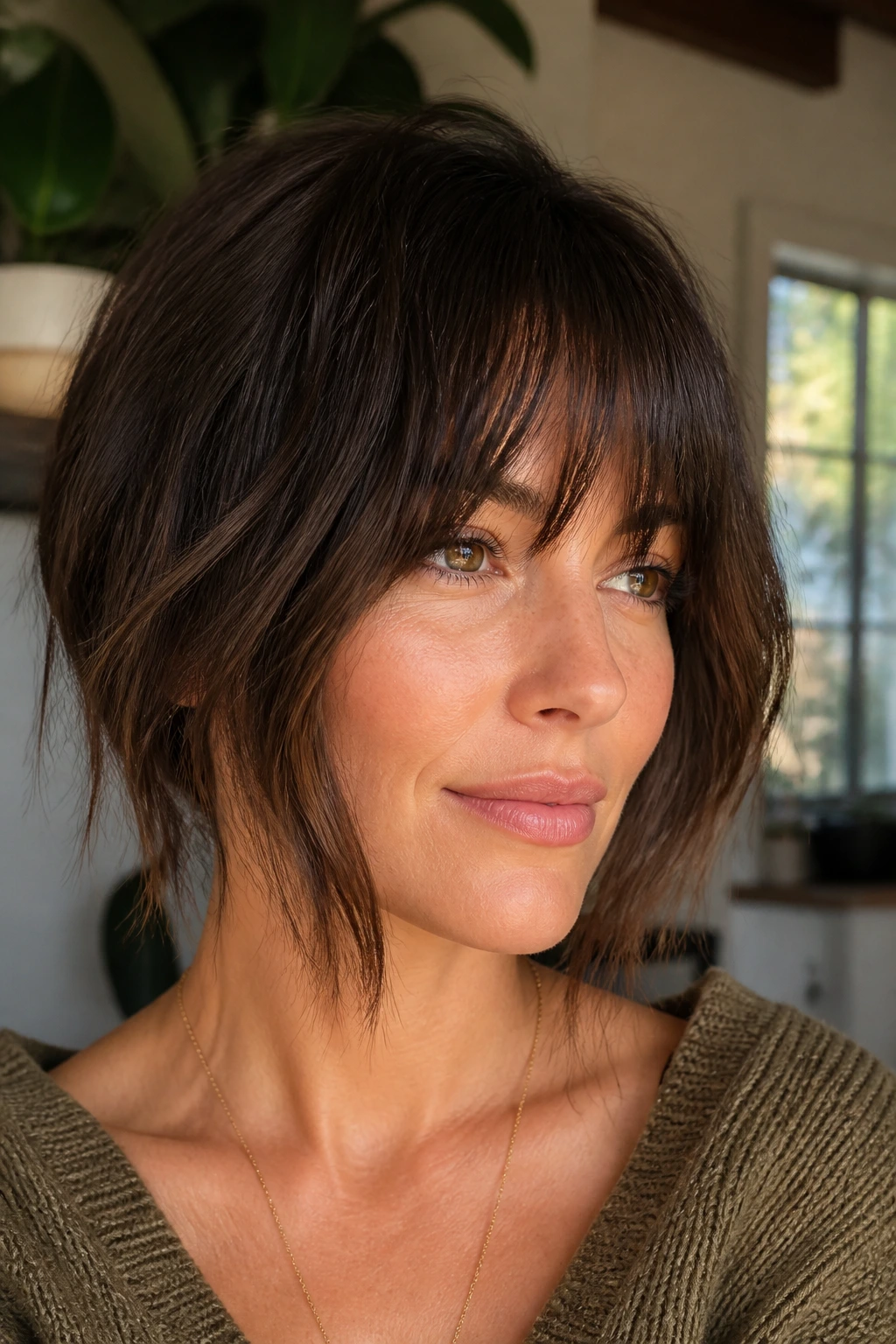
Some people don’t want bangs so much as a front shape that starts high and ends lower. This is that cut. The bangs begin around the brows, then drift into long face-framing pieces that open right at the chin. For heart-shaped faces, that lower movement can be a lifesaver.
The reason is simple: it puts visual weight back where the face narrows. Thick hair makes this style look lush instead of limp, so you get a real frame without the brittle stringiness that thinner hair can sometimes create. The front never feels disconnected from the rest of the cut.
This is the one I’d recommend if you’re nervous about committing to a short fringe. It still gives you the bang effect, but the length buys you options. Push it forward. Sweep it aside. Tuck it back. It stays useful either way.
10. Wispy Heavy Bangs With Internal Weight Removal
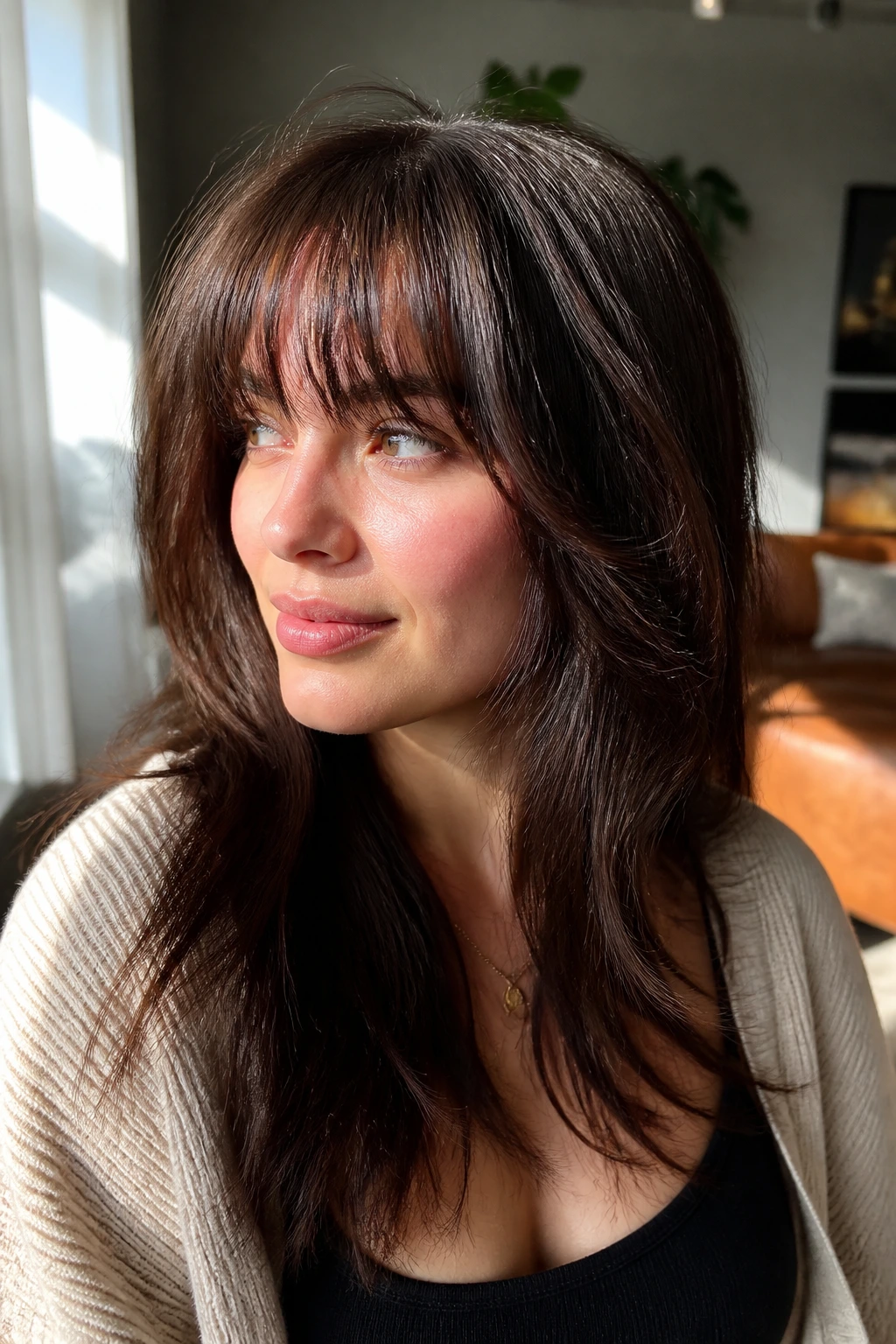
That phrase sounds contradictory, but it makes sense in the chair. The fringe looks substantial when you first see it, yet it feels light because the stylist has removed bulk from the inside rather than thinning the outline to nothing. Thick hair is ideal for this because there’s enough density to carve into.
The result sits somewhere between full bangs and airy bangs. You get coverage across the forehead, which heart-shaped faces often like, but the texture keeps the fringe from reading as dense or blocky. The edges can be point-cut so the line breaks up in small, uneven pieces.
This is a good option if you want bangs that look like hair, not a design choice. It’s softer than a blunt cut, more controlled than a shag, and easier to push to one side on lazy mornings. The whole point is movement with a bit of body left in the line.
11. Grown-Out Bangs That Sit at the Lash Line

Lash-line bangs can be a pain on the wrong hair type. On thick hair, they’re a little easier to live with because the front section keeps enough shape to stay visible even after a few hours. Add choppy ends and the length feels deliberate instead of merely grown out.
This is the fringe for someone who wants the eyes framed but not crowded. The bangs sit low enough to create softness, yet they leave most of the forehead exposed. On a heart-shaped face, that balance is useful. You keep the top from looking too wide and still give the center of the face a little mystery.
A good styling trick here is to dry the bangs from side to side with your fingers before finishing them forward. It stops them from drying in one flat plane. And yes, dry shampoo helps, but use it early in the day, not after the bangs have already gone stringy.
12. Tousled French Fringe With Uneven Tips
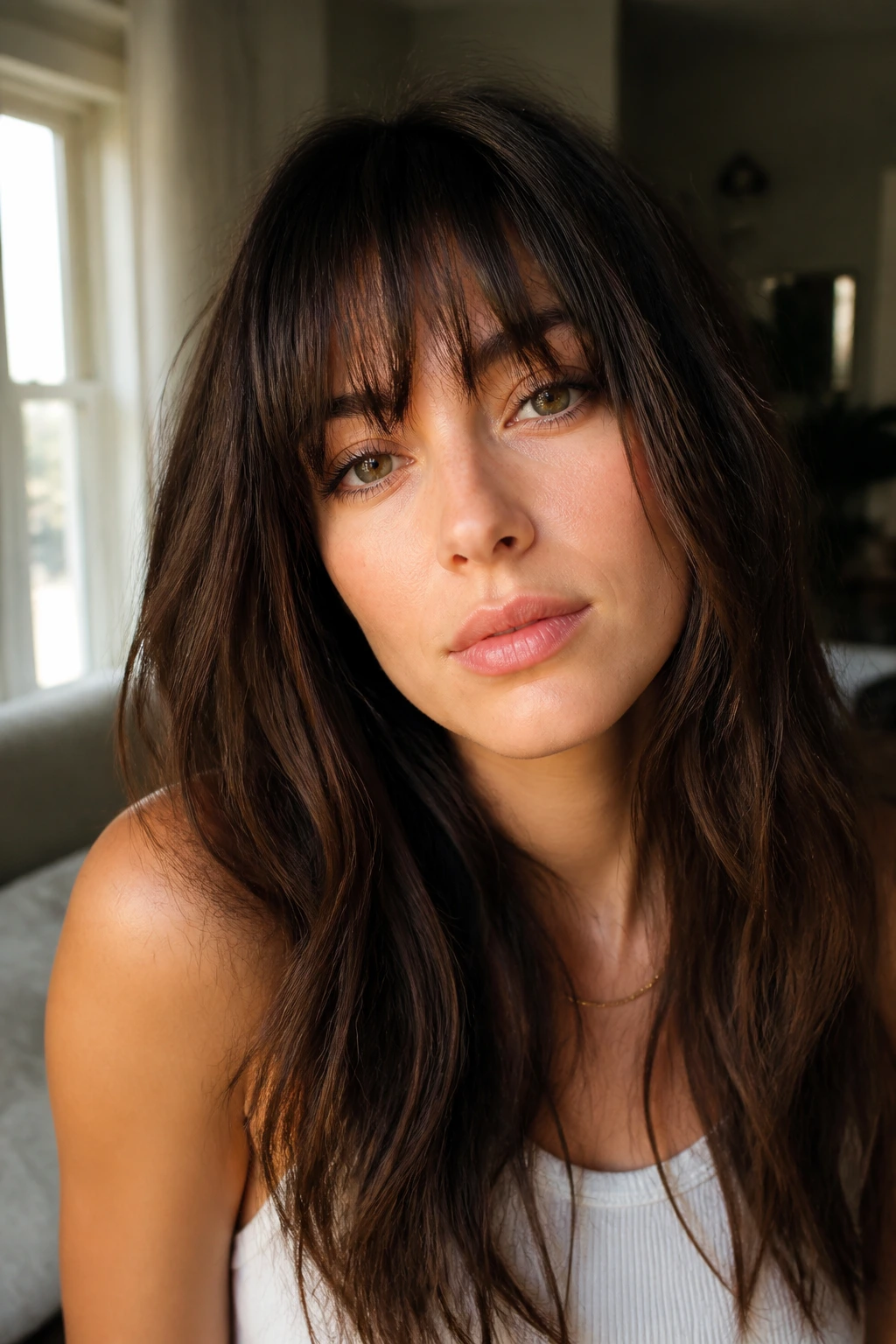
French fringe gets copied a lot and worn badly almost as often. The version that works on thick hair is not a perfect, rounded line. It’s a little tousled, a little broken, and a little uneven at the tips. That keeps it from sitting like a cap across the forehead.
Heart-shaped faces usually look better when the center of the fringe is light and the sides drift outward. This cut does that naturally. The bangs break around the brows, then keep moving instead of stopping dead. It feels casual, but not sloppy.
If your hair tends to dry with a bend already in it, this style will probably suit you. If it’s pin-straight, ask for a subtle curve through the center so the line doesn’t flatten against your forehead. That one small choice changes how grown-up the fringe looks.
13. Blunt-Base Choppy Bangs for Dense Hair
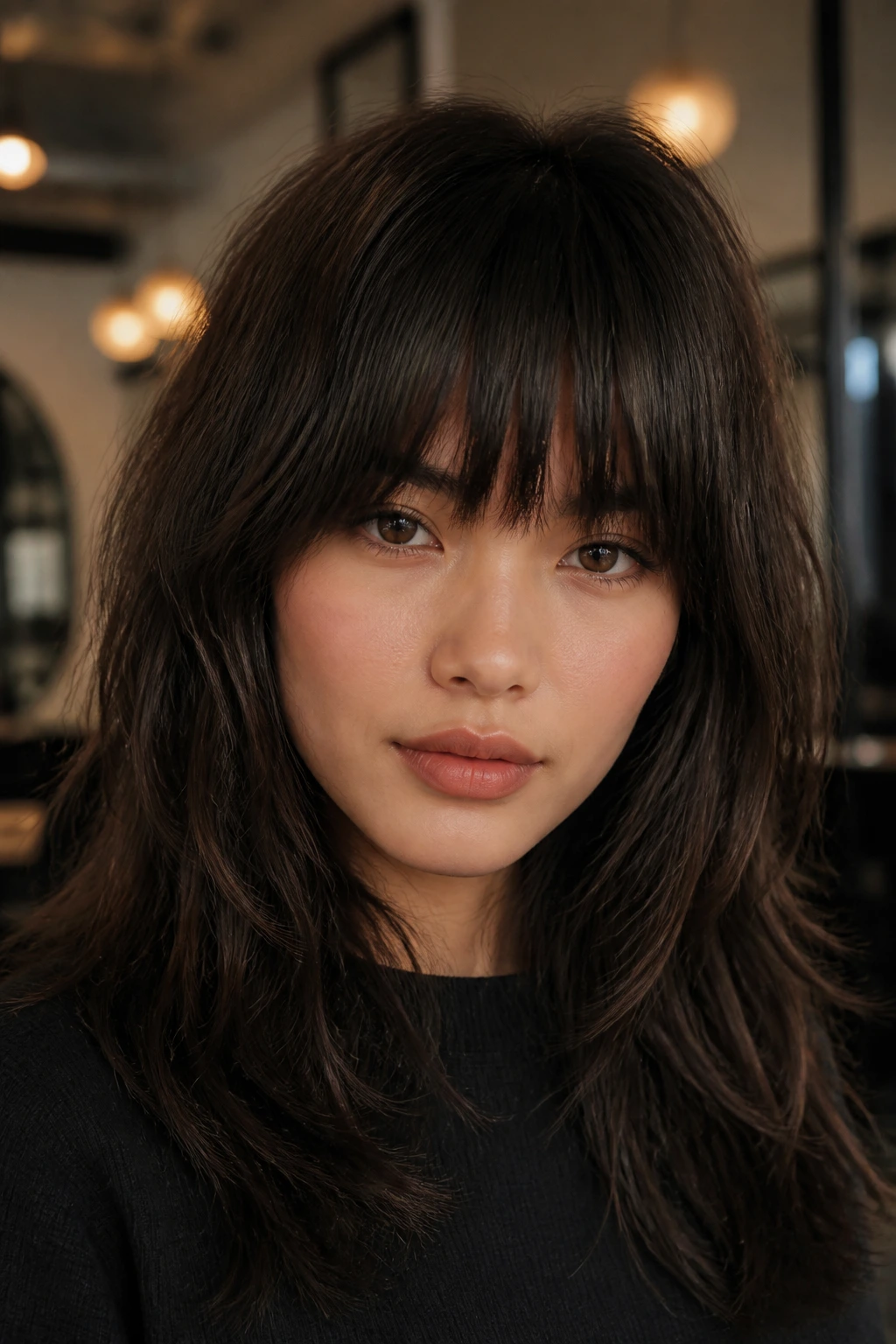
A blunt base with choppy ends sounds like a contradiction, but it’s one of the better moves for very dense hair. The base line gives the fringe enough body to hold its shape. The choppy ends stop it from turning into a solid block.
What to ask for at the chair
- Keep the outline full through the center.
- Remove bulk only inside the fringe, not so much that the bangs become sparse.
- Leave the corners slightly longer so the forehead doesn’t look boxed in.
- Finish with point cutting, not a straight edge.
This style is for people whose thick hair tends to puff when it’s cut too light. It gives you the security of a full bang, then breaks the line just enough to keep it modern. For heart-shaped faces, that small bit of softness at the corners matters. Without it, the shape can feel top-heavy. With it, the whole fringe settles.
14. Disconnected Fringe With a Deep Side Part
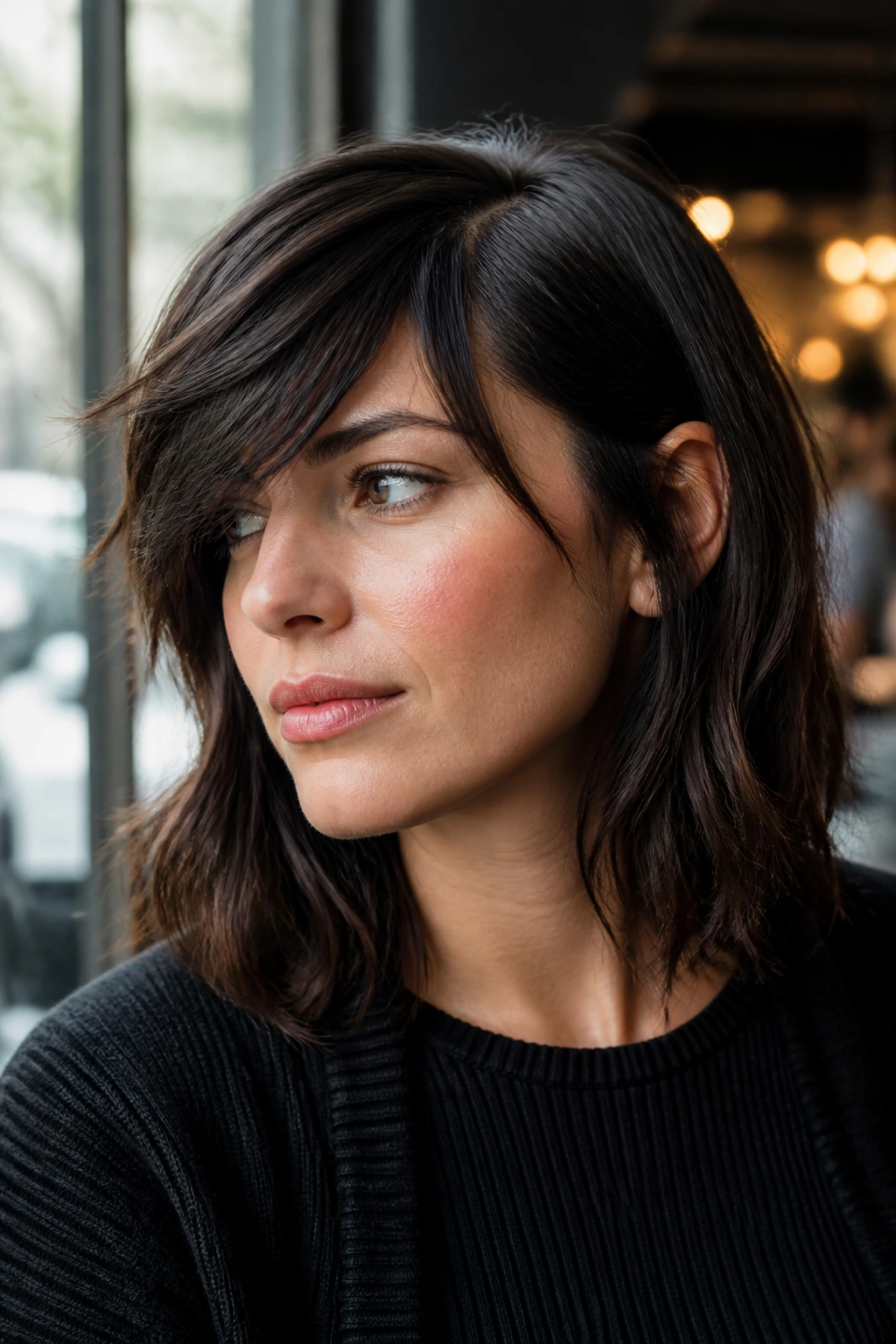
Disconnected fringe has more attitude than most of the other styles here. One side starts near the part and falls forward; the other melts into the haircut with very little visible join. On thick hair, that separation is clean and strong instead of wispy and accidental.
The deep side part is what makes it work for heart-shaped faces. It pulls attention away from the center of the forehead and breaks up the visual width at the top. The asymmetry also gives the jawline a little more presence, which is handy when the chin is naturally narrower.
This is a strong choice if you like a haircut that looks intentionally styled even on a quick day. A bit of paste at the ends and a blow-dry in the direction of the part are usually enough. If you want symmetry, skip this one. If you like a little drama, it’s a good one.
15. Curved Collarbone Layers Plus a Bang Fragment
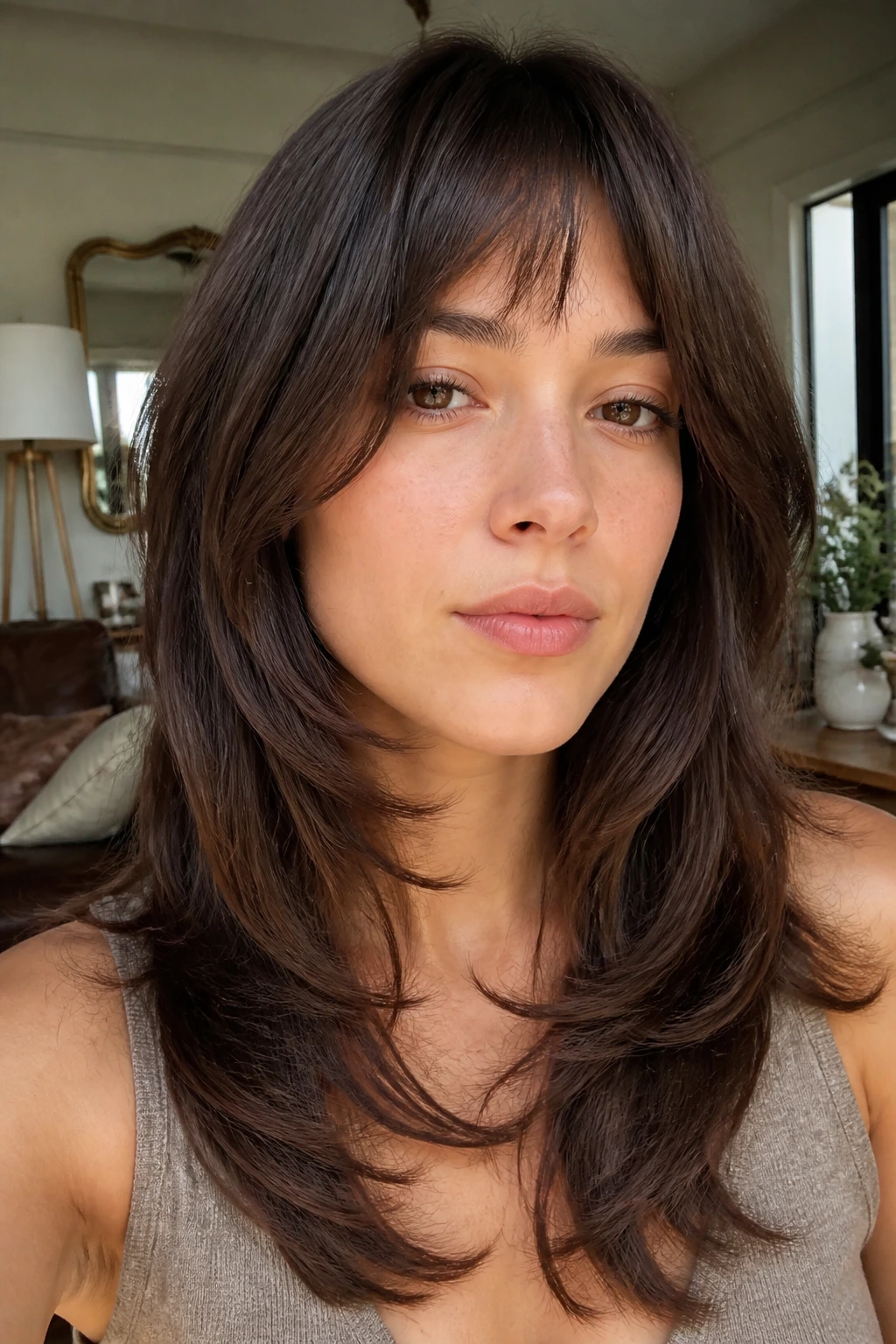
Not everyone wants bangs in the classic sense. Some people want a fragment of fringe—just enough to shift the balance of the haircut. This version starts with a small bang section, then lets the rest fall into curved collarbone layers. Thick hair makes the whole front feel expensive, not skimpy.
On a heart-shaped face, this is useful because it leaves the forehead open while still changing the frame. The little bang fragment catches the eye first. The layers carry it downward. Nothing gets stuck in one place, and the face stays soft all the way to the shoulders.
Why this cut stays wearable
The front never becomes a maintenance trap. If the fringe gets annoying, it can be swept aside. If you want the bang effect, a quick bend at the root brings it back. That flexibility is the reason I’d pick this over a more committed fringe when someone is nervous about change.
16. Textured Baby Curtain Bangs
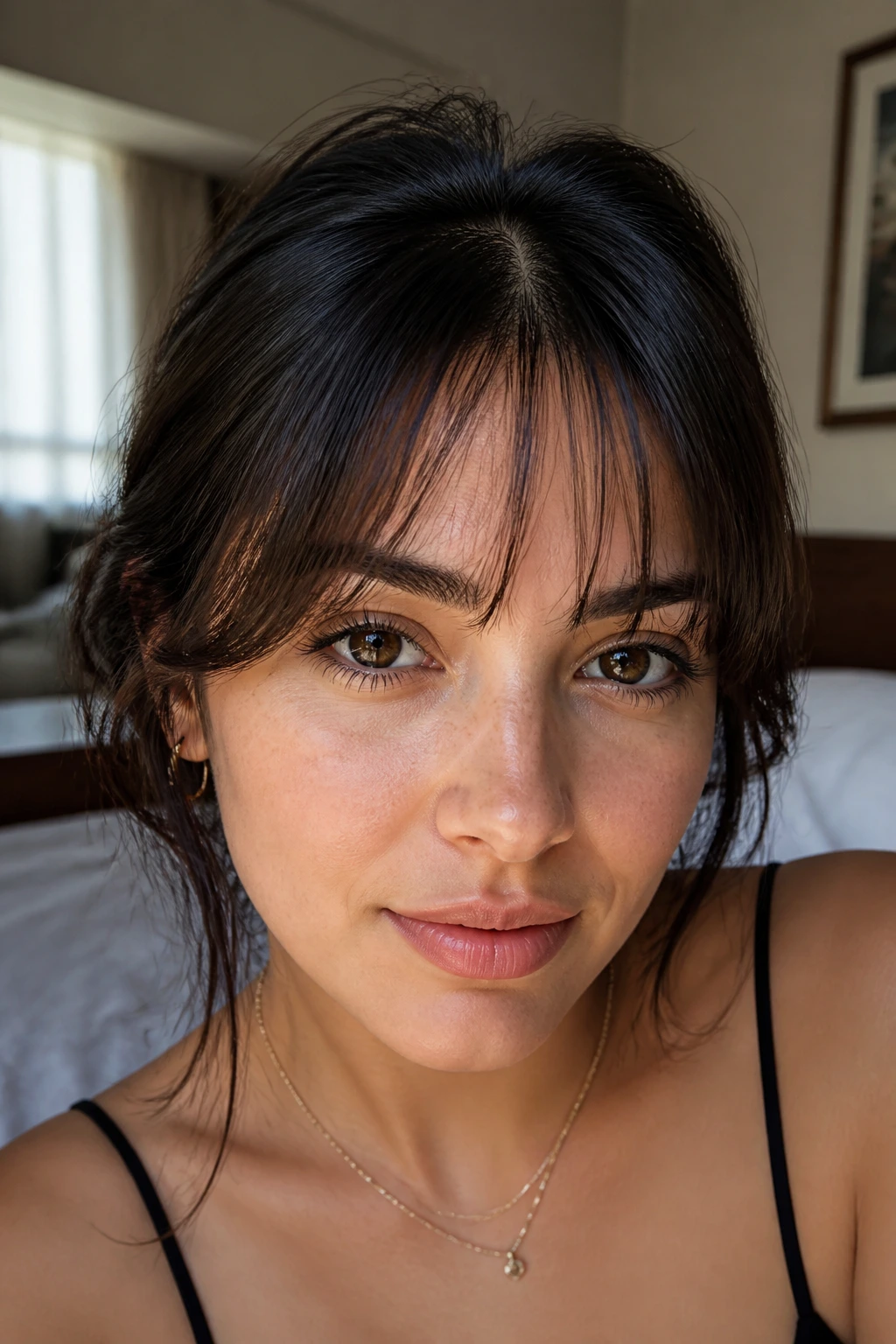
Baby curtain bangs are short enough to feel fresh, but not so short that they trap you in one look. The textured version is the one to choose for thick hair. It uses broken ends and a small split at the center, which keeps the front light even when the density underneath is high.
Heart-shaped faces often do well with this kind of small opening through the middle. The forehead is softened, not hidden. The sides land near the outer brows, which keeps the face from widening too much at the temples. It’s a small detail, but on this face shape, small details carry weight.
I’d style these with fingers first and a brush second. If you force them into a perfect curve, they lose the point. The point is movement. Tiny pieces, a little bend, and enough separation that the bangs never look like they were cut with a ruler.
17. Wedge-Shaped Fringe That Hits the Brows

A wedge shape gives the fringe a fuller middle and narrower sides. That’s useful on thick hair because it controls where the weight sits. You can keep the center rich enough to cover the forehead, then taper the edges so the bangs don’t spread too far toward the temples.
For heart-shaped faces, the taper matters more than the center. The forehead already has presence; the sides should help soften that, not widen it. A wedge-shaped fringe does a nice job of narrowing as it moves outward, which keeps the face looking balanced.
The style works best when the ends are cut with a slightly rough hand. Too clean, and the wedge feels heavy. Too thinned out, and it loses its shape. The sweet spot sits in the middle, where you can still see individual pieces but the outline stays clear.
18. Soft Razor Bangs With a Center Bend

Soft razor bangs have a little bend built in, which makes them easier to wear than a straight razor fringe. The center falls gently, then the sides turn away from the face without looking like a curtain. That shape is forgiving on thick hair, especially if the front section has a natural wave.
I like this cut for heart-shaped faces because it doesn’t cover the forehead in one hard line. It breaks the upper section into small pieces, which gives the face a little breathing room. The center bend keeps the eye from going straight across. It drops the gaze down the face instead.
Use a low heat setting and a small brush or even your fingers to encourage the bend. Strong heat can flatten the softness out of it. And if the hair at your hairline is coarse, ask the stylist to leave a touch more length at the first trim. Thick hair with a sharp front edge can flare up faster than you’d expect.
19. Air-Dried Wave Bangs With Split Definition
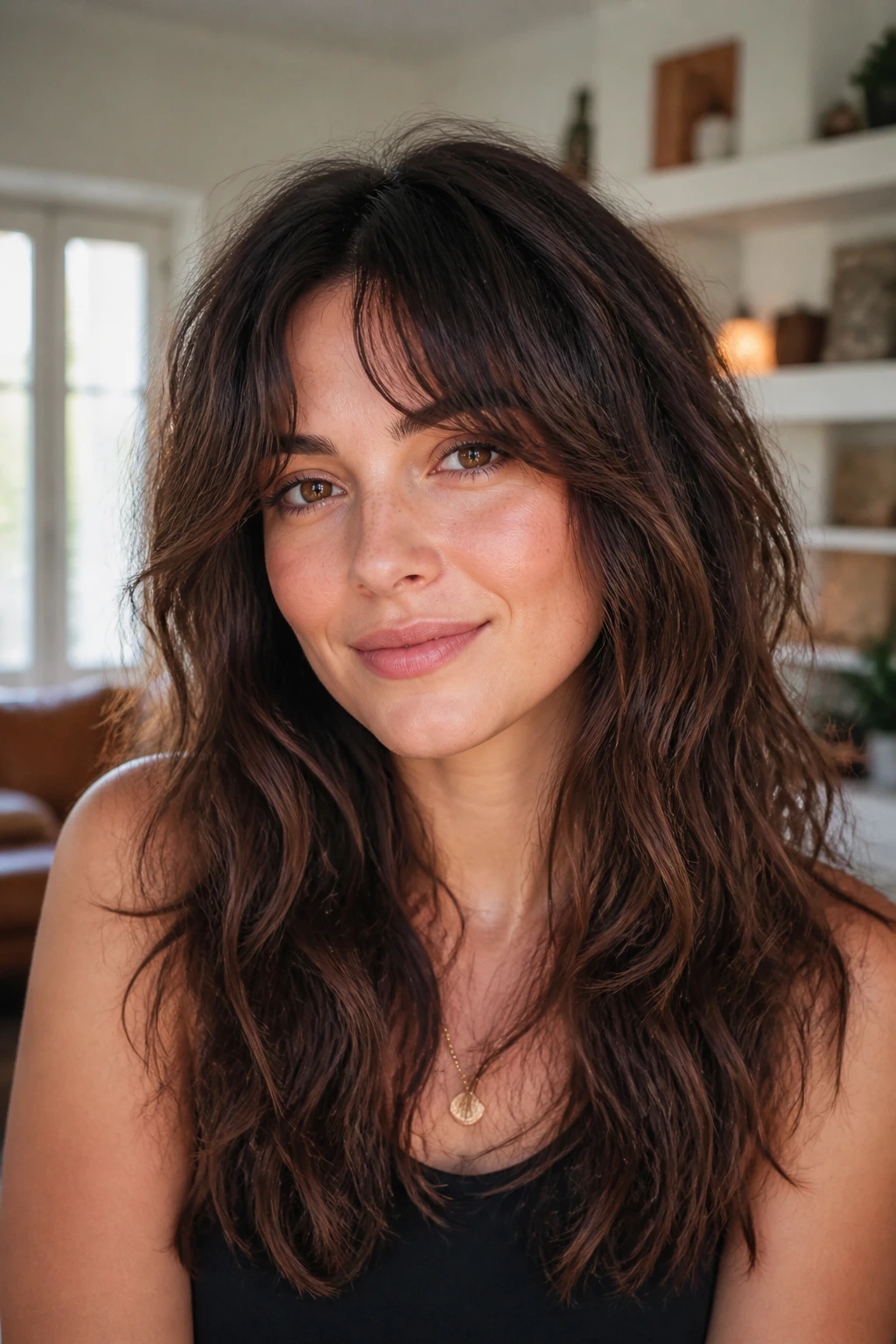
Air-dried wave bangs are for the person who would rather not spend ten minutes wrestling one front section every morning. Thick hair helps because wave has something to hold onto. The split at the center keeps the forehead from feeling crowded, and the choppy ends stop the bangs from drying into one solid sheet.
This style suits heart-shaped faces because the opening at the center makes room for the widest part of the face, while the sides drift toward the cheekbones. The overall effect is soft, not fussy. It looks like your hair knew what to do on its own.
A light mousse or wave cream is enough here. Anything heavy makes the pieces clump. Let the bangs dry where they want, then separate the ends with dry fingers once they’re fully dry. If you touch them too early, they lose the shape and start puffing.
20. Sweeping Fringe That Blends Into Long Layers
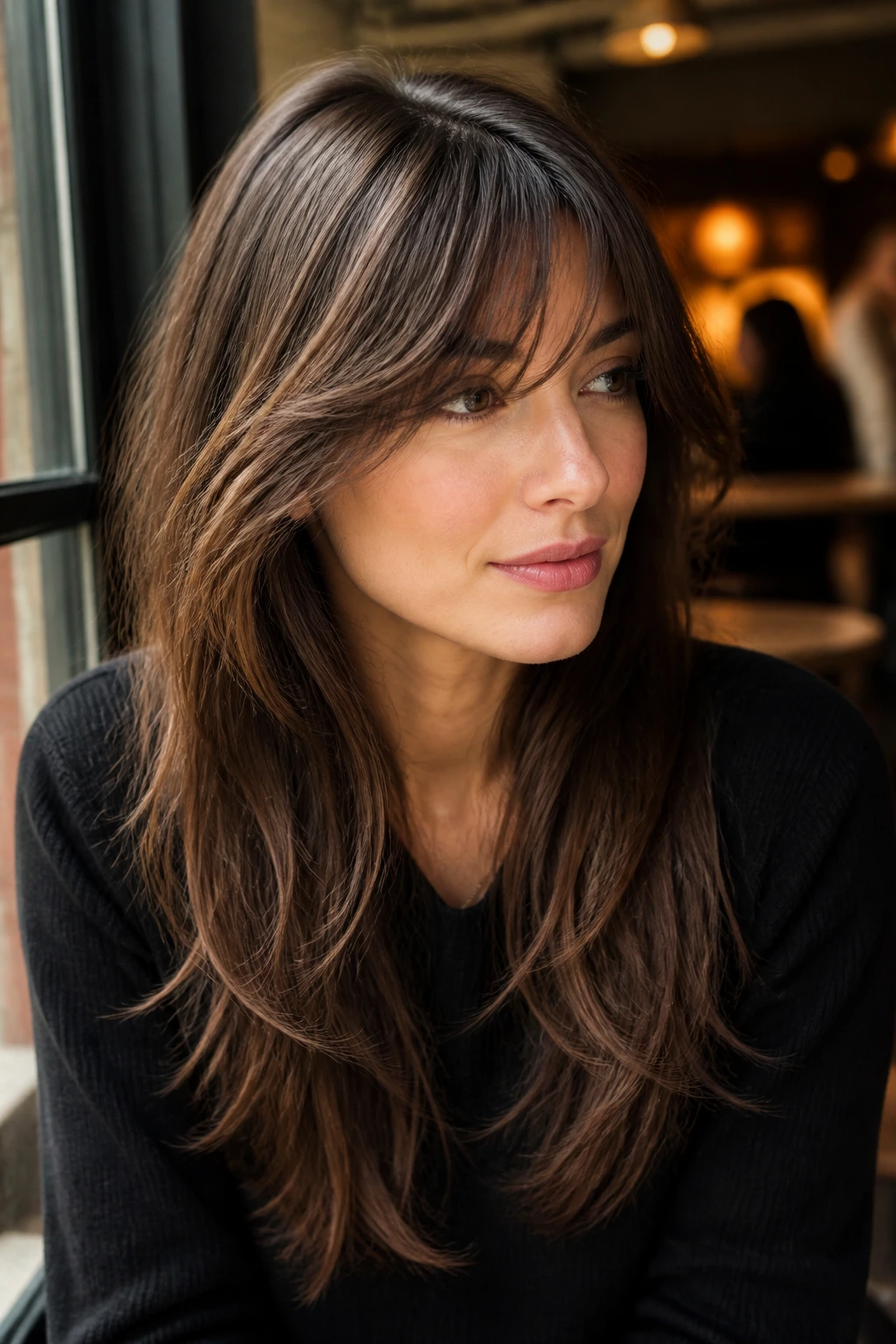
Sweeping fringe is a quiet option, and I mean that as praise. It doesn’t announce itself the way micro bangs do. Instead, it slides across the forehead and melts into long layers around the face. On thick hair, that transition can look especially lush because the hair keeps enough weight to stay connected.
Heart-shaped faces often like this look because it gives the forehead some coverage without boxing in the face. The sweep draws the eye diagonally, which helps the upper half feel less broad. Then the longer layers take over and finish the shape near the jaw and collarbone.
This is one of the easiest styles to grow out. When you’re tired of bangs, you already have the face-framing length. That alone makes it worth considering if you hate the idea of a sharp grow-out line.
21. Curly-Textured Choppy Fringe

Curly hair and thick hair often live in the same neighborhood, but they need a different cutting hand. A curly-textured choppy fringe should be cut dry, or at least almost dry, so the stylist can see where the curls actually land. Wet curls lie. Dry curls tell the truth.
For heart-shaped faces, curly fringe is useful because it softens the forehead and widens the upper frame in a gentler way than a straight line ever could. The trick is to keep the center from sitting too short. Curls bounce up, and thick curls bounce up more. If the shortest curl sits at brow level when wet, it may hover much higher once it dries.
I’d ask for soft, staggered pieces rather than a crisp line. The goal is shape, not symmetry. A little curl pattern variation makes the fringe look lived in instead of manicured. That’s the whole charm.
22. Peekaboo Bangs With Temple Length
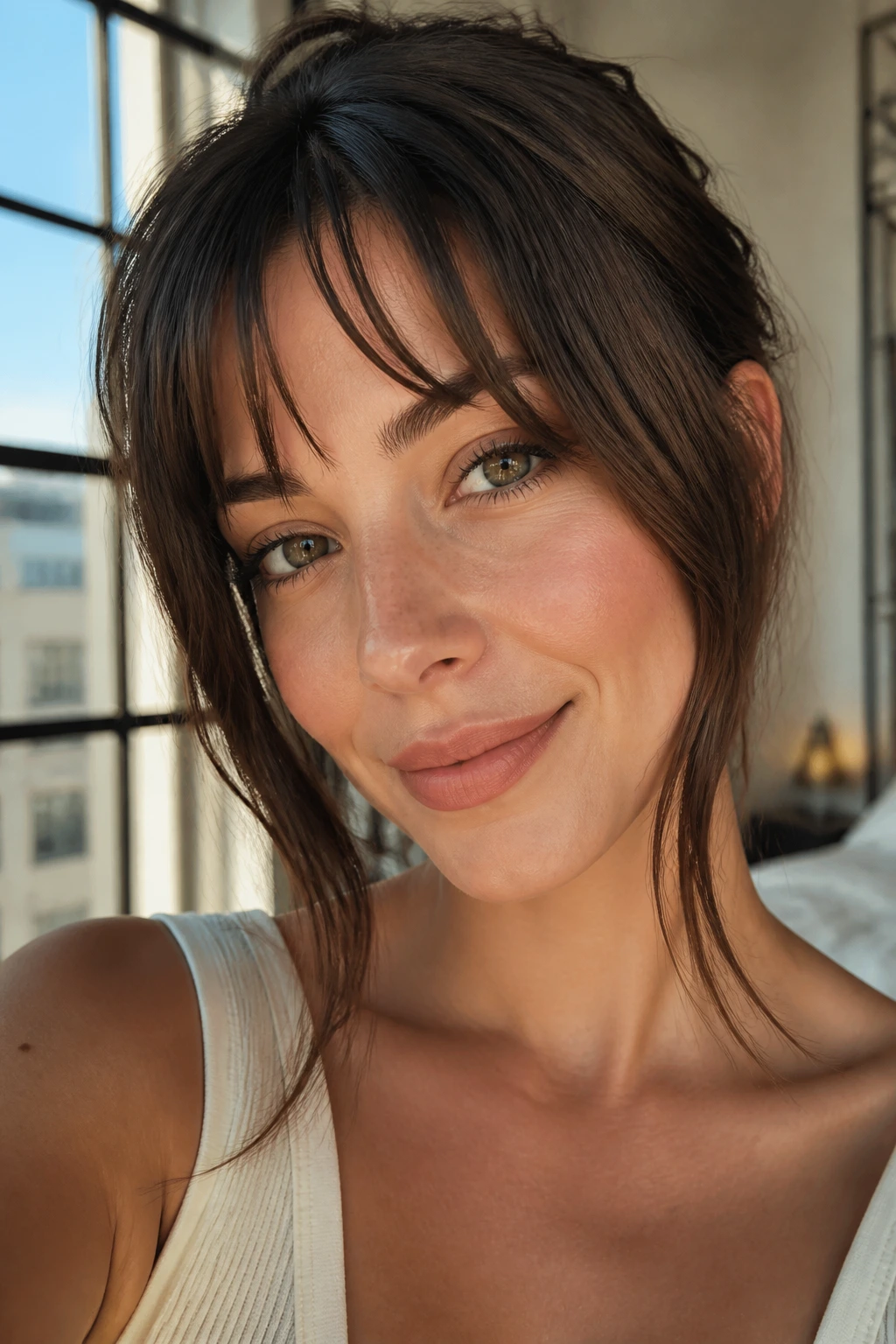
Peekaboo bangs are the ones that let the forehead show through in pieces instead of covering it completely. On thick hair, they can look especially interesting because the density creates enough contrast to make the gaps visible. The temple length keeps the cut from feeling short or boxed in.
This is a smart choice for heart-shaped faces that do better with partial coverage. Too much bang can crowd the upper face. Peekaboo pieces soften it instead. They give the forehead a break, not a blanket.
Best way to wear them
- Dry them forward first, then split them with your fingers.
- Keep the texture piecey, not fluffy.
- Use a small amount of dry shampoo if the front gets oily early.
- Let a few longer pieces fall toward the temples so the shape doesn’t end too soon.
It’s a subtle fringe, but subtle is the point here. Not everyone wants bangs with a loud entrance.
23. Chunky Piecey Bangs With a Little Lift
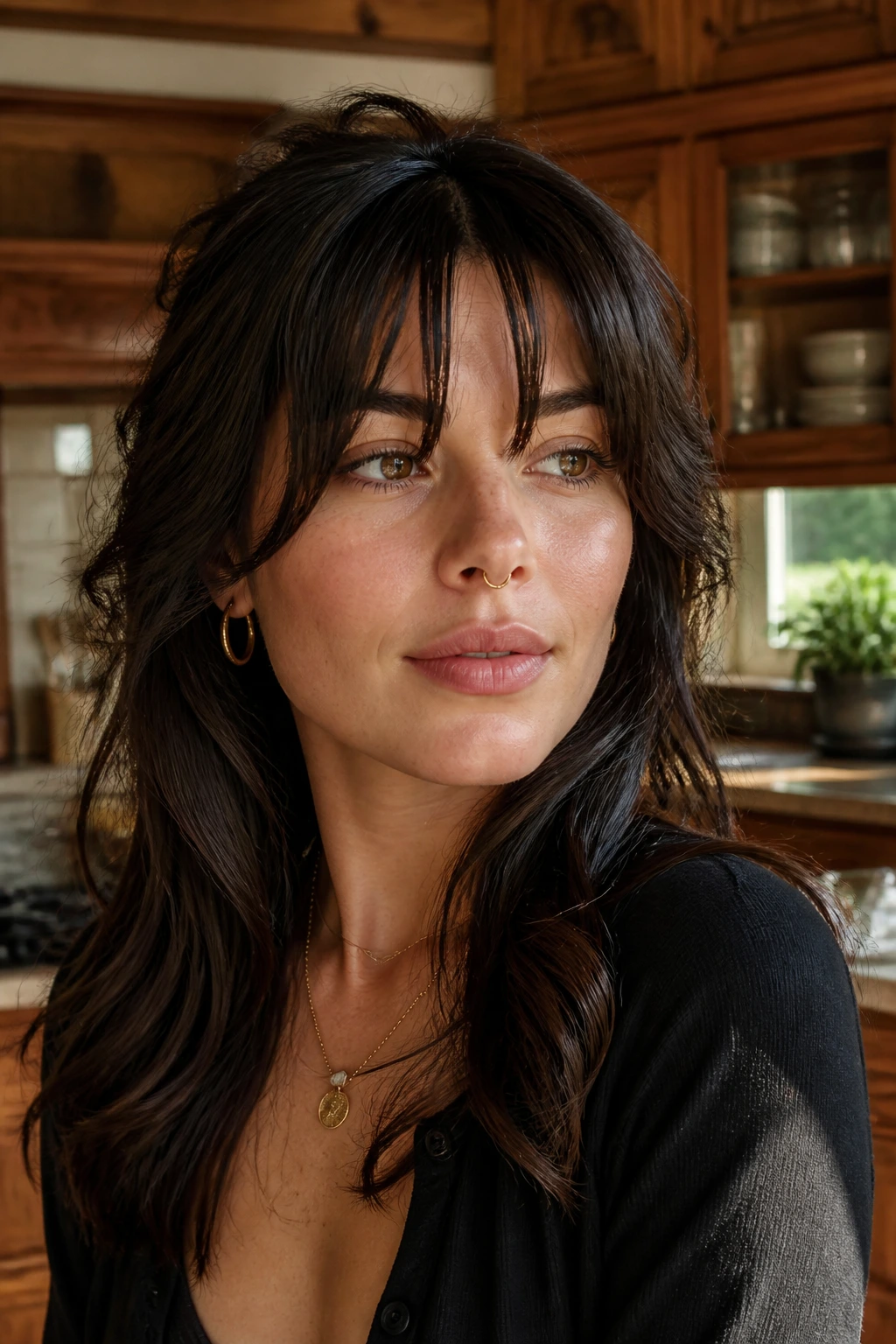
Chunky piecey bangs are for people who like some edge in the front. Thick hair gives you enough mass to separate the fringe into visible pieces, and a little lift at the root keeps the whole thing from collapsing. Heart-shaped faces usually wear this well when the pieces are directed slightly away from the center.
The thing to watch is product. Too much serum and the chunks melt together. Too little, and the bangs frizz apart. A pea-sized amount of matte cream rubbed between the fingers is usually enough to build those separated strands without making them sticky.
This style feels modern because it’s not polished. It’s a little rough, in a good way. The uneven pieces soften the forehead while still making the bang look intentional, which is a hard balance to get with very dense hair.
24. Lived-In Side Curtain Fringe
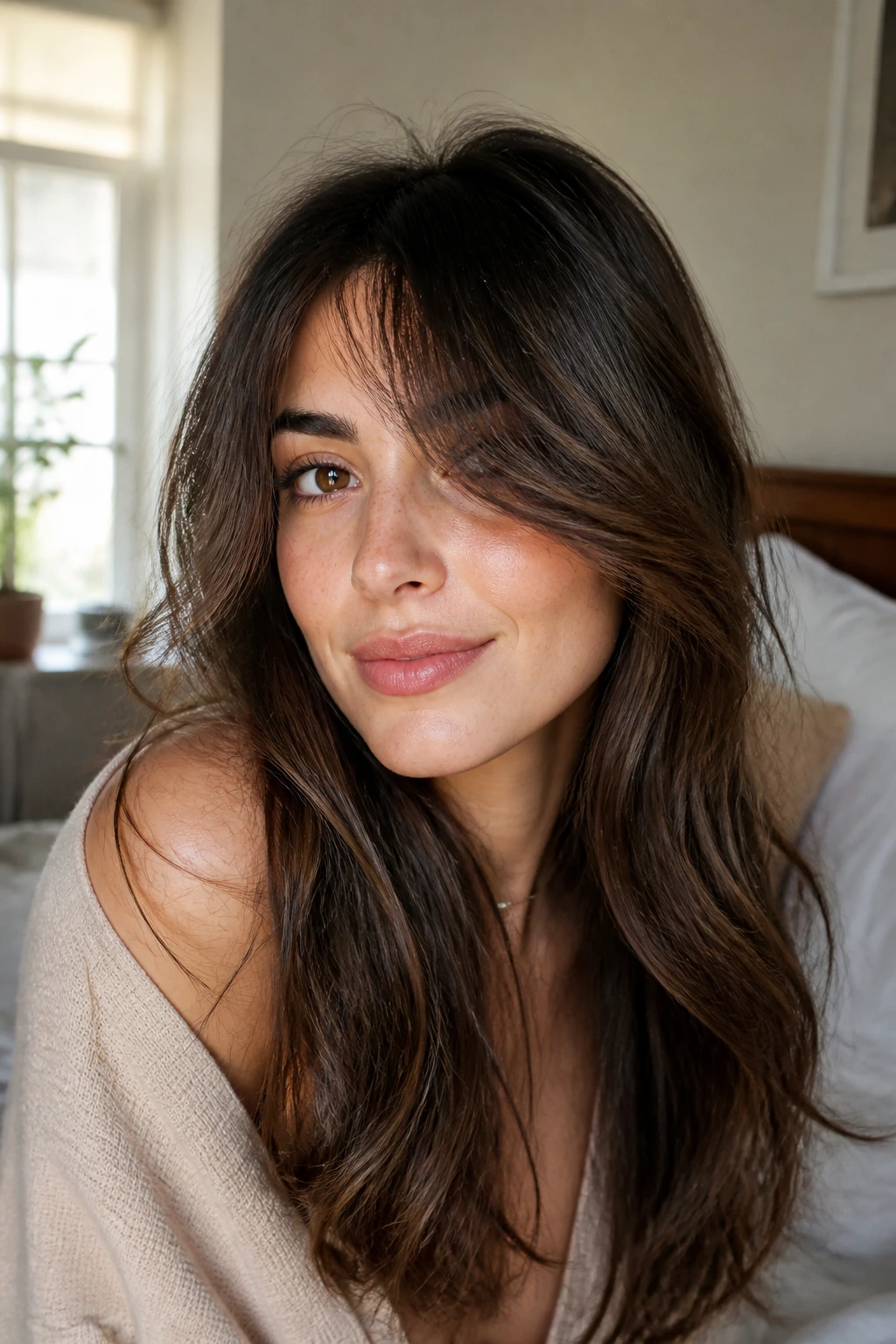
A lived-in side curtain fringe is what you wear when you want the cut to do the work even on an unremarkable Tuesday. The part leans off-center, the pieces fall softly across the forehead, and the ends are broken just enough to keep the line from feeling severe. Thick hair helps because it gives the fringe enough body to hold its shape all day.
Heart-shaped faces benefit from the side bias. It shifts the focus away from the widest part of the forehead and toward the cheekbones and jaw. The whole thing feels relaxed, which is useful if you don’t want your hair to look like it needs a perfect blowout to be acceptable.
If you’re stuck between curtain bangs and side bangs, this is the in-between. You get the softness of one and the ease of the other. Nice compromise. Sometimes that’s the best kind.
25. Low-Fuss Choppy Bangs With a Long Grow-Out

Low-fuss choppy bangs are the cut I suggest to anyone who wants fringe without signing a long-term contract. The length stays on the longer side of brow level, and the ends are broken up so the bang can be swept, tucked, or worn forward depending on the day. Thick hair makes the whole thing look full instead of flimsy.
For heart-shaped faces, the long grow-out is a gift. It keeps the forehead from looking crowded while still changing the balance at the top of the face. If you later decide you want less bang, the pieces already know how to live as a face frame.
That flexibility is the whole reason this style closes the list. It gives you shape now and options later. Not every fringe needs to be dramatic to be useful.
Why Thick Hair Makes Choppy Bangs Easier to Shape
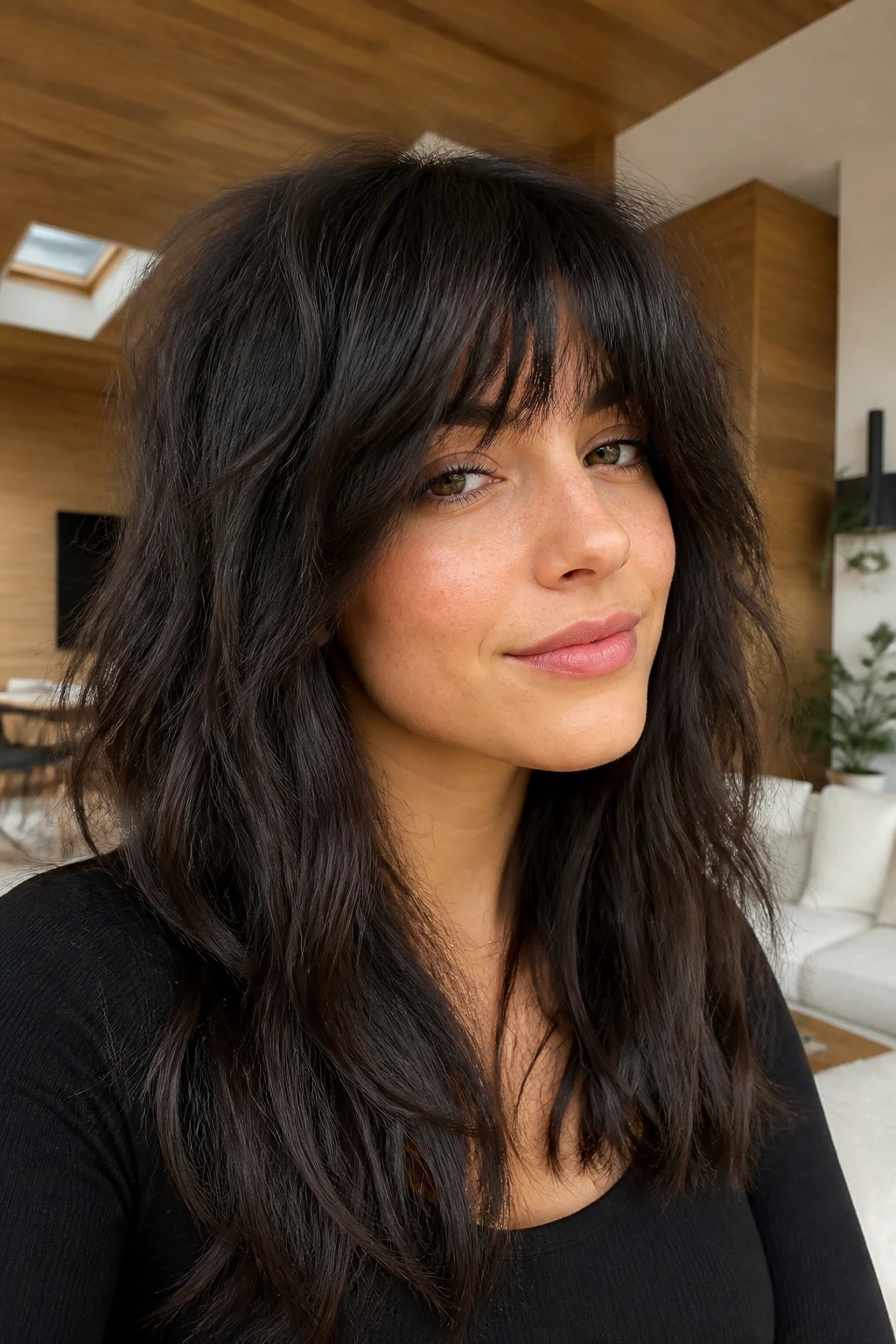
Thick hair changes the game because it gives the stylist something to sculpt. Fine bangs often need careful support so they don’t disappear. Thick bangs need control so they don’t overwhelm the face. Those are not the same problem, and the fix is not the same either.
Choppy bangs work so well here because weight can be removed in tiny amounts. Point cutting, slide cutting, and selective internal thinning let the fringe keep its outline while losing the bulk that makes it puff outward. That’s why the front sits better after a real cut than after a blunt trim. The line can breathe.
Heart-shaped faces benefit from that controlled breakup. A fringe that starts too heavy in the center can make the forehead feel broader. A fringe that’s too short and too symmetrical can make the upper face feel even more dominant. Choppy ends, especially near the temples, soften both problems at once. The eye moves down. The face looks less top-heavy. Simple.
There’s another perk people forget: grow-out. Dense hair tends to keep a shape as it grows, which means choppy bangs often age better than crisp ones. They can slide into curtain pieces or face-framing layers before they turn awkward. That alone makes them easier to live with between trims.
Styling Tools That Make the Cut Easier to Live With

You don’t need a suitcase of gadgets, but a few specific tools make choppy bangs behave better on thick hair.
- Blow dryer with a concentrator nozzle: Directs the airflow so the fringe dries in the shape you want instead of blasting every piece in different directions.
- Small round brush, about 1 to 1.5 inches: Gives a bend at the root and enough curve at the ends to keep the bangs from sitting flat.
- Fine-tooth comb: Useful for creating a clean part and checking whether the fringe is sitting where you actually want it.
- Duckbill or sectioning clips: Keep the rest of the hair out of the way while you dry just the bang area.
- Light mousse or root-lift spray: Helps thick hair hold separation without turning crunchy.
- Texturizing spray or dry texture powder: Good for piecey ends and for breaking up bangs that start to clump.
- Flat iron with narrow plates: Handy for quick bends, not straightening every hair into submission.
- Salon shears and texturizing shears: These belong in a stylist’s hands, not yours, unless you already know how to use them without creating holes.
How to Ask for the Cut and Style It on Day One
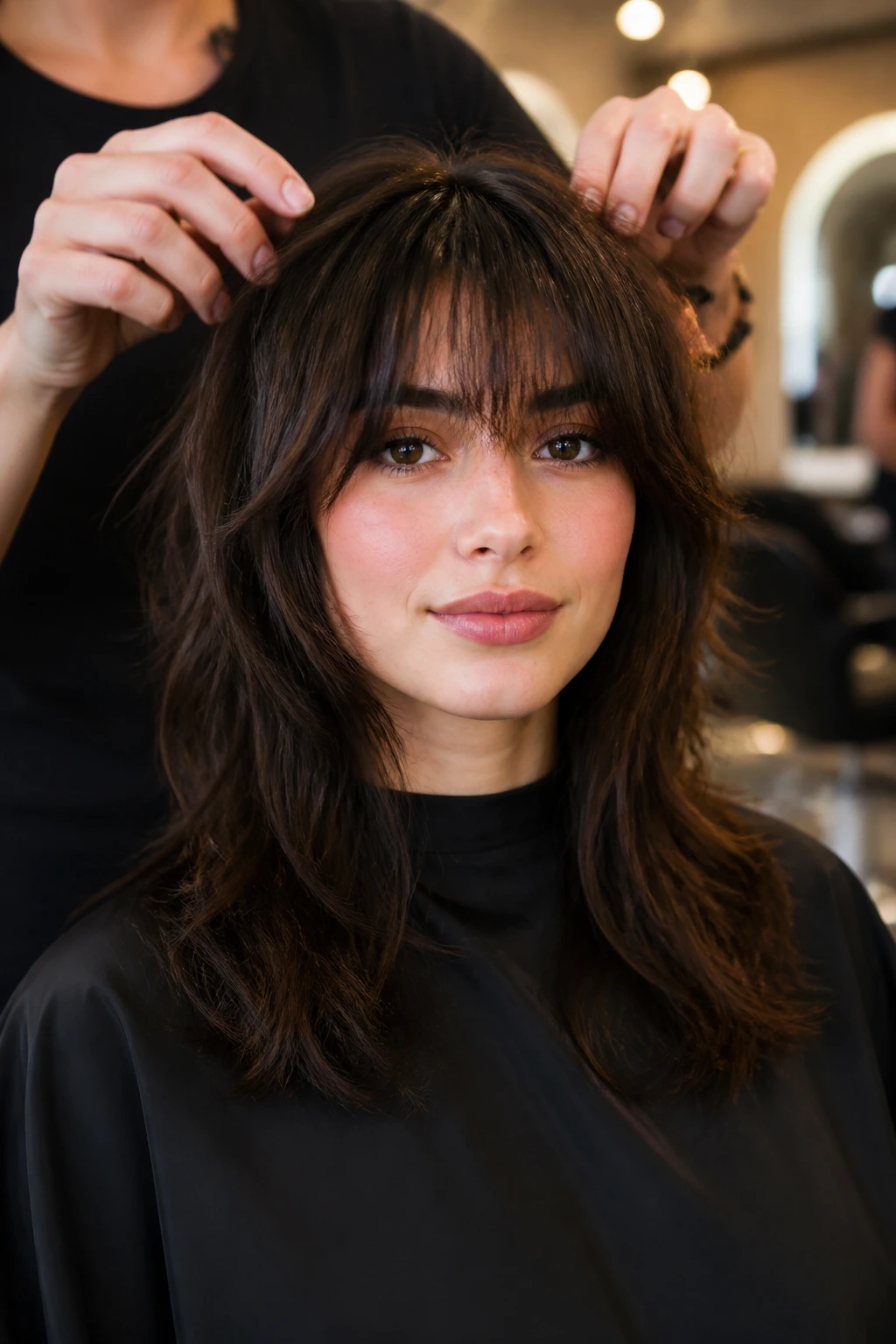
Bring two photos, not one. One should show the length you want at the brows or cheekbones. The other should show the texture you like. Those are not always the same thing, and that’s where bad bang cuts usually begin.
Salon Script: say you want the fringe choppy, not sparse, with enough density left to suit thick hair. Tell the stylist whether you want the center to sit at brow level, lash level, or cheekbone level. If your forehead is shorter, say so. If your hairline has a cowlick or a strong bend, say that too.
Length Check: ask for the first cut to be a touch longer than the final goal. Thick hair jumps when it dries, and bangs that look safe when wet can end up too short. A little insurance is better than an emergency pin-back plan.
Blow-Dry Direction: dry the bangs from side to side first, then guide them forward or to the side depending on the style. That keeps them from setting into one fixed line. A tiny round brush works, but your fingers often do half the job.
Product Rule: use less than you think. Thick fringe does not need much. Too much cream or oil makes the ends collapse and the piecey separation disappears. Start with a fingertip amount and add only if the bangs are frizzing.
Common Mistakes That Make Fringe Puff Out or Split
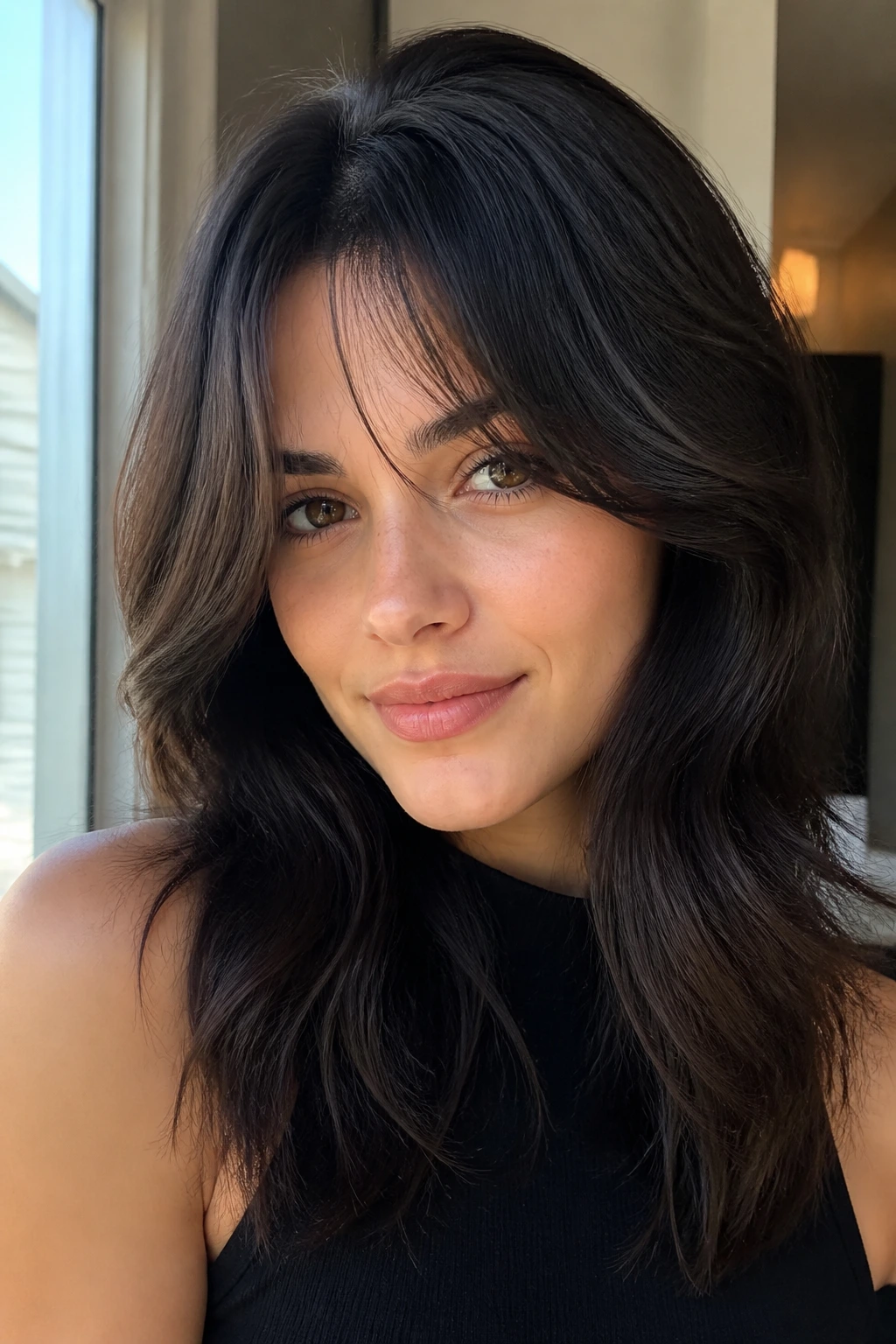
- Cutting the bangs too short on the first pass: Thick hair bounces, and a fringe that looks safe at the salon chair can jump an extra quarter inch when it dries. Leave room.
- Removing bulk from the wrong place: If the stylist thins the perimeter instead of the interior, the bangs can end up wispy at the edges and heavy in the center. The shape gets weird fast.
- Ignoring the temple zone: On a heart-shaped face, the temples are part of the fringe story. If they’re left too blunt, the forehead can look wider than it needs to.
- Using too much serum or oil: Thick bangs can go flat and stringy in minutes if they’re overloaded. Keep shine products off the root area.
- Cutting curly or wavy fringe as if it were straight: Shrinkage changes everything. Wet cuts without curl awareness usually come back too short.
- Skipping trim upkeep: Even a good choppy bang grows into awkward territory if it’s left alone for too long. The line loses its rhythm, and the center starts to split.
Variations to Try When You Want Less Commitment

Soft Curtain Start: Begin with longer curtain bangs and only a little choppiness at the ends. This gives you the shape without forcing you into daily fringe maintenance, and it grows into face-framing layers with very little drama.
Curly-Dry Cut: If your hair is wavy or curly, ask for the fringe to be cut dry in its natural state. That keeps the length honest and prevents the bangs from jumping too high once they dry at home.
Short-Chop Statement: Go shorter in the center and keep the sides piecey. This works for people who want the forehead open but still want a bold front line. It’s sharper, so the choppiness matters even more.
Temple-Softened Fringe: Leave the corners longer and feather them into the side layers. That version is kinder to heart-shaped faces that need a little extra softness around the upper face.
Grow-Out Friendly Fringe: Keep the shortest point at or just below the brows and avoid over-thinning the ends. The bangs will still look deliberate, but they’ll slide into curtain pieces more gracefully if you change your mind.
Keeping the Fringe in Shape Between Salon Visits
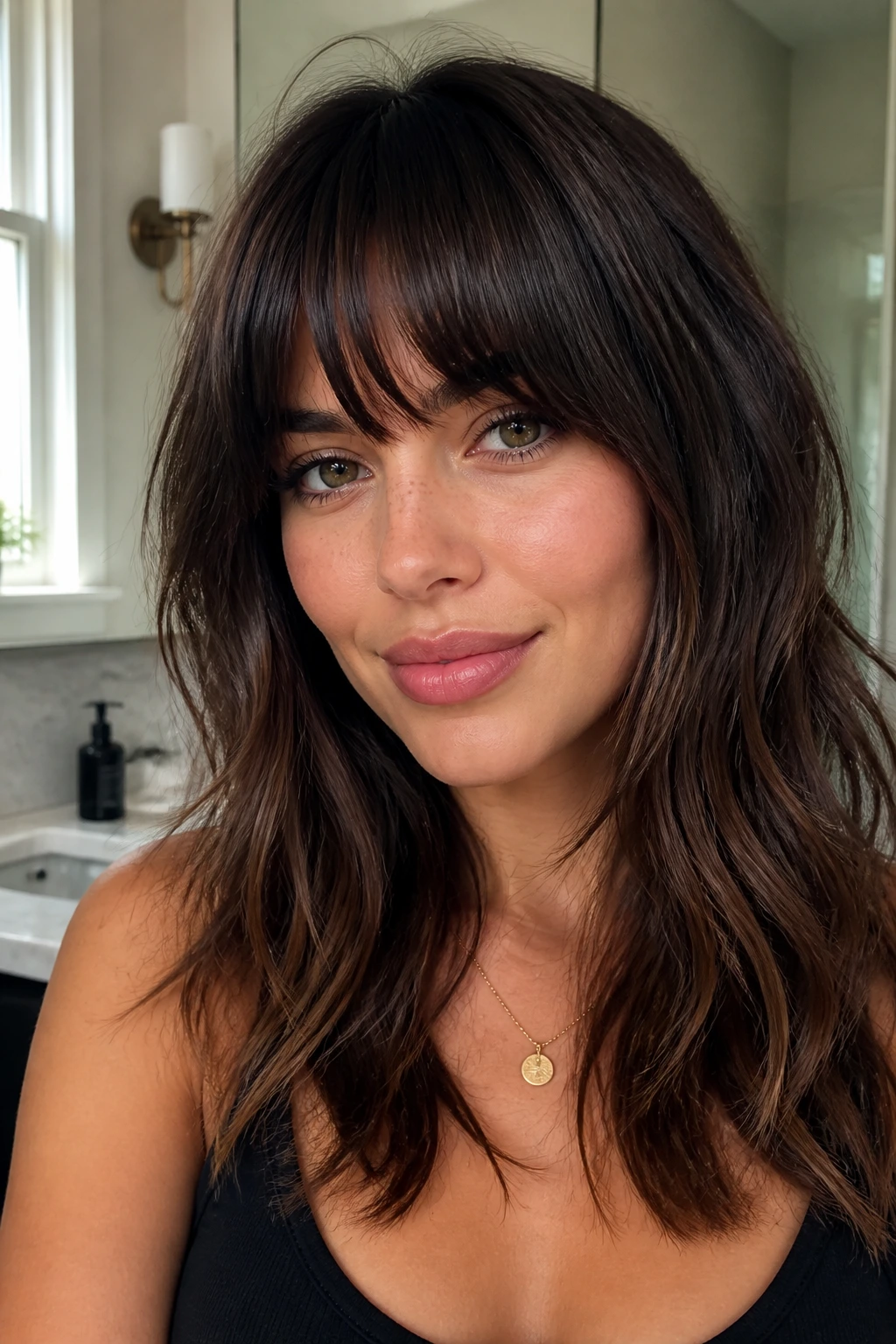
Bang maintenance is mostly about the front section, and thick hair makes that both easier and more annoying. Easier because the bangs hold shape. Annoying because they show oil, sweat, and cowlicks fast.
Wash the fringe or at least rinse it at the sink every one to two days if your roots get greasy quickly. A tiny bit of shampoo on the front section and a quick blow-dry is often enough. If you’re not washing the rest of your hair, clip it back and clean only the bangs. It takes five minutes. Sometimes less.
Trim the fringe every three to five weeks if you want the line to stay intentional. If you’re wearing a longer curtain or side-sweep version, you can stretch that to six or seven weeks. The more precise the shape, the faster it shows growth.
At night, push the bangs away from your forehead if you sleep hot. A loose clip, a tiny roller, or even a soft headband can keep them from waking up bent in strange directions. And if they split in the morning, dampen just the roots, not the ends, then re-blow in the right direction.
Frequently Asked Questions
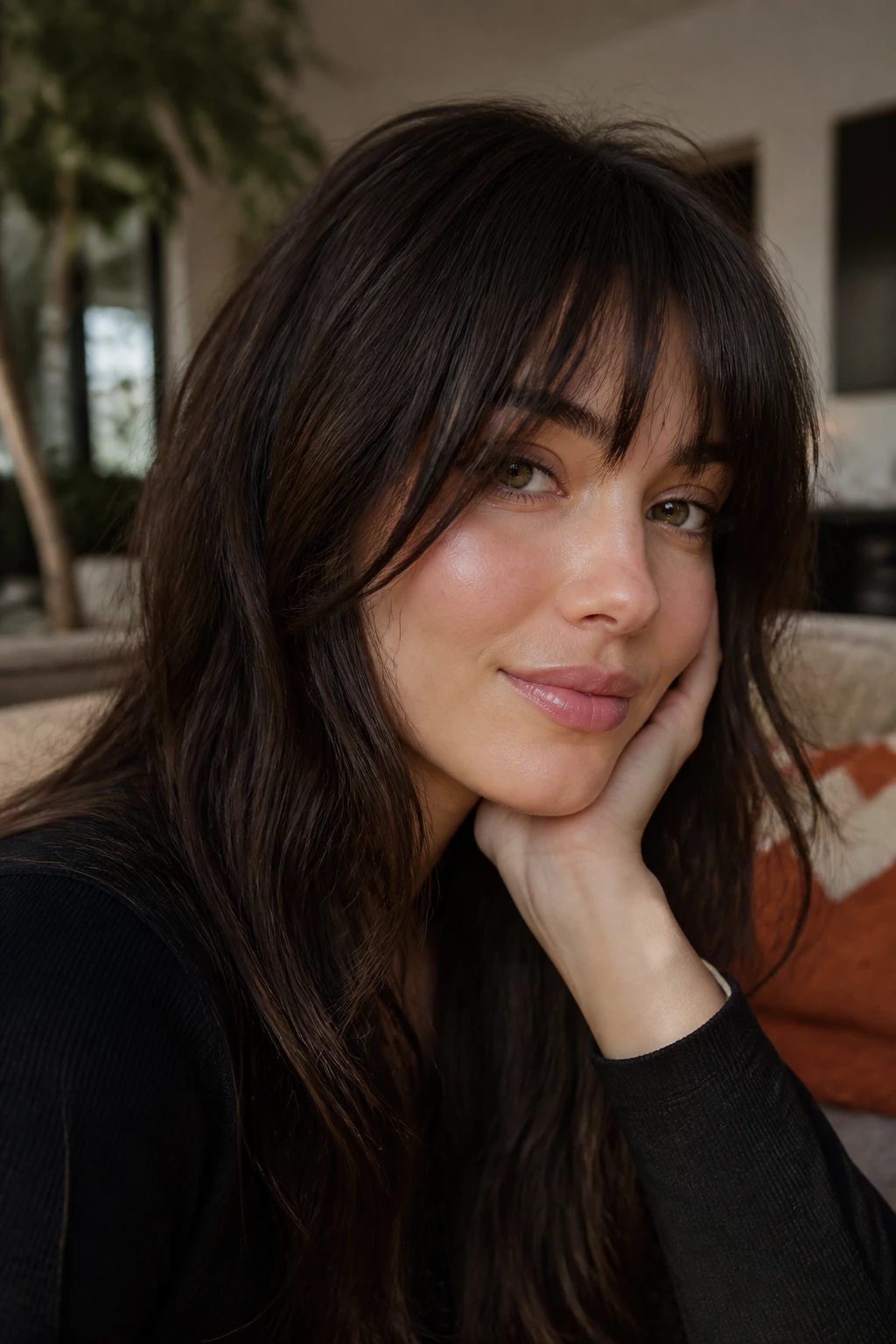
How short should choppy bangs be on a heart-shaped face?
Usually somewhere between brow level and just below the lashes works best, depending on how much forehead you want to show. If your forehead is on the shorter side, keep the fringe a little longer so the face doesn’t feel crowded.
Are choppy bangs good for very thick, coarse hair?
Yes, as long as the bulk is removed in the right places. Coarse thick hair needs internal softening and a clean outline, not aggressive thinning at the ends. Otherwise the fringe can split and frizz.
Do choppy bangs make a wide forehead look smaller?
They can, but the trick is balance rather than blanket coverage. A fringe with texture at the temples and some openness near the center usually works better than a solid wall of hair.
Can I wear these bangs with curly or wavy hair?
Absolutely, but the cut should respect shrinkage. Dry cutting or near-dry cutting helps the stylist see where the fringe lands when it’s fully shaped, not just when it’s wet.
How often do I need trims?
Most choppy bangs need a touch-up every three to five weeks. Longer curtain or side-swept versions can go a bit longer, but once the ends lose their breakup, the fringe starts to look heavy again.
What if my bangs keep separating into two pieces?
That usually means a cowlick, a strong natural part, or too little weight in the center. A stylist can leave a little more length in the middle or shift the part slightly so the bangs sit where they want to sit instead of fighting your hairline.
Can I grow choppy bangs out without an awkward stage?
Usually, yes. The longer versions in this list are already halfway to face-framing layers, which makes the transition easier. You can tuck, pin, or sweep them as they get longer.
Should I cut choppy bangs on wet or dry hair?
For straight, dense hair, either can work if the stylist knows how your hair dries. For waves, curls, or strong cowlicks, dry or nearly dry cutting is safer because it shows the real shape and prevents surprise shrinkage.
A Fringe That Moves With You
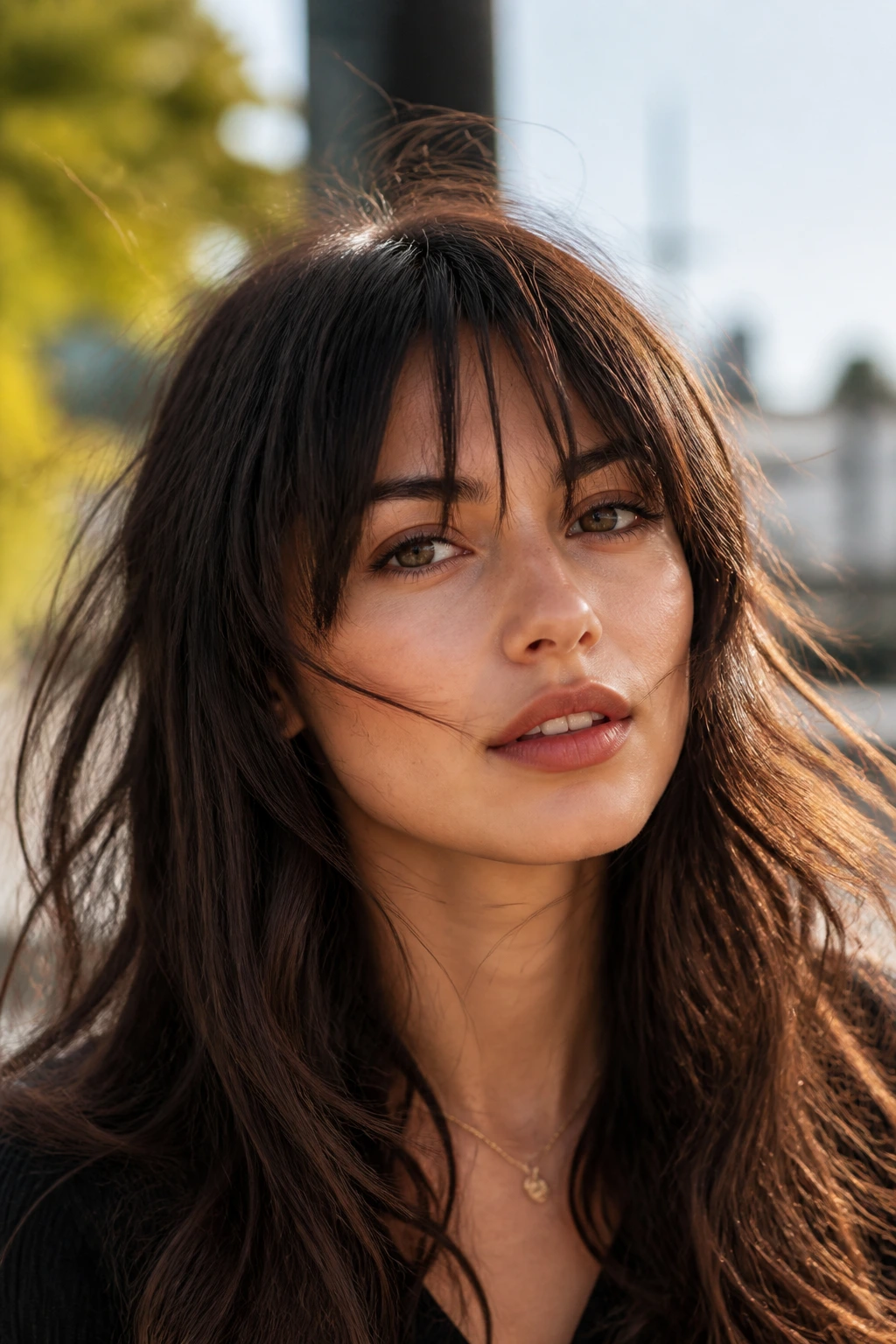
The nice thing about choppy bangs on thick hair is that they don’t ask your face to disappear. They soften it, shape it, and give it a little movement at the front without flattening all the density you actually paid for. On a heart-shaped face, that balance matters even more. The forehead gets some relief. The cheekbones get room. The whole haircut feels less top-heavy.
If you’re choosing between a crisp fringe and a softer, broken one, I’d take the broken version almost every time on this texture and face shape. It wears better, grows out kinder, and looks like it belongs to the rest of the haircut instead of sitting on top of it. That’s the difference that keeps a bang from becoming a burden.
Pick the version that matches how much upkeep you’re willing to do, then let the stylist carve the weight instead of chopping it off. That’s where the good stuff happens.