



Thick hair can sit on your shoulders like a wool coat in July. It has weight, it has presence, and when the cut is wrong it can feel like it has its own weather system. Side-swept bangstyle long layers for thick hair work because they give all that density a direction instead of letting it spread outward into a boxy shape that swallows the face.
A good version of this cut doesn’t try to make thick hair look thin. That’s the mistake. What you want is controlled movement: layers that start low enough to keep the body where you need it, and a side-swept fringe long enough to bend, tuck, and grow out without turning into a blunt shelf or a choppy accident. The difference between “heavy” and “expensive-looking” is often just two inches of placement.
The sweet spot is more specific than most salon talk makes it sound. On dense hair, long layers usually behave best when they begin around the chin or lower, while the bang area lives somewhere between the cheekbone and lip line so it can sweep instead of stick up. Get that balance right and thick hair stops fighting the haircut. It starts carrying it.
Why These Cuts Earn Their Keep on Thick Hair
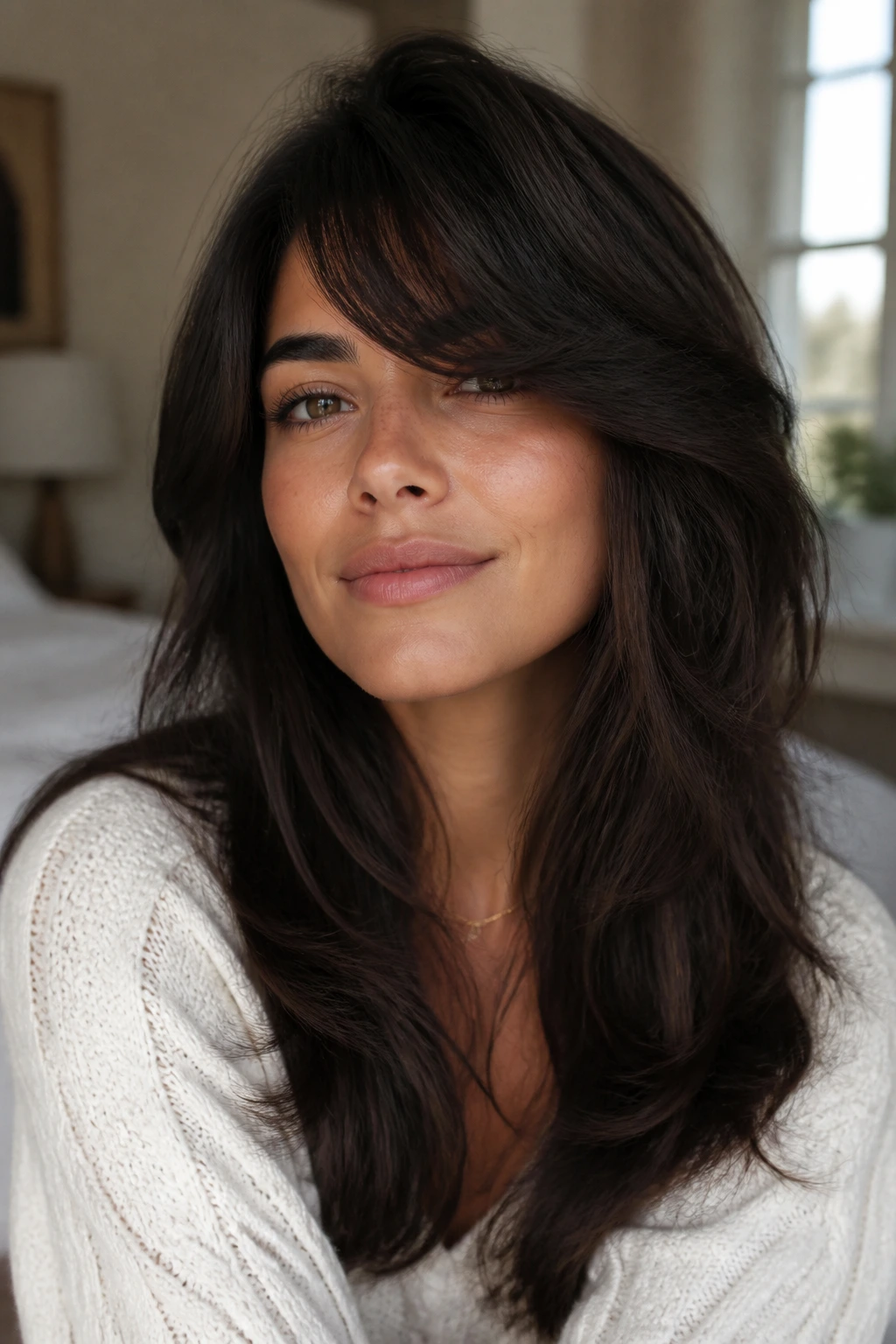
- They control bulk without stripping away shape: The right long layers remove weight from the places that puff out first, especially around the sides and back.
- They keep the front from going flat and severe: A side-swept fringe breaks up a heavy hairline and adds a softer line across the face.
- They grow out with less drama: Longer bangs and extended layers can go several weeks before they look ragged, which is a gift if you hate frequent salon visits.
- They work with more than one styling mood: You can wear them blown smooth, brushed into a bend, or left with a loose wave and they still make sense.
- They suit thick hair instead of fighting it: Density is not the enemy here; bad placement is. These cuts use the hair’s own body instead of trying to flatten it into submission.
1. Feathered Cascade with a Soft Side Sweep
A blunt wall of hair can make thick lengths feel boxed in. This version softens that wall with feathered ends and long, drifting layers that start below the cheekbone, so the bulk stays in the body of the hair instead of piling around the face. The side sweep matters too: the fringe should skim from the temple and taper toward the outer eyebrow, not stop dead at the nose.
This cut is especially flattering if your hair is straight or only slightly wavy. You can round-brush just the front and let the rest fall naturally, which keeps the style from looking overworked on a random Tuesday. Thick hair looks expensive when it moves in one clean line, then breaks into soft bends at the ends.
The thing I like most here is restraint. There’s enough layering to keep the weight from sitting like a helmet, but not so much that the perimeter turns wispy. If your hair tends to swell in humidity, this is one of the safer bets.
2. Deep Side Part and Chin-Skimming Frame
Why the part does half the work
If your hair gets puffy near the temples, this is the cut that stops the argument. A deeper side part shifts weight to one side, and the chin-skimming front pieces break up the width without losing length. It looks intentional in a way that a flat center part on thick hair sometimes doesn’t.
The shortest face-framing layer should begin at the chin, then melt into longer layers that trail toward the collarbone. That keeps the front from puffing up near the cheekbones, which is where thick hair can start to look triangular if the cut is too high. The side-swept bang should stay long enough to tuck behind the ear when you need it gone.
- Ask for a deep side part, but not a hard one.
- Keep the fringe long enough to brush the outer brow.
- Have the stylist cut it dry or check the finish dry, because thick hair shrinks and swings once it’s fully dry.
Best move: style the part the same direction for a few washes in a row. Thick hair learns fast when you keep the pattern consistent.
3. Butterfly Layers with a Diagonal Fringe
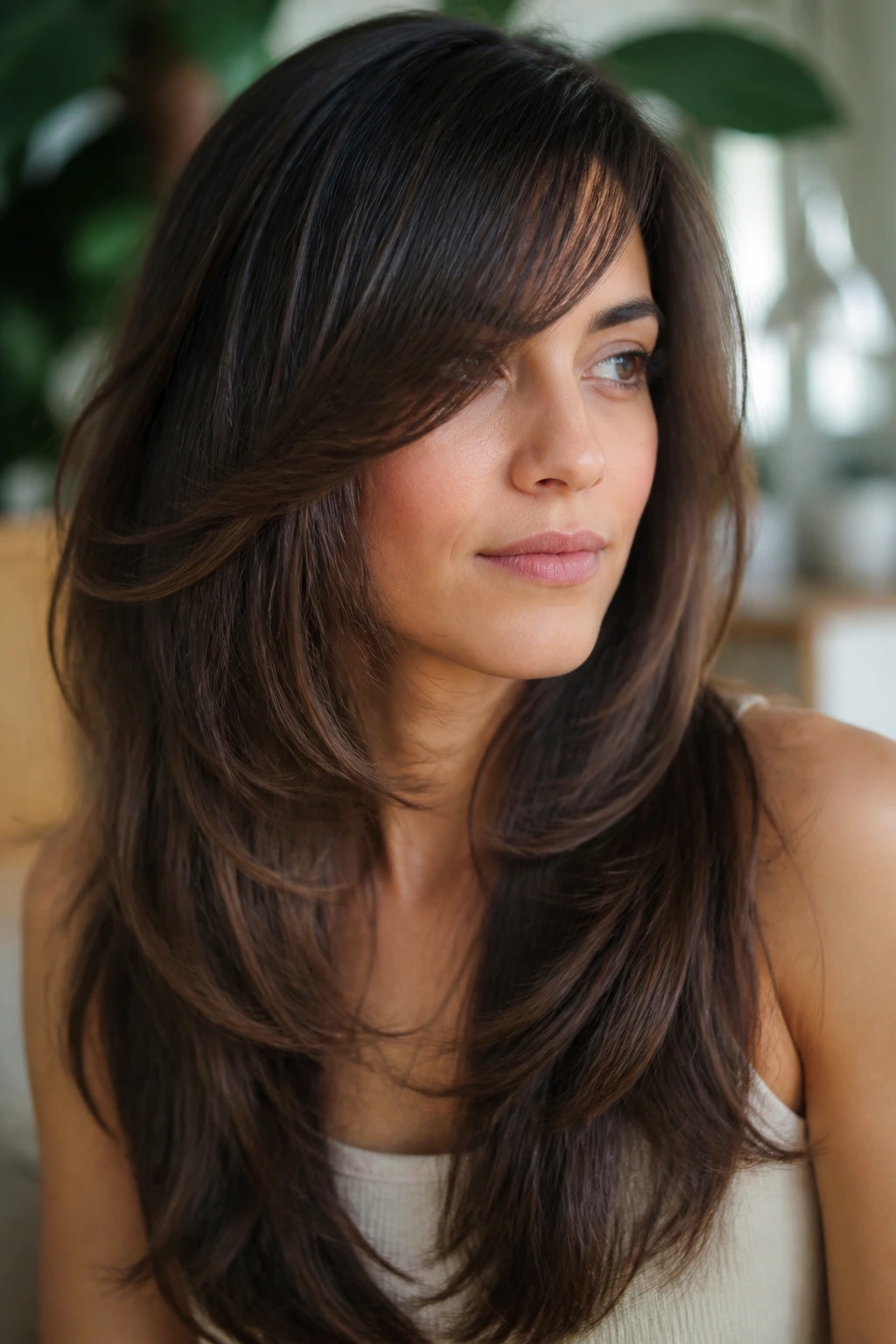
Why does this cut work so well on dense hair? Because it leaves the bottom long and strong while creating movement through the top half. Butterfly layers are the ones that give you that lifted, floating effect around the face without taking away the weight that keeps thick hair from poofing outward.
The diagonal fringe matters here. It starts on the heavier side of the part, then sweeps across the forehead and blends into the front layers, so the whole cut feels connected. You don’t get that awkward disconnect where bangs look pasted onto a long style. That glued-on look is what I always tell people to avoid.
How to ask for it
Say you want the shortest face frame to hit around the cheekbone, with longer pieces dropping toward the collarbone. That gives the front some drama, but the length still reads as hair, not bangs. If your hair is coarse, ask for soft point cutting rather than aggressive texturizing; too much thinning can leave the surface frizzy.
4. Hidden Weight Removal with Sleek Ends
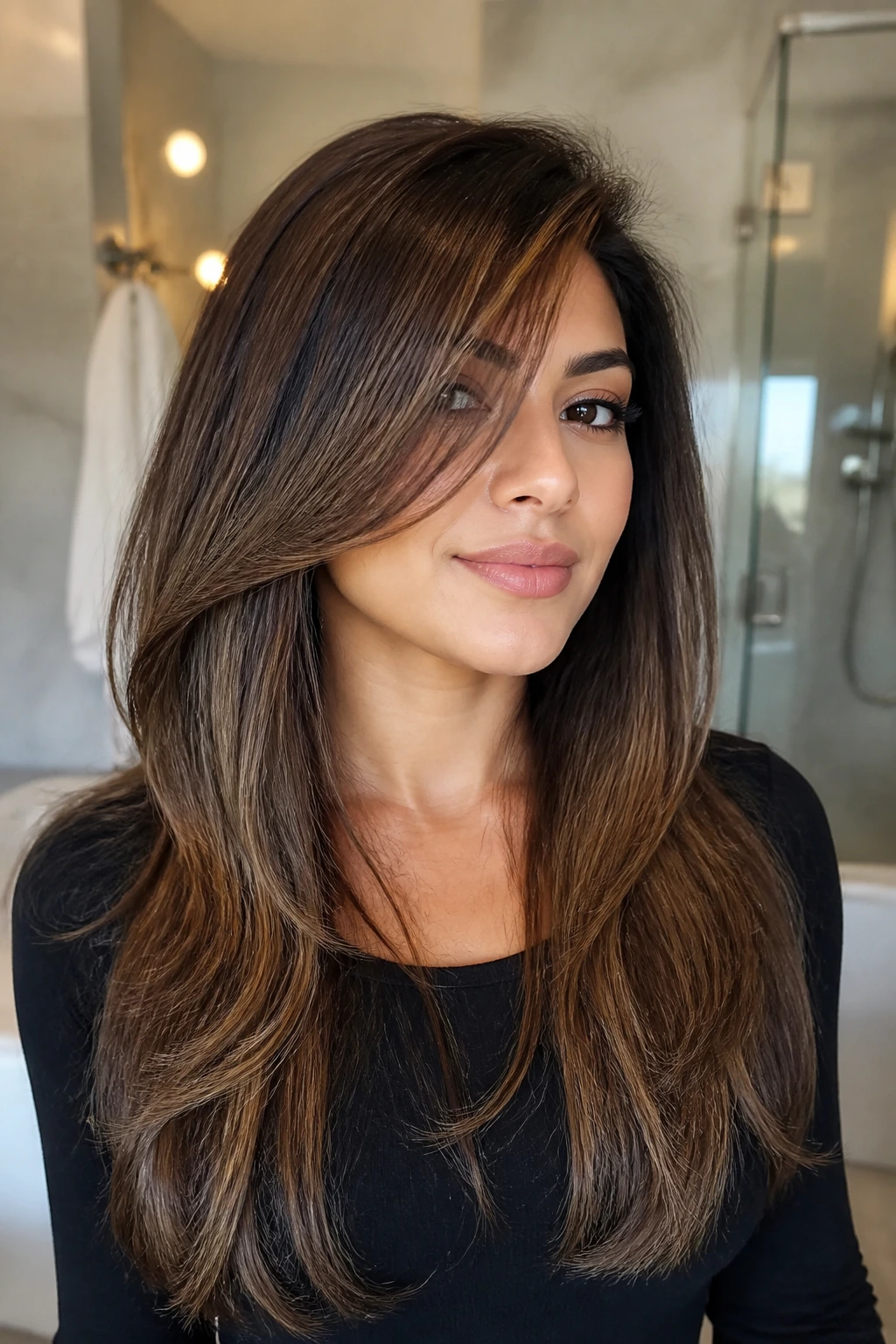
This is the haircut for people who want thick hair to lie down, not float away from the head. The outside line stays clean, but the inside has carefully placed weight removal so the cut doesn’t feel heavy when you wear it straight. It’s subtle. That’s the point.
The side-swept bangs here should be long, smooth, and connected to the rest of the front. I prefer this shape on hair that already likes to go sleek with a blow-dryer or flat iron. If your texture is wild and dry, this can still work, but it needs a smoother finish or the internal layers will show through in a messy way.
What makes the cut special is that you get less bulk without sacrificing the full perimeter. Too many thick-haired cuts get thinned to the point where the ends look feathery and tired. This one keeps the bottom line intact.
5. Wavy Ribbon Layers
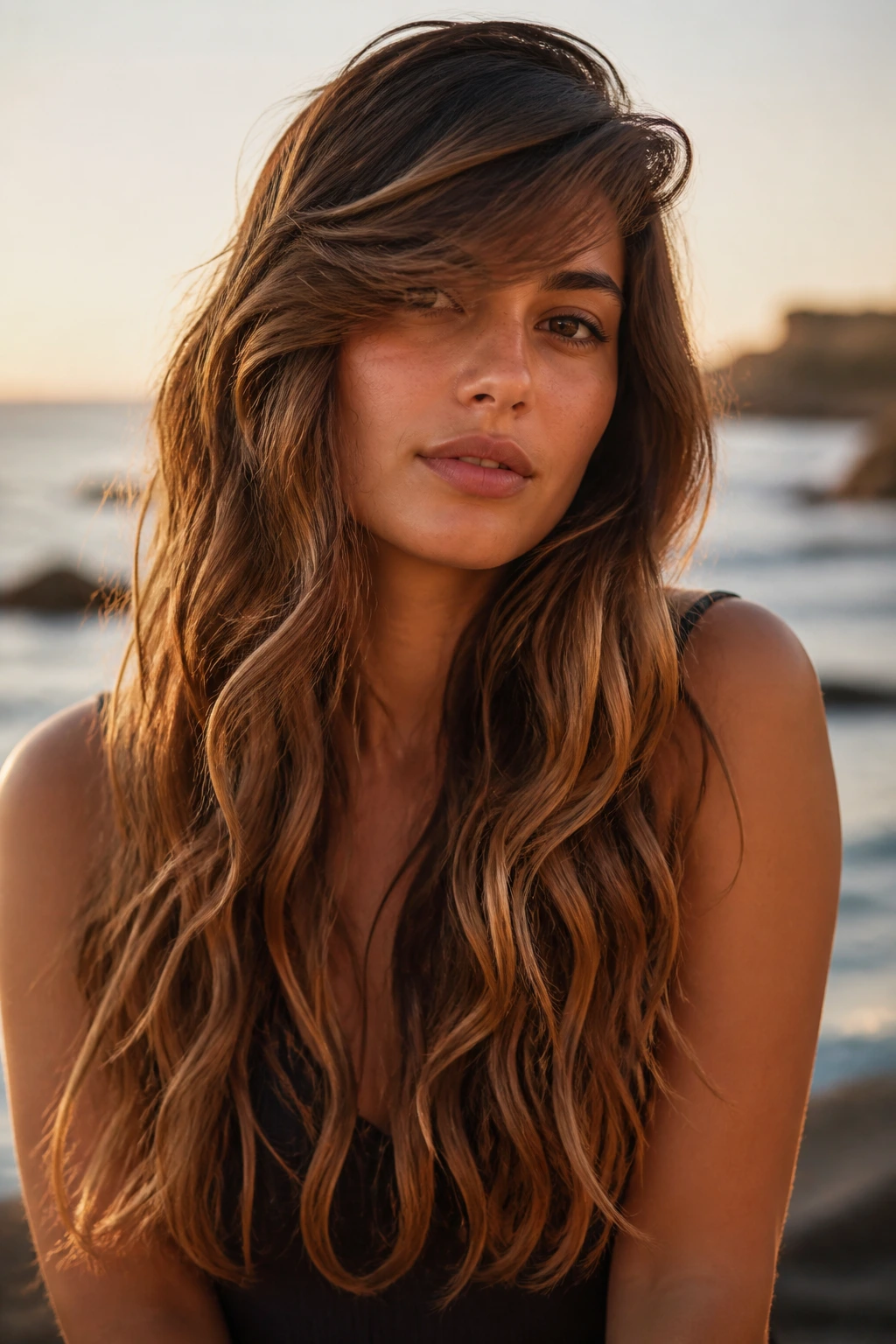
Thick wavy hair can look like a crown of fuzz when the layers are too short. Ribbon layers solve that by staying long and elongated, so each wave falls in a wide bend instead of bunching into a puff. The side-swept fringe should follow the same logic: long enough to curve, soft enough to blend, and never chopped into tiny pieces.
I like this version when the hair has its own memory. You know the type. The kind that forms a wave without asking permission. Those textures do not need a lot of shaping at the ends; they need room. Give them that, and the layers fall in these loose ribbons that move when you turn your head.
A little salt spray at the mid-lengths helps, but don’t drown the fringe in product. Thick hair already has enough structure. You’re just encouraging the bend, not rebuilding the whole thing.
6. Razor-Soft Straight Layers
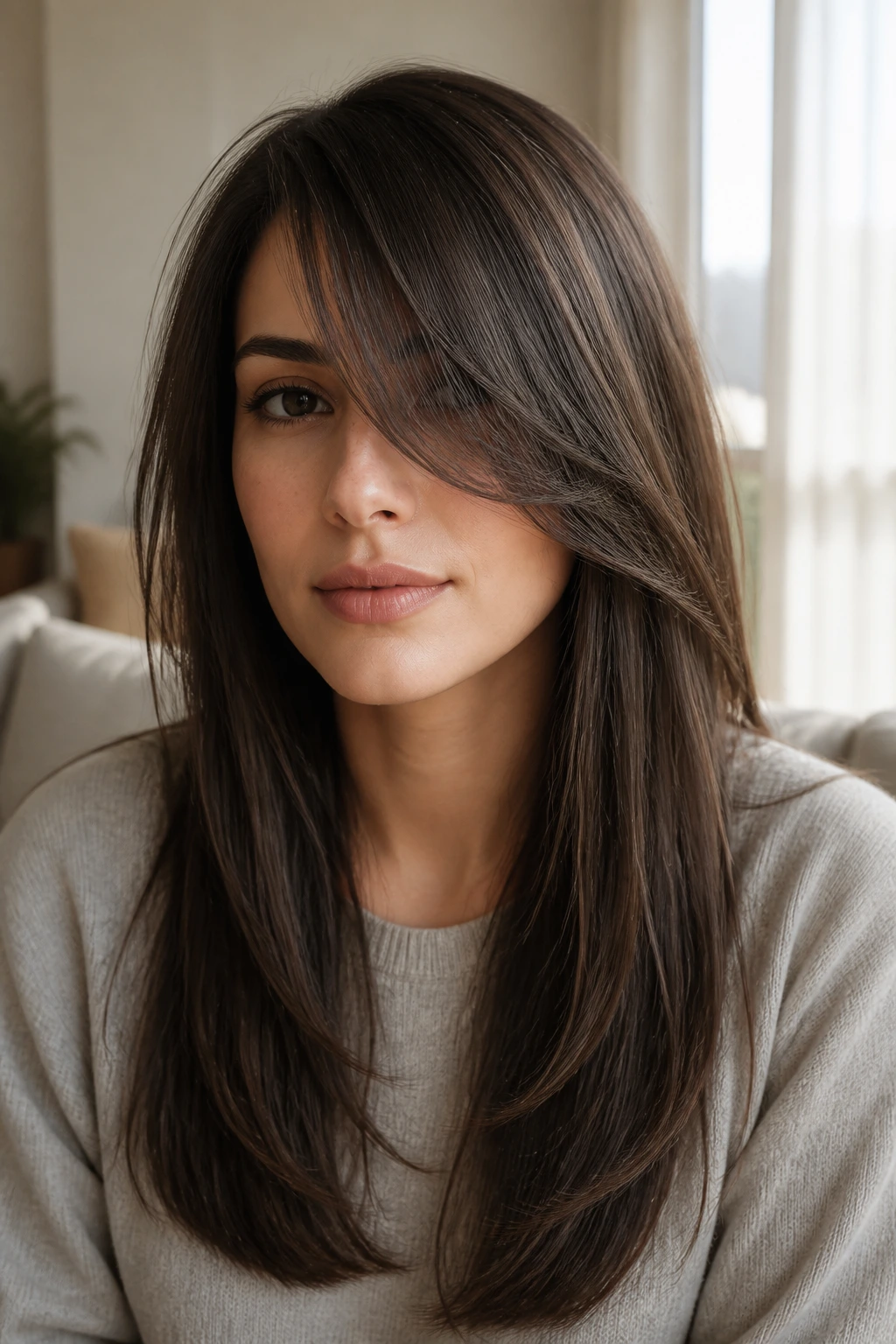
Unlike choppy shag layers, this cut keeps a cleaner silhouette while softening the edges enough that thick straight hair doesn’t feel like a sheet. A razor or slide-cut finish can take the stiffness off the perimeter, especially if your hair grows out in one heavy block. The result is smoother movement with less obvious layering.
The side-swept bang should stay long and slightly tapered, not sliced into a harsh diagonal. On straight hair, a hard fringe line can look too severe against a dense length. The soft taper lets the front fall into the rest of the haircut instead of sitting on top of it.
Best for people who like a polished finish and hate a lot of visible separation in the layers. If your ends already frizz or split easily, though, ask your stylist to go easy with the razor. Too much can make the bottom look dry.
7. Collarbone Sweep
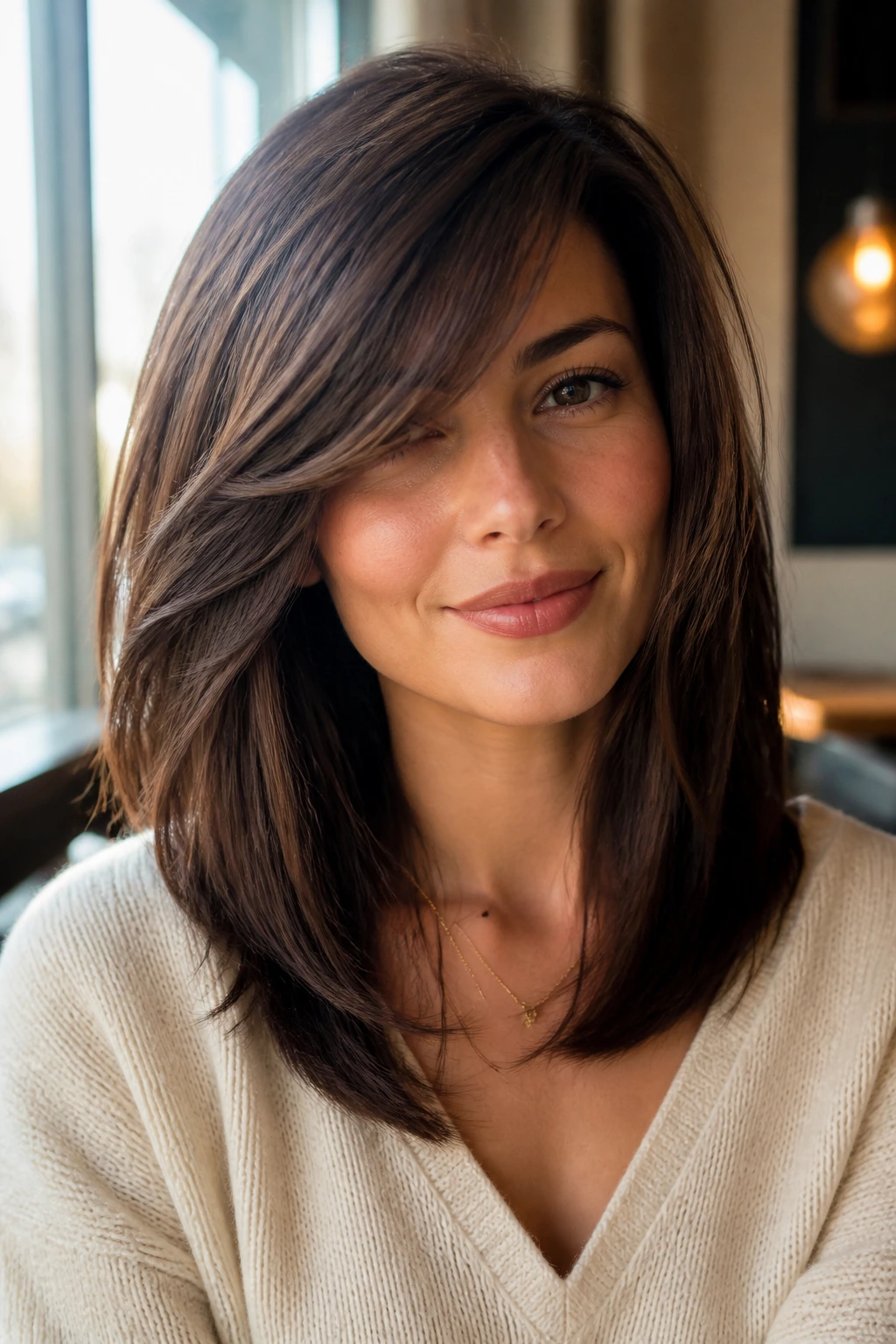
A collarbone-length front frame gives thick hair room to move without dragging the face downward. The shortest pieces start around the collarbone and then drift into longer lengths, which keeps the cut from feeling chopped up. Side-swept bangs tie the front together, especially if your part is a little off-center.
What makes it feel lighter
The magic is in the angle. The front pieces are long enough to make a diagonal line across the face, which visually reduces bulk near the jaw without making the hair look short. Thick hair benefits from that diagonal because it creates motion even when the rest of the style is straight.
- Wear it with a loose blowout if you want the layers to show.
- Let the bang fall across the brow rather than forcing it flat.
- Keep the ends blunt enough that the perimeter still has substance.
A collarbone sweep is one of those haircuts that looks better after a little movement. Perfectly still, it can seem simple. In motion, it gets interesting fast.
8. U-Shape Length with a Soft Sweep
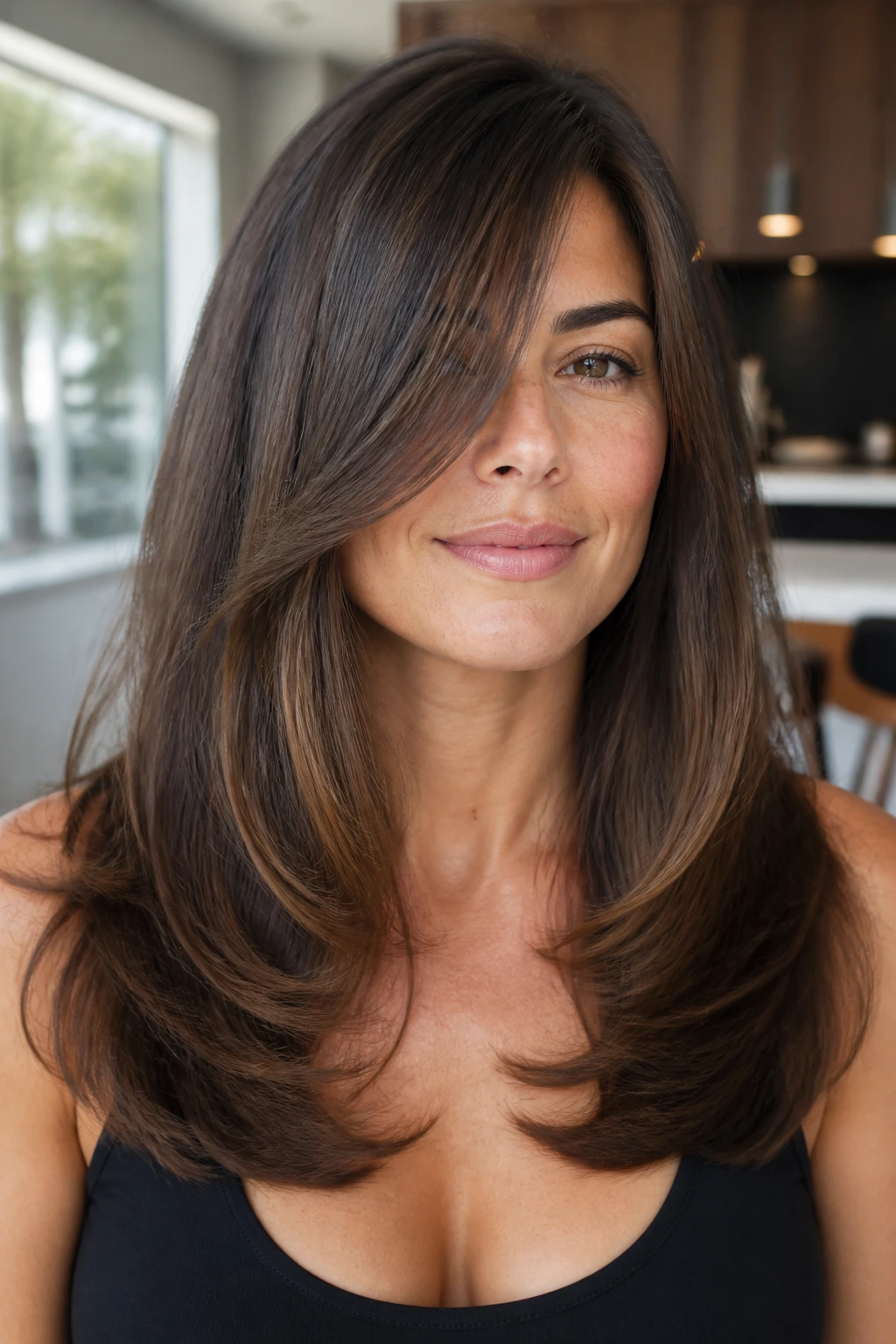
A U-shape preserves fullness at the bottom while taking weight out of the sides, which is a smart trade on thick hair. The curve keeps the haircut from looking boxy from behind, and the longer front pieces help the face frame without turning into a full curtain fringe. It’s tidy but not stiff.
The side-swept bang should begin at the heavier side of the part and travel into the longest front layers. That keeps the eye moving downward instead of outward. On dense hair, that little bit of direction matters more than people think. It stops the silhouette from spreading into a rectangle.
This is one of my favorites for people who want their hair to still look “thick” in the good sense. The ends have enough presence to feel lush, but the shape isn’t heavy or dated. That balance is hard to get, and easy to miss if the layers are cut too high.
9. Blowout Layers with Root Lift
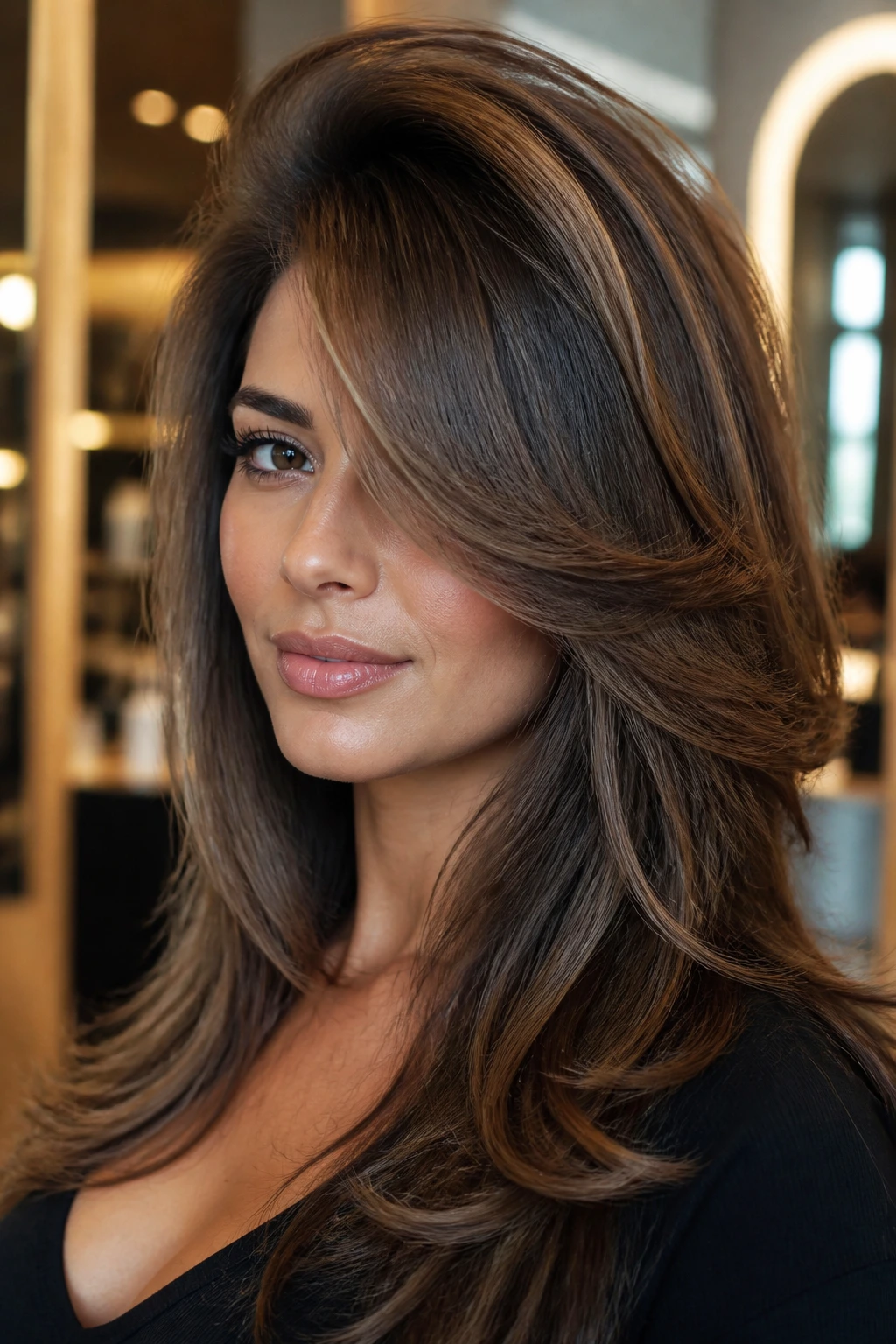
Do you like the look of a round-brush blowout, even if you only do it twice a week? Then this is the cut. Long layers are arranged so the roots can lift and the ends can curve, giving thick hair that big-salon shape without requiring a lot of teasing or product.
The side-swept fringe should be cut with a gentle arch so it follows the brush naturally. If it’s too short, it will kick up. If it’s too heavy, it collapses into the eye. The sweet spot is usually somewhere between eyebrow and cheekbone length, depending on your forehead and part.
A little setting spray at the roots and a 1.25-inch round brush do most of the work here. I would not use a tiny barrel. It makes thick hair look over-styled in the worst way, like the curl pattern is trying too hard.
10. Shag-Lite with Polished Fringe
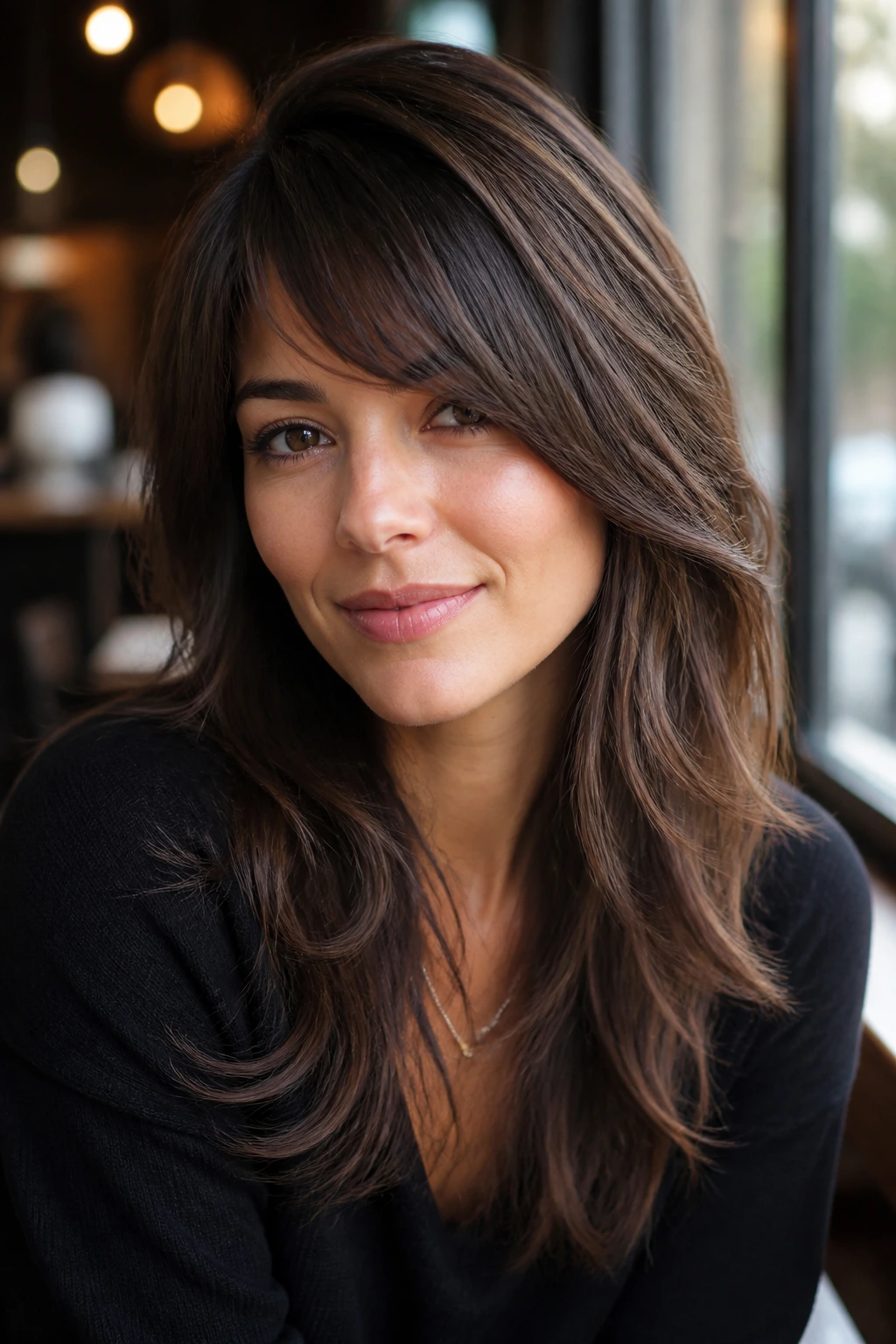
This is for people who like a little edge but don’t want to look like they were dragged through a music festival. The layers are softer and longer than a classic shag, but they still break up the mass of thick hair enough to create movement. The fringe is side-swept and polished, which keeps the whole thing from tipping into messy territory.
The best version starts with slightly shorter crown layers and longer lengths through the sides and back. That creates lift where thick hair usually lies flat and reduces bulk where it usually blows out. The fringe can be brushed over with a bit of cream or spray wax so it stays controlled.
I like this cut on hair that naturally has some bend. It’s less useful if your hair is pin-straight and resistant, because then the pieces can sit apart in a way that feels unfinished. But on the right texture, it has real personality.
11. Curtain-to-Side Hybrid
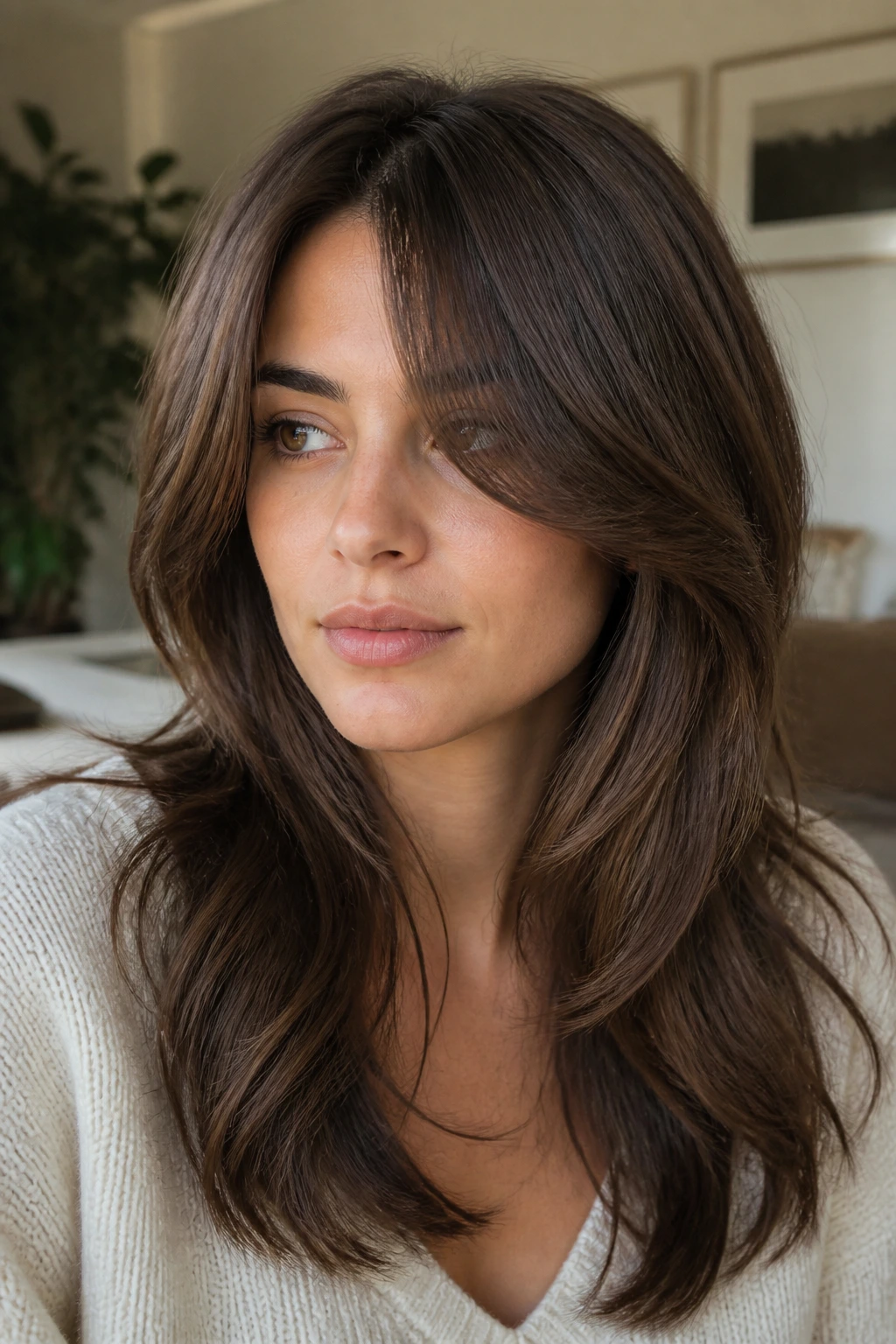
This is the cut for someone who wants to flirt with curtain bangs without fully committing to the center split. The front pieces start near the middle, then angle into a side sweep, which makes the fringe easier to grow out and easier to live with on thick hair. It gives you movement around the face without a heavy bang line.
Why it’s easier than a strict side fringe
A hybrid fringe can change shape with your part. Wear it deeper one day, softer the next, or tuck one side behind the ear when you’re tired of seeing hair on your face. Thick hair benefits from that flexibility because the front doesn’t have to perform the same way every morning.
Ask your stylist for a long, face-framing fringe that is shorter at the center and longer at the sides. The key is softness at the transition point, not a hard step. If the layers are blended well, the grow-out looks deliberate instead of awkward.
12. High-Lift Crown Layers
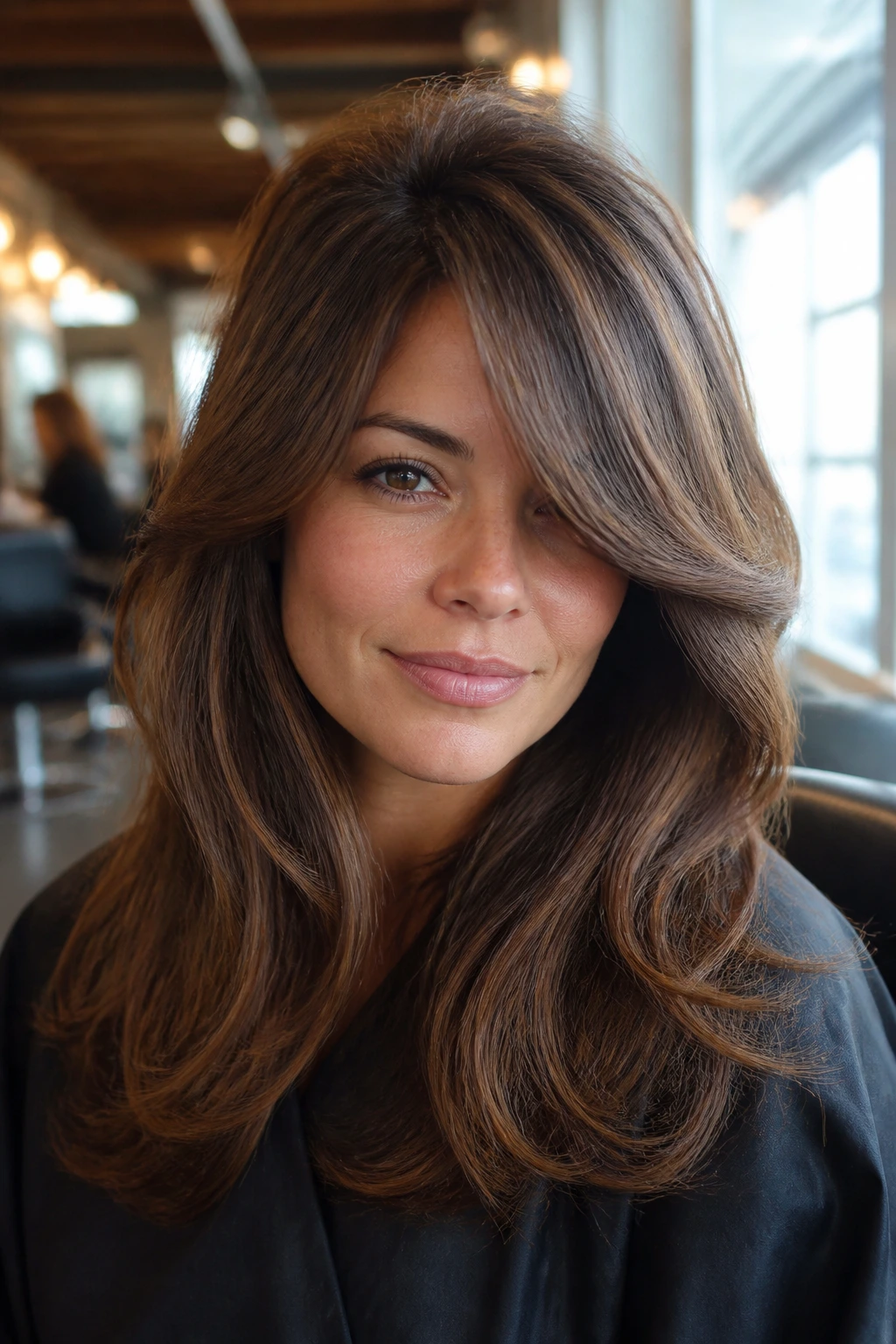
If your thick hair sits flat at the roots and heavy everywhere else, this cut shifts the balance upward. The crown gets more lift, the sides get more breathing room, and the side-swept bangs pull the eye up instead of letting the whole shape drop. It’s a smart move for rounder faces and anyone who likes a fuller top.
Unlike low-layered cuts that keep everything hanging at the same level, this one creates a little more height at the top without turning the ends stringy. The front should still stay long. That keeps the bangs from looking like a separate crop cut into the haircut.
A root-boost spray and blow-dry with the nozzle pointed down the hair shaft help a lot here. Skip the heavy oils at the crown. Thick hair does not need help looking flat.
13. Invisible Debulked Length
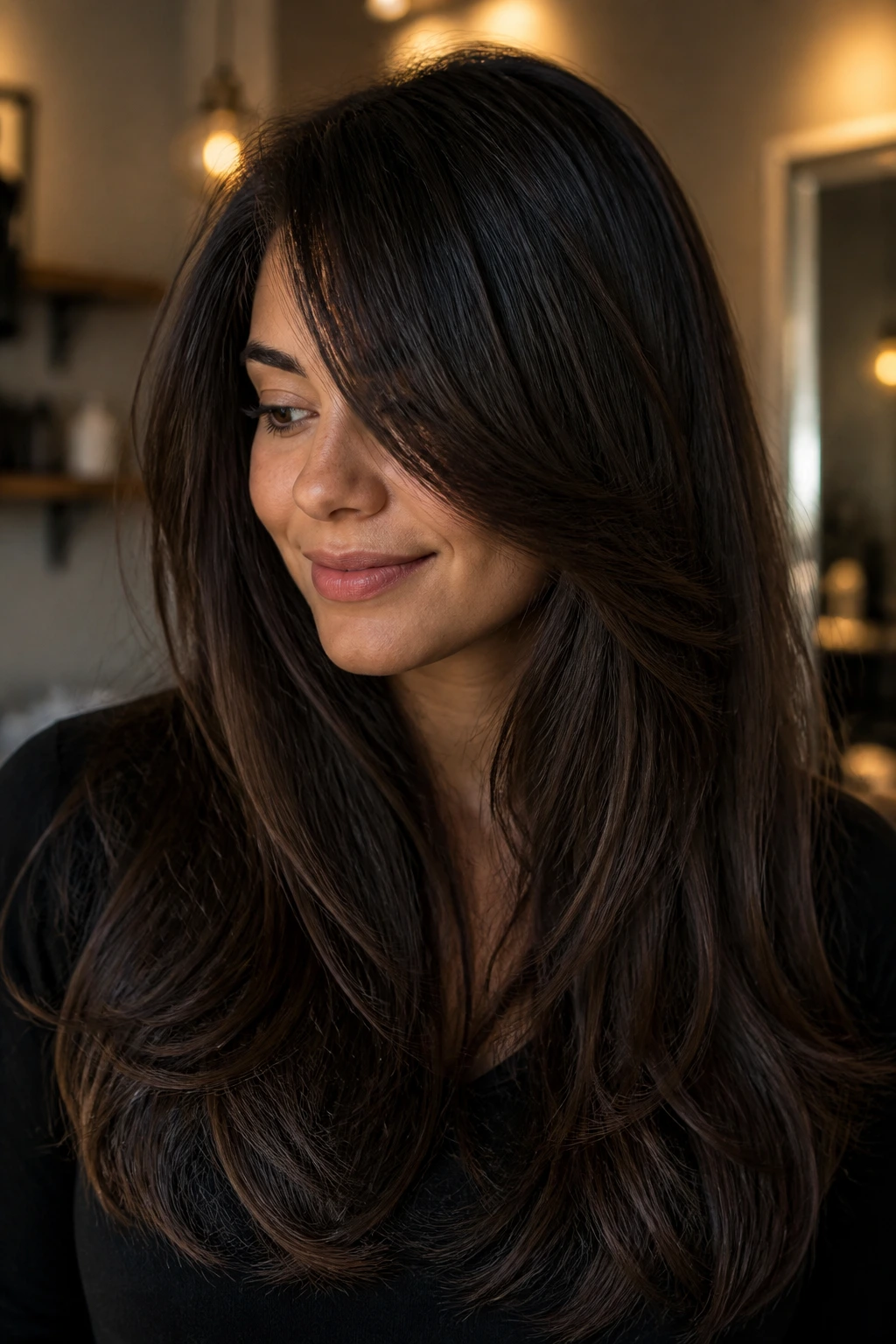
This cut is pure sleight of hand. From the outside it looks long and mostly one-length, but inside the haircut there are weight-removing sections that take pressure off the mid-lengths and ends. On thick hair, that hidden work is what lets the hair fall instead of flaring out.
The side-swept fringe should stay long and connected to the rest of the front so the haircut doesn’t look like it has a separate bang area. I prefer this shape on people who like to wear their hair down a lot and don’t want the layers to announce themselves. It’s quiet, but not boring.
If your hair is very dense at the nape, ask for the internal removal to happen there rather than at the crown. That keeps the top from looking airy while the bottom stays manageable. The wrong kind of thinning can make thick hair look fragile. This cut avoids that.
14. Glassy Straight Sweep
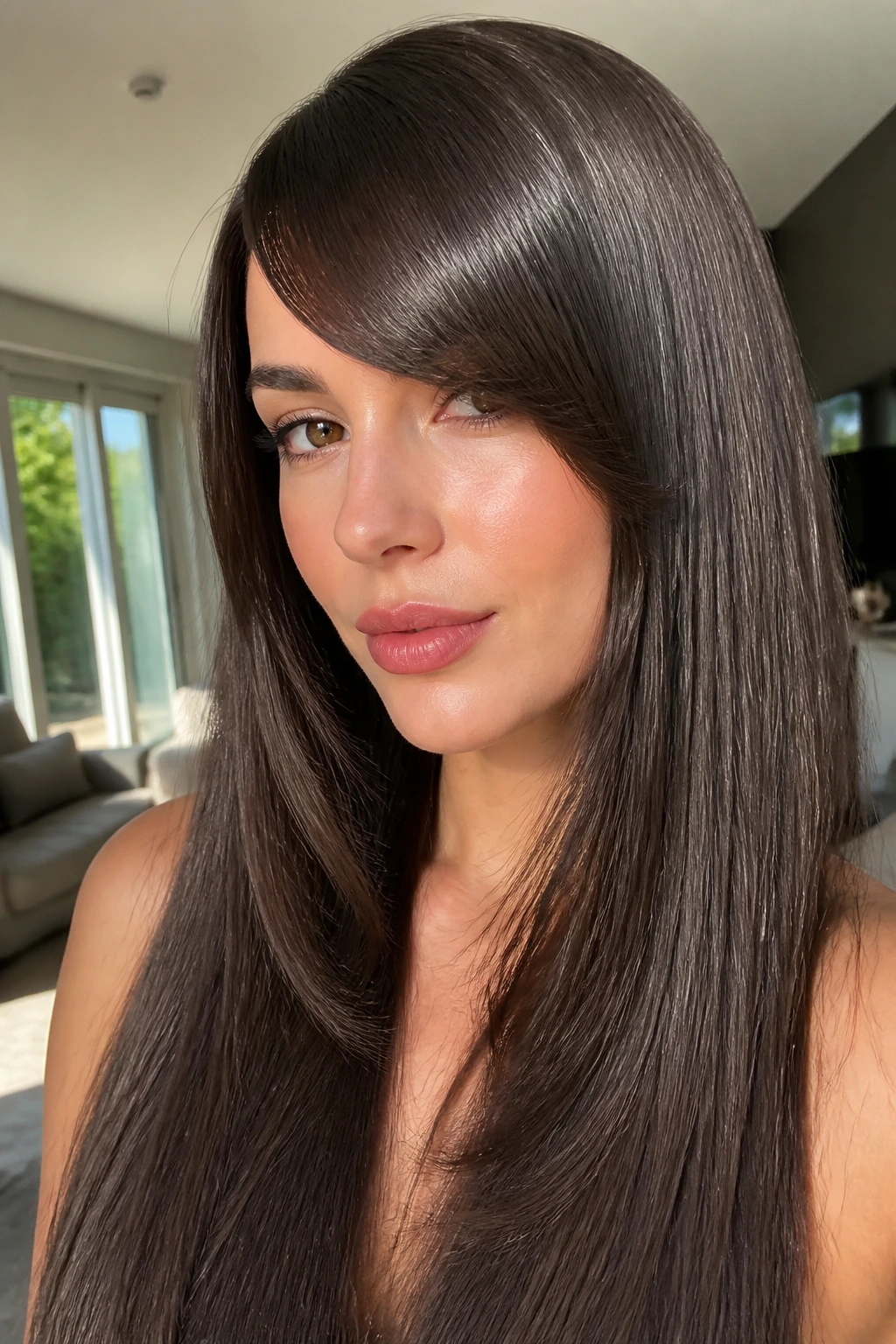
A glassy finish on thick hair is a mood, and a demanding one. The layers are long, the fringe is sleek, and the whole shape depends on a clean blow-dry or flat-iron pass that leaves the cut reflective rather than bulky. The side-swept bang should slide across the forehead in one smooth curve.
This works best when the layers are cut conservatively. Too much separation in a straight, glossy style can create random shelf lines, which defeat the point. You want the movement to come from the bend, not from choppy sections.
I’d reach for a heat protectant and a paddle brush for the lengths, then a small round brush just for the fringe. The trick is keeping the rest of the hair smooth enough that the bang has room to stand out. If everything is competing, nothing wins.
15. Tousled Beach-Length Layers
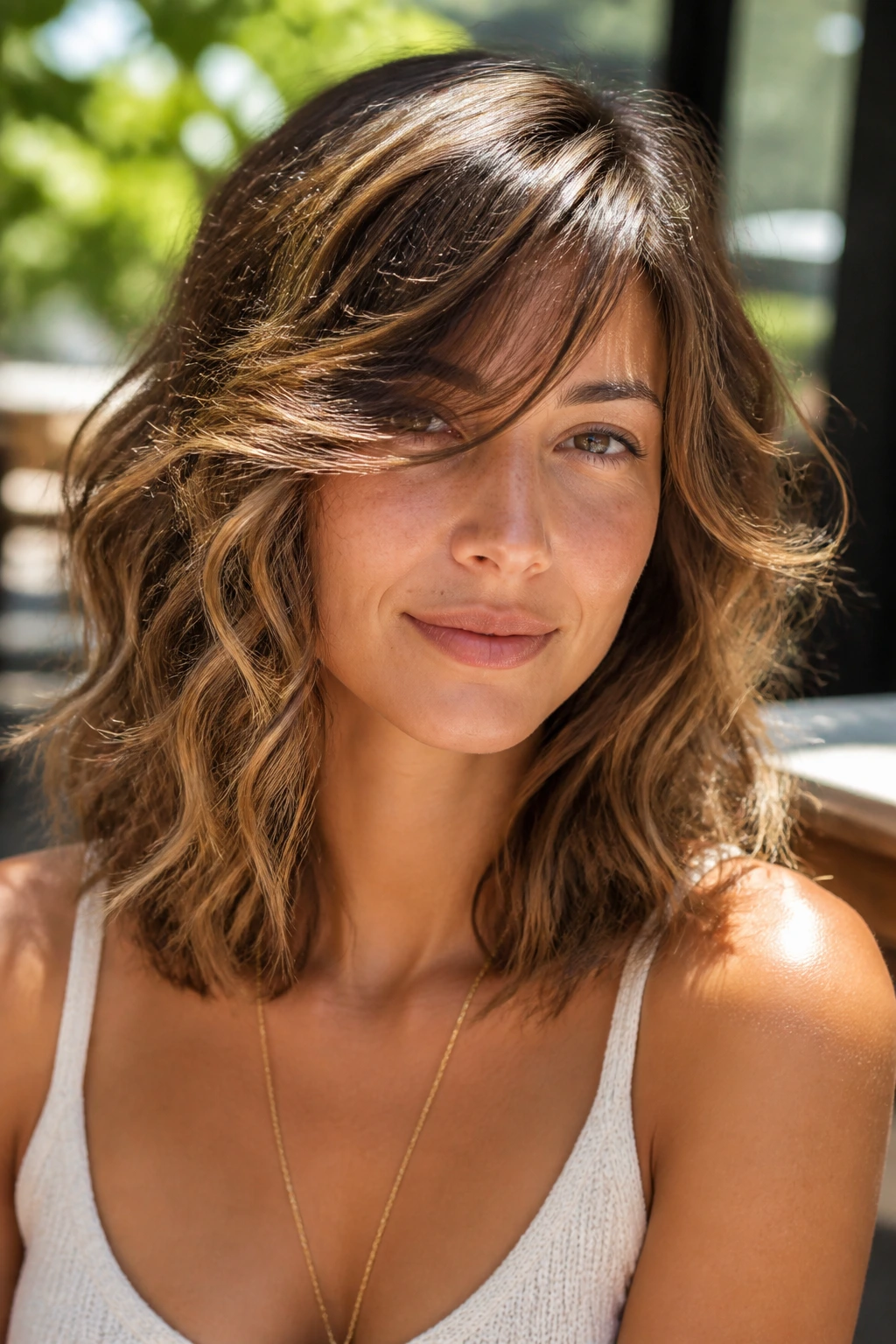
Can thick hair look airy without losing its body? Yes, if the layers are long and the wave pattern is wide. This beach-length version keeps the ends full while breaking the mass into soft bends, so the hair moves instead of sitting like a curtain. The side-swept fringe should be piecey, not curly.
A 1.25- to 1.5-inch iron or wand works better here than a small barrel. Wrap the hair loosely and leave the last inch or two out so the ends don’t look ringleted. Thick hair needs a broad bend, not tiny spirals. Tiny spirals make the hair look even denser.
This is a nice option if you want hair that feels relaxed but still shaped. A few sprays of texture spray and a finger-comb are usually enough. Overbrushing kills the separation and makes the layers collapse into one mass.
16. Face-Frame First Layers for Heart Shapes
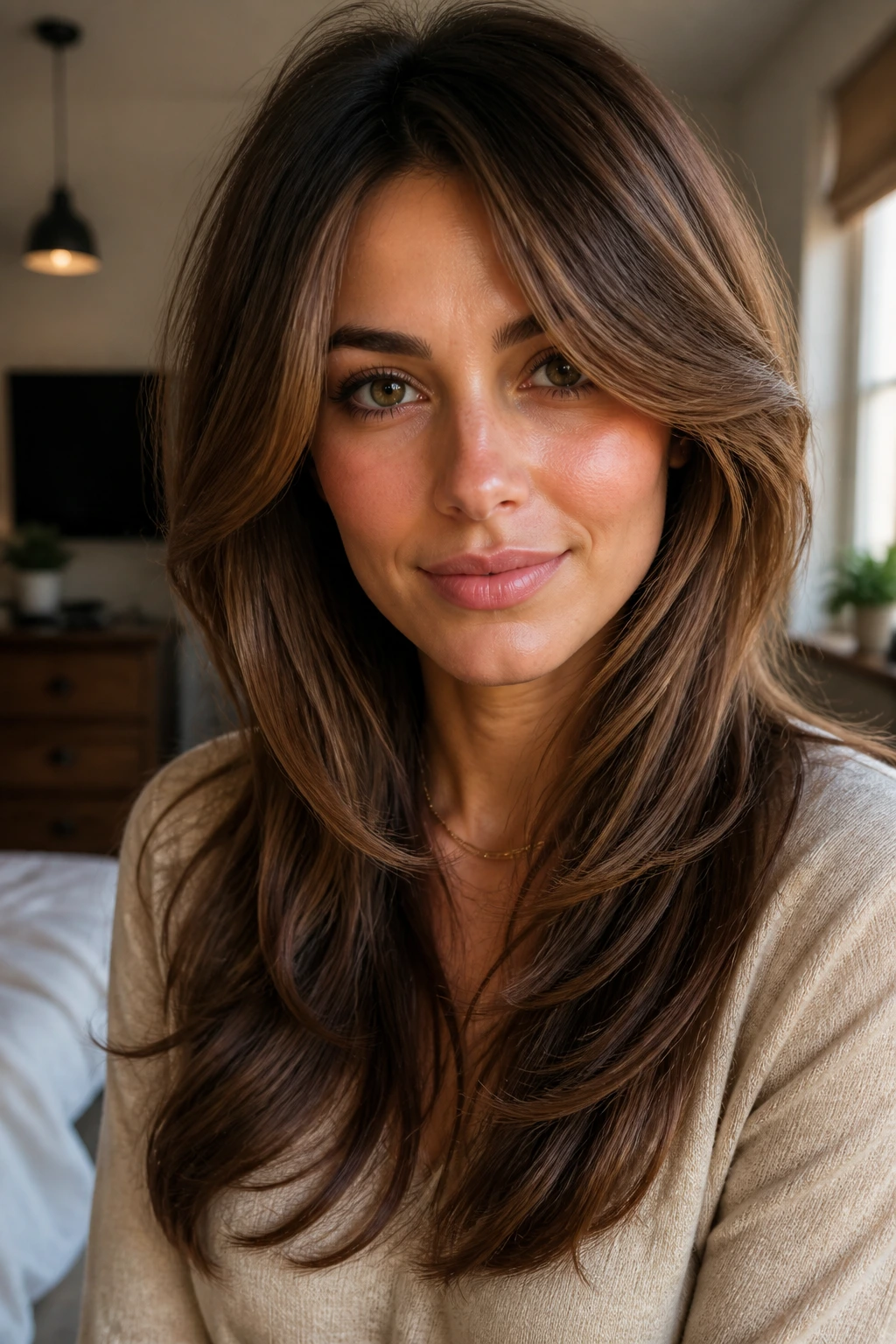
Heart-shaped faces often need the front softened just a bit more than the rest of the cut. This version starts the face-framing layers at the cheekbone or below, then lets the side-swept bangs travel down toward the jawline. The effect is gentle, especially on thick hair that likes to pile up near the temples.
The goal isn’t to hide the face. It’s to balance it. Thick hair can make a narrow chin look even narrower if the layers are too short around the top half of the face. Longer front pieces avoid that problem and keep the silhouette from feeling top-heavy.
A little bend toward the jaw helps the cut settle into place. If your layers stop above the chin, they can bounce up and make the top half feel crowded. Length fixes that. Sometimes the answer is just more hair, not less.
17. Soft V-Cut with Traveling Fringe
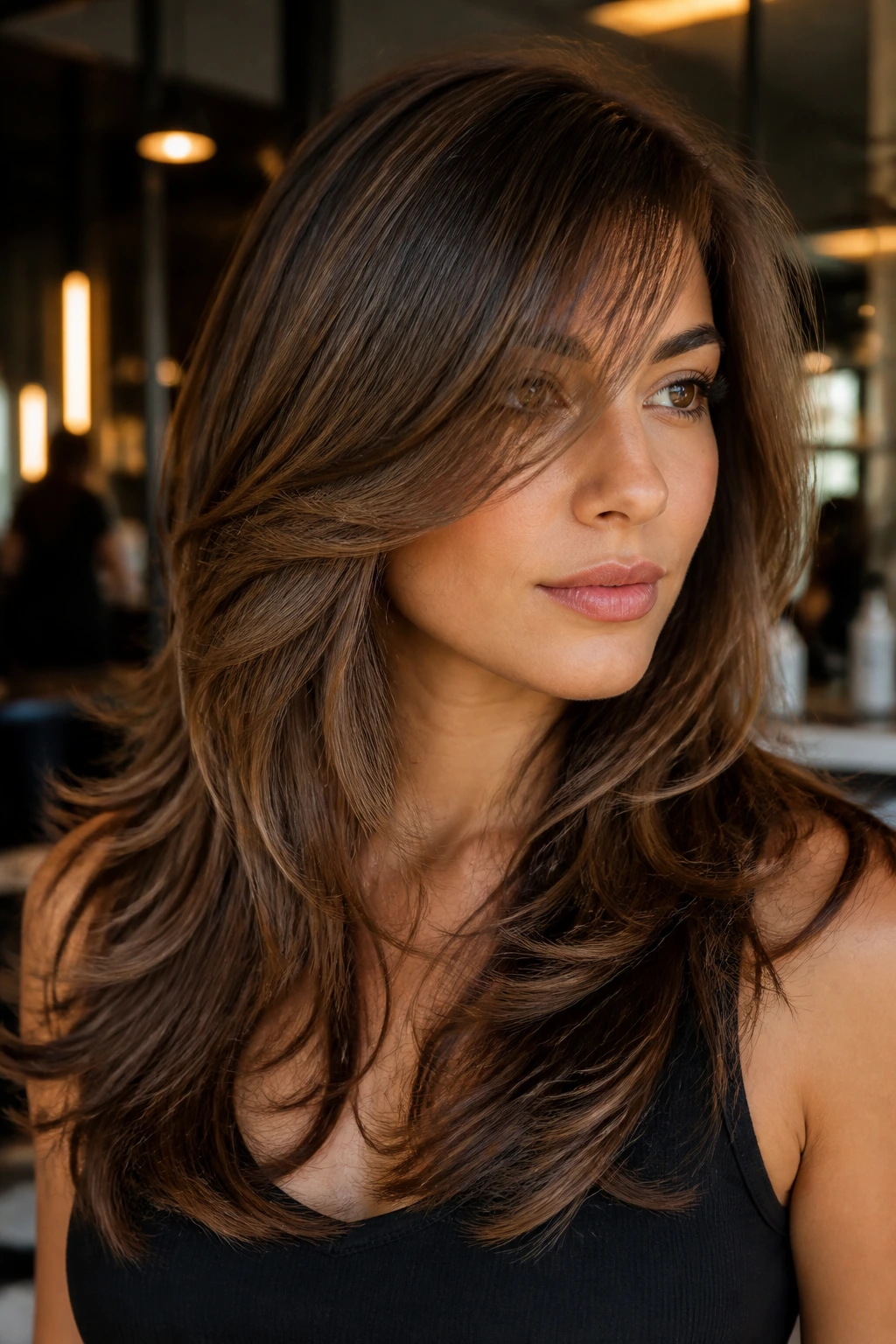
The V-cut gives thick hair a tapered back shape that looks full without being wide. The length at the center back drops a little lower than the sides, so the haircut narrows as it goes down instead of staying blunt across the bottom. A traveling side fringe ties the whole thing together.
I like this on hair that has a lot of density through the ends. The V-shape keeps the bottom from feeling like a shelf, and the fringe pulls attention diagonally across the face. Diagonal movement is your friend here. It stops the eye from reading only bulk.
Who should consider it
People with long thick hair that feels heavy on the back often like this shape because it makes ponytails and half-up styles sit better. It also works well if you wear your hair mostly down and want something that looks a little more styled than a plain U-cut.
18. Office-Ready Low Sweep Layers
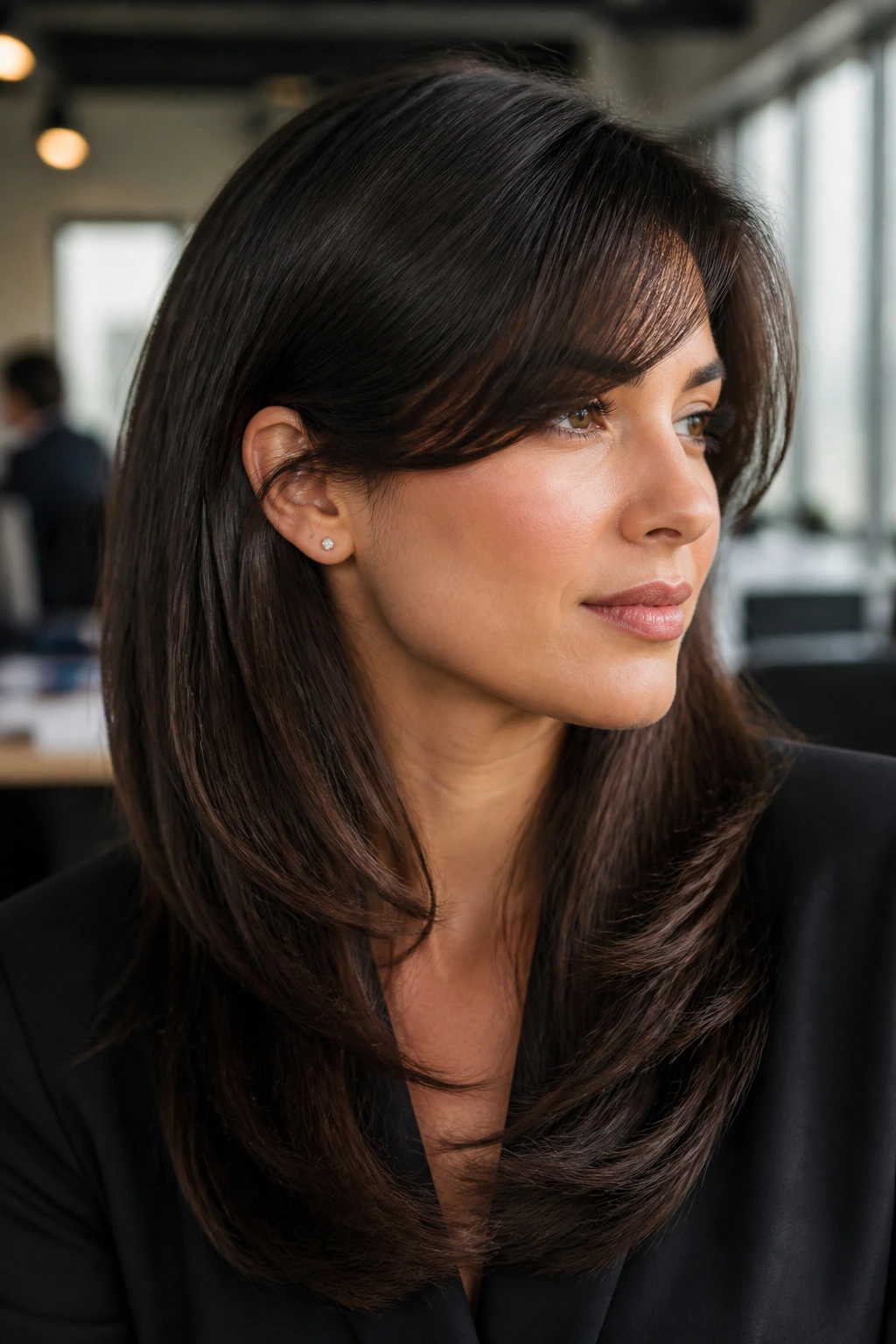
This one is quieter than the shaggier options and cleaner than the big blowout looks. The layers sit low, the ends stay polished, and the side-swept bangs are long enough to tuck behind the ear or clip back on a hectic morning. Thick hair behaves better when the haircut doesn’t ask for too much drama.
The front should curve softly from the side part into the longest layers, with no sharp step where the bang ends and the rest begins. That smooth transition is what makes the cut look refined instead of fussy. It also means the hair stays presentable after a long day, which is more useful than people admit.
If you live in a ponytail or low clip, this is a practical place to land. You still get face framing when the hair is down, but the cut does not fight you when it’s pinned back. That matters more than a glamorous photo.
19. Airy Razor Wavy Layers
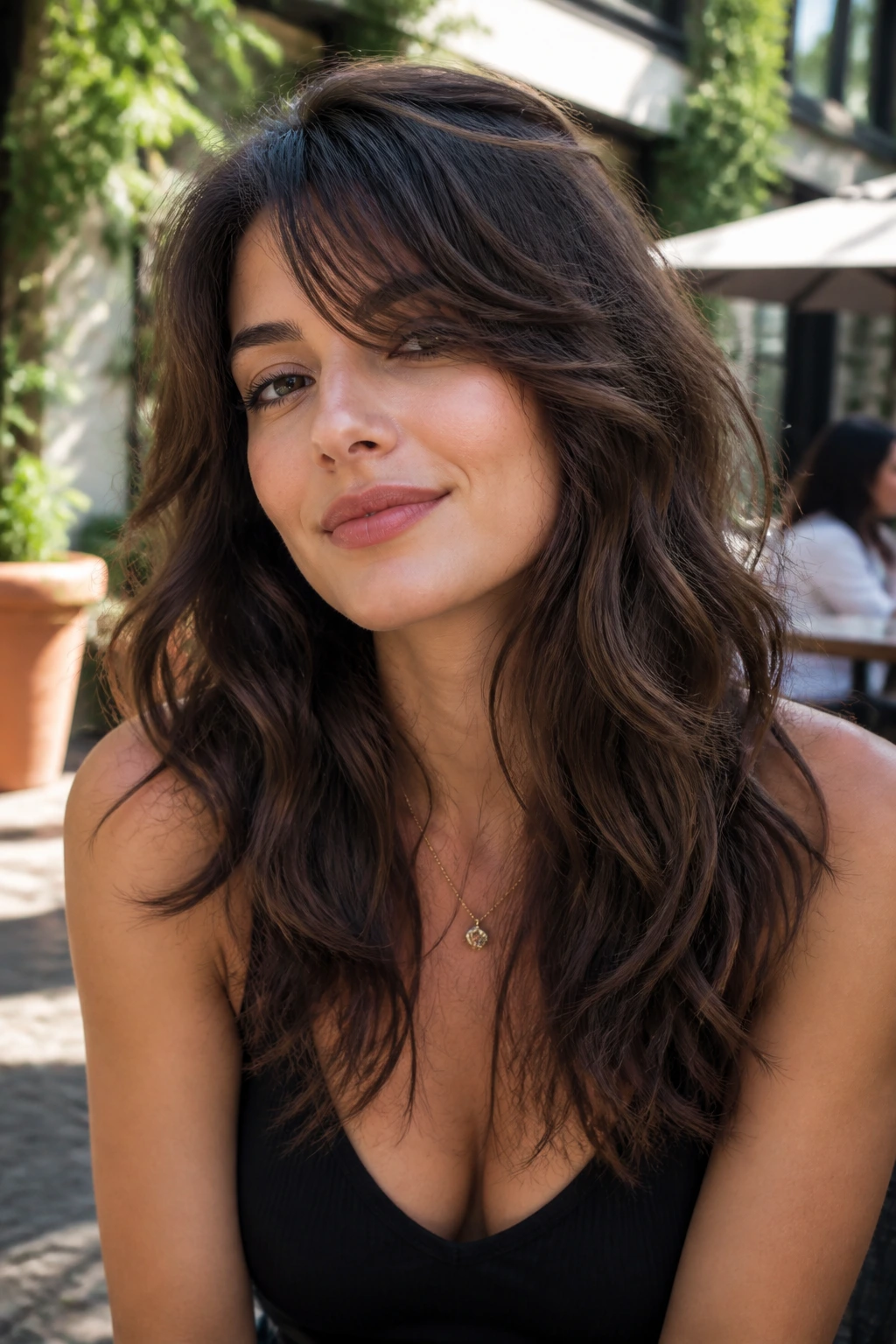
Razor layers can be tricky on thick hair, but on the right wavy texture they create a lighter feel that scissors alone can’t always match. The razor softens the edge of the layers, which helps the wave pattern fall in pieces instead of in one massive sheet. The side-swept bang should follow that same soft, airy line.
What to watch for
If your hair is dry, coarse, or already frizzy, a razor can exaggerate that texture. On healthier wavy hair, though, it can make the ends look more alive and less boxy. The trick is restraint and good conditioning. Not a giant pile of product.
This cut is especially nice if you like a lived-in look that doesn’t need to be perfect. Air-dry with a cream, scrunch once, and let the layers settle. Thick hair usually needs less coaxing than people think.
20. Money Piece Sweep
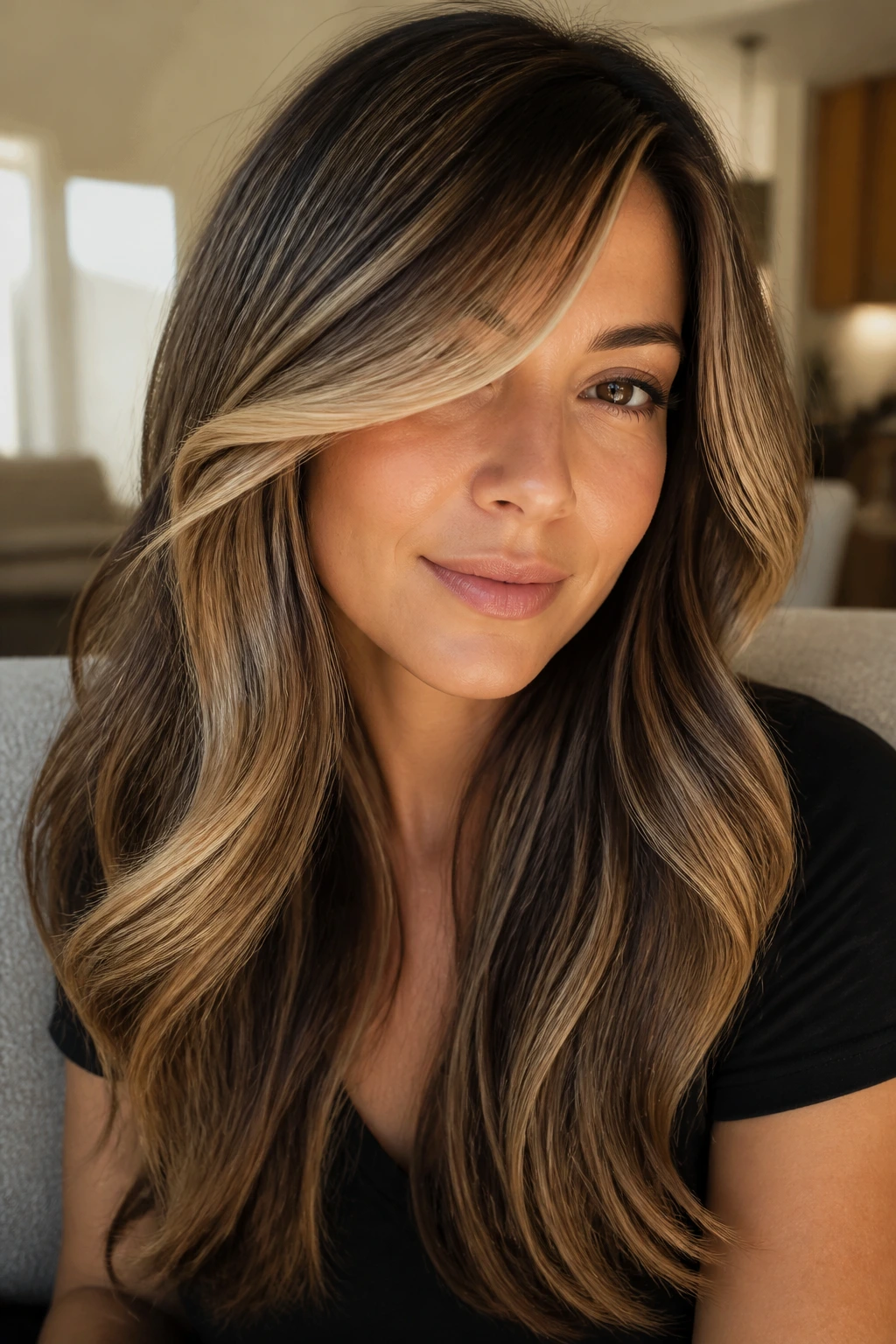
A lighter face frame can make side-swept bangs read more clearly, especially on dark or very dense hair. That “money piece” area around the fringe and first layers pulls the eye toward the movement, which is useful when the rest of the hair is heavy and full. It doesn’t have to be blonde. It just needs to be a touch brighter or lighter than the rest.
The haircut itself should stay long and blended, with the bang sweeping across the forehead into the colored front pieces. I like this on hair that looks great in motion but can feel a little flat in photographs. The contrast gives the cut a focal point.
If you’re not into color, you can still use the same idea with gloss or shine. A smoother, brighter front reads the same way. The point is to give the sweep a little definition.
21. Low-Maintenance Grow-Out Layers
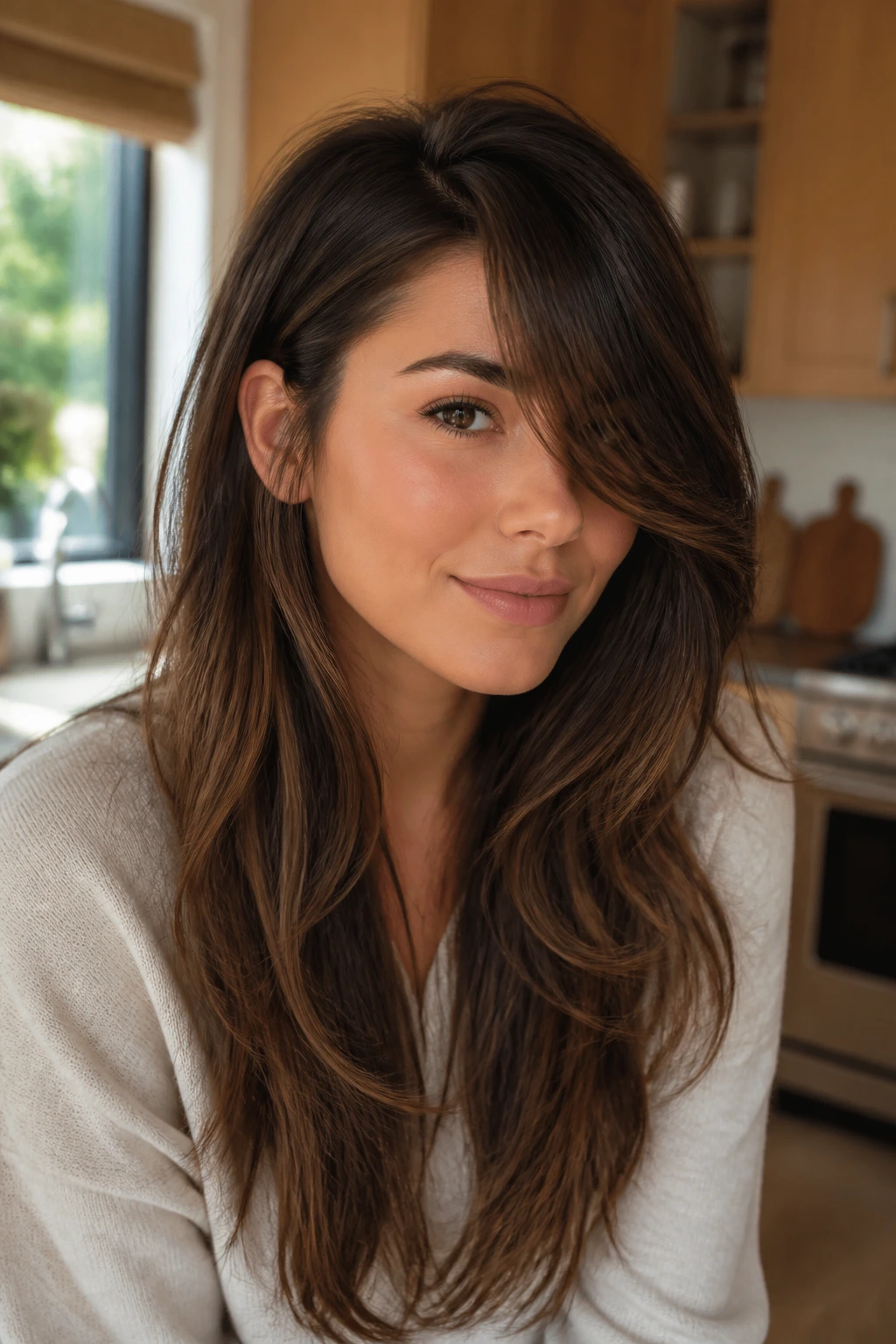
This is the version for people who know they will not book a trim every six weeks and would rather plan honestly. The layers are long, the fringe is kept extra sweeping, and the overall shape is cut so it still looks neat after it’s grown for a while. Thick hair can hold a shape longer than fine hair, which makes this a smart compromise.
The shortest face-framing piece should be long enough to tuck behind the ear from day one. That sounds like too much length to some people, then three weeks later they’re grateful. Thick hair shrinks less in the ends than in the front, but the fringe still springs a little. Better to leave room.
If you are busy, lazy, or just allergic to constant salon visits, this cut respects that. It still looks styled. It just doesn’t demand weekly attention.
22. Event-Ready Glam Sweep
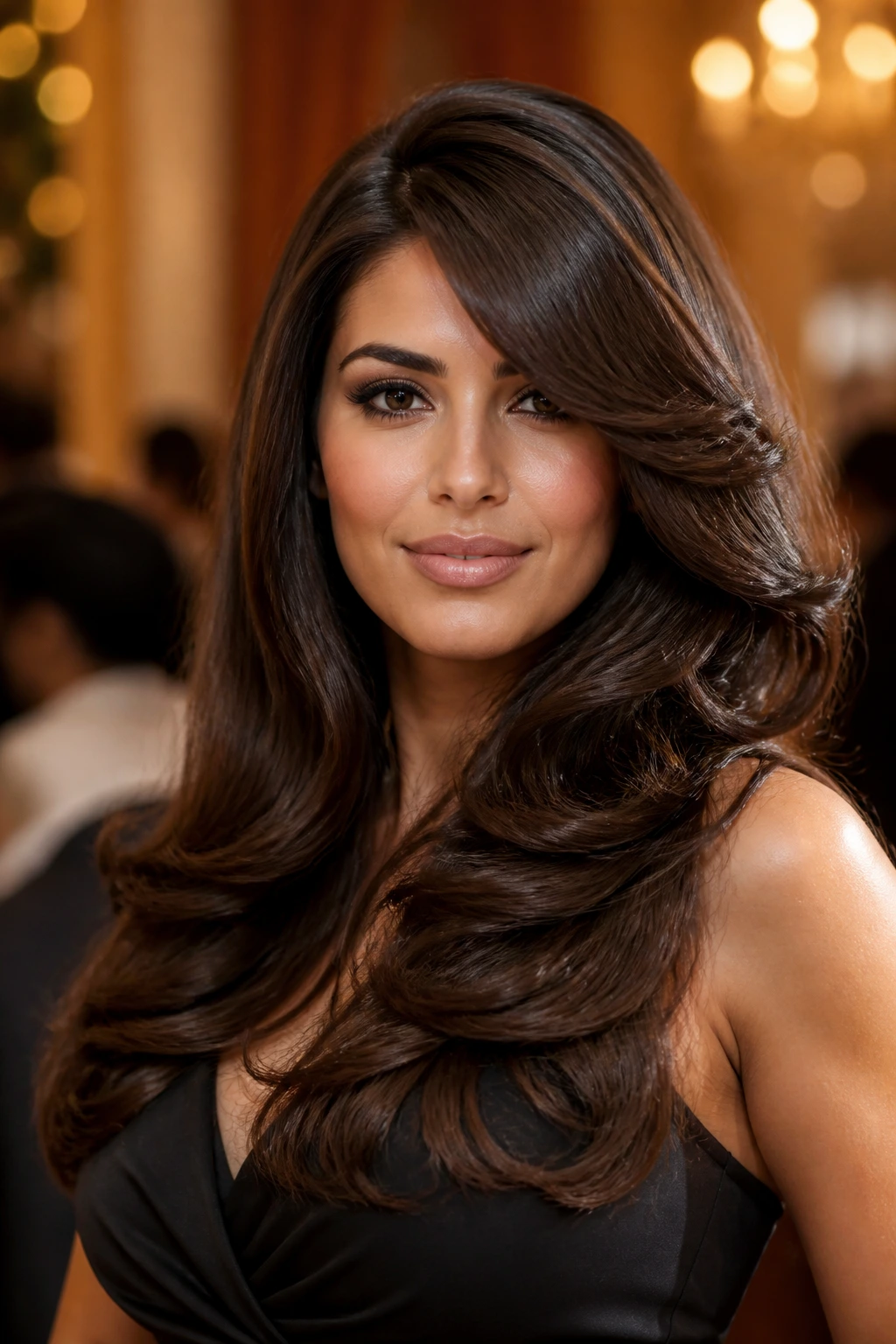
There’s a reason thick hair looks so good in a polished side sweep when it’s done right. The density gives the style weight, so the movement looks lush instead of flimsy. Long layers keep the ends from turning into a triangular mass, and the bang arcs across the face with enough volume to feel deliberate.
This is the version I’d pick for a formal blowout, a party, or any day you want the hair to look like it has been brushed by a professional hand. The front should have a deep part, the layers should have a rounded bend, and the finish should be glossy rather than crunchy. No stiff hairspray helmet. Please.
The whole thing works because thick hair gives the sweep some actual structure. Fine hair often needs teasing to fake that shape. Thick hair just needs the right cut and a clean bend.
What Thick Hair Needs From a Layered Cut
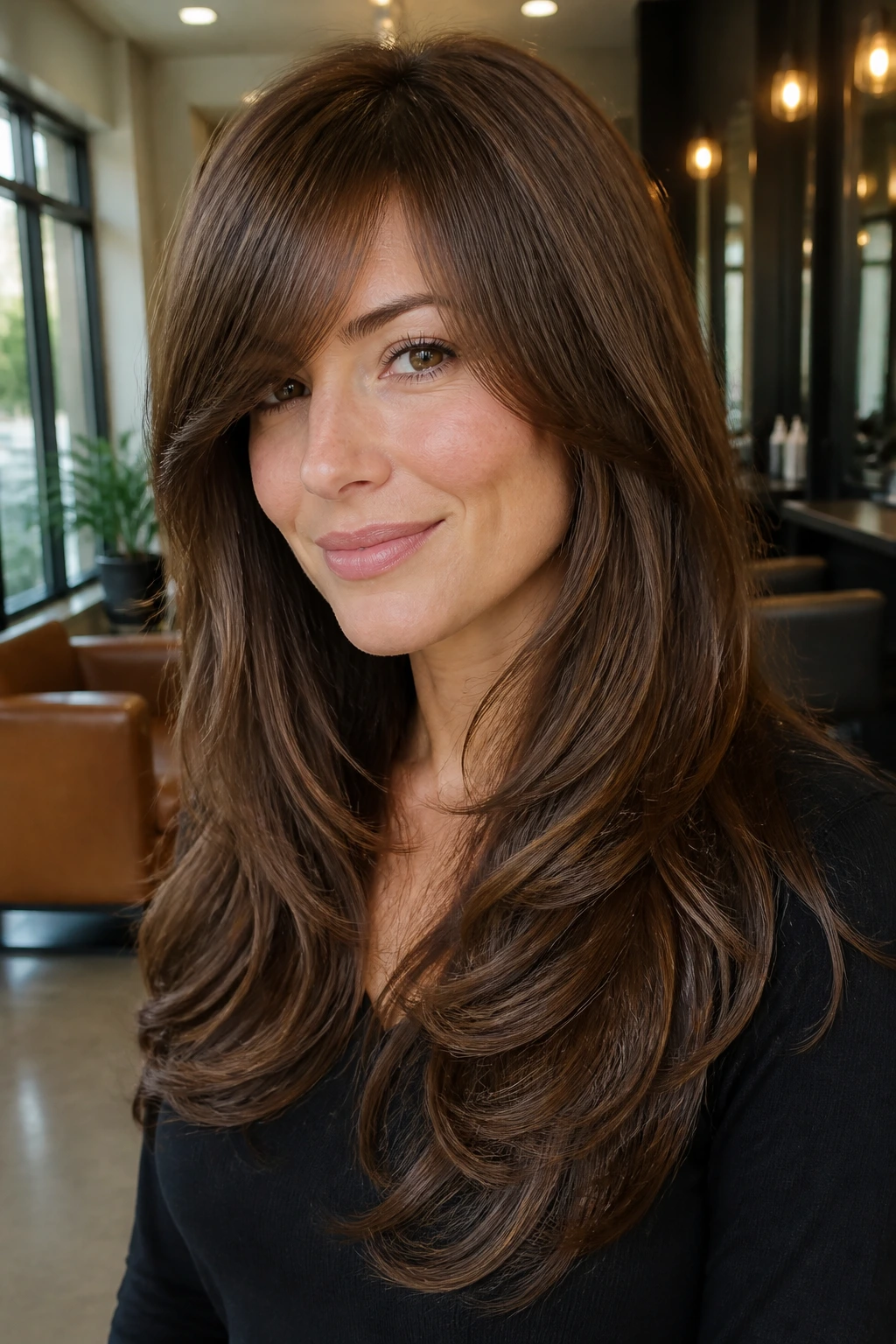
Thick hair does not usually need more layers. It needs better layers. There’s a difference, and it’s a big one. Short layers piled high around the crown can make dense hair spring outward like a triangle, while long layers let the weight drop through the shape so the haircut moves in one direction instead of five.
Side-swept bangs help because they break the front edge of the hair without creating a hard line across the forehead. On thick hair, that hard line can look blunt fast. A diagonal sweep softens the face and gives the cut a place to travel. The hair stops sitting there. It starts falling somewhere useful.
Placement matters more than almost anything else. If the shortest layer begins too high, the style can look airy for two days and mushroom-like by the end of the week. If it begins too low, the hair may still feel heavy, but the shape will at least stay clean. I’d choose clean over over-thinned every time.
A good stylist will also think about where your hair already wants to separate. Cowlicks, a strong part, and temple density can change how the fringe sits by a full inch. Thick hair remembers everything. A cut that ignores that memory usually loses.
Essential Tools for Styling These Looks
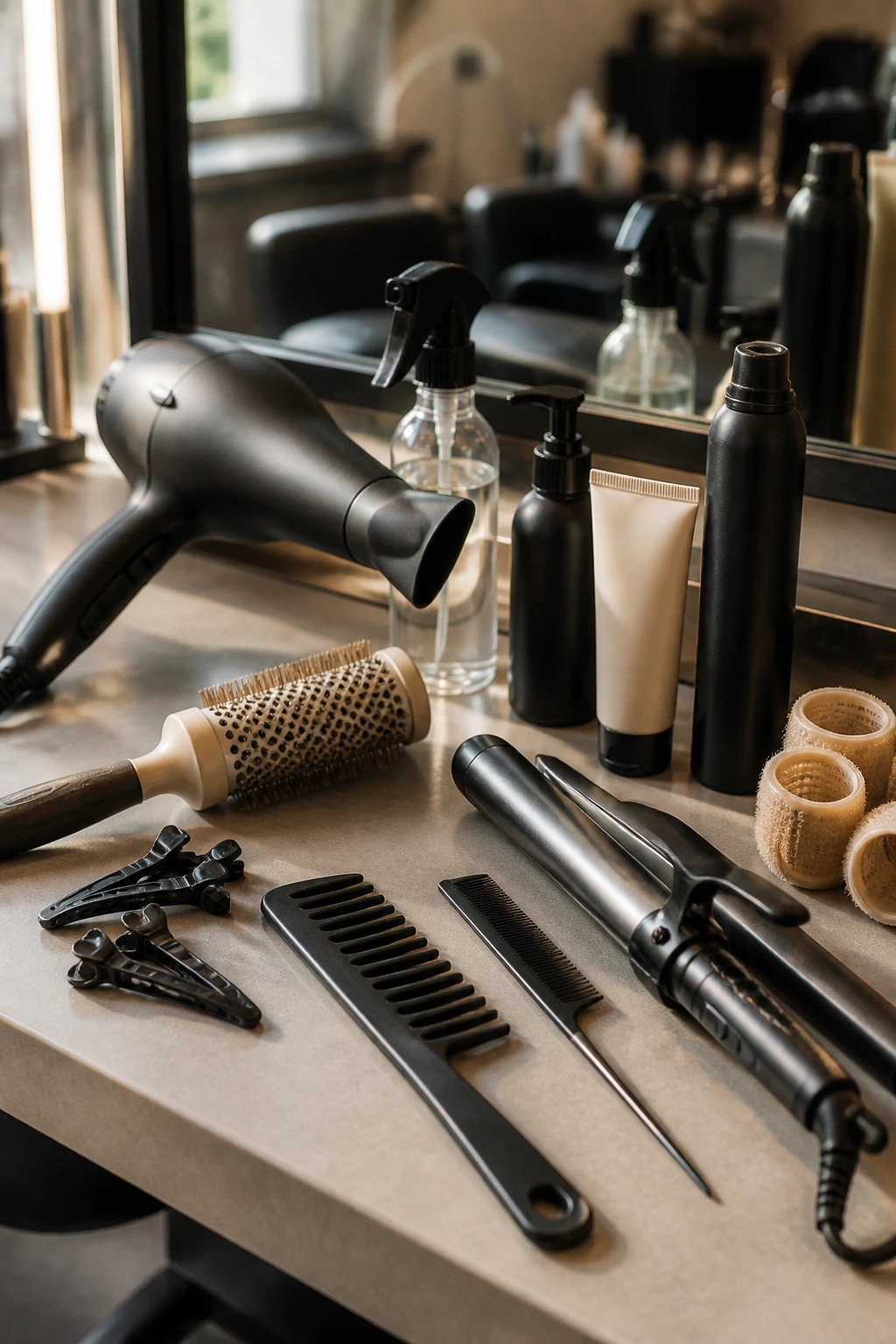
- Blow-dryer with a concentrator nozzle: The nozzle helps direct the airflow down the shaft, which keeps thick hair smoother and makes the side-swept fringe behave.
- 1.25-inch round brush: A medium barrel gives the bangs and layers a bend without turning them into tiny curls.
- Heat protectant spray: Use it before any iron or blow-dry with tension; thick hair can take heat, but dry ends still show damage fast.
- Wide-tooth comb and tail comb: The wide-tooth comb detangles without ripping through the length, and the tail comb makes a clean side part.
- Sectioning clips: Thick hair is too heavy to work in one big pile. Clips keep the top, sides, and back under control.
- Flat iron or curling iron, 1.25 to 1.5 inches: Either can shape the front and add a bend through the layers.
- Lightweight smoothing cream or serum: A pea-sized amount is enough for the ends; too much will flatten the movement.
- Texturizing spray or soft-hold hairspray: These help the layers stay separated just enough to show shape.
- Optional velcro rollers: Handy if you want crown lift and a smoother bang without much heat.
How to Ask for Side-Swept Bangstyle Long Layers at the Salon
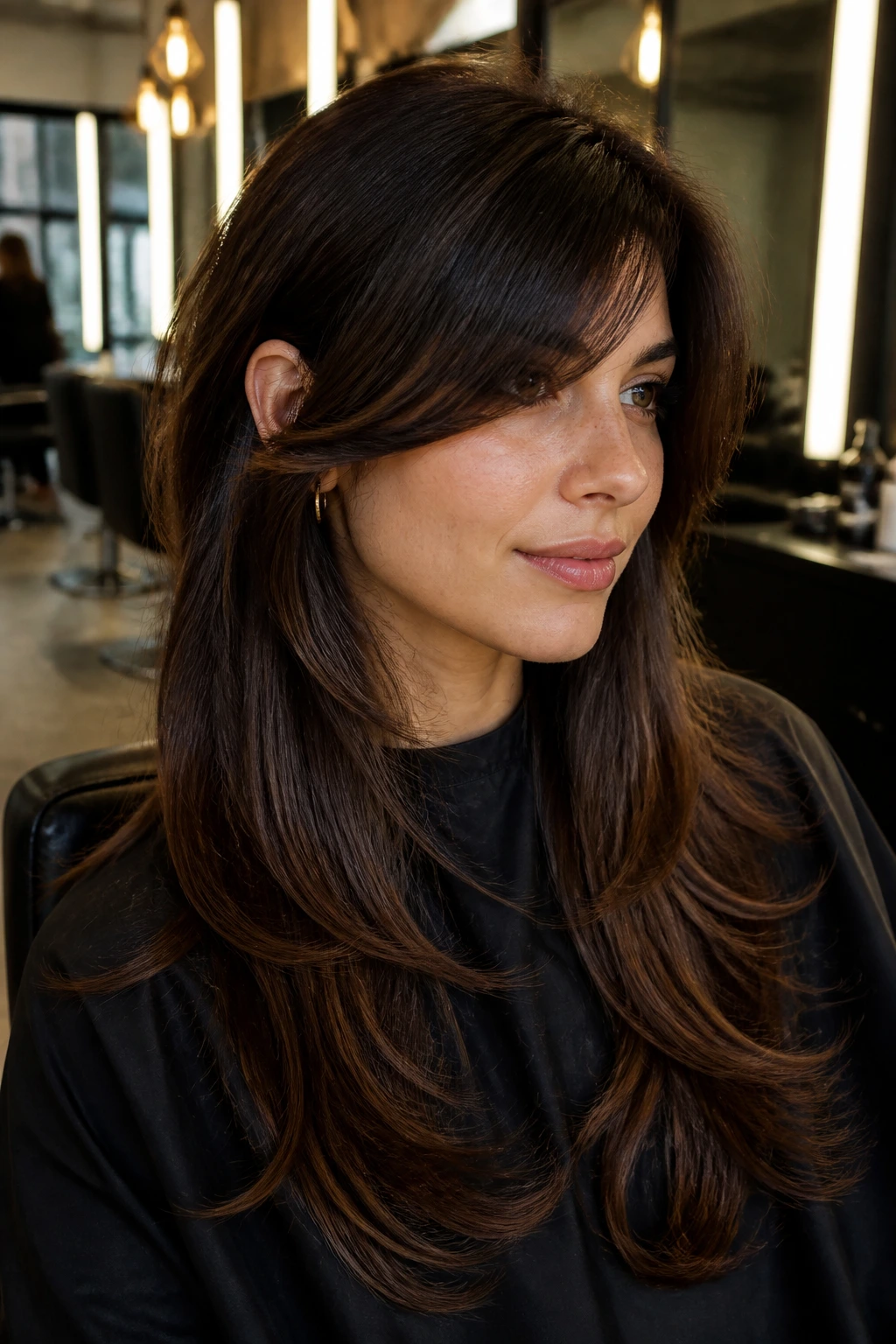
Start with the part, not the bangs. That sounds backward, but it matters. If you know your hair naturally wants a left side part, a right side part, or a center part that drifts, tell the stylist before they pick up scissors. Thick hair behaves differently depending on where the weight is distributed, and the part sets the whole map.
Use plain words. Say you want long layers that keep the ends full, not choppy pieces that live around the cheekbones. If you want the fringe, say you want a side-swept bang that can tuck behind the ear and still blend with the front layers. That sentence alone saves a lot of bad haircut math.
Bring photos, but bring the right kind. One shot from the front and one from the side will tell more than a dozen filtered selfies taken in a car. You want to show the length of the layers, the fall of the fringe, and whether the ends are blunt, feathered, or softly textured. Thick hair can make the same cut look heavier or lighter depending on where the density sits.
Mention your routine, too. If you air-dry, say that. If you blow-dry for five minutes and leave, say that too. A cut that only works with a round brush and forty minutes of patience is not a good fit for someone who wants to get out the door. A stylist can keep the shape simpler if they know what your real life looks like.
How to Style Thick Hair So the Bangs Fall the Right Way
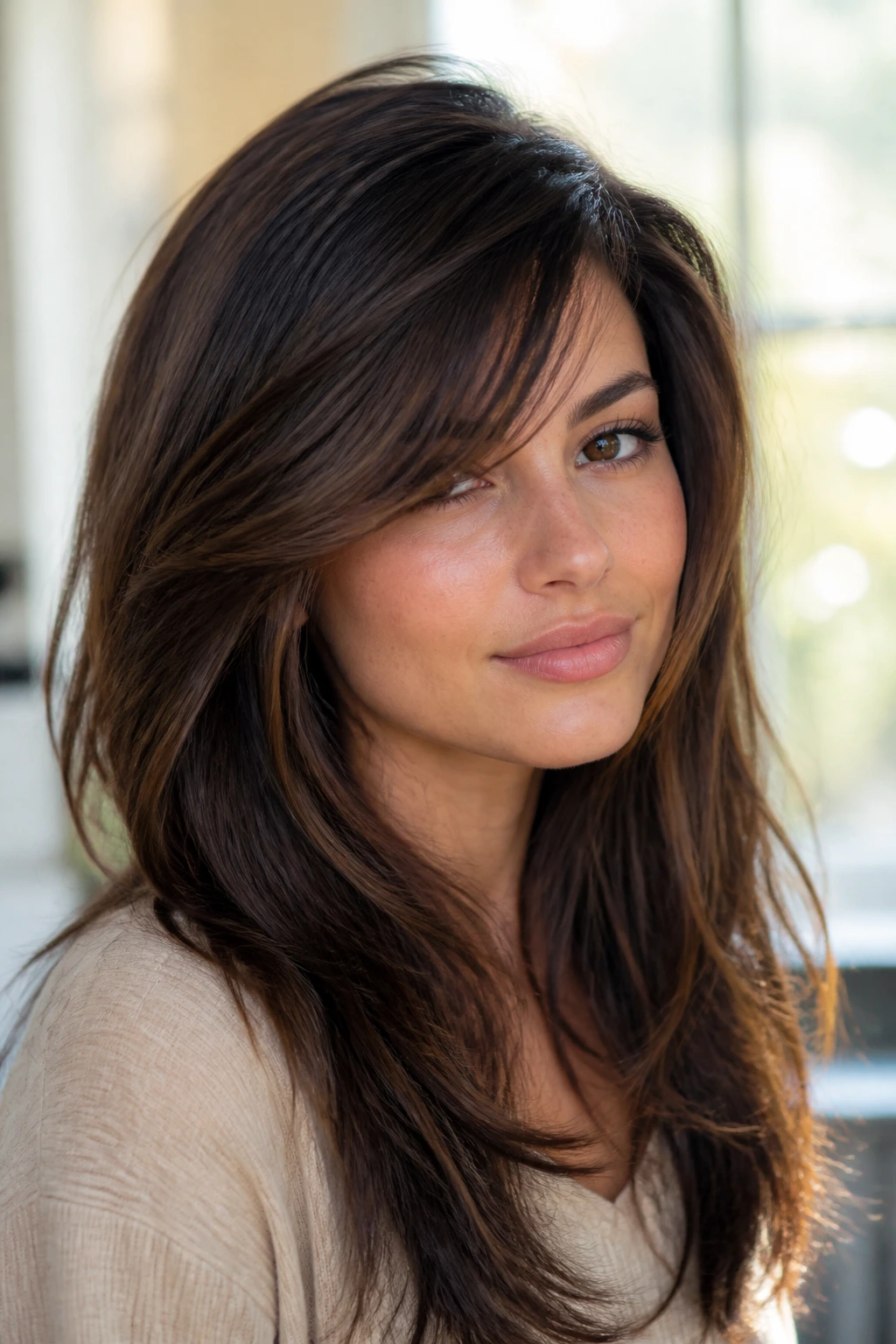
Root direction: Dry the bangs first, while they’re still damp, and direct the airflow exactly where you want the sweep to live. Thick hair sets in the direction it’s dried. If you let the fringe dry crooked, you’ll spend the rest of the morning arguing with it.
Bend, don’t curl: Use a medium barrel iron or round brush just to create a soft arc through the front layers. A full curl makes the bang too round and can make thick hair look even wider near the face. A bend is enough.
Keep the front a little longer than you think: Thick hair bounces up after it dries, and side-swept fringe looks shorter once it separates. If the cut is meant to graze the brow or cheekbone, don’t panic when it looks long while wet. That extra length usually disappears the moment the blow-dryer stops.
Finish lightly: Work a tiny bit of smoothing cream through the ends only, then mist the layers with soft-hold spray from about 8 to 10 inches away. You want the pieces to stay together, not turn stiff. Heavy serum at the roots is the fastest way to flatten a thick style.
Refresh without starting over: On day two, mist the fringe lightly with water, brush it to the side, and hit it with warm air for 20 to 30 seconds. It’s faster than redoing the whole head, and it keeps the front from splitting into two stubborn halves.
Common Mistakes That Make Thick Hair Puff Out
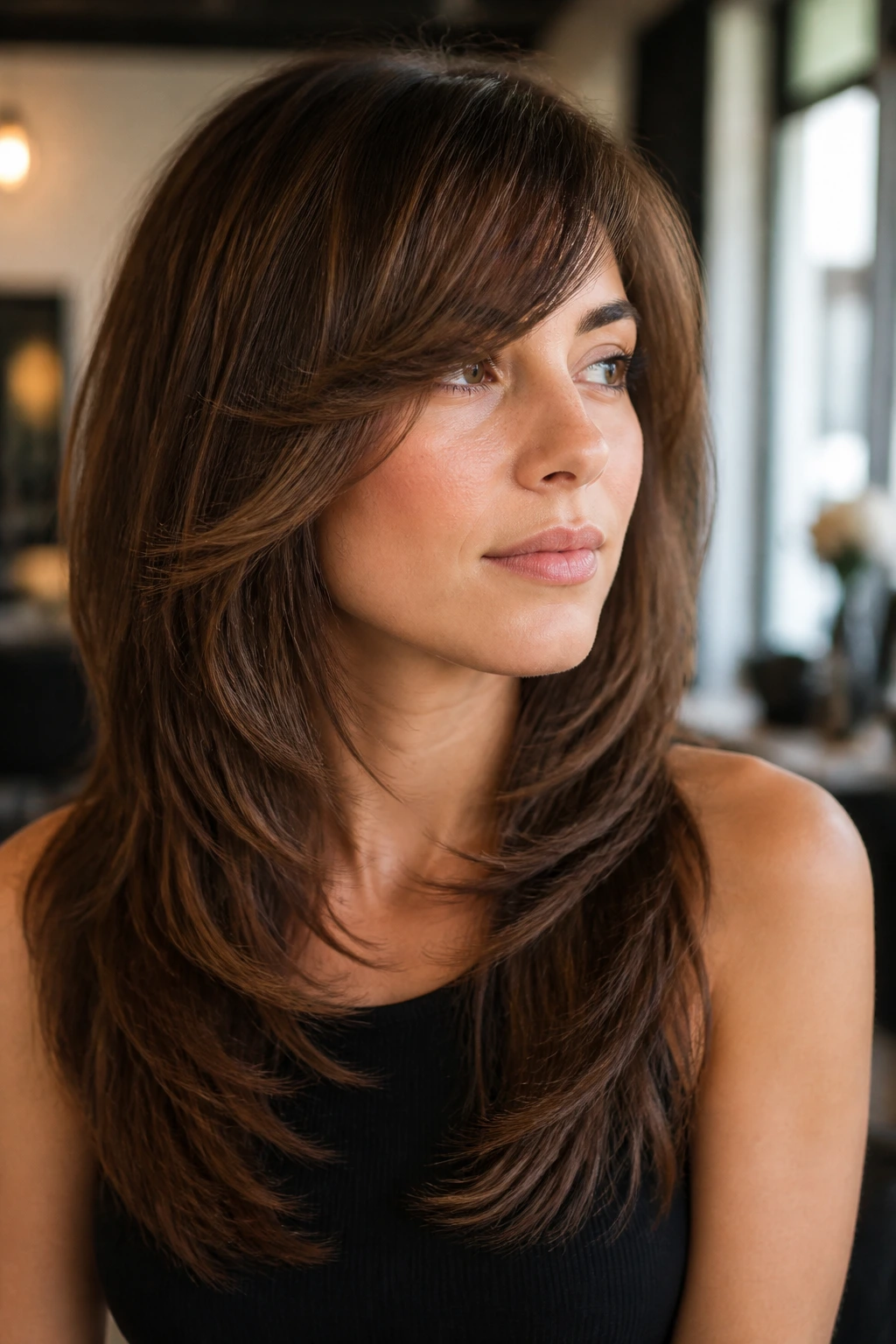
- Starting the layers too high: The hair gets shorter in all the wrong places and balloons around the crown. Fix it by asking for longer layers that begin below the chin or even lower.
- Cutting the side fringe too short: Thick hair springs up, and a short bang can sit awkwardly above the brow. Keep the sweep long enough to bend instead of stand at attention.
- Over-thinning the ends: Too much texturizing leaves the perimeter frayed and fuzzy, which makes thick hair look dry. Internal weight removal is safer than aggressive thinning at the surface.
- Using too small a hot tool: Small irons make the layers curl tightly, which makes the hair look wider. A larger barrel creates a broader bend that matches the length.
- Forcing the hair against its natural part: The fringe fights back, splits open, or sticks straight out. Work with the cowlick instead of pretending it isn’t there.
- Loading on product near the roots: Heavy creams and oils flatten the top and make the layers look pasted down. Keep product to the mid-lengths and ends.
Variations and Face-Shape Tweaks Worth Trying
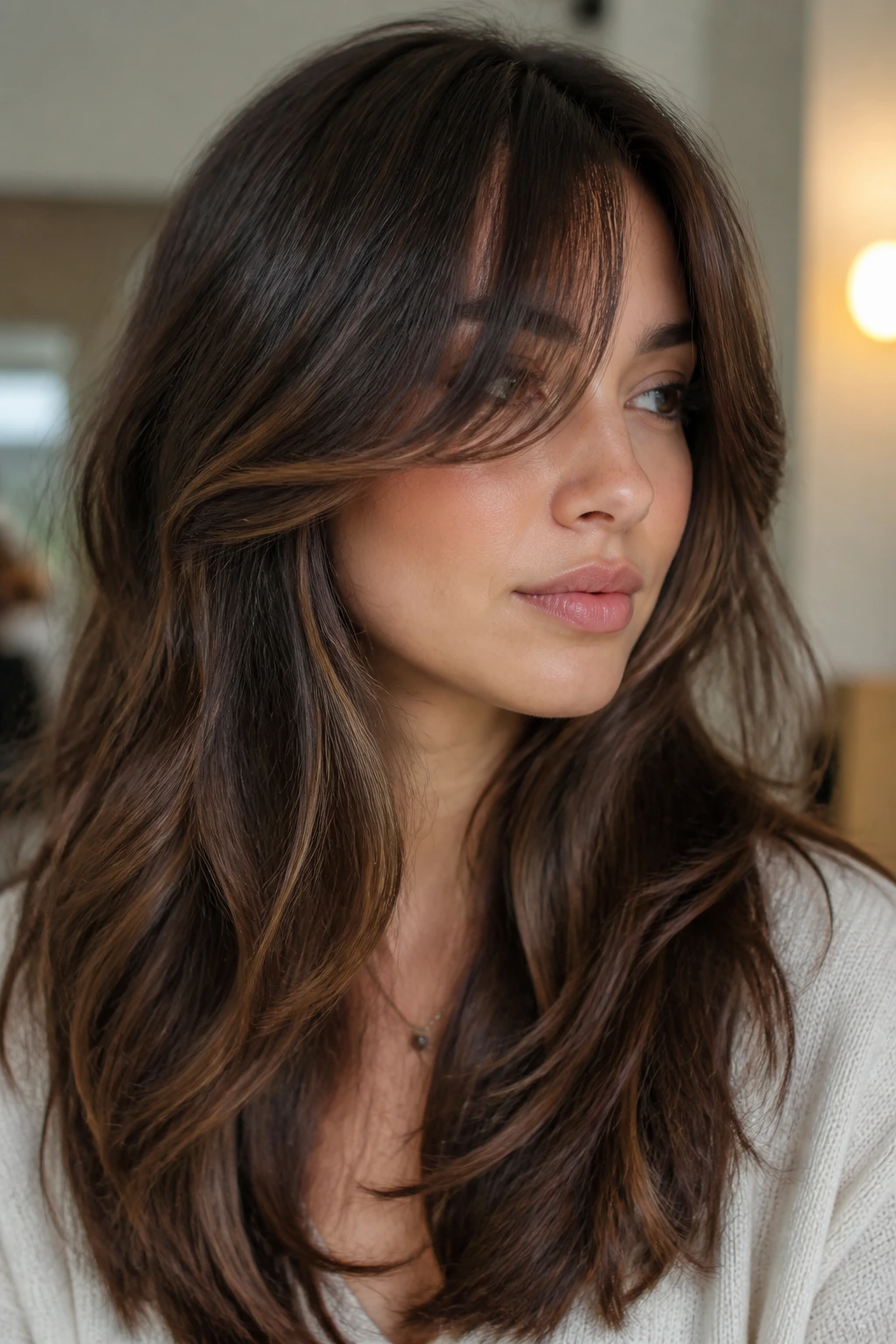
The Soft Curtain Sweep: The bang starts closer to the center, then moves to one side as it drops. This is the easiest grow-out path if you’re not ready for a strict side fringe, and it softens thick hair around the forehead without closing off the face.
The Jaw-Opening Angle: Ask for the shortest front layer to land right around the jawline if you want to soften a square or round face. That length creates a clean diagonal and keeps the front from spreading wide near the cheeks.
The Air-Dry Friendly Version: Keep the layers longer and the texturizing light, then let the hair dry with a leave-in cream and a little scrunching. This works when you don’t want to round-brush every day and your hair already has a natural wave.
The Glossy Blowout Version: Use longer layers, smoother ends, and a side sweep that starts with a deep part. This one is made for brushed volume and a polished finish, not lived-in texture.
The Heavy-Length Reset: If your hair feels overwhelming but you don’t want to lose length, keep the perimeter blunt and let the internal layers do the work. It’s the safest move for very dense hair that still needs to look full at the bottom.
Keeping the Shape Sharp Between Trims
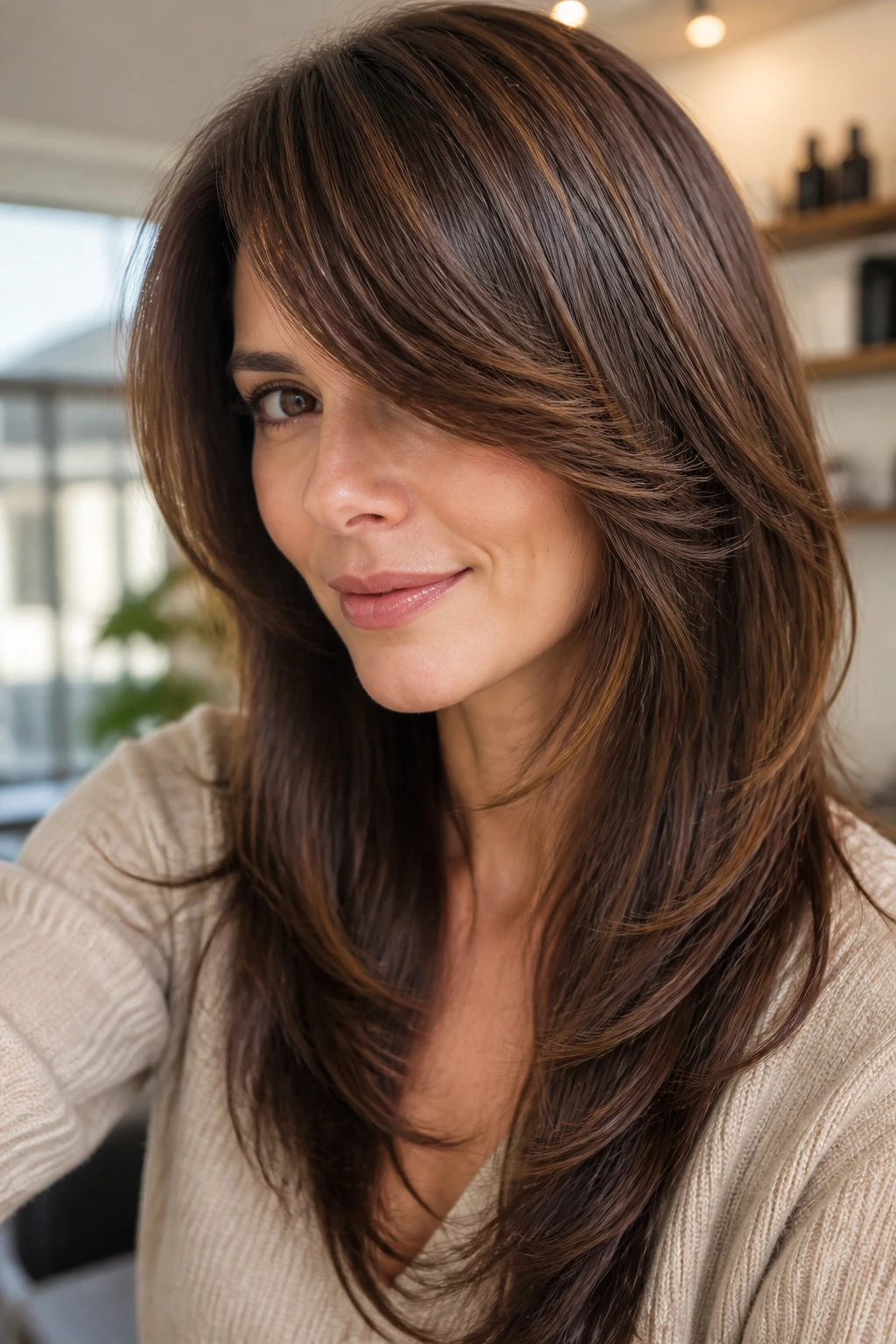
Thick hair gives you a little more time between salon visits, but the fringe usually shows wear first. Side-swept bangs often need a trim every 4 to 6 weeks if you want them to stay in that sweet bendy length. The rest of the layers can often go 8 to 12 weeks before they start losing shape, though coarse or fast-growing hair may need earlier cleanup.
At home, the trick is not to over-wash the front. Bangs pick up oil fast because they sit against the forehead, but daily shampooing can dry out the ends and make the side sweep frizzy. A small bit of dry shampoo at the roots, applied 6 to 8 inches away, usually buys you another day without turning the fringe chalky.
Sleep matters too. Thick hair that gets smashed flat overnight tends to puff at the ends by morning. A loose clip, a soft scrunchie, or a silk pillowcase can keep the layers from kinking in weird places. Nothing glamorous about it. It just works.
If the fringe starts poking into your eye, do not wait until it becomes a face-annoying mess. A tiny dusting trim is easier than reshaping a grown-out bang from scratch, and it keeps the whole haircut feeling intentional.
Questions People Ask Before Booking the Cut
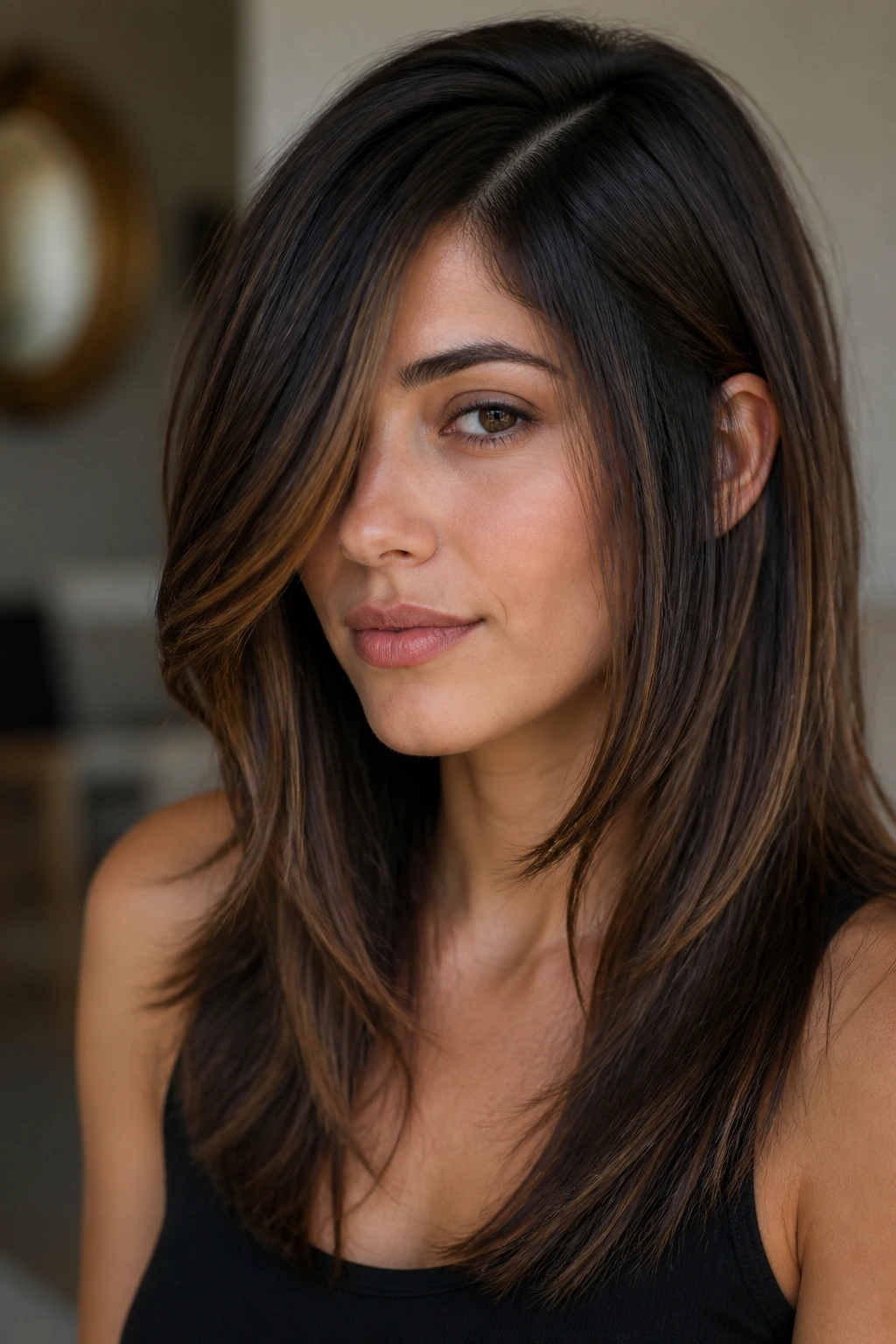
Can thick hair have side-swept bangs without looking bulky?
Yes, if the bangs are cut long enough to bend and blend into the front layers. The problem is usually length or placement, not the hair itself. Thick hair can carry a side sweep better than fine hair because it has enough weight to hold the shape.
Should long layers on thick hair start at the chin or lower?
Usually lower, unless your stylist is working around a very specific face shape or texture issue. Starting too high can make the crown puff and the ends look lighter than you want. Chin level is often the upper limit; collarbone is safer for a lot of dense hair.
What if my hair parts itself in the wrong spot?
Work with it. A strong cowlick or natural part can actually help the side-swept fringe sit properly if the cut respects it. Fighting a stubborn part usually means more heat styling, more frizz, and less cooperation.
Is this cut good for wavy or curly thick hair?
Yes, but the layers need to be cut with the texture in mind. Wavy hair can take the side-swept shape beautifully, while curly hair needs a stylist who understands shrinkage and should often be cut dry or in curl form.
How often should I trim the fringe?
About every 4 to 6 weeks if you want the sweep to stay clear and easy to style. The full layers can go longer, but the front is what tends to change first because it’s the piece you see every day.
Can I air-dry this haircut and still look put together?
You can, especially if the layers are long and the fringe is not too short. Use a lightweight cream, part the hair while damp, and tuck the bang in the direction it naturally wants to fall. The result is softer than a blowout, but it still reads as shaped.
What should I ask for if I want less volume on top?
Ask for long internal layers, not short crown layers. That keeps the top from ballooning while taking weight out of the sides and back. “Less volume on top” is useful language, but “long layers with internal debulking” helps the stylist understand the mechanics.
Is this haircut hard to grow out?
Not if the fringe is kept long. A side-swept bang grows out more gracefully than a blunt one because it can be worn as a face frame before it gets fully absorbed into the length. That is one reason people keep coming back to it.
A Shape That Lets Thick Hair Move
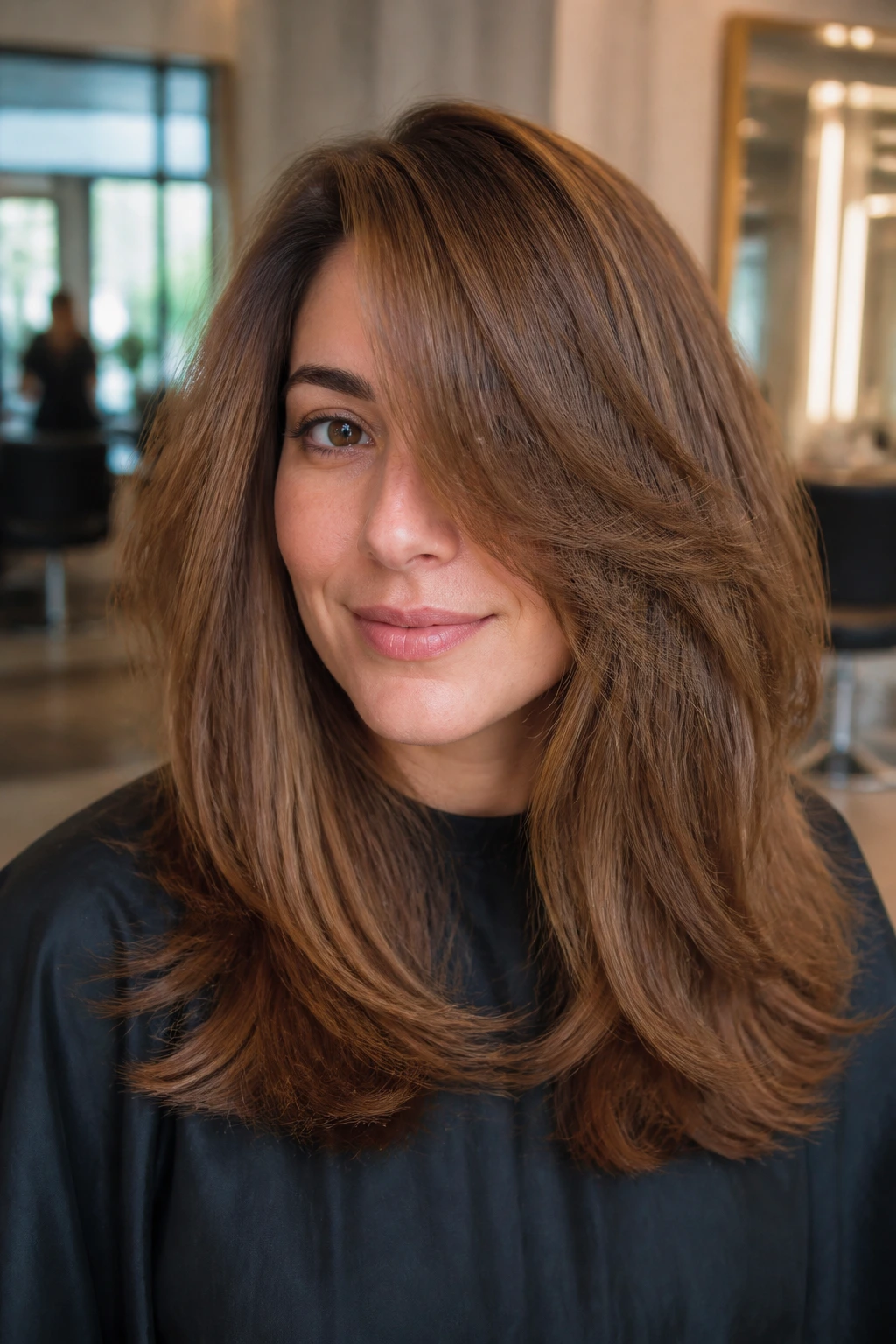
The nicest thing about these cuts is that they respect the thickness instead of trying to fight it. Thick hair has enough body to make a side sweep look deliberate, enough weight to make long layers fall cleanly, and enough structure to hold shape longer than most people expect. When the cut is placed well, the hair stops feeling like a problem to solve.
I’d pick this family of looks any time I wanted density to look polished instead of puffy. The face stays open, the ends stay full, and the fringe gives you that soft diagonal line that makes the whole haircut feel finished. It’s a practical shape, but it never has to look plain.
If you’re heading to the salon, bring one photo of the front, one of the side, and a clear opinion about how much styling you’re willing to do. That tiny bit of honesty does more for thick hair than a folder full of inspiration shots.