



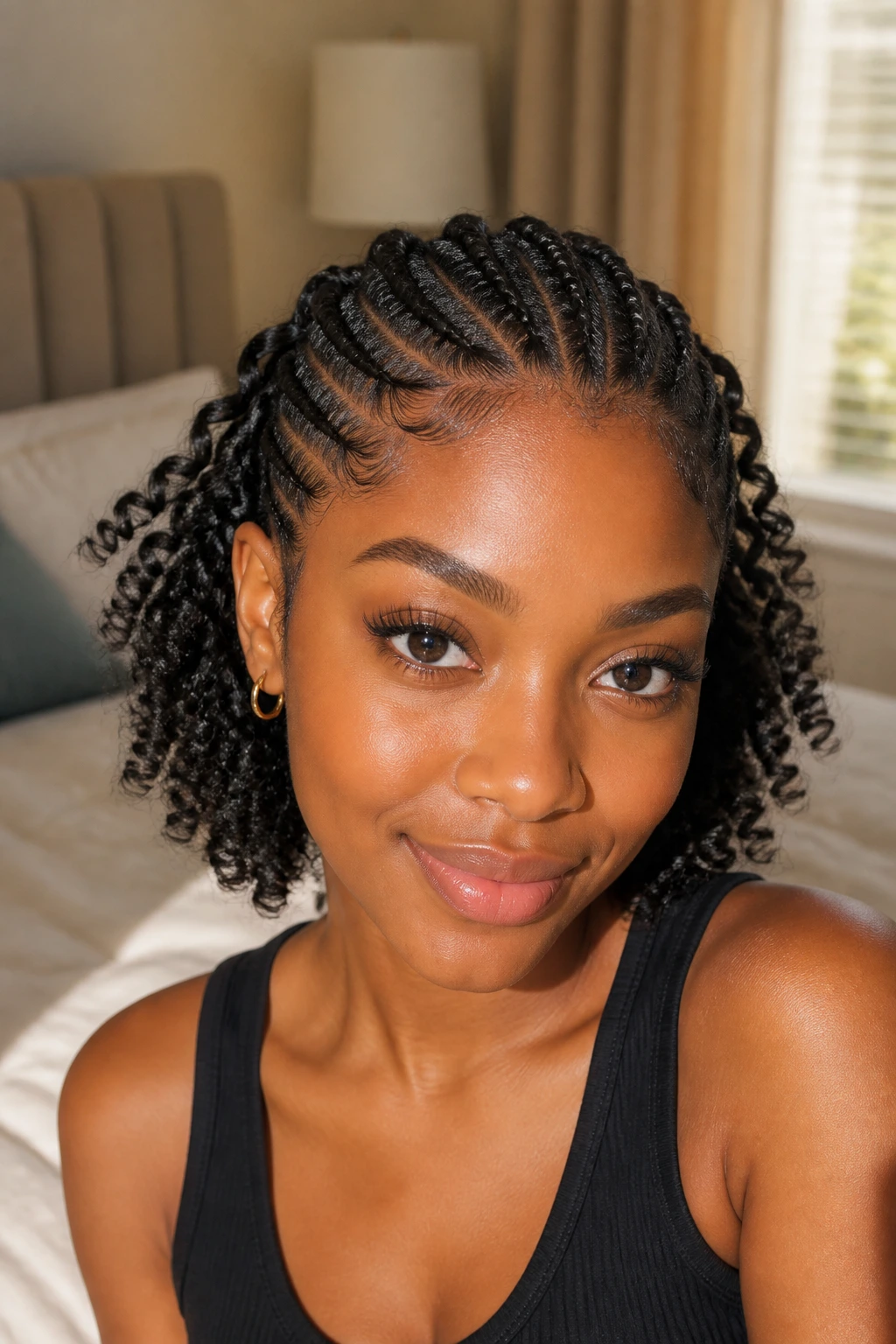
Short natural hair tells on bad braids fast. If the rows are too wide, the front tugs, and the loose curls start sitting on top of the style instead of softening it. That’s why black cornrows for short natural hair with loose curls work best when the parting is deliberate and the curl placement is treated like architecture, not decoration.
The good versions have a clean line at the scalp, a little breathing room around the edges, and curls that move in a way the braid itself cannot. The contrast is the whole point. Cornrows give the shape. Loose curls keep the look from going stiff or severe, which matters even more when the hair is cropped and every detail shows.
Short hair also changes the rules. You cannot hide sloppy spacing under length, and you cannot force every braid pattern to behave the same way. Some styles need feed-in hair to get the rows started. Others lean on the natural shrinkage at the crown. A few look best when the curls are kept wispy and soft instead of packed into a heavy tail. That flexibility is what makes this collection worth a close look.
Why You’ll Love This Collection
-
Short-Hair Friendly: These styles are built around clean scalp work, so they still look intentional when the hair does not have much length to spare.
-
Soft Without Looking Messy: The loose curls break up the hard lines of cornrows and keep the style from feeling too sharp or too formal.
-
Low-Tension Options: A lot of these looks can be done with smaller sections and lighter feed-ins, which is kinder to edges and a sensitive scalp.
-
Shape Where Short Hair Needs It: Loose curls add width, movement, and a little drama at the crown, nape, or shoulder line where short coils sometimes collapse.
-
Easy to Dress Up or Down: Change the parting, add cuffs, or swap the curl size, and the same braid base can read polished, playful, or outright glam.
-
Better Wear Time Than You’d Expect: When the rows are clean and the curls are refreshed with foam or a light mist, these styles hold their shape for days without looking flat.
Why Cornrows and Loose Curls Fit Short Natural Hair So Well
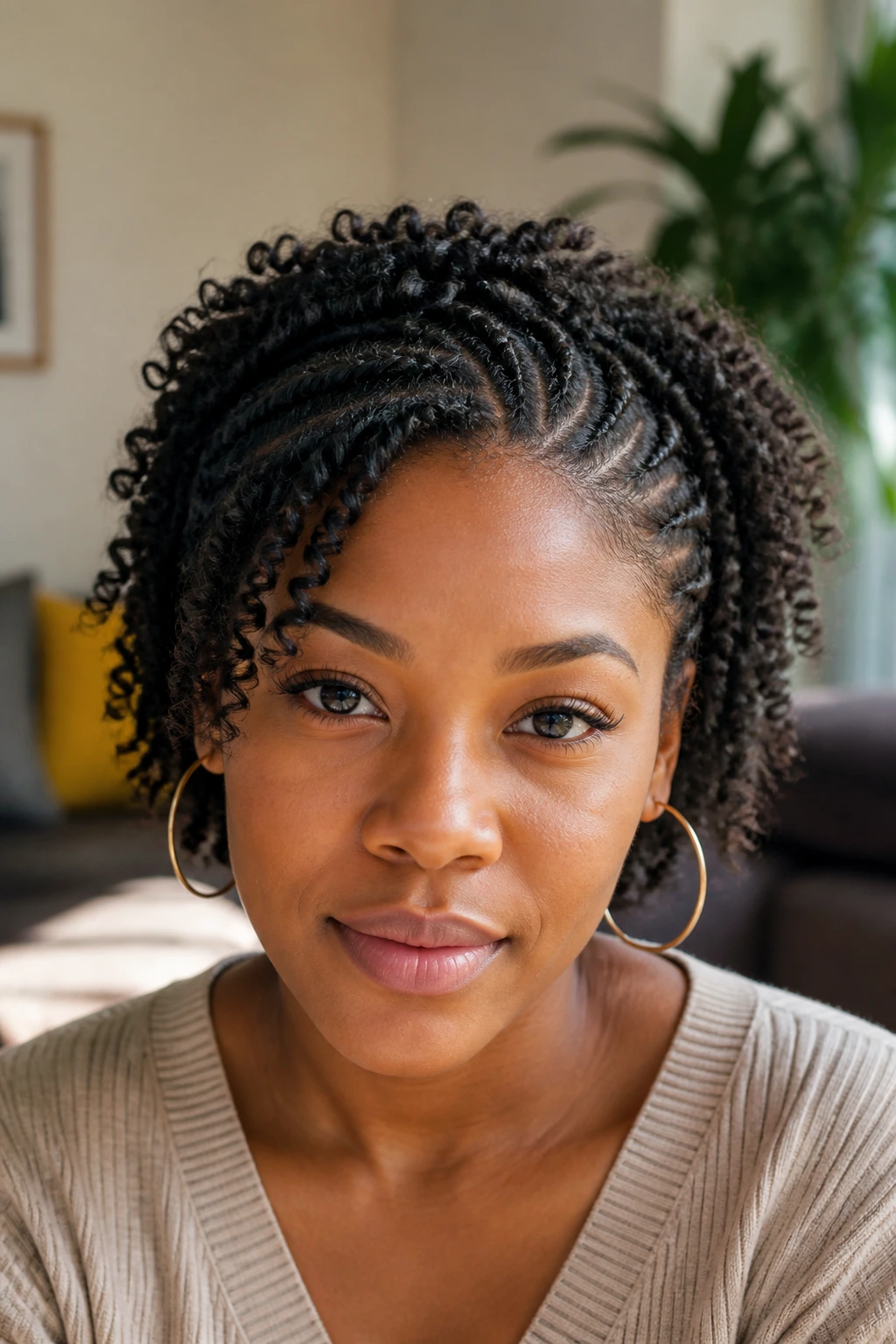
Short natural hair has a specific problem: it shrinks, puffs, and changes shape faster than almost any other texture. That is annoying when you want sleek rows, but it is also exactly why cornrows work. The braid locks the root area down, and the curls give you a finish that feels lively instead of pinched.
The sweet spot is tension. Not enough, and the rows wobble or lift at the roots. Too much, and the scalp starts complaining by the end of the day. On short hair, that middle ground is easier to find when the sections are small and the braid path is clear. You are not wrestling long lengths into place. You are guiding the hair where it wants to go.
Loose curls help in a second way: they disguise the fact that short hair ends quickly. Instead of a blunt stop, you get a soft cascade, a puff, a coil, or a shoulder-grazing finish. That is why these looks feel more finished than a plain set of straight-back rows on the same hair length.
A lot of stylists lean into this by keeping the braids neat at the base and letting the curls do the expressive work. Smart move. The braid sets the structure; the curls carry the mood.
1. Straight-Back Cornrows with Soft Curly Ends
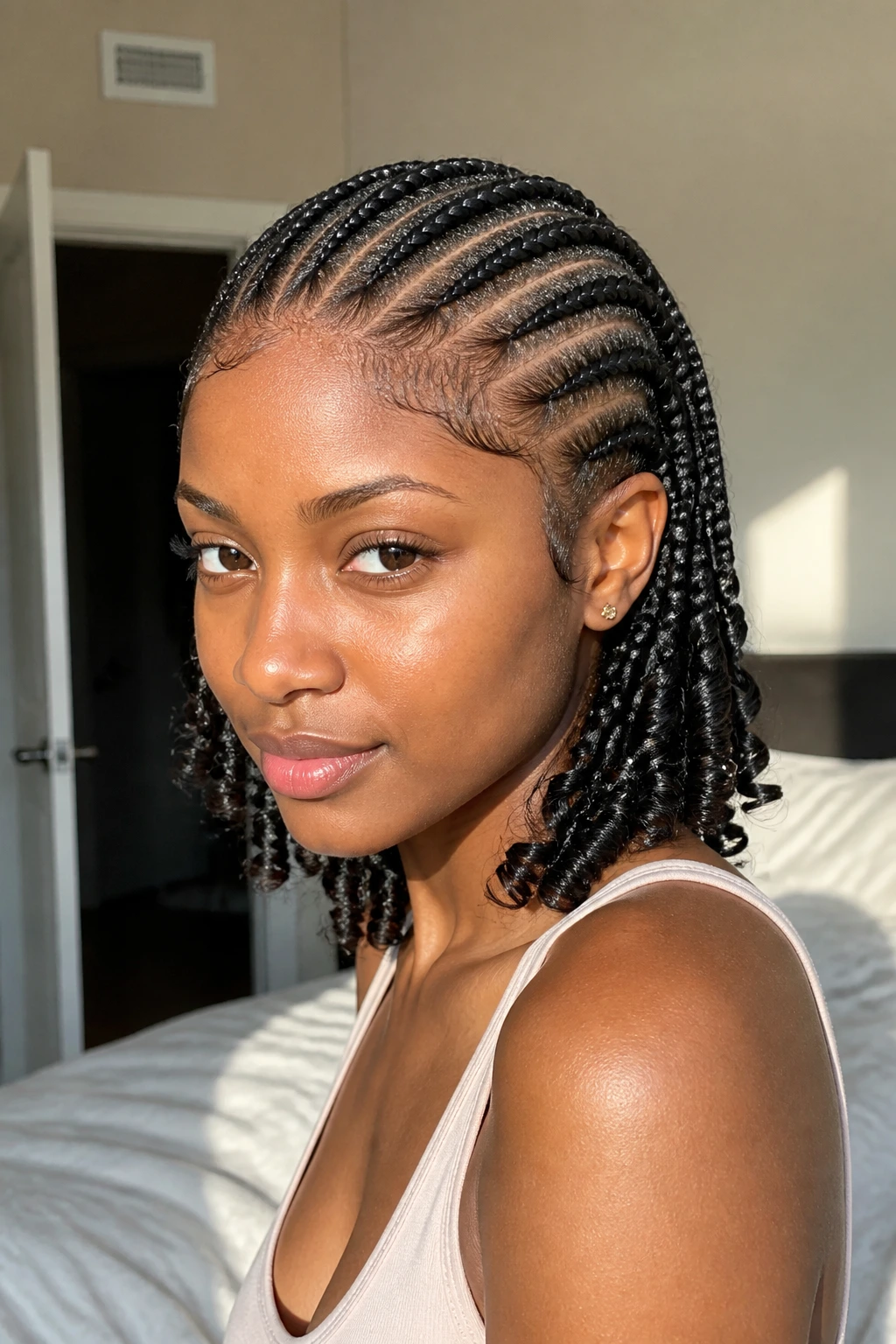
Short hair loves a clean spine, and straight-back rows give it exactly that. The loose curls at the ends soften the look so it does not stop in a hard block at the nape; instead, the style drops into movement right where cropped hair usually wants to puff out.
Why this one works
This is the easiest style to read from across a room. The rows run straight from the hairline, which makes the parting look crisp even when the hair is short and the ends are too short to hang on their own. I like this one when the sides are tapered or when the top has enough length to grip but not enough to wear loose.
Keep the rows narrow—about 1/4 to 1/2 inch—so the braid sits flat and the curls have room to fan out instead of bunching together. If the curls begin too high, the whole style gets crowded and the top starts looking bulky.
Small detail that matters
Ask for the curls to start just below the braid ends, not right at the scalp. That tiny shift keeps the rows tidy and lets the curl pattern feel intentional rather than stuffed in as an afterthought.
A soft barrel curl or a brushed-out spiral works better than tiny corkscrews here. The larger curl gives the style a little swing. And yes, a sharp center part makes the back curls look even better. Short hair is honest. If the parts are crooked, you see it immediately.
2. Deep Side Part Cornrows with a Curly Sweep
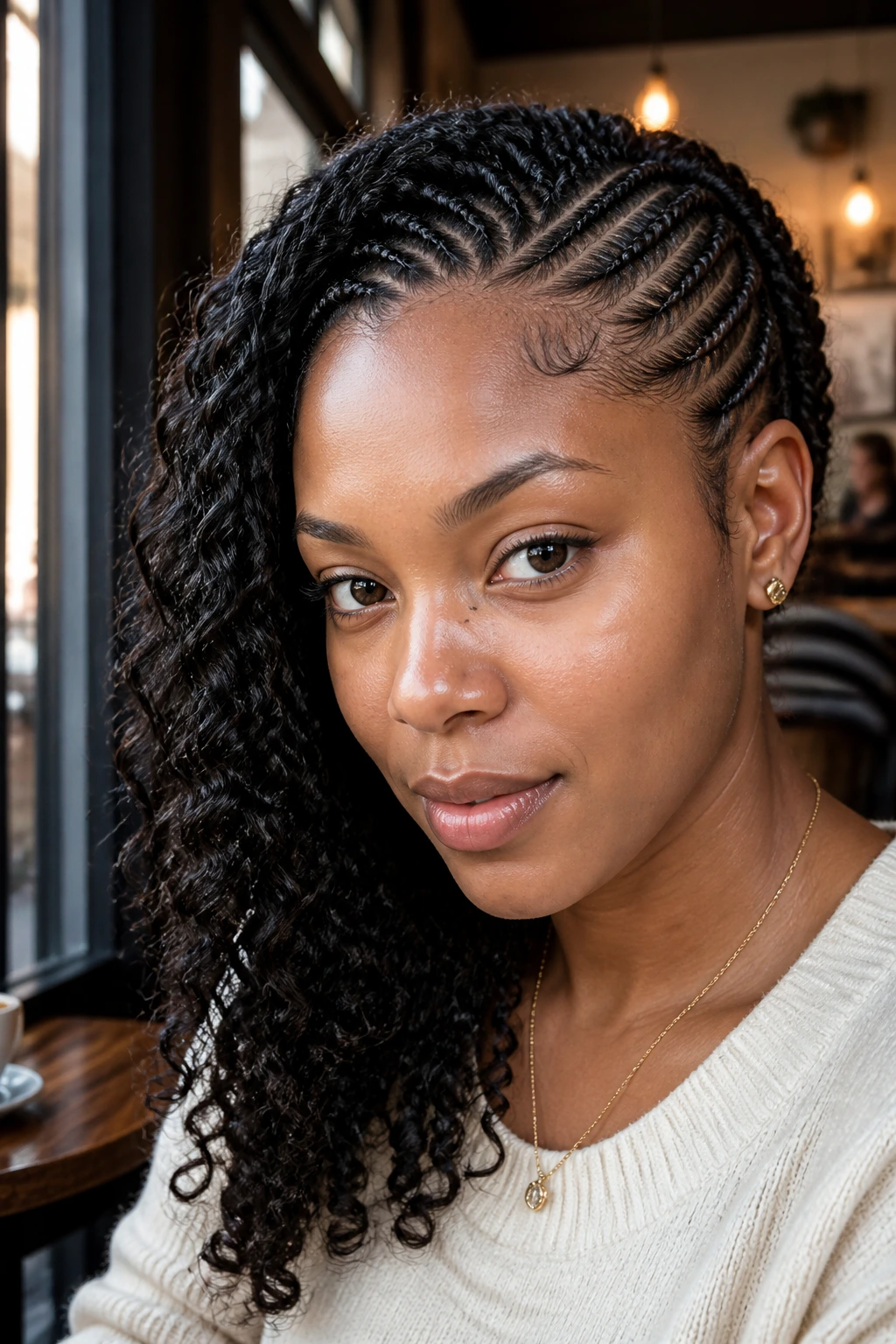
A deep side part changes everything. It makes short hair look longer at the front, gives the braids a little drama, and lets the loose curls fall over one shoulder in a way that feels styled instead of accidental.
This version is one of my favorites for short natural hair because the part does half the work. You do not need a lot of length to get impact if the hair is pushed hard to one side and the braid pattern follows that line. A few rows can curve toward the temple, then disappear into a soft curly sweep at the opposite side. Clean. Easy to read. No clutter.
The trick is keeping the front row close to the scalp without flattening the whole hairline. If the front is too tight, the style looks severe. If it is too loose, the side part loses its shape and the curls start wandering. I like a light edge finish and a side sweep with curls that sit near the collarbone, not much lower. That keeps the look tidy on shorter hair.
For clothing, this one does well with off-shoulder tops, scoop necklines, or anything with an open neckline. The braid line becomes part of the outfit. A little gold hoop? Perfect. A heavy necklace? Too much, usually.
3. Zig-Zag Part Cornrows with Spiral Ends
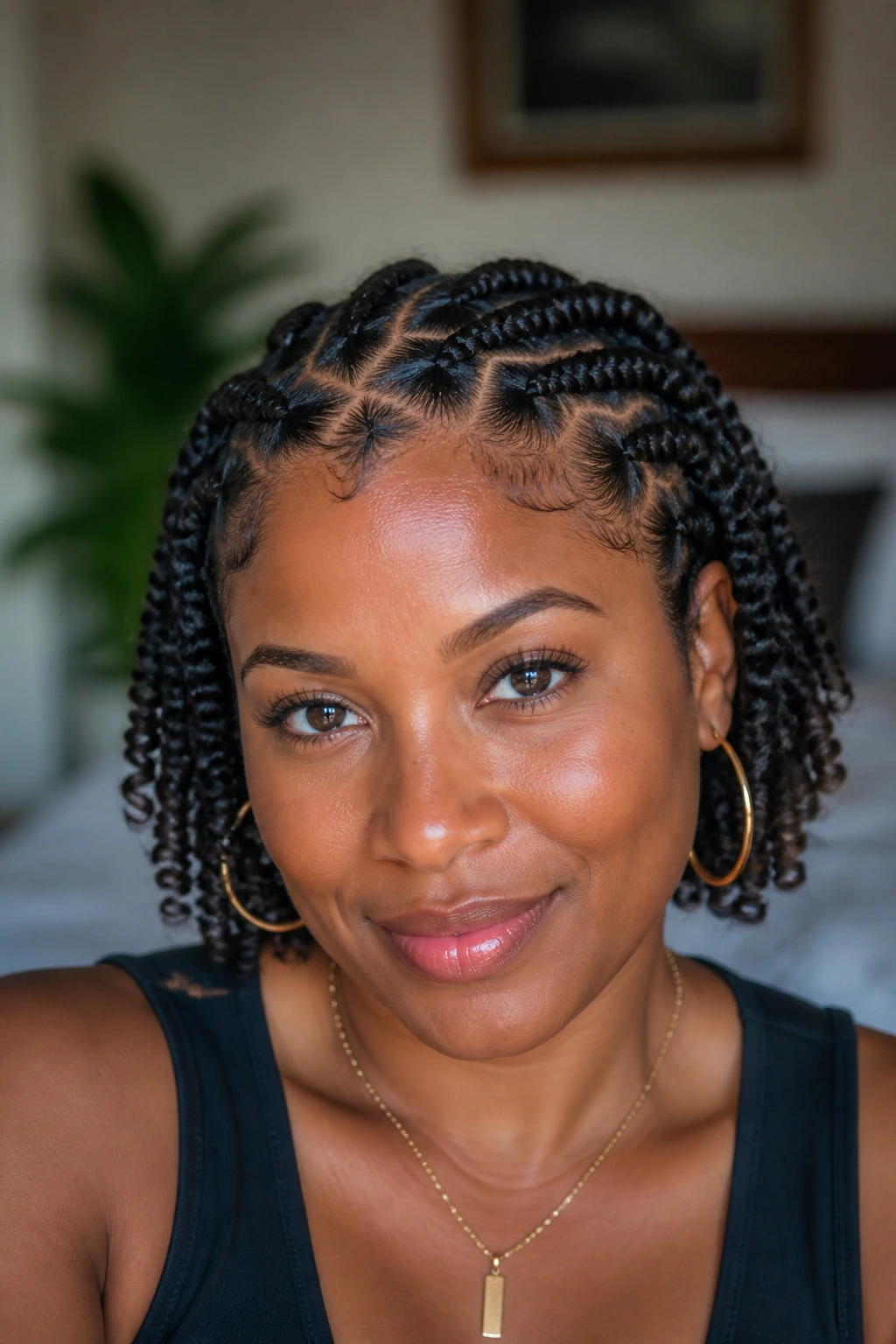
Why does this work so well on short hair? Because the parting itself becomes the feature. Zig-zag lines break up the scalp in a way that makes short rows look deliberate, and the loose spiral ends keep the style from feeling too rigid.
This look is best when you want people to notice the pattern before they notice the length. The sections do not have to be large. In fact, smaller zig-zag pieces tend to look sharper because the angles stay visible. Once the rows are braided back, let the curls hang just long enough to move when you turn your head. If they are too stiff, the whole effect loses its charm.
What to ask for
- Ask for the zig-zag to stay visible for at least the front third of the style.
- Keep the braid tension even, especially around the turns in the pattern.
- Use spiral curls at the ends if you want a more playful finish, or brushed-out curls if you want something softer.
- Leave a little room around the crown so the design does not collapse into one dense patch.
Short hair can make decorative parts look crowded fast, so the key is restraint. One strong zig-zag line beats four weak ones. And if your hairline is delicate, this is not the style to pull too tight. The geometry should do the talking, not the tension.
4. Four Slim Cornrows into a Low Curly Puff
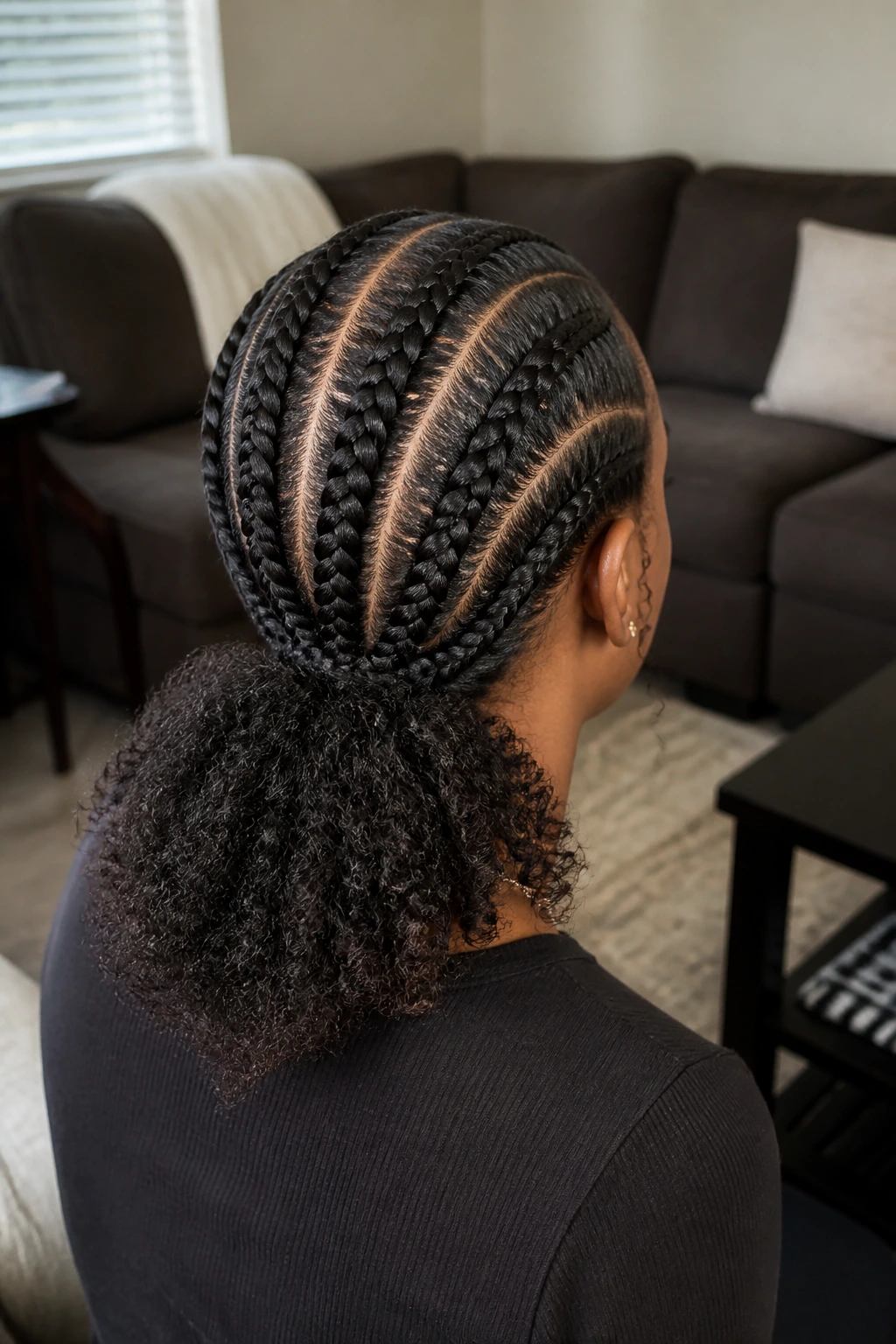
This is the style for the person who wants the front clean and the back soft. Four slim cornrows move straight or slightly diagonal toward the nape, then gather into a low puff with loose curls mixed in. It is tidy without looking stern.
Short natural hair often benefits from a style that leaves some shape at the back instead of forcing every strand into a braid. The puff gives you that softness. It also helps when your curls are too short to drop dramatically on their own. Add a bit of extension hair if needed, but keep it light. A low puff should still feel airy, not like a helmet.
The best version of this look keeps the rows close together near the front and opens a little at the back. That means the scalp stays visible in a nice, neat way, while the puff gives the silhouette some lift. If your hair is dense, the puff can be patted into a rounded shape. If it is finer, use less hair and let the texture do the work.
This is one of those styles that looks especially good the second day. The rows settle, the puff softens, and the curls stop looking freshly set in the stiff way some styles do. That is not a flaw. It is the point.
5. Half-Up Crown Cornrows with Back Curls
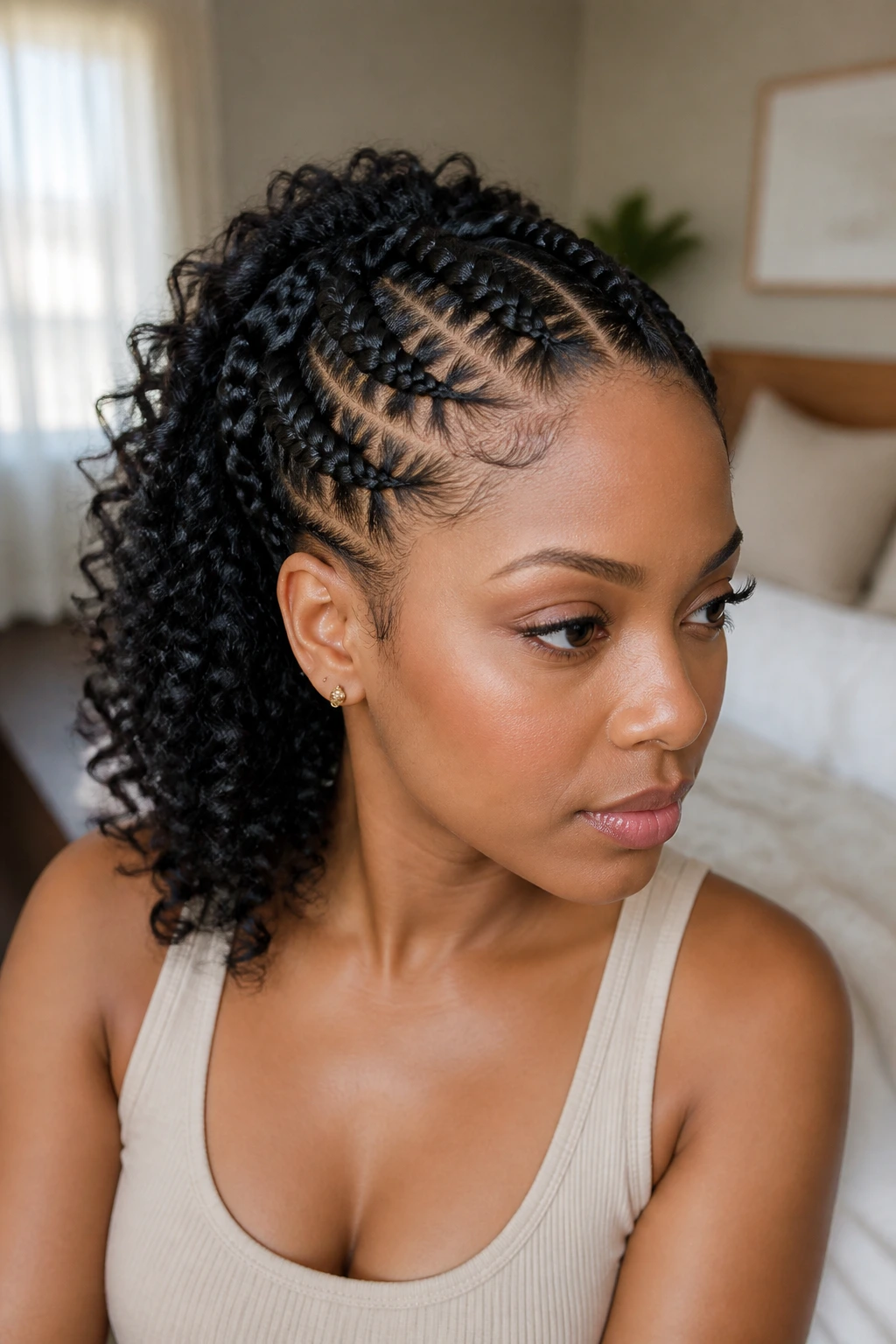
The crown braid takes the attention off length and puts it on shape. On short hair, that matters. A half-up cornrow crown pulls the top and sides back neatly, then leaves the back loose enough for curls to sit where they have room.
This one reads almost like a built-in frame. The braids trace around the head and create a little halo effect, while the loose curls fall behind it. It is a smart choice when the hair is short at the sides but fuller on top, because the crown line keeps everything anchored. The curls do not need to be long. They just need to move.
I prefer this style with medium-thick braids rather than tiny ones. Tiny rows can disappear into the crown and make the top look overworked. A few clean lines are easier to read and kinder to short hair. If you want extra polish, add one or two subtle cuffs near the temple. More than that usually starts to compete with the braid pattern.
A half-up crown also plays nicely with earrings. Large hoops, ear cuffs, and studs all show up better because the hair is pulled away from the face. Small thing. Big difference.
6. Curved Swoop Cornrows with Face-Framing Spirals
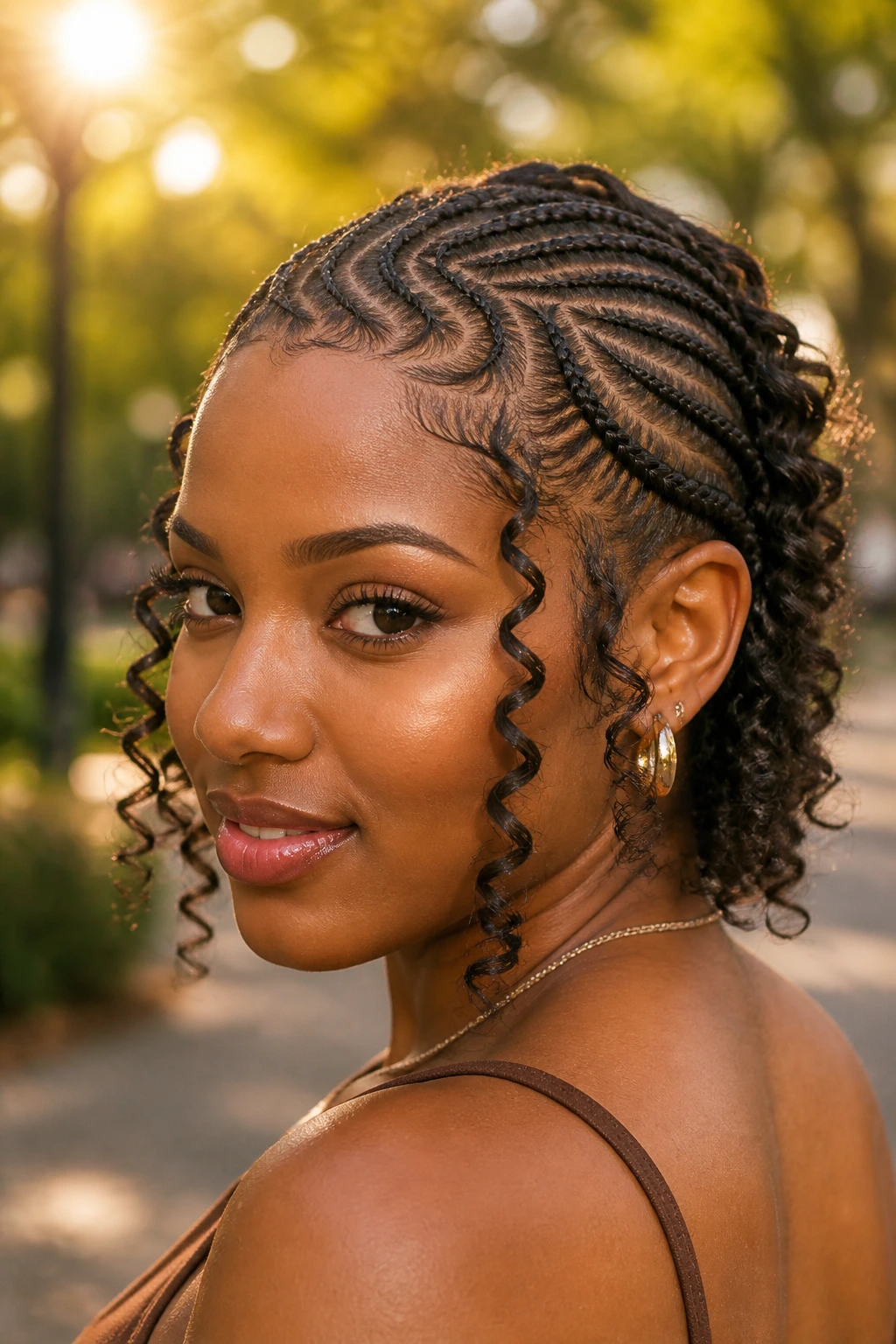
This style has movement before you even get to the curls. The cornrows sweep in a soft curve instead of running straight back, and that curve makes the short hair look fuller at the front. Then the loose spirals frame the cheeks and jaw in a way that straight rows never quite manage.
A curved swoop is the answer when your hairline feels too short for a dramatic ponytail but you still want the style to read feminine and soft. The front section should be neat, but not severe. The braid line should lean with the head shape, not fight it. That is where the shape comes from.
What makes it flattering
The side spiral pieces should start around the cheekbone or just below the ear. Too high and they poke out awkwardly. Too low and they lose the face-framing effect. On short hair, placement is everything.
If you are doing this on a tapered cut, leave a touch more length around the temples. Those little curls become the frame, and the frame is what makes the whole thing look finished. I also like this one with a soft mousse finish rather than heavy gel. You want the braid line smooth and the curls supple, not glued into place.
7. Side Cornrows Tucked into a Short Curly Bob
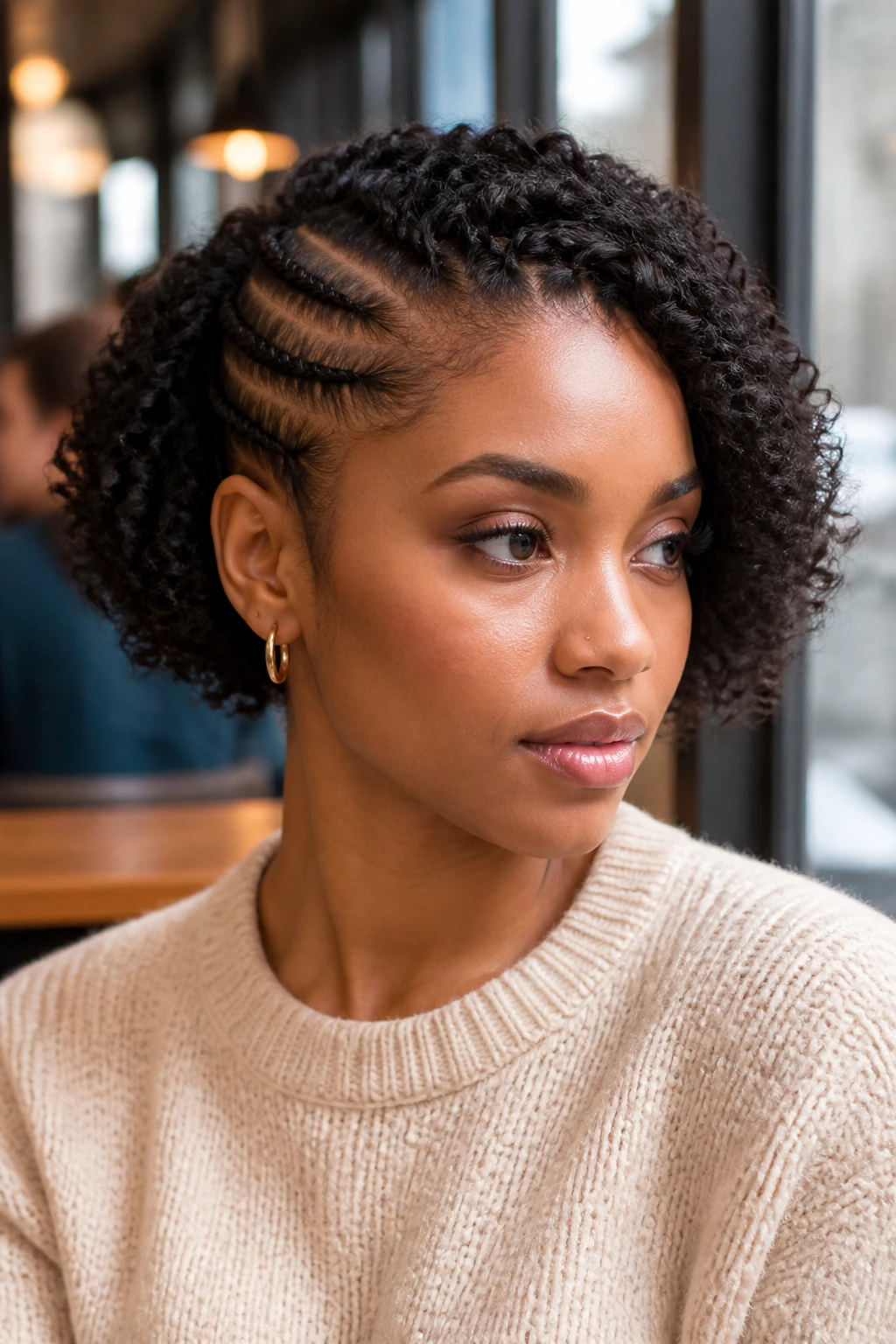
This is the style that makes short hair look purposeful instead of “in-between.” The cornrows live on one side, maybe two or three neat rows, and the rest turns into a short curly bob that sits around the chin or just under the ear.
It works because it gives short hair a shape it can actually hold. Instead of trying to force a long ponytail, you let the curls build a compact bob shape. The braid side keeps the front controlled, which means the curls can stay loose without turning fluffy too early.
The cut or installed hair should fall in a rounded shape, not a triangle. That matters more than people think. A rounded bob keeps the style from looking bottom-heavy, and on short hair, the line around the jaw can make or break the look. If the curls are synthetic or set on rods, separate them gently with oiled fingers so they do not clump into one hard mass.
This is a good “everyday but not boring” style. It can go to work, brunch, or a dinner where you want to look like you made an effort without looking overdone. The braid side gives it structure. The bob gives it softness. Nice little balance.
8. Mohawk Cornrows with Loose Curls Down the Center
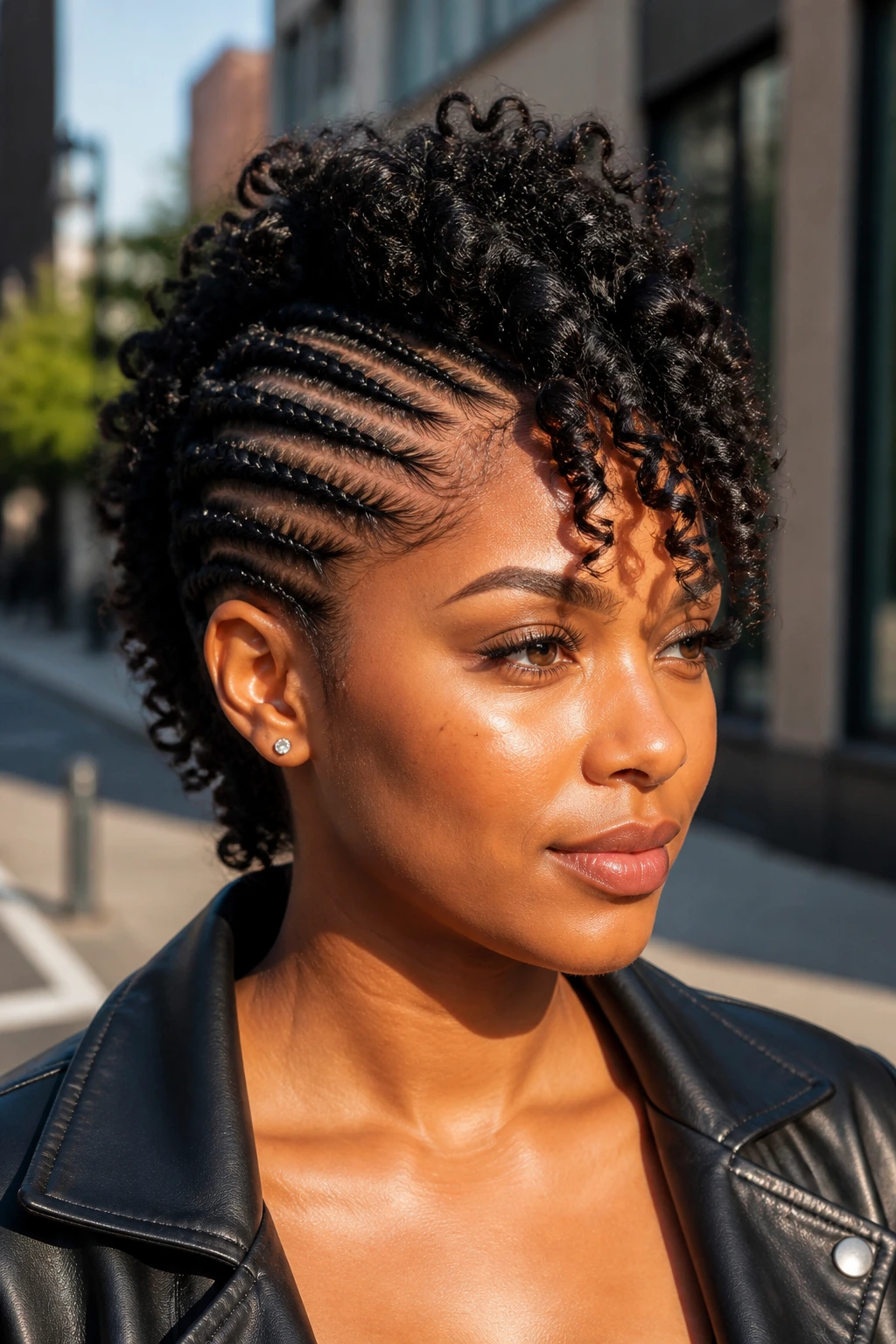
Some styles whisper. This one does not.
A mohawk braid pattern is one of the best ways to make short natural hair look longer, taller, and more intentional. The sides are braided tight to the scalp, the center section stays elevated, and the loose curls sit right down the middle where they can pile up with shape. If you want height without a ton of length, this is the one.
The center row does most of the visual heavy lifting. Keep it a little fuller than the side rows so the curls have enough base to sit on. If the hair is very short, add a modest amount of feed-in hair just for the center; that keeps the braid from shrinking too close to the scalp and disappearing. The curls can be tight spirals or brushed-out waves, depending on how soft you want the finish.
This style looks especially good with a strong brow, glossy lip, or clean earrings because the braid pattern gives the face a frame. It is bold, yes, but it is not loud for the sake of being loud. There is a difference.
9. Diagonal Cornrows into a Low Curly Bun
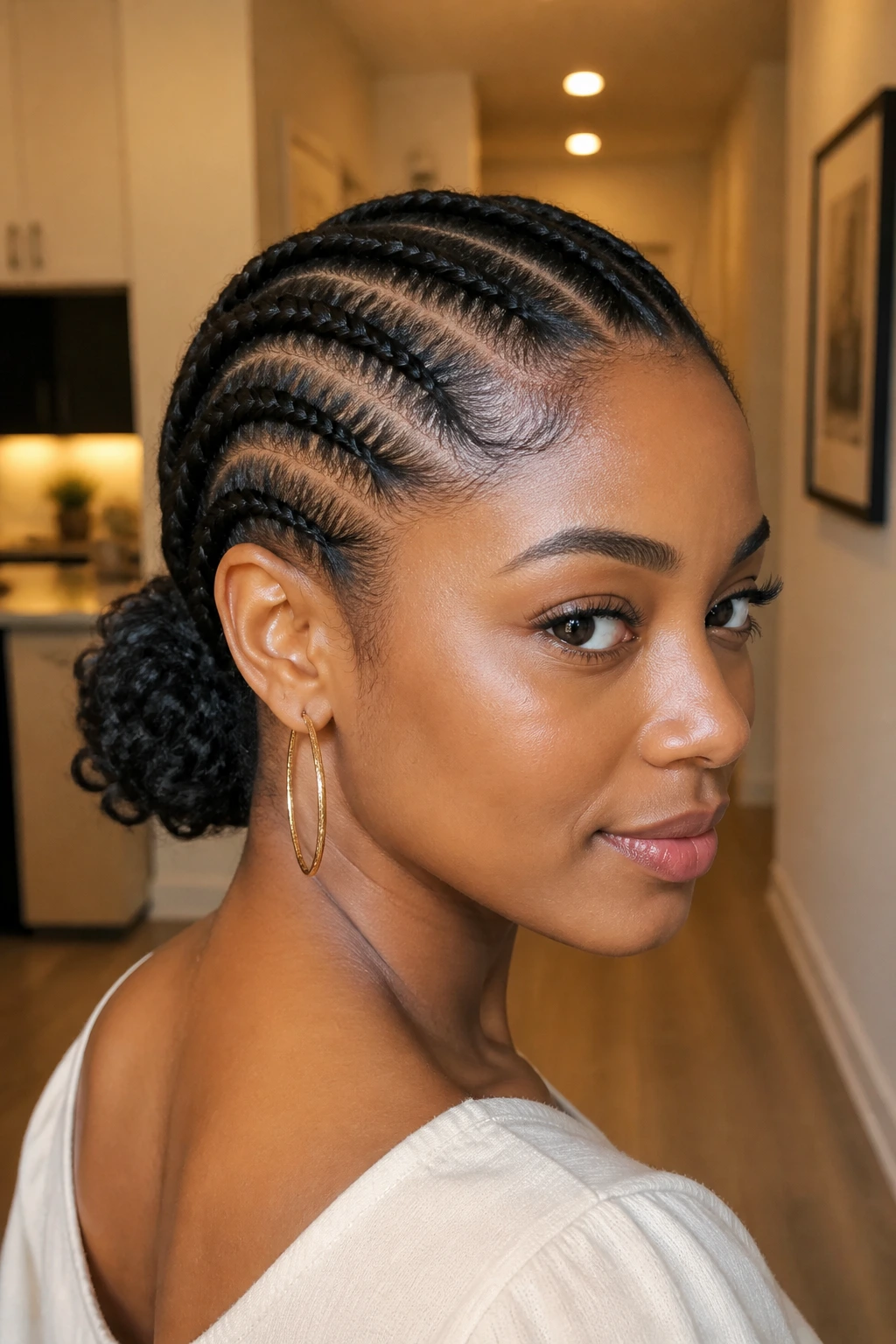
Diagonal rows can make short hair look more dynamic than straight-back braids, and that matters when the length is limited. The slant gives the head shape more movement, while the low curly bun keeps the finish compact and tidy.
If your hair tends to puff at the sides, diagonal braids help pull that volume into the pattern. The rows can start near one temple and angle toward the opposite nape, then gather into a bun with a few loose curls tucked around the base. Keep the bun low. Short hair rarely needs height here; too much height and the style starts to wobble.
I like this look for days when you want the back secured but still want a little softness. The bun can be smooth, with the curls just peeking out, or it can be fuller and slightly messy. Both work. What does not work is piling too much hair into a hard knot. That makes the style feel heavy and usually shortens wear time because the pins and bands start pulling.
If you wear collars or jackets with high necklines, this style stays neat. No curls trapped under fabric. No braid ends sticking out at odd angles. Just a clean diagonal line and a low finish.
10. Halo Cornrows with Loose Curls in Back
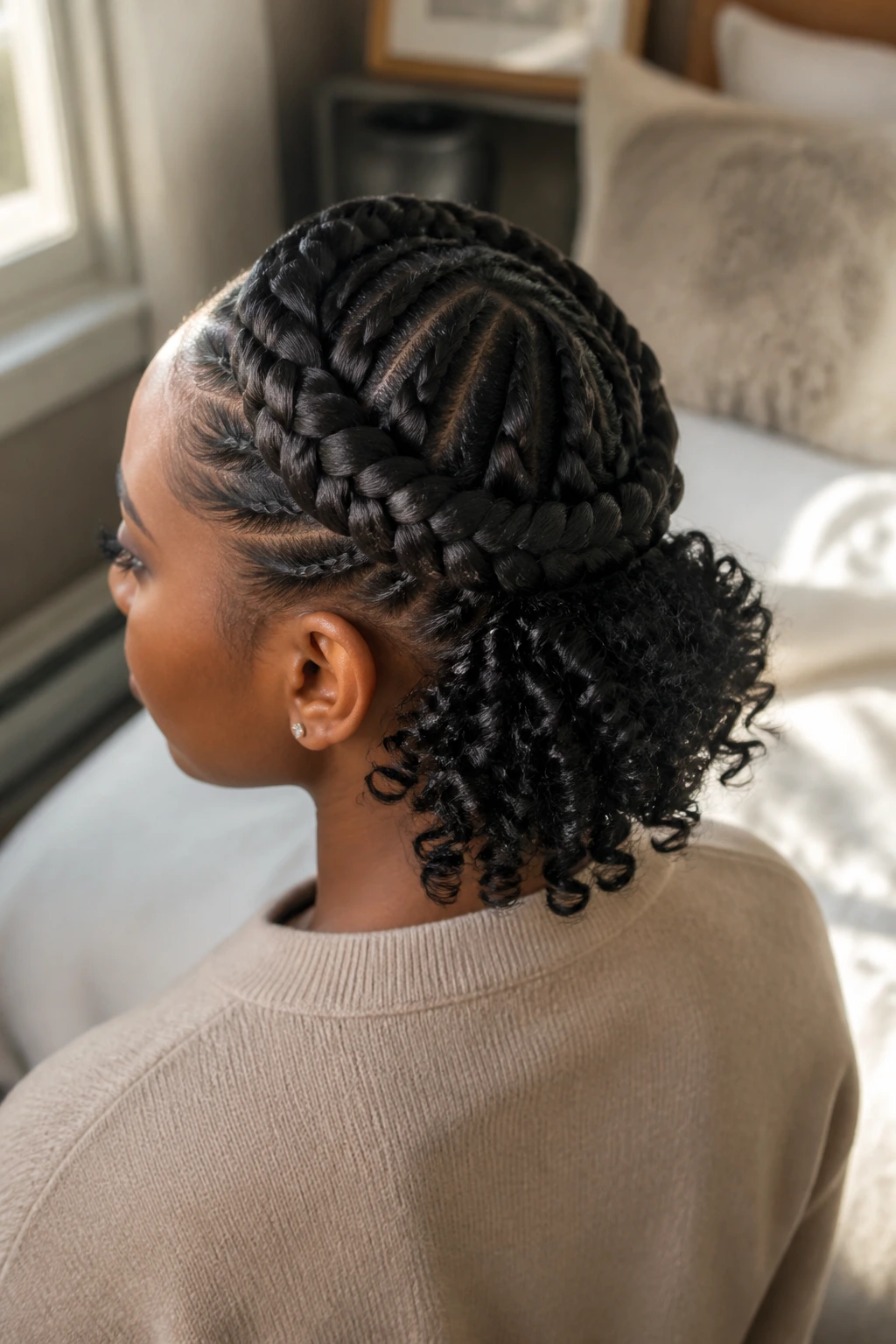
A halo braid on short hair can look almost sculptural. The rows curve around the head like a frame, and the loose curls at the back add the softness that keeps the style from feeling too formal.
This is one of those looks that benefits from patience in the parting stage. The curve needs to sit evenly around the head, especially near the ears and the nape. If the halo line jumps or dips, the whole style reads uneven. Short hair does not forgive lazy parting, and honestly, that is part of the appeal. The better the sections, the cleaner the result.
The back curls can be left thicker here, since the halo already keeps the front controlled. I like a soft, full curl rather than a tiny ringlet. It makes the back feel plush without looking crowded. If you are adding hair, keep the curl texture consistent from row to row so the back does not look patched together.
This style is especially strong when you want the hair out of the face but not completely pulled back. It gives you that “finished” feeling without needing a long tail or a big bun.
11. Micro Cornrows with a Soft Curly Fringe
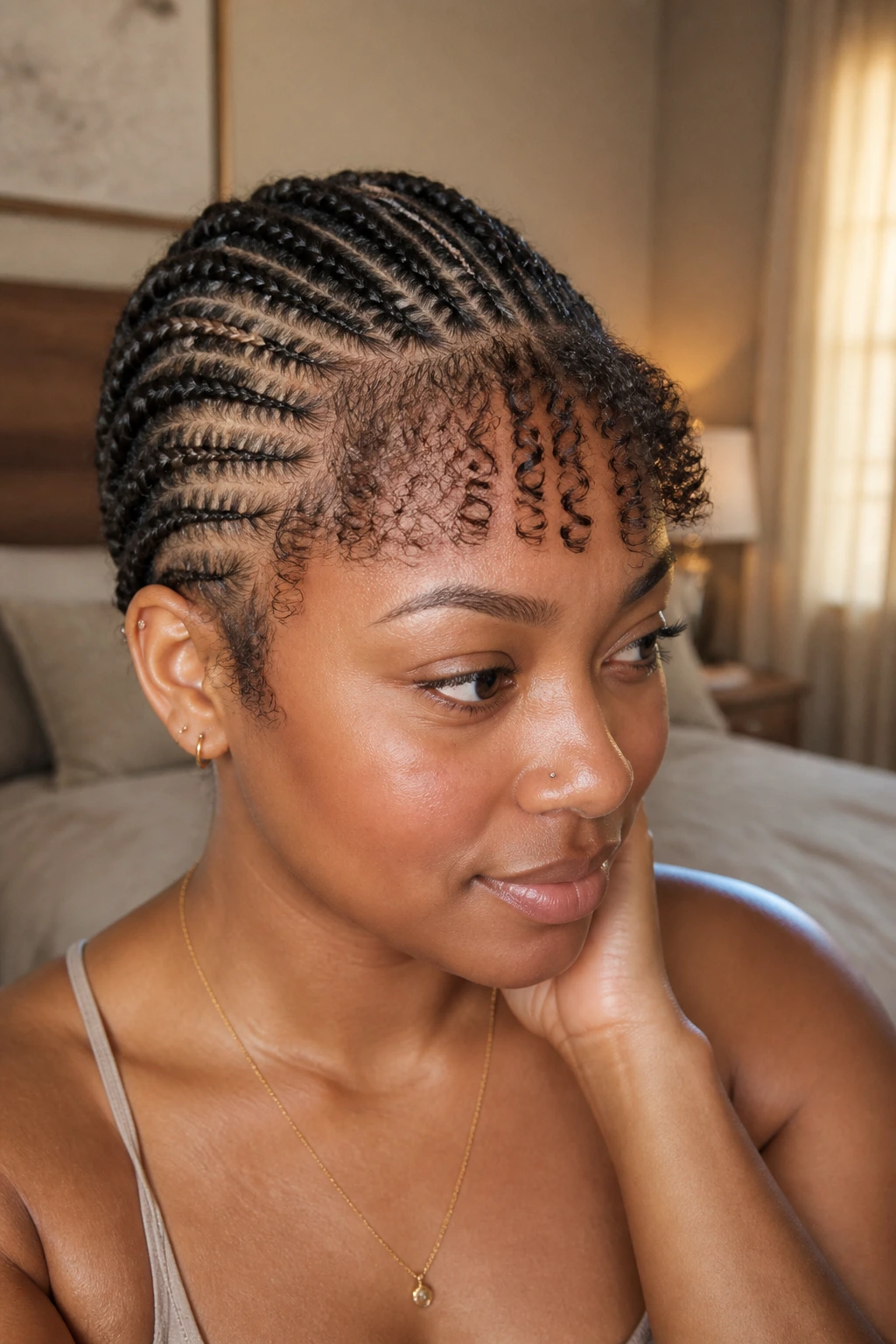
Micro cornrows on short natural hair are not for the impatient, but they can look beautiful when the pattern is tight and the curls are soft around the front. The tiny rows create texture across the scalp, and the fringe curls stop the style from feeling too severe.
The reason this works is scale. Small rows make short hair look denser, almost like a woven surface. That means the style can handle a little bit of exposed scalp without looking sparse. The fringe curls then break up the edge near the forehead, so the entire look reads gentle instead of rigid.
This style asks for discipline. The rows need to be even, and the fringe needs to be handled lightly. No yanking. No over-gelling. If the curls are on the front and they’re brushed too hard, they lose their shape fast and frizz in a halo around the hairline. I’d rather see a soft, controlled puff of curl than a slick front that cracks by lunchtime.
Micro rows are also one of the better choices if you like accessories. Tiny cuffs, a single string wrap, or a clean side part can make the pattern pop without crowding it. Tiny details matter more here than dramatic ones.
12. Two Big Cornrows with Flared Curly Ends
There is something blunt and chic about two large cornrows when the hair is short. You get a bold line, very little clutter, and enough braid surface to make the curls at the ends look deliberate. The flared ends are the whole trick.
A two-braid style gives the hair a strong shape with minimal fuss. That is useful when the hair is short enough that too many rows would just crowd the scalp. The ends can be wrapped, curled, or gently fluffed so they fan out at the shoulders. I prefer that flare over a tiny, stiff finish. It feels more relaxed.
This is one of the best styles for people who like symmetry but do not want a lot of parting time. The braids do not need to be complicated to look good. They need to be clean, even, and started with enough feed-in hair to keep them from shrinking into tiny ropes. Once the rows are set, the flared curls finish the job.
It also photographs well from the front and side because the two lines frame the face without hiding it. Simple. Strong. No wasted motion.
13. Stitch Cornrows with a Curly Tail
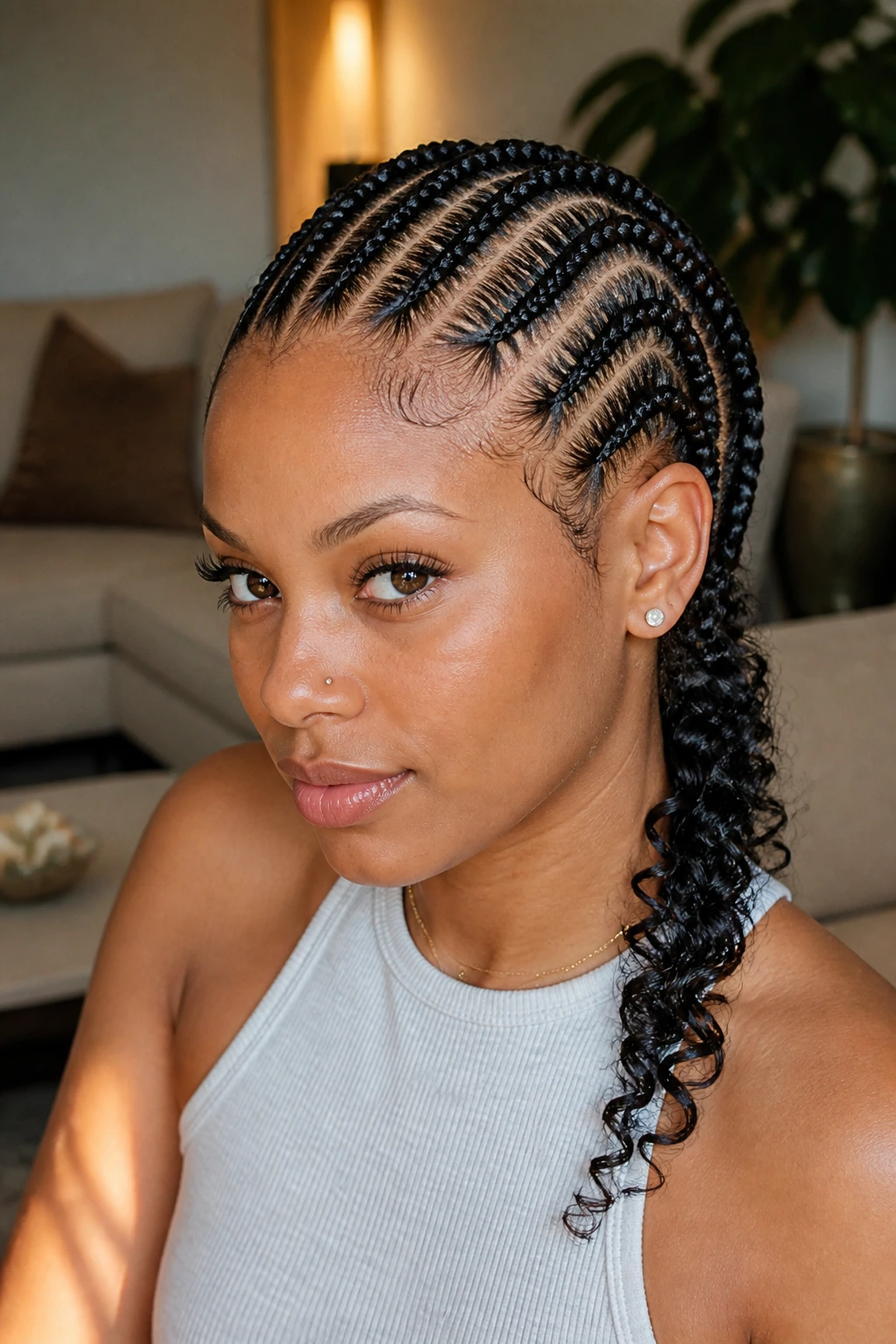
Stitch braids have that segmented, almost tailor-made look that works beautifully on short hair when the parts are crisp. The straight line and little “stitches” make the scalp pattern look crisp, while the curly tail at the end softens the whole thing.
This style is for someone who likes detail. Stitch cornrows are one of the more exact patterns on the list, and short hair shows every section, so the parting has to be neat. The good news is that the final look feels controlled and polished even when the hair itself is quite short. The curly tail keeps it from reading too hard.
I like this with a medium-density curl tail—something that has body but not so much volume that it hides the stitch pattern. The braid should still be visible when you turn your head. If the tail is too thick, the detail gets swallowed.
The best part is how clean it looks after a night wrapped in silk. The stitch pattern stays readable longer than looser braid bases, which makes this one a strong pick if you want a style that keeps its shape for several days.
14. Asymmetrical Side Panel Cornrows
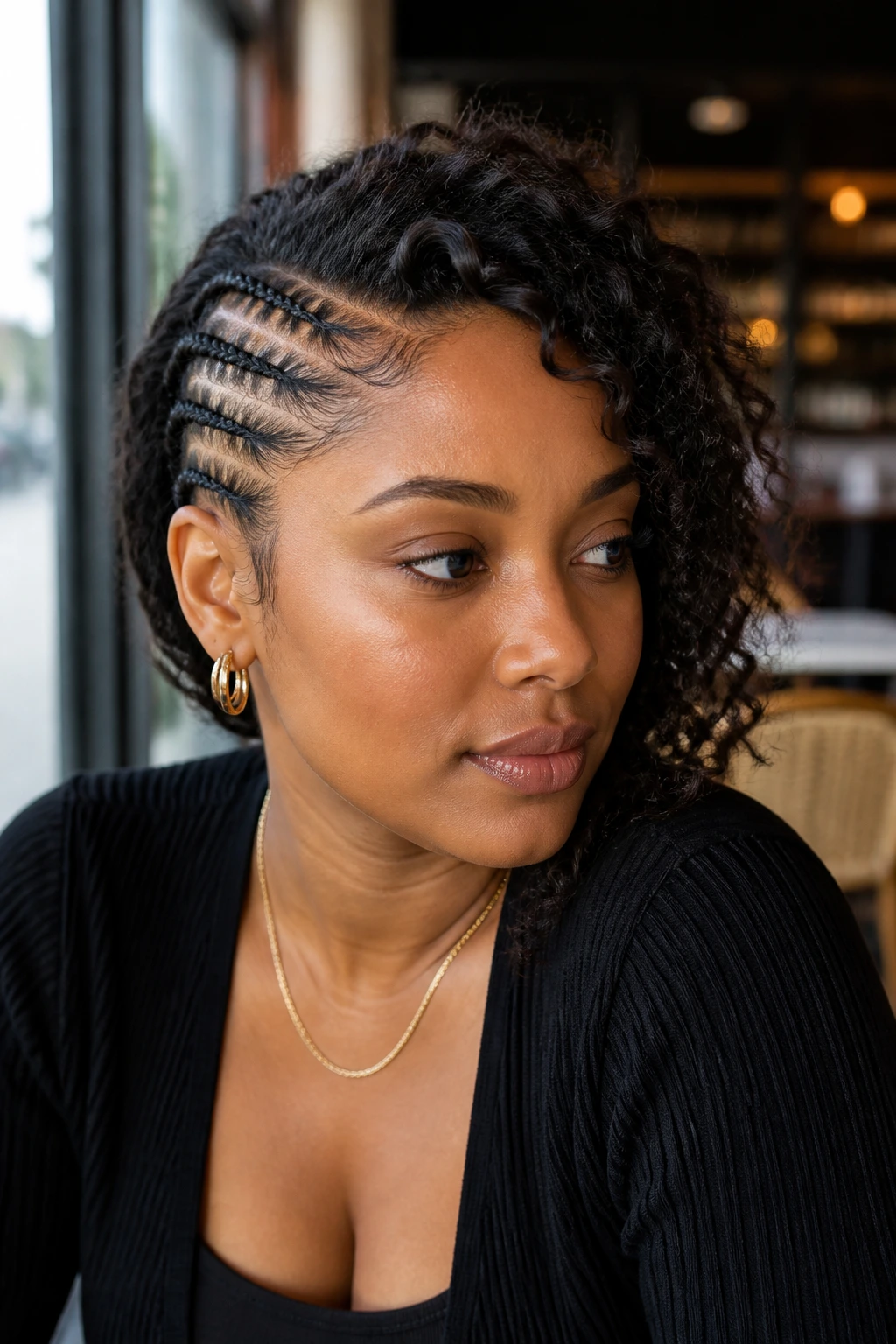
Asymmetry is your friend when the hair is short. A side panel of cornrows lets one part of the head carry the design while the rest stays soft and open, which makes the curls feel bigger and more interesting than they would in a fully braided set.
This is one of those styles that feels modern without trying too hard. One side gets the braid structure—maybe three or four rows angled toward the back—while the other side is left to show off loose curls or a natural curly section. The contrast is what sells it.
If your hairline is uneven, asymmetry can actually help. The eye is drawn to the designed side, not the small imperfections on the other side. That is useful. And if your curls have a mind of their own, letting one side stay looser gives them a place to behave without fighting the braid base.
This looks especially good with a tucked ear on the braided side and a statement earring on the looser side. That tiny styling move does more than people expect. It keeps the whole look balanced without making it too symmetrical or stiff.
15. Geometric Triangle Parts with Hanging Curls
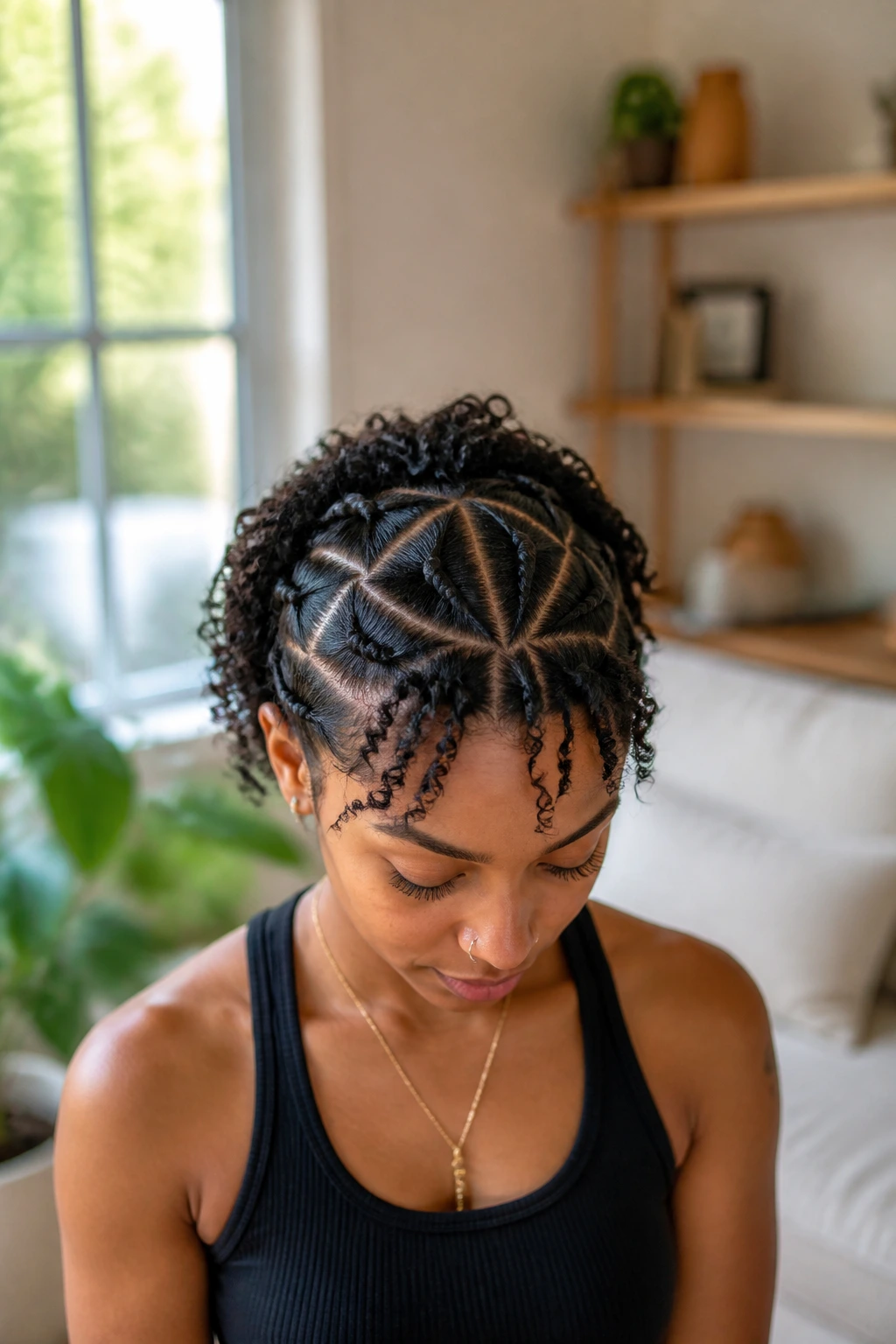
Triangle parts give short hair a sharper, more graphic finish than standard straight sections. The pointed parting makes each row feel deliberate, and the hanging curls soften the edge so the style does not look too hard or architectural.
This is a good choice when you want the scalp design to be part of the style, not just the braid itself. Triangle sections show beautifully on short hair because there is less length competing with the parting. That means the shape reads fast, even from a distance. A few hanging curls near the back or sides keep it from feeling boxy.
Why the shape matters
The triangles should be clean but not oversized. Big triangles on short hair can look clumsy because the sections crowd each other. Smaller, even triangles let the rows sit closer together and make the whole head look more balanced.
I like this with soft curls at the ends, not ultra-tight ringlets. The visual tension between the sharp parting and the loose curl finish is what makes the look interesting. One is precise. The other moves. Together, they do the work.
16. Six-Row Sleek Cornrows with Bouncy Ends
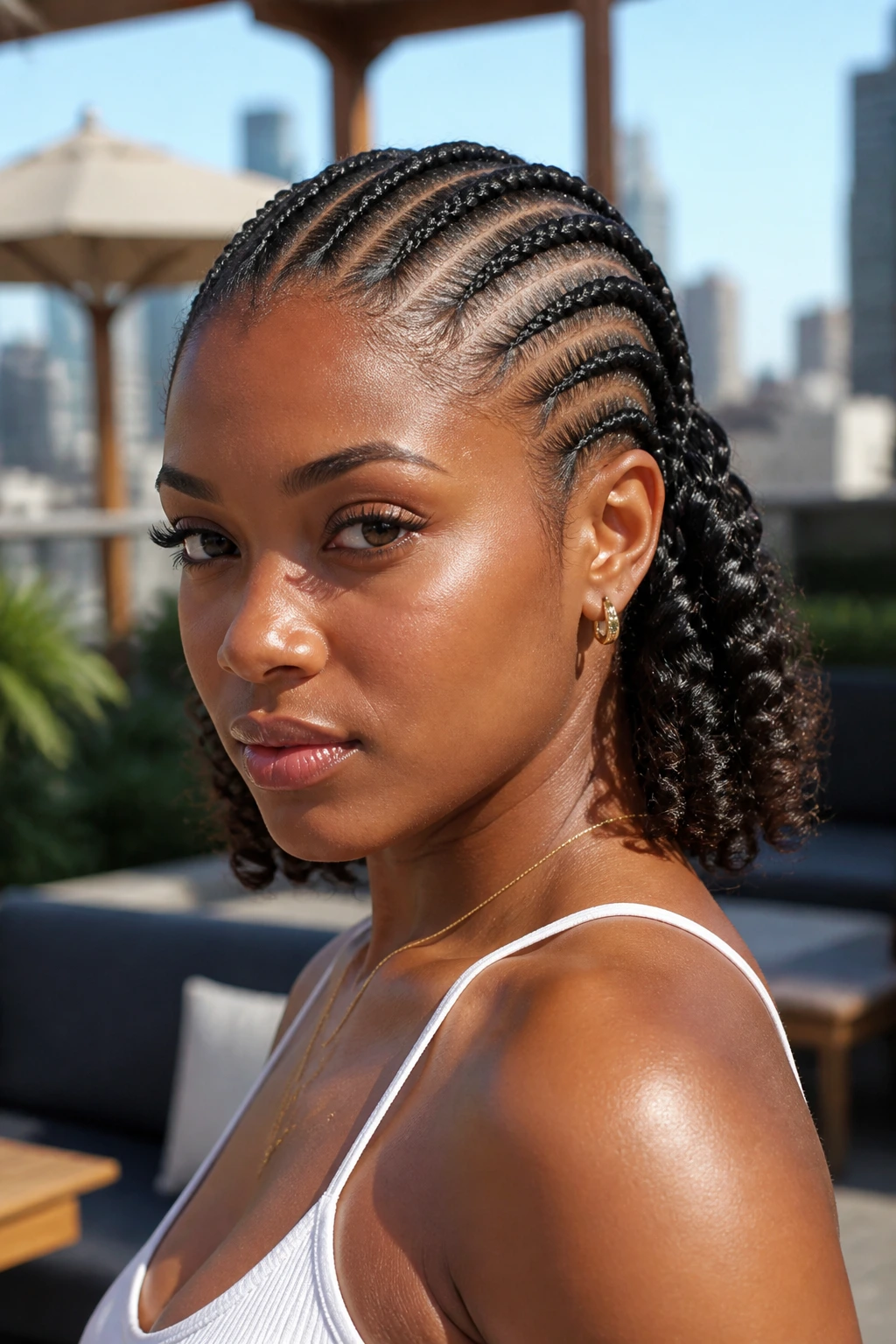
Six rows is the sweet spot for a lot of short hair. It gives you enough structure to feel styled without packing the scalp so tightly that the pattern gets busy. The bouncy ends make the whole look feel lighter.
This style is a good middle ground between minimal and detailed. The rows can start straight back or slightly angled, depending on your head shape, but the important part is that they stay smooth and evenly spaced. On short hair, six rows usually feel balanced because they do not overwhelm the crown.
The bouncy ends should be allowed to move. If they are set too stiffly, the style feels flat by day two. A little mousse or foam wrap lotion at the ends keeps the curl alive without making it crunchy. I like this one for people who want a clean everyday braid look that still has personality.
The other nice thing is that it wears well with plain clothes. You do not need a dramatic outfit for the style to make sense. A white tee, denim, and these braids can look better than a very dressed-up outfit with a style that is too fussy.
17. Braided Crown into a Curly Pineapple
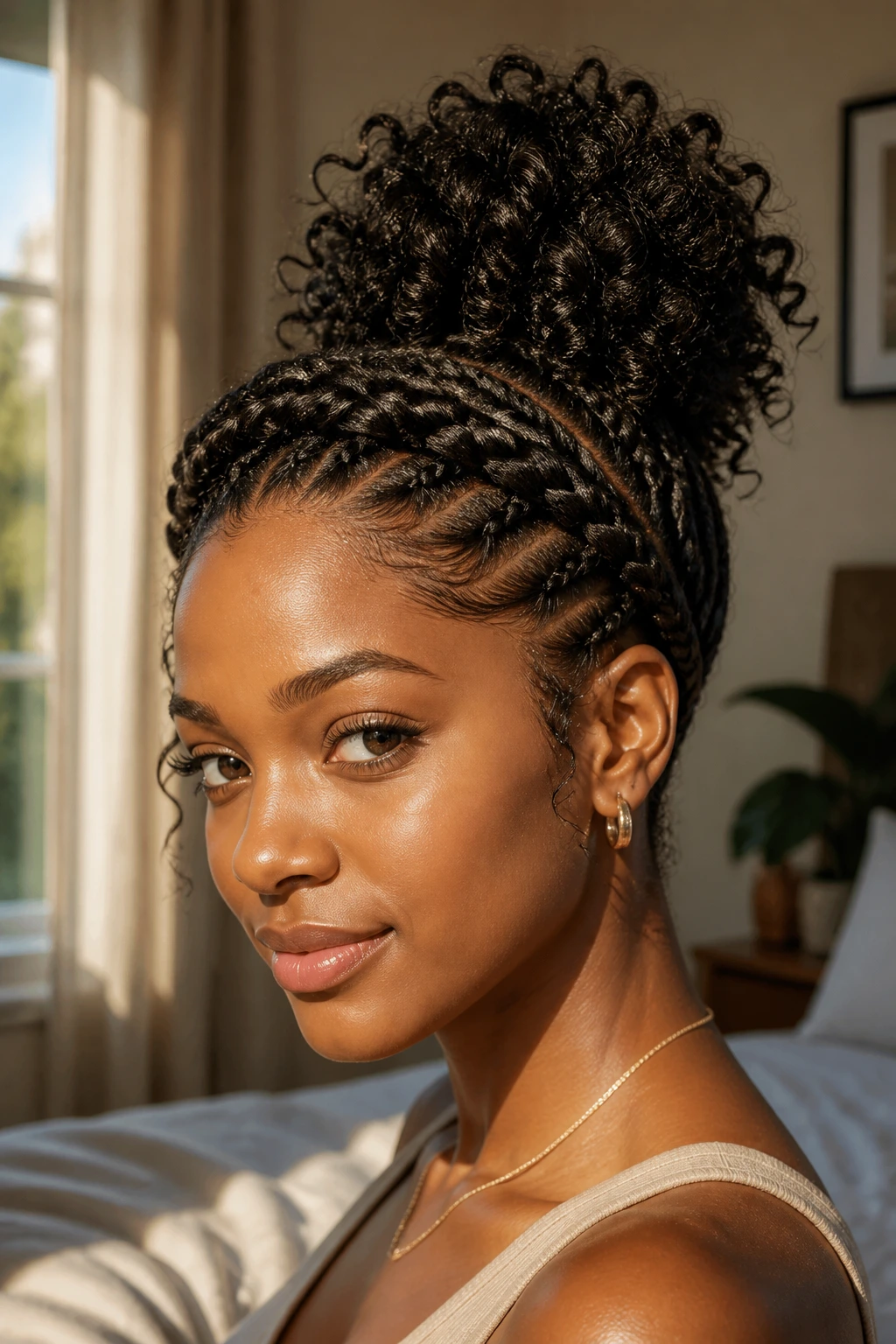
A braided crown is already pretty. Add a curly pineapple at the top or back, and it gets a little mischievous in the best way. The crown keeps the hairline neat; the pineapple gives the curls a lifted, playful shape.
This is one of my go-to suggestions when short natural hair needs height. Instead of chasing length, you build upward. The crown braid frames the face, and the pineapple sits high enough to create volume without dragging the hair down the back. Short hair can actually handle this better than longer hair sometimes, because there is less weight to collapse the shape.
If your curls are natural, let them keep some texture instead of brushing them into a perfectly smooth ball. That tiny bit of irregularity makes the style feel lively. If you are using added curly hair, keep the pieces light and separate them with your fingers rather than a brush. Brushes can make the pineapple too uniform, and uniform is not always flattering here.
This one suits larger earrings, open necklines, and makeup with a clean brow or bright lip. The hair is doing a lot already. Let it.
18. Temple Cornrows with Soft Top Volume
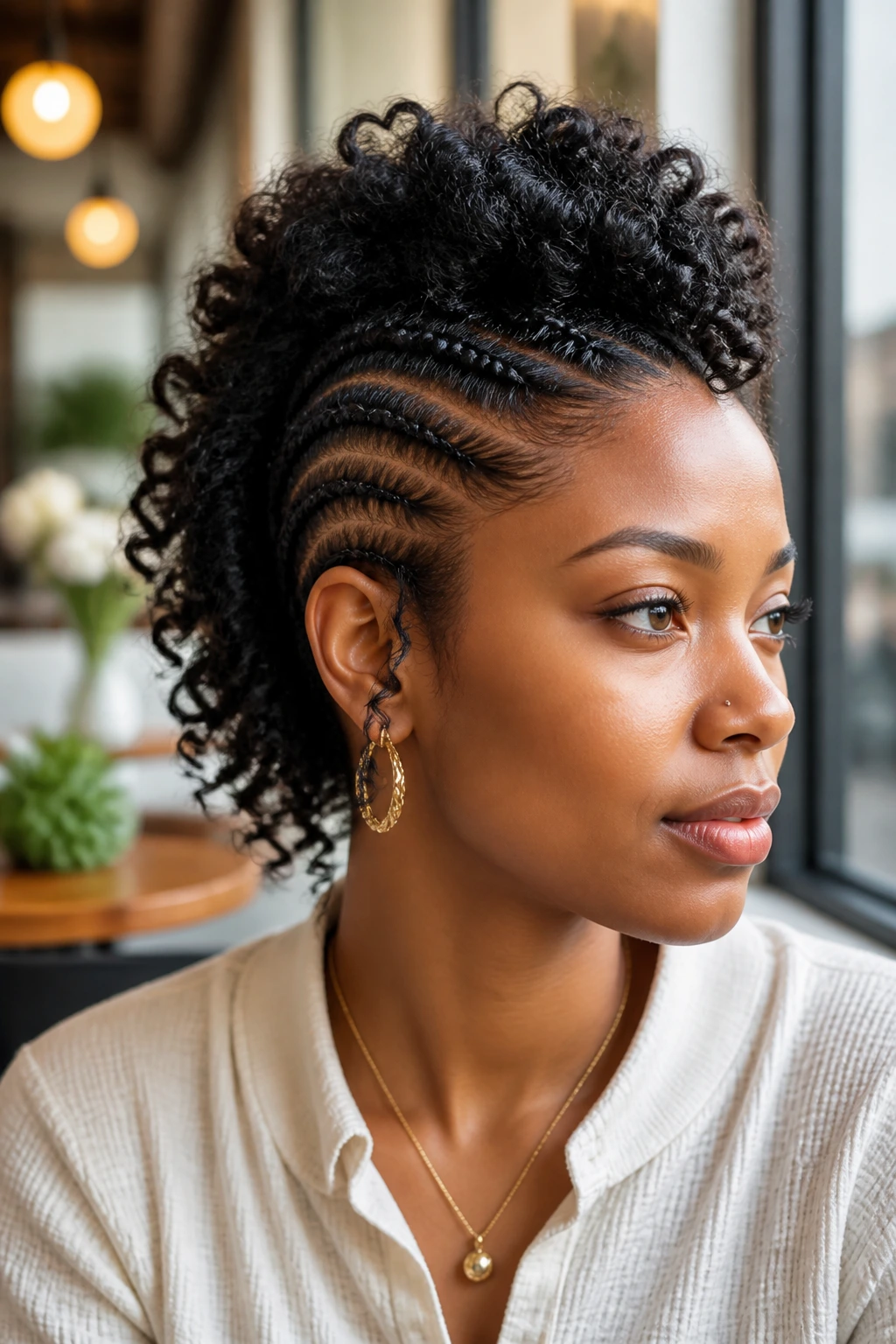
Temple cornrows are the quiet achiever of this whole group. The rows focus on the sides and temples, while the top keeps a little volume and the loose curls do the softening. That keeps short hair from looking flattened at the crown.
I like this when the top section is the strongest part of the haircut. The temple braids pull the face in, and the top stays just loose enough to give height. The curls can sit at the back or around the crown, depending on whether you want the style to feel more casual or more finished.
Good reasons to choose it
- It gives the hairline a neat frame without pulling every strand back.
- The top volume helps short hair look fuller, not scraped tight.
- Loose curls at the back keep the silhouette soft.
This style is especially good on tapered cuts or shapes with a little natural lift at the top. It respects the haircut instead of forcing it into a box. That matters more than most people admit.
19. Basketweave Cornrows with Free Curls
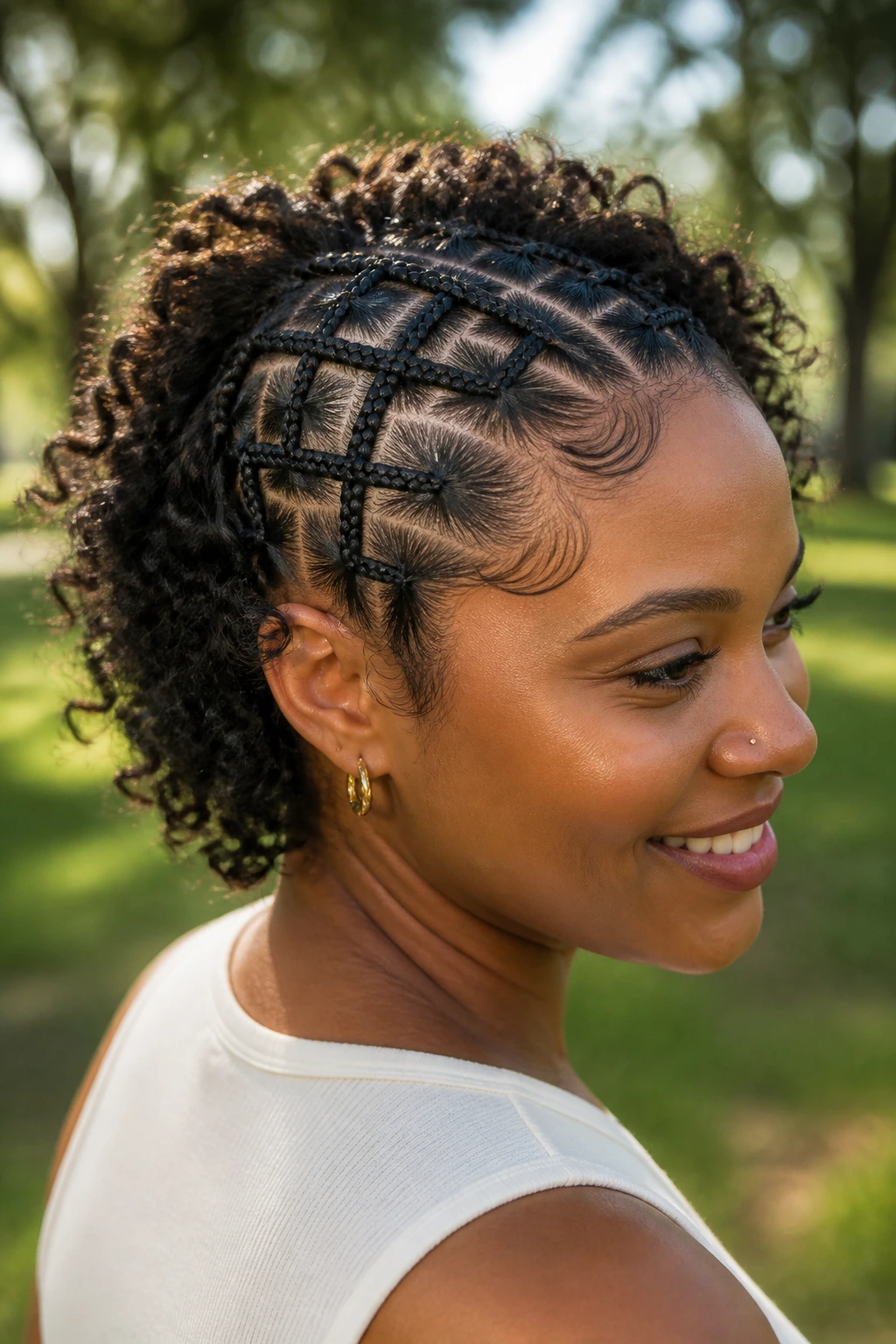
Basketweave patterns look intricate, but on short hair they can be surprisingly practical. The back-and-forth line makes the scalp design feel rich without requiring a lot of length, and the free curls keep the look from getting too structured.
The key is spacing. Basketweave only works when the pattern is clear, so the rows need to alternate cleanly. On short natural hair, a busy weave can easily look like a tangle if the parts are sloppy. Keep it organized and let a few curls fall free around the edges or at the back so the pattern breathes.
This style works well for people who enjoy braid detail but do not want a full head of tiny rows. It gives you visual texture without making the scalp feel overloaded. And because the curls are free rather than pinned into one rigid shape, the whole style has a softer finish.
A small warning: basketweave patterns can take a little longer to install, so this is the one I’d choose when you have time and want the style to hold its own for several days. Rushing the parting always shows.
20. Nape Cornrows with a High Curly Bun
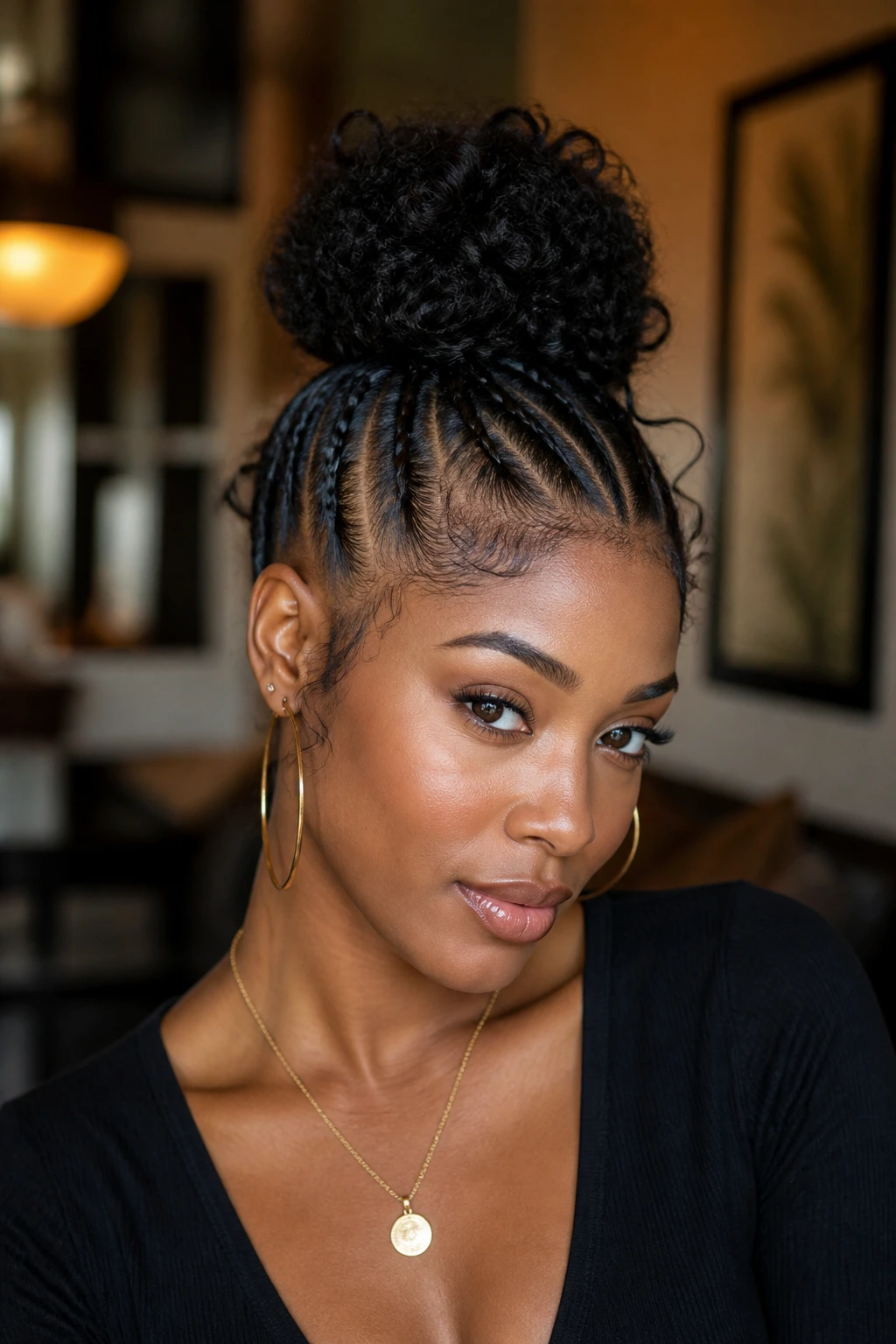
A nape-focused braid pattern is one of the cleanest ways to handle short hair that needs to stay up and out of the way. Pull the cornrows low, then gather the loose curls into a high bun that sits just above the crown. The contrast gives the style a little lift.
This works because the braids anchor the lower head, where short hair can be the most stubborn, and the bun gives the style a focal point. If you’ve ever had a short braid style that looked fine from the front but wandered at the back, this solves that problem. The bun keeps the finish contained.
If the curls are too heavy, the bun can sag. So keep the curl bundle compact. A few fluffy pieces around the bun are enough. You are after shape, not bulk. That is the part a lot of people miss.
Practical note
If your hair is very short at the nape, use pins or a small elastic that matches your hair color. The support should disappear. You want the eye to stay on the braid path and the curl shape, not on what is holding everything together.
21. Feed-In Cornrows with Ringlet Extensions
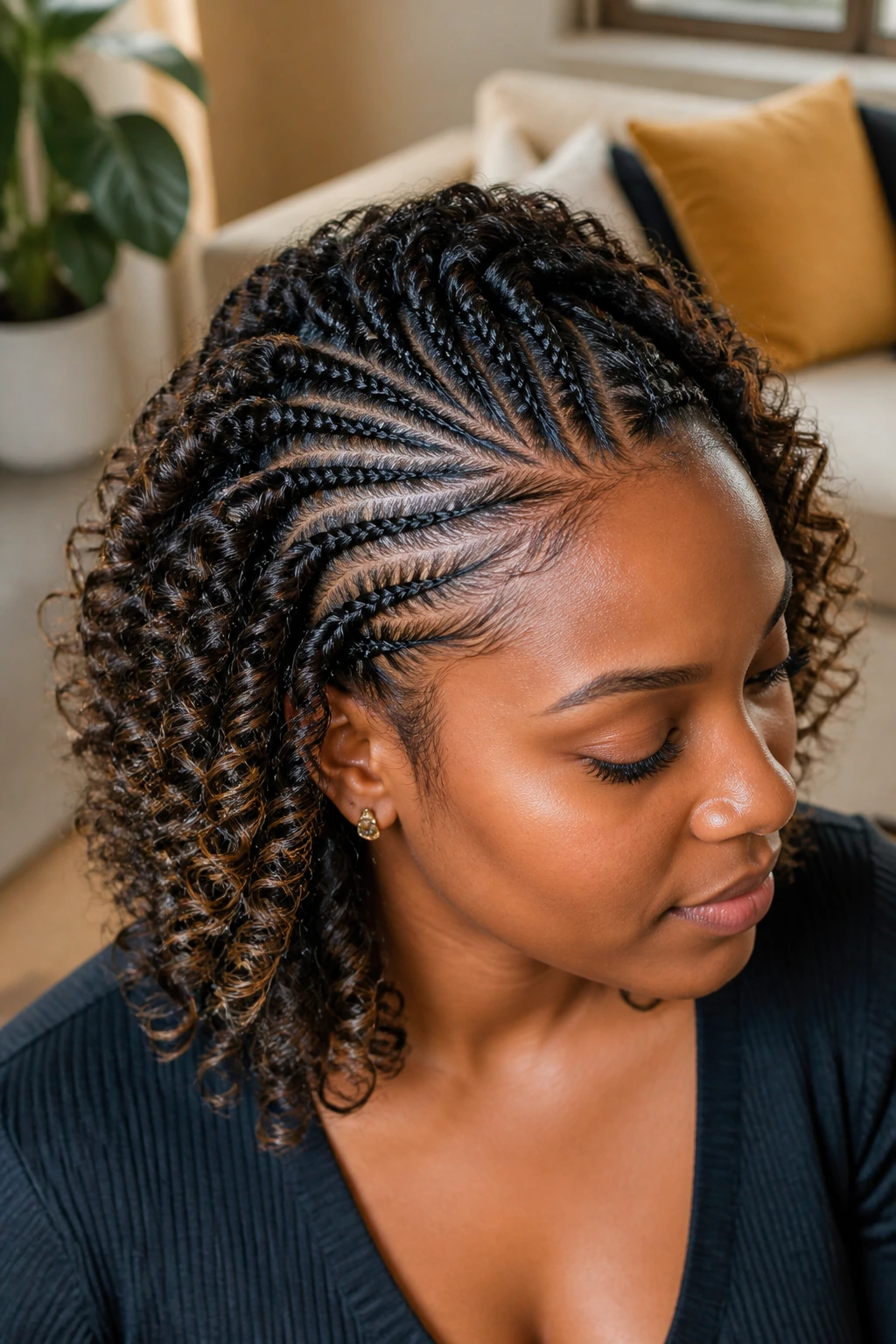
Feed-in braiding is one of the smartest tools for short natural hair because it lets you build the braid gradually instead of forcing a thick section from the start. Pair that with ringlet extensions, and you get a finish that looks full without feeling bulky.
The gradual feed-in matters more on short hair than on long hair. It keeps the root area flat and smooth, which helps the style sit close to the scalp. Then the ringlets add that loose curl finish the title promises. If you want a more defined curl shape, keep the ringlets separated. If you want softness, fluff them gently with fingers coated in a little oil.
I like this style when the goal is length without weight. Ringlet extensions can look elegant, but only if they are kept light. Too much added hair and the short base starts to struggle. The braid no longer looks like a clean extension of your hair; it looks like it is sitting on top of it.
This one is also a good candidate for color accents. A warm brown, honey, or auburn curl can make the black cornrows pop without needing a dramatic cut or dye job.
22. Event-Ready Cornrows with Gold Cuffs and Glossy Curls
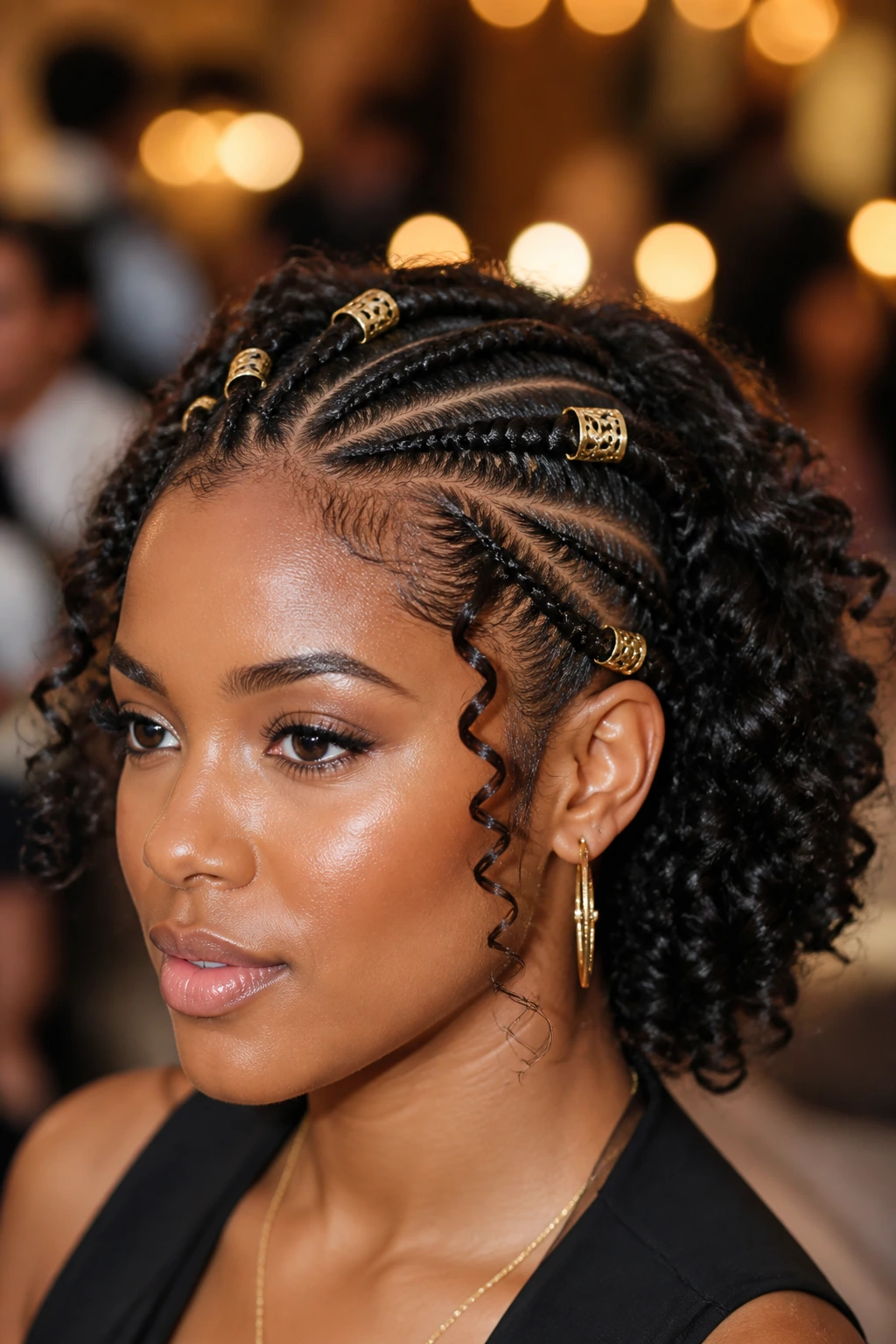
This is the dress-up version. The rows are clean, the curls are glossy, and the gold cuffs give the style enough shine to hold its own under bright lights. On short natural hair, that kind of finish can be a lifesaver when you want polish without extra length.
The braid pattern itself can be simple or layered, but the finishing matters. Keep the curls smooth and separated, not frizzy or overworked. A light foam at the end helps, and a tiny bit of sheen spray near the braid lengths can make the whole style look more expensive without making it greasy. I do mean a tiny bit. Too much shine product turns the curls stringy fast.
Gold cuffs work best when they are placed with restraint—one near the front, one or two near the back, maybe a single accent on one side. More than that can tip the look into costume territory. The goal is a style that looks intentional when you walk in and still feels wearable when you leave.
This is the one I’d choose for a wedding guest look, a dinner out, or any event where you want the hair to look finished from every angle.
Why This Braided-and-Curly Mix Feels So Good on Short Hair
Short hair does not need to be hidden. It needs a shape that respects its length.
That is the real appeal of these looks. The braid gives the hair a line to follow, the curls keep the style from looking too stern, and the short length keeps everything close enough to the head that the details actually matter. No wasted inches. No loose ends dragging the style down.
Cornrows with loose curls also let you choose how much attention you want. A two-row style with soft ends is quiet. A mohawk braid with a high curly center is not quiet at all. Same hair length. Completely different mood.
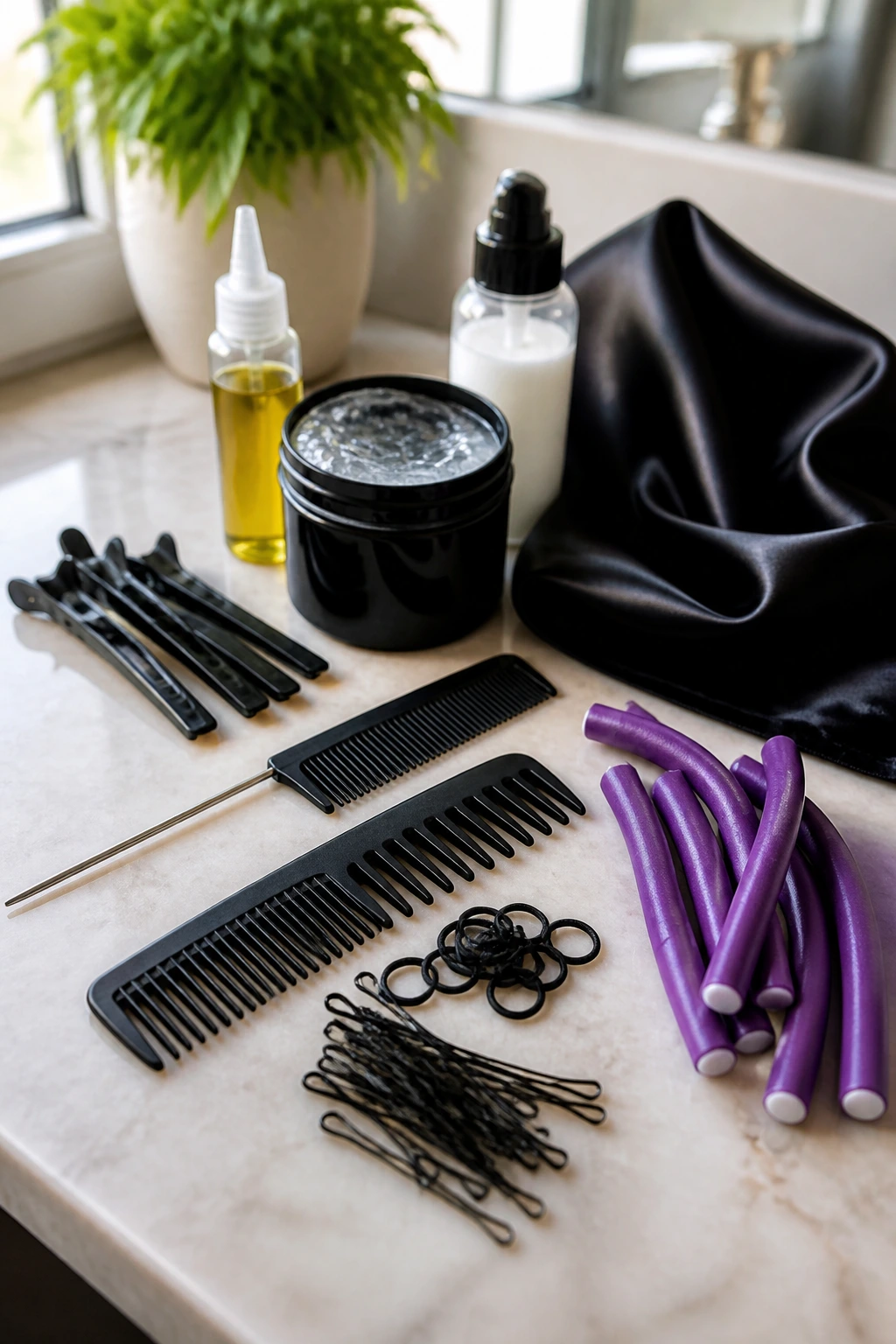
Essential Tools for These Styles
-
Rat-tail comb: Clean parts start here, and short hair shows crooked sections faster than long hair does.
-
Wide-tooth comb or detangling brush: Use this to stretch and smooth the hair before parting so the rows grip evenly.
-
Styling clips: They keep the unbraided sections out of the way while you work through small parts.
-
Braiding gel or light edge control: Use a small amount at the roots for grip and clean parts, not a thick layer that flakes later.
-
Foam wrap lotion or setting mousse: This helps the loose curls stay soft and shaped without turning crunchy.
-
Small elastics or clear bands: Handy for securing added curls or small bun finishes when the style needs extra support.
-
Bobby pins: Useful for buns, crowns, and tucked ends on short hair where the braid alone needs backup.
-
Satin scarf or bonnet: Night protection matters. The style looks better on day three when it sleeps properly.
-
Curling rods or flexi rods: Helpful if you are setting the loose curls yourself, especially on added hair or leave-out.
-
Light scalp oil or applicator bottle: Best for keeping the scalp comfortable between washes without soaking the braids.
Smart Product Picks and Hair Prep
Short natural hair behaves better when it is clean, stretched, and lightly moisturized before braiding. That does not mean loaded up with butter. Heavy creams can make the parts slippery, and slippery parts do not hold the way you want them to. A lightweight leave-in, a little oil on the scalp, and a stronger hold product at the roots is usually enough.
If your hair shrinks hard, stretch it first. Banding, twists, or a low-heat blow-dry on a cool setting can make the braid base easier to grip. You do not need bone-straight hair. You just need enough control to let the rows lie flat. That small bit of prep saves time later because the braid does not have to fight the shrinkage.
For the loose curls, choose your texture on purpose. Soft spiral curls look best when you want a more romantic finish. Larger curls or brushed-out waves make the style feel fuller and more casual. If you are using added hair, match the curl pattern to the braid size. Tiny braids with huge curls can look disconnected. Big braids with tiny curls can look sparse.
A light foam at the end is usually better than a heavy gel all the way through the style. Gel can dry flaky on curly extensions. Foam keeps the curls separated and gives the whole look a softer movement. I also prefer not to overload the hairline. A little edge product goes a long way. Too much and the front starts looking stiff before the day is over.
How to Wear Them with Outfits and Accessories
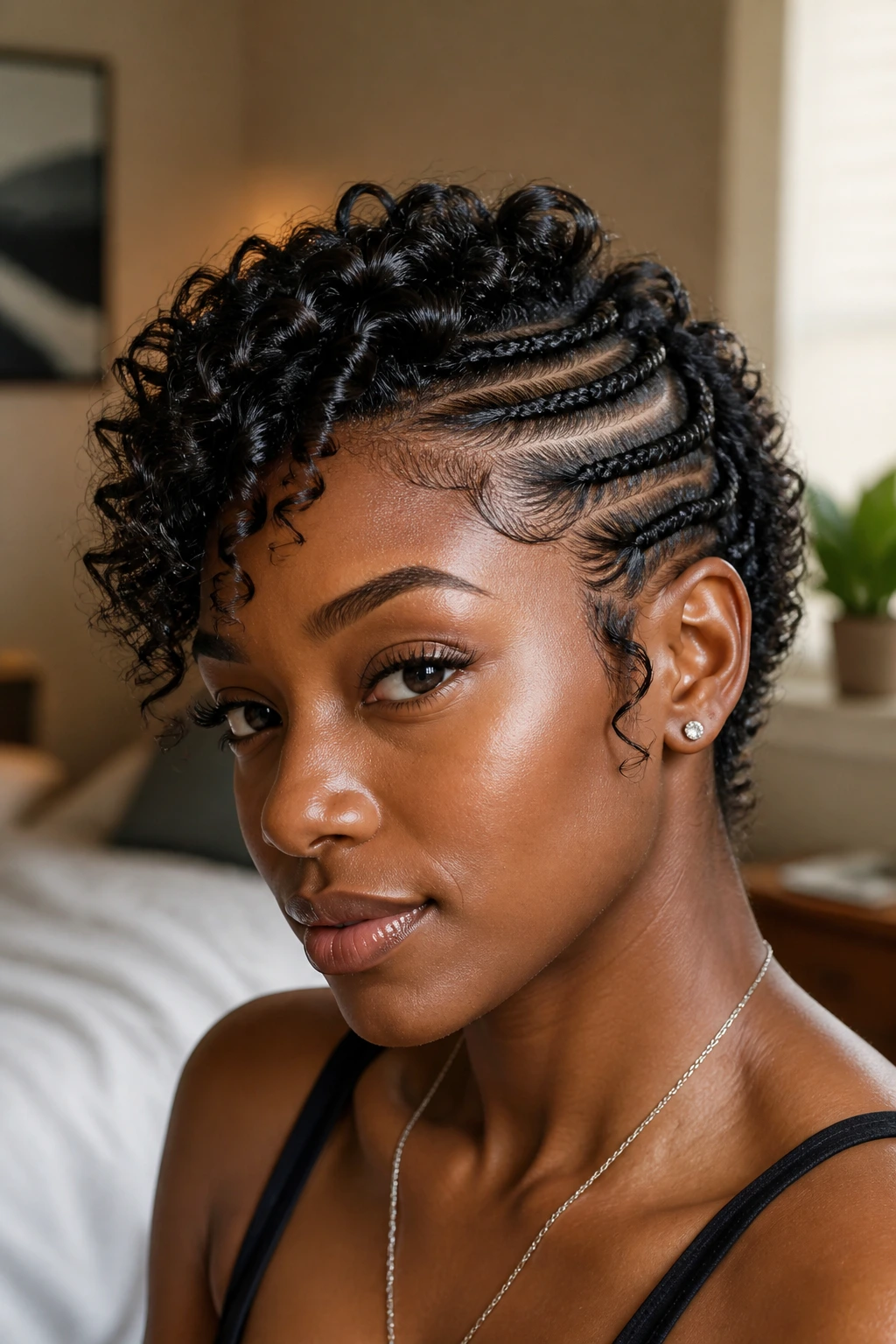
Presentation: Let the braid pattern show. Pull collars down a little, keep the neckline clean, and do not hide the best part of the style under a high jacket. A side part or crown braid should be visible at a glance.
Outfits: These looks work with plain tees, tailored blazers, hoop earrings, knits, and open-neck tops. If the braids are bold—say, a mohawk or basketweave—keep the clothes simple. If the style is smaller and sleeker, you can wear a bigger necklace or a patterned top without the whole outfit fighting itself.
Occasions: The cleaner straight-back and side-part styles fit work, errands, or school runs. The halo, crown, and event-ready versions lean dressier. The nice thing is that short hair does not trap you in one lane. You can go from practical to polished with cuffs, a glossy finish, or a sharper part.
Accessories: Gold cuffs, small beads, silk ribbons, and one strong pair of earrings can change the mood fast. I would avoid piling on too many accessories at once. On short hair, one or two accents usually land better than a crowded set.
Small Tweaks That Keep the Rows Clean
Parting first, styling second. If the parts are even, the style already looks better than half the braid looks people wear. On short hair, I like to map the whole head before braiding the first row. That way, you do not get trapped into making one side thicker just because you ran out of room.
Keep the feed-in light. Short hair does not need a heavy braid base. Adding too much hair too soon makes the row bulky and harder to smooth. Start small, build gradually, and stop as soon as the braid holds its shape.
Place the curls where the eye lands. A curly tail at the nape feels different from one at the crown or one draped over the shoulder. Decide where you want the style to move, then put the curls there. Sounds simple. It is. But people skip it all the time.
Use foam, not grease, on the loose curls. Heavy product drags the curls down and makes them separate in ugly little strings. Foam keeps the movement soft and the finish cleaner.
Common Mistakes That Ruin the Shape

Too much tension at the hairline. The symptom is obvious: a tight, shiny front that feels tender by the end of the day. The fix is smaller sections and a softer grip at the roots. Short hair does not need to be pulled to cooperate.
Rows that are too wide for the hair length. When the braids are too thick, they bulge and lift instead of sitting flat. The style looks unfinished. Narrow the sections and, if needed, add just enough feed-in hair to support the braid.
Heavy oils or thick creams before braiding. The hair becomes slippery, and the parts keep collapsing. Use a lighter leave-in and save richer products for after the style is set, if you need them at all.
Curls that are brushed too aggressively. They frizz fast and turn vague. Separate them with fingers or a wide-tooth comb, then stop. Short hair with loose curls looks best when the curl pattern still has some shape.
Sleeping without protection. The next morning brings flattened curls, fuzzy roots, and braid edges that do not sit right. A silk scarf or bonnet is not optional if you want the style to keep its line.
Variations and Adaptations to Try
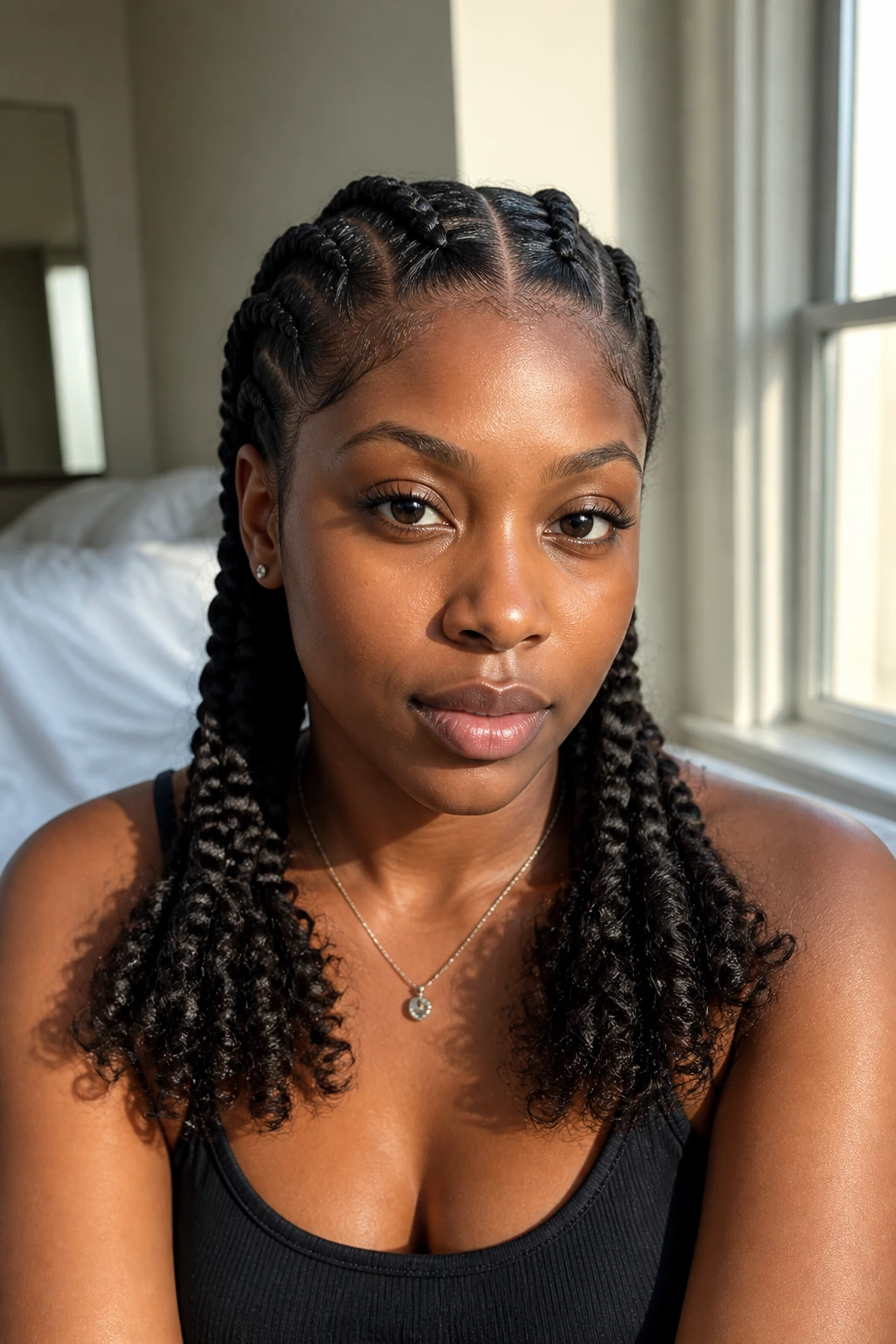
Barely-There Rows: Use just two or three slim cornrows and let most of the style come from the loose curls. This is a good pick if you want a softer look and your hair is very short at the sides.
Extra-Gloss Finish: Add a little sheen spray to the braid lengths and use a foam wrap on the curls. The result is cleaner and dressier, especially for nighttime wear or formal events.
Low-Tension Protective Version: Keep the rows small, skip heavy extensions, and leave the curls light. This works well if your scalp gets sore easily or if your edges need a gentler week.
Color-Accent Curls: Swap in honey, auburn, burgundy, or deep brown curly extensions for the loose sections. Even a small color change can make the cornrows pop without touching your natural hair color.
Weekend Soft Glam: Brush the curls out just enough to widen them, then add cuffs near the front rows only. It reads relaxed but still finished, which is a nice balance for brunch, parties, or a dinner out.
How to Keep the Style Fresh
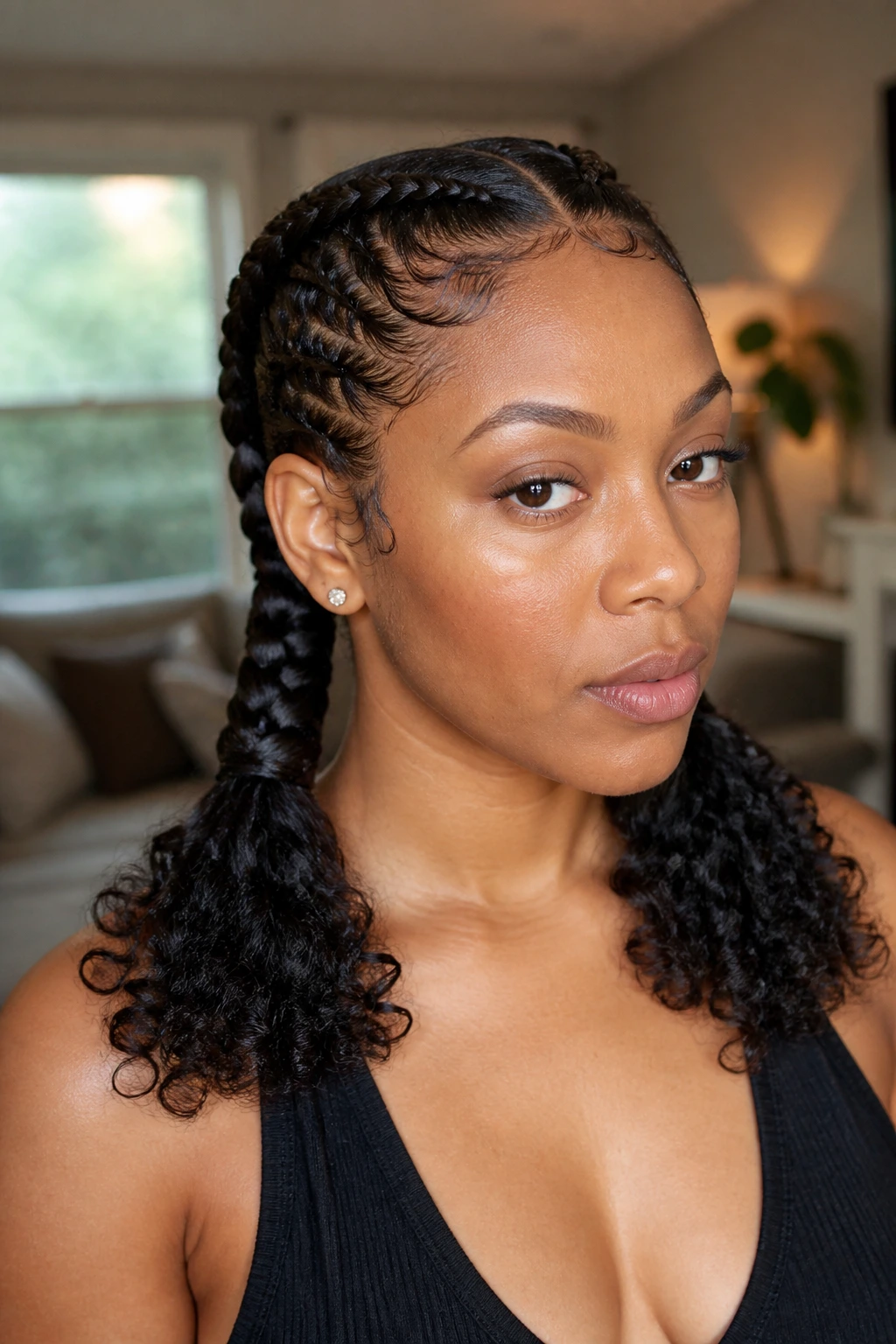
Short cornrows with loose curls usually look best for about two to four weeks, depending on your hair growth, the braid size, and how much added hair you used. The sweet spot is often around the two-week mark, when the roots are still neat but the style has softened a little.
At night, wrap the braids with a silk scarf or wear a bonnet that actually covers the curls without flattening them too hard. If the curls are long enough to twist, gather them loosely so they do not get crushed under your head. A silk pillowcase helps too, but it does not replace the scarf.
For the scalp, use a light applicator bottle with diluted oil or a scalp serum every few days if the skin feels dry. Do not soak the braids. That only brings buildup and makes the roots limp. If you need to clean the scalp, a foam cleanser or diluted shampoo around the roots every 7 to 10 days works better than scrubbing with thick product.
The curls themselves can be refreshed with a mist of water and a little mousse, then finger-separated once they dry. If the ends have gone flat, roll a few pieces around flexi rods for a short reset. It is a small effort, and it changes the whole look.
Frequently Asked Questions
How short is too short for cornrows with loose curls?
If the hair is too short to grip at all, the braid base will not hold cleanly. Many stylists can work with very short natural hair if the sections are small and the tension stays controlled, but hair that cannot be gathered at the root usually needs either a growth-out period or a different protective style.
Can I do these styles without added hair?
Yes, some can be done with your own hair alone, especially if the loose curls are just the natural ends left out or set on rods. Still, a lot of the fuller looks use a small amount of added curly hair because short hair does not always have enough length to create a visible curl drop.
Will loose curls make the style frizz faster?
They can, especially if you touch them too much or sleep without protection. Foam, a satin wrap, and finger separation instead of brushing keep the curl shape soft without turning it fluffy too soon.
How long do these styles usually last?
Most of them look their best for about 2 to 4 weeks. Smaller, cleaner rows can sometimes last a bit longer, but if the front starts lifting or the scalp feels crowded, it is time to take them out rather than push the style too far.
Can I wash my hair while wearing cornrows with loose curls?
Yes, but keep it gentle. A diluted shampoo or foam cleanser at the scalp works better than a rough scrub, and you should let the style dry fully so the braids do not stay damp near the roots.
What if my edges are fragile?
Choose a low-tension style with fewer rows and less added hair. Avoid tight swoops at the hairline, skip hard brushing of the curls near the front, and make sure the braider is not pulling the first few rows too snugly.
Do these styles work on 4C hair?
Absolutely. In fact, short 4C hair often holds cornrows well once it is lightly stretched and sectioned cleanly. The key is not length alone; it is grip, parting, and using the right amount of feed-in hair where needed.
What if the curls go flat after the first day?
Mist them lightly with water, add a small amount of foam, and finger-coil a few pieces back into shape. If the curls were set with rods, you can also re-roll a few sections overnight for a quick reset.
A Style That Knows What Short Hair Can Do
Short hair does not need to apologize for being short. When the cornrow pattern is clean and the loose curls are placed with care, the result feels deliberate, not compromised. That is the part people miss when they try to force length onto a cut that does not want it.
The best styles in this collection work because they respect the hair’s actual shape. They use braid lines to create control, then let curls loosen the edges, soften the frame, and add movement where the scalp would otherwise do all the talking.
Pick the version that fits your face, your hairline, and your patience level. The right one will not fight your hair. It will sit on it like it was meant to be there.