



Short curly hair has a way of looking finished even when you barely touched it. A clean part, a metal clip, a little gel at the roots, and suddenly the whole shape reads on purpose.
That is the real draw of texture hairstyles for short hair with curly hair: the cut does half the work, and the styling only needs to sharpen the outline. You are not fighting your curl pattern here. You are framing it, nudging it, maybe pinning one side back, and letting the rest do what it already wants to do.
And short curls give you options that long hair hides. A jaw-length bob can swing from soft and airy to sleek and sculpted with one product change. A cropped coil pattern can look polished with finger coils one day and rough-dry, piece-y, and cool the next. None of it needs to be complicated. It does need to be intentional.
Why These Short Curly Styles Earn Their Keep
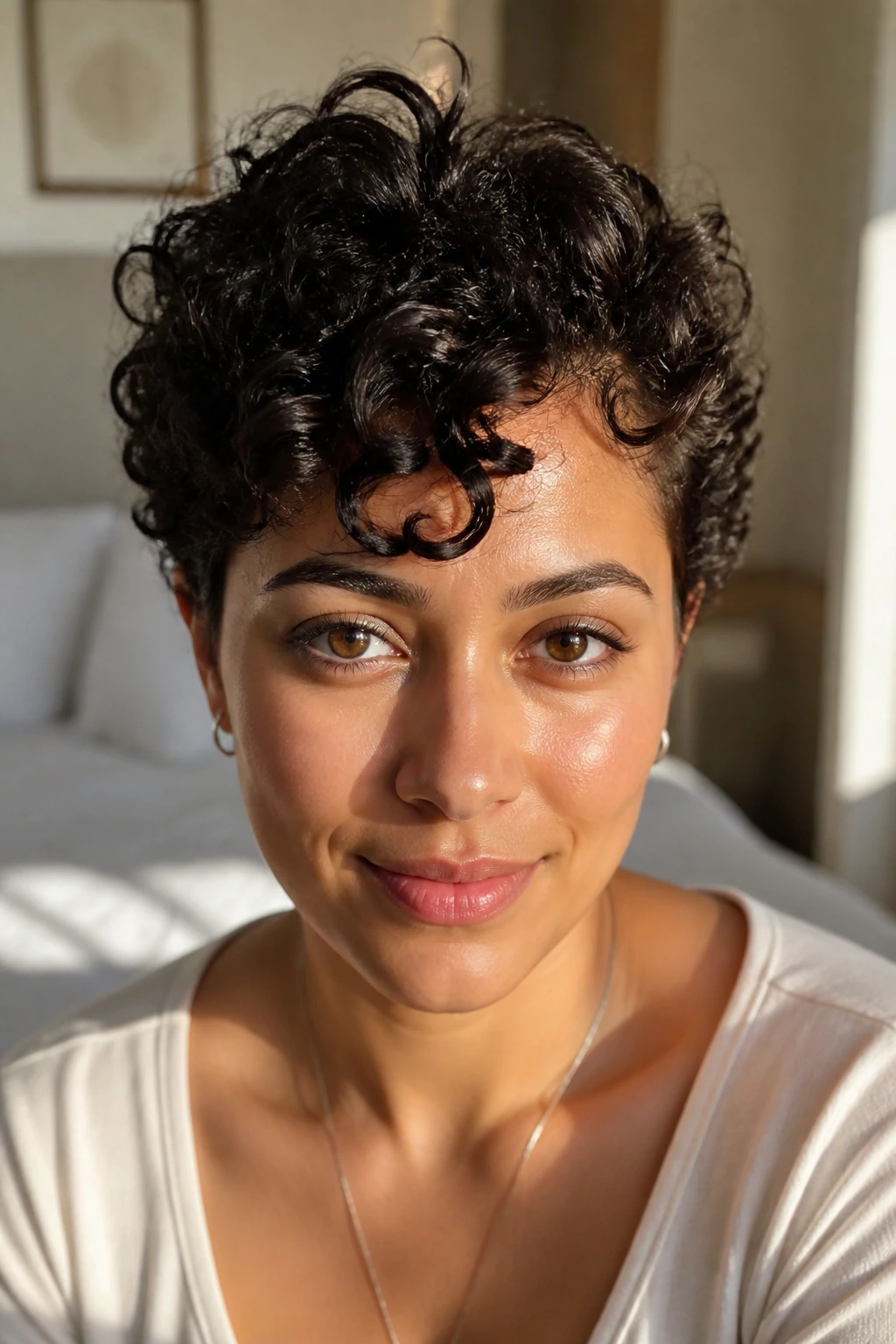
- Less weight, more shape: Short curls spring up faster because there is less length dragging them down, which means your part, crown lift, and side volume show up sooner.
- Faster resets: Most of these looks can be revived with water, a little mousse, and a diffuser pass instead of a full wash.
- Better curl definition: Short hair makes curl clumps easier to see, so one good styling pass can sharpen the whole head instead of just the top layer.
- Accessory-friendly: Clips, scarves, headbands, and pins have room to matter on short hair; they change the silhouette fast.
- Low-tension styling: The best short curly styles use pinning, twisting, and shaping—not tight pulling that leaves the scalp sore by noon.
- Works across curl types: Loose waves, springy spirals, and tight coils all respond well to the same short-hair styling moves, just with different product weight and hold.
1. Rounded Curly Bob with a Deep Side Part
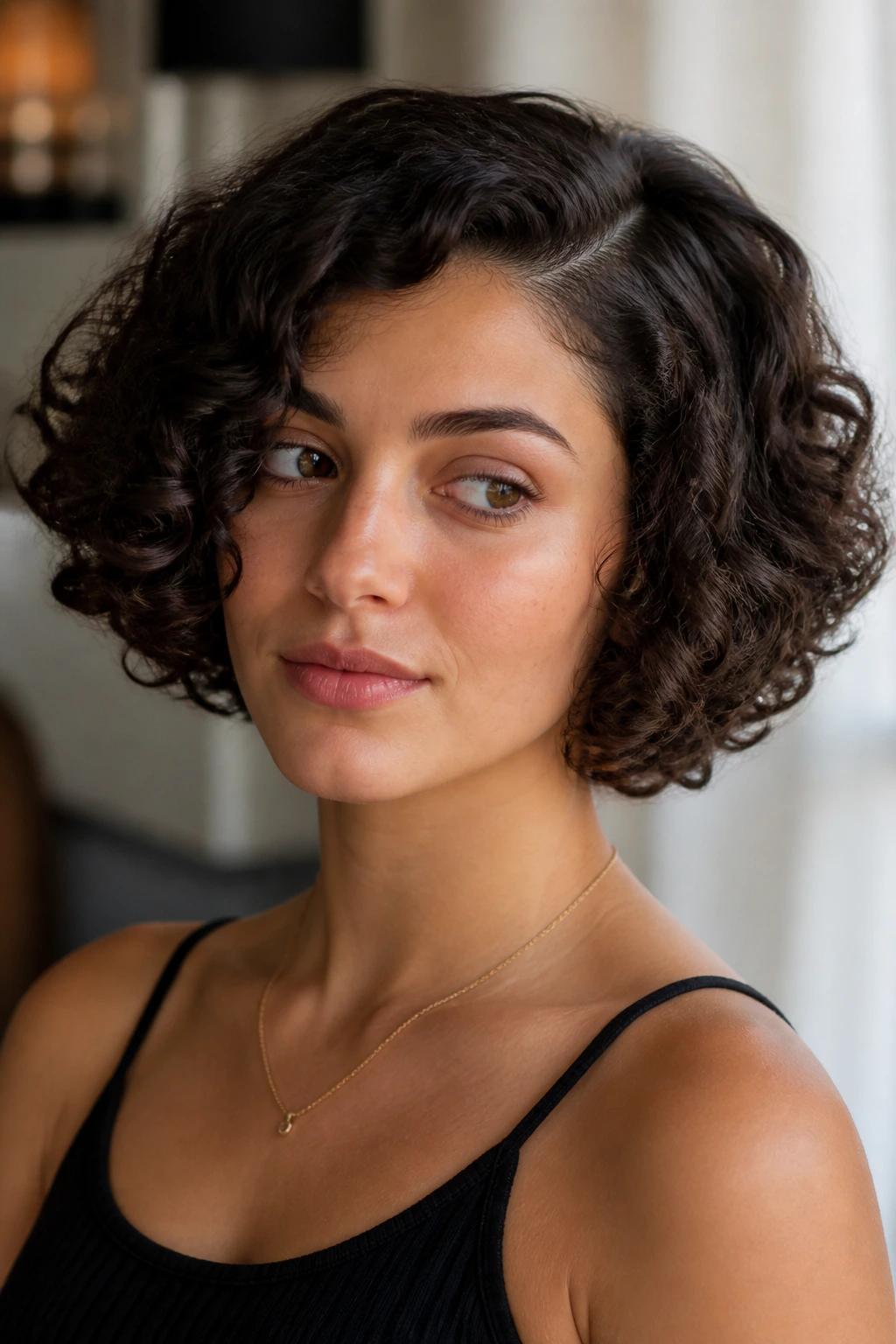
A rounded curly bob with a deep side part has that clean, edited shape that makes short curls look expensive without trying too hard. The deeper part pushes one side into soft lift, and the curls stack in a way that gives the bob a little arc around the cheekbones. It is one of those styles that looks planned even when you styled it in ten minutes.
The trick is hold at the roots, not just on the ends. On damp hair, rake in a light leave-in, then a mousse or foam from the roots through the mids, and finish the ends with a small touch of gel if your curls frizz early. Clip the heavier side at the root while it dries, then diffuse on low heat until the shape holds.
What makes it work
The side part creates an instant line, and that line is doing real work. It gives short curls direction, which matters more than length when the hair sits between jaw and chin. If your curls want to puff outward, this style reins them in just enough.
2. Tapered Curly Pixie with Soft Edges
A tapered curly pixie is for the days when you want the back and sides neat, but you still want the top to move. Keep the nape closer to the head and let the crown stay loose enough to show curl bends and tiny ringlets. It reads sharp, not stiff.
I like this style with a curl cream that has some slip and a touch of gel at the front hairline. Use your fingers more than a brush. Push the curls up at the crown while they are damp, then let the side taper dry smooth so the contrast is obvious. If your hair shrinks a lot, that is not a problem here. It actually helps.
Best on
- Hair that is shorter at the nape and a little longer on top
- Coils that lose shape when overloaded with heavy cream
- Anyone who wants a cropped style without a flat crown
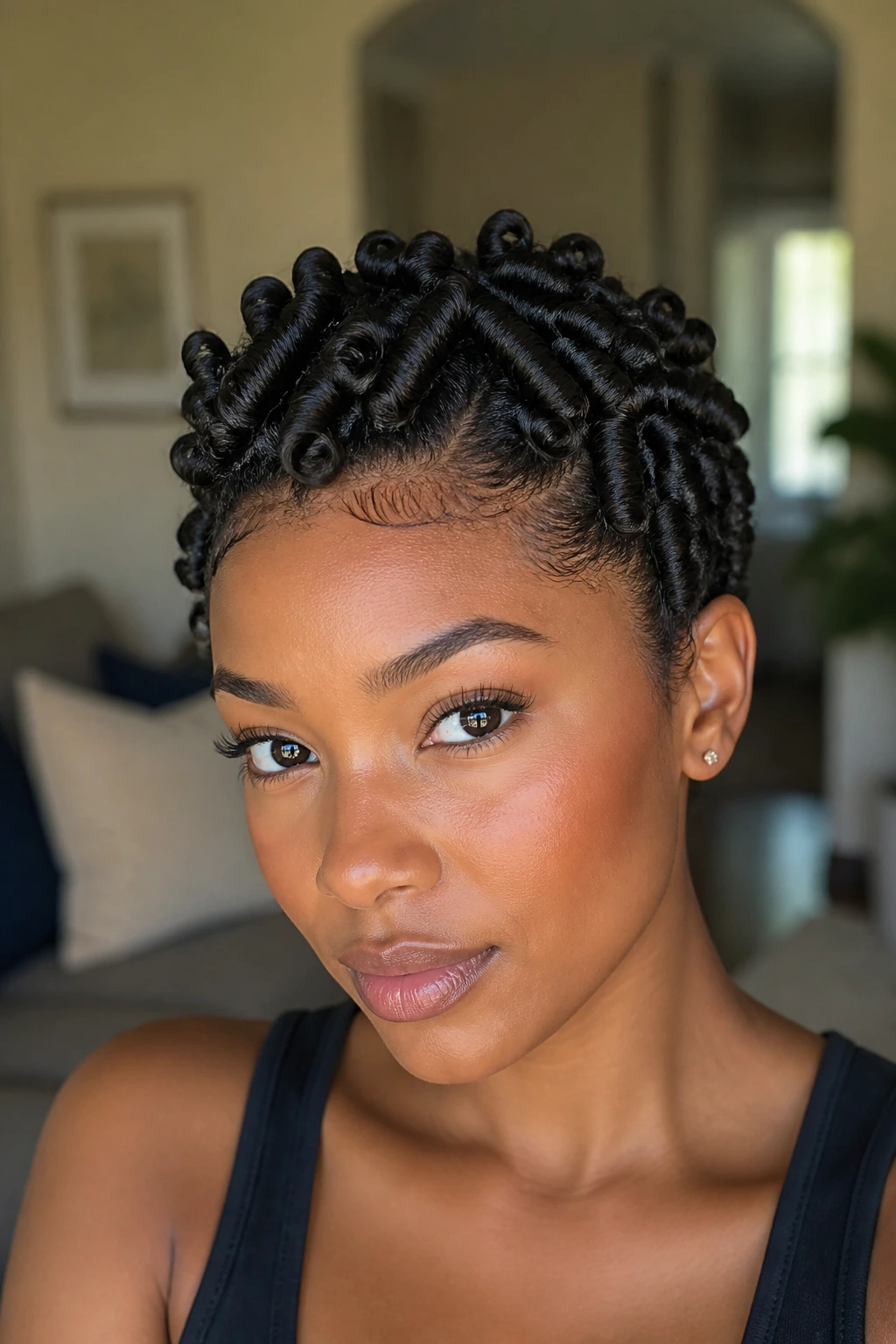
3. Finger Coils Wrapped Tight at the Crown
Finger coils give short curly hair a very deliberate finish. Small sections, a little gel, and repeated twisting turn a loose crop into a tighter, more sculpted shape that holds its own for days. The top can look almost bead-like when done cleanly, which is part of the appeal.
Start on soaking-wet or very damp hair. Work in tiny sections, coat each one with a strong-hold gel, and twist the strand around your finger until it forms a neat coil from root to tip. Let them dry fully before touching them. Half-dry finger coils are a mess. Fully dry ones click into place.
One detail people skip: part size matters. Bigger sections give you wider coils and more fluff; smaller sections give you that neat, defined finish. If you want the coils to sit close together, keep the sections consistent and resist the urge to separate them too early.
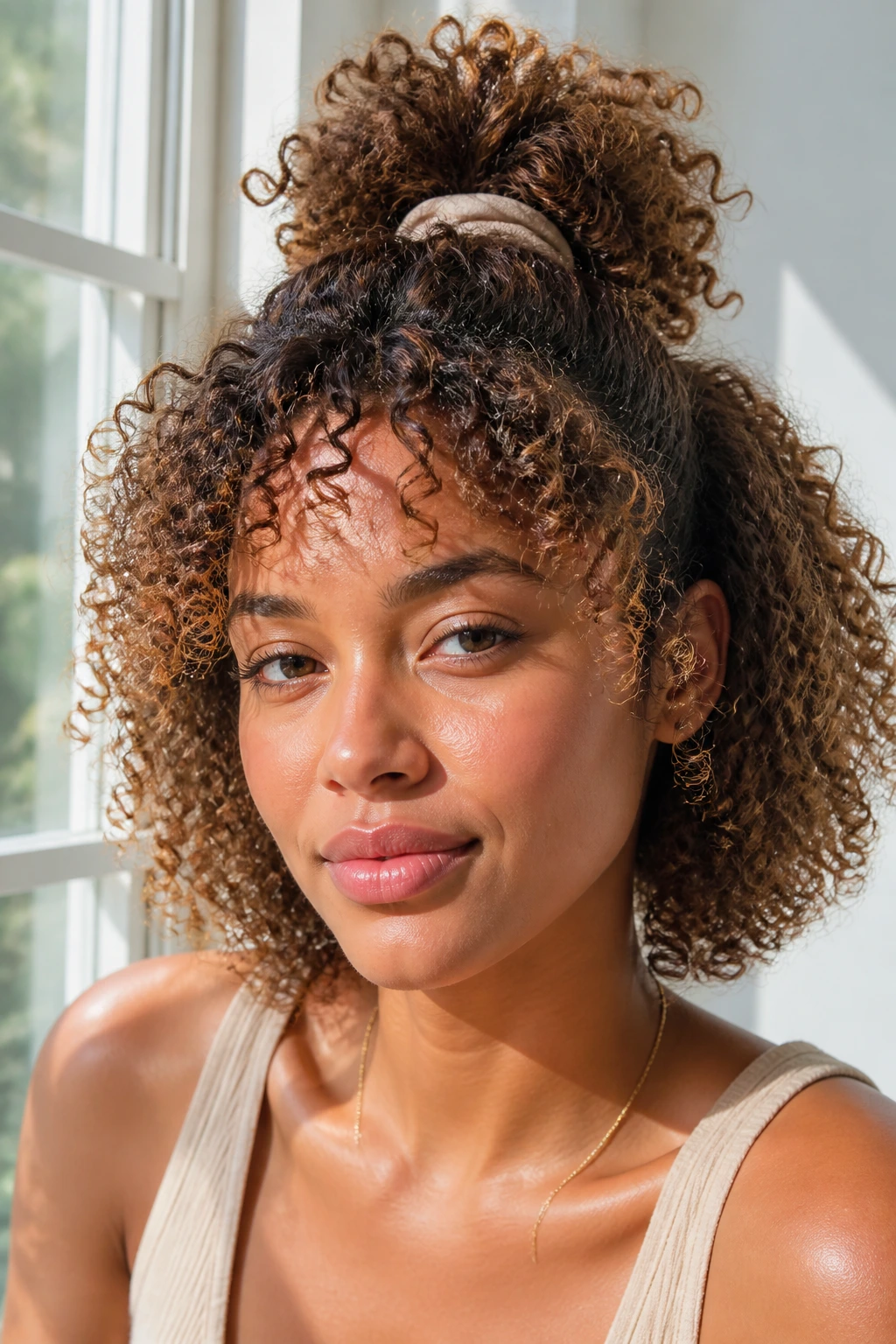
4. Half-Up Pineapple Puff
The half-up pineapple puff is the style I reach for when short curls need lift but not a full updo. Gather the top section loosely at the crown, let the back and sides keep their curl pattern, and secure the top with a soft scrunchie or coil-friendly tie. The result is playful without getting childish.
This works especially well on hair that sits around the ears or jaw. You do not need enough length for a true ponytail; you only need enough for a gentle lift at the crown. Pull too tight and the whole thing gets strained. Keep it loose, then fluff the front pieces so the shape still feels curly instead of stretched.
A small mist of water at the roots helps the top section gather cleanly. If your curls are day-two and a little puffy, this style hides the reset very well.
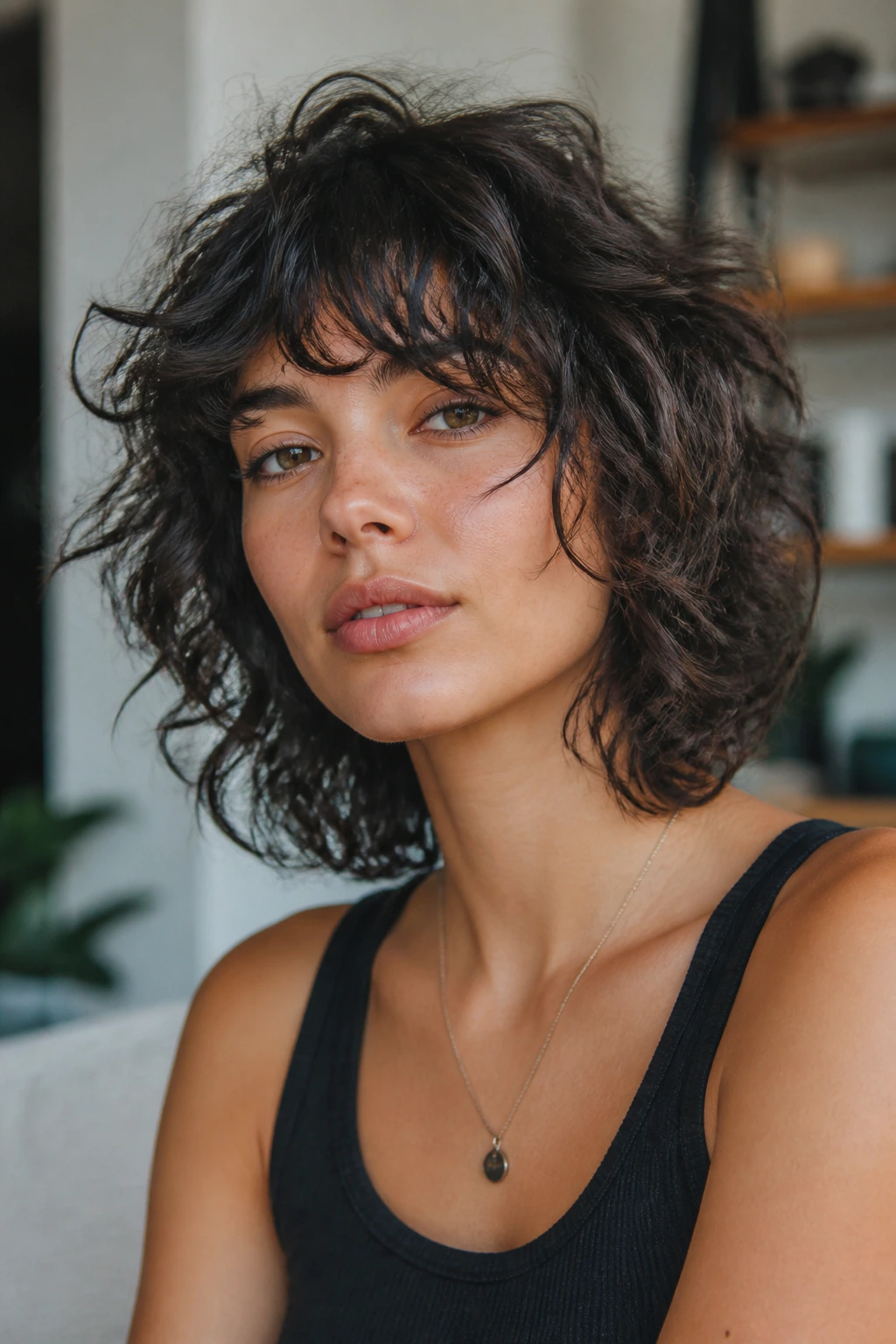
5. Curly Shag with Choppy Layers
A curly shag is the style that makes short curls look alive. The layers create little shelves of movement, so the hair never sits as one block. Around the face, the curls break into soft pieces; at the crown, the shorter layers lift before the ends even get a chance to drag them down.
This one likes a lighter product hand. Too much cream and the layers collapse into each other. Instead, use a leave-in plus mousse, then scrunch while the curls are still damp. Diffuse with your head upright if you want a cleaner crown, or upside down if you want more lift at the roots. Both work, but they do not look the same.
Why I keep coming back to this cut
It gives you shape even when the style is a little messy. That is the point. A shag on short curly hair does not need perfect definition to look good; it needs good layers and a little separation.
6. Deep Side-Swept Bob
A deep side-swept bob has drama built in, but it is a quiet kind of drama. One side falls over the forehead, the other side opens the face, and the whole shape leans instead of sits square. It feels slightly dressed up even with a T-shirt.
Use a rat-tail comb to draw the part far over, then clip the heavier side at the root while it dries so it holds that direction. A mousse at the crown helps the lift stay where you want it. If your hair keeps flipping back, a duckbill clip at the root for ten minutes does more than another layer of product.
The finish matters here. Let the front pieces stay soft and a little piece-y. If you over-separate, the style loses the sweep and starts reading like basic big curls instead of a real side-swept shape.
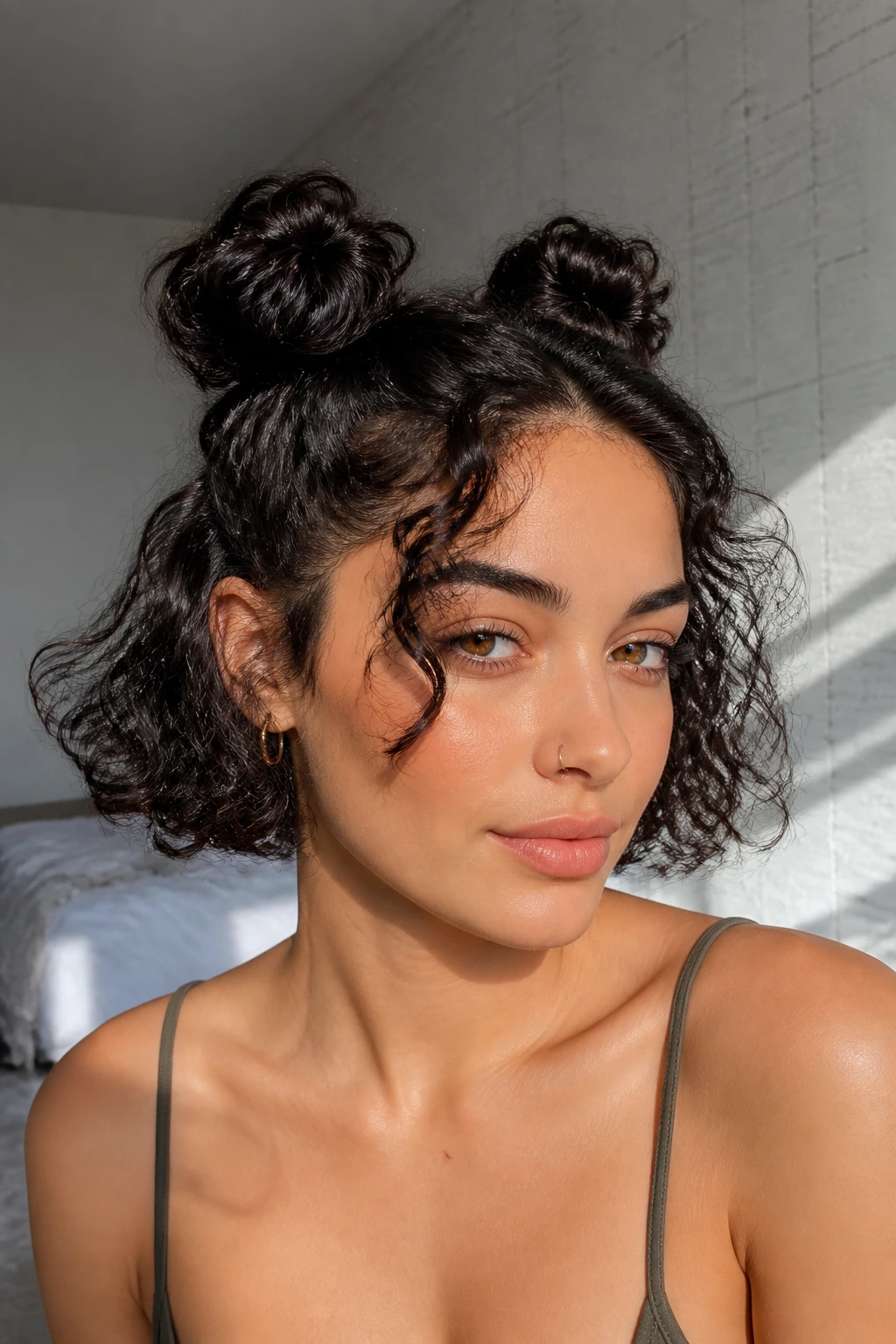
7. Mini Space Buns on a Curly Crop
Mini space buns are one of the few short curly styles that can look neat and playful at the same time. The buns sit high enough to show the curl texture, while the loose ends or underlayers keep the style from feeling too polished. On chin-length hair, they sit like little knots of texture. On shorter hair, they become more of a lifted twist-and-pin look.
Split the top half into two small sections, then twist each side into a compact bun and secure with pins or mini elastics. Leave the bottom layer free if you can. That contrast is what makes the style work. If every curl gets pulled in, the result can look cramped.
I prefer this on second-day curls because the hair has a bit more grip. Freshly washed hair can be too slippery unless you add mousse first. A little edge smoothing around the temples keeps the buns from looking fuzzy by lunch.
8. Flat-Twist Halo with Loose Ends
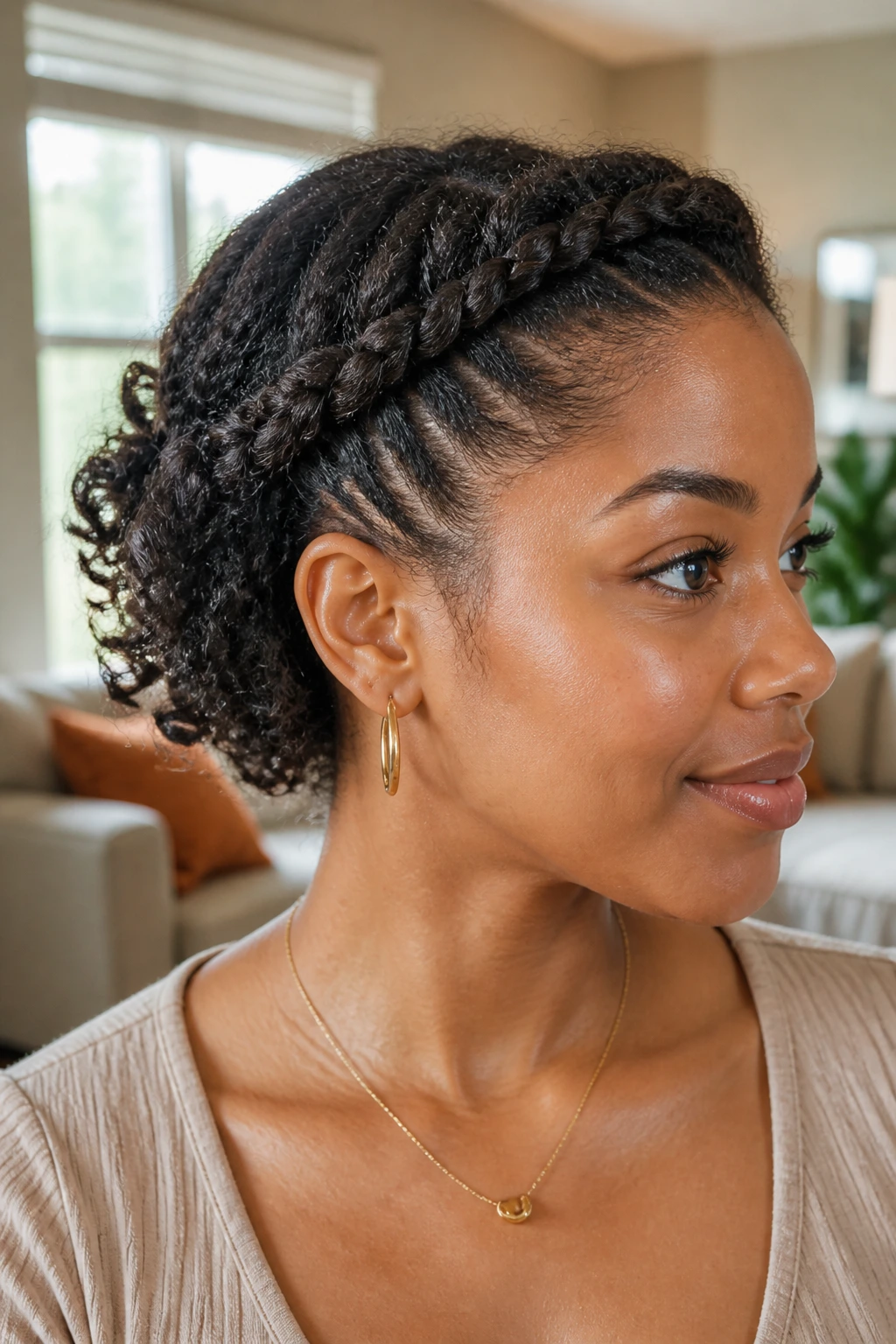
A flat-twist halo gives short hair a soft frame around the face without needing long braids. Twist along the hairline on one side, wrap across the top, and pin as you go. The back can stay loose, or you can tuck in the ends if the length is short enough.
This style is smart for curls that frizz at the front first. The twist keeps the hairline controlled, and the loose ends keep the whole look from feeling tight. If your curls are dense, use a little gel at the part so the twist stays neat. If they are fine, a cream and a couple of pins are usually enough.
It is one of those styles that looks better the less you fuss with it. The halo line should be visible, but the rest should still feel like curly hair, not a braided helmet. That balance is the whole thing.
9. Clipped-Back Fringe and Defined Sides
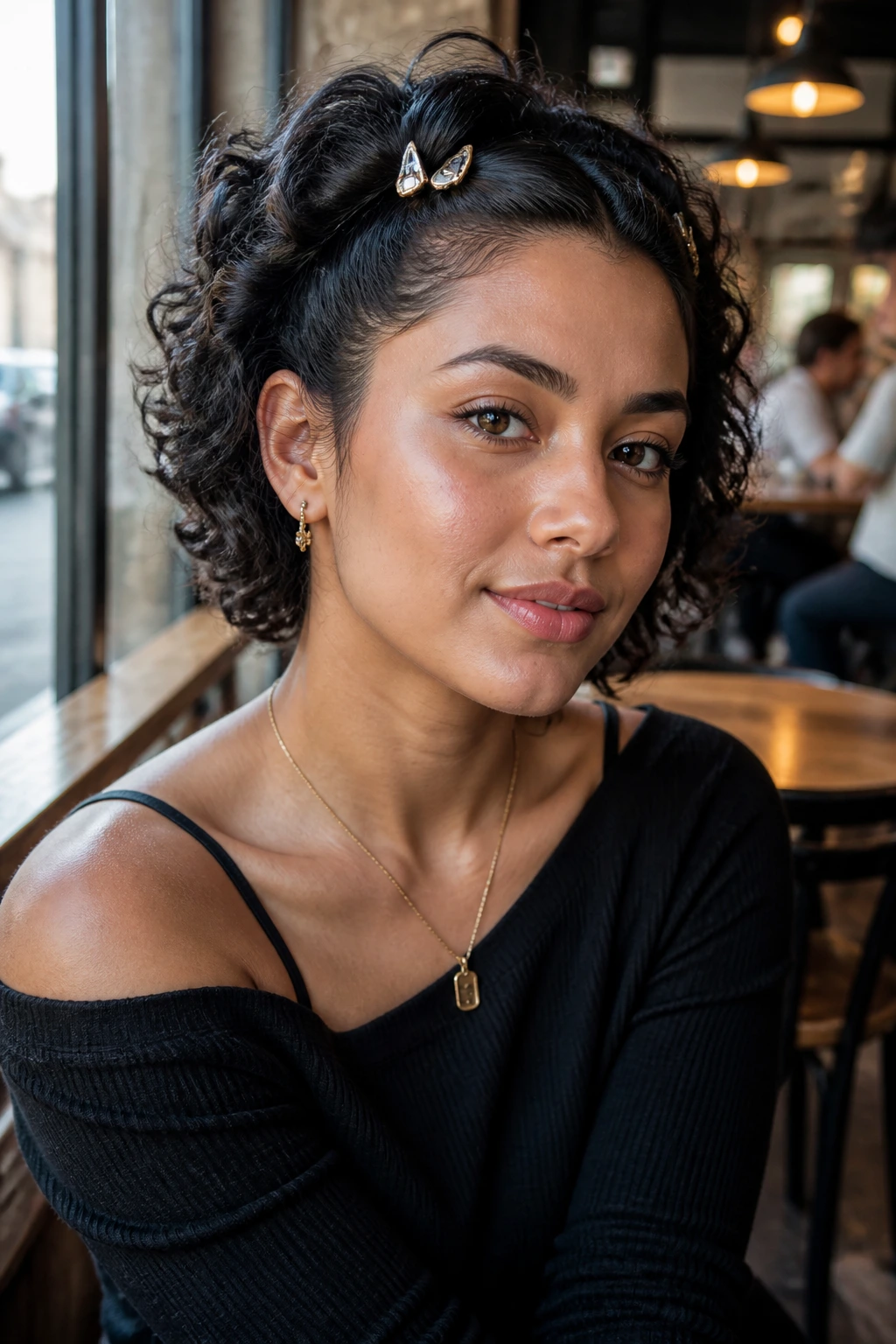
If your curls are growing into your eyes, clipped-back fringe is the fastest fix that still looks intentional. Push the front curls back just enough to clear the face, then pin them with one or two barrettes or snap clips. The sides stay defined, so the shape still feels curly instead of flattened.
This style works best when the front section has a little extra moisture. Dry fringe fights you and springs free. Damp it slightly, smooth a pea-sized amount of gel through the front pieces, and clip them at a slight angle rather than straight back. That angle keeps the lift visible.
Small detail, big difference
Use clips with some grip. Slippery fashion clips look cute for five minutes and then slide. If the fringe is heavy, stack two clips instead of forcing one clip to do all the work.
10. Wet-Look Slicked Sides with a Curly Top
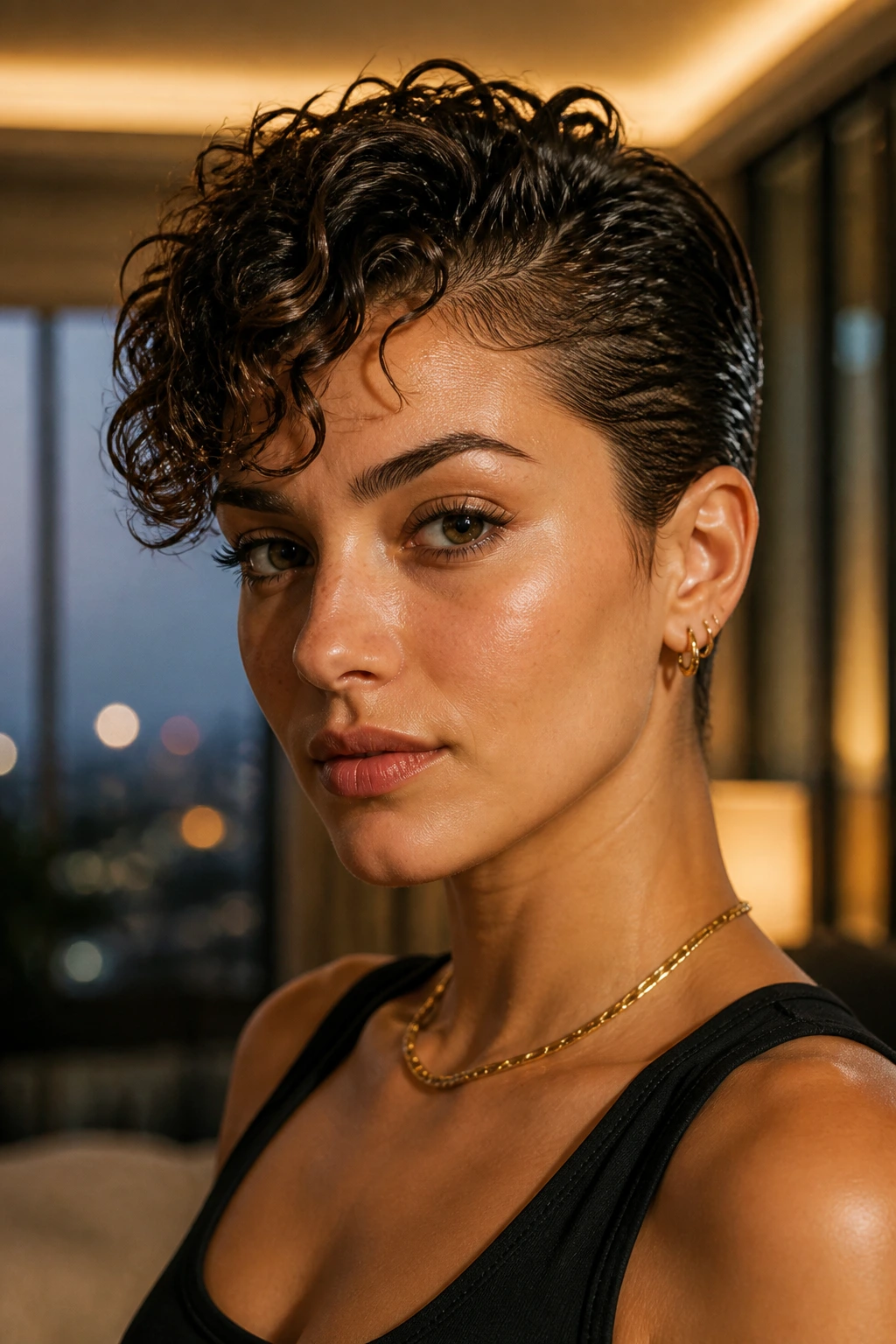
Wet-look sides on short curly hair can be sharp in the best way. The sides lie close to the head, the top keeps its curl and height, and the contrast makes the whole silhouette look deliberate. This is the style I would pick when I want my curls to look dressed for a night out.
Use a strong-hold gel on the sides and along the hairline, then smooth with a comb or brush until the strands sit flat. Keep the top section separate and curl-forward, not smushed down. The top needs freedom. If you slick everything back, you lose the point of the style.
This look is unforgiving with flakes, so do not pile on random products. Pick one gel that dries clean, work it into damp hair, and stop touching it while it sets. The shine should look neat, not crunchy.
11. Bantu Knot Crown on Short Hair
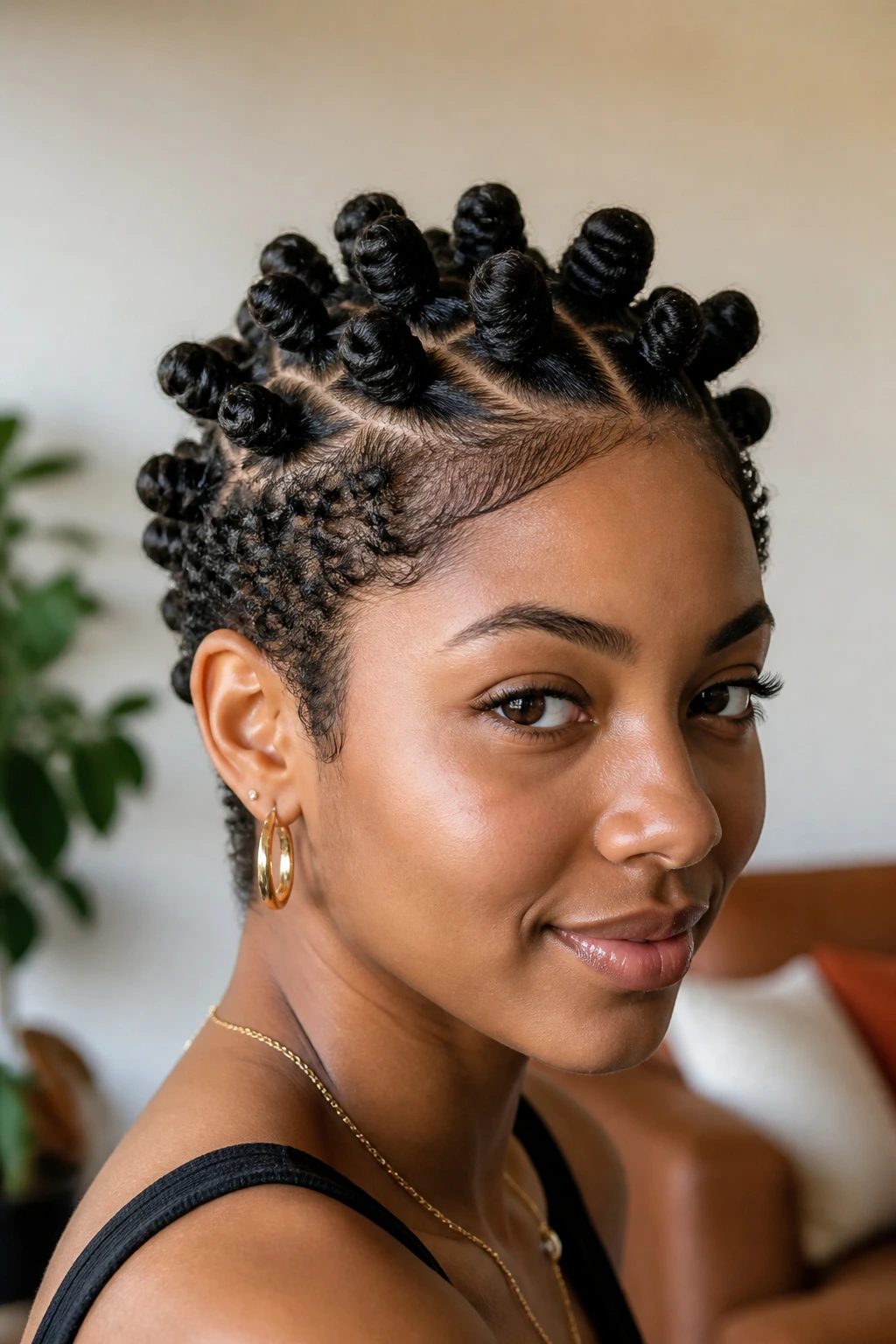
Bantu knots on short curly hair are tiny, neat, and a little bit bold. When the hair is short, the knots sit close to the head and create a clean crown line. You can wear them as knots, or you can unravel them later for a defined curl pattern with a strong bend at the roots.
Section the top into small squares or triangles, twist each piece from the root, then wrap it into a knot and pin or tuck the end underneath. A little gel on each section keeps the knots smooth. If your hair is too short for large knots, go smaller and use more sections. That usually fixes the problem.
A satin scarf at night helps the knots stay tight. Cotton will rough them up fast. And yes, the pattern matters. Clean parting makes this style look sharp; random parting makes it look accidental.
12. Curly Faux Hawk with Tucked Sides
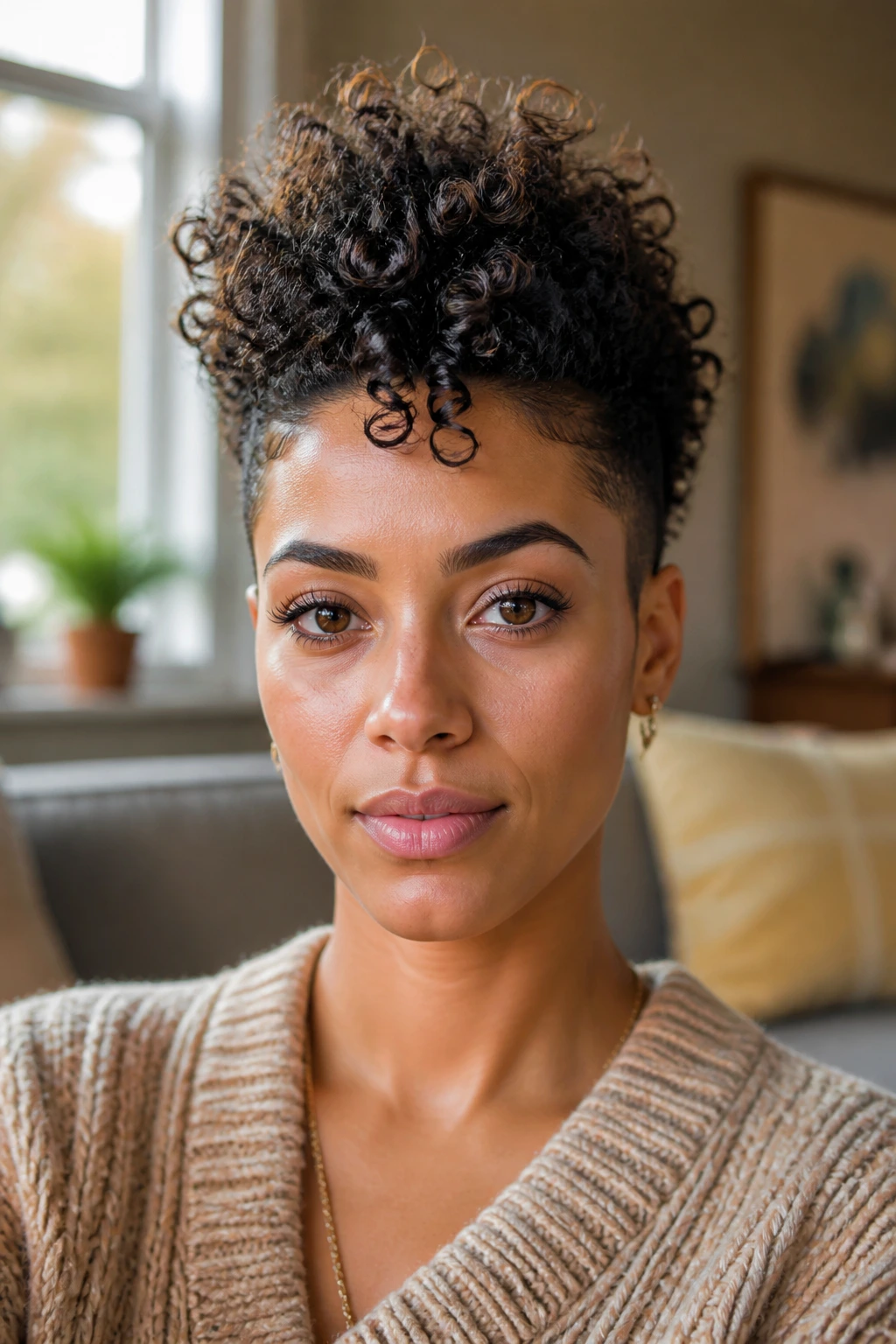
A curly faux hawk is one of the easiest ways to make short curls look louder without making them messy. The sides get pinned or smoothed down, while the center strip stays lifted and textured. The effect is strong, but the process is mostly about placement.
Start by moisturizing the curls in the center section, then pin the sides back with bobby pins or small clips close to the scalp. Use a diffuser to dry the center upward, not downward. That upward drying helps the middle stand tall instead of spreading out. If the sides puff, a touch of gel at the edges keeps them close.
What to ask of this style
You want height in the middle, not a triangle. That means the front and crown should stay fuller than the nape. If the silhouette widens too much at the bottom, re-pin the sides a little tighter.
13. Accessorized Clip Stack on a Side Sweep
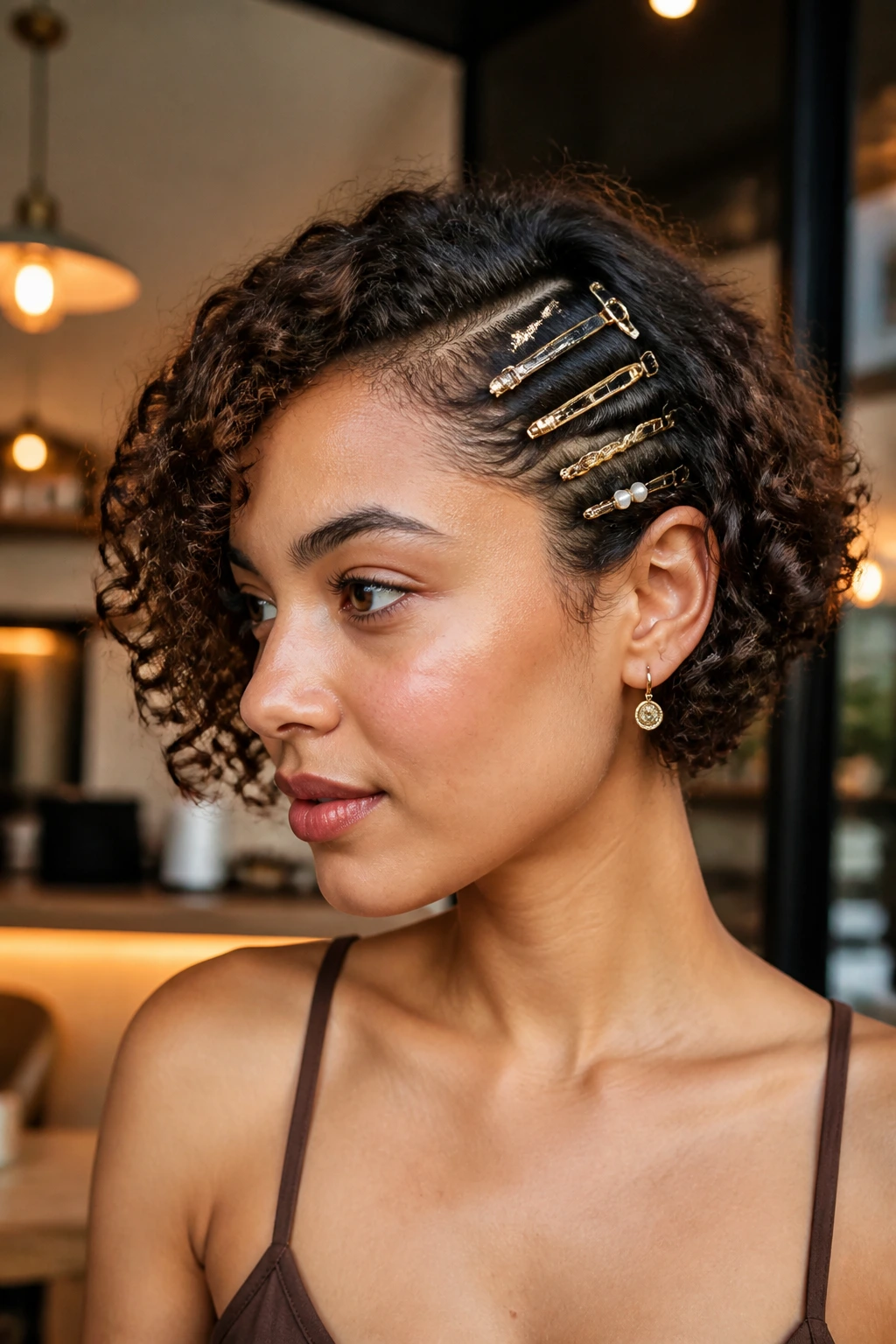
A stack of clips on one side can do more than a whole lot of styling if your curls are short. Sweep the front pieces across the forehead or temple, then layer two or three clips in a row so the hair stays put. The curls still move, but the front stops fighting your face.
This is a good style for hair that has a little grown-out fringe or a side-heavy cut. The clips can be plain metal, pearl, matte black, or colored resin. I would keep the rest of the hair soft and loose so the clips are the clear feature. If everything is decorated, nothing stands out.
The secret is spacing. Stack the clips with a tiny gap between them, not right on top of one another. That makes the side sweep look deliberate instead of crowded.
14. Twist-Out Bob with Soft Ends
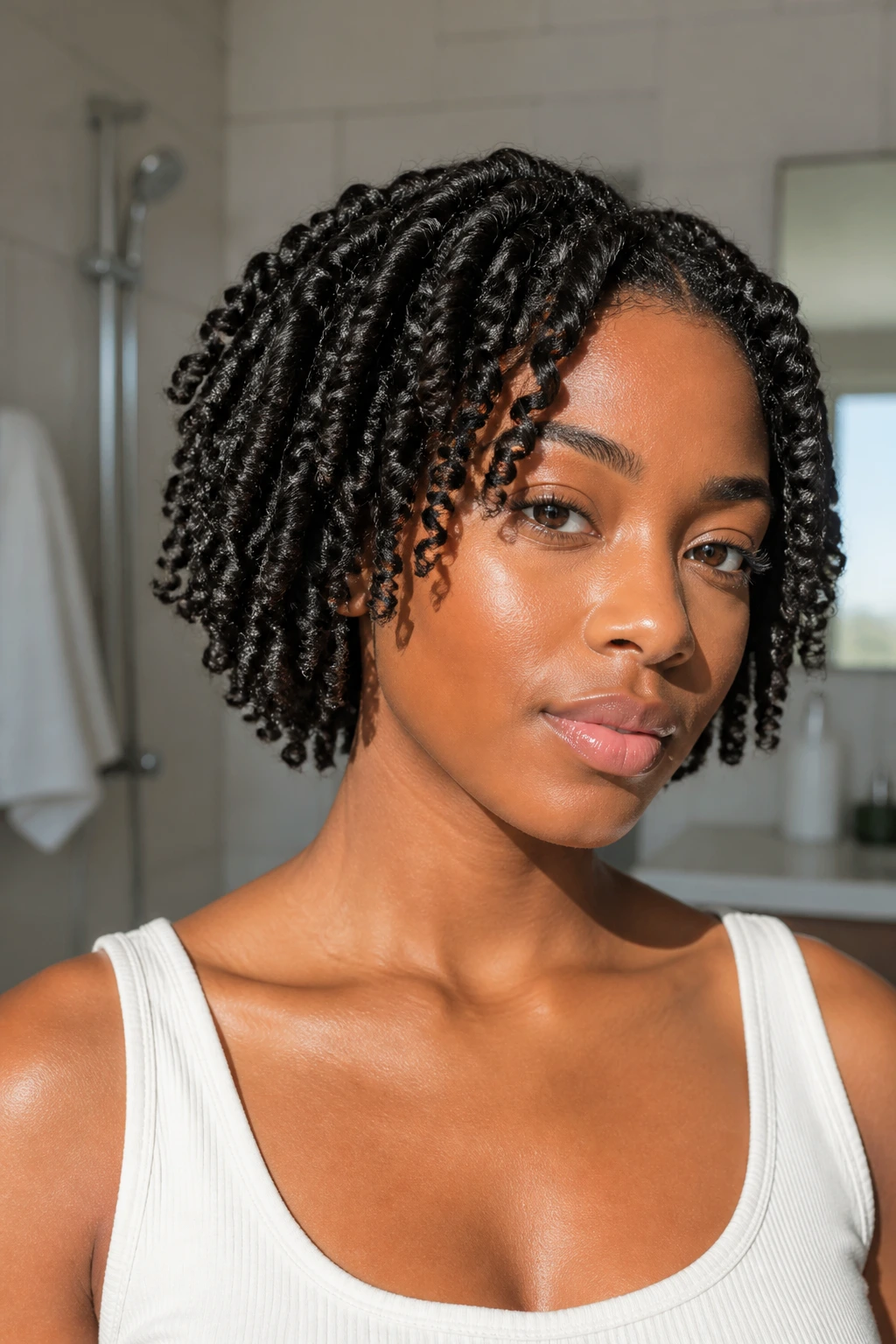
A twist-out on short hair gives you curl pattern with a little stretch, which is why I like it when the bob needs body but not stiffness. The twists set the hair in a controlled bend, and the unraveling leaves behind soft definition with a touch more length than a shrink-heavy wash-and-go.
Do the twists on damp hair with a cream and gel combo if your curls are frizz-prone. Keep each twist tidy and medium in size; too large and the pattern turns vague, too small and you spend half the night setting it. Unravel only when the hair is fully dry. Then separate with oily fingertips, not rough hands, so the twist pattern stays smooth.
This is one of the best styles for a jaw-length cut because it makes the shape look fuller at the ends. It also gives you a second-day style that does not collapse the moment you step outside.
15. Side-Part Pixie with Pinned Volume
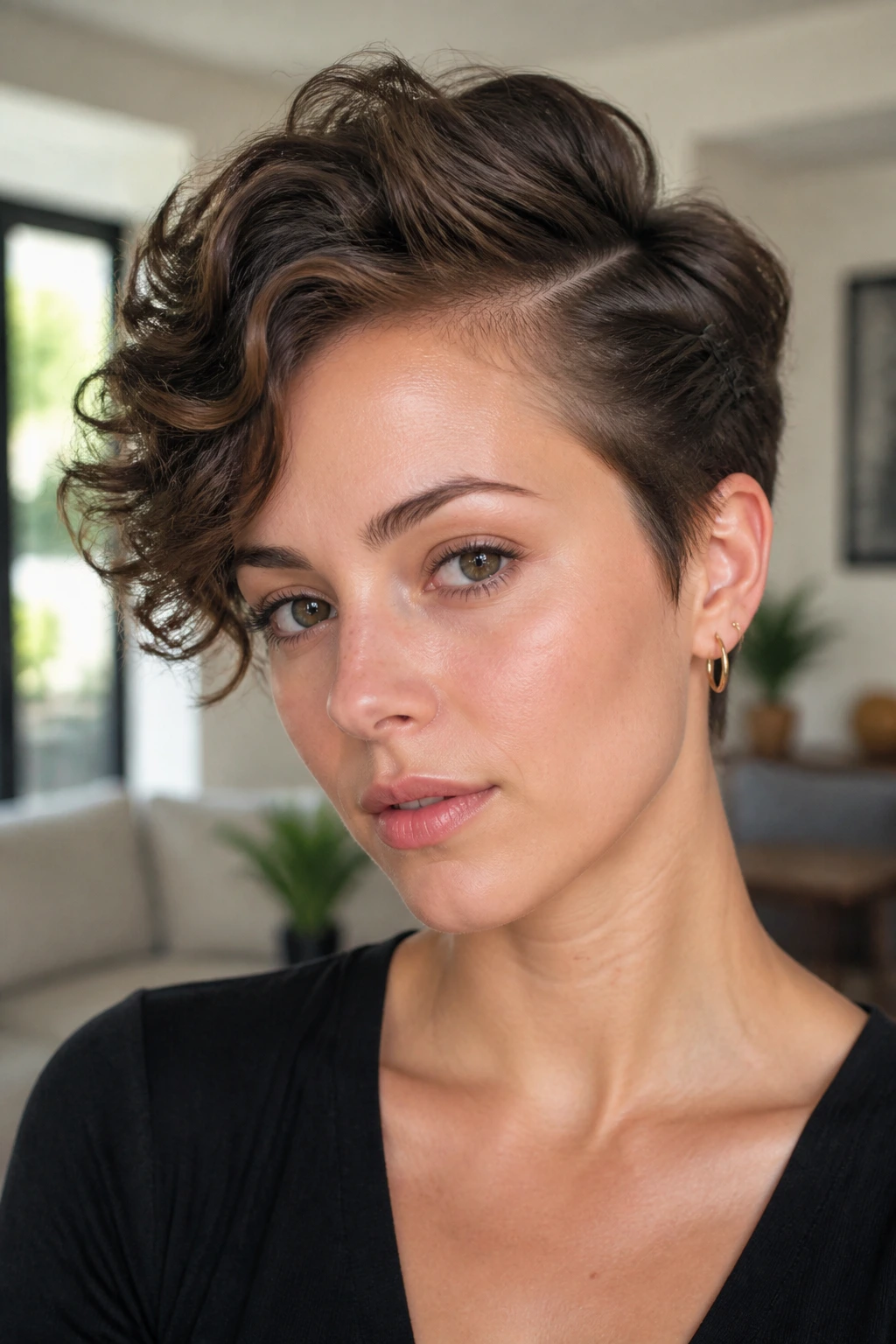
A side-part pixie is all about where the height lands. The part sends one side down, the other side up, and the front gets a little lift that makes the cut feel longer than it is. It is neat, but not flat. That difference matters.
Use a light mousse near the roots and a curl cream on the ends. Then lift the front section with your fingers while it dries, pinning only the side that wants to fall into your face. If your pixie is a little grown out, this style actually improves with that extra length. The curls have more room to sit up instead of lying down.
A fine-tooth comb can help with the part, but do not overcomb the crown. You are arranging the shape, not sanding it down.
16. Pineapple Pony with Face-Framing Pieces
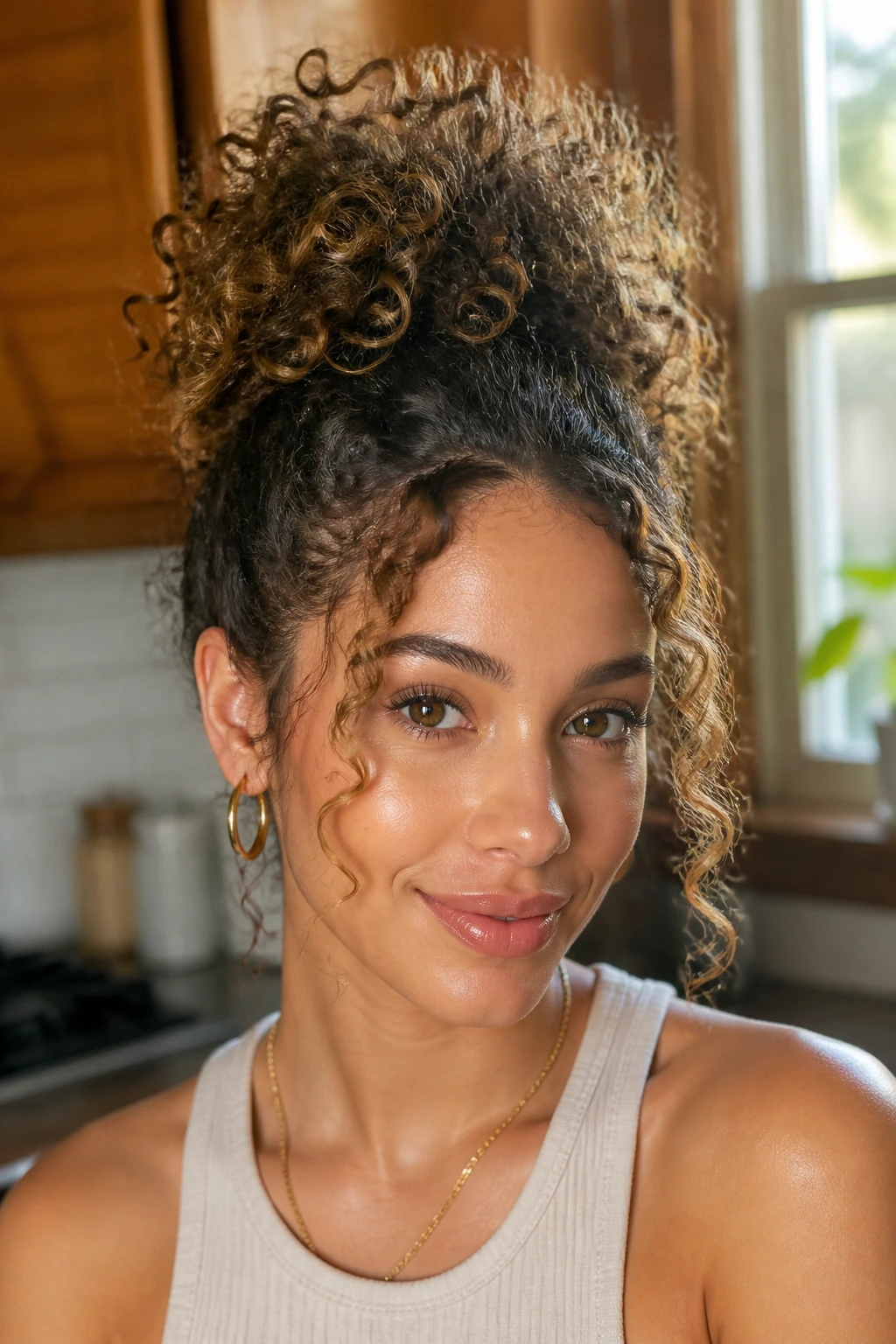
A pineapple pony on short curly hair is the looser cousin of the half-up puff. The top gathers into a high pony or puff at the crown, but the front pieces stay out to frame the face. That little bit of looseness keeps the style from feeling too severe.
This works especially well when the hair is a touch longer on top than on the sides. Use a soft tie and do not pull the pony too tight. The goal is height, not tension. If the front pieces frizz, smooth them with damp hands and a pinch of gel before lifting the pony.
The shape is especially good on busy mornings. It takes very little time, and the front pieces soften the look so it does not read as a rushed topknot. Small difference, big payoff.
17. Mini Puff Pairs
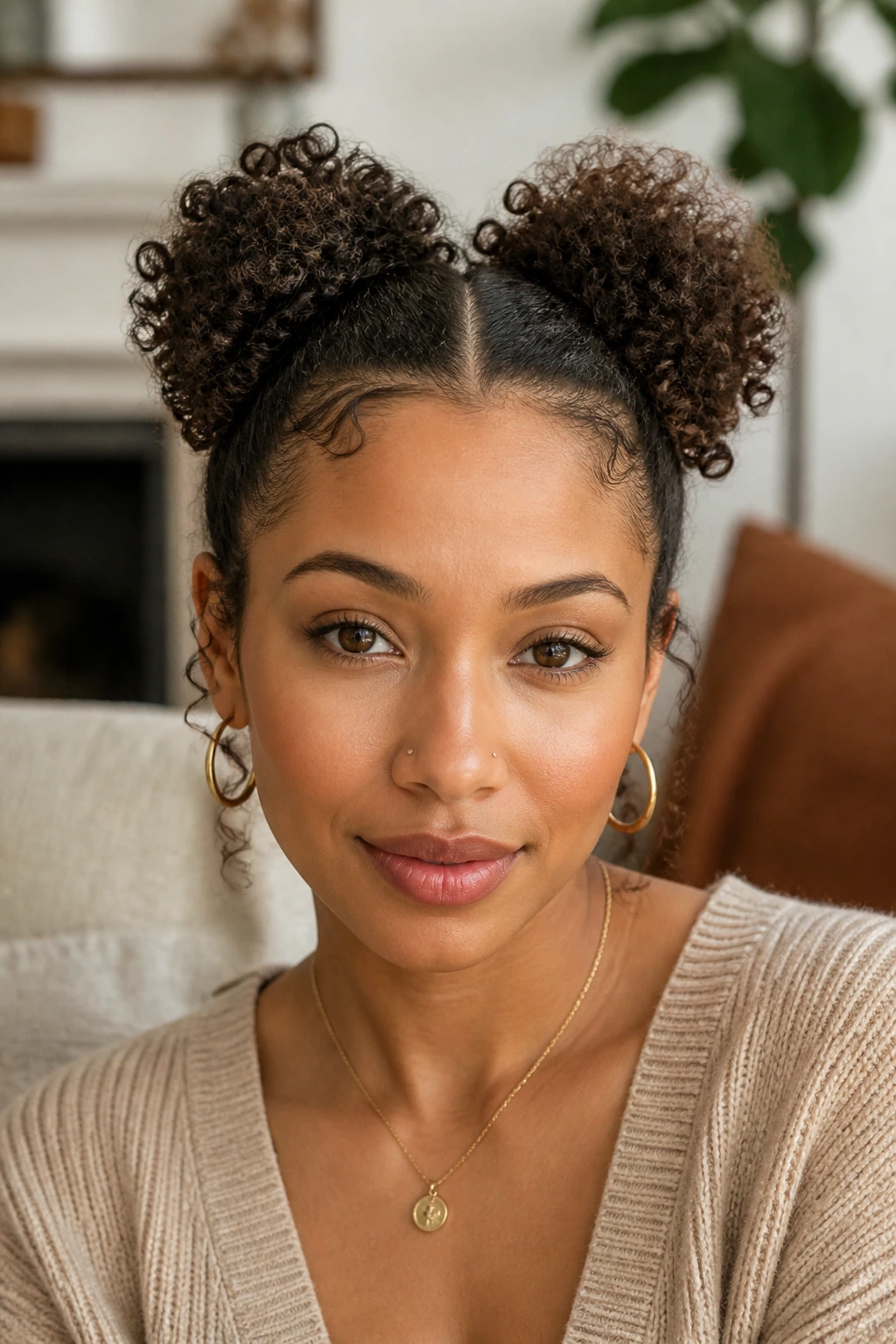
Two mini puffs on short curly hair can look playful, polished, or just plain practical, depending on how neat you make the parts. A center part gives you symmetry; a slight off-center part makes the style feel less strict. Either way, each puff gets its own little curve and lift.
I like this style best when the hair is dense enough to hold shape in both sections. If the puffs feel small, that is fine. Small puffs still read clean when the parting is crisp and the roots are lifted. Smooth the base with a little gel, gather each side with a soft tie, and fluff the curls outward with fingertips.
The mistake people make is stretching the puffs too much. Leave the curl pattern visible. That is what gives the style character instead of making it look like two tiny buns that changed their mind halfway through.
18. Defined Ringlet Crop
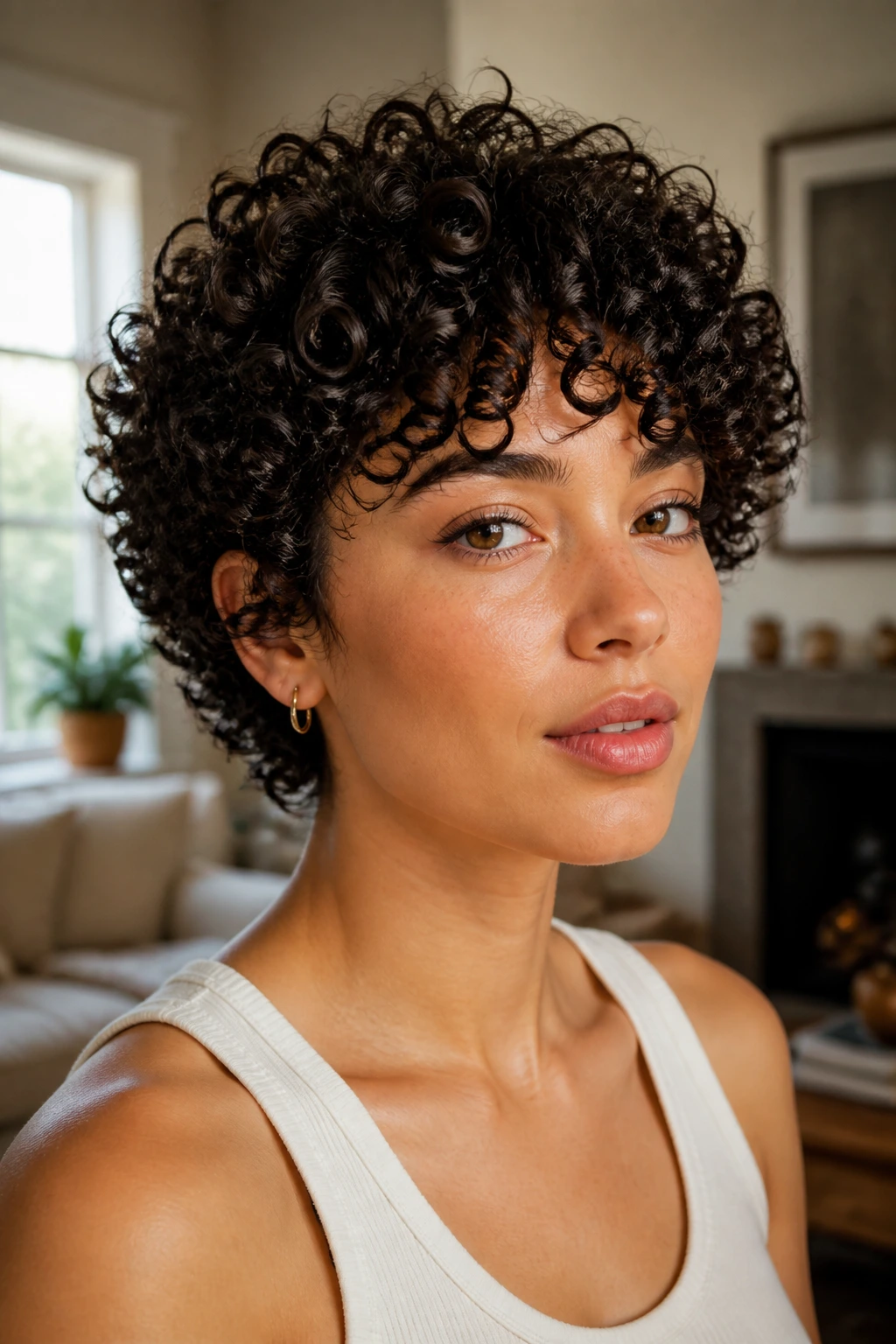
A defined ringlet crop is what happens when you decide every curl should show up. Small sections, a brush or finger-coiling method, and a strong-hold styler make the whole cut look crisp from root to tip. This is the style for days when you want shape that lasts.
Work on damp hair and keep your sections small enough that each curl can hold its own. If you use a curl brush, smooth the section once, then let the curl spring back. If you finger coil, wrap until the hair wants to coil naturally, not until it fights you. Then let it dry completely before fluffing.
This style is especially good for short hair that tends to sit fluffy instead of clumping. Definition is doing the visual work here. Once the curls are set, they carry the look.
19. Bandana-Tied Curly Bob
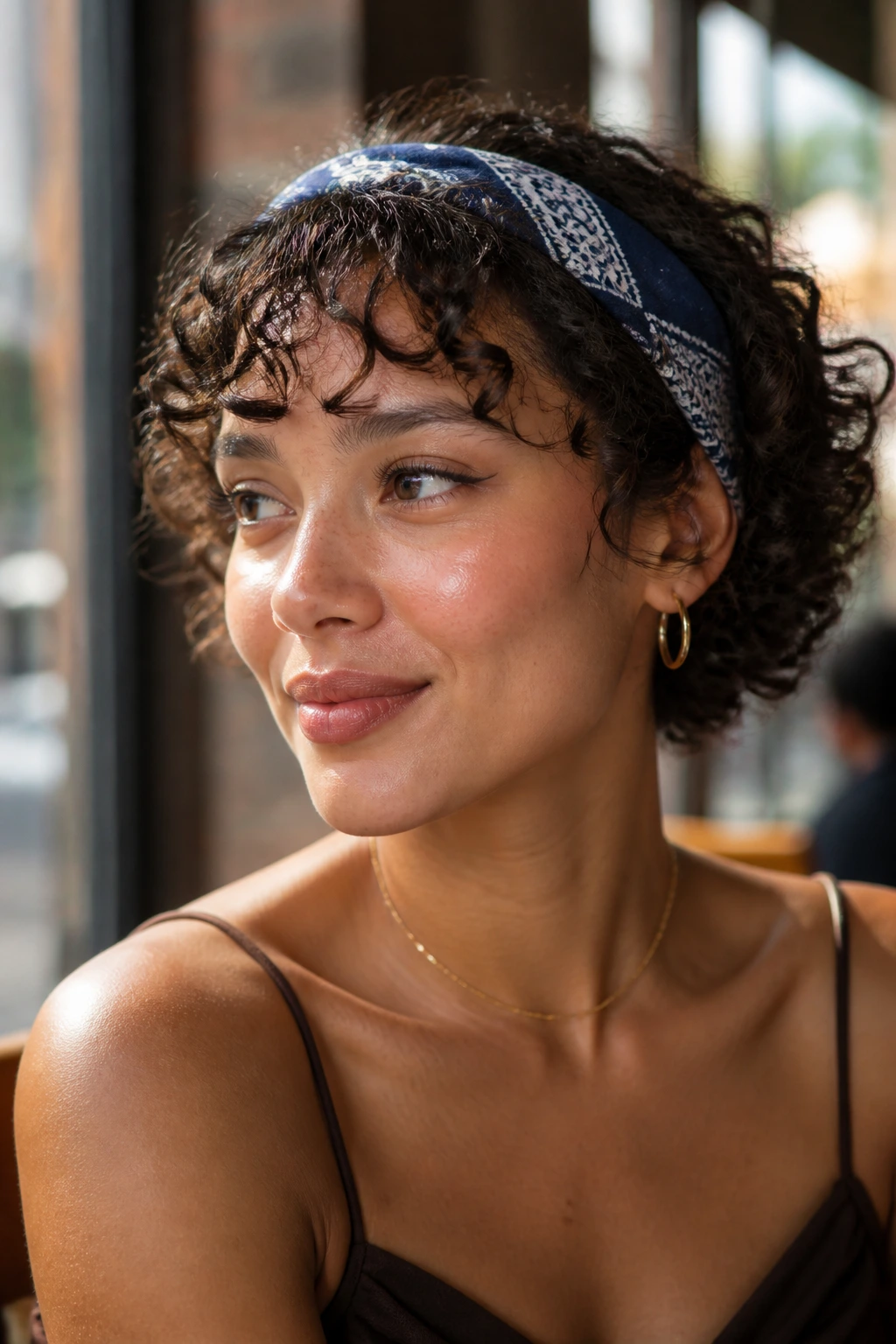
A bandana tied around a short curly bob gives you shape at the hairline and freedom everywhere else. It keeps the front smooth, hides any uneven growth around the temples, and adds a clean frame around the face. The curls underneath still do their thing.
Fold the bandana into a narrow strip or a full triangle, depending on how much coverage you want. Tie it just behind the hairline so it does not crush the crown. If you pull it too low, the top goes flat and the whole style loses lift. The rest of the bob can stay loose and airy.
This is a good choice for day-three curls that need a reset but not a full restyle. A bandana covers the messy bits while still showing the curl texture at the sides and back.
20. Wet Set Curls with a Diffused Finish
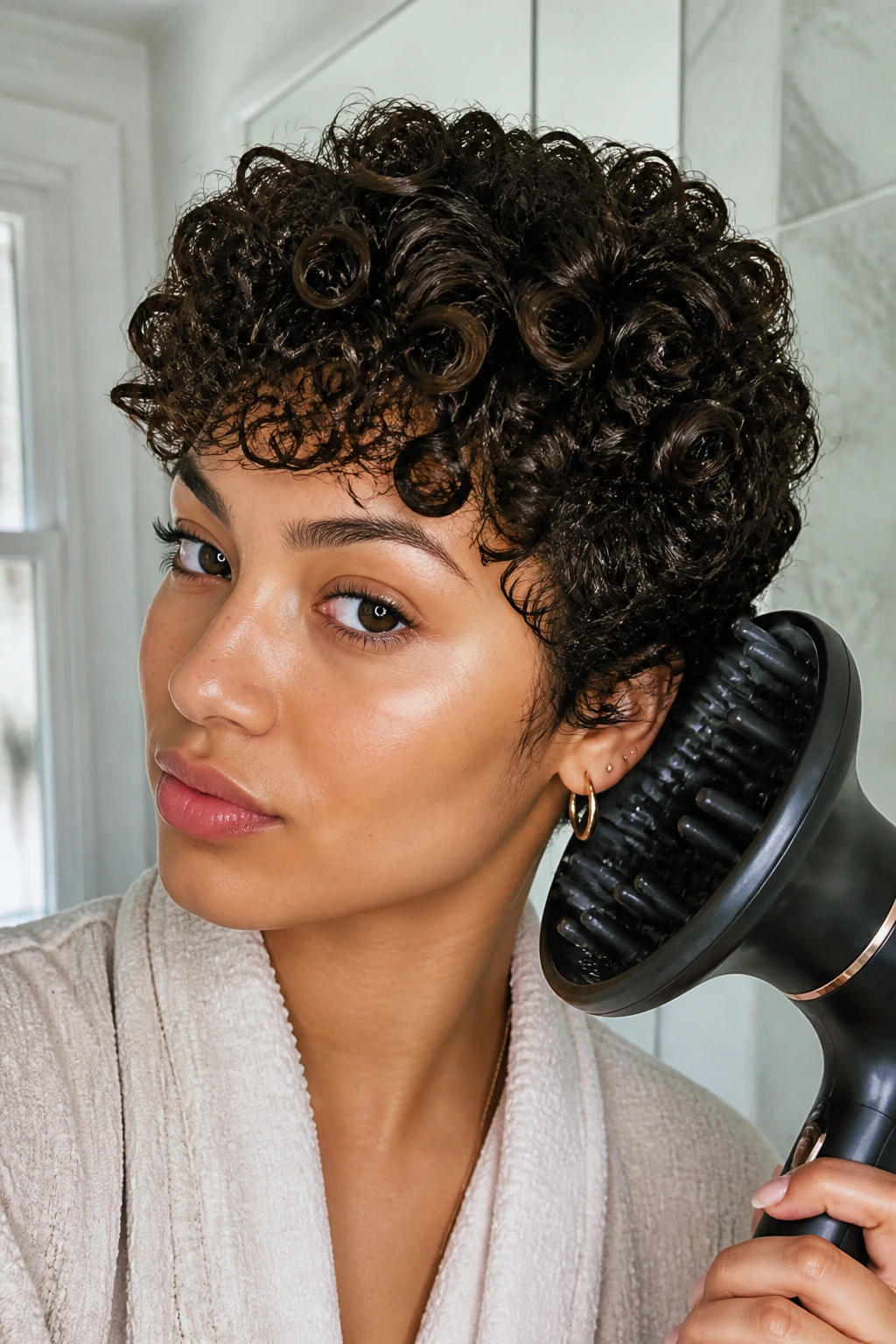
A wet set is for short curls that need structure. Flexi rods, small rollers, or perm rods can create a cleaner curl shape than air-drying alone, and the diffuser helps set the form without disturbing it. The result is more polished than a wash-and-go and usually lasts longer too.
Set the hair on damp, not dripping, sections. If the hair is too wet, the set takes forever to dry and the roots can stay puffy in a bad way. Once the rods are in, dry gently and fully. Half-dry wet sets are the reason people think this style failed when it really just needed more time.
The finish can be tight and glossy or soft and separated, depending on how much you break apart the curls after they dry. Start small. You can always loosen the ringlets later. You cannot rebuild a fuzzy set without redoing it.
21. Curly Mullet with a Tapered Nape
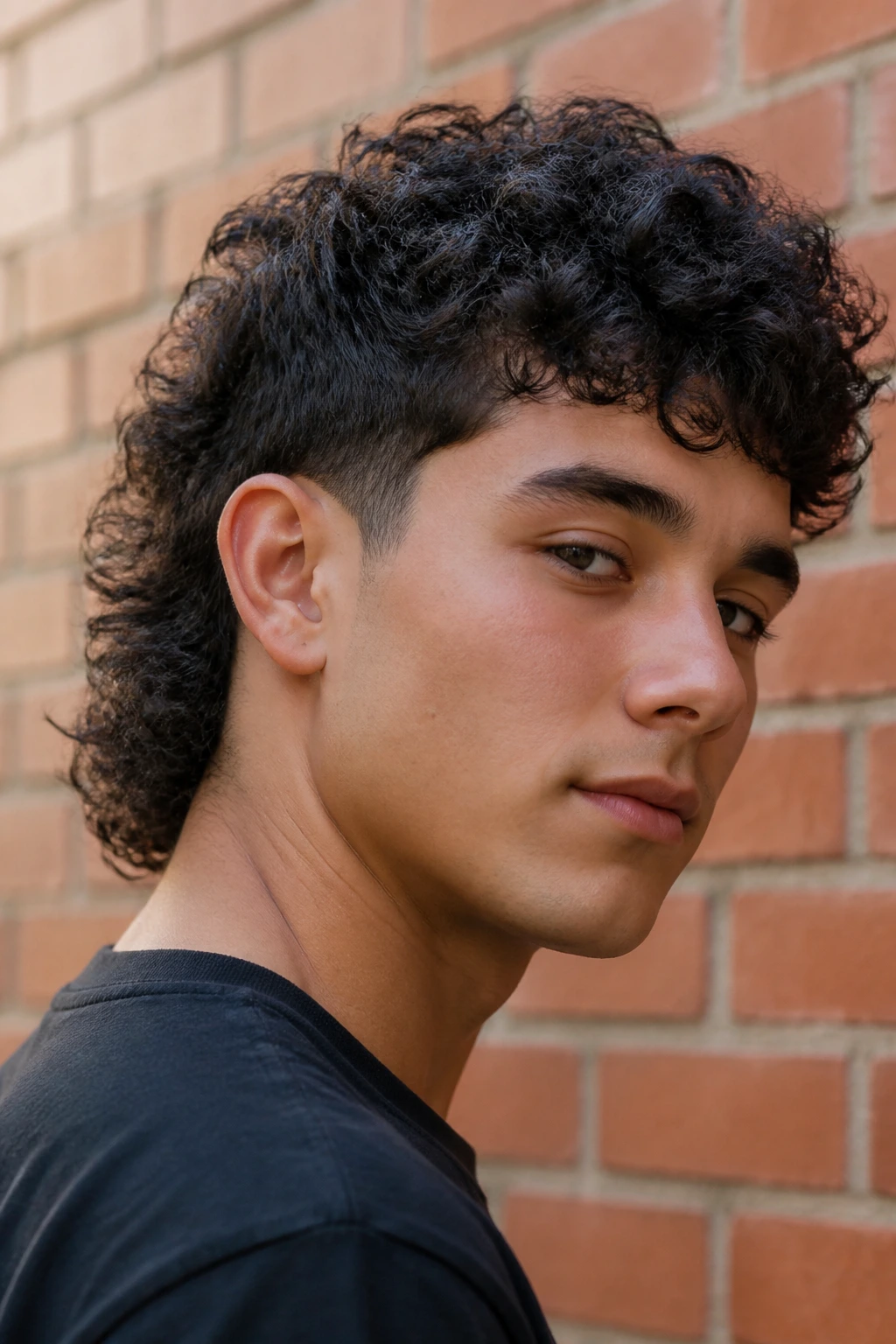
A curly mullet on short hair is not subtle, and that is the fun of it. The front and crown stay fuller, the nape sits closer to the neck, and the whole cut reads as layered with a bit of edge. The curly texture keeps it from looking harsh.
This style loves movement. Work a lighter cream through the shorter back section and a mousse or gel mix through the front so the shape has some control. Diffuse with the head upright to keep the crown from collapsing. If the nape starts to puff too much, a tiny bit of gel at the roots calms it down.
The point is contrast. Shorter in the back, a little more attitude up front. If you want a style that looks intentional even when it gets messy, this is one of the strongest options in the whole group.
22. Side-Twist and Tuck
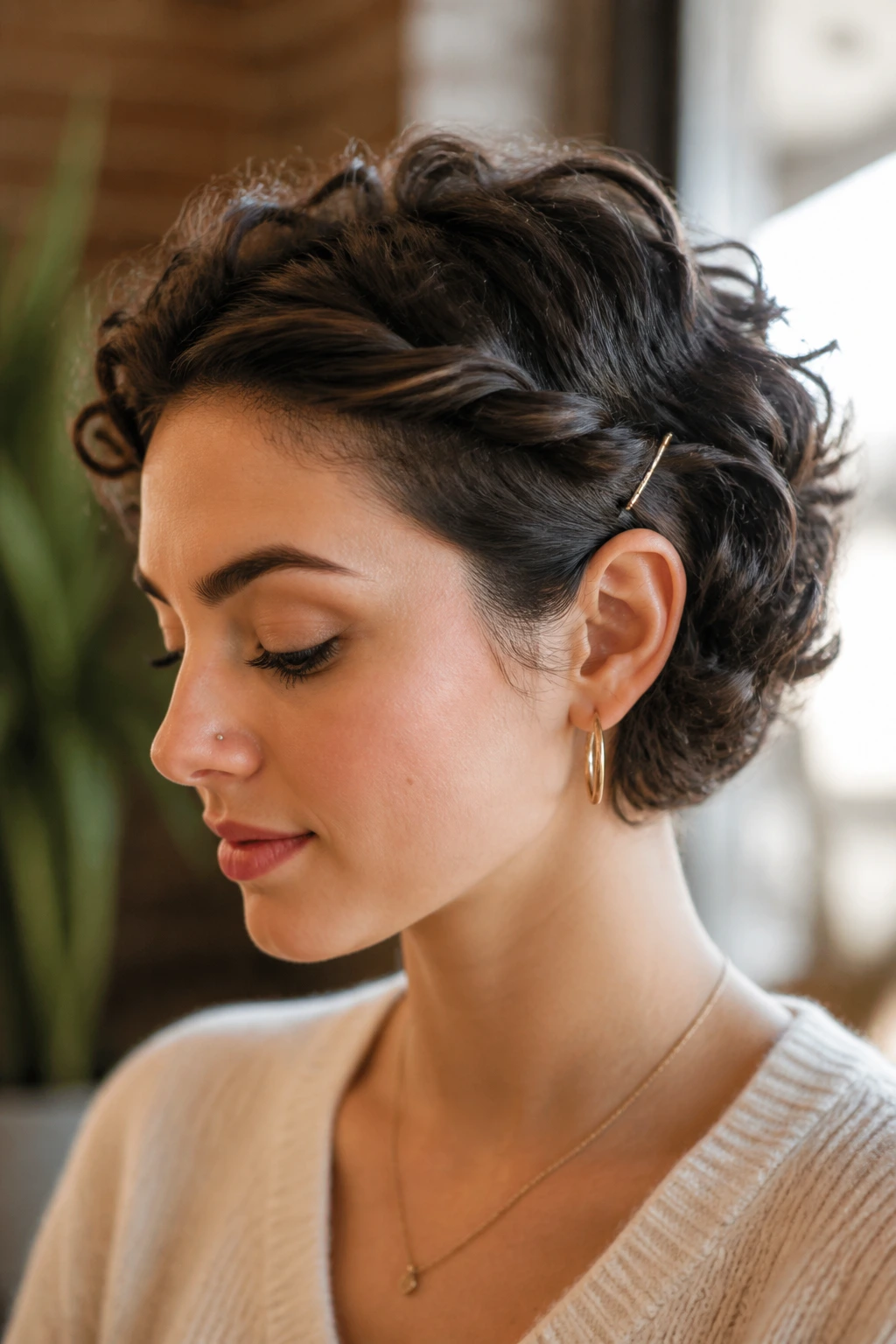
A side-twist and tuck is the low-effort style I reach for when I need one side out of my face and I do not want to commit to a full pin-up. Twist a front section back along the hairline, tuck it behind the ear, and secure it with a pin. Leave the rest loose.
This works best when the hair has some grip. Day-two curls are easier than freshly washed ones. If the twist slips, add a tiny bit of gel to the section first, then pin it where the twist crosses the temple. A single decorative pin can make the whole thing look finished.
It is also a nice option for short hair that is growing out unevenly. You can control the side that feels awkward and let the good side stay visible.
23. Curly Fringe with a Headband Frame
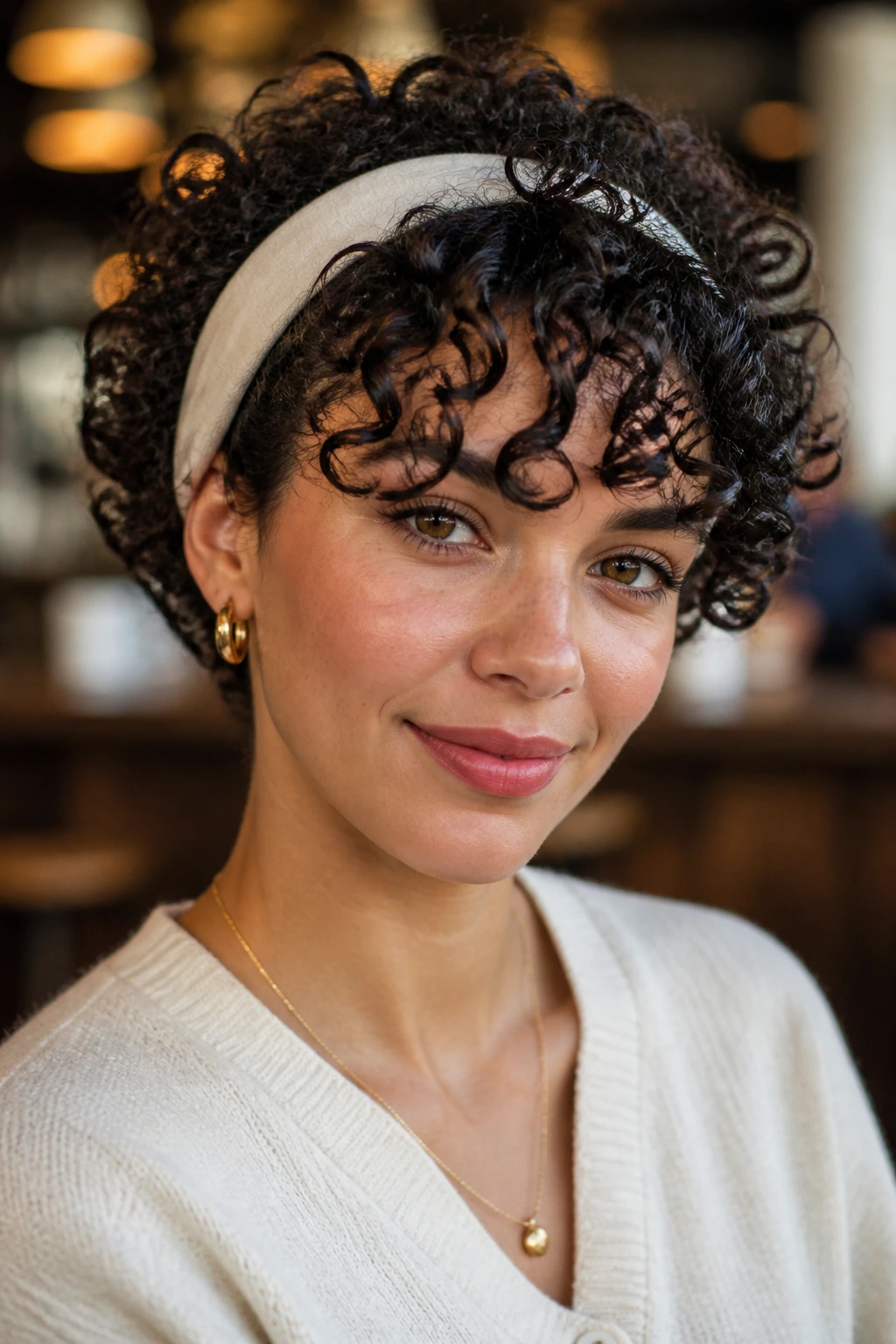
A headband frame around short curly fringe can clean up the front without hiding the curls. The band keeps the fringe back just enough to open the face, and the curls above it puff forward in a soft arch. It is one of the easiest ways to make bangs behave.
Choose a headband that grips but does not squeeze. Place it about one to two inches behind the hairline so it catches the front curls without flattening the crown. If the fringe wants to split, dampen it slightly and scrunch it into place before the band goes on.
A small note on shape
Wide padded headbands push the curls back more. Narrower ones let the fringe stay visible. That choice changes the whole mood of the style.
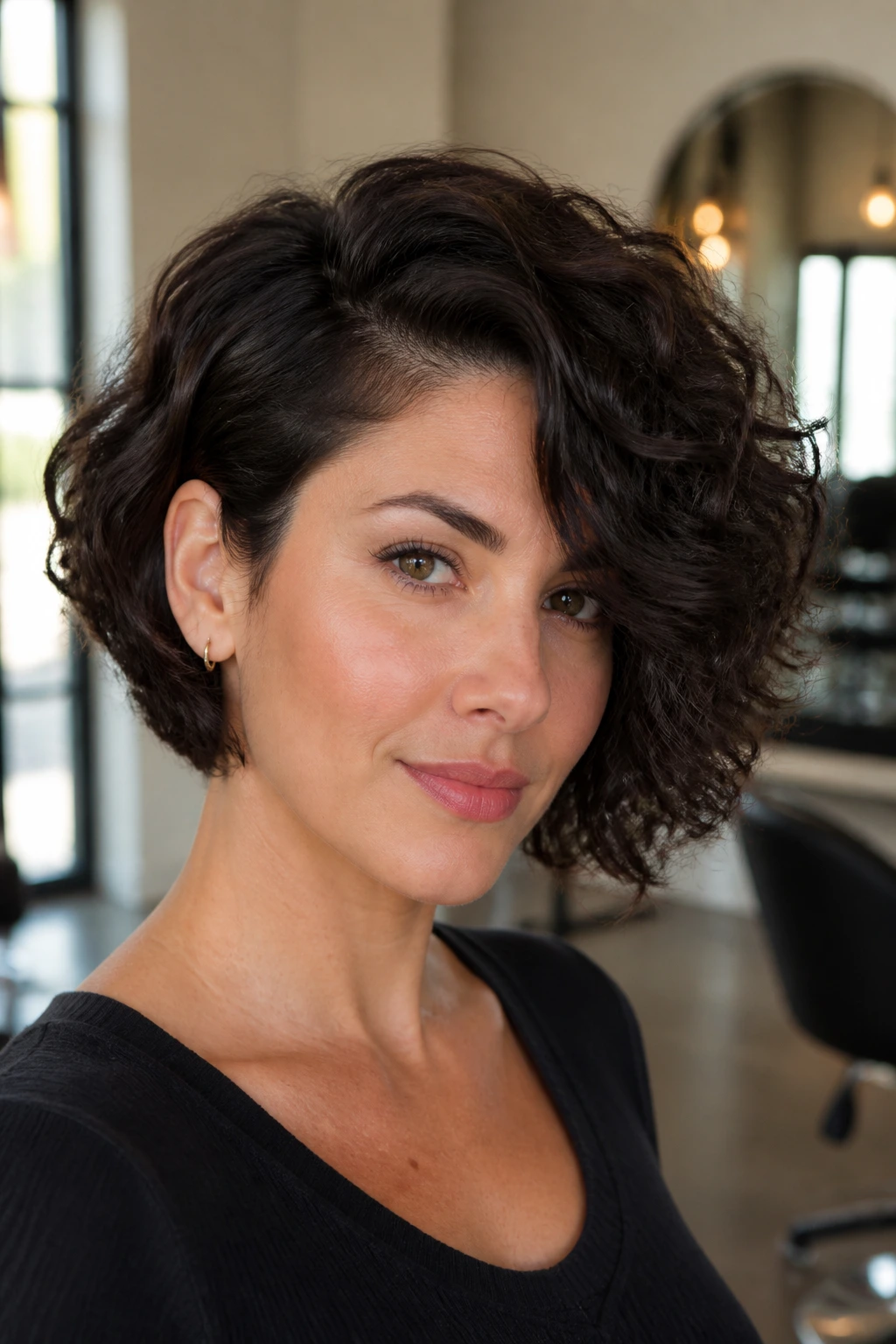
24. Asymmetrical Curly Cut Styled Forward
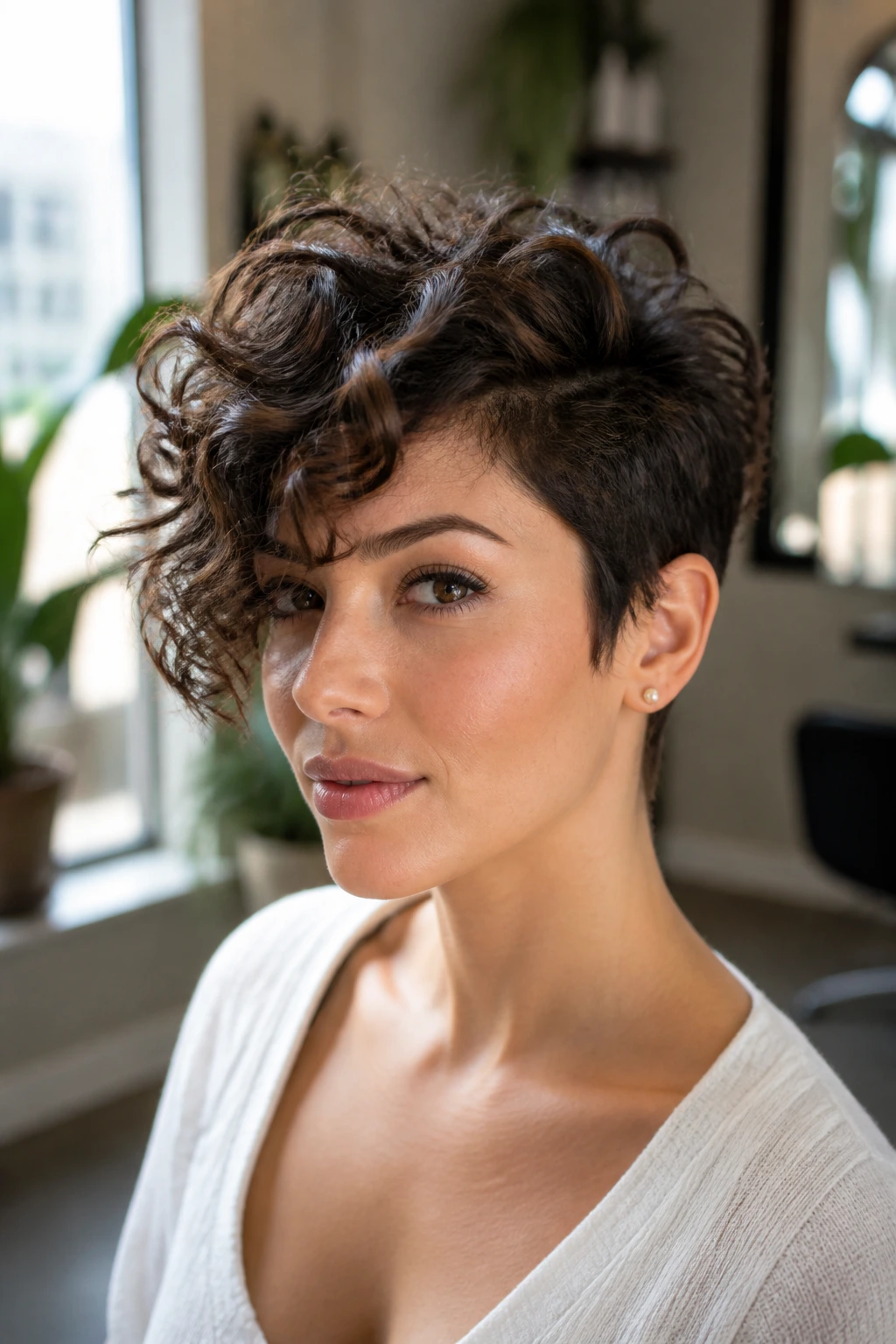
An asymmetrical short curly style looks best when the shorter side stays controlled and the longer side moves forward. It is the angle that matters. The eye goes first to the forward sweep, then to the difference in length, then to the texture itself.
Use a side part, then direct the longer section toward the face while the shorter side stays tucked or pinned. A diffuser on low heat helps the curls keep that forward lean. If you scrunch too hard, the asymmetry disappears and the cut starts reading as even again.
This look is one of my favorites for short curls that have a little personality in the cut already. You are not inventing shape from scratch. You are just making the existing line easier to see.
25. Crown Puff with Loose Nape Curls
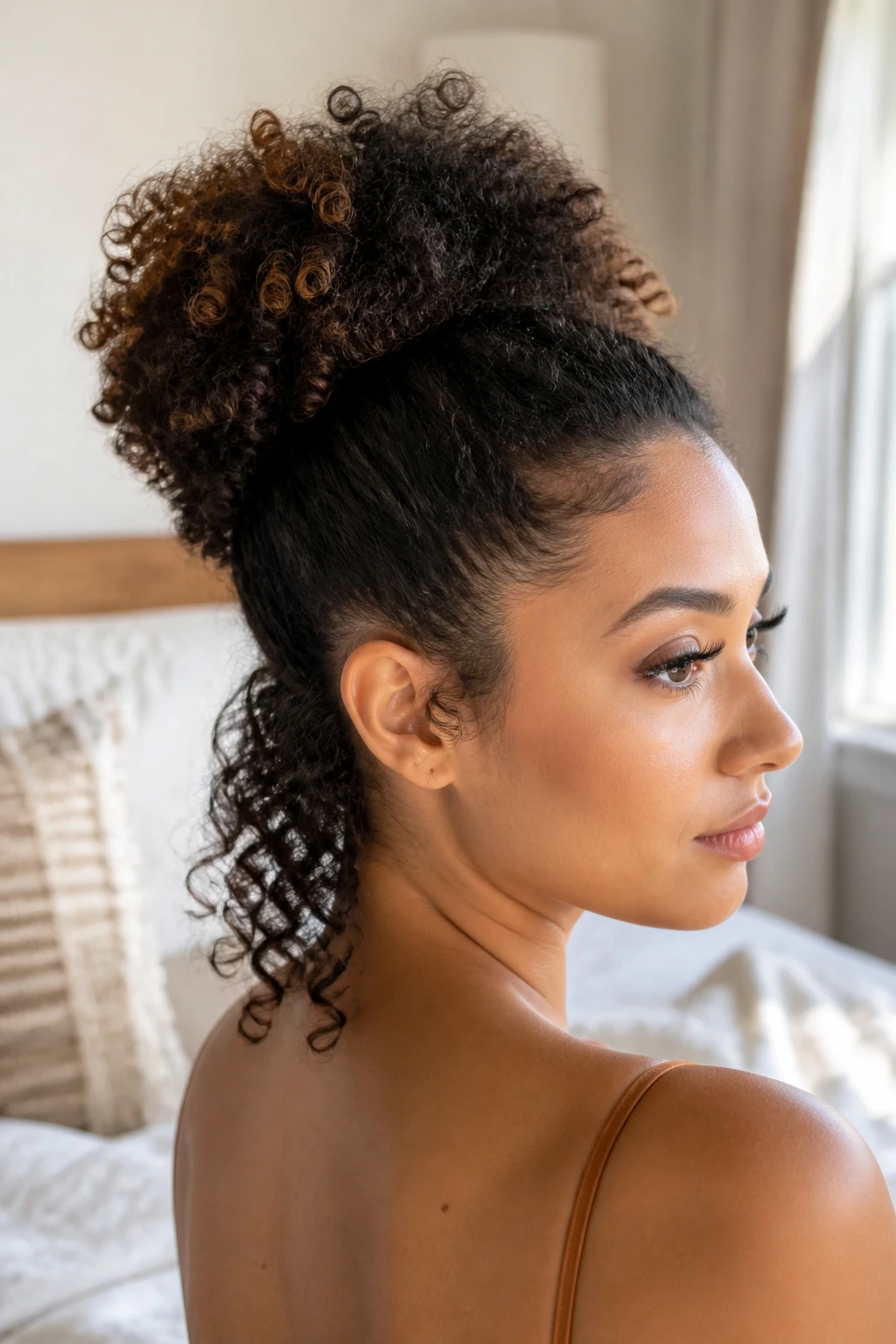
A crown puff with loose nape curls gives you height where the eye wants it and softness where the neck needs it. The top section gathers into a puff, while the curls at the back stay free. That mix keeps the style from looking like an all-or-nothing updo.
Pull the crown up with a soft band or tie, then shape the front so the puff sits high but not stretched tight. Leave the nape loose if the length allows it. If your back layer is too short to hang freely, pin it lightly instead of forcing it into the puff. The goal is shape, not strain.
This one works especially well on hair that has strong shrinkage. The crown gives you lift, the back keeps the texture visible, and the whole thing holds onto its curly identity.
Why Short Curls Hold Shape Better Than People Think
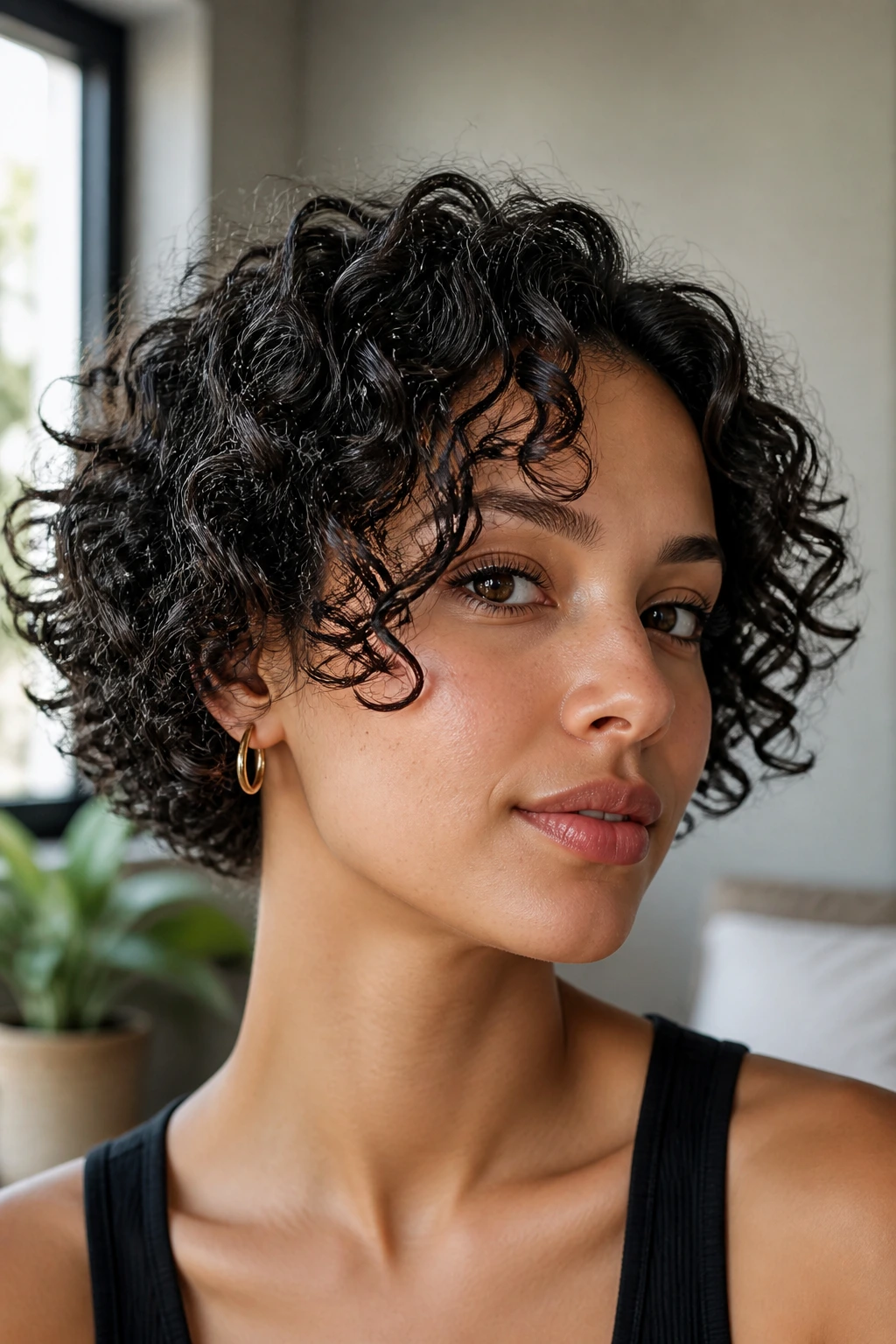
Short curly hair does not have the weight problem that longer hair does. That sounds obvious, but the styling result is bigger than people expect. Less length means the roots can lift sooner, the curl pattern can stack on itself faster, and a part line can change the whole shape in seconds.
There is also less need to bury the curl under product. A short cut often looks best when you can still see the bend of each strand, the little clumps, the breaks between sections. Long hair can hide a clump or two and still look full. Short hair cannot. That is not a weakness. It is the reason short curly styles read so clearly.
Shrinkage matters here too. A chin-length curl can sit much shorter once it dries, and that is why the same style can look loose when wet and crisp when dry. If you understand that, you stop fighting the drying process and start styling for it. The best result usually comes from shaping the curls while they are damp, then leaving them alone long enough to set.
Essential Tools for These Looks
- Spray bottle with clean water: This is the fastest way to wake up short curls before restyling or refreshing.
- Leave-in conditioner: Helps damp hair glide while you section, twist, or smooth the front pieces.
- Curl cream: Use a light hand; a small amount softens rough ends without weighing down the crown.
- Mousse or foam: Gives airy lift and keeps short curls from collapsing at the roots.
- Strong-hold gel: Best for finger coils, slicked sides, fringe control, and any look that has to last.
- Rat-tail comb: Useful for clean parts, side sweeps, and neat sectioning around the hairline.
- Duckbill clips: Hold lift at the roots while hair dries, which matters more than people think.
- Soft scrunchies or coil-friendly ties: Better than tight elastics for pineapple puffs and mini ponies.
- Bobby pins and snap clips: Keep twists, side tucks, and fringe pieces in place without pulling too hard.
- Diffuser attachment: Helps set shape while keeping curls from getting blown apart.
- Satin bonnet or scarf: Protects the style overnight and cuts down on friction.
- Wide-tooth comb or fingers: Use to separate curls gently; sharp brushes can wreck definition fast.
Picking the Right Products for Short Curly Hair
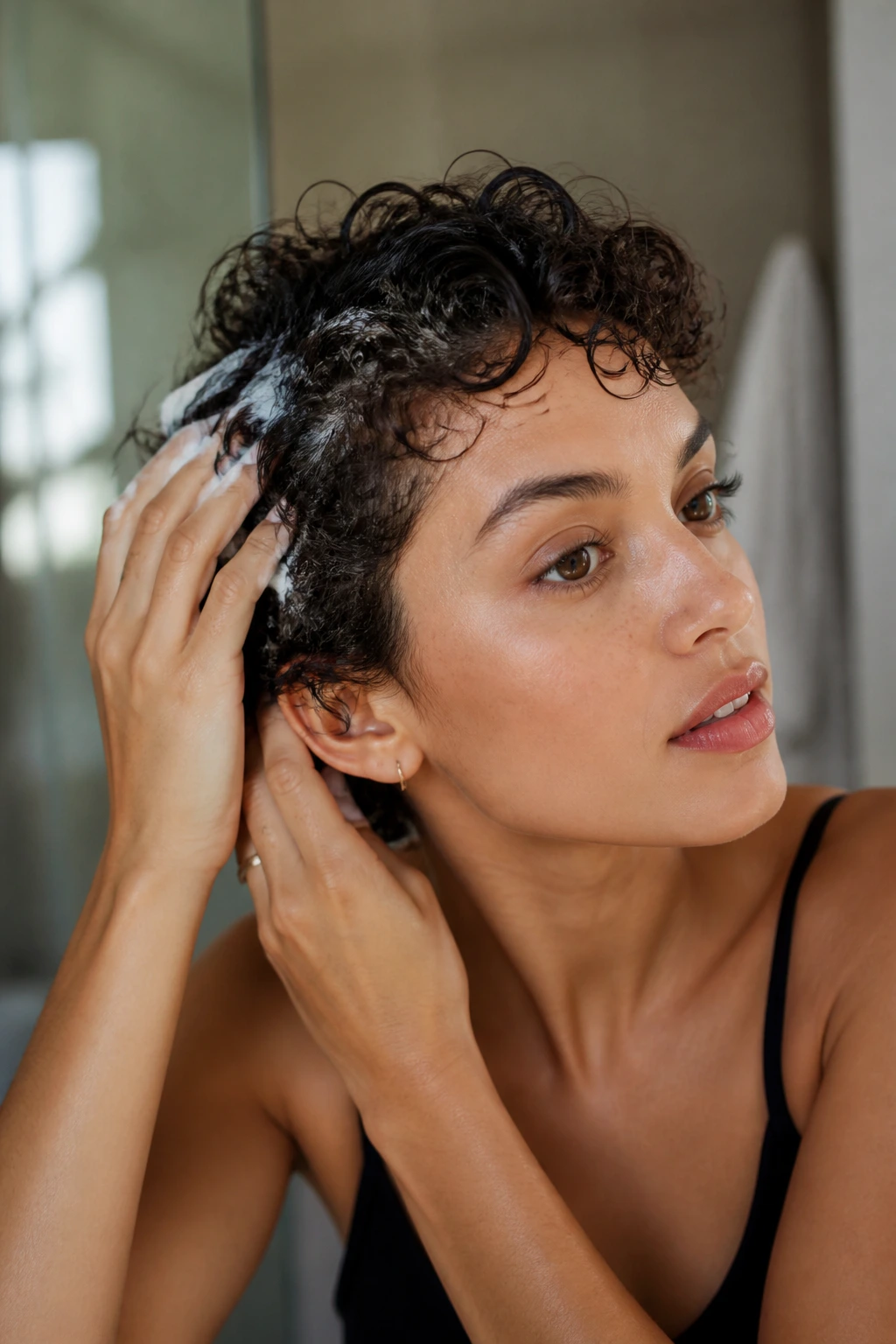
The product choice on short curls comes down to one question: do you want softness, hold, or both? If your hair is fine or loose-curled, a foam or mousse often gives more shape than a heavy cream ever will. If your hair is dense or very coily, cream plus gel usually works better because the cream keeps the curl supple while the gel locks the shape in place.
Heavy oils and thick butters are where people get tripped up. A little can be fine on dry ends, but too much at the roots steals volume fast. Short hair does not have spare length to carry that weight. If the style needs lift, start lighter than you think you should. You can always add a touch more later.
Strong-hold gel belongs in the styles that need a clean line: finger coils, slicked sides, wet sets, headband styles, and fringe control. Mousse is the move for airy shapes like shag cuts, side-swept bobs, and faux hawks. Curl cream is the comfort product. Use it when the hair feels rough, but do not let it become the whole style. It usually works best when it supports another product instead of replacing it.
How to Wear These Looks Without Fighting Your Day
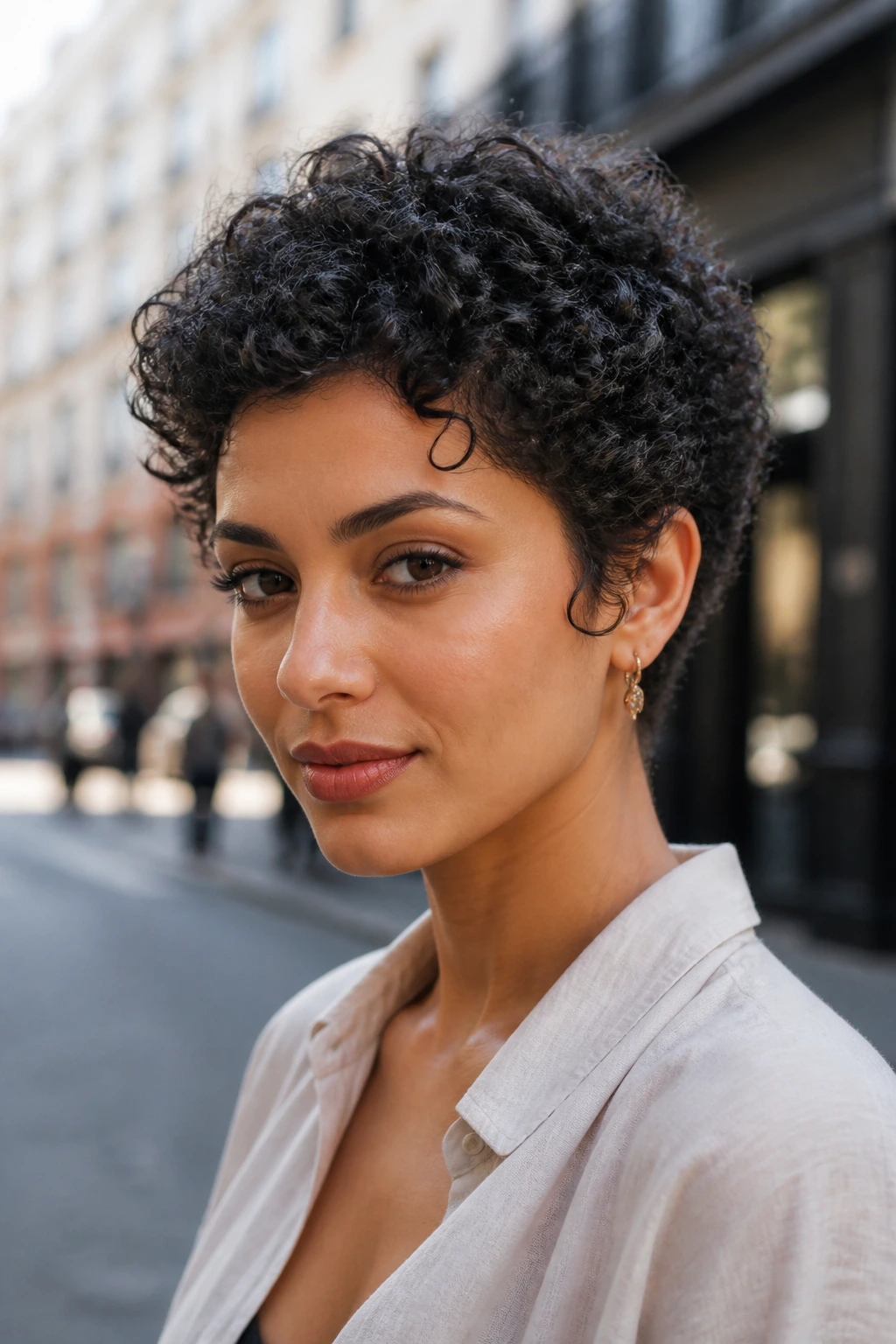
A short curly style should fit your life, not just a mirror. For a low-key day, the clipped fringe, side-twist and tuck, or bandana bob keeps the hair off your face and leaves enough texture to feel like your own hair. Those are the styles that can survive a desk, a windshield, or a damp commute without asking for a full redo.
For a more put-together look, pick the rounded bob, deep side sweep, wet-look sides, or defined ringlet crop. Those styles have a cleaner outline, which makes them read sharper with earrings, collars, and jackets. If you wear a lot of crew necks or structured tops, a side part and some crown lift keep the style from disappearing into the neckline.
Evening styles want contrast. That is where mini space buns, the faux hawk, the crown puff, and the clip stack start to make sense. They catch the eye because they change the shape of the head first and the texture second. That is a good order. The shape should lead.
Practical Tips for Better Definition and Less Frizz
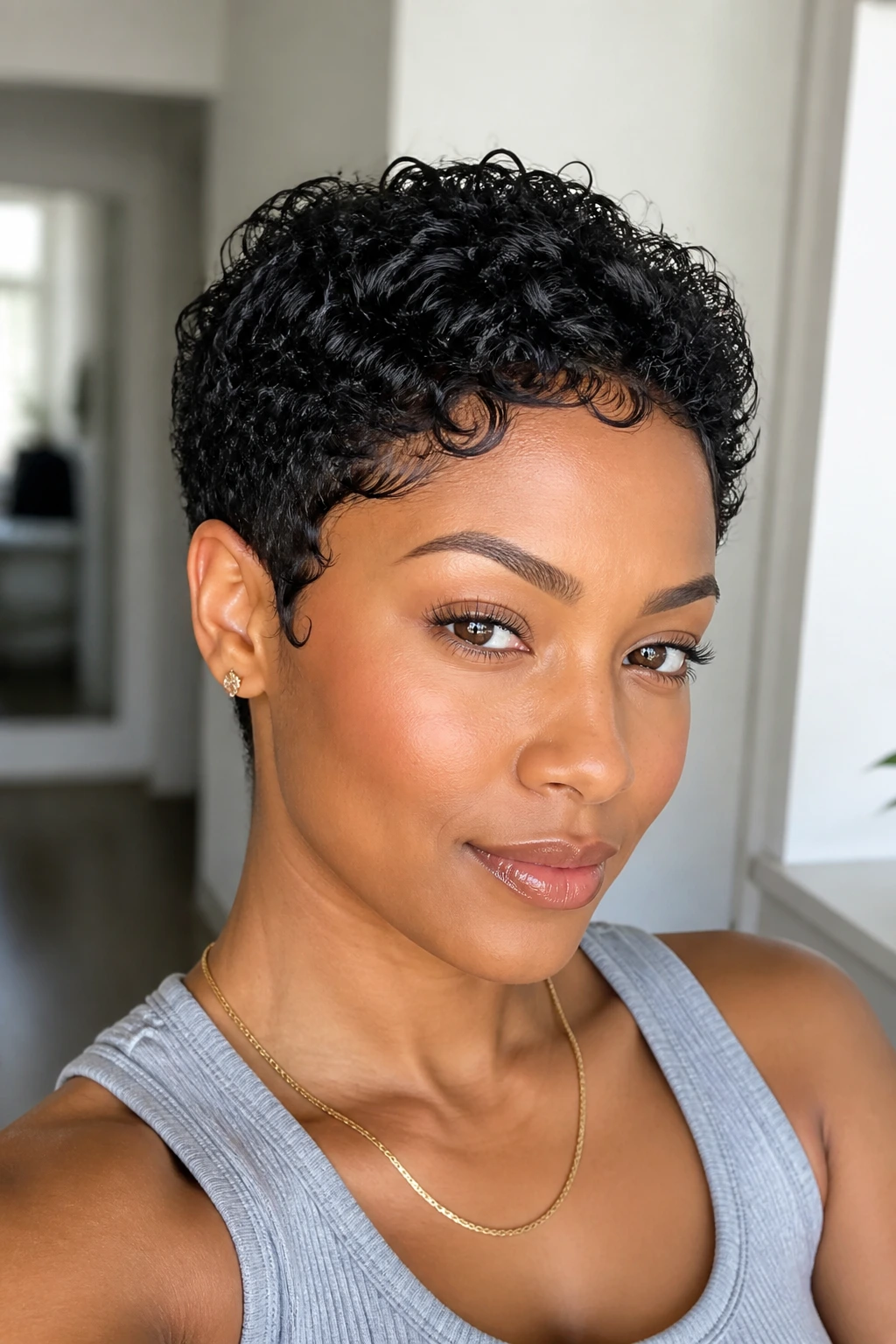
Start with more water than product. Short curls set better when the hair is damp enough to slip through your fingers. If it feels dry while you are styling, mist it again before adding more cream or gel.
Use the part as a shaping tool. A side part, diagonal part, or center part does more than separate sections. It changes where the eye goes and where the volume lands, which is why a small part shift can make the whole style look different.
Dry the roots first. The ends can stay soft longer, but if the roots are flat and damp, the style loses shape. A diffuser aimed at the crown and sides gives you lift where it counts.
Do not separate too early. Wait until the hair is fully dry before fluffing finger coils, twist-outs, or set curls. If you pull them apart while they still feel cool or damp, the frizz shows up fast.
Finish with hands, not a brush. Once the shape is set, use your fingers to nudge pieces into place. Brushes are useful at the start. They are a bad idea at the end.
Common Mistakes That Flatten Short Curly Hair
The first mistake is loading on too much cream. The curls look smooth at first, then the roots sink and the style goes limp by lunch. On short hair, the fix is simple: use less cream and add more hold with mousse or gel if you need it.
The second mistake is styling hair that is already half-dry. That usually leads to patchy definition, especially around the crown and hairline. Start with damp hair, section cleanly, and re-mist when the strands stop cooperating. Short curls need even moisture to set evenly.
Another one: tight elastics and heavy pulling. They can leave dents, split the curl pattern, and make the scalp sore. Use soft ties, pins, or clips whenever you can. If a style needs tension to hold, that tension is probably too much.
People also mess up by roughing up the curls too soon. Unraveling twist-outs, finger coils, or set curls before they dry is one of the fastest ways to create frizz. Let the style set all the way through, even if that means diffusing for a few extra minutes.
Variations and Adaptations to Try
For Fine Curly Hair: Use mousse, not heavy cream, and choose styles that rely on root lift—side parts, faux hawks, and clipped fringe work better than dense knot styles. Fine short curls lose height fast when they are overloaded.
For Tight Coils: Strong-hold gel, small sections, and neat parting matter more here. Finger coils, Bantu knots, and crown puffs usually hold their shape longer because the curl pattern already wants to sit compact.
For Loose Waves: Keep the styling lighter and let the movement stay soft. A rounded bob, side-swept sweep, and headband frame keep the texture visible without turning the hair into a helmet of product.
For Humid Weather: Choose styles that can survive a little puff—curly shag, faux hawk, clip stack, and twist-out bob usually handle moisture better than sleek slick-backs. A stronger gel at the hairline helps the edges stay in place.
For Growing-Out Cuts: Side tucks, clipped fringe, and asymmetrical forward styles hide uneven lengths better than straight-down styles. That is often the difference between “awkward stage” and “managed shape.”
Night Care and Refreshing the Style
Most short curly styles look best for two to four days if you protect them at night. Finger coils, twist-outs, and wet sets can sometimes stretch to five or six days, but only if you keep your hands out of them and wrap them properly. A satin bonnet or scarf cuts down on friction, and a satin pillowcase helps if the bonnet slips off.
For puff styles and side sweeps, the simplest trick is to preserve the part or the lift. Pin down the side that wants to puff, or gather the top loosely so the shape survives sleep. In the morning, mist the flattened sections with water, scrunch once, and let the hair dry for a few minutes before touching it again.
If the style has product at the roots, do not soak the whole head every morning. That leads to buildup and makes short hair feel heavy. Spot-refresh the pieces that need it. Around the hairline, a tiny bit of gel can clean up frizz without forcing a full restyle. Around the crown, a few clips while the hair air-dries can bring the shape back faster than redoing everything.
Frequently Asked Questions
How short is too short for these styles?
If your curls are long enough to pinch between your fingers, you already have styling options. Very short crops lean more toward texture, side parts, clips, and slicked shapes, while chin-length hair can handle puffs, twist-outs, and small buns more easily.
Can I do these styles without heat?
Yes. Most of them work best with air-drying or a diffuser on low heat, and several—finger coils, Bantu knots, twist-outs, mini puffs—do not need heat at all. Heat is a tool for speed, not a requirement for shape.
What if my curls puff up by midday?
That usually means the style needed more hold at the roots or the hair was touched too much after drying. A small amount of gel near the hairline, plus a tighter set on the first styling pass, usually helps. If the ends are the only part puffing, the fix is less product break-up and a better seal on the tips.
Which styles work best on day-two hair?
Side-twist and tuck, half-up pineapple puff, bandana bob, clipped fringe, and clip-stack styles are easy to revive on older curls. Day-two hair usually has more grip, which helps pins and ties stay where you put them.
Do I need different products for fine curls and thick coils?
Yes, and the difference matters. Fine curls usually need lighter products like mousse and a soft gel, while thick coils often need cream plus a stronger gel to keep the shape from fuzzing out too soon.
How do I keep short curls from looking flat at the crown?
Dry the roots first, clip them up while they set, and avoid heavy product near the scalp. A side part or slight diagonal part also helps because it changes where the lift lands.
Can these styles work for formal events?
They can, especially the wet-look sides, defined ringlets, finger coils, and deep side-swept bob. A polished clip, a clean part, or a satin scarf can make short curls look dressed up fast.
What should I do if a twist-out or coil set comes out fuzzy?
Do not keep separating it and hoping it improves. Smooth a tiny amount of gel or light cream over the fuzz, then press the shape back with damp hands and let it dry again. If the sectioning was too loose, the next set needs smaller parts and a little more hold.
Short Curls, More Shape
Short curly hair does not need a long list of rules. It needs a few good shapes, the right product weight, and a little patience while the style dries. Once you stop trying to force curls into straight-hair logic, the whole thing gets easier.
Pick one style that fits your length, one that fits your routine, and one that can survive your commute without falling apart. Then keep notes on what your curls actually do. They will tell you quickly which shapes they like best, and they are usually right.